EP3550206B1 - Pyrromethen-bor-komplex, farbkonversionszusammensetzung, farbkonversionsfolie, lichtquelleneinheit, anzeige und beleuchtungsvorrichtung - Google Patents
Pyrromethen-bor-komplex, farbkonversionszusammensetzung, farbkonversionsfolie, lichtquelleneinheit, anzeige und beleuchtungsvorrichtung Download PDFInfo
- Publication number
- EP3550206B1 EP3550206B1 EP17875117.8A EP17875117A EP3550206B1 EP 3550206 B1 EP3550206 B1 EP 3550206B1 EP 17875117 A EP17875117 A EP 17875117A EP 3550206 B1 EP3550206 B1 EP 3550206B1
- Authority
- EP
- European Patent Office
- Prior art keywords
- group
- substituted
- unsubstituted
- light
- color conversion
- Prior art date
- Legal status (The legal status is an assumption and is not a legal conclusion. Google has not performed a legal analysis and makes no representation as to the accuracy of the status listed.)
- Active
Links
Images

Classifications
-
- C—CHEMISTRY; METALLURGY
- C07—ORGANIC CHEMISTRY
- C07F—ACYCLIC, CARBOCYCLIC OR HETEROCYCLIC COMPOUNDS CONTAINING ELEMENTS OTHER THAN CARBON, HYDROGEN, HALOGEN, OXYGEN, NITROGEN, SULFUR, SELENIUM OR TELLURIUM
- C07F5/00—Compounds containing elements of Groups 3 or 13 of the Periodic Table
- C07F5/02—Boron compounds
-
- C—CHEMISTRY; METALLURGY
- C07—ORGANIC CHEMISTRY
- C07F—ACYCLIC, CARBOCYCLIC OR HETEROCYCLIC COMPOUNDS CONTAINING ELEMENTS OTHER THAN CARBON, HYDROGEN, HALOGEN, OXYGEN, NITROGEN, SULFUR, SELENIUM OR TELLURIUM
- C07F5/00—Compounds containing elements of Groups 3 or 13 of the Periodic Table
- C07F5/02—Boron compounds
- C07F5/022—Boron compounds without C-boron linkages
-
- C—CHEMISTRY; METALLURGY
- C07—ORGANIC CHEMISTRY
- C07F—ACYCLIC, CARBOCYCLIC OR HETEROCYCLIC COMPOUNDS CONTAINING ELEMENTS OTHER THAN CARBON, HYDROGEN, HALOGEN, OXYGEN, NITROGEN, SULFUR, SELENIUM OR TELLURIUM
- C07F5/00—Compounds containing elements of Groups 3 or 13 of the Periodic Table
- C07F5/02—Boron compounds
- C07F5/027—Organoboranes and organoborohydrides
-
- C—CHEMISTRY; METALLURGY
- C09—DYES; PAINTS; POLISHES; NATURAL RESINS; ADHESIVES; COMPOSITIONS NOT OTHERWISE PROVIDED FOR; APPLICATIONS OF MATERIALS NOT OTHERWISE PROVIDED FOR
- C09K—MATERIALS FOR MISCELLANEOUS APPLICATIONS, NOT PROVIDED FOR ELSEWHERE
- C09K11/00—Luminescent materials, e.g. electroluminescent or chemiluminescent
- C09K11/02—Use of particular materials as binders, particle coatings or suspension media therefor
-
- C—CHEMISTRY; METALLURGY
- C09—DYES; PAINTS; POLISHES; NATURAL RESINS; ADHESIVES; COMPOSITIONS NOT OTHERWISE PROVIDED FOR; APPLICATIONS OF MATERIALS NOT OTHERWISE PROVIDED FOR
- C09K—MATERIALS FOR MISCELLANEOUS APPLICATIONS, NOT PROVIDED FOR ELSEWHERE
- C09K11/00—Luminescent materials, e.g. electroluminescent or chemiluminescent
- C09K11/06—Luminescent materials, e.g. electroluminescent or chemiluminescent containing organic luminescent materials
-
- G—PHYSICS
- G09—EDUCATION; CRYPTOGRAPHY; DISPLAY; ADVERTISING; SEALS
- G09F—DISPLAYING; ADVERTISING; SIGNS; LABELS OR NAME-PLATES; SEALS
- G09F9/00—Indicating arrangements for variable information in which the information is built-up on a support by selection or combination of individual elements
-
- H—ELECTRICITY
- H05—ELECTRIC TECHNIQUES NOT OTHERWISE PROVIDED FOR
- H05B—ELECTRIC HEATING; ELECTRIC LIGHT SOURCES NOT OTHERWISE PROVIDED FOR; CIRCUIT ARRANGEMENTS FOR ELECTRIC LIGHT SOURCES, IN GENERAL
- H05B33/00—Electroluminescent light sources
- H05B33/12—Light sources with substantially two-dimensional [2D] radiating surfaces
- H05B33/14—Light sources with substantially two-dimensional [2D] radiating surfaces characterised by the chemical or physical composition or the arrangement of the electroluminescent material, or by the simultaneous addition of the electroluminescent material in or onto the light source
-
- H—ELECTRICITY
- H10—SEMICONDUCTOR DEVICES; ELECTRIC SOLID-STATE DEVICES NOT OTHERWISE PROVIDED FOR
- H10H—INORGANIC LIGHT-EMITTING SEMICONDUCTOR DEVICES HAVING POTENTIAL BARRIERS
- H10H20/00—Individual inorganic light-emitting semiconductor devices having potential barriers, e.g. light-emitting diodes [LED]
- H10H20/80—Constructional details
- H10H20/85—Packages
- H10H20/851—Wavelength conversion means
-
- H—ELECTRICITY
- H10—SEMICONDUCTOR DEVICES; ELECTRIC SOLID-STATE DEVICES NOT OTHERWISE PROVIDED FOR
- H10H—INORGANIC LIGHT-EMITTING SEMICONDUCTOR DEVICES HAVING POTENTIAL BARRIERS
- H10H20/00—Individual inorganic light-emitting semiconductor devices having potential barriers, e.g. light-emitting diodes [LED]
- H10H20/80—Constructional details
- H10H20/85—Packages
- H10H20/851—Wavelength conversion means
- H10H20/8511—Wavelength conversion means characterised by their material, e.g. binder
- H10H20/8512—Wavelength conversion materials
-
- C—CHEMISTRY; METALLURGY
- C09—DYES; PAINTS; POLISHES; NATURAL RESINS; ADHESIVES; COMPOSITIONS NOT OTHERWISE PROVIDED FOR; APPLICATIONS OF MATERIALS NOT OTHERWISE PROVIDED FOR
- C09K—MATERIALS FOR MISCELLANEOUS APPLICATIONS, NOT PROVIDED FOR ELSEWHERE
- C09K2211/00—Chemical nature of organic luminescent or tenebrescent compounds
- C09K2211/10—Non-macromolecular compounds
- C09K2211/1003—Carbocyclic compounds
- C09K2211/1007—Non-condensed systems
-
- C—CHEMISTRY; METALLURGY
- C09—DYES; PAINTS; POLISHES; NATURAL RESINS; ADHESIVES; COMPOSITIONS NOT OTHERWISE PROVIDED FOR; APPLICATIONS OF MATERIALS NOT OTHERWISE PROVIDED FOR
- C09K—MATERIALS FOR MISCELLANEOUS APPLICATIONS, NOT PROVIDED FOR ELSEWHERE
- C09K2211/00—Chemical nature of organic luminescent or tenebrescent compounds
- C09K2211/10—Non-macromolecular compounds
- C09K2211/1018—Heterocyclic compounds
-
- C—CHEMISTRY; METALLURGY
- C09—DYES; PAINTS; POLISHES; NATURAL RESINS; ADHESIVES; COMPOSITIONS NOT OTHERWISE PROVIDED FOR; APPLICATIONS OF MATERIALS NOT OTHERWISE PROVIDED FOR
- C09K—MATERIALS FOR MISCELLANEOUS APPLICATIONS, NOT PROVIDED FOR ELSEWHERE
- C09K2211/00—Chemical nature of organic luminescent or tenebrescent compounds
- C09K2211/18—Metal complexes
- C09K2211/188—Metal complexes of other metals not provided for in one of the previous groups
-
- H—ELECTRICITY
- H10—SEMICONDUCTOR DEVICES; ELECTRIC SOLID-STATE DEVICES NOT OTHERWISE PROVIDED FOR
- H10H—INORGANIC LIGHT-EMITTING SEMICONDUCTOR DEVICES HAVING POTENTIAL BARRIERS
- H10H20/00—Individual inorganic light-emitting semiconductor devices having potential barriers, e.g. light-emitting diodes [LED]
- H10H20/80—Constructional details
- H10H20/85—Packages
- H10H20/851—Wavelength conversion means
- H10H20/8515—Wavelength conversion means not being in contact with the bodies
Definitions
- the present invention relates to a pyrromethene-boron complex, a color conversion composition, a color conversion film, a light source unit, a display, and an illumination apparatus.
- color conversion refers to the conversion of light emitted from a light-emitting body to light with a longer wavelength, e.g., the conversion of blue emission light to green emission light or red emission light.
- a composition having this color conversion function (hereinafter referred to as a "color conversion composition”) can be made into a film and, for example, through combination with a blue light source, it is possible to extract the three primary colors of blue, green, and red from the blue light source, that is, to obtain white light.
- a white light source made by combining such a blue light source and a film having the color conversion function (hereinafter referred to as a "color conversion film”) can be made into a light source, which can be combined with a liquid crystal drive section and a color filter to manufacture a full-color display. If there is no liquid crystal drive section, use without modification as a white light source is possible for applications such as an LED illumination, for example.
- a technology has also been proposed to use an organic light-emitting material in place of the quantum dots as the color conversion composition.
- Examples that have been disclosed of the use of an organic light-emitting material as a component of a color conversion composition include the use of a pyridine-phthalimide condensation product (refer to Patent Literature 2, for example), the use of a coumarin derivative (refer to Patent Literature 3, for example) and the use of pyrromethene-boron complexes (refer to Patent Literature 10, for example).
- Disclosures to date of a red light emission material include the use of a perylene derivative (refer to Patent Literature 4, for example), the use of a rhodamine derivative (refer to Patent Literature 5, for example) and the use of a pyrromethene derivative (refer to Patent Literature 6 to 9, for example).
- the problem to be solved by the present invention is to provide an organic light-emitting material suitable as a color conversion material that can be used in a liquid crystal or other such display or an LED or other such illumination apparatus, and to achieve both improved color reproducibility and high durability.
- a pyrromethene-boron complex according to the present invention is a compound represented by general formula (1), wherein in general formula (1), X is C-R 7 or N, R 1 to R 7 are each the same or different and are selected from among hydrogen, a substituted or unsubstituted alkyl group, a substituted or unsubstituted cycloalkyl group, a substituted or unsubstituted heterocyclic group, a substituted or unsubstituted alkenyl group, a substituted or unsubstituted cycloalkenyl group, a substituted or unsubstituted alkynyl group, a hydroxy group, a thiol group, a substituted or unsubstituted alkoxy group, a substituted or unsubstituted alkylthio group, a substituted or unsubstituted aryl ether group, a substituted or unsubstituted
- At least two of R 1 to R 6 in the general formula (1) are groups containing a fluorine atom.
- At least one of R 2 and R 5 in the general formula (1) is a group containing a fluorine atom.
- R 2 and R 5 in the general formula (1) are groups containing a fluorine atom
- the group containing the fluorine atom in the general formula (1) is a fluorine-containing ester group.
- R 1 , R 3 , R 4 , and R 6 in the general formula (1) is a substituted or unsubstituted alkyl group.
- R 7 in the general formula (1) is a substituted or unsubstituted aryl group.
- the compound represented by the general formula (1) is a compound represented by general formula (2), in general formula (2), R 1 to R 6 , R 8 , and R 9 are the same as in the general formula (1), R 12 is a substituted or unsubstituted aryl group or a substituted or unsubstituted heteroaryl group, L is a substituted or unsubstituted arylene group or a substituted or unsubstituted heteroarylene group, and n is an integer of 1 to 5.
- the compound represented by general formula (1) exhibits a light emission with a peak wavelength observed in a region of 500 to 580 nm inclusive, in response to excitation light.
- a color conversion composition according to the present invention is a color conversion composition that converts incident light to light with a longer wavelength than a wavelength of the incident light.
- the color conversion composition includes: the pyrromethene-boron complex according to any one of the above-mentioned inventions; and a binder resin.
- the color conversion composition according to the present invention includes: a light-emitting material (a); and a light-emitting material (b), at least one of the light-emitting material (a) and the light-emitting material (b) being the pyrromethene-boron complex, the light-emitting material (a) being a light-emitting material emitting, in response to excitation light, light having a peak wavelength observed in a region of 500 to 580 nm inclusive, and the light-emitting material (b) being a light-emitting material emitting, in response to at least one of excitation by excitation light and light emission from the light-emitting material (a), light having a peak wavelength observed in a region of 580 to 750 nm inclusive.
- content w a of the light-emitting material (a) and content w b of the light-emitting material (b) have a relation w a ⁇ w b .
- the color conversion composition according to the embodiments of the present invention further includes a solvent.
- the binder resin is a thermoplastic resin.
- a color conversion film according to the present invention includes a layer containing the color conversion composition according to any one of the above-mentioned inventions or a cured product thereof.
- the color conversion film according to the embodiments of the invention further includes a barrier film.
- a light source unit includes: a light source; and the color conversion film according to the above-mentioned inventions.
- the light source is a light-emitting diode having a maximum light emission in a wavelength range of 430 to 500 nm inclusive.
- a display according to the present invention includes the color conversion film according to any one of the above-mentioned inventions.
- the color conversion film using the pyrromethene-boron complex and color conversion composition according to the present invention achieves both light emission with high color purity and high durability and therefore exhibits the effect of making it possible to both improve color reproducibility and achieve high durability.
- the light source unit, the display, and the illumination apparatus according to the present invention use such a color conversion film and therefore exhibit the effect of making it possible to both improve color reproducibility and achieve high durability.
- the pyrromethene-boron complex according to the embodiments of the present invention is described in detail.
- the pyrromethene-boron complex according to the embodiments of the present invention is a color conversion material composing a color conversion composition, a color conversion film or the like and is a compound represented by general formula (1).
- X is C-R 7 or N.
- R 1 to R 7 may each be the same or different, and is selected from among hydrogen, a substituted or unsubstituted alkyl group, a substituted or unsubstituted cycloalkyl group, a substituted or unsubstituted heterocyclic group, a substituted or unsubstituted alkenyl group, a substituted or unsubstituted cycloalkenyl group, a substituted or unsubstituted alkynyl group, a hydroxy group, a thiol group, a substituted or unsubstituted alkoxy group, a substituted or unsubstituted alkylthio group, a substituted or unsubstituted aryl ether group, a substituted or unsubstituted aryl thioether group, a substituted or unsubstituted aryl group, a substituted or unsubstituted heterostit
- R 8 and R 9 are selected from among a substituted or unsubstituted alkyl group, a substituted or unsubstituted cycloalkyl group, a substituted or unsubstituted heterocyclic group, a substituted or unsubstituted alkenyl group, a substituted or unsubstituted cycloalkenyl group, a substituted or unsubstituted alkynyl group, a hydroxy group, a thiol group, a substituted or unsubstituted alkoxy group, a substituted or unsubstituted alkylthio group, a substituted or unsubstituted aryl ether group, a substituted or unsubstituted aryl thioether group, a substituted or unsubstituted aryl group, a substituted or unsubstituted heteroaryl group, a halogen, and a cyano group. At least one of R 1 to
- the hydrogen in all of the abovementioned groups is optionally deuterium.
- a substituted or unsubstituted aryl group having 6 to 40 carbon atoms refers to an aryl group have a total number of carbon atoms of 6 to 40, including the carbon atoms included in the substituent substituted in the aryl group.
- the substituent is preferably an alkyl group, a cycloalkyl group, a heterocyclic group, an alkenyl group, a cycloalkenyl group, an alkynyl group, a hydroxy group, a thiol group, an alkoxy group, an alkyl thio group, an aryl ether group, an aryl thioether group, an aryl group, a heteroaryl group, a halogen, a cyano group, an aldehyde group, a carbonyl group, a carboxy group, an oxycarbonyl group, a carbamoyl group, an amino group, a nitro group, a silyl group, a siloxanyl group, a boryl group, or a phosphine oxide group, and more preferably a substituent that is specifically recited as preferable in the description of the individual substituent.
- the substituents are optionally
- the alkyl group refers to a saturated aliphatic hydrocarbon group such as, for example, a methyl group, an ethyl group, a n-propyl group, an isopropyl group, a n-butyl group, a sec-butyl group, or a tert-butyl group, which is optionally substituted.
- the additional substituent is not particularly limited and includes, for example, an alkyl group, a halogen, an aryl group, a heteroaryl group and the like, and this is a common feature in the descriptions below.
- the carbon number of the alkyl group is not particularly limited but is preferably in the range of 1 to 20 inclusive and more preferably 1 to 8 inclusive from the perspectives of ease of acquisition and cost.
- cycloalkyl group refers to a saturated alicyclic hydrocarbon group such as, for example, a cyclopropyl group, a cyclohexyl group, a norbornyl group, or an adamantyl group, which optionally has a substituent.
- the carbon number of the alkyl group moiety is not particularly limited but is preferably in the range of 3 to 20 inclusive.
- heterocyclic group refers to an aliphatic ring having an atom other than carbon in the ring, such as a pyran ring, a piperidine ring, or cyclic amide, for example, which optionally has a substituent.
- the carbon number of the heterocyclic group is not particularly limited but is preferably in the range of 2 to 20 inclusive.
- alkenyl group refers to an unsaturated aliphatic hydrocarbon group containing a double bond such as, for example, a vinyl group, an allyl group, or a butadienyl group, which optionally has a substituent.
- the carbon number of the alkenyl group is not particularly limited but is preferably in the range of 2 to 20 inclusive.
- cycloalkenyl group refers to an unsaturated alicyclic hydrocarbon group containing a double bond such as, for example, a cyclopentenyl group, a cyclopentadienyl group, or a cyclohexenyl group, which optionally has a substituent.
- alkynyl group refers to an unsaturated aliphatic hydrocarbon group containing a triple group such as, for example, an ethynyl group, which optionally has a substituent.
- the carbon number of the alkynyl group is not particularly limited but is preferably in the range of 2 to 20 inclusive.
- alkoxy group refers to a functional group to which an aliphatic hydrocarbon group is bonded through an ether bond such as, for example, a methoxy group, an ethoxy group, or a propoxy group, and the aliphatic hydrocarbon group optionally has a substituent.
- the carbon number of the alkoxy group is not particularly limited but is preferably in the range of 1 to 20 inclusive.
- alkyl thio group refers to an alkoxy group in which the oxygen atom in the ether bond has been substituted with a sulfur atom.
- the hydrocarbon group in the alkyl thio group optionally has a substituent.
- the carbon number of the alkyl thio group is not particularly limited but is preferably in the range of 1 to 20 inclusive.
- aryl ether group refers to a functional group to which an aromatic hydrocarbon group is bonded through an ether bond such as, for example, a phenoxy group, and the aromatic hydrocarbon group optionally has a substituent.
- the carbon number of the aryl ether group is not particularly limited but is preferably in the range of 6 to 40 inclusive.
- aryl thioether group refers to an aryl ether group in which the oxygen atom in the ether bond has been substituted with a sulfur atom.
- the aromatic hydrocarbon group in the aryl thioether group optionally has a substituent.
- the carbon number of the aryl thioether group is not particularly limited but is preferably in the range of 6 to 40 inclusive.
- aryl group refers to an aromatic hydrocarbon group such as, for example, a phenyl group, a biphenyl group, a terphenyl group, a naphthyl group, a fluorenyl group, a benzofluorenyl group, a dibenzofluorenyl group, a phenanthryl group, an anthracenyl group, a benzophenanthryl, a benzoanthracenyl group, a chrysenyl group, a pyrenyl group, a fluoranthenyl group, a triphenylenyl group, a benzofluoranthenyl group, a dibenzoanthracenyl group, a perylenyl group, or a helicenyl group.
- aromatic hydrocarbon group such as, for example, a phenyl group, a biphenyl group, a terphenyl group, a naphthyl group
- the phenyl group, the biphenyl group, the terphenyl group, the naphthyl group, the fluorenyl group, the phenanthryl group, the anthracenyl group, the pyrenyl group, the fluoranthenyl group, and the triphenylenyl group are preferable.
- the aryl group optionally has a substituent.
- the carbon number of the aryl group is not particularly limited but is preferably in the range of 6 to 40 inclusive and more preferably 6 to 30 inclusive.
- the aryl group is preferably a phenyl group, a biphenyl group, a terphenyl group, a naphthyl group, a fluorenyl group, a phenanthryl group, or an anthracenyl group, more preferably a phenyl group, a biphenyl group, a terphenyl group, or a naphthyl group, still more preferably a phenyl group, a biphenyl group, or a terphenyl group, and particularly preferably a phenyl group.
- the aryl group is preferably a phenyl group, a biphenyl group, a terphenyl group, a naphthyl group, a fluorenyl group, a phenanthryl group, or an anthracenyl group, more preferably a phenyl group, a biphenyl group, a terphenyl group, or a naphthyl group, and particularly preferably a phenyl group.
- heteroaryl group refers to a cyclic aromatic group having one or more atoms other than carbon in the ring such as, for example, a pyridyl group, a furanyl group, a thienyl group, a quinolinyl group, an isoquinolinyl group, a pyrazinyl group, a pyrimidyl group, a pyridazinyl group, a triazinyl group, a naphthyridinyl group, a cinnolinyl group, a phthalazinyl group, a quinoxalinyl group, a quinazolinyl group, a benzofuranyl group, a benzothienyl group, an indolyl group, a dibenzofuranyl group, a dibenzothienyl group, a carbazolyl group, a benzocarbazolyl group, a carbolinyl group, an indo
- naphthyridinyl group refers to any of a 1,5-naphthyridinyl group, a 1,6-naphthyridinyl group, a 1,7-naphthyridinyl group, a 1,8-naphthyridinyl group, a 2,6-naphthyridinyl group and a 2,7-naphthyridinyl group.
- the heteroaryl group optionally has a substituent.
- the carbon number of the heteroaryl group is not particularly limited but is preferably in the range of 2 to 40 inclusive and more preferably 2 to 30 inclusive.
- the heteroaryl group is preferably a pyridyl group, a furanyl group, a thienyl group, a quinolinyl group, a pyrimidyl group, a triazinyl group, a benzofuranyl group, a benzothienyl group, an indolyl group, a dibenzofuranyl group, a dibenzothienyl group, a carbazolyl group, a benzoimidazolyl group, an imidazopyridyl group, a benzoxazolyl group, a benzothiazolyl group, or a phenanthrolinyl group, more preferably a pyridyl group, a furanyl group, a thienyl group, or a quinolinyl group, and particularly preferably a pyridyl group.
- the heteroaryl group is preferably a pyridyl group, a furanyl group, a thienyl group, a quinolinyl group, a pyrimidyl group, a triazinyl group, a benzofuranyl group, a benzothienyl group, an indolyl group, a dibenzofuranyl group, a dibenzothienyl group, a carbazolyl group, a benzoimidazolyl group, an imidazopyridyl group, a benzoxazolyl group, a benzothiazolyl group, or a phenanthrolinyl group, more preferably a pyridyl group, a furanyl group, a thienyl group, or a quinolinyl group, and particularly preferably a pyridyl group.
- halogen refers to an atom selected from fluorine, chlorine, bromine, and iodine.
- Each of the carbonyl group, the carboxy group, the oxycarbonyl group and the carbamoyl group optionally has a substituent.
- substituent include an alkyl group, a cycloalkyl group, an aryl group, a heteroaryl group and the like and are optionally further substituted.
- ester group refers to a functional group to which an alkyl group, a cycloalkyl group, an aryl group, a heteroaryl group or the like, for example, is bonded through an ester bond, and this substituent is operationally further substituted.
- the carbon number of the ester group is not particularly limited but is preferably in the range of 1 to 20 inclusive.
- a methyl ester group such as a methoxycarbonyl group, an ethyl ester group such as an ethoxycarbonyl group, a propyl ester group such as a propoxycarbonyl group, a butyl ester group such as a butoxycarbonyl group, an isopropyl ester group such as an isopropoxy methoxycarbonyl group, a hexyl ester group such as a hexyloxy carbonyl group, or a phenyl ester group such as a phenoxycarbonyl group may be given as examples of the ester group.
- amide group refers to a functional group to which a substituent such as, for example, an alkyl group, a cycloalkyl group, an aryl group, or a heteroaryl group is bonded through an amide bond, and the substituent is further optionally substituted.
- the carbon number of the amide group is not particularly limited but is favorably in the range of 1 to 20 inclusive. More specifically, a methyl amide group, an ethyl amide group, a propyl amide group, a butyl amide group, an isopropyl amide group, a hexyl amide group, or a phenyl amide group may be given as examples of the amide group.
- amino group refers to a substituted or unsubstituted amino group.
- the amino group optionally has a substituent, examples of which include an aryl group, a heteroaryl group, a linear alkyl group, and a branched alkyl group.
- the aryl group and the heteroaryl group are preferably a phenyl group, a naphthyl group, a pyridyl group, or a quinolinyl group. These substituents are optionally further substituted.
- the carbon number is not particularly limited but is preferably in the range of 2 to 50 inclusive, more preferably 6 to 40 inclusive, and particularly preferably 6 to 30 inclusive.
- silyl group refers to an alkylsilyl group such as a trimethylsilyl group, a triethylsilyl group, a tert-butyldimethylsilyl group, a propyldimethylsilyl group, or a vinyldimethylsilyl group, or an arylsilyl group such as a phenyldimethylsilyl group, a tert-butyldiphenylsilyl group, a triphenylsilyl group, or a trinaphthylsilyl group.
- the substituent on the silicon is optionally further substituted.
- the carbon number of the silyl group is not particularly limited but is preferably in the range of 1 to 30 inclusive.
- siloxanyl group refers to a silicon compound group bonding through an ether bond such as a trimethyl siloxanyl group.
- the substituent on the silicon is optionally further substituted.
- boryl group refers to a substituted or unsubstituted boryl group.
- the boryl group optionally has a substituent, examples of which include an aryl group, a heteroaryl group, a linear alkyl group, a branched alkyl group, an aryl ether group, an alkoxy group, and a hydroxy group, for example, and among these, the aryl group and the aryl ether group are preferable.
- acyl group refers to a functional group to which a substituent such as, for example, an alkyl group, a cycloalkyl group, an aryl group, or a heteroaryl group is bonded through a carbonyl bond, and the substituent is optionally further substituted.
- the carbon number of the acyl group is not particularly limited but is favorably in the range of 1 to 20 inclusive.
- an acetyl group, a propionyl group, a benzoyl group, an acrylyl group or the like may be given as examples of the acyl group.
- the arylene group refers to a bivalent or polyvalent group derived from an aromatic hydrocarbon group such as benzene, naphthalene, biphenyl, fluorene or phenanthrene, and optionally has a substituent.
- the arylene group is preferably bivalent or trivalent. More specifically, a phenylene group, a biphenylene group, and a naphthylene group may be given as examples of the arylene group.
- heteroarylene group refers to a bivalent or polyvalent group derived from an aromatic group having one or more atoms other than carbon in the ring such as pyridine, quinoline, pyrimidine, pyrazine, triazine, quinoxaline, quinazoline, dibenzofuran, or dibenzothiophene, and optionally has a substituent.
- the heteroarylene group is preferably bivalent or trivalent.
- the carbon number of the heteroarylene group is not particularly limited but is favorably in the range of 2 to 30.
- a 2,6-pyridylene group, a 2,5-pyridylene group, a 2,4-pyridylene group, a 3,5-pyridylene group, a 3,6-pyridylene group, a 2,4,6-pyridylene group, a 2,4-pyrimidinylene group, a 2,5-pyrimidinylene group, a 4,6-pyrimidinylene group, a 2,4,6-pyrimidinylene group, a 2,4,6-triazinylene group, a 4,6-dibenzofuranylene group, a 2,6-dibenzofuranylene group, a 2,8-dibenzofuranylene group, or a 3,7-dibenzofuranylene group may be given as examples of the heteroarylene group.
- the compound represented by general formula (1) has a pyrromethene-boron complex skeleton.
- the pyrromethene-boron complex skeleton is rigid and has high planarity. Therefore, the compound with a pyrromethene-boron complex skeleton exhibits a high emission quantum yield, and the peak full width at half maximum of the light emission spectrum of the compound is small. Accordingly, the compound represented by general formula (1) can achieve efficient color conversion and high color purity.
- the compound represented by general formula (1) necessarily has a group containing a fluorine atom in the pyrromethene-boron complex skeleton.
- the color conversion composition according to the present invention that is, the color conversion composition having the compound (pyrromethene-boron complex) as a component carries out the color conversion of light when the contained pyrromethene-boron complex is excited by excitation light and light having a wavelength different from the excitation light is emitted.
- the compound represented by general formula (1) does not have a group containing a fluorine atom in the pyrromethene-boron complex skeleton, when the abovementioned cycle of the excitation and the light emission repeats, the pyrromethene-boron complex contained in the color conversion composition oxidizes and quenches light due to an interaction between the pyrromethene-boron complex and oxygen. Accordingly, oxidation of the pyrromethene-boron complex causes degradation in the durability of the compound.
- the introduction of a group containing a fluorine atom into the pyrromethene-boron complex skeleton lowers the electron density of the pyrromethene-boron complex skeleton. Doing so improves the stability of the compound represented by general formula (1) against oxygen, resulting in improved durability of the compound.
- the compound represented by general formula (1) has a pyrromethene-boron complex skeleton and a group containing a fluorine atom in the molecule, thereby making it possible to achieve efficient light emission (color conversion), high color purity, and high durability.
- R 2 and R 5 are not a substituted or unsubstituted aryl group or a substituted or unsubstituted heteroaryl group. That is, R 2 and R 5 are selected from the abovementioned groups other than a substituted or unsubstituted aryl group and a substituted or unsubstituted heteroaryl group.
- At least one of R 2 and R 5 in the pyrromethene-boron complex skeleton is not a substituted or unsubstituted aryl group or a substituted or unsubstituted heteroaryl group.
- R 2 and R 5 are groups not containing a heteroaryl group with at least two condensed rings.
- a heteroaryl group with at least two condensed rings absorbs visible light.
- a portion of the skeleton contains a heteroatom, such that local electronic bias readily occurs in the conjugation in the excited state.
- the electron transition that is, excitation and deactivation, is necessary within the pyrromethene-boron complex skeleton.
- heteroaryl groups with at least two condensed rings when included at the R 2 and the R 5 positions, which greatly affect the conjugation of the pyrromethene-boron complex, the heteroaryl groups with at least two condensed rings absorb visible light and undergo excitation, so that electronic bias occurs in the heteroaryl group with at least two condensed rings. Therefore, an electron transfer occurs between the heteroaryl group and the pyrromethene-boron complex, which results in hindering electron transitions within the pyrromethene-boron complex skeleton, and therefore the emission quantum yield of the pyrromethene-boron complex decreases. Hence, when a film containing such a compound is used as a color conversion film in a display, the light emission efficiency decreases.
- the drop in the emission quantum yield is a phenomenon that occurs when visible light is absorbed by substituents contained in R 2 and R 5 and an electron transfer occurs between the substituents and the pyrromethene-boron complex skeleton. If the substituents contained in R 2 and R 5 are monocyclic heteroaryl groups, the heteroaryl groups do not absorb visible light and therefore are not excited. Accordingly, no electron transfer occurs between the heteroaryl groups and the pyrromethene-boron complex skeleton, and as a result, no reduction is seen in the emission quantum yield.
- R 1 and R 6 are both preferably neither a fluorine-containing aryl group nor a fluorine-containing alkyl group. With these exclusions, the emission quantum yield can be increased. When a film containing such a compound is used as a color conversion film in a display, the emission efficiency can be further enhanced.
- the compound represented by general formula (1) exhibits a high emission quantum yield and the peak full width at half maximum of the light emission spectrum is small, so that both efficient color conversion and high color purity can be achieved.
- a suitable substituent at a suitable location it is possible to adjust various characteristics and physical properties of the compound represented by general formula (1) such as the light emission efficiency, the color purity, the thermal stability, the photostability, the dispersibility, and others.
- R 1 to R 6 in general formula (1) are preferably groups containing a fluorine atom.
- the compound represented by general formula (1) has at least two groups containing a fluorine atom, making it possible to further reduce the electron density in the pyrromethene-boron complex skeleton. This improves the stability of the compound represented by general formula (1) against oxygen, resulting in improved durability.
- R 2 and R 5 preferably contains a fluorine atom.
- the reason is as indicated below.
- the positions R 2 and R 5 in general formula (1) are substitution positions that greatly affect the electron density of the pyrromethene-boron complex skeleton.
- the electron density of the pyrromethene-boron complex skeleton can be efficiently reduced by introducing a group containing a fluorine atom at R 2 and R 5 . Doing so further improves the stability of the compound represented by general formula (1) against oxygen, resulting in further improved durability.
- R 2 and R 5 are more favorably groups containing a fluorine atom.
- This structure further improves the stability of the compound represented by general formula (1) against oxygen, resulting in a great improvement in the durability.
- Examples of preferable groups with a fluorine atom include a fluorine atom, a fluorine-containing aryl group, a fluorine-containing heteroaryl group, a fluorine-containing alkyl group, a fluorine-containing acyl group, a fluorine-containing ester group, a fluorine-containing amide group, a fluorine-containing sulfonyl group, a fluorine-containing sulfonic acid ester group, and a fluorine-containing sulfonamide group.
- These groups can efficiently reduce the electron density of the pyrromethene-boron complex skeleton. This improves the stability of the compound represented by general formula (1) against oxygen, resulting in further improved durability. Therefore, these groups are preferable as groups containing a fluorine atom.
- a linear fluoroalkyl group and a fluoroaryl group may be given as specific examples of the fluorine-containing aryl group, the fluorine-containing heteroaryl group, and the fluorine-containing alkyl group.
- General formulas (3) to (8) may be given as specific examples of the fluorine-containing acyl group, the fluorine-containing ester group, the fluorine-containing amide group, the fluorine-containing sulfonyl group, the fluorine-containing sulfonic acid ester group, and the fluorine-containing sulfonamide group.
- R 101 to R 108 are each independently a hydrogen, a substituted or unsubstituted alkyl group, a substituted or unsubstituted cycloalkyl group, a substituted or unsubstituted aryl group, or a substituted or unsubstituted heteroaryl group in which at least one oxygen is substituted by a fluorine atom.
- a linear fluoroalkyl group, a fluoroaryl group and the like may be given as specific examples of R 101 to R 108 .
- fluorine atoms contained in the group containing fluorine atoms There are preferably 1 to 30 fluorine atoms contained in the group containing fluorine atoms and more preferably 1 to 20.
- Examples of preferable groups containing a fluorine atom are a fluorine-containing acyl group (general formula (3)), a fluorine-containing ester group (general formula (4)), a fluorine-containing amide group (general formula (5)), a fluorine-containing sulfonyl group (general formula (6)), a fluorine-containing sulfonic acid ester group (general formula (7)), and a fluorine-containing sulfonamide group (general formula (8)).
- These groups reduce the electron density of the pyrromethene-boron complex skeleton without expanding the conjugation thereof. Therefore, the durability can be improved in the compound represented by general formula (1) without loss in light emission efficiency or color purity. Hence, these groups more preferably contain a fluorine atom.
- An example of a particularly preferable group containing a fluorine atom is a fluorine-containing ester group (general formula (4)). If the group containing a fluorine atom is a fluorine-containing ester group, it is possible to moderately reduce the electron density of the pyrromethene-boron complex skeleton without expanding the conjugation thereof. Therefore, it is possible to further improve the durability of the compound represented by general formula (1) without loss in light emission efficiency or color purity. Hence, a fluorine-containing ester group is particularly preferable as the group containing a fluorine atom.
- R 1 , R 3 , R 4 , and R 6 is preferably a substituted or unsubstituted alkyl group, a substituted or unsubstituted aryl group, or a substituted or unsubstituted heteroaryl group. This is because if at least one of R 1 , R 3 , R 4 , and R 6 is one of the abovementioned groups, the thermal stability and light stability exhibited by the compound represented by general formula (1) are better than if all of R 1 , R 3 , R 4 , and R 6 are oxygen.
- the alkyl group is preferably a group with 1 to 6 carbon atoms, i.e., a methyl group, an ethyl group, an n-propyl group, an isopropyl group, an n-butyl group, a sec-butyl group, a tert-butyl group, a pentyl group, or a hexyl group.
- the alkyl group is preferably a methyl group, an ethyl group, an n-propyl group, an isopropyl group, an n-butyl group, a sec-butyl group, or a tert-butyl group.
- the alkyl group is preferably a sterically bulky tert-butyl group.
- a methyl group may be favorably used as the alkyl group.
- Each of R 1 , R 3 , R 4 , and R 6 in general formula (1) may be the same or different and is preferably a substituted or unsubstituted alkyl group because of favorable solubility in a binder resin and a solvent. From the perspectives of ease of synthesis and ease of procuring raw materials, the alkyl group is preferably a methyl group.
- At least one of R 1 , R 3 , R 4 , and R 6 in general formula (1) is preferably a substituted or unsubstituted aryl group, in which case, the light stability is further improved.
- the aryl group is preferably a phenyl group, a biphenyl group, a terphenyl group, or a naphthyl group, more preferably a phenyl group or a biphenyl group, and particularly preferably a phenyl group.
- R 1 , R 3 , R 4 , and R 6 in general formula (1) is a substituted or unsubstituted heteroaryl group
- the heteroaryl group is preferably a pyridyl group, a quinolinyl group, or a thienyl group, more preferably a pyridyl group or a quinolinyl group, and particularly preferably a pyridyl group.
- Each of R 1 , R 3 , R 4 , and R 6 in general formula (1) may be the same or different and is preferably a substituted or unsubstituted aryl group or a substituted or unsubstituted heteroaryl group because of the favorable thermal stability and light stability that are exhibited.
- each of R 1 , R 3 , R 4 , and R 6 is the same or different and if one or more are a substituted or unsubstituted aryl group, a plurality of types of substituents are preferably introduced such that, for example, R 1 ⁇ R 4 , R 3 ⁇ R 6 , R 1 ⁇ R 3 or R 4 ⁇ R 6 .
- the " ⁇ " symbol indicates groups with different structures.
- R 1 ⁇ R 4 indicates that R 1 and R 4 are groups with different structures.
- R 1 ⁇ R 3 or R 4 ⁇ R 6 is preferable from the perspective of improving the balance between light emission efficiency and color purity.
- the aryl group mainly affecting color purity is preferably an aryl group substituted with an electron donor group.
- An alkyl group, an alkoxy group, and the like may be given as examples of the electron donor group.
- an alkyl group with a carbon number of 1 to 8 or an alkoxy group with a carbon number of 1 to 8 is preferable, and a methyl group, an ethyl group, a tert-butyl group, or a methoxy group is more preferable.
- a tert-butyl group or a methoxy group is particularly preferable from the perspective of dispersibility, and if one of the groups is used as the abovementioned electron donor group, light quenching due to molecular aggregation can be prevented in the compound represented by general formula (1).
- the substitution position of the substituent is not particularly limited but is preferably at the meta position or the para position at the bonding position of the pyrromethene-boron complex skeleton because of the need to curb twisting of the bond in order to enhance the light stability of the compound represented by general formula (1).
- the aryl group affecting mainly the light emission efficiency is preferably an aryl group having a bulky substituent such as a tert-butyl group, an adamantyl group, or a methoxy group.
- R 1 , R 3 , R 4 , and R 6 are all the same or different and if they are substituted or unsubstituted aryl groups, the R 1 , R 3 , R 4 , and R 6 are preferably each selected from Ar-1 to Ar-6 below. In this case, preferable combinations of R 1 , R 3 , R 4 , and R 6 are listed in Tables 1-1 to 1-11 but are not limited thereto.
- the substituent R 7 has a large effect of reducing the durability of the compound represented by general formula (1), that is, reducing the light emission strength of the compound over time. More specifically, if R 7 is hydrogen, the hydrogen easily reacts with moisture and oxygen in the air due to the high reactivity of the hydrogen. This causes the decomposition of the compound represented by general formula (1). If R 7 is a substituent with a high degree of freedom of movement in the molecular chain such as, for example, an alkyl group, then the reactivity certainly drops, although the compounds aggregate in the color conversion composition over time, which invites a reduction in the light emission strength due to concentration quenching.
- R 7 is preferably a rigid group with little freedom of movement and does not easily aggregate.
- R 7 is preferably one of, for example, a substituted or unsubstituted alkyl group, a substituted or unsubstituted cycloalkyl group, a substituted or unsubstituted aryl group, or a substituted or unsubstituted heteroaryl group.
- R 7 is preferably a substituted or unsubstituted aryl group from the perspective of light stability. If R 7 is a substituted or unsubstituted aryl group, molecular aggregation can be prevented without loss of light emission wavelength, thereby improving the durability of the compound represented by general formula (1).
- R 7 is preferably a substituted or unsubstituted phenyl group, a substituted or unsubstituted biphenyl group, a substituted or unsubstituted terphenyl group, or a substituted or unsubstituted naphthyl group, and more preferably a substituted or unsubstituted phenyl group, a substituted or unsubstituted biphenyl group, or a substituted or unsubstituted terphenyl group.
- the substituent is preferably a substituted or unsubstituted alkyl group or a substituted or unsubstituted alkoxy group, more preferably a methyl group, an ethyl group, an isopropyl group, a tert-butyl group, or a methoxy group, and, from the perspective of dispersibility, particularly preferably a tert-butyl group or a methoxy group.
- the reason for this preference is to prevent light quenching due to molecular aggregation.
- a substituted or unsubstituted phenyl group may be given as a particularly preferable example of R 7 . More specifically, a phenyl group, a 2-tolyl group, a 3-tolyl group, a 4-tolyl group, a 2-methoxyphenyl group, a 3-methoxyphenyl group, a 4-methoxyphenyl group, a 4-ethyl phenyl group, a 4-n-propylphenyl group, a 4-isopropylphenyl group, a 4-n-butylphenyl group, a 4-t-butylphenyl group, a 2,4-xylyl group, a 3,5-xylyl group, a 2,6-xylyl group, a 2,4-dimethoxyphenyl group, a 3,5-dimethoxyphenyl group, a 2,6-dimethoxyphenyl group, a 2,4,6-trimethylphenyl group (mesityl group),
- R 7 is substituted, the substituent is preferably an electron-withdrawing group from the perspective of improving durability through improved stability of the compound represented by general formula (1) against oxygen.
- a fluorophenyl group, a trifluoromethylphenyl group, a carboxylate phenyl group, an acylphenyl group, an amide phenyl group, a sulfonyl phenyl group, a nitrophenyl group, a silylphenyl group, and a benzonitrile group may be given as particularly preferable examples of R 7 .
- a 3-methoxycarbonyl phenyl group, a 4-methoxycarbonyl phenyl group, a 3,5-bis(methoxycarbonyl)phenyl group, a 3-trifluoromethylphenyl group, a 4-trifluoromethylphenyl group, and a 3,5-bis(trifluoromethyl)phenyl group are more preferable.
- R 12 is a substituted or unsubstituted aryl group or a substituted or unsubstituted heteroaryl group.
- L is a substituted or unsubstituted arylene group or a substituted or unsubstituted heteroarylene group.
- n is an integer of 1 to 5. If n is between 2 and 5, n R 12 s may be the same or different.
- the compound represented by general formula (2) has a substituted or unsubstituted arylene group or a substituted or unsubstituted heteroarylene group in the pyrromethene-boron complex skeleton.
- L is preferably a substituted or unsubstituted arylene group in general formula (2) from the perspective of light stability. If L is a substituted or unsubstituted arylene group, it is possible to prevent molecular aggregation without a loss in light emission wavelength. As a result, the durability of the compound represented by general formula (2) can be improved. More specifically, the arylene group is preferably a phenylene group, a biphenylene group, or a naphthylene group.
- the substituent is preferably a substituted or unsubstituted alkyl group or a substituted or unsubstituted alkoxy group, and more preferably a methyl group, an ethyl group, an isopropyl group, a tert-butyl group, or a methoxy group.
- the substituent is particularly preferably a tert-butyl group or a methoxy group from the perspective of dispersibility. The reason for this preference is because light quenching due to molecular aggregation can be prevented.
- the substituent is preferably an electron-withdrawing group from the perspective of improving durability through improved stability of the compound represented by general formula (2) against oxygen.
- the electron-withdrawing group is preferably fluorine, a fluorine-containing alkyl group, a substituted or unsubstituted acyl group, a substituted or unsubstituted ester group, a substituted or unsubstituted amide group, a substituted or unsubstituted sulfonyl group, a nitro group, a silyl group, a cyano group, an aromatic heterocyclic group, or the like.
- R 12 is preferably a substituted or unsubstituted aryl group in general formula (2) from the perspective of light stability. If R 12 is a substituted or unsubstituted aryl group, molecular aggregation can be prevented without loss of light emission wavelength, thereby improving the durability of the compound represented by general formula (2).
- the aryl group is preferably a substituted or unsubstituted phenyl group, a substituted or unsubstituted biphenyl group, a substituted or unsubstituted terphenyl group, or a substituted or unsubstituted naphthyl group, and more preferably a substituted or unsubstituted phenyl group, a substituted or unsubstituted biphenyl group, or a substituted or unsubstituted terphenyl group.
- the substituent is preferably a substituted or unsubstituted alkyl group or a substituted or unsubstituted alkoxy group, and more preferably a methyl group, an ethyl group, an isopropyl group, a tert-butyl group, or a methoxy group.
- the substituent is particularly preferably a tert-butyl group or a methoxy group from the perspective of dispersibility. The reason for this preference is to prevent light quenching due to molecular aggregation.
- a substituted or unsubstituted phenyl group may be given as a particularly preferable example of R 12 . More specifically, a phenyl group, a 2-tolyl group, a 3-tolyl group, a 4-tolyl group, a 2-methoxyphenyl group, a 3-methoxyphenyl group, a 4-methoxyphenyl group, a 4-ethyl phenyl group, a 4-n-propylphenyl group, a 4-isopropylphenyl group, a 4-n-butylphenyl group, a 4-t-butylphenyl group, a 2,4-xylyl group, a 3,5-xylyl group, a 2,6-xylyl group, a 2,4-dimethoxyphenyl group, a 3,5-dimethoxyphenyl group, a 2,6-dimethoxyphenyl group, a 2,4,6-trimethylphenyl group (mesityl group),
- the substituent is preferably an electron-withdrawing group from the perspective of improving durability through improved stability of the compound represented by general formula (2) against oxygen.
- the electron-withdrawing group is preferably fluorine, a fluorine-containing alkyl group, a substituted or unsubstituted acyl group, a substituted or unsubstituted alkoxy carbonyl group, a substituted or unsubstituted aryl oxycarbonyl group, a substituted or unsubstituted ester group, a substituted or unsubstituted amide group, a substituted or unsubstituted sulfonyl group, a nitro group, a silyl group, a cyano group, an aromatic heterocyclic group, or the like, for example.
- a fluorophenyl group, a trifluoromethylphenyl group, an alkoxycarbonylphenyl group, an aryloxycarbonylphenyl group, a carboxylate phenyl group, an acylphenyl group, an amide phenyl group, a sulfonyl phenyl group, a nitrophenyl group, a silylphenyl group, and a benzonitrile group may be given as particularly preferable examples of R 12 .
- L in general formula (2) is preferably a substituted or unsubstituted phenylene group.
- the integer n is preferably 1 or 2. More specifically, the compound represented by general formula (2) preferably contains one or two R 12 s. By providing the compound with one or two R 12 s having a bulky substituent or an electron-withdrawing group, the durability of the compound represented by general formula (2) can be improved while maintaining the high emission quantum yield.
- n is preferably 2. More specifically, the compound represented by general formula (2) preferably contains two R 12 s. By ensuring that the compound necessarily contains two R 12 s having a bulky substituent or an electron-withdrawing group, the durability of the compound represented by general formula (2) can be improved while maintaining the high emission quantum yield. If n is 2, the two R 12 s can be the same or different.
- R 8 and R 9 are preferably an alkyl group, an aryl group, a heteroaryl group, an alkoxy group, an aryloxy group, fluorine, a fluorine-containing alkyl group, a fluorine-containing heteroaryl group, a fluorine-containing aryl group, a fluorine-containing alkoxy group, a fluorine-containing aryloxy group, or a cyano group, and, from the perspective of stability of the excitation light and a higher emission quantum yield, more preferably fluorine, a fluorine-containing alkyl group, a fluorine-containing alkoxy group, a fluorine-containing aryl group, or a cyano group.
- R 8 and R 9 are even more favorably fluorine or a cyano group from a perspective of ease of synthesis.
- the fluorine-containing aryl group is an aryl group containing fluorine.
- a fluorophenyl group, a trifluoromethylphenyl group, and a pentafluorophenyl group may be given as examples of the fluorine-containing aryl group.
- the term fluorine-containing heteroaryl group refers to a heteroaryl group containing fluorine.
- a fluoropyridyl group, a trifluoromethylpyridyl group, and a trifluoropyridyl group may be given as examples of the fluorine-containing heteroaryl group.
- fluorine-containing alkyl group refers to an alkyl group containing fluorine.
- a trifluoromethyl group and a pentafluoroethyl group may be given as examples of the fluorine-containing alkyl group.
- R 8 or R 9 is a cyano group. Because a cyano group has a strong electron-withdrawing property, the introduction of a cyano group as a substituent on the boron in the pyrromethene-boron complex skeleton lowers the electron density thereof. Doing so improves the stability of the compound represented by general formula (1) or general formula (2) against oxygen, resulting in improved durability of the compound.
- R 8 and R 9 are both preferably cyano groups.
- the electron density of the pyrromethene-boron complex skeleton can be further lowered by introducing two cyano groups on the boron. Doing so further improves the stability of the compound represented by general formula (1) or general formula (2) against oxygen, resulting in a great improvement in durability of the compound.
- the compound represented by general formula (1) can be produced with the method described in, for example, Publication of Japanese Translation of PCT Application No. H8-509471 or Japanese Patent Application Laid-open No. 2000-208262 . More specifically, a pyrromethene compound and a metal salt can be made to react in the presence of a base to obtain the object pyrromethene metal complex.
- the compound represented by general formula (1) can be synthesized with reference to methods such as described in J. Org. Chem., vol. 64, No. 21, pp. 7813-7819 (1999 ) and Angew. Chem., Int. Ed. Engl., vol. 36, pp. 1333-1335 (1997 ).
- a coupling reaction between a halogenated derivative and boronic acid or a derivative esterified therewith is used to produce a carbon-carbon bond
- the present invention is not limited thereto.
- an example of a method may be given in which a coupling reaction between a halogenated derivative and an amine or a carbazolyl derivative under a metal catalyst such as palladium is used to produce a carbon-nitrogen bond, but the present invention is not limited thereto.
- the compound represented by general formula (1) preferably emits, in response to excitation light, light having a peak wavelength observed in the region of 500 to 580 nm inclusive.
- a light emission with the peak wavelength observed in the region of 500 to 580 nm inclusive is referred to as a "green light emission.”
- the compound represented by general formula (1) preferably exhibits a green light emission in response to the use of excitation light having a wavelength range of 430 to 500 nm inclusive.
- excitation light having a wavelength range of 430 to 500 nm inclusive.
- excitation light with a wavelength range of 430 to 500 nm inclusive has a relatively low excitation energy. Therefore, a green light emission with favorable color purity can be obtained without inducing degradation in the light-emitting material in the color conversion composition.
- the compound represented by general formula (1) preferably emits, in response to excitation light, light having a peak wavelength observed in the region of 580 to 750 nm inclusive.
- a light emission with the peak wavelength observed in the region of 580 to 750 nm inclusive is referred to as a "red light emission.”
- the compound represented by general formula (1) preferably exhibits a red light emission in response to the use of excitation light having a wavelength range of 430 to 580 nm inclusive.
- excitation light having a wavelength range of 430 to 580 nm inclusive.
- excitation light with a wavelength range of 430 to 580 nm inclusive has a relatively low excitation energy. Therefore, a red light emission with a favorable color purity can be obtained without incurring degradation in the light-emitting material in the color conversion composition.
- the pyrromethene-boron complex according to the embodiments of the present invention achieves both the high light emission efficiency and the high durability described above, and therefore may be used as a color conversion filter in addition to as a coloring material such as the dye of a dye-sensitized solar cell, the photoelectric conversion dye of an organic solar cell or the like, the luminescent dye of an organic electroluminescence element, a dye laser or the like, a dye for an agrohorticultural film, a pigment and the like.
- a coloring material such as the dye of a dye-sensitized solar cell, the photoelectric conversion dye of an organic solar cell or the like, the luminescent dye of an organic electroluminescence element, a dye laser or the like, a dye for an agrohorticultural film, a pigment and the like.
- the color conversion composition according to the embodiments of the present invention converts incident light from a light-emitting body such as a light source to light with a wavelength longer than a wavelength of the incident light, and preferably contains the compound (pyrromethene-boron complex) represented by general formula (1) and a binder resin.
- the color conversion composition according to the embodiments of the present invention can contain, as appropriate, the compound represented by general formula (1) as well as other compounds as needed.
- an assistant dopant such as rubrene may be included in order to further enhance the energy transfer efficiency from the excitation light to the compound represented by general formula (1).
- the desired organic light-emitting material e.g., a coumarin derivative or a rhodamine derivative, may be added.
- a known light-emitting material such as an inorganic phosphor, a fluorescent pigment, a fluorescent dye, quantum dots or the like may also be added in combination.
- organic light-emitting materials other than the compound represented by general formula (1) are presented below but the present invention is not limited thereto.
- the color conversion composition in the present invention preferably exhibits emission light with a peak wavelength observed in the region of 500 to 580 nm inclusive.
- the color conversion composition preferably emits, in response to the use of excitation light, light having a peak wavelength observed in the region of 580 to 750 nm inclusive.
- the color conversion composition according to the embodiments of the present invention preferably contains the below-mentioned light-emitting material (a) and light-emitting material (b).
- the light-emitting material (a) emits, in response to the use of excitation light, light having a peak wavelength observed in the range of 500 to 580 nm inclusive.
- the light-emitting material (b) emits, in response to excitation by at least one of excitation light and light emission from the light-emitting material (a), light having a peak wavelength observed in the region of 580 to 750 nm inclusive.
- At least one of the light-emitting material (a) and the light-emitting material (b) is preferably the compound (pyrromethene-boron complex) represented by general formula (1).
- the use of excitation light in the wavelength range of 430 to 500 nm inclusive is preferable as the abovementioned excited light.
- a portion of the excitation light in the wavelength range of 430 to 500 nm inclusive is partially transmitted through the color conversion film according to the embodiments of the present invention, and therefore if a blue LED with a sharp light emission peak is used, sharply formed light emission spectra are indicated in each color, i.e., blue, green, and red, and white light with a favorable color purity can be obtained. As a result, a larger color gamut can be efficiently created that has more vivid colors particularly on a display.
- the light-emission properties particularly of the green region and the red region are improved in illumination uses over a white LED combining a blue LED and a yellow phosphor, which is currently mainstream, making it possible to obtain a preferable white light source with improved color rendering.
- the light-emitting material (a) suitably includes, but is not particularly limited to, a coumarin derivative such as coumarin 6, coumarin 7, and coumarin 153; a cyanine derivative such as indocyanine green; a fluorescein derivative such as fluorescein, fluorescein isothiocyanate, and carboxy fluorescein diacetate; a phthalocyanine derivative such as phthalocyanine green; and a perylene derivative such as diisobutyl-4,10-dicyanoperylene-3,9-dicarboxylate; as well as a pyrromethene derivative, a stilbene derivative, an oxazine derivative, a naphthalimide derivative, a pyrazine derivative, a benzimidazole derivative, a benzoxazole derivative, a benzothiazole derivative, an imidazopyridine derivative, an azole derivative, a compound containing a condensed aryl ring such as
- a pyrromethene derivative imparts a high emission quantum yield and emits light with high color purity, and is therefore particularly suitable.
- the compound represented by general formula (1) greatly improves durability and is therefore preferable.
- the light-emitting material (b) suitably includes, but is not particularly limited to, a cyanine derivative such as 4-dicyanomethylene-2-methyl-6-(p-dimethylaminostyrylyl)-4H-pyran, a rhodamine derivative such as rhodamine B, rhodamine 6G, rhodamine 101, or sulforhodamine 101, a pyridine derivative such as 1-ethyl-2-(4-(p-dimethylaminophenyl)-1,3-butadienyl)- pyridinium-perchlorate, a perylene derivative such as N,N'-bis(2,6-diisopropylphenyl)-1,6,7,12-tetraphenoxyperylene-3,4:9,10-bisdicarboimide, a porphyrin derivative, a pyrromethene derivative, an oxazine derivative, a pyrazin
- the pyrromethene derivative imparts a high emission quantum yield and emits light with high color purity, and is therefore particularly suitable.
- the compound represented by general formula (1) markedly improves durability and is therefore preferable.
- Both the light-emitting material (a) and the light-emitting material (b) are preferably compounds represented by general formula (1) since highly efficient light emission and high color purity can be attained as well as high durability.
- the content of the compound represented by general formula (1) in the color conversion composition according to the embodiments of the present invention varies depending on the molar absorption coefficient, the emission quantum yield, and the absorption intensity at the excitation wavelength of the compound, and on the thickness and transmittance of the film produced, but is ordinarily 1.0 ⁇ 10 -4 to 30 parts by weight, preferably 1.0 ⁇ 10 -3 to 10 parts by weight and particularly preferably 1.0 ⁇ 10 -2 to 5 parts by weight per 100 parts by weight of the binder resin.
- the color conversion composition contains both the light-emitting material (a) exhibiting green light emission and the light-emitting material (b) exhibiting red light emission, a portion of the green light emission is converted to a red light emission, and therefore the content w a of the light-emitting material (a) and the content w b of the light-emitting material (b) preferably have the relation w a ⁇ w b .
- the content w a and the content w b are weight percentages relative to the weight of the binder resin.
- the binder resin forms a continuous phase and should be a material with excellent moldability, transparency, heat resistance, and the like.
- the binder resin that may be given include known resins such as a photocurable resist material having a reactive vinyl group such as acrylic acid, methacrylic acid, polyvinyl cinnamate and cyclic rubber resins, an epoxy resin, a silicone resin (including a cured (crosslinked) organopolysiloxane such as silicone rubber and silicone gel), a urea resin, a fluororesin, a polycarbonate resin, an acryl resin, a urethane resin, a melamine resin, a polyvinyl resin, a polyamide resin, a phenol resin, a polyvinyl alcohol resin, a cellulose resin, an aliphatic ester resin, an aromatic ester resin, an aliphatic polyolefin resin, and an aromatic polyolefin resin.
- a copolymer resin thereof may also be used.
- a binder resin useful for the color conversion composition and the color conversion film according to the embodiments of the present invention may be obtained.
- a thermoplastic resin is more preferable due to the ease of the film-forming process.
- thermosetting resins an epoxy resin, a silicone resin, an acryl resin, an ester resin, an olefin resin, or a mixture thereof may be suitably used from the perspectives of transparency, heat resistance and the like.
- Particularly favorable thermoplastic resins are an acrylic resin, an ester resin, and an olefin resin from the perspective of durability.
- a dispersant, a levelling agent or the like for coating film stabilization may be added as an additive to the binder resin, and an adhesive adjuvant such as a silane coupling agent may be added as a film surface modifier.
- Silica particles, silicone fine particles or other inorganic particles as a color conversion material precipitation inhibitor may also be added to the binder resin.
- the binder resin is particularly preferably a silicone resin from the perspective of heat resistance.
- silicone resins an addition reaction-curing silicone composition is preferable.
- the addition reaction-curing silicone composition is cured by heating at room temperature of a temperature of 50 to 200°C and has excellent transparency, heat resistance and adhesiveness.
- the addition reaction-curing silicone composition is formed, for example, from a hydrosilylation reaction between a compound containing an alkenyl group bonded to a silicon atom and a compound having a hydrogen atom bonded to a silicon atom.
- vinyltrimethoxysilane, vinyltriethoxysilane, aryltrimethoxysilane, propenyltrimethoxysilane, norbornenyltrimethoxysilane, octenyltrimethoxysilane, and the like may be given as examples of the "compound containing an alkenyl group bonded to a silicon atom".
- Methyl hydrogen polysiloxane, dimethylpolysiloxane-CO-methyl hydrogen polysiloxane, ethyl hydrogen polysiloxane, methyl hydrogen polysiloxane-CO-methyl phenyl polysiloxane, and the like may be given as examples of the "compound having a hydrogen atom bonded to a silicon atom".
- Known compounds such as those described in Japanese Patent Application Laid-open No. 2010-159411 , for example, may be used as the addition reaction-curing silicone composition.
- a commercially available silicone sealing material for general LED application may also be used as the addition reaction-curing silicone composition.
- Specific examples include OE-6630A/B and OE-6336A/B manufactured by Toray, SCR-1012A/B and SCR-1016A/B manufactured by Shin-Etsu Chemical Co., Ltd., and the like.
- the binder resin in the color conversion composition for manufacturing the color conversion film according to the embodiments of the present invention is preferably mixed with, as another component, a hydrosilylation reaction retarder such as acetylene alcohol for suppressing setting at room temperature to extend the pot life.
- a hydrosilylation reaction retarder such as acetylene alcohol
- the binder resin may also be mixed, as needed, with a filler such as fumed silica, a glass powder, a quartz powder or other fine particles, titanium oxide, zirconium oxide, barium titanate, zinc oxide or another inorganic filler, a pigment, a flame retardant, a heat-resistant agent, an antioxidant, a dispersant, a solvent, or an adhesiveness-imparting agent such as a silane coupling agent or a titanium coupling agent within a scope such that the effect of the present invention is not lost.
- a filler such as fumed silica, a glass powder, a quartz powder or other fine particles, titanium oxide, zirconium oxide, barium titanate, zinc oxide or another inorganic filler, a pigment, a flame retardant, a heat-resistant agent, an antioxidant, a dispersant, a solvent, or an adhesiveness-imparting agent such as a silane coupling agent or a titanium coupling agent within a scope such that the effect of the present invention is
- a polydimethylsiloxane component with a low molecular weight, silicone oil or the like is preferable from the perspective of surface smoothness of the color conversion film.
- a component is preferably added at 100 to 2,000 ppm or more preferably 500 to 1,000 ppm to the entire composition.
- the color conversion composition according to the embodiments of the present invention may contain, in addition to the binder resin and the abovementioned compound represented by general formula (1), a photostabilizer, an antioxidant, a processing and heat stabilizer, a light-resistant stabilizer such as an ultraviolet absorber, silicone fine particles, a silane coupling agent and other such components (additives).
- a photostabilizer such as an antioxidant, a processing and heat stabilizer, a light-resistant stabilizer such as an ultraviolet absorber, silicone fine particles, a silane coupling agent and other such components (additives).
- the photostabilizer includes, but is not particularly limited to, a tertiary amine, a catechol derivative, and a nickel compound, for example. These photostabilizers may be used alone or in combination.
- the antioxidant includes, but is not particularly limited to, phenol antioxidants such as, for example, 2,6-di-tert-butyl-p-cresol and 2,6-di-tert-butyl-4-ethylphenol. These antioxidants may be used alone or in combination.
- the processing and heat stabilizer includes, but is not particularly limited to, a phosphorus stabilizer such as, for example, tributyl phosphite, tricyclohexyl phosphite, triethylphosphine, and diphenylbutyl phosphine. These stabilizers may be used alone or in combination.
- the light-resistant stabilizer includes, but is not particularly limited to, a benzotriazole such as, for example, 2-(5-methyl-2-hydroxyphenyl)benzotriazole and 2-[2-hydroxy-3,5-bis( ⁇ , ⁇ -dimethylbenzyl)phenyl]-2H-benzotriazole. These light-resistant stabilizers may be used alone or in combination.
- a benzotriazole such as, for example, 2-(5-methyl-2-hydroxyphenyl)benzotriazole and 2-[2-hydroxy-3,5-bis( ⁇ , ⁇ -dimethylbenzyl)phenyl]-2H-benzotriazole.
- the content of these additives depends on the molar absorption coefficient, the emission quantum yield, and the absorption intensity at the excitation wavelength of the compound and on the thickness and transmittance of the color conversion film produced, but the content is ordinarily preferably 1.0 ⁇ 10 -3 to 30 parts by weight inclusive, more preferably 1.0 ⁇ 10 -2 to 15 parts by weight inclusive, and particularly preferably 1.0 ⁇ 10 -1 to 10 parts by weight to 100 parts by weight of the binder resin.
- the color conversion composition according to the embodiments of the present invention may also contain a solvent.
- the solvent is not particularly limited as long as the solvent can adjust the viscosity of the resin in a fluid state and does not impart an excessive effect on the light emission and durability of the light-emitting substance.
- a solvent includes, for example, toluene, methyl ethyl ketone, methyl isobutyl ketone, hexane, acetone, terpineol, Texanol, methyl cellosolve, butyl carbitol, butyl carbitol acetate, propylene glycol monomethyl ether acetate, and the like. Two or more of these solvents may also be mixed together and used.
- toluene is particularly suitable for use as it does not affect degradation of the compound represented by general formula (1) and leaves little residual solvent after drying.
- the prescribed quantities of the compound represented by the abovementioned general formula (1), the binder resin, the solvent and the like are mixed.
- the composition is mixed and dispersed homogenously with a stirrer/kneader such as a homogenizer, a rotation-revolution stirrer, a three-roll mill, a ball mill, a planetary ball mill, or a bead mill to obtain a color conversion composition.
- a stirrer/kneader such as a homogenizer, a rotation-revolution stirrer, a three-roll mill, a ball mill, a planetary ball mill, or a bead mill to obtain a color conversion composition.
- defoaming is also preferably carried out under a vacuum or reduced pressure.
- specific components may be mixed in advance or a treatment such as aging may be carried out.
- the solvent may be removed by an evaporator to obtain the desired solid content concentration.
- the configuration of the color conversion film is not limited as long as the film contains the abovementioned color conversion composition or a cured product thereof.
- the cured product of the color conversion composition is preferably contained as a layer obtained by curing the color conversion composition (a layer containing the cured product of the color conversion composition).
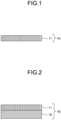
- FIG. 1 is a schematic cross-section view illustrating a first example of the color conversion film according to the embodiments of the present invention.
- a color conversion film 1A which is the first example, is a single-layer film configured by a color conversion layer 11 as illustrated in FIG. 1 .
- the color conversion layer 11 includes the abovementioned color conversion composition or cured product thereof.
- FIG. 2 is a schematic cross-section view illustrating a second example of the color conversion film according to the embodiments of the present invention.
- a color conversion film 1B which is the second example, is a laminate of a substrate layer 10 and the color conversion layer 11 as illustrated in FIG. 2 .
- the color conversion layer 11 is laminated on the substrate layer 10.
- FIG. 3 is a schematic cross-section view illustrating a third example of the color conversion film according to the embodiments of the present invention.
- a color conversion film 1C which is the third example, is a laminate of a plurality of the substrate layers 10 and the color conversion layer 11 as illustrated in FIG. 3 .
- the color conversion layer 11 is sandwiched by the plurality of substrate layers 10.
- FIG. 4 is a schematic cross-section view illustrating a fourth example of the color conversion film according to the embodiments of the present invention.
- a color conversion film 1D which is the fourth example, is a laminate of a plurality of the substrate layers 10, the color conversion layer 11, and a plurality of barrier films 12 as illustrated in FIG. 4 .
- the color conversion layer 11 is sandwiched by the plurality of barrier films 12, and a laminate of the color conversion layer 11 and the plurality of barrier films 12 is sandwiched by the plurality of substrate layers 10. That is, the color conversion film 1D may also have barrier films 12 as illustrated in FIG. 4 to prevent degradation of the color conversion layer 11 due to oxygen, moisture and heat.
- the substrate layer includes a metal sheet or foil such as aluminum (including an aluminum alloy), zinc, copper or iron, a film of a plastic such as cellulose acetate, polyethylene terephthalate (PET), polyethylene, polyester, polyamide, polyimide, polyphenylene sulfide, polystyrene, polypropylene, polycarbonate, polyvinyl acetal, aramid, silicone, polyolefin or a thermoplastic fluororesin that is a copolymer of tetrafluoroethylene and ethylene (ETFE), a film of an ⁇ -polyolefin resin, a polycaprolactone resin, an acrylic resin, a silicone resin, or a plastic containing the resins copolymerized with ethylene, paper laminated with the aforementioned plastic, paper
- a metal sheet or foil such as aluminum (including an aluminum alloy), zinc, copper or iron
- a film of a plastic such as cellulose acetate, polyethylene terephthalate (PET),
- the glass or the resin film may be preferably used in view of the ease of manufacturing and molding the color conversion film.
- a high-strength film is preferable so as to avoid the risk of rupture or the like.
- a resin film is preferable in view of the required characteristics and economy, and among these, a plastic film selected from the group consisting of PET, polyphenylene sulfide, polycarbonate, and polypropylene is preferred in view of economy and easy of handling.
- a polyimide film is preferred in view of heat resistance.
- the surface of the substrate layer may be subjected to a release treatment in advance in view of the ease of film separation.
- the thickness of the substrate layer is not particularly limited but preferably has a lower limit of at least 25 ⁇ m and more preferably at least 38 ⁇ m and preferably has an upper limit of no more than 5,000 ⁇ m and more preferably no more than 3,000 ⁇ m.
- the color conversion composition manufactured with the method described above is applied on the substrate layer or a substrate such as a barrier film and dried.
- the color conversion layer e.g., the color conversion layer 11 illustrated in FIGS. 1 to 4 .
- the application can be carried out with a reverse roll coater, a blade coater, a slit die coater, a direct gravure coater, an offset gravure coater, a kiss coater, a natural roll coater, an air knife coater, a roll blade coater, a reverse roll blade coater, a two-stream coater, a rod coater, a wire bar coater, an applicator, a dip coater, a curtain coater, a spin coater, a knife coater, or the like.
- a slit die coater is preferable.
- the color conversion layer can be dried using a general heating apparatus such as a hot air drier or an infrared drier.
- the color conversion film can be heated using a general heating apparatus such as a hot air drier or an infrared drier.
- the heating conditions are ordinarily 40 to 250°C for 1 minute to five hours, and preferably 60 to 200°C for 2 minutes to four hours. Heating/curing can also be carried out incrementally such as with stepwise curing.
- the substrate layer may be modified as needed.
- a simple method for doing so includes, but is not limited to, a method for relaminating using a hot plate and a method using a vacuum laminator or a dry film laminator, for example.
- the thickness of the color conversion layer is not particularly limited but is preferably 10 to 1,000 ⁇ m. If the thickness of the color conversion layer is less than 10 ⁇ m, a problem arises in that the toughness of the color conversion film is low. If the thickness of the color conversion layer exceeds 1,000 ⁇ m, cracks occur easily and the color conversion film is difficult to mold.
- the thickness of the color conversion layer is more preferably 30 to 100 ⁇ m.
- the thickness thereof is preferably 200 ⁇ m or less, more preferably 100 ⁇ m or less, and still more preferably 50 ⁇ m or less.
- the thickness of the color conversion film in the present invention refers to the film thickness (average thickness) measured on the basis of thickness measurement method A using mechanical scanning in JIS K 7130 (1999) Method for Measuring Plastic Films and Sheets.
- a barrier film (e.g., the barrier films 12 illustrated in FIG. 4 ) may be used, as appropriate, such as when improving the gas barrier priority of the color conversion layer.
- the barrier film include a metal oxide thin film or metal nitride thin film including an inorganic oxide such as silicon oxide, aluminum oxide, titanium oxide, tantalum oxide, zinc oxide, tin oxide, indium oxide, yttrium oxide, and magnesium oxide, an inorganic nitride such as silicon nitride, aluminum nitride, titanium nitride and silicon carbide nitride, a mixture thereof, or same having another element added thereto, and a film containing various resins such as polyvinylidene chloride, an acrylic resin, a silicone resin, a melamine resin, a urethane resin, a fluorine resin, or a polyvinyl alcohol resin such as saponified vinyl acetate.
- Examples of a barrier film functioning as a barrier against water include a film containing various resins such as polyethylene, polypropylene, nylon, polyvinylidene chloride, a vinylidene chloride-vinyl chloride copolymer, a vinylidene chloride-acrylonitrile copolymer, a fluorine resin, and a polyvinyl alcohol resin such as saponified vinyl acetate.
- various resins such as polyethylene, polypropylene, nylon, polyvinylidene chloride, a vinylidene chloride-vinyl chloride copolymer, a vinylidene chloride-acrylonitrile copolymer, a fluorine resin, and a polyvinyl alcohol resin such as saponified vinyl acetate.
- the barrier film may be provided on both surfaces of the color conversion layer 11 such as the barrier film 12 illustrated in FIG. 4 , or may be provided on only one surface of the color conversion layer 11.
- An auxiliary layer may be further provided having an antireflection function, an antiglare function, an antireflection-antiglare function, a hard coat function (anti-friction function), an antistatic function, an antifouling function, an electromagnetic wave shielding function, an infrared cutting function, an ultraviolet cutting function, a polarization function, or a toning function according to the function required in the color conversion film.
- excitation light any type of excitation light can be used as long as the excitation light emits light in the wavelength region in which the mixed light-emitting substance, such as the compound represented by general formula (1), can absorb light.
- the excitation light from, for example, a fluorescent light source such as a hot cathode tube, a cold cathode tube, or an inorganic electroluminescence (EL) element, an organic EL element light source, an LED light source, an incandescent light source, or solar light can be used in principle.
- Light from an LED light source is a particularly preferable excitation light.
- Light from a blue LED light source having excitation light in the wavelength range of 430 to 500 nm is further preferable in display and illumination applications from the viewpoint of enhancing the blue light color purity.
- the excitation light may have one or more types of light emission peaks, but one type of light emission peak is preferable in order to enhance the light purity.
- a plurality of different types of light emission peaks may also be optionally combined and used.
- the light source unit according to the embodiments of the present invention is provided with at least a light source and the abovementioned color conversion film.
- the method for arranging the light source and the color conversion film is not particularly limited, and a configuration may be adopted in which the light source and the color conversion film adhere closely or a remote phosphor system may be adopted in which the light source and the color conversion film are separated.
- a configuration for the light source unit may be adopted in which a color filter is further provided with the object of enhancing the color purity.
- the excitation light in the wavelength range of 430 to 500 nm is a relatively small excitation energy and decomposition of a light-emitting substance such as the compound represented by general formula (1) can be prevented.
- the light source used in the light source unit is preferably a light-emitting diode having a maximum light emission with a wavelength in the range of 430 to 500 nm inclusive and more preferably a wavelength in the range of 440 to 470 nm inclusive.
- the light source is preferably a light-emitting diode having a light emission peak in the range of 430 to 470 nm and a light-emission wavelength region in the range of 400 to 500 nm, the light emission spectrum of the light-emitting diode satisfying mathematical expression (1).
- ⁇ is the light emission intensity at the light emission wavelength peak of the light emission spectrum
- ⁇ is the light emission intensity at the wavelength of the light emission wavelength peak plus 15 nm.
- the light source unit in the present invention can be used in a display, illumination, interiors, signs, signboards and other such applications, but is particularly suitable for use in a display or illumination application.
- a display according to the embodiments of the present invention is provided with at least the abovementioned color conversion film.
- a light source unit having the abovementioned light source unit, and the color conversion film, and the like may be used as a backlight unit in a liquid display or other such display, for example.
- the method for synthesizing the compound G-41 of synthesis example 3 in the present invention is described below.
- the compound G-27 (1.95 g) was placed in a flask, dichloromethane (25 mL), trimethylsilyl cyanide (3.5 mL), and a boron trifluoride-diethyl ether complex (0.75 mL) were added and the result was stirred for 18 hours.
- water 25 mL was added, the result was stirred, and the organic layer was separated. The organic layer was dried with magnesium sulfate and filtered, and then the solvent was distilled off.
- G-2 to G-26, G-28 to G-40, G-42 to G-51, and G-101 to G-106 can be easily synthesized by changing the starting materials, such as the alcohol starting material and the aldehyde starting material.
- a backlight unit was provided with color conversion films, a blue LED element (light emission peak wavelength: 445 nm), and a light guide, a color conversion film was laminated on one surface of the light guide, a prism sheet was laminated on the color conversion film, then a current was allowed to flow to light the blue LED element, and the initial light emission characteristics were measured with a spectral radiance meter (CS-1000 manufactured by Konica Minolta). The initial value at the time of the initial light emission characteristics measurement was set so that the brightness of light from the blue LED element was 800 cd/m 2 without the insertion of a color conversion film. Subsequently, light from the blue LED element was continuously irradiated at room temperature and the time until the light emission intensity dropped to a set amount was observed to evaluate the optical durability.
- CS-1000 spectral radiance meter
- an acrylic resin was used as the binder resin, and 0.25 parts by weight of the compound G-1 as the light-emitting material and 400 parts by weight of toluene as the solvent were mixed with 100 parts by weight of the acrylic resin. Subsequently, the mixture was stirred and defoamed at 300 rpm for 20 minutes with a planetary stirring/defoaming device, the "MAZERUSTAR KK-400" (manufactured by Kurabo Industries Ltd.), and the color conversion composition was obtained.
- the color conversion composition obtained as described above was applied with a slit die coater onto a "Lumirror" U48 (manufactured by Toray, thickness: 50 ⁇ m), which was the first substrate layer, the resultant was heated at 100°C for 20 minutes and dried to form an (A) layer with an average thickness of 16 ⁇ m.
- the two layers i.e., the (A) layer and the (B) layer, were heat-laminated so that the color conversion layer of the (A) layer and the adhesion layer of the (B) layer were directly laminated to produce a color conversion film with a laminated configuration "first substrate layer/color conversion layer/adhesion layer/second substrate layer/light diffusion layer".
- This color conversion film was used to color-convert the light (blue light) from the blue LED element, and when only the light-emission region of the green light was extracted, green emission light with a high color purity was obtained with a peak wavelength of 528 nm and a full width at half maximum of a light emission spectrum in the peak wavelength of 27 nm.
- the light emission intensity in the peak wavelength is a relative value with the light emission intensity in the comparative example 1 described below set to 1.00.
- the light emission intensity of the example 1 was 1.19.
- the luminescence dropped 5% after 320 hours.
- the light emission material and the evaluation results of the example 1 are listed below in Table 2.
- a color conversion film was manufactured and evaluated the same was as in the example 1 for cases other than where the compounds (compounds G-2 to G-51 and G-101 to G-106) described in tables 2 to 4 were appropriately used as the light emission materials.
- the light emission material and the evaluation results of the examples 2 to 25 are listed below in Table 2.
- the light emission material and the evaluation results of the examples 26 to 51 are listed below in Table 3.
- the light emission material and the evaluation results of the comparative examples 1 to 6 are listed in Table 4.
- the light emission intensities (relative values) in the tables are at the peak wavelength and are relative values when the intensity in the comparative example 1 is set to 1.00 as in the example 1.
- the pyrromethene-boron complex, the color conversion composition, the color conversion film, the light source unit, the display, and the illumination apparatus according to the present invention are suitable for both improving color reproducibility and achieving high durability.
Landscapes
- Chemical & Material Sciences (AREA)
- Organic Chemistry (AREA)
- Engineering & Computer Science (AREA)
- Materials Engineering (AREA)
- Physics & Mathematics (AREA)
- General Physics & Mathematics (AREA)
- Theoretical Computer Science (AREA)
- Liquid Crystal (AREA)
- Electroluminescent Light Sources (AREA)
- Optical Filters (AREA)
- Non-Portable Lighting Devices Or Systems Thereof (AREA)
Claims (19)
- Pyrromethen-Bor-Komplex, der eine durch die allgemeine Formel (1) dargestellte Verbindung ist,
 wobei in der allgemeinen Formel (1) X C-R7 oder N ist, R1 bis R7 jeweils gleich oder verschieden sind und ausgewählt sind aus Wasserstoff, einer substituierten oder unsubstituierten Alkylgruppe, einer substituierten oder unsubstituierten Cycloalkylgruppe, einer substituierten oder unsubstituierten heterocyclischen Gruppe, einer substituierten oder unsubstituierten Alkenylgruppe, einer substituierten oder unsubstituierten Cycloalkenylgruppe, einer substituierten oder unsubstituierten Alkinylgruppe, einer Hydroxygruppe, einer Thiolgruppe, einer substituierten oder unsubstituierten Alkoxygruppe, einer substituierten oder unsubstituierten Alkylthiogruppe, einer substituierten oder unsubstituierten Arylethergruppe, einer substituierten oder unsubstituierten Arylthioethergruppe, einer substituierten oder unsubstituierten Arylgruppe, einer substituierten oder unsubstituierten Heteroarylgruppe, einem Halogen, einer Cyanogruppe, einer Aldehydgruppe, einer substituierten oder unsubstituierten Carbonylgruppe, einer Carboxygruppe, einer substituierten oder unsubstituierten Oxycarbonylgruppe, einer substituierten oder unsubstituierten Carbamoylgruppe, einer substituierten oder unsubstituierten Estergruppe, einer substituierten oder unsubstituierten Amidgruppe, einer substituierten oder unsubstituierten Acylgruppe, einer substituierten oder unsubstituierten Sulfonylgruppe, einer substituierten oder unsubstituierten Sulfonsäureestergruppe, einer substituierten oder unsubstituierten Sulfonamidgruppe, einer Nitrogruppe, einer substituierten oder unsubstituierten Silylgruppe, einer substituierten oder unsubstituierten Siloxanylgruppe, einer substituierten oder unsubstituierten Borylgruppe und einer substituierten oder unsubstituierten Phosphinoxidgruppe, wobei R2 und R5 ausgewählt sind aus den Gruppen außer einer substituierten oder unsubstituierten Arylgruppe und einer substituierten oder unsubstituierten Heteroarylgruppe; R2 und R5 Gruppen sind, die keine Heteroarylgruppe mit mindestens zwei kondensierten Ringen enthalten; R8 und R9 ausgewählt sind aus einer substituierten oder unsubstituierten Alkylgruppe, einer substituierten oder unsubstituierten Cycloalkylgruppe, einer substituierten oder unsubstituierten heterocyclischen Gruppe, einer substituierten oder unsubstituierten Alkenylgruppe, einer substituierten oder unsubstituierten Cycloalkenylgruppe, einer substituierten oder unsubstituierten Alkinylgruppe, einer Hydroxygruppe, einer Thiolgruppe, einer substituierten oder unsubstituierten Alkoxygruppe, einer substituierten oder unsubstituierten Alkylthiogruppe, einer substituierten oder unsubstituierten Arylethergruppe, einer substituierten oder unsubstituierten Arylthioethergruppe, einer substituierten oder unsubstituierten Arylgruppe, einer substituierten oder unsubstituierten Heteroarylgruppe, einem Halogen und einer Cyanogruppe; und mindestens eines von R1 bis R6 eine Gruppe ist, die ein Fluoratom enthält,wobei die Gruppe, die das Fluoratom in der allgemeinen Formel (1) enthält, eine fluorhaltige Acylgruppe, eine fluorhaltige Estergruppe, eine fluorhaltige Amidgruppe, eine fluorhaltige Sulfonylgruppe, eine fluorhaltige Sulfonsäureestergruppe oder eine fluorhaltige Sulfonamidgruppe ist und/oderwobei entweder R8 oder R9 in der allgemeinen Formel (1) eine Cyanogruppe ist.
 - Pyrromethen-Bor-Komplex nach Anspruch 1, wobei mindestens zwei von R1 bis R6 in der allgemeinen Formel (1) Gruppen sind, die ein Fluoratom enthalten.
- Pyrromethen-Bor-Komplex nach Anspruch 1 oder 2, wobei mindestens eines von R2 und R5 in der allgemeinen Formel (1) eine Gruppe ist, die ein Fluoratom enthält.
- Pyrromethen-Bor-Komplex nach einem der Ansprüche 1 bis 3, wobei R2 und R5 in der allgemeinen Formel (1) Gruppen sind, die ein Fluoratom enthalten.
- Pyrromethen-Bor-Komplex nach einem der Ansprüche 1 bis 4, wobei die Gruppe, die das Fluoratom in der allgemeinen Formel (1) enthält, eine fluorhaltige Estergruppe ist.
- Pyrromethen-Bor-Komplex nach einem der Ansprüche 1 bis 5, wobei mindestens eines von R1, R3, R4 und R6 in der allgemeinen Formel (1) eine substituierte oder unsubstituierte Alkylgruppe ist.
- Pyrromethen-Bor-Komplex nach einem der Ansprüche 1 bis 6, wobei R7 in der allgemeinen Formel (1) eine substituierte oder unsubstituierte Arylgruppe ist.
- Pyrromethen-Bor-Komplex nach einem der Ansprüche 1 bis 6, wobei die durch die allgemeine Formel (1) dargestellte Verbindung eine durch die allgemeine Formel (2) dargestellte Verbindung ist,
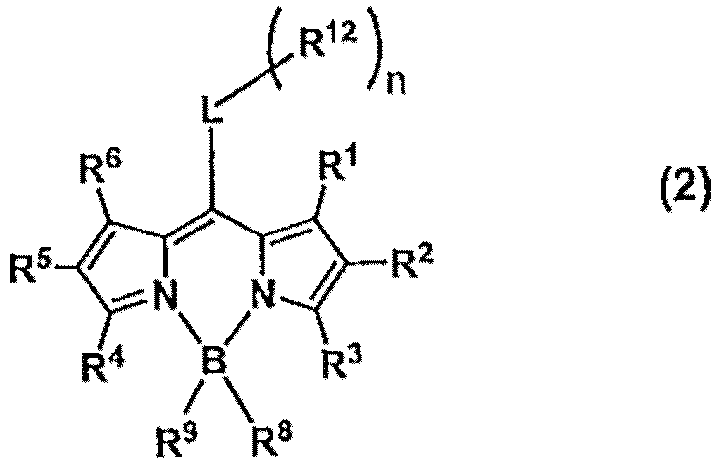
- Pyrromethen-Bor-Komplex nach einem der Ansprüche 1 bis 8, wobei die durch die allgemeine Formel (1) dargestellte Verbindung eine Lichtemission mit einer Spitzenwellenlänge, die in einem Bereich von 500 bis 580 nm einschließlich beobachtet wird, als Reaktion auf Anregungslicht zeigt.
- Farbumwandlungszusammensetzung, die einfallendes Licht in Licht mit einer längeren Wellenlänge als eine Wellenlänge des einfallenden Lichts umwandelt, wobei die Farbumwandlungszusammensetzung umfasst:den Pyrromethen-Bor-Komplex nach einem der Ansprüche 1 bis 9; undein Bindemittelharz.
- Farbumwandlungszusammensetzung nach Anspruch 10, umfassend:ein lichtemittierendes Material (a); undein lichtemittierendes Material (b),wobei mindestens eines von dem lichtemittierenden Material (a) und dem lichtemittierenden Material (b) der Pyrromethen-Bor-Komplex ist,wobei das lichtemittierende Material (a) ein lichtemittierendes Material ist, das als Reaktion auf Anregungslicht Licht mit einer Spitzenwellenlänge emittiert, die in einem Bereich von 500 bis 580 nm einschließlich beobachtet wird, undwobei das lichtemittierende Material (b) ein lichtemittierendes Material ist, das als Reaktion auf mindestens eines von Anregung durch Anregungslicht und Lichtemission von dem lichtemittierenden Material (a) Licht mit einer Spitzenwellenlänge emittiert, die in einem Bereich von 580 bis 750 nm einschließlich beobachtet wird.
- Farbumwandlungszusammensetzung nach Anspruch 11, wobei der Gehalt wa des lichtemittierenden Materials (a) und der Gehalt wb des lichtemittierenden Materials (b) eine Beziehung wa ≥ wb aufweisen.
- Farbumwandlungszusammensetzung nach einem der Ansprüche 10 bis 12, ferner umfassend ein Lösungsmittel.
- Farbumwandlungszusammensetzung nach einem der Ansprüche 10 bis 13, wobei das Bindemittelharz ein thermoplastisches Harz ist.
- Farbumwandlungsfilm, umfassend eine Schicht, die die Farbumwandlungszusammensetzung nach einem der Ansprüche 10 bis 14 oder ein gehärtetes Produkt davon enthält.
- Farbumwandlungsfilm nach Anspruch 15, ferner umfassend einen Barrierefilm.
- Lichtquelleneinheit, umfassend:eine Lichtquelle; undden Farbumwandlungsfilm nach Anspruch 15 oder 16.
- Lichtquelleneinheit nach Anspruch 17, wobei die Lichtquelle eine lichtemittierende Diode mit einer maximalen Lichtemission in einem Wellenlängenbereich von 430 bis 500 nm einschließlich ist.
- Anzeige oder Beleuchtungsvorrichtung, umfassend den Farbumwandlungsfilm nach Anspruch 15 oder 16.
Applications Claiming Priority (3)
| Application Number | Priority Date | Filing Date | Title |
|---|---|---|---|
| JP2016232257 | 2016-11-30 | ||
| JP2017146290 | 2017-07-28 | ||
| PCT/JP2017/041865 WO2018101129A1 (ja) | 2016-11-30 | 2017-11-21 | ピロメテンホウ素錯体、色変換組成物、色変換フィルム、光源ユニット、ディスプレイおよび照明装置 |
Publications (3)
| Publication Number | Publication Date |
|---|---|
| EP3550206A1 EP3550206A1 (de) | 2019-10-09 |
| EP3550206A4 EP3550206A4 (de) | 2020-11-25 |
| EP3550206B1 true EP3550206B1 (de) | 2025-03-19 |
Family
ID=62242395
Family Applications (1)
| Application Number | Title | Priority Date | Filing Date |
|---|---|---|---|
| EP17875117.8A Active EP3550206B1 (de) | 2016-11-30 | 2017-11-21 | Pyrromethen-bor-komplex, farbkonversionszusammensetzung, farbkonversionsfolie, lichtquelleneinheit, anzeige und beleuchtungsvorrichtung |
Country Status (8)
| Country | Link |
|---|---|
| US (1) | US10907094B2 (de) |
| EP (1) | EP3550206B1 (de) |
| JP (1) | JP6432697B2 (de) |
| KR (1) | KR102200716B1 (de) |
| CN (1) | CN109996802B (de) |
| MX (1) | MX2019006457A (de) |
| TW (1) | TWI708777B (de) |
| WO (1) | WO2018101129A1 (de) |
Families Citing this family (12)
| Publication number | Priority date | Publication date | Assignee | Title |
|---|---|---|---|---|
| CN109563405B (zh) * | 2016-07-29 | 2022-06-17 | 株式会社Lg化学 | 含氮环状化合物、包含其的色彩转换膜以及包含其的背光单元和显示装置 |
| EP3621970B1 (de) * | 2017-05-11 | 2021-01-13 | Merck Patent GmbH | Bororganische komplexe für organische elektrolumineszente vorrichtungen |
| JP6939787B2 (ja) * | 2017-06-02 | 2021-09-22 | 東レ株式会社 | 色変換シート、それを含む光源ユニット、ディスプレイおよび照明装置 |
| CN111615653A (zh) * | 2018-01-23 | 2020-09-01 | 东丽株式会社 | 发光元件、显示器及颜色转换基板 |
| JP6693578B2 (ja) * | 2018-01-26 | 2020-05-13 | 東レ株式会社 | ピロメテンホウ素錯体、色変換組成物、色変換フィルム、光源ユニット、ディスプレイ、照明装置および発光素子 |
| WO2019151121A1 (ja) * | 2018-01-31 | 2019-08-08 | 東レ株式会社 | 化合物、それを含む組成物、それを用いた成形体および発光装置 |
| EP3845542A4 (de) * | 2018-08-27 | 2022-05-04 | Toray Industries, Inc. | Pyrromethen-borkomplex, lichtemittierendes element damit, anzeigevorrichtung, beleuchtungsvorrichtung, farbumwandlungszusammensetzung, farbumwandlungsfilm, farbumwandlungssubstrat, lichtquelleneinheit und anzeigevorrichtung |
| EP4006040A4 (de) * | 2019-07-24 | 2022-10-26 | Toray Industries, Inc. | Pyrromethen-bor-komplex, farbumwandlungszusammensetzung, farbumwandlungsfolie, lichtquelleneinheit, anzeige und beleuchtungsvorrichtung |
| JP7679768B2 (ja) * | 2020-01-24 | 2025-05-20 | 東レ株式会社 | ピロメテンホウ素錯体、それを含有する発光素子、表示装置および照明装置 |
| WO2022230643A1 (ja) * | 2021-04-28 | 2022-11-03 | 東レ株式会社 | 多環芳香族化合物、色変換組成物、色変換シート、光源ユニット、ディスプレイおよび照明装置 |
| ES2948561A1 (es) * | 2021-08-16 | 2023-09-14 | Consejo Superior Investigacion | Compuestos para etiquetado fluorescente |
| US12372830B1 (en) | 2024-07-29 | 2025-07-29 | Lg Electronics Inc. | Backlight unit and display device including the same |
Family Cites Families (31)
| Publication number | Priority date | Publication date | Assignee | Title |
|---|---|---|---|---|
| US4916711A (en) | 1988-09-29 | 1990-04-10 | Boyer Joseph H | Lasing compositions and methods for using the same |
| US5326692B1 (en) | 1992-05-13 | 1996-04-30 | Molecular Probes Inc | Fluorescent microparticles with controllable enhanced stokes shift |
| US5446157A (en) | 1990-04-23 | 1995-08-29 | Morgan; Lee R. | Boron difluoride compounds useful in photodynamic therapy and production of laser light |
| JPH1143491A (ja) * | 1997-07-30 | 1999-02-16 | Mitsui Chem Inc | ピロメテン金属キレ−ト化合物及びそれを用いた光記録媒体 |
| JP3993698B2 (ja) * | 1998-06-12 | 2007-10-17 | 関西ペイント株式会社 | 可視光硬化性樹脂組成物及びその用途 |
| JP4007684B2 (ja) * | 1998-06-08 | 2007-11-14 | 関西ペイント株式会社 | 可視光硬化性樹脂組成物及びその用途 |
| US6106999A (en) | 1997-08-12 | 2000-08-22 | Mitsui Chemicals | Photosensitizer, visible light curable resin composition using the same, and use of the composition |
| JP4117063B2 (ja) * | 1998-05-07 | 2008-07-09 | 関西ペイント株式会社 | 光増感剤及び該光増感剤を用いる可視光硬化性樹脂組成物およびその用途 |
| JP3159259B2 (ja) | 1999-01-13 | 2001-04-23 | 日本電気株式会社 | 有機エレクトロルミネッセンス素子 |
| JP4005749B2 (ja) | 1999-12-13 | 2007-11-14 | 出光興産株式会社 | 色変換膜及び有機エレクトロルミネッセンス素子 |
| JP4948713B2 (ja) | 2001-04-19 | 2012-06-06 | 三井化学株式会社 | 色変換材料、該材料を含む組成物、該組成物を使用した色変換光学部品および該色変換光学部品を使用した発光素子 |
| JP4948714B2 (ja) | 2001-05-24 | 2012-06-06 | 三井化学株式会社 | 色変換材料、該材料を含む組成物、該組成物を使用した色変換光学部品および該色変換光学部品を使用した発光素子 |
| JP5221859B2 (ja) | 2006-03-09 | 2013-06-26 | 株式会社Adeka | クマリン化合物を含有してなるフィルム、クマリン化合物とマトリクスを含む色変換層、該色変換層を含む色変換フィルタ、補色層、補色フィルタならびに多色発光デバイス |
| JP2008083416A (ja) * | 2006-09-27 | 2008-04-10 | Fujifilm Corp | 感光性着色硬化性組成物、カラーフィルタ及びその製造方法 |
| JP2009031713A (ja) | 2006-09-27 | 2009-02-12 | Fujifilm Corp | ジピロメテン系ホウ素錯体化合物及びその互換異性体、感光性着色硬化性組成物、カラーフィルタ、及びその製造方法 |
| KR101474900B1 (ko) | 2006-09-27 | 2014-12-19 | 후지필름 가부시키가이샤 | 화합물 또는 이것의 토토머, 금속착체 화합물, 착색 감광성경화 조성물, 컬러필터, 및 제조 |
| US8278819B2 (en) * | 2007-03-09 | 2012-10-02 | Idemitsu Kosan Co., Ltd. | Organic electroluminescence device and display |
| JP5548394B2 (ja) * | 2008-06-10 | 2014-07-16 | 富士フイルム株式会社 | インクジェット用インク、カラーフィルタおよびその製造方法、ならびにそれを用いる液晶ディスプレイおよび画像表示デバイス |
| JP2010159411A (ja) | 2008-12-12 | 2010-07-22 | Nitto Denko Corp | 半硬化状シリコーン樹脂シート |
| TW201035079A (en) * | 2009-02-27 | 2010-10-01 | Idemitsu Kosan Co | Pyrromethene-boron complex compounds and organic electro- luminescent elements using same |
| JP2011241160A (ja) | 2010-05-17 | 2011-12-01 | Yamamoto Chem Inc | 色変換材料、該材料を含む組成物、該組成物を使用した色変換光学部品および該色変換光学部品を使用した発光素子 |
| JP2012022028A (ja) | 2010-07-12 | 2012-02-02 | Ns Materials Kk | 液晶ディスプレイ |
| US8968875B2 (en) * | 2012-03-21 | 2015-03-03 | Larry Takiff | Eyewear including nitrophenyl functionalized boron pyrromethene dye for neutralizing laser threat |
| JP6279209B2 (ja) | 2013-01-17 | 2018-02-14 | 山本化成株式会社 | 波長変換層、及びこれを用いた波長変換フィルタ |
| EP3034580B1 (de) * | 2013-08-13 | 2020-04-29 | DIC Corporation | Harzzusammensetzung und formartikel |
| CN105899639A (zh) * | 2013-11-01 | 2016-08-24 | Toray化学株式会社 | 补偿膜及补偿膜用有机点 |
| CN107001392B (zh) | 2014-12-29 | 2019-09-13 | 株式会社Lg化学 | 化合物和包含其的色彩转换膜 |
| EP3305870B1 (de) | 2015-05-26 | 2020-11-18 | Toray Industries, Inc. | Pyrromethen-bor-komplex, farbveränderliche zusammensetzung, farbveränderliche folie, lichtquelleneinheit damit, anzeige und beleuchtung |
| WO2017073923A1 (ko) * | 2015-10-27 | 2017-05-04 | 주식회사 엘지화학 | 화합물 및 이를 포함하는 색변환 필름 |
| KR101968940B1 (ko) | 2015-10-27 | 2019-04-15 | 주식회사 엘지화학 | 화합물 및 이를 포함하는 색변환 필름 |
| US10854838B2 (en) * | 2015-12-08 | 2020-12-01 | Idemitsu Kosan Co., Ltd. | Organic EL light emitting apparatus and electronic instrument |
-
2017
- 2017-11-21 JP JP2017561423A patent/JP6432697B2/ja active Active
- 2017-11-21 US US16/463,171 patent/US10907094B2/en active Active
- 2017-11-21 CN CN201780072671.0A patent/CN109996802B/zh active Active
- 2017-11-21 KR KR1020197014038A patent/KR102200716B1/ko active Active
- 2017-11-21 MX MX2019006457A patent/MX2019006457A/es unknown
- 2017-11-21 WO PCT/JP2017/041865 patent/WO2018101129A1/ja not_active Ceased
- 2017-11-21 EP EP17875117.8A patent/EP3550206B1/de active Active
- 2017-11-27 TW TW106141154A patent/TWI708777B/zh active
Also Published As
| Publication number | Publication date |
|---|---|
| WO2018101129A1 (ja) | 2018-06-07 |
| EP3550206A1 (de) | 2019-10-09 |
| JPWO2018101129A1 (ja) | 2018-12-06 |
| KR20190088046A (ko) | 2019-07-25 |
| EP3550206A4 (de) | 2020-11-25 |
| CN109996802A (zh) | 2019-07-09 |
| TW201825503A (zh) | 2018-07-16 |
| JP6432697B2 (ja) | 2018-12-05 |
| US20190345380A1 (en) | 2019-11-14 |
| KR102200716B1 (ko) | 2021-01-12 |
| US10907094B2 (en) | 2021-02-02 |
| TWI708777B (zh) | 2020-11-01 |
| MX2019006457A (es) | 2020-10-01 |
| CN109996802B (zh) | 2020-10-16 |
Similar Documents
| Publication | Publication Date | Title |
|---|---|---|
| EP3550206B1 (de) | Pyrromethen-bor-komplex, farbkonversionszusammensetzung, farbkonversionsfolie, lichtquelleneinheit, anzeige und beleuchtungsvorrichtung | |
| US11149196B2 (en) | Pyrromethene-boron complex, color-changing composition, color-changing film, light source unit including same, display, and lighting | |
| CN107922835B (zh) | 颜色转换组合物、颜色转换膜以及包含其的背光单元、显示器及照明 | |
| TWI753225B (zh) | 吡咯亞甲基硼錯合物、顏色轉換組成物、顏色轉換膜、光源單元、顯示器、照明裝置和發光元件 | |
| WO2017057287A1 (ja) | 色変換フィルムならびにそれを含む光源ユニット、ディスプレイおよび照明装置 | |
| WO2017141795A1 (ja) | 色変換シート、それを含む光源ユニット、ディスプレイおよび照明装置 | |
| TWI807198B (zh) | 吡咯亞甲基硼錯合物、顏色變換組成物、顏色變換膜、光源單元、顯示器及照明裝置 | |
| JP2021162665A (ja) | ピロメテンホウ素錯体、色変換組成物、色変換フィルムならびにそれを含む光源ユニット、ディスプレイおよび照明装置 | |
| WO2024075649A1 (ja) | ピロメテンホウ素錯体、色変換組成物、色変換シート、色変換基板、光源ユニット、表示装置および照明装置 | |
| KR20250006018A (ko) | 조성물 | |
| JP2024115627A (ja) | 化合物、色変換組成物、部材ならびにそれを含む光源ユニット、ディスプレイ、照明装置、発光素子およびセンサー |
Legal Events
| Date | Code | Title | Description |
|---|---|---|---|
| STAA | Information on the status of an ep patent application or granted ep patent |
Free format text: STATUS: THE INTERNATIONAL PUBLICATION HAS BEEN MADE |
|
| PUAI | Public reference made under article 153(3) epc to a published international application that has entered the european phase |
Free format text: ORIGINAL CODE: 0009012 |
|
| STAA | Information on the status of an ep patent application or granted ep patent |
Free format text: STATUS: REQUEST FOR EXAMINATION WAS MADE |
|
| 17P | Request for examination filed |
Effective date: 20190603 |
|
| AK | Designated contracting states |
Kind code of ref document: A1 Designated state(s): AL AT BE BG CH CY CZ DE DK EE ES FI FR GB GR HR HU IE IS IT LI LT LU LV MC MK MT NL NO PL PT RO RS SE SI SK SM TR |
|
| AX | Request for extension of the european patent |
Extension state: BA ME |
|
| DAV | Request for validation of the european patent (deleted) | ||
| DAX | Request for extension of the european patent (deleted) | ||
| A4 | Supplementary search report drawn up and despatched |
Effective date: 20201027 |
|
| RIC1 | Information provided on ipc code assigned before grant |
Ipc: H01L 33/50 20100101ALI20201021BHEP Ipc: C07F 5/02 20060101ALI20201021BHEP Ipc: C09K 11/06 20060101ALI20201021BHEP Ipc: G09F 9/00 20060101ALI20201021BHEP Ipc: F21V 1/17 20180101AFI20201021BHEP |
|
| STAA | Information on the status of an ep patent application or granted ep patent |
Free format text: STATUS: EXAMINATION IS IN PROGRESS |
|
| 17Q | First examination report despatched |
Effective date: 20230215 |
|
| REG | Reference to a national code |
Ref legal event code: R079 Ref country code: DE Ref document number: 602017088467 Country of ref document: DE Free format text: PREVIOUS MAIN CLASS: F21V0001170000 Ipc: H05B0033140000 |
|
| GRAP | Despatch of communication of intention to grant a patent |
Free format text: ORIGINAL CODE: EPIDOSNIGR1 |
|
| STAA | Information on the status of an ep patent application or granted ep patent |
Free format text: STATUS: GRANT OF PATENT IS INTENDED |
|
| RIC1 | Information provided on ipc code assigned before grant |
Ipc: H01L 33/50 20100101ALI20241115BHEP Ipc: C07F 5/02 20060101ALI20241115BHEP Ipc: C09K 11/06 20060101ALI20241115BHEP Ipc: H05B 33/14 20060101AFI20241115BHEP |
|
| INTG | Intention to grant announced |
Effective date: 20241204 |
|
| GRAS | Grant fee paid |
Free format text: ORIGINAL CODE: EPIDOSNIGR3 |
|
| GRAA | (expected) grant |
Free format text: ORIGINAL CODE: 0009210 |
|
| STAA | Information on the status of an ep patent application or granted ep patent |
Free format text: STATUS: THE PATENT HAS BEEN GRANTED |
|
| AK | Designated contracting states |
Kind code of ref document: B1 Designated state(s): AL AT BE BG CH CY CZ DE DK EE ES FI FR GB GR HR HU IE IS IT LI LT LU LV MC MK MT NL NO PL PT RO RS SE SI SK SM TR |
|
| P01 | Opt-out of the competence of the unified patent court (upc) registered |
Free format text: CASE NUMBER: APP_6419/2025 Effective date: 20250207 |
|
| REG | Reference to a national code |
Ref country code: GB Ref legal event code: FG4D |
|
| REG | Reference to a national code |
Ref country code: CH Ref legal event code: EP |
|
| REG | Reference to a national code |
Ref country code: IE Ref legal event code: FG4D |
|
| REG | Reference to a national code |
Ref country code: DE Ref legal event code: R096 Ref document number: 602017088467 Country of ref document: DE |
|
| PG25 | Lapsed in a contracting state [announced via postgrant information from national office to epo] |
Ref country code: RS Free format text: LAPSE BECAUSE OF FAILURE TO SUBMIT A TRANSLATION OF THE DESCRIPTION OR TO PAY THE FEE WITHIN THE PRESCRIBED TIME-LIMIT Effective date: 20250619 |
|
| PG25 | Lapsed in a contracting state [announced via postgrant information from national office to epo] |
Ref country code: FI Free format text: LAPSE BECAUSE OF FAILURE TO SUBMIT A TRANSLATION OF THE DESCRIPTION OR TO PAY THE FEE WITHIN THE PRESCRIBED TIME-LIMIT Effective date: 20250319 |
|
| REG | Reference to a national code |
Ref country code: LT Ref legal event code: MG9D |
|
| PG25 | Lapsed in a contracting state [announced via postgrant information from national office to epo] |
Ref country code: NO Free format text: LAPSE BECAUSE OF FAILURE TO SUBMIT A TRANSLATION OF THE DESCRIPTION OR TO PAY THE FEE WITHIN THE PRESCRIBED TIME-LIMIT Effective date: 20250619 |
|
| PG25 | Lapsed in a contracting state [announced via postgrant information from national office to epo] |
Ref country code: HR Free format text: LAPSE BECAUSE OF FAILURE TO SUBMIT A TRANSLATION OF THE DESCRIPTION OR TO PAY THE FEE WITHIN THE PRESCRIBED TIME-LIMIT Effective date: 20250319 |
|
| PG25 | Lapsed in a contracting state [announced via postgrant information from national office to epo] |
Ref country code: LV Free format text: LAPSE BECAUSE OF FAILURE TO SUBMIT A TRANSLATION OF THE DESCRIPTION OR TO PAY THE FEE WITHIN THE PRESCRIBED TIME-LIMIT Effective date: 20250319 |
|
| PG25 | Lapsed in a contracting state [announced via postgrant information from national office to epo] |
Ref country code: BG Free format text: LAPSE BECAUSE OF FAILURE TO SUBMIT A TRANSLATION OF THE DESCRIPTION OR TO PAY THE FEE WITHIN THE PRESCRIBED TIME-LIMIT Effective date: 20250319 Ref country code: GR Free format text: LAPSE BECAUSE OF FAILURE TO SUBMIT A TRANSLATION OF THE DESCRIPTION OR TO PAY THE FEE WITHIN THE PRESCRIBED TIME-LIMIT Effective date: 20250620 |
|
| REG | Reference to a national code |
Ref country code: NL Ref legal event code: MP Effective date: 20250319 |
|
| REG | Reference to a national code |
Ref country code: AT Ref legal event code: MK05 Ref document number: 1778055 Country of ref document: AT Kind code of ref document: T Effective date: 20250319 |
|
| PG25 | Lapsed in a contracting state [announced via postgrant information from national office to epo] |
Ref country code: NL Free format text: LAPSE BECAUSE OF FAILURE TO SUBMIT A TRANSLATION OF THE DESCRIPTION OR TO PAY THE FEE WITHIN THE PRESCRIBED TIME-LIMIT Effective date: 20250319 |
|
| PG25 | Lapsed in a contracting state [announced via postgrant information from national office to epo] |
Ref country code: SE Free format text: LAPSE BECAUSE OF FAILURE TO SUBMIT A TRANSLATION OF THE DESCRIPTION OR TO PAY THE FEE WITHIN THE PRESCRIBED TIME-LIMIT Effective date: 20250319 |
|
| PG25 | Lapsed in a contracting state [announced via postgrant information from national office to epo] |
Ref country code: SM Free format text: LAPSE BECAUSE OF FAILURE TO SUBMIT A TRANSLATION OF THE DESCRIPTION OR TO PAY THE FEE WITHIN THE PRESCRIBED TIME-LIMIT Effective date: 20250319 |
|
| PG25 | Lapsed in a contracting state [announced via postgrant information from national office to epo] |
Ref country code: ES Free format text: LAPSE BECAUSE OF FAILURE TO SUBMIT A TRANSLATION OF THE DESCRIPTION OR TO PAY THE FEE WITHIN THE PRESCRIBED TIME-LIMIT Effective date: 20250319 Ref country code: PT Free format text: LAPSE BECAUSE OF FAILURE TO SUBMIT A TRANSLATION OF THE DESCRIPTION OR TO PAY THE FEE WITHIN THE PRESCRIBED TIME-LIMIT Effective date: 20250721 |
|
| PG25 | Lapsed in a contracting state [announced via postgrant information from national office to epo] |
Ref country code: PL Free format text: LAPSE BECAUSE OF FAILURE TO SUBMIT A TRANSLATION OF THE DESCRIPTION OR TO PAY THE FEE WITHIN THE PRESCRIBED TIME-LIMIT Effective date: 20250319 Ref country code: IT Free format text: LAPSE BECAUSE OF FAILURE TO SUBMIT A TRANSLATION OF THE DESCRIPTION OR TO PAY THE FEE WITHIN THE PRESCRIBED TIME-LIMIT Effective date: 20250319 |
|
| PG25 | Lapsed in a contracting state [announced via postgrant information from national office to epo] |
Ref country code: AT Free format text: LAPSE BECAUSE OF FAILURE TO SUBMIT A TRANSLATION OF THE DESCRIPTION OR TO PAY THE FEE WITHIN THE PRESCRIBED TIME-LIMIT Effective date: 20250319 |
|
| PG25 | Lapsed in a contracting state [announced via postgrant information from national office to epo] |
Ref country code: EE Free format text: LAPSE BECAUSE OF FAILURE TO SUBMIT A TRANSLATION OF THE DESCRIPTION OR TO PAY THE FEE WITHIN THE PRESCRIBED TIME-LIMIT Effective date: 20250319 Ref country code: CZ Free format text: LAPSE BECAUSE OF FAILURE TO SUBMIT A TRANSLATION OF THE DESCRIPTION OR TO PAY THE FEE WITHIN THE PRESCRIBED TIME-LIMIT Effective date: 20250319 |
|
| PG25 | Lapsed in a contracting state [announced via postgrant information from national office to epo] |
Ref country code: RO Free format text: LAPSE BECAUSE OF FAILURE TO SUBMIT A TRANSLATION OF THE DESCRIPTION OR TO PAY THE FEE WITHIN THE PRESCRIBED TIME-LIMIT Effective date: 20250319 |
|
| PG25 | Lapsed in a contracting state [announced via postgrant information from national office to epo] |
Ref country code: SK Free format text: LAPSE BECAUSE OF FAILURE TO SUBMIT A TRANSLATION OF THE DESCRIPTION OR TO PAY THE FEE WITHIN THE PRESCRIBED TIME-LIMIT Effective date: 20250319 |
|
| PG25 | Lapsed in a contracting state [announced via postgrant information from national office to epo] |
Ref country code: IS Free format text: LAPSE BECAUSE OF FAILURE TO SUBMIT A TRANSLATION OF THE DESCRIPTION OR TO PAY THE FEE WITHIN THE PRESCRIBED TIME-LIMIT Effective date: 20250719 |
|
| REG | Reference to a national code |
Ref country code: DE Ref legal event code: R097 Ref document number: 602017088467 Country of ref document: DE |
|
| PGFP | Annual fee paid to national office [announced via postgrant information from national office to epo] |
Ref country code: DE Payment date: 20250930 Year of fee payment: 9 |
|
| PGFP | Annual fee paid to national office [announced via postgrant information from national office to epo] |
Ref country code: GB Payment date: 20251001 Year of fee payment: 9 |
|
| PG25 | Lapsed in a contracting state [announced via postgrant information from national office to epo] |
Ref country code: DK Free format text: LAPSE BECAUSE OF FAILURE TO SUBMIT A TRANSLATION OF THE DESCRIPTION OR TO PAY THE FEE WITHIN THE PRESCRIBED TIME-LIMIT Effective date: 20250319 |
|
| PLBE | No opposition filed within time limit |
Free format text: ORIGINAL CODE: 0009261 |
|
| STAA | Information on the status of an ep patent application or granted ep patent |
Free format text: STATUS: NO OPPOSITION FILED WITHIN TIME LIMIT |
|
| REG | Reference to a national code |
Ref country code: CH Ref legal event code: L10 Free format text: ST27 STATUS EVENT CODE: U-0-0-L10-L00 (AS PROVIDED BY THE NATIONAL OFFICE) Effective date: 20260128 |
|
| 26N | No opposition filed |
Effective date: 20251222 |