EP3550741A1 - Verfahren zur erzeugung eines stl-stroms, lokaler adapter und entsprechendes computerprogramm - Google Patents
Verfahren zur erzeugung eines stl-stroms, lokaler adapter und entsprechendes computerprogramm Download PDFInfo
- Publication number
- EP3550741A1 EP3550741A1 EP19164912.8A EP19164912A EP3550741A1 EP 3550741 A1 EP3550741 A1 EP 3550741A1 EP 19164912 A EP19164912 A EP 19164912A EP 3550741 A1 EP3550741 A1 EP 3550741A1
- Authority
- EP
- European Patent Office
- Prior art keywords
- stl
- stream
- packet
- output
- plp
- Prior art date
- Legal status (The legal status is an assumption and is not a legal conclusion. Google has not performed a legal analysis and makes no representation as to the accuracy of the status listed.)
- Withdrawn
Links
Images



Classifications
-
- H—ELECTRICITY
- H04—ELECTRIC COMMUNICATION TECHNIQUE
- H04H—BROADCAST COMMUNICATION
- H04H20/00—Arrangements for broadcast or for distribution combined with broadcast
- H04H20/10—Arrangements for replacing or switching information during the broadcast or the distribution
- H04H20/103—Transmitter-side switching
-
- H—ELECTRICITY
- H04—ELECTRIC COMMUNICATION TECHNIQUE
- H04N—PICTORIAL COMMUNICATION, e.g. TELEVISION
- H04N21/00—Selective content distribution, e.g. interactive television or video on demand [VOD]
- H04N21/20—Servers specifically adapted for the distribution of content, e.g. VOD servers; Operations thereof
- H04N21/23—Processing of content or additional data; Elementary server operations; Server middleware
- H04N21/242—Synchronisation processes, e.g. processing of PCR [Programme Clock References]
-
- H—ELECTRICITY
- H04—ELECTRIC COMMUNICATION TECHNIQUE
- H04L—TRANSMISSION OF DIGITAL INFORMATION, e.g. TELEGRAPHIC COMMUNICATION
- H04L49/00—Packet switching elements
- H04L49/55—Prevention, detection or correction of errors
- H04L49/552—Prevention, detection or correction of errors by ensuring the integrity of packets received through redundant connections
-
- H—ELECTRICITY
- H04—ELECTRIC COMMUNICATION TECHNIQUE
- H04L—TRANSMISSION OF DIGITAL INFORMATION, e.g. TELEGRAPHIC COMMUNICATION
- H04L65/00—Network arrangements, protocols or services for supporting real-time applications in data packet communication
- H04L65/10—Architectures or entities
- H04L65/102—Gateways
-
- H—ELECTRICITY
- H04—ELECTRIC COMMUNICATION TECHNIQUE
- H04L—TRANSMISSION OF DIGITAL INFORMATION, e.g. TELEGRAPHIC COMMUNICATION
- H04L65/00—Network arrangements, protocols or services for supporting real-time applications in data packet communication
- H04L65/1066—Session management
- H04L65/1069—Session establishment or de-establishment
-
- H—ELECTRICITY
- H04—ELECTRIC COMMUNICATION TECHNIQUE
- H04L—TRANSMISSION OF DIGITAL INFORMATION, e.g. TELEGRAPHIC COMMUNICATION
- H04L65/00—Network arrangements, protocols or services for supporting real-time applications in data packet communication
- H04L65/60—Network streaming of media packets
- H04L65/61—Network streaming of media packets for supporting one-way streaming services, e.g. Internet radio
- H04L65/611—Network streaming of media packets for supporting one-way streaming services, e.g. Internet radio for multicast or broadcast
-
- H—ELECTRICITY
- H04—ELECTRIC COMMUNICATION TECHNIQUE
- H04L—TRANSMISSION OF DIGITAL INFORMATION, e.g. TELEGRAPHIC COMMUNICATION
- H04L65/00—Network arrangements, protocols or services for supporting real-time applications in data packet communication
- H04L65/60—Network streaming of media packets
- H04L65/65—Network streaming protocols, e.g. real-time transport protocol [RTP] or real-time control protocol [RTCP]
-
- H—ELECTRICITY
- H04—ELECTRIC COMMUNICATION TECHNIQUE
- H04H—BROADCAST COMMUNICATION
- H04H20/00—Arrangements for broadcast or for distribution combined with broadcast
- H04H20/53—Arrangements specially adapted for specific applications, e.g. for traffic information or for mobile receivers
- H04H20/59—Arrangements specially adapted for specific applications, e.g. for traffic information or for mobile receivers for emergency or urgency
Definitions
- the present disclosure relates to the field of the broadcasting of information, especially the terrestrial broadcasting of television services.
- the present disclosure relates to the generation of a STL (Studio-to-Transmitter Link) stream in accordance with ATSC 3.0 standard, which is a broadcasting standard for terrestrial broadcasting, or future standards.
- STL Stio-to-Transmitter Link
- the generation of a STL stream according to the disclosure can be implemented in a local adapter, located upstream of an exciter of a transmitter site.
- Such local adapter can receive one or more STL streams (generated from one or more broadcast gateways), and generate a new STL stream from the received STL stream(s).
- the present disclosure thus offers a regionalization solution compliant at least with ATSC 3.0 standard.
- a broadcast network according to ATSC 3.0 standard comprises at least:
- the RF signal generated by the transmitter sites 121, 122 can be received by an end user, for example on a TV set.
- the data stream generated by the broadcast gateway(s) 112 is a STL stream.
- Such data stream can be sent from the studio 11 to the transmitter sites 121, 122 through a distribution network (for example through a satellite, IP network, micro-wave, radio frequency, etc., link).
- STL STL stream
- IP layers an outer layer 21, called “STL outer”, and an inner layer 22, called “STL inner”.
- the STL outer 21 comprises a unique IP/UDP packet, i.e. addressed by a unique IP/UDP tuple.
- the payload of the STL outer is the STL inner.
- a specific RTP encapsulation can be added to allow transmission robustness (ECC, packet re-ordering) and the STL inner de-encapsulation.
- the STL inner 22 comprises three types of packets:
- the STL stream can carry at least one PLP ("Physical Layer Pipe").
- PLP Physical Layer Pipe
- Each PLP is associated to a specific modulation configuration allowing a tunable degree of robustness for the data.
- Several BB packets can be used to carry one PLP. In this case, a BBP addressing per PLP can be defined.
- Each of the STL inner packets (PRE, TMP and BBP packets) can be IP/UDP/RTP encapsulated.
- Each type of STL inner packet can be addressed by a unique IP/UDP tuple.
- Figure 3 illustrates the ATSC 3.0 frame notion at the STL stream level through the RTP timestamp of the STL layers. Indeed, all the STL inner packets of a given frame (frame N, frame N+1, ...) generally have the same RTP timestamp. Such RTP timestamp is usually a function of the emission time, at the transmitter site, of the given frame.
- Regional content broadcasting consists in broadcasting per geographical area (states, region%) specific contents dedicated to a given area, in addition or replacement to common contents shared by all the areas.
- a first solution for regional content broadcasting consists in generating, in a central studio, several STL streams carrying each both common content and specific content, and to provide the STL streams to the different transmitter sites.
- a first STL stream carrying national common content and specific content dedicated to region A can be generated by a broadcast gateway in the central studio. Such first STL stream can then be distributed from the broadcast gateway to the exciters of the transmitter sites of region A.
- a second STL stream carrying national common content and specific content dedicated to region B can be generated by a broadcast gateway in the central studio. Such second STL stream can then be distributed from the broadcast gateway to the exciters of the transmitter sites of region B.
- a third STL stream carrying national common content and specific content dedicated to region C can be generated by a broadcast gateway in the central studio. Such third STL stream can then be distributed from the broadcast gateway to the exciters of the transmitter sites of region C.
- this solution relies on the reception, by the central studio, of the specific content dedicated to region A, the specific content dedicated to region B and the specific content dedicated to region C, in order to generate the different STL streams.
- this solution relies on the distribution of the different STL streams, each carrying the national common content, to the different regions. The national common content is thus duplicated in each STL stream, which is costly in terms of bandwidth.
- first, second and/or third STL streams are generated by different broadcast gateways not located in the same central studio, the specific content dedicated to region A, B and /or C should be provided to the central studio, which is also costly.
- a solution based on PLP replacement is disclosed in US 9,148,607 .
- common contents are distributed only once in a main transport stream, and a recomposition device combines the content carried by the main transport stream with a content dedicated to a specific region served by the recomposition device.
- the recomposition device replaces, in the main transport stream, a PLP comprising padding packets or packets carrying contents dedicated to a specific region (region B for example), with a PLP comprising some packets carrying contents dedicated to another specific region served by the recomposition device (region A for example).
- the disclosure proposes a novel solution for regional content broadcasting that is compliant with ATSC3.0 standard or future standards.
- a first embodiment of the disclosure relies on a method for generating a STL stream, comprising, in at least one local adapter configured to serve at least one transmitter site in a broadcast network:
- the local adapter receives one STL stream from a broadcast gateway, and output one STL stream.
- the output STL stream thus carries less PLPs than the input STL stream, as it carries only the selected PLPs.
- a second embodiment of the disclosure relies on a method for generating a STL stream, comprising, in at least one local adapter configured to serve at least one transmitter site in a broadcast network:
- the local adapter receives at least two STL streams from one or more broadcast gateways, and output one STL stream.
- the number of PLPs carried by the output STL stream depends on the number of PLPs selected in the input STL streams.
- the structure, in terms of numbers of BB packets, of the output STL stream can thus differ from the structure of the input STL streams.
- At least one embodiment of the disclosure also aims at protecting a computer program comprising instructions adapted to implementing the method for generating a STL stream as described here above when this program is executed by a processor, as well as a computer-readable information medium comprising instructions of a computer program as mentioned here above.
- At least one embodiment of the disclosure also relates to a device for generating a STL stream as described above, called a local adapter.
- Such device could of course comprise the different characteristics pertaining to the method for generating a STL stream according to the disclosure. Such characteristics can be combined or taken in isolation.
- one local adapter can be located in one region/cell cluster (several transmitter sites belonging to a same region) or else at each transmitter site.
- Each transmitter site can broadcast an ATSC 3.0 RF stream generated from the STL stream outputted by a local adapter.
- the general principle relies on the distribution, in a broadcast network according to ATSC 3.0 standard for example, of at least one STL stream carrying one or more PLPs, and the generation, by a local adapter receiving the distributed STL stream(s), of a new STL stream to be transmitted to the transmitter sites.
- a local adapter can thus receive either only one STL stream, or several STL streams, select the desired PLPs in the received STL streams, and generate a new STL stream from the PLP selection, with updated preamble (PRE) and timing (TMP) packets depending on the PLP selection.
- PRE preamble
- TMP timing
- At least one embodiment of the disclosure thus relies on PLP aggregation, instead of PLP replacement as disclosed in the prior art.
- PLP aggregation can be performed deterministically to ensure a SFN broadcasting of the ATSC 3.0 RF streams outputted by each transmitter site.
- the management of regional content can thus be achieved using the Multiple Physical Layer Pipes (PLP) technology.
- PLP Physical Layer Pipes
- common contents can be carried in one or several PLPs in a first STL stream.
- Regional contents can be carried in one or more PLPs in at least one second STL stream.
- the first STL stream thus carries common contents, for example a national content, and doesn't carry a specific content, for example dedicated to a specific region, or padding packets in one or more PLPs, as disclosed in US 9,148,607 .
- the local adapter is a device of the transmitter site, connected to or integrated to the exciter of the transmitter site.
- Each transmitter site can thus be equipped with a local adapter.
- the local adapter can be located upstream of the transmitter sites.
- one local adapter can serve one or more transmitter sites. For example there is one local adapter per SFN region/cell cluster.
- Figures 4 and 5 illustrate a method for generating a STL stream according to two embodiments, implemented in at least one local adapter configured to serve at least one transmitter site in a broadcast network.
- the local adapter receives (41) a first STL stream, STL1, generated by a first broadcast gateway.
- STL stream (or more specifically at least one inner layer of the STL stream) comprises at least one frame comprising:
- the local adapter selects 44 at least one PLP among the PLPs carried by the BB packets of STL1. In other words, the local adapter selects all the BB packets of at least one PLP among the BB packets of STL1. For example, if STL1 carries three PLPs, one PLP carrying national content (PLP0), one PLP carrying regional content dedicated to region B (PLP1), and one PLP dedicated to region C (PLP2), a local adapter serving the transmitter sites of region B can select only PLP0 and PLP1.
- PLP0 national content
- PLP1 PLP carrying regional content dedicated to region B
- PLP2 PLP dedicated to region C
- the local adapter then generates (45) an output STL stream, STL out.
- STL stream (or more specifically at least one inner layer of the STL stream) comprises at least one frame comprising at least:
- the timing packet of the output STL stream, STL out corresponds to the timing packet of the first STL stream, STL1.
- the timing packet of STL out can be obtained by duplicating the timing packet of STL1.
- generating the output STL stream also comprises updating the dynamic fields of the timing packet dedicated to emergency alert. To do so, the method also comprises:
- detecting emergency alert information comprises detecting, for each selected PLP, if an Advanced Emergency Alerting Table is present.
- the emergency alert field of the timing packet of the output STL stream comprises a flag whose value depends on a sum of the version value of the detected Advanced Emergency Alerting Tables.
- the preamble packet of the output STL stream, STL out can be initialized with PLP information of the preamble packet of the first STL stream, STL1, said PLP information being related to the selected PLP(s).
- PLP information being related to the selected PLP(s).
- the parts of the preamble packet of STL1 corresponding to the selected PLP(s) can be copied in the preamble packet of STL out.
- generating the output STL stream also comprises updating the dynamic fields of the preamble packet. To do so, the method also comprises:
- the low layer signaling field of the preamble packet of the output STL stream comprises a flag whose value is set to a predetermined value when a Low Layer Signaling Table is detected in at least one of the selected PLPs.
- Such method can be used to generate the preamble packet, timing packet and BB packets of at least one frame of the output stream. Such packets can be duplicated and updated for generating other frames of the output stream.
- At least one inner layer of the output STL stream can be generated in this way.
- the output layer of the output STL stream can then be classically generated, by rebuilding at least the marker and offset fields.
- the local adapter receives (41) a first STL stream, STL1, as in the first embodiment.
- the local adapter receives (52), simultaneously or at a different time, at least one second STL stream, STL2, STL3, ..., generated by at least one second broadcast gateway.
- Such STL stream (or more specifically at least one inner layer of the STL stream) comprises at least one frame comprising:
- the received STL streams (STL1, STL2, 7) have the same frame duration. This constraint allows the synchronization of the received STL streams and then a deterministic processing.
- the first STL stream, STL1, and second STL stream(s), STL2, STL3, ..., are then synchronized (53) using at least one frame emission time of the first STL stream and one frame emission time of the second STL stream(s).
- the method comprises selecting one reference stream among the first STL stream and the second STL stream(s), and synchronizing the first STL stream and second STL stream(s) comprises aligning the frame emission time of all the input STL streams on the frame emission time of the reference stream.
- the local adapter selects (44) at least one PLP carried by the received streams.
- the local adapter selects at least one PLP among the PLP carried by the BB packets of the first STL stream, STL1, and the PLP carried by the BB packets of the second STL stream(s), STL2, STL3, ....
- the local adapter generates (45) the output STL stream.
- the second embodiment the second embodiment:
- the timing packet of the output STL stream, STL out is initialized with the timing packet of the reference stream. For example, if STL1 is chosen as a reference stream, the timing packet TMP of STL1 can be copied in the timing packet TMP of STL out.
- generating the output STL stream also comprises updating the dynamic fields of the timing packet dedicated to emergency alert. To do so, the method also comprises, as per the first embodiment:
- detecting emergency alert information comprises detecting, for each selected PLP, if an Advanced Emergency Alerting Table is present.
- the emergency alert field of the timing packet of the output STL stream comprises a flag whose value depends on a sum of the version value of the detected Advanced Emergency Alerting Tables.
- the emergency alert flag has to be generated into the output STL stream depending on the PLP selection. For example, all the emergency alerts from the selected PLPs should be generated in the STL output, whereas an alert of a non-selected PLP should be removed.
- the local adapter checks the AEAT table presence on each selected PLP. In the case where no AEAT table has been found, the EA flag on the STL output can be set to '0', meaning that there is no emergency alert. At the opposite, when at least one AEAT table is detected, an EA flag value different from 0 can be generated.
- This value can be computed as follows: for each AEAT table detected, the AEAT table version value is extracted, and all the version values are summed. The result of this sum is translated to the alert interval [1..3] thanks to a modulo 3 operation followed by an addition of 1.
- the process according to this embodiment enables a deterministic generation of the EA flag on the output STL.
- the preamble packet of the output STL stream, STL out can be initialized with PLP information of the preamble packet of the first STL stream, STL1, or of the second STL stream(s), STL2, STL3, ... said PLP information being related to the selected PLP(s).
- PLP information being related to the selected PLP(s).
- parts of the preamble packet of STL1 corresponding to selected PLP(s) and/or parts of the preamble packet of STL2 (and/or STL3, etc.) corresponding to selected PLP(s) can be copied in the preamble packet of STL out.
- the relative parts of each selected PLPs, in the preamble packets of the input STL streams, can be copied in the preamble packet of the STL output stream.
- generating the output STL stream also comprises updating the dynamic fields of the preamble packet. To do so, the method also comprises:
- the low layer signaling field of the preamble packet of the output STL stream comprises a flag whose value is set to a predetermined value when a Low Layer Signaling Table is detected in at least one of the selected PLPs.
- the dynamic fields of the preamble packet are related to LLS flags.
- LLS flags are associated to LLS tables carried by the input PLPs.
- LLS tables are present or not in the STL output stream depending on the selected PLPs.
- the LLS flag can be set to '1' (for example based on an "OR" processing on the selected PLPs).
- Such method can be used to generate the preamble packet, timing packet and BB packets of at least one frame of the output stream. Such packets can be duplicated and updated for generating other frames of the output stream.
- At least one inner layer of the output STL stream can be generated with the preamble packet PRE, timing packet TMP and BB packets carrying the selected PLPs aligned on the reference stream.
- the RTP timestamps of the BB packets of the output STL stream can be-aligned on the RTP timestamp of the BB packets of the reference stream.
- the output layer of the output STL stream can then be generated, by rebuilding at least the marker and offset fields.
- the STL output stream can then be transmitted to an exciter of a transmitter site.
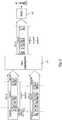
- the local adapter 61 receives two input STL streams, STL X and STL Y, both having a same frame duration.
- the output STL stream, STL Z also has the same frame duration.
- STL X and STL Y can be synchronized, based on the frame emission time of a frame of STL X (for example frame N) and the frame emission time of a frame of STL Y (for example frame P).
- Such frame emission time can be encoded in a timestamp in each frame, for example a RTP timestamp or a bootstrap emission time timestamp of the timing packet.
- the frame emission time of frame N of STL X is not mandatorily the same as the frame emission time of frame P of STL Y, but they are synchronous due to the frame duration constraint and the time synchronization of the broadcast gateways with the TAI time (International Atomic Time). The potential offsets between the frames emission time are then static.
- one input stream is selected as a reference stream, and the frame emission time of all the input STL streams are aligned on the frame emission time of the reference stream.
- STL X is selected as the reference stream
- the frame emission time of the output stream STL Z (for example its RTP timestamp) is set equal to the frame emission time of STL X. This allows a deterministic construction of the STL output timestamp.
- At least one PLP can then be selected among the input STLs. All the BB packets related to a selected PLP can be copied as BB packets of the output STL.
- the input stream STL X carries in frame P only one PLP on the BB packets BBP 0 (PLP0).
- the input stream STL Y carries three different PLPs in frame P: a first PLP on the BB packets BBP 1 (PLP1), a second PLP on the BB packets BBP 2 (PLP2) and a third PLP on the BB packets BBP 3 (PLP3).
- all the BB packets of frame N of STL X carrying PLP0 and all the BB packets of frame P of STL Y carrying PLP3 can be copied as BB packets of frame Q of the output stream STL Z.
- the preamble packet and timing packet of the output stream STL Z can be generated from the preamble packet and timing packet of the input streams STL X and STL Y, as disclosed above in view of Figure 5 .
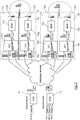
- Figures 7 and 8 illustrate two examples of broadcasting networks implementing a regional content broadcasting according to the disclosure.
- the broadcasting network comprises a first studio comprising a first broadcast gateway 71 outputting a first STL stream, STL1.
- the first broadcast gateway 71 is located in a national studio, and outputs a STL stream STL1 carrying only one PLP, PLP0, comprising national content.
- the broadcasting network also comprises a second studio comprising a second broadcast gateway 72 outputting a second STL stream, STL2.
- the second broadcast gateway 72 is located in a regional studio, and outputs a STL stream STL2 carrying three PLPs comprising specific regional contents: a first PLP carrying regional content dedicated to region A, PLP1, a second PLP carrying regional content dedicated to region B, PLP2, and a third PLP carrying regional content dedicated to region C, PLP3.
- STL1 and STL2 are distributed in a distribution network (for example through a satellite, IP network, micro-wave, and/or radio frequency link), from the first broadcast gateway 71 and the second broadcast gateway 72, to the transmitter sites 73 and 74 of region B, and to the transmitter sites 75 and 76 of region C.
- a distribution network for example through a satellite, IP network, micro-wave, and/or radio frequency link
- Each transmitter site (73, 74, 75, 76) comprises a local adapter (731, 741, 751, 761) according to at least one embodiment of the disclosure, an exciter (732, 742, 752, 762) and an antenna (733, 743, 753, 763).
- Each local adapter (731, 741, 751, 761) receives both STL1 and STL2.
- Each of the local adapters 731 and 741 located on the transmitter sites 73 and 74 of region B can select the PLPs carrying national content and regional content dedicated to region B, i.e. PLP0 carried by STL1 and PLP2 carried by STL2, in order to generate a first STL output stream, STLout1, according to at least one embodiment of the disclosure.
- STLout1 carries PLP0 and PLP2, but doesn't carry PLP1 and PLP3, which are dedicated to other regions.
- STLout1 issued by local adapter 731 can be transmitted to the exciter 732, and sent as a RF signal through the antenna 733.
- STLout1 issued by local adapter 741 can be transmitted to the exciter 742, and sent as a RF signal through the antenna 743.
- Each of the local adapters 751 and 761 located on the transmitter sites 75 and 76 of region C can select the PLPs carrying national content and regional content dedicated to region C, i.e. PLP0 carried by STL1 and PLP3 carried by STL2, in order to generate a second STL output stream, STLout2, according to at least one embodiment of the disclosure.
- STLout2 carries PLP0 and PLP3, but doesn't carry PLP1 and PLP2, which are dedicated to other regions.
- STLout2 issued by local adapter 751 can be transmitted to the exciter 752, and sent as a RF signal through the antenna 753.
- STLout2 issued by local adapter 761 can be transmitted to the exciter 762, and sent as a RF signal through the antenna 763.
- the broadcasting network comprises a first studio comprising a first broadcast gateway 81 outputting a first STL stream, STL1.
- the first broadcast gateway 81 is located in a national studio, and outputs a STL stream STL1 carrying only one PLP, PLP0, comprising national content.
- the broadcasting network also comprises a second studio comprising a second broadcast gateway 82 outputting a second STL stream, STL2, a third studio comprising a third broadcast gateway 83 outputting a third STL stream, STL3, and a fourth studio comprising a fourth broadcast gateway 84 outputting a fourth STL stream, STL4.
- the second broadcast gateway 82 is located in a regional studio dedicated to region A, and STL2 carries only one PLP, comprising regional content dedicated to region A (PLP1), the third broadcast gateway 83 is located in a regional studio dedicated to region B, and STL3 carries only one PLP comprising regional content dedicated to region B (PLP2), and the fourth broadcast gateway 84 is located in a regional studio dedicated to region C, and STL4 carries only one PLP comprising regional content dedicated to region C (PLP3).
- STL1, STL2, STL3 and STL4 are distributed in a distribution network from the fourth broadcast gateways 81, 82, 83, 84, to the transmitter sites 85 and 86 of region B, and to the transmitter sites 87 and 88 of region C.
- Each transmitter site (85, 86, 87, 88) comprises a local adapter (851, 861, 871, 881) according to at least one embodiment of the disclosure, an exciter (852, 862, 872, 882) and an antenna (853, 863, 873, 883).
- Each local adapter (851, 861, 871, 881) receives all the STL streams STL1, STL2, STL3 and STL4.
- the local adapters receive the STL stream carrying national content and the STL stream carrying regional content dedicated to the region served by the local adapter.
- Each of the local adapters 851 and 861 located on the transmitter sites 85 and 86 of region B can select the PLPs carrying national content and regional content dedicated to region B, i.e. PLP0 carried by STL1 and PLP2 carried by STL3, in order to generate a first STL output stream, STLout1, according to at least one embodiment of the disclosure.
- STLout1 carries PLP0 and PLP2, but doesn't carry PLP1 and PLP3, which are dedicated to other regions.
- STLout1 issued by local adapter 851 can be transmitted to the exciter 852, and sent as a RF signal through the antenna 853.
- STLout1 issued by local adapter 861 can be transmitted to the exciter 862, and sent as a RF signal through the antenna 863.
- Each of the local adapters 871 and 881 located on the transmitter sites 87 and 88 of region C can select the PLPs carrying national content and regional content dedicated to region C, i.e. PLP0 carried by STL1 and PLP3 carried by STL4, in order to generate a second STL output stream, STLout2, according to at least one embodiment of the disclosure.
- STLout2 carries PLP0 and PLP3, but doesn't carry PLP1 and PLP2, which are dedicated to other regions.
- STLout2 issued by local adapter 871 can be transmitted to the exciter 872, and sent as a RF signal through the antenna 873.
- STLout2 issued by local adapter 881 can be transmitted to the exciter 882, and sent as a RF signal through the antenna 883.
- At least one embodiment of the disclosure thus offers a solution for regional content broadcasting solution compliant at least with ATSC 3.0 standard.
- Such a device comprises a memory 91, for example a buffer memory, a processing unit 92 equipped for example with a processor P and driven by the computer program 93 implementing the method for generating a STL stream according to at least one embodiment.
- the code instructions of the computer program 93 are for example loaded into a RAM and then executed by the processor of the processing unit 92.
- the processing unit 92 inputs at least one STL stream.
- the processor of the processing unit 92 implements the method described here above, according to the instructions of the computer program 93, to generate a new STL stream carrying only the selected PLPs and with updated signaling information.
- the processing unit 92 is configured to:
Landscapes
- Engineering & Computer Science (AREA)
- Multimedia (AREA)
- Signal Processing (AREA)
- Computer Networks & Wireless Communication (AREA)
- Business, Economics & Management (AREA)
- General Business, Economics & Management (AREA)
- Computer Security & Cryptography (AREA)
- Mobile Radio Communication Systems (AREA)
- Two-Way Televisions, Distribution Of Moving Picture Or The Like (AREA)
Applications Claiming Priority (1)
| Application Number | Priority Date | Filing Date | Title |
|---|---|---|---|
| US15/946,781 US10750220B2 (en) | 2018-04-06 | 2018-04-06 | Method for generating a STL stream, local adapter and corresponding computer program |
Publications (1)
| Publication Number | Publication Date |
|---|---|
| EP3550741A1 true EP3550741A1 (de) | 2019-10-09 |
Family
ID=65955101
Family Applications (1)
| Application Number | Title | Priority Date | Filing Date |
|---|---|---|---|
| EP19164912.8A Withdrawn EP3550741A1 (de) | 2018-04-06 | 2019-03-25 | Verfahren zur erzeugung eines stl-stroms, lokaler adapter und entsprechendes computerprogramm |
Country Status (2)
| Country | Link |
|---|---|
| US (1) | US10750220B2 (de) |
| EP (1) | EP3550741A1 (de) |
Families Citing this family (7)
| Publication number | Priority date | Publication date | Assignee | Title |
|---|---|---|---|---|
| KR102465266B1 (ko) * | 2017-05-24 | 2022-11-11 | 한국전자통신연구원 | Miso 동작을 위한 게이트웨이 시그널링 방법 및 이를 위한 장치 |
| WO2018216999A1 (ko) * | 2017-05-24 | 2018-11-29 | 한국전자통신연구원 | Miso 동작을 위한 게이트웨이 시그널링 방법 및 이를 위한 장치 |
| KR102758629B1 (ko) * | 2017-06-07 | 2025-01-22 | 한국전자통신연구원 | 주파수/타이밍 옵셋을 위한 게이트웨이 시그널링 방법 및 이를 위한 장치 |
| WO2018226028A1 (ko) * | 2017-06-07 | 2018-12-13 | 한국전자통신연구원 | 주파수/타이밍 옵셋을 위한 게이트웨이 시그널링 방법 및 이를 위한 장치 |
| US10917448B2 (en) * | 2018-06-18 | 2021-02-09 | Electronics And Telecommunications Research Institute | Method and apparatus for broadcast gateway signaling for ensuring reliability |
| JP7210272B2 (ja) * | 2018-12-28 | 2023-01-23 | 株式会社東芝 | 放送システム、エンコーダ、多重化装置、多重化方法、系統切替装置、および同期制御装置 |
| US11924260B2 (en) * | 2020-07-09 | 2024-03-05 | Triveni Digital Inc. | Secure television distribution over heterogeneous networks |
Citations (4)
| Publication number | Priority date | Publication date | Assignee | Title |
|---|---|---|---|---|
| US9148607B2 (en) | 2010-08-13 | 2015-09-29 | Enensys Technologies | DVB-T2 broadcasting method with the insertion of regional content, and device used in the method |
| US20160080828A1 (en) * | 2012-12-13 | 2016-03-17 | Enensys Technologies | Method for generating and transferring at least one data stream |
| FR3036904A1 (fr) * | 2015-06-01 | 2016-12-02 | Enensys Tech | Procede de traitement d'un flux global d'origine comprenant au moins un tunnel couche physique encapsulant un flux de transport, dispositif et programme d'ordinateur correspondants |
| WO2017217885A1 (ru) * | 2016-06-14 | 2017-12-21 | ТимКаст Текнолоджи | Способы передачи сообщений, регионализации контента и сигнализации регионального букета |
Family Cites Families (2)
| Publication number | Priority date | Publication date | Assignee | Title |
|---|---|---|---|---|
| US10666961B2 (en) * | 2016-01-08 | 2020-05-26 | Qualcomm Incorporated | Determining media delivery event locations for media transport |
| WO2018016295A1 (ja) * | 2016-07-20 | 2018-01-25 | ソニー株式会社 | 受信装置、およびデータ処理方法 |
-
2018
- 2018-04-06 US US15/946,781 patent/US10750220B2/en active Active
-
2019
- 2019-03-25 EP EP19164912.8A patent/EP3550741A1/de not_active Withdrawn
Patent Citations (4)
| Publication number | Priority date | Publication date | Assignee | Title |
|---|---|---|---|---|
| US9148607B2 (en) | 2010-08-13 | 2015-09-29 | Enensys Technologies | DVB-T2 broadcasting method with the insertion of regional content, and device used in the method |
| US20160080828A1 (en) * | 2012-12-13 | 2016-03-17 | Enensys Technologies | Method for generating and transferring at least one data stream |
| FR3036904A1 (fr) * | 2015-06-01 | 2016-12-02 | Enensys Tech | Procede de traitement d'un flux global d'origine comprenant au moins un tunnel couche physique encapsulant un flux de transport, dispositif et programme d'ordinateur correspondants |
| WO2017217885A1 (ru) * | 2016-06-14 | 2017-12-21 | ТимКаст Текнолоджи | Способы передачи сообщений, регионализации контента и сигнализации регионального букета |
Also Published As
| Publication number | Publication date |
|---|---|
| US10750220B2 (en) | 2020-08-18 |
| US20190313137A1 (en) | 2019-10-10 |
Similar Documents
| Publication | Publication Date | Title |
|---|---|---|
| EP3550741A1 (de) | Verfahren zur erzeugung eines stl-stroms, lokaler adapter und entsprechendes computerprogramm | |
| KR100900531B1 (ko) | 단일 주파수 네트워크에서 전송 스트림을 동기시키기 위한시스템 및 방법 | |
| CA2925273C (en) | Apparatus for transmitting broadcast signal, apparatus for receiving broadcast signal, method for transmitting broadcast signal and method for receiving broadcast signal | |
| CN106537822B (zh) | 广播发送设备及其处理数据的方法、广播接收设备及其处理数据的方法 | |
| US8149817B2 (en) | Systems, apparatus, methods and computer program products for providing ATSC interoperability | |
| KR101801595B1 (ko) | 방송 신호 송신 장치, 방송 신호 수신 장치, 방송 신호 송신 방법, 및 방송 신호 수신 방법 | |
| EP3206391A1 (de) | Rundfunksignalübertragungsvorrichtung, rundfunksignalempfangsvorrichtung, rundfunksignalübertragungsverfahren und rundfunksignalempfangsverfahren | |
| US9148607B2 (en) | DVB-T2 broadcasting method with the insertion of regional content, and device used in the method | |
| EP3258695A1 (de) | Rundfunksignalsendevorrichtung, rundfunksignalempfangsvorrichtung, rundfunksignalsendeverfahren und rundfunksignalempfangsverfahren | |
| US10051339B2 (en) | Method for generating and transferring at least one data stream | |
| US10097289B2 (en) | Method for replacing a main content with at least one secondary content, corresponding content replacement device and computer program | |
| US11368504B2 (en) | Method for generating a data stream, broadcast gateway, method and device for selecting a data stream and corresponding computer program | |
| CN101854528B (zh) | 移动多媒体广播技术的实现方法、系统和装置 | |
| US10749619B2 (en) | Method and piece of equipment for generating an original whole data stream and a modified whole data stream, intended to be broadcast by a broadcasting site and a rebroadcasting site, respectively | |
| US10454601B2 (en) | Method for processing an original global stream including at least one physical layer tunnel encapsulating a transport stream | |
| US8885491B1 (en) | Method and system for communicating conditional access packet signals through a network | |
| US20080107099A1 (en) | System and method for adapting a transport stream for transmission | |
| WO2017217885A1 (ru) | Способы передачи сообщений, регионализации контента и сигнализации регионального букета | |
| US10321205B2 (en) | Method for broadcasting an alert service |
Legal Events
| Date | Code | Title | Description |
|---|---|---|---|
| PUAI | Public reference made under article 153(3) epc to a published international application that has entered the european phase |
Free format text: ORIGINAL CODE: 0009012 |
|
| AK | Designated contracting states |
Kind code of ref document: A1 Designated state(s): AL AT BE BG CH CY CZ DE DK EE ES FI FR GB GR HR HU IE IS IT LI LT LU LV MC MK MT NL NO PL PT RO RS SE SI SK SM TR |
|
| AX | Request for extension of the european patent |
Extension state: BA ME |
|
| STAA | Information on the status of an ep patent application or granted ep patent |
Free format text: STATUS: THE APPLICATION IS DEEMED TO BE WITHDRAWN |
|
| 18D | Application deemed to be withdrawn |
Effective date: 20200603 |