EP3551016B1 - Sac de couchage à circonférence réglable - Google Patents
Sac de couchage à circonférence réglable Download PDFInfo
- Publication number
- EP3551016B1 EP3551016B1 EP18736232.2A EP18736232A EP3551016B1 EP 3551016 B1 EP3551016 B1 EP 3551016B1 EP 18736232 A EP18736232 A EP 18736232A EP 3551016 B1 EP3551016 B1 EP 3551016B1
- Authority
- EP
- European Patent Office
- Prior art keywords
- top cover
- lateral
- sleeping
- footward
- bottom sheet
- Prior art date
- Legal status (The legal status is an assumption and is not a legal conclusion. Google has not performed a legal analysis and makes no representation as to the accuracy of the status listed.)
- Active
Links
Images

Classifications
-
- A—HUMAN NECESSITIES
- A47—FURNITURE; DOMESTIC ARTICLES OR APPLIANCES; COFFEE MILLS; SPICE MILLS; SUCTION CLEANERS IN GENERAL
- A47G—HOUSEHOLD OR TABLE EQUIPMENT
- A47G9/00—Bed-covers; Counterpanes; Travelling rugs; Sleeping rugs; Sleeping bags; Pillows
- A47G9/08—Sleeping bags
-
- A—HUMAN NECESSITIES
- A47—FURNITURE; DOMESTIC ARTICLES OR APPLIANCES; COFFEE MILLS; SPICE MILLS; SUCTION CLEANERS IN GENERAL
- A47G—HOUSEHOLD OR TABLE EQUIPMENT
- A47G9/00—Bed-covers; Counterpanes; Travelling rugs; Sleeping rugs; Sleeping bags; Pillows
- A47G9/08—Sleeping bags
- A47G9/086—Sleeping bags for outdoor sleeping
Definitions
- the field of the present invention relates to sleeping bags.
- examples of a girth-adjustable sleeping bag and of methods of use thereof are disclosed.
- a sleeping bag is typically used in conjunction with a sleeping pad. Movement of the user while sleeping can result in the user in the sleeping bag rolling or sliding off of the sleeping pad.
- the sleeping pad typically provides at least some degree of thermal insulation under the sleeper, which is well, because the compressible insulation of the sleeping bag loses its thermally insulating properties when compressed by the weight of the user. The weight of the sleeping bag insulation that ends up beneath the user is effectively dead weight.
- EP2891432 discloses a bed covering and method of manufacture.
- US5815861 discloses a sheet gripping system.
- a sleeping bag comprises a top cover and a bottom sheet, the bottom sheet is structurally arranged so as to be secured to a sleeping pad; the bottom sheet includes a sheet portion and a pair of flexible opposing lateral flaps connected along corresponding medial edges thereof to the sheet portion so that, with the bottom sheet secured to the sleeping pad, the lateral flaps are positioned along corresponding opposite lateral edges of the sleeping pad; and the top cover and the pair of lateral flaps are structurally arranged so as to enable attachment, detachment, and reattachment of each lateral flap along a corresponding lateral edge thereof to an outer surface of the top cover along a corresponding curved or linear attachment path displaced medially from a corresponding lateral edge of the top cover; characterised in that the bottom sheet includes a hood comprising a transverse hood segment and a pair of lateral hood segments and is attached to the sheet portion of the bottom sheet so that, with the sheet portion of the bottom sheet secured to the sleeping pad, (i
- Such placement of the attachments paths on the top cover enables a headward portion of the top cover (extending in a headward direction from footward ends of the lateral flaps) to assume wrapped and expanded configurations, and enables a user occupying the sleeping bag to convert between the wrapped and expanded configurations.
- the headward portion of the top cover is arranged with portions of the top cover outer surface, that are disposed laterally relative to the attachment paths, positioned against the sheet portion of the bottom sheet; in the expanded configuration, each one of the lateral flaps, and laterally disposed portions of the top cover, are arranged to extend upward or laterally away from the corresponding lateral edges of the sleeping pad.
- top, bottom, up, down, above, below, and so forth are defined relative to a generally horizontal surface (e.g., the ground) on which a sleeping pad 100 and the inventive sleeping bag are positioned for a user to occupy the sleeping bag.
- a generally horizontal surface e.g., the ground
- the terms "headward” and “footward” designate opposite longitudinal directions along the length of the inventive sleeping bag or its components, with headward indicating the direction toward which the head of a user occupying the sleeping bag typically would be positioned, and footward indicating the opposite direction, toward which the feet of the user occupying the sleeping bag typically would be positioned.
- transverse indicates directions generally horizontal and generally orthogonal to the headward/footward directions.
- lateral indicates a position along a structure or object that is located farther transversely from a longitudinal midline of the sleeping bag, while “medial” indicates a position along the structure or object that is located closer transversely to the longitudinal midline of the sleeping bag.
- movement or conversion "between" a first configuration or arrangement and a second configuration or arrangement includes both (i) movement or conversion from the first configuration or arrangement to the second configuration or arrangement and (ii) movement or conversion from the second configuration or arrangement to the first configuration or arrangement.
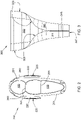
- an inventive sleeping bag is shown in Figs. 1B and 1C and comprises a top cover 300 and a bottom sheet 200; an inventive sleeping bag can further include a sleeping pad 100 ( e.g., as shown in Fig. 1A ), or a sleeping pad can be provided separately.
- a sleeping pad 100 e.g., as shown in Fig. 1A
- a sleeping pad can be provided separately.
- the top cover 300 is referred to as a quilt or comforter
- the bottom sheet 200 is referred to simply as a sheet.
- the top cover 300 can be arranged to act as a thermal insulator or can include any suitable or desired insulating material.
- the bottom sheet 200 is structurally arranged so as to be secured to the sleeping pad 100, and includes a sheet portion 201 and a pair of flexible opposing lateral flaps 220, which are each connected along their corresponding medial edges 223 to the sheet portion 201.
- the sleeping pad 100 is also referred to as a mattress
- the lateral flaps 220 are referred to as hinges or hinge elements.
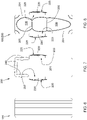
- Attachment "along" a lateral edge of the sleeping pad 100 can denote attachment directly on the lateral edge (e.g., as in Figs. 7 and 8 ), or attachment generally paralleling the lateral edge but displaced only slightly medially (e.g., as in Figs. 1B and 5 ).
- "Generally paralleling" can include deviation up to, e.g., about 5° or about 10° from parallel to the lateral edge; displaced "slightly medially” can include medial displacement from the lateral edge of up to, e.g., about 1 inch, about 2 inches, about 3 inches, or about 5 inches.
- Attachment can be by sewing, adhering, thermal or ultrasonic bonding or welding, or any other suitable attachment method.
- Suitable materials for forming the lateral flaps 220 can include one or more of stretchable materials, non-stretchable materials, thermally insulating materials, or non-insulating materials.
- the lateral flaps 220 and the sheet portion 201 can comprise the same one or more materials.
- the transverse distance along each lateral flap 220 between its medial and lateral edges 223 and 225 i.e., the flap width
- the transverse distance along each lateral flap 220 between its medial and lateral edges 223 and 225 is greater than or about equal to 4 inches, and can be greater than or about equal to 5 inches, greater than or about equal to 6 inches, greater than or about equal to 7 inches, greater than or about equal to 9 inches, greater than or about equal to 11 inches, or even larger.
- the flap width is substantially constant along the length of the lateral flap 220 (i.e., the flap length); in other examples the flap width can vary along the flap length, e.g., monotonically increasing or decreasing with increasing footward distance along the flap length, or exhibiting some more complicated width variation along the flap length.
- a given flap width variation (or lack thereof) can be selected to provide desired fit characteristics for the inventive sleeping bag.
- the top cover 300 and the pair of lateral flaps 220 are structurally arranged so as to enable attachment, detachment, and reattachment of each lateral flap 220 along its corresponding lateral edge 225 to the outer surface 301 of the top cover 300.
- the lateral edge 225 of each lateral flap 220 is attached to the top cover 300 along a corresponding curved or linear attachment path 335 along the outer surface 301 of the top cover 300.
- the outer surface 301 is the surface of the top cover 300 that faces generally away from a user occupying the sleeping bag, while the inner surface 302 is the surface of the top cover 301 that faces generally toward the user occupying the sleeping bag.
- Each attachment path 335 is displaced medially from a corresponding lateral edge 303 of the top cover 300.
- the medial displacement of the attachment paths 335 in the inventive sleeping bag is greater than or about equal to 4 inches, and can be greater than or about equal to 5 inches, greater than or about equal to 6 inches, greater than or about equal to 7 inches, greater than or about equal to 9 inches, greater than or about equal to 11 inches, or even larger.
- Such large medial displacements of the attachment paths 335 from the lateral edges 303 of the top cover 300 are substantially larger than a displacement resulting from use of a typical zipper baffle such as might be employed with an edge zipper (e.g., typically less than about 2 or 3 inches of displacement of the edge zipper from a corresponding edge; an example of a typical zipper baffle is shown on the lower right edge 345 of the top cover 300 in Fig. 1C ).
- the relatively large medial displacement (e.g., greater than or about equal to 4 inches or more, as noted above) of the attachment paths 335 from the corresponding lateral edges 303 of the top cover 300, and the transverse distance across each lateral flap 220 (e.g., flap width greater than or about equal to 4 inches or more, as noted above), enable the inventive sleeping bag (with the bottom sheet 200 secured to the sleeping pad 100, and with the lateral flaps 220 attached to the top cover 300 along the attachment paths 335) to assume different arrangements according to the desires of a user occupying the sleeping bag, and to be converted between those different arrangements while the user occupies the sleeping bag.
- a headward portion the top cover 300 (i.e., that portion extending in a headward direction from footward ends of the attachment paths 335 and the attached lateral flaps 220) can assume both wrapped and expanded configurations, and can be converted between those configurations while the user occupies the sleeping bag.
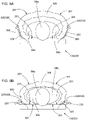
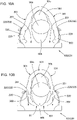
- Figs. 9A/9B and 10A/10B are schematic views in a footward direction from the headward end of the inventive sleeping bag occupied by a user having a head 99a and torso 99b; in Figs. 9A/9B the user lies on his or her back, while in Figs. 10A/10B the user lies on his or her side.
- the wrapped configuration e.g., as in Figs.
- the headward portion of the top cover 300 is arranged with portions of the top cover outer surface 301, that are disposed laterally relative to the attachment paths 335, turned under and positioned against the sheet portion 201 of the bottom sheet 200; those lateral, headward portions of the top cover 300 can extend beneath a portion of the torso 99b of the user occupying the sleeping bag, and can even overlap one another if wrapped sufficiently tightly.
- the wrapped configuration might be desirable for a user having a petite or slight build, or to reduce or minimize the interior volume of the sleeping bag to keep the user warmer in colder conditions.
- the expanded configuration (as in Figs.
- each one of the lateral flaps 220, and laterally disposed portions of the top cover 300 extend upward or laterally away from the corresponding lateral edges of the sleeping pad 100. In some examples, little or none of those lateral, headward portions of the top cover 300 remains in contact with the sheet portion 201 of the bottom sheet 200. In some other examples, some lateral, headward portions of the top cover 300 can remain in contact with the sheet portion 201 of the bottom sheet 200 (albeit substantially less than in the wrapped arrangement).
- the expanded configuration might be desirable for a user having a bulkier build, or to increase or maximize the interior volume of the sleeping bag to adapt to warmer conditions or to allow more freedom of movement or more comfortable sleep for the user occupying the sleeping bag (e.g., on the user's back as in Figs. 9A/9B or on the user's side as in Figs. 10A/10B ).
- distance along the top cover 301 from each attachment path 335 to the corresponding lateral edge 303 of the top cover 300 typically is greater than, or at least about equal to, distance along each lateral flap 220 from its medial edge to its lateral edge 225.
- the inventive sleeping bag provides the new and useful result that the sleeping bag can be used comfortably by users of various different builds (e.g., with the headward portion of the top cover 300 in the wrapped configuration for a user with a slender build, or in the expanded configuration for a user with a stout build) or under different temperature conditions (e.g., with the headward portion of the top cover 300 in the wrapped configuration for colder conditions, or in the expanded configuration for warmer conditions or to provide more freedom of movement for the user).
- a single inventive sleeping bag can take the place of multiple different conventional sleeping bags that are each suitable for only a relatively narrow range of temperature conditions.
- Conventional sleeping bags of multiple different sizes for accommodating users of different sizes can be replaced by inventive sleeping bags of relatively fewer different sizes, or even only a single size (so-called one-size-fits-all or one-size-fits-most scenarios).
- Weight can also be reduced relative to a conventional sleeping bag, because a portion of thermally insulating material that would necessarily end up underneath the user in a conventional sleeping bag can be omitted from the inventive sleeping bag, while still providing increased freedom of movement with the top cover in its expanded configuration.
- the attachment of the top cover 300 to the lateral flaps 220 also serves to prevent, in most instances, the user from sliding or rolling off of the sleeping pad 100; the lateral flaps 220 obstruct such movements of the user.
- the sleeping pad 100 can be of any suitable type or arrangement, including but not limited to a foam pad or an inflatable pad. Typical widths include widths from about 20 inches to about 30 inches; other suitable widths can be employed outside of that range. Typical lengths includes lengths from about 36 inches to about 80 inches, typically from about 60 inches to about 80 inches for adults; other lengths outside those ranges can be employed.
- the sleeping pad 100 can act as a thermal insulator or can include any suitable or desired thermally insulating material.
- the sleeping pad can be roughly rectangular (e.g., as in Fig. 6 ), or can have a mummy-like shape (i.e., similar to the shape of a conventional mummy-type sleeping bag; e.g., as in Fig.
- the sheet portion 201 of the bottom sheet 200 is suitably sized and shaped according to the size and shape of the sleeping pad 100 with which it is intended to be used.
- the bottom sheet 200 and the sleeping pad 100 are separate articles.
- the sleeping pad 100 can be one article of a set that also includes the bottom sheet 200 and the top cover 300 of an inventive sleeping bag, or can be an item that is acquired by a user separately from acquiring the inventive sleeping bag.
- the bottom sheet 200 and the sleeping pad 100 can be integrally formed (i.e., the sheet portion 201 forms a surface of the sleeping pad 100, so that the lateral flaps 220 are attached directly to the sleeping pad 100).
- the sleeping pad 100 is necessarily acquired by the user as a part of the inventive sleeping bag.
- the sheet portion 201 of the bottom sheet 200 can be arranged so as to be secured to the sleeping pad 100 in a fitted-sheet arrangement (e.g., as in Figs. 2 and 8 ).
- the sheet portion 201 can include corner pockets or end pockets arranged to receive corresponding portions of the sleeping pad 100 and hold the bottom sheet 200 secured to the sleeping pad 100.
- the sheet portion can include elastic or a draw cord arranged to maintain the sheet portion 201 in the fitted-sheet arrangement.
- the bottom sheet 200 can include one or more straps 205 arranged to maintain the sheet portion in the fitted-sheet arrangement.
- Each strap 205 can be arranged so that, with sheet portion 201 of the bottom sheet 200 secured to the sleeping pad 100 in the fitted-sheet arrangement, each strap 205 is connected to opposite edges of sheet portion 201 and passes underneath the sleeping pad 100.
- One or more of the straps 205 can be positioned along the length of the sheet portion 201 so as to fall within the lengthwise span of the lateral flaps 220; thus arranged, the straps 205 are advantageously positioned to prevent tension on the lateral flap 220 from pulling a side edge of the sheet portion 201 off of the sleeping pad 100 as a user-occupant moves around within the sleeping bag.
- Any suitable or desired number of straps 205 can be employed; two straps 205 are shown in the examples of Figs. 2 and 8 .
- the bottom sheet 200 can be secured to the sleeping pad 100 in any suitable or desired way, e.g., using zippers, sets of fasteners, or other methods of attachment.
- each lateral flap 220 extends in headward and footward directions to any suitable or desired positions along the sleeping pad 100, e.g., over the entire length of the sleeping pad 100 or over only a portion of the length of the sleeping pad 100.
- the footward ends of the lateral flaps 220 extend no further than about a midpoint of the sleeping pad 100 (e.g., extend less than or about equal to 36 inches from the headward end of a 72-inch sleeping pad).
- neither lateral flap 220 extends in a headward direction as far as a headward end of the sleeping pad 100.
- the headward portion of the top cover 300 typically extends only as far footward as the footward ends of the lateral flaps 220, and typically extends headward beyond the headward ends of the lateral flaps 220.
- lateral flaps 220 that do not reach the headward end of the sleeping pad 100 and a headward portion of the top cover 300 that extends headward beyond the lateral flaps 220 enables a user occupying the sleeping bag to decide whether or how much to cover the user's arms, shoulders, upper torso, or head.
- a portion of the top cover 300 that extends beyond the lateral flaps 220 is folded footward, so that a headward portion of the top cover inner surface 302 is exposed.
- Fig. 5 in which the headward portion of the top cover 300 is in the wrapped configuration
- the top cover 300 extends headward beyond the lateral flaps 220.
- each lateral flap 220 includes a zipper element that mates with a corresponding zipper element arranged along the corresponding attachment path 335 on the top cover 300.
- Those mating zipper elements enable the attachment, detachment, and reattachment of each lateral flap 220 along its lateral edge 225 to the outer surface 301 of the top cover 300 along the corresponding curved or linear attachment path 335 (typically linear).
- the top cover 300 and the bottom sheet 200 can include corresponding sets of mating fastener elements arranged along the lateral edges 225 of the lateral flaps 220 and along the attachment paths 335 that enable the attachment, detachment, and reattachment of each lateral flap 220 along its lateral edge 225 to the outer surface 301 of the top cover 300 along the corresponding attachment path 335.
- suitable fastener elements can include, e.g., snaps, clasps, hook-and-loop, buttons, ties or laces, and so forth.
- a headward portion of the top cover 300 can be arranged in the wrapped or expanded configuration; that headward portion extends headward from the footward ends of the attachment paths 335 (and headward from the footward ends of the lateral flaps 220 when the top cover is attached to the bottom sheet 200).
- a footward portion of the top cover 300 can be arranged as a closed footbox (i.e., a fixed tubular portion with a fixedly closed end).
- the footward portion of the top cover 300 can also be structurally arranged to assume different configurations according to the needs or desires of a user occupying the sleeping bag.
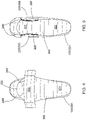
- the footward portion of the top cover can be structurally arranged to assume a tubular configuration (e.g., as in Fig. 3 through 5 ); corresponding footward portions 345 of the opposite lateral edges 303 of the top cover 300 can be secured together to form the tubular configuration.
- the footward portions 345 of the lateral edges 303 of the top cover 300 can, but need not, extend headward as far as the footward ends of the attachment paths 335, but typically no farther; in the example of Fig. 1C the footward portion (indicated by the presence of mating zipper elements along footward portions 345 the lateral edges 303 of the top cover 300) does not extend headward as far as the attachment paths 335.
- the footward portion of the top cover 300 can be further arranged to enable separation of footward portions 345 of the lateral edges 303 of the top cover 300, so that the footward portion of the top cover 300 can assume a substantially flattened configuration (e.g., as in Fig. 1C ).
- the footward portions 345 of the lateral edges 303 of the top cover 300 can include mating zipper elements to enable those edges to be secured together or separated.
- sets of mating fastener elements can be employed for securing together those edge portions together (to assume the tubular configuration) or allowing them to separate (to assume a substantially flattened configuration).
- a footward end 347 of the top cover 300 can be further arranged to enable the footward end of the top cover 300 to be closed when it is arranged in the tubular configuration (e.g., as in Figs. 4 and 5 ).
- the footward end of the top cover 300 can include one or more zippers, fasteners, drawstrings, or other devices or arrangements for closing the footward end 347 of the top cover 300 when it is in the tubular configuration.
- footward portions 345 of the top cover lateral edges 303 can be secured together so that the footward portion of the top cover 300 is arranged in the tubular configuration; the footward end 347 of the top cover 300 can also be closed, if desired. In that way the lower portions of the user's body are completely encircled by the top cover 300. In conjunction with the wrapped arrangement of the headward portion of the top cover 300, maximal warmth is provided to the user occupying the sleeping bag.
- the footward portions 345 of the top cover lateral edges 303 can be separated and the footward portion of the top cover 300 can be arranged in the flattened configuration.
- the lower portions of the user's body can move unconstrained by the top cover 300, and can even move out from under the top cover 300.
- increased freedom of movement is available to the user occupying the sleeping bag. If even more freedom of movement is desired, or if a given temperature is too warm for the user's comfort beneath the top cover 300, the top cover 300 can be detached from one or both lateral flaps 220 while the user occupies the sleeping bag.
- top cover 300 Detachment of the top cover 300 from one or both lateral flaps 220 enables the user to arrange the top cover 300 to cover, or leave uncovered, any desired portions of the user's body for achieving comfort under the given temperature conditions, in a manner similar to use of traditional bedding.
- the bottom sheet 200 of the inventive sleeping bag includes a hood 240 comprising a transverse hood segment and a pair of lateral hood segments.
- the hood 240 is attached to the sheet portion 201 of the bottom sheet 200 so that, with the bottom sheet 200 secured to the sleeping pad 100, (i) the transverse hood segment is positioned across a headward end of the sleeping pad 100, and (ii) the lateral hood segments are positioned along corresponding headward portions of corresponding opposite lateral edges of the sleeping pad 100.
- the hood 240 can act as a thermal insulator or include thermally insulating material.
- the hood 240 can be arranged to surround the user's head and shoulders while occupying the sleeping bag (e.g., in conjunction with the headward portion of the top cover 300 being arranged in the wrapped configuration, and with the footward portion of the top cover 300 being arranged in the tubular configuration with the footward end closed; optionally part of the headward portion of the top cover 300 can be tucked into the hood 240, e.g., as in Fig. 5 ).
- the hood 240 can be folded down to act as a pillow for the user's head (e.g., in conjunction with the headward portion of the top cover 300 being arranged in the expanded configuration and optionally folded down over the lateral flaps 220 as in Fig.
- a separate pillow 250 can be positioned within the hood 240 on the bottom sheet 200, if desired (e.g., as in Fig. 4 ).
- each lateral flap 220 can be integrally formed with a corresponding one of the lateral hood segments; one advantage of such an arrangement is a headward portion of the top cover 300 can be readily tucked into the hood 240 in cooler conditions.
- the hood 240 and the lateral flaps 220 are separate portions of the bottom sheet 200. In such examples, each lateral flap 220 can extend in a footward direction from a corresponding footward end of the corresponding lateral hood segment.
- a headward portion of each lateral flap 220 and a corresponding footward portion of the corresponding lateral hood segment overlap one another; in some of those examples, the overlapping portions of the lateral hood segments are positioned medially relative to the corresponding overlapping portions of the lateral flaps 220, to maintain thermal integrity of the sleeping bag when the lateral flaps 220 are secured to the top cover 300.
- one or more of the hood 240, the bottom sheet 200, or the top cover 300 can be provided with a storage pocket formed therein or thereon.
- a storage pocket can include a zipper, fastener, or other closure if needed or desired.
- any one or more materials suitable for constructing a conventional sleeping bag can be employed for constructing an inventive sleeping bag.
- materials include, but are not limited to: nylon, polyester, silk, cotton, taffeta, ripstop, pongee, flannel, microfiber, Gore-Tex, or fleece; natural down, synthetic insulation, or other insulating material; or metal-coated polymer film or other thermally shielding or thermally reflective material.
- one or more of the sleeping pad, bottom sheet, or top cover can include heating elements, e.g., electrical or chemical heating elements.
- Example 1 A sleeping bag comprising a top cover and a bottom sheet, wherein: (a) the bottom sheet is structurally arranged so as to be secured to a sleeping pad; (b) the bottom sheet includes a sheet portion and a pair of flexible opposing lateral flaps connected along corresponding medial edges thereof to the sheet portion so that, with the bottom sheet secured to the sleeping pad, the lateral flaps are positioned along corresponding opposite lateral edges of the sleeping pad; and (c) the top cover and the pair of lateral flaps are structurally arranged so as to enable attachment, detachment, and reattachment of each lateral flap along a corresponding lateral edge thereof to an outer surface of the top cover along a corresponding curved or linear attachment path displaced medially from a corresponding lateral edge of the top cover.
- Example 2 The sleeping bag of Example 1 wherein, with the bottom sheet secured to the sleeping pad and with the lateral flaps attached to the top cover, the top cover and the bottom sheet are structurally arranged so as to enable a headward portion of the top cover, which extends in a headward direction from footward ends of the lateral flaps, (i) to assume a wrapped configuration with portions of the top cover outer surface, that are disposed laterally relative to the attachment paths, being positioned against the sheet portion of the bottom sheet; (ii) to assume an expanded configuration with each one of the lateral flaps, and laterally disposed portions of the top cover, extending upward or laterally away from the corresponding lateral edges of the sleeping pad; and (iii) to be converted between the wrapped and expanded configurations by a user occupying the sleeping bag.
- Example 3 The sleeping bag of any one of Examples 1 or 2 wherein distance along each flap from the medial edge thereof to the lateral edge thereof is greater than or about equal to 4 inches, greater than or about equal to 5 inches, greater than or about equal to 6 inches, greater than or about equal to 7 inches, greater than or about equal to 9 inches, greater than or about equal to 11 inches, or even larger.
- Example 4 The sleeping bag of any one of Examples 1 through 3 wherein distance along the top cover from each attachment path to the corresponding lateral edge of the top cover is greater than or about equal to 4 inches, greater than or about equal to 5 inches, greater than or about equal to 6 inches, greater than or about equal to 7 inches, greater than or about equal to 9 inches, greater than or about equal to 11 inches, or even larger.
- Example 5 The sleeping bag of any one of Examples 1 through 4 wherein distance along the top cover from each attachment path to the corresponding lateral edge of the top cover is greater than or about equal to distance along each flap from the medial edge thereof to the lateral edge thereof.
- Example 6 The sleeping bag of any one of Examples 1 through 5 wherein, with the bottom sheet secured to the sleeping pad, each lateral flap extends in a footward direction no further than about a midpoint of the sleeping pad.
- Example 7 The sleeping bag of any one of Examples 1 through 6 wherein, with the bottom sheet secured to the sleeping pad, neither lateral flap extends in a headward direction as far as a headward end of the sleeping pad.
- Example 8 The sleeping pad of any one of Examples 1 through 7 wherein the top cover acts as a thermal insulator or includes thermally insulating material.
- Example 9 The sleeping pad of any one of Examples 1 through 8 wherein the sleeping pad acts as a thermal insulator or includes thermally insulating material.
- Example 10 The sleeping bag of any one of Examples 1 through 9 further comprising the sleeping pad.
- Example 11 The sleeping bag of Example 10 wherein the bottom sheet and the sleeping pad are integrally formed.
- Example 12 The sleeping bag of any one of Examples 1 through 10 wherein sheet portion of the bottom sheet is arranged so as to be secured to the sleeping pad in a fitted-sheet arrangement.
- Example 13 The sleeping bag of Example 12 wherein the bottom sheet includes one or more straps arranged so that, with the sheet portion of the bottom sheet secured to the sleeping pad in the fitted-sheet arrangement, each one of the one or more straps is connected to opposite edges of the sheet portion and passes underneath the sleeping pad.
- Example 14 The sleeping bag of any one of Examples 1 through 13 wherein the bottom sheet includes a hood comprising a transverse hood segment and a pair of lateral hood segments and is attached to the sheet portion of the bottom sheet so that, with the sheet portion of the bottom sheet secured to the sleeping pad, (i) the transverse hood segment is positioned across a headward end of the sleeping pad, and (ii) the lateral hood segments are positioned along corresponding headward portions of corresponding opposite lateral edges of the sleeping pad.
- Example 15 The sleeping bag of Example 14 wherein each lateral flap is integrally formed with a corresponding one of the lateral hood segments.
- Example 16 The sleeping bag of any one of Examples 14 or 15 wherein each lateral flap extends in a footward direction from a corresponding footward end of the corresponding lateral hood segment.
- Example 17 The sleeping bag of any one of Examples 14 or 16 wherein a headward portion of each lateral flap and a corresponding footward portion of the corresponding lateral hood segment overlap one another.
- Example 18 The sleeping bag of any one of Examples 14 through 17 wherein the hood acts as a thermal insulator or includes thermally insulating material.
- Example 19 The sleeping bag of any one of Examples 1 through 18 wherein the top cover and the bottom sheet include corresponding mating zipper elements arranged so as to enable the attachment, detachment, and reattachment of each lateral flap along the corresponding lateral edge thereof to the outer surface of the top cover along the corresponding curved or linear attachment path.
- Example 20 The sleeping bag of any one of Examples 1 through 19 wherein the top cover and the bottom sheet include corresponding sets of mating fastener elements arranged so as to enable the attachment, detachment, and reattachment of each lateral flap along the corresponding lateral edge thereof to the outer surface of the top cover along the corresponding curved or linear attachment path.
- Example 21 The sleeping bag of any one of Examples 1 through 20 wherein a footward portion of the top cover is structurally arranged so as to enable the footward portion of the top cover to assume a tubular configuration with corresponding footward portions of opposite lateral edges of the top cover secured together.
- Example 22 The sleeping bag of Example 21 wherein the top cover includes corresponding mating zipper elements arranged along the footward portions of the opposite lateral edges of the top cover so as to enable (i) the footward portion of the top cover to assume the tubular configuration with the footward portions of the lateral edges secured together, and (ii) the footward portions of the lateral edges of the top cover to be detached from each other and thereby enable the footward portion of the top cover to assume a substantially flattened configuration.
- Example 23 The sleeping bag of any one of Examples 21 or 22 wherein the top cover includes corresponding sets of mating fastener elements arranged along the footward portions of the opposite lateral edges of the top cover so as to enable (i) the footward portion of the top cover to assume the tubular configuration with the footward portions of the lateral edges secured together, and (ii) the footward portions of the lateral edges of the top cover to be detached from each other and thereby enable the footward portion of the top cover to assume a substantially flattened configuration.
- Example 24 The sleeping bag of any one of Examples 21 through 23 wherein a footward end of the top cover is structurally arranged so as to enable, with the footward portion of the top cover in the tubular configuration, the footward end of the top cover to be closed.
- Example 25 The sleeping bag of Example 24 wherein the footward end of the top cover includes one or more zippers, fasteners, or drawstrings arranged so as to enable, with the footward portion of the top cover in the tubular configuration, the footward end of the top cover to be closed.
- Example 26 The sleeping bag of any one of Examples 21 through 25 wherein the footward portion of the top cover extends headward at least a far as footward ends of the connection paths.
- Example 27 The sleeping bag of any one of Examples 1 through 26 further comprising a pillow positioned within the hood.
- Example 28 The sleeping bag of any one of Examples 1 through 27 further comprising a storage pocket formed in or on the hood, the bottom sheet, or the top cover.
- Example 29 A method for using the sleeping bag of any one of Examples 1 through 28, the method comprising: (A) with the bottom sheet secured to the sleeping pad, attaching each lateral flap along the corresponding lateral edge thereof to the outer surface of the top cover along the corresponding attachment path so that a user occupying the sleeping bag is at least partly enclosed by the bottom sheet and the top cover; and one or both of: (B) with the lateral flaps attached to the top cover, arranging a headward portion of the top cover, which extends in a headward direction from footward ends of the lateral flaps, to assume a wrapped configuration with portions of the top cover outer surface that are disposed laterally relative to the attachment paths being positioned against the sheet portion of the bottom sheet underneath the user; or (C) with the lateral flaps attached to the top cover, arranging the headward portion of the top cover to assume an expanded configuration with each one of the lateral flaps, and laterally disposed portions of the top cover, extending upward and laterally away from the corresponding lateral edges of the sleeping pad.
- Example 30 The method of Example 29 for using the sleeping bag of any one of Examples 2 through 28, the method further comprising, with the lateral flaps attached to the top cover and the user occupying the sleeping bag, converting the top cover from the wrapped configuration to the expanded configuration or from the expanded configuration to the wrapped configuration.
- Example 31 The method of any one of Examples 29 or 30 for using the sleeping bag of any one of Examples 1 through 28, the method further comprising, with the lateral flaps attached to the top cover and the user occupying the sleeping bag, detaching one or both flaps from the top cover.
- Example 32 The method of any one of Examples 29 through 31 for using the sleeping bag of any one of Examples 12 through 28, the method further comprising, before part (A), securing the bottom sheet to the sleeping pad in a fitted-sheet arrangement.
- Example 33 The method of any one of Examples 29 through 32 for using the sleeping bag of any one of Examples 21 through 28, the method further comprising arranging a footward portion of the top cover to assume a tubular configuration with corresponding footward portions of opposite lateral edges of the top cover secured together.
- Example 34 The method of any one of Examples 29 through 33 for using the sleeping bag of any one of Examples 24 through 28, the method further comprising, with the footward portion of the top cover in the tubular configuration, closing a footward end of the top cover.
- Example 35 The method of any one of Examples 29 through 34 for using the sleeping bag of any one of Examples 22 through 28, the method further comprising arranging a footward portion of the top cover to assume a substantially flattened configuration with corresponding footward portions of opposite lateral edges of the top cover separated from one another.
Landscapes
- Bedding Items (AREA)
- Thermotherapy And Cooling Therapy Devices (AREA)
Claims (14)
- Sac de couchage comprenant un recouvrement supérieur (300) et un drap de dessous (200), dans lequel :(a) le drap de dessous (200) est agencé structurellement de manière à être fixé à un matelas de sol (100) ;(b) le drap de dessous (200) inclut une portion de drap (201) et une paire de rabats latéraux opposés flexibles (220) connectés le long de bords médiaux correspondants (223) de ceux-ci à la portion de drap (201) de sorte que, avec le drap de dessous (200) fixé au matelas de sol (100), les rabats latéraux (220) sont positionnés le long de bords latéraux opposés correspondants du matelas de sol (100) ; et(c) le recouvrement supérieur (300) et la paire de rabats latéraux (220) sont agencés structurellement de manière à permettre la connexion, déconnexion et reconnexion de chaque rabat latéral (220) le long d'un bord latéral correspondant (225) de celui-ci à une surface externe (301) du recouvrement supérieur (300) le long d'un trajet de connexion courbé ou linéaire correspondant (335) déplacé de manière médiale depuis un bord latéral correspondant (303) du recouvrement supérieur (300) ; caractérisé en ce que le drap de dessous (200) inclut une capuche (240) comprenant un segment de capuche transversal et une paire de segments de capuche latéraux, et est connectée à la portion de drap (201) du drap de dessous (200) de sorte que, avec la portion de drap (201) du drap de dessous (200) fixée au matelas de sol (100), (i) le segment de capuche transversal est positionné en travers d'une extrémité vers la tête du matelas de sol (100), et (ii) les segments de capuche latéraux sont positionnés le long de portions vers la tête correspondantes de bords latéraux opposés correspondants du matelas de sol (100), dans lequel, en option, chaque rabat latéral (220) est intégralement formé d'un segment correspondant des segments de capuche latéraux.
- Sac de couchage selon la revendication 1, dans lequel, avec le drap de dessous (200) fixé au matelas de sol (100) et avec les rabats latéraux (220) connectés au recouvrement supérieur (300), le recouvrement supérieur (300) et le drap de dessous (200) sont agencés structurellement de manière à permettre à une portion vers la tête du recouvrement supérieur (300), qui s'étend dans une direction vers la tête depuis des extrémités vers les pieds des rabats latéraux (220), (i) d'adopter une configuration enveloppée avec des portions de la surface externe de recouvrement supérieur (301), qui sont disposées latéralement par rapport aux trajets de connexion (335), qui sont positionnées contre la portion de drap (201) du drap de dessous (200) ; (ii) d'adopter une configuration déployée avec chacun des rabats latéraux (220), et des portions disposées latéralement du recouvrement supérieur (300), s'étendant vers le haut ou latéralement à l'écart des bords latéraux correspondants du matelas de sol (100) ; et (iii) d'être convertie entre les configurations enveloppée et déployée par un utilisateur occupant le sac de couchage.
- Sac de couchage selon la revendication 1, dans lequel la distance le long de chaque rabat (220) du bord médial (223) de celui-ci au bord latéral (225) de celui-ci est supérieure à ou environ égale à 4 pouces.
- Sac de couchage selon la revendication 1, dans lequel la distance le long du recouvrement supérieur (300) de chaque trajet de connexion (335) au bord latéral correspondant (303) du recouvrement supérieur (300) est supérieure à ou environ égale à 4 pouces.
- Sac de couchage selon la revendication 1, dans lequel la distance le long du recouvrement supérieur (300) de chaque trajet de connexion (335) au bord latéral correspondant (303) du recouvrement supérieur (300) est supérieure à ou environ égale à la distance le long de chaque rabat (220) du bord médial (223) de celui-ci au bord latéral (225) de celui-ci.
- Sac de couchage selon la revendication 1, comprenant en outre le matelas de sol (100), dans lequel, en option, le drap de dessous (200) et le matelas de sol (100) sont intégralement formés.
- Sac de couchage selon la revendication 1, dans lequel la portion de drap (201) du drap de dessous (200) est agencée de manière à être fixée au matelas de sol (100) dans un agencement de drap housse, dans lequel, en option, le drap de dessous (200) inclut une ou plusieurs bandes (205) agencées de sorte que, avec la portion de drap (201) du drap de dessous (200) fixée au matelas de sol (100) dans l'agencement de drap housse, chacune de la ou des bandes (205) est connectée à des bords opposés de la portion de drap (201) et passe en dessous du matelas de sol (100).
- Sac de couchage selon la revendication 1, dans lequel le recouvrement supérieur (300) et le drap de dessous (200) incluent des éléments de fermeture éclair conjugués correspondants ou des ensembles correspondants d'éléments de fixation conjugués agencés de manière à permettre la connexion, déconnexion et reconnexion de chaque rabat latéral (220) le long du bord latéral correspondant (225) de celui-ci à la surface externe (301) du recouvrement supérieur (300) le long du trajet de connexion courbé ou linéaire correspondant (335).
- Sac de couchage selon la revendication 1, dans lequel une portion vers les pieds du recouvrement supérieur (300) est agencée structurellement de manière à permettre à la portion vers les pieds du recouvrement supérieur (300) d'adopter une configuration tubulaire avec des portions vers les pieds correspondantes de bords latéraux opposés (303) du recouvrement supérieur (300) fixées ensemble, dans lequel, en option, une extrémité vers les pieds du recouvrement supérieur (300) est agencée structurellement de manière à permettre, avec la portion vers les pieds du recouvrement supérieur (300) dans la configuration tubulaire, à l'extrémité vers les pieds du recouvrement supérieur (300) d'être fermée, et dans lequel, en option, le recouvrement supérieur (300) inclut des éléments de fermeture éclair conjugués correspondants ou des ensembles correspondants d'éléments de fixation conjugués agencés le long des portions vers les pieds des bords latéraux opposés (303) du recouvrement supérieur (300) de manière à permettre (i) à la portion vers les pieds du recouvrement supérieur (300) d'adopter la configuration tubulaire avec les portions vers les pieds des bords latéraux (303) fixées ensemble, et (ii) aux portions vers les pieds des bords latéraux (303) du recouvrement supérieur (300) d'être déconnectées l'une de l'autre et permettre de ce fait à la portion vers les pieds du recouvrement supérieur (300) d'adopter une configuration essentiellement aplatie.
- Procédé d'utilisation du sac de couchage selon la revendication 1, le procédé comprenant :(a) avec le drap de dessous (200) fixé au matelas de sol (100), connecter chaque rabat latéral (220) le long du bord latéral correspondant (225) de celui-ci à la surface externe (301) du recouvrement supérieur (300) le long du trajet de connexion correspondant (335) de sorte qu'un utilisateur occupant le sac de couchage est au moins partiellement entouré par le drap de dessous (200) et le recouvrement supérieur (300) ;et une action ou les deux parmi :(b) avec les rabats latéraux (220) connectés au recouvrement supérieur (300), agencer une portion vers la tête du recouvrement supérieur (300), qui s'étend dans une direction vers la tête depuis des extrémités vers les pieds des rabats latéraux (220), pour adopter une configuration enveloppée avec des portions de la surface externe de recouvrement supérieur (301) qui sont disposées latéralement par rapport aux trajets de connexion (335) qui sont positionnées contre la portion de drap (201) du drap de dessous (200) en dessous de l'utilisateur ; ou(c) avec les rabats latéraux (220) connectés au recouvrement supérieur (300), agencer la portion vers la tête du recouvrement supérieur (300) pour adopter une configuration déployée avec chacun des rabats latéraux (220), et des portions disposées latéralement du recouvrement supérieur (300), s'étendant vers le haut et latéralement à l'écart des bords latéraux correspondants du matelas de sol (100).
- Procédé selon la revendication 10, comprenant en outre, avec les rabats latéraux (220) connectés au recouvrement supérieur (300) et l'utilisateur occupant le sac de couchage, convertir le recouvrement supérieur (300) de la configuration enveloppée à la configuration déployée ou de la configuration déployée à la configuration enveloppée.
- Procédé selon la revendication 10, comprenant en outre, avec les rabats latéraux (220) connectés au recouvrement supérieur (300) et l'utilisateur occupant le sac de couchage, déconnecter un rabat ou les deux du recouvrement supérieur (300).
- Procédé selon la revendication 10, comprenant en outre, avant la partie (a), fixer le drap de dessous (200) au matelas de sol (100) dans un agencement de drap housse.
- Procédé selon la revendication 10, comprenant en outre agencer une portion vers les pieds du recouvrement supérieur (300) pour adopter une des configurations suivantes :(i) une configuration tubulaire avec des portions vers les pieds correspondantes de bords latéraux opposés (303) du recouvrement supérieur (300) fixées ensemble ; et(ii) une configuration essentiellement aplatie avec des portions vers les pieds correspondantes de bords latéraux opposés (303) du recouvrement supérieur (300) séparées l'une de l'autre.
Priority Applications (2)
| Application Number | Priority Date | Filing Date | Title |
|---|---|---|---|
| EP22186795.5A EP4115775B1 (fr) | 2017-01-09 | 2018-01-08 | Sac de couchage réglable en circonférence |
| EP24198270.1A EP4445805B1 (fr) | 2017-01-09 | 2018-01-08 | Sac de couchage réglable en tour |
Applications Claiming Priority (2)
| Application Number | Priority Date | Filing Date | Title |
|---|---|---|---|
| US201762444228P | 2017-01-09 | 2017-01-09 | |
| PCT/US2018/012848 WO2018129485A1 (fr) | 2017-01-09 | 2018-01-08 | Sac de couchage à circonférence réglable |
Related Child Applications (2)
| Application Number | Title | Priority Date | Filing Date |
|---|---|---|---|
| EP24198270.1A Division EP4445805B1 (fr) | 2017-01-09 | 2018-01-08 | Sac de couchage réglable en tour |
| EP22186795.5A Division EP4115775B1 (fr) | 2017-01-09 | 2018-01-08 | Sac de couchage réglable en circonférence |
Publications (3)
| Publication Number | Publication Date |
|---|---|
| EP3551016A1 EP3551016A1 (fr) | 2019-10-16 |
| EP3551016A4 EP3551016A4 (fr) | 2020-08-19 |
| EP3551016B1 true EP3551016B1 (fr) | 2022-07-27 |
Family
ID=62782462
Family Applications (3)
| Application Number | Title | Priority Date | Filing Date |
|---|---|---|---|
| EP24198270.1A Active EP4445805B1 (fr) | 2017-01-09 | 2018-01-08 | Sac de couchage réglable en tour |
| EP18736232.2A Active EP3551016B1 (fr) | 2017-01-09 | 2018-01-08 | Sac de couchage à circonférence réglable |
| EP22186795.5A Active EP4115775B1 (fr) | 2017-01-09 | 2018-01-08 | Sac de couchage réglable en circonférence |
Family Applications Before (1)
| Application Number | Title | Priority Date | Filing Date |
|---|---|---|---|
| EP24198270.1A Active EP4445805B1 (fr) | 2017-01-09 | 2018-01-08 | Sac de couchage réglable en tour |
Family Applications After (1)
| Application Number | Title | Priority Date | Filing Date |
|---|---|---|---|
| EP22186795.5A Active EP4115775B1 (fr) | 2017-01-09 | 2018-01-08 | Sac de couchage réglable en circonférence |
Country Status (5)
| Country | Link |
|---|---|
| US (4) | US10786100B2 (fr) |
| EP (3) | EP4445805B1 (fr) |
| CN (1) | CN110167397B (fr) |
| AU (1) | AU2018205333B2 (fr) |
| WO (1) | WO2018129485A1 (fr) |
Families Citing this family (9)
| Publication number | Priority date | Publication date | Assignee | Title |
|---|---|---|---|---|
| USD889771S1 (en) * | 2013-09-06 | 2020-07-14 | Exxel Outdoors, Llc | Sleeping bag |
| RU185609U1 (ru) * | 2018-07-18 | 2018-12-12 | Иван Юрьевич Бринк | Составной спальный мешок |
| US10765240B2 (en) | 2018-07-22 | 2020-09-08 | Zenbivy LLC | Sleeping bag closure |
| US20220151408A1 (en) * | 2020-07-20 | 2022-05-19 | Lisa Edwards | Elastic gusset sleeping bag |
| US11116338B1 (en) * | 2021-01-06 | 2021-09-14 | Matthew J. Mundt | Body compression sleepwear with a leg opening |
| USD940997S1 (en) * | 2021-01-12 | 2022-01-18 | Matthew J. Mundt | Compression sleepwear |
| US12349826B2 (en) * | 2021-09-02 | 2025-07-08 | Zenbivy LLC | Adjustable quilt |
| US20240099484A1 (en) | 2022-09-23 | 2024-03-28 | Zenbivy LLC | Quilt with footbox |
| US20250064221A1 (en) * | 2023-08-24 | 2025-02-27 | Hest Corporation | Comforter blanket |
Family Cites Families (57)
| Publication number | Priority date | Publication date | Assignee | Title |
|---|---|---|---|---|
| US1263825A (en) * | 1917-07-06 | 1918-04-23 | Julia Nott Waugh | Camp bedding-roll. |
| US2656540A (en) | 1951-01-15 | 1953-10-27 | Verne L Stephenson | Robe with fasteners |
| DE1877004U (de) * | 1961-02-21 | 1963-08-08 | Daniel Alexandre Carrez | Schlafsack. |
| CH557667A (de) * | 1972-05-17 | 1975-01-15 | Huebner Geb Beck Heidegund | Sicherheitsschlafsack fuer kleinkinder und babys. |
| US3857124A (en) * | 1973-07-02 | 1974-12-31 | B Hadley | Bedclothes |
| US4217662A (en) | 1978-04-17 | 1980-08-19 | Barclay Home Products, Inc. | Comforter and robe combination |
| US4301561A (en) * | 1979-01-23 | 1981-11-24 | Mcleod Margaret | Separable, fitted liner and bed sheet for waterbeds |
| US4484362A (en) | 1980-05-21 | 1984-11-27 | Asher Ron E | Multi-purpose outerwear |
| US4739529A (en) * | 1983-05-10 | 1988-04-26 | Mills Carol B | Convertible doll and sleeping bag |
| NO833318L (no) * | 1983-09-15 | 1985-03-18 | More Tekstilfab | Overlevelsesteppe |
| US4757832A (en) * | 1986-04-16 | 1988-07-19 | Russell Chesley G | Self-supporting outdoor sleeping system |
| US5125547A (en) * | 1984-03-06 | 1992-06-30 | Russell Chesley G | Article compression and compression pack |
| US4790040A (en) * | 1987-04-06 | 1988-12-13 | Grilliot William L | Transport container for victim contaminated by hazardous material |
| US5193235A (en) * | 1992-05-29 | 1993-03-16 | Kathy Kircher | Flat lying sleeping bag |
| US5386602A (en) * | 1993-03-29 | 1995-02-07 | Krenzler; Leo M. | Sleeping bag with adjustable/removable mesh panel |
| US5321862A (en) * | 1993-05-04 | 1994-06-21 | Katherine Campbell | Bed making method and bedclothes to accomodate same |
| US5333769A (en) * | 1993-07-29 | 1994-08-02 | Skroski Mitchell E | Infant carrier apparatus and method |
| CA2109387A1 (fr) * | 1993-10-27 | 1995-04-28 | Rob A. Judge | Dispositif s'adaptant a un sac de couchage |
| US5815861A (en) * | 1995-07-17 | 1998-10-06 | Lagrange; Linda | Sheet gripping system |
| US5966756A (en) * | 1997-12-31 | 1999-10-19 | Cartier; Gary R. | Convertible sleeping bag |
| US6018830A (en) | 1998-02-17 | 2000-02-01 | Howe; Robert H. | Adjustable sleeping bag with drawcords |
| US6175976B1 (en) * | 1999-08-16 | 2001-01-23 | American Recreation Products, Inc. | Sleeping bag with adjustable foot space |
| US6513164B1 (en) * | 2001-09-14 | 2003-02-04 | Renee Burnadette Hearns | Baby blanket assembly |
| US6490741B1 (en) * | 2001-10-22 | 2002-12-10 | Peggy A. Wheeler | Bed covering system |
| US20040255379A1 (en) * | 2002-03-29 | 2004-12-23 | Yu Zheng | Inflatable apparatus |
| KR100488358B1 (ko) | 2002-07-26 | 2005-05-11 | 에스케이 텔레콤주식회사 | 이동 단말기를 이용한 여행 안전 보험 서비스 방법 및시스템 |
| US6868566B2 (en) * | 2002-07-31 | 2005-03-22 | Michael Dean Gatten | Swaddling blanket |
| KR20040100133A (ko) * | 2003-05-21 | 2004-12-02 | (주)박홍근홈패션 | 탈착식 매트를 구비한 침낭 |
| FR2905580B1 (fr) * | 2006-09-12 | 2011-03-04 | Promiles | Sac de couchage adapte pour etre solidarite a un matelas |
| US20090025118A1 (en) * | 2007-07-24 | 2009-01-29 | Judith Pothier | Apparel for protecting lower body from wetness |
| US7669257B2 (en) * | 2008-01-11 | 2010-03-02 | Cas Enterprises, Inc. | Bedding assembly |
| US7832032B2 (en) * | 2009-04-03 | 2010-11-16 | Haislip Richard E | Multipurpose sleeping bag |
| US20100251482A1 (en) * | 2009-04-07 | 2010-10-07 | Macdonald Jennifer | Zippered Bedding |
| US8453280B2 (en) * | 2010-01-18 | 2013-06-04 | Aaron Martray | Quilt-style sleeping bag with associated sleeping pad attachment system and method of use thereof |
| FR2979811A1 (fr) * | 2011-09-12 | 2013-03-15 | Decathlon Sa | Sac de couchage apte a recevoir un matelas, et ensemble comprenant un sac de couchage et un matelas. |
| CN202525712U (zh) * | 2012-03-20 | 2012-11-14 | 江苏省阿珂姆野营用品有限公司 | 一种可调节睡袋 |
| CN202636380U (zh) * | 2012-06-04 | 2013-01-02 | 扬州金泉旅游用品有限公司 | 一种弹性睡袋 |
| US8707479B2 (en) * | 2012-07-16 | 2014-04-29 | Gary N. Benninger | Sleeping bag |
| CN203059105U (zh) | 2012-12-31 | 2013-07-17 | 杭州马帝格罗服饰有限公司 | 可变大小的睡袋 |
| US9523165B2 (en) * | 2012-12-31 | 2016-12-20 | Kade Enterprises Llc | Bed covering product and method of manufacture |
| AU2014239566A1 (en) * | 2013-03-15 | 2015-10-01 | Exxel Outdoors, Llc | Sleeping bag |
| US8950023B2 (en) | 2013-04-29 | 2015-02-10 | Seth Jacobsen | Multipurpose attachable protective blanket |
| US9486095B2 (en) * | 2013-05-29 | 2016-11-08 | Exxel Outdoors, Llc | Shell with arm ports |
| EP2891432B1 (fr) * | 2013-12-31 | 2018-06-20 | KaDe Enterprises LLC | Protection de lit et procédé de fabrication |
| CN204091535U (zh) * | 2014-07-11 | 2015-01-14 | 天津润德户外用品有限公司 | 保暖睡袋 |
| JP3195245U (ja) | 2014-10-24 | 2015-01-08 | グローブ有限会社 | 寝袋 |
| US9756882B2 (en) * | 2015-01-07 | 2017-09-12 | Servant's Heart Outfitters, L.L.C. | Blanket to protect body from harsh environmental conditions |
| CN204734245U (zh) * | 2015-06-17 | 2015-11-04 | 天津天石休闲用品有限公司 | 绒棉混合拓展睡袋 |
| CN104921527A (zh) * | 2015-06-17 | 2015-09-23 | 天津天石休闲用品有限公司 | 绒棉混合拓展睡袋及制作方法和使用方法 |
| CN104921528B (zh) * | 2015-06-17 | 2016-08-17 | 天津天石休闲用品有限公司 | 环拱形睡袋及制作方法和使用方法 |
| US10010198B2 (en) * | 2015-07-21 | 2018-07-03 | Exxel Outdoors, Llc | Sleeping bag with blanket |
| US20170238734A1 (en) * | 2016-02-24 | 2017-08-24 | Gregory Joseph Pastor | Partitioned Modular Bedding |
| CN205696936U (zh) * | 2016-04-15 | 2016-11-23 | 常州喜马拉雅户外用品有限公司 | 一种睡袋 |
| US10555628B2 (en) | 2016-12-20 | 2020-02-11 | The North Face Apparel Corp. | Multi-climate sleeping bag |
| US10702072B2 (en) * | 2017-12-18 | 2020-07-07 | Nai-Yu LIU | Bedding assembly |
| US11812879B2 (en) * | 2021-02-28 | 2023-11-14 | Born Outdoor Group, Ltd. | Modular portable bedding system |
| US12262835B2 (en) * | 2021-10-27 | 2025-04-01 | Julie Kozak | Multi-mode sleeping bag for children |
-
2018
- 2018-01-08 EP EP24198270.1A patent/EP4445805B1/fr active Active
- 2018-01-08 EP EP18736232.2A patent/EP3551016B1/fr active Active
- 2018-01-08 CN CN201880006322.3A patent/CN110167397B/zh active Active
- 2018-01-08 WO PCT/US2018/012848 patent/WO2018129485A1/fr not_active Ceased
- 2018-01-08 AU AU2018205333A patent/AU2018205333B2/en active Active
- 2018-01-08 EP EP22186795.5A patent/EP4115775B1/fr active Active
- 2018-01-08 US US15/865,233 patent/US10786100B2/en active Active
-
2020
- 2020-08-18 US US16/996,611 patent/US10952554B2/en active Active
-
2021
- 2021-02-09 US US17/171,676 patent/US11930952B2/en active Active
-
2024
- 2024-03-05 US US18/595,616 patent/US20240197090A1/en active Pending
Also Published As
| Publication number | Publication date |
|---|---|
| EP4445805A3 (fr) | 2025-03-26 |
| EP3551016A4 (fr) | 2020-08-19 |
| EP3551016A1 (fr) | 2019-10-16 |
| EP4445805B1 (fr) | 2026-03-04 |
| US10952554B2 (en) | 2021-03-23 |
| CN110167397B (zh) | 2021-04-06 |
| CN110167397A (zh) | 2019-08-23 |
| US20200375380A1 (en) | 2020-12-03 |
| AU2018205333A1 (en) | 2019-08-29 |
| EP4445805A2 (fr) | 2024-10-16 |
| US20210161317A1 (en) | 2021-06-03 |
| EP4115775A2 (fr) | 2023-01-11 |
| US10786100B2 (en) | 2020-09-29 |
| US20180192796A1 (en) | 2018-07-12 |
| EP4115775B1 (fr) | 2024-10-16 |
| US11930952B2 (en) | 2024-03-19 |
| EP4115775A3 (fr) | 2023-03-22 |
| WO2018129485A1 (fr) | 2018-07-12 |
| US20240197090A1 (en) | 2024-06-20 |
| AU2018205333B2 (en) | 2022-11-24 |
Similar Documents
| Publication | Publication Date | Title |
|---|---|---|
| EP3551016B1 (fr) | Sac de couchage à circonférence réglable | |
| US8256045B2 (en) | Blanket backpack | |
| US8464374B1 (en) | Multi-functional convertible blanket | |
| US8191188B2 (en) | Swaddle blanket | |
| CN111936015A (zh) | 具有一体式被子的睡袋 | |
| US20090013466A1 (en) | Pocketed body pillow cover | |
| US20050177941A1 (en) | Case for enclosing a pillow | |
| KR20140089089A (ko) | 매트리스 토퍼 | |
| US7376990B2 (en) | Sham for a travel pillow | |
| CN214433402U (zh) | 一种新型夹克睡袋 | |
| US20060272094A1 (en) | Safety blanket assembly | |
| US20080034500A1 (en) | Foot warming bed sheet | |
| KR100903980B1 (ko) | 보낭 겸용 겉싸개 | |
| CN213155176U (zh) | 一种旅行用睡袋 | |
| CN223759595U (zh) | 高度可调式枕头 | |
| KR101299401B1 (ko) | 경추 지지용 멀티 기능 베개 | |
| US3408667A (en) | Bed cover | |
| JP2006288820A (ja) | 組み合わせ掛け布団 | |
| JP3045078U (ja) | 寝具衿カバー | |
| KR200253643Y1 (ko) | 포대기 | |
| KR101749193B1 (ko) | 다기능 블랭킷 및 그 사용방법 | |
| US20200375378A1 (en) | Modular duvet apparatus and methods | |
| EP1542570A1 (fr) | Ensemble draps de lit | |
| JP2002248040A (ja) | マットレスカバー |
Legal Events
| Date | Code | Title | Description |
|---|---|---|---|
| STAA | Information on the status of an ep patent application or granted ep patent |
Free format text: STATUS: THE INTERNATIONAL PUBLICATION HAS BEEN MADE |
|
| PUAI | Public reference made under article 153(3) epc to a published international application that has entered the european phase |
Free format text: ORIGINAL CODE: 0009012 |
|
| STAA | Information on the status of an ep patent application or granted ep patent |
Free format text: STATUS: REQUEST FOR EXAMINATION WAS MADE |
|
| 17P | Request for examination filed |
Effective date: 20190710 |
|
| AK | Designated contracting states |
Kind code of ref document: A1 Designated state(s): AL AT BE BG CH CY CZ DE DK EE ES FI FR GB GR HR HU IE IS IT LI LT LU LV MC MK MT NL NO PL PT RO RS SE SI SK SM TR |
|
| AX | Request for extension of the european patent |
Extension state: BA ME |
|
| DAV | Request for validation of the european patent (deleted) | ||
| DAX | Request for extension of the european patent (deleted) | ||
| A4 | Supplementary search report drawn up and despatched |
Effective date: 20200720 |
|
| RIC1 | Information provided on ipc code assigned before grant |
Ipc: A47G 9/08 20060101AFI20200714BHEP |
|
| GRAP | Despatch of communication of intention to grant a patent |
Free format text: ORIGINAL CODE: EPIDOSNIGR1 |
|
| STAA | Information on the status of an ep patent application or granted ep patent |
Free format text: STATUS: GRANT OF PATENT IS INTENDED |
|
| INTG | Intention to grant announced |
Effective date: 20220214 |
|
| GRAS | Grant fee paid |
Free format text: ORIGINAL CODE: EPIDOSNIGR3 |
|
| GRAA | (expected) grant |
Free format text: ORIGINAL CODE: 0009210 |
|
| STAA | Information on the status of an ep patent application or granted ep patent |
Free format text: STATUS: THE PATENT HAS BEEN GRANTED |
|
| AK | Designated contracting states |
Kind code of ref document: B1 Designated state(s): AL AT BE BG CH CY CZ DE DK EE ES FI FR GB GR HR HU IE IS IT LI LT LU LV MC MK MT NL NO PL PT RO RS SE SI SK SM TR |
|
| REG | Reference to a national code |
Ref country code: CH Ref legal event code: EP |
|
| REG | Reference to a national code |
Ref country code: DE Ref legal event code: R096 Ref document number: 602018038465 Country of ref document: DE |
|
| REG | Reference to a national code |
Ref country code: AT Ref legal event code: REF Ref document number: 1506481 Country of ref document: AT Kind code of ref document: T Effective date: 20220815 |
|
| REG | Reference to a national code |
Ref country code: IE Ref legal event code: FG4D |
|
| REG | Reference to a national code |
Ref country code: LT Ref legal event code: MG9D |
|
| REG | Reference to a national code |
Ref country code: NL Ref legal event code: MP Effective date: 20220727 |
|
| PG25 | Lapsed in a contracting state [announced via postgrant information from national office to epo] |
Ref country code: SE Free format text: LAPSE BECAUSE OF FAILURE TO SUBMIT A TRANSLATION OF THE DESCRIPTION OR TO PAY THE FEE WITHIN THE PRESCRIBED TIME-LIMIT Effective date: 20220727 Ref country code: RS Free format text: LAPSE BECAUSE OF FAILURE TO SUBMIT A TRANSLATION OF THE DESCRIPTION OR TO PAY THE FEE WITHIN THE PRESCRIBED TIME-LIMIT Effective date: 20220727 Ref country code: PT Free format text: LAPSE BECAUSE OF FAILURE TO SUBMIT A TRANSLATION OF THE DESCRIPTION OR TO PAY THE FEE WITHIN THE PRESCRIBED TIME-LIMIT Effective date: 20221128 Ref country code: NO Free format text: LAPSE BECAUSE OF FAILURE TO SUBMIT A TRANSLATION OF THE DESCRIPTION OR TO PAY THE FEE WITHIN THE PRESCRIBED TIME-LIMIT Effective date: 20221027 Ref country code: NL Free format text: LAPSE BECAUSE OF FAILURE TO SUBMIT A TRANSLATION OF THE DESCRIPTION OR TO PAY THE FEE WITHIN THE PRESCRIBED TIME-LIMIT Effective date: 20220727 Ref country code: LV Free format text: LAPSE BECAUSE OF FAILURE TO SUBMIT A TRANSLATION OF THE DESCRIPTION OR TO PAY THE FEE WITHIN THE PRESCRIBED TIME-LIMIT Effective date: 20220727 Ref country code: LT Free format text: LAPSE BECAUSE OF FAILURE TO SUBMIT A TRANSLATION OF THE DESCRIPTION OR TO PAY THE FEE WITHIN THE PRESCRIBED TIME-LIMIT Effective date: 20220727 Ref country code: FI Free format text: LAPSE BECAUSE OF FAILURE TO SUBMIT A TRANSLATION OF THE DESCRIPTION OR TO PAY THE FEE WITHIN THE PRESCRIBED TIME-LIMIT Effective date: 20220727 Ref country code: ES Free format text: LAPSE BECAUSE OF FAILURE TO SUBMIT A TRANSLATION OF THE DESCRIPTION OR TO PAY THE FEE WITHIN THE PRESCRIBED TIME-LIMIT Effective date: 20220727 |
|
| REG | Reference to a national code |
Ref country code: AT Ref legal event code: MK05 Ref document number: 1506481 Country of ref document: AT Kind code of ref document: T Effective date: 20220727 |
|
| PG25 | Lapsed in a contracting state [announced via postgrant information from national office to epo] |
Ref country code: PL Free format text: LAPSE BECAUSE OF FAILURE TO SUBMIT A TRANSLATION OF THE DESCRIPTION OR TO PAY THE FEE WITHIN THE PRESCRIBED TIME-LIMIT Effective date: 20220727 Ref country code: IS Free format text: LAPSE BECAUSE OF FAILURE TO SUBMIT A TRANSLATION OF THE DESCRIPTION OR TO PAY THE FEE WITHIN THE PRESCRIBED TIME-LIMIT Effective date: 20221127 Ref country code: HR Free format text: LAPSE BECAUSE OF FAILURE TO SUBMIT A TRANSLATION OF THE DESCRIPTION OR TO PAY THE FEE WITHIN THE PRESCRIBED TIME-LIMIT Effective date: 20220727 Ref country code: GR Free format text: LAPSE BECAUSE OF FAILURE TO SUBMIT A TRANSLATION OF THE DESCRIPTION OR TO PAY THE FEE WITHIN THE PRESCRIBED TIME-LIMIT Effective date: 20221028 |
|
| PG25 | Lapsed in a contracting state [announced via postgrant information from national office to epo] |
Ref country code: SM Free format text: LAPSE BECAUSE OF FAILURE TO SUBMIT A TRANSLATION OF THE DESCRIPTION OR TO PAY THE FEE WITHIN THE PRESCRIBED TIME-LIMIT Effective date: 20220727 Ref country code: RO Free format text: LAPSE BECAUSE OF FAILURE TO SUBMIT A TRANSLATION OF THE DESCRIPTION OR TO PAY THE FEE WITHIN THE PRESCRIBED TIME-LIMIT Effective date: 20220727 Ref country code: DK Free format text: LAPSE BECAUSE OF FAILURE TO SUBMIT A TRANSLATION OF THE DESCRIPTION OR TO PAY THE FEE WITHIN THE PRESCRIBED TIME-LIMIT Effective date: 20220727 Ref country code: CZ Free format text: LAPSE BECAUSE OF FAILURE TO SUBMIT A TRANSLATION OF THE DESCRIPTION OR TO PAY THE FEE WITHIN THE PRESCRIBED TIME-LIMIT Effective date: 20220727 Ref country code: AT Free format text: LAPSE BECAUSE OF FAILURE TO SUBMIT A TRANSLATION OF THE DESCRIPTION OR TO PAY THE FEE WITHIN THE PRESCRIBED TIME-LIMIT Effective date: 20220727 |
|
| REG | Reference to a national code |
Ref country code: DE Ref legal event code: R097 Ref document number: 602018038465 Country of ref document: DE |
|
| PG25 | Lapsed in a contracting state [announced via postgrant information from national office to epo] |
Ref country code: SK Free format text: LAPSE BECAUSE OF FAILURE TO SUBMIT A TRANSLATION OF THE DESCRIPTION OR TO PAY THE FEE WITHIN THE PRESCRIBED TIME-LIMIT Effective date: 20220727 Ref country code: EE Free format text: LAPSE BECAUSE OF FAILURE TO SUBMIT A TRANSLATION OF THE DESCRIPTION OR TO PAY THE FEE WITHIN THE PRESCRIBED TIME-LIMIT Effective date: 20220727 |
|
| PLBE | No opposition filed within time limit |
Free format text: ORIGINAL CODE: 0009261 |
|
| STAA | Information on the status of an ep patent application or granted ep patent |
Free format text: STATUS: NO OPPOSITION FILED WITHIN TIME LIMIT |
|
| PG25 | Lapsed in a contracting state [announced via postgrant information from national office to epo] |
Ref country code: AL Free format text: LAPSE BECAUSE OF FAILURE TO SUBMIT A TRANSLATION OF THE DESCRIPTION OR TO PAY THE FEE WITHIN THE PRESCRIBED TIME-LIMIT Effective date: 20220727 |
|
| 26N | No opposition filed |
Effective date: 20230502 |
|
| PG25 | Lapsed in a contracting state [announced via postgrant information from national office to epo] |
Ref country code: SI Free format text: LAPSE BECAUSE OF FAILURE TO SUBMIT A TRANSLATION OF THE DESCRIPTION OR TO PAY THE FEE WITHIN THE PRESCRIBED TIME-LIMIT Effective date: 20220727 |
|
| REG | Reference to a national code |
Ref country code: CH Ref legal event code: PL |
|
| PG25 | Lapsed in a contracting state [announced via postgrant information from national office to epo] |
Ref country code: LU Free format text: LAPSE BECAUSE OF NON-PAYMENT OF DUE FEES Effective date: 20230108 |
|
| REG | Reference to a national code |
Ref country code: BE Ref legal event code: MM Effective date: 20230131 |
|
| PG25 | Lapsed in a contracting state [announced via postgrant information from national office to epo] |
Ref country code: LI Free format text: LAPSE BECAUSE OF NON-PAYMENT OF DUE FEES Effective date: 20230131 Ref country code: CH Free format text: LAPSE BECAUSE OF NON-PAYMENT OF DUE FEES Effective date: 20230131 |
|
| PG25 | Lapsed in a contracting state [announced via postgrant information from national office to epo] |
Ref country code: BE Free format text: LAPSE BECAUSE OF NON-PAYMENT OF DUE FEES Effective date: 20230131 |
|
| PG25 | Lapsed in a contracting state [announced via postgrant information from national office to epo] |
Ref country code: IE Free format text: LAPSE BECAUSE OF NON-PAYMENT OF DUE FEES Effective date: 20230108 |
|
| PG25 | Lapsed in a contracting state [announced via postgrant information from national office to epo] |
Ref country code: IT Free format text: LAPSE BECAUSE OF FAILURE TO SUBMIT A TRANSLATION OF THE DESCRIPTION OR TO PAY THE FEE WITHIN THE PRESCRIBED TIME-LIMIT Effective date: 20220727 |
|
| PG25 | Lapsed in a contracting state [announced via postgrant information from national office to epo] |
Ref country code: MC Free format text: LAPSE BECAUSE OF FAILURE TO SUBMIT A TRANSLATION OF THE DESCRIPTION OR TO PAY THE FEE WITHIN THE PRESCRIBED TIME-LIMIT Effective date: 20220727 |
|
| PG25 | Lapsed in a contracting state [announced via postgrant information from national office to epo] |
Ref country code: MC Free format text: LAPSE BECAUSE OF FAILURE TO SUBMIT A TRANSLATION OF THE DESCRIPTION OR TO PAY THE FEE WITHIN THE PRESCRIBED TIME-LIMIT Effective date: 20220727 |
|
| PG25 | Lapsed in a contracting state [announced via postgrant information from national office to epo] |
Ref country code: BG Free format text: LAPSE BECAUSE OF FAILURE TO SUBMIT A TRANSLATION OF THE DESCRIPTION OR TO PAY THE FEE WITHIN THE PRESCRIBED TIME-LIMIT Effective date: 20220727 |
|
| PG25 | Lapsed in a contracting state [announced via postgrant information from national office to epo] |
Ref country code: BG Free format text: LAPSE BECAUSE OF FAILURE TO SUBMIT A TRANSLATION OF THE DESCRIPTION OR TO PAY THE FEE WITHIN THE PRESCRIBED TIME-LIMIT Effective date: 20220727 |
|
| PG25 | Lapsed in a contracting state [announced via postgrant information from national office to epo] |
Ref country code: CY Free format text: LAPSE BECAUSE OF FAILURE TO SUBMIT A TRANSLATION OF THE DESCRIPTION OR TO PAY THE FEE WITHIN THE PRESCRIBED TIME-LIMIT; INVALID AB INITIO Effective date: 20180108 |
|
| PG25 | Lapsed in a contracting state [announced via postgrant information from national office to epo] |
Ref country code: HU Free format text: LAPSE BECAUSE OF FAILURE TO SUBMIT A TRANSLATION OF THE DESCRIPTION OR TO PAY THE FEE WITHIN THE PRESCRIBED TIME-LIMIT; INVALID AB INITIO Effective date: 20180108 |
|
| PG25 | Lapsed in a contracting state [announced via postgrant information from national office to epo] |
Ref country code: TR Free format text: LAPSE BECAUSE OF FAILURE TO SUBMIT A TRANSLATION OF THE DESCRIPTION OR TO PAY THE FEE WITHIN THE PRESCRIBED TIME-LIMIT Effective date: 20220727 |
|
| PGFP | Annual fee paid to national office [announced via postgrant information from national office to epo] |
Ref country code: GB Payment date: 20260127 Year of fee payment: 9 |
|
| PGFP | Annual fee paid to national office [announced via postgrant information from national office to epo] |
Ref country code: DE Payment date: 20260128 Year of fee payment: 9 |
|
| PGFP | Annual fee paid to national office [announced via postgrant information from national office to epo] |
Ref country code: FR Payment date: 20260126 Year of fee payment: 9 |