EP3551413B1 - Verfahren zur herstellung eines thermoplastischen materials - Google Patents
Verfahren zur herstellung eines thermoplastischen materials Download PDFInfo
- Publication number
- EP3551413B1 EP3551413B1 EP17826262.2A EP17826262A EP3551413B1 EP 3551413 B1 EP3551413 B1 EP 3551413B1 EP 17826262 A EP17826262 A EP 17826262A EP 3551413 B1 EP3551413 B1 EP 3551413B1
- Authority
- EP
- European Patent Office
- Prior art keywords
- raw material
- consolidation
- thermoplastic
- product
- fragments
- Prior art date
- Legal status (The legal status is an assumption and is not a legal conclusion. Google has not performed a legal analysis and makes no representation as to the accuracy of the status listed.)
- Active
Links
Images


Classifications
-
- B—PERFORMING OPERATIONS; TRANSPORTING
- B29—WORKING OF PLASTICS; WORKING OF SUBSTANCES IN A PLASTIC STATE IN GENERAL
- B29C—SHAPING OR JOINING OF PLASTICS; SHAPING OF MATERIAL IN A PLASTIC STATE, NOT OTHERWISE PROVIDED FOR; AFTER-TREATMENT OF THE SHAPED PRODUCTS, e.g. REPAIRING
- B29C43/00—Compression moulding, i.e. applying external pressure to flow the moulding material; Apparatus therefor
- B29C43/22—Compression moulding, i.e. applying external pressure to flow the moulding material; Apparatus therefor of articles of indefinite length
- B29C43/228—Compression moulding, i.e. applying external pressure to flow the moulding material; Apparatus therefor of articles of indefinite length using endless belts feeding the material between non-rotating pressure members, e.g. vibrating pressure members
-
- B—PERFORMING OPERATIONS; TRANSPORTING
- B29—WORKING OF PLASTICS; WORKING OF SUBSTANCES IN A PLASTIC STATE IN GENERAL
- B29C—SHAPING OR JOINING OF PLASTICS; SHAPING OF MATERIAL IN A PLASTIC STATE, NOT OTHERWISE PROVIDED FOR; AFTER-TREATMENT OF THE SHAPED PRODUCTS, e.g. REPAIRING
- B29C43/00—Compression moulding, i.e. applying external pressure to flow the moulding material; Apparatus therefor
- B29C43/32—Component parts, details or accessories; Auxiliary operations
- B29C43/36—Moulds for making articles of definite length, i.e. discrete articles
- B29C43/3697—Moulds for making articles of definite length, i.e. discrete articles comprising rollers or belts cooperating with non-rotating mould parts
-
- B—PERFORMING OPERATIONS; TRANSPORTING
- B29—WORKING OF PLASTICS; WORKING OF SUBSTANCES IN A PLASTIC STATE IN GENERAL
- B29C—SHAPING OR JOINING OF PLASTICS; SHAPING OF MATERIAL IN A PLASTIC STATE, NOT OTHERWISE PROVIDED FOR; AFTER-TREATMENT OF THE SHAPED PRODUCTS, e.g. REPAIRING
- B29C43/00—Compression moulding, i.e. applying external pressure to flow the moulding material; Apparatus therefor
- B29C43/32—Component parts, details or accessories; Auxiliary operations
- B29C43/34—Feeding the material to the mould or the compression means
- B29C2043/3405—Feeding the material to the mould or the compression means using carrying means
- B29C2043/3416—Feeding the material to the mould or the compression means using carrying means conveyor belts
-
- B—PERFORMING OPERATIONS; TRANSPORTING
- B29—WORKING OF PLASTICS; WORKING OF SUBSTANCES IN A PLASTIC STATE IN GENERAL
- B29C—SHAPING OR JOINING OF PLASTICS; SHAPING OF MATERIAL IN A PLASTIC STATE, NOT OTHERWISE PROVIDED FOR; AFTER-TREATMENT OF THE SHAPED PRODUCTS, e.g. REPAIRING
- B29C43/00—Compression moulding, i.e. applying external pressure to flow the moulding material; Apparatus therefor
- B29C43/32—Component parts, details or accessories; Auxiliary operations
- B29C43/34—Feeding the material to the mould or the compression means
- B29C2043/3405—Feeding the material to the mould or the compression means using carrying means
- B29C2043/3427—Feeding the material to the mould or the compression means using carrying means hopper, vessel, chute, tube, conveying screw, for material in discrete form, e.g. particles or powder or fibres
-
- B—PERFORMING OPERATIONS; TRANSPORTING
- B29—WORKING OF PLASTICS; WORKING OF SUBSTANCES IN A PLASTIC STATE IN GENERAL
- B29C—SHAPING OR JOINING OF PLASTICS; SHAPING OF MATERIAL IN A PLASTIC STATE, NOT OTHERWISE PROVIDED FOR; AFTER-TREATMENT OF THE SHAPED PRODUCTS, e.g. REPAIRING
- B29C43/00—Compression moulding, i.e. applying external pressure to flow the moulding material; Apparatus therefor
- B29C43/32—Component parts, details or accessories; Auxiliary operations
- B29C43/34—Feeding the material to the mould or the compression means
- B29C2043/3483—Feeding the material to the mould or the compression means using band or film carriers
-
- B—PERFORMING OPERATIONS; TRANSPORTING
- B29—WORKING OF PLASTICS; WORKING OF SUBSTANCES IN A PLASTIC STATE IN GENERAL
- B29C—SHAPING OR JOINING OF PLASTICS; SHAPING OF MATERIAL IN A PLASTIC STATE, NOT OTHERWISE PROVIDED FOR; AFTER-TREATMENT OF THE SHAPED PRODUCTS, e.g. REPAIRING
- B29C43/00—Compression moulding, i.e. applying external pressure to flow the moulding material; Apparatus therefor
- B29C43/32—Component parts, details or accessories; Auxiliary operations
- B29C43/34—Feeding the material to the mould or the compression means
- B29C2043/3488—Feeding the material to the mould or the compression means uniformly distributed into the mould
- B29C2043/3494—Feeding the material to the mould or the compression means uniformly distributed into the mould using vibrating means
-
- B—PERFORMING OPERATIONS; TRANSPORTING
- B29—WORKING OF PLASTICS; WORKING OF SUBSTANCES IN A PLASTIC STATE IN GENERAL
- B29C—SHAPING OR JOINING OF PLASTICS; SHAPING OF MATERIAL IN A PLASTIC STATE, NOT OTHERWISE PROVIDED FOR; AFTER-TREATMENT OF THE SHAPED PRODUCTS, e.g. REPAIRING
- B29C43/00—Compression moulding, i.e. applying external pressure to flow the moulding material; Apparatus therefor
- B29C43/32—Component parts, details or accessories; Auxiliary operations
- B29C43/34—Feeding the material to the mould or the compression means
-
- B—PERFORMING OPERATIONS; TRANSPORTING
- B29—WORKING OF PLASTICS; WORKING OF SUBSTANCES IN A PLASTIC STATE IN GENERAL
- B29K—INDEXING SCHEME ASSOCIATED WITH SUBCLASSES B29B, B29C OR B29D, RELATING TO MOULDING MATERIALS OR TO MATERIALS FOR MOULDS, REINFORCEMENTS, FILLERS OR PREFORMED PARTS, e.g. INSERTS
- B29K2105/00—Condition, form or state of moulded material or of the material to be shaped
- B29K2105/06—Condition, form or state of moulded material or of the material to be shaped containing reinforcements, fillers or inserts
-
- B—PERFORMING OPERATIONS; TRANSPORTING
- B29—WORKING OF PLASTICS; WORKING OF SUBSTANCES IN A PLASTIC STATE IN GENERAL
- B29K—INDEXING SCHEME ASSOCIATED WITH SUBCLASSES B29B, B29C OR B29D, RELATING TO MOULDING MATERIALS OR TO MATERIALS FOR MOULDS, REINFORCEMENTS, FILLERS OR PREFORMED PARTS, e.g. INSERTS
- B29K2105/00—Condition, form or state of moulded material or of the material to be shaped
- B29K2105/26—Scrap or recycled material
Definitions
- the present invention relates to a method and an installation, or manufacturing line, for the production of a plastic material, in particular thermoplastic, preferably in the form of plates or multilayers.
- Materials based on a plastic polymer, or on a mixture of plastic polymers, in particular thermoplastic(s), are used in a very large number of fields of activity.
- Thermoplastic polymers have the advantage, unlike thermosetting polymers, of being able to be repeatedly softened by heating and hardened by cooling, and, in the softened state, of being able to be shaped by injection, extrusion, calendering or forming by compression-stamping and/or creep compression in a punch-die type tool. This quality makes a material based on thermoplastic polymers potentially recyclable.
- compositions comprising a matrix based on one or more thermoplastic polymers and one or more components, generally called reinforcements, modifying the mechanical properties of the final product incorporating these compositions, such as for example natural fibers, fibers carbon or glass, whether continuous or discontinuous, short or long, for example in the form of mats, needled or not, or in the form of textiles, which makes such materials, called thermoplastic composites, less easy to recycle .
- thermoplastic materials and thermoplastic composites can be found in different forms, for example in the form of films or sheets having thicknesses of between 0.3 and 0.8 mm, in the form of laminates also called multilayers, or in the form of plates, usually having thicknesses between 0.9 and 10 mm.
- thermoplastic films are produced, continuously, from a composition in the softened or molten state, by calendering, extrusion or extrusion blow molding.
- Multilayer products which comprise one or more film(s) based on thermoplastic polymers, and optionally one or more reinforcement(s), in the form of mats or fabrics, are usually obtained by a continuous calendering process.
- a composite multilayer can also be produced using a forming press, including a compression mold, for step-by-step consolidation, i.e. sequential consolidation of one part of the product at a time.
- thermoplastic materials or thermoplastic composites they can be produced from thermoplastic fragments, deposited on a conveyor belt, softened by the action of heat, or in a compression mold, before being consolidated and possibly shaped using a hot press, according to a step-by-step process, namely in which part of the raw material advances from one treatment station to another, in successive stages. Nevertheless, continuous processes have also been proposed using belt presses or a calender.
- the document EP 0 046 526 describes a process for manufacturing thermoplastic plates with a thickness of at least 10 mm in which the fragments of thermoplastic raw materials are deposited on a rolling belt to form a flat layer of raw material, heated by infrared, at a temperature between 100 and 140°C, then continuously consolidated in a hot band press, before being cooled.
- the document US 5,145,626 describes the continuous production of a thermoplastic composite plate, covered with a polymeric film, using a double belt hot press.
- the document UK 2,141,376 describes the use of a press comprising a first series of platens, which heats the thermoplastic fibers to a molten state and which presses them in order to densify the fiber mat, and a second series of platens coolers to cold press the densified fiber mat, in order to stiffen it to obtain a plate.
- thermoplastic composites for the production of thermoplastic composite sheets.
- the document FR 3 007 684 describes the production of a thermoplastic composite from thermoplastic composites to be recycled, fragmented into fragments of determined sizes, which are heated to soften them or even fuse them, before re-agglomerating them by calendering.
- the implementation of such a process, for obtaining plates having thicknesses of more than 10 mm involves the use of particular calenders, comprising cylinders of larger diameter, which makes the process in question more expensive and more complex to implement.
- thermoplastics or thermoplastic composites in the form of sheets, or in the form of plates, present the disadvantage of being difficult to homogenize, not only through their thickness, but also over their length and their width, this inhomogeneity negatively impacting the mechanical properties of the final products.
- thermoplastic or composite multilayer products whether they operate continuously or step by step, have the disadvantage of only allowing the production of a single type of multilayer, a single multilayer structure .
- manufacture of a multitude of different multilayer products, of different structure requires either the use of a production line dedicated to each multilayer, which is expensive, or the disassembly and adaptation of an existing line, which is costly and time-consuming because it requires numerous manipulations.
- the present invention aims to provide a method which does not have the disadvantages of the state of the art.
- the present invention aims to provide an alternative to existing prior art solutions.
- the present invention aims to provide a method for reducing or eliminating imperfections or inhomogeneities in thermoplastic materials or thermoplastic composites.
- the present invention aims to provide a method, which is adaptable, and makes it possible to produce, in an inexpensive, flexible and easy way, thermoplastics or thermoplastic composites, in the form of plates and multilayers, on the same production line, and allowing the production of products having, over all or part of their length and/or their width, one or more structures and/or one or more different physical or mechanical characteristics.
- the present invention relates to a method of manufacturing a thermoplastic product or a thermoplastic composite, in the form of a plate and/or a multilayer, comprising the steps of providing a raw material comprising at least one thermoplastic , to deposit the raw material on conveying means, to pre-consolidate the raw material step by step by compressing it, while heating it to a temperature below its melting point, to form a pre-consolidated product, to consolidate step by step the pre-consolidated product, by compressing it, while heating it to a temperature higher than the melting temperature of said raw material, to form a consolidated product, the pre-consolidation and the consolidation being done sequentially.
- the method according to the invention comprises a step of step-by-step pre-consolidation of the raw material, to form a pre-consolidated product, and a step of step-by-step consolidation of the pre-consolidated product, to form a consolidated, or the method includes a step of pre-consolidating the raw material step by step by compressing it, while heating it to a temperature below its melting temperature, to form a pre-consolidated, step-by-step consolidation product of the pre-consolidated product, by compressing it, while heating it to a temperature above the melting temperature of said raw material, to form a consolidated product, the method may comprise a step of depositing the raw material implementing a or several removable module(s) (6).
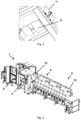
- the figure 1 is a schematic view, in perspective, of the installation used for the invention comprising raw material supply means, which comprise modules delivering fragments.
- the picture 2 is a schematic representation of a module delivering fragments.
- the picture 3 represents a schematic view, seen from below, of a particular embodiment of the means for obtaining a bed of fragments of a determined width.
- the figure 4 represents a schematic view, in perspective, of the installation used for the invention comprising means for supplying raw material, which comprise modules comprising reels of thermoplastic and/or reinforcing films.
- the figure 5 represents a schematic view, in perspective, of the installation used for the invention comprising raw material supply means, which comprise a module delivering fragments and modules comprising coils.
- the figure 6 shows a schematic view of the pre-consolidation means and the installation consolidation means used for the invention.
- the installation 1 comprises means 2 for supplying raw material, which are capable of depositing, on conveying means 3, at least one thermoplastic material, preferably also at least one reinforcing material, whatever its or their form.
- the raw material can be in the form of one or more powders, one or more fragments, one or more films or sheets, of different nature, dimensions and shapes.
- thermoplastic products or thermoplastic composites according to the invention in the form of plates, are made on the basis of one or more powders, of one or more fragments or granules, and of one or more reinforcements, and the multilayers are made from at least one film and a reinforcement, or from at least one film, fragments, and optionally one or more reinforcements.
- the raw material may comprise one or more thermoplastic resins, virgin or not, of the same chemical nature or of similar grades, chosen from polyolefin, polyvinyl, polyacrylic, polystyrenic, polyamide, polyester resins thermoplastics and polycarbonates, polyetherimides, polyaryletherketones, polyetheretherketones, and polyphenylene sulfides.
- thermoplastic resins virgin or not, of the same chemical nature or of similar grades, chosen from polyolefin, polyvinyl, polyacrylic, polystyrenic, polyamide, polyester resins thermoplastics and polycarbonates, polyetherimides, polyaryletherketones, polyetheretherketones, and polyphenylene sulfides.
- the reinforcing material can be, or comprise, mineral or plant fragments, recycled or not, mats of woven or non-woven fibers, optionally needled, the fibers possibly being textile, natural or synthetic. It may be, for example, glass or carbon fibers.
- the raw material comprises thermoplastic fragments having a size, in any of the dimensions, between 0.2 and 250 mm, preferably between 10 and 250 mm, with advantageously a thickness between 0 .1 to 0.8 mm.
- the thermoplastic films or sheets have a thickness of between 0.2 and 0.8 mm, and the reinforcing mats and fabrics have a surface weight of between 30 and 950 g/m 2 .
- the means 2 for supplying raw material comprise, or consist of, at least one module 6, preferably of two or three modules 6, advantageously of several modules 6, which are preferably removable ( figures 1, 2 , 4 and 5 ).
- the module(s) 6 are mobile and comprise(s) a frame 7 mounted on wheels, for easy movement.
- the module(s) 6 is or are arranged near, above and/or next to the conveying means 3, in order to deposit the raw material on the latter.
- the latter can be arranged in series ( figure 1 , 4 and 5 ), which has the advantage of having a final product whose structure and/or composition varies over all or part of its thickness.
- This embodiment makes it possible to have, for example, a sandwich effect, with a more or less thick thermoplastic resin-based core of adjustable density and/or reinforcement mats or fabrics with a preferential arrangement of these fibers in the longitudinal or transverse direction and reinforcing mats or fabrics with a preferential orientation of these fibers in the longitudinal or transverse direction, on either side of this core.
- thermoplastic composite with reinforcing fibers superimposed in the longitudinal and transverse direction, at 45° or 22.5°, in order to obtain a structure with suitable mechanical strength in these four directions. It is also possible to use one or more reinforcing mat(s) or fabric(s) between two thermoplastic films to produce a composite structure with a barrier effect.
- the modules 6 can be arranged in series, which has the advantage of being able to obtain a final product whose structure or composition varies over all or part of its thickness. This allows, for example, to have a virgin thermoplastic resin above and below a recycled thermoplastic resin which would constitute the core of a composite plate.
- the modules 6 can be arranged in parallel, which has the advantage of being able to obtain a final product whose structure or composition varies over all or part of its width. It would then be conceivable to have a product of the width of the installation 1 comprising several different thermoplastic composites, possibly before slitting to the correct width.
- the modules 6 can be arranged for some in series and/or for some in parallel, in order to combine the advantages of these arrangements.
- the installation 1 can comprise a module 6, or a plurality of modules 6, delivering fragments.
- the module(s) 6 are removable and mobile(s), preferably three in number, have identical structures, but deliver raw material, in the form of fragments or granules, of shape, size , different color and/or composition ( figure 1 ).
- the module or modules 6 delivering the fragments comprise means for homogenizing the bed of fragments on the means 3 for conveying.
- the module(s) 6 comprise a tray 8 for storing the fragments, a hopper 9 receiving the fragments and which is in communication with a vibrating table 10, itself communication with a chute 11 for the discharge of the fragments onto the conveying means 3 ( picture 2 ).
- the vibrating table 10 has the advantage of homogenizing the bed of fragments on the conveying means 3.
- Chute 11, preferably adjustable makes it possible to obtain a determined, adjustable width of a homogeneous bed of fragments.
- the adjustable width of the bed is obtained by the use of a hatch 12, in the bottom of the chute, the opening of which determines the width of the bed of fragments ( picture 3 ).
- the vibrating table 10 vibrates in the plane of the table and/or in a plane perpendicular to the plane formed by the table, and, preferably, according to a frequency comprised between 20 Hz and 55 Hz.
- the module(s) 6 delivering the fragments may comprise means for forming the fragments, and/or sieving means, and/or means for dosing the fragments of raw material.
- the installation 1 can comprise one or more module(s) 6 removable(s) and mobile(s), and comprising a frame 13 on which is or are mounted one or more coil(s) 14 of one or more thermoplastic film(s), of one or more composite film(s) or of one or more reinforcing material(s) ( figure 4 ).
- the installation 1 can comprise one or more removable and mobile module(s) 6 delivering fragments and one or more module(s) 6 comprising one or more coil(s) 14 of a or more thermoplastic film(s), one or more composite film(s) or one or more reinforcing material(s). Nevertheless, it is also possible to use one or more mixed module(s) 6 delivering both one or more type(s) of fragment(s) and one or more film(s).
- a module 6 or a plurality of modules 6, removable(s) and preferably mobile(s), allowing the deposition of a raw material different, in shape and/or in nature has the advantage of being able to act on the structure of the product to be made, to modulate its properties over its width and/or over its length without having to modify the production line heavily, which makes the manufacturing installation which comprises one or more of these modules 6, in particular the installation 1, easily adaptable, flexible in its operation, for the production of thermoplastic products or thermoplastic composites having different physical or mechanical characteristics.
- the installation 1 comprises the means 2 for supplying raw material described previously, and in particular those comprising, or consisting of, one or more modules 6, the installation 1 comprises means 3 for conveying which include, or are, any suitable means for transporting the raw material from the supply means 2 to the pre-consolidation means and the consolidation means, preferably incrementally, advantageously at a speed or a pace compatible or adequate with that or those of the means 4 of pre-consolidation and of the means 5 of consolidation.
- it is a conveyor belt.
- the installation 1 comprises means 4 for pre-consolidation which, according to the invention, produce a first softening and a first compression, in the stacking direction, of the thermoplastic raw material, and for thermoplastic composites, a rimpedement, or the start of impregnation, of the thermoplastic raw material with the reinforcing material or materials, without application of emptiness.
- These means 4 operate step by step, advantageously at the same rate as the sequential consolidation means 5, which has the advantage of not requiring the use of time delay or accumulation means, between the means 2 for supplying raw material and the sequential means of consolidation, which would cool the pre-consolidated product, which would harm the homogeneity of the final product.
- the pre-consolidation means 4 heat the raw material(s) to a lower temperature, advantageously lower by 10 to 40 degrees Celsius, than the melting temperature of the raw material or mixture of raw materials. , in particular the thermoplastic material(s).
- the pre-consolidation means 4 also apply, to the raw material(s), a pressure of between 0.5 and 5 bars (50 and 500 kPa).
- the pre-consolidation means 4 perform a single hot compression, however, it is also possible to have multiple successive compressions of the thermoplastic raw material, and therefore without the latter advancing and leaving the means. 4 pre-consolidation.
- the pre-consolidation temperature is between 140 and 160 degrees Celsius and the pressure is between 0.5 and 1 bar (50 at 100 kPa).
- the residence time of the raw material in the pre-consolidation means 4 can vary depending on the raw material to be pre-consolidated and its form, fragmented or in the form of films.
- this duration can range between 2 and 30 seconds and preferably between 10 and 25 seconds.
- the duration of the pressing and that of the heating are identical, but they can be different.
- the pre-consolidation means 4 comprise progressive compression means, which have the advantage of making it possible to drain the air or the gases contained in the bed of raw material or generated by the pre-consolidation. Preferably, these means do not use a vacuum.
- the pre-consolidation means 4 comprise, or consist of, a press, advantageously a press 15 with platen(s) comprising at least one platen 16, preferably in stainless steel or polished steel, coming directly , or by means of conveyor belts, in contact with the raw material placed on the conveying means 3.
- the press 15 comprises at least two plates 16, a lower plate and an upper plate, for heating and pressing the raw material, on either side of the conveying means 3.
- only one of the two plates 16 can be mobile, the other being fixed, or both plates 16 can be mobile.
- the surface of the plate(s) 16 is substantially planar and does not include texturing.
- the progressive compression means comprise or consist of a portion of the plate(s) 16 which comprises a beveled edge 17.
- the beveled edge 17 is located on the side where the entry of the raw material in order to expel the air or the gases above the raw material, without there being any thermoplastic material which is entrained with the air or the gases, and if there should be any , the latter is reused in the raw material to be pre-consolidated.
- the raw material is deposited on two conveyor belts placed between the plates of the press, in order to prevent the raw material from sticking to all or parts of the plate or plates of the press. It may also be advantageous to provide for the use of a mold release agent deposited on these conveyor belts.
- the pre-consolidation means 4 are arranged adjacent to sequential consolidation means 5 ( figure 6 ).
- the pre-consolidation means 4 and the sequential consolidation means 5 are arranged within the same device, which has the advantage of avoiding excessive cooling of the pre-consolidated product, negatively impacting the homogeneity of the final product.
- the sequential consolidation means 5 operate step by step, and carry out the consolidation, by pressing and successive advancements, of the pre-consolidated product, preferably by heating it to a temperature greater than or equal to the melting temperature of the raw material or the mixing of raw materials, in particular the thermoplastic material(s), preferably without applying a vacuum.
- the sequential consolidation means comprise a different temperature profile between the inlet of the pre-consolidated product and the outlet of the consolidated product, so that the pre-consolidated product is heated to a temperature above the temperature of melting of the raw material or mixture of raw materials, in particular the thermoplastic material(s), then gradually cooled to a temperature below the solidification temperature of the raw material or mixture of raw materials, in particular the thermoplastic material(s).
- these sequential consolidation means comprise or cooperate with heating and cooling means.
- the sequential consolidation means also apply, and concomitantly, to the pre-consolidated product, either a fixed pressure, for example between 1 and 35 bars (100 to 3500 kPa), or a different profile or gradient between entry of the pre-consolidated product and exit of the consolidated product.
- the pitch of the sequential consolidation means 5 is between L/50 and L/2, L being the length of the platen(s) of the press in the direction of progression of the pre-consolidated product to be consolidated.
- the consolidation temperature is between 160 and 180 degrees Celsius and the pressure applied is between 1 and 35 bars ( 100 to 3500 kPa).
- the residence time of the pre-consolidated product in the sequential consolidation means may vary depending on the raw material of the pre-consolidated product and its shape, plate or multilayer. By way of example, this duration can range between 2 and 20 minutes and preferably between 5 and 10 minutes.
- the duration of the pressing and that of the heating are identical, but they can be different.
- the sequential consolidation means 5 comprise progressive compression means, which have the advantage of making it possible to drain the air or the gases contained in the pre-consolidated product or generated by the consolidation.
- these means do not use a vacuum.
- the sequential consolidation means 5 comprise, or consist of, a press 18, advantageously, a platen press comprising at least one platen 19, preferably in stainless steel or polished steel, coming into contact with the pre-consolidated product on the conveyor belt 3.
- the press 18 comprises at least two plates 19, a lower plate and an upper plate, for heating and pressing the pre-consolidated product, on either side of the conveyor belt 3.
- only one of the two plates 19 can be mobile, the other being fixed, or else the two plates 19 can be mobile.
- the surface of the plate(s) 19 is substantially planar and may or may not include texturing.
- the upper plate comprises, advantageously the upper plate and the lower plate comprise, zones of different temperatures, preferably two, advantageously three or four, zones having different temperatures for progressive heating and/or cooling.
- the tray or trays 19 may comprise a first zone which is hot and a second zone which has a temperature lower than that of the first zone, or even a zone which is cold, namely which has a temperature lower than the ambient temperature in which is the installation 1 and/or the consolidation press which can be used with the invention.
- the tray(s) 19 may include any means of heating and cooling, preferably programmable.
- the upper plate and/or the lower plate is or are monobloc(s) and the hot and cold zones are separated by a groove made over part of their thickness.
- This groove has the advantage of reducing, or even avoiding, excessive heat exchange between the hot zone and the colder one.
- the progressive compression means comprise or consist of a portion of the plate(s) 19 which comprises a beveled edge 20.
- the beveled edge 20 is located on the side where the product enters. pre-consolidated in order to expel the air or the gases above the pre-consolidated product, without there being any thermoplastic material which is entrained with the air or the gas, and if there should be any, the latter is reused in the pre-consolidated product.
- one or more strips is or are arranged between the plate(s) of the consolidation press and the pre-consolidated product during consolidation, in order to prevent the product from sticking on all or part of the plate(s) of the press, strip on which a release agent can be deposited.
- the sequential consolidation means 5 share these bands with the pre-consolidation means 4.
- the sequential means 5 of consolidation in particular the press 18 with platen(s) used with the invention, have the advantage of allowing the consolidation of a pre-consolidated product based on fragments, but also based on films or based on fragments and films, allowing the adhesion of thermoplastic films between them, but also with fragments, while providing good homogeneity to the final product .
- the combined and sequential use of the pre-consolidation means 4 and the consolidation means 5 makes it possible to reduce, or even eliminate, in the final product, the spaces between the fragments of raw materials , to expel air bubbles between the raw material films or between the film(s) and the fragments, thereby reducing the size and number of pores formed during consolidation, thereby providing thermoplastic products or thermoplastic composites having improved physical or mechanical properties. It was found that for a plate based on polyamide fragments (PA66), the porosity rate was less than about 5%, whereas for a multilayer this rate was less than about 8%, and less than about 12% for a composite based on polyamide (PA66) and glass as reinforcement material.
- the sequential consolidation means 5 may also comprise shaping means for shaping the final product into a desired shape, during its consolidation.
- the consolidation platen press 18 may include one or more compression molds.
- the installation 1 may include these means, arranged at the outlet of the sequential consolidation means 5.
- the installation 1 may also comprise means 21 for regulating the thickness of the bed of raw materials on the conveying means 3, for example a calibration bar, a blade or a scraper.
- the installation 1 may further comprise drive means, possibly also means for controlling the speed of progression of the conveying means 3, in particular of the conveyor belt 3, and means for controlling the means 2 raw material supply.
- the installation 1 further comprises means for cutting the final product and optionally also packaging means.
- thermoplastic product or a thermoplastic composite in the form of a plate or a multilayer, according to the invention, preferably implements the installation 1.
- the method according to the invention comprises a step of supplying a raw material based on at least one thermoplastic material, preferably also at least one reinforcing material.
- a raw material based on at least one thermoplastic material, preferably also at least one reinforcing material.
- it is one or more thermoplastic materials or one or more thermoplastic composites that are recycled or to be recycled.
- the raw material can be in the form of one or more types of powder, fragments or granules, or one or more type(s) of films or sheets.
- the supply of raw material is done in a modular fashion, preferably using supply means 2 as described above, advantageously by the use of one or more removable module(s) 6 and preferably also mobile(s), arranged near, above and/or next to the conveying means 3, the modules 6 being able to be arranged with respect to each other in series and/or in parallel .
- the raw material can be supplied in the form of fragments or granules and/or films, of different shape, size, color and/or composition, whether it is based on one or more materials ( s) thermoplastic(s), one or more reinforcing material(s), one or more thermoplastic composite(s) recycled or to be recycled.
- This has the advantage of being able to produce materials in the form of plates and/or multilayers, having a different structure, and therefore different mechanical properties, over all or part of their width and/or their length.
- the raw material is deposited on conveying means 3, for example a conveyor belt, this deposit preferably taking place in a homogeneous manner, in any case so as to obtain a homogeneous, uniform bed of raw material, whether it is one or more types of powders, fragments or films.
- the raw material undergoes, on the conveying means 3, a step-by-step, sequential pre-consolidation of part of the raw material at a time, advantageously at the same pace or rate as the subsequent sequential consolidation.
- the pre-consolidation is carried out by softening and compression, in the stacking direction, of the raw material, under the combined action of heat and pressure, with the aid of pre-consolidation means 4, preferably as previously described.
- the softening is preferably done by heating to a lower temperature, advantageously lower by 10 to 40 degrees Celsius, than the melting temperature of the raw material, in particular of the thermoplastic material, for 2 to 30 seconds and preferably between 10 and 25 seconds, under a pressure between 0.5 and 5 bars (50 and 500 kPa).
- the pre-consolidation comprises or implements a progressive compression of the raw material, making it possible to drain the air or the gases contained in the bed of raw material or generated by the pre-consolidation, preferably, without resorting to to vacuum, but advantageously with progressive compression means as described above.
- this progressive compression is done in the direction of the progression of the raw material from the entry of the means 4 of pre-consolidation.
- the pre-consolidated product then undergoes a sequential consolidation, step by step, of a part of the pre-consolidated product at a time, by hot pressing, preferably using the consolidation means, as previously described.
- the consolidation is carried out by heating to a temperature equal to or higher, advantageously higher by 20 to 50 degrees Celsius, to the melting temperature of the raw material, in particular of the thermoplastic material, for 2 to 20 minutes and preferably between 5 and 10 minutes, at a pressure between 1 and 35 bars (100 to 3500 kPa).
- the consolidation is done according to at least one temperature profile, so as to heat the pre-consolidated product to a temperature above the melting temperature of the thermoplastic material, then to cool it gradually to a temperature below the solidification temperature of the thermoplastic material.
- the consolidation also takes place according to a pressure profile, between the start and the end of the consolidation.
- the consolidation includes or implements a progressive compression of the raw material, making it possible to drain the air or the gases contained in the bed of raw material or generated by the pre-consolidation, preferably, without using vacuum, but advantageously with progressive compression means as described above.
- this progressive compression is done in the direction of the progression of the raw material from the entry of the means 4 of pre-consolidation.
- the consolidation takes place immediately after the pre-consolidation, advantageously without the pre-consolidated product cooling down, even more advantageously without the product cooling down by more than 50 degrees Celsius.
- the method according to the invention may also comprise a step of forming the product into a desired shape, which may be subsequent to or concomitant with the consolidation step and/or a cutting step. of the consolidated product.
- thermoplastic plates and multilayers or thermoplastic composites made using the installation 1, or according to the method according to the invention, can be used as is, or undergo a step of forming or integration into a product for the creation of more elaborate pieces.
Landscapes
- Engineering & Computer Science (AREA)
- Mechanical Engineering (AREA)
- Casting Or Compression Moulding Of Plastics Or The Like (AREA)
Claims (9)
- Verfahren zur Herstellung eines thermoplastischen Produkts oder eines thermoplastischen Verbundstoffs in Form einer Platte und/oder eines Mehrschichtgegenstands, umfassend die folgenden Schritte:- Bereitstellen eines Rohmaterials, umfassend mindestens eine thermoplastisches Material,- Ablegen des Rohmaterials auf Transportmitteln (3),- Schritt für Schritt Vorkonsolidieren des Rohmaterials, indem es komprimiert wird und gleichzeitig auf eine Temperatur unter seiner Fusionstemperatur erhitzt wird, um ein vorkonsolidiertes Produkt zu bilden,- Schritt für Schritt Konsolidieren des vorkonsolidierten Produkts, indem es komprimiert wird und gleichzeitig auf eine Temperatur über der Fusionstemperatur des Rohmaterials erhitzt wird, um ein konsolidiertes Produkt zu bilden,wobei die Vorkonsolidierung und die Konsolidierung auf sequenzielle Weise erfolgen.
- Verfahren nach Anspruch 1, wobei der Schritt des Ablegens des Rohmaterials mit Hilfe eines oder mehrerer entfernbarer Module (6) erfolgt.
- Verfahren nach Anspruch 2, wobei die entfernbaren Module (6), die einen mit Bezug auf die anderen, in Reihe und/oder parallel entlang der und auf beiden Seiten der Transportmittel (3) angeordnet sind.
- Verfahren nach einem der vorhergehenden Ansprüche, wobei das Rohmaterial die Form eines oder mehrerer Pulver und/oder eines oder mehrerer Fragmente und/oder einer oder mehrerer Folien aufweist.
- Verfahren nach einem der vorhergehenden Ansprüche, wobei der Schritt des Ablegens des Rohmaterials mit Hilfe eines oder mehrerer entfernbarer Module (6) erfolgt, ausgewählt aus einem Modul (8) zur Versorgung mit einem oder mehreren Pulvern, mit einem oder mehreren Fragmenten, mit einer oder mehreren Folien, Matten oder Geweben und der Kombination derselben.
- Verfahren nach einem der vorhergehenden Ansprüche, wobei der Schritt des Ablegens des Rohmaterials auf den Transportmitteln (3) derart erfolgt, dass ein homogenes Bett erhalten wird.
- Verfahren nach Anspruch 6, wobei der Schritt des Ablegens des Rohmaterials auf den Transportmitteln (3), um ein homogenes Bett zu erhalten, mit Hilfe eine vibrierenden Tischs (10) erfolgt.
- Verfahren nach einem der vorhergehenden Ansprüche, wobei der Schritt des Vorkonsolidierens und/oder der Schritt des Konsolidierens eine fortschreitende Kompression durchführt.
- Verfahren nach einem der vorhergehenden Ansprüche, wobei der Schritt des Vorkonsolidierens und der Schritt des Konsolidierens jeweils eine Presse (15, 18) mit einer Platte/Platten (16, 19) durchführen.
Priority Applications (1)
| Application Number | Priority Date | Filing Date | Title |
|---|---|---|---|
| EP21202364.2A EP3957455B1 (de) | 2016-12-06 | 2017-11-29 | Anlage zur herstellung eines thermoplastischen materials und dessen verwendung |
Applications Claiming Priority (2)
| Application Number | Priority Date | Filing Date | Title |
|---|---|---|---|
| EP16306622.8A EP3332934A1 (de) | 2016-12-06 | 2016-12-06 | Verfahren und anlage zur herstellung eines thermoplastischen materials |
| PCT/FR2017/053280 WO2018104613A1 (fr) | 2016-12-06 | 2017-11-29 | Procédé et installation de fabrication d'un matériau thermoplastique |
Related Child Applications (2)
| Application Number | Title | Priority Date | Filing Date |
|---|---|---|---|
| EP21202364.2A Division EP3957455B1 (de) | 2016-12-06 | 2017-11-29 | Anlage zur herstellung eines thermoplastischen materials und dessen verwendung |
| EP21202364.2A Division-Into EP3957455B1 (de) | 2016-12-06 | 2017-11-29 | Anlage zur herstellung eines thermoplastischen materials und dessen verwendung |
Publications (2)
| Publication Number | Publication Date |
|---|---|
| EP3551413A1 EP3551413A1 (de) | 2019-10-16 |
| EP3551413B1 true EP3551413B1 (de) | 2022-03-02 |
Family
ID=57614297
Family Applications (3)
| Application Number | Title | Priority Date | Filing Date |
|---|---|---|---|
| EP16306622.8A Withdrawn EP3332934A1 (de) | 2016-12-06 | 2016-12-06 | Verfahren und anlage zur herstellung eines thermoplastischen materials |
| EP21202364.2A Active EP3957455B1 (de) | 2016-12-06 | 2017-11-29 | Anlage zur herstellung eines thermoplastischen materials und dessen verwendung |
| EP17826262.2A Active EP3551413B1 (de) | 2016-12-06 | 2017-11-29 | Verfahren zur herstellung eines thermoplastischen materials |
Family Applications Before (2)
| Application Number | Title | Priority Date | Filing Date |
|---|---|---|---|
| EP16306622.8A Withdrawn EP3332934A1 (de) | 2016-12-06 | 2016-12-06 | Verfahren und anlage zur herstellung eines thermoplastischen materials |
| EP21202364.2A Active EP3957455B1 (de) | 2016-12-06 | 2017-11-29 | Anlage zur herstellung eines thermoplastischen materials und dessen verwendung |
Country Status (2)
| Country | Link |
|---|---|
| EP (3) | EP3332934A1 (de) |
| WO (1) | WO2018104613A1 (de) |
Families Citing this family (3)
| Publication number | Priority date | Publication date | Assignee | Title |
|---|---|---|---|---|
| IT202000003383A1 (it) * | 2020-02-19 | 2021-08-19 | Sacmi | Apparato e metodo per produrre oggetti in materiale polimerico riciclato. |
| US12257814B2 (en) | 2022-06-30 | 2025-03-25 | Continuus Materials Intellectual Property, Llc | Heat transfer system with improved efficiency for composite panel production |
| FR3142930B1 (fr) * | 2022-12-07 | 2025-12-05 | Sasminimum | Procédé de mise en forme |
Family Cites Families (11)
| Publication number | Priority date | Publication date | Assignee | Title |
|---|---|---|---|---|
| DE3031839C2 (de) | 1980-08-23 | 1983-10-20 | Dynamit Nobel Ag, 5210 Troisdorf | Verfahren zum kontinuierlichen Herstellen einer gemusterten Bahn aus thermoplastischem Kunststoff |
| IT1174108B (it) * | 1983-05-31 | 1987-07-01 | Allen Ind | Metodo e apparecchiature per la produzione di un foglio dimateriale |
| DE3530309A1 (de) * | 1985-08-24 | 1987-02-26 | Held Kurt | Verfahren und vorrichtung zum kontinuierlichen herstellen thermoplastischer kunststoffbahnen |
| IT1188405B (it) | 1986-03-03 | 1988-01-14 | Montedison Spa | Procedimento per la produzione in continuo di compositi termoplastici termoformabili |
| FR2640544B1 (fr) * | 1988-12-21 | 1991-06-28 | Combe Daniel | Procede de production de panneaux en continu et machine pour sa mise en oeuvre |
| AU3411001A (en) * | 2000-02-22 | 2001-09-03 | Masao Konishi | Apparatus for mixing and molding different types of plastics |
| JP4387237B2 (ja) * | 2004-04-23 | 2009-12-16 | 株式会社トピア | プラスチック繊維成形体、プラスチック繊維成形体の製造方法、プラスチック繊維板の製造装置 |
| US8333858B2 (en) | 2006-02-02 | 2012-12-18 | The Boeing Company | Method for fabricating curved thermoplastic composite parts |
| EP3175930A1 (de) * | 2012-08-21 | 2017-06-07 | Avery Dennison Corporation | Selektive partikelausgabevorrichtung |
| ES2692653T3 (es) * | 2012-08-21 | 2018-12-04 | Avery Dennison Corporation | Sistemas y métodos para fabricar películas, fibras, esferas y otros artículos porosos |
| FR3007684B1 (fr) | 2013-06-28 | 2016-01-01 | Cetim Cermat | Procede de recyclage de pieces en composite thermoplastique |
-
2016
- 2016-12-06 EP EP16306622.8A patent/EP3332934A1/de not_active Withdrawn
-
2017
- 2017-11-29 EP EP21202364.2A patent/EP3957455B1/de active Active
- 2017-11-29 WO PCT/FR2017/053280 patent/WO2018104613A1/fr not_active Ceased
- 2017-11-29 EP EP17826262.2A patent/EP3551413B1/de active Active
Non-Patent Citations (1)
| Title |
|---|
| None * |
Also Published As
| Publication number | Publication date |
|---|---|
| WO2018104613A1 (fr) | 2018-06-14 |
| EP3551413A1 (de) | 2019-10-16 |
| EP3957455B1 (de) | 2023-04-19 |
| EP3332934A1 (de) | 2018-06-13 |
| EP3957455A1 (de) | 2022-02-23 |
Similar Documents
| Publication | Publication Date | Title |
|---|---|---|
| EP0815307B1 (de) | Verfahren und vorrichtung zur herstellung eines kompositmaterials | |
| EP1134314B2 (de) | Zwischen-Verbundstoff, dessen Herstellungsverfahren und dessen Verwendung als Formmaterial | |
| EP1373621B1 (de) | Verfahren und vorrichtung zur herstellung einer verbundplatte mit multiaxialer faserverstärkung | |
| WO2004062893A1 (fr) | Procede et dispositif de fabrication d'une plaque composite | |
| EP3551413B1 (de) | Verfahren zur herstellung eines thermoplastischen materials | |
| KR101684821B1 (ko) | 섬유 강화된 수지 기재 또는 수지 성형체의 제조 방법 및 이 제조 방법에 사용하는 가소화 토출기 | |
| CH629700A5 (fr) | Procede de production d'une feuille de resine renforcee de fibre de verre. | |
| EP0888471B1 (de) | Verfahren und vorrichtung zur herstellung von verbundplatten | |
| US12325198B2 (en) | Method of manufacturing a composite part comprising a core and UHMWPE skin regions | |
| EP1226298B1 (de) | Verfahren und vorrichtung zur herstellung von verbundplatten | |
| EP0447479A1 (de) | Verfahren und einrichtung zur herstellung eines pressteils aus thermoplastischem verbundwerkstoff | |
| FR2779988A1 (fr) | Procede et dispositif de moulage de produits composites thermoplastiques | |
| FR2811688A1 (fr) | Nappe unidirectionnelle en materiau composite | |
| JPH0242058B2 (de) | ||
| EP3212829B1 (de) | Verfahren und vorrichtung zur entwebung und neuausrichtung von kohlenstofffasern | |
| CA2556145C (fr) | Structure multicouche textile pour la fabrication de materiaux composites | |
| FR2646443A1 (fr) | Feuille plastique renforcee de fibres et procede de production d'une telle feuille | |
| JP2023113513A (ja) | 繊維強化熱可塑性樹脂シートの製造方法 | |
| FR2570329A1 (fr) | Procede et appareillage pour realiser un produit stratifie forme d'une resine thermoplastique renforcee par des fibres | |
| FR3093669A1 (fr) | Procédé de fabrication d’un renfort fibreux pré-imprégné à partir d’un non-tissé thermoplastique et d’un renfort de fibres naturelles | |
| BE560140A (de) |
Legal Events
| Date | Code | Title | Description |
|---|---|---|---|
| STAA | Information on the status of an ep patent application or granted ep patent |
Free format text: STATUS: UNKNOWN |
|
| STAA | Information on the status of an ep patent application or granted ep patent |
Free format text: STATUS: THE INTERNATIONAL PUBLICATION HAS BEEN MADE |
|
| PUAI | Public reference made under article 153(3) epc to a published international application that has entered the european phase |
Free format text: ORIGINAL CODE: 0009012 |
|
| STAA | Information on the status of an ep patent application or granted ep patent |
Free format text: STATUS: REQUEST FOR EXAMINATION WAS MADE |
|
| 17P | Request for examination filed |
Effective date: 20190607 |
|
| AK | Designated contracting states |
Kind code of ref document: A1 Designated state(s): AL AT BE BG CH CY CZ DE DK EE ES FI FR GB GR HR HU IE IS IT LI LT LU LV MC MK MT NL NO PL PT RO RS SE SI SK SM TR |
|
| AX | Request for extension of the european patent |
Extension state: BA ME |
|
| DAV | Request for validation of the european patent (deleted) | ||
| DAX | Request for extension of the european patent (deleted) | ||
| STAA | Information on the status of an ep patent application or granted ep patent |
Free format text: STATUS: EXAMINATION IS IN PROGRESS |
|
| 17Q | First examination report despatched |
Effective date: 20200710 |
|
| RAP3 | Party data changed (applicant data changed or rights of an application transferred) |
Owner name: CETIM GRAND EST Owner name: CETIM |
|
| GRAP | Despatch of communication of intention to grant a patent |
Free format text: ORIGINAL CODE: EPIDOSNIGR1 |
|
| STAA | Information on the status of an ep patent application or granted ep patent |
Free format text: STATUS: GRANT OF PATENT IS INTENDED |
|
| INTG | Intention to grant announced |
Effective date: 20211213 |
|
| GRAS | Grant fee paid |
Free format text: ORIGINAL CODE: EPIDOSNIGR3 |
|
| GRAA | (expected) grant |
Free format text: ORIGINAL CODE: 0009210 |
|
| STAA | Information on the status of an ep patent application or granted ep patent |
Free format text: STATUS: THE PATENT HAS BEEN GRANTED |
|
| AK | Designated contracting states |
Kind code of ref document: B1 Designated state(s): AL AT BE BG CH CY CZ DE DK EE ES FI FR GB GR HR HU IE IS IT LI LT LU LV MC MK MT NL NO PL PT RO RS SE SI SK SM TR |
|
| REG | Reference to a national code |
Ref country code: GB Ref legal event code: FG4D Free format text: NOT ENGLISH |
|
| REG | Reference to a national code |
Ref country code: CH Ref legal event code: EP Ref country code: AT Ref legal event code: REF Ref document number: 1471896 Country of ref document: AT Kind code of ref document: T Effective date: 20220315 |
|
| REG | Reference to a national code |
Ref country code: DE Ref legal event code: R096 Ref document number: 602017054149 Country of ref document: DE |
|
| REG | Reference to a national code |
Ref country code: IE Ref legal event code: FG4D Free format text: LANGUAGE OF EP DOCUMENT: FRENCH |
|
| REG | Reference to a national code |
Ref country code: NL Ref legal event code: FP |
|
| REG | Reference to a national code |
Ref country code: LT Ref legal event code: MG9D |
|
| PG25 | Lapsed in a contracting state [announced via postgrant information from national office to epo] |
Ref country code: SE Free format text: LAPSE BECAUSE OF FAILURE TO SUBMIT A TRANSLATION OF THE DESCRIPTION OR TO PAY THE FEE WITHIN THE PRESCRIBED TIME-LIMIT Effective date: 20220302 Ref country code: RS Free format text: LAPSE BECAUSE OF FAILURE TO SUBMIT A TRANSLATION OF THE DESCRIPTION OR TO PAY THE FEE WITHIN THE PRESCRIBED TIME-LIMIT Effective date: 20220302 Ref country code: NO Free format text: LAPSE BECAUSE OF FAILURE TO SUBMIT A TRANSLATION OF THE DESCRIPTION OR TO PAY THE FEE WITHIN THE PRESCRIBED TIME-LIMIT Effective date: 20220602 Ref country code: LT Free format text: LAPSE BECAUSE OF FAILURE TO SUBMIT A TRANSLATION OF THE DESCRIPTION OR TO PAY THE FEE WITHIN THE PRESCRIBED TIME-LIMIT Effective date: 20220302 Ref country code: HR Free format text: LAPSE BECAUSE OF FAILURE TO SUBMIT A TRANSLATION OF THE DESCRIPTION OR TO PAY THE FEE WITHIN THE PRESCRIBED TIME-LIMIT Effective date: 20220302 Ref country code: ES Free format text: LAPSE BECAUSE OF FAILURE TO SUBMIT A TRANSLATION OF THE DESCRIPTION OR TO PAY THE FEE WITHIN THE PRESCRIBED TIME-LIMIT Effective date: 20220302 Ref country code: BG Free format text: LAPSE BECAUSE OF FAILURE TO SUBMIT A TRANSLATION OF THE DESCRIPTION OR TO PAY THE FEE WITHIN THE PRESCRIBED TIME-LIMIT Effective date: 20220602 |
|
| REG | Reference to a national code |
Ref country code: AT Ref legal event code: MK05 Ref document number: 1471896 Country of ref document: AT Kind code of ref document: T Effective date: 20220302 |
|
| PG25 | Lapsed in a contracting state [announced via postgrant information from national office to epo] |
Ref country code: PL Free format text: LAPSE BECAUSE OF FAILURE TO SUBMIT A TRANSLATION OF THE DESCRIPTION OR TO PAY THE FEE WITHIN THE PRESCRIBED TIME-LIMIT Effective date: 20220302 Ref country code: LV Free format text: LAPSE BECAUSE OF FAILURE TO SUBMIT A TRANSLATION OF THE DESCRIPTION OR TO PAY THE FEE WITHIN THE PRESCRIBED TIME-LIMIT Effective date: 20220302 Ref country code: GR Free format text: LAPSE BECAUSE OF FAILURE TO SUBMIT A TRANSLATION OF THE DESCRIPTION OR TO PAY THE FEE WITHIN THE PRESCRIBED TIME-LIMIT Effective date: 20220603 Ref country code: FI Free format text: LAPSE BECAUSE OF FAILURE TO SUBMIT A TRANSLATION OF THE DESCRIPTION OR TO PAY THE FEE WITHIN THE PRESCRIBED TIME-LIMIT Effective date: 20220302 |
|
| PG25 | Lapsed in a contracting state [announced via postgrant information from national office to epo] |
Ref country code: SM Free format text: LAPSE BECAUSE OF FAILURE TO SUBMIT A TRANSLATION OF THE DESCRIPTION OR TO PAY THE FEE WITHIN THE PRESCRIBED TIME-LIMIT Effective date: 20220302 Ref country code: SK Free format text: LAPSE BECAUSE OF FAILURE TO SUBMIT A TRANSLATION OF THE DESCRIPTION OR TO PAY THE FEE WITHIN THE PRESCRIBED TIME-LIMIT Effective date: 20220302 Ref country code: RO Free format text: LAPSE BECAUSE OF FAILURE TO SUBMIT A TRANSLATION OF THE DESCRIPTION OR TO PAY THE FEE WITHIN THE PRESCRIBED TIME-LIMIT Effective date: 20220302 Ref country code: PT Free format text: LAPSE BECAUSE OF FAILURE TO SUBMIT A TRANSLATION OF THE DESCRIPTION OR TO PAY THE FEE WITHIN THE PRESCRIBED TIME-LIMIT Effective date: 20220704 Ref country code: EE Free format text: LAPSE BECAUSE OF FAILURE TO SUBMIT A TRANSLATION OF THE DESCRIPTION OR TO PAY THE FEE WITHIN THE PRESCRIBED TIME-LIMIT Effective date: 20220302 Ref country code: CZ Free format text: LAPSE BECAUSE OF FAILURE TO SUBMIT A TRANSLATION OF THE DESCRIPTION OR TO PAY THE FEE WITHIN THE PRESCRIBED TIME-LIMIT Effective date: 20220302 Ref country code: AT Free format text: LAPSE BECAUSE OF FAILURE TO SUBMIT A TRANSLATION OF THE DESCRIPTION OR TO PAY THE FEE WITHIN THE PRESCRIBED TIME-LIMIT Effective date: 20220302 |
|
| PG25 | Lapsed in a contracting state [announced via postgrant information from national office to epo] |
Ref country code: IS Free format text: LAPSE BECAUSE OF FAILURE TO SUBMIT A TRANSLATION OF THE DESCRIPTION OR TO PAY THE FEE WITHIN THE PRESCRIBED TIME-LIMIT Effective date: 20220702 Ref country code: AL Free format text: LAPSE BECAUSE OF FAILURE TO SUBMIT A TRANSLATION OF THE DESCRIPTION OR TO PAY THE FEE WITHIN THE PRESCRIBED TIME-LIMIT Effective date: 20220302 |
|
| REG | Reference to a national code |
Ref country code: DE Ref legal event code: R097 Ref document number: 602017054149 Country of ref document: DE |
|
| PLBE | No opposition filed within time limit |
Free format text: ORIGINAL CODE: 0009261 |
|
| STAA | Information on the status of an ep patent application or granted ep patent |
Free format text: STATUS: NO OPPOSITION FILED WITHIN TIME LIMIT |
|
| PG25 | Lapsed in a contracting state [announced via postgrant information from national office to epo] |
Ref country code: DK Free format text: LAPSE BECAUSE OF FAILURE TO SUBMIT A TRANSLATION OF THE DESCRIPTION OR TO PAY THE FEE WITHIN THE PRESCRIBED TIME-LIMIT Effective date: 20220302 |
|
| 26N | No opposition filed |
Effective date: 20221205 |
|
| PG25 | Lapsed in a contracting state [announced via postgrant information from national office to epo] |
Ref country code: SI Free format text: LAPSE BECAUSE OF FAILURE TO SUBMIT A TRANSLATION OF THE DESCRIPTION OR TO PAY THE FEE WITHIN THE PRESCRIBED TIME-LIMIT Effective date: 20220302 |
|
| PG25 | Lapsed in a contracting state [announced via postgrant information from national office to epo] |
Ref country code: MC Free format text: LAPSE BECAUSE OF FAILURE TO SUBMIT A TRANSLATION OF THE DESCRIPTION OR TO PAY THE FEE WITHIN THE PRESCRIBED TIME-LIMIT Effective date: 20220302 |
|
| GBPC | Gb: european patent ceased through non-payment of renewal fee |
Effective date: 20221129 |
|
| P01 | Opt-out of the competence of the unified patent court (upc) registered |
Effective date: 20230810 |
|
| PG25 | Lapsed in a contracting state [announced via postgrant information from national office to epo] |
Ref country code: IE Free format text: LAPSE BECAUSE OF NON-PAYMENT OF DUE FEES Effective date: 20221129 Ref country code: GB Free format text: LAPSE BECAUSE OF NON-PAYMENT OF DUE FEES Effective date: 20221129 |
|
| PG25 | Lapsed in a contracting state [announced via postgrant information from national office to epo] |
Ref country code: HU Free format text: LAPSE BECAUSE OF FAILURE TO SUBMIT A TRANSLATION OF THE DESCRIPTION OR TO PAY THE FEE WITHIN THE PRESCRIBED TIME-LIMIT; INVALID AB INITIO Effective date: 20171129 |
|
| PG25 | Lapsed in a contracting state [announced via postgrant information from national office to epo] |
Ref country code: CY Free format text: LAPSE BECAUSE OF FAILURE TO SUBMIT A TRANSLATION OF THE DESCRIPTION OR TO PAY THE FEE WITHIN THE PRESCRIBED TIME-LIMIT Effective date: 20220302 |
|
| PG25 | Lapsed in a contracting state [announced via postgrant information from national office to epo] |
Ref country code: MK Free format text: LAPSE BECAUSE OF FAILURE TO SUBMIT A TRANSLATION OF THE DESCRIPTION OR TO PAY THE FEE WITHIN THE PRESCRIBED TIME-LIMIT Effective date: 20220302 |
|
| PG25 | Lapsed in a contracting state [announced via postgrant information from national office to epo] |
Ref country code: TR Free format text: LAPSE BECAUSE OF FAILURE TO SUBMIT A TRANSLATION OF THE DESCRIPTION OR TO PAY THE FEE WITHIN THE PRESCRIBED TIME-LIMIT Effective date: 20220302 |
|
| PG25 | Lapsed in a contracting state [announced via postgrant information from national office to epo] |
Ref country code: MT Free format text: LAPSE BECAUSE OF FAILURE TO SUBMIT A TRANSLATION OF THE DESCRIPTION OR TO PAY THE FEE WITHIN THE PRESCRIBED TIME-LIMIT Effective date: 20220302 |
|
| PGFP | Annual fee paid to national office [announced via postgrant information from national office to epo] |
Ref country code: LU Payment date: 20241126 Year of fee payment: 8 Ref country code: NL Payment date: 20241120 Year of fee payment: 8 |
|
| PGFP | Annual fee paid to national office [announced via postgrant information from national office to epo] |
Ref country code: DE Payment date: 20241121 Year of fee payment: 8 |
|
| PGFP | Annual fee paid to national office [announced via postgrant information from national office to epo] |
Ref country code: BE Payment date: 20241120 Year of fee payment: 8 |
|
| PGFP | Annual fee paid to national office [announced via postgrant information from national office to epo] |
Ref country code: IT Payment date: 20241126 Year of fee payment: 8 |
|
| PGFP | Annual fee paid to national office [announced via postgrant information from national office to epo] |
Ref country code: CH Payment date: 20241201 Year of fee payment: 8 |
|
| PGFP | Annual fee paid to national office [announced via postgrant information from national office to epo] |
Ref country code: FR Payment date: 20251127 Year of fee payment: 9 |