EP3552636A1 - Zugangskanüle mit sperrvorrichtung - Google Patents
Zugangskanüle mit sperrvorrichtung Download PDFInfo
- Publication number
- EP3552636A1 EP3552636A1 EP19167973.7A EP19167973A EP3552636A1 EP 3552636 A1 EP3552636 A1 EP 3552636A1 EP 19167973 A EP19167973 A EP 19167973A EP 3552636 A1 EP3552636 A1 EP 3552636A1
- Authority
- EP
- European Patent Office
- Prior art keywords
- dwell
- spring element
- spring
- tube
- access cannula
- Prior art date
- Legal status (The legal status is an assumption and is not a legal conclusion. Google has not performed a legal analysis and makes no representation as to the accuracy of the status listed.)
- Granted
Links
Images
Classifications
-
- A—HUMAN NECESSITIES
- A61—MEDICAL OR VETERINARY SCIENCE; HYGIENE
- A61M—DEVICES FOR INTRODUCING MEDIA INTO, OR ONTO, THE BODY; DEVICES FOR TRANSDUCING BODY MEDIA OR FOR TAKING MEDIA FROM THE BODY; DEVICES FOR PRODUCING OR ENDING SLEEP OR STUPOR
- A61M1/00—Suction or pumping devices for medical purposes; Devices for carrying-off, for treatment of, or for carrying-over, body-liquids; Drainage systems
- A61M1/36—Other treatment of blood in a by-pass of the natural circulatory system, e.g. temperature adaptation, irradiation ; Extra-corporeal blood circuits
- A61M1/3621—Extra-corporeal blood circuits
- A61M1/3653—Interfaces between patient blood circulation and extra-corporal blood circuit
- A61M1/3659—Cannulae pertaining to extracorporeal circulation
-
- A—HUMAN NECESSITIES
- A61—MEDICAL OR VETERINARY SCIENCE; HYGIENE
- A61B—DIAGNOSIS; SURGERY; IDENTIFICATION
- A61B17/00—Surgical instruments, devices or methods
- A61B17/34—Trocars; Puncturing needles
- A61B17/3417—Details of tips or shafts, e.g. grooves, expandable, bendable; Multiple coaxial sliding cannulas, e.g. for dilating
- A61B17/3421—Cannulas
-
- A—HUMAN NECESSITIES
- A61—MEDICAL OR VETERINARY SCIENCE; HYGIENE
- A61M—DEVICES FOR INTRODUCING MEDIA INTO, OR ONTO, THE BODY; DEVICES FOR TRANSDUCING BODY MEDIA OR FOR TAKING MEDIA FROM THE BODY; DEVICES FOR PRODUCING OR ENDING SLEEP OR STUPOR
- A61M1/00—Suction or pumping devices for medical purposes; Devices for carrying-off, for treatment of, or for carrying-over, body-liquids; Drainage systems
- A61M1/14—Dialysis systems; Artificial kidneys; Blood oxygenators ; Reciprocating systems for treatment of body fluids, e.g. single needle systems for hemofiltration or pheresis
- A61M1/16—Dialysis systems; Artificial kidneys; Blood oxygenators ; Reciprocating systems for treatment of body fluids, e.g. single needle systems for hemofiltration or pheresis with membranes
-
- A—HUMAN NECESSITIES
- A61—MEDICAL OR VETERINARY SCIENCE; HYGIENE
- A61M—DEVICES FOR INTRODUCING MEDIA INTO, OR ONTO, THE BODY; DEVICES FOR TRANSDUCING BODY MEDIA OR FOR TAKING MEDIA FROM THE BODY; DEVICES FOR PRODUCING OR ENDING SLEEP OR STUPOR
- A61M1/00—Suction or pumping devices for medical purposes; Devices for carrying-off, for treatment of, or for carrying-over, body-liquids; Drainage systems
- A61M1/36—Other treatment of blood in a by-pass of the natural circulatory system, e.g. temperature adaptation, irradiation ; Extra-corporeal blood circuits
- A61M1/3621—Extra-corporeal blood circuits
- A61M1/3653—Interfaces between patient blood circulation and extra-corporal blood circuit
-
- A—HUMAN NECESSITIES
- A61—MEDICAL OR VETERINARY SCIENCE; HYGIENE
- A61M—DEVICES FOR INTRODUCING MEDIA INTO, OR ONTO, THE BODY; DEVICES FOR TRANSDUCING BODY MEDIA OR FOR TAKING MEDIA FROM THE BODY; DEVICES FOR PRODUCING OR ENDING SLEEP OR STUPOR
- A61M1/00—Suction or pumping devices for medical purposes; Devices for carrying-off, for treatment of, or for carrying-over, body-liquids; Drainage systems
- A61M1/36—Other treatment of blood in a by-pass of the natural circulatory system, e.g. temperature adaptation, irradiation ; Extra-corporeal blood circuits
- A61M1/3621—Extra-corporeal blood circuits
- A61M1/3653—Interfaces between patient blood circulation and extra-corporal blood circuit
- A61M1/3656—Monitoring patency or flow at connection sites; Detecting disconnections
-
- A—HUMAN NECESSITIES
- A61—MEDICAL OR VETERINARY SCIENCE; HYGIENE
- A61M—DEVICES FOR INTRODUCING MEDIA INTO, OR ONTO, THE BODY; DEVICES FOR TRANSDUCING BODY MEDIA OR FOR TAKING MEDIA FROM THE BODY; DEVICES FOR PRODUCING OR ENDING SLEEP OR STUPOR
- A61M1/00—Suction or pumping devices for medical purposes; Devices for carrying-off, for treatment of, or for carrying-over, body-liquids; Drainage systems
- A61M1/36—Other treatment of blood in a by-pass of the natural circulatory system, e.g. temperature adaptation, irradiation ; Extra-corporeal blood circuits
- A61M1/3621—Extra-corporeal blood circuits
- A61M1/3653—Interfaces between patient blood circulation and extra-corporal blood circuit
- A61M1/3659—Cannulae pertaining to extracorporeal circulation
- A61M1/3661—Cannulae pertaining to extracorporeal circulation for haemodialysis
-
- A—HUMAN NECESSITIES
- A61—MEDICAL OR VETERINARY SCIENCE; HYGIENE
- A61M—DEVICES FOR INTRODUCING MEDIA INTO, OR ONTO, THE BODY; DEVICES FOR TRANSDUCING BODY MEDIA OR FOR TAKING MEDIA FROM THE BODY; DEVICES FOR PRODUCING OR ENDING SLEEP OR STUPOR
- A61M39/00—Tubes, tube connectors, tube couplings, valves, access sites or the like, specially adapted for medical use
- A61M39/22—Valves or arrangement of valves
- A61M39/28—Clamping means for squeezing flexible tubes, e.g. roller clamps
-
- A—HUMAN NECESSITIES
- A61—MEDICAL OR VETERINARY SCIENCE; HYGIENE
- A61M—DEVICES FOR INTRODUCING MEDIA INTO, OR ONTO, THE BODY; DEVICES FOR TRANSDUCING BODY MEDIA OR FOR TAKING MEDIA FROM THE BODY; DEVICES FOR PRODUCING OR ENDING SLEEP OR STUPOR
- A61M2205/00—General characteristics of the apparatus
- A61M2205/14—Detection of the presence or absence of a tube, a connector or a container in an apparatus
-
- A—HUMAN NECESSITIES
- A61—MEDICAL OR VETERINARY SCIENCE; HYGIENE
- A61M—DEVICES FOR INTRODUCING MEDIA INTO, OR ONTO, THE BODY; DEVICES FOR TRANSDUCING BODY MEDIA OR FOR TAKING MEDIA FROM THE BODY; DEVICES FOR PRODUCING OR ENDING SLEEP OR STUPOR
- A61M2205/00—General characteristics of the apparatus
- A61M2205/33—Controlling, regulating or measuring
- A61M2205/3331—Pressure; Flow
Definitions
- the present invention relates to an access cannula, in particular a venous indwelling cannula, with a retention tube, which is configured to serve as access during a treatment, in particular a dialysis treatment, wherein a blocking device is provided to bend the retention tube in a rest position to keep.
- Dialysis particularly hemodialysis, hemofiltration, and hemodiafiltration, is the most common treatment for renal failure and requires frequent and regular patient care, which can be performed in a clinic as well as at home by the patient.
- an arterial access is made by means of an arterial insertion needle and a venous access by means of a venous insertion needle in order to connect the patient to a dialysis machine.
- venous indwelling needles or catheters are used, in which a plastic tube or retention tube is inserted via a needle or metal cannula into a patient vessel and remains after removal of the insertion needle as access in the vein.
- venous indwelling cannulas are well known in the art.
- VND venous needle dislocation
- VND are critical because the patient is unable to notice the VND itself and may not be able to respond and alert in time.
- VND can occur almost at any time. Although some risk factors are known, such as restlessness or mental disability of patients, as well as the onset of muscle cramps during treatment, VND also occur under ideal conditions and thus are hardly predictable.
- Another solution is to detect leakage through access-mounted leak or moisture sensors that monitor blood leakage into the environment, such as by VenAcc from Fresenius Medical Care and Redsense Medical Redsense, which have a disposable sensor pad glued together with the needle and detects even small amounts of leaking fluids.
- these devices are associated with additional costs, as this expensive additional equipment and disposable parts are needed and human errors can not be excluded by this.
- the object of the present invention is therefore to provide a system which i.a. eliminates the above-mentioned disadvantages of existing systems and in particular allows a reliable, rapid detection of VND and the fastest possible, reliable interruption of blood flow. Furthermore, the object of the invention is to provide such a system, which requires no additional equipment, and is inexpensive and easy to handle.
- an access cannula in particular a venous indwelling cannula, with a retention tube, which is configured to serve as an access into a patient's body during a treatment, in particular a dialysis treatment.
- a locking device is provided, which in addition is configured, in a rest position (in which the dwell is not or not correctly applied in the patient's body) to keep the dwell bent.
- the access cannula of the invention is particularly intended to provide venous access, but may equally be used for arterial access. Furthermore, the invention should not be limited to dialysis treatments. For example, use as an access for an infusion is also conceivable, where an access cannula according to the invention makes it possible to prevent leakage of medicaments, etc. in the case of a needle dislocation. This is particularly relevant for drugs for oncological treatment.
- the rest position in which the dwell is preferably kept bent at a desired kink corresponds to a position in which a force exerted by the locking device on the dwell, the elastic restoring force of the dwell and possibly a present in the dwell pressure balance each other ,
- the access cannula with the retention tube must be held in a substantially or near an extended position against the force of the locking device, for example by adhesive attachment to patient skin by a provided on the access cannula mounting base or pad, so as possible Resistant blood flow through the hose is possible. Since, as described above, the retention tube is pushed over an insertion needle as described above and inserted into the vein, the retention tube follows the geometry of the insertion needle, ie it is stretched. Subsequently, the dwell in this position can be attached to the patient's body and the needle can be removed.
- the tubing is kept stretched by the needle, which eliminates the need for additional parts or movement / handling and the use of an access cannula according to the present invention, compared with a currently common access cannula, does not require additional medical personnel.
- the dwell tube slips out of the patient's vein, i. if it comes to a needle dislocation, then the attachment / attachment of the access cannula on the patient dissolves. Consequently, the dwell is no longer held in an extended position and bent by the locking device. This interrupts or inhibits blood flow through the treatment system, e.g. the dialysis machine, so that no or little blood can flow out of the dwell.
- the treatment system e.g. the dialysis machine
- Blocking the blood flow for example, in an extracorporeal blood circuit of a dialysis machine leads to a blockage of venous access to an increased blood pressure upstream of the curvature and to a blocking of the arterial access to a falling blood pressure downstream of the curvature.
- This pressure change is rapid and large enough to be safely detected by the pressure monitoring system provided as standard in the treatment system, particularly the dialysis machine, and a response can be initiated, i. an alarm can be output immediately and, if necessary, a blood pump switched off or stopped. It is advantageous in this case in particular that an alarm can indeed be pushed away, but this would strike again immediately due to the blocking of the blood flow.
- the force with which the locking device keeps the hose kinked, in the case of a VND not only counteracts the elastic restoring force of the tube, but possibly also against the pressure built up by the blood pump.
- the blocking device is set or adjustable depending on a delivery rate of the blood pump used on the one hand such that reopening of the retention tube due to the rising blood pressure is prevented or at least delayed for a predetermined time.
- the locking device must be set such that in the case of a stretched attached to the patient's skin dwelling tube this bond not by the Locking device itself can be solved, which would lead to an interruption of treatment and in the worst case could even trigger a VND.
- the locking device comprises a spring element, which is arranged with a first end at a first position of the dwell and which is connected to a second end at a second position with the dwell or connectable.
- the second position along a longitudinal axis of the dwell tube is at a distance from the first position.
- the distance and the spring element are adjusted such that the spring element is tensioned when the dwell tube is held in an extended position.
- the spring element serves to exert a (bending) force / spring force on the indwelling hose, as a result of which it can be bent.
- the spring force corresponds to the force of the locking device.
- the spring element is due to the distance between the first and the second position and / or restrained by the restoring force of the indwelling tube slightly biased in the rest position and is additionally stretched in the extended position on the bias of the rest position addition.
- the distance may be determined by the positions of the connections of the locking device to the dwell or determined by other structural parameters, such as the length of the spring.
- the first position may be both distal and proximal to the second position.
- the first position or the second position may be the same position at which the attachment base or attachment pad is provided for adhesively attaching the retention tube to the patient's skin.
- the distance is set such that the spring force exerted on the dwell tube is a predetermined spring force which, as described above, depends, for example, on the delivery rate of the blood pump and / or the elongated attachment of the dwell tube.
- the distance is preferably a fixed distance, which depends inter alia on the length of the spring element, or is alternatively determined directly by parameters of the spring element.
- the distance of the first and the second position is adjustable and securable, in that one of the two positions is variable with respect to the other.
- the spring element at the second position exerts a spring force on the indwelling hose, which acts at least proportionally perpendicular to the longitudinal axis of the indwelling hose when the spring element is tensioned.
- the spring force exerted by the spring element can only act perpendicular to the longitudinal axis of the indwelling tube, but it can instead also be composed of both a vertical force component and a force component parallel to the longitudinal axis of the indwelling tube. Since the spring element is attached to a first position of the dwell, this causes a moment which acts on the dwell and leads to a kinking.
- the dwell hose is preferably bent by a spring force of the spring element at a desired kink point, if the dwell hose is not held in an extended position.
- the spring force of the spring element is set such that the dwell is always bent, unless a stretched position is selectively produced. Even if, for example, a VND occurs while one arm of the patient would rest on the dwell, this tends to turn away rather than to stretch, so that the dwell retains its bent position or its rest position.
- An extended position of the indwelling tube should therefore only be able to be produced if both positions, to which the ends of the spring element are fastened, are held and optionally fixed in such a way that the tube is stretched.
- the locking device has a base portion which directly or indirectly connects or makes connectable the first end of the spring element with the dwell, and a connection portion which connects the second end of the spring element with the dwell or makes connectable.
- the base portion and / or the connection portion on the dwell can be displaced and possibly securable or have a plurality of differently positioned elements which are adapted to a To hold the end of the spring element.
- a displaceable base or connection section can be, for example, a closed or slotted, preferably clip-on, sleeve or a ring, eg a rubber ring, which can optionally be displaced along the hose and, if necessary, clamped.
- Elements that hold one end of the spring element may be, for example, hooks, eyes, grooves or undercuts.
- the base section and / or the connecting section can be firmly connected or connectable to the indwelling hose.
- the base portion can be aligned arbitrarily to the rest of the access cannula.
- the side of the base portion to which the spring element is connected or attached referred to herein as "above”
- the side where the attachment socket or pad of the access cannula is located referred to herein as "bottom”
- may be radial are opposite.
- the base portion may be aligned with the access cannula at any angle, for example, rotated 90 ° from the orientation of the above example, so that the Spring element is "side" of the base portion and the side on which possibly the mounting base or pad of the access cannula is "down".
- the access cannula according to the invention in this way it is possible to inexpensively manufacture the access cannula according to the invention as a disposable part.
- the blocking device is manufactured or injection-molded separately from the dwell tube, it can be connected to the dwell tube in a further production step, e.g. be glued.
- the locking device with other parts of the access cannula such. be made in one piece with the mounting base or pad.
- the dwell can be a purchased part. This is also possible if the locking device or parts of the locking device are sprayed directly onto the dwell and thus formed integrally with this.
- the spring element is designed as a bending spring.
- the spiral spring can be designed, for example, as a leaf spring, as a bending beam or as a bending rod.
- the spiral spring can be bent (stretched) in a further manufacturing step.
- the connection section can be connected to the dwell at the second position.
- connection section may be preferred be freely slidable along the longitudinal axis of the indwelling tube, so that the position of the connecting portion (the second position) and the distance to the first position by the length of the spiral spring is predetermined.
- the connecting portion may be both hinged (rotatable about an axis perpendicular to the longitudinal axis of the indwelling tube) and / or slidably connected to the indwelling hose or connectable, as well as firmly connected to the indwelling hose or connectable, for example by gluing.
- a non-rotatable connection between the spiral spring and the dwell tube causes the angle at which the spring force acts on the dwell hose is always the same.
- the spring force of the spiral spring has, strictly speaking, no component which is perpendicular to the longitudinal axis of the dwell.
- the moment applied to the hold-up hose by the bending spring directly results in a portion of the hold-up hose moving in a direction perpendicular to the longitudinal axis of the hold-up hose as it moves out of its extended position. This leads to the kinking of the dwell. In the context of this invention, this may be considered as acting perpendicular to the longitudinal axis of the indwelling hose according to any of the aspects of the invention described above.
- the spring element is designed as a tension spring, preferably as an elastic band.
- the tension spring is held or hooked at its one end to the base portion and held or hooked at its second end to the terminal portion.
- the base portion defines a radial distance of the first end of the spring element from the longitudinal axis of the dwell.
- the base portion has a rod-shaped part or is cam-shaped or has a correspondingly large overall diameter, however, it is equally possible to use any structure extending radially outwards from the longitudinal axis of the retention hose to determine the radial distance of the first end of the Determine spring element of the longitudinal axis of the dwell.
- the tension spring may be instead of an elastic band, for example, a coil spring or the like.
- the base portion and the connecting portion can be made in one piece with the dwell, in particular be cast on these and are directly connected to this.
- the second position of the indwelling tube or the connecting portion is displaceable along the longitudinal axis of the indwelling tube, wherein a minimum distance from the first position or the base portion is defined for example by a stop.
- the force / spring force of the locking device may possibly be adjusted by exchanging the spring element for another spring element of different strength and / or that the connection section and / or the base section according to one of the aspects of the invention described above, several selectable, differently positioned elements for Holding one of the ends of the spring.
- the base portion is formed such that the first end of the spring element designed as a tension spring is connected or connectable to the base portion at a predetermined radial distance from the longitudinal axis of the dwell.
- the angle of the tension spring to the longitudinal axis of the dwell tube according to this aspect of the invention depends on the predetermined radial distance. Consequently, the vertical force component of the spring force, which acts perpendicular to the longitudinal axis of the dwell, depending on the predetermined radial distance.
- the radial distance is chosen small enough that the base portion is not in the way and the risk to hang it is low, but large enough that the vertical component of force is sufficiently large to bend the dwell according to the invention.
- the object is achieved by an access cannula in which the dwell at the first position has a mounting base or a mounting pad, which is for preferably adhesive fixation of Indwelling tube is formed on a patient surface, preferably patient skin and on which the spring element is fixed or held at the first end, and the dwell tube at the second position has a connection element or a connection portion, on which the spring element is fixed or held at its second end, wherein the dwell tube is formed axially between the first and second positions with a predetermined kink and the spring element either as a tension or compression spring, preferably in the form of an elastic band or a coil spring, or as a bending spring, preferably in the form of a leaf spring or a cantilever is formed, which is installed and / or aligned between the first and second position such that the spring element in a tensioned position outside the rest position exerts a force on the dwell at the second position, which acts at least partially perpendicular to the longitudinal axis of the dwell to bias this
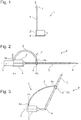
- Fig. 1 shows a locking device 1 of an access cannula Z according to a first embodiment of the invention.
- the entire locking device 1 is formed in one piece, wherein all of its elements can be made of the same material, preferably by injection molding.
- the locking device 1 has a sleeve-shaped base portion 2, which is intended to be mounted on a dwell tube 3 or attached to it.
- the base portion 2 is directly and integrally connected to a mounting base 4 of the access cannula Z, which serves to fix the access cannula Z for a treatment on a patient, more particularly on a skin portion of the patient, preferably adhesively.
- the locking device 1 has a relaxed in the position shown spring element 5 in the form of a spiral spring, which is connected directly and integrally to the base portion 2.
- the spring element 5 is arranged on the mounting base 4 radially opposite side of the base portion 2.
- the locking device 1 has a connection section 6, which is connected directly and integrally to the spring element 5.
- the connection section 6 is sleeve-shaped with a receiving hole 7 for receiving the dwell tube 3.
- Fig. 2 shows the access cannula Z according to the first embodiment in a fully assembled state. That is, the access cannula Z is in the condition in which it can be used to provide access for treatment.
- the dwell tube 3 sits on a needle 8, which serves to puncture the patient tissue as the skin and vessels when laying the access.
- the above-described locking device 1 according to Fig. 1 is mounted on the dwell tube 3.
- the bending spring as the spring element 5 is bent and stretched and the sleeve-shaped connection section 6 is mounted on the dwell tube 3 by the dwell tube 3 was passed through the receiving hole 7 of the connection portion 6.
- the spring element 5 strives for a relaxed, stretched position, it exerts in this case a force or a moment with a component which is perpendicular to a longitudinal axis L of the dwell 3, on the dwell tube 3, thereby possibly kinking the dwell 3 is triggered.
- the connection section 6 is freely displaceable on the dwell tube 3, so that the connection section 6 aligns itself during mounting itself along the dwell tube 3 and no additional adjustment of the spring element 5 is necessary. Since the residence tube 3 is seated on the insertion needle 8, which has the shape of a long, straight, thin sleeve, the shape of the retention tube 3 is adapted to the shape of the insertion needle 8, ie the retention tube 3 is held in an extended position by the insertion needle 8.
- the insertion needle 8 of the access cannula Z is inserted into the vessel of the patient. Subsequently, the dwell tube 3 is inserted via the insertion needle 8 into the vessel and the access cannula Z is fixed to the skin of the patient. Subsequently, the insertion needle 8 is withdrawn and removed, while the retention tube 3 remains in the vessel of the patient and serves as an access during the treatment.
- Fig. 3 shows the access cannula Z according to the invention according to the first embodiment in a rest position, which is present when the dwell tube 3 is not held in the extended position.
- a VND occurs, ie when the dwell tube 3 of the patient's venous access slips out of the patient's vessel.
- the kink is located at a predetermined kink K of the dwell 3 between the first position P1 and the second position P2, ie between the base portion 2 and the connection portion 6.
- the spring element 5 is biased in this case and is in equilibrium with an elastic restoring force of the residence tube 3. If a VND is present, the force of the spring element 5 acts both against the restoring force of the retention tube 3 and against a blood pressure built up in the retention tube 3.
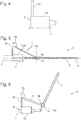
- Fig. 4 shows a part of a locking device 1 according to a second embodiment of the invention.
- This consists of a base portion 2, which has a sleeve portion 2a, which substantially corresponds to the above-described base portion 2 according to the first embodiment and is also integrally connected to a mounting base 4.
- the base portion 2 according to the second embodiment has a rod-shaped spacer portion 2b extending radially outward in a direction perpendicular to the longitudinal axis L of the dwell tube 3, the spacer portion 2b and the sleeve portion 2a being integrally formed with each other.
- the spacer part 2b has a first, radially inner end, to which it is directly connected to the sleeve part 2a, and a second, radially outer end, which is adapted to hold a spring element 5.
- the second, radially outer end has for this purpose, for example, a notch, an eyelet or the like, in which the spring element 5 is easily used with its first end.
- Fig. 5 shows the access cannula Z according to the second embodiment in a fully assembled state, which essentially, in particular with regard to a usability as an access for a treatment or its laying and the interaction with a Einstecknadel 8, the first embodiment according to Fig. 2 equivalent.
- the spring element 5 is designed as a tension spring, in particular as an elastic band.
- This spring element 5 has at its first end 5a a portion which For example, a loop, a hook or a tee shaped and which is adapted to cooperate with the second, radially outer end of the spacer part 2b and inserted, hooked or wrapped around this. In this way, as in Fig.
- the radial extension of the spacer part 2b or a length thereof determines the distance of the first end 5a of the spring element 5 from the longitudinal axis L of the dwell tube 3.
- a second end 5b of the spring member 5 is provided with a similar or equal shaped portion as the first end 5a of the spring member 5 and is adapted to be held by a terminal portion 6 of the lock device 1.
- the substantially sleeve-shaped connecting portion 6 has for this purpose, similar to the second, radially outer end of the spacer member 2b a correspondingly adapted portion, for example with a notch, an eyelet or the like, through which the second end 5b of the spring element 5 is held ,
- the connecting portion 6 is substantially formed as a pushed onto the dwell 3 sleeve, which is held at a position at a predetermined distance from the base portion 2 against displacement in the direction of the base portion 2, so that the spring element 5 between the base portion 2 and the connection section 6 is stretched.
- connection section 6 is held by a trained on the dwell 3 stage or is fixed to the dwell adhesive.
- a terminal connection can be used, the connection portion 6 consist of a simple groove or groove in the dwell 3 or the connection portion 6 molded directly to the dwell 3 or made in one piece with this.
- the force exerted by the spring element 5 on the dwell 3 force is dependent and optionally adjustable based on the elasticity and length of the spring element 5, the radial distance of the first end 5a of the spring element 5 from the longitudinal axis L of the dwell 3 and the distance of the connecting portion. 6 from the base part 2.
- Fig. 6 shows the access cannula Z according to the invention according to the second embodiment in a rest position, which substantially the above already in Fig. 3 described representation of the first embodiment corresponds.
- the spring element 5 exerts a force with at least one component perpendicular to the dwell hose 3, or acts on it with a moment and holds it in a position bent at a predetermined bending point K.
Landscapes
- Health & Medical Sciences (AREA)
- Heart & Thoracic Surgery (AREA)
- Vascular Medicine (AREA)
- Life Sciences & Earth Sciences (AREA)
- General Health & Medical Sciences (AREA)
- Biomedical Technology (AREA)
- Animal Behavior & Ethology (AREA)
- Public Health (AREA)
- Veterinary Medicine (AREA)
- Engineering & Computer Science (AREA)
- Hematology (AREA)
- Anesthesiology (AREA)
- Cardiology (AREA)
- Urology & Nephrology (AREA)
- Surgery (AREA)
- Pulmonology (AREA)
- Pathology (AREA)
- Nuclear Medicine, Radiotherapy & Molecular Imaging (AREA)
- Medical Informatics (AREA)
- Molecular Biology (AREA)
- Emergency Medicine (AREA)
- Infusion, Injection, And Reservoir Apparatuses (AREA)
- External Artificial Organs (AREA)
- Media Introduction/Drainage Providing Device (AREA)
Abstract
Description
- Bei der vorliegenden Erfindung handelt es sich um eine Zugangskanüle, insbesondere eine Venenverweilkanüle, mit einem Verweilschlauch, welcher dazu konfiguriert ist, während einer Behandlung, insbesondere einer Dialysebehandlung, als Zugang zu dienen, wobei eine Sperrvorrichtung dazu vorgesehen ist, den Verweilschlauch in einer Ruhelage abgeknickt zu halten.
- Dialyse, insbesondere Hämodialyse, Hämofiltration und Hämodiafiltration, stellt die häufigste Behandlungsform bei Nierenversagen dar und erfordert häufige und regelmäßige Behandlungen für einen Patienten, welche sowohl in einer Klinik durchgeführt werden können als auch zu Hause von dem Patienten selbst.
- Bei einer Dialysebehandlung werden mittels einer arteriellen Einstecknadel ein arterieller Zugang und mittels einer venösen Einstecknadel ein venöser Zugang gelegt, um den Patienten an eine Dialysemaschine anzuschließen. Hierfür werden Venenverweilkanülen oder -katheter eingesetzt, bei welchen ein Kunststoffschlauch oder Verweilschlauch über eine Einstecknadel oder Metallkanüle in ein Patientengefäß eingeführt wird und nach Entfernen der Einstecknadel als Zugang in der Vene verbleibt. Derartige Venenverweilkanülen sind aus dem Stand der Technik hinreichend bekannt.
- Wenn sich bei einer Dialysebehandlung der venöse Zugang löst und aus dem Gefäß rutscht, wird dies als venöse Nadeldislokation (VND) bezeichnet, was eine kritische Komplikation und Gefahr für den Patienten darstellt. In einem solchen Fall fließt Blut, welches die Dialysemaschine durchflossen hat, nicht zurück in den Kreislauf des Patienten, sondern wird in die Umgebung gepumpt, insbesondere durch eine Blutpumpe der Behandlungsmaschine. Ein durchschnittlicher Patient kann bei einer VND innerhalb von 5 Minuten bis zu 50% seines Gesamtblutvolumens verlieren und es reichen bereits zwei Minuten, bis Vitalzeichen eines Patienten signifikant beeinträchtigt sind. Folglich ist es essentiell wichtig, eine VND möglichst schnell zu erkennen. Je nach Reaktionszeit liegen die Folgen bei einem relativ geringen Blutverlust, erhöhter Infektionsgefahr, irreversiblen Hirnschäden bis hin zum Tod. Neben den physischen und psychischen Folgen für den Patienten fallen durch benötigte Blutkonserven und Folgebehandlungen auch hohe Kosten an. Insbesondere bei Heimdialyse und nächtlichen Behandlungen, wo die Patienten zumeist schlafen, sind VND kritisch, da der Patient nicht in der Lage ist, die VND selbst zu bemerken und möglicherweise nicht rechtzeitig reagieren und auf sich aufmerksam machen kann.
- Eine besondere Herausforderung besteht darin, dass eine VND nahezu jederzeit auftreten kann. Zwar sind einige Risikofaktoren bekannt, wie beispielsweise Rastlosigkeit oder mentale Beeinträchtigung der Patienten sowie das Auftreten von Muskelkrämpfen während der Behandlung, jedoch treten VND auch unter Idealbedingungen auf und sind somit kaum vorhersagbar.
- Um die Gefahr einer VND zu verringern, gibt es Richtlinien zu der Art und Weise, wie ein Zugang gelegt und befestigt werden soll. Ferner existieren Lösungen, welche ein Auftreten einer VND erkennen und einen Alarm auslösen, sowie ggf. die Blutpumpe der Behandlungsmaschine anhalten können.
- Eine solche Lösung ist eine Drucküberwachung an der venösen Leitung bzw. an dem venösen Zugang, was in Dialysemaschinen standardmäßig vorgesehen ist. Die Überwachung des venösen Druckverlaufs gilt jedoch als notorisch unsicher, unter anderem weil der Druck abhängig von einer Vielzahl von Faktoren stark variieren kann. Häufig wird eine VND nur verzögert erkannt, weshalb der Patient bereits bis zum Auslösen des Alarms eine signifikante Menge Blut verloren haben kann. Ferner kommt es vor, dass beispielsweise aufgrund von Strömungswiderständen an der Nadel oder deren Befestigungsmaterial sowie bei unvollständigem Lösen der Nadel der Druckabfall so gering ist, dass dieser nicht als VND erkannt wird und gar kein Alarm ausgelöst wird.
- Eine weitere Lösung besteht in der Erkennung einer Leckage durch an dem Zugang angebrachte Leckage- oder Feuchtigkeitssensoren, welche einen Blutverlust in die Umgebung überwachen, wie zum Beispiel durch VenAcc von Fresenius Medical Care und Redsense von Redsense Medical, welche ein Einweg-Sensorpad aufweisen, das zusammen mit der Nadel aufgeklebt wird und bereits geringe Mengen austretender Flüssigkeiten erkennt. Allerdings sind diese Vorrichtungen mit zusätzlichen Kosten verbunden, da hierfür teure Zusatzgeräte und Einwegteile benötigt werden und menschliche Fehler hierdurch nicht ausgeschlossen werden können.
- Die bekannten Lösungen ermöglichen somit keine hundertprozentig sichere Erkennung von VND. Da außerdem durch Fehlanwendung bzw. Fehlbedienung oder zu eng gesetzte Grenzwerte die Wahrscheinlichkeit für Fehlalarme hoch ist, werden venöse Alarme häufig einfach weggedrückt, sodass trotz Anschlagen eines Alarms eine VND ggf. nicht rechtzeitig erkannt wird.
- Die Aufgabe der vorliegenden Erfindung besteht folglich darin, ein System zur Verfügung zu stellen, welches u.a. die vorstehend genannten Nachteile bestehender Systeme behebt und insbesondere eine zuverlässige, schnelle Erkennung von VND und eine möglichst schnelle, zuverlässige Unterbrechung des Blutflusses ermöglicht. Ferner besteht die Aufgabe der Erfindung darin, ein derartiges System zur Verfügung zu stellen, welches keinen apparativen Mehraufwand erfordert, sowie kostengünstig und einfach zu handhaben ist.
- Diese Aufgabe wird gelöst durch eine Zugangskanüle, insbesondere eine Venenverweilkanüle, mit einem Verweilschlauch, welcher dazu konfiguriert ist, während einer Behandlung, insbesondere einer Dialysebehandlung, als ein Zugang in einen Patientenkörper zu dienen. Dabei ist eine Sperrvorrichtung vorgesehen, welche dazu konfiguriert ist, in einer Ruhelage (in welcher der Verweilschlauch nicht oder nicht korrekt im Patientenkörper appliziert ist) den Verweilschlauch abgeknickt zu halten.
- Die erfindungsgemäße Zugangskanüle ist insbesondere dazu vorgesehen, um den venösen Zugang zu legen, kann jedoch gleichermaßen auch für den arteriellen Zugang verwendet werden. Ferner soll die Erfindung nicht auf Dialysebehandlungen beschränkt sein. Beispielsweise ist auch ein Einsatz als Zugang für eine Infusion denkbar, wo eine erfindungsgemäße Zugangskanüle ermöglicht, bei einer Nadeldislokation ein Auslaufen von Medikamenten etc. zu verhindern. Dies ist insbesondere bei Medikamenten zur onkologischen Behandlung relevant.
- Die Ruhelage, in welcher der Verweilschlauch vorzugsweise an einer Soll-Knickstelle abgeknickt gehalten wird, entspricht einer Lage, in welcher eine Kraft, die die Sperrvorrichtung auf den Verweilschlauch ausübt, die elastische Rückstellkraft des Verweilschlauchs und ggf. ein in dem Verweilschlauch vorliegender Druck einander ausgleichen.
- Um als Zugang dienen zu können, muss die Zugangskanüle mit dem Verweilschlauch in einer im Wesentlichen oder nahe einer gestreckten Lage entgegen der Kraft der Sperrvorrichtung gehalten werden, beispielsweise durch klebende Befestigung an Patientenhaut durch einen an der Zugangskanüle vorgesehenen Befestigungssockel oder -pad, sodass ein möglichst widerstandsloser Blutfluss durch den Schlauch möglich ist. Da beim Legen des Zugangs wie bereits vorstehend beschrieben der Verweilschlauch über eine Einstecknadel geschoben und so in die Vene einführt wird, folgt der Verweilschlauch dabei der Geometrie der Einstecknadel, d.h. er ist gestreckt. Anschließend kann der Verweilschlauch in dieser Lage am Patientenkörper befestigt werden und die Einstecknadel abgezogen werden. Somit wird während des standartmäßigen Legens des Zugangs der Schlauch durch die Nadel gestreckt gehalten, wodurch hierfür keine zusätzlichen Teile oder Bewegungen/Handhabung benötigt werden und der Einsatz einer erfindungsgemäßen Zugangskanüle im Vergleich mit einer derzeit gängigen Zugangskanüle keinen Mehraufwand für das medizinische Personal bedeutet.
- Wenn der Verweilschlauch aus der Vene des Patienten rutscht, d.h. wenn es zu einer Nadeldislokation kommt, dann löst sich auch die Anbringung/Befestigung der Zugangskanüle an dem Patienten. Folglich wird der Verweilschlauch nicht mehr in gestreckter Lage gehalten und durch die Sperrvorrichtung abgeknickt. Dies unterbricht oder hemmt den Blutfluss durch das Behandlungssystem, z.B. die Dialysemaschine, sodass kein oder wenig Blut aus dem Verweilschlauch ausströmen kann. Insbesondere bei einer VND, also einer Nadeldislokation an dem venösen Zugang, verhindert dies im günstigsten Fall, dass Blut aus dem arteriellen Zugang durch das Behandlungssystem und aus dem gelösten venösen Zugang in die Umgebung gepumpt wird.
- Das Absperren des Blutflusses beispielsweise in einem extrakorporalen Blutkreis einer Dialysemaschine führt bei einer Sperrung des venösen Zugangs zu einem erhöhten Blutdruck stromaufwärts des Knicks sowie bei einer Sperrung des arteriellen Zugangs zu einem abfallenden Blutdruck stromabwärts des Knicks. Diese Druckänderung erfolgt schnell und ist groß genug, dass sie sicher von dem in dem Behandlungssystem, insbesondere der Dialysemaschine, standardmäßig vorgesehenen Drucküberwachungssystem erfasst werden und eine Reaktion eingeleitet werden kann, d.h. ein Alarm kann unmittelbar ausgegeben und ggf. eine Blutpumpe abgeschaltet bzw. angehalten werden. Vorteilhaft ist hierbei insbesondere, dass ein Alarm zwar weggedrückt werden kann, dieser aufgrund der Sperrung des Blutflusses jedoch sofort wieder anschlagen würde.
- Es ist zu beachten, dass die Kraft, mit welcher die Sperrvorrichtung den Schlauch abgeknickt hält, im Falle einer VND nicht nur entgegen der elastischen Rückstellkraft des Schlauchs wirkt, sondern ggf. auch entgegen des durch die Blutpumpe aufgebauten Druckes. Entsprechend ist die Sperrvorrichtung einerseits abhängig von einer Förderleistung der eingesetzten Blutpumpe derart eingestellt bzw. einstellbar, dass ein Wiederöffnen des Verweilschlauchs aufgrund des steigenden Blutdrucks verhindert oder zumindest für eine vorbestimmte Zeit verzögert wird. Andererseits muss die Sperrvorrichtung derart eingestellt sein, dass im Fall eines klebend an der Patientenhaut gestreckt angebrachten Verweilschlauchs diese Klebung nicht durch die Sperrvorrichtung selbst gelöst werden kann, was zu einer Unterbrechung der Behandlung führen würde und schlimmstenfalls sogar eine VND auslösen könnte.
- Nach einem bevorzugten Aspekt der Erfindung weist die Sperrvorrichtung ein Federelement auf, welches mit einem ersten Ende an einer ersten Position des Verweilschlauchs angeordnet ist und welches mit einem zweiten Ende an einer zweiten Position mit dem Verweilschlauch verbunden oder verbindbar ist. Dabei ist die zweite Position entlang einer Längsachse des Verweilschlauchs mit einem Abstand von der ersten Position entfernt. Nach einem weiteren bevorzugten Aspekt der Erfindung sind der Abstand und das Federelement derart eingestellt, dass das Federelement gespannt ist, wenn der Verweilschlauch in einer gestreckten Lage gehalten wird.
- Das Federelement dient dazu, eine (Biege-) Kraft/Federkraft auf den Verweilschlauch auszuüben, wodurch dieser abgeknickt werden kann. Die Federkraft entspricht hierbei der Kraft der Sperrvorrichtung. Das Federelement ist bedingt durch den Abstand der ersten und der zweiten Position und/oder durch die Rückstellkraft des Verweilschlauchs auch in der Ruhelage geringfügig vorgespannt und ist in gestreckter Lage über die Vorspannung der Ruhelage hinaus zusätzlich gespannt. Grundsätzlich ist es auch denkbar, mehrere Federelemente vorzusehen. Der Abstand kann durch die Positionen der Verbindungen der Sperrvorrichtung mit dem Verweilschlauch bestimmt sein oder bedingt durch andere strukturelle Parameter, wie die Länge der Feder, bestimmt sein. Die erste Position kann sowohl distal als auch proximal von der zweiten Position liegen. Die erste Position oder die zweite Position kann die gleiche Position sein, an welcher der Befestigungssockel oder das Befestigungspad zum klebenden Befestigen des Verweilschlauchs an der Patientenhaut vorgesehen ist. Der Abstand ist derart eingestellt, dass die auf den Verweilschlauch ausgeübte Federkraft eine vorbestimmte Federkraft ist, welche wie vorstehend beschrieben beispielsweise von der Förderleistung der Blutpumpe und/oder der gestreckten Befestigung des Verweilschlauchs abhängig ist. Der Abstand ist vorzugsweise ein fest eingestellter Abstand, welcher u.a. abhängig von der Länge des Federelements ist, oder ist alternativ unmittelbar durch Parameter des Federelements bestimmt. Es ist jedoch auch denkbar, dass der Abstand der ersten und der zweiten Position einstellbar und sicherbar ist, indem eine der beiden Positionen gegenüber der anderen veränderbar ist. Dies ist beispielsweise dadurch realisierbar, dass ein Element, welches das Federelement mit dem Verweilschlauch verbindet, entlang des Verweilschlauchs verschiebbar ist, oder dass entlang des Verweilschlauchs mehrere Elemente zum Halten/Anschließen eines der Enden des Federelements vorgesehen sind und das entsprechende Ende des Federelements umgesetzt bzw. umgehakt werden kann, d.h. je nach gewünschter Kraft/Federkraft des Sperrelements das Federelement von unterschiedlichen Elementen gehalten werden kann.
- Nach einem bevorzugten Aspekt der Erfindung übt das Federelement an der zweiten Position eine Federkraft auf den Verweilschlauch aus, welche zumindest anteilig senkrecht zu der Längsachse des Verweilschlauchs wirkt, wenn das Federelement gespannt ist.
- Dies ermöglicht es, den Verweilschlauch mit einem relativ geringen Kraftaufwand abzuknicken, verglichen mit einem Fall, in welchem der Verweilschlauch nur in Längsrichtung mit Kraft beaufschlagt würde und ähnlich einem druckbelasteten Knickstab nachgeben müsste. Die durch das Federelement ausgeübte Federkraft kann ausschließlich senkrecht zu der Längsachse des Verweilschlauchs wirken, sie kann jedoch stattdessen auch sowohl aus einer senkrechten Kraftkomponente als auch aus einer Kraftkomponente parallel zu der Längsachse des Verweilschlauchs zusammengesetzt sein. Da das Federelement an einer ersten Position des Verweilschlauchs angebracht ist, bewirkt dies ein Moment, welches auf den Verweilschlauch wirkt und zu einem Abknicken führt.
- Nach einem bevorzugten Aspekt der Erfindung ist der Verweilschlauch durch eine Federkraft des Federelements vorzugsweise an einer Soll-Knickstelle abgeknickt, wenn der Verweilschlauch nicht in einer gestreckten Lage gehalten wird.
- In anderen Worten ist die Federkraft des Federelements derart eingestellt, dass der Verweilschlauch stets abgeknickt ist, es sei denn eine gestreckte Lage wird gezielt hergestellt. Auch falls beispielsweise eine VND auftritt und dabei ein Arm des Patienten auf dem Verweilschlauch aufliegen würde, tendiert dieser eher dazu, sich wegzudrehen, als sich zu strecken, sodass der Verweilschlauch seine abgeknickte Stellung oder seine Ruhestellung beibehält. Eine gestreckte Lage des Verweilschlauchs sollte also nur hergestellt werden können, wenn gezielt beide Positionen, an welchen die Enden des Federelements befestigt sind, derart gehalten und ggf. fixiert sind, dass der Schlauch gestreckt ist.
- Nach einem weiteren bevorzugten Aspekt der Erfindung hat die Sperrvorrichtung einen Basisabschnitt, welcher das erste Ende des Federelements mit dem Verweilschlauch direkt oder indirekt verbindet oder verbindbar macht, und einen Anschlussabschnitt, welcher das zweite Ende des Federelements mit dem Verweilschlauch verbindet oder verbindbar macht.
- Im dem Fall, in dem die erste Position und die zweite Position zueinander einstellbar/veränderbar sind, kann hierbei der Basisabschnitt und/oder der Anschlussabschnitt auf dem Verweilschlauch verschiebbar und ggf. sicherbar sein oder mehrere unterschiedlich positionierte Elemente aufweisen, welche dazu angepasst sind, ein Ende des Federelements zu halten. Ein verschiebbarer Basis- oder Anschlussabschnitt kann beispielsweise eine geschlossene oder geschlitzte, vorzugsweise aufklipsbare Hülse oder ein Ring, z.B. ein Gummiring, sein, welche bzw. welcher ggf. entlang des Schlauchs verschoben und ggf. festgeklemmt werden kann. Elemente, welche ein Ende des Federelements halten, können beispielsweise Haken, Ösen, Nuten oder Hinterschnitte sein. Falls der Abstand der beiden Positionen zueinander nicht einstellbar ist, können der Basisabschnitt und/oder der Anschlussabschnitt fest mit dem Verweilschlauch verbunden oder verbindbar sein. Ferner kann der Basisabschnitt beliebig zu der übrigen Zugangskanüle ausgerichtet sein. Beispielsweise kann die Seite des Basisabschnitts, an welcher das Federelement angeschlossen oder befestigt ist (hier als "oben bezeichnet"), der Seite, an welcher sich ggf. der Befestigungssockel oder -pad der Zugangskanüle befindet (hier als "unten" bezeichnet), radial gegenüberliegen. Alternativ kann der Basisabschnitt zu der Zugangskanüle jedoch in einem beliebigen Winkel ausgerichtet sein, beispielsweise gegenüber der Ausrichtung des vorstehenden Beispiels um 90° verdreht, sodass das Federelement sich "seitlich" des Basisabschnitts befindet und die Seite, an welcher sich ggf. der Befestigungssockel oder -pad der Zugangskanüle befindet, "unten" liegt.
- Nach einem bevorzugten Aspekt der Erfindung sind zumindest der Basisabschnitt und/oder der Anschlussabschnitt, vorzugsweise die gesamte Sperrvorrichtung inklusive dem Federelement, mit dem Verweilschlauch einstückig ausgebildet oder als ein von dem Verweilschlauch unterschiedliches Bauteil einstückig ausgebildet, vorzugsweise als Spritzgussteil.
- Auf diese Weise ist es möglich, die erfindungsgemäße Zugangskanüle kostengünstig als Einwegteil zu fertigen. Falls die Sperrvorrichtung getrennt von dem Verweilschlauch gefertigt bzw. spritzgegossen ist, kann diese in einem weiteren Fertigungsschritt mit dem Verweilschlauch verbunden, z.B. geklebt, werden. Dabei kann ggf. die Sperrvorrichtung mit anderen Teilen der Zugangskanüle wie z.B. dem Befestigungssockel oder -pad einstückig gefertigt sein. Auf diese Weise kann der Verweilschlauch ein Zukaufteil sein. Dies ist ebenfalls möglich, wenn die Sperrvorrichtung oder Teile der Sperrvorrichtung direkt auf den Verweilschlauch aufgespritzt werden und somit mit diesem einstückig ausgebildet sind.
- Nach einem bevorzugten Aspekt der Erfindung ist das Federelement als Biegefeder ausgebildet.
- Dies stellt eine Ausführungsform der Erfindung dar und ist insbesondere vorteilhaft, da hierbei die gesamte Sperrvorrichtung und ggf. sogar die gesamte Zugangskanüle inklusive dem Verweilschlauch einstückig fertigbar ist, insbesondere spritzgegossen werden kann und somit besonders günstig herzustellen ist. Die Biegefeder kann zum Beispiel als Blattfeder, als Biegebalken oder als Biegestab ausgebildet sein. Um die Sperrvorrichtung einsatzfertig zu machen oder in die Ruhelage zu bringen, kann die Biegefeder in einem weiteren Fertigungsschritt gebogen (gespannt) werden. Hierfür kann beispielsweise der Anschlussabschnitt an der zweiten Position mit dem Verweilschlauch verbunden werden. Vorzugsweise kann dabei der Anschlussabschnitt gemäß einem der vorstehend beschriebenen Aspekte der Erfindung entlang der Längsachse des Verweilschlauchs frei verschiebbar sein, sodass die Position des Anschlussabschnitts (die zweite Position) und deren Abstand zu der ersten Position durch die Länge der Biegefeder vorbestimmt ist. Der Anschlussabschnitt kann sowohl gelenkig (beispielsweise um eine Achse senkrecht zu der Längsachse des Verweilschlauchs drehbar) und/oder verschiebbar mit dem Verweilschlauch verbunden oder verbindbar sein, als auch fest mit dem Verweilschlauch verbunden oder verbindbar sein, z.B. durch Kleben. Eine drehfeste Verbindung zwischen der Biegefeder und dem Verweilschlauch führt dazu, dass der Winkel, in welchem die Federkraft auf den Verweilschlauch wirkt, stets gleich ist. Insbesondere, falls die Biegefeder mit der Längsachse des Verweilschlauchs an der Verbindungsstelle zwischen der Biegefeder und dem Verweilschlauch einen starren, rechten Winkel bildet, hat die Federkraft der Biegefeder genau genommen keine Komponente, welche senkrecht zu der Längsachse des Verweilschlauchs ist. Jedoch führt das Moment, welches durch die Biegefeder auf den Verweilschlauch aufgebracht wird, direkt dazu, dass ein Teil des Verweilschlauchs sich in eine Richtung senkrecht zu der Längsachse des Verweilschlauchs bewegt, wenn er sich aus seiner gestreckten Lage herausbewegt. Das führt zum Abknicken des Verweilschlauchs. Im Kontext dieser Erfindung kann dies als senkrecht zu der Längsachse des Verweilschlauchs wirkende Kraft gemäß einem der vorstehend beschriebenen Aspekte der Erfindung angesehen werden.
- Nach einem bevorzugten Aspekt der Erfindung ist das Federelement als Zugfeder, vorzugsweise als elastisches Band, ausgebildet.
- Dies stellt eine weitere Ausführungsform der Erfindung dar. Hierbei wird die Zugfeder an ihrem einen Ende an dem Basisabschnitt gehalten oder eingehakt und an ihrem zweiten Ende an dem Anschlussabschnitt gehalten oder eingehakt. Dabei definiert der Basisabschnitt einen radialen Abstand des ersten Endes des Federelements von der Längsachse des Verweilschlauchs. Ggf. hat der Basisabschnitt hierfür einen stabförmigen Teil oder ist nockenförmig ausgebildet oder hat einen entsprechend großen Gesamtdurchmesser, es kann jedoch gleichermaßen jede sich ausgehend von der Längsachse des Verweilschlauchs radial nach außen erstreckende Struktur genutzt werden, um den radialen Abstand des ersten Endes des Federelements von der Längsachse des Verweilschlauchs festzulegen. Die Zugfeder kann anstelle eines elastischen Bandes beispielsweise auch eine Spiralfeder oder Ähnliches sein. Der Basisabschnitt und der Anschlussabschnitt können einstückig mit dem Verweilschlauch gefertigt, insbesondere an diesen angegossen werden und sind unmittelbar mit diesem verbunden. Bevorzugt ist die zweite Position des Verweilschlauchs bzw. der Anschlussabschnitt entlang der Längsachse des Verweilschlauchs verschiebbar, wobei ein Minimalabstand von der ersten Position bzw. dem Basisabschnitt beispielsweise durch einen Anschlag definiert ist. Die Kraft/Federkraft der Sperrvorrichtung kann ggf. dadurch eingestellt werden, dass das Federelement gegen ein anderes unterschiedlich starkes Federelement ausgetauscht wird und/oder dass der Anschlussabschnitt und/oder der Basisabschnitt gemäß einem der vorstehend beschriebenen Aspekte der Erfindung mehrere auswählbare, unterschiedlich positionierte Elemente zum Halten eines der Enden der Feder aufweisen.
- Nach einem bevorzugten Aspekt der Erfindung ist der Basisabschnitt derart ausgebildet, dass das erste Ende des als Zugfeder ausgebildeten Federelements an dem Basisabschnitt mit einem vorbestimmten radialen Abstand von der Längsachse des Verweilschlauchs verbunden oder verbindbar ist.
- Der Winkel der Zugfeder zu der Längsachse des Verweilschlauchs ist nach diesem Aspekt der Erfindung abhängig von dem vorbestimmten radialen Abstand. Folglich ist auch die senkrechte Kraftkomponente der Federkraft, welche senkrecht zu der Längsachse des Verweilschlauchs wirkt, abhängig von dem vorbestimmten radialen Abstand. Hierbei ist der radiale Abstand klein genug gewählt, dass der Basisabschnitt nicht im Weg ist und die Gefahr, daran hängen zu bleiben gering ist, aber groß genug, dass die senkrechte Kraftkomponente ausreichend groß ist, um den Verweilschlauch erfindungsgemäß abzuknicken.
- Insbesondere und bevorzugt wird die Aufgabe gelöst durch eine Zugangskanüle bei welcher der Verweilschlauch an der ersten Position einen Befestigungssockel oder ein Befestigungspad aufweist, das zur vorzugsweise klebenden Fixierung des Verweilschlauchs an einer Patientenoberfläche, vorzugsweise Patientenhaut ausgebildet ist und an dem das Federelement an dessen erstem Ende fixiert oder gehalten ist, und der Verweilschlauch an der zweiten Position ein Anschlusselement oder einen Anschlussabschnitt aufweist, an dem das Federelement an dessen zweitem Ende fixiert oder gehalten ist, wobei der Verweilschlauch axial zwischen der ersten und zweiten Position mit einer Soll-Knickstelle ausgebildet ist und das Federelement entweder als Zug- oder Druckfeder, vorzugsweise in Form eines elastischen Bands oder einer Schraubenfeder, oder als Biegefeder, vorzugsweise in Form einer Blattfeder oder eines Federbalkens, ausgebildet ist, die zwischen der ersten und zweiten Position derart eingebaut und/oder ausgerichtet ist, dass das Federelement in einer gespannten Lage außerhalb der Ruhelage eine Kraft auf den Verweilschlauch an der zweiten Position ausübt, die zumindest teilweise senkrecht zur Längsachse des Verweilschlauchs wirkt, um diesen aus einer wenig oder nicht geknickten Stellung in die abgeknickte Stellung vorzuspannen.
- Die Erfindung wird im Folgenden anhand bevorzugter Ausführungsformen beschrieben, wobei Merkmale verschiedener Ausführungsformen untereinander ausgetauscht und/oder kombiniert werden können. Es versteht sich, dass Einzelheiten der beschriebenen bevorzugten Ausführungsformen die Erfindung als solche nicht beschränken und sich für den Fachmann naheliegend verschiedenartige Änderungen, Modifikationen und/oder Äquivalente ergeben können, die als solche allesamt im Rahmen des durch die beigefügten Ansprüche definierten Schutzbereichs der Erfindung liegen. Ferner werden in der nachfolgenden Beschreibung der bevorzugten Ausführungsformen gleiche Bezugszeichen für einander entsprechende Merkmale verwendet, welche ggf. nur einmal beschrieben werden, jedoch in jeder der vorgestellten Ausführungsformen vorgesehen sein können.
-
Fig. 1 zeigt eine Sperrvorrichtung nach einer ersten Ausführungsform der Erfindung in entspannter Lage, -
Fig. 2 zeigt eine Zugangskanüle nach der ersten Ausführungsform, welche auf einer Einstecknadel geführt ist, -
Fig. 3 zeigt eine Zugangskanüle nach der ersten Ausführungsform, welche in Ruhelage ist, -
Fig. 4 zeigt einen Teil einer Zugangskanüle nach der zweiten Ausführungsform, -
Fig. 5 zeigt eine Zugangskanüle nach einer zweiten Ausführungsform, welche auf einer Einstecknadel geführt ist, -
Fig. 6 zeigt eine Zugangskanüle nach der zweiten Ausführungsform, welche in Ruhelage ist. -
Fig. 1 zeigt eine Sperrvorrichtung 1 einer Zugangskanüle Z nach einer ersten Ausführungsform der Erfindung. Dabei ist die gesamte Sperrvorrichtung 1 einstückig ausgebildet, wobei sämtliche ihrer Elemente aus dem gleichen Material gefertigt sein können, vorzugsweise durch Spritzgießen. Die Sperrvorrichtung 1 hat einen hülsenförmigen Basisabschnitt 2, welcher dazu vorgesehen ist, an einem Verweilschlauch 3 montiert bzw. darauf aufgesteckt zu werden. Der Basisabschnitt 2 ist unmittelbar und einstückig mit einem Befestigungssockel 4 der Zugangskanüle Z verbunden, welcher dazu dient, die Zugangskanüle Z für eine Behandlung an einem Patienten, genauer an einem Hautabschnitt des Patienten, vorzugsweise klebend zu fixieren. Ferner weist die Sperrvorrichtung 1 ein in der abgebildeten Lage entspanntes Federelement 5 in Form einer Biegefeder auf, welches unmittelbar und einstückig an dem Basisabschnitt 2 angeschlossen ist. Dabei ist das Federelement 5 auf der dem Befestigungssockel 4 radial gegenüberliegenden Seite des Basisabschnitts 2 angeordnet. Ferner weist die Sperrvorrichtung 1 einen Anschlussabschnitt 6 auf, welcher unmittelbar und einstückig an das Federelement 5 angeschlossen ist. Der Anschlussabschnitt 6 ist hülsenförmig mit einem Aufnahmeloch 7 zum Aufnehmen des Verweilschlauchs 3 ausgebildet. -
Fig. 2 zeigt die Zugangskanüle Z nach der ersten Ausführungsform in einem fertig montierten Zustand. Das heißt, die Zugangskanüle Z befindet sich in dem Zustand, in welchem sie dafür genutzt werden kann, einen Zugang für eine Behandlung zu legen. Hierbei sitzt der Verweilschlauch 3 auf einer Einstecknadel 8, welche dazu dient, beim Legen des Zugangs Patientengewebe wie dessen Haut und Gefäße, zu punktieren. Die vorstehend beschriebene Sperrvorrichtung 1 gemäßFig. 1 ist an dem Verweilschlauch 3 montiert. Die Biegefeder als das Federelement 5 ist gebogen und gespannt und der hülsenförmige Anschlussabschnitt 6 ist an dem Verweilschlauch 3 montiert, indem der Verweilschlauch 3 durch das Aufnahmeloch 7 des Anschlussabschnitts 6 geführt wurde. Da das Federelement 5 eine entspannte, gestreckte Lage anstrebt, übt es hierbei eine Kraft bzw. ein Moment mit einer Komponente, welche senkrecht zu einer Längsachse L des Verweilschlauchs 3 steht, auf den Verweilschlauch 3 aus, sodass hierdurch ggf. ein Abknicken des Verweilschlauchs 3 ausgelöst wird. Der Anschlussabschnitt 6 ist auf dem Verweilschlauch 3 frei verschiebbar, sodass der Anschlussabschnitt 6 sich beim Montieren selbst entlang des Verweilschlauchs 3 ausrichtet und kein zusätzliches Einstellen des Federelements 5 notwendig ist. Da der Verweilschlauch 3 auf der Einstecknadel 8 sitzt, welche die Form einer langen, geraden, dünnen Hülse hat, ist die Form des Verweilschlauchs 3 der Form der Einstecknadel 8 angepasst, d.h. der Verweilschlauch 3 wird durch die Einstecknadel 8 in einer gestreckten Lage gehalten. - Beim Legen des Zugangs wird die Einstecknadel 8 der Zugangskanüle Z in das Gefäß des Patienten eingeführt. Anschließend wird der Verweilschlauch 3 über die Einstecknadel 8 in das Gefäß eingeschoben und die Zugangskanüle Z wird an der Haut des Patienten fixiert. Anschließend wird die Einstecknadel 8 abgezogen und entfernt, während der Verweilschlauch 3 in dem Gefäß des Patienten verbleibt und während der Behandlung als Zugang dient.
-
Fig. 3 zeigt die erfindungsgemäße Zugangskanüle Z nach der ersten Ausführungsform in einer Ruhelage, welche dann vorliegt, wenn der Verweilschlauch 3 nicht in gestreckter Position gehalten wird. Dies ist beispielsweise der Fall, wenn eine VND auftritt, wenn also der Verweilschlauch 3 des venösen Zugangs des Patienten aus dem Gefäß des Patienten herausrutscht. In dieser Ruhelage wird der Verweilschlauch 3 durch die durch das Federelement 5 aufgebrachte Kraft bzw. dessen Moment abgeknickt gehalten, wobei sich der Knick an einer Sollknickstelle K des Verweilschlauchs 3 zwischen der ersten Position P1 und der zweiten Position P2, also zwischen dem Basisabschnitt 2 und dem Anschlussabschnitt 6 befindet. Das Federelement 5 ist hierbei vorgespannt und ist mit einer elastischen Rückstellkraft des Verweilschlauchs 3 im Gleichgewicht. Sollte eine VND vorliegen, wirkt die Kraft des Federelements 5 sowohl gegen die Rückstellkraft des Verweilschlauchs 3 als auch gegen einen in dem Verweilschlauch 3 aufgebauten Blutdruck. -
Fig. 4 zeigt einen Teil einer Sperrvorrichtung 1 nach einer zweiten Ausführungsform der Erfindung. Dieses besteht aus einem Basisabschnitt 2, welcher einen Hülsenteil 2a hat, welcher im Wesentlichen dem vorstehend beschriebenen Basisabschnitt 2 nach der ersten Ausführungsform entspricht und ebenfalls einstückig mit einem Befestigungssockel 4 verbunden ist. Darüber hinaus hat der Basisabschnitt 2 nach der zweiten Ausführungsform einen stabförmigen Abstandhalterteil 2b, welcher sich in einer Richtung senkrecht zu der Längsachse L des Verweilschlauchs 3 radial nach außen erstreckt, wobei der Abstandhalterteil 2b und der Hülsenteil 2a einstückig miteinander ausgebildet sind. Der Abstandhalterteil 2b hat ein erstes, radial innenliegendes Ende, an welchem er mit dem Hülsenteil 2a unmittelbar verbunden ist, und ein zweites, radial außen liegendes Ende, welches dazu angepasst ist, ein Federelement 5 zu halten. Das zweite, radial außen liegende Ende weist hierfür beispielsweise eine Kerbe, eine Öse oder Ähnliches auf, in welche das Federelement 5 mit seinem ersten Ende leicht einsetzbar ist. -
Fig. 5 zeigt die Zugangskanüle Z nach der zweiten Ausführungsform in einem fertig montierten Zustand, welcher im Wesentlichen, insbesondere in Hinblick auf eine Einsetzbarkeit als ein Zugang für eine Behandlung bzw. dessen Legen und das Zusammenwirken mit einer Einstecknadel 8, der ersten Ausführung nachFig. 2 entspricht. Im Unterschied zu der ersten Ausführungsform ist in der erfindungsgemäßen Sperrvorrichtung 1 der Zugangskanüle Z nach der ersten Ausführungsform das Federelement 5 als Zugfeder, insbesondere als elastisches Band ausgebildet. Dieses Federelement 5 weist an seinem ersten Ende 5a einen Abschnitt auf, welcher beispielsweise eine Schlaufe, einen Haken oder ein T-Stück formt und welcher dazu angepasst ist, mit dem zweiten, radial außen liegenden Ende des Abstandhalterteils 2b zusammenzuwirken und daran eingesetzt, eingehakt oder um dieses herumgelegt werden kann. Auf diese Weise wird, wie inFig. 5 dargestellt, das erste Ende 5a des Federelements 5 von dem zweiten, radial außen liegenden Ende des Abstandhalterteils 2b und somit von dem Basisabschnitt 2 gehalten. Die radiale Erstreckung des Abstandhalterteils 2b bzw. eine Länge desselben bestimmt hierbei den Abstand des ersten Endes 5a des Federelements 5 von der Längsachse L des Verweilschlauchs 3. - Ein zweites Ende 5b des Federelements 5 ist mit einem ähnlich oder gleich geformten Abschnitt versehen wie das erste Ende 5a des Federelements 5 und ist dazu angepasst, von einem Anschlussabschnitt 6 der Sperrvorrichtung 1 gehalten zu werden. Der im Wesentlichen hülsenförmig ausgebildete Anschlussabschnitt 6 weist hierfür, ähnlich wie das zweite, radial außen liegende Ende des Abstandhalterteils 2b einen entsprechend angepassten Abschnitt, beispielsweise mit einer Kerbe, einer Öse oder Ähnlichem, auf, durch welchen das zweite Ende 5b des Federelements 5 gehalten wird. Der Anschlussabschnitt 6 ist im Wesentlichen als eine auf den Verweilschlauch 3 aufgeschobene Hülse ausgebildet, welche an einer Position mit einem vorbestimmten Abstand von dem Basisabschnitt 2 gegen Verschieben in Richtung des Basisabschnitts 2 gehalten bzw. gesichert ist, sodass das Federelement 5 zwischen dem Basisabschnitt 2 und dem Anschlussabschnitt 6 gespannt ist. Der Anschlussabschnitt 6 wird dabei durch eine an dem Verweilschlauch 3 ausgebildete Stufe gehalten oder ist an dem Verweilschlauch klebend fixiert. Alternativ hierzu kann auch eine Klemmverbindung eingesetzt werden, der Anschlussabschnitt 6 aus einer simplen Nut oder Rille in dem Verweilschlauch 3 bestehen oder der Anschlussabschnitt 6 direkt an den Verweilschlauch 3 angespritzt bzw. einstückig mit diesem gefertigt werden. Die durch das Federelement 5 auf den Verweilschlauch 3 ausgeübte Kraft ist abhängig und ggf. einstellbar anhand der Elastizität und Länge des Federelements 5, des radialen Abstandes des ersten Endes 5a des Federelements 5 von der Längsachse L des Verweilschlauchs 3 sowie von dem Abstand des Anschlussabschnitts 6 von dem Basisteil 2.
-
Fig. 6 zeigt die erfindungsgemäße Zugangskanüle Z nach der zweiten Ausführungsform in einer Ruhelage, welche im Wesentlichen der vorstehend bereits inFig. 3 beschriebenen Darstellung des ersten Ausführungsbeispiels entspricht. Auch hier übt das Federelement 5 eine Kraft mit zumindest einer zu dem Verweilschlauch 3 senkrechten Komponente aus, bzw. beaufschlagt diesen mit einem Moment und hält diesen in einer an einer Sollknickstelle K abgeknickten Lage. -
- 1
- Sperrvorrichtung
- 2
- Basisabschnitt
- 2a
- Hülsenteil
- 2b
- Abstandhalterteil
- 3
- Verweilschlauch
- 4
- Befestigungssockel oder -pad
- 5
- Federelement
- 5a
- erstes Ende des Federelements
- 5b
- zweites Ende des Federelements
- 6
- Anschlussabschnitt
- 7
- Aufnahmeloch
- 8
- Einstecknadel
- K
- Sollknickstelle des Verweilschlauchs
- L
- Längsachse des Verweilschlauchs
- P1
- erste Position des Verweilschlauchs
- P2
- zweite Position des Verweilschlauchs
- Z
- Zugangskanüle
Claims (12)
- Zugangskanüle (Z), insbesondere eine Venenverweilkanüle, mit einem Verweilschlauch (3), welcher dazu konfiguriert ist, während einer Behandlung, insbesondere einer Dialysebehandlung, als Zugang zu dienen, und einer Sperrvorrichtung (1), welche dazu konfiguriert ist, in einer Ruhelage den Verweilschlauch (3) abgeknickt zu halten,
dadurch gekennzeichnet, dass die Sperrvorrichtung (1) ein Federelement (5) aufweist, welches mit einem ersten Ende (5a) an einer ersten Position (P1) des Verweilschlauchs (3) angeordnet ist und welches mit einem zweiten Ende (5b) an einer zweiten Position (P2) an dem Verweilschlauch (3) verbunden oder verbindbar ist,
wobei die zweite Position (P2) entlang einer Längsachse (L) des Verweilschlauchs (3) mit einem Abstand von der ersten Position (P1) entfernt ist. - Zugangskanüle (Z) nach Anspruch 1, wobei der Abstand und das Federelement (5) derart eingestellt sind, dass das Federelement (5) gespannt ist, wenn der Verweilschlauch (3) in einer gestreckten Lage gehalten ist.
- Zugangskanüle (Z) nach Anspruch 1 oder 2, wobei das Federelement (5) an der zweiten Position (P2) eine Federkraft auf den Verweilschlauch (3) ausübt, welche zumindest teilweise senkrecht zu der Längsachse (L) des Verweilschlauchs (3) wirkt, wenn das Federelement (5) gespannt ist.
- Zugangskanüle (Z) nach einem der Ansprüche 1 bis 3, wobei der Verweilschlauch (3) durch eine Federkraft des Federelements (5) vorzugsweise an einer Soll-Knickstelle (K) abgeknickt ist, wenn der Verweilschlauch (3) nicht in einer gestreckten Lage gehalten ist.
- Zugangskanüle (Z) nach einem der vorstehenden Ansprüche, wobei die Sperrvorrichtung (1) einen Basisabschnitt (2), welcher das erste Ende (5a) des Federelements (5) mit dem Verweilschlauch (3) direkt oder indirekt verbindet oder verbindbar macht, und einen Anschlussabschnitt (6) aufweist, welcher das zweite Ende (5b) des Federelements (5) mit dem Verweilschlauch (3) verbindet oder verbindbar macht.
- Zugangskanüle (Z) nach Anspruch 5, wobei zumindest der Basisabschnitt (2) und/oder der Anschlussabschnitt (6), vorzugsweise die gesamte Sperrvorrichtung (1) inklusive dem Federelement (5), mit dem Verweilschlauch oder als ein von dem Verweilschlauch (3) unterschiedliches Bauteil einstückig ausgebildet sind, vorzugsweise als Spritzgussteil.
- Zugangskanüle (Z) nach einem der vorstehenden Ansprüche, wobei das Federelement (5) als Biegefeder ausgebildet ist.
- Zugangskanüle (Z) nach Anspruch 7, wobei das zweite Ende (5b) der Biegefeder (5) entlang der Längsachse (L) des Verweilschlauchs (3) verschiebbar und somit die zweite Position (P2) des Verweilschlauchs (3) veränderlich ist.
- Zugangskanüle (Z) nach einem der vorstehenden Ansprüche, wobei das Federelement (5) als Zugfeder, vorzugsweise als elastisches Band, ausgebildet ist.
- Zugangskanüle (Z) nach Anspruch 9, wobei die zweite Position (P2) des Verweilschlauchs (3), an welcher das zweite Ende (5b) der Zugfeder (5) gehalten wird, entlang der Längsachse (L) des Verweilschlauchs (3) veränderlich ist und einen vorbestimmten, vorzugsweise durch einen Anschlag definierten, Minimalabstand von der ersten Position (P1) hat oder mit einem vorbestimmten Axialabstand von der ersten Position (P1) an dem Verweilschlauch (3) angebracht ist.
- Zugangskanüle (Z) nach Anspruch 9 oder 10, wobei der Basisabschnitt (2) derart ausgebildet ist, dass das erste Ende (5a) des als Zugfeder ausgebildeten Federelements (5) an dem Basisabschnitt (2) mit einem vorbestimmten radialen Abstand von der Längsachse (L) des Verweilschlauchs (3) verbunden oder verbindbar ist.
- Zugangskanüle (Z) nach Anspruch 1, dadurch gekennzeichnet, dass der Verweilschlauch (3) an der ersten Position (P1) einen Befestigungssockel oder ein Befestigungspad (4) aufweist, das zur vorzugsweise klebenden Fixierung des Verweilschlauchs (3) an einer Patientenoberfläche, vorzugsweise Patientenhaut ausgebildet ist und an dem das Federelement (5) an dessen erstem Ende (5a) fixiert oder gehalten ist, und der Verweilschlauch (3) an der zweiten Position (P2) ein Anschlusselement oder einen Anschlussabschnitt (6) aufweist, an dem das Federelement (5) an dessen zweitem Ende (5b) fixiert oder gehalten ist, wobei der Verweilschlauch (3) axial zwischen der ersten und zweiten Position (P1, P2) mit einer Soll-Knickstelle (K) ausgebildet ist und das Federelement (5) entweder als Zug- oder Druckfeder, vorzugsweise in Form eines elastischen Bands oder einer Schraubenfeder, oder als Biegefeder, vorzugsweise in Form einer Blattfeder oder eines Federbalkens, ausgebildet ist, die zwischen der ersten und zweiten Position (P1, P2) derart eingebaut und/oder ausgerichtet ist, dass das Federelement (5) in einer gespannten Lage außerhalb der Ruhelage eine Kraft auf den Verweilschlauch (3) an der zweiten Position (P2) ausübt, die zumindest teilweise senkrecht zur Längsachse (L) des Verweilschlauchs (3) wirkt, um diesen aus einer wenig oder nicht geknickten Stellung in die abgeknickte Stellung vorzuspannen.
Applications Claiming Priority (1)
| Application Number | Priority Date | Filing Date | Title |
|---|---|---|---|
| DE102018108293.2A DE102018108293A1 (de) | 2018-04-09 | 2018-04-09 | Zugangskanüle mit Sperrvorrichtung |
Publications (2)
| Publication Number | Publication Date |
|---|---|
| EP3552636A1 true EP3552636A1 (de) | 2019-10-16 |
| EP3552636B1 EP3552636B1 (de) | 2022-12-21 |
Family
ID=66102573
Family Applications (1)
| Application Number | Title | Priority Date | Filing Date |
|---|---|---|---|
| EP19167973.7A Active EP3552636B1 (de) | 2018-04-09 | 2019-04-08 | Zugangskanüle mit sperrvorrichtung |
Country Status (5)
| Country | Link |
|---|---|
| US (1) | US10946132B2 (de) |
| EP (1) | EP3552636B1 (de) |
| CN (2) | CN110354323B (de) |
| DE (1) | DE102018108293A1 (de) |
| ES (1) | ES2938655T3 (de) |
Families Citing this family (2)
| Publication number | Priority date | Publication date | Assignee | Title |
|---|---|---|---|---|
| DE102018108293A1 (de) * | 2018-04-09 | 2019-10-10 | B. Braun Avitum Ag | Zugangskanüle mit Sperrvorrichtung |
| CN115778501B (zh) * | 2022-11-23 | 2025-12-19 | 安徽普盛医疗科技有限公司 | 一种介入治疗用的穿刺辅助器 |
Citations (4)
| Publication number | Priority date | Publication date | Assignee | Title |
|---|---|---|---|---|
| US3029059A (en) * | 1957-06-10 | 1962-04-10 | Baxter Don Inc | Tubing clamp |
| WO1997011296A1 (en) * | 1995-09-21 | 1997-03-27 | Abbott Laboratories | Tension responsive pinch valve |
| US20060016478A1 (en) * | 2004-07-21 | 2006-01-26 | Vinit Chantalat | Bending sleeve clamp for controlling fluid flow in a flexible tube |
| US20080281276A1 (en) * | 2007-05-10 | 2008-11-13 | Nilimedix Ltd. | Infusion set self-occlusion mechanism |
Family Cites Families (12)
| Publication number | Priority date | Publication date | Assignee | Title |
|---|---|---|---|---|
| US5807333A (en) * | 1995-09-21 | 1998-09-15 | Abbott Laboratories | Peristaltic pump and fluid delivery set |
| DE102006011313B3 (de) * | 2006-03-11 | 2007-05-10 | Fresenius Medical Care Deutschland Gmbh | Vorrichtung und Verfahren zur Überwachung eines Zuganges zu einem Patienten, insbesondere eines Gefäßzuganges bei einer extrakorporalen Blutbehandlung |
| DE102006041265B3 (de) * | 2006-09-02 | 2007-12-06 | Fresenius Medical Care Deutschland Gmbh | Vorrichtung und Verfahren zur Überwachung eines Gefäßzugangs sowie Vorrichtung zur Schaffung eines Gefäßzugangs |
| US8152751B2 (en) * | 2007-02-09 | 2012-04-10 | Baxter International Inc. | Acoustic access disconnection systems and methods |
| GB2448374A (en) * | 2007-04-14 | 2008-10-15 | Peter Lynton Howard | Clamping mechanism for dialysis tubing |
| DE102007039581A1 (de) * | 2007-08-22 | 2009-02-26 | Fresenius Medical Care Deutschland Gmbh | Vorrichtung und Verfahren zur Überwachung eines Zugangs zu einem Patienten |
| DE102008013090A1 (de) * | 2008-03-07 | 2009-09-10 | Fresenius Medical Care Deutschland Gmbh | Vorrichtung und Verfahren zur Überwachung eines Zugangs zu einem Patienten, insbesondere eines Gefäßzugangs bei einer extrakorporalen Blutbehandlung |
| WO2010101783A2 (en) * | 2009-03-06 | 2010-09-10 | Deka Products Limited Partnership | Devices and methods for occluding a flexible tube |
| EP2750737A1 (de) * | 2011-08-29 | 2014-07-09 | Sid Technologies LLC | Subkutane und intradermale pflasterinfusoren |
| US9750396B2 (en) * | 2011-12-12 | 2017-09-05 | Smiths Medical Asd, Inc. | Variable length portal access device |
| WO2015156850A1 (en) * | 2014-04-11 | 2015-10-15 | Hemotek Medical Incorporated | Systems and methods for automatic termination of flow due to needle dislodgement |
| DE102018108293A1 (de) * | 2018-04-09 | 2019-10-10 | B. Braun Avitum Ag | Zugangskanüle mit Sperrvorrichtung |
-
2018
- 2018-04-09 DE DE102018108293.2A patent/DE102018108293A1/de not_active Withdrawn
-
2019
- 2019-04-01 US US16/371,523 patent/US10946132B2/en active Active
- 2019-04-04 CN CN201910272012.2A patent/CN110354323B/zh active Active
- 2019-04-04 CN CN201920453380.2U patent/CN211327258U/zh active Active
- 2019-04-08 EP EP19167973.7A patent/EP3552636B1/de active Active
- 2019-04-08 ES ES19167973T patent/ES2938655T3/es active Active
Patent Citations (4)
| Publication number | Priority date | Publication date | Assignee | Title |
|---|---|---|---|---|
| US3029059A (en) * | 1957-06-10 | 1962-04-10 | Baxter Don Inc | Tubing clamp |
| WO1997011296A1 (en) * | 1995-09-21 | 1997-03-27 | Abbott Laboratories | Tension responsive pinch valve |
| US20060016478A1 (en) * | 2004-07-21 | 2006-01-26 | Vinit Chantalat | Bending sleeve clamp for controlling fluid flow in a flexible tube |
| US20080281276A1 (en) * | 2007-05-10 | 2008-11-13 | Nilimedix Ltd. | Infusion set self-occlusion mechanism |
Also Published As
| Publication number | Publication date |
|---|---|
| US20190307944A1 (en) | 2019-10-10 |
| US10946132B2 (en) | 2021-03-16 |
| CN110354323A (zh) | 2019-10-22 |
| CN211327258U (zh) | 2020-08-25 |
| ES2938655T3 (es) | 2023-04-13 |
| EP3552636B1 (de) | 2022-12-21 |
| CN110354323B (zh) | 2023-11-07 |
| DE102018108293A1 (de) | 2019-10-10 |
Similar Documents
| Publication | Publication Date | Title |
|---|---|---|
| EP2377564B1 (de) | Vorrichtung zur Überwachung eines Zuganges zu einem Patienten, insbesondere eines Gefäßzuganges bei einer extrakorporalen Blutbehandlung | |
| DE69702085T2 (de) | Lueranschluss mit Widerhaken | |
| DE69730513T2 (de) | Subkutane sicherheitskatheter-anordnung | |
| DE69709201T2 (de) | Katheter mit Befestigungsflügel | |
| DE3486330T2 (de) | Katheter mit 2-Wegeventil. | |
| DE2238722C3 (de) | Katheter | |
| DE68902428T2 (de) | Auschlusssystem fuer einen doppellumigen katheter. | |
| DE2745899C3 (de) | Verbindungsstück zwischen einer Blut-führenden Röhre und einem Verbindungsabschnitt einer externen arteriovenösen Zweigleitung oder einer Fistel | |
| EP1432469A2 (de) | Vorrichtung zur katheterkonnektion | |
| WO2011157737A2 (de) | Halterung für eine injektionsspritze | |
| DE102015009190A1 (de) | Dialysekanüle | |
| EP3539589B1 (de) | Sicherungseinrichtung mit nadeldislokation-erfassungs- und absperrmechanismus zum not-absperren eines extrakorporalen blutleitungssystems | |
| EP3552636B1 (de) | Zugangskanüle mit sperrvorrichtung | |
| EP3765119B1 (de) | Vorrichtung zur überwachung des gefässzugangs bei einem extrakorporalen blutbehandlung | |
| WO2007140994A1 (de) | VORRICHTUNG FÜR EINE EINRICHTUNG ZUR ÜBERWACHUNG EINES ZUGANGS ZU EINEM PATIENTEN UND VERFAHREN ZUR ÜBERWACHUNG EINES PATIENTENZUGANGS, INSBESONDERE EINES GEFÄßZUGANGS BEI EINER EXTRAKORPORALEN BLUTBEHANDLUNG | |
| DE102007029150A1 (de) | Perfusionsvorrichtung für Hohlorgane und deren Verwendung zur Perfusion eines explantierten Hohlorgans | |
| DE112023000530T5 (de) | Zugangsvorrichtung | |
| EP2739326B1 (de) | Schlauchleitung mit einer Vorrichtung zum Fixieren eines Schlauchsegments der Schlauchleitung und eine Vorrichtung zur Überwachung der Zufuhr oder Abfuhr einer Flüssigkeit zu einem Patienten | |
| EP2838599A1 (de) | Sicherheitskanüle für die extrakorporale blutbehandlung | |
| WO2013007837A2 (de) | Peripherer venenkatheter mit schutz gegen blutverspritzen | |
| WO2023025963A1 (de) | Röhrchen für medizinische anwendungen aus superelastischer oder thermischer formgedächtnislegierung | |
| DE202011104038U1 (de) | Vorrichtung zum Fixieren eines Schlauchsegments für eine Vorrichtung zur Überwachung eines Patientenzugangs | |
| WO2020208076A1 (de) | Rollenpumpe mit halteabschnitten zum festlegen eines pumpenschlauchsegments | |
| DE8610008U1 (de) | Gefäßzugang mit Kurzschlußverbindung für die arterio-venöse Hämofiltration | |
| DE8117040U1 (de) | Katheter zum durchfluss von fluessigkeiten |
Legal Events
| Date | Code | Title | Description |
|---|---|---|---|
| PUAI | Public reference made under article 153(3) epc to a published international application that has entered the european phase |
Free format text: ORIGINAL CODE: 0009012 |
|
| STAA | Information on the status of an ep patent application or granted ep patent |
Free format text: STATUS: THE APPLICATION HAS BEEN PUBLISHED |
|
| AK | Designated contracting states |
Kind code of ref document: A1 Designated state(s): AL AT BE BG CH CY CZ DE DK EE ES FI FR GB GR HR HU IE IS IT LI LT LU LV MC MK MT NL NO PL PT RO RS SE SI SK SM TR |
|
| AX | Request for extension of the european patent |
Extension state: BA ME |
|
| STAA | Information on the status of an ep patent application or granted ep patent |
Free format text: STATUS: REQUEST FOR EXAMINATION WAS MADE |
|
| 17P | Request for examination filed |
Effective date: 20200416 |
|
| GRAP | Despatch of communication of intention to grant a patent |
Free format text: ORIGINAL CODE: EPIDOSNIGR1 |
|
| STAA | Information on the status of an ep patent application or granted ep patent |
Free format text: STATUS: GRANT OF PATENT IS INTENDED |
|
| INTG | Intention to grant announced |
Effective date: 20220708 |
|
| GRAS | Grant fee paid |
Free format text: ORIGINAL CODE: EPIDOSNIGR3 |
|
| GRAA | (expected) grant |
Free format text: ORIGINAL CODE: 0009210 |
|
| STAA | Information on the status of an ep patent application or granted ep patent |
Free format text: STATUS: THE PATENT HAS BEEN GRANTED |
|
| AK | Designated contracting states |
Kind code of ref document: B1 Designated state(s): AL AT BE BG CH CY CZ DE DK EE ES FI FR GB GR HR HU IE IS IT LI LT LU LV MC MK MT NL NO PL PT RO RS SE SI SK SM TR |
|
| REG | Reference to a national code |
Ref country code: GB Ref legal event code: FG4D Free format text: NOT ENGLISH |
|
| REG | Reference to a national code |
Ref country code: CH Ref legal event code: EP |
|
| REG | Reference to a national code |
Ref country code: DE Ref legal event code: R096 Ref document number: 502019006558 Country of ref document: DE |
|
| REG | Reference to a national code |
Ref country code: AT Ref legal event code: REF Ref document number: 1538673 Country of ref document: AT Kind code of ref document: T Effective date: 20230115 |
|
| REG | Reference to a national code |
Ref country code: IE Ref legal event code: FG4D Free format text: LANGUAGE OF EP DOCUMENT: GERMAN |
|
| REG | Reference to a national code |
Ref country code: LT Ref legal event code: MG9D |
|
| REG | Reference to a national code |
Ref country code: ES Ref legal event code: FG2A Ref document number: 2938655 Country of ref document: ES Kind code of ref document: T3 Effective date: 20230413 |
|
| REG | Reference to a national code |
Ref country code: NL Ref legal event code: MP Effective date: 20221221 |
|
| PG25 | Lapsed in a contracting state [announced via postgrant information from national office to epo] |
Ref country code: SE Free format text: LAPSE BECAUSE OF FAILURE TO SUBMIT A TRANSLATION OF THE DESCRIPTION OR TO PAY THE FEE WITHIN THE PRESCRIBED TIME-LIMIT Effective date: 20221221 Ref country code: NO Free format text: LAPSE BECAUSE OF FAILURE TO SUBMIT A TRANSLATION OF THE DESCRIPTION OR TO PAY THE FEE WITHIN THE PRESCRIBED TIME-LIMIT Effective date: 20230321 Ref country code: LT Free format text: LAPSE BECAUSE OF FAILURE TO SUBMIT A TRANSLATION OF THE DESCRIPTION OR TO PAY THE FEE WITHIN THE PRESCRIBED TIME-LIMIT Effective date: 20221221 Ref country code: FI Free format text: LAPSE BECAUSE OF FAILURE TO SUBMIT A TRANSLATION OF THE DESCRIPTION OR TO PAY THE FEE WITHIN THE PRESCRIBED TIME-LIMIT Effective date: 20221221 |
|
| PG25 | Lapsed in a contracting state [announced via postgrant information from national office to epo] |
Ref country code: RS Free format text: LAPSE BECAUSE OF FAILURE TO SUBMIT A TRANSLATION OF THE DESCRIPTION OR TO PAY THE FEE WITHIN THE PRESCRIBED TIME-LIMIT Effective date: 20221221 Ref country code: LV Free format text: LAPSE BECAUSE OF FAILURE TO SUBMIT A TRANSLATION OF THE DESCRIPTION OR TO PAY THE FEE WITHIN THE PRESCRIBED TIME-LIMIT Effective date: 20221221 Ref country code: HR Free format text: LAPSE BECAUSE OF FAILURE TO SUBMIT A TRANSLATION OF THE DESCRIPTION OR TO PAY THE FEE WITHIN THE PRESCRIBED TIME-LIMIT Effective date: 20221221 Ref country code: GR Free format text: LAPSE BECAUSE OF FAILURE TO SUBMIT A TRANSLATION OF THE DESCRIPTION OR TO PAY THE FEE WITHIN THE PRESCRIBED TIME-LIMIT Effective date: 20230322 |
|
| PG25 | Lapsed in a contracting state [announced via postgrant information from national office to epo] |
Ref country code: NL Free format text: LAPSE BECAUSE OF FAILURE TO SUBMIT A TRANSLATION OF THE DESCRIPTION OR TO PAY THE FEE WITHIN THE PRESCRIBED TIME-LIMIT Effective date: 20221221 |
|
| PG25 | Lapsed in a contracting state [announced via postgrant information from national office to epo] |
Ref country code: SM Free format text: LAPSE BECAUSE OF FAILURE TO SUBMIT A TRANSLATION OF THE DESCRIPTION OR TO PAY THE FEE WITHIN THE PRESCRIBED TIME-LIMIT Effective date: 20221221 Ref country code: RO Free format text: LAPSE BECAUSE OF FAILURE TO SUBMIT A TRANSLATION OF THE DESCRIPTION OR TO PAY THE FEE WITHIN THE PRESCRIBED TIME-LIMIT Effective date: 20221221 Ref country code: PT Free format text: LAPSE BECAUSE OF FAILURE TO SUBMIT A TRANSLATION OF THE DESCRIPTION OR TO PAY THE FEE WITHIN THE PRESCRIBED TIME-LIMIT Effective date: 20230421 Ref country code: EE Free format text: LAPSE BECAUSE OF FAILURE TO SUBMIT A TRANSLATION OF THE DESCRIPTION OR TO PAY THE FEE WITHIN THE PRESCRIBED TIME-LIMIT Effective date: 20221221 Ref country code: CZ Free format text: LAPSE BECAUSE OF FAILURE TO SUBMIT A TRANSLATION OF THE DESCRIPTION OR TO PAY THE FEE WITHIN THE PRESCRIBED TIME-LIMIT Effective date: 20221221 |
|
| PG25 | Lapsed in a contracting state [announced via postgrant information from national office to epo] |
Ref country code: SK Free format text: LAPSE BECAUSE OF FAILURE TO SUBMIT A TRANSLATION OF THE DESCRIPTION OR TO PAY THE FEE WITHIN THE PRESCRIBED TIME-LIMIT Effective date: 20221221 Ref country code: PL Free format text: LAPSE BECAUSE OF FAILURE TO SUBMIT A TRANSLATION OF THE DESCRIPTION OR TO PAY THE FEE WITHIN THE PRESCRIBED TIME-LIMIT Effective date: 20221221 Ref country code: IS Free format text: LAPSE BECAUSE OF FAILURE TO SUBMIT A TRANSLATION OF THE DESCRIPTION OR TO PAY THE FEE WITHIN THE PRESCRIBED TIME-LIMIT Effective date: 20230421 Ref country code: AL Free format text: LAPSE BECAUSE OF FAILURE TO SUBMIT A TRANSLATION OF THE DESCRIPTION OR TO PAY THE FEE WITHIN THE PRESCRIBED TIME-LIMIT Effective date: 20221221 |
|
| REG | Reference to a national code |
Ref country code: DE Ref legal event code: R097 Ref document number: 502019006558 Country of ref document: DE |
|
| PLBE | No opposition filed within time limit |
Free format text: ORIGINAL CODE: 0009261 |
|
| STAA | Information on the status of an ep patent application or granted ep patent |
Free format text: STATUS: NO OPPOSITION FILED WITHIN TIME LIMIT |
|
| PG25 | Lapsed in a contracting state [announced via postgrant information from national office to epo] |
Ref country code: DK Free format text: LAPSE BECAUSE OF FAILURE TO SUBMIT A TRANSLATION OF THE DESCRIPTION OR TO PAY THE FEE WITHIN THE PRESCRIBED TIME-LIMIT Effective date: 20221221 |
|
| P01 | Opt-out of the competence of the unified patent court (upc) registered |
Effective date: 20231012 |
|
| 26N | No opposition filed |
Effective date: 20230922 |
|
| REG | Reference to a national code |
Ref country code: CH Ref legal event code: PL |
|
| GBPC | Gb: european patent ceased through non-payment of renewal fee |
Effective date: 20230408 |
|
| PG25 | Lapsed in a contracting state [announced via postgrant information from national office to epo] |
Ref country code: LU Free format text: LAPSE BECAUSE OF NON-PAYMENT OF DUE FEES Effective date: 20230408 |
|
| REG | Reference to a national code |
Ref country code: BE Ref legal event code: MM Effective date: 20230430 |
|
| PG25 | Lapsed in a contracting state [announced via postgrant information from national office to epo] |
Ref country code: MC Free format text: LAPSE BECAUSE OF FAILURE TO SUBMIT A TRANSLATION OF THE DESCRIPTION OR TO PAY THE FEE WITHIN THE PRESCRIBED TIME-LIMIT Effective date: 20221221 |
|
| PG25 | Lapsed in a contracting state [announced via postgrant information from national office to epo] |
Ref country code: GB Free format text: LAPSE BECAUSE OF NON-PAYMENT OF DUE FEES Effective date: 20230408 |
|
| PG25 | Lapsed in a contracting state [announced via postgrant information from national office to epo] |
Ref country code: SI Free format text: LAPSE BECAUSE OF FAILURE TO SUBMIT A TRANSLATION OF THE DESCRIPTION OR TO PAY THE FEE WITHIN THE PRESCRIBED TIME-LIMIT Effective date: 20221221 Ref country code: MC Free format text: LAPSE BECAUSE OF FAILURE TO SUBMIT A TRANSLATION OF THE DESCRIPTION OR TO PAY THE FEE WITHIN THE PRESCRIBED TIME-LIMIT Effective date: 20221221 Ref country code: LI Free format text: LAPSE BECAUSE OF NON-PAYMENT OF DUE FEES Effective date: 20230430 Ref country code: GB Free format text: LAPSE BECAUSE OF NON-PAYMENT OF DUE FEES Effective date: 20230408 Ref country code: CH Free format text: LAPSE BECAUSE OF NON-PAYMENT OF DUE FEES Effective date: 20230430 |
|
| REG | Reference to a national code |
Ref country code: IE Ref legal event code: MM4A |
|
| PG25 | Lapsed in a contracting state [announced via postgrant information from national office to epo] |
Ref country code: BE Free format text: LAPSE BECAUSE OF NON-PAYMENT OF DUE FEES Effective date: 20230430 |
|
| PG25 | Lapsed in a contracting state [announced via postgrant information from national office to epo] |
Ref country code: IE Free format text: LAPSE BECAUSE OF NON-PAYMENT OF DUE FEES Effective date: 20230408 |
|
| PG25 | Lapsed in a contracting state [announced via postgrant information from national office to epo] |
Ref country code: IE Free format text: LAPSE BECAUSE OF NON-PAYMENT OF DUE FEES Effective date: 20230408 |
|
| PG25 | Lapsed in a contracting state [announced via postgrant information from national office to epo] |
Ref country code: BG Free format text: LAPSE BECAUSE OF FAILURE TO SUBMIT A TRANSLATION OF THE DESCRIPTION OR TO PAY THE FEE WITHIN THE PRESCRIBED TIME-LIMIT Effective date: 20221221 |
|
| PG25 | Lapsed in a contracting state [announced via postgrant information from national office to epo] |
Ref country code: BG Free format text: LAPSE BECAUSE OF FAILURE TO SUBMIT A TRANSLATION OF THE DESCRIPTION OR TO PAY THE FEE WITHIN THE PRESCRIBED TIME-LIMIT Effective date: 20221221 |
|
| REG | Reference to a national code |
Ref country code: AT Ref legal event code: MM01 Ref document number: 1538673 Country of ref document: AT Kind code of ref document: T Effective date: 20240408 |
|
| PGFP | Annual fee paid to national office [announced via postgrant information from national office to epo] |
Ref country code: DE Payment date: 20250417 Year of fee payment: 7 |
|
| PGFP | Annual fee paid to national office [announced via postgrant information from national office to epo] |
Ref country code: ES Payment date: 20250519 Year of fee payment: 7 |
|
| PGFP | Annual fee paid to national office [announced via postgrant information from national office to epo] |
Ref country code: IT Payment date: 20250430 Year of fee payment: 7 |
|
| PGFP | Annual fee paid to national office [announced via postgrant information from national office to epo] |
Ref country code: FR Payment date: 20250422 Year of fee payment: 7 |
|
| PG25 | Lapsed in a contracting state [announced via postgrant information from national office to epo] |
Ref country code: AT Free format text: LAPSE BECAUSE OF NON-PAYMENT OF DUE FEES Effective date: 20240408 |
|
| PG25 | Lapsed in a contracting state [announced via postgrant information from national office to epo] |
Ref country code: CY Free format text: LAPSE BECAUSE OF FAILURE TO SUBMIT A TRANSLATION OF THE DESCRIPTION OR TO PAY THE FEE WITHIN THE PRESCRIBED TIME-LIMIT; INVALID AB INITIO Effective date: 20190408 |
|
| PG25 | Lapsed in a contracting state [announced via postgrant information from national office to epo] |
Ref country code: HU Free format text: LAPSE BECAUSE OF FAILURE TO SUBMIT A TRANSLATION OF THE DESCRIPTION OR TO PAY THE FEE WITHIN THE PRESCRIBED TIME-LIMIT; INVALID AB INITIO Effective date: 20190408 |
|
| PG25 | Lapsed in a contracting state [announced via postgrant information from national office to epo] |
Ref country code: TR Free format text: LAPSE BECAUSE OF FAILURE TO SUBMIT A TRANSLATION OF THE DESCRIPTION OR TO PAY THE FEE WITHIN THE PRESCRIBED TIME-LIMIT Effective date: 20221221 |
|
| PGFP | Annual fee paid to national office [announced via postgrant information from national office to epo] |
Ref country code: AT Payment date: 20260410 Year of fee payment: 5 |