EP3552791A1 - Matériau composite - Google Patents
Matériau composite Download PDFInfo
- Publication number
- EP3552791A1 EP3552791A1 EP19167232.8A EP19167232A EP3552791A1 EP 3552791 A1 EP3552791 A1 EP 3552791A1 EP 19167232 A EP19167232 A EP 19167232A EP 3552791 A1 EP3552791 A1 EP 3552791A1
- Authority
- EP
- European Patent Office
- Prior art keywords
- composite material
- filler particles
- extruder
- layer
- cup
- Prior art date
- Legal status (The legal status is an assumption and is not a legal conclusion. Google has not performed a legal analysis and makes no representation as to the accuracy of the status listed.)
- Withdrawn
Links
- 239000002131 composite material Substances 0.000 title claims abstract description 67
- 235000013305 food Nutrition 0.000 claims abstract description 84
- 239000002245 particle Substances 0.000 claims abstract description 71
- 239000000945 filler Substances 0.000 claims abstract description 59
- 238000004519 manufacturing process Methods 0.000 claims abstract description 53
- 238000004806 packaging method and process Methods 0.000 claims abstract description 44
- 229920001169 thermoplastic Polymers 0.000 claims abstract description 33
- 239000002699 waste material Substances 0.000 claims abstract description 30
- 239000011159 matrix material Substances 0.000 claims abstract description 22
- 238000009826 distribution Methods 0.000 claims abstract description 10
- 239000010410 layer Substances 0.000 claims description 53
- 238000000034 method Methods 0.000 claims description 43
- 239000007788 liquid Substances 0.000 claims description 31
- 235000013353 coffee beverage Nutrition 0.000 claims description 15
- 239000000203 mixture Substances 0.000 claims description 15
- 238000001746 injection moulding Methods 0.000 claims description 13
- 239000008187 granular material Substances 0.000 claims description 11
- -1 polypropylene Polymers 0.000 claims description 10
- 238000000465 moulding Methods 0.000 claims description 8
- XLYOFNOQVPJJNP-UHFFFAOYSA-N water Substances O XLYOFNOQVPJJNP-UHFFFAOYSA-N 0.000 claims description 8
- 238000001125 extrusion Methods 0.000 claims description 7
- 238000003856 thermoforming Methods 0.000 claims description 7
- 235000015099 wheat brans Nutrition 0.000 claims description 7
- 239000004743 Polypropylene Substances 0.000 claims description 5
- 229920001155 polypropylene Polymers 0.000 claims description 5
- 239000004698 Polyethylene Substances 0.000 claims description 4
- 229920000747 poly(lactic acid) Polymers 0.000 claims description 4
- 229920002961 polybutylene succinate Polymers 0.000 claims description 4
- 239000004631 polybutylene succinate Substances 0.000 claims description 4
- 229920000573 polyethylene Polymers 0.000 claims description 4
- 239000002356 single layer Substances 0.000 claims description 4
- FACXGONDLDSNOE-UHFFFAOYSA-N buta-1,3-diene;styrene Chemical compound C=CC=C.C=CC1=CC=CC=C1.C=CC1=CC=CC=C1 FACXGONDLDSNOE-UHFFFAOYSA-N 0.000 claims description 3
- 239000005014 poly(hydroxyalkanoate) Substances 0.000 claims description 3
- 229920003048 styrene butadiene rubber Polymers 0.000 claims description 3
- 229920000468 styrene butadiene styrene block copolymer Polymers 0.000 claims description 3
- 229920000903 polyhydroxyalkanoate Polymers 0.000 claims description 2
- 229920000098 polyolefin Polymers 0.000 claims description 2
- 229920006248 expandable polystyrene Polymers 0.000 claims 1
- 239000000463 material Substances 0.000 description 12
- 230000008020 evaporation Effects 0.000 description 7
- 238000001704 evaporation Methods 0.000 description 7
- 238000002156 mixing Methods 0.000 description 6
- 239000007789 gas Substances 0.000 description 4
- 238000007872 degassing Methods 0.000 description 3
- 238000000227 grinding Methods 0.000 description 3
- 238000002347 injection Methods 0.000 description 3
- 239000007924 injection Substances 0.000 description 3
- 241000196324 Embryophyta Species 0.000 description 2
- 239000004793 Polystyrene Substances 0.000 description 2
- 235000013339 cereals Nutrition 0.000 description 2
- 239000007795 chemical reaction product Substances 0.000 description 2
- 238000010276 construction Methods 0.000 description 2
- 238000005469 granulation Methods 0.000 description 2
- 230000003179 granulation Effects 0.000 description 2
- 239000000155 melt Substances 0.000 description 2
- 238000002844 melting Methods 0.000 description 2
- 230000008018 melting Effects 0.000 description 2
- 238000003801 milling Methods 0.000 description 2
- 238000011112 process operation Methods 0.000 description 2
- 239000000047 product Substances 0.000 description 2
- 238000007670 refining Methods 0.000 description 2
- 239000002028 Biomass Substances 0.000 description 1
- 239000004215 Carbon black (E152) Substances 0.000 description 1
- 101100185408 Mus musculus Mug2 gene Proteins 0.000 description 1
- 241000209140 Triticum Species 0.000 description 1
- 235000021307 Triticum Nutrition 0.000 description 1
- 230000004308 accommodation Effects 0.000 description 1
- 239000000654 additive Substances 0.000 description 1
- 239000002216 antistatic agent Substances 0.000 description 1
- 230000009286 beneficial effect Effects 0.000 description 1
- 235000013361 beverage Nutrition 0.000 description 1
- 230000005540 biological transmission Effects 0.000 description 1
- 238000013329 compounding Methods 0.000 description 1
- 150000001875 compounds Chemical class 0.000 description 1
- 238000010411 cooking Methods 0.000 description 1
- 235000013399 edible fruits Nutrition 0.000 description 1
- 230000000694 effects Effects 0.000 description 1
- 238000005516 engineering process Methods 0.000 description 1
- 230000003203 everyday effect Effects 0.000 description 1
- 235000013312 flour Nutrition 0.000 description 1
- 239000011888 foil Substances 0.000 description 1
- 239000007792 gaseous phase Substances 0.000 description 1
- 238000002309 gasification Methods 0.000 description 1
- 239000011521 glass Substances 0.000 description 1
- 238000010438 heat treatment Methods 0.000 description 1
- 229920005669 high impact polystyrene Polymers 0.000 description 1
- 239000004797 high-impact polystyrene Substances 0.000 description 1
- 229930195733 hydrocarbon Natural products 0.000 description 1
- 150000002430 hydrocarbons Chemical class 0.000 description 1
- 235000021539 instant coffee Nutrition 0.000 description 1
- 239000012071 phase Substances 0.000 description 1
- 239000000049 pigment Substances 0.000 description 1
- 229920000642 polymer Polymers 0.000 description 1
- 229920002223 polystyrene Polymers 0.000 description 1
- 238000012216 screening Methods 0.000 description 1
- 238000007873 sieving Methods 0.000 description 1
- 239000000243 solution Substances 0.000 description 1
- 239000007858 starting material Substances 0.000 description 1
- 230000001360 synchronised effect Effects 0.000 description 1
- 229920003002 synthetic resin Polymers 0.000 description 1
- 239000000057 synthetic resin Substances 0.000 description 1
- 230000007704 transition Effects 0.000 description 1
- 235000013618 yogurt Nutrition 0.000 description 1
Images


Classifications
-
- C—CHEMISTRY; METALLURGY
- C08—ORGANIC MACROMOLECULAR COMPOUNDS; THEIR PREPARATION OR CHEMICAL WORKING-UP; COMPOSITIONS BASED THEREON
- C08L—COMPOSITIONS OF MACROMOLECULAR COMPOUNDS
- C08L23/00—Compositions of homopolymers or copolymers of unsaturated aliphatic hydrocarbons having only one carbon-to-carbon double bond; Compositions of derivatives of such polymers
-
- C—CHEMISTRY; METALLURGY
- C08—ORGANIC MACROMOLECULAR COMPOUNDS; THEIR PREPARATION OR CHEMICAL WORKING-UP; COMPOSITIONS BASED THEREON
- C08L—COMPOSITIONS OF MACROMOLECULAR COMPOUNDS
- C08L99/00—Compositions of natural macromolecular compounds or of derivatives thereof not provided for in groups C08L89/00 - C08L97/00
-
- B—PERFORMING OPERATIONS; TRANSPORTING
- B29—WORKING OF PLASTICS; WORKING OF SUBSTANCES IN A PLASTIC STATE IN GENERAL
- B29B—PREPARATION OR PRETREATMENT OF THE MATERIAL TO BE SHAPED; MAKING GRANULES OR PREFORMS; RECOVERY OF PLASTICS OR OTHER CONSTITUENTS OF WASTE MATERIAL CONTAINING PLASTICS
- B29B7/00—Mixing; Kneading
- B29B7/80—Component parts, details or accessories; Auxiliary operations
- B29B7/88—Adding charges, i.e. additives
- B29B7/90—Fillers or reinforcements, e.g. fibres
-
- B—PERFORMING OPERATIONS; TRANSPORTING
- B29—WORKING OF PLASTICS; WORKING OF SUBSTANCES IN A PLASTIC STATE IN GENERAL
- B29C—SHAPING OR JOINING OF PLASTICS; SHAPING OF MATERIAL IN A PLASTIC STATE, NOT OTHERWISE PROVIDED FOR; AFTER-TREATMENT OF THE SHAPED PRODUCTS, e.g. REPAIRING
- B29C45/00—Injection moulding, i.e. forcing the required volume of moulding material through a nozzle into a closed mould; Apparatus therefor
- B29C45/0013—Injection moulding, i.e. forcing the required volume of moulding material through a nozzle into a closed mould; Apparatus therefor using fillers dispersed in the moulding material, e.g. metal particles
-
- B—PERFORMING OPERATIONS; TRANSPORTING
- B29—WORKING OF PLASTICS; WORKING OF SUBSTANCES IN A PLASTIC STATE IN GENERAL
- B29C—SHAPING OR JOINING OF PLASTICS; SHAPING OF MATERIAL IN A PLASTIC STATE, NOT OTHERWISE PROVIDED FOR; AFTER-TREATMENT OF THE SHAPED PRODUCTS, e.g. REPAIRING
- B29C48/00—Extrusion moulding, i.e. expressing the moulding material through a die or nozzle which imparts the desired form; Apparatus therefor
- B29C48/022—Extrusion moulding, i.e. expressing the moulding material through a die or nozzle which imparts the desired form; Apparatus therefor characterised by the choice of material
- B29C48/023—Extruding materials comprising incompatible ingredients
-
- B—PERFORMING OPERATIONS; TRANSPORTING
- B29—WORKING OF PLASTICS; WORKING OF SUBSTANCES IN A PLASTIC STATE IN GENERAL
- B29C—SHAPING OR JOINING OF PLASTICS; SHAPING OF MATERIAL IN A PLASTIC STATE, NOT OTHERWISE PROVIDED FOR; AFTER-TREATMENT OF THE SHAPED PRODUCTS, e.g. REPAIRING
- B29C48/00—Extrusion moulding, i.e. expressing the moulding material through a die or nozzle which imparts the desired form; Apparatus therefor
- B29C48/03—Extrusion moulding, i.e. expressing the moulding material through a die or nozzle which imparts the desired form; Apparatus therefor characterised by the shape of the extruded material at extrusion
- B29C48/06—Rod-shaped
-
- B—PERFORMING OPERATIONS; TRANSPORTING
- B29—WORKING OF PLASTICS; WORKING OF SUBSTANCES IN A PLASTIC STATE IN GENERAL
- B29C—SHAPING OR JOINING OF PLASTICS; SHAPING OF MATERIAL IN A PLASTIC STATE, NOT OTHERWISE PROVIDED FOR; AFTER-TREATMENT OF THE SHAPED PRODUCTS, e.g. REPAIRING
- B29C48/00—Extrusion moulding, i.e. expressing the moulding material through a die or nozzle which imparts the desired form; Apparatus therefor
- B29C48/25—Component parts, details or accessories; Auxiliary operations
- B29C48/36—Means for plasticising or homogenising the moulding material or forcing it through the nozzle or die
- B29C48/50—Details of extruders
- B29C48/76—Venting, drying means; Degassing means
- B29C48/765—Venting, drying means; Degassing means in the extruder apparatus
- B29C48/766—Venting, drying means; Degassing means in the extruder apparatus in screw extruders
- B29C48/767—Venting, drying means; Degassing means in the extruder apparatus in screw extruders through a degassing opening of a barrel
-
- B—PERFORMING OPERATIONS; TRANSPORTING
- B29—WORKING OF PLASTICS; WORKING OF SUBSTANCES IN A PLASTIC STATE IN GENERAL
- B29C—SHAPING OR JOINING OF PLASTICS; SHAPING OF MATERIAL IN A PLASTIC STATE, NOT OTHERWISE PROVIDED FOR; AFTER-TREATMENT OF THE SHAPED PRODUCTS, e.g. REPAIRING
- B29C51/00—Shaping by thermoforming, i.e. shaping sheets or sheet like preforms after heating, e.g. shaping sheets in matched moulds or by deep-drawing; Apparatus therefor
- B29C51/08—Deep drawing or matched-mould forming, i.e. using mechanical means only
-
- B—PERFORMING OPERATIONS; TRANSPORTING
- B65—CONVEYING; PACKING; STORING; HANDLING THIN OR FILAMENTARY MATERIAL
- B65D—CONTAINERS FOR STORAGE OR TRANSPORT OF ARTICLES OR MATERIALS, e.g. BAGS, BARRELS, BOTTLES, BOXES, CANS, CARTONS, CRATES, DRUMS, JARS, TANKS, HOPPERS, FORWARDING CONTAINERS; ACCESSORIES, CLOSURES, OR FITTINGS THEREFOR; PACKAGING ELEMENTS; PACKAGES
- B65D1/00—Rigid or semi-rigid containers having bodies formed in one piece, e.g. by casting metallic material, by moulding plastics, by blowing vitreous material, by throwing ceramic material, by moulding pulped fibrous material or by deep-drawing operations performed on sheet material
- B65D1/22—Boxes or like containers with side walls of substantial depth for enclosing contents
- B65D1/26—Thin-walled containers, e.g. formed by deep-drawing operations
- B65D1/265—Drinking cups
-
- B—PERFORMING OPERATIONS; TRANSPORTING
- B65—CONVEYING; PACKING; STORING; HANDLING THIN OR FILAMENTARY MATERIAL
- B65D—CONTAINERS FOR STORAGE OR TRANSPORT OF ARTICLES OR MATERIALS, e.g. BAGS, BARRELS, BOTTLES, BOXES, CANS, CARTONS, CRATES, DRUMS, JARS, TANKS, HOPPERS, FORWARDING CONTAINERS; ACCESSORIES, CLOSURES, OR FITTINGS THEREFOR; PACKAGING ELEMENTS; PACKAGES
- B65D1/00—Rigid or semi-rigid containers having bodies formed in one piece, e.g. by casting metallic material, by moulding plastics, by blowing vitreous material, by throwing ceramic material, by moulding pulped fibrous material or by deep-drawing operations performed on sheet material
- B65D1/22—Boxes or like containers with side walls of substantial depth for enclosing contents
- B65D1/26—Thin-walled containers, e.g. formed by deep-drawing operations
- B65D1/28—Thin-walled containers, e.g. formed by deep-drawing operations formed of laminated material
-
- B—PERFORMING OPERATIONS; TRANSPORTING
- B65—CONVEYING; PACKING; STORING; HANDLING THIN OR FILAMENTARY MATERIAL
- B65D—CONTAINERS FOR STORAGE OR TRANSPORT OF ARTICLES OR MATERIALS, e.g. BAGS, BARRELS, BOTTLES, BOXES, CANS, CARTONS, CRATES, DRUMS, JARS, TANKS, HOPPERS, FORWARDING CONTAINERS; ACCESSORIES, CLOSURES, OR FITTINGS THEREFOR; PACKAGING ELEMENTS; PACKAGES
- B65D81/00—Containers, packaging elements, or packages, for contents presenting particular transport or storage problems, or adapted to be used for non-packaging purposes after removal of contents
- B65D81/38—Containers, packaging elements, or packages, for contents presenting particular transport or storage problems, or adapted to be used for non-packaging purposes after removal of contents with thermal insulation
- B65D81/3865—Containers, packaging elements, or packages, for contents presenting particular transport or storage problems, or adapted to be used for non-packaging purposes after removal of contents with thermal insulation drinking cups or like containers
- B65D81/3874—Containers, packaging elements, or packages, for contents presenting particular transport or storage problems, or adapted to be used for non-packaging purposes after removal of contents with thermal insulation drinking cups or like containers formed of different materials, e.g. laminated or foam filling between walls
-
- C—CHEMISTRY; METALLURGY
- C08—ORGANIC MACROMOLECULAR COMPOUNDS; THEIR PREPARATION OR CHEMICAL WORKING-UP; COMPOSITIONS BASED THEREON
- C08J—WORKING-UP; GENERAL PROCESSES OF COMPOUNDING; AFTER-TREATMENT NOT COVERED BY SUBCLASSES C08B, C08C, C08F, C08G or C08H
- C08J3/00—Processes of treating or compounding macromolecular substances
- C08J3/20—Compounding polymers with additives, e.g. colouring
- C08J3/205—Compounding polymers with additives, e.g. colouring in the presence of a continuous liquid phase
- C08J3/2053—Compounding polymers with additives, e.g. colouring in the presence of a continuous liquid phase the additives only being premixed with a liquid phase
-
- C—CHEMISTRY; METALLURGY
- C08—ORGANIC MACROMOLECULAR COMPOUNDS; THEIR PREPARATION OR CHEMICAL WORKING-UP; COMPOSITIONS BASED THEREON
- C08J—WORKING-UP; GENERAL PROCESSES OF COMPOUNDING; AFTER-TREATMENT NOT COVERED BY SUBCLASSES C08B, C08C, C08F, C08G or C08H
- C08J5/00—Manufacture of articles or shaped materials containing macromolecular substances
-
- C—CHEMISTRY; METALLURGY
- C08—ORGANIC MACROMOLECULAR COMPOUNDS; THEIR PREPARATION OR CHEMICAL WORKING-UP; COMPOSITIONS BASED THEREON
- C08K—Use of inorganic or non-macromolecular organic substances as compounding ingredients
- C08K11/00—Use of ingredients of unknown constitution, e.g. undefined reaction products
- C08K11/005—Waste materials, e.g. treated or untreated sewage sludge
-
- C—CHEMISTRY; METALLURGY
- C08—ORGANIC MACROMOLECULAR COMPOUNDS; THEIR PREPARATION OR CHEMICAL WORKING-UP; COMPOSITIONS BASED THEREON
- C08L—COMPOSITIONS OF MACROMOLECULAR COMPOUNDS
- C08L25/00—Compositions of, homopolymers or copolymers of compounds having one or more unsaturated aliphatic radicals, each having only one carbon-to-carbon double bond, and at least one being terminated by an aromatic carbocyclic ring; Compositions of derivatives of such polymers
-
- C—CHEMISTRY; METALLURGY
- C08—ORGANIC MACROMOLECULAR COMPOUNDS; THEIR PREPARATION OR CHEMICAL WORKING-UP; COMPOSITIONS BASED THEREON
- C08L—COMPOSITIONS OF MACROMOLECULAR COMPOUNDS
- C08L25/00—Compositions of, homopolymers or copolymers of compounds having one or more unsaturated aliphatic radicals, each having only one carbon-to-carbon double bond, and at least one being terminated by an aromatic carbocyclic ring; Compositions of derivatives of such polymers
- C08L25/02—Homopolymers or copolymers of hydrocarbons
- C08L25/04—Homopolymers or copolymers of styrene
- C08L25/06—Polystyrene
-
- C—CHEMISTRY; METALLURGY
- C08—ORGANIC MACROMOLECULAR COMPOUNDS; THEIR PREPARATION OR CHEMICAL WORKING-UP; COMPOSITIONS BASED THEREON
- C08L—COMPOSITIONS OF MACROMOLECULAR COMPOUNDS
- C08L25/00—Compositions of, homopolymers or copolymers of compounds having one or more unsaturated aliphatic radicals, each having only one carbon-to-carbon double bond, and at least one being terminated by an aromatic carbocyclic ring; Compositions of derivatives of such polymers
- C08L25/02—Homopolymers or copolymers of hydrocarbons
- C08L25/04—Homopolymers or copolymers of styrene
- C08L25/08—Copolymers of styrene
- C08L25/10—Copolymers of styrene with conjugated dienes
-
- C—CHEMISTRY; METALLURGY
- C08—ORGANIC MACROMOLECULAR COMPOUNDS; THEIR PREPARATION OR CHEMICAL WORKING-UP; COMPOSITIONS BASED THEREON
- C08L—COMPOSITIONS OF MACROMOLECULAR COMPOUNDS
- C08L53/00—Compositions of block copolymers containing at least one sequence of a polymer obtained by reactions only involving carbon-to-carbon unsaturated bonds; Compositions of derivatives of such polymers
- C08L53/02—Compositions of block copolymers containing at least one sequence of a polymer obtained by reactions only involving carbon-to-carbon unsaturated bonds; Compositions of derivatives of such polymers of vinyl-aromatic monomers and conjugated dienes
-
- C—CHEMISTRY; METALLURGY
- C08—ORGANIC MACROMOLECULAR COMPOUNDS; THEIR PREPARATION OR CHEMICAL WORKING-UP; COMPOSITIONS BASED THEREON
- C08L—COMPOSITIONS OF MACROMOLECULAR COMPOUNDS
- C08L67/00—Compositions of polyesters obtained by reactions forming a carboxylic ester link in the main chain; Compositions of derivatives of such polymers
-
- B—PERFORMING OPERATIONS; TRANSPORTING
- B29—WORKING OF PLASTICS; WORKING OF SUBSTANCES IN A PLASTIC STATE IN GENERAL
- B29B—PREPARATION OR PRETREATMENT OF THE MATERIAL TO BE SHAPED; MAKING GRANULES OR PREFORMS; RECOVERY OF PLASTICS OR OTHER CONSTITUENTS OF WASTE MATERIAL CONTAINING PLASTICS
- B29B7/00—Mixing; Kneading
- B29B7/30—Mixing; Kneading continuous, with mechanical mixing or kneading devices
- B29B7/34—Mixing; Kneading continuous, with mechanical mixing or kneading devices with movable mixing or kneading devices
- B29B7/38—Mixing; Kneading continuous, with mechanical mixing or kneading devices with movable mixing or kneading devices rotary
- B29B7/46—Mixing; Kneading continuous, with mechanical mixing or kneading devices with movable mixing or kneading devices rotary with more than one shaft
-
- B—PERFORMING OPERATIONS; TRANSPORTING
- B29—WORKING OF PLASTICS; WORKING OF SUBSTANCES IN A PLASTIC STATE IN GENERAL
- B29B—PREPARATION OR PRETREATMENT OF THE MATERIAL TO BE SHAPED; MAKING GRANULES OR PREFORMS; RECOVERY OF PLASTICS OR OTHER CONSTITUENTS OF WASTE MATERIAL CONTAINING PLASTICS
- B29B7/00—Mixing; Kneading
- B29B7/80—Component parts, details or accessories; Auxiliary operations
- B29B7/84—Venting or degassing ; Removing liquids, e.g. by evaporating components
- B29B7/845—Venting, degassing or removing evaporated components in devices with rotary stirrers
-
- B—PERFORMING OPERATIONS; TRANSPORTING
- B29—WORKING OF PLASTICS; WORKING OF SUBSTANCES IN A PLASTIC STATE IN GENERAL
- B29B—PREPARATION OR PRETREATMENT OF THE MATERIAL TO BE SHAPED; MAKING GRANULES OR PREFORMS; RECOVERY OF PLASTICS OR OTHER CONSTITUENTS OF WASTE MATERIAL CONTAINING PLASTICS
- B29B9/00—Making granules
- B29B9/02—Making granules by dividing preformed material
- B29B9/06—Making granules by dividing preformed material in the form of filamentary material, e.g. combined with extrusion
-
- B—PERFORMING OPERATIONS; TRANSPORTING
- B29—WORKING OF PLASTICS; WORKING OF SUBSTANCES IN A PLASTIC STATE IN GENERAL
- B29C—SHAPING OR JOINING OF PLASTICS; SHAPING OF MATERIAL IN A PLASTIC STATE, NOT OTHERWISE PROVIDED FOR; AFTER-TREATMENT OF THE SHAPED PRODUCTS, e.g. REPAIRING
- B29C48/00—Extrusion moulding, i.e. expressing the moulding material through a die or nozzle which imparts the desired form; Apparatus therefor
- B29C48/001—Combinations of extrusion moulding with other shaping operations
- B29C48/0017—Combinations of extrusion moulding with other shaping operations combined with blow-moulding or thermoforming
-
- B—PERFORMING OPERATIONS; TRANSPORTING
- B29—WORKING OF PLASTICS; WORKING OF SUBSTANCES IN A PLASTIC STATE IN GENERAL
- B29C—SHAPING OR JOINING OF PLASTICS; SHAPING OF MATERIAL IN A PLASTIC STATE, NOT OTHERWISE PROVIDED FOR; AFTER-TREATMENT OF THE SHAPED PRODUCTS, e.g. REPAIRING
- B29C48/00—Extrusion moulding, i.e. expressing the moulding material through a die or nozzle which imparts the desired form; Apparatus therefor
- B29C48/25—Component parts, details or accessories; Auxiliary operations
- B29C48/36—Means for plasticising or homogenising the moulding material or forcing it through the nozzle or die
- B29C48/395—Means for plasticising or homogenising the moulding material or forcing it through the nozzle or die using screws surrounded by a cooperating barrel, e.g. single screw extruders
- B29C48/40—Means for plasticising or homogenising the moulding material or forcing it through the nozzle or die using screws surrounded by a cooperating barrel, e.g. single screw extruders using two or more parallel screws or at least two parallel non-intermeshing screws, e.g. twin screw extruders
- B29C48/402—Means for plasticising or homogenising the moulding material or forcing it through the nozzle or die using screws surrounded by a cooperating barrel, e.g. single screw extruders using two or more parallel screws or at least two parallel non-intermeshing screws, e.g. twin screw extruders the screws having intermeshing parts
-
- B—PERFORMING OPERATIONS; TRANSPORTING
- B29—WORKING OF PLASTICS; WORKING OF SUBSTANCES IN A PLASTIC STATE IN GENERAL
- B29C—SHAPING OR JOINING OF PLASTICS; SHAPING OF MATERIAL IN A PLASTIC STATE, NOT OTHERWISE PROVIDED FOR; AFTER-TREATMENT OF THE SHAPED PRODUCTS, e.g. REPAIRING
- B29C48/00—Extrusion moulding, i.e. expressing the moulding material through a die or nozzle which imparts the desired form; Apparatus therefor
- B29C48/25—Component parts, details or accessories; Auxiliary operations
- B29C48/36—Means for plasticising or homogenising the moulding material or forcing it through the nozzle or die
- B29C48/395—Means for plasticising or homogenising the moulding material or forcing it through the nozzle or die using screws surrounded by a cooperating barrel, e.g. single screw extruders
- B29C48/40—Means for plasticising or homogenising the moulding material or forcing it through the nozzle or die using screws surrounded by a cooperating barrel, e.g. single screw extruders using two or more parallel screws or at least two parallel non-intermeshing screws, e.g. twin screw extruders
- B29C48/405—Intermeshing co-rotating screws
-
- B—PERFORMING OPERATIONS; TRANSPORTING
- B29—WORKING OF PLASTICS; WORKING OF SUBSTANCES IN A PLASTIC STATE IN GENERAL
- B29C—SHAPING OR JOINING OF PLASTICS; SHAPING OF MATERIAL IN A PLASTIC STATE, NOT OTHERWISE PROVIDED FOR; AFTER-TREATMENT OF THE SHAPED PRODUCTS, e.g. REPAIRING
- B29C48/00—Extrusion moulding, i.e. expressing the moulding material through a die or nozzle which imparts the desired form; Apparatus therefor
- B29C48/25—Component parts, details or accessories; Auxiliary operations
- B29C48/36—Means for plasticising or homogenising the moulding material or forcing it through the nozzle or die
- B29C48/395—Means for plasticising or homogenising the moulding material or forcing it through the nozzle or die using screws surrounded by a cooperating barrel, e.g. single screw extruders
- B29C48/40—Means for plasticising or homogenising the moulding material or forcing it through the nozzle or die using screws surrounded by a cooperating barrel, e.g. single screw extruders using two or more parallel screws or at least two parallel non-intermeshing screws, e.g. twin screw extruders
- B29C48/435—Sub-screws
- B29C48/44—Planetary screws
-
- B—PERFORMING OPERATIONS; TRANSPORTING
- B29—WORKING OF PLASTICS; WORKING OF SUBSTANCES IN A PLASTIC STATE IN GENERAL
- B29K—INDEXING SCHEME ASSOCIATED WITH SUBCLASSES B29B, B29C OR B29D, RELATING TO MOULDING MATERIALS OR TO MATERIALS FOR MOULDS, REINFORCEMENTS, FILLERS OR PREFORMED PARTS, e.g. INSERTS
- B29K2105/00—Condition, form or state of moulded material or of the material to be shaped
- B29K2105/26—Scrap or recycled material
-
- B—PERFORMING OPERATIONS; TRANSPORTING
- B65—CONVEYING; PACKING; STORING; HANDLING THIN OR FILAMENTARY MATERIAL
- B65D—CONTAINERS FOR STORAGE OR TRANSPORT OF ARTICLES OR MATERIALS, e.g. BAGS, BARRELS, BOTTLES, BOXES, CANS, CARTONS, CRATES, DRUMS, JARS, TANKS, HOPPERS, FORWARDING CONTAINERS; ACCESSORIES, CLOSURES, OR FITTINGS THEREFOR; PACKAGING ELEMENTS; PACKAGES
- B65D2543/00—Lids or covers essentially for box-like containers
- B65D2543/00009—Details of lids or covers for rigid or semi-rigid containers
- B65D2543/00018—Overall construction of the lid
- B65D2543/00064—Shape of the outer periphery
- B65D2543/00074—Shape of the outer periphery curved
- B65D2543/00092—Shape of the outer periphery curved circular
-
- B—PERFORMING OPERATIONS; TRANSPORTING
- B65—CONVEYING; PACKING; STORING; HANDLING THIN OR FILAMENTARY MATERIAL
- B65D—CONTAINERS FOR STORAGE OR TRANSPORT OF ARTICLES OR MATERIALS, e.g. BAGS, BARRELS, BOTTLES, BOXES, CANS, CARTONS, CRATES, DRUMS, JARS, TANKS, HOPPERS, FORWARDING CONTAINERS; ACCESSORIES, CLOSURES, OR FITTINGS THEREFOR; PACKAGING ELEMENTS; PACKAGES
- B65D2543/00—Lids or covers essentially for box-like containers
- B65D2543/00009—Details of lids or covers for rigid or semi-rigid containers
- B65D2543/00018—Overall construction of the lid
- B65D2543/00259—Materials used
- B65D2543/00314—Combination, e.g. laminates, several different materials
-
- B—PERFORMING OPERATIONS; TRANSPORTING
- B65—CONVEYING; PACKING; STORING; HANDLING THIN OR FILAMENTARY MATERIAL
- B65D—CONTAINERS FOR STORAGE OR TRANSPORT OF ARTICLES OR MATERIALS, e.g. BAGS, BARRELS, BOTTLES, BOXES, CANS, CARTONS, CRATES, DRUMS, JARS, TANKS, HOPPERS, FORWARDING CONTAINERS; ACCESSORIES, CLOSURES, OR FITTINGS THEREFOR; PACKAGING ELEMENTS; PACKAGES
- B65D43/00—Lids or covers for rigid or semi-rigid containers
- B65D43/02—Removable lids or covers
- B65D43/0202—Removable lids or covers without integral tamper element
- B65D43/0204—Removable lids or covers without integral tamper element secured by snapping over beads or projections
- B65D43/0212—Removable lids or covers without integral tamper element secured by snapping over beads or projections only on the outside, or a part turned to the outside, of the mouth
-
- C—CHEMISTRY; METALLURGY
- C08—ORGANIC MACROMOLECULAR COMPOUNDS; THEIR PREPARATION OR CHEMICAL WORKING-UP; COMPOSITIONS BASED THEREON
- C08J—WORKING-UP; GENERAL PROCESSES OF COMPOUNDING; AFTER-TREATMENT NOT COVERED BY SUBCLASSES C08B, C08C, C08F, C08G or C08H
- C08J2323/00—Characterised by the use of homopolymers or copolymers of unsaturated aliphatic hydrocarbons having only one carbon-to-carbon double bond; Derivatives of such polymers
- C08J2323/02—Characterised by the use of homopolymers or copolymers of unsaturated aliphatic hydrocarbons having only one carbon-to-carbon double bond; Derivatives of such polymers not modified by chemical after treatment
- C08J2323/04—Homopolymers or copolymers of ethene
- C08J2323/06—Polyethene
-
- C—CHEMISTRY; METALLURGY
- C08—ORGANIC MACROMOLECULAR COMPOUNDS; THEIR PREPARATION OR CHEMICAL WORKING-UP; COMPOSITIONS BASED THEREON
- C08J—WORKING-UP; GENERAL PROCESSES OF COMPOUNDING; AFTER-TREATMENT NOT COVERED BY SUBCLASSES C08B, C08C, C08F, C08G or C08H
- C08J2323/00—Characterised by the use of homopolymers or copolymers of unsaturated aliphatic hydrocarbons having only one carbon-to-carbon double bond; Derivatives of such polymers
- C08J2323/02—Characterised by the use of homopolymers or copolymers of unsaturated aliphatic hydrocarbons having only one carbon-to-carbon double bond; Derivatives of such polymers not modified by chemical after treatment
- C08J2323/10—Homopolymers or copolymers of propene
- C08J2323/12—Polypropene
-
- C—CHEMISTRY; METALLURGY
- C08—ORGANIC MACROMOLECULAR COMPOUNDS; THEIR PREPARATION OR CHEMICAL WORKING-UP; COMPOSITIONS BASED THEREON
- C08J—WORKING-UP; GENERAL PROCESSES OF COMPOUNDING; AFTER-TREATMENT NOT COVERED BY SUBCLASSES C08B, C08C, C08F, C08G or C08H
- C08J2325/00—Characterised by the use of homopolymers or copolymers of compounds having one or more unsaturated aliphatic radicals, each having only one carbon-to-carbon double bond, and at least one being terminated by an aromatic carbocyclic ring; Derivatives of such polymers
- C08J2325/02—Homopolymers or copolymers of hydrocarbons
- C08J2325/04—Homopolymers or copolymers of styrene
- C08J2325/06—Polystyrene
-
- C—CHEMISTRY; METALLURGY
- C08—ORGANIC MACROMOLECULAR COMPOUNDS; THEIR PREPARATION OR CHEMICAL WORKING-UP; COMPOSITIONS BASED THEREON
- C08J—WORKING-UP; GENERAL PROCESSES OF COMPOUNDING; AFTER-TREATMENT NOT COVERED BY SUBCLASSES C08B, C08C, C08F, C08G or C08H
- C08J2367/00—Characterised by the use of polyesters obtained by reactions forming a carboxylic ester link in the main chain; Derivatives of such polymers
- C08J2367/04—Polyesters derived from hydroxy carboxylic acids, e.g. lactones
Definitions
- the present invention relates to a composite material for the manufacture of a food packaging, which is a cup and / or a cup lid, wherein the composite material comprises a matrix of at least one thermoplastic polymer and distributed in the matrix filler particles from food production waste.
- the invention also relates to a food packaging, which is a cup and / or a cup lid, with at least one layer of such a composite material and a method for producing such a composite material and method for producing a food packaging, which a cup and / or a cup lid is.
- the US 3,499,851 It is known to use ground coffee grounds as a filler for thermoplastic polymers.
- the US 3,499,851 recommends grinding the coffee grounds so that it fits through a 100 mesh grid.
- the JP 2010-173169 discloses the production of moldings by injection molding with a biodegradable synthetic resin and coffee grounds as a filler.
- the similar discloses the JP 08207046 , although here polypropylene is used together with the coffee grounds.
- the WO 2012/069721 A1 discloses the production of everyday articles such as plates, packages and the like from biodegradable thermoplastic polymer with coffee grounds as filler.
- the object of the invention is to provide a composite material of the type mentioned above, which is also suitable for the production of very thin-walled food packaging.
- the invention proposes a composite material which is characterized in that, viewed in a frequency distribution, at least 95% of the filler particles have a particle size of less than 300 ⁇ m and at least 50% of the filler particles have a particle size of less than 100 ⁇ m.
- a basic idea of the invention is therefore that the filler particles from the food production waste must have a very small particle size in order to be able to produce thin-walled food packaging in the form of cups and / or cup lids.
- the filler particles from the food production waste must have a very small particle size in order to be able to produce thin-walled food packaging in the form of cups and / or cup lids.
- at least 95% of the total filler particles present have a particle size of less than 300 microns.
- At least 50% of the total filler particles present must have a particle size of less than 100 microns.
- the following should apply to the frequency distribution of the particle size of the filler particles: D 95: ⁇ 300 ⁇ m and D 50: ⁇ 100 ⁇ m. Only if this is the case, the filler particles distributed in the matrix allow the production of correspondingly thin-walled food packaging of the type mentioned.
- the food packages are cups, cup lids or cups and cup lids. It may be e.g. to trade yogurt cups.
- the cups are particularly preferably drink cups and / or their cup lids, more preferably coffee cups and / or their cup lids.
- the thinness is particularly advantageous for disposable cups, ie cups for single use, e.g. Be used in beverage vending machines and coffee machines in particular. From the composite material of the invention, the cup or the cup lid or a respective set of cups and cup lid can be made accordingly.
- the matrix of thermoplastic polymer is the material in which the Filler particles from food production waste, preferably finely dispersed.
- food production waste is waste from food production, which is usually biomass.
- the filler particles from food production waste are particularly preferably coffee grounds and / or wheat bran, and these filler particles may in principle also comprise or comprise other or additional materials. In any case, it is preferably provided that the filler particles from food production waste consist of coffee grounds and / or wheat bran or at least have coffee grounds and / or wheat bran.
- thermoplastic polymer forming the matrix of the composite may be artificial polymers, usually hydrocarbon based, but may also be biodegradable thermoplastic polymers. It is preferably provided that the thermoplastic polymer is a polyolefin, preferably a polypropylene (PP) or a polyethylene (PE), or a preferably impact-resistant (HIPS) and / or glass clear (GPPS) and / or expanded and / or foamed (EPS).
- PP polypropylene
- PE polyethylene
- HIPS impact-resistant
- GPPS glass clear
- EPS expanded and / or foamed
- the proportion of the filler particles in the composite material in preferred variants is from 10% by weight to 60% by weight, preferably from 20% by weight to 30% by weight.
- the composite material may also contain other additives known per se, without this needing to be explained in more detail below.
- the invention relates not only to the composite material but also to the food packaging per se, which may be a cup and / or a cup lid.
- This has at least one layer of a composite material according to the invention, wherein the layer of the composite material has a layer thickness in the range of 0.1 mm to 1.0 mm, preferably from 0.1 mm to 0.6 mm.
- the layer of the composite material alone or connected to other layers is preferably a self-supporting and / or inherently stable wall, preferably outer wall, of the food packaging.
- the end product of the food packaging in the form of a cup and / or a cup lid is therefore not a kind of film but a product with self-supporting walls. Although these may be elastically or plastically deformable, but have in themselves a stiffness, which receives its shape in the desired extent, at least in the normal load provided for use.
- the wall of the food packaging may be a multi-layered structure.
- the layer of the composite material according to the invention forms a middle layer in this wall.
- a color layer or other decor may be applied.
- the color pigments can also be incorporated directly into the middle layer of inventive composite material.
- an antistatic agent may be applied in a manner known per se as the outer layer on the outside.
- the food packaging according to the invention may also be one in which the wall of the food packaging consists exclusively of a single layer of inventive composite material.
- the filler particles from food production waste must be added as dry as possible to the thermoplastic polymer forming the matrix to produce the composite material
- the invention goes exactly the opposite way.
- the filler particles from food production wastes are added to the thermoplastic polymer in the form of a mixture of liquid, preferably water, and the filler particles, or in other words in the form of a pulp, to the thermoplastic polymer.
- the liquid is then at least partially evaporated in the extruder tube.
- the vaporized liquid in the extruder tube is discharged as steam via at least one in addition to the outlet nozzle, and preferably distanced from the outlet nozzle, arranged in the extruder tube steam outlet opening out of the extruder tube.
- the steam outlet opening can be set to atmospheric pressure. But it can just as well be subjected to vacuum or vacuum to suck the steam from the extruder tube.
- the term steam is generally understood to mean gaseous phase of the liquid, the liquid does not necessarily have to be water. Therefore, you can also use the gas as a gas and the gas Steam outlet also denote degassing.
- the process of evaporation could also be referred to as gasification or as a transition into the gas phase.
- the granules of thermoplastic polymer and the pulp of filler particles from food production wastes and the liquid, especially the water may be mixed prior to introduction into the extruder barrel and introduced as a mixture into the extruder barrel.
- a third variant is to first introduce the mixture of liquid and filler particles from the food production waste into the extruder barrel and then subsequently introduce the granules of the thermoplastic polymer into the extruder barrel by means of a side feed known per se.
- the extruder tube can thus be constructed in several parts and also be referred to as extruder housing.
- the steam outlet openings may be simple openings in the extruder barrel. However, it is also possible to use special degassing openings known per se in the prior art in the extruder tube.
- the filler particles from food production waste are ground until they are introduced into the extruder tube, preferably in a state diluted by the liquid, until, considered in the frequency distribution, at least 95% of the filler particles have a particle size smaller 300 microns and at least 50% of the filler particles have a particle size less than 100 microns.
- refining processes known per se can be used, for example as described in US Pat. from the paper industry knows.
- a variant of a method according to the invention for producing a food packaging which is a cup and / or a cup lid, provides that the composite material according to the invention is processed in an injection molding process for food packaging.
- the injection molding process can be carried out, as known per se in the prior art, wherein the composite material according to the invention, preferably in the form of granules, is used as the starting material in this injection molding.
- the ratio of flow path to wall thickness is favorably in the range> 100: 1, particularly preferably in the range from 200: 1 to 400: 1.
- This type of process for preparing inventive Food packaging is particularly beneficial if the food packaging is to have a single-layer wall structure.
- An alternative method for producing a food packaging which is a cup and / or a cup lid, is characterized in that the composite material according to the invention is extruded in an extrusion process as a single-layered film or as at least one layer of a multilayered film and subsequently the foodstuff packaging in a molding process is made from the film.
- Suitable molding methods are known per se. It can be e.g. to act thermoforming but also thermoforming.
- the film produced in the extrusion process may consist of a single layer of the composite material according to the invention.
- this type of production of the food packaging is particularly preferred if a multi-layer wall construction of the food packaging is to be realized, in which the composite material according to the invention forms, in addition to other layers, a layer, preferably a middle layer. It can be used in this case both known per se extrusion method as well as per se known molding method, so this need not be explained in detail.
- a deep drawing ratio ie a ratio between the film thickness of the starting film and the wall thickness of the end product in the range from 2 to 7, particularly preferably in the range from 4 to 5, is advantageously provided.
- the ratio of the diameter of the opening section to the depth is favorably in the range of 0.5 to 1.5, preferably 0.5 to 0.8.
- the forming ratio in the form of the ratio height to width or diameter is favorably in the range of 0.7 to 2, preferably 1.3 to 1.7.
- the in Fig. 1 The procedure shown is very general and schematic.
- the first process step 16 is a process known per se in food production in which the food production wastes from which the filler particles 4 are obtained are formed. If the filler particles 4 are coffee grounds, this can be, for example, the grinding and cooking of coffee in automatic coffee machines or in large-scale plants for the production of instant coffee. If the filler particles 4 are wheat bran, then the first process step 16 consists in the processing of grain and in the screening of the flour, the wheat bran, that is to say the seed shells and fruit peels of the wheat, remaining as residue in this sieving.
- the above-mentioned preferred mixing ratio of the mixture of liquid and filler particles 4 can then also be set immediately.
- the composite material can be produced with the method explained in the introduction.
- Various possibilities of such so-called compounding processes for the production of the composite material are in the Fig. 2 to 4 and are explained below.
- the food packaging 2 which is a cup and / or a cup lid, is then produced using the produced composite material 1 according to the invention.
- the food packaging 2 which is a cup and / or a cup lid, is then produced using the produced composite material 1 according to the invention.
- Various possibilities for carrying out this fourth method step 19 are described with reference to FIG Fig. 7 to 11 and 12 to 16 described below.
- Fig. 2 schematically shows a first extruder apparatus with which a method according to the invention for producing a composite material 1 according to the invention can be carried out.
- the extruder tube 11 is at least one by means of the rotor 20 and the gear 21 about its longitudinal axis rotatably mounted extruder screw 12.
- FIG Fig. 5 shown in a cross section through the extruder tube 11 to two extruder screws 12, which are preferably arranged concurrently and tightly meshing with each other in the extruder tube 11.
- the receiving spaces 25 is then the mixture of matrix 3, filler particles 4 and optionally still existing liquid or resulting steam.
- the ready mixed and melted composite material 1 is then pushed out of the extruder tube 11, for example in the form of a strand, through the outlet nozzle 13 of the extruder tube 11.
- This strand can then be comminuted by means of a known granulation 23 of composite material 1 into a granulate 10. But it is just as possible that the outlet nozzle 13 opens directly into a corresponding apparatus for performing the fourth method step 19, as exemplified in the Fig. 7 and 12 is shown.
- Fig. 3 shows an alternative of an extruder device for carrying out a method according to the invention for producing a composite material 1 according to the invention. It will be in the following only on the differences Fig. 2 received. Otherwise, the descriptions apply to Fig. 2 ,
- the main difference between Fig. 2 and Fig. 3 and the corresponding method for producing the composite material 1 according to the invention is that about the hopper 22 initially only a corresponding granules of the material of the matrix 3 of thermoplastic polymer is fed to the extruder barrel 11. The corresponding heat action and the action of the extruder screws 12 in the extruder tube 11 then causes the material of the matrix 3 to melt.
- the mixture of liquid and the filler particles 4 from food production waste is then fed via a corresponding nozzle 24 to the molten thermoplastic polymer.
- the further process of mixing the various materials and the evaporation of the liquid in the extruder tube 11 and the discharge of the vapor from the steam outlet openings 14 and 15 then takes place as described above.
- Fig. 7 11 shows a schematic structure with which a method for producing a food packaging 2, which is a cup and / or a cup lid, can be carried out, in which it is provided that the composite according to the invention is produced in an extrusion process, in this example as a layer 5 a multilayer film 31 is extruded, and then the food package 2 in a molding process, preferably in a thermoforming process or thermoforming process, made of the film 31 is produced.
- Fig. 8 shows a section through a food package 2 in the form of a cup in a schematic representation.
- This cup has self-supporting or dimensionally stable walls 9.
- the area A is in Fig. 9 shown enlarged. It is a longitudinal section through the wall 9 of the food packaging 2. It can be clearly seen that the wall 9 has a total of three-layer construction in this embodiment.
- the middle layer 5 consists of the composite material 1 according to the invention with the filler particles 4 from the food production waste, which are finely distributed in the matrix 3 of thermoplastic polymer.
- the layer thickness 6 of this layer 5 of the composite material 1 according to the invention is, as already explained, favorably in the range of 0.1 mm to 1.0 mm, preferably in the range of 0.1 mm to 0.6 mm. This layer thickness 6 is favorably 60-80% of the total thickness of the wall 9 from.
- the other layer 7 which could also be referred to as an inner layer.
- the inner layer or other layer 7 is favorably new material, for example pure polystyrene, polypropylene, polyethylene, polylactide, polybutylene succinate or polyhydroxyalkanoate.
- the thickness of the layer 7 is favorably 10 to 30% of the total thickness of the wall 9 from.
- the other layer 8 On the outside is the other layer 8. It may be e.g. to act an antistatic or a color. Other layers and materials of thermoplastic polymer are conceivable. As far as the desired decorative effect is already provided by the filler 4 in the layer 5, can be dispensed with additional color layers.
- the thickness of the layer 8 is favorably 10% of the total thickness of the wall 9.
- Fig. 10 shows by way of example a section through a food package 2 in the form of a cup lid, which consists of the composite material 1 according to the invention with the basis of Fig. 7 shown method has been produced.
- the area B of the wall 9 of this cup lid according to Fig. 10 is in Fig. 11 shown enlarged.
- the description of the layer structure 11 corresponds to the descriptions to Fig. 9 ,
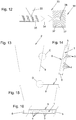
- Fig. 12 schematically shows an injection molding device known per se, with which a method for producing a food packaging 2 according to the invention, which is a cup and / or a cup lid, can be performed, wherein the composite material according to the invention is processed in an injection molding process for food packaging 2.
- the granules 10 of inventive composite material 1 which, for example, as based on the Fig. 2 to 4 in the funnel 22 of FIG Fig. 12 filled injection molding device are filled.
- the composite material 1 according to the invention is melted and injected by the screw 35 of the injection molding machine into the injection mold 36.
- the injection mold 36 is in Fig. 12 shown schematically. It has, as is known, two mold halves 37 which surround the mold cavity 38.
- the injection molding is known per se and need not be explained further.
- Fig. 13 is schematically illustrated a cup so produced in a vertical section.
- Its wall 9 consists exclusively of a layer 5 of inventive composite material 1.
- a vertical section through this wall 9 in the area C from Fig. 13 is enlarged in Fig. 14 shown.
- the filler particles 4 are distributed from food production waste arranged in the matrix 3 of thermoplastic polymer.
- Fig. 15 shows one accordingly Fig. 12 produced food packaging 2 according to the invention in the form of a cup lid.
- Its wall 9 also consists only of a layer 5 of inventive composite material 1.
- the area D from Fig. 15 and thus the corresponding section through the wall 9 is in Fig. 16 shown.
- the values given in the introduction are preferred.
Landscapes
- Chemical & Material Sciences (AREA)
- Engineering & Computer Science (AREA)
- Medicinal Chemistry (AREA)
- Health & Medical Sciences (AREA)
- Chemical Kinetics & Catalysis (AREA)
- Polymers & Plastics (AREA)
- Organic Chemistry (AREA)
- Mechanical Engineering (AREA)
- Ceramic Engineering (AREA)
- Manufacturing & Machinery (AREA)
- Materials Engineering (AREA)
- Dispersion Chemistry (AREA)
- Wrappers (AREA)
Applications Claiming Priority (1)
| Application Number | Priority Date | Filing Date | Title |
|---|---|---|---|
| AT952018 | 2018-04-09 |
Publications (1)
| Publication Number | Publication Date |
|---|---|
| EP3552791A1 true EP3552791A1 (fr) | 2019-10-16 |
Family
ID=66092132
Family Applications (1)
| Application Number | Title | Priority Date | Filing Date |
|---|---|---|---|
| EP19167232.8A Withdrawn EP3552791A1 (fr) | 2018-04-09 | 2019-04-04 | Matériau composite |
Country Status (2)
| Country | Link |
|---|---|
| EP (1) | EP3552791A1 (fr) |
| AT (1) | AT16956U1 (fr) |
Cited By (1)
| Publication number | Priority date | Publication date | Assignee | Title |
|---|---|---|---|---|
| EP4474412A1 (fr) | 2023-06-08 | 2024-12-11 | Volkswagen Ag | Compositions expansibles à base de matières premières biogènes |
Citations (8)
| Publication number | Priority date | Publication date | Assignee | Title |
|---|---|---|---|---|
| US3499851A (en) * | 1966-10-06 | 1970-03-10 | Eugenie Ligo | Waste coffee grounds as a filler in thermosetting materials |
| JP2002256081A (ja) * | 2001-03-01 | 2002-09-11 | Pokka Corp | 食品残渣炭混合生分解性プラスチック成形品 |
| US20060194900A1 (en) * | 2005-02-26 | 2006-08-31 | Chow David C | Articles of manufacture made from coffee bean residue, and methods for making such articles |
| JP2007277436A (ja) * | 2006-04-07 | 2007-10-25 | Japan Beverage Inc | 成型品の製造方法 |
| JP2010173169A (ja) * | 2009-01-29 | 2010-08-12 | Toppan Printing Co Ltd | コーヒーかすを含有する成形品の製造方法および成形品 |
| JP2011057920A (ja) * | 2009-09-14 | 2011-03-24 | Aska Company | コーヒー残渣混合プラスチック成形品 |
| WO2018078391A2 (fr) * | 2016-10-28 | 2018-05-03 | Cambond Limited | Matériaux biocomposites et bioplastiques et procédé |
| GB2567532A (en) * | 2017-08-11 | 2019-04-17 | Cambond Ltd | Cup and method |
Family Cites Families (4)
| Publication number | Priority date | Publication date | Assignee | Title |
|---|---|---|---|---|
| JP2000129136A (ja) * | 1998-10-27 | 2000-05-09 | Showa Denko Plastic Products Kk | 成形性が改善された樹脂組成物 |
| JP2012017426A (ja) * | 2010-07-09 | 2012-01-26 | Southern Works Kk | 熱可塑性樹脂用改質剤 |
| US20170022357A1 (en) * | 2015-07-22 | 2017-01-26 | Bradley W. Sokoly | Biodegradable composition and article of manufacture comprising said composition |
| KR101796074B1 (ko) * | 2015-10-13 | 2017-11-10 | 주식회사 에이유 | 방충성 및 항균성을 향상시킨 바이오플라스틱 및 이의 제조방법 |
-
2018
- 2018-04-09 AT ATGM8029/2019U patent/AT16956U1/de not_active IP Right Cessation
-
2019
- 2019-04-04 EP EP19167232.8A patent/EP3552791A1/fr not_active Withdrawn
Patent Citations (8)
| Publication number | Priority date | Publication date | Assignee | Title |
|---|---|---|---|---|
| US3499851A (en) * | 1966-10-06 | 1970-03-10 | Eugenie Ligo | Waste coffee grounds as a filler in thermosetting materials |
| JP2002256081A (ja) * | 2001-03-01 | 2002-09-11 | Pokka Corp | 食品残渣炭混合生分解性プラスチック成形品 |
| US20060194900A1 (en) * | 2005-02-26 | 2006-08-31 | Chow David C | Articles of manufacture made from coffee bean residue, and methods for making such articles |
| JP2007277436A (ja) * | 2006-04-07 | 2007-10-25 | Japan Beverage Inc | 成型品の製造方法 |
| JP2010173169A (ja) * | 2009-01-29 | 2010-08-12 | Toppan Printing Co Ltd | コーヒーかすを含有する成形品の製造方法および成形品 |
| JP2011057920A (ja) * | 2009-09-14 | 2011-03-24 | Aska Company | コーヒー残渣混合プラスチック成形品 |
| WO2018078391A2 (fr) * | 2016-10-28 | 2018-05-03 | Cambond Limited | Matériaux biocomposites et bioplastiques et procédé |
| GB2567532A (en) * | 2017-08-11 | 2019-04-17 | Cambond Ltd | Cup and method |
Cited By (2)
| Publication number | Priority date | Publication date | Assignee | Title |
|---|---|---|---|---|
| EP4474412A1 (fr) | 2023-06-08 | 2024-12-11 | Volkswagen Ag | Compositions expansibles à base de matières premières biogènes |
| DE102023205354A1 (de) | 2023-06-08 | 2024-12-12 | Volkswagen Aktiengesellschaft | Schäumbare Zusammensetzungen auf Basis biogener Rohstoffe |
Also Published As
| Publication number | Publication date |
|---|---|
| AT16956U1 (fr) | 2021-01-15 |
Similar Documents
| Publication | Publication Date | Title |
|---|---|---|
| AT512145B1 (de) | Vorrichtung zum aufbereiten von kunststoffmaterial | |
| EP2766163B1 (fr) | Dispositif pour préparer une matière plastique | |
| WO2019007756A1 (fr) | Dispositif et procédé pour l'extrusion de matériaux en vrac pouvant subir une déformation thermo-mécanique, et extrudeuse à vis de type compact | |
| EP0617050B1 (fr) | Procédé et dispositif pour l'obtention d'une mousse à base d'amidon non modifié | |
| DE9422084U1 (de) | Verpackung | |
| EP3974144B1 (fr) | Procédé et installation de recyclage destinés au recyclage des déchets feuilles | |
| EP4010165B1 (fr) | Procédé et appareil d'extrusion destinés à l'extrusion de matière plastique renforcée par des fibres pour la fabrication additive d'un élément | |
| WO2018188716A1 (fr) | Dégazage lors de l'extrusion de matières, en particulier de matières plastiques | |
| EP3363609B1 (fr) | Dispositif et procédé de traitement d'une matière plastique fondue | |
| WO2004087391A1 (fr) | Procede et dispositif pour plastifier une matiere plastique | |
| AT506658B1 (de) | Verfahren zur herstellung eines gefüllten polymermaterials | |
| EP3552791A1 (fr) | Matériau composite | |
| DE102018102731A1 (de) | Verfahren und Vorrichtung zur additiven Herstellung eines Werkstücks oder Bauteils aus verstärkten Kunststoffen | |
| EP3215341B1 (fr) | Procédé et dispositif de production de granules de polystyrène prévus comme matériau de remblai calorifuge | |
| DE2143597A1 (de) | Strangpreßvorrichtung zur Herstellung von Kunstharzverbundgebilden oder -laminaten | |
| DE2051253A1 (de) | Verfahren und Vorrichtung zur Plastifizierung thermoplastischer synthetischer Harze | |
| AT526989B1 (de) | Verfahren und Vorrichtung zur Bearbeitung bzw. Aufbereitung von Polymermaterialien | |
| EP1483091B1 (fr) | Procede de fabrication d'un produit thermoplastique en fibres naturelles | |
| WO2022200051A2 (fr) | Dispositif et procédé de traitement thermique de matières thermoplastiques fondues | |
| WO2025016708A1 (fr) | Utilisation de résidus de poudre plastique pour un procédé d'extrusion pour la fabrication additive d'un composant, et dispositif d'extrusion avec une unité de réduction de taille | |
| WO2025222232A1 (fr) | Extrudeuse pour le traitement de matériaux polymères | |
| WO2025194191A1 (fr) | Extrudeuse pour le traitement de matériaux polymères | |
| WO2026025136A1 (fr) | Dispositif de traitement de matériaux polymères | |
| EP3889359A1 (fr) | Procédé de fabrication d'une feuille à partir de polyéthylène, feuille de polyéthylène | |
| DE102023134446A1 (de) | System und Verfahren zur Wiederaufbereitung von ultrahochmolekularen Polymerfolienabschnitten |
Legal Events
| Date | Code | Title | Description |
|---|---|---|---|
| PUAI | Public reference made under article 153(3) epc to a published international application that has entered the european phase |
Free format text: ORIGINAL CODE: 0009012 |
|
| STAA | Information on the status of an ep patent application or granted ep patent |
Free format text: STATUS: THE APPLICATION HAS BEEN PUBLISHED |
|
| AK | Designated contracting states |
Kind code of ref document: A1 Designated state(s): AL AT BE BG CH CY CZ DE DK EE ES FI FR GB GR HR HU IE IS IT LI LT LU LV MC MK MT NL NO PL PT RO RS SE SI SK SM TR |
|
| AX | Request for extension of the european patent |
Extension state: BA ME |
|
| STAA | Information on the status of an ep patent application or granted ep patent |
Free format text: STATUS: REQUEST FOR EXAMINATION WAS MADE |
|
| 17P | Request for examination filed |
Effective date: 20200320 |
|
| RBV | Designated contracting states (corrected) |
Designated state(s): AL AT BE BG CH CY CZ DE DK EE ES FI FR GB GR HR HU IE IS IT LI LT LU LV MC MK MT NL NO PL PT RO RS SE SI SK SM TR |
|
| STAA | Information on the status of an ep patent application or granted ep patent |
Free format text: STATUS: THE APPLICATION IS DEEMED TO BE WITHDRAWN |
|
| 18D | Application deemed to be withdrawn |
Effective date: 20221101 |