EP3552962B1 - Système de maintenance de fichier d'une restauration de bord d'un véhicule - Google Patents
Système de maintenance de fichier d'une restauration de bord d'un véhicule Download PDFInfo
- Publication number
- EP3552962B1 EP3552962B1 EP19166466.3A EP19166466A EP3552962B1 EP 3552962 B1 EP3552962 B1 EP 3552962B1 EP 19166466 A EP19166466 A EP 19166466A EP 3552962 B1 EP3552962 B1 EP 3552962B1
- Authority
- EP
- European Patent Office
- Prior art keywords
- service unit
- inventory
- control element
- data
- designed
- Prior art date
- Legal status (The legal status is an assumption and is not a legal conclusion. Google has not performed a legal analysis and makes no representation as to the accuracy of the status listed.)
- Active
Links
Images

Classifications
-
- B—PERFORMING OPERATIONS; TRANSPORTING
- B64—AIRCRAFT; AVIATION; COSMONAUTICS
- B64D—EQUIPMENT FOR FITTING IN OR TO AIRCRAFT; FLIGHT SUITS; PARACHUTES; ARRANGEMENT OR MOUNTING OF POWER PLANTS OR PROPULSION TRANSMISSIONS IN AIRCRAFT
- B64D11/00—Passenger or crew accommodation; Flight-deck installations not otherwise provided for
- B64D11/0007—Devices specially adapted for food or beverage distribution services
-
- B—PERFORMING OPERATIONS; TRANSPORTING
- B64—AIRCRAFT; AVIATION; COSMONAUTICS
- B64D—EQUIPMENT FOR FITTING IN OR TO AIRCRAFT; FLIGHT SUITS; PARACHUTES; ARRANGEMENT OR MOUNTING OF POWER PLANTS OR PROPULSION TRANSMISSIONS IN AIRCRAFT
- B64D11/00—Passenger or crew accommodation; Flight-deck installations not otherwise provided for
- B64D11/04—Galleys
-
- B—PERFORMING OPERATIONS; TRANSPORTING
- B65—CONVEYING; PACKING; STORING; HANDLING THIN OR FILAMENTARY MATERIAL
- B65G—TRANSPORT OR STORAGE DEVICES, e.g. CONVEYORS FOR LOADING OR TIPPING, SHOP CONVEYOR SYSTEMS OR PNEUMATIC TUBE CONVEYORS
- B65G1/00—Storing articles, individually or in orderly arrangement, in warehouses or magazines
- B65G1/02—Storage devices
- B65G1/04—Storage devices mechanical
- B65G1/0492—Storage devices mechanical with cars adapted to travel in storage aisles
-
- G—PHYSICS
- G06—COMPUTING OR CALCULATING; COUNTING
- G06Q—INFORMATION AND COMMUNICATION TECHNOLOGY [ICT] SPECIALLY ADAPTED FOR ADMINISTRATIVE, COMMERCIAL, FINANCIAL, MANAGERIAL OR SUPERVISORY PURPOSES; SYSTEMS OR METHODS SPECIALLY ADAPTED FOR ADMINISTRATIVE, COMMERCIAL, FINANCIAL, MANAGERIAL OR SUPERVISORY PURPOSES, NOT OTHERWISE PROVIDED FOR
- G06Q10/00—Administration; Management
- G06Q10/08—Logistics, e.g. warehousing, loading or distribution; Inventory or stock management
- G06Q10/087—Inventory or stock management, e.g. order filling, procurement or balancing against orders
-
- G—PHYSICS
- G06—COMPUTING OR CALCULATING; COUNTING
- G06Q—INFORMATION AND COMMUNICATION TECHNOLOGY [ICT] SPECIALLY ADAPTED FOR ADMINISTRATIVE, COMMERCIAL, FINANCIAL, MANAGERIAL OR SUPERVISORY PURPOSES; SYSTEMS OR METHODS SPECIALLY ADAPTED FOR ADMINISTRATIVE, COMMERCIAL, FINANCIAL, MANAGERIAL OR SUPERVISORY PURPOSES, NOT OTHERWISE PROVIDED FOR
- G06Q50/00—Information and communication technology [ICT] specially adapted for implementation of business processes of specific business sectors, e.g. utilities or tourism
- G06Q50/10—Services
- G06Q50/12—Hotels or restaurants
-
- B—PERFORMING OPERATIONS; TRANSPORTING
- B65—CONVEYING; PACKING; STORING; HANDLING THIN OR FILAMENTARY MATERIAL
- B65G—TRANSPORT OR STORAGE DEVICES, e.g. CONVEYORS FOR LOADING OR TIPPING, SHOP CONVEYOR SYSTEMS OR PNEUMATIC TUBE CONVEYORS
- B65G2201/00—Indexing codes relating to handling devices, e.g. conveyors, characterised by the type of product or load being conveyed or handled
- B65G2201/02—Articles
- B65G2201/0202—Agricultural and processed food products
-
- B—PERFORMING OPERATIONS; TRANSPORTING
- B65—CONVEYING; PACKING; STORING; HANDLING THIN OR FILAMENTARY MATERIAL
- B65G—TRANSPORT OR STORAGE DEVICES, e.g. CONVEYORS FOR LOADING OR TIPPING, SHOP CONVEYOR SYSTEMS OR PNEUMATIC TUBE CONVEYORS
- B65G2203/00—Indexing code relating to control or detection of the articles or the load carriers during conveying
- B65G2203/02—Control or detection
- B65G2203/0208—Control or detection relating to the transported articles
- B65G2203/0216—Codes or marks on the article
-
- B—PERFORMING OPERATIONS; TRANSPORTING
- B65—CONVEYING; PACKING; STORING; HANDLING THIN OR FILAMENTARY MATERIAL
- B65G—TRANSPORT OR STORAGE DEVICES, e.g. CONVEYORS FOR LOADING OR TIPPING, SHOP CONVEYOR SYSTEMS OR PNEUMATIC TUBE CONVEYORS
- B65G2203/00—Indexing code relating to control or detection of the articles or the load carriers during conveying
- B65G2203/04—Detection means
- B65G2203/041—Camera
-
- G—PHYSICS
- G06—COMPUTING OR CALCULATING; COUNTING
- G06F—ELECTRIC DIGITAL DATA PROCESSING
- G06F3/00—Input arrangements for transferring data to be processed into a form capable of being handled by the computer; Output arrangements for transferring data from processing unit to output unit, e.g. interface arrangements
- G06F3/01—Input arrangements or combined input and output arrangements for interaction between user and computer
- G06F3/048—Interaction techniques based on graphical user interfaces [GUI]
- G06F3/0487—Interaction techniques based on graphical user interfaces [GUI] using specific features provided by the input device, e.g. functions controlled by the rotation of a mouse with dual sensing arrangements, or of the nature of the input device, e.g. tap gestures based on pressure sensed by a digitiser
- G06F3/0488—Interaction techniques based on graphical user interfaces [GUI] using specific features provided by the input device, e.g. functions controlled by the rotation of a mouse with dual sensing arrangements, or of the nature of the input device, e.g. tap gestures based on pressure sensed by a digitiser using a touch-screen or digitiser, e.g. input of commands through traced gestures
Definitions
- the present invention relates to an inventory management system for on-board catering in a vehicle.
- the pamphlet DE 10 2009 058 327 A1 discloses a system for warehousing in an aircraft galley, in which storage devices such as boxes, slide-in units or trolleys or the like are provided with transponders which emit identification signals characteristic of their content, which in turn are read in by a transmitter/receiver unit in the galley in order to sort the inventory to determine the galley. This is intended to improve the overview of the inventory in the galley.
- the pamphlet U.S. 2009/112377 A1 shows an inventory management system for on-board catering which is continuously updated, for example by reading an RFID tag.
- Other inventory management systems are from the publications DE 2010 027709 A1 , DE10 2007007717 A1 and U.S. 2015/057796 A1 known.
- the object of the present invention is to find improved solutions for managing the inventory of in-flight catering, in which the overview of the inventory is maintained at all times, even while the products are being distributed.
- a system for inventory management of on-board catering of a vehicle includes a galley, which is provided with a control unit for controlling the galley, the control unit being designed to provide inventory management data for the galley; a service unit for transporting supplies within the vehicle, wherein the inventory management data includes an inventory of the supplies transported with the service unit; and at least one operating element, which is connected to the control unit of the galley via a wireless data connection is communicatively connected and designed to record a removal of a supply item from the service unit and/or a receipt of a supply item from the service unit and, based on this, to cause the inventory of the transported supply items to be updated.
- the present invention provides a wireless data link that connects the galley to at least one control element.
- the control element or elements are used here to determine the output of a supply item from or from the service unit and to forward this information to the galley via the wireless connection. Based on this, the inventory is then updated accordingly. Accordingly, the inclusion of a supply item in, on or by the service unit can also be recorded and the inventory updated accordingly.
- the current stock of supplies can thus be called up in the on-board kitchen at any time.
- the invention opens up the possibility of tracking existing service products in an automated manner, in particular in real time, in a cabin of a vehicle or of monitoring their availability.
- the at least one control element can transmit a current position, ie for example in which passenger row and/or in which cabin section the operating person, ie the control element, and/or the service unit is located.
- the invention thus provides an automated merchandise management system for catering goods for a vehicle, in particular for a vehicle cabin, which informs a cabin crew at any time in a dynamic manner about the current inventory of the goods and their order situation.
- the control element comprises a first control element, which is designed as a portable computer.
- the personnel in a vehicle cabin can carry such an operating element with them, e.g. in the form of a mobile terminal device or generally a “smart mobile device”.
- a further control element can be arranged, attached and/or otherwise integrated into a roll container serving as a service unit.
- the cabin crew e.g. flight attendants, remove a product from the roll container or another service unit and issue it to a passenger
- the removal of the product can be determined using the operating element and the product can be identified automatically, e.g. using a barcode scanner or the like.
- the control element then causes the inventory list or the inventory to be updated, which is assigned to this roll container or this service unit and includes a list of the products contained or transported in it.
- a service unit within the meaning of the invention refers on the one hand to service trolleys such as roll containers, ie trolleys, dining trolleys or the like.
- service units within the meaning of the invention also include general receiving devices or transport devices for supplies and/or service products such as containers, boxes (English: “standard units”) or the like.
- a tray or a corresponding transport device can also represent a service unit within the meaning of the invention. In this case, it is detected whether a supply item is removed from the tray or placed on it. Then the inventory of the tray is updated accordingly updated.
- the present invention fundamentally enables the wireless connection of the galley to a large number of such service units. A large number of operating elements can also be provided.
- the wireless connection within the meaning of the invention can be implemented, for example, via a wireless local area network, e.g. a WLAN or similar.
- a wireless local area network e.g. a WLAN or similar.
- a wireless network that is already present in a passenger cabin for other purposes can be used.
- the provision of a separate wireless network specifically for this purpose is conceivable.
- this can be a secure network to which only persons or devices with appropriate security authentication have access, e.g. the on-board personnel of the vehicle and/or corresponding electronic devices which should/can only be operated by the on-board personnel.
- the at least one operating element can have an identification unit.
- the identification unit can be designed to identify a supply item using an identifier attached to it.
- optoelectronically readable writing such as bar codes, bar codes, bar codes or bar codes or the like can be attached to the outside of the supplies, which can be recognized by the identification unit.
- the identification unit can be designed, for example, as a barcode scanner or the like. Barcodes within the meaning of the invention include both one-dimensional and linear barcodes, ie in particular Bar codes, as well as two-dimensional versions or matrix codes, eg QR codes, etc.
- the identification unit can be designed for general object recognition.
- the identification unit can have a camera, with the help of which shapes, colors, etc. of objects and/or surfaces are recorded and, based on this, a supply item is identified.
- the identification unit can be designed as a barcode reader.
- the identification unit can thus be embodied as a data acquisition device which can read and pass on different barcodes or the like.
- the barcode reader can be set up, for example, as a CCD scanner, laser scanner or the like.
- barcode readers within the meaning of the invention also include camera scanners or imagers, i.e. devices that capture a barcode using a camera, in particular an optical one, and then process the recorded image using digital image processing in order to capture the barcode digitally.
- the at least one operating element can be designed to display the inventory management data.
- the operating element can have a display such as a screen or another electronic visual display on which the inventory management data can be displayed.
- the operating element can be an intelligent mobile device, eg data glasses (smart glasses), which can project information onto one or both glasses.
- the data glasses can also be equipped with a camera scanner, which is designed to capture barcodes.
- the data glasses can be connected to a (secure) wireless network. The flight personnel can wear such data glasses, for example, while food and/or drinks are being served.
- the data glasses can do anything record and identify the service product issued so that the inventory of the service product can be kept up-to-date at any time by data transmission over the wireless network without in any way impeding or affecting the usual catering operation.
- the inventory management data can include catering data, passenger data and/or cabin data or the like.
- the inventory management data therefore not only includes an inventory or an inventory list of one or more service units or the galley.
- various additional information or data can be included.
- the inventory management data can contain catering data, which is provided by a catering service provider and contains, among other things, information about the on-board catering provided, i.e. which products are provided to what extent and in what form.
- the inventory management data can contain passenger data, which, for example, contains data about which passengers have booked specific catering requests or options.
- the inventory management data can contain cabin data. Cabin data can include, for example, a seat map of the passengers.
- the first operating element can be a tablet computer, a smartphone, a smart watch or data glasses (smart glasses).
- the at least one control element can include a second control element.
- the second operating element can be integrated into the service unit.
- the second control element can be fastened or attached (detachably or non-detachably) to the outside of the service unit, e.g. in the form of a touchpad or a tablet computer.
- the second operating element can be a touchscreen or an electronic control panel, which is firmly embedded in a housing of the service unit.
- the second operating element can also have an identification unit, e.g. a barcode reader, via which supply products can be recorded.
- the operating element can be integrated into a service trolley or mobile container.
- the control element can also be integrated into a tablet, for example, which as a "smart tablet" can therefore track the placement or removal of supplies.
- the second control element can be a touchscreen and/or an electronic control panel.
- the at least one operating element can be designed to identify the service unit and, based on this, to assign the inventory to the service unit.
- conventional roll containers without an electronic connection to the wireless network can be used.
- the roll containers can be identified, for example, with a barcode or another identifier.
- An inventory can in turn be clearly assigned to the roll container in the existing inventory management data via the indicator, with the information being able to have been provided, for example, as catering data by a catering service provider.
- the operating element can, for example, have an identification unit, eg a barcode reader, with the help of which the Roll container is identified.
- the assigned inventory can be updated centrally via the control element during a subsequent food and/or beverage distribution, without the mobile container itself having to be connected to the wireless network in any way.
- other means of identification can be used in addition to barcodes.
- the service unit can have an RFID tag or the like, which can be read by a reading device or identification device provided in the operating element.
- the at least one operating element can be designed to authenticate itself to the service unit, with access to the inventory of the service unit and/or the supplies of the service unit being released after successful authentication.
- the operating element can be designed to manage access to the supply goods and/or the inventory of the service unit, ie to enable or block it, for example.
- a digital locking system can be implemented, among other things, in which the on-board personnel must first authenticate themselves using the control element before they can access the content and/or the data of the service unit.
- the operating element for example a smartphone or a tablet computer, can include a software application with which the service unit can be locked and unlocked in order to block or release access to the transported goods and/or the data of the service unit.
- the lock can be an electronic lock, for example, which can be actuated via a wireless data connection.
- the service unit can be identified via an RFID tag attached to it.
- Certified controls can now authenticate themselves using appropriate software applications and after successful authentication on the data and / or access supplies of the service unit. It will be clear to a person skilled in the art that a locking system can also be implemented purely at the software level, ie only access to the data of the service unit can be managed in this way. Combinations of hardware and software solutions are also possible.
- the service unit can include a data memory.
- the data memory can be designed to store the inventory.
- the service unit can contain a data memory that can be written or rewritten once, which can only be written to by a catering service provider and only read out by the flight crew, e.g. using the at least one operating element.
- the inventory can be updated centrally via the control unit of the galley for each service unit.
- active access to the data memory is enabled for the flight crew, so that an updated version of the inventory can be created directly on the data memory of the service unit.
- the at least one operating element can be communicatively connected to the data memory of the service unit and designed to read out the inventory from the data memory.
- the service unit can be equipped with an active or passive RFID tag, which includes a corresponding transponder and an electronic data memory, which in turn can be read by a suitable reading device, which can be integrated into the at least one control element.
- the inventory of a catering service provider can already be stored on the data storage device according to the delivered data before it is loaded onto the vehicle Equipment of the service unit must have been created. The flight crew can now identify the service unit before using it with the help of the operating element or determine its contents.
- the corresponding inventory is continuously updated during use in the usual manner by registering each dispensed product with the control.
- the at least one operating element can be communicatively connected to the data memory of the service unit and designed to cause the inventory on the data memory to be updated when a supply item is removed from the service unit and/or a supply item is received by the service unit.
- the service unit (or, in general, each service unit of a large number of service units) carries a current version of its inventory. This can be read out and updated at any time by the flight personnel using an operating element. A central version of the inventory of this service unit can also be continuously updated.
- the service unit can include a service unit display.
- the service unit display can be designed to display the inventory.
- the service unit display can be provided in the form of an electronic optical display with an operating function, eg as a touchscreen, via which additional inputs can be made and which at the same time serves as an operating element of the system.
- the service unit can only have a service unit display without further operating functions, which is designed exclusively for outputting the inventory or other inventory management data.
- the tenant may use a tenant display to display the inventory and also have a separate control element, which is linked to the galley via the wireless connection.
- the galley can have a galley display.
- the galley display can be designed to display inventory management data.
- the galley display can be designed as an electronic optical display with or without operating functions, e.g. as an LED, OLED, TFT or LCD screen or the like with or without backlighting and/or as a touchscreen etc ., Which, in addition to outputting information, also enables input via a screen serving as a touch panel.
- the galley display can be used to monitor and/or control the galley. For this purpose, the galley display can be linked to the control unit.
- control device of the galley can be communicatively connected to a cabin management system of the vehicle.
- control unit can be connected to a controller area network (CAN) of a cabin management system or the like, via which a connection to external catering service providers, airlines, etc. can also be possible.
- CAN controller area network
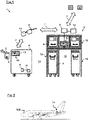
- figure 1 shows a schematic view of a system 1 for inventory management of on-board catering of a vehicle according to an embodiment of the invention.
- the system 1 is provided in a vehicle cabin 14 of an aircraft 100, in particular a passenger aircraft, as is shown, for example, in 2 is shown.
- the system 1 includes a galley 10, which is 1 is divided purely by way of example into several galley monuments 18 .
- Each of these galley monuments 18 has one or more slide-in compartments 19 which are designed to accommodate one or more service units 4 .
- One of the galley monuments 18 (bottom left in the galley in 1 ) a slot 19 for receiving a service unit 4, in this case a roll container.
- a slide-in compartment 19 is designed for two mobile containers, one of these two mobile containers being currently in use (see the service unit 4 on the left in 1 ).
- a third galley monument 18 is arranged above these two galley monuments 18, which can accommodate standard units as service units 4 in individual slide-in compartments 19, eg food containers.
- the slide-in compartments 19 can, for example, have standardized dimensions for accommodating standardized containers, trolleys or the like.
- the upper galley monument 18 includes an integrated galley display 12.
- the galley display 12 can be, for example, a screen with OLED or LCD technology or the like, with the galley display 12 being touch-sensitive as a touchscreen or touch display. Further the galley display 12 can be movably articulated on the galley monument 18 . In this exemplary embodiment, the galley display 12 is used as a monitoring and/or operating device for the galley 2 .
- the control unit 3 is in turn connected to a cabin management system 13, for example to a controller area network (CAN) or the like.
- the control unit 3 can contain other components that are not shown, such as a microprocessor, a data memory, databases, etc.
- the control unit 3 is also designed to provide inventory management data for the galley 2 which can be displayed via the galley display 12 .
- the inventory management data include, on the one hand, an inventory for each of the service units 4, ie for example for the roll container in use on the left 1 .
- the inventory includes a list of all supplies 5 or service products, eg food, drinks, etc., located in the respective service unit 4.
- the inventory management data includes other data, such as catering data, passenger data and/or cabin data or the like.
- catering data can be provided, for example, by a caterer 16 such as a catering service provider and can contain, among other things, information about the on-board catering provided, ie which products are provided to what extent and in what form.
- Passenger data can, for example, be provided by an airline 15 and contain, among other things, information about the passengers, which passengers have booked specific catering requests or options.
- the cabin data can, for example, be provided by the cabin management system 13 and contain, among other things, information regarding the cabin configuration, eg a seating plan for the passengers, etc.
- the control unit 3 can for the purpose of procurement This data can be directly or indirectly connected to the individual providers or data sources for communication via data line or wireless connection 7'. In the example configuration of 1 the control unit 3 is connected to the cabin management system 13 via a data line and can also contact the airline 15 and the caterer 16 via a wireless network 7′ provided for this purpose, eg retrieve or request data from databases.
- the system 1 also includes a first control element 10, which is communicatively connected to the control unit 3 of the galley 2 via a wireless data connection 7, eg a secure WLAN network.
- the first operating element 10 is smart glasses, ie data glasses, which are designed to detect a removal of a supply item 5 from the service units 4 and, based on this, to cause the inventory of the transported supply items 5 to be updated.
- the first operating element 10 can detect that a supply item 5 has been received in the service unit 4 .
- the first control element 10 includes an identification unit 8 in the form of a camera scanner or imager.
- the identification unit 8 is designed as a barcode reader in order to detect and identify a supply item 5 using an identifier 9 attached thereto.
- the links in 1 Supply item 5 shown is a beverage can on which a bar code is printed as identifier 9 .
- the first operating element 10 is worn on the body, for example, by a flight attendant (not shown) while the food and/or drinks are being served. While the flight attendant is handing out the supply item 5, the identifier 9 is detected and identified by the first control element 10. Then via the wireless connection 7 an update of the associated inventory. The galley 2 is thus informed at all times about the current inventory of supply products.
- the first control element 10 is also designed as data glasses to display the inventory management data, e.g. on and/or on one of the lenses (indicated by a broken line on the first control element 10 in 1 ).
- the flight personnel can have passenger, cabin and/or catering data displayed automatically at any time, for example in order to select a booked product for a specific passenger at a specific seat.
- the first operating element 10 can also output information about the inventory, so that it can be checked, for example based on a passenger request, whether the desired product is available in the service units 4 carried by the flight attendant or possibly in one of the other service units 4 . It is therefore possible to coordinate passenger information and requests with catering specifications and the configuration of the aircraft at any time.
- the supplies 5 can be tracked in the vehicle cabin 14 in an automated manner, in particular in real time, or their availability can be monitored.
- the first operating element 10 can transmit a current position, ie for example in which passenger row and/or in which cabin section the crew and/or the service unit 4 are currently located.
- the operating element 10 and/or the service unit 4 can display dynamically which order is present at the respective seat or row of seats.
- an automatic, dynamic goods management and goods tracking system for the on-board catering of the aircraft 100 is created, which monitors the actual status of the catering stock at all times without the goods issue being impaired in any way.
- further functionalities can be added without further ado.
- a payment system for issuing goods can be implemented, with corresponding payment actions being able to be carried out automatically via the first control element 10 (or another control element).
- the service units 4 can only be passively integrated into the system 1 without being able to actively communicate via the wireless network 7 . Rather, the service units 4 can only have identification marks, eg a barcode.
- the service unit 4 on the left in the figure has an RFID tag 17 that can be read actively or passively, via which the service unit 4 can be identified by the first operating element 10 .
- the RFID tag 17 can include a standard transponder (not shown) and the first control element can include a corresponding transmitter/receiver unit (also not shown).
- a flight attendant can first identify the service unit 4 and, based on this, clearly assign an inventory to the service unit 4, which, for example, has already been made available centrally in the control unit 3 and has been sent there beforehand, for example by the caterer 16 (e.g. by download or a other form of data transmission).
- the inventory can now be updated centrally in the manner described above.
- the first operating element 10 can also be designed to authenticate itself to the service unit 4, with access to the inventory of the service unit 4 and/or the supplies 5 of the service unit 4 being enabled after successful authentication.
- the authentication can be carried out, for example, via the wireless network 7, for example using a corresponding software application that is stored on the first operating element 10 .
- a locking system for the service unit 4 can be implemented on this basis, with the aid of which the service unit 4 can be opened and locked via the first operating element 10 .
- the service unit 4 can also include a data memory 6 on which, among other things, the inventory can be stored.
- the first operating element 10 can now be connected to the data memory 6, e.g. the data memory can be coupled to the RFID tag 17 and/or connected to the wireless network 7.
- the inventory can not only be stored locally on the service unit 4 (and, for example, already stored when the service unit 4 is delivered by a catering service provider), but can also be updated at any time using the first operating element 10 .
- the service unit 4 can also include, for example, a service unit display 11 on which information about the inventory of the service unit 4 and/or about products can be displayed. In this sense, the service unit display 11 can function to a certain extent as an electronic label.
- the system 1 can include further control elements that can be designed differently.
- the system 1 can include further control elements that can be designed differently.
- a second control element 10 ′ is provided purely by way of example, which cannot be worn on the flight attendant’s body, but is firmly integrated into the service unit 4 .
- the service unit display 11 of the service unit 4 serves as a second operating element 10' and is designed for this purpose as a touch screen, via which not only information can be displayed, but entries can also be made.
- the second operating element 10' can also be designed to record and identify the supplies 5.
- a barcode reader can be combined with the touchscreen (not shown).
- the flight attendant can also issue the product via the second operating element 10′, in that supplies 5 are recorded during the issue and the inventory is updated accordingly.
- the service unit 4 or the second operating element 10 ′ can be connected to the wireless network 7 .
- the first control element 10 or the second control element 10' for issuing goods.
- the system 1 shown is therefore particularly flexible in this embodiment.
- FIG 3 shows a schematic view of a system 1 for inventory management of on-board catering of a vehicle 100 according to a further embodiment of the invention.
- the system is similar to 1 in 3 the one in 1 .
- a control element 10 ′ is shown here purely by way of example, which is integrated with a service unit display 11 designed as a touchscreen in a top side of the service unit 4 .
- the operating element 10 ′ on the top of the service unit 4 has an identification unit 8 for reading out identifiers 9 attached to supply goods 5 or is communicatively connected to this.
- the identification unit 8 can be designed, for example, as a barcode reader, for example a CCD scanner or a camera, which can read out a barcode as an identifier 9 .
- the service unit 4 carries a large number of supplies 5 in the form of trays, each of which is prepackaged with a number of products, e.g. ready meals, beverages, etc.
- Each tray 5 is provided with an identifier 9, e.g. a bar code (cf. the tray 5 top left in 3 ).
- the identifier 9 is read out by the identification unit 8 when a tray 5 is removed.
- the inventory of the service unit 4 is then updated.
- the system 1 can be initialized manually or automatically, for example by opening a door of the service unit 4 and/or by activating a software application of the control element 10'.
- the identification unit 8 can also determine the external shape of the products and on this basis identify the products or the trays 5, e.g. by optically detecting the external shape, for example on the basis of object recognition algorithms which are based on object models of the products.
- the identification unit 8 can be permanently integrated into the service unit 4 .
- the identification unit 8 can be part of a portable control element and/or be communicatively coupled to it.
- FIG. 4 shows a schematic view of a service unit 4 for a system 1 for inventory management of on-board catering of a vehicle 100 according to a further embodiment of the invention.
- the service unit 4 is designed as an electronic tray, which uses an operating element 10' to record supply goods 5 that are placed on the tray and/or removed from it, and these via identifiers 9 identified attached to the supplies 5.
- the operating element 10′ includes an identification unit 8, which can be configured as a barcode reader, for example.
- the operating element 10′ optionally has a service unit display 11 which can, for example, output information about the inventory.
- the tablet is thus designed as a "smart tablet", with the inventory being updated automatically.
- the service unit 4 also includes one or more weight sensors 20.
- a support surface of the tray can be designed as a load cell.
- the consumption of the supplies 5 located on the service unit 4 can be monitored.
- a signal can be automatically generated in this way to the cabin crew in the event that a drink needs to be refilled. It goes without saying that other sensor technologies can also be used for this purpose.
Landscapes
- Business, Economics & Management (AREA)
- Engineering & Computer Science (AREA)
- Economics (AREA)
- Aviation & Aerospace Engineering (AREA)
- Tourism & Hospitality (AREA)
- Strategic Management (AREA)
- Physics & Mathematics (AREA)
- Theoretical Computer Science (AREA)
- Human Resources & Organizations (AREA)
- Marketing (AREA)
- General Physics & Mathematics (AREA)
- General Business, Economics & Management (AREA)
- Operations Research (AREA)
- Accounting & Taxation (AREA)
- Finance (AREA)
- Quality & Reliability (AREA)
- Development Economics (AREA)
- Entrepreneurship & Innovation (AREA)
- Mechanical Engineering (AREA)
- Health & Medical Sciences (AREA)
- General Health & Medical Sciences (AREA)
- Primary Health Care (AREA)
- Cash Registers Or Receiving Machines (AREA)
- Management, Administration, Business Operations System, And Electronic Commerce (AREA)
Claims (18)
- Système (1) de gestion du ravitaillement d'un véhicule, notamment d'un avion (100), ledit système comprenant :une cuisine de bord (2) qui est pourvue d'une unité de commande (3) destinée à commander la cuisine de bord (2), l'unité de commande (3) étant conçue pour fournir des données de gestion de la cuisine de bord (2) ;une unité de service (4) destinée à transporter des articles d'approvisionnement (5) à l'intérieur du véhicule, les données de gestion comprenant un registre d'inventaire des articles d'approvisionnement (5) transportés avec l'unité de service (4) ; etau moins un élément d'actionnement (10, 10') qui communique avec l'unité de commande (3) de la cuisine de bord (2) par une liaison de données sans fil (7) et qui est conçu pour détecter le retrait d'un article d'approvisionnement (5) de l'unité de service (4) et/ou la réception d'un article d'approvisionnement (5) par l'unité de service (4) et pour ordonner, sur cette base, la mise à jour du registre d'inventaire des articles d'approvisionnement transportés (5) ;l'au moins un élément d'actionnement (10, 10') comprenant un premier élément d'actionnement (10) qui est conçu comme un ordinateur portable.
- Système (1) selon la revendication 1, l'au moins un élément d'actionnement (10, 10') comportant une unité d'identification (8) qui est conçue pour identifier un article d'approvisionnement (5) à l'aide d'un identifiant (9) attaché à celui-ci.
- Système (1) selon la revendication 2, l'unité d'identification (8) étant conçue comme un lecteur de code-barres.
- Système (1) selon l'une des revendications 1 à 3, l'au moins un élément d'actionnement (10, 10') étant conçu pour afficher les données de gestion.
- Système (1) selon l'une des revendications 1 à 4, les données de gestion comprenant l'un au moins parmi des données de restauration, des données passagers et des données de cabine.
- Système (1) selon la revendication 1, le premier élément d'actionnement (10) étant une tablette informatique, un smartphone, une montre intelligente ou des lunettes de données.
- Système (1) selon l'une des revendications 1 à 6, l'au moins un élément d'actionnement (10, 10') comprenant un deuxième élément d'actionnement (10'), qui est intégré à l'unité de service (4).
- Système (1) selon la revendication 7, le deuxième élément d'actionnement (10') étant un écran tactile.
- Système (1) selon l'une des revendications 1 à 8, l'au moins un élément d'actionnement (10, 10') étant conçu pour identifier l'unité de service (4) et pour associer le registre d'inventaire à l'unité de service (4) .
- Système (1) selon la revendication 9, l'au moins un élément d'actionnement (10, 10') étant conçu pour s'authentifier auprès de l'unité de service (4), l'accès au registre d'inventaire de l'unité de service (4) et/ou aux articles d'approvisionnement (5) de l'unité de service (4) étant libéré après authentification réussie.
- Système (1) selon l'une des revendications 1 à 10, l'unité de service (4) comprenant une mémoire de données (6) qui est conçue pour mémoriser le registre d'inventaire.
- Système (1) selon la revendication 11, l'au moins un élément d'actionnement (10, 10') étant en communication avec la mémoire de données (6) de l'unité de service (4) et étant conçu pour lire le registre d'inventaire dans la mémoire de données (6).
- Système (1) selon la revendication 11 ou 12, l'au moins un élément d'actionnement (10, 10') étant en communication avec la mémoire de données (6) de l'unité de service (4) et étant conçu pour ordonner une mise à jour du registre d'inventaire dans la mémoire de données (6) lorsqu'un article d'approvisionnement (5) est retiré de l'unité de service (4) et/ou qu'un article d'approvisionnement (5) est reçu par l'unité de service (4) .
- Système (1) selon l'une des revendications 1 à 13, l'unité de service (4) comprenant un affichage d'unité de service (11) qui est conçu pour afficher le registre d'inventaire.
- Système (1) selon l'une des revendications 1 à 14, la cuisine de bord (2) comportant un affichage de cuisine de bord (12) qui est conçu pour afficher les données de gestion.
- Système (1) selon l'une des revendications 1 à 15, le dispositif de commande (3) de la cuisine de bord (2) est en communication avec un système de gestion de cabine (14) du véhicule.
- Système (1) selon l'une des revendications 1 à 16, l'unité de service (4) étant un chariot de service, un conteneur ou un plateau.
- Avion (100) comprenant un système (1) selon l'une des revendications 1 à 17.
Priority Applications (1)
| Application Number | Priority Date | Filing Date | Title |
|---|---|---|---|
| EP22187185.8A EP4098562B1 (fr) | 2018-04-09 | 2019-04-01 | Système de gestion d'inventaire d'une prise en charge à bord d'un véhicule |
Applications Claiming Priority (1)
| Application Number | Priority Date | Filing Date | Title |
|---|---|---|---|
| DE102018205289.1A DE102018205289A1 (de) | 2018-04-09 | 2018-04-09 | System zur Bestandsführung einer Bordverpflegung eines Fahrzeugs |
Related Child Applications (2)
| Application Number | Title | Priority Date | Filing Date |
|---|---|---|---|
| EP22187185.8A Division-Into EP4098562B1 (fr) | 2018-04-09 | 2019-04-01 | Système de gestion d'inventaire d'une prise en charge à bord d'un véhicule |
| EP22187185.8A Division EP4098562B1 (fr) | 2018-04-09 | 2019-04-01 | Système de gestion d'inventaire d'une prise en charge à bord d'un véhicule |
Publications (2)
| Publication Number | Publication Date |
|---|---|
| EP3552962A1 EP3552962A1 (fr) | 2019-10-16 |
| EP3552962B1 true EP3552962B1 (fr) | 2022-08-31 |
Family
ID=66049025
Family Applications (2)
| Application Number | Title | Priority Date | Filing Date |
|---|---|---|---|
| EP19166466.3A Active EP3552962B1 (fr) | 2018-04-09 | 2019-04-01 | Système de maintenance de fichier d'une restauration de bord d'un véhicule |
| EP22187185.8A Active EP4098562B1 (fr) | 2018-04-09 | 2019-04-01 | Système de gestion d'inventaire d'une prise en charge à bord d'un véhicule |
Family Applications After (1)
| Application Number | Title | Priority Date | Filing Date |
|---|---|---|---|
| EP22187185.8A Active EP4098562B1 (fr) | 2018-04-09 | 2019-04-01 | Système de gestion d'inventaire d'une prise en charge à bord d'un véhicule |
Country Status (4)
| Country | Link |
|---|---|
| US (1) | US11501249B2 (fr) |
| EP (2) | EP3552962B1 (fr) |
| CN (1) | CN110363459A (fr) |
| DE (1) | DE102018205289A1 (fr) |
Families Citing this family (11)
| Publication number | Priority date | Publication date | Assignee | Title |
|---|---|---|---|---|
| US12423648B2 (en) * | 2019-10-03 | 2025-09-23 | Safran Cabin Netherlands N.v. | System and method for stock inventory management |
| US20210253254A1 (en) * | 2020-02-14 | 2021-08-19 | The Boeing Company | Airline catering trolley |
| US11542006B2 (en) * | 2020-11-06 | 2023-01-03 | The Boeing Company | Galley cart assembly and an aircraft that utilizes the galley cart assembly |
| US12030639B2 (en) * | 2020-12-21 | 2024-07-09 | B/E Aerospace, Inc. | Aircraft galley insert with RFID tag for data logging, configuring and commissioning |
| EP4109359B1 (fr) | 2021-06-22 | 2026-01-28 | Airbus Operations GmbH | Méthode et système d'évaluation du cycle de vie d'un véhicule tel qu'un aéronef |
| EP4112461B1 (fr) | 2021-06-28 | 2024-04-03 | B/E Aerospace, Inc. | Système de gestion de boisson |
| US20230002054A1 (en) * | 2021-06-30 | 2023-01-05 | The Boeing Company | Automated cart systems and methods for an internal cabin of a vehicle |
| EP4145368A1 (fr) * | 2021-09-01 | 2023-03-08 | Airbus Operations GmbH | Système de gestion d'inventaire de gestion de produits de consommation sur un véhicule |
| EP4321433A3 (fr) * | 2022-08-11 | 2024-04-03 | B/E Aerospace, Inc. | Systèmes, procédés et dispositifs de restauration d'aéronef |
| US12365464B2 (en) * | 2023-03-06 | 2025-07-22 | Airbus (S.A.S.) | Galley for aircraft comprising a trolley locking system |
| EP4556367A1 (fr) * | 2023-11-14 | 2025-05-21 | B/E Aerospace, Inc. | Porte de conteneur d'office d'aéronef |
Family Cites Families (15)
| Publication number | Priority date | Publication date | Assignee | Title |
|---|---|---|---|---|
| CA2104660C (fr) * | 1993-08-23 | 1999-03-16 | Fredrick W. Radcliffe | Chariot |
| US5877962A (en) * | 1993-10-25 | 1999-03-02 | Radcliffe; Frederick W. | Cart |
| DE19732597C2 (de) | 1997-07-29 | 1999-08-12 | Anatoli Stobbe | Rollwagen mit einem Transponder |
| DE102007007717A1 (de) | 2007-02-16 | 2008-08-21 | Deutsche Telekom Ag | Rollcontainer |
| US8543259B2 (en) | 2007-10-29 | 2013-09-24 | The Boeing Company | System and method for virtual information |
| US8378825B2 (en) * | 2009-10-21 | 2013-02-19 | Airbus Operations Gmbh | System and method for stockkeeping in an aircraft galley |
| US8880685B2 (en) | 2010-03-26 | 2014-11-04 | Be Intellectual Property, Inc. | Gain to gain network for aircraft galley system |
| DE102010027709B4 (de) | 2010-07-20 | 2014-08-07 | Airbus Operations Gmbh | Verfahren und System zum Anzeigen von Information auf einer elektrischen Anzeigeeinheit in einer Flugzeugkabine |
| US20150057796A1 (en) | 2013-08-26 | 2015-02-26 | Lillian Boodaghians | Snack and Food Dispenser for Commercial Aircraft Use |
| NL2013635B1 (en) * | 2014-10-14 | 2016-10-04 | Zodiac Aircatering Equipment Europe B V | Passenger catering system for a passenger transport vehicle. |
| US10956856B2 (en) * | 2015-01-23 | 2021-03-23 | Samsung Electronics Co., Ltd. | Object recognition for a storage structure |
| US10241193B2 (en) * | 2016-03-28 | 2019-03-26 | Symbol Technologies, Llc | Arrangement for, and method of, accurately locating products in a noisy venue |
| WO2018026433A1 (fr) * | 2016-08-01 | 2018-02-08 | SAS Automation, LLC | Outils de gestion virtuelle d'inventaire et procédés d'utilisation |
| IT201600101331A1 (it) * | 2016-10-10 | 2018-04-10 | Iacobucci Hf Aerospace S P A | Carrello compattatore per usi aeronautici |
| US20200219606A1 (en) * | 2017-08-30 | 2020-07-09 | Samsung Electronics Co., Ltd. | Refrigerator |
-
2018
- 2018-04-09 DE DE102018205289.1A patent/DE102018205289A1/de not_active Withdrawn
-
2019
- 2019-04-01 EP EP19166466.3A patent/EP3552962B1/fr active Active
- 2019-04-01 EP EP22187185.8A patent/EP4098562B1/fr active Active
- 2019-04-01 CN CN201910259378.6A patent/CN110363459A/zh active Pending
- 2019-04-01 US US16/371,413 patent/US11501249B2/en active Active
Also Published As
| Publication number | Publication date |
|---|---|
| US20190311318A1 (en) | 2019-10-10 |
| CN110363459A (zh) | 2019-10-22 |
| US11501249B2 (en) | 2022-11-15 |
| EP3552962A1 (fr) | 2019-10-16 |
| DE102018205289A1 (de) | 2019-10-10 |
| EP4098562A1 (fr) | 2022-12-07 |
| EP4098562B1 (fr) | 2024-08-07 |
Similar Documents
| Publication | Publication Date | Title |
|---|---|---|
| EP3552962B1 (fr) | Système de maintenance de fichier d'une restauration de bord d'un véhicule | |
| DE102005019280B4 (de) | Maschinenlesbare Kennungen nutzendes Flugzeug-Frachtladelogistiksystem | |
| DE102009058327B4 (de) | System und Verfahren zur Lagerhaltung in einer Flugzeugbordküche | |
| EP2132114B1 (fr) | Système de stockage à rfid | |
| EP2128826A1 (fr) | Procédé d'enregistrement automatique de passagers et de leurs bagages | |
| EP4020308B1 (fr) | Étiquettes rfid intégrées dans un aéronef de passagers | |
| EP3956222B1 (fr) | Système d'adaptation automatique de paramètres de fonctionnement d'un dispositif de cuisine de bord | |
| EP2595885B1 (fr) | Méthode et dispositif pour l'affichage d'informations sur un dispositif d'affichage dans une cabine d'avion | |
| EP3543928B1 (fr) | Procédé d'ouverture d'une porte d'une camionnette | |
| DE202016007418U1 (de) | Abflugkontrollsystem | |
| EP3553717A1 (fr) | Système et procédé de traitement des informations d'inventaire | |
| EP1829816B1 (fr) | Chariot de manutention muni d'un ordinateur de bord | |
| DE102007007717A1 (de) | Rollcontainer | |
| WO2007140735A1 (fr) | Système et procédé d'approvisionnement individuel des passagers d'un moyen de transport en produits, notamment en aliments et boissons | |
| DE202012104079U1 (de) | System zum mobilen Einchecken | |
| DE102019212620A1 (de) | Aufbewahrung von Gegenständen innerhalb eines Fahrzeugs | |
| EP2538377A2 (fr) | Procédé de traitement de commandes Kanban et Caisses-palettes RFID | |
| DE202016106535U1 (de) | Materialteil Lagersystem | |
| DE102016205844A1 (de) | Verfahren zur personenlosen Auslieferung von Waren | |
| DE10003314A1 (de) | Transport-Informations-System | |
| DE102007023496A1 (de) | Einrichtung zur Passagierabfertigung, insbesondere beim Boarding im Flugverkehr | |
| EP1029321A2 (fr) | Element d'affichage, commande pour element d'affichage, procede de commande correspondant, element registre et systeme d'enregistrement | |
| EP1357450B1 (fr) | Système de surveillance du chargement d'un bateau | |
| EP3101605A1 (fr) | Système et procédé pour l'envoi postal | |
| WO2008080540A1 (fr) | Siège de moyen de transport et procédé pour collecter des données dans un moyen de transport |
Legal Events
| Date | Code | Title | Description |
|---|---|---|---|
| PUAI | Public reference made under article 153(3) epc to a published international application that has entered the european phase |
Free format text: ORIGINAL CODE: 0009012 |
|
| STAA | Information on the status of an ep patent application or granted ep patent |
Free format text: STATUS: THE APPLICATION HAS BEEN PUBLISHED |
|
| AK | Designated contracting states |
Kind code of ref document: A1 Designated state(s): AL AT BE BG CH CY CZ DE DK EE ES FI FR GB GR HR HU IE IS IT LI LT LU LV MC MK MT NL NO PL PT RO RS SE SI SK SM TR |
|
| AX | Request for extension of the european patent |
Extension state: BA ME |
|
| STAA | Information on the status of an ep patent application or granted ep patent |
Free format text: STATUS: REQUEST FOR EXAMINATION WAS MADE |
|
| 17P | Request for examination filed |
Effective date: 20200407 |
|
| RBV | Designated contracting states (corrected) |
Designated state(s): AL AT BE BG CH CY CZ DE DK EE ES FI FR GB GR HR HU IE IS IT LI LT LU LV MC MK MT NL NO PL PT RO RS SE SI SK SM TR |
|
| STAA | Information on the status of an ep patent application or granted ep patent |
Free format text: STATUS: EXAMINATION IS IN PROGRESS |
|
| 17Q | First examination report despatched |
Effective date: 20201103 |
|
| GRAP | Despatch of communication of intention to grant a patent |
Free format text: ORIGINAL CODE: EPIDOSNIGR1 |
|
| STAA | Information on the status of an ep patent application or granted ep patent |
Free format text: STATUS: GRANT OF PATENT IS INTENDED |
|
| RIC1 | Information provided on ipc code assigned before grant |
Ipc: G06Q 50/12 20120101ALI20220228BHEP Ipc: G06Q 10/08 20120101ALI20220228BHEP Ipc: B64D 11/04 20060101ALI20220228BHEP Ipc: B64D 11/00 20060101AFI20220228BHEP |
|
| INTG | Intention to grant announced |
Effective date: 20220323 |
|
| GRAS | Grant fee paid |
Free format text: ORIGINAL CODE: EPIDOSNIGR3 |
|
| GRAA | (expected) grant |
Free format text: ORIGINAL CODE: 0009210 |
|
| STAA | Information on the status of an ep patent application or granted ep patent |
Free format text: STATUS: THE PATENT HAS BEEN GRANTED |
|
| AK | Designated contracting states |
Kind code of ref document: B1 Designated state(s): AL AT BE BG CH CY CZ DE DK EE ES FI FR GB GR HR HU IE IS IT LI LT LU LV MC MK MT NL NO PL PT RO RS SE SI SK SM TR |
|
| REG | Reference to a national code |
Ref country code: CH Ref legal event code: EP Ref country code: GB Ref legal event code: FG4D Free format text: NOT ENGLISH |
|
| REG | Reference to a national code |
Ref country code: AT Ref legal event code: REF Ref document number: 1515137 Country of ref document: AT Kind code of ref document: T Effective date: 20220915 Ref country code: DE Ref legal event code: R096 Ref document number: 502019005463 Country of ref document: DE |
|
| REG | Reference to a national code |
Ref country code: IE Ref legal event code: FG4D Free format text: LANGUAGE OF EP DOCUMENT: GERMAN |
|
| REG | Reference to a national code |
Ref country code: LT Ref legal event code: MG9D |
|
| REG | Reference to a national code |
Ref country code: NL Ref legal event code: MP Effective date: 20220831 |
|
| PG25 | Lapsed in a contracting state [announced via postgrant information from national office to epo] |
Ref country code: SE Free format text: LAPSE BECAUSE OF FAILURE TO SUBMIT A TRANSLATION OF THE DESCRIPTION OR TO PAY THE FEE WITHIN THE PRESCRIBED TIME-LIMIT Effective date: 20220831 Ref country code: RS Free format text: LAPSE BECAUSE OF FAILURE TO SUBMIT A TRANSLATION OF THE DESCRIPTION OR TO PAY THE FEE WITHIN THE PRESCRIBED TIME-LIMIT Effective date: 20220831 Ref country code: NO Free format text: LAPSE BECAUSE OF FAILURE TO SUBMIT A TRANSLATION OF THE DESCRIPTION OR TO PAY THE FEE WITHIN THE PRESCRIBED TIME-LIMIT Effective date: 20221130 Ref country code: LV Free format text: LAPSE BECAUSE OF FAILURE TO SUBMIT A TRANSLATION OF THE DESCRIPTION OR TO PAY THE FEE WITHIN THE PRESCRIBED TIME-LIMIT Effective date: 20220831 Ref country code: LT Free format text: LAPSE BECAUSE OF FAILURE TO SUBMIT A TRANSLATION OF THE DESCRIPTION OR TO PAY THE FEE WITHIN THE PRESCRIBED TIME-LIMIT Effective date: 20220831 Ref country code: FI Free format text: LAPSE BECAUSE OF FAILURE TO SUBMIT A TRANSLATION OF THE DESCRIPTION OR TO PAY THE FEE WITHIN THE PRESCRIBED TIME-LIMIT Effective date: 20220831 |
|
| PG25 | Lapsed in a contracting state [announced via postgrant information from national office to epo] |
Ref country code: PL Free format text: LAPSE BECAUSE OF FAILURE TO SUBMIT A TRANSLATION OF THE DESCRIPTION OR TO PAY THE FEE WITHIN THE PRESCRIBED TIME-LIMIT Effective date: 20220831 Ref country code: IS Free format text: LAPSE BECAUSE OF FAILURE TO SUBMIT A TRANSLATION OF THE DESCRIPTION OR TO PAY THE FEE WITHIN THE PRESCRIBED TIME-LIMIT Effective date: 20221231 Ref country code: HR Free format text: LAPSE BECAUSE OF FAILURE TO SUBMIT A TRANSLATION OF THE DESCRIPTION OR TO PAY THE FEE WITHIN THE PRESCRIBED TIME-LIMIT Effective date: 20220831 Ref country code: GR Free format text: LAPSE BECAUSE OF FAILURE TO SUBMIT A TRANSLATION OF THE DESCRIPTION OR TO PAY THE FEE WITHIN THE PRESCRIBED TIME-LIMIT Effective date: 20221201 |
|
| PG25 | Lapsed in a contracting state [announced via postgrant information from national office to epo] |
Ref country code: SM Free format text: LAPSE BECAUSE OF FAILURE TO SUBMIT A TRANSLATION OF THE DESCRIPTION OR TO PAY THE FEE WITHIN THE PRESCRIBED TIME-LIMIT Effective date: 20220831 Ref country code: RO Free format text: LAPSE BECAUSE OF FAILURE TO SUBMIT A TRANSLATION OF THE DESCRIPTION OR TO PAY THE FEE WITHIN THE PRESCRIBED TIME-LIMIT Effective date: 20220831 Ref country code: PT Free format text: LAPSE BECAUSE OF FAILURE TO SUBMIT A TRANSLATION OF THE DESCRIPTION OR TO PAY THE FEE WITHIN THE PRESCRIBED TIME-LIMIT Effective date: 20230102 Ref country code: ES Free format text: LAPSE BECAUSE OF FAILURE TO SUBMIT A TRANSLATION OF THE DESCRIPTION OR TO PAY THE FEE WITHIN THE PRESCRIBED TIME-LIMIT Effective date: 20220831 Ref country code: DK Free format text: LAPSE BECAUSE OF FAILURE TO SUBMIT A TRANSLATION OF THE DESCRIPTION OR TO PAY THE FEE WITHIN THE PRESCRIBED TIME-LIMIT Effective date: 20220831 Ref country code: CZ Free format text: LAPSE BECAUSE OF FAILURE TO SUBMIT A TRANSLATION OF THE DESCRIPTION OR TO PAY THE FEE WITHIN THE PRESCRIBED TIME-LIMIT Effective date: 20220831 |
|
| PG25 | Lapsed in a contracting state [announced via postgrant information from national office to epo] |
Ref country code: SK Free format text: LAPSE BECAUSE OF FAILURE TO SUBMIT A TRANSLATION OF THE DESCRIPTION OR TO PAY THE FEE WITHIN THE PRESCRIBED TIME-LIMIT Effective date: 20220831 Ref country code: EE Free format text: LAPSE BECAUSE OF FAILURE TO SUBMIT A TRANSLATION OF THE DESCRIPTION OR TO PAY THE FEE WITHIN THE PRESCRIBED TIME-LIMIT Effective date: 20220831 |
|
| REG | Reference to a national code |
Ref country code: DE Ref legal event code: R097 Ref document number: 502019005463 Country of ref document: DE |
|
| PG25 | Lapsed in a contracting state [announced via postgrant information from national office to epo] |
Ref country code: NL Free format text: LAPSE BECAUSE OF FAILURE TO SUBMIT A TRANSLATION OF THE DESCRIPTION OR TO PAY THE FEE WITHIN THE PRESCRIBED TIME-LIMIT Effective date: 20220831 Ref country code: AL Free format text: LAPSE BECAUSE OF FAILURE TO SUBMIT A TRANSLATION OF THE DESCRIPTION OR TO PAY THE FEE WITHIN THE PRESCRIBED TIME-LIMIT Effective date: 20220831 |
|
| PLBE | No opposition filed within time limit |
Free format text: ORIGINAL CODE: 0009261 |
|
| STAA | Information on the status of an ep patent application or granted ep patent |
Free format text: STATUS: NO OPPOSITION FILED WITHIN TIME LIMIT |
|
| 26N | No opposition filed |
Effective date: 20230601 |
|
| PG25 | Lapsed in a contracting state [announced via postgrant information from national office to epo] |
Ref country code: SI Free format text: LAPSE BECAUSE OF FAILURE TO SUBMIT A TRANSLATION OF THE DESCRIPTION OR TO PAY THE FEE WITHIN THE PRESCRIBED TIME-LIMIT Effective date: 20220831 |
|
| REG | Reference to a national code |
Ref country code: CH Ref legal event code: PL |
|
| PG25 | Lapsed in a contracting state [announced via postgrant information from national office to epo] |
Ref country code: LU Free format text: LAPSE BECAUSE OF NON-PAYMENT OF DUE FEES Effective date: 20230401 |
|
| REG | Reference to a national code |
Ref country code: BE Ref legal event code: MM Effective date: 20230430 |
|
| PG25 | Lapsed in a contracting state [announced via postgrant information from national office to epo] |
Ref country code: MC Free format text: LAPSE BECAUSE OF FAILURE TO SUBMIT A TRANSLATION OF THE DESCRIPTION OR TO PAY THE FEE WITHIN THE PRESCRIBED TIME-LIMIT Effective date: 20220831 |
|
| PG25 | Lapsed in a contracting state [announced via postgrant information from national office to epo] |
Ref country code: MC Free format text: LAPSE BECAUSE OF FAILURE TO SUBMIT A TRANSLATION OF THE DESCRIPTION OR TO PAY THE FEE WITHIN THE PRESCRIBED TIME-LIMIT Effective date: 20220831 Ref country code: LI Free format text: LAPSE BECAUSE OF NON-PAYMENT OF DUE FEES Effective date: 20230430 Ref country code: CH Free format text: LAPSE BECAUSE OF NON-PAYMENT OF DUE FEES Effective date: 20230430 |
|
| REG | Reference to a national code |
Ref country code: IE Ref legal event code: MM4A |
|
| PG25 | Lapsed in a contracting state [announced via postgrant information from national office to epo] |
Ref country code: BE Free format text: LAPSE BECAUSE OF NON-PAYMENT OF DUE FEES Effective date: 20230430 |
|
| PG25 | Lapsed in a contracting state [announced via postgrant information from national office to epo] |
Ref country code: IE Free format text: LAPSE BECAUSE OF NON-PAYMENT OF DUE FEES Effective date: 20230401 |
|
| PG25 | Lapsed in a contracting state [announced via postgrant information from national office to epo] |
Ref country code: IE Free format text: LAPSE BECAUSE OF NON-PAYMENT OF DUE FEES Effective date: 20230401 |
|
| PG25 | Lapsed in a contracting state [announced via postgrant information from national office to epo] |
Ref country code: IT Free format text: LAPSE BECAUSE OF FAILURE TO SUBMIT A TRANSLATION OF THE DESCRIPTION OR TO PAY THE FEE WITHIN THE PRESCRIBED TIME-LIMIT Effective date: 20220831 |
|
| PG25 | Lapsed in a contracting state [announced via postgrant information from national office to epo] |
Ref country code: BG Free format text: LAPSE BECAUSE OF FAILURE TO SUBMIT A TRANSLATION OF THE DESCRIPTION OR TO PAY THE FEE WITHIN THE PRESCRIBED TIME-LIMIT Effective date: 20220831 |
|
| PG25 | Lapsed in a contracting state [announced via postgrant information from national office to epo] |
Ref country code: BG Free format text: LAPSE BECAUSE OF FAILURE TO SUBMIT A TRANSLATION OF THE DESCRIPTION OR TO PAY THE FEE WITHIN THE PRESCRIBED TIME-LIMIT Effective date: 20220831 |
|
| REG | Reference to a national code |
Ref country code: AT Ref legal event code: MM01 Ref document number: 1515137 Country of ref document: AT Kind code of ref document: T Effective date: 20240401 |
|
| PGFP | Annual fee paid to national office [announced via postgrant information from national office to epo] |
Ref country code: DE Payment date: 20250422 Year of fee payment: 7 |
|
| PGFP | Annual fee paid to national office [announced via postgrant information from national office to epo] |
Ref country code: GB Payment date: 20250423 Year of fee payment: 7 |
|
| PGFP | Annual fee paid to national office [announced via postgrant information from national office to epo] |
Ref country code: FR Payment date: 20250425 Year of fee payment: 7 |
|
| PG25 | Lapsed in a contracting state [announced via postgrant information from national office to epo] |
Ref country code: AT Free format text: LAPSE BECAUSE OF NON-PAYMENT OF DUE FEES Effective date: 20240401 |
|
| PG25 | Lapsed in a contracting state [announced via postgrant information from national office to epo] |
Ref country code: CY Free format text: LAPSE BECAUSE OF FAILURE TO SUBMIT A TRANSLATION OF THE DESCRIPTION OR TO PAY THE FEE WITHIN THE PRESCRIBED TIME-LIMIT; INVALID AB INITIO Effective date: 20190401 |
|
| PG25 | Lapsed in a contracting state [announced via postgrant information from national office to epo] |
Ref country code: HU Free format text: LAPSE BECAUSE OF FAILURE TO SUBMIT A TRANSLATION OF THE DESCRIPTION OR TO PAY THE FEE WITHIN THE PRESCRIBED TIME-LIMIT; INVALID AB INITIO Effective date: 20190401 |
|
| PG25 | Lapsed in a contracting state [announced via postgrant information from national office to epo] |
Ref country code: TR Free format text: LAPSE BECAUSE OF FAILURE TO SUBMIT A TRANSLATION OF THE DESCRIPTION OR TO PAY THE FEE WITHIN THE PRESCRIBED TIME-LIMIT Effective date: 20220831 |
|
| PGFP | Annual fee paid to national office [announced via postgrant information from national office to epo] |
Ref country code: AT Payment date: 20260410 Year of fee payment: 5 |