EP3552970A1 - Freifallübungsvorrichtung und übungsverfahren damit - Google Patents
Freifallübungsvorrichtung und übungsverfahren damit Download PDFInfo
- Publication number
- EP3552970A1 EP3552970A1 EP17878852.7A EP17878852A EP3552970A1 EP 3552970 A1 EP3552970 A1 EP 3552970A1 EP 17878852 A EP17878852 A EP 17878852A EP 3552970 A1 EP3552970 A1 EP 3552970A1
- Authority
- EP
- European Patent Office
- Prior art keywords
- trainee
- free
- fall
- posture
- supporter
- Prior art date
- Legal status (The legal status is an assumption and is not a legal conclusion. Google has not performed a legal analysis and makes no representation as to the accuracy of the status listed.)
- Withdrawn
Links
- 238000000034 method Methods 0.000 title claims abstract description 20
- 238000009434 installation Methods 0.000 claims abstract description 6
- 238000007667 floating Methods 0.000 claims description 10
- 238000011179 visual inspection Methods 0.000 claims description 3
- 230000036544 posture Effects 0.000 description 65
- 238000004088 simulation Methods 0.000 description 15
- 230000000694 effects Effects 0.000 description 4
- 238000005516 engineering process Methods 0.000 description 3
- 230000002411 adverse Effects 0.000 description 2
- 230000009191 jumping Effects 0.000 description 2
- 230000003247 decreasing effect Effects 0.000 description 1
- 239000000446 fuel Substances 0.000 description 1
- 238000005096 rolling process Methods 0.000 description 1
- 238000004804 winding Methods 0.000 description 1
Images


Classifications
-
- G—PHYSICS
- G09—EDUCATION; CRYPTOGRAPHY; DISPLAY; ADVERTISING; SEALS
- G09B—EDUCATIONAL OR DEMONSTRATION APPLIANCES; APPLIANCES FOR TEACHING, OR COMMUNICATING WITH, THE BLIND, DEAF OR MUTE; MODELS; PLANETARIA; GLOBES; MAPS; DIAGRAMS
- G09B9/00—Simulators for teaching or training purposes
-
- A—HUMAN NECESSITIES
- A63—SPORTS; GAMES; AMUSEMENTS
- A63G—MERRY-GO-ROUNDS; SWINGS; ROCKING-HORSES; CHUTES; SWITCHBACKS; SIMILAR DEVICES FOR PUBLIC AMUSEMENT
- A63G31/00—Amusement arrangements
-
- A—HUMAN NECESSITIES
- A63—SPORTS; GAMES; AMUSEMENTS
- A63G—MERRY-GO-ROUNDS; SWINGS; ROCKING-HORSES; CHUTES; SWITCHBACKS; SIMILAR DEVICES FOR PUBLIC AMUSEMENT
- A63G31/00—Amusement arrangements
- A63G31/02—Amusement arrangements with moving substructures
-
- B—PERFORMING OPERATIONS; TRANSPORTING
- B64—AIRCRAFT; AVIATION; COSMONAUTICS
- B64D—EQUIPMENT FOR FITTING IN OR TO AIRCRAFT; FLIGHT SUITS; PARACHUTES; ARRANGEMENT OR MOUNTING OF POWER PLANTS OR PROPULSION TRANSMISSIONS IN AIRCRAFT
- B64D23/00—Training of parachutists
-
- G—PHYSICS
- G09—EDUCATION; CRYPTOGRAPHY; DISPLAY; ADVERTISING; SEALS
- G09B—EDUCATIONAL OR DEMONSTRATION APPLIANCES; APPLIANCES FOR TEACHING, OR COMMUNICATING WITH, THE BLIND, DEAF OR MUTE; MODELS; PLANETARIA; GLOBES; MAPS; DIAGRAMS
- G09B9/00—Simulators for teaching or training purposes
- G09B9/003—Simulators for teaching or training purposes for military purposes and tactics
-
- A—HUMAN NECESSITIES
- A63—SPORTS; GAMES; AMUSEMENTS
- A63G—MERRY-GO-ROUNDS; SWINGS; ROCKING-HORSES; CHUTES; SWITCHBACKS; SIMILAR DEVICES FOR PUBLIC AMUSEMENT
- A63G31/00—Amusement arrangements
- A63G2031/002—Free-fall
-
- A—HUMAN NECESSITIES
- A63—SPORTS; GAMES; AMUSEMENTS
- A63G—MERRY-GO-ROUNDS; SWINGS; ROCKING-HORSES; CHUTES; SWITCHBACKS; SIMILAR DEVICES FOR PUBLIC AMUSEMENT
- A63G31/00—Amusement arrangements
- A63G2031/005—Skydiving
Definitions
- the present invention relates to a free-fall training apparatus, and more particularly, to a free-fall training apparatus and a training method using the same capable of moving or rotating the body of a trainee according to a posture of the trainee.
- trainee a drop trainee
- a helicopter rides on an aircraft or a helicopter and is trained to land on the ground by jumping off from the aircraft or the helicopter at a certain altitude.
- a simulation training apparatus for drop training is configured so that, by installing a virtual simulator on the ground, training may be performed under realistic conditions without operating an aircraft or a helicopter.
- the simulation training apparatus allows training to be performed even in situations in which it is impossible to take off or land an aircraft or a helicopter due to adverse weather conditions. Also, the simulation training apparatus has advantages in that, since it is possible to prevent accidents that may occur during drop training using an aircraft or a helicopter, even an unskilled person may receive drop training and that aviation fuel for operating an aircraft or a helicopter may be saved.
- the present invention has been devised to solve the above-described conventional problems, and objectives of the present invention are as follow.
- the present invention is directed to providing a free-fall training apparatus and a training method using the same capable of allowing a trainee to feel similar to an actual free-fall situation.
- the present invention is directed to providing a free-fall training device and a training method using the same capable of moving or rotating a trainee according to a posture of the trainee, thereby allowing the trainee to experience moving or rotating of the body according to a posture of the trainee during actual free fall.
- a free-fall training apparatus includes a supporter, a driver, a string, a pulley, a detector, and a controller.
- the supporter may be installed in parallel with an installation surface.
- the driver may be configured to adjust a slope of the supporter or apply impact or vibration to the supporter.
- the string may be configured to connect the body of a trainee to the supporter.
- the pulley may be installed at the supporter and configured to adjust a length of the string according to rotation.
- the detector may be configured to detect a position and a movement of the body of the trainee.
- the controller may be configured to control the driver and the pulley on the basis of information input from the detector.
- the free-fall training apparatus may move the trainee upward or downward according to a posture of the trainee.
- a sensor configured to detect a movement of joints of the body of the trainee may be applied as the detector.
- the controller may, on the basis of the information input from the detector, move the trainee downward by winding the pulley and increasing the length of the string when it is determined that the center of the body of the trainee has become relatively lower due to retroflexion of the spine of the trainee in a free-fall posture and may move the trainee upward by unwinding the pulley and decreasing the length of the string when it is determined that the center of the body of the trainee has become relatively higher due to anteflexion of the spine of the trainee in the free-fall posture.
- the free-fall training apparatus may further include a mover configured to move the supporter forward, rearward, leftward, and rightward or rotate the supporter, wherein the controller may control the mover on the basis of information input from the detector, thereby moving or rotating the trainee according to a posture of the trainee.
- the controller may, on the basis of the information input from the detector, control the driver and the mover according to a movement of an arm of the trainee and twisting of the torso of the trainee so that the trainee rotates.
- the controller may, on the basis of the information input from the detector, control the driver and the mover to move the trainee forward or rearward according to slopes of the upper and lower bodies of the trainee.
- the controller may, on the basis of the information input from the detector, control the driver and the mover to move the trainee leftward or rightward according to left and right slopes of the body of the trainee.
- a free-fall training method includes a floating step, a free-fall experiencing step, and an upward-downward moving step.
- a string may be connected to the body of a trainee, and a length of the string may be adjusted using a pulley so that the trainee is adjusted to take a free-fall posture.
- a driver may be operated so that a slope of the body of the trainee is changed as in an actual free-fall situation or vibration and impact applied to the body of the trainee are adjusted.
- the length of the string may be adjusted using the pulley so that the trainee ascends or descends.
- the free-fall training method according to the present embodiment may further include at least one of a rotating step, a forward-rearward moving step, and a leftward-rightward moving step.
- the driver may be operated to allow the trainee to rotate.
- the driver when the trainee changes the slopes of the upper and lower bodies in the free-fall posture, the driver may be operated to allow the trainee to move forward or rearward.
- the driver may be operated to allow the trainee to move leftward and rightward.
- All of the above-mentioned steps may include a process in which a trainer checks by visual inspection whether the trainee is taking a proper posture and instructs the trainee to take the proper posture.
- a controller controls a driver and a pulley to move and rotate a trainee upward, downward, forward, rearward, leftward, and rightward according to a movement of the body of the trainee detected by a detector, thereby allowing the trainee to experience in advance a direction in which the body moves or rotates according to a movement of the trainee in an actual free-fall situation.
- the trainee may correct the posture and take a correct posture.
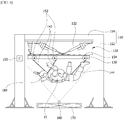
- FIG. 1 is a view illustrating a state in which a trainee takes a free-fall posture by a free-fall training apparatus according to an embodiment of the present invention
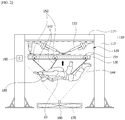
- FIG. 2 is a view illustrating a state in which the trainee takes an upward-moving posture by the free-fall training apparatus according to an embodiment of the present invention
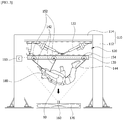
- FIG. 3 is a view illustrating a state in which the trainee takes a downward-moving posture by the free-fall training apparatus according to an embodiment of the present invention
- FIG. 4 is a view illustrating a state in which the trainee takes a rotating posture by the free-fall training apparatus according to an embodiment of the present invention
- FIG. 1 is a view illustrating a state in which a trainee takes a free-fall posture by a free-fall training apparatus according to an embodiment of the present invention
- FIG. 2 is a view illustrating a state in which the trainee takes an upward-moving posture by the free-fall training apparatus according to an embodiment of the present invention
- FIG. 3 is a view illustrating a
- FIG. 5 is a view illustrating a state in which the trainee takes a forward-moving posture by the free-fall training apparatus according to an embodiment of the present invention
- FIG. 6 is a view illustrating a state in which the trainee takes a rearward-moving posture by the free-fall training apparatus according to an embodiment of the present invention
- FIG. 7 is a view illustrating a state in which the trainee takes a rightward-moving posture by the free-fall training apparatus according to an embodiment of the present invention.
- the free-fall training apparatus includes a support frame 110, a driver 120, a mover (not illustrated), a supporter 130, strings 142 and 144, pulleys 152 and 154, and a controller 190.
- the support frame 110 is an element fixed to an installation surface and configured to support other elements with respect to the installation surface.
- the support frame 110 may include a pair of vertical frames 112 and a horizontal frame 114 disposed between the pair of vertical frames 112.
- the controller 190 may be embedded in the support frame 110 or installed outside the support frame 110.
- Various programs for operating the driver 120, which will be described below, and the pulleys 152 and 154, which will be described below, may be embedded in the controller 190, and the driver 120 or the pulleys 152 and 154 may be controlled by programs being executed according to various signals input to the controller 190.
- the driver 120 is an element disposed between the horizontal frame 114 and the supporter 130 and configured to adjust a slope of the supporter 130 or apply impact or vibration to the supporter 130 according to a signal output from the controller 190.
- the driver 120 may rotate the supporter 130, which will be described below, by a predetermined angle about a rotation axis in a vertical direction.
- the driver 120 is a device configured to cause a trainee 10 to feel a sense of real experience in a directed situation.
- the driver 120 By an operation in which the driver 120 is tilted or moved upward or downward, the trainee 10 may feel as if he or she is actually participating in a car race or riding on a combat plane.
- movements that one may actually experience while participating in a car race or riding on a combat plane may be implemented by utilizing a mechanical degree of freedom.
- a hydraulic pressure, an electric motor, a pneumatic pressure, and the like may be used as a driving force for moving the driver 120.
- the driver 120 is configured to deliver the human body response similar to that in actual drop training to the trainee 10.
- the driver 120 is a motion base formed of six actuators 122, wherein distal ends of the actuators 122 connected to the supporter 130 are installed to be connected to the horizontal frame 114 so that the distal ends face downward.
- a side surface of the horizontal frame 114 is stably supported by the support frame 110 at an outer boundary thereof.
- the six actuators 122 are configured as follows. Two actuators 122 form a pair so that, while lower ends thereof are connected to the horizontal frame 114, distal ends thereof are connected to each other. Three pairs of actuators 122 constitute three groups. Here, the distal ends of the three groups of actuators 122 are formed of three points which constitute a triangular shape in a plan view, like a connecting portions between the driver 120 and the supporter 130, and are connected to three points of the supporter 130 by a hinge shaft.
- the motion base formed of the six actuators 122 is described as an embodiment in the present invention, the present invention is not limited thereto, and, for example, a four-axis, eight-axis, or nine-axis driver 120 may also be applied.
- a motor (not illustrated) may be applied as the driver 120, and, according to an operation of the motor (not illustrated), the supporter 130 may vibrate, impact may be applied to the supporter 130, or the supporter 130 may be rotated by a predetermined angle. Since the driver 120 is a known technology, a more detailed description thereof will be omitted.
- the supporter 130 is installed at the horizontal frame 114 so as to be parallel with an installation surface in an initial state. A slope and a height of the supporter 130 are adjusted by the driver 120, and, by an operation of the driver 120, the supporter 130 may deliver the human body response similar to that in actual free-fall training to the trainee 10.
- the supporter 130 may be formed in various shapes including a polygonal shape such as triangular, quadrangular, and hexagonal or a circular shape.
- the mover is an element configured to move the supporter 130 forward, rearward, leftward, and rightward so that the trainee 10 is moved as a result.
- the mover may be disposed between the driver 120 and the horizontal frame and move the supporter 130 connected to the driver 120 according to a signal output from the controller 190.
- the mover may include a moving plate on which the driver 120 is directly installed and a guide rail provided between the moving plate and the horizontal frame 114 and configured to guide movement of the moving plate.
- a pair of guide rails may be disposed perpendicular to each other in order to guide forward, rearward, leftward, and rightward movements of the moving plate.
- a motor may be provided in the guide rail so as to provide a driving force to the moving plate.
- the moving plate may move forward, rearward, leftward, and rightward along the guide rail according to a signal output from the controller 190.
- the configuration of the mover is not limited to that described above, and the mover (not illustrated) may be configured in any other way as long as the configuration is capable of moving the supporter 130 forward, rearward, leftward, and rightward.
- the strings 142 and 144 connect the body of the trainee 10 to the supporter 130.
- the strings may include first strings 142 configured to connect the upper body of the trainee 10 to the supporter 130 and second strings 144 configured to connect the lower body of the trainee 10 to the supporter 130.
- the first strings 142 may be connected to the shoulders of the trainee 10, and the second strings 144 may be connected to the legs of the trainee 10.
- the connection positions of the first strings 142 and the second strings 144 are not limited to those described above, and the first strings 142 and the second strings 144 may be connected to any other parts of the body as long as interference with a movement of the trainee 10 does not occur while the load of the body of the trainee 10 is stably supported.
- first strings 142 may be disposed, and the second string 144 may be connected to each of both legs of the trainee 10.
- the numbers of first strings 142 and second strings 144 are not limited thereto, and any other numbers of first strings 142 and second strings 144 may be provided as long as the first strings 142 and the second strings 144 stably support the trainee 10 and are capable of smoothly adjusting the body of the trainee 10.
- operations of the driver 120 are delivered to the trainee 10 through the first strings 142 and the second strings 144 via the supporter 130, and the entire training process, which includes jumping off from an actual aircraft or helicopter, floating in the air in a free-fall state, and landing on the ground, may be performed on the ground realistically as actual training.
- the trainee 10 may experience actual drop training.
- the pulleys 152 and 154 are installed at the supporter 130 and configured to adjust lengths of the strings 142 and 144 according to rotation.
- the pulleys may include first pulleys 152 configured to adjust the lengths of the first strings 142 according to unwinding rotation and second pulleys 154 configured to adjust the lengths of the second strings 144 according to rotation.
- the first pulleys 152 are installed at the supporter 130.
- the second pulleys 154 may also be installed at one side of the support frame 110 other than being installed at the supporter 130.
- the first pulleys 152 and the second pulleys 154 may be separately controlled by the controller 190 and adjust the slope or height of the body of the trainee 10 or adjust impact applied to the body of the trainee 10. In this way, various situations that may occur during an actual free-fall of the trainee 10 may be reproduced.
- the detector 160 may detect a position and a movement of the body of the trainee 10.
- a sensor configured to detect a movement of the joints of the body of the trainee 10 may be applied as the detector 160.
- a sensor configured to transmit an infrared wavelength and then measure time taken for receiving a signal that returns by being reflected from a subject may be applied as the detector 160, and a method in which the controller 190 calculates a distance from the subject on the basis of the time taken for receiving the signal may be applied.
- a gesture interface such as a method in which a projector projects a changing pattern, a camera captures an image on which the pattern is overlaid, and the controller 190 calculates a distance from the subject using the captured image may also be applied.
- a program for operating the pulleys 152 and 154, the driver 120, and the mover (not illustrated) according to each posture of the trainee 10 input via the detector 160 may be embedded in the controller 190.
- the detector 160 may detect the movement of the trainee 10 and output the detected movement to the controller 190, and the controller 190 may unwind the pulleys 152 and 154 according to the embedded program and increase the lengths of the strings 142 and 144 so that the trainee 10 descends.
- the trainee 10 when, as illustrated in FIG. 3 , the trainee 10 takes a posture in which the spine is anteflexed such that the navel is pushed upward in the free-fall posture during an actual free-fall, the trainee 10 may descend from the air at a lower speed. Therefore, when the trainee 10 takes such a posture during free-fall training, the detector 160 may detect the movement of the trainee 10 and output the detected movement to the controller 190, and the controller 190 may wind the pulleys 152 and 154 according to the embedded program and decrease the lengths of the strings 142 and 144 so that the trainee 10 ascends.
- the trainee 10 when, as illustrated in FIG. 4 , the trainee 10 twists the torso toward one side while pulling one arm toward the torso in the free-fall posture during an actual free-fall, the trainee 10 may rotate and change a direction of the body. Therefore, when the trainee 10 takes such a posture during free-fall training, the detector 160 may detect the movement of the trainee 10 and output the detected movement to the controller 190, and the controller 190 may operate the driver 120 according to the embedded program and rotate the supporter 130 so that the trainee 10 is rotated as a result.
- the trainee 10 when, as illustrated in FIG. 5 , the trainee 10 changes the slope of the body and causes the height of the lower body to be relatively higher than the height of the upper body in the free-fall posture during an actual free-fall, the trainee 10 may move forward, and, when, as illustrated in FIG. 6 , the trainee 10 causes the height of the upper body to be higher than the height of the lower body, the trainee 10 may move rearward. Therefore, when the trainee 10 takes such postures during free-fall training, the detector 160 may detect the movement of the trainee 10 and output the detected movement to the controller 190, and the controller 190 may operate the mover (not illustrated) according to the embedded program and move the supporter 130 forward or rearward so that the trainee 10 is moved forward or rearward as a result.
- the trainee 10 when, as illustrated in FIG. 7 , the trainee 10 changes the slope of the body and causes the right side of the body to be lower than the left side of the body in the free-fall posture during an actual free-fall, the trainee 10 may move rightward. Also, although not illustrated in the drawings, when, conversely, the trainee 10 causes the left side of the body to be lower than the right side of the body, the trainee 10 may move leftward. Therefore, when the trainee 10 takes such postures during free-fall training, the detector 160 may detect the movement of the trainee 10 and output the detected movement to the controller 190, and the controller 190 may operate the mover (not illustrated) according to the embedded program and move the supporter 130 rightward or leftward so that the trainee 10 is moved rightward or leftward as a result.
- the controller 190 moving or rotating the trainee 10 by outputting a suitable signal for each movement of the trainee 10, the trainee 10 may experience in advance the change of direction, the speed control, and the like during an actual free-fall.
- the controller 190 may stop operations of the pulleys 152 and 154, the driver 120, and the mover (not illustrated).
- the free-fall training apparatus may include an air blower 170 configured to generate wind toward the trainee 10 from below or beside the trainee 10 so that the trainee 10 can experience an actual falling situation more realistically.
- the air blower 10 may generate strong upward wind from below the trainee 10 so that the trainee 10 feels a sense of floating in the air and feels as if he or she is descending from a high altitude and may help the trainee 10 take various postures easily.
- an emergency exit training apparatus may further include a simulation video player 180 in order to increase the sense of reality.
- a simulation video player 180 in order to increase the sense of reality.
- virtual reality VR
- the trainee 10 can feel a sense of realism as if he or she is actually being trained at a high altitude.
- the simulation video player 180 may be electrically connected to the controller 190 and play a video according to a training situation. Also, when a suitable signal is input from an external input device to a video being played, the simulation video player 180 may play a video corresponding to the input signal.
- the simulation video player 180 may play a video of an aircraft before dropping.
- the simulation video player 180 may play a falling video. Also, when the trainee 10 takes a specific posture to move or rotate the body, the simulation video player 180 may play a video suitable therefor.
- the simulation video player 180 may be linked to the driver 120 and the mover (not illustrated) by the controller 190, and the driver 120 and the mover (not illustrated) may deliver the vibration, impact, slope, movement, and the like corresponding to a simulation video to the trainee 10.
- the free-fall training method includes a floating step, a free-fall experiencing step, an upward-downward moving step, a rotating step, a forward-rearward moving step, and a leftward-rightward moving step.
- the first pulleys 152 and the second pulleys 154 are rotated to wind the first strings 142 and the second strings 144 so that the trainee 10 is lifted in the air as illustrated in FIG. 1 .
- the driver 120 is operated to change the slope or height of the body of the trainee 10 or impact applied to the body of the trainee 10 is adjusted in order to reproduce various situations that may occur during an actual free-fall of the trainee 10.
- the detector 160 may detect the movement or position of the trainee 10 and output the detected movement or position to the controller 190, and the controller 190 may determine the posture of the trainee 10 on the basis of the signal received via the detector 160 and execute a program suitable for each posture.
- the first pulleys 152 and the second pulleys 154 may be operated to unwind the first strings 142 and the second strings 144 so that the trainee 10 may descend.
- the first pulleys 152 and the second pulleys 154 may be operated to wind the first strings 142 and the second strings 144 so that the trainee 10 may ascend. In this way, the trainee 10 may be trained on ways of adjusting a descending speed during actual free-falling.
- the driver 120 may be operated to rotate the supporter 130 so that the trainee 10 connected to the supporter 130 also rotates together. In this way, the trainee 10 may be trained on ways of rotating the direction of the body during actual free-falling.
- the mover (not illustrated) may be operated to move the supporter rearward so that the trainee 10 also moves rearward.
- the mover may be operated to move the supporter forward so that the trainee 10 also moves forward. In this way, the trainee 10 may be trained on ways of moving forward or rearward during actual free-falling.
- the mover may move the supporter rightward so that the trainee 10 also moves rightward.
- the mover may move the supporter leftward so that the trainee 10 also moves leftward. In this way, the trainee 10 may be trained on ways of moving rightward or leftward during actual free-falling.
- the upward-downward moving step, the rotating step, the forward-rearward moving step, and the leftward-rightward moving step may not be performed in the stated order, and the order may vary according to the posture of the trainee 10.
- all of the above-described steps may include a process in which a trainer (not illustrated) checks by visual inspection whether the trainee 10 is taking a proper posture and instructs the trainee 10 to take the proper posture.
Landscapes
- Engineering & Computer Science (AREA)
- Theoretical Computer Science (AREA)
- Business, Economics & Management (AREA)
- Physics & Mathematics (AREA)
- Educational Administration (AREA)
- Educational Technology (AREA)
- General Physics & Mathematics (AREA)
- Aviation & Aerospace Engineering (AREA)
- Rehabilitation Tools (AREA)
- Devices Affording Protection Of Roads Or Walls For Sound Insulation (AREA)
Applications Claiming Priority (2)
| Application Number | Priority Date | Filing Date | Title |
|---|---|---|---|
| KR1020160165487A KR20180065107A (ko) | 2016-12-07 | 2016-12-07 | 자유낙하 훈련 장치 및 이를 이용한 훈련 방법 |
| PCT/KR2017/010373 WO2018105866A1 (ko) | 2016-12-07 | 2017-09-21 | 자유낙하 훈련 장치 및 이를 이용한 훈련 방법 |
Publications (2)
| Publication Number | Publication Date |
|---|---|
| EP3552970A1 true EP3552970A1 (de) | 2019-10-16 |
| EP3552970A4 EP3552970A4 (de) | 2020-12-16 |
Family
ID=62492327
Family Applications (1)
| Application Number | Title | Priority Date | Filing Date |
|---|---|---|---|
| EP17878852.7A Withdrawn EP3552970A4 (de) | 2016-12-07 | 2017-09-21 | Freifallübungsvorrichtung und übungsverfahren damit |
Country Status (6)
| Country | Link |
|---|---|
| US (1) | US20190318646A1 (de) |
| EP (1) | EP3552970A4 (de) |
| KR (1) | KR20180065107A (de) |
| CN (1) | CN110248871A (de) |
| PH (1) | PH12019501271A1 (de) |
| WO (1) | WO2018105866A1 (de) |
Cited By (2)
| Publication number | Priority date | Publication date | Assignee | Title |
|---|---|---|---|---|
| AT526074B1 (de) * | 2023-02-16 | 2023-11-15 | Simventure Gmbh | Vorrichtung zur Interaktion eines Benutzers mit einem Simulationsumfeld |
| GB2619514A (en) * | 2022-06-07 | 2023-12-13 | Wingsuited Ltd | A skydiving simulator system |
Families Citing this family (8)
| Publication number | Priority date | Publication date | Assignee | Title |
|---|---|---|---|---|
| KR101783714B1 (ko) * | 2016-09-01 | 2017-11-06 | 주식회사 쓰리디아이 | 항공 레포츠 가상 체험을 위한 장치 |
| CN110070775A (zh) * | 2019-04-25 | 2019-07-30 | 西安飞机工业(集团)航电科技工程有限公司 | 一种模拟直升机乘员海上逃逸救生训练系统和训练方法 |
| CN110877734B (zh) * | 2019-10-22 | 2020-11-10 | 中国人民解放军91976部队 | 一种用于跳伞模拟舱的驱动控制系统、方法及存储介质 |
| CN113813598B (zh) * | 2021-09-01 | 2024-04-30 | 深圳市一恒科电子科技有限公司 | 一种vr交互用人体定位辅助装置 |
| CN114699703A (zh) * | 2022-05-10 | 2022-07-05 | 中南大学 | 高寒高海拔井下火灾应急演练系统 |
| GB2623383A (en) * | 2022-10-11 | 2024-04-17 | D&D Skunkworks Inc | Systems of flight simulation and methods of operating same |
| US11891182B2 (en) * | 2023-01-23 | 2024-02-06 | Flight-1 Technologies, LLC | Multi-axis parachute and skydiving simulator |
| CN117125257B (zh) * | 2023-08-08 | 2025-11-04 | 广西峰联科技有限公司 | 一种伞降训练设备的姿态控制系统 |
Family Cites Families (12)
| Publication number | Priority date | Publication date | Assignee | Title |
|---|---|---|---|---|
| JPH08182788A (ja) * | 1994-12-28 | 1996-07-16 | Ishikawajima Harima Heavy Ind Co Ltd | スカイダイビング及びパラシュート降下訓練シミュレータ |
| KR200235863Y1 (ko) * | 2001-03-22 | 2001-10-08 | 이성태 | 고공강하 모의 훈련장치 |
| KR100402933B1 (ko) | 2001-03-22 | 2003-10-22 | 이성태 | 고공강하 모의 훈련장치 및 그를 이용한 고공강하 훈련방법 |
| US7028542B2 (en) | 2004-07-30 | 2006-04-18 | Metni N Alan | Reduced drag cable for use in wind tunnels and other locations |
| KR101230192B1 (ko) * | 2011-03-23 | 2013-02-27 | 염도호 | 낙하산 강하 훈련 시뮬레이션 시스템 및 그 방법 |
| KR101089041B1 (ko) * | 2011-04-21 | 2011-12-07 | 주식회사인스타 | 이동형 낙하 훈련 시뮬레이터 및 그 방법 |
| KR101212445B1 (ko) * | 2012-05-08 | 2012-12-13 | (주)아레스 | 고공강하 모의훈련 및 가상현실 체험을 위한 시뮬레이터 장치 |
| KR20140066934A (ko) * | 2012-11-24 | 2014-06-03 | 윤종식 | 낙하 훈련 시뮬레이터 및 그의 동작 방법 |
| KR101473291B1 (ko) * | 2013-04-24 | 2014-12-16 | 주식회사 에이스카이 | 인체감응 효과를 구비한 낙하 훈련 시뮬레이터 |
| KR20160063019A (ko) * | 2014-11-26 | 2016-06-03 | (주)피엔아이시스템 | 낙하 훈련 시뮬레이터 시스템 및 방법 |
| KR101628544B1 (ko) * | 2014-11-27 | 2016-06-08 | 주식회사 한영엔지니어링 | 3d 패러글라이딩 체험 장치 |
| KR20160113491A (ko) * | 2015-03-20 | 2016-09-29 | 한국전자통신연구원 | 모션 플랫폼 시스템 |
-
2016
- 2016-12-07 KR KR1020160165487A patent/KR20180065107A/ko not_active Ceased
-
2017
- 2017-09-21 CN CN201780084321.6A patent/CN110248871A/zh active Pending
- 2017-09-21 US US16/467,133 patent/US20190318646A1/en not_active Abandoned
- 2017-09-21 WO PCT/KR2017/010373 patent/WO2018105866A1/ko not_active Ceased
- 2017-09-21 EP EP17878852.7A patent/EP3552970A4/de not_active Withdrawn
-
2019
- 2019-06-06 PH PH12019501271A patent/PH12019501271A1/en unknown
Cited By (4)
| Publication number | Priority date | Publication date | Assignee | Title |
|---|---|---|---|---|
| GB2619514A (en) * | 2022-06-07 | 2023-12-13 | Wingsuited Ltd | A skydiving simulator system |
| AT526074B1 (de) * | 2023-02-16 | 2023-11-15 | Simventure Gmbh | Vorrichtung zur Interaktion eines Benutzers mit einem Simulationsumfeld |
| AT526074A4 (de) * | 2023-02-16 | 2023-11-15 | Simventure Gmbh | Vorrichtung zur Interaktion eines Benutzers mit einem Simulationsumfeld |
| WO2024168361A1 (de) | 2023-02-16 | 2024-08-22 | Simventure Gmbh | Vorrichtung zur interaktion eines benutzers mit einem simulationsumfeld |
Also Published As
| Publication number | Publication date |
|---|---|
| PH12019501271A1 (en) | 2019-12-16 |
| EP3552970A4 (de) | 2020-12-16 |
| US20190318646A1 (en) | 2019-10-17 |
| KR20180065107A (ko) | 2018-06-18 |
| WO2018105866A1 (ko) | 2018-06-14 |
| CN110248871A (zh) | 2019-09-17 |
Similar Documents
| Publication | Publication Date | Title |
|---|---|---|
| US20190318646A1 (en) | Freefall training apparatus and training method using same | |
| KR101882227B1 (ko) | 낙하 훈련 시뮬레이션 장치 및 방법 | |
| KR101473291B1 (ko) | 인체감응 효과를 구비한 낙하 훈련 시뮬레이터 | |
| JP6752954B2 (ja) | シミュレータ乗り物 | |
| KR101212445B1 (ko) | 고공강하 모의훈련 및 가상현실 체험을 위한 시뮬레이터 장치 | |
| US6929480B2 (en) | Skydiving simulator and skydiving training process using the same | |
| EP3082122B1 (de) | Angewandtes layout in virtuellem sphärischen bewegungsbeschleunigungssimulator | |
| KR101230192B1 (ko) | 낙하산 강하 훈련 시뮬레이션 시스템 및 그 방법 | |
| KR101089041B1 (ko) | 이동형 낙하 훈련 시뮬레이터 및 그 방법 | |
| KR102032831B1 (ko) | 낙하산을 이용한 항공기 조종사 비상탈출 훈련용 시뮬레이터 시스템 | |
| JP3836878B2 (ja) | 改良された飛行シミュレーター | |
| CN103703499B (zh) | 用于模拟加速度的装置和方法 | |
| KR20140066934A (ko) | 낙하 훈련 시뮬레이터 및 그의 동작 방법 | |
| CN107600437B (zh) | 一种vr跳伞训练模拟器 | |
| RU2713681C1 (ru) | Тренажёр для отработки прыжков с парашютом (варианты) | |
| KR20220016872A (ko) | 모션 시스템 | |
| KR101546408B1 (ko) | 낙하산 조종 모의 훈련장치 | |
| RU2653900C1 (ru) | Тренажер парашютиста-десантника и способ динамического сопровождения обучения на нем | |
| CN107424463A (zh) | 一种跳伞模拟训练设备以及跳伞模拟训练方法 | |
| CN112562446A (zh) | 一种基于虚拟现实的实感伞降模拟训练器 | |
| US11931664B2 (en) | User experiences in simulated environments | |
| KR102145333B1 (ko) | 자유낙하 훈련 장치 및 이를 이용한 훈련 방법 | |
| WO2012083409A1 (en) | Simulator with lift-in drop-out cockpit module | |
| JPH09104398A (ja) | パラシュート降下教育装置 | |
| RU2712355C1 (ru) | Тренажер парашютиста |
Legal Events
| Date | Code | Title | Description |
|---|---|---|---|
| STAA | Information on the status of an ep patent application or granted ep patent |
Free format text: STATUS: THE INTERNATIONAL PUBLICATION HAS BEEN MADE |
|
| PUAI | Public reference made under article 153(3) epc to a published international application that has entered the european phase |
Free format text: ORIGINAL CODE: 0009012 |
|
| STAA | Information on the status of an ep patent application or granted ep patent |
Free format text: STATUS: REQUEST FOR EXAMINATION WAS MADE |
|
| 17P | Request for examination filed |
Effective date: 20190703 |
|
| AK | Designated contracting states |
Kind code of ref document: A1 Designated state(s): AL AT BE BG CH CY CZ DE DK EE ES FI FR GB GR HR HU IE IS IT LI LT LU LV MC MK MT NL NO PL PT RO RS SE SI SK SM TR |
|
| AX | Request for extension of the european patent |
Extension state: BA ME |
|
| DAV | Request for validation of the european patent (deleted) | ||
| DAX | Request for extension of the european patent (deleted) | ||
| A4 | Supplementary search report drawn up and despatched |
Effective date: 20201113 |
|
| RIC1 | Information provided on ipc code assigned before grant |
Ipc: G09B 9/00 20060101ALI20201109BHEP Ipc: B64D 23/00 20060101AFI20201109BHEP Ipc: A63G 31/00 20060101ALI20201109BHEP |
|
| STAA | Information on the status of an ep patent application or granted ep patent |
Free format text: STATUS: THE APPLICATION IS DEEMED TO BE WITHDRAWN |
|
| 18D | Application deemed to be withdrawn |
Effective date: 20210612 |