EP3553724A1 - Verfahren zur anzeige einer zahlungsseite, client und elektronische vorrichtung - Google Patents
Verfahren zur anzeige einer zahlungsseite, client und elektronische vorrichtung Download PDFInfo
- Publication number
- EP3553724A1 EP3553724A1 EP17879282.6A EP17879282A EP3553724A1 EP 3553724 A1 EP3553724 A1 EP 3553724A1 EP 17879282 A EP17879282 A EP 17879282A EP 3553724 A1 EP3553724 A1 EP 3553724A1
- Authority
- EP
- European Patent Office
- Prior art keywords
- signal
- computing device
- client computing
- payment
- predetermined
- Prior art date
- Legal status (The legal status is an assumption and is not a legal conclusion. Google has not performed a legal analysis and makes no representation as to the accuracy of the status listed.)
- Withdrawn
Links
Images


Classifications
-
- G—PHYSICS
- G06—COMPUTING OR CALCULATING; COUNTING
- G06Q—INFORMATION AND COMMUNICATION TECHNOLOGY [ICT] SPECIALLY ADAPTED FOR ADMINISTRATIVE, COMMERCIAL, FINANCIAL, MANAGERIAL OR SUPERVISORY PURPOSES; SYSTEMS OR METHODS SPECIALLY ADAPTED FOR ADMINISTRATIVE, COMMERCIAL, FINANCIAL, MANAGERIAL OR SUPERVISORY PURPOSES, NOT OTHERWISE PROVIDED FOR
- G06Q20/00—Payment architectures, schemes or protocols
- G06Q20/30—Payment architectures, schemes or protocols characterised by the use of specific devices or networks
- G06Q20/32—Payment architectures, schemes or protocols characterised by the use of specific devices or networks using wireless devices
- G06Q20/327—Short range or proximity payments by means of M-devices
-
- G—PHYSICS
- G06—COMPUTING OR CALCULATING; COUNTING
- G06Q—INFORMATION AND COMMUNICATION TECHNOLOGY [ICT] SPECIALLY ADAPTED FOR ADMINISTRATIVE, COMMERCIAL, FINANCIAL, MANAGERIAL OR SUPERVISORY PURPOSES; SYSTEMS OR METHODS SPECIALLY ADAPTED FOR ADMINISTRATIVE, COMMERCIAL, FINANCIAL, MANAGERIAL OR SUPERVISORY PURPOSES, NOT OTHERWISE PROVIDED FOR
- G06Q20/00—Payment architectures, schemes or protocols
- G06Q20/30—Payment architectures, schemes or protocols characterised by the use of specific devices or networks
- G06Q20/32—Payment architectures, schemes or protocols characterised by the use of specific devices or networks using wireless devices
- G06Q20/326—Payment applications installed on the mobile devices
-
- G—PHYSICS
- G06—COMPUTING OR CALCULATING; COUNTING
- G06Q—INFORMATION AND COMMUNICATION TECHNOLOGY [ICT] SPECIALLY ADAPTED FOR ADMINISTRATIVE, COMMERCIAL, FINANCIAL, MANAGERIAL OR SUPERVISORY PURPOSES; SYSTEMS OR METHODS SPECIALLY ADAPTED FOR ADMINISTRATIVE, COMMERCIAL, FINANCIAL, MANAGERIAL OR SUPERVISORY PURPOSES, NOT OTHERWISE PROVIDED FOR
- G06Q20/00—Payment architectures, schemes or protocols
- G06Q20/08—Payment architectures
- G06Q20/20—Point-of-sale [POS] network systems
- G06Q20/202—Interconnection or interaction of plural electronic cash registers [ECR] or to host computer, e.g. network details, transfer of information from host to ECR or from ECR to ECR
-
- G—PHYSICS
- G06—COMPUTING OR CALCULATING; COUNTING
- G06Q—INFORMATION AND COMMUNICATION TECHNOLOGY [ICT] SPECIALLY ADAPTED FOR ADMINISTRATIVE, COMMERCIAL, FINANCIAL, MANAGERIAL OR SUPERVISORY PURPOSES; SYSTEMS OR METHODS SPECIALLY ADAPTED FOR ADMINISTRATIVE, COMMERCIAL, FINANCIAL, MANAGERIAL OR SUPERVISORY PURPOSES, NOT OTHERWISE PROVIDED FOR
- G06Q20/00—Payment architectures, schemes or protocols
- G06Q20/08—Payment architectures
- G06Q20/20—Point-of-sale [POS] network systems
- G06Q20/204—Point-of-sale [POS] network systems comprising interface for record bearing medium or carrier for electronic funds transfer or payment credit
-
- G—PHYSICS
- G06—COMPUTING OR CALCULATING; COUNTING
- G06Q—INFORMATION AND COMMUNICATION TECHNOLOGY [ICT] SPECIALLY ADAPTED FOR ADMINISTRATIVE, COMMERCIAL, FINANCIAL, MANAGERIAL OR SUPERVISORY PURPOSES; SYSTEMS OR METHODS SPECIALLY ADAPTED FOR ADMINISTRATIVE, COMMERCIAL, FINANCIAL, MANAGERIAL OR SUPERVISORY PURPOSES, NOT OTHERWISE PROVIDED FOR
- G06Q20/00—Payment architectures, schemes or protocols
- G06Q20/30—Payment architectures, schemes or protocols characterised by the use of specific devices or networks
- G06Q20/32—Payment architectures, schemes or protocols characterised by the use of specific devices or networks using wireless devices
- G06Q20/322—Aspects of commerce using mobile devices [M-devices]
- G06Q20/3223—Realising banking transactions through M-devices
-
- G—PHYSICS
- G06—COMPUTING OR CALCULATING; COUNTING
- G06Q—INFORMATION AND COMMUNICATION TECHNOLOGY [ICT] SPECIALLY ADAPTED FOR ADMINISTRATIVE, COMMERCIAL, FINANCIAL, MANAGERIAL OR SUPERVISORY PURPOSES; SYSTEMS OR METHODS SPECIALLY ADAPTED FOR ADMINISTRATIVE, COMMERCIAL, FINANCIAL, MANAGERIAL OR SUPERVISORY PURPOSES, NOT OTHERWISE PROVIDED FOR
- G06Q20/00—Payment architectures, schemes or protocols
- G06Q20/30—Payment architectures, schemes or protocols characterised by the use of specific devices or networks
- G06Q20/32—Payment architectures, schemes or protocols characterised by the use of specific devices or networks using wireless devices
- G06Q20/322—Aspects of commerce using mobile devices [M-devices]
- G06Q20/3224—Transactions dependent on location of M-devices
-
- G—PHYSICS
- G06—COMPUTING OR CALCULATING; COUNTING
- G06Q—INFORMATION AND COMMUNICATION TECHNOLOGY [ICT] SPECIALLY ADAPTED FOR ADMINISTRATIVE, COMMERCIAL, FINANCIAL, MANAGERIAL OR SUPERVISORY PURPOSES; SYSTEMS OR METHODS SPECIALLY ADAPTED FOR ADMINISTRATIVE, COMMERCIAL, FINANCIAL, MANAGERIAL OR SUPERVISORY PURPOSES, NOT OTHERWISE PROVIDED FOR
- G06Q20/00—Payment architectures, schemes or protocols
- G06Q20/30—Payment architectures, schemes or protocols characterised by the use of specific devices or networks
- G06Q20/32—Payment architectures, schemes or protocols characterised by the use of specific devices or networks using wireless devices
- G06Q20/322—Aspects of commerce using mobile devices [M-devices]
- G06Q20/3227—Aspects of commerce using mobile devices [M-devices] using secure elements embedded in M-devices
-
- G—PHYSICS
- G06—COMPUTING OR CALCULATING; COUNTING
- G06Q—INFORMATION AND COMMUNICATION TECHNOLOGY [ICT] SPECIALLY ADAPTED FOR ADMINISTRATIVE, COMMERCIAL, FINANCIAL, MANAGERIAL OR SUPERVISORY PURPOSES; SYSTEMS OR METHODS SPECIALLY ADAPTED FOR ADMINISTRATIVE, COMMERCIAL, FINANCIAL, MANAGERIAL OR SUPERVISORY PURPOSES, NOT OTHERWISE PROVIDED FOR
- G06Q20/00—Payment architectures, schemes or protocols
- G06Q20/30—Payment architectures, schemes or protocols characterised by the use of specific devices or networks
- G06Q20/32—Payment architectures, schemes or protocols characterised by the use of specific devices or networks using wireless devices
- G06Q20/327—Short range or proximity payments by means of M-devices
- G06Q20/3272—Short range or proximity payments by means of M-devices using an audio code
-
- G—PHYSICS
- G06—COMPUTING OR CALCULATING; COUNTING
- G06Q—INFORMATION AND COMMUNICATION TECHNOLOGY [ICT] SPECIALLY ADAPTED FOR ADMINISTRATIVE, COMMERCIAL, FINANCIAL, MANAGERIAL OR SUPERVISORY PURPOSES; SYSTEMS OR METHODS SPECIALLY ADAPTED FOR ADMINISTRATIVE, COMMERCIAL, FINANCIAL, MANAGERIAL OR SUPERVISORY PURPOSES, NOT OTHERWISE PROVIDED FOR
- G06Q20/00—Payment architectures, schemes or protocols
- G06Q20/30—Payment architectures, schemes or protocols characterised by the use of specific devices or networks
- G06Q20/32—Payment architectures, schemes or protocols characterised by the use of specific devices or networks using wireless devices
- G06Q20/327—Short range or proximity payments by means of M-devices
- G06Q20/3274—Short range or proximity payments by means of M-devices using a pictured code, e.g. barcode or QR-code, being displayed on the M-device
-
- G—PHYSICS
- G06—COMPUTING OR CALCULATING; COUNTING
- G06Q—INFORMATION AND COMMUNICATION TECHNOLOGY [ICT] SPECIALLY ADAPTED FOR ADMINISTRATIVE, COMMERCIAL, FINANCIAL, MANAGERIAL OR SUPERVISORY PURPOSES; SYSTEMS OR METHODS SPECIALLY ADAPTED FOR ADMINISTRATIVE, COMMERCIAL, FINANCIAL, MANAGERIAL OR SUPERVISORY PURPOSES, NOT OTHERWISE PROVIDED FOR
- G06Q20/00—Payment architectures, schemes or protocols
- G06Q20/30—Payment architectures, schemes or protocols characterised by the use of specific devices or networks
- G06Q20/32—Payment architectures, schemes or protocols characterised by the use of specific devices or networks using wireless devices
- G06Q20/327—Short range or proximity payments by means of M-devices
- G06Q20/3276—Short range or proximity payments by means of M-devices using a pictured code, e.g. barcode or QR-code, being read by the M-device
-
- G—PHYSICS
- G06—COMPUTING OR CALCULATING; COUNTING
- G06Q—INFORMATION AND COMMUNICATION TECHNOLOGY [ICT] SPECIALLY ADAPTED FOR ADMINISTRATIVE, COMMERCIAL, FINANCIAL, MANAGERIAL OR SUPERVISORY PURPOSES; SYSTEMS OR METHODS SPECIALLY ADAPTED FOR ADMINISTRATIVE, COMMERCIAL, FINANCIAL, MANAGERIAL OR SUPERVISORY PURPOSES, NOT OTHERWISE PROVIDED FOR
- G06Q20/00—Payment architectures, schemes or protocols
- G06Q20/38—Payment protocols; Details thereof
- G06Q20/40—Authorisation, e.g. identification of payer or payee, verification of customer or shop credentials; Review and approval of payers, e.g. check credit lines or negative lists
- G06Q20/401—Transaction verification
-
- G—PHYSICS
- G06—COMPUTING OR CALCULATING; COUNTING
- G06Q—INFORMATION AND COMMUNICATION TECHNOLOGY [ICT] SPECIALLY ADAPTED FOR ADMINISTRATIVE, COMMERCIAL, FINANCIAL, MANAGERIAL OR SUPERVISORY PURPOSES; SYSTEMS OR METHODS SPECIALLY ADAPTED FOR ADMINISTRATIVE, COMMERCIAL, FINANCIAL, MANAGERIAL OR SUPERVISORY PURPOSES, NOT OTHERWISE PROVIDED FOR
- G06Q20/00—Payment architectures, schemes or protocols
- G06Q20/38—Payment protocols; Details thereof
- G06Q20/40—Authorisation, e.g. identification of payer or payee, verification of customer or shop credentials; Review and approval of payers, e.g. check credit lines or negative lists
- G06Q20/401—Transaction verification
- G06Q20/4015—Transaction verification using location information
-
- G—PHYSICS
- G07—CHECKING-DEVICES
- G07G—REGISTERING THE RECEIPT OF CASH, VALUABLES, OR TOKENS
- G07G1/00—Cash registers
- G07G1/0036—Checkout procedures
- G07G1/0045—Checkout procedures with a code reader for reading of an identifying code of the article to be registered, e.g. barcode reader or radio-frequency identity [RFID] reader
- G07G1/0081—Checkout procedures with a code reader for reading of an identifying code of the article to be registered, e.g. barcode reader or radio-frequency identity [RFID] reader the reader being a portable scanner or data reader
Definitions
- the present application relates to the field of information exchange technologies, and in particular, to a method, a client computing device, and an electronic device for displaying a payment page.
- An existing process of displaying a payment page usually includes the following: A user opens an application program that has a payment function on an electronic device, an initial page of the application program can be displayed on a display screen of the electronic device, the user taps a "Payment" button on the initial page of the application program, and the electronic device can display a payment page that has a user payment authorization code.
- the user payment authorization code can be a bar code and/or a two-dimensional code.
- the user can further provide the payment page for a payee. After obtaining the user payment authorization code on the payment page, the payee can initiate a payment request to complete payment.
- the existing method for displaying a payment page after opening the application program that has the payment function on the electronic device, the user needs to tap the "Payment” button on the initial page to display the payment page, and then the user provides the payment page for the payee. Because the process needs to take a certain time, a payment speed is often affected when many people wait for making a payment. In addition, the user needs to tap the "Payment” button on the initial page. Because there are usually many buttons that have different functions on the initial page, if the user fails to tap the "Payment” button when tapping, but taps another function, the user needs to exit the another function first, and then taps the "Payment” button again. As a result, the payment process takes too much time. Therefore, the existing method for displaying a payment page is not convenient enough, the payment efficiency is relatively low, and user experience is poor.
- An objective of implementations of the present application is to provide a method, a client computing device, and an electronic device for displaying a payment page, to improve the convenience to display a payment page and therefore improve the payment efficiency and user experience.
- implementations of the present application provide a method, a client computing device, and an electronic device for displaying a payment page.
- a method for displaying a payment page includes the following: receiving, by a client computing device, a first signal within a predetermined range; and displaying, by the client computing device, a payment page when the first signal received by the client computing device is a predetermined characteristic signal, where the payment page includes a payment authorization code.
- a client computing device includes a signal receiver, a processor, and a display, where the signal receiver is configured to receive a signal within a predetermined range; the display is configured to display page data; and the processor is configured to determine whether the signal received by the signal receiver is a predetermined characteristic signal, and the processor is further configured to control the display to display a payment page if a result of the determination is yes.
- An electronic device includes a signal generation apparatus and a scanning apparatus, where the signal generation apparatus is configured to send a predetermined characteristic signal; and the scanning apparatus is configured to scan a payment page of a client computing device to obtain a user authorization code of the client computing device.
- the electronic device can request to obtain the user authorization code from the client computing device by sending the predetermined characteristic signal; the client computing device can display the payment page that includes the user authorization code after receiving the predetermined characteristic signal sent by the electronic device; and the scanning apparatus of the electronic device can obtain the user authorization code in the payment page by sending the scanning signal for electronic payment.
- the electronic payment process is very convenient, so that the speed and efficiency of the electronic payment can be improved.
- Implementations of the present application provide a method, a client computing device, and an electronic device for displaying a payment page.
- FIG. 1 is a flowchart illustrating an implementation of the method for displaying a payment page, according to the present application.
- the method for displaying a payment page can include the following steps.
- a client computing device receives a first signal within a predetermined range.
- the client computing device can be an electronic device that has a signal receiving function.
- the client computing device can be an electronic device equipped with a signal receiving apparatus, for example, can be an electronic device that has a photosensitive sensor or an acoustic wave sensor.
- the client computing device can receive the first signal within the predetermined range.
- the first signal can include an optical wave signal or an acoustic wave signal.
- the predetermined range can be a range formed by using the client computing device as a center and using a predetermined distance as a radius.
- the predetermined distance can be 0 to 1 meter.
- FIG. 2 is a schematic diagram illustrating a predetermined range within which a client computing device receives a first signal, according to an implementation of the present application. Referring to FIG. 2 , if the client computing device is a client computing device that can receive an acoustic wave signal, the predetermined range can be a spherical range formed by using the client computing device as a center and having a radius of 1 meter.
- the predetermined range can be a range formed by using a direction perpendicular to a display screen of the client computing device as an axis, using an angle between another direction and the axis as a predetermined angle, and using a distance from the client computing device to the display screen as a predetermined distance.
- the predetermined angle can be 10 to 90 degrees.
- FIG. 3 is another schematic diagram illustrating a predetermined range within which a client computing device receives a first signal, according to an implementation of the present application. Referring to FIG.
- the predetermined range can be a conical range formed by using a direction perpendicular to a display screen of the client computing device as a direction of an axis, using an angle of 29.7 degrees between another direction and the axis, and using a distance of 1 meter from the client computing device.
- the range within which the client computing device receives the signal is set, so that it can be ensured that the client computing device receives a signal only within a relatively small range, and interference from another signal to the received signal can be prevented.
- the client computing device displays a payment page when the first signal received by the client computing device is a predetermined characteristic signal.
- the payment page can include a payment authorization code.
- the predetermined characteristic signal can be a signal sent by an electronic device of a payee, for example, can be a signal sent by a code scanner.
- the predetermined characteristic signal can be used to indicate a request for obtaining a user authorization code.
- the predetermined characteristic signal can be an optical wave signal with a predetermined wavelength or an acoustic wave signal with a predetermined frequency.
- the predetermined characteristic signal can be an infrared optical wave signal with a wavelength of 760 nanometers (nm) to 1 millimeter (mm), or the predetermined characteristic signal can be an acoustic wave signal with a frequency of 16 kilohertz to 18 kilohertz (kHz).
- the first signal received by the client computing device When the first signal received by the client computing device is a predetermined characteristic signal, it can indicate that the signal received by the client computing device is a request sent by the payee for obtaining the payment authorization code.
- the client computing device can display the payment page.
- the payment page can include the payment authorization code associated with a user.
- the predetermined characteristic signal can be an infrared optical wave signal with a wavelength of 820 nm
- a signal that can be received by the client computing device is an optical wave signal
- a predetermined range within which the client computing device receives the optical wave signal can be a conical range formed by using a direction perpendicular to the display screen of the client computing device as a direction of an axis, using an angle of 45 degrees between another direction and the axis, and using a distance of 1 meter from the client computing device.
- the client computing device can receive the optical wave signal within the predetermined range, and determine whether the received optical wave signal is an infrared optical wave signal with a wavelength of 820 nm.
- the client computing device can ignore the optical wave signal. If a result of the determination is yes, it indicates that the received optical wave signal is a request sent by the payee for obtaining the user authorization code. In this case, the client computing device displays the payment page that has the user authorization code. For example, the user can orient a screen of a mobile phone to the electronic device of the payee to ensure that an optical wave signal sent by the electronic device of the payee can be accurately received. After receiving the optical wave signal sent by the electronic device of the payee, the mobile phone of the user automatically displays a payment page to the electronic device of the payee for scanning.
- the user only needs to orient the screen of the mobile phone to the electronic device of the payee, and no other operation is needed. As such, a case that the user cannot correctly tap a "Payment" button on an initial page of an electronic payment application program can be avoided, and the electronic payment efficiency can be improved.
- the predetermined characteristic signal can be an acoustic wave signal with a frequency of 18 kHz
- a signal that can be received by the client computing device is an acoustic wave signal.
- a predetermined range within which the client computing device receives the acoustic wave signal can be a conical range formed by using a direction perpendicular to the display screen of the client computing device as a direction of an axis, using an angle of 45 degrees between another direction and the axis, and using a distance of 1 meter from the client computing device.
- the client computing device can receive the acoustic wave signal within the predetermined range, and determine whether the received acoustic wave signal is an acoustic wave signal with a frequency of 18 kHz.
- the client computing device can ignore the acoustic wave signal. If a result of the determination is yes, it indicates that the received acoustic wave signal is a request sent by the payee for obtaining the user authorization code. In this case, the client computing device displays the payment page that has the user authorization code. For example, the user can place a mobile phone near the electronic device of the payee to ensure that an acoustic wave signal sent by the electronic device of the payee can be accurately received. The mobile phone of the user can automatically display a payment page after receiving the acoustic wave signal sent by the electronic device of the payee, and the user can provide the displayed payment page for the electronic device of the payee for scanning.
- the user only needs to place the mobile phone near the electronic device of the payee, and provide the displayed payment page for the payee, and no other operation is needed.
- a case that the user cannot correctly tap a "Payment" button on an initial page of an electronic payment application program can be avoided, and the electronic payment efficiency can be improved.
- the client computing device based on the signal received by the client computing device, it can be determined whether the signal received by the client computing device is the predetermined characteristic signal sent by the payee for indicating the request for obtaining the user authorization code.
- the client computing device displays the payment page that includes the user authorization code to a payer for scanning, to complete the electronic payment process.
- the electronic payment process is very convenient, so that the speed and efficiency of the electronic payment can be improved.
- FIG. 4 is a schematic composition diagram illustrating an implementation of a client computing device, according to the present application.
- the client computing device can include a signal receiver 401, a processor 402, and a display 403.
- the signal receiver 401 can be configured to receive a signal within a predetermined range.
- the signal receiver 401 can include a photosensitive sensor and/or an acoustic wave sensor.
- the client computing device can receive an optical wave signal when the signal receiver 401 includes a photosensitive sensor.
- the client computing device can receive an acoustic wave signal when the signal receiver 401 includes an acoustic wave sensor.
- the display 403 can be configured to display page data, for example, can be configured to display a payment page that includes a user authorization code.
- the display 403 can be a display tool that displays an electronic file on a screen by using a particular transmission device and then reflects the electronic file to human's eyes.
- the display 403 can be a cathode ray tube (CRT) display, a plasma display (PDP), a liquid crystal display (LCD), etc.
- the processor 402 can be configured to determine whether the signal received by the signal receiver is a predetermined characteristic signal, and the processor can be further configured to control the display to display a payment page if a result of the determination is yes.
- the processor 402 can be implemented based on any suitable method.
- the processor 402 can be a microprocessor or a processor and a computer readable medium storing computer readable program code (such as software or firmware) that can be executed by the microprocessor or the processor, a logic gate, a switch, an application-specific integrated circuit (ASIC), a programmable logic controller, or a built-in microcontroller.
- computer readable program code such as software or firmware
- ASIC application-specific integrated circuit
- programmable logic controller or a built-in microcontroller.
- a photosensitive surface of the photosensitive sensor is on the same plane as a screen of the display 403 of the client computing device.
- the user can directly orient the screen of the client computing device to a payee, and after the client computing device receives the optical wave signal, the displayed payment page can be directly provided for the payee for scanning.
- the convenience and efficiency of a user's payment operation can be improved.
- a function performed by the client computing device provided in the previous implementation can be explained with reference to the method implementation of the present application, can implement the method implementation of the present application, and can achieve technical effects of the method implementation.
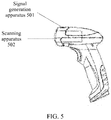
- FIG. 5 is a schematic composition diagram illustrating an implementation of an electronic device, according to the present application.
- the electronic device can include a signal generation apparatus 501 and a scanning apparatus 502.
- the signal generation apparatus 501 can be configured to send a predetermined characteristic signal.
- the signal generation apparatus 501 can include an acoustic wave generation apparatus and/or an optical wave generator.
- the scanning apparatus 502 can be configured to scan a payment page of a client computing device to obtain a user authorization code of the client computing device.
- the scanning apparatus 502 can include a bar code scanning apparatus, a two-dimensional code scanning apparatus, and/or a character code scanning apparatus.
- the scanning apparatus 502 can continuously send a scanning signal. For example, after the electronic device is powered on, the scanning apparatus 502 can continuously send a scanning signal.
- the scanning apparatus 502 can send a scanning signal after the signal generation apparatus 501 sends the predetermined characteristic signal for a predetermined time interval.
- the predetermined time interval can be set to 1 to 3 seconds.
- the scanning apparatus 502 can send a scanning signal after the signal generation apparatus 501 sends the predetermined characteristic signal for 1 second.
- it can be ensured that the payment page can be scanned in time after the client computing device displays the payment page, or scanning may not be enabled before the signal generation apparatus sends the predetermined characteristic signal, to save energy.
- a direction in which the optical wave generator sends an optical wave signal can be the same as a direction in which the scanning apparatus 502 sends a scanning signal.
- an operation of sending a request for obtaining the user authorization code and an operation of obtaining the user authorization code displayed on the user's client computing device can be completed successively provided that the user who uses the electronic device orients a direction of sending the signal to a direction of a display screen of the user's client computing device.
- the payment process is very convenient, so that the electronic payment speed and the payment efficiency can be improved.
- the electronic device provided in the previous implementation is used in co-operation with the implementation of the client computing device in the present application, the electronic device can request to obtain the user authorization code from the client computing device by sending the predetermined characteristic signal; the client computing device can display the payment page that includes the user authorization code after receiving the predetermined characteristic signal sent by the electronic device; and the scanning apparatus of the electronic device can obtain the user authorization code in the payment page by sending the scanning signal for electronic payment.
- the electronic payment process is very convenient, so that the speed and efficiency of the electronic payment can be improved.
- a technical improvement is a hardware improvement (for example, an improvement to a circuit structure, such as a diode, a transistor, or a switch) or a software improvement (an improvement to a method procedure) can be clearly distinguished.
- a hardware improvement for example, an improvement to a circuit structure, such as a diode, a transistor, or a switch
- a software improvement an improvement to a method procedure
- a designer usually programs an improved method procedure into a hardware circuit, to obtain a corresponding hardware circuit structure. Therefore, a method procedure can be improved by using a hardware entity module.
- a programmable logic device for example, a field programmable gate array (FPGA)
- FPGA field programmable gate array
- a designer performs programming to "integrate" a digital system to a single PLD, without requiring a chip manufacturer to design and manufacture a dedicated integrated circuit chip.
- this type of programming is mostly implemented by using "logic compiler” software.
- the programming is similar to a software compiler used to develop and write a program. Original code needs to be written in a particular programming language for compilation. The language is referred to as a hardware description language (HDL).
- HDL hardware description language
- HDLs such as the Advanced Boolean Expression Language (ABEL), the Altera Hardware Description Language (AHDL), Confluence, the Cornell University Programming Language (CUPL), HDCal, the Java Hardware Description Language (JHDL), Lava, Lola, MyHDL, PALASM, and the Ruby Hardware Description Language (RHDL).
- ABEL Advanced Boolean Expression Language
- AHDL Altera Hardware Description Language
- CUPL Cornell University Programming Language
- HDCal the Java Hardware Description Language
- JHDL Java Hardware Description Language
- Lava Lola
- MyHDL MyHDL
- PALASM Ruby Hardware Description Language
- RHDL Ruby Hardware Description Language
- VHDL very-high-speed integrated circuit hardware description language
- Verilog2 Verilog2
- a controller can be implemented by using any appropriate method.
- the controller can be a microprocessor or a processor and a computer readable medium storing computer readable program code (such as software or firmware) that can be executed by the microprocessor or the processor, a logic gate, a switch, an application-specific integrated circuit (ASIC), a programmable logic controller, or a built-in microcontroller.
- Examples of the controller include but are not limited to the following microprocessors: ARC 625D, Atmel AT91SAM, Microchip PIC18F26K20, and Silicone Labs C8051F320.
- the memory controller can also be implemented as a part of the control logic of the memory.
- controller can be considered as a hardware component, and an apparatus configured to implement various functions in the controller can also be considered as a structure in the hardware component. Or the apparatus configured to implement various functions can even be considered as both a software module implementing the method and a structure in the hardware component.
- the system, apparatus, module, or unit illustrated in the previous implementations can be implemented by using a computer chip or an entity, or can be implemented by using a product having a certain function.
- the apparatus above is described by dividing functions into various units. Certainly, when the present application is implemented, the functions of the units can be implemented in one or more pieces of software and/or hardware.
- a computing device includes one or more processors (CPU), one or more input/output interfaces, one or more network interfaces, and one or more memories.
- the computer software product can include several instructions for instructing a computer device (which can be a personal computer, a server, a network device, etc.) to perform the methods described in the implementations of the present application or some parts of the implementations.
- the computer software product can be stored in the memory, and the memory can include a non-permanent memory, a random access memory (RAM) and/or a non-volatile memory in a computer readable medium, for example, a read-only memory (ROM) or a flash memory (flash RAM).
- the memory is an example of the computer readable medium.
- the computer readable medium includes persistent, non-persistent, movable, and unmovable media that can store information by using any method or technology.
- the information can be a computer readable instruction, a data structure, a program module, or other data.
- Examples of a computer storage medium include but are not limited to a phase-change random access memory (PRAM), a static random access memory (SRAM), a dynamic random access memory (DRAM), another type of random access memory (RAM), a read-only memory (ROM), an electrically erasable programmable read-only memory (EEPROM), a flash memory or another memory technology, a compact disc read-only memory (CD-ROM), a digital versatile disc (DVD) or another optical storage, a cassette magnetic tape, a magnetic tape/magnetic disk storage or another magnetic storage device, or any other non-transmission medium.
- the computer storage medium can be used to store information accessible by the computing device. Based on the description in the present specification, the computer readable medium does not include transitory computer readable media (transitory media), such as a modulated data signal and carrier.
- the present application can be applied to many general-purpose or dedicated computer system environments or configurations, for example, a personal computer, a server computer, a handheld device or a portable device, a flat panel device, a multi-processor system, a microprocessor-based system, a set-top box, a programmable consumption electronic device, a network PC, a minicomputer, a mainframe computer, and a distributed computing environment including any one of the previous systems or devices.
- the present application can be described in the general context of computer executable instructions executed by a computer, for example, a program module.
- the program module includes a routine, a program, an object, a component, a data structure, etc. executing a specific task or implementing a specific abstract data type.
- the present application can also be practiced in distributed computing environments. In the distributed computing environments, tasks are performed by remote processing devices connected through a communications network. In a distributed computing environment, the program module can be located in both local and remote computer storage media including storage devices.
Landscapes
- Business, Economics & Management (AREA)
- Engineering & Computer Science (AREA)
- Accounting & Taxation (AREA)
- Physics & Mathematics (AREA)
- General Physics & Mathematics (AREA)
- Theoretical Computer Science (AREA)
- Strategic Management (AREA)
- General Business, Economics & Management (AREA)
- Computer Networks & Wireless Communication (AREA)
- Finance (AREA)
- Computer Security & Cryptography (AREA)
- Development Economics (AREA)
- Economics (AREA)
- User Interface Of Digital Computer (AREA)
- Financial Or Insurance-Related Operations Such As Payment And Settlement (AREA)
- Cash Registers Or Receiving Machines (AREA)
Applications Claiming Priority (2)
| Application Number | Priority Date | Filing Date | Title |
|---|---|---|---|
| CN201611128026.XA CN107038570A (zh) | 2016-12-09 | 2016-12-09 | 一种支付页面显示方法、客户端及电子设备 |
| PCT/CN2017/113565 WO2018103560A1 (zh) | 2016-12-09 | 2017-11-29 | 一种支付页面显示方法、客户端及电子设备 |
Publications (2)
| Publication Number | Publication Date |
|---|---|
| EP3553724A1 true EP3553724A1 (de) | 2019-10-16 |
| EP3553724A4 EP3553724A4 (de) | 2019-11-20 |
Family
ID=59530755
Family Applications (1)
| Application Number | Title | Priority Date | Filing Date |
|---|---|---|---|
| EP17879282.6A Withdrawn EP3553724A4 (de) | 2016-12-09 | 2017-11-29 | Verfahren zur anzeige einer zahlungsseite, client und elektronische vorrichtung |
Country Status (10)
| Country | Link |
|---|---|
| US (2) | US10997580B2 (de) |
| EP (1) | EP3553724A4 (de) |
| JP (1) | JP6785970B2 (de) |
| KR (1) | KR102491415B1 (de) |
| CN (1) | CN107038570A (de) |
| MY (1) | MY198830A (de) |
| PH (1) | PH12019501287A1 (de) |
| SG (1) | SG10202102393YA (de) |
| TW (1) | TW201822090A (de) |
| WO (1) | WO2018103560A1 (de) |
Families Citing this family (13)
| Publication number | Priority date | Publication date | Assignee | Title |
|---|---|---|---|---|
| CN107038570A (zh) * | 2016-12-09 | 2017-08-11 | 阿里巴巴集团控股有限公司 | 一种支付页面显示方法、客户端及电子设备 |
| CN107609856B (zh) * | 2017-09-27 | 2019-03-15 | 深圳市万通顺达科技股份有限公司 | 一种二维码支付系统及其支付方法 |
| CN108985749A (zh) * | 2018-06-07 | 2018-12-11 | 阿里巴巴集团控股有限公司 | 一种支付方法、测距方法、支付机具设备和测距设备 |
| CN109472175B (zh) * | 2018-08-21 | 2022-08-16 | 中国银联股份有限公司 | 电磁感应装置以及受理终端及其切换控制方法 |
| CN109993014A (zh) * | 2018-12-14 | 2019-07-09 | 中国银联股份有限公司 | 受理设备、移动终端及条码读取控制方法 |
| CN111210222B (zh) * | 2020-01-08 | 2022-04-29 | 支付宝实验室(新加坡)有限公司 | 一种数据展示、支付方法、装置、设备及介质 |
| CN112307325B (zh) * | 2020-04-13 | 2023-08-29 | 中科网联数据科技有限公司 | 消息推送的方法、装置、存储介质和电子设备 |
| US11714887B2 (en) * | 2020-07-28 | 2023-08-01 | Motorola Mobility Llc | Application functionality authentication and authorization in a multi-camera system |
| CN113537973A (zh) * | 2021-08-25 | 2021-10-22 | 苏州触达信息技术有限公司 | 基于超声声波的快捷支付方法与系统 |
| TWI827155B (zh) * | 2022-07-22 | 2023-12-21 | 一德金屬工業股份有限公司 | 運用擴增實境的解鎖方法 |
| CN116911843A (zh) * | 2023-07-18 | 2023-10-20 | 支付宝(杭州)信息技术有限公司 | 一种基于近场通信的支付方法、装置、设备及介质 |
| US12624572B2 (en) | 2024-08-26 | 2026-05-12 | I-Tek Metal Mfg. Co., Ltd. | Lock capable of showing locking or unlocking state |
| WO2026060557A1 (en) * | 2024-09-18 | 2026-03-26 | Orange | Lauching an application by light detection |
Family Cites Families (26)
| Publication number | Priority date | Publication date | Assignee | Title |
|---|---|---|---|---|
| KR20040082000A (ko) * | 2003-03-17 | 2004-09-23 | 주식회사 비즈모델라인 | 무선 결제 시스템 및 무선 결제 방법 |
| KR100836879B1 (ko) * | 2006-09-25 | 2008-06-11 | 에스케이 텔레콤주식회사 | 이동통신 단말기를 이용한 결제 서비스 시스템 및 제어방법 그리고 그를 위한 이동통신 단말기 및 동작 방법 |
| KR100845528B1 (ko) * | 2007-06-29 | 2008-07-10 | (주)하기소닉 | 이방성 초음파센서를 이용한 이동로봇의 주행 중 장애물회피와 자동충전을 위한 접속장치 및 방법 |
| US20090307140A1 (en) * | 2008-06-06 | 2009-12-10 | Upendra Mardikar | Mobile device over-the-air (ota) registration and point-of-sale (pos) payment |
| US8430317B2 (en) * | 2010-09-22 | 2013-04-30 | Striiv, Inc. | Barcode rendering device |
| US20120089471A1 (en) * | 2010-10-06 | 2012-04-12 | Rt7 Incorporated | System and method of capturing point-of-sale data and providing real-time advertising content |
| US20130048709A1 (en) * | 2011-05-05 | 2013-02-28 | Gary Turner | Method and apparatus for automatic encoded signal information delivery |
| EP2710531A1 (de) * | 2011-05-19 | 2014-03-26 | Alcatel-Lucent | Elektronische transaktionen mit mobile kommunikationsvorrichtungen über kodierte grafische darstellungen |
| DE202012100620U1 (de) | 2011-11-22 | 2012-06-13 | Square, Inc. | System zur Bearbeitung von kartenlosen Bezahlungstransaktionen |
| US9179244B2 (en) * | 2012-08-31 | 2015-11-03 | Apple Inc. | Proximity and tap detection using a wireless system |
| US8447654B1 (en) | 2012-09-24 | 2013-05-21 | Wal-Mart Stores, Inc. | Determination of customer proximity to a register through use of sound and methods thereof |
| US9386393B2 (en) * | 2012-11-29 | 2016-07-05 | Symbol Technologies, Llc | System and method for automatically activating a function of a mobile device with another device |
| NZ736945A (en) * | 2012-11-30 | 2019-04-26 | Taxiprop Pty Ltd | Taximeter, system and method for a taxi |
| US8770478B2 (en) * | 2013-07-11 | 2014-07-08 | Scvngr, Inc. | Payment processing with automatic no-touch mode selection |
| WO2015070799A1 (zh) * | 2013-11-15 | 2015-05-21 | 深圳光启创新技术有限公司 | 指令信息的发送和接收方法及其装置 |
| CN103824190B (zh) * | 2013-12-26 | 2016-08-31 | 深圳光启智能光子技术有限公司 | 支付方法、客户端、接收端及系统 |
| US20160092880A1 (en) * | 2014-09-26 | 2016-03-31 | Apriva, Llc | System and method for facilitating a purchase transaction using a merchant device beacon |
| US9489670B2 (en) * | 2015-01-15 | 2016-11-08 | Conversant Ip Management Inc. | Hybrid wireless short range payment system and method |
| CN105590199B (zh) * | 2014-11-14 | 2020-08-25 | 中国银联股份有限公司 | 一种基于动态二维码的支付方法以及支付系统 |
| CN105653963B (zh) | 2014-11-20 | 2020-06-19 | 阿里巴巴集团控股有限公司 | 一种信息展示方法及装置 |
| CN105844460A (zh) * | 2015-01-13 | 2016-08-10 | 顾泽苍 | 一种手机刷脸支付系统的构成 |
| WO2016186851A1 (en) * | 2015-05-19 | 2016-11-24 | Alibaba Group Holding Limited | Wireless mobile payment device |
| US9940637B2 (en) * | 2015-06-05 | 2018-04-10 | Apple Inc. | User interface for loyalty accounts and private label accounts |
| CN106056379A (zh) * | 2016-05-25 | 2016-10-26 | 努比亚技术有限公司 | 一种支付终端及支付数据处理方法 |
| CN106911658B (zh) | 2016-06-07 | 2021-08-06 | 创新先进技术有限公司 | 数据的传输方法、数据发送端、数据接收端及系统 |
| CN107038570A (zh) | 2016-12-09 | 2017-08-11 | 阿里巴巴集团控股有限公司 | 一种支付页面显示方法、客户端及电子设备 |
-
2016
- 2016-12-09 CN CN201611128026.XA patent/CN107038570A/zh active Pending
-
2017
- 2017-09-19 TW TW106132062A patent/TW201822090A/zh unknown
- 2017-11-29 WO PCT/CN2017/113565 patent/WO2018103560A1/zh not_active Ceased
- 2017-11-29 JP JP2019531107A patent/JP6785970B2/ja active Active
- 2017-11-29 KR KR1020197019772A patent/KR102491415B1/ko active Active
- 2017-11-29 MY MYPI2019003239A patent/MY198830A/en unknown
- 2017-11-29 EP EP17879282.6A patent/EP3553724A4/de not_active Withdrawn
- 2017-11-29 SG SG10202102393YA patent/SG10202102393YA/en unknown
-
2019
- 2019-06-06 US US16/433,608 patent/US10997580B2/en active Active
- 2019-06-07 PH PH12019501287A patent/PH12019501287A1/en unknown
-
2021
- 2021-04-29 US US17/244,664 patent/US11282065B2/en active Active
Also Published As
| Publication number | Publication date |
|---|---|
| US20210248588A1 (en) | 2021-08-12 |
| US20190311350A1 (en) | 2019-10-10 |
| KR20190090860A (ko) | 2019-08-02 |
| EP3553724A4 (de) | 2019-11-20 |
| CN107038570A (zh) | 2017-08-11 |
| WO2018103560A1 (zh) | 2018-06-14 |
| JP2020504864A (ja) | 2020-02-13 |
| JP6785970B2 (ja) | 2020-11-18 |
| SG10202102393YA (en) | 2021-04-29 |
| PH12019501287A1 (en) | 2020-01-20 |
| US11282065B2 (en) | 2022-03-22 |
| MY198830A (en) | 2023-09-30 |
| US10997580B2 (en) | 2021-05-04 |
| TW201822090A (zh) | 2018-06-16 |
| KR102491415B1 (ko) | 2023-01-20 |
Similar Documents
| Publication | Publication Date | Title |
|---|---|---|
| JP6785970B2 (ja) | 支払いページ表示方法、クライアントおよび電子デバイス | |
| US10877559B2 (en) | System to provide tactile feedback during non-contact interaction | |
| US10831740B2 (en) | Parallel processing of service data corresponding to multiple target objects | |
| CN110024370B (zh) | 电子装置以及在电子装置中显示用于虹膜辨识的图像的方法 | |
| TWI699717B (zh) | 資料處理方法、終端設備和資料處理系統 | |
| CN108769476B (zh) | 图像获取方法及装置、图像采集装置、计算机设备和可读存储介质 | |
| US20250139606A1 (en) | Data processing method, terminal device and data processing system | |
| WO2019227999A1 (zh) | 一种移动支付方法、装置及支付系统 | |
| TWI775999B (zh) | 頁面顯示方法、裝置及設備 | |
| CN110851510A (zh) | 基于区块链的交易系统的数据处理方法及装置 | |
| US10057748B1 (en) | Technology application restructuring and deployment for home receiver integration | |
| CN110716642A (zh) | 一种调节显示界面的方法与设备 | |
| WO2018188621A1 (zh) | 一种资源传输方法及装置 | |
| GB2522748A (en) | Detecting pause in audible input to device | |
| CN112036887A (zh) | 资源转移的方法、装置、设备及存储介质 | |
| TW201931244A (zh) | 付款碼獲取、支付請求響應方法、裝置以及設備 | |
| CN106168871A (zh) | 电子设备及其屏幕显示方法 | |
| CN113138560A (zh) | 终端控制方法、装置、设备及可读存储介质 | |
| US10789519B1 (en) | Scanning interface display | |
| US20250061667A1 (en) | Control method and apparatus based on mixed reality, electronic device, and storage medium | |
| US20130083392A1 (en) | Mechanism for employing and facilitating a universal and dynamic eyewear optical lens stack and an intelligent tracking system at an eyewear device | |
| HK1241528A1 (en) | Payment page display method, client, and electronic equipment | |
| HK1241528A (en) | Payment page display method, client, and electronic equipment | |
| US7742013B2 (en) | Integrated spectacles and display unit for computers and video | |
| WO2023221062A1 (zh) | 电子设备的语音唤醒方法、装置、存储介质及芯片 |
Legal Events
| Date | Code | Title | Description |
|---|---|---|---|
| STAA | Information on the status of an ep patent application or granted ep patent |
Free format text: STATUS: THE INTERNATIONAL PUBLICATION HAS BEEN MADE |
|
| PUAI | Public reference made under article 153(3) epc to a published international application that has entered the european phase |
Free format text: ORIGINAL CODE: 0009012 |
|
| STAA | Information on the status of an ep patent application or granted ep patent |
Free format text: STATUS: REQUEST FOR EXAMINATION WAS MADE |
|
| 17P | Request for examination filed |
Effective date: 20190708 |
|
| AK | Designated contracting states |
Kind code of ref document: A1 Designated state(s): AL AT BE BG CH CY CZ DE DK EE ES FI FR GB GR HR HU IE IS IT LI LT LU LV MC MK MT NL NO PL PT RO RS SE SI SK SM TR |
|
| AX | Request for extension of the european patent |
Extension state: BA ME |
|
| A4 | Supplementary search report drawn up and despatched |
Effective date: 20191018 |
|
| RIC1 | Information provided on ipc code assigned before grant |
Ipc: G06Q 20/20 20120101ALI20191014BHEP Ipc: G07G 1/00 20060101ALI20191014BHEP Ipc: G06Q 20/32 20120101AFI20191014BHEP Ipc: G06Q 20/40 20120101ALI20191014BHEP |
|
| DAV | Request for validation of the european patent (deleted) | ||
| DAX | Request for extension of the european patent (deleted) | ||
| RAP1 | Party data changed (applicant data changed or rights of an application transferred) |
Owner name: ADVANCED NEW TECHNOLOGIES CO., LTD. |
|
| STAA | Information on the status of an ep patent application or granted ep patent |
Free format text: STATUS: EXAMINATION IS IN PROGRESS |
|
| 17Q | First examination report despatched |
Effective date: 20210507 |
|
| STAA | Information on the status of an ep patent application or granted ep patent |
Free format text: STATUS: THE APPLICATION HAS BEEN WITHDRAWN |
|
| 18W | Application withdrawn |
Effective date: 20220328 |