EP3553855A1 - Matériau actif d'électrode positive pour batterie secondaire au lithium, son procédé de préparation et batterie secondaire au lithium le comprenant - Google Patents
Matériau actif d'électrode positive pour batterie secondaire au lithium, son procédé de préparation et batterie secondaire au lithium le comprenant Download PDFInfo
- Publication number
- EP3553855A1 EP3553855A1 EP17881416.6A EP17881416A EP3553855A1 EP 3553855 A1 EP3553855 A1 EP 3553855A1 EP 17881416 A EP17881416 A EP 17881416A EP 3553855 A1 EP3553855 A1 EP 3553855A1
- Authority
- EP
- European Patent Office
- Prior art keywords
- positive electrode
- electrode active
- active material
- secondary battery
- lithium secondary
- Prior art date
- Legal status (The legal status is an assumption and is not a legal conclusion. Google has not performed a legal analysis and makes no representation as to the accuracy of the status listed.)
- Pending
Links
Images




Classifications
-
- C—CHEMISTRY; METALLURGY
- C01—INORGANIC CHEMISTRY
- C01G—COMPOUNDS CONTAINING METALS NOT COVERED BY SUBCLASSES C01D OR C01F
- C01G53/00—Compounds of nickel
- C01G53/40—Complex oxides containing nickel and at least one other metal element
- C01G53/42—Complex oxides containing nickel and at least one other metal element containing alkali metals, e.g. LiNiO2
-
- H—ELECTRICITY
- H01—ELECTRIC ELEMENTS
- H01M—PROCESSES OR MEANS, e.g. BATTERIES, FOR THE DIRECT CONVERSION OF CHEMICAL ENERGY INTO ELECTRICAL ENERGY
- H01M4/00—Electrodes
- H01M4/02—Electrodes composed of, or comprising, active material
- H01M4/36—Selection of substances as active materials, active masses, active liquids
- H01M4/48—Selection of substances as active materials, active masses, active liquids of inorganic oxides or hydroxides
- H01M4/485—Selection of substances as active materials, active masses, active liquids of inorganic oxides or hydroxides of mixed oxides or hydroxides for inserting or intercalating light metals, e.g. LiTi2O4 or LiTi2OxFy
-
- H—ELECTRICITY
- H01—ELECTRIC ELEMENTS
- H01M—PROCESSES OR MEANS, e.g. BATTERIES, FOR THE DIRECT CONVERSION OF CHEMICAL ENERGY INTO ELECTRICAL ENERGY
- H01M4/00—Electrodes
- H01M4/02—Electrodes composed of, or comprising, active material
- H01M4/36—Selection of substances as active materials, active masses, active liquids
- H01M4/48—Selection of substances as active materials, active masses, active liquids of inorganic oxides or hydroxides
- H01M4/50—Selection of substances as active materials, active masses, active liquids of inorganic oxides or hydroxides of manganese
- H01M4/505—Selection of substances as active materials, active masses, active liquids of inorganic oxides or hydroxides of manganese of mixed oxides or hydroxides containing manganese for inserting or intercalating light metals, e.g. LiMn2O4 or LiMn2OxFy
-
- C—CHEMISTRY; METALLURGY
- C01—INORGANIC CHEMISTRY
- C01G—COMPOUNDS CONTAINING METALS NOT COVERED BY SUBCLASSES C01D OR C01F
- C01G53/00—Compounds of nickel
- C01G53/40—Complex oxides containing nickel and at least one other metal element
- C01G53/42—Complex oxides containing nickel and at least one other metal element containing alkali metals, e.g. LiNiO2
- C01G53/44—Complex oxides containing nickel and at least one other metal element containing alkali metals, e.g. LiNiO2 containing manganese
- C01G53/50—Complex oxides containing nickel and at least one other metal element containing alkali metals, e.g. LiNiO2 containing manganese of the type (MnO2)n-, e.g. Li(NixMn1-x)O2 or Li(MyNixMn1-x-y)O2
-
- H—ELECTRICITY
- H01—ELECTRIC ELEMENTS
- H01M—PROCESSES OR MEANS, e.g. BATTERIES, FOR THE DIRECT CONVERSION OF CHEMICAL ENERGY INTO ELECTRICAL ENERGY
- H01M10/00—Secondary cells; Manufacture thereof
- H01M10/05—Accumulators with non-aqueous electrolyte
- H01M10/052—Li-accumulators
- H01M10/0525—Rocking-chair batteries, i.e. batteries with lithium insertion or intercalation in both electrodes; Lithium-ion batteries
-
- H—ELECTRICITY
- H01—ELECTRIC ELEMENTS
- H01M—PROCESSES OR MEANS, e.g. BATTERIES, FOR THE DIRECT CONVERSION OF CHEMICAL ENERGY INTO ELECTRICAL ENERGY
- H01M4/00—Electrodes
- H01M4/02—Electrodes composed of, or comprising, active material
- H01M4/13—Electrodes for accumulators with non-aqueous electrolyte, e.g. for lithium-accumulators; Processes of manufacture thereof
- H01M4/131—Electrodes based on mixed oxides or hydroxides, or on mixtures of oxides or hydroxides, e.g. LiCoOx
-
- H—ELECTRICITY
- H01—ELECTRIC ELEMENTS
- H01M—PROCESSES OR MEANS, e.g. BATTERIES, FOR THE DIRECT CONVERSION OF CHEMICAL ENERGY INTO ELECTRICAL ENERGY
- H01M4/00—Electrodes
- H01M4/02—Electrodes composed of, or comprising, active material
- H01M4/36—Selection of substances as active materials, active masses, active liquids
- H01M4/48—Selection of substances as active materials, active masses, active liquids of inorganic oxides or hydroxides
- H01M4/52—Selection of substances as active materials, active masses, active liquids of inorganic oxides or hydroxides of nickel, cobalt or iron
- H01M4/525—Selection of substances as active materials, active masses, active liquids of inorganic oxides or hydroxides of nickel, cobalt or iron of mixed oxides or hydroxides containing iron, cobalt or nickel for inserting or intercalating light metals, e.g. LiNiO2, LiCoO2 or LiCoOxFy
-
- C—CHEMISTRY; METALLURGY
- C01—INORGANIC CHEMISTRY
- C01P—INDEXING SCHEME RELATING TO STRUCTURAL AND PHYSICAL ASPECTS OF SOLID INORGANIC COMPOUNDS
- C01P2002/00—Crystal-structural characteristics
- C01P2002/50—Solid solutions
- C01P2002/52—Solid solutions containing elements as dopants
-
- C—CHEMISTRY; METALLURGY
- C01—INORGANIC CHEMISTRY
- C01P—INDEXING SCHEME RELATING TO STRUCTURAL AND PHYSICAL ASPECTS OF SOLID INORGANIC COMPOUNDS
- C01P2002/00—Crystal-structural characteristics
- C01P2002/60—Compounds characterised by their crystallite size
-
- C—CHEMISTRY; METALLURGY
- C01—INORGANIC CHEMISTRY
- C01P—INDEXING SCHEME RELATING TO STRUCTURAL AND PHYSICAL ASPECTS OF SOLID INORGANIC COMPOUNDS
- C01P2002/00—Crystal-structural characteristics
- C01P2002/70—Crystal-structural characteristics defined by measured X-ray, neutron or electron diffraction data
- C01P2002/72—Crystal-structural characteristics defined by measured X-ray, neutron or electron diffraction data by d-values or two theta-values, e.g. as X-ray diagram
-
- C—CHEMISTRY; METALLURGY
- C01—INORGANIC CHEMISTRY
- C01P—INDEXING SCHEME RELATING TO STRUCTURAL AND PHYSICAL ASPECTS OF SOLID INORGANIC COMPOUNDS
- C01P2002/00—Crystal-structural characteristics
- C01P2002/70—Crystal-structural characteristics defined by measured X-ray, neutron or electron diffraction data
- C01P2002/76—Crystal-structural characteristics defined by measured X-ray, neutron or electron diffraction data by a space-group or by other symmetry indications
-
- C—CHEMISTRY; METALLURGY
- C01—INORGANIC CHEMISTRY
- C01P—INDEXING SCHEME RELATING TO STRUCTURAL AND PHYSICAL ASPECTS OF SOLID INORGANIC COMPOUNDS
- C01P2002/00—Crystal-structural characteristics
- C01P2002/70—Crystal-structural characteristics defined by measured X-ray, neutron or electron diffraction data
- C01P2002/77—Crystal-structural characteristics defined by measured X-ray, neutron or electron diffraction data by unit-cell parameters, atom positions or structure diagrams
-
- C—CHEMISTRY; METALLURGY
- C01—INORGANIC CHEMISTRY
- C01P—INDEXING SCHEME RELATING TO STRUCTURAL AND PHYSICAL ASPECTS OF SOLID INORGANIC COMPOUNDS
- C01P2002/00—Crystal-structural characteristics
- C01P2002/80—Crystal-structural characteristics defined by measured data other than those specified in group C01P2002/70
- C01P2002/85—Crystal-structural characteristics defined by measured data other than those specified in group C01P2002/70 by XPS, EDX or EDAX data
-
- C—CHEMISTRY; METALLURGY
- C01—INORGANIC CHEMISTRY
- C01P—INDEXING SCHEME RELATING TO STRUCTURAL AND PHYSICAL ASPECTS OF SOLID INORGANIC COMPOUNDS
- C01P2004/00—Particle morphology
- C01P2004/01—Particle morphology depicted by an image
- C01P2004/03—Particle morphology depicted by an image obtained by SEM
-
- C—CHEMISTRY; METALLURGY
- C01—INORGANIC CHEMISTRY
- C01P—INDEXING SCHEME RELATING TO STRUCTURAL AND PHYSICAL ASPECTS OF SOLID INORGANIC COMPOUNDS
- C01P2004/00—Particle morphology
- C01P2004/60—Particles characterised by their size
- C01P2004/61—Micrometer sized, i.e. from 1-100 micrometer
-
- C—CHEMISTRY; METALLURGY
- C01—INORGANIC CHEMISTRY
- C01P—INDEXING SCHEME RELATING TO STRUCTURAL AND PHYSICAL ASPECTS OF SOLID INORGANIC COMPOUNDS
- C01P2006/00—Physical properties of inorganic compounds
- C01P2006/40—Electric properties
-
- H—ELECTRICITY
- H01—ELECTRIC ELEMENTS
- H01M—PROCESSES OR MEANS, e.g. BATTERIES, FOR THE DIRECT CONVERSION OF CHEMICAL ENERGY INTO ELECTRICAL ENERGY
- H01M4/00—Electrodes
- H01M4/02—Electrodes composed of, or comprising, active material
- H01M2004/026—Electrodes composed of, or comprising, active material characterised by the polarity
- H01M2004/028—Positive electrodes
-
- Y—GENERAL TAGGING OF NEW TECHNOLOGICAL DEVELOPMENTS; GENERAL TAGGING OF CROSS-SECTIONAL TECHNOLOGIES SPANNING OVER SEVERAL SECTIONS OF THE IPC; TECHNICAL SUBJECTS COVERED BY FORMER USPC CROSS-REFERENCE ART COLLECTIONS [XRACs] AND DIGESTS
- Y02—TECHNOLOGIES OR APPLICATIONS FOR MITIGATION OR ADAPTATION AGAINST CLIMATE CHANGE
- Y02E—REDUCTION OF GREENHOUSE GAS [GHG] EMISSIONS, RELATED TO ENERGY GENERATION, TRANSMISSION OR DISTRIBUTION
- Y02E60/00—Enabling technologies; Technologies with a potential or indirect contribution to GHG emissions mitigation
- Y02E60/10—Energy storage using batteries
Definitions
- the present invention relates to a positive electrode active material for a lithium secondary battery, a method for preparing the same, and a lithium secondary battery comprising the same are disclosed.
- a lithium secondary battery has recently drawn attention as a power source for small portable electronic devices.
- the lithium secondary battery uses an organic electrolyte solution and thereby, have twice as high a discharge voltage as a conventional battery using an alkali aqueous solution and accordingly, high energy density.
- a lithium transition metal composite oxide which is a positive electrode active material of a lithium secondary battery includes a lithium oxide having a structure capable of intercalating lithium ions such as LiCoO 2 , LiMn 2 O 4 , or LiNi 1-x Co x O 2 (0 ⁇ x ⁇ 1).
- LiCoO 2 the most widely used positive electrode active material in the related industry is LiCoO 2 , which may be used for a lithium secondary battery to improve charge and discharge and discharge voltage characteristics.
- the lithium secondary battery including LiCoO 2 has a problem that its characteristics (for example, cycle-life characteristics, high temperature characteristics, thermal stability, etc.) may be deteriorated rapidly as charge and discharge are repeated. This is because LiCoO 2 therein tends to be degraded by the use of a lithium secondary battery, and this problem becomes even more serious at a high temperature.
- the present invention provides a positive electrode active material including metals having an average oxidation number of greater than 3.5 which are doped in a lithium transition metal composite oxide.
- a positive electrode active material for a lithium secondary battery according to an embodiment of the present invention includes a lithium transition metal composite oxide and doping metals doped in the lithium-transition metal composite oxide, wherein the doping metals includes at least two kinds and an average oxidation number of the doping metals is greater than 3.5.
- the doping metals may include at least one (M 1 ) selected from the group including aluminum, boron, gallium, indium, titanium, zirconium, hafnium, vanadium, niobium, tantalum, and thallium and at least one (M 2 ) selected from the group including molybdenum, chromium, and tungsten.
- M 1 selected from the group including aluminum, boron, gallium, indium, titanium, zirconium, hafnium, vanadium, niobium, tantalum, and thallium
- M 2 selected from the group including molybdenum, chromium, and tungsten.
- the positive electrode active material for a lithium secondary battery may be represented by Chemical Formula 1.
- Chemical Formula 1 Li a (Ni x Co y Mn 1-x-y ) b (M 1 z M 2 1-z ) c O 2
- the z may be greater than or equal to 0.7.
- the x may be greater than or equal to 0.8.
- the c may be greater than or equal to about 0.01.
- a method of preparing a positive electrode active material for a lithium secondary battery includes 1) mixing a mixture of a transition metal precursor and a lithium precursor with a doping metal precursor having an average oxidation number of greater than +3.5; and firing the resultant mixture obtained in the 1) step to form a positive electrode active material, wherein the positive electrode active material is represented by Chemical Formula 1.
- Chemical Formula 1 Li a (Ni x Co y Mn 1-x-y ) b (M 1 z M 2 1-z ) c O 2
- the firing may be performed at a temperature of 400 °C to 900 °C for 20 hours to 30 hours in a temperature increasing and decreasing sections.
- a lithium secondary battery includes a positive electrode for a lithium secondary battery including the aforementioned positive electrode active material; a negative electrode overlapped therewith; and a separator and an electrolyte disposed between the positive electrode and the negative electrode.
- a positive electrode active material for a lithium secondary battery being stable for a high temperature and heat and having improved reliability, and a lithium secondary battery including the same are provided.
- a positive electrode active material according to an embodiment of the present invention includes a compound represented by Chemical Formula 1.
- Chemical Formula 1 Li a (Ni x Co y Mn 1-x-y ) b (M 1 z M 2 1-z ) c O 2
- M 1 is selected from the group consisting of aluminum (Al), boron (B), gallium (Ga), indium (In), titanium (Ti), zirconium (Zr), hafnium (Hf), vanadium (V), niobium (Nb), tantalum (Ta), thallium (Tl), and a combination thereof
- M 2 is selected from the group consisting of molybdenum (Mo), chromium (Cr), tungsten (W), and a combination thereof.
- the z may be greater than or equal to 0.6, and more specifically, the z may be in the range of 0.6 to 0.9 or 0.65 to 0.85.
- a secondary battery employing a positive electrode active material according to the present embodiment may greatly improve high rate discharge characteristics. Therefore, there is an advantage that a secondary battery having improved output characteristics may be realized.
- the c may be less than or equal to 0.015, and more specifically the c may be in the range of 0.001 to 0.015. If the c value in Chemical Formula 1 satisfies the range, the cycle-life characteristics of the secondary battery using the positive electrode active material according to the present embodiment may be improved considerably.
- the positive electrode active material represented by Chemical Formula 1 is based on a lithium-nickel-based oxide and includes the doping metals represented by M 1 and M 2 in Chemical Formula 1 to compensate structural instability of lithium-nickel-based oxide.
- a nickel content may be 50 to 95 mol% and more specifically, 70 to 95 mol% or 80 mol% to 93 mol% based on a total amount of the nickel, cobalt, and manganese components.
- the positive electrode active material including these may improve battery characteristics of a secondary battery such as discharge voltages, capacity characteristics, and the like.
- the nickel may have a concentration gradient from a core part to a surface part, and the concentration gradient may exist in a region of 95 length% of the entire radius.
- the nickel concentration of the surface part may gradually decrease to 50 mol%.
- the nickel is taken as an example, but the description of the concentration gradient may also be applied to the manganese and cobalt.
- the doping metals represented by M 1 and M 2 may be doped in a lithium cation site in order to prevent mixing of nickel cations into a lithium layer thereof.
- M 1 may be selected from the group consisting of aluminum (Al), boron (B), gallium (Ga), indium (In), titanium (Ti), zirconium (Zr), hafnium (Hf), vanadium (V), niobium (Nb), tantalum (Ta), thallium (TI), and a combination thereof and M 2 may be selected from the group consisting of molybdenum (Mo), chromium (Cr), tungsten (W), and a combination thereof.
- the doping metals may include at least two kinds, and Chemical Formula 1 may be represented by M 1 and M 2 but it is not limited thereto and may include three or more kinds.
- An average oxidation number of at least two kinds of the selected doping metals may be greater than + 3.5.
- the present disclosure illustrates a positive electrode active material including two kinds of doping metals, whose average oxidation number is greater than 3.5, but is not limited thereto and may include greater than or equal to 3 or 4 kinds of doping metals, whose average oxidation number is greater than 3.5.
- at least two kinds of doping metals may have an average oxidation number of greater than 3.5 and specifically, in a range of 3.5 to 5 or 3.5 to 4.5. When the average oxidation number of the doping elements satisfies the range, electrochemical characteristics of a secondary battery manufactured by applying the positive electrode active material according to the present embodiment may be improved.
- the doping metals represented by M 1 and M 2 may be positioned in a lithium cation site in the crystal structure of the positive electrode active material or an empty space in a crystal lattice and thus make a charge balance. Accordingly, the doping metals may suppress the cation mixing into the lithium cation site and work as a filler and thus promote structural stability of the positive electrode active material and reduce a natural loss of lithium cations.
- the positive electrode active material for a secondary battery of the present embodiment may have an a-axis lattice parameter of 2.865 ⁇ to 2.874 ⁇ , and more specifically 2.868 ⁇ to 2.873 ⁇ .
- the positive electrode active material may have a c-axis lattice parameter of 14.180 ⁇ to 14.214 ⁇ and more specifically, 14.180 ⁇ to 14.213 ⁇ .
- c-axis lattice parameter/a-axis lattice parameter values may be in the range of 4.945 to 4.950 and the crystalline size may be 82.5 nm to 100 nm, and more specifically 83 nm to 90 nm.
- a method of preparing a positive electrode active material for a lithium secondary battery includes mixing a solution including a transition metal precursor and a lithium precursor with a metal precursor having an average oxidation number of greater than +3.5, and firing the same to prepare the positive electrode active material represented by Chemical Formula 1.
- the preparing the lithium transition metal composite oxide in the step are not limited to the method and may be produced by a method commonly known in the art such as a solid-phase reaction method, a co-precipitation method, a gel method, and a hydrothermal synthesis method.
- each precursor respectively including nickel, cobalt, and manganese is dissolved in a solvent and then, co-precipitated to obtain a transition metal composite hydroxide.
- the transition metal composite hydroxide may be represented by Me(OH) 2 , wherein the Me represents a transition metal and is represented by Ni x Co y Mn 1-x-y in Chemical Formula 1.
- the lithium precursor is additionally mixed therewith to prepare a lithium transition metal composite oxide.
- a doping metal precursor for example, a first doping metal precursor and a second doping metal precursor are added thereto, and the obtained mixture may be fired.
- the first doping metal precursor may be Al 2 O 3 and the second doping metal precursor may be MoO 3 .
- the firing may be performed by heat treating at a temperature ranging from 400 ° C to 900 ° C for 20 hours to 30 hours in a temperature increasing and decreasing sections, but is not limited thereto.
- This specification also provides a positive electrode for a lithium secondary battery in which positive electrode material slurry including the aforementioned positive electrode active material is applied on the current collector.
- a positive electrode according to an embodiment may be manufactured by applying a positive electrode active material slurry including the positive electrode active material to a positive electrode current collector, and drying and compressing the same.
- the positive electrode current collector may generally have a thickness of 3 ⁇ m to 500 ⁇ m, and is not particularly limited as long as it has high conductivity without causing chemical changes in the battery, but may be for example stainless steel, aluminum, nickel, titanium, fired carbon, or aluminum or stainless steel which is surface-treated with carbon, nickel, titanium, or silver.
- the positive electrode active material slurry may be prepared by adding a binder, a conductive material, and an additive such as a filler, a dispersing agent, and the like to the positive electrode active material and mixing them.
- the binder is a component that assists in binding between the positive electrode active material and the conductive material and binding to the current collector and may be generally from 1 wt% to 30 wt% based on a total amount of positive electrode active material.
- a binder is not particularly limited and conventional binders known in the art may be used, but may be for example one or more selected from the group consisting of polyvinylidene fluoride-co-hexafluoropropylene (PVDF-co-HFP), polyvinylidene fluoride, polyacrylonitrile, polymethylmethacrylate, polyvinyl alcohol, carboxylmethyl cellulose (CMC), starch, hydroxypropyl cellulose, regenerated cellulose, polyvinylpyrrolidone, tetrafluoroethylene, polyethylene, polypropylene, polyacrylic acid, an ethylene-propylene-diene monomer (EPDM), sulfonated EPDM, a styrene-butyrene rubber (
- the conductive material may generally be added in an amount of 0.05 wt% to 5 wt% based on a total weight of the positive electrode active material.
- a conductive material is not particularly limited as long as it is not particularly limited and is conductive without causing side reactions with other components of the battery, but may be for example graphite such as natural graphite, artificial graphite, and the like; carbon black such as carbon black, acetylene black, ketjen black, channel black, furnace black, lamp black, thermal black, and the like; a conductive fiber such as a carbon fiber, a metal fiber, and the like; a metal powder such as carbon fluoride, aluminum, a nickel powder, and the like; a conductive whisker such as zinc oxide, potassium titanate, and the like; a conductive metal oxide such as titanium oxide and the like; a conductive material such as a polyphenylene derivative and the like.
- the filler is a component that suppresses expansion of a positive electrode and may be used as needed. It is not particularly limited if it is a fiber-shaped material without inducing chemical changes in the battery, but may be for example a polyolefin-based polymer such as polyethylene polypropylene; a fiber-shaped material such as a glass fiber, a carbon fiber, and the like.
- the dispersing agent is not particularly limited, but may be for example isopropyl alcohol, N-methyl-2-pyrrolidone (NMP), acetone, and the like.
- the applying may be performed by a generally known method in the art but may be for example performed by supplying the positive electrode active material slurry on one upper surface of the positive electrode current collector and uniformly dispersing it using a doctor. In addition, it may be performed by methods such as die casting, comma coating, screen printing, and the like.
- the drying may be performed within a day at a vacuum oven of 50 ° C to 200 ° C, although not particularly limited.
- An embodiment of the present invention provides a lithium secondary battery including the aforementioned positive electrode for a lithium secondary battery, a negative electrode, and a separator and an electrolyte disposed between the positive electrode and the negative electrode.
- the positive electrode may have improved structural stability by including the aforementioned positive electrode active material.
- the description of the positive electrode is omitted.
- the negative electrode may be manufactured by applying a negative active material slurry including a negative active material on one upper surface of the negative electrode current collector and then drying it, and the negative active material slurry may include a binder, a conductive material, and additives such as a filler and a dispersing agent in addition to a negative active material.
- the negative electrode current collector may be the same as or included in the positive electrode current collector mentioned above.
- the negative active material is not particularly limited and may be a carbon material in which lithium ions may be intercalated and deintercalated, lithium metal, silicon, or tin and the like, which is commonly known in this art.
- the carbon materials may preferably be used and for the carbon materials, low crystalline carbon and high crystalline carbon may be used.
- the low crystalline carbon may be soft carbon and hard carbon and the high crystalline carbon may be natural graphite, kish graphite, pyrolytic carbon, a mesophase pitch based carbon fiber, meso-carbon microbeads, mesophase pitches, and high temperature fired carbon such as petroleum-based and coal-based cokes.
- Additives such as a binder, a conductive material, and an additive such as a filler and a dispersing agent used in the negative electrode may be the same as or included in the aforementioned manufacture of the positive electrode.
- the separator may be an insulating thin film having high ion transmittance and mechanical strength, and may generally be a pore diameter of 0.01 ⁇ m to 10 ⁇ m and a thickness of 5 ⁇ m to 300 ⁇ m.
- the separator may be a porous polymer film, for example made of a polyolefin polymer, an ethylene homopolymer, a propylene homopolymer, an ethylene/butene copolymer, an ethylene/hexene copolymer, and an ethylene/methacrylate copolymer may be used alone or in a form of a stack thereof, or a generally porous non-woven fabric, for example a non-woven fabric made of a glass fiber having a high melting point or a polyethylene terephthalate fiber, but is not limited thereto.
- the electrolyte may include organic solvents and lithium salts commonly used in electrolytes, and is not particularly limited.
- the organic solvents may be at least one selected from the group consisting of propylene carbonate, ethylene carbonate, diethylcarbonate, dimethylcarbonate, ethylmethylcarbonate, methylpropylcarbonate, dipropylcarbonate, dimethylsulfoxide, acetonitrile, dimethoxyethane, diethoxyethane, vinylenecarbonate, sulfolane, gamma-butyrolactone, propylenesulfite, and tetrahydrofuran.
- the electrolyte may further include pyridine, triethylphosphite, triethanolamine, cyclic ether, ethylene diamine, n-glyme(glyme), hexaphosphoric acid triamide, a nitrobenzene derivative, sulfur, a quinone imine dye, N-substituted oxazolidinone, N,N-substituted imidazolidine, ethylene glycol dialkyl ether, an ammonium salt, pyrrole, 2-methoxy ethanol, aluminum trichloride, and the like as needed in order to improve charge and discharge characteristics, flame retardancy characteristics, and the like.
- it may further include a halogen-containing solvent such as carbon tetrachloride, ethylene trifluoride, and the like in order to impart non-flammability, it may further include a carbon dioxide gas in order to improve high temperature preservation characteristics, and it may further include FEC (fluoro-ethylene carbonate), PRS (propene sultone), FPC (fluoro-propylene carbonate), and the like.
- a halogen-containing solvent such as carbon tetrachloride, ethylene trifluoride, and the like in order to impart non-flammability
- a carbon dioxide gas in order to improve high temperature preservation characteristics
- FEC fluoro-ethylene carbonate
- PRS propene sultone
- FPC fluoro-propylene carbonate
- the lithium secondary battery of the present invention may be manufactured by disposing a separator between a positive electrode and a negative electrode to form an electrode assembly, placing the electrode assembly in a cylindrical battery case or a prismatic battery case, and injecting an electrolyte.
- the electrode assembly may be stacked and may be impregnated with the electrolyte, and the resulting material sealed in a battery case.
- the battery case used in the present invention may be adopted as commonly used in the related art, and there is no limitation on the external shape according to the use of the battery and may be for example, a cylindrical, square, pouch type or coin (coin) type or the like.
- Example 1 Preparation of Precursor and Positive Electrode Active Material Simultaneously Doped with Al/Mo
- a precursor having a (Ni 0.8 Co 0.1 Mn 0.1 )(OH) 2 composition was prepared by a general co-precipitation method.
- a feeding tank 1 having a high nickel concentration and a feeding tank 2 having a low nickel concentration were arranged in series.
- a high Ni solution of the feeding tank 1 alone was injected into a reactor in order to perform a co-precipitation, and then, a concentration gradient of the shell part was formed by injecting a solution from the feeding tank 2 to the feeding tank 1 and sequentially, from the feeding tank 1 to the reactor to change the nickel concentration during the co-precipitation.
- NiSO 4 ⁇ 6H 2 O, CoSO 4 ⁇ 7H 2 O, and MnSO 4 ⁇ H 2 O were dissolved in ultrapure water (DI water), and NH 4 (OH) was used as a co-precipitation chelating agent, and NaOH was used for pH adjustment.
- DI water ultrapure water
- NH 4 (OH) was used as a co-precipitation chelating agent
- NaOH was used for pH adjustment.
- N 2 was purged, and a temperature of the reactor was maintained at 50 °C.
- the prepared precursor was filtered, washed with ultrapure water, and dried in a 100 °C oven for 24 hours.
- the core-shell gradient precursor (Ni 0.8 Co 0.1 Mn 0.1 (OH) 2 ) prepared according to the 1), LiOH ⁇ H 2 O (Battery Grade, Samchun Chemicals), Al 2 O 3 (2N, Samchun Chemicals), and MoO 3 (2N5, Samchun Chemicals) were weighed according to a mole ratio and then, uniformly mixed and fired under an oxygen atmosphere. Specifically, the fired product was inserted into a tube furnace (an interior diameter of 50 mm, a length of 1,000 mm) and then, fired, while oxygen was injected thereinto at 200 mL/min. The firing was performed by maintaining 480 °C for 5 hours and then, 800 °C for 16 hours, wherein the temperature was increased at 5 °C/min.
- Al and Mo was used in a mole ratio of 0.8:0.2 to obtain an average oxidation number of 3.6, and (Ni 0.8 Co 0.1 Mn 0.1 (OH) 2 ) : (Al 0.8 Mo 0.2 ) were used in a ratio of 0.995 : 0.005 to maintain 0.5 mol% of an Al/Mo doping material.
- a precursor was prepared according to the same method as the 1) of Example 1 and then, used to prepare a positive electrode active material according to the same method as the 2) of Example 1 except that the following conditions were changed.
- Al and Mo were used in a mole ratio of 0.83:0.17 to obtain an average oxidation number of 3.51, and (Ni 0.8 Co 0.1 Mn 0.1 (OH) 2 ) : (Al 0.83 Mo 0.17 ) were used in a ratio of 0.995 : 0.005 to maintain 0.5 mol% of an Al/Mo doping material.
- a precursor was prepared according to the same method as the 1) of Example 1 and then, used according to the same method as the 2) of Example 1 to prepare a positive electrode active material except that the following conditions were changed.
- Al and Mo were used in a mole ratio of 0.75:0.25 to obtain an average oxidation number of 3.75, and (Ni 0.8 Co 0.1 Mn 0.1 (OH) 2 ) : (Al 0.75 Mo 0.25 ) were used in a ratio of 0.995 : 0.005 to maintain 0.5 mol% of an Al/Mo doping material.
- a precursor was prepared according to the same method as the 1) of Example 1 and then, used according to the same method as the 2) of Example 1 to prepare a positive electrode active material except that the following conditions were changed.
- Al and Mo were used in a mole ratio of 0.7:0.3 to obtain an average oxidation number of 3.9, and (Ni 0.8 Co 0.1 Mn 0.1 (OH) 2 ): (Al 0.7 Mo 0.3 ) were used in a ratio of 0.995 : 0.005 to maintain 0.5 mol% of an Al/Mo doping material.
- a precursor was prepared according to the same method as the 1) of Example 1 and then, used according to the same method as the 2) of Example 1 to prepare a positive electrode active material except that the following conditions were changed.
- Al and Mo were used in a mole ratio of 0.65:0.35 to obtain an average oxidation number of 4.05, and (Ni 0.8 Co 0.1 Mn 0.1 (OH) 2 ) : (Al 0.65 Mo 0.35 ) were used in a ratio of 0.995 : 0.005 to maintain 0.5 mol% of an Al/Mo doping material.
- a precursor was prepared according to the same method as the 1) of Example 1 and then, used according to the same method as the 2) of Example 1 to prepare a positive electrode active material except that the following conditions were changed.
- Al and Mo were used in a mole ratio of 0.8 : 0.2 to obtain an average oxidation number of 3.6, and (Ni 0.8 Co 0.1 Mn 0.1 (OH) 2 ): (Al 0.7 Mo 0.3 ) were used in a ratio of 0.998 : 0.002 to maintain 0.5 mol% of an Al/Mo doping material.
- a precursor was prepared according to the same method as the 1) of Example 1 and then, used according to the same method as the 2) of Example 1 to prepare a positive electrode active material except that the following conditions were changed.
- Al and Mo were used in a mole ratio of 0.8 : 0.2 to obtain an average oxidation number of 3.6, and (Ni 0.8 Co 0.1 Mn 0.1 (OH) 2 ) : (Al 0.8 Mo 0.2 ) were used in a ratio of 0.99 : 0.01 to maintain 1 mol% of an Al/Mo doping material.
- a precursor was prepared according to the same method as the 1) of Example 1 and then, used according to the same method as the 2) of Example 1 to prepare a positive electrode active material except that the following conditions were changed.
- Al and Mo were used in a mole ratio of 0.8 : 0.2 to obtain an average oxidation number of 3.6, and (Ni 0.8 Co 0.1 Mn 0.1 (OH) 2 ) : (Al 0.8 Mo 0.2 ) were used in a ratio of 0.985 : 0.015 to maintain 1.5 mol% of an Al/Mo doping material.
- the core-shell gradient precursor Ni 0.8 Co 0.1 Mn 0.1 (OH) 2
- LiOH ⁇ H 2 O Battery Grade, Samchun Chemicals
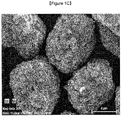
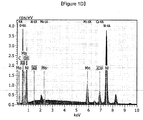
- FIGS. 1A to 1D are referred for illustration.
- FIGS. 1A , 1B , 1C , and 1D show element-mapping results of the surfaces of the positive electrode active materials after the firing with EDS (Energy dispersive X-ray spectroscopy) in order to examine if Al/Mo were simultaneously co-doped. As shown in FIGS. 1A to 1D , Al and Mo were uniformly distributed in the positive electrode active materials.
- Example 1 the positive electrode active material including a material doped with 0.5 mol% of Al/Mo of NCM fractions
- Comparative Example 1 XRD comparison results of Example 1 (the positive electrode active material including a material doped with 0.5 mol% of Al/Mo of NCM fractions) and Comparative Example 1 are shown in FIG. 2 .
- XRD was X'Pert3 Powder (a model name) made by PANalytical Company, and a scan speed was 0.328 °/s.
- Example 1 and Comparative Example 1 all showed that a (003) peak was well developed around 18.7 ° as a main peak and that (006)/(102) peak splitting between 37.5 ° and 38.5 ° and (108)/(110) peak splitting between 63.5 ° and 65.5 ° were observed. These results show that a satisfactory crystal structure was formed in a hexagonal layer. Accordingly, a typical hexagonal ⁇ -NaFeO2 (space group R-3m) structure was exhibited.
- a crystalline size of the positive electrode active materials prepared by doping aluminum and molybdenum according to Examples 1 to 5 was in a range of 86 nm to 86.8 nm, which a little increased compared with that of Comparative Example 1 having no doping.
- the positive electrode active material of Comparative Example 1 showed a I(003)/I(104) ratio of 1.13, while the positive electrode active materials of Examples 1 to 5 showed a ratio near to 1.2. Accordingly, in the positive electrode active materials prepared by doping Al and Mo according to Examples 1 to 5, cation mixing of Li + and Ni 2+ was small.
- the positive electrode active material of Comparative Example 1 showed 0.545.
- the positive electrode active materials of Examples 1 to 5 showed R_factors near to 0.5 or reduced to less than or equal to 0.5, which indicated that a hexagonal structure was stably formed.
- the positive electrode active materials prepared by doping Al and Mo according to Examples 1 to 5 were structurally stable compared with the positive electrode active material according to Comparative Example 1.
- the cation mixing has a correlation with the hexagonal ordering. Specifically, firing at a low temperature decreases a particle size, which may be disadvantageous in terms of the crystalline ordering but advantageous in terms of the cation mixing.
- firing at a high temperature increases the particle size, which may be advantageous in terms of the crystalline ordering but disadvantageous in terms of the cation mixing.
- the cation mixing increases, battery performance may be deteriorated by decreasing mobility of lithium ions. Accordingly, the firing temperature needs to be optimized.
- a 2016 coin cell was manufactured to perform an electrochemical evaluation.
- Slurry for an electrode plate was prepared by respectively using the positive electrode active materials according to Examples 1 to 5 and Comparative Example 1. Specifically, each positive electrode active material : a conductive material (super-P) : a binder (PVDF, KF1300) were used in a ratio of 88:8:4 wt%, and NMP (N-Methyl-2-pyrrolidone) was added thereto so that a solid content might be about 30 % to adjust slurry viscosity and resultantly, obtain the slurry for an electrode plate.
- a conductive material super-P
- PVDF binder
- NMP N-Methyl-2-pyrrolidone
- the prepared slurry was coated on a 15 ⁇ m-thick Al foil by using a doctor blade and then, dried and compressed.
- the electrode loading amount was in a range of 9 to 10 mg/cm 2 , and compression density was 3.1 g/cm 3 .
- a capacity evaluation was performed by using 200 mAh/g as a reference capacity, and the charge and discharge was performed under a condition of CC/CV of 3.0 to 4.3 V and a cut-off of 0.005 C.
- Rate characteristics were evaluated by measuring capacity, while a C rate was sequentially increased into 1 C, 4 C, and 7 C under a charge condition of 0.1 C after twice repeating 0.1 C charge/0.1 C discharge.
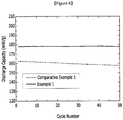
- Cycle-life characteristics were evaluated through 50 times measurements at room temperature of 25 °C under a condition of 0.5 C charge/1 C discharge.
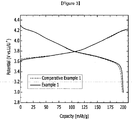
- FIG. 3 shows a comparison result of initial charge/discharge curves of the positive electrode active material doped with 0.5 mol% of Al 0.8 Mo 0.2 (Example 1) and the positive electrode active material having no doping (Comparative Example 1), in which Example 1 showed all increased initial charge capacity, initial discharge capacity, and initial efficiency compared with those of Comparative Example 1.
- Example 1 showed not so large initial charge resistance as to that of Comparative Example 1.
- the cell evaluation was performed under a 1 C reference condition of 200 mA/g within a potential range of 4.3 V to 3.0 V.
- compositions of the positive electrode active materials according to Examples 1 to 5 under a condition of greater than or equal to 3.5 of an average oxidation number of Al and Mo and the positive electrode active material having no doping of Comparative Example 1 and initial charge capacity, discharge capacity, initial efficiency, and a cycle-life (50 cycles) thereof are shown in Table 2.
- the positive electrode active materials of Examples 1 to 5 showed a cycle-life of greater than or equal to 95.8 % after the 50 th charge and discharge, structural stability of the positive electrode active materials through co-doping of Al and Mo improved cycle-life characteristics of a lithium secondary battery manufactured by applying the same.
- the positive electrode active materials doped with aluminum and molybdenum according to Examples 1 to 5 showed overall excellent output characteristics.
- the positive electrode active material not doped with aluminum and molybdenum according to Comparative Example 1 showed efficiency of 84 % at 4 C/0.1 C, but the positive electrode active materials doped with aluminum and molybdenum according to Examples 1 to 5 showed efficiency of at least greater than or equal to 85.6 % at 4 C/0.1 C.
- molybdenum showed a large influence on a high rate discharge of 4 C or higher, when an amount thereof was increased. Specifically, referring to the 7 C discharge results, when doped with Al 0.65 Mo 0.35 , an excellent output characteristic result of 76.8 % was obtained. Accordingly, when aluminum and molybdenum were the co-doped, output characteristics may be improved.
- FIG. 4 shows room temperature cycle-life results under a condition of 0.5 C charge/1 C discharge before/after doped with Al/Mo.
- Electrochemical Evaluation 2 (coin 2032, using 92.5 % of Positive Electrode Active Material)
- a 2032 coin cell was manufactured to perform an electrochemical evaluation.
- Slurry for an electrode plate was prepared by respectively using the positive electrode active materials according to Examples 1 and 6 to 8 and Comparative Example 1.
- each positive electrode active material a conductive material (denka black) : a binder (PVDF, KF1100) were used in a ratio of 92.5 : 3.5 : 4 wt%, and then, NMP (N-Methyl-2-pyrrolidone) was added thereto so that solid content might be about 30 % to adjust slurry viscosity.
- NMP N-Methyl-2-pyrrolidone
- a capacity evaluation was performed with a reference to 200 mAh/g, and the charge and discharge were performed under a condition of CC/CV of 2.5 to 4.25 V and a cut-off of 0.005 C.
- Rate characteristics were evaluated by measuring capacities, while a C rate was sequentially increased into 1 C, 2 C, and 4 C under a charge condition of 0.2 C after twice repeating 0.1 C charge/0.1 C discharge.
- Cycle-life characteristics were evaluated through 50 times measurements at room temperature of 25 °C under a condition of 0.5 C charge/0.5 C discharge.
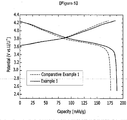
- FIG. 5 shows a comparison result of charge/discharge curves of a doped case with 0.5 mol% of Al 0.8 Mo 0.2 and a case having no dopingunder the condition of the electrochemical Evaluation 2 (0.2 C charge, 0.1 C discharge).
- Example doped with aluminum and molybdenum showed discharge capacity of 188.3 mAh/g, but Comparative Example having no doping showed discharge capacity of 176.3 mAh/g. In other word, capacity (12 mAh/g) of Example was more largely realized.
- Table 4 showed initial charge capacity, initial discharge capacity, and initial efficiency (0.2 C charge, 0.2 C discharge) under a condition of 0.2 C charge/0.2 C discharge, and Table 5 showed room temperature discharge capacities (with a reference to 0.2 C charge) according to a C-rate increase before and after the doping.
- Example 1 (doped with Al/Mo) showed increased initial efficiency.
- Comparative Example 1 (not doped with Al/Mo) showed discharge capacity of 78.7 % at 4 C/0.2 C, but Example 1 (Li 1.05 (Ni 0.8 Co 0.1 Mn 0.1 ) 0.995 (Al 0.8 Mo 0.2 ) 0.005 O 2 ) showed discharge capacity of 83.9 %.
- output characteristics were also greatly improved similarly to Table 3.
- FIG. 6 shows room temperature cycle-life results of the positive electrode active materials according to Example 1 and Comparative Example 1 under a condition of 0.5 C charge, 0.5 C discharge, and 2.5 to 4.25 V charge and discharge.
- the positive electrode active material not doped with aluminum and molybdenum according to Comparative Example 1 showed 97.1 % of a capacity retention after the 50 th cycle relative to the 1 st cycle.
- the positive electrode active material doped with aluminum and molybdenum according to Example 1 showed 99.8 % of a capacity retention relative to the initial capacity under the same condition. Referring to these results, excellent electrochemical properties were obtained despite coin cell evaluation condition changes (a positive electrode composition, a loading amount increase, and a charge and discharge voltage adjustment).
- Table 6 shows initial charge capacity, initial discharge capacity, initial efficiency, and cycle-life characteristics of the positive electrode active materials according to Examples 1 and 6 to 8 and Comparative Example 1.
- 1 st charge capacity (mAh/g@0.1C) 1 st discharge capacity (mAh/g@ 0.1C) Initial efficiency (%) Cycle-life % (@50 times, 5C charge/1C discharge) Comparative Example 1 223.0 198.5 89.0 95 Li 1.05 (Ni 0.8 Co 0.1 Mn 0.1 )O 2
- the positive electrode active materials of Examples 1 and 6 to 8 were prepared by co-doping aluminum and molybdenum but adjusting the total doping amount of the aluminum and the molybdenum in a state of fixing a doping composition as Al 0.8 Mo 0.2 .
- the positive electrode active materials of Examples 1 and 6 to 8 showed all increased initial charge capacity, discharge capacity, efficiency, and cycle-life characteristics compared with those of the positive electrode active material not doped with aluminum and molybdenum according to Comparative Example 1.
Landscapes
- Chemical & Material Sciences (AREA)
- Chemical Kinetics & Catalysis (AREA)
- Electrochemistry (AREA)
- General Chemical & Material Sciences (AREA)
- Engineering & Computer Science (AREA)
- Inorganic Chemistry (AREA)
- Materials Engineering (AREA)
- Organic Chemistry (AREA)
- Manufacturing & Machinery (AREA)
- Battery Electrode And Active Subsutance (AREA)
- Inorganic Compounds Of Heavy Metals (AREA)
- Secondary Cells (AREA)
Applications Claiming Priority (2)
| Application Number | Priority Date | Filing Date | Title |
|---|---|---|---|
| KR1020160168830A KR101918719B1 (ko) | 2016-12-12 | 2016-12-12 | 리튬 이차전지용 양극 활물질, 이의 제조 방법, 및 이를 포함하는 리튬 이차전지 |
| PCT/KR2017/014321 WO2018110899A1 (fr) | 2016-12-12 | 2017-12-07 | Matériau actif d'électrode positive pour batterie secondaire au lithium, son procédé de préparation et batterie secondaire au lithium le comprenant |
Publications (2)
| Publication Number | Publication Date |
|---|---|
| EP3553855A1 true EP3553855A1 (fr) | 2019-10-16 |
| EP3553855A4 EP3553855A4 (fr) | 2019-12-25 |
Family
ID=62558924
Family Applications (1)
| Application Number | Title | Priority Date | Filing Date |
|---|---|---|---|
| EP17881416.6A Pending EP3553855A4 (fr) | 2016-12-12 | 2017-12-07 | Matériau actif d'électrode positive pour batterie secondaire au lithium, son procédé de préparation et batterie secondaire au lithium le comprenant |
Country Status (6)
| Country | Link |
|---|---|
| US (1) | US11670766B2 (fr) |
| EP (1) | EP3553855A4 (fr) |
| JP (1) | JP7039591B2 (fr) |
| KR (1) | KR101918719B1 (fr) |
| CN (1) | CN110199416B (fr) |
| WO (1) | WO2018110899A1 (fr) |
Cited By (2)
| Publication number | Priority date | Publication date | Assignee | Title |
|---|---|---|---|---|
| EP4113660A4 (fr) * | 2020-09-03 | 2024-04-03 | Shenzhen Ori Technology Co., Limited | Procédé de préparation d'un matériau ayant une caractéristique de gradient de composition, et application dans une batterie |
| EP4270529A4 (fr) * | 2020-12-25 | 2025-07-30 | Panasonic Ip Man Co Ltd | Batterie rechargeable à électrolyte non aqueux |
Families Citing this family (13)
| Publication number | Priority date | Publication date | Assignee | Title |
|---|---|---|---|---|
| KR102327530B1 (ko) * | 2018-05-21 | 2021-11-17 | 주식회사 엘지화학 | 이차 전지용 양극 및 이를 포함하는 이차 전지 |
| KR102757221B1 (ko) * | 2018-11-28 | 2025-01-21 | 현대자동차주식회사 | 리튬 이차전지 및 리튬 이차전지의 제조방법 |
| KR102724456B1 (ko) | 2018-11-30 | 2024-11-01 | 주식회사 엘지에너지솔루션 | 양극 활물질, 상기 양극 활물질을 포함하는 양극 및 리튬 이차전지 |
| KR102204140B1 (ko) * | 2018-12-19 | 2021-01-18 | 재단법인 포항산업과학연구원 | 전고체 전지 및 이의 제조방법 |
| KR102725846B1 (ko) * | 2019-02-15 | 2024-11-05 | 주식회사 엘지화학 | 이차전지용 양극 활물질 및 이를 포함하는 리튬 이차전지 |
| WO2021107363A1 (fr) | 2019-11-27 | 2021-06-03 | 주식회사 엘지에너지솔루션 | Matériau actif d'électrode positive comprenant un oxyde à base de nickel-lithium dopé avec un élément dopant, et batterie secondaire le comprenant |
| CN111211320A (zh) * | 2020-01-21 | 2020-05-29 | 华东理工大学 | 一种锂镍钴氧化物正极材料及其制备方法、锂离子电池 |
| CN111628157B (zh) * | 2020-06-30 | 2024-03-26 | 蜂巢能源科技有限公司 | 正极材料、其制备方法及锂离子电池 |
| KR102515175B1 (ko) * | 2020-08-21 | 2023-03-29 | 코스모신소재 주식회사 | 이차전지용 양극활물질 및 양극활물질 제조방법 |
| CN112670493B (zh) * | 2020-12-25 | 2022-03-15 | 格林美(湖北)新能源材料有限公司 | 一种钨铊共掺杂镍钴铝三元正极材料及其制备方法 |
| CN113307310B (zh) * | 2021-04-08 | 2022-09-30 | 桂林理工大学 | 一种高循环性能的钼掺杂二氧化钛包覆高镍三元正极材料的制备方法 |
| CN113716625B (zh) * | 2021-09-02 | 2023-11-21 | 厦门厦钨新能源材料股份有限公司 | 大晶粒聚集体三元正极材料、其制备方法及锂离子电池 |
| WO2026095465A1 (fr) * | 2024-10-30 | 2026-05-07 | 주식회사 에코프로비엠 | Matériau actif d'électrode positive et batterie secondaire au lithium le comprenant |
Family Cites Families (28)
| Publication number | Priority date | Publication date | Assignee | Title |
|---|---|---|---|---|
| JP3281829B2 (ja) | 1997-01-16 | 2002-05-13 | 三洋電機株式会社 | 非水電解質二次電池 |
| CA2350710C (fr) | 1998-11-13 | 2005-09-13 | Fmc Corporation | Oxydes de lithium metallique stratifie exempt de phases structurelles spinello a des cubiques localisees et procede de fabrication |
| JP2001106534A (ja) | 1999-10-06 | 2001-04-17 | Tanaka Chemical Corp | 非水電解液電池活物質用原料複合金属水酸化物及び活物質リチウム複合金属酸化物 |
| JP2006066330A (ja) | 2004-08-30 | 2006-03-09 | Shin Kobe Electric Mach Co Ltd | 非水電解液二次電池用正極活物質、非水電解液二次電池及び正極活物質の製造方法 |
| JP5066798B2 (ja) * | 2005-07-29 | 2012-11-07 | ソニー株式会社 | 二次電池 |
| KR100822012B1 (ko) | 2006-03-30 | 2008-04-14 | 한양대학교 산학협력단 | 리튬 전지용 양극 활물질, 그 제조 방법 및 그를 포함하는리튬 이차 전지 |
| JP5181482B2 (ja) * | 2007-01-26 | 2013-04-10 | 住友金属鉱山株式会社 | 非水電解質二次電池用正極活物質の製造方法 |
| CN102379053B (zh) | 2009-04-09 | 2016-06-29 | 株式会社Lg化学 | 锂二次电池用正极活性材料 |
| KR101115416B1 (ko) | 2009-06-08 | 2012-02-15 | 한양대학교 산학협력단 | 리튬 이차 전지용 양극 활물질, 이의 제조 방법 및 이를 포함하는 리튬 이차 전지 |
| JP5695373B2 (ja) * | 2009-09-09 | 2015-04-01 | 日立マクセル株式会社 | 電気化学素子用電極及びそれを用いた電気化学素子 |
| JP5638232B2 (ja) | 2009-12-02 | 2014-12-10 | 住友金属鉱山株式会社 | 非水系電解質二次電池正極活物質用ニッケルコバルトマンガン複合水酸化物粒子とその製造方法、非水系電解質二次電池用正極活物質とその製造方法、および非水系電解質二次電池 |
| KR101705250B1 (ko) * | 2010-03-19 | 2017-02-09 | 삼성전자주식회사 | 양극활물질, 및 이를 채용한 양극과 리튬전지 |
| JP5421865B2 (ja) * | 2010-06-30 | 2014-02-19 | 株式会社日立製作所 | リチウムイオン二次電池 |
| JP5485065B2 (ja) | 2010-07-30 | 2014-05-07 | 三洋電機株式会社 | 非水電解質二次電池 |
| WO2012081518A2 (fr) | 2010-12-15 | 2012-06-21 | 三洋電機株式会社 | Batterie secondaire à electrolyte non aqueux |
| WO2012131881A1 (fr) | 2011-03-28 | 2012-10-04 | 住友金属鉱山株式会社 | Particules d'hydroxyde composite de nickel-manganèse, procédé pour produire celles-ci, matériau actif d'électrode positive pour batteries secondaires d'électrolyte non aqueux, procédé pour produire un matériau actif d'électrode positive pour des batteries secondaires à électrolyte non aqueux, et batterie secondaire à électrolyte non aqueux |
| JP5741932B2 (ja) | 2011-06-01 | 2015-07-01 | 住友金属鉱山株式会社 | 非水系電解質二次電池用正極活物質の前駆体となる遷移金属複合水酸化物とその製造方法、及び非水系電解質二次電池用正極活物質の製造方法 |
| KR101127554B1 (ko) * | 2011-07-20 | 2012-03-23 | 한화케미칼 주식회사 | 층상형 결정구조의 단일상 리튬-부족형 리튬 다성분계 전이금속 산화물 및 그 제조 방법 |
| KR101360798B1 (ko) * | 2011-12-27 | 2014-02-12 | 한화케미칼 주식회사 | 층상형 결정구조의 단일상 리튬―부족형 리튬 다성분계 전이금속 산화물 및 그 제조 방법 |
| JP6286855B2 (ja) * | 2012-04-18 | 2018-03-07 | 日亜化学工業株式会社 | 非水電解液二次電池用正極組成物 |
| KR101609544B1 (ko) * | 2013-03-26 | 2016-04-06 | 주식회사 엘 앤 에프 | 리튬 이차 전지용 양극 활물질 및 이를 이용한 리튬 이차 전지 |
| KR102076030B1 (ko) * | 2013-07-15 | 2020-02-12 | 삼성전자 주식회사 | 네트워크 부하가 적은 무선랜 ap 탐색을 위한 빠른 스캔 방법 및 장치 |
| JP6133720B2 (ja) | 2013-07-24 | 2017-05-24 | 住友金属鉱山株式会社 | 非水電解質二次電池用正極活物質とその製造方法、並びに、非水電解質二次電池 |
| JP6170161B2 (ja) | 2013-08-29 | 2017-07-26 | エルジー・ケム・リミテッド | リチウム遷移金属複合粒子、この製造方法、及びこれを含む正極活物質 |
| JP6554780B2 (ja) | 2013-10-29 | 2019-08-07 | 日亜化学工業株式会社 | 非水電解液二次電池用正極組成物及びその製造方法 |
| KR101633256B1 (ko) | 2014-06-09 | 2016-06-27 | 주식회사 포스코 | 리튬 이차 전지용 양극 활물질, 이의 제조 방법, 및 이를 포함하는 리튬 이차 전지 |
| KR101746187B1 (ko) | 2014-10-15 | 2017-06-12 | 주식회사 포스코 | 리튬 이차 전지용 양극 활물질, 및 이를 포함하는 리튬 이차 전지 |
| CN104810512B (zh) | 2015-05-06 | 2017-05-31 | 中信国安盟固利电源技术有限公司 | 一种包覆改性的正极材料及其制备方法 |
-
2016
- 2016-12-12 KR KR1020160168830A patent/KR101918719B1/ko active Active
-
2017
- 2017-12-07 JP JP2019531454A patent/JP7039591B2/ja active Active
- 2017-12-07 US US16/468,874 patent/US11670766B2/en active Active
- 2017-12-07 WO PCT/KR2017/014321 patent/WO2018110899A1/fr not_active Ceased
- 2017-12-07 EP EP17881416.6A patent/EP3553855A4/fr active Pending
- 2017-12-07 CN CN201780083220.7A patent/CN110199416B/zh active Active
Cited By (2)
| Publication number | Priority date | Publication date | Assignee | Title |
|---|---|---|---|---|
| EP4113660A4 (fr) * | 2020-09-03 | 2024-04-03 | Shenzhen Ori Technology Co., Limited | Procédé de préparation d'un matériau ayant une caractéristique de gradient de composition, et application dans une batterie |
| EP4270529A4 (fr) * | 2020-12-25 | 2025-07-30 | Panasonic Ip Man Co Ltd | Batterie rechargeable à électrolyte non aqueux |
Also Published As
| Publication number | Publication date |
|---|---|
| EP3553855A4 (fr) | 2019-12-25 |
| WO2018110899A1 (fr) | 2018-06-21 |
| US11670766B2 (en) | 2023-06-06 |
| JP7039591B2 (ja) | 2022-03-22 |
| KR101918719B1 (ko) | 2018-11-14 |
| CN110199416A (zh) | 2019-09-03 |
| JP2020501329A (ja) | 2020-01-16 |
| KR20180067775A (ko) | 2018-06-21 |
| US20200106095A1 (en) | 2020-04-02 |
| CN110199416B (zh) | 2023-05-02 |
Similar Documents
| Publication | Publication Date | Title |
|---|---|---|
| US11670766B2 (en) | Positive electrode active material for lithium secondary battery, method for preparing same, and lithium secondary battery comprising same | |
| KR102495992B1 (ko) | 양극 활물질 전구체 및 이를 활용한 리튬 이차 전지 | |
| KR102265141B1 (ko) | 리튬 복합 산화물, 리튬 이차전지용 양극 활물질 및 이를 포함하는 리튬 이차전지 | |
| KR102293034B1 (ko) | 리튬 이차 전지용 양극 활물질 및 이를 포함하는 리튬 이차 전지 | |
| KR102292889B1 (ko) | 리튬 복합 산화물 및 이를 포함하는 리튬 이차전지 | |
| KR102786820B1 (ko) | 양극 활물질 및 이를 포함하는 리튬 이차전지 | |
| KR20180087162A (ko) | 고온 저장 특성이 향상된 리튬 이차전지의 제조 방법 | |
| KR102632381B1 (ko) | 양극 활물질 및 이를 사용하는 리튬 이차전지 | |
| KR20220116105A (ko) | 양극 활물질 및 이를 포함하는 리튬 이차전지 | |
| KR102264804B1 (ko) | 리튬 복합 산화물 및 이를 포함하는 리튬 이차전지 | |
| KR20250162479A (ko) | 리튬 이차 전지용 양극 활물질 및 이를 포함하는 리튬 이차 전지 | |
| KR20200018147A (ko) | Si계 음극을 포함하는 리튬 이차전지 및 그의 제조방법 | |
| KR101918723B1 (ko) | 리튬 이차전지용 양극 활물질, 이의 제조 방법, 및 이를 포함하는 리튬 이차전지 | |
| US20230207803A1 (en) | Positive electrode active material and lithium secondary battery comprising the same | |
| KR102323189B1 (ko) | 양극 활물질 및 이를 포함하는 리튬 이차전지 | |
| KR102534215B1 (ko) | Si계 음극을 포함하는 리튬 이차전지 | |
| KR102195178B1 (ko) | 양극 활물질 및 이를 포함하는 리튬 이차전지 | |
| KR102940281B1 (ko) | 리튬 이차 전지용 양극 활물질 및 이를 포함하는 리튬 이차 전지 | |
| KR102940280B1 (ko) | 리튬 이차 전지용 양극 활물질 및 이를 포함하는 리튬 이차 전지 | |
| EP4708398A1 (fr) | Matériau actif d'électrode positive, son procédé de production, électrode positive comprenant un matériau actif d'électrode positive, et batterie secondaire au lithium comprenant un matériau actif d'électrode positive | |
| KR20250094449A (ko) | 리튬 이차 전지용 양극 활물질, 이의 제조방법 및 이를 포함하는 리튬 이차 전지 | |
| KR20250159450A (ko) | 이차 전지용 양극 및 리튬 이차 전지 | |
| US20230238530A1 (en) | Positive electrode active material and lithium secondary battery comprising the same |
Legal Events
| Date | Code | Title | Description |
|---|---|---|---|
| STAA | Information on the status of an ep patent application or granted ep patent |
Free format text: STATUS: THE INTERNATIONAL PUBLICATION HAS BEEN MADE |
|
| PUAI | Public reference made under article 153(3) epc to a published international application that has entered the european phase |
Free format text: ORIGINAL CODE: 0009012 |
|
| STAA | Information on the status of an ep patent application or granted ep patent |
Free format text: STATUS: REQUEST FOR EXAMINATION WAS MADE |
|
| 17P | Request for examination filed |
Effective date: 20190621 |
|
| AK | Designated contracting states |
Kind code of ref document: A1 Designated state(s): AL AT BE BG CH CY CZ DE DK EE ES FI FR GB GR HR HU IE IS IT LI LT LU LV MC MK MT NL NO PL PT RO RS SE SI SK SM TR |
|
| AX | Request for extension of the european patent |
Extension state: BA ME |
|
| REG | Reference to a national code |
Ref country code: DE Ref legal event code: R079 Free format text: PREVIOUS MAIN CLASS: H01M0004485000 Ipc: C01G0053000000 |
|
| A4 | Supplementary search report drawn up and despatched |
Effective date: 20191121 |
|
| RIC1 | Information provided on ipc code assigned before grant |
Ipc: C01G 53/00 20060101AFI20191115BHEP Ipc: H01M 4/485 20100101ALI20191115BHEP Ipc: H01M 10/0525 20100101ALI20191115BHEP Ipc: H01M 4/131 20100101ALI20191115BHEP Ipc: H01M 4/525 20100101ALI20191115BHEP |
|
| DAV | Request for validation of the european patent (deleted) | ||
| DAX | Request for extension of the european patent (deleted) | ||
| STAA | Information on the status of an ep patent application or granted ep patent |
Free format text: STATUS: EXAMINATION IS IN PROGRESS |
|
| 17Q | First examination report despatched |
Effective date: 20220203 |
|
| RAP3 | Party data changed (applicant data changed or rights of an application transferred) |
Owner name: RESEARCH INSTITUTE OF INDUSTRIAL SCIENCE & TECHNOLOGY Owner name: POSCO HOLDINGS INC. |
|
| RAP1 | Party data changed (applicant data changed or rights of an application transferred) |
Owner name: POSCO FUTURE M CO., LTD Owner name: RESEARCH INSTITUTE OF INDUSTRIAL SCIENCE & TECHNOLOGY Owner name: POSCO HOLDINGS INC. |
|
| GRAP | Despatch of communication of intention to grant a patent |
Free format text: ORIGINAL CODE: EPIDOSNIGR1 |
|
| STAA | Information on the status of an ep patent application or granted ep patent |
Free format text: STATUS: GRANT OF PATENT IS INTENDED |
|
| INTG | Intention to grant announced |
Effective date: 20260209 |