EP3556423A1 - Injektionsvorrichtung eines implantats, das mit einer übertragungsvorrichtung vom typ zahnstangen-ritzel-getriebe ausgestattet ist - Google Patents
Injektionsvorrichtung eines implantats, das mit einer übertragungsvorrichtung vom typ zahnstangen-ritzel-getriebe ausgestattet ist Download PDFInfo
- Publication number
- EP3556423A1 EP3556423A1 EP19169959.4A EP19169959A EP3556423A1 EP 3556423 A1 EP3556423 A1 EP 3556423A1 EP 19169959 A EP19169959 A EP 19169959A EP 3556423 A1 EP3556423 A1 EP 3556423A1
- Authority
- EP
- European Patent Office
- Prior art keywords
- implant
- rack
- injection
- injection device
- push rod
- Prior art date
- Legal status (The legal status is an assumption and is not a legal conclusion. Google has not performed a legal analysis and makes no representation as to the accuracy of the status listed.)
- Withdrawn
Links
Images


Classifications
-
- A—HUMAN NECESSITIES
- A61—MEDICAL OR VETERINARY SCIENCE; HYGIENE
- A61M—DEVICES FOR INTRODUCING MEDIA INTO, OR ONTO, THE BODY; DEVICES FOR TRANSDUCING BODY MEDIA OR FOR TAKING MEDIA FROM THE BODY; DEVICES FOR PRODUCING OR ENDING SLEEP OR STUPOR
- A61M37/00—Other apparatus for introducing media into the body; Percutany, i.e. introducing medicines into the body by diffusion through the skin
- A61M37/0069—Devices for implanting pellets, e.g. markers or solid medicaments
-
- A—HUMAN NECESSITIES
- A61—MEDICAL OR VETERINARY SCIENCE; HYGIENE
- A61B—DIAGNOSIS; SURGERY; IDENTIFICATION
- A61B17/00—Surgical instruments, devices or methods
- A61B17/34—Trocars; Puncturing needles
- A61B17/3468—Trocars; Puncturing needles for implanting or removing devices, e.g. prostheses, implants, seeds, wires
-
- A—HUMAN NECESSITIES
- A61—MEDICAL OR VETERINARY SCIENCE; HYGIENE
- A61F—FILTERS IMPLANTABLE INTO BLOOD VESSELS; PROSTHESES; DEVICES PROVIDING PATENCY TO, OR PREVENTING COLLAPSING OF, TUBULAR STRUCTURES OF THE BODY, e.g. STENTS; ORTHOPAEDIC, NURSING OR CONTRACEPTIVE DEVICES; FOMENTATION; TREATMENT OR PROTECTION OF EYES OR EARS; BANDAGES, DRESSINGS OR ABSORBENT PADS; FIRST-AID KITS
- A61F2/00—Filters implantable into blood vessels; Prostheses, i.e. artificial substitutes or replacements for parts of the body; Appliances for connecting them with the body; Devices providing patency to, or preventing collapsing of, tubular structures of the body, e.g. stents
- A61F2/0095—Packages or dispensers for prostheses or other implants
-
- A—HUMAN NECESSITIES
- A61—MEDICAL OR VETERINARY SCIENCE; HYGIENE
- A61M—DEVICES FOR INTRODUCING MEDIA INTO, OR ONTO, THE BODY; DEVICES FOR TRANSDUCING BODY MEDIA OR FOR TAKING MEDIA FROM THE BODY; DEVICES FOR PRODUCING OR ENDING SLEEP OR STUPOR
- A61M5/00—Devices for bringing media into the body in a subcutaneous, intra-vascular or intramuscular way; Accessories therefor, e.g. filling or cleaning devices, arm rests
- A61M5/50—Devices for bringing media into the body in a subcutaneous, intra-vascular or intramuscular way; Accessories therefor, e.g. filling or cleaning devices, arm rests having means for preventing re-use, or for indicating if defective, used, tampered with or unsterile
-
- A—HUMAN NECESSITIES
- A61—MEDICAL OR VETERINARY SCIENCE; HYGIENE
- A61M—DEVICES FOR INTRODUCING MEDIA INTO, OR ONTO, THE BODY; DEVICES FOR TRANSDUCING BODY MEDIA OR FOR TAKING MEDIA FROM THE BODY; DEVICES FOR PRODUCING OR ENDING SLEEP OR STUPOR
- A61M5/00—Devices for bringing media into the body in a subcutaneous, intra-vascular or intramuscular way; Accessories therefor, e.g. filling or cleaning devices, arm rests
- A61M5/50—Devices for bringing media into the body in a subcutaneous, intra-vascular or intramuscular way; Accessories therefor, e.g. filling or cleaning devices, arm rests having means for preventing re-use, or for indicating if defective, used, tampered with or unsterile
- A61M5/5086—Devices for bringing media into the body in a subcutaneous, intra-vascular or intramuscular way; Accessories therefor, e.g. filling or cleaning devices, arm rests having means for preventing re-use, or for indicating if defective, used, tampered with or unsterile for indicating if defective, used, tampered with or unsterile
-
- A—HUMAN NECESSITIES
- A61—MEDICAL OR VETERINARY SCIENCE; HYGIENE
- A61B—DIAGNOSIS; SURGERY; IDENTIFICATION
- A61B17/00—Surgical instruments, devices or methods
- A61B17/34—Trocars; Puncturing needles
- A61B2017/347—Locking means, e.g. for locking instrument in cannula
-
- A—HUMAN NECESSITIES
- A61—MEDICAL OR VETERINARY SCIENCE; HYGIENE
- A61B—DIAGNOSIS; SURGERY; IDENTIFICATION
- A61B90/00—Instruments, implements or accessories specially adapted for surgery or diagnosis and not covered by any of the groups A61B1/00 - A61B50/00, e.g. for luxation treatment or for protecting wound edges
- A61B90/03—Automatic limiting or abutting means, e.g. for safety
- A61B2090/033—Abutting means, stops, e.g. abutting on tissue or skin
- A61B2090/034—Abutting means, stops, e.g. abutting on tissue or skin abutting on parts of the device itself
-
- A—HUMAN NECESSITIES
- A61—MEDICAL OR VETERINARY SCIENCE; HYGIENE
- A61B—DIAGNOSIS; SURGERY; IDENTIFICATION
- A61B90/00—Instruments, implements or accessories specially adapted for surgery or diagnosis and not covered by any of the groups A61B1/00 - A61B50/00, e.g. for luxation treatment or for protecting wound edges
- A61B90/08—Accessories or related features not otherwise provided for
- A61B2090/0814—Preventing re-use
-
- A—HUMAN NECESSITIES
- A61—MEDICAL OR VETERINARY SCIENCE; HYGIENE
- A61B—DIAGNOSIS; SURGERY; IDENTIFICATION
- A61B90/00—Instruments, implements or accessories specially adapted for surgery or diagnosis and not covered by any of the groups A61B1/00 - A61B50/00, e.g. for luxation treatment or for protecting wound edges
- A61B90/39—Markers, e.g. radio-opaque or breast lesions markers
- A61B2090/3987—Applicators for implanting markers
-
- A—HUMAN NECESSITIES
- A61—MEDICAL OR VETERINARY SCIENCE; HYGIENE
- A61B—DIAGNOSIS; SURGERY; IDENTIFICATION
- A61B90/00—Instruments, implements or accessories specially adapted for surgery or diagnosis and not covered by any of the groups A61B1/00 - A61B50/00, e.g. for luxation treatment or for protecting wound edges
- A61B90/90—Identification means for patients or instruments, e.g. tags
- A61B90/98—Identification means for patients or instruments, e.g. tags using electromagnetic means, e.g. transponders
-
- A—HUMAN NECESSITIES
- A61—MEDICAL OR VETERINARY SCIENCE; HYGIENE
- A61M—DEVICES FOR INTRODUCING MEDIA INTO, OR ONTO, THE BODY; DEVICES FOR TRANSDUCING BODY MEDIA OR FOR TAKING MEDIA FROM THE BODY; DEVICES FOR PRODUCING OR ENDING SLEEP OR STUPOR
- A61M2205/00—General characteristics of the apparatus
- A61M2205/27—General characteristics of the apparatus preventing use
- A61M2205/273—General characteristics of the apparatus preventing use preventing reuse, e.g. of disposables
-
- A—HUMAN NECESSITIES
- A61—MEDICAL OR VETERINARY SCIENCE; HYGIENE
- A61M—DEVICES FOR INTRODUCING MEDIA INTO, OR ONTO, THE BODY; DEVICES FOR TRANSDUCING BODY MEDIA OR FOR TAKING MEDIA FROM THE BODY; DEVICES FOR PRODUCING OR ENDING SLEEP OR STUPOR
- A61M2205/00—General characteristics of the apparatus
- A61M2205/58—Means for facilitating use, e.g. by people with impaired vision
- A61M2205/581—Means for facilitating use, e.g. by people with impaired vision by audible feedback
-
- A—HUMAN NECESSITIES
- A61—MEDICAL OR VETERINARY SCIENCE; HYGIENE
- A61M—DEVICES FOR INTRODUCING MEDIA INTO, OR ONTO, THE BODY; DEVICES FOR TRANSDUCING BODY MEDIA OR FOR TAKING MEDIA FROM THE BODY; DEVICES FOR PRODUCING OR ENDING SLEEP OR STUPOR
- A61M2205/00—General characteristics of the apparatus
- A61M2205/58—Means for facilitating use, e.g. by people with impaired vision
- A61M2205/582—Means for facilitating use, e.g. by people with impaired vision by tactile feedback
-
- A—HUMAN NECESSITIES
- A61—MEDICAL OR VETERINARY SCIENCE; HYGIENE
- A61M—DEVICES FOR INTRODUCING MEDIA INTO, OR ONTO, THE BODY; DEVICES FOR TRANSDUCING BODY MEDIA OR FOR TAKING MEDIA FROM THE BODY; DEVICES FOR PRODUCING OR ENDING SLEEP OR STUPOR
- A61M5/00—Devices for bringing media into the body in a subcutaneous, intra-vascular or intramuscular way; Accessories therefor, e.g. filling or cleaning devices, arm rests
- A61M5/178—Syringes
- A61M5/31—Details
- A61M5/32—Needles; Details of needles pertaining to their connection with syringe or hub; Accessories for bringing the needle into, or holding the needle on, the body; Devices for protection of needles
- A61M5/3205—Apparatus for removing or disposing of used needles or syringes, e.g. containers; Means for protection against accidental injuries from used needles
- A61M5/321—Means for protection against accidental injuries by used needles
- A61M5/322—Retractable needles, i.e. disconnected from and withdrawn into the syringe barrel by the piston
Definitions
- the invention relates to the technical field of injecting one or more implants into the body of a patient.
- Implant injection devices including a hollow needle attached to a housing receiving an implant.
- the implant is injected by means of a push rod, which pushes the implant through the hollow needle and beyond to allow injection of the implant into the body of a patient.
- actuation sliding support does not easily allow the user to inject multiple implants. Indeed, this actuation is generally performed by the thumb of the user, which has a reduced stroke for actuation that is not sufficient to the stroke necessary for the injection of an implant of great length and / or for the successive injection of two or more implants.
- actuation does not make it possible to maintain high injection precision over a large stroke, and does not in particular make it possible to stop the injection when the injection of an implant is performed, for example to orient the needle. injection in another direction for a second implant so as not to inject over too long. Indeed, the risk of starting unwantedly the injection of an implant following the already injected implant exists with such an actuation. This is undesirable to ensure correct injection, especially to prevent rupture of at least one of the implants or injury to the patient.
- these implant injection devices do not allow to easily inject a long implant or a plurality of implants.
- the present invention aims in particular to provide an implant injection device, which can easily inject a long implant and / or a plurality of implants.
- an easy implant injector to handle and assemble, achieving a pleasant motion transmission for a user. Indeed, by one or more movements of small amplitude, the user can actuate the push rod over a long length thanks to the rack transmission, allowing for example to inject a long implant or a plurality of implants.
- a rack-and-pinion transmission mechanism preferably comprises a toothed rectilinear element cooperating with a toothed wheel, for transforming a rotational movement into a translation movement or vice versa.
- implant is preferably intended to mean a pharmaceutical compound in the solid or semi-solid state, for example in the form of an encapsulated liquid, and / or an electronic component, for example an electronic chip that may be of RFID type.
- patient or “subject” is generally understood to mean a living being, for example a mammal, in particular a human being. The user is usually a different person than the patient, but it is possible that the user is the patient himself.
- the distal direction designates the direction farthest from the fingers of a user, that is to say, the closest to the skin or the surface of a patient at the time of a injection
- the proximal direction refers to the direction opposite to the distal direction.
- the distal direction and the distal direction are the direction and the direction that go to the "front" of the implant injection device, direction otherwise called injection direction.
- the distal end of a patch corresponds to the end on the side of the injection needle, and the proximal end is the opposite end.
- the injection axis, bearing the direction of injection corresponds to the axis of the implant injection device, defined by the axis of the injection needle.
- downstream direction is a direction opposite to the “upstream” direction and corresponds to the direction oriented in the direction of the distal end of the implant injection device, that is to say towards the injection site, towards the end configured to be in contact with the injection site of the implant.
- the "downstream” direction can also be called the injection direction.
- upstream and downstream are relative to the distal and proximal directions, a downstream element being disposed further in the distal direction than an upstream element.
- the implant injection device may further comprise one or more of the following features, taken alone or in combination.
- an implant injection device comprises an injection needle 9 (visible on the figure 2 ) carried by a gripping case 7 and protected by a cap 3 (visible on the figure 1 ), a reception body 11 (visible on the figure 2 ), at least one implant, injection means 5 and a gripping housing 7.
- the implant injection device 1 is configured to inject one or more implants into the body of a patient via the visible injection needle 9. Although in the following, the example is illustrated with two implants, the implant injection device 1 is also applicable to a single implant, or a number of implants greater than two, as for example three, four, five, ten implants.
- the injection needle 9 is hollow and is for example made of metal such as stainless steel.
- the injection needle 9 has a distal end beveled to facilitate its insertion into the body of the patient.
- the injection needle 9 carries a support member 13, which may be made of plastic material and is intended to limit the depth of insertion of the injection needle 9 in the body of the patient.
- the injection needle 9 is attached at its proximal end to the receiving body 11. It can be protected in the storage configuration by the cap 3.
- the cap 3 is a protective cap of the injection needle 9, it is here assembled on the gripping housing 7, by snapping its proximal end on the gripping housing 7.
- other means of assembly are possible, for example by screwing.
- the cap 3 is in this example in the form of ogive, may be provided with reliefs so as to facilitate its grip.
- the receiving body 11 is a receiving body of two implants. As illustrated on the figure 2 , the receiving body 11 is generally tubular and / or frustoconical, and houses the implants in its internal space, so that the implants are oriented towards the end of the injection needle 9, facing the the proximal end of the injection needle 9. In other words, the receiving body 11 is disposed upstream of the injection needle 9, and is intended to receive the implants so that the implants are arranged upstream of the injection needle 9, in the direction of injection of the injection needle 9.
- the receiving body 11 is configured to contain two implants, the two implants being arranged one behind the other, that is to say one upstream of the other, according to the direction of injection.
- the receiving body 11 may have, at its distal end, an implant retaining means, such as a membrane or a small narrowing of its internal diameter, for the purpose of preventing the fall of an implant through the needle. injection 9, for example under the action of the Earth's gravity force.
- the receiving body 11 may alternatively comprise, at its distal end, a flexible implant retaining element comprising an orifice of a diameter smaller than that of the implants, which is configured to deform and allow the passage of implants to the implant. injection needle 9 during the injection.
- the receiving body 11 advantageously comprises a window 15 (visible on the figure 2 ). Thus, a user is able to visually detect, through the window 15, the presence of the implants in the implant injection device 1 before performing the injection on a patient, after the withdrawal of the cap 3.
- the injection needle 9 and the receiving body 11 are patches with respect to the other, nevertheless it would be possible that the injection needle 9 and the receiving body 11 form two parts of the same part, for example by being made of material.
- the receiving body 11 is attached at its proximal end to the gripping casing 7, for example by snapping its proximal end onto the gripping casing 7, as illustrated in FIG. figure 3 .
- the receiving body 11 thus has a peripheral rib 16, which engages in a corresponding groove 18 carried by the gripping casing 7.
- other assembly means are possible, for example by screwing.
- the receiving body 11 could be made directly in the gripping housing 7, being integral with the latter.
- the receiving body 11 is made of a plastic material, possibly transparent.
- the outer gripping member 17, the distal plug 19 and the two supporting members 21, 23 are held in position relative to one another.
- the two support elements 21, 23 are assembled by snap-fitting of pins 25 (visible on the figure 3 ) carried by the male support member 21 in tubular housings 27 (visible on the figure 7 ) in the assembled state
- the distal plug 19 is in abutment against the distal end of the two support members 21, 23, and is connected to the outer member of the gripping 17 by latching protrusions 29, for example in the form of semi-cylindrical sections as illustrated in FIG. figure 5 in a corresponding inner peripheral groove of the outer gripping element 17.
- the injection means 5 make it possible to push the implant or implants through the injection needle 9 between an initial position and a final position in which the implant or implants are injected.
- the injection means 5 comprise a push rod 31 and actuating means 33 by a user.
- the push rod 31 is disposed upstream of the implants housed in the receiving body.
- the push rod 31 extends longitudinally and is configured to push the implants through the injection needle 9 between an initial position and a final position in which the implants are injected.
- the push rod 31 may be made of metal, for example steel, preferably stainless steel.
- the push rod 31 is disposed upstream of an implant which is itself the implant disposed the most upstream among the implants. .
- the push rod 31 is thus configured to push the implant, here the implants, through the injection needle 9 between an initial position and a final position.
- the implants are housed in the receiving body 11, and in the final position of the push rod 31, the implants are passed through the injection needle 9 and are located a priori in the body of a patient.
- the actuating means 33 by a user are configured to actuate a displacement of the push rod 31 from the initial position to the final position.
- the actuating means 33 comprise a rack transmission mechanism 35.
- the rack-and-pinion transmission mechanism 35 includes a first rack member 37 and a second rack member 39.
- the first rack member 37 is a rack and pinion member. It is thus configured to be driven by the user and forms a first rack-and-rack connection with a pinion 41.
- the pinion 41 comprises a first toothing 43 cooperating with the first rack member 37, and the pinion 41 comprises a second toothing 45 cooperating with the second rack member 39 configured to push the push rod 31 from the initial position to the position final.
- the pinion 41 thus forms a second rack-and-rack connection with the second rack element 39.
- the first set of teeth 43 and the second toothing 45 of the pinion 41 are formed respectively by a first gear 43 and a second gear 45, the first gear wheel 43 having a diameter smaller than the diameter of the second gear wheel 45.
- the number of teeth of the first toothing 43 is strictly less than the number of teeth of the second toothing 45, in order to achieve a reduction of the movement.
- the number of teeth of the first toothing 43 is between 5 and 15, preferably between 5 and 10, more preferably is close to or equal to 5, and / or the number of teeth of the second toothing 45 is included. between 6 and 30, preferably between 16 and 25, more preferably close to or equal to 18.
- the number of teeth of the first toothing 43 and the number of teeth of the second toothing 45 are preferably chosen so that the displacement ratio of the second rack member 39 relative to the movement of the first rack member 37 is between 2 and 10, preferably between 3 and 5, more preferably close to or equal to 3.6.
- the pinion 41 is pivotally mounted in the gripping housing 7.
- the pinion 41 comprises for this a pin at each of its ends, a pin being carried by the male support member 21, and a pin 46 being carried by the element
- the axis of rotation of the pinion 41 is substantially orthogonal to the longitudinal direction of the push rod 31, so that the movement of the second rack member 39 allows to push the push rod 31 from the initial position to the final position.
- the first rack member 37 further supports an actuation button 47, which is configured to be driven directly by the user.
- the actuating button 47 is assembled on the first rack member 37, for example by snap-fastening. It is understood that the first rack member 37 is in one piece with the actuating button 47.
- the actuating button 47 is slidably mounted in a direction substantially parallel to the longitudinal direction of the push rod 31.
- the first rack member 37 and the assembly formed by the male support member 21 and the female support member 23 form a sliding connection between them, in the longitudinal direction of the push rod 31.
- the second rack member 39 is a driven rack member. It is thus configured to be driven by the pinion 41 and forms a second rack-and-rack connection with the pinion 41.
- the second rack member 39 supports the push rod 31, the push rod 31 being for example fixed by clamping in a housing of the second rack member 39. Thus, when the second rack member 39 is driven, it pushes the push rod 31 in the injection direction from the initial position to the final position.
- the second rack member 39 is slidably mounted in a direction substantially parallel to the longitudinal direction of the push rod 31.
- the second rack member 39 and the assembly formed by the male support member 21 and the female support member 23 forms a slide connection therebetween, in the longitudinal direction of the push rod.
- the second rack member 39 slides in the longitudinal direction of the push rod, causing the push rod 31 to move in the distal direction.
- the push rod 31 then pushes at least one implant through the injection needle 9.
- the second rack member 39 does not continue its course.
- the gripping housing 7 then forms, in particular through the male support element 21, a stop for the second rack member 39.
- the user can inject an implant over too great length may injure the patient.
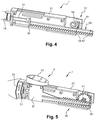
- the implant injection device 1 also comprises means 51 for indicating a position of the push rod 31 to the user, as illustrated, for example, on the figure 4 .
- the indication means 51 here comprise a first flexible tongue 53 carried by the gripping housing 7, in particular by the male support member 21.
- the rack transmission mechanism 35 comprises at least one projection 55, so that when the rack-and-pinion transmission mechanism 35 reaches a first predetermined position, the projection 55 abuts against the first flexible tab 53 so as to provide the user with a first audible and / or tactile indication.
- the push rod 31, in this first predetermined position of the rack transmission mechanism 35 occupies a position in which an implant is injected.
- the first flexible tongue 53 is supported by the male support member 21 of the gripping housing 7.
- the second rack member 39 supports two projections 55, each of which comprises a protruding tooth 57 of a longitudinal plane surface 59 of the gripping mechanism.
- a longitudinal plane surface it is possible to understand a surface extending substantially parallel to the longitudinal direction of the thrust rod 31.
- the longitudinal plane surface 59 is carried by the second element of rack 39.
- the rack transmission mechanism 35 When the rack transmission mechanism 35 reaches a first predetermined position, for example a position in which an implant is injected, even an intermediate position in which a first implant is injected and a second implant is not injected and is still in the implant injection device 1, as illustrated on the figure 4 the protrusion 55 or tooth 57 is in abutment with the first flexible tongue 53.
- a first predetermined position for example a position in which an implant is injected
- the protrusion 55 or tooth 57 is in abutment with the first flexible tongue 53.
- the user In the case of an intermediate position, in order to inject the second implant, the user must then exert a force to cause the deformation of the first flexible tongue 53 and allow the crossing by the first flexible tongue 53 of a protrusion 55 or tooth 57.
- the indication means 51 comprise a second flexible tongue 61, carried by the gripping housing 7, in particular by the male support element 21.
- the second flexible tongue 61 is configured to abut against a protrusion 55 or tooth 57 in a second predetermined position preceding the first predetermined position.
- the rack-and-pinion transmission mechanism When the rack-and-pinion transmission mechanism reaches a second predetermined position, for example a position in which an implant is partially injected, or even a position in which an implant is close to being injected in its entirety, the projection 55 or tooth 57 is in abutment against the second flexible tongue 61, and when the rack transmission mechanism 35 exceeds the second predetermined position, the second flexible tab 61 passes the projection 55 or tooth 57 so as to provide the user with a second audible and / or tactile indication.
- the user In this second predetermined position, in order to continue the injection of an implant, the user must then exert a force to cause the deformation of the second flexible tongue 61 and allow the crossing by the second flexible tongue 61 of a protrusion 55 or tooth 57.
- the first flexible tongue 53 has a greater flexural strength than the second flexible tongue 61.
- the user easily distinguishes the first predetermined position from the second predetermined position.
- the second predetermined position will first be reached, indicating for example to the user the approach of the injection of the entire implant.
- the first predetermined position is reached, indicating for example to the user injection of the entire implant. This may for example allow the user to reposition the implant injection device 1, in particular the injection needle 9, so as to begin the injection of another implant with a proper positioning.
- the implant injection device 1 comprising two projections 55 or tooth 57
- the rack transmission mechanism 35 can thus occupy two first predetermined positions, respectively two predetermined second positions.
- a first predetermined position and a second predetermined position are reached during the injection of each of the two implants.
- the implant injection device 1 comprises locking means arranged to lock the push rod 31 in its final position, in which position the push rod 31 preferably projects towards the downstream direction beyond the end. of the injection needle 9.
- the implant injection device 1 may comprise locking means arranged to lock the push rod 31 in the final position.
- a lug supported by the first rack member 37 or the second rack member 39 cooperates with a recess carried by the gripping housing 7, in particular formed in the male support member 21.
- pin can be formed on the longitudinal surface 59 of the second rack member 39 and be in the form of a ramp terminating at its upstream end by a wall substantially orthogonal to the longitudinal surface, so that the crossing of this ramp by the first flexible tongue 53 or the second flexible tongue 61 generates a sound signal audible by the user, as a 'click'.
- the presence of the substantially orthogonal wall does not allow crossing the lug in the other direction, except for example to cause the rupture of the first flexible tongue 53 or the second flexible tongue 61. This avoids so simple reuse of the implant injection device 1 and also allows to avoid injury due to the injection needle 9, for example in case of fall of the implant injection device 1 after use, thanks in that the push rod 31 protrudes beyond the end of the injection needle 9 and is blocked by these locking means.
- the elements of the implant injection device 1 whose material is not specified in the present description may be made of thermoplastic material, for example polyethylene or polypropylene.
- the implant injection device 1 as illustrated on the figure 1 is in storage configuration, before use.
- the user must remove the protection cap 3 from the injection needle 9, as illustrated on the figure 2 - the implant injection device 1 being considered assembled - it checks the presence of the implant or implants by visualization through the window 15 of the receiving body 11.
- the injection needle 9 is then pressed into the body of the patient, and the user slides on the actuating button 47.
- the actuating button 47 and the first rack member 37 then slide relative to the grip housing 7.
- the first rack element 37 then drives the pinion 41 in rotation through its first toothing 43.
- the rotation of the pinion 41, via its second toothing 45 in contact with the second rack element 39, causes sliding of the second rack member 39.
- the second rack member 39 then pushes the push rod 31 in the injection direction from its initial position to its final position.
- the push rod 31 then pushes the implant or implants through the injection needle 9, so as to cause the injection of the implant (s) in the body of the patient.
- the rack transmission mechanism 35 reaches a second predetermined position, for example a position in which an injection of an implant is nearing completion, the protrusion 55 or tooth 57 abuts against the second flexible tongue. 61.
- the user if he continues pressing the actuating button 47, must then exert a force so that the rack transmission mechanism 35 exceeds the second predetermined position. This causes a deformation of the second flexible tongue 61 and allows the second flexible tongue 61 to cross the protrusion 55 or tooth 57 so as to provide the user with a second audible indication, such as a 'click', and / or touch, due for example to the additional effort required to pass the protrusion 55 or tooth 57.
- the transmission mechanism reaches a first predetermined position, for example a position in which the push rod 31 occupies a position in which an implant is injected as illustrated in FIG. figure 4 the protrusion 55 or tooth 57 is in abutment with the first flexible tongue 43.
- the user if he continues to press the actuating button 47, must then exert a force so that the rack transmission mechanism 35 exceeds the first predetermined position. This causes a deformation of the first flexible tongue 53 and allows the first flexible tongue 53 to cross the projection 55 or tooth 57 so as to provide the user with a first sound indication, such as a 'click', and / or touch, due for example to the additional effort to be provided to cross the protrusion 55 or tooth 57.
- a first predetermined position for example a position in which the push rod 31 occupies a position in which an implant is injected as illustrated in FIG. figure 4 the protrusion 55 or tooth 57 is in abutment with the first flexible tongue 43.
- the user if he continues to press the
- the first flexible tongue 53 has a higher flexural strength than the second flexible tongue 61, so that the user can easily distinguish whether the injection of an implant is nearing completion or if this implant is injected.
- the second rack member 39 comprises two teeth 57, positioned one behind the other so as to correspond to the injection of a first implant and a second implant.
- the first tooth 57 positioned downstream relative to the second tooth 57, cooperates with the second tongue 61 and the first tongue 53 during the injection of a first implant, and the second tooth 57 cooperates with the second tongue 61 then the first tongue 53 when injecting a second implant.
- implant injection device 1 configured to inject two implants
- implant injection device 1 can be configured to inject a single implant. implant, for example with a long length, or a number of implants greater than two.
Landscapes
- Health & Medical Sciences (AREA)
- Engineering & Computer Science (AREA)
- Life Sciences & Earth Sciences (AREA)
- General Health & Medical Sciences (AREA)
- Public Health (AREA)
- Biomedical Technology (AREA)
- Heart & Thoracic Surgery (AREA)
- Animal Behavior & Ethology (AREA)
- Veterinary Medicine (AREA)
- Hematology (AREA)
- Anesthesiology (AREA)
- Medical Informatics (AREA)
- Vascular Medicine (AREA)
- Surgery (AREA)
- Dermatology (AREA)
- Pathology (AREA)
- Nuclear Medicine, Radiotherapy & Molecular Imaging (AREA)
- Molecular Biology (AREA)
- Cardiology (AREA)
- Oral & Maxillofacial Surgery (AREA)
- Transplantation (AREA)
- Infusion, Injection, And Reservoir Apparatuses (AREA)
Applications Claiming Priority (1)
| Application Number | Priority Date | Filing Date | Title |
|---|---|---|---|
| FR1853406A FR3080291B1 (fr) | 2018-04-18 | 2018-04-18 | Dispositif d'injection d'implant dote d'une transmission de type pignon-cremaillere |
Publications (1)
| Publication Number | Publication Date |
|---|---|
| EP3556423A1 true EP3556423A1 (de) | 2019-10-23 |
Family
ID=63080048
Family Applications (1)
| Application Number | Title | Priority Date | Filing Date |
|---|---|---|---|
| EP19169959.4A Withdrawn EP3556423A1 (de) | 2018-04-18 | 2019-04-17 | Injektionsvorrichtung eines implantats, das mit einer übertragungsvorrichtung vom typ zahnstangen-ritzel-getriebe ausgestattet ist |
Country Status (3)
| Country | Link |
|---|---|
| US (1) | US11344712B2 (de) |
| EP (1) | EP3556423A1 (de) |
| FR (1) | FR3080291B1 (de) |
Families Citing this family (12)
| Publication number | Priority date | Publication date | Assignee | Title |
|---|---|---|---|---|
| US20230355223A1 (en) * | 2020-05-20 | 2023-11-09 | Betaglue Technologies S.P.A. | Methods and apparatus for controlled delivery of a sealant |
| US20240033446A1 (en) * | 2020-12-17 | 2024-02-01 | Eli Lilly And Company | Fluid delivery system with needle assembly |
| USD1039687S1 (en) * | 2021-11-24 | 2024-08-20 | Iantrek, Inc. | Ocular implant delivery device |
| USD1018842S1 (en) | 2021-11-24 | 2024-03-19 | Iantrek, Inc. | Cannula assembly for an ocular implant delivery device |
| CN114569325B (zh) * | 2022-01-18 | 2024-06-07 | 苏州朗目医疗科技有限公司 | 一种推注器 |
| CN114587527B (zh) * | 2022-03-07 | 2024-06-14 | 梁山县人民医院(梁山县人民医院和缓互联网医院) | 一种心内科穿刺装置及其使用方法 |
| CN114848289B (zh) * | 2022-05-06 | 2025-02-14 | 海思盖德(苏州)生物医学科技有限公司 | 一种眼部植入物输送器 |
| EP4494612A1 (de) * | 2023-07-18 | 2025-01-22 | Activoris Medizintechnik GmbH | Implantatapplikator |
| JP2026526746A (ja) * | 2023-07-18 | 2026-08-10 | アクティフォリス メディツィンテヒニーク ゲーエムベーハー | インプラント・アプリケータ |
| USD1128052S1 (en) | 2023-10-19 | 2026-05-26 | Iantrek, Inc. | Cannula assembly for an ocular implant delivery device |
| USD1088226S1 (en) | 2023-10-19 | 2025-08-12 | Iantrek, Inc. | Handpiece for an ocular implant delivery device |
| CN119925081B (zh) * | 2025-03-17 | 2026-01-13 | 明澈生物科技(苏州)有限公司 | 一种推注器 |
Citations (6)
| Publication number | Priority date | Publication date | Assignee | Title |
|---|---|---|---|---|
| US2883984A (en) * | 1957-09-09 | 1959-04-28 | Pfizer & Co C | Pellet implanter |
| US4447223A (en) * | 1982-04-16 | 1984-05-08 | Cct Associates | Medicament implant applicator |
| US4474572A (en) * | 1981-09-29 | 1984-10-02 | Syntex (U.S.A.) Inc. | Implanting device and implant magazine |
| US4576591A (en) * | 1983-07-06 | 1986-03-18 | Ivy-Gene Co., Inc. | Medicament implant applicator |
| US4762515A (en) * | 1987-01-06 | 1988-08-09 | Ivy Laboratories, Inc. | Medicament implant applicator |
| EP2719355A2 (de) * | 2012-10-11 | 2014-04-16 | Cook Medical Technologies LLC | Handstück mit gekuppeltem Zahnstangenrad für das Einsetzen von Markern |
Family Cites Families (9)
| Publication number | Priority date | Publication date | Assignee | Title |
|---|---|---|---|---|
| WO2004026106A2 (en) | 2002-09-18 | 2004-04-01 | Allergan, Inc. | Methods and apparatus for delivery of ocular implants |
| US7468065B2 (en) | 2002-09-18 | 2008-12-23 | Allergan, Inc. | Apparatus for delivery of ocular implants |
| US9849027B2 (en) * | 2007-11-08 | 2017-12-26 | Alimera Sciences, Inc. | Ocular implantation device |
| US9545483B2 (en) * | 2008-12-02 | 2017-01-17 | Sanofi-Aventis Deutschland Gmbh | Drive assembly suitable for use in a medication delivery device and medication delivery device |
| CH703993A2 (de) * | 2012-02-09 | 2012-03-15 | Tecpharma Licensing Ag | Injektionsgerät zur Verabreichung oder Förderung von fluidem Produkt. |
| DK2983749T3 (da) * | 2013-04-10 | 2020-08-31 | Sanofi Sa | Injektionsanordning |
| WO2016164189A1 (en) * | 2015-04-09 | 2016-10-13 | Cleveland Kenneth Edwards | Hormone or other pellet delivery device |
| JP6969876B2 (ja) * | 2016-02-29 | 2021-11-24 | メディセル・アーゲー | 伝動機構、特に歯車列を有するインジェクタ |
| WO2018009357A1 (en) * | 2016-07-02 | 2018-01-11 | Gennady Kleyman | Fluid dispensing device |
-
2018
- 2018-04-18 FR FR1853406A patent/FR3080291B1/fr active Active
-
2019
- 2019-04-17 US US16/387,109 patent/US11344712B2/en active Active
- 2019-04-17 EP EP19169959.4A patent/EP3556423A1/de not_active Withdrawn
Patent Citations (6)
| Publication number | Priority date | Publication date | Assignee | Title |
|---|---|---|---|---|
| US2883984A (en) * | 1957-09-09 | 1959-04-28 | Pfizer & Co C | Pellet implanter |
| US4474572A (en) * | 1981-09-29 | 1984-10-02 | Syntex (U.S.A.) Inc. | Implanting device and implant magazine |
| US4447223A (en) * | 1982-04-16 | 1984-05-08 | Cct Associates | Medicament implant applicator |
| US4576591A (en) * | 1983-07-06 | 1986-03-18 | Ivy-Gene Co., Inc. | Medicament implant applicator |
| US4762515A (en) * | 1987-01-06 | 1988-08-09 | Ivy Laboratories, Inc. | Medicament implant applicator |
| EP2719355A2 (de) * | 2012-10-11 | 2014-04-16 | Cook Medical Technologies LLC | Handstück mit gekuppeltem Zahnstangenrad für das Einsetzen von Markern |
Also Published As
| Publication number | Publication date |
|---|---|
| FR3080291A1 (fr) | 2019-10-25 |
| US11344712B2 (en) | 2022-05-31 |
| FR3080291B1 (fr) | 2023-06-16 |
| US20190321075A1 (en) | 2019-10-24 |
Similar Documents
| Publication | Publication Date | Title |
|---|---|---|
| FR3080291A1 (fr) | Dispositif d'injection d'implant dote d'une transmission de type pignon-cremaillere | |
| EP2047879B1 (de) | Sicherheitseinrichtung für eine Spritzvorrichtung | |
| EP2657795B1 (de) | Befestigungsvorrichtung eines austauschbaren Armbands für Uhren | |
| EP2308532B1 (de) | Sicherheitsvorrichtung für eine Spritze und Anordnung bestehend aus dieser Vorrichtung und einer Spritze | |
| CH706523B1 (fr) | Pièce d'horlogerie. | |
| EP3374008B1 (de) | Autoinjektor | |
| EP3556424B1 (de) | Injektionsvorrichtung eines implantats, das mit mitteln zum drücken zur sequentiellen freisetzung ausgestattet ist | |
| EP1213980A1 (de) | Vorrichtung zur positionsverriegelung eines bezüglich eines ortsfesten elements beweglichen teils | |
| FR3011186A1 (fr) | Dispositif de reception pour une seringue d'injection comprenant un capuchon de protection de l'aiguille | |
| FR2481103A1 (fr) | Bistouri medical pour recueillir une goutte de sang et son procede de fabrication | |
| EP2688506B1 (de) | Mechanisierte chirurgische ausrüstung mit einem instrument und einem instrumentenhalter, entsprechende verpackung und instrumentenhalter | |
| EP3556425A1 (de) | Injektionsvorrichtung eines implantats, die mit rückhaltemitteln durch reibung ausgestattet ist | |
| FR2969499A3 (fr) | Auto-injecteurs | |
| EP3852845B1 (de) | Autoinjektor | |
| FR3058895A1 (fr) | Dispositif d'injection presentant un dispositif de retrait de capuchon de seringue ameliore | |
| EP1687051B1 (de) | Sicherheitsinjektionsvorrichtung für eine spritze | |
| EP3374006B1 (de) | Autoinjektor mit einem mittelfenster mit einem dreieckigen ende | |
| EP1661070A1 (de) | Indikator von dosen für eine flüssigprodukt-verteilungseinrichtung | |
| CA2512218C (fr) | Perfectionnement aux instruments dentaires mecanises, notamment aux instruments d'endodontie et piece a main, dit "contre-angle" | |
| EP1372772A1 (de) | Sicherheitsspritze | |
| EP1728491B1 (de) | Chirurgische Vorrichtung zum Behandeln von Plattfüssen und entsprechender chirurgischer Teilesatz. | |
| EP4390571B1 (de) | Vorrichtung zur befestigung eines armbandes | |
| EP1234546B1 (de) | Vorrichtung zum Schutz von chirurgischen Stiften | |
| WO2005072663A1 (fr) | Pince de prehension gastrique | |
| FR3086176A1 (fr) | Autoinjecteur. |
Legal Events
| Date | Code | Title | Description |
|---|---|---|---|
| PUAI | Public reference made under article 153(3) epc to a published international application that has entered the european phase |
Free format text: ORIGINAL CODE: 0009012 |
|
| STAA | Information on the status of an ep patent application or granted ep patent |
Free format text: STATUS: THE APPLICATION HAS BEEN PUBLISHED |
|
| AK | Designated contracting states |
Kind code of ref document: A1 Designated state(s): AL AT BE BG CH CY CZ DE DK EE ES FI FR GB GR HR HU IE IS IT LI LT LU LV MC MK MT NL NO PL PT RO RS SE SI SK SM TR |
|
| AX | Request for extension of the european patent |
Extension state: BA ME |
|
| STAA | Information on the status of an ep patent application or granted ep patent |
Free format text: STATUS: REQUEST FOR EXAMINATION WAS MADE |
|
| 17P | Request for examination filed |
Effective date: 20200325 |
|
| RBV | Designated contracting states (corrected) |
Designated state(s): AL AT BE BG CH CY CZ DE DK EE ES FI FR GB GR HR HU IE IS IT LI LT LU LV MC MK MT NL NO PL PT RO RS SE SI SK SM TR |
|
| GRAP | Despatch of communication of intention to grant a patent |
Free format text: ORIGINAL CODE: EPIDOSNIGR1 |
|
| STAA | Information on the status of an ep patent application or granted ep patent |
Free format text: STATUS: GRANT OF PATENT IS INTENDED |
|
| RIC1 | Information provided on ipc code assigned before grant |
Ipc: A61B 90/00 20160101ALN20231010BHEP Ipc: A61M 37/00 20060101AFI20231010BHEP |
|
| INTG | Intention to grant announced |
Effective date: 20231026 |
|
| STAA | Information on the status of an ep patent application or granted ep patent |
Free format text: STATUS: THE APPLICATION IS DEEMED TO BE WITHDRAWN |
|
| 18D | Application deemed to be withdrawn |
Effective date: 20240306 |