EP3556812A1 - Composition de résine résistante au feu et corps moulé en résine résistante au feu - Google Patents
Composition de résine résistante au feu et corps moulé en résine résistante au feu Download PDFInfo
- Publication number
- EP3556812A1 EP3556812A1 EP17884510.3A EP17884510A EP3556812A1 EP 3556812 A1 EP3556812 A1 EP 3556812A1 EP 17884510 A EP17884510 A EP 17884510A EP 3556812 A1 EP3556812 A1 EP 3556812A1
- Authority
- EP
- European Patent Office
- Prior art keywords
- fire
- resistant resin
- resin composition
- mass
- parts
- Prior art date
- Legal status (The legal status is an assumption and is not a legal conclusion. Google has not performed a legal analysis and makes no representation as to the accuracy of the status listed.)
- Withdrawn
Links
Images
Classifications
-
- C—CHEMISTRY; METALLURGY
- C08—ORGANIC MACROMOLECULAR COMPOUNDS; THEIR PREPARATION OR CHEMICAL WORKING-UP; COMPOSITIONS BASED THEREON
- C08K—Use of inorganic or non-macromolecular organic substances as compounding ingredients
- C08K3/00—Use of inorganic substances as compounding ingredients
- C08K3/02—Elements
- C08K3/04—Carbon
-
- C—CHEMISTRY; METALLURGY
- C08—ORGANIC MACROMOLECULAR COMPOUNDS; THEIR PREPARATION OR CHEMICAL WORKING-UP; COMPOSITIONS BASED THEREON
- C08L—COMPOSITIONS OF MACROMOLECULAR COMPOUNDS
- C08L23/00—Compositions of homopolymers or copolymers of unsaturated aliphatic hydrocarbons having only one carbon-to-carbon double bond; Compositions of derivatives of such polymers
- C08L23/02—Compositions of homopolymers or copolymers of unsaturated aliphatic hydrocarbons having only one carbon-to-carbon double bond; Compositions of derivatives of such polymers not modified by chemical after-treatment
- C08L23/04—Homopolymers or copolymers of ethene
-
- C—CHEMISTRY; METALLURGY
- C08—ORGANIC MACROMOLECULAR COMPOUNDS; THEIR PREPARATION OR CHEMICAL WORKING-UP; COMPOSITIONS BASED THEREON
- C08K—Use of inorganic or non-macromolecular organic substances as compounding ingredients
- C08K3/00—Use of inorganic substances as compounding ingredients
- C08K3/01—Use of inorganic substances as compounding ingredients characterized by their specific function
- C08K3/013—Fillers, pigments or reinforcing additives
-
- C—CHEMISTRY; METALLURGY
- C08—ORGANIC MACROMOLECULAR COMPOUNDS; THEIR PREPARATION OR CHEMICAL WORKING-UP; COMPOSITIONS BASED THEREON
- C08K—Use of inorganic or non-macromolecular organic substances as compounding ingredients
- C08K3/00—Use of inorganic substances as compounding ingredients
- C08K3/01—Use of inorganic substances as compounding ingredients characterized by their specific function
- C08K3/016—Flame-proofing or flame-retarding additives
-
- C—CHEMISTRY; METALLURGY
- C08—ORGANIC MACROMOLECULAR COMPOUNDS; THEIR PREPARATION OR CHEMICAL WORKING-UP; COMPOSITIONS BASED THEREON
- C08K—Use of inorganic or non-macromolecular organic substances as compounding ingredients
- C08K3/00—Use of inorganic substances as compounding ingredients
- C08K3/32—Phosphorus-containing compounds
-
- C—CHEMISTRY; METALLURGY
- C08—ORGANIC MACROMOLECULAR COMPOUNDS; THEIR PREPARATION OR CHEMICAL WORKING-UP; COMPOSITIONS BASED THEREON
- C08K—Use of inorganic or non-macromolecular organic substances as compounding ingredients
- C08K5/00—Use of organic ingredients
- C08K5/0008—Organic ingredients according to more than one of the "one dot" groups of C08K5/01 - C08K5/59
- C08K5/0066—Flame-proofing or flame-retarding additives
-
- C—CHEMISTRY; METALLURGY
- C08—ORGANIC MACROMOLECULAR COMPOUNDS; THEIR PREPARATION OR CHEMICAL WORKING-UP; COMPOSITIONS BASED THEREON
- C08K—Use of inorganic or non-macromolecular organic substances as compounding ingredients
- C08K5/00—Use of organic ingredients
- C08K5/16—Nitrogen-containing compounds
- C08K5/34—Heterocyclic compounds having nitrogen in the ring
- C08K5/3467—Heterocyclic compounds having nitrogen in the ring having more than two nitrogen atoms in the ring
- C08K5/3477—Six-membered rings
- C08K5/3492—Triazines
- C08K5/34922—Melamine; Derivatives thereof
-
- C—CHEMISTRY; METALLURGY
- C08—ORGANIC MACROMOLECULAR COMPOUNDS; THEIR PREPARATION OR CHEMICAL WORKING-UP; COMPOSITIONS BASED THEREON
- C08L—COMPOSITIONS OF MACROMOLECULAR COMPOUNDS
- C08L101/00—Compositions of unspecified macromolecular compounds
-
- C—CHEMISTRY; METALLURGY
- C08—ORGANIC MACROMOLECULAR COMPOUNDS; THEIR PREPARATION OR CHEMICAL WORKING-UP; COMPOSITIONS BASED THEREON
- C08L—COMPOSITIONS OF MACROMOLECULAR COMPOUNDS
- C08L21/00—Compositions of unspecified rubbers
-
- C—CHEMISTRY; METALLURGY
- C08—ORGANIC MACROMOLECULAR COMPOUNDS; THEIR PREPARATION OR CHEMICAL WORKING-UP; COMPOSITIONS BASED THEREON
- C08L—COMPOSITIONS OF MACROMOLECULAR COMPOUNDS
- C08L23/00—Compositions of homopolymers or copolymers of unsaturated aliphatic hydrocarbons having only one carbon-to-carbon double bond; Compositions of derivatives of such polymers
- C08L23/02—Compositions of homopolymers or copolymers of unsaturated aliphatic hydrocarbons having only one carbon-to-carbon double bond; Compositions of derivatives of such polymers not modified by chemical after-treatment
- C08L23/04—Homopolymers or copolymers of ethene
- C08L23/08—Copolymers of ethene
- C08L23/0846—Copolymers of ethene with unsaturated hydrocarbons containing atoms other than carbon or hydrogen
- C08L23/0853—Ethylene vinyl acetate copolymers
-
- C—CHEMISTRY; METALLURGY
- C08—ORGANIC MACROMOLECULAR COMPOUNDS; THEIR PREPARATION OR CHEMICAL WORKING-UP; COMPOSITIONS BASED THEREON
- C08L—COMPOSITIONS OF MACROMOLECULAR COMPOUNDS
- C08L23/00—Compositions of homopolymers or copolymers of unsaturated aliphatic hydrocarbons having only one carbon-to-carbon double bond; Compositions of derivatives of such polymers
- C08L23/02—Compositions of homopolymers or copolymers of unsaturated aliphatic hydrocarbons having only one carbon-to-carbon double bond; Compositions of derivatives of such polymers not modified by chemical after-treatment
- C08L23/16—Ethylene-propylene or ethylene-propylene-diene copolymers
-
- C—CHEMISTRY; METALLURGY
- C08—ORGANIC MACROMOLECULAR COMPOUNDS; THEIR PREPARATION OR CHEMICAL WORKING-UP; COMPOSITIONS BASED THEREON
- C08L—COMPOSITIONS OF MACROMOLECULAR COMPOUNDS
- C08L27/00—Compositions of homopolymers or copolymers of compounds having one or more unsaturated aliphatic radicals, each having only one carbon-to-carbon double bond, and at least one being terminated by a halogen; Compositions of derivatives of such polymers
- C08L27/02—Compositions of homopolymers or copolymers of compounds having one or more unsaturated aliphatic radicals, each having only one carbon-to-carbon double bond, and at least one being terminated by a halogen; Compositions of derivatives of such polymers not modified by chemical after-treatment
- C08L27/04—Compositions of homopolymers or copolymers of compounds having one or more unsaturated aliphatic radicals, each having only one carbon-to-carbon double bond, and at least one being terminated by a halogen; Compositions of derivatives of such polymers not modified by chemical after-treatment containing chlorine atoms
- C08L27/06—Homopolymers or copolymers of vinyl chloride
-
- C—CHEMISTRY; METALLURGY
- C08—ORGANIC MACROMOLECULAR COMPOUNDS; THEIR PREPARATION OR CHEMICAL WORKING-UP; COMPOSITIONS BASED THEREON
- C08L—COMPOSITIONS OF MACROMOLECULAR COMPOUNDS
- C08L27/00—Compositions of homopolymers or copolymers of compounds having one or more unsaturated aliphatic radicals, each having only one carbon-to-carbon double bond, and at least one being terminated by a halogen; Compositions of derivatives of such polymers
- C08L27/22—Compositions of homopolymers or copolymers of compounds having one or more unsaturated aliphatic radicals, each having only one carbon-to-carbon double bond, and at least one being terminated by a halogen; Compositions of derivatives of such polymers modified by chemical after-treatment
- C08L27/24—Compositions of homopolymers or copolymers of compounds having one or more unsaturated aliphatic radicals, each having only one carbon-to-carbon double bond, and at least one being terminated by a halogen; Compositions of derivatives of such polymers modified by chemical after-treatment halogenated
-
- C—CHEMISTRY; METALLURGY
- C08—ORGANIC MACROMOLECULAR COMPOUNDS; THEIR PREPARATION OR CHEMICAL WORKING-UP; COMPOSITIONS BASED THEREON
- C08L—COMPOSITIONS OF MACROMOLECULAR COMPOUNDS
- C08L63/00—Compositions of epoxy resins; Compositions of derivatives of epoxy resins
-
- E—FIXED CONSTRUCTIONS
- E04—BUILDING
- E04B—GENERAL BUILDING CONSTRUCTIONS; WALLS, e.g. PARTITIONS; ROOFS; FLOORS; CEILINGS; INSULATION OR OTHER PROTECTION OF BUILDINGS
- E04B1/00—Constructions in general; Structures which are not restricted either to walls, e.g. partitions, or floors or ceilings or roofs
- E04B1/62—Insulation or other protection; Elements or use of specified material therefor
- E04B1/92—Protection against other undesired influences or dangers
- E04B1/94—Protection against other undesired influences or dangers against fire
-
- E—FIXED CONSTRUCTIONS
- E04—BUILDING
- E04B—GENERAL BUILDING CONSTRUCTIONS; WALLS, e.g. PARTITIONS; ROOFS; FLOORS; CEILINGS; INSULATION OR OTHER PROTECTION OF BUILDINGS
- E04B1/00—Constructions in general; Structures which are not restricted either to walls, e.g. partitions, or floors or ceilings or roofs
- E04B1/62—Insulation or other protection; Elements or use of specified material therefor
- E04B1/92—Protection against other undesired influences or dangers
- E04B1/94—Protection against other undesired influences or dangers against fire
- E04B1/941—Building elements specially adapted therefor
-
- E—FIXED CONSTRUCTIONS
- E06—DOORS, WINDOWS, SHUTTERS, OR ROLLER BLINDS IN GENERAL; LADDERS
- E06B—FIXED OR MOVABLE CLOSURES FOR OPENINGS IN BUILDINGS, VEHICLES, FENCES OR LIKE ENCLOSURES IN GENERAL, e.g. DOORS, WINDOWS, BLINDS, GATES
- E06B5/00—Doors, windows, or like closures for special purposes; Border constructions therefor
- E06B5/10—Doors, windows, or like closures for special purposes; Border constructions therefor for protection against air-raid or other war-like action; for other protective purposes
- E06B5/16—Fireproof doors or similar closures; Adaptations of fixed constructions therefor
-
- E—FIXED CONSTRUCTIONS
- E06—DOORS, WINDOWS, SHUTTERS, OR ROLLER BLINDS IN GENERAL; LADDERS
- E06B—FIXED OR MOVABLE CLOSURES FOR OPENINGS IN BUILDINGS, VEHICLES, FENCES OR LIKE ENCLOSURES IN GENERAL, e.g. DOORS, WINDOWS, BLINDS, GATES
- E06B5/00—Doors, windows, or like closures for special purposes; Border constructions therefor
- E06B5/10—Doors, windows, or like closures for special purposes; Border constructions therefor for protection against air-raid or other war-like action; for other protective purposes
- E06B5/16—Fireproof doors or similar closures; Adaptations of fixed constructions therefor
- E06B5/165—Fireproof windows
Definitions
- the present invention relates to a fire-resistant resin composition and a fire-resistant resin molded body.
- a fire-resistant resin composition obtained by mixing a matrix resin with an inorganic material that expands when heated is used for fire prevention in building materials, such as fittings, pillars, and wall materials.
- building materials such as fittings, pillars, and wall materials.
- Such a fire-resistant resin composition and a fire-resistant resin molded body formed from the fire-resistant resin composition expand when heated, and the combustion residue is formed into a fire-resistant, heat-insulating layer, exerting fire-resistant, heat-insulation performance.
- Patent Literature (PTL) 1 discloses a fire-resistant rubber composition for a fire-resistant covering, comprising a base rubber component consisting of 30 to 60 parts by mass of liquid rubber and 40 to 70 parts by mass of butyl rubber, and comprising at least 3 to 50 parts by mass of a tackifier, 10 to 100 parts by mass of a thermally expandable graphite, 30 to 180 parts by mass of a flame retardant, 30 to 210 parts by mass of an inorganic filler, 0.1 to 10 parts by mass of a vulcanizing agent, and 0.1 to 10 parts by mass of a vulcanization accelerator, per 100 parts by mass of the base rubber component, the rubber composition being formed as unvulcanized.
- This fire-resistant rubber composition can contain 1 to 50 parts by mass of aluminum phosphite to improve the shape retention.
- PTL 1 does not address water resistance.
- An object of the present invention is to provide a fire-resistant resin composition that has excellent fire resistance and water resistance, and provide a fire-resistant resin molded body that is formed from the fire-resistant resin composition.
- the fire-resistant resin composition according to the present invention and the fire-resistant resin molded body formed from the fire-resistant resin composition are capable of imparting excellent fire resistance and water resistance to buildings.
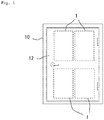
- Fig. 1 is a schematic view illustrating an example in which a thermally expandable fire-resistant sheet is applied to a door.
- the fire-resistant resin composition of the present invention comprises at least one matrix component selected from the group consisting of resins, elastomers, and rubbers; a thermally expandable graphite; and at least one flame retardant selected from the group consisting of lower phosphoric acid salts and melamine derivatives.
- Examples of the matrix component include resins, elastomers, rubbers, and combinations thereof.
- resins examples include thermoplastic resins, thermosetting resins, and combinations thereof.
- thermoplastic resins include polyolefin resins, such as polypropylene resins, polyethylene resins, poly(1-)butene resins, and polypentene resins; polyester resins, such as polyethylene terephthalate; and synthetic resins, such as polystyrene resins, acrylonitrile-butadiene-styrene (ABS) resins, ethylene vinyl acetate (EVA) copolymers, polycarbonate resins, polyphenylene ether resins, (meth)acrylic resins, polyamide resins, polyvinyl chloride resins, chlorinated polyvinyl chloride resins, novolak resins, polyurethane resins, and polyisobutylene.
- polyolefin resins such as polypropylene resins, polyethylene resins, poly(1-)butene resins, and polypentene resins
- polyester resins such as polyethylene terephthalate
- synthetic resins such as polystyrene resin
- thermosetting resins include synthetic resins, such as polyurethane, polyisocyanate, polyisocyanurate, phenol resins, epoxy resins, urea resins, melamine resins, unsaturated polyester resins, and polyimide.
- elastomers examples include olefin-based elastomers (TPO), styrene-based elastomers, ester-based elastomers, amide-based elastomers, vinyl chloride-based elastomers, and combinations thereof.
- TPO olefin-based elastomers
- styrene-based elastomers such as polyethylene and polypropylene, as a hard segment
- a rubber such as ethylene-propylene rubber and ethylene-propylene-diene rubber
- rubbers examples include natural rubber, isoprene rubber, butadiene rubber, 1,2-polybutadiene rubber, styrene-butadiene rubber, chloroprene rubber, nitrile rubber, butyl rubber, chlorinated butyl rubber, ethylene-propylene rubber, ethylene-propylene-diene rubber (EPDM), chlorosulfonylated polyethylene, acrylic rubber, epichlorohydrin rubber, highly vulcanized rubber, nonvulcanized rubber, silicone rubber, fluorine rubber, urethane rubber, and the like.
- natural rubber isoprene rubber, butadiene rubber, 1,2-polybutadiene rubber, styrene-butadiene rubber, chloroprene rubber, nitrile rubber, butyl rubber, chlorinated butyl rubber, ethylene-propylene rubber, ethylene-propylene-diene rubber (EPDM), chlorosulfonylated polyethylene, acrylic rubber, epichlorohydrin
- resins, elastomers, and rubbers may be used alone or in a combination of two or more. Resins, elastomers, and rubbers may also be used in combination.
- a polyvinyl chloride resin and a chlorinated polyvinyl chloride resin in terms of fire resistance.
- a polyolefin resin, TPO, or EPDM is preferable.
- an epoxy resin is preferable.
- the thermally expandable graphite is a known substance that expands when heated.
- the thermally expandable graphite is a graphite intercalation compound formed by subjecting a powder, such as natural flake graphite, pyrolytic graphite, or kish graphite to an acid treatment with a strong oxidizing agent.
- the strong oxidizing agent include inorganic acids, such as concentrated sulfuric acid, nitric acid, and selenic acid; concentrated nitric acid; perchloric acid; perchlorate; permanganate; dichromate; hydrogen peroxide; and the like.
- the thermally expandable graphite is a crystalline compound in which a carbon layer structure is maintained.
- the thermally expandable graphite may optionally be neutralized. Specifically, the thermally expandable graphite obtained by acid treatment as described above is further neutralized with ammonia, a lower aliphatic amine, an alkali metal compound, an alkaline earth metal compound, or the like.
- the thermally expandable graphite obtained by acid treatment as described above may be further neutralized with ammonia, a lower aliphatic amine, an alkali metal compound, an alkaline earth metal compound, or the like.
- the amount of the thermally expandable graphite in the fire-resistant resin composition is not particularly limited.
- the amount is preferably 5 to 400 parts by mass, and more preferably 10 to 200 parts by mass, per 100 parts by mass of the matrix component.
- the amount of the thermally expandable graphite is preferably 5 parts by mass or more. In terms of shape retention, the amount is preferably 400 parts by mass or less.
- the grain size of the thermally expandable graphite is preferably 20 to 200 mesh. When the grain size is 200 mesh or smaller, the degree of expansion of the graphite is sufficient to obtain an expandable heat insulating layer. When the grain size is 20 mesh or greater, the dispersibility upon mixing with a resin becomes desirable, thereby ensuring desirable properties.
- the at least one flame retardant selected from the group consisting of lower phosphoric acid salts and melamine derivatives is added to enhance the flame retardancy of the fire-resistant resin composition, as well as to improve the resistance to water, such as rain, dew condensation, and moisture.
- the addition of the flame retardant inhibits reduction in the performance of the fire-resistant resin composition when exposed to water.
- lower phosphoric acid salt refers to an inorganic phosphoric acid salt that is not condensed, i.e., that is not polymerized.
- inorganic phosphoric acids include primary phosphoric acid, secondary phosphoric acid, tertiary phosphoric acid, metaphosphoric acid, phosphorous acid, hypophosphorous acid, and the like.
- salts include alkali metal salts (such as lithium salts, sodium salts, or potassium salts), alkaline-earth metal salts (such as magnesium salts, calcium salts, strontium salts, or barium salts), salts of periodic table Group 3B metals (such as aluminum salts), transition metal salts (such as titanium salts, manganese salts, iron salts, nickel salts, copper salts, zinc salts, vanadium salts, chromium salts, molybdenum salts, or tungsten salts), ammonium salts, amine salts, for example, guanidine salts or salts of triazine compounds, and the like.
- Metal salts are preferable. However, melamine salts are excluded.
- the lower phosphoric acid salt comprises metal phosphate or metal phosphite, or both.
- the metal phosphite may be foamable.
- metal phosphite may be used after being surface-treated with a surface-treating agent or the like so as to increase the adherence to the matrix component.
- surface-treating agents include functional compounds (e.g., epoxy-based compounds, silane-based compounds, and titanate-based compounds) and the like.
- metal salts of the lower phosphoric acid include aluminum primary phosphate, sodium primary phosphate, potassium primary phosphate, calcium primary phosphate, zinc primary phosphate, aluminum secondary phosphate, sodium secondary phosphate, potassium secondary phosphate, calcium secondary phosphate, zinc secondary phosphate, aluminum tertiary phosphate, sodium tertiary phosphate, potassium tertiary phosphate, calcium tertiary phosphate, zinc tertiary phosphate, aluminum phosphite, sodium phosphite, potassium phosphite, calcium phosphite, zinc phosphite, aluminum hypophosphite, sodium hypophosphite, potassium hypophosphite, calcium hypophosphite, zinc hypophosphite, aluminum metaphosphate, sodium metaphosphate, potassium metaphosphate, calcium metaphosphate, zinc metaphosphate, and the like.
- the amount of the lower phosphoric acid salt is preferably 5 to 400 parts by mass, more preferably 10 to 400 parts by mass, and still more preferably 15 to 200 parts by mass, per 100 parts by mass of the matrix component.
- the amount is preferably 5 parts by mass or more. When the amount is 400 parts by mass or less, the water resistance of the fire-resistant resin composition improves further.
- Such lower phosphoric acid salts are excellent in safety and economically advantageous, and ensure greatly improved flame retardancy.
- melamine derivatives include, but are not particularly limited to, nitrogen-containing cyclic compounds that contain amino groups, such as melam, melem, and melon, other than melamine; salts of nitrogen-containing cyclic compounds that contain amino groups, such as melam, melem, melon, and melamine with nitrogen-containing compounds that contain oxygen acid, organic phosphoric acid, or hydroxy; amide polyphosphate; cyclic urea compounds; melamine pyrophosphate; melamine orthophosphate; melamine polyphosphate-melam-melem double salt; melamine polymetaphosphate; melamine sulfate; melam pyrosulfate; melam organic sulfonate; melamine organic phosphate; melamine organic phosphinate; melamine cyanurate; melamine borate; and the like.
- the melamine derivative is preferably at least one member selected from melamine pyrophosphate, melamine orthophosphate, melamine polyphosphate, and melamine borate to impart further enhanced flame retardancy, and in terms of easy availability.
- the amount of the melamine derivative is preferably 5 to 400 parts by mass, more preferably 10 to 400 parts by mass, and still more preferably 15 to 200 parts by mass, per 100 parts by mass of the matrix component.
- the amount is preferably 5 parts by mass or more.
- the amount is 400 parts by mass or less, the water resistance of the fire-resistant resin composition further improves.
- the total amount of the flame retardants is preferably 5 to 400 parts by mass, more preferably 10 to 400 parts by mass, and still more preferably 15 to 200 parts by mass.
- the fire-resistant resin composition of the present invention may further comprise an inorganic filler.
- the inorganic filler increases the heat capacity and suppresses the heat transmission when an expandable heat-insulating layer is formed, and acts as an aggregate to increase the strength of the expandable heat-insulating layer.
- inorganic fillers include, but are not particularly limited to, metal oxides such as alumina, zinc oxide, titanium oxide, calcium oxide, magnesium oxide, iron oxide, tin oxide, antimony oxide, and ferrite; metal hydroxides, such as calcium hydroxide, magnesium hydroxide, aluminum hydroxide, and hydrotalcite; metal carboxylates, such as basic magnesium carbonate, calcium carbonate, magnesium carbonate, zinc carbonate, strontium carbonate, and barium carbonate; calcium salts, such as calcium sulfate, gypsum fiber, and calcium silicate; as well as silica, diatomaceous earth, dawsonite, barium sulfate, talc, clay, mica, montmorillonite, bentonite, activated clay, sepiolite, imogolite, sericite, glass fiber, glass bead, silica balloon, aluminum nitride, boron nitride, silicon nitride, carbon black, glaphite, carbon fiber
- the particle size of the inorganic filler is preferably 0.5 to 100 ⁇ m, and more preferably 1 to 50 ⁇ m. Since the dispersibility significantly influences the performance, when a small amount of an inorganic filler is added, the inorganic filler preferably has a small particle size. However, the particle size is preferably 0.5 ⁇ m or more in terms of dispersibility. When a large amount of an inorganic filler is added, the viscosity of the fire-resistant resin composition increases more as the addition of the filler increases, thereby decreasing formability. However, since the viscosity of the fire-resistant resin composition can be decreased by increasing the size of the inorganic filler particle, the inorganic filler preferably has a large particle size. However, the particle size is preferably 100 ⁇ m or less. When the particle size of the inorganic filler is 100 ⁇ m or less, the surface properties of the molded body and mechanical-physical properties of the fire-resistant resin composition further increase.
- the amount of the inorganic filler in the fire-resistant resin composition is not particularly limited.
- the amount is preferably 0 to 400 parts by mass, per 100 parts by mass of the matrix component.
- the amount of the inorganic filler is 5 to 400 parts by mass, per 100 parts by mass of the matrix component.
- the amount of the inorganic filler is preferably 400 parts by mass or less, per 100 parts by mass of the matrix component.
- the mass ratio of the amount of the thermally expandable graphite to the total amount of the flame retardant and the inorganic filler is preferably 1:0.5 to 1:10. When this mass ratio is 1:0.5 or more, sufficient fire resistance can be obtained. When this mass ratio is 1:10 or less, the mechanical physical properties improve, and sufficient strength can be obtained.
- the fire-resistant resin composition comprises the thermally expandable graphite in an amount of 10 to 200 parts by mass, the flame retardant in an amount of 5 to 400 parts by mass, and the inorganic filler in an amount of 0 to 400 parts by mass, per 100 parts by mass of the matrix component, such a fire-resistant resin composition can achieve both excellent fire resistance and water resistance.
- the fire-resistant resin composition of the present invention may further comprise a phosphorus compound to increase the strength of the expandable heat-insulating layer and improve the fireproof performance.
- a phosphorus compound include, but are not particularly limited to, red phosphorus; various types of phosphoric esters, such as triphenyl phosphate, tricresyl phosphate, trixylenyl phosphate, cresyl diphenyl phosphate, and xylenyl diphenyl phosphate; metal phosphates, such as sodium phosphate, potassium phosphate, and magnesium phosphate; ammonium polyphosphates; compounds represented by the following formula (1); and the like.
- the phosphorus compound is preferably red phosphorus, an ammonium polyphosphate, or a compound represented by the following formula (1).
- R 1 and R 3 are identical or different, and each represents hydrogen, linear or branched C 1-16 alkyl, or C 6-16 aryl.
- R 2 represents hydroxy, linear or branched C 1-16 alkyl, linear or branched C 1-16 alkoxyl, C 6-16 aryl, or C 6-16 aryloxy.
- Red phosphorus may be a commercially available product. Red phosphorus particles having ammonium polyphosphate resin-coated surfaces and the like are preferably used in view of moisture resistance and safety, i.e.; no spontaneous ignition occurs upon kneading.
- Examples of the compounds represented by formula (1) include, but are not particularly limited to, methylphosphonic acid, dimethyl methylphosphate, diethyl methylphosphate, ethylphosphonic acid, n-propylphosphonic acid, n-butylphosphonic acid, 2-methylpropylphosphonic acid, t-butylphosphonic acid, 2,3-dimethyl-butylphosphonic acid, octylphosphonic acid, phenylphosphonic acid, dioctyl phenylphosphonate, dimethylphosphinic acid, methylethylphosphinic acid, methylpropylphosphinic acid, diethylphosphinic acid, dioctylphosphinic acid, phenylphosphinic acid, diethylphenylphosphinic acid, diphenylphosphinic acid, bis(4-methoxyphenyl)phosphinic acid, and the like. Of these, although it is expensive, t-butyl
- the amount of the phosphorus compound is not limited, and is preferably 0 to 50 parts by mass, per 100 parts by mass of the matrix component.
- the fire-resistant resin composition of the present invention may further comprise a plasticizer.
- the plasticizer is not particularly limited.
- one or more of the following plasticizers shown as examples may be used alone or in combination:
- phthalic acid-based plasticizers are preferable in terms of flame retardancy and from the economic viewpoint.
- the amount of the plasticizer to be added is preferably, but is not limited to, 0 to 200 parts of mass, per 100 parts by mass of the matrix component.
- the amount of the plasticizer may be 20 to 200 parts by mass, per 100 parts by mass of the matrix component.
- the fire-resistant resin composition may further comprise other components as long as the physical properties are not impaired.
- examples include antioxidants based on phenol, amine, sulfur, or the like; metal deterioration inhibitors; antistatic agents; stabilizers; crosslinking agents; lubricants; softening agents; pigments; and the like.
- phosphorus is preferably contained in a minimum amount in order to inhibit reduction in resistance to exposure to moisture, such as water and moisture.
- the fire-resistant resin composition preferably comprises 25 mass% or less of a phosphorus-containing compound, other than the at least one flame retardant selected from the group consisting of lower phosphoric acid salts and melamine derivatives.
- a thermally expandable fire-resistant sheet having a desired thickness By applying the fire-resistant resin composition comprising a mixture of the matrix component, the thermally expandable graphite, the flame retardant, and optional other components to a substrate, such as building materials of a building, and dried, a thermally expandable fire-resistant sheet having a desired thickness can be obtained.
- the application is known in this technical field.
- the thickness of the thermally expandable fire-resistant sheet is preferably, but is not particularly limited to, 0.2 to 10 mm. When the thickness is 0.2 mm or more, the sheet exhibits heat-insulating properties. When the thickness is 10 mm or less, the handling of the sheet is good in terms of the weight.
- Molding of the fire-resistant resin composition comprising a mixture of the matrix component, the thermally expandable graphite, the flame retardant, and optional other components enables the production of a fire-resistant resin molded body. Molding includes press molding, extrusion molding, and injection molding.
- the fire-resistant resin molded body includes packing materials, such as air-tight members, glazing channels, and gaskets, thermally expandable fire-resistant sheets, and the like.
- the thermally expandable fire-resistant sheet preferably has a thickness of, but is not particularly limited to, 0.2 to 10 mm.
- the fire-resistant resin composition, thermally expandable fire-resistant sheet, and fire-resistant resin molded body are not particularly limited insofar as they can block heat by the expansion layer upon exposure to a high temperature such as a fire, and insofar as the expansion layer ensures a certain strength.
- the fire-resistant resin composition, thermally expandable fire-resistant sheet, and fire-resistant resin molded body preferably have a coefficient of expansion of 3 to 50 times after being heated for 30 minutes under a condition of 50 kW/m 2 . When the coefficient of expansion is 3 times or more, the expansion can sufficiently fill the burned portions of the matrix component. Further, when the coefficient of expansion is 50 times or less, the strength of the expansion layer is maintained, thereby maintaining the fire penetration prevention effect.
- the coefficient of expansion is calculated using a test sample of the fire-resistant resin composition, the thermally expandable fire-resistant sheet, or the fire-resistant resin molded body using the following formula: (the thickness of the test sample after heating)/(the thickness of the test sample before heating).
- the thermally expandable fire-resistant sheet may be laminated with a substrate.
- the substrate is laminated on one surface or both surfaces of the thermally expandable fire-resistant sheet.
- the substrate is usually a woven or nonwoven fabric.
- the fiber used in the woven or nonwoven fabric is preferably, but is not particularly limited to, non-combustible or quasi-noncombustible materials.
- Preferable examples include glass fiber, ceramic fiber, cellulose fiber, polyester fiber, carbon fiber, graphite fiber, thermosetting resin fiber, and the like.
- the non-combustible material as used herein refers to a material that does not undergo combustion for 20 minutes after the initiation of exposure to heat from usual fire (see Article 2 (9) of Building Standards Act and Article 108 (2) (i) of the Enforcement Ordinance of Building Standards Act). Examples include carbon fiber, metal, glass, and the like.
- the "quasi-noncombustible material” refers to a material that does not undergo combustion for 10 minutes after the initiation of exposure to heat from usual fire (see Article 1 (5) of the Enforcement Ordinance of Building Standards Act).
- the fire-resistant resin composition of the present invention and the fire-resistant resin molded body formed from the resin composition can be used to impart fire resistance to building materials.
- the fire-resistant resin composition of the present invention or the fire-resistant resin molded body formed from the resin composition may be used for fittings, such as windows (including sliding windows, opening windows, and raising-and-lowering windows), shoji (paper sliding doors), doors, to (Japanese doors), and fusuma (Japanese sliding screens); pillars; and walls such as of steel reinforced concrete, thus enabling reduction or prevention of entering of fire or smoke.
- windows including sliding windows, opening windows, and raising-and-lowering windows
- shoji paper sliding doors
- doors to (Japanese doors), and fusuma (Japanese sliding screens)
- pillars such as of steel reinforced concrete
- the present invention may also take the following configurations.
- compositions containing a predetermined amount of each component were prepared. The following are details of each component:
- Each of these compositions was kneaded in a planetary stirring machine to obtain a fire-resistant resin composition. Each component is expressed in part by mass.
- the obtained fire-resistant resin composition was press molded at 25°C for 5 minutes.
- the resulting fire-resistant resin composition in the form of a sheet was placed in a constant-temperature bath at 100°C for 15 hours, and the sheet was cured, thereby producing a 1.5-mm-thick thermally expandable fire-resistant sheet, which is a molded body.
- Example 3 Examples 6 to 16, 23, and 24
- compositions containing a predetermined amount of each component were prepared. The following are details of each component:
- compositions were kneaded at 150°C on a kneading roller for 8 minutes, followed by press molding and curing, to thus obtain a 1.5-mm-thick thermally expandable fire-resistant sheet.
- compositions containing a predetermined amount of each component were prepared. The following are details of each component:
- compositions were kneaded at 150°C on a kneading roller for 8 minutes, followed by press molding and curing, to thus obtain a 1.5-mm-thick thermally expandable fire-resistant sheet.
- compositions containing a predetermined amount of each component were prepared. The following are details of each component:
- compositions were kneaded at 150°C on a kneading roller for 8 minutes, followed by press molding and curing, to thus obtain a 1.5-mm-thick thermally expandable fire-resistant sheet.
- compositions containing a predetermined amount of each component were prepared. The following are details of each component:
- compositions were kneaded at 150°C on a kneading roller for 8 minutes, followed by press molding and curing, to thus obtain a 1.5-mm-thick thermally expandable fire-resistant sheet.
- compositions containing a predetermined amount of each component were prepared. The following are details of each component:
- compositions were kneaded at 150°C on a kneading roller for 8 minutes, followed by press molding and curing, to thus obtain a 1.5-mm-thick thermally expandable fire-resistant sheet.
- Example 1 Instead of using 100 parts by mass of the inorganic filler (calcium carbonate, product name: Whiton BF-300, Bihoku Funka Kogyo Co., Ltd.) and 100 parts by mass of the flame retardant (melamine polyphosphate-melam-melem, product name: Phosmel (registered trademark) 200, Nissan Chemical Industries, Ltd.) as in Example 1, the inorganic filler (calcium carbonate, product name: Whiton BF-300, Bihoku Funka Kogyo Co., Ltd.) was used in an amount of 200 parts by mass, and the amount of the flame retardant (product name: Phosmel (registered trademark) 200, Nissan Chemical Industries, Ltd.) was changed to 0 part by mass. Other components were the same as those used in Example 1. A 1.5-mm-thick thermally expandable fire-resistant sheet was thus obtained as in Example 1.
- Example 1 the amount of the flame retardant (melamine polyphosphate-melam-melem, product name: Phosmel (registered trademark) 200, Nissan Chemical Industries, Ltd.) was changed to 0 parts by mass, and 100 parts by mass of a flame retardant (ammonium polyphosphate, product name: AP422, Clariant) was used instead. Other components were the same as those used in Example 1. A 1.5-mm-thick thermally expandable fire-resistant sheet was thus obtained as in Example 1.
- the flame retardant melamine polyphosphate-melam-melem, product name: Phosmel (registered trademark) 200, Nissan Chemical Industries, Ltd.
- Each of the fire-resistant sheets (300 mm x 300 mm, thickness: 1.5 mm) of Examples 1 to 32 and Comparative Examples 1 and 2 for evaluation was attached at the center of a reinforced gypsum board GB-F produced by Yoshino Gypsum Co., Ltd. (910 mm x 910 mm, thickness: 12.5 mm) with a staple gun at 9 points in total, i.e., 8 points at the periphery of the sheet at 150 mm intervals and 1 point at the center of the sheet.
- the obtained test sample was placed in a vertical furnace (heating was performed vertically with respect to the sample), the heating conditions were adjusted according to the ISO fire curve, and a fire resistance test was performed for 20 minutes.
Landscapes
- Chemical & Material Sciences (AREA)
- Organic Chemistry (AREA)
- Polymers & Plastics (AREA)
- Medicinal Chemistry (AREA)
- Chemical Kinetics & Catalysis (AREA)
- Health & Medical Sciences (AREA)
- Engineering & Computer Science (AREA)
- Civil Engineering (AREA)
- Structural Engineering (AREA)
- Architecture (AREA)
- Physics & Mathematics (AREA)
- Electromagnetism (AREA)
- General Chemical & Material Sciences (AREA)
- Compositions Of Macromolecular Compounds (AREA)
- Special Wing (AREA)
- Fireproofing Substances (AREA)
- Building Environments (AREA)
Applications Claiming Priority (2)
| Application Number | Priority Date | Filing Date | Title |
|---|---|---|---|
| JP2016245621 | 2016-12-19 | ||
| PCT/JP2017/045453 WO2018117075A1 (fr) | 2016-12-19 | 2017-12-19 | Composition de résine résistante au feu et corps moulé en résine résistante au feu |
Publications (2)
| Publication Number | Publication Date |
|---|---|
| EP3556812A1 true EP3556812A1 (fr) | 2019-10-23 |
| EP3556812A4 EP3556812A4 (fr) | 2020-07-22 |
Family
ID=62626399
Family Applications (1)
| Application Number | Title | Priority Date | Filing Date |
|---|---|---|---|
| EP17884510.3A Withdrawn EP3556812A4 (fr) | 2016-12-19 | 2017-12-19 | Composition de résine résistante au feu et corps moulé en résine résistante au feu |
Country Status (4)
| Country | Link |
|---|---|
| EP (1) | EP3556812A4 (fr) |
| JP (3) | JP6391881B1 (fr) |
| KR (1) | KR102245331B1 (fr) |
| WO (1) | WO2018117075A1 (fr) |
Families Citing this family (12)
| Publication number | Priority date | Publication date | Assignee | Title |
|---|---|---|---|---|
| GB2580283B (en) | 2018-08-03 | 2022-02-23 | Gurit Uk Ltd | Fire-retardant epoxide resins and use thereof |
| JP7201373B2 (ja) * | 2018-09-14 | 2023-01-10 | 積水化学工業株式会社 | 耐火性樹脂組成物、及び熱膨張性シート |
| JP7264453B2 (ja) * | 2019-04-18 | 2023-04-25 | イイダ産業株式会社 | 樹脂系耐火性組成物 |
| KR102039639B1 (ko) * | 2019-04-30 | 2019-11-26 | 가온전선 주식회사 | 내화 팽창 부재용 조성물 및 이를 이용한 내화성 부싱 시스템 |
| JP2021031605A (ja) * | 2019-08-26 | 2021-03-01 | 積水化学工業株式会社 | 熱膨張性耐火材 |
| JP7007424B2 (ja) * | 2020-06-01 | 2022-01-24 | 積水化学工業株式会社 | 耐火性樹脂組成物、耐火シート及び建具 |
| JP7000499B2 (ja) * | 2020-06-01 | 2022-01-19 | 積水化学工業株式会社 | 熱膨張性耐火シート及び建具 |
| US20230365783A1 (en) * | 2020-09-18 | 2023-11-16 | Basf Se | Flame-retarded thermoplastic polyurethane |
| JP7074924B1 (ja) | 2021-12-21 | 2022-05-24 | デンカ株式会社 | 熱膨張性耐火材 |
| KR102459675B1 (ko) * | 2022-02-03 | 2022-10-26 | 이정훈 | 금속 포스피네이트계 난연제를 포함하는 난연성 조성물 및 이를 적용한 난연성 합성 수지 조성물 |
| KR102809364B1 (ko) * | 2023-04-20 | 2025-05-16 | 고의환 | 내화 발포 시트 및 이를 이용한 샌드위치 패널 |
| WO2025254154A1 (fr) * | 2024-06-04 | 2025-12-11 | 積水化学工業株式会社 | Matériau réfractaire thermiquement expansible |
Family Cites Families (18)
| Publication number | Priority date | Publication date | Assignee | Title |
|---|---|---|---|---|
| JP2679214B2 (ja) * | 1989-02-16 | 1997-11-19 | 日本化成株式会社 | 難燃性ポリウレタンフォーム |
| JPH0812805A (ja) * | 1994-07-04 | 1996-01-16 | Sekisui Chem Co Ltd | 難燃性熱可塑性樹脂組成物 |
| JP3320575B2 (ja) * | 1994-08-25 | 2002-09-03 | 積水化学工業株式会社 | 高難燃性樹脂発泡体 |
| JP2006151001A (ja) * | 2004-11-25 | 2006-06-15 | Nsk Ltd | ステアリング装置 |
| JP4450760B2 (ja) * | 2005-03-30 | 2010-04-14 | 電気化学工業株式会社 | 目地材及びガスケット |
| JP4250153B2 (ja) | 2005-06-17 | 2009-04-08 | 信越化学工業株式会社 | 熱膨張性塩化ビニル系樹脂組成物およびその成形体 |
| US8097669B2 (en) * | 2007-07-10 | 2012-01-17 | Styrolution GmbH | Flame-retardant elastic block copolymer |
| JP4312254B2 (ja) | 2008-10-24 | 2009-08-12 | 電気化学工業株式会社 | 耐火ゴム組成物 |
| JP5994118B2 (ja) * | 2012-06-11 | 2016-09-21 | 帝人株式会社 | 難燃性合成皮革 |
| CN103923405B (zh) * | 2014-04-28 | 2016-04-13 | 郴州和利泡沫塑料有限公司 | 一种用于可发性聚苯乙烯材料的阻燃添加剂 |
| AU2015309847A1 (en) | 2014-08-27 | 2017-03-16 | Sekisui Chemical Co., Ltd. | Thermally expandable fire resistant resin composition |
| JP6139018B2 (ja) * | 2015-01-22 | 2017-05-31 | 積水化学工業株式会社 | 耐火性樹脂組成物 |
| JP2016151001A (ja) | 2015-02-19 | 2016-08-22 | 積水化学工業株式会社 | 熱膨張性耐火性シート及びその製造方法 |
| JP6427040B2 (ja) * | 2015-03-06 | 2018-11-21 | 出光ライオンコンポジット株式会社 | 樹脂組成物及び成形体 |
| WO2016182059A1 (fr) * | 2015-05-14 | 2016-11-17 | 積水化学工業株式会社 | Composition de résine résistante au feu |
| CN106554612B (zh) * | 2015-09-29 | 2019-08-06 | 万华化学集团股份有限公司 | 无卤阻燃热塑性聚氨酯弹性体组合物及其制品、阻燃剂包 |
| KR20180103841A (ko) * | 2016-01-20 | 2018-09-19 | 세키스이가가쿠 고교가부시키가이샤 | 내화성 수지 조성물 |
| JP6533538B2 (ja) * | 2016-01-26 | 2019-06-19 | 積水化学工業株式会社 | 耐火樹脂組成物 |
-
2017
- 2017-12-19 KR KR1020187036145A patent/KR102245331B1/ko not_active Expired - Fee Related
- 2017-12-19 WO PCT/JP2017/045453 patent/WO2018117075A1/fr not_active Ceased
- 2017-12-19 EP EP17884510.3A patent/EP3556812A4/fr not_active Withdrawn
- 2017-12-19 JP JP2018502277A patent/JP6391881B1/ja active Active
-
2018
- 2018-05-17 JP JP2018095346A patent/JP6379317B2/ja active Active
- 2018-07-18 JP JP2018134796A patent/JP6962875B2/ja active Active
Also Published As
| Publication number | Publication date |
|---|---|
| JP6379317B2 (ja) | 2018-08-22 |
| JP6962875B2 (ja) | 2021-11-05 |
| KR102245331B1 (ko) | 2021-04-28 |
| JP2018123345A (ja) | 2018-08-09 |
| KR20190093120A (ko) | 2019-08-08 |
| EP3556812A4 (fr) | 2020-07-22 |
| JP6391881B1 (ja) | 2018-09-19 |
| WO2018117075A1 (fr) | 2018-06-28 |
| JPWO2018117075A1 (ja) | 2018-12-20 |
| JP2018199814A (ja) | 2018-12-20 |
Similar Documents
| Publication | Publication Date | Title |
|---|---|---|
| EP3556812A1 (fr) | Composition de résine résistante au feu et corps moulé en résine résistante au feu | |
| JP6243985B2 (ja) | 耐火樹脂組成物 | |
| JP7323280B2 (ja) | 耐火樹脂組成物及び耐火樹脂成形体 | |
| JP6200622B1 (ja) | 耐火性樹脂組成物 | |
| JP6200572B2 (ja) | 耐火性樹脂組成物 | |
| JP6985235B2 (ja) | 熱膨張性耐火シート | |
| JP6386600B2 (ja) | 耐火性樹脂組成物 | |
| JP7777204B2 (ja) | 耐火性樹脂組成物 | |
| JP6163247B1 (ja) | 耐火性樹脂組成物 | |
| JP2017137475A (ja) | 耐火性樹脂組成物 | |
| JP6145198B2 (ja) | 耐火樹脂成形体およびそれを備えた建具 | |
| JP6244000B2 (ja) | 耐火性樹脂組成物 |
Legal Events
| Date | Code | Title | Description |
|---|---|---|---|
| STAA | Information on the status of an ep patent application or granted ep patent |
Free format text: STATUS: THE INTERNATIONAL PUBLICATION HAS BEEN MADE |
|
| PUAI | Public reference made under article 153(3) epc to a published international application that has entered the european phase |
Free format text: ORIGINAL CODE: 0009012 |
|
| STAA | Information on the status of an ep patent application or granted ep patent |
Free format text: STATUS: REQUEST FOR EXAMINATION WAS MADE |
|
| 17P | Request for examination filed |
Effective date: 20190415 |
|
| AK | Designated contracting states |
Kind code of ref document: A1 Designated state(s): AL AT BE BG CH CY CZ DE DK EE ES FI FR GB GR HR HU IE IS IT LI LT LU LV MC MK MT NL NO PL PT RO RS SE SI SK SM TR |
|
| AX | Request for extension of the european patent |
Extension state: BA ME |
|
| DAV | Request for validation of the european patent (deleted) | ||
| DAX | Request for extension of the european patent (deleted) | ||
| A4 | Supplementary search report drawn up and despatched |
Effective date: 20200619 |
|
| RIC1 | Information provided on ipc code assigned before grant |
Ipc: C08L 63/00 20060101ALI20200612BHEP Ipc: C08L 101/00 20060101AFI20200612BHEP Ipc: C08L 23/04 20060101ALI20200612BHEP Ipc: C08K 3/04 20060101ALI20200612BHEP Ipc: C08L 23/16 20060101ALI20200612BHEP Ipc: C08K 3/32 20060101ALI20200612BHEP Ipc: E06B 5/16 20060101ALI20200612BHEP Ipc: E04B 1/94 20060101ALI20200612BHEP Ipc: C08K 5/3492 20060101ALI20200612BHEP Ipc: C08L 23/08 20060101ALI20200612BHEP Ipc: C08L 27/06 20060101ALI20200612BHEP Ipc: C08L 21/00 20060101ALI20200612BHEP |
|
| STAA | Information on the status of an ep patent application or granted ep patent |
Free format text: STATUS: THE APPLICATION IS DEEMED TO BE WITHDRAWN |
|
| 18D | Application deemed to be withdrawn |
Effective date: 20210119 |