EP3558407B1 - Revêtements libérant un médicament pour dispositifs médicaux et procédés pour les produire - Google Patents
Revêtements libérant un médicament pour dispositifs médicaux et procédés pour les produire Download PDFInfo
- Publication number
- EP3558407B1 EP3558407B1 EP17816872.0A EP17816872A EP3558407B1 EP 3558407 B1 EP3558407 B1 EP 3558407B1 EP 17816872 A EP17816872 A EP 17816872A EP 3558407 B1 EP3558407 B1 EP 3558407B1
- Authority
- EP
- European Patent Office
- Prior art keywords
- drug
- balloon
- water soluble
- coating
- vial
- Prior art date
- Legal status (The legal status is an assumption and is not a legal conclusion. Google has not performed a legal analysis and makes no representation as to the accuracy of the status listed.)
- Active
Links
Images

Classifications
-
- A—HUMAN NECESSITIES
- A61—MEDICAL OR VETERINARY SCIENCE; HYGIENE
- A61L—METHODS OR APPARATUS FOR STERILISING MATERIALS OR OBJECTS IN GENERAL; DISINFECTION, STERILISATION OR DEODORISATION OF AIR; CHEMICAL ASPECTS OF BANDAGES, DRESSINGS, ABSORBENT PADS OR SURGICAL ARTICLES; MATERIALS FOR BANDAGES, DRESSINGS, ABSORBENT PADS OR SURGICAL ARTICLES
- A61L29/00—Materials for catheters, medical tubing, cannulae, or endoscopes or for coating catheters
- A61L29/08—Materials for coatings
-
- A—HUMAN NECESSITIES
- A61—MEDICAL OR VETERINARY SCIENCE; HYGIENE
- A61K—PREPARATIONS FOR MEDICAL, DENTAL OR TOILETRY PURPOSES
- A61K31/00—Medicinal preparations containing organic active ingredients
- A61K31/33—Heterocyclic compounds
- A61K31/335—Heterocyclic compounds having oxygen as the only ring hetero atom, e.g. fungichromin
- A61K31/337—Heterocyclic compounds having oxygen as the only ring hetero atom, e.g. fungichromin having four-membered rings, e.g. taxol
-
- A—HUMAN NECESSITIES
- A61—MEDICAL OR VETERINARY SCIENCE; HYGIENE
- A61K—PREPARATIONS FOR MEDICAL, DENTAL OR TOILETRY PURPOSES
- A61K31/00—Medicinal preparations containing organic active ingredients
- A61K31/33—Heterocyclic compounds
- A61K31/395—Heterocyclic compounds having nitrogen as a ring hetero atom, e.g. guanethidine or rifamycins
- A61K31/435—Heterocyclic compounds having nitrogen as a ring hetero atom, e.g. guanethidine or rifamycins having six-membered rings with one nitrogen as the only ring hetero atom
- A61K31/4353—Heterocyclic compounds having nitrogen as a ring hetero atom, e.g. guanethidine or rifamycins having six-membered rings with one nitrogen as the only ring hetero atom ortho- or peri-condensed with heterocyclic ring systems
- A61K31/436—Heterocyclic compounds having nitrogen as a ring hetero atom, e.g. guanethidine or rifamycins having six-membered rings with one nitrogen as the only ring hetero atom ortho- or peri-condensed with heterocyclic ring systems the heterocyclic ring system containing a six-membered ring having oxygen as a ring hetero atom, e.g. rapamycin
-
- A—HUMAN NECESSITIES
- A61—MEDICAL OR VETERINARY SCIENCE; HYGIENE
- A61K—PREPARATIONS FOR MEDICAL, DENTAL OR TOILETRY PURPOSES
- A61K31/00—Medicinal preparations containing organic active ingredients
- A61K31/33—Heterocyclic compounds
- A61K31/395—Heterocyclic compounds having nitrogen as a ring hetero atom, e.g. guanethidine or rifamycins
- A61K31/435—Heterocyclic compounds having nitrogen as a ring hetero atom, e.g. guanethidine or rifamycins having six-membered rings with one nitrogen as the only ring hetero atom
- A61K31/4353—Heterocyclic compounds having nitrogen as a ring hetero atom, e.g. guanethidine or rifamycins having six-membered rings with one nitrogen as the only ring hetero atom ortho- or peri-condensed with heterocyclic ring systems
- A61K31/437—Heterocyclic compounds having nitrogen as a ring hetero atom, e.g. guanethidine or rifamycins having six-membered rings with one nitrogen as the only ring hetero atom ortho- or peri-condensed with heterocyclic ring systems the heterocyclic ring system containing a five-membered ring having nitrogen as a ring hetero atom, e.g. indolizine, beta-carboline
-
- A—HUMAN NECESSITIES
- A61—MEDICAL OR VETERINARY SCIENCE; HYGIENE
- A61L—METHODS OR APPARATUS FOR STERILISING MATERIALS OR OBJECTS IN GENERAL; DISINFECTION, STERILISATION OR DEODORISATION OF AIR; CHEMICAL ASPECTS OF BANDAGES, DRESSINGS, ABSORBENT PADS OR SURGICAL ARTICLES; MATERIALS FOR BANDAGES, DRESSINGS, ABSORBENT PADS OR SURGICAL ARTICLES
- A61L29/00—Materials for catheters, medical tubing, cannulae, or endoscopes or for coating catheters
- A61L29/04—Macromolecular materials
- A61L29/044—Proteins; Polypeptides; Degradation products thereof
- A61L29/048—Other specific proteins or polypeptides not covered by A61L29/045 - A61L29/047
-
- A—HUMAN NECESSITIES
- A61—MEDICAL OR VETERINARY SCIENCE; HYGIENE
- A61L—METHODS OR APPARATUS FOR STERILISING MATERIALS OR OBJECTS IN GENERAL; DISINFECTION, STERILISATION OR DEODORISATION OF AIR; CHEMICAL ASPECTS OF BANDAGES, DRESSINGS, ABSORBENT PADS OR SURGICAL ARTICLES; MATERIALS FOR BANDAGES, DRESSINGS, ABSORBENT PADS OR SURGICAL ARTICLES
- A61L29/00—Materials for catheters, medical tubing, cannulae, or endoscopes or for coating catheters
- A61L29/08—Materials for coatings
- A61L29/085—Macromolecular materials
-
- A—HUMAN NECESSITIES
- A61—MEDICAL OR VETERINARY SCIENCE; HYGIENE
- A61L—METHODS OR APPARATUS FOR STERILISING MATERIALS OR OBJECTS IN GENERAL; DISINFECTION, STERILISATION OR DEODORISATION OF AIR; CHEMICAL ASPECTS OF BANDAGES, DRESSINGS, ABSORBENT PADS OR SURGICAL ARTICLES; MATERIALS FOR BANDAGES, DRESSINGS, ABSORBENT PADS OR SURGICAL ARTICLES
- A61L29/00—Materials for catheters, medical tubing, cannulae, or endoscopes or for coating catheters
- A61L29/14—Materials characterised by their function or physical properties, e.g. lubricating compositions
- A61L29/16—Biologically active materials, e.g. therapeutic substances
-
- A—HUMAN NECESSITIES
- A61—MEDICAL OR VETERINARY SCIENCE; HYGIENE
- A61P—SPECIFIC THERAPEUTIC ACTIVITY OF CHEMICAL COMPOUNDS OR MEDICINAL PREPARATIONS
- A61P37/00—Drugs for immunological or allergic disorders
- A61P37/02—Immunomodulators
- A61P37/06—Immunosuppressants, e.g. drugs for graft rejection
-
- A—HUMAN NECESSITIES
- A61—MEDICAL OR VETERINARY SCIENCE; HYGIENE
- A61K—PREPARATIONS FOR MEDICAL, DENTAL OR TOILETRY PURPOSES
- A61K38/00—Medicinal preparations containing peptides
- A61K38/16—Peptides having more than 20 amino acids; Gastrins; Somatostatins; Melanotropins; Derivatives thereof
- A61K38/17—Peptides having more than 20 amino acids; Gastrins; Somatostatins; Melanotropins; Derivatives thereof from animals; from humans
- A61K38/38—Albumins
- A61K38/385—Serum albumin
-
- A—HUMAN NECESSITIES
- A61—MEDICAL OR VETERINARY SCIENCE; HYGIENE
- A61L—METHODS OR APPARATUS FOR STERILISING MATERIALS OR OBJECTS IN GENERAL; DISINFECTION, STERILISATION OR DEODORISATION OF AIR; CHEMICAL ASPECTS OF BANDAGES, DRESSINGS, ABSORBENT PADS OR SURGICAL ARTICLES; MATERIALS FOR BANDAGES, DRESSINGS, ABSORBENT PADS OR SURGICAL ARTICLES
- A61L2300/00—Biologically active materials used in bandages, wound dressings, absorbent pads or medical devices
- A61L2300/20—Biologically active materials used in bandages, wound dressings, absorbent pads or medical devices containing or releasing organic materials
- A61L2300/204—Biologically active materials used in bandages, wound dressings, absorbent pads or medical devices containing or releasing organic materials with nitrogen-containing functional groups, e.g. aminoxides, nitriles, guanidines
-
- A—HUMAN NECESSITIES
- A61—MEDICAL OR VETERINARY SCIENCE; HYGIENE
- A61L—METHODS OR APPARATUS FOR STERILISING MATERIALS OR OBJECTS IN GENERAL; DISINFECTION, STERILISATION OR DEODORISATION OF AIR; CHEMICAL ASPECTS OF BANDAGES, DRESSINGS, ABSORBENT PADS OR SURGICAL ARTICLES; MATERIALS FOR BANDAGES, DRESSINGS, ABSORBENT PADS OR SURGICAL ARTICLES
- A61L2300/00—Biologically active materials used in bandages, wound dressings, absorbent pads or medical devices
- A61L2300/20—Biologically active materials used in bandages, wound dressings, absorbent pads or medical devices containing or releasing organic materials
- A61L2300/22—Lipids, fatty acids, e.g. prostaglandins, oils, fats, waxes
-
- A—HUMAN NECESSITIES
- A61—MEDICAL OR VETERINARY SCIENCE; HYGIENE
- A61L—METHODS OR APPARATUS FOR STERILISING MATERIALS OR OBJECTS IN GENERAL; DISINFECTION, STERILISATION OR DEODORISATION OF AIR; CHEMICAL ASPECTS OF BANDAGES, DRESSINGS, ABSORBENT PADS OR SURGICAL ARTICLES; MATERIALS FOR BANDAGES, DRESSINGS, ABSORBENT PADS OR SURGICAL ARTICLES
- A61L2300/00—Biologically active materials used in bandages, wound dressings, absorbent pads or medical devices
- A61L2300/40—Biologically active materials used in bandages, wound dressings, absorbent pads or medical devices characterised by a specific therapeutic activity or mode of action
- A61L2300/416—Anti-neoplastic or anti-proliferative or anti-restenosis or anti-angiogenic agents, e.g. paclitaxel, sirolimus
-
- A—HUMAN NECESSITIES
- A61—MEDICAL OR VETERINARY SCIENCE; HYGIENE
- A61L—METHODS OR APPARATUS FOR STERILISING MATERIALS OR OBJECTS IN GENERAL; DISINFECTION, STERILISATION OR DEODORISATION OF AIR; CHEMICAL ASPECTS OF BANDAGES, DRESSINGS, ABSORBENT PADS OR SURGICAL ARTICLES; MATERIALS FOR BANDAGES, DRESSINGS, ABSORBENT PADS OR SURGICAL ARTICLES
- A61L2300/00—Biologically active materials used in bandages, wound dressings, absorbent pads or medical devices
- A61L2300/40—Biologically active materials used in bandages, wound dressings, absorbent pads or medical devices characterised by a specific therapeutic activity or mode of action
- A61L2300/426—Immunomodulating agents, i.e. cytokines, interleukins, interferons
-
- A—HUMAN NECESSITIES
- A61—MEDICAL OR VETERINARY SCIENCE; HYGIENE
- A61L—METHODS OR APPARATUS FOR STERILISING MATERIALS OR OBJECTS IN GENERAL; DISINFECTION, STERILISATION OR DEODORISATION OF AIR; CHEMICAL ASPECTS OF BANDAGES, DRESSINGS, ABSORBENT PADS OR SURGICAL ARTICLES; MATERIALS FOR BANDAGES, DRESSINGS, ABSORBENT PADS OR SURGICAL ARTICLES
- A61L2300/00—Biologically active materials used in bandages, wound dressings, absorbent pads or medical devices
- A61L2300/60—Biologically active materials used in bandages, wound dressings, absorbent pads or medical devices characterised by a special physical form
- A61L2300/606—Coatings
- A61L2300/608—Coatings having two or more layers
- A61L2300/61—Coatings having two or more layers containing two or more active agents in different layers
-
- A—HUMAN NECESSITIES
- A61—MEDICAL OR VETERINARY SCIENCE; HYGIENE
- A61L—METHODS OR APPARATUS FOR STERILISING MATERIALS OR OBJECTS IN GENERAL; DISINFECTION, STERILISATION OR DEODORISATION OF AIR; CHEMICAL ASPECTS OF BANDAGES, DRESSINGS, ABSORBENT PADS OR SURGICAL ARTICLES; MATERIALS FOR BANDAGES, DRESSINGS, ABSORBENT PADS OR SURGICAL ARTICLES
- A61L2300/00—Biologically active materials used in bandages, wound dressings, absorbent pads or medical devices
- A61L2300/80—Biologically active materials used in bandages, wound dressings, absorbent pads or medical devices characterised by a special chemical form
- A61L2300/802—Additives, excipients, e.g. cyclodextrins, fatty acids, surfactants
-
- A—HUMAN NECESSITIES
- A61—MEDICAL OR VETERINARY SCIENCE; HYGIENE
- A61L—METHODS OR APPARATUS FOR STERILISING MATERIALS OR OBJECTS IN GENERAL; DISINFECTION, STERILISATION OR DEODORISATION OF AIR; CHEMICAL ASPECTS OF BANDAGES, DRESSINGS, ABSORBENT PADS OR SURGICAL ARTICLES; MATERIALS FOR BANDAGES, DRESSINGS, ABSORBENT PADS OR SURGICAL ARTICLES
- A61L2420/00—Materials or methods for coatings medical devices
-
- A—HUMAN NECESSITIES
- A61—MEDICAL OR VETERINARY SCIENCE; HYGIENE
- A61L—METHODS OR APPARATUS FOR STERILISING MATERIALS OR OBJECTS IN GENERAL; DISINFECTION, STERILISATION OR DEODORISATION OF AIR; CHEMICAL ASPECTS OF BANDAGES, DRESSINGS, ABSORBENT PADS OR SURGICAL ARTICLES; MATERIALS FOR BANDAGES, DRESSINGS, ABSORBENT PADS OR SURGICAL ARTICLES
- A61L2420/00—Materials or methods for coatings medical devices
- A61L2420/02—Methods for coating medical devices
-
- A—HUMAN NECESSITIES
- A61—MEDICAL OR VETERINARY SCIENCE; HYGIENE
- A61L—METHODS OR APPARATUS FOR STERILISING MATERIALS OR OBJECTS IN GENERAL; DISINFECTION, STERILISATION OR DEODORISATION OF AIR; CHEMICAL ASPECTS OF BANDAGES, DRESSINGS, ABSORBENT PADS OR SURGICAL ARTICLES; MATERIALS FOR BANDAGES, DRESSINGS, ABSORBENT PADS OR SURGICAL ARTICLES
- A61L2420/00—Materials or methods for coatings medical devices
- A61L2420/06—Coatings containing a mixture of two or more compounds
-
- A—HUMAN NECESSITIES
- A61—MEDICAL OR VETERINARY SCIENCE; HYGIENE
- A61L—METHODS OR APPARATUS FOR STERILISING MATERIALS OR OBJECTS IN GENERAL; DISINFECTION, STERILISATION OR DEODORISATION OF AIR; CHEMICAL ASPECTS OF BANDAGES, DRESSINGS, ABSORBENT PADS OR SURGICAL ARTICLES; MATERIALS FOR BANDAGES, DRESSINGS, ABSORBENT PADS OR SURGICAL ARTICLES
- A61L2420/00—Materials or methods for coatings medical devices
- A61L2420/08—Coatings comprising two or more layers
-
- A—HUMAN NECESSITIES
- A61—MEDICAL OR VETERINARY SCIENCE; HYGIENE
- A61L—METHODS OR APPARATUS FOR STERILISING MATERIALS OR OBJECTS IN GENERAL; DISINFECTION, STERILISATION OR DEODORISATION OF AIR; CHEMICAL ASPECTS OF BANDAGES, DRESSINGS, ABSORBENT PADS OR SURGICAL ARTICLES; MATERIALS FOR BANDAGES, DRESSINGS, ABSORBENT PADS OR SURGICAL ARTICLES
- A61L2430/00—Materials or treatment for tissue regeneration
- A61L2430/04—Materials or treatment for tissue regeneration for mammary reconstruction
-
- B—PERFORMING OPERATIONS; TRANSPORTING
- B05—SPRAYING OR ATOMISING IN GENERAL; APPLYING FLUENT MATERIALS TO SURFACES, IN GENERAL
- B05D—PROCESSES FOR APPLYING FLUENT MATERIALS TO SURFACES, IN GENERAL
- B05D1/00—Processes for applying liquids or other fluent materials
- B05D1/18—Processes for applying liquids or other fluent materials performed by dipping
Definitions
- This application relates generally to the field of drug releasing insertable devices and methods of making and using same. Specifically, this technology relates to controlled release of drug from a coated balloon directly into affected tissue regions within the body of an individual.
- Atherosclerosis is a chronic inflammatory response in the walls of arteries that, over time, has disastrous effects on arterial blood vessels and arterial walls, and can result in formation of fatal plaques as cells accumulated.
- Coronary artery disease CAD
- CAD Coronary artery disease
- PTCA percutaneous transluminal coronary angioplasty
- the employment of PTCA has been a viable option for the last four decades, though many angioplasty techniques have been limited by frequently occurring complications, including vessel dissection, restenosis, recoil and thrombosis.
- inflammation caused by angioplasty and mechanical implant injury often causes smooth muscle cell proliferation and regrowth inside the mechanical implant, thus partially closing the flow channel, and thereby reducing or eliminating the beneficial effect of the angioplasty/implant procedure.
- Blood clots may also form inside of the newly inserted mechanical implant due to the thrombotic nature of such implant surfaces, even when biocompatible materials are used to form such implant. Restenosis results in significant more morbidity and mortality and frequently necessitates further interventions such as repeated angioplasty or coronary by-pass surgery.
- U.S. Patent Publication No. 20040224003 describes medical devices such as stents and balloons having an oil based coating suitable for delivering water insoluble therapeutic agents. There is no mention of lipids or albumin with respect to the oil based coatings described therein.
- PCT Publication No. WO 97/35575 describes the macrocyclic triene immunosuppressive compound everolimus and related compounds for the treatment of restenosis as a consequence of proliferation and migration of intimal smooth muscle cell as induced by vascular surgeries such as angioplasty.
- U.S. Patent Publication No. 20070264303 describes an implantable medical device for delivering a therapeutic agent further comprising an inorganic or ceramic oxide, such as titanium oxide.
- U.S. Patent Publication No. 20100285085 describes the use of a coating exhibiting drug transfer control through modulation of coating thickness for application to a balloon catheter. This coating may be applied to a balloon catheter or, optionally, a stent, with less than 30% of the coating to remain on the balloon or stent after delivery to a vessel.
- U.S. Patent Publication No. 20140046254 teaches a drug delivery balloon having a coating which includes a therapeutic agent, an excipient and a plasticizer, wherein at least 30% of the coating transfers from the balloon surface within one to two minutes after inflation of the balloon.
- U.S. Patent No. 6,171,609 teaches the use of an intravascular stent comprising a coating of taxol in order to inhibit or reduce restenosis following placement of the stent. Also disclosed are methods for the direct and/or targeted delivery of therapeutic agents to vascular smooth muscle cells that cause a dilation and fixation of the vascular lumen by inhibiting smooth muscle cell contraction, thereby constituting a biological stent.
- U.S. Patent No. 6,258,121 discloses a stent having a polymeric coating for controlled release of an agent, wherein the polymeric coating a first and second polymeric material, as well as the use of PLA-PEO and PLA-PCL copolymers in order to control the pace of the drug release.
- U.S. Patent No. 8,114,049 describes catheter devices having an expandable balloon for delivering a therapeutic agent to a body site.
- the expandable balloon is capable of being foldable in a variety of configurations and may be coated with a contrast agent or carbohydrate, either separately or blended with the therapeutic agent of interest.
- the expandable balloon is also folded with one or more packets that contain the therapeutic agent to be delivered.
- U.S. Patent No. 8,066,404 describes synthetic biocompatible terpolymer, co-polymer and homopolymer compositions for drug releasing medical devices.
- the polymers disclosed allow for release of the drug substance from the medical devices.
- U.S. Patent 8,414,525 describes balloon catheter devices coated with therapeutic agents with additive materials other than oils or lipids that specifically do not crack upon expansion of the balloon. This technology is specifically designed to avoid cracking upon expansion of the balloon.
- One embodiment includes albumin as an emulsion in an additive layer coupled with the drug in the same layer in order to avoid the cracking.
- EP 2 793 967 A1 published as WO 2013/092416 A1 discloses medical devices with a lipophilic lubricant coating.
- WO 2007/047781 A1 discloses medical devices having hydrophobic crosslinked gels as coating.
- US 2006/069427 A1 discloses stents having a substantially polymer-free drug coating.
- US 2007/104753 A1 discloses stents having a coating with therapeutic agent in it.
- WO 2013/182503 A1 discloses derivatives of rapamycin.
- the literature describes various ideas regarding the mechanisms behind the transfer of drug from balloon surface to vessel wall. Proposed theories range from the drug fracturing or dissolving from the coating upon balloon expansion to the drug permeating into the vessel wall via direct contact with the coating on the balloon surface. Regardless of the precise mechanism behind drug transfer from a balloon, a constant of the state of art is the need for rapid delivery of a specific drug concentration during balloon expansion.
- EPR Enhanced permeability and retention
- vascular permeability mediators such as Bradykinin, vascular endothelial growth factor (VEGF), nitric oxide, prostaglandins and other permeability enhancing factors
- VEGF vascular endothelial growth factor
- nitric oxide vascular endothelial growth factor
- prostaglandins vascular endothelial growth factor
- EPR effects can also deliver and result in the accumulation of albumin bound drugs within atherosclerotic tissue.
- Albumin has shown effective binding for a variety of drug agents including paclitaxel nanoparticles ( Kratz, F., J. Control. Release 132: 171-183 (2008 ))
- the present invention provides for a drug eluting balloon catheter, comprising a primer drug releasing layer containing a water soluble, preferably neat, material layer and a multi-part drug layer having a first part and a second part, wherein the first part comprises a macrocyclic triene immunosuppressive compound and the second part comprises at least one polymer-free excipient, wherein polymer-free excipient is a fatty alcohol or fatty aldehyde or a fatty acid or a nonionic surfactant.
- the polymer-free excipient is selected from fatty alcohols or fatty aldehydes as defined herein and is preferably selected from fatty alcohols.
- the polymer-free excipient can further be saturated or unsaturated, linear or branched and is preferably saturated and linear.
- the balloon catheter is comprised of a primer drug releasing layer and a drug layer, wherein the drug layer comprises a macrocyclic triene immunosuppressive compound.
- the drug releasing layer is allowed to dry prior to the application of the drug layer.
- the water soluble material drug releasing layer is globular serum protein and the macrocyclic triene immunosuppressive compound is lipophilic.
- the water soluble material layer is composed of a polymer or a protein having an approximate molecular weight of between 50 to 200 kD.
- the water soluble material is a polymer or a protein having an approximate molecular weight of between 65-70 kD.
- the water soluble material is selected from blood proteins such as globulins and/or fibrinogens having molecular weights up to approximately 160 kD.
- the present invention teaches a method of manufacturing a drug eluting balloon catheter comprising: (a) providing a device, preferably a balloon catheter capable of radial expansion once inflated; (b) providing an aqueous solution of a water soluble agent or excipient preferably comprising from about 10% to about 30% of the water soluble agent or excipient in a solution of water; (c) coating, preferably dip coating the device in the solution of (b); (d) allowing the coated device to dry; (e) applying a solution comprising a macrocyclic triene immunosuppressive compound and at least one polymer-free excipient to the device of (d); and (f) allowing the device of (e) to dry.
- the present invention teaches a method of manufacturing a drug eluting balloon catheter comprising: (a) providing a balloon catheter capable of radial expansion once inflated; (b) providing an aqueous solution of a water soluble agent preferably comprising from about 10% to about 30% of the water soluble agent in a solution of water; (c) dip coating the balloon catheter in the solution of (b); (d) allowing the dip coated balloon catheter to dry; (e) applying a solution comprising a macrocyclic triene immunosuppressive compound and at least one saturated fatty alcohol polymer-free excipient to the balloon catheter of (d); and (f) allowing the balloon catheter of (e) to dry.
- the present invention provides a medical device comprising a catheter with a balloon (balloon catheter) having a primer coating layer comprising a water soluble agent and a second, preferably outermost layer containing a fatty alcohol or fatty aldehyde lipid excipient and a drug, wherein the water soluble agent is a globular serum protein, the fatty alcohol or aldehyde lipid excipient is a nonionic, linear hydrocarbon and the drug is a lipophilic, macrocyclic triene immunosuppressive compound, further wherein the outermost coating layer is capable of forming cracks after the balloon catheter is deployed.
- a primer coating layer comprising a water soluble agent and a second, preferably outermost layer containing a fatty alcohol or fatty aldehyde lipid excipient and a drug
- the water soluble agent is a globular serum protein
- the fatty alcohol or aldehyde lipid excipient is a nonionic, linear hydrocarbon
- the drug is
- the term "coated” or “coating” with reference to a balloon catheter refers to compounds or substances applied to the balloon surface or otherwise integral to the balloon surface. This would include a drug or therapeutic compound, as well as any other substance that is applied to the balloon surface in order to facilitate the delivery of the drug from the balloon surface to a target.
- the term “elution” refers to the transfer of a drug or therapeutic agent out of the coating layer and is determined as the total amount of the drug or therapeutic agent excreted out of the coating layer as formulated for application to the surface of the balloon catheter of the present invention.
- excipient refers to a natural or synthetically derived substance that is formulated in conjunction with an active agent.
- lipids refers to any of a group of organic compounds, including the fats, oils, waxes, sterols, and triglycerides, that are largely insoluble in water but soluble in nonpolar organic solvents, and are oily to the touch.
- target tissue refers to the therapeutic endpoint for the devices of the present invention.
- Such tissues may include, but are not limited to, blood vessels, interior vasculature areas and regions at the interface between organs and the vasculature of an individual.
- macrocyclic triene immunosuppressive compound includes rapamycin (sirolimus), everolimus, zotarolimus, biolimus, novolimus, myolimus, temsirolimus and the rapamycin derivatives described in this disclosure.
- the macrocyclic triene immunosuppressive compound is selected from the group comprising or consisting of rapamycin (sirolimus), everolimus, zotarolimus and biolimus.
- the multi-part drug layer may contain tacrolimus, paclitaxel, docetaxel or analogs thereof or mixtures thereof as drug.
- the present invention provides for a balloon catheter, and methods of making and using same, having a unique multi-layer coating formulated for application to the external surface of the balloon to be inserted and deployed at the target site.
- the embodiments of the present invention are designed for insertion into the body of an individual in order to be applied to a target tissue or site of interest.
- Such non-limiting examples of the application of the devices of the present invention include for use in the treatment of diseases or conditions of the vasculature system, but also include specific targets (ie. internal organs, certain tissue types or internal regions) that would benefit from the therapeutic uses described herein.
- the devices to which the coating as suggested herein can be applied are not limited to balloon catheters, but can also other devices which benefit from a fast and efficient drug release.
- the present invention provides for a drug eluting balloon catheter having a coating formulated as follows: a primer layer comprising a water soluble material and a multi-part drug layer, wherein the multi-part drug layer further comprises a macrocyclic triene immunosuppressive compound and at least one fatty alcohol or fatty aldehyde, polymer-free excipient.
- the primer layer of the multi-layer coating is comprised of a water soluble material and forms the first coating layer on the surface of the balloon catheter.
- This primer layer is preferably applied via dip coating, wherein the balloon catheter is placed into a solution comprising the water soluble material, which is applied to the surface of the balloon catheter.
- Other suitable methods such as spraying or application of a solution by a thread, a needle, a cannula, a sponge or a piece of cloth can be used for the coating procedure.
- the balloon catheter is removed from the solution or the application device and allowed to dry, for example at ambient room temperature for a time less than 24 hours
- the water soluble material that is meant to comprise the bulk of the primer layer is a polymer or a protein having an approximate molecular weight of between 50 to 200 kD.
- the water soluble material is selected from water soluble human serum proteins or water soluble blood proteins preferably having an approximate molecular weight of between 50 to 200 kD.
- the water soluble material is a polymer or a protein having an approximate molecular weight of between 65-70 kD, preferably a globular serum protein having an approximate molecular weight of between 65-70 kD.
- the water soluble material is selected from blood proteins such as globulins and/or fibrinogens having molecular weights up to approximately 160 kD. More preferably, the water soluble material is human fibrinogen or immunoglobulin.
- the water soluble material is a human serum protein having at least 90% identity to the following sequence:
- the water soluble excipient is human serum albumin.
- a multi-part drug layer is applied to the surface of the balloon catheter and on top of the dried primer layer.
- the multi-part drug layer is formulated to comprise at least two parts: a first part comprising a drug and a second part comprising a polymer-free excipient as defined herein.
- the multi-part drug layer is formulated as a single formulation.
- the drug of the first part of the multi-part drug layer is a macrocyclic triene immunosuppressive compound.
- the drug is a macrocyclic triene immunosuppressive compound having the following structure: where R is C(O)-(CH 2 ) n -X, n is 0, 1 or 2, X is a cyclic hydrocarbon having 3-8 carbons and optionally contains one or more unsaturated bonds.
- C(O)-(CH 2 ) n -X has one of the following structures:
- the excipient of the second part of the multi-part drug layer is a non-polymer, non-ionic, linear hydrocarbon or surfactant selected from the group consisting of a lipoic fatty alcohol or a fatty aldehyde or a fatty acid or combinations thereof.
- the excipient is a member selected from the group consisting of lauryl alcohol, undecyl alcohol, myristyl alcohol, pentadecyl alcohol, palmitoleyl alcohol, palmityl alcohol, isocetyl alcohol, heptadecanol, lanolin alcohol, stearyl alcohol, isostearly alcohol, 12-hydroxystearyl alcohol, heneicosyl alcohol, behenyl alcohol, erucyl alcohol, 1-tricosanol, lignoceryl alcohol, 1-pentacosanol, ceryl alcohol, 1-heptacosanol, montanyl alcohol, 1-nonacosanol, myricyl alcohol, 1-hentriacontanol, lacceryl alcohol, 1-tritriacontanol, geddyl alcohol, arachidic acid, behenic acid, lignoceric acid and cerotic acid and the like as well as the aldehyde version of each.
- the fatty alcohol or fatty aldehyde or nonionic surfactant is linear and contains at least 12 carbon atoms.
- the coating comprises a compound having the formula C x H y O, wherein x is at least 12 and y is at least 22, preferably x is at least 16 and y is at least 28.
- the coating comprises a compound having the formula C x H y O, wherein x is at least 12 and at the most 34, and y is at least 22 and at the most 70.
- the coating comprises a compound having the formula C x H y O, wherein x is at least 16 and y is at least 28 and the compound is a non-polymer, linear, branched or cyclic, saturated or unsaturated fatty alcohol or fatty aldehyde. Yet more preferably, the coating comprises a compound having the formula C x H y O, wherein x is at least 18 and at the most 24, and y is at least 32 and at the most 50, and wherein the compound may further be a non-polymer, linear, branched or cyclic, saturated or unsaturated fatty alcohol or fatty aldehyde, and preferably a linear, saturated fatty alcohol.
- the formulation of the multi-part drug layer comprises at least 80% by weight of the drug as defined herein and at least 15% by weight of at least one polymer-free excipient as defined herein.
- the formulation of the multi-part drug layer comprises from 60 to 95% by weight of the drug as defined herein and 5 to 40% by weight of at least one polymer-free excipient as defined.
- the formulation may further comprise an adequate amount of a solubilizing agent, such as a suitable organic solvent, and particularly a nonpolar organic solvent to facilitate suitable application of the formulation such as spray coating.
- the amount of the drug as defined herein applied per drug eluting device, and in particular per balloon catheter is between 5 ⁇ g to 25 mg, preferably from about 1 mg to about 10 mg, depending on implant size.
- the amount of the polymer-free excipient is between 1 ⁇ g to 16.7 mg, preferably from about 2 ⁇ g to about 2.9 mg.
- the drug load of the drug as defined herein per unit length of the catheter balloon from about 0,5 ⁇ g/mm 2 to 10 ⁇ g/mm 2 and preferably from about 1 to 3 ⁇ g/mm 2. .
- the multi-part drug layer comprising the first part and the second part is applied to the surface of the balloon after the primer layer has dried.
- the multi-part drug layer is applied via spray coating on top of the primer layer.
- the multi-part drug layer is vacuum dried at a temperature higher than ambient room temperature, preferably in the range of 30 to 50 °C and most preferably at 40 °C.
- the macrocyclic triene immunosuppressive compound of the present invention has more than one embodiment and may be described as comprising at least one of the following species from Table 1: Table 1 Description of CRC-015 species Main structure R is C(O)-(CH2)n-X having one of the following structures Species CRC-015a CRC-015b CRC-015c CRC-015d CRC-015e CRC-015f CRC-015g
- CRC-015 is a term meant to encompass a genus and used to refer to each of the following species from Table 1: CRC-015a, CRC-015b, CRC-015c, CRC-015d, CRC-015e, CRC-015f and CRC-015g.
- a solution containing 20% of the water soluble, serum protein in water is prepared.
- the balloon catheter is dipped into the solution and left for a period of time.
- the surface-bound releasing agent, known as the primer layer is allowed to dry at ambient temperature for less than 24 hours.
- the serum protein of the primer layer is water soluble and serves a dual purpose of being both a balloon releasing agent (for the drug layer coated thereafter) and a tissue targeting agent. The latter occurs once the balloon is deployed at the target site of interest, where the drug is released through diffusion kinetic effects and specific EPR metabolic features associated with serum protein used in the primer layer.
- the multi-part drug layer is formulated to comprise two parts: a first part comprising a drug and a second part comprising a lipid excipient.
- the drug of the first part of the multi-part drug layer is a macrocyclic triene immunosuppressive compound.
- the excipient of the second part of the multi-part drug layer is a polymer-free, saturated or unsaturated fatty alcohol or fatty aldehyde.
- the specific macrocylic triene immunosuppressive compound known herein as CRC015, was formulated with the polymer-free excipient and directly applied, via spray coating, onto the surface of the balloon catheter having the primer layer already applied.
- a solubilizing agent was used in order to make the saturated fatty alcohol readily soluble and to accommodate the formulation with CRC015 prior to spray coating.
- the balloon catheter now having the multi-part drug layer spray coated on top of the primer layer, is dried at 40° in vacuum.
- CRC015 will bind at high levels with the serum protein of the primer layer (SEQ ID NO: 1) in vivo. It was also discovered that while the serum protein of the primer layer is highly water soluble, CRC015 is highly lipophilic. Accordingly, studies were performed that evidenced the protective properties of CRC015 on the degradative effects on the primer layer during device delivery.
- the balloon catheter Once the balloon catheter has reached the target tissue, it is deployed or inflated, causing the balloon surface to come in physical contact with the target tissue. After the balloon is deployed, the multi-part drug layer cracks, allowing the infiltration of water molecules in the plasma to interact with the primer layer, which then disassociates from the balloon surface, carrying the bound drug directly into the target tissue, where it continues to elute at a therapeutic rate over extended time.
- Tissue level concentrations after 8 days are significant and demonstrate utility of this invention.
- CRC-015 was determined to have higher binding to albumin. High sirolimus-albumin binding is consistent with previous referenced results.
- the coating methods of the present invention are distinguishable over the present state of the art in drug coated medical devices, namely, catheters.
- a major technical advantage of this new approach, relative to the current state of the art, is the requirement that the therapeutic material is retained on the balloon surface during placement of the catheter, while simultaneously releasing the therapeutic material at the targeted site.
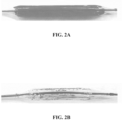
- FIG. 2 exemplifies the difference between the present invention and the current state of the art with respect to catheters and drug coated balloons.
- Catheter A contains a nylon balloon coated with a lipophilic blue dye, designed to mimic the CRC-015 compound ( FIG. 2A ).
- Catheter B was a similar balloon to that used in Catheter A, but was first coated with a releasing layer comprised of human serum albumin, followed by the same amount of blue dye used on Catheter A ( FIG. 2B ). Both balloons were expanded while suspended in a static 0.9% NaCl solution. Catheter B was removed from the solution after 30 minutes while Catheter A was allowed to soak for 24 hours. Catheter B releasing layer proved very effective in causing prompt release of the hydrophobic material, as evidenced in FIG. 2B .
Landscapes
- Health & Medical Sciences (AREA)
- Life Sciences & Earth Sciences (AREA)
- Animal Behavior & Ethology (AREA)
- General Health & Medical Sciences (AREA)
- Public Health (AREA)
- Veterinary Medicine (AREA)
- Epidemiology (AREA)
- Chemical & Material Sciences (AREA)
- Medicinal Chemistry (AREA)
- Pharmacology & Pharmacy (AREA)
- Engineering & Computer Science (AREA)
- Immunology (AREA)
- Molecular Biology (AREA)
- Biomedical Technology (AREA)
- Bioinformatics & Cheminformatics (AREA)
- Transplantation (AREA)
- Chemical Kinetics & Catalysis (AREA)
- General Chemical & Material Sciences (AREA)
- Nuclear Medicine, Radiotherapy & Molecular Imaging (AREA)
- Organic Chemistry (AREA)
- Materials For Medical Uses (AREA)
- Pharmaceuticals Containing Other Organic And Inorganic Compounds (AREA)
- Media Introduction/Drainage Providing Device (AREA)
- Medicinal Preparation (AREA)
Claims (8)
- Dispositif d'élution d'un médicament comprenant une couche primaire contenant une couche de matériau soluble dans l'eau et une couche de médicament en plusieurs parties ayant une première partie et une deuxième partie, dans lequel la première partie comprend un composé immunosuppresseur triène macrocyclique et la deuxième partie comprend au moins un excipient exempt de polymère, dans lequel l'excipient exempt de polymère est un alcool gras, ou un aldéhyde gras, ou un acide gras, ou un tensioactif non ionique, le dispositif étant un cathéter à ballonnet éluant un médicament.
- Dispositif selon la revendication 1, dans lequel le matériau soluble dans l'eau est une protéine de sérum globulaire ayant un poids moléculaire entre 65 et 70 kD.
- Dispositif selon la revendication 1 ou la revendication 2, dans lequel le matériau soluble dans l'eau est de l'albumine de sérum humain.
- Dispositif selon l'une des revendications 1 à 3, dans lequel le composé immunosuppresseur triène macrocyclique possède la structure suivante :

- Dispositif selon la revendication 4, dans lequel C(O)-(CH2)n-X possède l'une des structures suivantes :


- Dispositif selon l'une des revendications 1 à 5, dans lequel le composé triène macrocyclique est la rapamycine, l'évorolimus, le zotarolimus, le biolimus ou le temsirolimus.
- Dispositif selon l'une des revendications 1 à 6, dans lequel l'excipient exempt de polymère est un alcool gras, ou un aldéhyde gras, ou un acide gras, ou un tensioactif non ionique linéaire, contenant au moins 12 atomes de carbone.
- Procédé de fabrication d'un cathéter à ballonnet éluant un médicament selon l'une des revendications 1 à 7 comprenant : (a) la fourniture d'un cathéter à ballonnet, de préférence un cathéter à ballonnet capable d'être expansé radialement une fois gonflé ; (b) l'alimentation par une solution aqueuse d'un excipient soluble dans l'eau comprenant de préférence environ 10 % à environ 30 % d'excipient soluble dans l'eau dans une solution d'eau; (c) le revêtement par trempage du dispositif dans la solution de (b) ; (d) le fait de laisser sécher le dispositif revêtu par trempage ; (e) l'application d'une solution comprenant un composé immunosuppresseur triène macrocyclique et au moins un alcool gras saturé, un excipient exempt de polymère au dispositif de (d) ; et (f) le fait de laisser sécher le dispositif de (e).
Applications Claiming Priority (2)
| Application Number | Priority Date | Filing Date | Title |
|---|---|---|---|
| US201662437685P | 2016-12-22 | 2016-12-22 | |
| PCT/EP2017/083614 WO2018114992A1 (fr) | 2016-12-22 | 2017-12-19 | Revêtements libérant un médicament pour dispositifs médicaux et procédés pour les produire |
Publications (2)
| Publication Number | Publication Date |
|---|---|
| EP3558407A1 EP3558407A1 (fr) | 2019-10-30 |
| EP3558407B1 true EP3558407B1 (fr) | 2023-03-15 |
Family
ID=60702806
Family Applications (2)
| Application Number | Title | Priority Date | Filing Date |
|---|---|---|---|
| EP17816872.0A Active EP3558407B1 (fr) | 2016-12-22 | 2017-12-19 | Revêtements libérant un médicament pour dispositifs médicaux et procédés pour les produire |
| EP17818136.8A Active EP3558408B1 (fr) | 2016-12-22 | 2017-12-19 | Matériaux d'administration de médicament intratumorale et procédés de traitement du cancer du sein |
Family Applications After (1)
| Application Number | Title | Priority Date | Filing Date |
|---|---|---|---|
| EP17818136.8A Active EP3558408B1 (fr) | 2016-12-22 | 2017-12-19 | Matériaux d'administration de médicament intratumorale et procédés de traitement du cancer du sein |
Country Status (5)
| Country | Link |
|---|---|
| US (2) | US11826492B2 (fr) |
| EP (2) | EP3558407B1 (fr) |
| JP (1) | JP7118061B2 (fr) |
| CN (1) | CN109996569B (fr) |
| WO (2) | WO2018114992A1 (fr) |
Families Citing this family (3)
| Publication number | Priority date | Publication date | Assignee | Title |
|---|---|---|---|---|
| WO2019019043A1 (fr) * | 2017-07-26 | 2019-01-31 | 鼎科医疗技术(苏州)有限公司 | Ballonnet d'enrobage de médicament liquéfié en surface |
| WO2022023416A1 (fr) * | 2020-07-29 | 2022-02-03 | Biotronik Ag | Dispositifs médicaux et procédés d'enrobage de médicaments par microsphères |
| CN114949552A (zh) * | 2022-05-13 | 2022-08-30 | 上海畅德医疗科技有限公司 | 一种具有功能化药物涂层的药囊导管及其制备方法和应用 |
Family Cites Families (34)
| Publication number | Priority date | Publication date | Assignee | Title |
|---|---|---|---|---|
| WO1991019529A1 (fr) * | 1990-06-15 | 1991-12-26 | Cortrak Medical, Inc. | Appareil et procede d'acheminement de medicament |
| US6515009B1 (en) | 1991-09-27 | 2003-02-04 | Neorx Corporation | Therapeutic inhibitor of vascular smooth muscle cells |
| CN1052915C (zh) * | 1995-11-27 | 2000-05-31 | 中国医学科学院生物医学工程研究所 | 用于携载基因的蛋白质涂层医用载体及其制作方法 |
| GB9606452D0 (en) | 1996-03-27 | 1996-06-05 | Sandoz Ltd | Organic compounds |
| US6258121B1 (en) | 1999-07-02 | 2001-07-10 | Scimed Life Systems, Inc. | Stent coating |
| PT1300396E (pt) * | 2000-06-12 | 2009-04-20 | Eisai R&D Man Co Ltd | Compostos de 1,2-di-hidropiridina, processos para a sua preparação e sua utilização |
| US7771468B2 (en) * | 2001-03-16 | 2010-08-10 | Angiotech Biocoatings Corp. | Medicated stent having multi-layer polymer coating |
| US6939376B2 (en) * | 2001-11-05 | 2005-09-06 | Sun Biomedical, Ltd. | Drug-delivery endovascular stent and method for treating restenosis |
| US20040224003A1 (en) | 2003-02-07 | 2004-11-11 | Schultz Robert K. | Drug formulations for coating medical devices |
| US7901451B2 (en) * | 2004-09-24 | 2011-03-08 | Biosensors International Group, Ltd. | Drug-delivery endovascular stent and method for treating restenosis |
| US8124127B2 (en) * | 2005-10-15 | 2012-02-28 | Atrium Medical Corporation | Hydrophobic cross-linked gels for bioabsorbable drug carrier coatings |
| US20070104753A1 (en) * | 2005-11-04 | 2007-05-10 | Aiden Flanagan | Medical device with a coating comprising an active form and an inactive form of therapeutic agent(s) |
| US20070264303A1 (en) | 2006-05-12 | 2007-11-15 | Liliana Atanasoska | Coating for medical devices comprising an inorganic or ceramic oxide and a therapeutic agent |
| US20080175887A1 (en) * | 2006-11-20 | 2008-07-24 | Lixiao Wang | Treatment of Asthma and Chronic Obstructive Pulmonary Disease With Anti-proliferate and Anti-inflammatory Drugs |
| US8414525B2 (en) | 2006-11-20 | 2013-04-09 | Lutonix, Inc. | Drug releasing coatings for medical devices |
| WO2008079983A1 (fr) * | 2006-12-21 | 2008-07-03 | Vanderbilt University | Libération de protéines à partir de matériaux de greffes tissulaires |
| EP2262547B1 (fr) | 2008-03-06 | 2013-01-09 | Boston Scientific Scimed, Inc. | Dispositifs de cathéter à ballonnet avec un polymère gonflable dans un solvant |
| CN101264351B (zh) * | 2008-04-07 | 2011-08-24 | 易生科技(北京)有限公司 | 复合涂层心血管药物洗脱支架及其制备方法 |
| US20090258924A1 (en) * | 2008-04-15 | 2009-10-15 | Allergan, Inc. | METHODS, COMPOSITIONS AND DRUG DELIVERY SYSTEMS FOR INTRAOCULAR DELIVERY OF siRNA MOLECULES |
| US8128951B2 (en) * | 2008-09-15 | 2012-03-06 | Cv Ingenuity Corp. | Local delivery of water-soluble or water-insoluble therapeutic agents to the surface of body lumens |
| US20100285085A1 (en) | 2009-05-07 | 2010-11-11 | Abbott Cardiovascular Systems Inc. | Balloon coating with drug transfer control via coating thickness |
| RU2573045C2 (ru) * | 2009-06-02 | 2016-01-20 | Консепт Медикал Инк. | Медицинское устройство, доставляющее лекарственное средство, способ его получения и способ доставки лекарственного средства |
| US20100324645A1 (en) | 2009-06-17 | 2010-12-23 | John Stankus | Drug coated balloon catheter and pharmacokinetic profile |
| CN101943334A (zh) | 2009-07-03 | 2011-01-12 | 富准精密工业(深圳)有限公司 | 灯具 |
| WO2013007273A1 (fr) * | 2011-07-08 | 2013-01-17 | Cardionovum Sp.Z.O.O. | Revêtement superficiel pour ballonnets |
| WO2013091722A1 (fr) * | 2011-12-23 | 2013-06-27 | Innora Gmbh | Dispositifs médicaux enduits d'un médicament |
| AU2013266238B2 (en) * | 2012-05-23 | 2017-07-27 | The Ohio State University | Lipid-coated albumin nanoparticle compositions and methods of making and method of using the same |
| US9408884B2 (en) * | 2012-06-08 | 2016-08-09 | Biotronik Ag | Rapamycin 40-O-cyclic hydrocarbon esters, compositions and methods |
| US20140221961A1 (en) * | 2013-02-07 | 2014-08-07 | Vascular Nanotransfer Technologies LLC | Insertable medical device for delivering nano-carriers of mitomycin (and its analogues) to a target site, and methods for preparing and using the same |
| CN103566418B (zh) * | 2013-08-13 | 2016-01-20 | 重庆大学 | 一种多层涂层药物洗脱血管支架的制备方法 |
| CN104174074B (zh) * | 2013-11-27 | 2016-05-18 | 浙江归创医疗器械有限公司 | 一种适用于涂在植入或介入医疗器械表面的药物涂层组合物 |
| US10525171B2 (en) * | 2014-01-24 | 2020-01-07 | The Spectranetics Corporation | Coatings for medical devices |
| US9474834B2 (en) * | 2014-04-11 | 2016-10-25 | Abbott Cardiovascular Systems Inc. | Stent with albumin coating for enhanced thromboresistance |
| SG11201900602XA (en) * | 2016-09-19 | 2019-02-27 | Biotronik Ag | Polymer-free drug eluting vascular stents |
-
2017
- 2017-12-19 EP EP17816872.0A patent/EP3558407B1/fr active Active
- 2017-12-19 US US16/465,937 patent/US11826492B2/en active Active
- 2017-12-19 EP EP17818136.8A patent/EP3558408B1/fr active Active
- 2017-12-19 US US16/465,787 patent/US20190358369A1/en not_active Abandoned
- 2017-12-19 JP JP2019527453A patent/JP7118061B2/ja active Active
- 2017-12-19 CN CN201780072288.5A patent/CN109996569B/zh active Active
- 2017-12-19 WO PCT/EP2017/083614 patent/WO2018114992A1/fr not_active Ceased
- 2017-12-19 WO PCT/EP2017/083609 patent/WO2018114989A1/fr not_active Ceased
Also Published As
| Publication number | Publication date |
|---|---|
| JP7118061B2 (ja) | 2022-08-15 |
| US20200030498A1 (en) | 2020-01-30 |
| WO2018114992A1 (fr) | 2018-06-28 |
| US11826492B2 (en) | 2023-11-28 |
| EP3558408B1 (fr) | 2024-04-17 |
| JP2020501641A (ja) | 2020-01-23 |
| EP3558407A1 (fr) | 2019-10-30 |
| EP3558408C0 (fr) | 2024-04-17 |
| EP3558408A1 (fr) | 2019-10-30 |
| CN109996569A (zh) | 2019-07-09 |
| CN109996569B (zh) | 2022-05-03 |
| US20190358369A1 (en) | 2019-11-28 |
| WO2018114989A1 (fr) | 2018-06-28 |
Similar Documents
| Publication | Publication Date | Title |
|---|---|---|
| JP7277489B2 (ja) | 医療装置のための薬物放出コーティング | |
| JP6756664B2 (ja) | 薬剤を分散させるための医療器具 | |
| EP1087801B1 (fr) | Inhibiteurs de topoisomerase permettant de prevenir la restenose | |
| JP5741576B2 (ja) | 薬物送達医療機器 | |
| JP6038912B2 (ja) | シロリムスを制御放出するためのシロリムスコーティングされたカテーテルバルーンを有するバルーンカテーテル | |
| US20130245570A1 (en) | Progesterone-containing compositions and devices | |
| JP6270165B2 (ja) | 水不溶性治療剤を組み込む組成物およびデバイスならびにその使用方法 | |
| CN111166942A (zh) | 用于非血管狭窄的药物涂层球囊导管 | |
| AU2010252545B2 (en) | Re-establishment of blood flow in blocked human arteries by transferring nano-encapsulated drug through medical devices, designed for the same and releasing the nano- encapsulated drug in human artery with body pH | |
| JP7074747B2 (ja) | ポリマーフリー薬剤溶出型血管ステント | |
| JP2015526183A (ja) | 弁形成のためのバルーン表面被覆 | |
| US20190358369A1 (en) | Drug releasing coatings for medical devices and methods of making same | |
| WO2005049021A1 (fr) | Substances et procedes pour inhiber l'hyperplasie neointime | |
| US20230364016A1 (en) | Intracranial drug delivery materials and methods | |
| Yamamoto et al. | Preclinical evaluation of a paclitaxel-incorporated nanoparticle-coated balloon in rabbit and porcine models |
Legal Events
| Date | Code | Title | Description |
|---|---|---|---|
| STAA | Information on the status of an ep patent application or granted ep patent |
Free format text: STATUS: UNKNOWN |
|
| STAA | Information on the status of an ep patent application or granted ep patent |
Free format text: STATUS: THE INTERNATIONAL PUBLICATION HAS BEEN MADE |
|
| PUAI | Public reference made under article 153(3) epc to a published international application that has entered the european phase |
Free format text: ORIGINAL CODE: 0009012 |
|
| STAA | Information on the status of an ep patent application or granted ep patent |
Free format text: STATUS: REQUEST FOR EXAMINATION WAS MADE |
|
| 17P | Request for examination filed |
Effective date: 20190315 |
|
| AK | Designated contracting states |
Kind code of ref document: A1 Designated state(s): AL AT BE BG CH CY CZ DE DK EE ES FI FR GB GR HR HU IE IS IT LI LT LU LV MC MK MT NL NO PL PT RO RS SE SI SK SM TR |
|
| AX | Request for extension of the european patent |
Extension state: BA ME |
|
| DAV | Request for validation of the european patent (deleted) | ||
| DAX | Request for extension of the european patent (deleted) | ||
| STAA | Information on the status of an ep patent application or granted ep patent |
Free format text: STATUS: EXAMINATION IS IN PROGRESS |
|
| 17Q | First examination report despatched |
Effective date: 20201022 |
|
| GRAP | Despatch of communication of intention to grant a patent |
Free format text: ORIGINAL CODE: EPIDOSNIGR1 |
|
| STAA | Information on the status of an ep patent application or granted ep patent |
Free format text: STATUS: GRANT OF PATENT IS INTENDED |
|
| INTG | Intention to grant announced |
Effective date: 20221010 |
|
| GRAS | Grant fee paid |
Free format text: ORIGINAL CODE: EPIDOSNIGR3 |
|
| GRAA | (expected) grant |
Free format text: ORIGINAL CODE: 0009210 |
|
| STAA | Information on the status of an ep patent application or granted ep patent |
Free format text: STATUS: THE PATENT HAS BEEN GRANTED |
|
| AK | Designated contracting states |
Kind code of ref document: B1 Designated state(s): AL AT BE BG CH CY CZ DE DK EE ES FI FR GB GR HR HU IE IS IT LI LT LU LV MC MK MT NL NO PL PT RO RS SE SI SK SM TR |
|
| REG | Reference to a national code |
Ref country code: CH Ref legal event code: EP Ref country code: GB Ref legal event code: FG4D |
|
| REG | Reference to a national code |
Ref country code: DE Ref legal event code: R096 Ref document number: 602017066864 Country of ref document: DE |
|
| REG | Reference to a national code |
Ref country code: IE Ref legal event code: FG4D |
|
| REG | Reference to a national code |
Ref country code: AT Ref legal event code: REF Ref document number: 1553621 Country of ref document: AT Kind code of ref document: T Effective date: 20230415 |
|
| REG | Reference to a national code |
Ref country code: LT Ref legal event code: MG9D |
|
| P01 | Opt-out of the competence of the unified patent court (upc) registered |
Effective date: 20230614 |
|
| REG | Reference to a national code |
Ref country code: NL Ref legal event code: MP Effective date: 20230315 |
|
| PG25 | Lapsed in a contracting state [announced via postgrant information from national office to epo] |
Ref country code: RS Free format text: LAPSE BECAUSE OF FAILURE TO SUBMIT A TRANSLATION OF THE DESCRIPTION OR TO PAY THE FEE WITHIN THE PRESCRIBED TIME-LIMIT Effective date: 20230315 Ref country code: NO Free format text: LAPSE BECAUSE OF FAILURE TO SUBMIT A TRANSLATION OF THE DESCRIPTION OR TO PAY THE FEE WITHIN THE PRESCRIBED TIME-LIMIT Effective date: 20230615 Ref country code: LV Free format text: LAPSE BECAUSE OF FAILURE TO SUBMIT A TRANSLATION OF THE DESCRIPTION OR TO PAY THE FEE WITHIN THE PRESCRIBED TIME-LIMIT Effective date: 20230315 Ref country code: LT Free format text: LAPSE BECAUSE OF FAILURE TO SUBMIT A TRANSLATION OF THE DESCRIPTION OR TO PAY THE FEE WITHIN THE PRESCRIBED TIME-LIMIT Effective date: 20230315 Ref country code: HR Free format text: LAPSE BECAUSE OF FAILURE TO SUBMIT A TRANSLATION OF THE DESCRIPTION OR TO PAY THE FEE WITHIN THE PRESCRIBED TIME-LIMIT Effective date: 20230315 |
|
| REG | Reference to a national code |
Ref country code: AT Ref legal event code: MK05 Ref document number: 1553621 Country of ref document: AT Kind code of ref document: T Effective date: 20230315 |
|
| PG25 | Lapsed in a contracting state [announced via postgrant information from national office to epo] |
Ref country code: SE Free format text: LAPSE BECAUSE OF FAILURE TO SUBMIT A TRANSLATION OF THE DESCRIPTION OR TO PAY THE FEE WITHIN THE PRESCRIBED TIME-LIMIT Effective date: 20230315 Ref country code: NL Free format text: LAPSE BECAUSE OF FAILURE TO SUBMIT A TRANSLATION OF THE DESCRIPTION OR TO PAY THE FEE WITHIN THE PRESCRIBED TIME-LIMIT Effective date: 20230315 Ref country code: GR Free format text: LAPSE BECAUSE OF FAILURE TO SUBMIT A TRANSLATION OF THE DESCRIPTION OR TO PAY THE FEE WITHIN THE PRESCRIBED TIME-LIMIT Effective date: 20230616 Ref country code: FI Free format text: LAPSE BECAUSE OF FAILURE TO SUBMIT A TRANSLATION OF THE DESCRIPTION OR TO PAY THE FEE WITHIN THE PRESCRIBED TIME-LIMIT Effective date: 20230315 |
|
| PG25 | Lapsed in a contracting state [announced via postgrant information from national office to epo] |
Ref country code: SM Free format text: LAPSE BECAUSE OF FAILURE TO SUBMIT A TRANSLATION OF THE DESCRIPTION OR TO PAY THE FEE WITHIN THE PRESCRIBED TIME-LIMIT Effective date: 20230315 Ref country code: RO Free format text: LAPSE BECAUSE OF FAILURE TO SUBMIT A TRANSLATION OF THE DESCRIPTION OR TO PAY THE FEE WITHIN THE PRESCRIBED TIME-LIMIT Effective date: 20230315 Ref country code: PT Free format text: LAPSE BECAUSE OF FAILURE TO SUBMIT A TRANSLATION OF THE DESCRIPTION OR TO PAY THE FEE WITHIN THE PRESCRIBED TIME-LIMIT Effective date: 20230717 Ref country code: ES Free format text: LAPSE BECAUSE OF FAILURE TO SUBMIT A TRANSLATION OF THE DESCRIPTION OR TO PAY THE FEE WITHIN THE PRESCRIBED TIME-LIMIT Effective date: 20230315 Ref country code: EE Free format text: LAPSE BECAUSE OF FAILURE TO SUBMIT A TRANSLATION OF THE DESCRIPTION OR TO PAY THE FEE WITHIN THE PRESCRIBED TIME-LIMIT Effective date: 20230315 Ref country code: CZ Free format text: LAPSE BECAUSE OF FAILURE TO SUBMIT A TRANSLATION OF THE DESCRIPTION OR TO PAY THE FEE WITHIN THE PRESCRIBED TIME-LIMIT Effective date: 20230315 Ref country code: AT Free format text: LAPSE BECAUSE OF FAILURE TO SUBMIT A TRANSLATION OF THE DESCRIPTION OR TO PAY THE FEE WITHIN THE PRESCRIBED TIME-LIMIT Effective date: 20230315 |
|
| PG25 | Lapsed in a contracting state [announced via postgrant information from national office to epo] |
Ref country code: SK Free format text: LAPSE BECAUSE OF FAILURE TO SUBMIT A TRANSLATION OF THE DESCRIPTION OR TO PAY THE FEE WITHIN THE PRESCRIBED TIME-LIMIT Effective date: 20230315 Ref country code: PL Free format text: LAPSE BECAUSE OF FAILURE TO SUBMIT A TRANSLATION OF THE DESCRIPTION OR TO PAY THE FEE WITHIN THE PRESCRIBED TIME-LIMIT Effective date: 20230315 Ref country code: IS Free format text: LAPSE BECAUSE OF FAILURE TO SUBMIT A TRANSLATION OF THE DESCRIPTION OR TO PAY THE FEE WITHIN THE PRESCRIBED TIME-LIMIT Effective date: 20230715 |
|
| REG | Reference to a national code |
Ref country code: DE Ref legal event code: R097 Ref document number: 602017066864 Country of ref document: DE |
|
| PLBE | No opposition filed within time limit |
Free format text: ORIGINAL CODE: 0009261 |
|
| STAA | Information on the status of an ep patent application or granted ep patent |
Free format text: STATUS: NO OPPOSITION FILED WITHIN TIME LIMIT |
|
| PG25 | Lapsed in a contracting state [announced via postgrant information from national office to epo] |
Ref country code: SI Free format text: LAPSE BECAUSE OF FAILURE TO SUBMIT A TRANSLATION OF THE DESCRIPTION OR TO PAY THE FEE WITHIN THE PRESCRIBED TIME-LIMIT Effective date: 20230315 Ref country code: DK Free format text: LAPSE BECAUSE OF FAILURE TO SUBMIT A TRANSLATION OF THE DESCRIPTION OR TO PAY THE FEE WITHIN THE PRESCRIBED TIME-LIMIT Effective date: 20230315 |
|
| 26N | No opposition filed |
Effective date: 20231218 |
|
| PG25 | Lapsed in a contracting state [announced via postgrant information from national office to epo] |
Ref country code: IT Free format text: LAPSE BECAUSE OF FAILURE TO SUBMIT A TRANSLATION OF THE DESCRIPTION OR TO PAY THE FEE WITHIN THE PRESCRIBED TIME-LIMIT Effective date: 20230315 |
|
| PG25 | Lapsed in a contracting state [announced via postgrant information from national office to epo] |
Ref country code: LU Free format text: LAPSE BECAUSE OF NON-PAYMENT OF DUE FEES Effective date: 20231219 |
|
| PG25 | Lapsed in a contracting state [announced via postgrant information from national office to epo] |
Ref country code: MC Free format text: LAPSE BECAUSE OF FAILURE TO SUBMIT A TRANSLATION OF THE DESCRIPTION OR TO PAY THE FEE WITHIN THE PRESCRIBED TIME-LIMIT Effective date: 20230315 |
|
| REG | Reference to a national code |
Ref country code: BE Ref legal event code: MM Effective date: 20231231 |
|
| PG25 | Lapsed in a contracting state [announced via postgrant information from national office to epo] |
Ref country code: MC Free format text: LAPSE BECAUSE OF FAILURE TO SUBMIT A TRANSLATION OF THE DESCRIPTION OR TO PAY THE FEE WITHIN THE PRESCRIBED TIME-LIMIT Effective date: 20230315 Ref country code: LU Free format text: LAPSE BECAUSE OF NON-PAYMENT OF DUE FEES Effective date: 20231219 |
|
| REG | Reference to a national code |
Ref country code: IE Ref legal event code: MM4A |
|
| PG25 | Lapsed in a contracting state [announced via postgrant information from national office to epo] |
Ref country code: IE Free format text: LAPSE BECAUSE OF NON-PAYMENT OF DUE FEES Effective date: 20231219 |
|
| PG25 | Lapsed in a contracting state [announced via postgrant information from national office to epo] |
Ref country code: BE Free format text: LAPSE BECAUSE OF NON-PAYMENT OF DUE FEES Effective date: 20231231 |
|
| PG25 | Lapsed in a contracting state [announced via postgrant information from national office to epo] |
Ref country code: IE Free format text: LAPSE BECAUSE OF NON-PAYMENT OF DUE FEES Effective date: 20231219 Ref country code: BE Free format text: LAPSE BECAUSE OF NON-PAYMENT OF DUE FEES Effective date: 20231231 |
|
| PG25 | Lapsed in a contracting state [announced via postgrant information from national office to epo] |
Ref country code: BG Free format text: LAPSE BECAUSE OF FAILURE TO SUBMIT A TRANSLATION OF THE DESCRIPTION OR TO PAY THE FEE WITHIN THE PRESCRIBED TIME-LIMIT Effective date: 20230315 |
|
| PG25 | Lapsed in a contracting state [announced via postgrant information from national office to epo] |
Ref country code: BG Free format text: LAPSE BECAUSE OF FAILURE TO SUBMIT A TRANSLATION OF THE DESCRIPTION OR TO PAY THE FEE WITHIN THE PRESCRIBED TIME-LIMIT Effective date: 20230315 |
|
| REG | Reference to a national code |
Ref country code: DE Ref legal event code: R082 Ref document number: 602017066864 Country of ref document: DE Representative=s name: WSL PATENTANWAELTE PARTNERSCHAFT MBB, DE |
|
| PG25 | Lapsed in a contracting state [announced via postgrant information from national office to epo] |
Ref country code: CY Free format text: LAPSE BECAUSE OF FAILURE TO SUBMIT A TRANSLATION OF THE DESCRIPTION OR TO PAY THE FEE WITHIN THE PRESCRIBED TIME-LIMIT; INVALID AB INITIO Effective date: 20171219 |
|
| PG25 | Lapsed in a contracting state [announced via postgrant information from national office to epo] |
Ref country code: HU Free format text: LAPSE BECAUSE OF FAILURE TO SUBMIT A TRANSLATION OF THE DESCRIPTION OR TO PAY THE FEE WITHIN THE PRESCRIBED TIME-LIMIT; INVALID AB INITIO Effective date: 20171219 |
|
| PG25 | Lapsed in a contracting state [announced via postgrant information from national office to epo] |
Ref country code: TR Free format text: LAPSE BECAUSE OF FAILURE TO SUBMIT A TRANSLATION OF THE DESCRIPTION OR TO PAY THE FEE WITHIN THE PRESCRIBED TIME-LIMIT Effective date: 20230315 |
|
| REG | Reference to a national code |
Ref country code: CH Ref legal event code: U11 Free format text: ST27 STATUS EVENT CODE: U-0-0-U10-U11 (AS PROVIDED BY THE NATIONAL OFFICE) Effective date: 20260101 |
|
| PGFP | Annual fee paid to national office [announced via postgrant information from national office to epo] |
Ref country code: GB Payment date: 20251219 Year of fee payment: 9 |
|
| PGFP | Annual fee paid to national office [announced via postgrant information from national office to epo] |
Ref country code: FR Payment date: 20251229 Year of fee payment: 9 |
|
| PGFP | Annual fee paid to national office [announced via postgrant information from national office to epo] |
Ref country code: DE Payment date: 20251216 Year of fee payment: 9 |
|
| PGFP | Annual fee paid to national office [announced via postgrant information from national office to epo] |
Ref country code: CH Payment date: 20260101 Year of fee payment: 9 |