EP3559258B1 - Procédé pour déterminer une teneur en adn foetal libre et dispositif pour mettre en oeuvre ce procédé - Google Patents
Procédé pour déterminer une teneur en adn foetal libre et dispositif pour mettre en oeuvre ce procédé Download PDFInfo
- Publication number
- EP3559258B1 EP3559258B1 EP17879950.8A EP17879950A EP3559258B1 EP 3559258 B1 EP3559258 B1 EP 3559258B1 EP 17879950 A EP17879950 A EP 17879950A EP 3559258 B1 EP3559258 B1 EP 3559258B1
- Authority
- EP
- European Patent Office
- Prior art keywords
- dna
- sequences
- cell
- content
- sequencing
- Prior art date
- Legal status (The legal status is an assumption and is not a legal conclusion. Google has not performed a legal analysis and makes no representation as to the accuracy of the status listed.)
- Active
Links
Images
Classifications
-
- C—CHEMISTRY; METALLURGY
- C12—BIOCHEMISTRY; BEER; SPIRITS; WINE; VINEGAR; MICROBIOLOGY; ENZYMOLOGY; MUTATION OR GENETIC ENGINEERING
- C12Q—MEASURING OR TESTING PROCESSES INVOLVING ENZYMES, NUCLEIC ACIDS OR MICROORGANISMS; COMPOSITIONS OR TEST PAPERS THEREFOR; PROCESSES OF PREPARING SUCH COMPOSITIONS; CONDITION-RESPONSIVE CONTROL IN MICROBIOLOGICAL OR ENZYMOLOGICAL PROCESSES
- C12Q1/00—Measuring or testing processes involving enzymes, nucleic acids or microorganisms; Compositions therefor; Processes of preparing such compositions
- C12Q1/68—Measuring or testing processes involving enzymes, nucleic acids or microorganisms; Compositions therefor; Processes of preparing such compositions involving nucleic acids
- C12Q1/6813—Hybridisation assays
- C12Q1/6827—Hybridisation assays for detection of mutation or polymorphism
-
- C—CHEMISTRY; METALLURGY
- C12—BIOCHEMISTRY; BEER; SPIRITS; WINE; VINEGAR; MICROBIOLOGY; ENZYMOLOGY; MUTATION OR GENETIC ENGINEERING
- C12Q—MEASURING OR TESTING PROCESSES INVOLVING ENZYMES, NUCLEIC ACIDS OR MICROORGANISMS; COMPOSITIONS OR TEST PAPERS THEREFOR; PROCESSES OF PREPARING SUCH COMPOSITIONS; CONDITION-RESPONSIVE CONTROL IN MICROBIOLOGICAL OR ENZYMOLOGICAL PROCESSES
- C12Q1/00—Measuring or testing processes involving enzymes, nucleic acids or microorganisms; Compositions therefor; Processes of preparing such compositions
- C12Q1/68—Measuring or testing processes involving enzymes, nucleic acids or microorganisms; Compositions therefor; Processes of preparing such compositions involving nucleic acids
- C12Q1/6869—Methods for sequencing
-
- C—CHEMISTRY; METALLURGY
- C12—BIOCHEMISTRY; BEER; SPIRITS; WINE; VINEGAR; MICROBIOLOGY; ENZYMOLOGY; MUTATION OR GENETIC ENGINEERING
- C12Q—MEASURING OR TESTING PROCESSES INVOLVING ENZYMES, NUCLEIC ACIDS OR MICROORGANISMS; COMPOSITIONS OR TEST PAPERS THEREFOR; PROCESSES OF PREPARING SUCH COMPOSITIONS; CONDITION-RESPONSIVE CONTROL IN MICROBIOLOGICAL OR ENZYMOLOGICAL PROCESSES
- C12Q1/00—Measuring or testing processes involving enzymes, nucleic acids or microorganisms; Compositions therefor; Processes of preparing such compositions
- C12Q1/68—Measuring or testing processes involving enzymes, nucleic acids or microorganisms; Compositions therefor; Processes of preparing such compositions involving nucleic acids
- C12Q1/6876—Nucleic acid products used in the analysis of nucleic acids, e.g. primers or probes
- C12Q1/6883—Nucleic acid products used in the analysis of nucleic acids, e.g. primers or probes for diseases caused by alterations of genetic material
-
- C—CHEMISTRY; METALLURGY
- C40—COMBINATORIAL TECHNOLOGY
- C40B—COMBINATORIAL CHEMISTRY; LIBRARIES, e.g. CHEMICAL LIBRARIES
- C40B40/00—Libraries per se, e.g. arrays, mixtures
- C40B40/04—Libraries containing only organic compounds
- C40B40/06—Libraries containing nucleotides or polynucleotides, or derivatives thereof
- C40B40/08—Libraries containing RNA or DNA which encodes proteins, e.g. gene libraries
-
- G—PHYSICS
- G16—INFORMATION AND COMMUNICATION TECHNOLOGY [ICT] SPECIALLY ADAPTED FOR SPECIFIC APPLICATION FIELDS
- G16B—BIOINFORMATICS, i.e. INFORMATION AND COMMUNICATION TECHNOLOGY [ICT] SPECIALLY ADAPTED FOR GENETIC OR PROTEIN-RELATED DATA PROCESSING IN COMPUTATIONAL MOLECULAR BIOLOGY
- G16B20/00—ICT specially adapted for functional genomics or proteomics, e.g. genotype-phenotype associations
- G16B20/10—Ploidy or copy number detection
-
- G—PHYSICS
- G16—INFORMATION AND COMMUNICATION TECHNOLOGY [ICT] SPECIALLY ADAPTED FOR SPECIFIC APPLICATION FIELDS
- G16B—BIOINFORMATICS, i.e. INFORMATION AND COMMUNICATION TECHNOLOGY [ICT] SPECIALLY ADAPTED FOR GENETIC OR PROTEIN-RELATED DATA PROCESSING IN COMPUTATIONAL MOLECULAR BIOLOGY
- G16B30/00—ICT specially adapted for sequence analysis involving nucleotides or amino acids
-
- G—PHYSICS
- G16—INFORMATION AND COMMUNICATION TECHNOLOGY [ICT] SPECIALLY ADAPTED FOR SPECIFIC APPLICATION FIELDS
- G16B—BIOINFORMATICS, i.e. INFORMATION AND COMMUNICATION TECHNOLOGY [ICT] SPECIALLY ADAPTED FOR GENETIC OR PROTEIN-RELATED DATA PROCESSING IN COMPUTATIONAL MOLECULAR BIOLOGY
- G16B30/00—ICT specially adapted for sequence analysis involving nucleotides or amino acids
- G16B30/10—Sequence alignment; Homology search
-
- C—CHEMISTRY; METALLURGY
- C12—BIOCHEMISTRY; BEER; SPIRITS; WINE; VINEGAR; MICROBIOLOGY; ENZYMOLOGY; MUTATION OR GENETIC ENGINEERING
- C12Q—MEASURING OR TESTING PROCESSES INVOLVING ENZYMES, NUCLEIC ACIDS OR MICROORGANISMS; COMPOSITIONS OR TEST PAPERS THEREFOR; PROCESSES OF PREPARING SUCH COMPOSITIONS; CONDITION-RESPONSIVE CONTROL IN MICROBIOLOGICAL OR ENZYMOLOGICAL PROCESSES
- C12Q2535/00—Reactions characterised by the assay type for determining the identity of a nucleotide base or a sequence of oligonucleotides
- C12Q2535/122—Massive parallel sequencing
-
- C—CHEMISTRY; METALLURGY
- C12—BIOCHEMISTRY; BEER; SPIRITS; WINE; VINEGAR; MICROBIOLOGY; ENZYMOLOGY; MUTATION OR GENETIC ENGINEERING
- C12Q—MEASURING OR TESTING PROCESSES INVOLVING ENZYMES, NUCLEIC ACIDS OR MICROORGANISMS; COMPOSITIONS OR TEST PAPERS THEREFOR; PROCESSES OF PREPARING SUCH COMPOSITIONS; CONDITION-RESPONSIVE CONTROL IN MICROBIOLOGICAL OR ENZYMOLOGICAL PROCESSES
- C12Q2563/00—Nucleic acid detection characterized by the use of physical, structural and functional properties
- C12Q2563/159—Microreactors, e.g. emulsion PCR or sequencing, droplet PCR, microcapsules, i.e. non-liquid containers with a range of different permeability's for different reaction components
Definitions
- the present invention relates to the field of noninvasive prenatal gene testing using high-through sequencing technologies. Particularly, the present application relates to a method for determining the content of cell-free fetal DNA in maternal peripheral blood.
- the current noninvasive prenatal gene testing is carried out by collecting maternal peripheral blood, extracting cell-free plasma DNA contained therein, performing the next generation high-through sequencing and bioinformatics analysis, and finally evaluating the risk of developing chromosomal aneuploidy (such as trisomy 21 (T21) which is also called Down's syndrome, trisomy 18, and trisomy 13) in a fetus.
- chromosomal aneuploidy such as trisomy 21 (T21) which is also called Down's syndrome, trisomy 18, and trisomy 13
- the cell-free DNA present in the maternal peripheral plasma as small fragments with an average length of 166bp.
- the content of cell-free DNA in the plasma is very low, generally is only nanograms per milliliter of blood plasma.
- the content of cell-free DNA originating from a fetus is even lower, which only accounts for 3%-6% of the total cell-free DNA (this ratio increases slowly along with the gestation weeks).
- the half-life of the cell-free fetal DNA is very short, which is around 16 minutes, thus it cannot be detected in the maternal peripheral blood obtained 2 hours after normal delivery. This property of rapid degradation of the cell-free fetal DNA makes it an optimal material for noninvasive prenatal testing.
- the cell-free fetal DNA is 20% and the cell-free maternal DNA per se is 80%, for simplicity, assuming it is 10 copies of DNA in total, thus, in the peripheral blood plasma of a woman bearing a normal fetus, the cell-free DNA of chromosome 21 is 10 copies, wherein 2 copies originate from the fetus, and 8 copies originate from the woman. On the other side, for a woman bearing a T21 fetus, it can be calculated that there are 11 copies of cell-free DNA for chromosome 21, wherein 3 copies originate from the fetus, and 8 copies originate from the woman.
- the ratio of cell-free DNA of chromosome 21 between the woman bearing a T21 fetus and the woman bearing a normal fetus is 11:10.
- the ratio of cell-free DNA of chromosome 21 between the woman bearing a T21 fetus and the woman bearing a normal fetus is 10.25:10. Accordingly, without isolating cell-free DNA originated from the fetus, it can be determined that generally there is a small increment in the total content of cell-free DNA of chromosome 21 in the peripheral plasma from a woman bearing a T21 fetus. Theoretically, by distinguishing such small increment, cffDNA can be used for prenatal detection of chromosomal abnormality in a fetus.
- the content of cell-free fetal DNA directly affects the ratio of chromosomes to be detected, thereby affecting the accuracy of the noninvasive prenatal testing eventually.
- the content of cell-free fetal DNA is an important factor contributing to the accuracy of detection.
- the detection results may be false negative or false positive.
- Yu et al found that the size of cell-free DNA fragment derived from the fetus is generally shorter than that derived from the mother, and further verified that the size ratio of shorter fragments (100-150bp) and longer fragments (163-169p) is linearly correlated with the content of cell-free fetal DNA by performing high-throughput paired-end sequencing and calculating the distribution of the cell-free DNA fragments in plasma (see Yu, S.C. et al., Size-based molecular diagnostics using plasma DNA for noninvasive prenatal testing, Proc Natl Acad Sci U S A, 2014, 111(23):8538-8588 ).
- the content of cell-free fetal DNA is a key determinant to evaluate the reliability of a noninvasive prenatal testing.
- the inventors propose an effective method of determining the content of cell-free fetal DNA by high-throughput single-end sequencing.
- the high-throughput single-end sequencing has certain probability to simultaneously detect both ends of a double strand DNA fragment derived from the same DNA molecule.
- the probability of detecting both ends of the same fragment by a single-end sequencing can be calculated as follows:
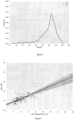
- paired-end sequencing data can be obtained from the single-end sequencing results (Example 1 and Figure 1 ), thereby the size distribution of plasma DNA fragment can be calculated according to the localization of the paired-end sequence in the genome, which enables efficient calculation of the content of cell-free fetal DNA.
- the present invention provides a method for determining the content of cell-free fetal DNA in a maternal peripheral blood sample, comprising:
- said step (1) comprises: extracting plasma DNA from the maternal peripheral blood, constructing a library and performing high-throughput single-end sequencing using said library to obtain resulting sequences.
- reads of the high-throughput single-end sequencing is shorter than the size of cell-free fetal DNA, preferably shorter than 166p, more preferably is from 30bp to 50bp.
- the construction of a library is free of PCR amplification, which enables the library finally used in sequencing to keep the sample DNA in original condition without introducing any DNA sequence modification caused by PCR (such as mutation) and will not dilute valid data.
- constructing a library without PCR amplification ensures the accuracy of the sequencing data, shortens the time needed for constructing a library and saves cost.
- each sample has at least 4M resulting sequences.
- the ratio between the number of nucleotide sequences anchored on a chip and the number of loaded DNA molecules during sequencing is at least 0.1%. This ratio also represents the ratio between the number of molecules that can be detected and the total number of loaded molecules. If this ratio is less than 0.1%, the probability of detecting both ends of a DNA would not be high, thereby sufficient paired-end data cannot be obtained from the single-end sequencing results to calculate the size of detected DNA fragments.
- the relationship between the content of cell-free fetal DNA and the size distribution of plasma DNA fragments is obtained by linear fitting the size distribution of plasma DNA fragments and the cell-free DNA content in a male fetus.
- the content of cell-free fetal DNA can be easily calculated based on the percentage of chromosome Y sequence reads relative to the reads aligned to autosomes (chrY%).
- the size distribution of plasma DNA fragments refers to the ratio between the fragments with a size of 100-150bp and the fragments with a size of 163-169bp.
- the present invention provides a device for determining the content of cell-free fetal DNA in a maternal peripheral blood sample, comprising:
- the detection module of the present invention is any platform that can be used for high-throughput single-end sequencing known in the art, for example, cBot instrument from Illumina, Genome Analyzer or NextSeq CN500 sequencer from Illumina, or sequencer of SOLiD series from ABI.
- the alignment module of the present invention includes various alignment softwares known by one skilled in the art, such as Bowtie, Bowtie2, BWA, Subread and the like.
- modules or some steps of the invention as described above can be achieved by common computing devices. They can be assembled on a single computing device, or be arranged on an internet comprising multiple computing devices. Optionally, they can be realized by executing program codes in computing devices. Thus, they can be stored in a storing device and executed by a computing device, or can be made in several integrated circuit modules respectively. Alternatively, multiple modules or steps can be realized by making them into a single integrated circuit module. Therefore, the present invention is not limited to any combination of specific hardware and software.
- the present invention evaluates the reliability of said prenatal testing by determining the content of cell-free fetal DNA.
- the method of the invention does not require any other experimental operation to provide an important index for assessing the reliability of the prenatal testing.
- Step 1 DNA extraction. About 5ng plasma DNA was extracted from the maternal peripheral blood.
- Step 3 Linker ligation.
- the reaction mixture was prepared as follows by adding additional reaction agents into the solution obtained in step 2: Table 2 Plasma DNA (from step 2) 50 ⁇ l Reaction buffer for quick ligation (10X) 10 ⁇ l DNA linker 2 ⁇ l Quick T4 DNA ligase (NEB) 1 ⁇ l Sterile H 2 O 37 ⁇ l Total volume 100 ⁇ l
- the mixture was placed in a 20°C warm bath for 15min, and then transferred to a 65°C warm bath for additional 10min, and finally was kept at 4°C.
- the ligated plasma DNA was recovered using Beckman Ampure XP beads and eluted with 22 ⁇ l sterile dH 2 O or an elution buffer, so as to obtain a library.
- the DNA linkers used in this step includes a fist-end linker and a second-end linker, which have different labels.
- Step 4 Quantification of the library and mixing. 1 ⁇ l prepared library was taken for qPCR quantification, and a concentration higher than or equal to 20pM means the quality of the library is good. According to arrangement of channels, 96 libraries with different linkers in the same channel were mixed with equal amount. 1 ⁇ l mixed samples was used for qPCR quantification.
- Step 5 Sequencing.
- the mixed library was diluted to 2.5pmol/L based on the above qPCR quantification results.
- 1.3mL sample was loaded according to the instructions of NextSeq CN50 to perform a 36bp paired-end sequencing.
- Step 6 Analysis of the sequencing results.
- the paired-end sequencing results were aligned to the reference human genome.
- the size of a DNA fragment was calculated as the subtraction result of the aligned positions of two ends of the same DNA fragment.
- the size distribution of DNA fragments was counted and plotted (see Figure 1 , PE). Sequences aligned to sex chromosomes and mitochondrion were excluded here.
- Step 7 Calculation of size distribution of DNA fragments using single-end data. Sequencing data from the first-end linker (similar results were obtained with sequencing data from the second-end linker) was extracted from the paired-end sequencing results based on different labels, which was further aligned to the human reference genome sequence, and the numbering as well as localization of each detected sequence in chromosomes were recorded. Two sequences which were aligned to the same chromosome with a relatively short distance (considering that the cell-free fetal DNA generally is shorter than 200bp and most has a size around 167bp, the selected distance herein was 200bp or less) were selected to calculate the size of DNA fragments.
- Sequences aligned to sex chromosomes and mitochondrion were excluded here. If the alignment orientation of the 36bp sequence is forward, then it is recorded as F, otherwise it is recorded as R. Two sequences aligned to a relatively short distance may come from the same DNA fragment (i.e. "paired-end" signal) or may be just two unrelated DNA fragments happened to have a close distribution distance (i.e. base event). If the signal comes from both ends of the same DNA fragment, the alignment orientations thereof should be opposite and direct inwards (recorded as FR). In other words, regarding the same reference sequence, the 36bp sequence aligned to the front part is forward, and that aligned to the later part is reverse.
- the base event in which DNA fragments were randomly distributed has no bias in alignment orientation.
- the base event has an even distribution among the 4 combinations of various alignment orientations of two sequences (i.e. FR, RF, FF, and RR).
- all events can be classified as four groups according to the alignment orientation of two 36bp sequences, wherein FR includes paired-end signals and base events, while RF, FF and RR only include base events, and the number of base events in FR, RF, FF and RR should be the same.
- the average number of RF, FF and RR can be counted to estimate the number of base events in FR, thereby obtaining the "paired-end” signal by subtracting the base events from the total FR events.
- the size distribution of fragments can be obtained by analysing said "paired-end” signal (see Figure 1 , SE).
- the size distribution of fragments directly obtained from the paired-end sequencing results of said sample generally is in line with that obtained from calculation based on single-end data in terms of overall trend, although the single-end data fluctuates largely relative to the paired-end sequencing results due to significantly smaller quantity of available data.
- the results show that, analysis based on single-end data of the invention can well represent the actual distribution of DNA fragments in maternal plasma.
- Example 2 The relationship of the content of cell-free fetal DNA with the size distribution of plasma DNA fragments calculated based on single-end sequencing results.
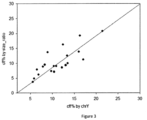
- the content of cell-free fetal DNA in 40 samples from female fetuses was calculated using the fitting parameters obtained in Example 2.
- the content of cell-free fetal DNA in 20 samples from male fetuses was calculated using the fitting parameters obtained in Example 2.
- Table 2 shows the content of cell-free fetal DNA cff% in each sample calculated using the method of the invention and the method of alignment to chromosome Y (ChrY).
- Table 2 Sample cff% calculated by ChrY cff% calculated by the present invention 15C44222 17.054 11.24 15C44663 12.439 16.224 15C54809 13.344 12.558 15C57852 6.508 7.836 15C61827 7.84 8.864 15C62515 10.883 8.979 15C63915 13.035 9.315 15C67942 13.474 10.01 15C68743 16.288 19.241 15C71040 5.843 4.87 15C79157 5.53 3.737 15C80858 21.437 20.744 15C81096 10.369 9.004 15C82765 10.407 7.114 15C82770 8.282 9.492 15C84218 16.022 13.88 15C84246 12.167 8.531 15C85236 8.94 13.705 15
Landscapes
- Life Sciences & Earth Sciences (AREA)
- Chemical & Material Sciences (AREA)
- Health & Medical Sciences (AREA)
- Proteomics, Peptides & Aminoacids (AREA)
- Organic Chemistry (AREA)
- Engineering & Computer Science (AREA)
- Physics & Mathematics (AREA)
- General Health & Medical Sciences (AREA)
- Analytical Chemistry (AREA)
- Bioinformatics & Cheminformatics (AREA)
- Molecular Biology (AREA)
- Genetics & Genomics (AREA)
- Wood Science & Technology (AREA)
- Zoology (AREA)
- Biophysics (AREA)
- Biotechnology (AREA)
- Biochemistry (AREA)
- General Engineering & Computer Science (AREA)
- Microbiology (AREA)
- Immunology (AREA)
- Spectroscopy & Molecular Physics (AREA)
- Bioinformatics & Computational Biology (AREA)
- Evolutionary Biology (AREA)
- Medical Informatics (AREA)
- Theoretical Computer Science (AREA)
- Pathology (AREA)
- Chemical Kinetics & Catalysis (AREA)
- General Chemical & Material Sciences (AREA)
- Medicinal Chemistry (AREA)
- Measuring Or Testing Involving Enzymes Or Micro-Organisms (AREA)
- Investigating Or Analysing Biological Materials (AREA)
Claims (12)
- Procédé pour déterminer la teneur en ADN foetal acellulaire dans un échantillon de sang périphérique maternel, comprenant :(1) la réalisation d'un séquençage à extrémité unique à haut débit sur des fragments d'ADN plasmatique extraits du sang périphérique maternel pour obtenir des séquences résultantes comprenant :(1.1) le remplissage d'extrémité et l'ajout d'une séquence poly-adénine ;(1.2) la ligature de lieurs d'ADN incluant un lieur de première extrémité et un lieur de seconde extrémité qui ont des marqueurs différents ;(1.3) le séquençage pour obtenir des lectures du séquençage à extrémité unique à haut débit de 36 pb ;(2) l'alignement desdites séquences résultantes avec un génome de référence humain pour déterminer la numérotation et la localisation de chaque séquence résultante dans un chromosome, dans lequel des séquences alignées sur des chromosomes sexuels et la mitochondrie sont exclues,dans lequel deux séquences qui sont alignées sur le même chromosome avec une distance relativement courte ont été sélectionnées pour calculer la taille des fragments d'ADN, dans lequel des séquences alignées sur des chromosomes sexuels et la mitochondrie sont exclues ;dans lequel, lorsque l'orientation d'alignement de la séquence est vers l'avant, alors elle est enregistrée comme F, sinon elle est enregistrée comme R ;dans lequel deux séquences alignées à une distance relativement courte soit proviennent du même fragment d'ADN soit sont deux fragments d'ADN non apparentés qui se trouvent avoir une distance de distribution proche, dans lequel deux séquences provenant du même fragment d'ADN sont un signal « à extrémité appariée » et deux séquences étant de l'ADN non apparenté sont un événement de base ;dans lequel, lorsque leurs orientations d'alignement sont opposées et dirigées vers l'intérieur, les deux séquences sont enregistrées comme FR, et l'événement de base a une distribution régulière parmi les 4 combinaisons d'orientations d'alignement de deux séquences, incluant FR, RF, FF et RR ;dans lequel FR inclut des signaux à extrémité appariée et des événements de base, et RF, FF et RR n'incluent que des événements de base, et le nombre d'événements de base dans FR, RF, FF et RR est le même ;dans lequel le nombre moyen de RF, FF et RR est compté pour estimer le nombre d'événements de base dans FR, obtenant ainsi le signal « à extrémité appariée » en soustrayant les événements de base du total d'événements FR ; et(3) la détermination de la distribution de taille des fragments d'ADN plasmatique sur la base des signaux « à extrémité appariée » et la détermination de la teneur en ADN foetal acellulaire sur la base de sa relation avec la distribution de taille d'ADN plasmatique.
- Procédé selon la revendication 1, dans lequel l'étape (1) comprend : l'extraction d'ADN plasmatique du sang périphérique maternel, la construction d'une banque et la réalisation d'un séquençage à extrémité unique à haut débit à l'aide de ladite banque pour obtenir des séquences résultantes.
- Procédé selon la revendication 2, caractérisé en ce que la construction de ladite banque est réalisée sans PCR.
- Procédé selon la revendication 1, caractérisé en ce que, l'échantillon a au moins 4 M de séquences résultantes.
- Procédé selon la revendication 1, caractérisé en ce que, le rapport entre le nombre de séquences nucléotidiques ancrées sur une puce et le nombre de molécules d'ADN chargées pendant le séquençage est d'au moins 0,1 %.
- Procédé selon la revendication 1, caractérisé en ce que, la relation de la teneur en ADN foetal acellulaire avec la distribution de taille des fragments d'ADN plasmatique est obtenue par ajustement linéaire de la distribution de taille des fragments d'ADN plasmatique et de la teneur en ADN foetal acellulaire chez un foetus mâle.
- Dispositif pour déterminer la teneur en ADN foetal acellulaire dans un échantillon de sang périphérique maternel, comprenant :- un module de détection, pour réaliser un séquençage à extrémité unique à haut débit sur des fragments d'ADN plasmatique extraits du sang périphérique maternel afin d'obtenir des séquences résultantes, dans lequel le module de détection est configuré pour réaliser :- (1.1) le remplissage d'extrémité et l'ajout de séquence poly-adénine ;- (1.2) la ligature de lieurs d'ADN incluant un lieur de première extrémité et un lieur de seconde extrémité qui ont des étiquettes différentes ;- (1.3) le séquençage pour obtenir des lectures du séquençage à extrémité unique à haut débit de 36 pb ;- un module d'alignement, pour aligner lesdites séquences résultantes avec un génome de référence humain afin de déterminer la numérotation et la localisation de chaque séquence résultante dans un chromosome, dans lequel les séquences alignées sur des chromosomes sexuels et la mitochondrie sont exclues,dans lequel deux séquences qui sont alignées sur le même chromosome avec une distance relativement courte ont été sélectionnées pour calculer la taille des fragments d'ADN, dans lequel des séquences alignées sur des chromosomes sexuels et la mitochondrie sont exclues ;dans lequel, lorsque l'orientation d'alignement de la séquence est vers l'avant, elle est enregistrée comme F, sinon elle est enregistrée comme R ;dans lequel deux séquences alignées à une distance relativement courte soit proviennent du même fragment d'ADN soit sont deux fragments d'ADN non apparentés qui se trouvent avoir une distance de distribution proche, dans lequel deux séquences provenant du même fragment d'ADN sont un signal « à extrémité appariée » et deux séquences étant de l'ADN non apparenté sont un événement de base ;dans lequel, lorsque leurs orientations d'alignement sont opposées et dirigées vers l'intérieur, les deux séquences sont enregistrées comme FR, et l'événement de base a une distribution régulière parmi les 4 combinaisons d'orientations d'alignement de deux séquences, incluant FR, RF, FF et RR ;dans lequel FR inclut des signaux à extrémité appariée et des événements de base, et RF, FF et RR n'incluent que des événements de base, et le nombre d'événements de base dans FR, RF, FF et RR est le même ;dans lequel le nombre moyen de RF, FF et RR est décompté pour estimer le nombre d'événements de base dans FR, obtenant ainsi le signal « à extrémité appariée » en soustrayant les événements de base du total d'événements FR ;- un module de calcul, pour déterminer une distribution de taille des fragments d'ADN plasmatique sur la base des signaux « à extrémité appariée », et pour déterminer la teneur en ADN foetal acellulaire sur la base de sa relation avec la distribution de taille d'ADN plasmatique ; et- un module de sortie, pour délivrer en sortie la teneur en ADN foetal acellulaire.
- Dispositif selon la revendication 7, dans lequel ledit séquençage à extrémité unique à haut débit comprend : l'extraction d'ADN plasmatique du sang périphérique maternel, la construction d'une banque et la réalisation d'un séquençage à extrémité unique à haut débit à l'aide de ladite banque pour obtenir des séquences résultantes.
- Dispositif selon la revendication 8, caractérisé en ce que la construction de ladite banque est réalisée sans PCR.
- Dispositif selon la revendication 7, caractérisé en ce que, l'échantillon a au moins 4 M de séquences résultantes.
- Dispositif selon la revendication 7, caractérisé en ce que, le rapport entre le nombre de séquences nucléotidiques ancrées sur une puce et le nombre de molécules d'ADN chargées pendant le séquençage est d'au moins 0,1 %.
- Dispositif selon la revendication 7, caractérisé en ce que, la relation de la teneur en ADN foetal acellulaire avec la distribution de taille d'ADN plasmatique est obtenue par ajustement linéaire de la distribution de taille d'ADN plasmatique et de la teneur en ADN foetal acellulaire chez un foetus mâle.
Applications Claiming Priority (2)
| Application Number | Priority Date | Filing Date | Title |
|---|---|---|---|
| CN201611153694.8A CN106591451B (zh) | 2016-12-14 | 2016-12-14 | 测定胎儿游离dna含量的方法及其用于实施该方法的装置 |
| PCT/CN2017/076826 WO2018107598A1 (fr) | 2016-12-14 | 2017-03-15 | Procédé pour déterminer une teneur en adn foetal libre et dispositif pour mettre en oeuvre ce procédé |
Publications (4)
| Publication Number | Publication Date |
|---|---|
| EP3559258A1 EP3559258A1 (fr) | 2019-10-30 |
| EP3559258A4 EP3559258A4 (fr) | 2020-07-08 |
| EP3559258C0 EP3559258C0 (fr) | 2025-02-26 |
| EP3559258B1 true EP3559258B1 (fr) | 2025-02-26 |
Family
ID=58802446
Family Applications (1)
| Application Number | Title | Priority Date | Filing Date |
|---|---|---|---|
| EP17879950.8A Active EP3559258B1 (fr) | 2016-12-14 | 2017-03-15 | Procédé pour déterminer une teneur en adn foetal libre et dispositif pour mettre en oeuvre ce procédé |
Country Status (4)
| Country | Link |
|---|---|
| US (1) | US11959128B2 (fr) |
| EP (1) | EP3559258B1 (fr) |
| CN (1) | CN106591451B (fr) |
| WO (1) | WO2018107598A1 (fr) |
Families Citing this family (4)
| Publication number | Priority date | Publication date | Assignee | Title |
|---|---|---|---|---|
| CN107622183B (zh) * | 2017-08-15 | 2021-04-09 | 上海派森诺生物科技股份有限公司 | 一种基于多重指标的胎儿染色体倍性检测分析方法 |
| WO2020020174A1 (fr) * | 2018-07-23 | 2020-01-30 | The Chinese University Of Hong Kong | Analyse de l'altération de l'adn acellulaire et ses applications cliniques |
| CN109461473B (zh) * | 2018-09-30 | 2019-12-17 | 北京优迅医疗器械有限公司 | 胎儿游离dna浓度获取方法和装置 |
| CN113270138B (zh) * | 2021-04-13 | 2023-09-22 | 杭州博圣医学检验实验室有限公司 | 基于生物信息学富集胎儿游离dna用于拷贝数变异的分析方法 |
Family Cites Families (6)
| Publication number | Priority date | Publication date | Assignee | Title |
|---|---|---|---|---|
| CA2780016C (fr) | 2009-11-06 | 2017-09-19 | The Chinese University Of Hong Kong | Analyse genomique basee sur la taille |
| CN102108406B (zh) * | 2010-12-20 | 2014-05-21 | 北京贝瑞和康生物技术有限公司 | 检测胚胎染色体拷贝数的试剂盒、装置和方法 |
| US9892230B2 (en) * | 2012-03-08 | 2018-02-13 | The Chinese University Of Hong Kong | Size-based analysis of fetal or tumor DNA fraction in plasma |
| US11242559B2 (en) | 2015-01-13 | 2022-02-08 | The Chinese University Of Hong Kong | Method of nuclear DNA and mitochondrial DNA analysis |
| CN104951671B (zh) | 2015-06-10 | 2017-09-19 | 东莞博奥木华基因科技有限公司 | 基于单样本外周血检测胎儿染色体非整倍性的装置 |
| CN106156543B (zh) * | 2016-06-22 | 2018-11-27 | 厦门艾德生物医药科技股份有限公司 | 一种肿瘤ctDNA信息统计方法 |
-
2016
- 2016-12-14 CN CN201611153694.8A patent/CN106591451B/zh active Active
-
2017
- 2017-03-15 US US16/469,102 patent/US11959128B2/en active Active
- 2017-03-15 EP EP17879950.8A patent/EP3559258B1/fr active Active
- 2017-03-15 WO PCT/CN2017/076826 patent/WO2018107598A1/fr not_active Ceased
Also Published As
| Publication number | Publication date |
|---|---|
| US20200080138A1 (en) | 2020-03-12 |
| US11959128B2 (en) | 2024-04-16 |
| EP3559258A4 (fr) | 2020-07-08 |
| WO2018107598A1 (fr) | 2018-06-21 |
| EP3559258C0 (fr) | 2025-02-26 |
| EP3559258A1 (fr) | 2019-10-30 |
| CN106591451A (zh) | 2017-04-26 |
| CN106591451B (zh) | 2020-06-23 |
Similar Documents
| Publication | Publication Date | Title |
|---|---|---|
| US20250215495A1 (en) | Noninvasive diagnosis of fetal aneuploidy by sequencing | |
| US9547748B2 (en) | Method for determining fetal chromosomal abnormality | |
| AU2022226186A1 (en) | Methods for detection of donor-derived cell-free dna in transplant recipients of multiple organs | |
| US20180371539A1 (en) | Method of detecting a pre-determined event in a nucleic acid sample and system thereof | |
| EP3564391B1 (fr) | Procédé, dispositif et kit pour la détection d'une mutation génétique chez un foetus | |
| EP3559258B1 (fr) | Procédé pour déterminer une teneur en adn foetal libre et dispositif pour mettre en oeuvre ce procédé | |
| Webb et al. | Non invasive prenatal diagnosis of aneuploidy: next generation sequencing or fetal DNA enrichment? | |
| AU2021200569B2 (en) | Noninvasive diagnosis of fetal aneuploidy by sequencing | |
| HK1177767A (en) | Noninvasive diagnosis of fetal aneuploidy by sequencing |
Legal Events
| Date | Code | Title | Description |
|---|---|---|---|
| STAA | Information on the status of an ep patent application or granted ep patent |
Free format text: STATUS: THE INTERNATIONAL PUBLICATION HAS BEEN MADE |
|
| PUAI | Public reference made under article 153(3) epc to a published international application that has entered the european phase |
Free format text: ORIGINAL CODE: 0009012 |
|
| STAA | Information on the status of an ep patent application or granted ep patent |
Free format text: STATUS: REQUEST FOR EXAMINATION WAS MADE |
|
| 17P | Request for examination filed |
Effective date: 20190708 |
|
| AK | Designated contracting states |
Kind code of ref document: A1 Designated state(s): AL AT BE BG CH CY CZ DE DK EE ES FI FR GB GR HR HU IE IS IT LI LT LU LV MC MK MT NL NO PL PT RO RS SE SI SK SM TR |
|
| AX | Request for extension of the european patent |
Extension state: BA ME |
|
| DAV | Request for validation of the european patent (deleted) | ||
| DAX | Request for extension of the european patent (deleted) | ||
| A4 | Supplementary search report drawn up and despatched |
Effective date: 20200608 |
|
| RIC1 | Information provided on ipc code assigned before grant |
Ipc: C12Q 1/6869 20180101ALI20200603BHEP Ipc: C40B 40/08 20060101ALI20200603BHEP Ipc: C12Q 1/68 20180101AFI20200603BHEP Ipc: C12Q 1/6883 20180101ALI20200603BHEP Ipc: G16B 20/10 20190101ALI20200603BHEP |
|
| STAA | Information on the status of an ep patent application or granted ep patent |
Free format text: STATUS: EXAMINATION IS IN PROGRESS |
|
| 17Q | First examination report despatched |
Effective date: 20210816 |
|
| RAP3 | Party data changed (applicant data changed or rights of an application transferred) |
Owner name: BERRY GENOMICS CO., LTD |
|
| P01 | Opt-out of the competence of the unified patent court (upc) registered |
Effective date: 20230601 |
|
| REG | Reference to a national code |
Ref country code: DE Ref legal event code: R079 Free format text: PREVIOUS MAIN CLASS: C12Q0001680000 Ipc: G16B0030100000 Ref document number: 602017088065 Country of ref document: DE |
|
| GRAP | Despatch of communication of intention to grant a patent |
Free format text: ORIGINAL CODE: EPIDOSNIGR1 |
|
| STAA | Information on the status of an ep patent application or granted ep patent |
Free format text: STATUS: GRANT OF PATENT IS INTENDED |
|
| RIC1 | Information provided on ipc code assigned before grant |
Ipc: C40B 40/08 20060101ALI20240917BHEP Ipc: C40B 40/18 20060101ALI20240917BHEP Ipc: G16B 20/10 20190101ALI20240917BHEP Ipc: C12Q 1/6883 20180101ALI20240917BHEP Ipc: C12Q 1/6869 20180101ALI20240917BHEP Ipc: G16B 30/10 20190101AFI20240917BHEP |
|
| INTG | Intention to grant announced |
Effective date: 20240926 |
|
| GRAS | Grant fee paid |
Free format text: ORIGINAL CODE: EPIDOSNIGR3 |
|
| GRAA | (expected) grant |
Free format text: ORIGINAL CODE: 0009210 |
|
| STAA | Information on the status of an ep patent application or granted ep patent |
Free format text: STATUS: THE PATENT HAS BEEN GRANTED |
|
| AK | Designated contracting states |
Kind code of ref document: B1 Designated state(s): AL AT BE BG CH CY CZ DE DK EE ES FI FR GB GR HR HU IE IS IT LI LT LU LV MC MK MT NL NO PL PT RO RS SE SI SK SM TR |
|
| REG | Reference to a national code |
Ref country code: GB Ref legal event code: FG4D |
|
| REG | Reference to a national code |
Ref country code: CH Ref legal event code: EP |
|
| REG | Reference to a national code |
Ref country code: DE Ref legal event code: R096 Ref document number: 602017088065 Country of ref document: DE |
|
| REG | Reference to a national code |
Ref country code: IE Ref legal event code: FG4D |
|
| U01 | Request for unitary effect filed |
Effective date: 20250321 |
|
| P04 | Withdrawal of opt-out of the competence of the unified patent court (upc) registered |
Free format text: CASE NUMBER: APP_19007/2025 Effective date: 20250421 |
|
| U07 | Unitary effect registered |
Designated state(s): AT BE BG DE DK EE FI FR IT LT LU LV MT NL PT RO SE SI Effective date: 20250424 |
|
| PG25 | Lapsed in a contracting state [announced via postgrant information from national office to epo] |
Ref country code: RS Free format text: LAPSE BECAUSE OF FAILURE TO SUBMIT A TRANSLATION OF THE DESCRIPTION OR TO PAY THE FEE WITHIN THE PRESCRIBED TIME-LIMIT Effective date: 20250526 |
|
| PG25 | Lapsed in a contracting state [announced via postgrant information from national office to epo] |
Ref country code: PL Free format text: LAPSE BECAUSE OF FAILURE TO SUBMIT A TRANSLATION OF THE DESCRIPTION OR TO PAY THE FEE WITHIN THE PRESCRIBED TIME-LIMIT Effective date: 20250226 |
|
| PG25 | Lapsed in a contracting state [announced via postgrant information from national office to epo] |
Ref country code: ES Free format text: LAPSE BECAUSE OF FAILURE TO SUBMIT A TRANSLATION OF THE DESCRIPTION OR TO PAY THE FEE WITHIN THE PRESCRIBED TIME-LIMIT Effective date: 20250226 |
|
| PG25 | Lapsed in a contracting state [announced via postgrant information from national office to epo] |
Ref country code: NO Free format text: LAPSE BECAUSE OF FAILURE TO SUBMIT A TRANSLATION OF THE DESCRIPTION OR TO PAY THE FEE WITHIN THE PRESCRIBED TIME-LIMIT Effective date: 20250526 Ref country code: IS Free format text: LAPSE BECAUSE OF FAILURE TO SUBMIT A TRANSLATION OF THE DESCRIPTION OR TO PAY THE FEE WITHIN THE PRESCRIBED TIME-LIMIT Effective date: 20250626 |
|
| PG25 | Lapsed in a contracting state [announced via postgrant information from national office to epo] |
Ref country code: HR Free format text: LAPSE BECAUSE OF FAILURE TO SUBMIT A TRANSLATION OF THE DESCRIPTION OR TO PAY THE FEE WITHIN THE PRESCRIBED TIME-LIMIT Effective date: 20250226 |
|
| PG25 | Lapsed in a contracting state [announced via postgrant information from national office to epo] |
Ref country code: GR Free format text: LAPSE BECAUSE OF FAILURE TO SUBMIT A TRANSLATION OF THE DESCRIPTION OR TO PAY THE FEE WITHIN THE PRESCRIBED TIME-LIMIT Effective date: 20250527 |
|
| U20 | Renewal fee for the european patent with unitary effect paid |
Year of fee payment: 9 Effective date: 20250617 |
|
| PG25 | Lapsed in a contracting state [announced via postgrant information from national office to epo] |
Ref country code: SM Free format text: LAPSE BECAUSE OF FAILURE TO SUBMIT A TRANSLATION OF THE DESCRIPTION OR TO PAY THE FEE WITHIN THE PRESCRIBED TIME-LIMIT Effective date: 20250226 |
|
| PG25 | Lapsed in a contracting state [announced via postgrant information from national office to epo] |
Ref country code: CZ Free format text: LAPSE BECAUSE OF FAILURE TO SUBMIT A TRANSLATION OF THE DESCRIPTION OR TO PAY THE FEE WITHIN THE PRESCRIBED TIME-LIMIT Effective date: 20250226 |
|
| REG | Reference to a national code |
Ref country code: CH Ref legal event code: H13 Free format text: ST27 STATUS EVENT CODE: U-0-0-H10-H13 (AS PROVIDED BY THE NATIONAL OFFICE) Effective date: 20251023 |
|
| PG25 | Lapsed in a contracting state [announced via postgrant information from national office to epo] |
Ref country code: SK Free format text: LAPSE BECAUSE OF FAILURE TO SUBMIT A TRANSLATION OF THE DESCRIPTION OR TO PAY THE FEE WITHIN THE PRESCRIBED TIME-LIMIT Effective date: 20250226 |
|
| PG25 | Lapsed in a contracting state [announced via postgrant information from national office to epo] |
Ref country code: MC Free format text: LAPSE BECAUSE OF FAILURE TO SUBMIT A TRANSLATION OF THE DESCRIPTION OR TO PAY THE FEE WITHIN THE PRESCRIBED TIME-LIMIT Effective date: 20250226 |
|
| PLBE | No opposition filed within time limit |
Free format text: ORIGINAL CODE: 0009261 |
|
| STAA | Information on the status of an ep patent application or granted ep patent |
Free format text: STATUS: NO OPPOSITION FILED WITHIN TIME LIMIT |
|
| PG25 | Lapsed in a contracting state [announced via postgrant information from national office to epo] |
Ref country code: CH Free format text: LAPSE BECAUSE OF NON-PAYMENT OF DUE FEES Effective date: 20250331 |
|
| PG25 | Lapsed in a contracting state [announced via postgrant information from national office to epo] |
Ref country code: IE Free format text: LAPSE BECAUSE OF NON-PAYMENT OF DUE FEES Effective date: 20250315 |
|
| GBPC | Gb: european patent ceased through non-payment of renewal fee |
Effective date: 20250526 |
|
| 26N | No opposition filed |
Effective date: 20251127 |
|
| U20 | Renewal fee for the european patent with unitary effect paid |
Year of fee payment: 10 Effective date: 20260217 |
|
| PG25 | Lapsed in a contracting state [announced via postgrant information from national office to epo] |
Ref country code: GB Free format text: LAPSE BECAUSE OF NON-PAYMENT OF DUE FEES Effective date: 20250526 |