EP3560108B1 - Mimo distribué et/ou diversité de transmission dans un système de réseau d'accès radio infonuagique - Google Patents
Mimo distribué et/ou diversité de transmission dans un système de réseau d'accès radio infonuagique Download PDFInfo
- Publication number
- EP3560108B1 EP3560108B1 EP17884470.0A EP17884470A EP3560108B1 EP 3560108 B1 EP3560108 B1 EP 3560108B1 EP 17884470 A EP17884470 A EP 17884470A EP 3560108 B1 EP3560108 B1 EP 3560108B1
- Authority
- EP
- European Patent Office
- Prior art keywords
- user equipment
- antenna ports
- items
- transmit
- downlink transmission
- Prior art date
- Legal status (The legal status is an assumption and is not a legal conclusion. Google has not performed a legal analysis and makes no representation as to the accuracy of the status listed.)
- Active
Links
Images



Classifications
-
- H—ELECTRICITY
- H04—ELECTRIC COMMUNICATION TECHNIQUE
- H04B—TRANSMISSION
- H04B7/00—Radio transmission systems, i.e. using radiation field
- H04B7/02—Diversity systems; Multi-antenna system, i.e. transmission or reception using multiple antennas
- H04B7/022—Site diversity; Macro-diversity
-
- H—ELECTRICITY
- H04—ELECTRIC COMMUNICATION TECHNIQUE
- H04B—TRANSMISSION
- H04B7/00—Radio transmission systems, i.e. using radiation field
- H04B7/02—Diversity systems; Multi-antenna system, i.e. transmission or reception using multiple antennas
- H04B7/04—Diversity systems; Multi-antenna system, i.e. transmission or reception using multiple antennas using two or more spaced independent antennas
- H04B7/0413—MIMO systems
- H04B7/0426—Power distribution
- H04B7/043—Power distribution using best eigenmode, e.g. beam forming or beam steering
-
- H—ELECTRICITY
- H04—ELECTRIC COMMUNICATION TECHNIQUE
- H04B—TRANSMISSION
- H04B7/00—Radio transmission systems, i.e. using radiation field
- H04B7/02—Diversity systems; Multi-antenna system, i.e. transmission or reception using multiple antennas
- H04B7/04—Diversity systems; Multi-antenna system, i.e. transmission or reception using multiple antennas using two or more spaced independent antennas
- H04B7/0413—MIMO systems
- H04B7/0456—Selection of precoding matrices or codebooks, e.g. using matrices antenna weighting
- H04B7/046—Selection of precoding matrices or codebooks, e.g. using matrices antenna weighting taking physical layer constraints into account
- H04B7/0465—Selection of precoding matrices or codebooks, e.g. using matrices antenna weighting taking physical layer constraints into account taking power constraints at power amplifier or emission constraints, e.g. constant modulus, into account
-
- H—ELECTRICITY
- H04—ELECTRIC COMMUNICATION TECHNIQUE
- H04B—TRANSMISSION
- H04B7/00—Radio transmission systems, i.e. using radiation field
- H04B7/02—Diversity systems; Multi-antenna system, i.e. transmission or reception using multiple antennas
- H04B7/04—Diversity systems; Multi-antenna system, i.e. transmission or reception using multiple antennas using two or more spaced independent antennas
- H04B7/0413—MIMO systems
- H04B7/0456—Selection of precoding matrices or codebooks, e.g. using matrices antenna weighting
- H04B7/0478—Special codebook structures directed to feedback optimisation
- H04B7/0481—Special codebook structures directed to feedback optimisation using subset selection of codebooks
-
- H—ELECTRICITY
- H04—ELECTRIC COMMUNICATION TECHNIQUE
- H04L—TRANSMISSION OF DIGITAL INFORMATION, e.g. TELEGRAPHIC COMMUNICATION
- H04L1/00—Arrangements for detecting or preventing errors in the information received
- H04L1/02—Arrangements for detecting or preventing errors in the information received by diversity reception
- H04L1/06—Arrangements for detecting or preventing errors in the information received by diversity reception using space diversity
- H04L1/0606—Space-frequency coding
-
- H—ELECTRICITY
- H04—ELECTRIC COMMUNICATION TECHNIQUE
- H04L—TRANSMISSION OF DIGITAL INFORMATION, e.g. TELEGRAPHIC COMMUNICATION
- H04L27/00—Modulated-carrier systems
- H04L27/26—Systems using multi-frequency codes
- H04L27/2601—Multicarrier modulation systems
- H04L27/2647—Arrangements specific to the receiver only
- H04L27/2655—Synchronisation arrangements
- H04L27/2668—Details of algorithms
- H04L27/2673—Details of algorithms characterised by synchronisation parameters
- H04L27/2675—Pilot or known symbols
-
- H—ELECTRICITY
- H04—ELECTRIC COMMUNICATION TECHNIQUE
- H04L—TRANSMISSION OF DIGITAL INFORMATION, e.g. TELEGRAPHIC COMMUNICATION
- H04L5/00—Arrangements affording multiple use of the transmission path
- H04L5/003—Arrangements for allocating sub-channels of the transmission path
- H04L5/0032—Distributed allocation, i.e. involving a plurality of allocating devices, each making partial allocation
- H04L5/0035—Resource allocation in a cooperative multipoint environment
-
- H—ELECTRICITY
- H04—ELECTRIC COMMUNICATION TECHNIQUE
- H04L—TRANSMISSION OF DIGITAL INFORMATION, e.g. TELEGRAPHIC COMMUNICATION
- H04L5/00—Arrangements affording multiple use of the transmission path
- H04L5/003—Arrangements for allocating sub-channels of the transmission path
- H04L5/0058—Allocation criteria
- H04L5/0073—Allocation arrangements that take into account other cell interferences
-
- H—ELECTRICITY
- H04—ELECTRIC COMMUNICATION TECHNIQUE
- H04W—WIRELESS COMMUNICATION NETWORKS
- H04W72/00—Local resource management
- H04W72/20—Control channels or signalling for resource management
- H04W72/23—Control channels or signalling for resource management in the downlink direction of a wireless link, i.e. towards a terminal
-
- G—PHYSICS
- G06—COMPUTING OR CALCULATING; COUNTING
- G06F—ELECTRIC DIGITAL DATA PROCESSING
- G06F17/00—Digital computing or data processing equipment or methods, specially adapted for specific functions
- G06F17/10—Complex mathematical operations
- G06F17/16—Matrix or vector computation, e.g. matrix-matrix or matrix-vector multiplication, matrix factorization
-
- H—ELECTRICITY
- H04—ELECTRIC COMMUNICATION TECHNIQUE
- H04L—TRANSMISSION OF DIGITAL INFORMATION, e.g. TELEGRAPHIC COMMUNICATION
- H04L5/00—Arrangements affording multiple use of the transmission path
Definitions
- LTE Long Term Evolution
- 3GPP 3rd Generation Partnership Project
- LTE supports multiple downlink transmission modes, most of which support downlink transmission using multiple antennas. Indeed, support for the use of multiple antennas is a core feature of LTE.
- these multiple-antenna LTE downlink transmission modes are performed using precoding.
- Precoding performs a matrix transformation of v sequences of symbols x into p sequences of symbols y, where v corresponds to the number of layers being used and p corresponds to the number of transmit antenna ports being used. The number of layers being used is also referred to as the "transmission rank.”
- One or two data code words are transmitted per layer.
- a precoder matrix W is used for precoding.
- the multiple-antenna LTE downlink transmission modes that employ precoding use either transmit diversity or spatial multiplexing.
- transmit diversity for example, LTE downlink transmission mode 2
- a single sequence of symbols is transmitted from multiple antennas.
- a single code word is sent.
- the precoding is done using a precoding matrix W specified by the LTE standards that is based on Space-Frequency Block Coding (SFBC).
- SFBC Space-Frequency Block Coding
- the precoding is done using a precoding matrix W specified by the LTE standards that is based on SFBC and Frequency-Shift Transmit Diversity (FSTD)
- a codebook is a table that comprises several predefined precoder matrices W that can be selected for use in precoding.
- CS-RS Cell specific reference symbols
- the UE uses the CS-RSs to generate channel state information (CSI) that is fed back to the eNodeB.
- This CSI includes a rank indicator (RI) and a precoder matrix indicator (PMI).
- RI indicates how many layers should be used for the current channel conditions
- PMI indicates which one of the predefined precoder matrices included in the codebook should be used for the current channel conditions.
- the precoding schemes used with such multiple-antenna LTE downlink transmission modes are not designed for use with a specific base station or radio access network configuration.
- the present invention relates to a method and system as defined by the independent claims 1 and 7, respectively.
- FIG. 1 is a block diagram illustrating one exemplary embodiment of a radio access network (RAN) 100 in which multiple-antenna downlink transmission modes can be implemented in a distributed manner.
- the RAN 100 is deployed at a site 102 to provide wireless coverage and capacity for one or more wireless network operators.
- the site 102 may be, for example, a building or campus or other grouping of buildings (used, for example, by one or more businesses, government, other enterprise entities) or some other public venue (such as a hotel, resort, amusement park, hospital, shopping center, airport, university campus, arena, or an outdoor area such as a ski area, stadium or a densely-populated downtown area).
- the RAN 100 at the site 102 is implemented at least in part using a point-to-multipoint distributed base station architecture that employs at least one central controller 104 and multiple radio points (RPs) 106.
- Each RP 106 includes or is coupled to one or more antennas 108 via which downlink RF signals are radiated to user equipment 110 and via which uplink RF signals transmitted by user equipment (UE) 110 are received.
- UE user equipment
- each RP 106 comprises two antennas 108.
- Each RP 106 can include or be coupled to a different number of antennas 108.
- the RAN 100 is coupled to the core network 112 of each wireless network operator over an appropriate back-haul.
- the Internet 114 is used for back-haul between the RAN 100 and each core network 112.
- the back-haul can be implemented in other ways.
- LTE Long Term Evolution
- eNodeB eNodeB
- eNB LTE Evolved Node B
- each core network 112 is implemented as an Evolved Packet Core (EPC) 112 comprising standard LTE EPC network elements such as, for example, a mobility management entity (MME) and a Serving Gateway (SGW) and, optionally, a Home eNodeB gateway (HeNB GW) and a Security Gateway (SeGW) (all of which are not shown in FIG. 1 ).
- EPC Evolved Packet Core
- each controller 104 communicates with the MME and SGW in the EPC core network 112 using the LTE S1 interface and communicates with other eNodeBs using the LTE X2 interface.
- the controller 104 communicates with an outdoor macro eNodeB (not shown) via the LTE X2 interface.
- the controller 104 and the radio points 106 can be implemented to use an air interface that supports one or more of frequency-division duplexing (FDD) and/or time-division duplexing (TDD). Also, the controller 104 and the radio points 106 can be implemented to use an air interface that supports one or more of the multiple-input-multiple-output (MIMO), single-input-single-output (SISO), single-input-multiple-output (SIMO), multiple-input-single-output (MISO), and/or beam forming schemes. For example, the controller 104 and the radio points 106 can implement one or more of the LTE transmission modes. Moreover, the controller 104 and/or the radio points 106 can be configured to support multiple air interfaces and/or to support multiple wireless operators.
- FDD frequency-division duplexing
- TDD time-division duplexing
- MIMO multiple-input-multiple-output
- SISO single-input-single-out
- the front-haul that communicatively couples each controller 104 to the one or more RPs 106 is implemented using a standard ETHERNET network 118.
- ETHERNET network 118 the front-haul between the controllers 104 and RPs 106 can be implemented in other ways.
- one or more nodes in a RAN perform analog radio frequency (RF) functions for the air interface as well as digital Layer 1, Layer 2, and Layer 3 (of the Open Systems Interconnection (OSI) model) functions for the air interface.
- RF radio frequency
- OSI Open Systems Interconnection
- each controller 104 includes one or more baseband modems (BBMs) (or other units) 120 that perform digital Layer-3, Layer-2, and Layer-1 processing for the LTE air interface
- each RP 106 includes (optionally) one or more Layer-1 units (not shown) that implements any Layer-1 processing for the air interface that is not performed in the controller 104 and one or more radio frequency (RF) circuits (not shown) that implement the RF front-end functions for the air interface and the one or more antennas 108 associated with that RP 106.
- BFMs baseband modems
- RF radio frequency
- the baseband modems 120 in the controllers 104 can be configured to perform all of the digital Layer-3, Layer-2, and Layer-1 processing for the air interface, while the RPs 106 (specifically, the RF circuits) implement only the RF functions for the air interface and the antennas 108 associated with each RP 106.
- IQ data representing time-domain symbols for the air interface is communicated between the controller 104 and the RPs 106. Communicating such time-domain IQ data typically requires a relatively high data rate front haul. This approach (communicating time-domain IQ data over the front haul) is suitable for those implementations where the front-haul ETHERNET network 118 is able to deliver the required high data rate.
- the front-haul ETHERNET network 118 is not able to deliver the data rate needed to front haul time-domain IQ data (for example, where the front-haul is implemented using typical enterprise-grade ETHERNET networks), this issue can be addressed by communicating IQ data representing frequency-domain symbols for the air interface between the CUs 104 and the RPs 106.
- This frequency-domain IQ data represents the symbols in the frequency domain before the inverse fast Fourier transform (IFFT) is performed.
- IFFT inverse fast Fourier transform
- the time-domain IQ data can be generated by quantizing the IQ data representing the frequency-domain symbols without guard band zeroes or any cyclic prefix and communicating the resulting compressed, quantized frequency-domain IQ data over the front-haul ETHERNET network 118. Additional details regarding this approach to communicating frequency-domain IQ data can be found in US Patent Application Serial No. 13/762,283, filed on February 7, 2013 , and titled "RADIO ACCESS NETWORKS,”.
- the baseband modems 120 in each controller 104 can be configured to perform all of the digital Layer-3, Layer-2, and Layer-1 processing for the air interface except for the inverse fast Fourier transform (IFFT) in the downlink and the fast Fourier transform (FFT) in the uplink.
- IFFT inverse fast Fourier transform
- FFT fast Fourier transform
- the Layer-1 functions in each RP 106 can be configured to implement the digital Layer-1 processing for the air interface that is not performed in the controller 104 (that is, the IFFT in the downlink and the FFT in the uplink).
- Data can be front-hauled between the controllers 104 and RPs 106 in other ways (for example, using front-haul interfaces and techniques specified in the Common Public Radio Interface (CPRI) and/or Open Base Station Architecture Initiative (OBSAI) family of specifications).
- CPRI Common Public Radio Interface
- OBSAI Open Base Station Architecture Initiative
- Each baseband modem 120 in the controller 104 provides the capacity of a single cellular sector.
- traditional base stations for example, with traditional small cell or distributed base stations
- the capacity provided by each baseband modem creates a separate cell, having a separate physical cell identifier associated with that cell and transmitting separate control and reference signals associated with that cell.
- the capacity provided by several baseband modems for example, in the form of several small cell base stations
- multiple overlapping cells are created with interference at cell borders. This happens even when there is a traditional central service controller that is coordinating multiple small cell base stations.
- the service controller can assist with network configuration and optimization, handovers, and backhaul aggregation, but does not address the issue that each baseband modem forms a separate, standalone cell and interferes with its neighboring separate, standalone cells.
- the signal quality in these overlap areas can drop significantly, reducing data speeds and impairing voice quality.
- creating multiple separate cells generates frequent handovers, for example, in the form of "ping-ponging" of stationery users in border areas, or as users move about the site. This further degrades the user experience and creates the potential for handover failures.
- each controller 104 includes a central coordinator 128 that performs central resource block scheduling for all of the baseband modems 120 across all of the RPs 106 and all of the user equipment 110 associated with those baseband modems 120.
- Frequency reuse techniques can be used to create virtual sectors within the single super cell 126, with different baseband modems 120 providing capacity to each of the virtual sectors.
- the central coordinator 128 can also serve as an aggregation point for data that is transmitted and received using multiple baseband modems 120 and multiple RPs 106.
- the central coordinator 128 can schedule multiple RPs 106 to jointly transmit to an individual UE 110, helping overcome an interfering macro signal without having to boost RP transmit power such that it would interfere with the macro. Similarly, the central coordinator 128 can schedule multiple RPs 106 to jointly receive uplink transmissions from a single UE 110, which are then combined at the controller 104 (either in the baseband modem 120 or in the central coordinator 128). This inter-RP uplink combining enables the UE 110 to transmit at a lower power, reducing its interference on the macro uplink. Additional details regarding the creation of such a super cell 126 can be found in US Patent Application Serial No. 13/762,283 , mentioned above.
- the baseband modems 120 and the central coordinator 128 in each controller 104 can be implemented in software or firmware executing on one or more suitable programmable processors.
- the baseband modems 120 and the central coordinator 128 in each controller 104 (or portions thereof) can be implemented in other ways (for example, in a field programmable gate array (FPGA), application specific integrated circuit (ASIC), etc.).
- the baseband modem 120 and the central coordinator 128 in each controller 104 can be implemented in other ways.
- one or more Layer-1 units (not shown) in each RP 106 can be implemented in software or firmware executing on one or more suitable programmable processors.
- the one or more Layer-1 units in each RP 106 (or portions thereof) can be implemented in other ways (for example, in a field programmable gate array (FPGA), application specific integrated circuit (ASIC), etc.).
- the one or more RF circuits in each RP 106 can be implemented using one or more RF integrated circuits (RFICs) and/or discrete components.
- RFICs RF integrated circuits
- the Layer-1 units and RF circuit in each RP 106 can be implemented in other ways.
- the common, single super cell 126 is created using baseband modems 120 from multiple controllers 104, where resource block scheduling is performed across all of the baseband modems 120 from the multiple controllers 104 (for example, using one or more of the central coordinators 128 in the controllers 104 and/or using a separate global coordinator).
- FIG. 1 makes use of a central coordinator 128 to create a super cell 126 as described above, it is to be understood that other embodiments are implemented in other ways (for example, where the controllers 104 do not include such a central coordinator 128 and instead such coordination functions are incorporated into each baseband modem 120).
- the controllers 104 may also include certain MME functionality (not shown) and SGW functionality (not shown), thus allowing traffic to flow directly between UE 110 and a destination node on the Internet 114 or on a local network at the site 102 without traversing an operator's core network 112.
- a management system 130 is communicatively coupled to the controllers 104 and RPs 106, for example, via the Internet 114 and ETHERNET network 118 (in the case of the RPs 106).
- the management system 130 communicates with the various elements of the RAN 100 using the Internet 114 and the ETHERNET network 118. Also, in some implementations, the management system 130 sends and receives management communications to and from the controllers 104, each of which in turn forwards relevant management communications to and from the RPs 106.
- the controller 104 and RPs 106 together are used to implement an LTE eNodeB.
- the controller 104 and RPs 106 are configured to implement the multiple-antenna LTE downlink transmission modes in a distributed manner.
- the multiple-antenna LTE downlink transmission modes are implemented in a "distributed" manner in the sense that the multiple antennas for a given logical eNodeB are not co-located with each other and, instead, are deployed using radio points 106 that are located remotely from each other.
- Each downlink transmission mode makes use of one or more "antenna ports,” which are logical entities that are distinguished by their reference signal sequences.
- each multiple-antenna downlink transmission mode makes use of multiple antenna ports.
- each antenna port as assigned to a respective one or more antenna 108 in the RAN 100.
- each antenna port can be assigned one of four antenna port indices (0, 1, 2, or 3).
- Each of the distributed antennas 108 in the RAN 100 can also be assigned one of four antenna indices (0, 1, 2, or 3), where each antenna index corresponds to a respective antenna port index for that transmission mode.
- the RPs 106 (and associated antennas 108) are physically arranged within the coverage area of the RAN 100 so that four adjacent antennas 108 will be assigned four different antenna indices. Also, the antennas 108 are assigned and arranged to minimize the number of antennas 108 with the same antenna index that are physically near each other.
- each RP 106 includes or is coupled to two antennas 108.
- each RP 106 is assigned a respective one of two RP indices (0 or 1), where the RPs assigned the RP index 0 are labelled "RP 0" and where the RPs assigned the RP index 1 are labelled as "RP 1.”
- the two antennas 108 associated with each RP 0 are assigned antenna indices 0 and 1, respectively, (and are labelled "antenna 0" and “antenna 1,” respectively), and the two antennas 108 associated with each RP 1 are assigned antenna indices 2 and 3, respectively, (and are labelled “antenna 2" and “antenna 3,” respectively).
- adjacent pairs of RPs 106 are assigned different RP indices so that the associated antennas 108 are assigned four different antenna
- the RPs 106 are arranged in a generally "checkerboard" pattern with RPs 106 assigned the first RP index alternating in both of two directions with RPs 106 assigned the second RP index.
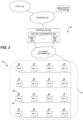
- FIG. 2 illustrates another example where each RP 106 includes or is coupled to a single antenna 108.
- each RP 106 is assigned a respective one of four RP indices (0, 1, 2, or 3), where the RPs 106 assigned the RP index 0 are labelled as "RP 0," the RPs 106 assigned the RP index 1 are labelled as "RP 1," the RPs 106 assigned the RP index 2 are labelled as "RP 2,” and the RPs 106 assigned the RP index 3 are labelled as "RP 3.”
- Each antenna 108 associated with each RP 0 is assigned antenna index 0 (and is labelled “antenna 0")
- each antenna 108 associated with each RP 1 is assigned antenna index 1 (and is labelled “antenna 1")
- each antenna 108 associated with each RP 2 is assigned antenna index 2 (and is labelled “antenna 2")
- each antenna 108 associated with each RP 3 is assigned antenna index 3 (and is labelled "antenna 3”
- These assignments can be made manually (for example, using the management system 130).
- receive power measurements of user-equipment transmissions are made at each RP 106 for many user-equipment positions. These power measurements are used to determine the antenna and radio point assignments.
- the controller 104 and the RPs 106 are made aware of the various assignments.
- a "simulcast group" for a given UE 110 is the set of RPs 106 and associated antennas 108 that are used to transmit downlink user data to that UE 110.
- the cell-specific reference symbols are radiated from all of the antennas 108 and RPs 106 in the RAN 100.
- the rank indicator (RI) that is, how many layers should be used for the current channel conditions
- the precoding matrix indicator (PMI) that is, which predefined precoder matrix included in the codebook should be used for the current channel conditions
- the user-plane data for each UE 110 is radiated from less than all of the antennas 108 and RPs 106. That is, the user-plane data for each UE 110 is only radiated from the antennas 108 and RPs 106 that are in that UE's simulcast group. This can result in bias when the user-plane transmissions are demodulated and decoded by each UE 110. This bias results from the difference between the composite RF channel under which each UE 110 receives the cell-specific reference symbols and the composite RF channel under which each UE 110 receives the user-plane transmissions.
- reuse refers to situations where two or more UEs 110 receive user-plane transmissions using the same resource elements in the same cell.
- one approach to supporting such reuse is to define simulcast groups that include the antennas 108 (and associated RPs 106) assigned to all of the antenna ports used by that downlink transmission mode. That is, where this type of reuse is being used with a downlink transmission mode that uses four antenna ports, each simulcast group for a UE 110 in reuse includes antennas 108 (and associated RPs 106) that are assigned to all four antenna ports.
- reuse can be used with a downlink transmission mode that uses four antenna ports where a first UE 110 is provided wireless service by a first simulcast group that includes a first pair of RPs 0 and 1 (and associated four antennas 0, 1, 2, and 3) and a second UE 110 is provided wireless service by a second simulcast group that includes a second pair of RPs 0 and 1 (and associated four antennas 0, 1, 2, and 3).
- Each UE is sufficiently physically separated from the antennas 108 of the other UE's simulcast group to enable such resource-element reuse.
- This first approach to reuse is also referred to here as "far" reuse.
- simulcast groups that include antennas 108 (and associated RPs 106) assigned to less than all of the antenna ports used by the multiple-antenna downlink transmission mode. For example, where reuse is being used with a downlink transmission mode that uses four antenna ports, each simulcast group can include physical antennas 108 (and associated RPs 106) assigned to two of the antenna ports.
- reuse can be used with a downlink transmission mode that uses four antenna ports where a first UE 110 is provided wireless service by a first simulcast group that includes a first RP 0 (and associated two antennas 0 and 1) and a second UE 110 is provided wireless service by a second simulcast group that includes RP 1 (and associated two antennas 2, and 3).
- Each UE 110 is sufficiently physically separated from the antennas 108 of the other UE's simulcast group to enable such resource-element reuse.
- This second approach to reuse is also referred to here as "near" reuse.
- near reuse can result in bias when the user-plane transmissions are demodulated and decoded by each UE 110. This bias results from the difference between the composite RF channel under which each UE 110 receives the cell-specific reference symbols and the composite RF channel under which each UE 110 receives the user-plane transmissions.
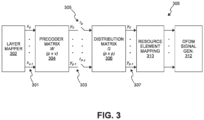
- FIG. 3 is a block diagram illustrating an exemplary embodiment of a scheme for addressing this issue with bias.
- the exemplary embodiment shown in FIG. 3 is described here as being implemented using the RAN 100 shown in FIG. 1 , though it is to be understood that other embodiments can be implemented in other ways (for example, using the example shown in FIG. 2 ).
- the scheme shown in FIG. 3 can implemented in the controller 104, the radio point 106, or both the controller 104 and the radio point 106. More specifically, the processing described here can be implemented at least in part in software or firmware (for example, by programming a programmable processor such as a general-purpose microprocessor or using a field programmable gate array (FPGA)). The processing can also be implemented at least in part in other ways (for example, implemented in discrete circuitry or using an application specification integrated circuit (ASIC)).
- ASIC application specification integrated circuit
- v sequences of symbols x 301 are received from the layer mapper 302 that performs standard LTE layer mapping (if necessary) for the selected LTE downlink transmission mode, where v corresponds to the number of layers being used.
- Standard LTE precoding of the sequences of symbols x 301 is performed for the selected LTE downlink transmission mode.
- This standard LTE precoding is performed using a precoder matrix W 304.
- the precoder matrix W 304 is a p ⁇ v matrix, where p corresponds to the number of transmit antenna ports being used for the selected LTE downlink transmission mode and again v corresponds to the number of layers being used.
- the result of performing the standard LTE precoding is p sequences of symbols y 303.
- a linear (matrix) transformation is performed on the resulting sequence of symbols y 303 resulting from the standard LTE precoding.
- This second matrix transformation is performed using a second matrix G 306.
- This second matrix transformation is also referred to here as the "distribution” transformation, and the second matrix G is also referred to here as the “distribution” matrix G.
- the distribution matrix G 306 is a p ⁇ p matrix, where again p is the number of transmit antenna ports being used for the selected LTE downlink transmission mode.
- the distribution matrix G 306 is configured to spatially distribute transmit power across the various transmit antenna ports being used for the associated downlink transmission mode.
- Some LTE downlink transmission modes employ closed-loop spatial multiplexing.
- cell-specific reference symbols (CS-RS) r 305 are inserted at the inputs to the distribution matrix G 306.
- the CSI including the RI and PMI
- the controller 104 reflects the transformation performed using the distribution matrix G 306.
- the result of performing the distribution transformation using the distribution matrix G 306 is p sequences of symbols y 307, where p corresponds to the number of transmit antenna ports being used for the selected LTE downlink transmission mode.
- the resulting sequences of symbols y 307 are then used for subsequent standard LTE processing 308 (for example, resource element mapping 310 and OFDM signal generation 312) in the controller 104 and/or radio points 106.
- the UEs 110 should be able to accurately measure the received power of reference symbols, independent of the location of each UE 110 and of the choice of reference symbols.
- the distribution matrix G is configured to be a unitary matrix and to have, for each column of the distribution G matrix, a significant (non-zero) gain for the entry associated with each antenna port. Not doing this would introduce correlations on the antenna ports and, as a result, lower throughput.
- the distribution matrix G is configured to steer the transmit power towards particular antenna ports (and associated RPs 106) when a particular precoder matrix is used. Doing this can be used to enable near reuse of the same resource elements by two or more UEs 110 in certain circumstances.
- the channel that is experienced by user-plane downlink transmissions to each of the UEs A and B is different from the channel experienced during transmission of the cell-specific reference symbols to each of the UEs A and B.
- the cell-specific reference symbols are transmitted to each UE A and B using all of the antennas ports (and associated antennas 108 and RPs 106), whereas user data is transmitted to UE A only from the specific RP 0 and associated antennas 0 and 1 in the simulcast group defined for UE A and user data is transmitted to UE B only from the specific RP 1 and associated antennas 2 and 3 in the simulcast group defined for UE B.
- the symbols that would normally be transmitted to UE A from RP 1 (and antennas 2 and 3) are not transmitted (that is, are "purged”).
- the symbols that would normally be transmitted to UE B from RP 0 (and antennas 0 and 1) are purged. This difference in the channel can result in bias error in the demodulation of the received symbols by UEs A and B.
- the distribution matrix G can be used to reduce or eliminate such bias during such near reuse of resource elements. This is done by using a distribution matrix G that is configured so that, for a given LTE downlink transmission mode, a first precoder matrix (having a corresponding PMI) in the associated codebook provides perfect steering of the transmit power to the antenna ports assigned to antennas 0 and 1 (and the associated RPs 0) and a second precoder matrix (having a corresponding PMI) in the associated codebook provides perfect steering of the transmit power to the antenna ports assigned to antennas 2 and 3 (and the associated RPs 1).
- a distribution matrix G that is configured so that, for a given LTE downlink transmission mode, a first precoder matrix (having a corresponding PMI) in the associated codebook provides perfect steering of the transmit power to the antenna ports assigned to antennas 0 and 1 (and the associated RPs 0) and a second precoder matrix (having a corresponding PMI) in the associated codebook provides perfect steering of the transmit power
- perfect steering to a given set of antenna ports refers to providing peak power to those antenna ports while providing no or extremely limited power to the other antenna ports (that is, the antenna ports that are not being steered to).
- perfect steering can be configured to provide 3dB higher power on each antenna port that is being steered to so that an output power (Pa) of -3dB can be used with peak transmit power.
- the controller 104 can be configured to determine if the two UEs A and B should be put into near reuse for some resource elements based on measurements of reference signals made at the UEs A and B and/or at the radio points 106.
- such determination can be made based on power measurements made by the radio points 106 and reported to the controller 104. These power measurements can be made based on Sounding Reference Signal (SRS) transmissions from the UEs 110.
- SRS Sounding Reference Signal
- the controller 104 can be configured to determine if the power measurements for the two UEs A and B indicate that it is appropriate for user-data downlink transmissions to one UE (UE A in this example) to use that first PMI (which perfectly steers to RP 0) and that it is appropriate for user-data downlink transmissions to the other UE (UE B in this example) to use the second PMI (which perfectly steers to RP 1). If the controller 104 determines that this is the case, the UEs A and B can be put into near reuse and the controller 104 uses the first PMI for user-data transmissions to UE A and uses the second PMI for user-data transmissions to UE B.
- the purging of the output symbols for the respective other RP does not cause any bias since peak power is already being provided on the antennas ports associated with the respective near RP and very little power is being provided on the antennas ports associated with the other RP. This results in improved transmission performance.
- the distribution matrix G can be configured to provide perfect steering to each RP 106 for a respective PMI for each of the one and two layer multiple-antenna LTE downlink transmission modes used in the RAN 100. These PMIs can be used to enable resource element reuse in more situations.
- the distribution matrix G can also be used to provide increased transmission performance for single-user transmission (that is, when near reuse is not be used for a UE).
- the distribution matrix G can be configured so that, for a given multiple-antenna downlink transmission mode, a precoder matrix (having a corresponding PMI) in the associated codebook distributes transmit power to all of the antenna ports used for the downlink transmission mode.
- a precoder matrix having a corresponding PMI
- the simulcast group defined for that UE 110 would include at least one RP 106 (with a relatively low path loss to the UE) that is associated with each of the antenna ports used for that downlink transmission mode.
- a precoder matrix (having a corresponding PMI) in the associated codebook distributes transmit power to all four antenna ports (and antennas 108 assigned all of the four antenna indices 0, 1, 2, and 3 and associated RPs 0 and 1) used for the downlink transmission mode.
- the simulcast group used for the UE C includes at least one RP that is associated each of the four antenna ports. That is, the simulcast group used for UE C includes at least one RP 0 (and the associated antennas 0 and 1) and at least one RP 1 (and the associated antennas 2, and 3).
- G sqrt 1 / 8 * ⁇ 1 + 1 i 1 ⁇ 1 i 1 + 1 i 1 + 1 i 1 ⁇ 1 i ⁇ 1 + 1 i 1 + 1 i 1 + 1 i 1 + 1 i 1 + 1 i 1 + 1 i 1 + 1 i 1 + 1 i 1 + 1 i 1 + 1 i 1 + 1 i 1 + 1 i 1 + 1 i 1 + 1 i 1 + 1 i 1 + 1 i 1 + 1 i 1 + 1 i 1 + 1 i 1 + 1 i 1 + 1 i 1 + 1 i 1 + 1 i 1 ⁇ 1 + 1 i 1 ⁇ 1 i 1 ⁇ 1 i
- the PMIs that provide perfect steering may result in excess power at the transmit antennas 108.
- This can be addressed using the referenceSignalPower (Pa) parameter defined by the LTE standard.
- the Pa parameter can be set to have the transmit power of resource elements carrying user data be the same as, greater than, or less than the transmit power of resource elements carrying the cell-specific reference signals.
- the controller 104 can use a referenceSignalPower (Pa) less than 0 dB (that is, Pa ⁇ 0 dB).
- Pa referenceSignalPower
- the controller 104 can be configured to monitor the receive power measurements for a UE 110 that are made at the radio points 106, to determine whether a UE 110 is a candidate for reuse, and to configure the referenceSignalPower (Pa) for the UE 110 accordingly.
- Pa referenceSignalPower
- the controller 104 performs both the precoding transformation and the distribution transformation and communicates the resulting the symbols y to the appropriate radio points 104 for subsequent LTE processing.
- the insertion of any CS-RSs is performed by the controller 104.
- Each symbol is associated with a respective transmit antenna port and is sent to the associated one or more radio points 106 in the simulcast group assigned to that UE 110.
- each radio point 106 performs the precoding transformation and the distribution transformation for the transmit antenna ports that are assigned to that radio point 106.
- the controller 104 communicates to each radio point 106 the input symbols x output by the layer mapper 302 and the RI and PMI feedback from the UE 110.
- Each radio point 106 generates the sequence of output symbols y for the transmit antenna ports assigned to that radio point 106 by performing both the precoding transformation and the distribution transformation (using, for example, a precoder matrix W304 and a distribution matrix G 306 implemented in that radio point 106).
- Each radio point 106 performs the insertion of any CS-RSs and the distribution transformation on the inserted CS-RSs (using, for example, a distribution matrix G 306 implemented in that radio point 106). Also, each radio point 106 performs the subsequent standard LTE processing 308.
- FIG. 4 is a flow diagram of one exemplary embodiment of a method 400 of transmitting data using a multiple-antenna downlink transmission mode with distributed antennas.
- the embodiment of method 400 shown in FIG. 4 is described here as being implemented in the RAN 100 shown in FIG. 1 . More specifically, the processing associated with method 400 is described here as being implemented by the controller 104 of the RAN 100. Also, in this exemplary embodiment, the distribution matrix G described above in connection with FIG. 3 can be used. It is to be understood that other embodiments can be implemented in other ways.
- Method 400 comprises performing linear transformations on sequences of precoded symbols using a distribution matrix G (block 402).
- the antenna ports used for the downlink transmission mode are divided into multiple disjoint subsets, where the number of subsets used is determined based on the number of UEs 110 that can be put into reuse to use the same one or more resource elements.
- the subsets are "disjoint" in that no antenna port is in both subsets.
- a first subset of the antenna ports includes antenna ports 0 and 1 and is associated with the RPs 106 assigned the RP index 0 and the antennas 108 assigned the antenna indices 0 and 1.
- a second subset of the antenna ports includes antenna ports 2 and 3 and is associated with the RPs 106 assigned the RP index 1 and the antennas 108 assigned the antenna indices 2 and 3.
- two UEs 110 that are in near reuse can be placed into far reuse with respect to one or more other UEs have high path loss with respect to those two UEs 110.
- the downlink transmission mode operates by precoding sequences of symbols using a precoder matrix selected from a codebook.
- the precoding produces sequences of precoded symbols.
- a respective sequence of precoded symbols is produced for each antenna port used for that downlink transmission mode.
- the system is configured to perform linear transformations on the sequences of precoded symbols using the distribution matrix G. If each sequence has N symbols, N linear transformations are performed using the distribution matrix G.
- the nth transformation is obtained as Gy, where vector y is a p ⁇ 1 vector, the kth element of which being the nth symbol in sequence k, and the nth transformation outputs vector y representing the p physical antenna output ports for the nth resource element.
- the distribution matrix G is configured so that, for each disjoint subset of antenna ports used for the downlink transmission mode, the codebook includes of one or more corresponding precoder matrices that provide perfect steering of transmit power to the antenna ports in that subset.
- the distribution matrix G is configured so that at least one precoder matrix provides peak power to all of the antenna ports used for the transmission mode.
- Method 400 comprises, for each active UE 110, determining whether that UE 110 can be placed into near reuse with another active UE 110 (block 404).
- two UEs 110 can be put into near reuse if simulcast groups can be defined for those two UEs 110 that are "orthogonal" and all of the RPs 106 (and associated antennas 108) in the simulcast group for a first one of the UEs 110 are assigned to a first subset of the antenna ports and all of the RPs 106 (and associated antennas 108) in the simulcast group for the other UE 110 are assigned to a second subset of the antenna ports, where the first and second subsets are disjoint.
- the simulcast groups for two UEs 110 are orthogonal if the simulcast groups defined for the two UEs 110 do not include any common RPs 106. If both conditions are true, then the controller 104 uses those simulcast groups for the two UEs 110.
- the controller 104 monitors the received power measurements made at each radio point 106 in the RAN 100 and determines if orthogonal simulcast groups can be defined for those two UEs 110 based on the power measurements.
- the controller 104 uses a "signature vector" (SV) determined for each active UE 110 based on receive power measurements made at each radio point 106 for that UE 110.
- the controller 104 maintains a signature vector for each UE 110 that includes, for each RP 106 associated with the cell, a signal reception metric indicative of the power level being received by that RP 106 from that UE 110 (for example, a signal-to-noise plus interference ratio (SNIR)).
- This signature vector is a measure of the UE's proximity to each RP 106 associated with the cell and is used to track the mobility of the UE 110.
- the controller 104 determines if orthogonal simulcast groups can be defined for those two UEs 110 by quantizing the SV for each UE 110 to one of two values ⁇ 0,1 ⁇ per RP 106 based on the received power metric measured at each RP 106 relative to the peak received power metric measurement.
- Various algorithms can be used to quantize received power metric measured at each RP 106 to one of the two values.
- a UE 110 is considered “close” to an RP 106 if the received power metric measured by that RP 106 for that UE 106 is quantized to a value of 1, and a UE 110 is not considered “close” to an RP 106 if the received power metric measured by that RP 106 for that UE 110 is quantized to a value of 0.
- the simulcast group for each UE 110 is then determined by selecting those RPs 106 having a 1 in the SV for that UE 110. Then, the simulcast groups for the two UEs 110 are orthogonal if the simulcast groups defined for the two UEs 110 do not include any common RPs 106. Also, it is determined if all of the RPs 106 (and associated antennas 108) for a first one of the UEs 110 are assigned to a first subset of the antenna ports and all of the RPs 106 (and associated antennas 108) for the other UE 110 are assigned to the second subset of the antenna ports, where the first and second subsets are disjoint.
- a first subset of the antenna ports includes antenna ports 0 and 1 and is associated with the RPs 106 assigned the RP index 0 and the antennas 108 assigned the antenna indices 0 and 1.
- a second subset of the antenna ports includes antenna ports 2 and 3 and is associated with the RPs 106 assigned the RP index 1 and the antennas 108 assigned the antenna indices 2 and 3.
- two active UEs 110 can be can be placed into near reuse if a first simulcast group can be defined for one of the active UEs 110 that includes only RPs 106 and antennas 108 assigned to the first subset of the antenna ports and a second simulcast group can be defined for the other one of the active UEs 110 that includes only RPs 106 and antennas 108 assigned to the second subset of the antenna ports.
- two active UEs 100 can be can be placed into near reuse if a first simulcast group can be defined for one of the active UEs 110 that includes only RPs 106 assigned the RP index 0 (and the associated antennas 108 assigned the antenna indices 0 and 1) and a second simulcast group can be defined for the other one of the active UEs 110 that includes only RPs 106 assigned the RP index 1 (and the associated antennas 108 assigned the antenna indices 2 and 3).
- UE A can be placed into near reuse with UE B since the simulcast group defined for UE A includes only RPs 106 in the first subset of antenna ports (that is, RP 0 and antennas 0 and 1) and the simulcast group defined for UE B includes only RPs 106 in the second subset of antenna ports (that is, RP 1 and antennas 2 and 3).
- the determination as to whether a UE 110 can be placed into near reuse with another active UE 110 is made in other ways.
- Method 400 further comprises, if an active UE 110 can be placed into near reuse with another active UE 110, reusing one or more resource elements by assigning a respective simulcast group to each UE 110 that uses a respective one of the plurality of disjoint subsets of antenna ports (block 406) and transmitting user data to each UE 110 using a respective precoder matrix that provides perfect steering to the respective subset of antenna ports in the simulcast group assigned to that UE 110 (block 408).
- an active UE 110 can be placed into near reuse with another active UE 110, one of the active UEs 110 is assigned a first simulcast group defined for it that includes only RPs 106 and antennas 108 assigned to the first subset of the antenna ports (that is, RP 0 and antennas 0 and 1) and the other active UE 110 is assigned a second simulcast group defined for it that includes only RPs 106 and antennas 108 assigned to the second subset of the antenna ports (that is, RP 1 and antennas 2 and 3).
- the first precoder matrix can be used for transmitting user data to the first active UE 110 (UE A in the example shown in FIG. 1 ) and the second precoder matrix can be used for transmitting user data to the second active UE 110 (UE B in the example shown in FIG. 1 ).
- method 400 further comprises, if an active UE 110 can be placed into near reuse with another active UE 110, using a referenceSignalPower (Pa) less than 0 dB (that is, Pa ⁇ 0 dB) for user-data transmissions to those UEs 110 using the one or more shared resource elements (block 410).
- Pa referenceSignalPower
- this is done to avoid transmit power in excess of peak. It is to be understood, however, that in other embodiments, this is not done.
- Method 400 comprises, if an active UE 110 cannot be placed into near reuse with any other active UE 110, using said one or more resource elements to transmit user data to one of UEs 110 by assigning to that UE 110 a simulcast group that uses all of the antenna ports for the downlink transmission mode (block 412) and transmitting user data to that UE 110 using the precoder matrix that provides peak power to all of the antenna ports (block 414).
- the controller 104 defines a simulcast group for that UE 110 that includes one or more RPs 106 (and the associated antennas 108) that are associated with all of the antenna ports used for the selected downlink transmission mode.
- the distribution matrix G is configured so that at least one precoder matrix provides peak power to all of the antenna ports used for the transmission mode.
- the controller 104 defines a simulcast group for that UE 110 that includes RPs 106 and antennas 108 assigned to all of the antenna ports (that is, RPs 0 and 1 and antennas 0, 1, 2 and 3). Then, user data can be transmitted to such a UE 110 using the precoder matrix that provides peak power to all of the antenna ports used for the transmission mode.
- Pa 0 dB
- near reuse can be combined with far reuse. That is, two UEs 110 that are in near reuse using the techniques described above in connection with FIG. 4 can also be placed into far reuse with one or more other UEs 110 having high path loss with those two UEs 110.
- UEs A and B can be placed into near reuse as described above while UEs A and B are placed into far reuse with UE C so that the same resource element can be used to simultaneously transmit user data to UEs A, B, and C.
- FIG. 5 illustrates another example in which UEs D and E have high path loss with UEs F and G.
- UEs D and E are placed into near reuse with each other as described above
- UEs F and G are placed into near reuse with each other as described above
- the UEs D and E are placed into far reuse with UEs F and G.
- the same resource element can be used to simultaneously transmit user data to UEs D, E, F, and G.
- the distribution matrix G can be selectively used with only some of the downlink transmission modes.
- those downlink transmissions modes 9 and 10 can be implemented without using the distribution matrix G (for example, by skipping the distribution matrix G processing or by performing the distribution matrix G processing using an identity matrix for the matrix G).
- the methods and techniques described here may be implemented in digital electronic circuitry, or with a programmable processor (for example, a special-purpose processor or a general-purpose processor such as a computer) firmware, software, or in combinations of them.
- Apparatus embodying these techniques may include appropriate input and output devices, a programmable processor, and a storage medium tangibly embodying program instructions for execution by the programmable processor.
- a process embodying these techniques may be performed by a programmable processor executing a program of instructions to perform desired functions by operating on input data and generating appropriate output.
- the techniques may advantageously be implemented in one or more programs that are executable on a programmable system including at least one programmable processor coupled to receive data and instructions from, and to transmit data and instructions to, a data storage system, at least one input device, and at least one output device.
- a processor will receive instructions and data from a read-only memory and/or a random access memory.
- Storage devices suitable for tangibly embodying computer program instructions and data include all forms of non-volatile memory, including by way of example semiconductor memory devices, such as EPROM, EEPROM, and flash memory devices; magnetic disks such as internal hard disks and removable disks; magneto-optical disks; and DVD disks. Any of the foregoing may be supplemented by, or incorporated in, specially-designed application-specific integrated circuits (ASICs).
- ASICs application-specific integrated circuits
Landscapes
- Engineering & Computer Science (AREA)
- Signal Processing (AREA)
- Computer Networks & Wireless Communication (AREA)
- Power Engineering (AREA)
- Mobile Radio Communication Systems (AREA)
Claims (15)
- Procédé de réutilisation d'un même élément de ressource dans une même cellule pour transmettre des données d'utilisateur à une pluralité d'articles d'équipement d'utilisateur (110) en utilisant un mode de transmission en liaison descendante qui utilise de multiples ports d'antenne, dans lequel le mode de transmission en liaison descendante précode des séquences de symboles en utilisant une matrice de précodeur sélectionnée à partir d'un livre de codes, dans lequel le précodage produit des séquences de symboles précodés, le procédé comprenant :la réalisation de transformations linéaires sur les séquences de symboles précodés en utilisant une matrice de distribution, dans lequel la matrice de distribution est configurée pour diriger la puissance de transmission vers l'un correspondant parmi une pluralité de sous-ensembles disjoints des ports d'antenne utilisés pour le mode de transmission en liaison descendante lorsque l'une correspondante parmi une pluralité de matrices de précodeur est utilisée, dans lequel chacun de la pluralité de sous-ensembles disjoints des ports d'antenne est attribué à une pluralité respective de points radio (106) ;le fait de déterminer si le même élément de ressource dans la même cellule peut être réutilisé pour transmettre simultanément des données d'utilisateur respectives à la pluralité d'articles d'équipement d'utilisateur (110) ; etlorsque le même élément de ressource dans la même cellule peut être réutilisé pour transmettre simultanément les données d'utilisateur respectives à la pluralité d'articles d'équipement d'utilisateur (110), la réutilisation du même élément de ressource pour transmettre simultanément les données d'utilisateur respectives à la pluralité d'articles d'équipement d'utilisateur (110) par :l'attribution d'un groupe de diffusion simultanée respectif à chacun de la pluralité d'articles d'équipement d'utilisateur (110) qui comporte un ou plusieurs parmi les points radio respectifs (106) et des antennes associées (108) auxquels un sous-ensemble respectif parmi la pluralité de sous-ensembles disjoints de ports d'antenne est attribué ; etla transmission simultanée, en utilisant le même élément de ressource dans la même cellule, des données d'utilisateur respectives à chacun des articles d'équipement d'utilisateur (110) en utilisant la matrice de précodeur respective qui dirige la puissance vers le sous-ensemble respectif de ports d'antenne attribué aux un ou plusieurs points radio (106) respectifs inclus dans le groupe de diffusion simultanée respectif pour cet article d'équipement d'utilisateur (110).
- Procédé selon la revendication 1, comprenant en outre :
lorsque le même élément de ressource dans la même cellule peut être réutilisé pour transmettre simultanément les données d'utilisateur respectives à la pluralité d'articles d'équipement d'utilisateur (110), la transmission simultanée, en utilisant le même élément de ressource dans la même cellule, des données d'utilisateur respectives à chacun des articles d'équipement d'utilisateur (110) à un premier niveau de puissance qui est inférieur à un deuxième niveau de puissance auquel des signaux de référence sont transmis aux articles d'équipement d'utilisateur (110). - Procédé selon la revendication 1, dans lequel la matrice de distribution est configurée de sorte qu'au moins une matrice de précodeur distribue une puissance de transmission à tous les ports d'antenne utilisés pour le mode de transmission de liaison descendante ; et
dans lequel le procédé comprend en outre, lorsque le même élément de ressource dans la même cellule ne peut pas être réutilisé pour transmettre simultanément les données d'utilisateur respectives à la pluralité d'articles d'équipement d'utilisateur (110), l'utilisation de l'élément de ressource pour transmettre des données d'utilisateur à un article d'équipement d'utilisateur (110) par :l'attribution audit un article d'équipement d'utilisateur (110) d'un groupe de diffusion simultanée qui comporte un ou plusieurs parmi des points radio respectifs (106) et des antennes associées (108) et qui utilise tous les ports d'antenne pour le mode de transmission en liaison descendante ; etla transmission de données d'utilisateur audit un article d'équipement d'utilisateur (110) en utilisant ladite au moins une matrice de précodeur qui distribue une puissance de transmission à tous les ports d'antenne. - Procédé selon la revendication 1, comprenant en outre :
lorsque le même élément de ressource dans la même cellule ne peut pas être réutilisé pour transmettre simultanément les données d'utilisateur respectives à la pluralité d'articles d'équipement d'utilisateur (110), la transmission de données d'utilisateur à un article d'équipement d'utilisateur (110) à un niveau de puissance qui est utilisé pour transmettre des signaux de référence aux articles d'équipement d'utilisateur (110). - Procédé selon la revendication 1, dans lequel la matrice de distribution est configurée pour être unitaire et pour avoir, pour chaque colonne de la matrice de distribution, un gain non nul pour une entrée correspondante associée à chaque port d'antenne.
- Procédé selon la revendication 1, dans lequel la matrice de distribution est configurée pour diriger la puissance de transmission vers l'un correspondant parmi la pluralité de sous-ensembles disjoints des ports d'antenne utilisés pour le mode de transmission en liaison descendante lorsque la matrice de précodeur correspondante est utilisée de manière à fournir une puissance supérieure de 3 décibels (dB) à l'un correspondant parmi la pluralité de sous-ensembles disjoints des ports d'antenne utilisés pour le mode de transmission en liaison descendante, la puissance supérieure de 3 dB étant supérieure de 3 dB à la puissance fournie aux ports d'antenne autres que ceux inclus dans l'un correspondant parmi la pluralité de sous-ensembles disjoints des ports d'antenne utilisés pour le mode de transmission en liaison descendante.
- Système pour fournir un service sans fil à un équipement d'utilisateur (110), le système comprenant :un dispositif de commande (104) couplé en communication à un réseau central (112) d'un fournisseur de services sans fil ;une pluralité de points radio (106) pour transmettre et recevoir des signaux de fréquence radio vers et depuis l'équipement d'utilisateur (110), chacun des points radio (106) étant associé à au moins une antenne (108) et situé à distance du dispositif de commande (104), dans lequel la pluralité de points radio (106) est couplée en communication au dispositif de commande (104) ; etdans lequel le dispositif de commande (104) et la pluralité de points radio (106) mettent en œuvre une station de base pour un réseau d'accès radio ;dans lequel le système est configuré pour réutiliser un même élément de ressource dans une même cellule afin de transmettre des données d'utilisateur à une pluralité d'articles d'équipement d'utilisateur (110) en utilisant un mode de transmission en liaison descendante qui utilise de multiples ports d'antenne ;dans lequel le système est configuré de sorte que le mode de transmission en liaison descendante précode des séquences de symboles en utilisant une matrice de précodeur sélectionnée à partir d'un livre de codes, dans lequel le précodage produit des séquences de symboles précodés ;dans lequel le système est configuré pour réaliser des transformations linéaires sur les séquences de symboles précodés en utilisant une matrice de distribution, dans lequel la matrice de distribution est configurée pour diriger la puissance de transmission vers un sous-ensemble correspondant parmi une pluralité de sous-ensembles disjoints des ports d'antenne utilisés pour le mode de transmission en liaison descendante lorsqu'une matrice correspondante d'une pluralité de matrices de précodage est utilisée, dans lequel chacun de la pluralité de sous-ensembles disjoints des ports d'antenne est attribué à des sous-ensembles différents respectifs de points radio (106) ;dans lequel le système est configuré pour déterminer si le même élément de ressource dans la même cellule peut être réutilisé pour transmettre simultanément des données d'utilisateur respectives à la pluralité d'articles d'équipement d'utilisateur (110) ; etdans lequel le système est configuré pour, lorsque le même élément de ressource dans la même cellule peut être réutilisé pour transmettre simultanément les données d'utilisateur respectives à la pluralité d'articles d'équipement d'utilisateur (110), réutiliser le même élément de ressource dans la même cellule pour transmettre simultanément les données d'utilisateur respectives à la pluralité d'articles d'équipement d'utilisateur (110) par :l'attribution d'un groupe de diffusion simultanée respectif à chacun de la pluralité d'articles d'équipement d'utilisateur (110) qui comporte un ou plusieurs parmi les points radio respectifs (106) et des antennes associées (108) auxquels un sous-ensemble respectif de la pluralité de sous-ensembles disjoints de ports d'antenne est attribué ; etla transmission simultanée, en utilisant le même élément de ressource dans la même cellule, des données d'utilisateur respectives à chacun des articles d'équipement d'utilisateur (110) en utilisant une matrice de précodeur respective qui dirige la puissance vers le sous-ensemble respectif de ports d'antenne assignés au ou aux points radio respectifs (106) inclus dans le groupe de diffusion simultanée respectif pour cet article d'équipement d'utilisateur (110).
- Système selon la revendication 7, dans lequel le système est configuré pour, lorsque le même élément de ressource dans la même cellule peut être réutilisé pour transmettre simultanément les données d'utilisateur respectives à la pluralité d'articles d'équipement d'utilisateur (110), transmettre simultanément, en utilisant le même élément de ressource dans la même cellule, les données d'utilisateur respectives à chacun des articles d'équipement d'utilisateur (110) à un premier niveau de puissance qui est inférieur à un deuxième niveau de puissance auquel des signaux de référence sont transmis aux articles d'équipement d'utilisateur (110).
- Système selon la revendication 7, dans lequel la matrice de distribution est configurée de sorte qu'au moins une matrice de précodeur distribue une puissance de transmission à tous les ports d'antenne utilisés pour le mode de transmission de liaison descendante ; et
dans lequel le système est configuré pour, lorsque le même élément de ressource dans la même cellule ne peut pas être réutilisé pour transmettre simultanément les données d'utilisateur respectives à la pluralité d'articles d'équipement d'utilisateur (110), utiliser l'élément de ressource pour transmettre des données d'utilisateur à un article d'équipement d'utilisateur (110) par :l'attribution audit un article d'équipement d'utilisateur d'un groupe de diffusion simultanée qui comporte un ou plusieurs parmi des points radio respectifs (106) et des antennes associées (108) et qui utilise tous les ports d'antenne pour le mode de transmission en liaison descendante ; etla transmission de données d'utilisateur audit un article d'équipement d'utilisateur (110) en utilisant ladite au moins une matrice de précodeur qui distribue une puissance de transmission à tous les ports d'antenne. - Système selon la revendication 7, dans lequel le système est configuré pour, lorsque le même élément de ressource dans la même cellule ne peut pas être réutilisé pour transmettre simultanément les données d'utilisateur respectives à une pluralité d'articles d'équipement d'utilisateur (110), transmettre des données d'utilisateur à un article d'équipement d'utilisateur (110) à un niveau de puissance qui est utilisé pour transmettre des signaux de référence aux articles d'équipement d'utilisateur (110).
- Système selon la revendication 7, dans lequel la matrice de distribution est configurée pour être unitaire et pour avoir, pour chaque colonne de la matrice de distribution, un gain non nul pour une entrée correspondante associée à chaque port d'antenne.
- Système selon la revendication 7, dans lequel : le dispositif de commande (104) est configuré pour réaliser la transformation linéaire sur les séquences de symboles précodés en utilisant la matrice de distribution ; ou un ou plusieurs parmi les points radio (106) sont configurés pour réaliser la transformation linéaire sur les séquences de symboles précodés en utilisant la matrice de distribution.
- Système selon la revendication 7, dans lequel la matrice de distribution est configurée pour diriger la puissance de transmission vers l'un correspondant parmi la pluralité de sous-ensembles disjoints des ports d'antenne utilisés pour le mode de transmission en liaison descendante lorsque la matrice de précodeur correspondante est utilisée de manière à fournir une puissance supérieure de 3 décibels (dB) à l'un correspondant parmi la pluralité de sous-ensembles disjoints des ports d'antenne utilisés pour le mode de transmission en liaison descendante, la puissance supérieure de 3 dB étant supérieure de 3 dB à la puissance fournie aux ports d'antenne autres que ceux inclus dans l'un correspondant parmi la pluralité de sous-ensembles disjoints des ports d'antenne utilisés pour le mode de transmission en liaison descendante.
- Système selon la revendication 7, dans lequel le mode de transmission en liaison descendante utilise quatre ports d'antenne, et dans lequel chacun de la pluralité de sous-ensembles disjoints de ports d'antenne comprend deux ports d'antenne ; et, facultativement, dans lequel chaque point radio (106) est associé à deux ports d'antenne ou à un port d'antenne.
- Système selon la revendication 7, dans lequel le système est configuré pour ne pas utiliser la matrice de distribution pour certains au moins un autre mode de transmission en liaison descendante.
Applications Claiming Priority (2)
| Application Number | Priority Date | Filing Date | Title |
|---|---|---|---|
| US201662438597P | 2016-12-23 | 2016-12-23 | |
| PCT/US2017/067991 WO2018119290A1 (fr) | 2016-12-23 | 2017-12-21 | Mimo distribué et/ou diversité de transmission dans un système de réseau d'accès radio infonuagique |
Publications (3)
| Publication Number | Publication Date |
|---|---|
| EP3560108A1 EP3560108A1 (fr) | 2019-10-30 |
| EP3560108A4 EP3560108A4 (fr) | 2020-06-03 |
| EP3560108B1 true EP3560108B1 (fr) | 2024-07-24 |
Family
ID=62625128
Family Applications (1)
| Application Number | Title | Priority Date | Filing Date |
|---|---|---|---|
| EP17884470.0A Active EP3560108B1 (fr) | 2016-12-23 | 2017-12-21 | Mimo distribué et/ou diversité de transmission dans un système de réseau d'accès radio infonuagique |
Country Status (4)
| Country | Link |
|---|---|
| US (1) | US10461825B2 (fr) |
| EP (1) | EP3560108B1 (fr) |
| CN (1) | CN110352566B (fr) |
| WO (1) | WO2018119290A1 (fr) |
Families Citing this family (7)
| Publication number | Priority date | Publication date | Assignee | Title |
|---|---|---|---|---|
| EP3881443A4 (fr) | 2018-11-16 | 2022-07-20 | CommScope Technologies LLC | Suppression d'interférence pour pré-codeurs mu-mimo (entrées multiples/sorties multiples multi-utilisateur) à l'aide d'une coordination entre un ou plusieurs points radio |
| JP7611891B2 (ja) | 2019-07-22 | 2025-01-10 | ジョン メツァリングア アソシエイツ エルエルシー | 単一の仮想基地局環境での共有スペクトルアクセスシステムにおいて複数のネットワーク事業者をセキュアにホストするためのシステムと方法 |
| US11350269B2 (en) * | 2019-10-31 | 2022-05-31 | Qualcomm Incorporated | Antenna correlation feedback for partial reciprocity |
| WO2021163992A1 (fr) * | 2020-02-21 | 2021-08-26 | Qualcomm Incorporated | Communications sans fil basées sur un groupe de ressources de précodage de liaison montante (uprg) |
| EP4413814A4 (fr) * | 2021-10-07 | 2025-08-27 | Commscope Technologies Llc | Systèmes et procédés d'utilisation de ports de signal de référence de démodulation orthogonal avec réutilisation de blocs de ressources dans une cellule unique |
| EP4423934A4 (fr) * | 2021-10-25 | 2025-06-25 | Nokia Solutions and Networks Oy | Solution de formation de faisceau pour communication mimo |
| US12574100B2 (en) * | 2024-03-12 | 2026-03-10 | Viavi Solutions Inc. | Differential sensing for joint communications and sensing |
Family Cites Families (43)
| Publication number | Priority date | Publication date | Assignee | Title |
|---|---|---|---|---|
| WO1995033350A1 (fr) | 1994-06-01 | 1995-12-07 | Airnet Communications Corp. | Station de base sans fil a large bande utilisant un bus a acces multiple a repartition dans le temps pour effectuer des connexions commutables avec des ressources modulateur/demodulateur |
| US5579341A (en) | 1994-12-29 | 1996-11-26 | Motorola, Inc. | Multi-channel digital transceiver and method |
| US5748683A (en) | 1994-12-29 | 1998-05-05 | Motorola, Inc. | Multi-channel transceiver having an adaptive antenna array and method |
| US5761619A (en) | 1995-03-23 | 1998-06-02 | Telefoanktiebolaget Lm Ericsson | Distributed telecommunications system |
| US6205133B1 (en) | 1996-11-25 | 2001-03-20 | Ericsson Inc. | Flexible wideband architecture for use in radio communications systems |
| CA2397430A1 (fr) | 2000-01-14 | 2001-07-19 | Breck W. Lovinggood | Repeteurs pour systemes de telecommunication sans fil |
| US7027770B2 (en) | 2001-05-22 | 2006-04-11 | Andrew Corporation | Repeater for customer premises |
| GB0125349D0 (en) | 2001-10-22 | 2001-12-12 | Qinetiq Ltd | Antenna system |
| IT1403065B1 (it) | 2010-12-01 | 2013-10-04 | Andrew Wireless Systems Gmbh | Distributed antenna system for mimo signals. |
| US8396368B2 (en) | 2009-12-09 | 2013-03-12 | Andrew Llc | Distributed antenna system for MIMO signals |
| US20030228854A1 (en) | 2002-06-10 | 2003-12-11 | Nokia Corporation | Method and system for increasing the output power of a wireless signal |
| US7079869B2 (en) | 2003-02-12 | 2006-07-18 | Lucent Technologies Inc. | Communication system transmitter or receiver module having integrated radio frequency circuitry directly coupled to antenna element |
| US8023589B2 (en) * | 2004-08-09 | 2011-09-20 | Texas Instruments Incorporated | Wireless MIMO transmitter with antenna and tone precoding blocks |
| FI20065841A0 (fi) | 2006-12-21 | 2006-12-21 | Nokia Corp | Kommunikointimenetelmä ja -järjestelmä |
| EP2119038B1 (fr) * | 2007-02-13 | 2015-04-08 | Telefonaktiebolaget L M Ericsson (publ) | Procédés et systèmes pour précodage combiné avec diversité de retard cyclique |
| US8190085B2 (en) | 2008-11-27 | 2012-05-29 | At&T Intellectual Property I, L.P. | Signal power summation using satellite transponders having orthogonal polarizations |
| US9350478B2 (en) * | 2009-04-24 | 2016-05-24 | Sharp Kabushiki Kaisha | Wireless communication system, wireless communication device, and wireless communication method |
| US8346091B2 (en) | 2009-04-29 | 2013-01-01 | Andrew Llc | Distributed antenna system for wireless network systems |
| CN102598523B (zh) * | 2009-09-04 | 2014-12-17 | 株式会社日立制作所 | 在多用户多输入多输出无线传输系统中利用额外的接收机处理的Tomlinson Harashima 预编码 |
| CN105391484A (zh) * | 2009-10-25 | 2016-03-09 | Lg电子株式会社 | 中继站的回程下行链路信号解码方法以及使用该方法的中继站 |
| IT1398025B1 (it) | 2010-02-12 | 2013-02-07 | Andrew Llc | Distributed antenna system for mimo communications. |
| JP5259639B2 (ja) | 2010-03-12 | 2013-08-07 | 株式会社日立製作所 | 無線通信システム及び方法、基地局装置 |
| WO2011122832A2 (fr) * | 2010-03-29 | 2011-10-06 | 엘지전자 주식회사 | Procédé et appareil permettant de transmettre efficacement des informations de commande pour soutenir une transmission en liaison montante à antennes multiples |
| EP3544200B1 (fr) * | 2010-04-08 | 2023-09-06 | LG Electronics Inc. | Procédé et appareil de transmission de signal qui utilisent un livre de codes dans un système de communication sans fil qui supporte de multiples antennes |
| SG191847A1 (en) | 2011-01-07 | 2013-08-30 | Interdigital Patent Holdings | Method and apparatus for signaling for multi-antenna transmission with precoding |
| EP2673892A4 (fr) | 2011-02-07 | 2016-09-14 | Intel Corp | Cophasage des émissions à partir de multiples n uds d'infrastructure |
| CN105742816A (zh) | 2011-08-19 | 2016-07-06 | 昆特尔科技有限公司 | 用于提供垂直平面空间波束成形的方法和装置 |
| KR20130032172A (ko) | 2011-09-22 | 2013-04-01 | 한국전자통신연구원 | 버틀러 매트릭스 |
| US9312941B2 (en) * | 2011-10-14 | 2016-04-12 | Qualcomm Incorporated | Base stations and methods for facilitating dynamic simulcasting and de-simulcasting in a distributed antenna system |
| US8908753B2 (en) | 2012-05-17 | 2014-12-09 | Andrew Llc | Calibration sub-system for telecommunication systems |
| US9088323B2 (en) | 2013-01-09 | 2015-07-21 | Lg Electronics Inc. | Method and apparatus for reporting downlink channel state |
| US9667372B2 (en) * | 2013-01-25 | 2017-05-30 | Ntt Docomo, Inc. | Mobile communication terminal |
| US9936470B2 (en) | 2013-02-07 | 2018-04-03 | Commscope Technologies Llc | Radio access networks |
| US9414399B2 (en) | 2013-02-07 | 2016-08-09 | Commscope Technologies Llc | Radio access networks |
| EP2954715B1 (fr) | 2013-02-11 | 2020-04-08 | CommScope Technologies LLC | Sous-système de configuration automatique pour des systèmes d'antenne distribués |
| WO2014142578A1 (fr) * | 2013-03-13 | 2014-09-18 | 엘지전자 주식회사 | Procédé de transmission de signal sans fil et dispositif associé |
| EP2802089B1 (fr) | 2013-05-07 | 2019-02-27 | Andrew Wireless Systems GmbH | Répétiteur pour réseau de communication sans fil |
| WO2014204396A1 (fr) * | 2013-06-20 | 2014-12-24 | Telefonaktiebolaget L M Ericsson (Publ) | Mappage de mots de code |
| EP3105864B1 (fr) | 2014-02-13 | 2019-07-24 | CommScope Technologies LLC | Sous-système à séparation spatiale destiné à la prise en charge d'opérations entrée multiple sortie multiple dans des systèmes d'antennes réparties |
| EP4213564A1 (fr) * | 2014-06-09 | 2023-07-19 | CommScope Technologies LLC | Réseaux d'accès radio utilisant plusieurs unites distantes |
| EP3764558A1 (fr) | 2014-11-06 | 2021-01-13 | CommScope Technologies LLC | Attribution de bande passante parmi des liaisons de communication dans un système de télécommunication |
| WO2016115545A2 (fr) * | 2015-01-16 | 2016-07-21 | Ping Liang | Formation de faisceau dans un système de communication sans fil mu-mimo avec relais |
| WO2017047210A1 (fr) * | 2015-09-17 | 2017-03-23 | ソニー株式会社 | Dispositif et procédé |
-
2017
- 2017-12-21 EP EP17884470.0A patent/EP3560108B1/fr active Active
- 2017-12-21 WO PCT/US2017/067991 patent/WO2018119290A1/fr not_active Ceased
- 2017-12-21 CN CN201780085961.9A patent/CN110352566B/zh not_active Expired - Fee Related
- 2017-12-21 US US15/851,364 patent/US10461825B2/en active Active
Also Published As
| Publication number | Publication date |
|---|---|
| WO2018119290A1 (fr) | 2018-06-28 |
| EP3560108A1 (fr) | 2019-10-30 |
| CN110352566A (zh) | 2019-10-18 |
| CN110352566B (zh) | 2022-03-18 |
| EP3560108A4 (fr) | 2020-06-03 |
| US10461825B2 (en) | 2019-10-29 |
| US20180183502A1 (en) | 2018-06-28 |
Similar Documents
| Publication | Publication Date | Title |
|---|---|---|
| EP3560108B1 (fr) | Mimo distribué et/ou diversité de transmission dans un système de réseau d'accès radio infonuagique | |
| JP5792058B2 (ja) | 複数アンテナ・ビーム形成セルラ・ネットワークに関する改善された性能 | |
| CN111226414B (zh) | 准同位框架的增强方法、用户设备及计算机可读介质 | |
| US10148332B2 (en) | System and method for multi-level beamformed non-orthogonal multiple access communications | |
| CN110663201B (zh) | 用于用户设备以及发送和接收点的波束管理过程 | |
| US20180212662A1 (en) | Multi-antenna channel measurement method and apparatus | |
| US20130188540A1 (en) | Controlling a power level of an uplink control channel | |
| CN103444220A (zh) | 基站装置、终端装置、通信系统以及通信方法 | |
| TW201312957A (zh) | 於無線通信系統中支援多重使用者及單一使用者多重輸入多重輸出之方法及裝置 | |
| EP3311518A1 (fr) | Dispositif sans fil, noeud de réseau radio, et procédés associés | |
| US12250677B2 (en) | Control signaling for uplink frequency selective precoding | |
| EP3641211B1 (fr) | Conceptions de csi-rs basées cdm8 pour des techniques mimo | |
| JP2019525610A (ja) | ダウンリンクビーム訓練方法および装置 | |
| CN110663199A (zh) | 用户设备和基站系统中的码本实现 | |
| US20240244612A1 (en) | Systems and Methods for PTRS and DMRS Port Association for Transmission of PUSCH on Multiple Beams | |
| KR101410603B1 (ko) | 셀룰러 네트워크에서 다중 사용자 안테나 빔형성을 지원하는 시스템 및 방법 | |
| WO2016008528A1 (fr) | Procédé, appareil et système | |
| US20220400495A1 (en) | Virtual multi-transmission reception point/panel transmission for urllc | |
| WO2025090008A1 (fr) | Rapport basé sur la mesure pour équipement utilisateur (ue) comprenant des récepteurs à faible complexité |
Legal Events
| Date | Code | Title | Description |
|---|---|---|---|
| STAA | Information on the status of an ep patent application or granted ep patent |
Free format text: STATUS: THE INTERNATIONAL PUBLICATION HAS BEEN MADE |
|
| PUAI | Public reference made under article 153(3) epc to a published international application that has entered the european phase |
Free format text: ORIGINAL CODE: 0009012 |
|
| STAA | Information on the status of an ep patent application or granted ep patent |
Free format text: STATUS: REQUEST FOR EXAMINATION WAS MADE |
|
| 17P | Request for examination filed |
Effective date: 20190711 |
|
| AK | Designated contracting states |
Kind code of ref document: A1 Designated state(s): AL AT BE BG CH CY CZ DE DK EE ES FI FR GB GR HR HU IE IS IT LI LT LU LV MC MK MT NL NO PL PT RO RS SE SI SK SM TR |
|
| AX | Request for extension of the european patent |
Extension state: BA ME |
|
| DAV | Request for validation of the european patent (deleted) | ||
| DAX | Request for extension of the european patent (deleted) | ||
| A4 | Supplementary search report drawn up and despatched |
Effective date: 20200506 |
|
| RIC1 | Information provided on ipc code assigned before grant |
Ipc: H04L 5/00 20060101ALI20200428BHEP Ipc: H04L 1/06 20060101ALI20200428BHEP Ipc: H04B 7/022 20170101ALI20200428BHEP Ipc: H04B 7/0456 20170101AFI20200428BHEP Ipc: H04B 7/04 20170101ALI20200428BHEP |
|
| STAA | Information on the status of an ep patent application or granted ep patent |
Free format text: STATUS: EXAMINATION IS IN PROGRESS |
|
| 17Q | First examination report despatched |
Effective date: 20210708 |
|
| GRAP | Despatch of communication of intention to grant a patent |
Free format text: ORIGINAL CODE: EPIDOSNIGR1 |
|
| STAA | Information on the status of an ep patent application or granted ep patent |
Free format text: STATUS: GRANT OF PATENT IS INTENDED |
|
| INTG | Intention to grant announced |
Effective date: 20230329 |
|
| GRAJ | Information related to disapproval of communication of intention to grant by the applicant or resumption of examination proceedings by the epo deleted |
Free format text: ORIGINAL CODE: EPIDOSDIGR1 |
|
| STAA | Information on the status of an ep patent application or granted ep patent |
Free format text: STATUS: EXAMINATION IS IN PROGRESS |
|
| GRAP | Despatch of communication of intention to grant a patent |
Free format text: ORIGINAL CODE: EPIDOSNIGR1 |
|
| STAA | Information on the status of an ep patent application or granted ep patent |
Free format text: STATUS: GRANT OF PATENT IS INTENDED |
|
| INTC | Intention to grant announced (deleted) | ||
| INTG | Intention to grant announced |
Effective date: 20230825 |
|
| GRAJ | Information related to disapproval of communication of intention to grant by the applicant or resumption of examination proceedings by the epo deleted |
Free format text: ORIGINAL CODE: EPIDOSDIGR1 |
|
| STAA | Information on the status of an ep patent application or granted ep patent |
Free format text: STATUS: EXAMINATION IS IN PROGRESS |
|
| INTC | Intention to grant announced (deleted) | ||
| GRAP | Despatch of communication of intention to grant a patent |
Free format text: ORIGINAL CODE: EPIDOSNIGR1 |
|
| STAA | Information on the status of an ep patent application or granted ep patent |
Free format text: STATUS: GRANT OF PATENT IS INTENDED |
|
| INTG | Intention to grant announced |
Effective date: 20240215 |
|
| RAP3 | Party data changed (applicant data changed or rights of an application transferred) |
Owner name: COMMSCOPE TECHNOLOGIES LLC |
|
| GRAS | Grant fee paid |
Free format text: ORIGINAL CODE: EPIDOSNIGR3 |
|
| GRAA | (expected) grant |
Free format text: ORIGINAL CODE: 0009210 |
|
| STAA | Information on the status of an ep patent application or granted ep patent |
Free format text: STATUS: THE PATENT HAS BEEN GRANTED |
|
| AK | Designated contracting states |
Kind code of ref document: B1 Designated state(s): AL AT BE BG CH CY CZ DE DK EE ES FI FR GB GR HR HU IE IS IT LI LT LU LV MC MK MT NL NO PL PT RO RS SE SI SK SM TR |
|
| REG | Reference to a national code |
Ref country code: GB Ref legal event code: FG4D |
|
| RIN1 | Information on inventor provided before grant (corrected) |
Inventor name: TARLAZZI, LUIGI Inventor name: RAGHOTHAMAN, BALAJI B. Inventor name: EYUBOGLU, VEDAT Inventor name: SANDBERG, STUART D. |
|
| REG | Reference to a national code |
Ref country code: CH Ref legal event code: EP |
|
| REG | Reference to a national code |
Ref country code: IE Ref legal event code: FG4D Ref country code: DE Ref legal event code: R096 Ref document number: 602017083591 Country of ref document: DE |
|
| REG | Reference to a national code |
Ref country code: LT Ref legal event code: MG9D |
|
| REG | Reference to a national code |
Ref country code: NL Ref legal event code: MP Effective date: 20240724 |
|
| PG25 | Lapsed in a contracting state [announced via postgrant information from national office to epo] |
Ref country code: PT Free format text: LAPSE BECAUSE OF FAILURE TO SUBMIT A TRANSLATION OF THE DESCRIPTION OR TO PAY THE FEE WITHIN THE PRESCRIBED TIME-LIMIT Effective date: 20241125 |
|
| REG | Reference to a national code |
Ref country code: AT Ref legal event code: MK05 Ref document number: 1707252 Country of ref document: AT Kind code of ref document: T Effective date: 20240724 |
|
| PG25 | Lapsed in a contracting state [announced via postgrant information from national office to epo] |
Ref country code: NL Free format text: LAPSE BECAUSE OF FAILURE TO SUBMIT A TRANSLATION OF THE DESCRIPTION OR TO PAY THE FEE WITHIN THE PRESCRIBED TIME-LIMIT Effective date: 20240724 |
|
| PG25 | Lapsed in a contracting state [announced via postgrant information from national office to epo] |
Ref country code: PT Free format text: LAPSE BECAUSE OF FAILURE TO SUBMIT A TRANSLATION OF THE DESCRIPTION OR TO PAY THE FEE WITHIN THE PRESCRIBED TIME-LIMIT Effective date: 20241125 Ref country code: NL Free format text: LAPSE BECAUSE OF FAILURE TO SUBMIT A TRANSLATION OF THE DESCRIPTION OR TO PAY THE FEE WITHIN THE PRESCRIBED TIME-LIMIT Effective date: 20240724 |
|
| PG25 | Lapsed in a contracting state [announced via postgrant information from national office to epo] |
Ref country code: NO Free format text: LAPSE BECAUSE OF FAILURE TO SUBMIT A TRANSLATION OF THE DESCRIPTION OR TO PAY THE FEE WITHIN THE PRESCRIBED TIME-LIMIT Effective date: 20241024 |
|
| PG25 | Lapsed in a contracting state [announced via postgrant information from national office to epo] |
Ref country code: FI Free format text: LAPSE BECAUSE OF FAILURE TO SUBMIT A TRANSLATION OF THE DESCRIPTION OR TO PAY THE FEE WITHIN THE PRESCRIBED TIME-LIMIT Effective date: 20240724 Ref country code: PL Free format text: LAPSE BECAUSE OF FAILURE TO SUBMIT A TRANSLATION OF THE DESCRIPTION OR TO PAY THE FEE WITHIN THE PRESCRIBED TIME-LIMIT Effective date: 20240724 Ref country code: GR Free format text: LAPSE BECAUSE OF FAILURE TO SUBMIT A TRANSLATION OF THE DESCRIPTION OR TO PAY THE FEE WITHIN THE PRESCRIBED TIME-LIMIT Effective date: 20241025 |
|
| PG25 | Lapsed in a contracting state [announced via postgrant information from national office to epo] |
Ref country code: BG Free format text: LAPSE BECAUSE OF FAILURE TO SUBMIT A TRANSLATION OF THE DESCRIPTION OR TO PAY THE FEE WITHIN THE PRESCRIBED TIME-LIMIT Effective date: 20240724 |
|
| PG25 | Lapsed in a contracting state [announced via postgrant information from national office to epo] |
Ref country code: LV Free format text: LAPSE BECAUSE OF FAILURE TO SUBMIT A TRANSLATION OF THE DESCRIPTION OR TO PAY THE FEE WITHIN THE PRESCRIBED TIME-LIMIT Effective date: 20240724 |
|
| PG25 | Lapsed in a contracting state [announced via postgrant information from national office to epo] |
Ref country code: IS Free format text: LAPSE BECAUSE OF FAILURE TO SUBMIT A TRANSLATION OF THE DESCRIPTION OR TO PAY THE FEE WITHIN THE PRESCRIBED TIME-LIMIT Effective date: 20241124 Ref country code: AT Free format text: LAPSE BECAUSE OF FAILURE TO SUBMIT A TRANSLATION OF THE DESCRIPTION OR TO PAY THE FEE WITHIN THE PRESCRIBED TIME-LIMIT Effective date: 20240724 |
|
| PG25 | Lapsed in a contracting state [announced via postgrant information from national office to epo] |
Ref country code: HR Free format text: LAPSE BECAUSE OF FAILURE TO SUBMIT A TRANSLATION OF THE DESCRIPTION OR TO PAY THE FEE WITHIN THE PRESCRIBED TIME-LIMIT Effective date: 20240724 |
|
| PG25 | Lapsed in a contracting state [announced via postgrant information from national office to epo] |
Ref country code: RS Free format text: LAPSE BECAUSE OF FAILURE TO SUBMIT A TRANSLATION OF THE DESCRIPTION OR TO PAY THE FEE WITHIN THE PRESCRIBED TIME-LIMIT Effective date: 20241024 Ref country code: ES Free format text: LAPSE BECAUSE OF FAILURE TO SUBMIT A TRANSLATION OF THE DESCRIPTION OR TO PAY THE FEE WITHIN THE PRESCRIBED TIME-LIMIT Effective date: 20240724 |
|
| PG25 | Lapsed in a contracting state [announced via postgrant information from national office to epo] |
Ref country code: RS Free format text: LAPSE BECAUSE OF FAILURE TO SUBMIT A TRANSLATION OF THE DESCRIPTION OR TO PAY THE FEE WITHIN THE PRESCRIBED TIME-LIMIT Effective date: 20241024 Ref country code: PL Free format text: LAPSE BECAUSE OF FAILURE TO SUBMIT A TRANSLATION OF THE DESCRIPTION OR TO PAY THE FEE WITHIN THE PRESCRIBED TIME-LIMIT Effective date: 20240724 Ref country code: NO Free format text: LAPSE BECAUSE OF FAILURE TO SUBMIT A TRANSLATION OF THE DESCRIPTION OR TO PAY THE FEE WITHIN THE PRESCRIBED TIME-LIMIT Effective date: 20241024 Ref country code: LV Free format text: LAPSE BECAUSE OF FAILURE TO SUBMIT A TRANSLATION OF THE DESCRIPTION OR TO PAY THE FEE WITHIN THE PRESCRIBED TIME-LIMIT Effective date: 20240724 Ref country code: IS Free format text: LAPSE BECAUSE OF FAILURE TO SUBMIT A TRANSLATION OF THE DESCRIPTION OR TO PAY THE FEE WITHIN THE PRESCRIBED TIME-LIMIT Effective date: 20241124 Ref country code: HR Free format text: LAPSE BECAUSE OF FAILURE TO SUBMIT A TRANSLATION OF THE DESCRIPTION OR TO PAY THE FEE WITHIN THE PRESCRIBED TIME-LIMIT Effective date: 20240724 Ref country code: GR Free format text: LAPSE BECAUSE OF FAILURE TO SUBMIT A TRANSLATION OF THE DESCRIPTION OR TO PAY THE FEE WITHIN THE PRESCRIBED TIME-LIMIT Effective date: 20241025 Ref country code: FI Free format text: LAPSE BECAUSE OF FAILURE TO SUBMIT A TRANSLATION OF THE DESCRIPTION OR TO PAY THE FEE WITHIN THE PRESCRIBED TIME-LIMIT Effective date: 20240724 Ref country code: ES Free format text: LAPSE BECAUSE OF FAILURE TO SUBMIT A TRANSLATION OF THE DESCRIPTION OR TO PAY THE FEE WITHIN THE PRESCRIBED TIME-LIMIT Effective date: 20240724 Ref country code: BG Free format text: LAPSE BECAUSE OF FAILURE TO SUBMIT A TRANSLATION OF THE DESCRIPTION OR TO PAY THE FEE WITHIN THE PRESCRIBED TIME-LIMIT Effective date: 20240724 Ref country code: AT Free format text: LAPSE BECAUSE OF FAILURE TO SUBMIT A TRANSLATION OF THE DESCRIPTION OR TO PAY THE FEE WITHIN THE PRESCRIBED TIME-LIMIT Effective date: 20240724 |
|
| PG25 | Lapsed in a contracting state [announced via postgrant information from national office to epo] |
Ref country code: DK Free format text: LAPSE BECAUSE OF FAILURE TO SUBMIT A TRANSLATION OF THE DESCRIPTION OR TO PAY THE FEE WITHIN THE PRESCRIBED TIME-LIMIT Effective date: 20240724 Ref country code: RO Free format text: LAPSE BECAUSE OF FAILURE TO SUBMIT A TRANSLATION OF THE DESCRIPTION OR TO PAY THE FEE WITHIN THE PRESCRIBED TIME-LIMIT Effective date: 20240724 Ref country code: SM Free format text: LAPSE BECAUSE OF FAILURE TO SUBMIT A TRANSLATION OF THE DESCRIPTION OR TO PAY THE FEE WITHIN THE PRESCRIBED TIME-LIMIT Effective date: 20240724 |
|
| PG25 | Lapsed in a contracting state [announced via postgrant information from national office to epo] |
Ref country code: EE Free format text: LAPSE BECAUSE OF FAILURE TO SUBMIT A TRANSLATION OF THE DESCRIPTION OR TO PAY THE FEE WITHIN THE PRESCRIBED TIME-LIMIT Effective date: 20240724 |
|
| PG25 | Lapsed in a contracting state [announced via postgrant information from national office to epo] |
Ref country code: CZ Free format text: LAPSE BECAUSE OF FAILURE TO SUBMIT A TRANSLATION OF THE DESCRIPTION OR TO PAY THE FEE WITHIN THE PRESCRIBED TIME-LIMIT Effective date: 20240724 |
|
| REG | Reference to a national code |
Ref country code: DE Ref legal event code: R097 Ref document number: 602017083591 Country of ref document: DE |
|
| PG25 | Lapsed in a contracting state [announced via postgrant information from national office to epo] |
Ref country code: SK Free format text: LAPSE BECAUSE OF FAILURE TO SUBMIT A TRANSLATION OF THE DESCRIPTION OR TO PAY THE FEE WITHIN THE PRESCRIBED TIME-LIMIT Effective date: 20240724 Ref country code: IT Free format text: LAPSE BECAUSE OF FAILURE TO SUBMIT A TRANSLATION OF THE DESCRIPTION OR TO PAY THE FEE WITHIN THE PRESCRIBED TIME-LIMIT Effective date: 20240724 |
|
| PLBE | No opposition filed within time limit |
Free format text: ORIGINAL CODE: 0009261 |
|
| STAA | Information on the status of an ep patent application or granted ep patent |
Free format text: STATUS: NO OPPOSITION FILED WITHIN TIME LIMIT |
|
| REG | Reference to a national code |
Ref country code: DE Ref legal event code: R119 Ref document number: 602017083591 Country of ref document: DE |
|
| 26N | No opposition filed |
Effective date: 20250425 |
|
| PG25 | Lapsed in a contracting state [announced via postgrant information from national office to epo] |
Ref country code: MC Free format text: LAPSE BECAUSE OF FAILURE TO SUBMIT A TRANSLATION OF THE DESCRIPTION OR TO PAY THE FEE WITHIN THE PRESCRIBED TIME-LIMIT Effective date: 20240724 |
|
| REG | Reference to a national code |
Ref country code: CH Ref legal event code: PL |
|
| PG25 | Lapsed in a contracting state [announced via postgrant information from national office to epo] |
Ref country code: LU Free format text: LAPSE BECAUSE OF NON-PAYMENT OF DUE FEES Effective date: 20241221 |
|
| PG25 | Lapsed in a contracting state [announced via postgrant information from national office to epo] |
Ref country code: SE Free format text: LAPSE BECAUSE OF FAILURE TO SUBMIT A TRANSLATION OF THE DESCRIPTION OR TO PAY THE FEE WITHIN THE PRESCRIBED TIME-LIMIT Effective date: 20240724 |
|
| REG | Reference to a national code |
Ref country code: BE Ref legal event code: MM Effective date: 20241231 |
|
| PG25 | Lapsed in a contracting state [announced via postgrant information from national office to epo] |
Ref country code: DE Free format text: LAPSE BECAUSE OF NON-PAYMENT OF DUE FEES Effective date: 20250701 |
|
| PG25 | Lapsed in a contracting state [announced via postgrant information from national office to epo] |
Ref country code: BE Free format text: LAPSE BECAUSE OF NON-PAYMENT OF DUE FEES Effective date: 20241231 |
|
| PG25 | Lapsed in a contracting state [announced via postgrant information from national office to epo] |
Ref country code: FR Free format text: LAPSE BECAUSE OF NON-PAYMENT OF DUE FEES Effective date: 20241231 |
|
| PG25 | Lapsed in a contracting state [announced via postgrant information from national office to epo] |
Ref country code: CH Free format text: LAPSE BECAUSE OF NON-PAYMENT OF DUE FEES Effective date: 20241231 |
|
| PG25 | Lapsed in a contracting state [announced via postgrant information from national office to epo] |
Ref country code: IE Free format text: LAPSE BECAUSE OF NON-PAYMENT OF DUE FEES Effective date: 20241221 |
|
| PGFP | Annual fee paid to national office [announced via postgrant information from national office to epo] |
Ref country code: GB Payment date: 20251229 Year of fee payment: 9 |