EP3560576B1 - Verwendung eines stickoxidspeichermaterials und abgasreinigungsverfahren - Google Patents
Verwendung eines stickoxidspeichermaterials und abgasreinigungsverfahren Download PDFInfo
- Publication number
- EP3560576B1 EP3560576B1 EP19167672.5A EP19167672A EP3560576B1 EP 3560576 B1 EP3560576 B1 EP 3560576B1 EP 19167672 A EP19167672 A EP 19167672A EP 3560576 B1 EP3560576 B1 EP 3560576B1
- Authority
- EP
- European Patent Office
- Prior art keywords
- composite oxide
- exhaust gas
- mmol
- storage
- gas purification
- Prior art date
- Legal status (The legal status is an assumption and is not a legal conclusion. Google has not performed a legal analysis and makes no representation as to the accuracy of the status listed.)
- Active
Links
Images







Classifications
-
- B—PERFORMING OPERATIONS; TRANSPORTING
- B01—PHYSICAL OR CHEMICAL PROCESSES OR APPARATUS IN GENERAL
- B01D—SEPARATION
- B01D53/00—Separation of gases or vapours; Recovering vapours of volatile solvents from gases; Chemical or biological purification of waste gases, e.g. engine exhaust gases, smoke, fumes, flue gases, aerosols
- B01D53/34—Chemical or biological purification of waste gases
- B01D53/92—Chemical or biological purification of waste gases of engine exhaust gases
- B01D53/94—Chemical or biological purification of waste gases of engine exhaust gases by catalytic processes
- B01D53/9404—Removing only nitrogen compounds
- B01D53/9409—Nitrogen oxides
- B01D53/9413—Processes characterised by a specific catalyst
- B01D53/9422—Processes characterised by a specific catalyst for removing nitrogen oxides by NOx storage or reduction by cyclic switching between lean and rich exhaust gases (LNT, NSC, NSR)
-
- B—PERFORMING OPERATIONS; TRANSPORTING
- B01—PHYSICAL OR CHEMICAL PROCESSES OR APPARATUS IN GENERAL
- B01D—SEPARATION
- B01D53/00—Separation of gases or vapours; Recovering vapours of volatile solvents from gases; Chemical or biological purification of waste gases, e.g. engine exhaust gases, smoke, fumes, flue gases, aerosols
- B01D53/34—Chemical or biological purification of waste gases
- B01D53/92—Chemical or biological purification of waste gases of engine exhaust gases
- B01D53/94—Chemical or biological purification of waste gases of engine exhaust gases by catalytic processes
- B01D53/9404—Removing only nitrogen compounds
- B01D53/9409—Nitrogen oxides
- B01D53/9413—Processes characterised by a specific catalyst
-
- B—PERFORMING OPERATIONS; TRANSPORTING
- B01—PHYSICAL OR CHEMICAL PROCESSES OR APPARATUS IN GENERAL
- B01J—CHEMICAL OR PHYSICAL PROCESSES, e.g. CATALYSIS OR COLLOID CHEMISTRY; THEIR RELEVANT APPARATUS
- B01J20/00—Solid sorbent compositions or filter aid compositions; Sorbents for chromatography; Processes for preparing, regenerating or reactivating thereof
- B01J20/02—Solid sorbent compositions or filter aid compositions; Sorbents for chromatography; Processes for preparing, regenerating or reactivating thereof comprising inorganic material
- B01J20/0203—Solid sorbent compositions or filter aid compositions; Sorbents for chromatography; Processes for preparing, regenerating or reactivating thereof comprising inorganic material comprising compounds of metals not provided for in B01J20/04
- B01J20/0233—Compounds of Cu, Ag, Au
-
- B—PERFORMING OPERATIONS; TRANSPORTING
- B01—PHYSICAL OR CHEMICAL PROCESSES OR APPARATUS IN GENERAL
- B01J—CHEMICAL OR PHYSICAL PROCESSES, e.g. CATALYSIS OR COLLOID CHEMISTRY; THEIR RELEVANT APPARATUS
- B01J20/00—Solid sorbent compositions or filter aid compositions; Sorbents for chromatography; Processes for preparing, regenerating or reactivating thereof
- B01J20/02—Solid sorbent compositions or filter aid compositions; Sorbents for chromatography; Processes for preparing, regenerating or reactivating thereof comprising inorganic material
- B01J20/0203—Solid sorbent compositions or filter aid compositions; Sorbents for chromatography; Processes for preparing, regenerating or reactivating thereof comprising inorganic material comprising compounds of metals not provided for in B01J20/04
- B01J20/0248—Compounds of B, Al, Ga, In, Tl
-
- B—PERFORMING OPERATIONS; TRANSPORTING
- B01—PHYSICAL OR CHEMICAL PROCESSES OR APPARATUS IN GENERAL
- B01J—CHEMICAL OR PHYSICAL PROCESSES, e.g. CATALYSIS OR COLLOID CHEMISTRY; THEIR RELEVANT APPARATUS
- B01J20/00—Solid sorbent compositions or filter aid compositions; Sorbents for chromatography; Processes for preparing, regenerating or reactivating thereof
- B01J20/02—Solid sorbent compositions or filter aid compositions; Sorbents for chromatography; Processes for preparing, regenerating or reactivating thereof comprising inorganic material
- B01J20/06—Solid sorbent compositions or filter aid compositions; Sorbents for chromatography; Processes for preparing, regenerating or reactivating thereof comprising inorganic material comprising oxides or hydroxides of metals not provided for in group B01J20/04
- B01J20/08—Solid sorbent compositions or filter aid compositions; Sorbents for chromatography; Processes for preparing, regenerating or reactivating thereof comprising inorganic material comprising oxides or hydroxides of metals not provided for in group B01J20/04 comprising aluminium oxide or hydroxide; comprising bauxite
-
- B—PERFORMING OPERATIONS; TRANSPORTING
- B01—PHYSICAL OR CHEMICAL PROCESSES OR APPARATUS IN GENERAL
- B01J—CHEMICAL OR PHYSICAL PROCESSES, e.g. CATALYSIS OR COLLOID CHEMISTRY; THEIR RELEVANT APPARATUS
- B01J20/00—Solid sorbent compositions or filter aid compositions; Sorbents for chromatography; Processes for preparing, regenerating or reactivating thereof
- B01J20/28—Solid sorbent compositions or filter aid compositions; Sorbents for chromatography; Processes for preparing, regenerating or reactivating thereof characterised by their form or physical properties
- B01J20/28054—Solid sorbent compositions or filter aid compositions; Sorbents for chromatography; Processes for preparing, regenerating or reactivating thereof characterised by their form or physical properties characterised by their surface properties or porosity
- B01J20/28057—Surface area, e.g. B.E.T specific surface area
- B01J20/28059—Surface area, e.g. B.E.T specific surface area being less than 100 m2/g
-
- B—PERFORMING OPERATIONS; TRANSPORTING
- B01—PHYSICAL OR CHEMICAL PROCESSES OR APPARATUS IN GENERAL
- B01J—CHEMICAL OR PHYSICAL PROCESSES, e.g. CATALYSIS OR COLLOID CHEMISTRY; THEIR RELEVANT APPARATUS
- B01J20/00—Solid sorbent compositions or filter aid compositions; Sorbents for chromatography; Processes for preparing, regenerating or reactivating thereof
- B01J20/30—Processes for preparing, regenerating, or reactivating
- B01J20/3028—Granulating, agglomerating or aggregating
-
- B—PERFORMING OPERATIONS; TRANSPORTING
- B01—PHYSICAL OR CHEMICAL PROCESSES OR APPARATUS IN GENERAL
- B01J—CHEMICAL OR PHYSICAL PROCESSES, e.g. CATALYSIS OR COLLOID CHEMISTRY; THEIR RELEVANT APPARATUS
- B01J23/00—Catalysts comprising metals or metal oxides or hydroxides, not provided for in group B01J21/00
- B01J23/002—Mixed oxides other than spinels, e.g. perovskite
-
- B—PERFORMING OPERATIONS; TRANSPORTING
- B01—PHYSICAL OR CHEMICAL PROCESSES OR APPARATUS IN GENERAL
- B01J—CHEMICAL OR PHYSICAL PROCESSES, e.g. CATALYSIS OR COLLOID CHEMISTRY; THEIR RELEVANT APPARATUS
- B01J23/00—Catalysts comprising metals or metal oxides or hydroxides, not provided for in group B01J21/00
- B01J23/38—Catalysts comprising metals or metal oxides or hydroxides, not provided for in group B01J21/00 of noble metals
- B01J23/54—Catalysts comprising metals or metal oxides or hydroxides, not provided for in group B01J21/00 of noble metals combined with metals, oxides or hydroxides provided for in groups B01J23/02 - B01J23/36
- B01J23/66—Silver or gold
-
- B—PERFORMING OPERATIONS; TRANSPORTING
- B01—PHYSICAL OR CHEMICAL PROCESSES OR APPARATUS IN GENERAL
- B01J—CHEMICAL OR PHYSICAL PROCESSES, e.g. CATALYSIS OR COLLOID CHEMISTRY; THEIR RELEVANT APPARATUS
- B01J23/00—Catalysts comprising metals or metal oxides or hydroxides, not provided for in group B01J21/00
- B01J23/70—Catalysts comprising metals or metal oxides or hydroxides, not provided for in group B01J21/00 of the iron group metals or copper
- B01J23/89—Catalysts comprising metals or metal oxides or hydroxides, not provided for in group B01J21/00 of the iron group metals or copper combined with noble metals
- B01J23/8933—Catalysts comprising metals or metal oxides or hydroxides, not provided for in group B01J21/00 of the iron group metals or copper combined with noble metals also combined with metals, or metal oxides or hydroxides provided for in groups B01J23/02 - B01J23/36
- B01J23/896—Catalysts comprising metals or metal oxides or hydroxides, not provided for in group B01J21/00 of the iron group metals or copper combined with noble metals also combined with metals, or metal oxides or hydroxides provided for in groups B01J23/02 - B01J23/36 with gallium, indium or thallium
-
- F—MECHANICAL ENGINEERING; LIGHTING; HEATING; WEAPONS; BLASTING
- F01—MACHINES OR ENGINES IN GENERAL; ENGINE PLANTS IN GENERAL; STEAM ENGINES
- F01N—GAS-FLOW SILENCERS OR EXHAUST APPARATUS FOR MACHINES OR ENGINES IN GENERAL; GAS-FLOW SILENCERS OR EXHAUST APPARATUS FOR INTERNAL-COMBUSTION ENGINES
- F01N3/00—Exhaust or silencing apparatus having means for purifying, rendering innocuous, or otherwise treating exhaust
- F01N3/08—Exhaust or silencing apparatus having means for purifying, rendering innocuous, or otherwise treating exhaust for rendering innocuous
- F01N3/0807—Exhaust or silencing apparatus having means for purifying, rendering innocuous, or otherwise treating exhaust for rendering innocuous by using absorbents or adsorbents
- F01N3/0814—Exhaust or silencing apparatus having means for purifying, rendering innocuous, or otherwise treating exhaust for rendering innocuous by using absorbents or adsorbents combined with catalytic converters, e.g. NOx absorption/storage reduction catalysts
-
- F—MECHANICAL ENGINEERING; LIGHTING; HEATING; WEAPONS; BLASTING
- F01—MACHINES OR ENGINES IN GENERAL; ENGINE PLANTS IN GENERAL; STEAM ENGINES
- F01N—GAS-FLOW SILENCERS OR EXHAUST APPARATUS FOR MACHINES OR ENGINES IN GENERAL; GAS-FLOW SILENCERS OR EXHAUST APPARATUS FOR INTERNAL-COMBUSTION ENGINES
- F01N3/00—Exhaust or silencing apparatus having means for purifying, rendering innocuous, or otherwise treating exhaust
- F01N3/08—Exhaust or silencing apparatus having means for purifying, rendering innocuous, or otherwise treating exhaust for rendering innocuous
- F01N3/0807—Exhaust or silencing apparatus having means for purifying, rendering innocuous, or otherwise treating exhaust for rendering innocuous by using absorbents or adsorbents
- F01N3/0828—Exhaust or silencing apparatus having means for purifying, rendering innocuous, or otherwise treating exhaust for rendering innocuous by using absorbents or adsorbents characterised by the absorbed or adsorbed substances
- F01N3/0842—Nitrogen oxides
-
- B—PERFORMING OPERATIONS; TRANSPORTING
- B01—PHYSICAL OR CHEMICAL PROCESSES OR APPARATUS IN GENERAL
- B01D—SEPARATION
- B01D2255/00—Catalysts
- B01D2255/10—Noble metals or compounds thereof
- B01D2255/104—Silver
-
- B—PERFORMING OPERATIONS; TRANSPORTING
- B01—PHYSICAL OR CHEMICAL PROCESSES OR APPARATUS IN GENERAL
- B01D—SEPARATION
- B01D2255/00—Catalysts
- B01D2255/20—Metals or compounds thereof
- B01D2255/207—Transition metals
- B01D2255/20738—Iron
-
- B—PERFORMING OPERATIONS; TRANSPORTING
- B01—PHYSICAL OR CHEMICAL PROCESSES OR APPARATUS IN GENERAL
- B01D—SEPARATION
- B01D2255/00—Catalysts
- B01D2255/20—Metals or compounds thereof
- B01D2255/207—Transition metals
- B01D2255/20761—Copper
-
- B—PERFORMING OPERATIONS; TRANSPORTING
- B01—PHYSICAL OR CHEMICAL PROCESSES OR APPARATUS IN GENERAL
- B01D—SEPARATION
- B01D2255/00—Catalysts
- B01D2255/20—Metals or compounds thereof
- B01D2255/209—Other metals
- B01D2255/2092—Aluminium
-
- B—PERFORMING OPERATIONS; TRANSPORTING
- B01—PHYSICAL OR CHEMICAL PROCESSES OR APPARATUS IN GENERAL
- B01D—SEPARATION
- B01D2255/00—Catalysts
- B01D2255/40—Mixed oxides
-
- B—PERFORMING OPERATIONS; TRANSPORTING
- B01—PHYSICAL OR CHEMICAL PROCESSES OR APPARATUS IN GENERAL
- B01J—CHEMICAL OR PHYSICAL PROCESSES, e.g. CATALYSIS OR COLLOID CHEMISTRY; THEIR RELEVANT APPARATUS
- B01J2523/00—Constitutive chemical elements of heterogeneous catalysts
-
- F—MECHANICAL ENGINEERING; LIGHTING; HEATING; WEAPONS; BLASTING
- F01—MACHINES OR ENGINES IN GENERAL; ENGINE PLANTS IN GENERAL; STEAM ENGINES
- F01N—GAS-FLOW SILENCERS OR EXHAUST APPARATUS FOR MACHINES OR ENGINES IN GENERAL; GAS-FLOW SILENCERS OR EXHAUST APPARATUS FOR INTERNAL-COMBUSTION ENGINES
- F01N2240/00—Combination or association of two or more different exhaust treating devices, or of at least one such device with an auxiliary device, not covered by indexing codes F01N2230/00 or F01N2250/00, one of the devices being
- F01N2240/18—Combination or association of two or more different exhaust treating devices, or of at least one such device with an auxiliary device, not covered by indexing codes F01N2230/00 or F01N2250/00, one of the devices being an adsorber or absorber
Definitions
- the present invention relates to an NO x storage material capable of efficiently storing nitrogen oxide (hereinafter, referred to as NO x ) in the low temperature region, and an exhaust gas purification method using the NO x storage material.
- NO x nitrogen oxide
- Recent increasing demand for fuel-efficient vehicles is expected to promote lowering of the exhaust gas temperature.
- the challenge is to promote purification of harmful gas components at low temperatures.
- NO x emission control at a temperature lower than 200°C that is a temperature at which the exhaust gas purification catalyst develops its activity is becoming a large challenge.
- the temperature region in which the conventional exhaust gas purification catalyst functions is 250°C or more, and it is therefore difficult to purify NO x generated before achieving sufficient warmup, for example, at the time of engine starting. Accordingly, as a means for controlling NO x emission from when sufficient warmup is not achieved until reaching a temperature region in which the catalyst functions, studies are being made on, for example, a method of disposing an NO x storage material in a first half of the catalyst, holding NO x in the NO x storage material in a low temperature region where the catalyst does not function, desorbing NO x from the NO x storage material in a temperature region where the catalyst exhibits activity, and purifying the desorbed NO x .
- Ce 1-x Zr x O 2 As such a material for storing NO x in a low temperature region, Ce 1-x Zr x O 2 is known. In this material, desorption of surface oxygen accompanied by reduction of Ce cation participates in oxidation of NO x , and NO x is held as a nitrate (nitrite) salt having Ce as the cation.
- NO x storage properties are further enhanced by making a noble metal including Pt be supported on such a material.
- CN 103 447 033 discloses a method for preparing mesoporous AgGaO 2 photocatalytic material via a sol-gel method with Ga(NO 3 ) 3 and AgNO 3 .
- WO 2018/123863 discloses Cu-based delafossite-type oxide that is effective as an exhaust gas catalyst. Cu is placed in a high catalytic activity low-valence state, whereby a Cu-based delafossite-type oxide is provided having high activity.
- a delafossite-type oxide for an exhaust gas purification catalyst the delafossite-type oxide being represented by general formula ABO 2 , and being characterized by including: Cu and Ag in the A site of the general formula; and two or more elements selected from the group consisting of Mn, Al, Cr, Ga, Fe, Co, Ni, In, La, Nd, Sm, Eu, Y, V, and Ti in the B site of the general formula, Ag being included in a proportion of at least 0.001 and less than 20 at.% in the A site of the general formula.
- Non-Paten Document 1 Even the material described in Non-Paten Document 1 is not yet satisfied in terms of NO X storage capacity at low temperatures. Furthermore, in the composite oxide composed of MnO x and CeO 2 , an essential requirement for exerting the performance is to contain a transition metal such as manganese, but since harmful effects of such a transition metal itself are pointed out, a material which uses an inexpensive metal without employing a transition metal and temporarily holds NO x in a low temperature region of 200°C or less, is demanded. An object of the present invention is to solve these problems and provide an NO x storage material having sufficient NO x storage capacity even in a low temperature region without using a transition metal.
- a transition metal such as manganese
- the present invention achieves the object above by the following means.
- the NO x storage material described can develop high NO x storage capacity at low temperatures, particularly, at a low temperature of 200°C or less.
- the NO x storage material of the present invention contains a composite oxide of silver and gallium.
- the composite oxide may further contain aluminum. Aluminum substitutes for part of gallium in the composite oxide of silver and gallium.
- the NO x storage material described contains a composite oxide in which silver (Ag) and gallium (Ga) are dissolved in solid solution, and the Ag-O-Ga site formed in the composite oxide functions as a low-temperature NO x storage reaction site. Then, it is considered that oxygen is activated on this site in a low temperature region, particularly, in a low temperature region of 200°C or less and the activated oxygen acts on the generation of nitrite salt (NO 2 - ) and nitrate salt (NO 3 - ) from NO, as a result, NO x is oxidatively stored.
- nitrite salt NO 2 -
- NO 3 - nitrate salt
- the composite oxide may be a composite oxide in which part of gallium in the composite oxide of silver and gallium is substituted by aluminum, and it is here considered that oxygen is activated on Ag-O-Ga(Al) site and NO x is oxidatively stored.
- the molar ratio between silver and gallium may be from 3:7 to 7:3 or from 4:6 to 6:4, and in the composite oxide of silver, gallium and aluminum, the molar ratio between silver and (gallium+aluminum) may be from 2:8 to 7:3.
- the composite oxide is preferably a delafossite-type composite oxide.
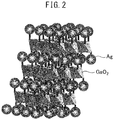
- Fig. 2 illustrates a schematic structure of the delafossite-type composite oxide.
- the delafossite-type structure is represented by AgGaO 2 or AgAl x Ga 1-x O 2 and is composed of monovalent cation Ag + , trivalent cation Ga 3+ , Ag 3+ , and oxide ion O - .
- x is preferably from 0.1 to 0.9, more preferably from 0.1 to 0.5.
- the AgGa(Al)O 2 takes on a layered structure in which a Ga(Al)O 2 layer formed by sharing sides of Ga(Al)O 6 octahedron and an Ag layer are alternately stacked. Thanks to such a structure, many Ag-O-Ga sites can be present on the oxide surface and since the site functions as an active site for NO x storage reaction, the NO x storage performance is high.
- the concentration of the composite oxide of silver and gallium may be 1.0 mmol/g or more and is preferably 1.7 mmol/g or more, or 1.8 mmol/g or more. In addition, the concentration may be 2.4 mmol/g or less.
- the NO x storage material described exhibits higher NO x storage capacity than a compound in which palladium is ion exchanged on to a zeolite compound such as chabazite conventionally used as the NO x storage material, in a low temperature region, particularly in a low temperature region of 200°C or less, furthermore 100°C or less.
- the NO x storage material described can be produced by any method commonly employed as the production method of a composite oxide and in particular, can be produced by the following method.
- the method for producing the NO x storage material described includes dissolving salts of metals constituting the composite oxide, i.e., a silver salt, a gallium salt and, if desired, an aluminum salt, in a solvent, and baking the solution.
- a silver salt, gallium salt and aluminum salt a nitrate, a carbonate, etc. employed in a general production method of a composite oxide can be used.
- a solvent capable of dissolving these salts for example, water, can be used.
- the silver salt and gallium salt are preferably mixed in a ratio such that the molar ratio of silver and gallium Ag:Ga becomes from 2:8 to 7:3, from 3:7 to 7:3, or from 4:6 to 6:4, and here, part of the gallium, i.e., from 10 to 90 mol% or from 10 to 50 mol%, may be substituted by aluminum.
- the baking temperature is usually 250°C or more, preferably 300°C or more, and is 600°C or less, preferably 400°C or less.
- the baking may be performed in air or in oxygen but is preferably performed in oxygen.
- the baking time can be appropriately determined according to the balance with the baking temperature and is usually from 1 to 10 hours.
- the baking is preferably performed in the presence of a fuel.
- a fuel glycine, glucose, sucrose, urea, citric acid, hydrazine, carbohydrazine, oxalyl dihydrazine, acetylacetone, hexamethylenetetramine, etc. can be used.
- the NO x storage device described has the above-described NO x storage material.
- the NO x storage material may be configured to be housed in a case, or the NO x storage material may be supported on a support particle and then housed.
- the support particle includes particles of a metal oxide such as alumina (Al 2 O 3 ), zirconia (ZrO 2 ), ceria (CeO 2 ), silica (SiO 2 ), magnesia (MgO) and titanium oxide (titania: TiO 2 ), or a composite oxide thereof (for example, a ceria-zirconia (CeO 2 -ZrO 2 ) composite oxide).
- a metal oxide such as alumina (Al 2 O 3 ), zirconia (ZrO 2 ), ceria (CeO 2 ), silica (SiO 2 ), magnesia (MgO) and titanium oxide (titania: TiO 2 ), or a composite oxide thereof (for example, a ceria-zirconia (CeO 2 -ZrO 2 ) composite oxide).
- a metal oxide such as alumina (Al 2 O 3 ), zirconia (ZrO 2 ), ceria (
- the exhaust gas purification method of the present invention includes causing an exhaust gas discharged from an internal combustion engine to flow through the NO x storage device above and then flow through an exhaust gas purification device having a catalyst metal.
- An exhaust gas discharged from an internal combustion engine is first flowed through the NO x storage device and put into contact with the NO x storage material, and NO x in the exhaust gas can thereby be stored at a low temperature as in starting of the internal combustion engine, particularly, at a low temperature of 100°C. Then, when the exhaust gas reaches a high temperature, NO x stored is desorbed from the NO x storage material and reduced by flowing through an exhaust gas purification device having a catalyst metal and consequently, the harmful component in the exhaust gas is purified.
- one or a plurality of metals such as platinum (Pt), rhodium (Rh), palladium (Pd), ruthenium (Ru), iridium (Ir) and osmium (Os) can be used.
- the content of the catalyst metal relative to the total volume of the catalyst in the exhaust gas purification device is, usually, appropriately from 0.5 to 10 g/L and is preferably, for example, from 0.5 to 7.0 g/L. If the amount of the catalyst metal supported is too small, the catalytic activity (in particular, oxidation catalytic activity) by virtue of the catalyst metal is insufficient, and on the other hand, if the amount of the catalyst metal supported is too large, the catalyst metal is likely to undergo grain growth and at the same time, a cost disadvantage occurs.
- the catalyst in the exhaust gas purification device can be used as a pellet by itself or may be used by disposing it on a substrate.
- the substrate the same substrate as employed in the conventionally known exhaust gas purification catalyst can be used.
- the substrate is preferably a substrate composed of a heat-resistant material having a porous structure.
- the heat-resistant material includes a heat-resistant metal such as cordierite, silicon carbide (SiC), aluminum titanate, silicon nitride and stainless steel, an alloy thereof, etc.
- the substrate preferably has a honeycomb structure, a foam shape, a pellet shape, etc.
- a cylindrical shape, an elliptic cylindrical shape, a polygonal cylindrical shape, etc. can be employed.
- Example 1 (Ag3Ga7 composite oxide):
- the powder was compact-molded at 2 t/cm 2 to obtain a pellet having a diameter ( ⁇ ) of 1.0 to 1.7 mm.
- the composite oxide thus produced at a charging ratio of silver and gallium of 3:7 is referred to as Ag3Ga7 composite oxide in the present description.
- a pellet was produced in the same manner as in Example 1 using 4.25 g (25 mmol) of silver nitrate (AgNO 3 ), 10.0 g (25 mmol) of gallium nitrate n-hydrate (Ga(NO 3 ) 3 ⁇ nH 2 O) and 1.41 g (19 mmol) of glycine.
- Example 3 (Ag7Ga3 composite oxide):
- a pellet was produced in the same manner as in Example 1 using 5.95 g (35 mmol) of silver nitrate (AgNO 3 ), 6.0 g (15 mmol) of gallium nitrate n-hydrate (Ga(NO 3 ) 3 ⁇ nH 2 O) and 1.41 g (19 mmol) of glycine.
- a pellet was produced in the same manner as in Example 1 using 0.85 g (5 mmol) of ⁇ silver nitrate (AgNO 3 ), 18.0 g (45 mmol) of gallium nitrate n-hydrate (Ga(NO 3 ) 3 ⁇ nH 2 O) and 1.41 g (19 mmol) of glycine.
- a pellet was produced in the same manner as in Example 1 using 4.25 g (25 mmol) of silver nitrate (AgNO 3 ), 7.0 g (17.5 mmol) of gallium nitrate n-hydrate (Ga(NO 3 ) 3 ⁇ nH 2 O), 2.81 g (7.5 mmol) of aluminum nitrate nonahydrate (Al(NO 3 ) 3 ⁇ 9H 2 O) and 0.62 g (8.3 mmol) of glycine.
- a pellet was produced in the same manner as in Example 1 using 4.25 g (25 mmol) of silver nitrate (AgNO 3 ), 5.0 g (12.5 mmol) of gallium nitrate n-hydrate (Ga(NO 3 ) 3 .nH 2 O), 4.69 g (12.5 mmol) of aluminum nitrate nonahydrate (Al(NO 3 ) 3 ⁇ 9H 2 O) and 0.62 g (8.3 mmol) of glycine.
- Example 7 (Ag5Ga5 composite oxide):
- a pellet was produced in the same manner as in Example 1 using 4.25 g (25 mmol) of silver nitrate (AgNO 3 ), 10.0 g (25.0 mmol) of gallium nitrate n-hydrate (Ga(NO 3 ) 3 ⁇ nH 2 O) and 0.62 g (8.3 mmol) of glycine.
- Example 8 (Ag5Al0.5Ga4.5 composite oxide):
- a pellet was produced in the same manner as in Example 1 using 4.25 g (25 mmol) of silver nitrate (AgNO 3 ), 9.0 g (22.5 mmol) of gallium nitrate n-hydrate (Ga(NO 3 ) 3 ⁇ nH 2 O), 0.94 g (2.5 mmol) of aluminum nitrate nonahydrate (Al(NO 3 ) 3 ⁇ 9H 2 O) and 0.62 g (8.3 mmol) of glycine.
- a pellet was produced in the same manner as in Example 1 using 22.0 g (50 mmol) of gallium nitrate n-hydrate (Ga(NO 3 ) 3 ⁇ nH 2 O) and 1.41 g (19 mmol) of glycine.
- a silver powder produced by Wako Pure Chemical Industries, Ltd. was used.
- the diffraction peak positions were compared with known data of JCPDS data file.
- the crystallite diameter was determined using the Scherrer equation.
- the measurement was performed at 77 K by the nitrogen adsorption/desorption method with use of BELSORP-max-12-N-VP manufactured by MicrotracBEL Corp.
- the measurement sample was subjected to vacuum pretreatment for 3 hours at 250°C.
- the specific surface area was calculated from the straight portion f of BET curve.
- the analysis was performed at BL07 Experimental Station of The Kyushu Synchrotron Light Research Center.
- the spectrum was measured by a transmission method using an ion chamber by means of an Si (220) double crystal spectrometer.
- Belcat A manufactured by MicrotracBEL Corp. was used. 200 mg of the sample powder was accurately weighed and put in a sample tube, 20 Vol% O 2 /He was flowed at 30 mL/min, and after the temperature was raised to 500°C and this temperature was maintained for 10 minutes, the system was cooled to 50°C in the same atmosphere. The gas in the tube was substituted by He gas at 50°C, He was then flowed at 30 mL/mi, the temperature was raised to 500°C while heating the sample at 10°C/min, and the O 2 desorption amount was analyzed by TCD.
- Jasco FT/IR-6200 infrared spectrophotometer manufactured by JASCO Corp. was used.
- a sample and KBr were mixed at a weight ratio of 3:7 in a mortar, 12 mg was accurately weighed and compact-molded into a disk of 8 mm in diameter ⁇ , and the disk was used as the sample.
- the window material CaF was used.
- As a pretreatment operation an operation of flowing a mixed gas of O 2 3%/Ar balance at a total flow rate of 200 mL/min at 350°C for 5 minutes and subsequently introducing a mixed gas of H 2 5%/Ar balance for 10 minutes was repeatedly performed.
- the mixed gas of O 2 3%/Ar balance at the same flow rate was cooled to the measurement temperature, background measurement was then performed, a mixed gas of NO 400 ppm+O 2 9%/Ar balance was flowed, and the spectra after 2, 5, 10, 15, 20, 30, 40, 50 and 60 minutes were measured.
- the measurement temperature was set to be 100°C, and in the measurement range of 1,000 to 4,000 cm -1 , 128 co-added scans were collected at 4 cm -1 resolution.
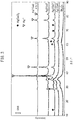
- FIG. 3 An XRD diffraction pattern of each sample is illustrated in Figs. 3 and 9 .
- Figs. 3 diffraction peaks based on delafossite-type AgGaO 2 oxide were detected in the samples except for Ga 2 O 3 .
- the diffraction intensity of the oxide above was highest.
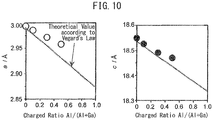
- Fig. 9 a diffraction line of Ag metal was detected in diffraction patterns of all products, as well as delafossite-type AgAl x Ga 1-x O 2 , and the products were confirmed to be a mixture of both.
- Fig. 10 illustrates the dependency of a lattice parameter calculated from the analysis of Fig. 9 on the Al charging ratio. Both a-axis length and c-axis length are decreased as the Al ratio increases, and it is therefore revealed that a delafossite-type oxide in which part of Ga is substituted by Al was produced. However, the results were not in complete agreement with the theoretical values according to Vegard's Law, and this suggests that part of Al was not substituted by and the oxide was present as Al 2 O 3 , etc.
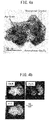
- Fig. 4a illustrates a DF-STEM observation image of Ag3Ga7 composite oxide (Example 1)
- Fig. 4b illustrates an EDS mapping image thereof.
- a hexagonal oxide in which the composition distribution of Ag, Ga and O is uniform can be confirmed. This oxide is expected to be the delafossite-type AgGaO 2 oxide detected in the XRD diffraction pattern of Fig. 3 .
- Fig. 5a illustrates XAFS analysis results of samples of Examples 1, 2 and 4, sample of Comparative Example 2, AgGaO 2 as reference sample, and Ag.
- the absorption spectrum of each sample changes through the isosbestic point in accordance with the difference in the Ag/Ga ratio, and this indicates a change due to difference in the abundance ratio of two components of Ag and AgGaO 2 .
- Fig. 5b illustrates the results of waveform separation of the XAFS spectrum of Fig. 5a into spectra of Ag 0 and AgGaO 2 and calculation of each component fraction. Based on the results of Fig. 5b , Ag component per weight of the material was quantitatively determined.
- the quantitative determination method was as follows. First, AgGaO 2 was dissolved in aqua regia. Thereafter, the solution was vaporized in ICP, and the Ag concentration was quantitatively determined. The value of Fig. 5c can be derived by multiplying the quantitatively determined Ag concentration by the component fraction calculated in XAFS analysis.
- AgGaO 2 is contained in a largest amount in the Ag3Ga7 composite oxide (Example 1). It is seen from the results of Fig. 5c that when Ag is 20 mol%, AgGaO 2 is present in an amount of 1.7 mmol per g of the sample; when Ag is 10 mol%, AgGaO 2 is present in an amount of 1.0 mmol per g of the sample; when Ag is 30 mol%, AgGaO 2 is present in an amount of 2.4 mmol per g of the sample; and when Ag is 50 mol%, AgGaO 2 is present in an amount of 1.8 mmol per g of the sample.
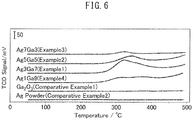
- Fig. 6 illustrates an O 2 -TPD measurement profile.
- a desorbed species was not detected in Ga 2 O 3 (Comparative Example 1) and Ag powder (Comparative Example 2), but on the other hand, an oxygen desorption peak was detected around 320°C in AgGaO 2 -containing composite oxides (Examples 1 to 4). This desorption peak is considered to be active oxygen desorbed from the Ag-O-Ga site.
- Fig. 7 illustrates IR analysis results in an environment where NO and O 2 were flowed at 100°C, with respect to the samples of Examples 1, 2 and 4.
- An absorption peak assigned to nitrite salt (NO 2 - ) and a shoulder assigned to nitrate salt (NO 3 - ) were detected at 1,255 cm -1 .
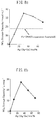
- Figs. 8a and 8b illustrate quantitative values of the NO x storage amount at 100°C with respect to each sample of Examples 1 to 4 and Comparative Examples 1 and 3.
- Fig. 8a illustrates the NO x storage amount per volume of the sample
- Fig. 8b illustrates the NO x storage amount per weight of the sample.
- the sample having a large storage amount (Ag3Ga7: Example 1, Ag5Ga5: Example 2, Ag7Ga3: Example 3) allows the presence of many effective sites for NO x storage and exhibits high properties in terms of the storage amount per volume, compared with Pd-chabazite known to have high low-temperature NO x storage properties ( Fig. 8a ).
- the sample Ag1Ga9 (Example 4) also exhibited sufficient storage amount, though the NO x storage amount was lower than Pd-chabazite.
- the order of NO x storage amount per weight relative to the Ag/(Ag+Ga) composition was completely in agreement with the order of the AgGaO 2 content ( Fig. 5c ) and therefore, AgGaO 2 is expected to assume the storage reaction.
- Fig. 11 illustrates the NO x storage amounts at 50°C, 100°C, 140°C and 180°C of each sample of Examples 5 to 8 and Comparative Example 3 (Pd-chabazite). Comparing with Ag5Ga5 (Example 7), in Ag5Al0.5Ga4.5 (Example 8), the NO x storage amount was low in the temperature region of 120 to 180°C but the NO x storage amount was high at a temperature of 100°C or less.
- Example 5 In Ag5Al1.5Ga3.5 (Example 5) and Ag5Al2.5Ga2.5 (Example 6), where the Al ratio was further lager than in Ag5Al0.5Ga4.5 (Example 8), the NO x storage amount was higher than Ag5Ga5 (Example 7) in the temperature region of 140°C or less. Furthermore, in Ag5Al2.5Ga2.5 (Example 6), the NO x storage amount was higher than Pd-chabazite (Comparative Example 3) in entire temperature region of 180°C or less.
- Fig. 12 illustrates an NO x -TPD measurement profile of Ag5Ga5 (Example 7)
- Fig. 13 illustrates an NO x -TPD measurement profile of Ag5Al2.5Ga2.5 (Example 6).
- NO x species exhibiting a desorption peak at 180°C and an NO x species undergoing desorption in a higher temperature region than that were detected The former NO x species undergoing desorption on the low temperature side was assigned to nitrite salt (NO 2 ) having low thermal stability, and the NO x species undergoing desorption on the high temperature side was assigned to nitrate salt (NO 3 - ).
- NO 2 nitrite salt
- NO 3 - nitrate salt
Landscapes
- Chemical & Material Sciences (AREA)
- Engineering & Computer Science (AREA)
- Chemical Kinetics & Catalysis (AREA)
- Organic Chemistry (AREA)
- Analytical Chemistry (AREA)
- Inorganic Chemistry (AREA)
- Combustion & Propulsion (AREA)
- Materials Engineering (AREA)
- Mechanical Engineering (AREA)
- General Engineering & Computer Science (AREA)
- Health & Medical Sciences (AREA)
- Biomedical Technology (AREA)
- Environmental & Geological Engineering (AREA)
- General Chemical & Material Sciences (AREA)
- Oil, Petroleum & Natural Gas (AREA)
- Catalysts (AREA)
- Exhaust Gas Treatment By Means Of Catalyst (AREA)
Claims (8)
- Verwendung eines Kompositoxids aus Silber und Gallium beim Speichern von NOx.
- Verwendung nach Anspruch 1, wobei das Kompositoxid ferner Aluminium enthält.
- Verwendung nach Anspruch 1 oder 2, wobei das Kompositoxid ein Delafossit-artiges Kompositoxid ist.
- Verwendung nach einem der Ansprüche 1 bis 3, wobei die Konzentration des Kompositoxids 1,7 mmol/g oder mehr beträgt.
- Abgasreinigungsverfahren, umfassend das Verursachen, dass ein Abgas, das aus einem Verbrennungsmotor abgelassen wird, durch eine NOx-Speichervorrichtung mit NOx-Speichermaterial strömt, umfassend ein Kompositoxid aus Silber und Gallium, und dann durch eine Abgasreinigungsvorrichtung mit einem Katalysatormetall strömt.
- Abgasreinigungsverfahren nach Anspruch 5, wobei das Kompositoxid ferner Aluminium enthält.
- Abgasreinigungsverfahren nach Ansprüchen 5 oder 6, wobei das Kompositoxid ein Delafossit-artiges Kompositoxid ist.
- Abgasreinigungsverfahren nach Ansprüchen 5, 6 oder 7, wobei die Konzentration des Kompositoxids 1,7 mmol/g oder mehr beträgt.
Applications Claiming Priority (2)
| Application Number | Priority Date | Filing Date | Title |
|---|---|---|---|
| JP2018082975 | 2018-04-24 | ||
| JP2019001170A JP7188091B2 (ja) | 2018-04-24 | 2019-01-08 | 窒素酸化物吸蔵材及び排ガス浄化方法 |
Publications (2)
| Publication Number | Publication Date |
|---|---|
| EP3560576A1 EP3560576A1 (de) | 2019-10-30 |
| EP3560576B1 true EP3560576B1 (de) | 2021-01-13 |
Family
ID=66101999
Family Applications (1)
| Application Number | Title | Priority Date | Filing Date |
|---|---|---|---|
| EP19167672.5A Active EP3560576B1 (de) | 2018-04-24 | 2019-04-05 | Verwendung eines stickoxidspeichermaterials und abgasreinigungsverfahren |
Country Status (2)
| Country | Link |
|---|---|
| EP (1) | EP3560576B1 (de) |
| CN (1) | CN110394173B (de) |
Family Cites Families (8)
| Publication number | Priority date | Publication date | Assignee | Title |
|---|---|---|---|---|
| JP2002255548A (ja) * | 2001-02-26 | 2002-09-11 | Japan Science & Technology Corp | 混合層積層不整結晶構造デラフォサイト型酸化物とその製造方法 |
| JP5146943B2 (ja) * | 2006-12-20 | 2013-02-20 | 三井金属鉱業株式会社 | 排ガス浄化用触媒及びその製造方法 |
| JP2009219972A (ja) * | 2007-03-20 | 2009-10-01 | Denso Corp | 触媒材料の製造方法 |
| GB2475740B (en) * | 2009-11-30 | 2017-06-07 | Johnson Matthey Plc | Catalysts for treating transient NOx emissions |
| EP2954950B1 (de) * | 2013-02-08 | 2020-06-17 | Umicore Shokubai Japan Co., Ltd. | Katalysator zur abgasreinigung mit nox-okklusionsminimierung und abgasreinigungsverfahren unter verwendung dieses katalysators |
| CN103447033B (zh) * | 2013-09-23 | 2015-04-15 | 长沙学院 | 一种介孔AgGaO2光催化材料的制备方法 |
| JP6048459B2 (ja) * | 2014-08-08 | 2016-12-21 | トヨタ自動車株式会社 | NOx吸蔵還元型触媒及びその製造方法 |
| CN110167670B (zh) * | 2016-12-27 | 2022-04-26 | 三井金属矿业株式会社 | 废气净化催化剂用铜铁矿型氧化物和使用该铜铁矿型氧化物的废气净化催化剂 |
-
2019
- 2019-04-05 EP EP19167672.5A patent/EP3560576B1/de active Active
- 2019-04-23 CN CN201910326870.0A patent/CN110394173B/zh active Active
Non-Patent Citations (1)
| Title |
|---|
| None * |
Also Published As
| Publication number | Publication date |
|---|---|
| EP3560576A1 (de) | 2019-10-30 |
| CN110394173A (zh) | 2019-11-01 |
| CN110394173B (zh) | 2022-09-09 |
Similar Documents
| Publication | Publication Date | Title |
|---|---|---|
| JP5422087B2 (ja) | 低貴金属担持三元触媒 | |
| JP5859366B2 (ja) | 排気ガス浄化用触媒及び排気ガス浄化用触媒構成体 | |
| JP5216189B2 (ja) | 排ガス浄化用触媒 | |
| EP1859851B1 (de) | Katalysator zur Abgasreinigung und Verfahren zur Abgasreinigung | |
| JP5674092B2 (ja) | 排気ガス浄化用触媒及びその製造方法 | |
| JP5146943B2 (ja) | 排ガス浄化用触媒及びその製造方法 | |
| JP5865110B2 (ja) | メタン酸化触媒およびその製造方法 | |
| JP2009119430A (ja) | 低温酸化触媒、その製造方法、および低温酸化触媒を用いた排ガスの浄化方法 | |
| EP3260199A1 (de) | Katalysator zur abgasreinigung und verfahren zur herstellung des katalysators | |
| EP2650046A1 (de) | Herstellungsverfahren für einen abgasreinigungskatalysator und kraftfahrzeug damit | |
| EP2823887B1 (de) | Oxidationskatalysator und abgasreinigungsverfahren damit | |
| JP2006346587A (ja) | 排ガス浄化用触媒 | |
| EP3560576B1 (de) | Verwendung eines stickoxidspeichermaterials und abgasreinigungsverfahren | |
| EP3984634A2 (de) | Hitzebeständiger rutheniumverbundstoff und seine verwendung als katalysator zur nox-speicherung und -reduktion | |
| US11298674B2 (en) | Nitrogen oxide storage material and exhaust gas purification method | |
| JP4435750B2 (ja) | 排ガス浄化用触媒及びその製造方法 | |
| JP6049154B2 (ja) | 排気ガス浄化用触媒担体及び排気ガス浄化用触媒並びに排気ガス浄化用触媒構成体 | |
| JP2023039982A (ja) | 窒素酸化物吸蔵材及び排ガス浄化用触媒 | |
| JP6468026B2 (ja) | 排ガス浄化用触媒 | |
| CN121155581A (zh) | 贵金属负载型稀土锰锆复合催化材料及制备方法、催化剂 | |
| CN121927596A (zh) | 废气净化用催化剂 | |
| JP2017185438A (ja) | 排ガス浄化用触媒 | |
| KR20190125087A (ko) | 배기가스 정화용 촉매의 제조방법 및 이를 통해 형성된 배기가스 정화용 촉매 | |
| JP2007229558A (ja) | 窒素酸化物浄化触媒 |
Legal Events
| Date | Code | Title | Description |
|---|---|---|---|
| PUAI | Public reference made under article 153(3) epc to a published international application that has entered the european phase |
Free format text: ORIGINAL CODE: 0009012 |
|
| STAA | Information on the status of an ep patent application or granted ep patent |
Free format text: STATUS: REQUEST FOR EXAMINATION WAS MADE |
|
| 17P | Request for examination filed |
Effective date: 20190405 |
|
| AK | Designated contracting states |
Kind code of ref document: A1 Designated state(s): AL AT BE BG CH CY CZ DE DK EE ES FI FR GB GR HR HU IE IS IT LI LT LU LV MC MK MT NL NO PL PT RO RS SE SI SK SM TR |
|
| AX | Request for extension of the european patent |
Extension state: BA ME |
|
| GRAP | Despatch of communication of intention to grant a patent |
Free format text: ORIGINAL CODE: EPIDOSNIGR1 |
|
| STAA | Information on the status of an ep patent application or granted ep patent |
Free format text: STATUS: GRANT OF PATENT IS INTENDED |
|
| INTG | Intention to grant announced |
Effective date: 20201105 |
|
| GRAS | Grant fee paid |
Free format text: ORIGINAL CODE: EPIDOSNIGR3 |
|
| GRAA | (expected) grant |
Free format text: ORIGINAL CODE: 0009210 |
|
| STAA | Information on the status of an ep patent application or granted ep patent |
Free format text: STATUS: THE PATENT HAS BEEN GRANTED |
|
| AK | Designated contracting states |
Kind code of ref document: B1 Designated state(s): AL AT BE BG CH CY CZ DE DK EE ES FI FR GB GR HR HU IE IS IT LI LT LU LV MC MK MT NL NO PL PT RO RS SE SI SK SM TR |
|
| REG | Reference to a national code |
Ref country code: GB Ref legal event code: FG4D |
|
| REG | Reference to a national code |
Ref country code: CH Ref legal event code: EP |
|
| REG | Reference to a national code |
Ref country code: IE Ref legal event code: FG4D |
|
| REG | Reference to a national code |
Ref country code: DE Ref legal event code: R096 Ref document number: 602019002131 Country of ref document: DE |
|
| REG | Reference to a national code |
Ref country code: AT Ref legal event code: REF Ref document number: 1354136 Country of ref document: AT Kind code of ref document: T Effective date: 20210215 |
|
| REG | Reference to a national code |
Ref country code: AT Ref legal event code: MK05 Ref document number: 1354136 Country of ref document: AT Kind code of ref document: T Effective date: 20210113 |
|
| REG | Reference to a national code |
Ref country code: NL Ref legal event code: MP Effective date: 20210113 |
|
| REG | Reference to a national code |
Ref country code: LT Ref legal event code: MG9D |
|
| PG25 | Lapsed in a contracting state [announced via postgrant information from national office to epo] |
Ref country code: BG Free format text: LAPSE BECAUSE OF FAILURE TO SUBMIT A TRANSLATION OF THE DESCRIPTION OR TO PAY THE FEE WITHIN THE PRESCRIBED TIME-LIMIT Effective date: 20210413 Ref country code: HR Free format text: LAPSE BECAUSE OF FAILURE TO SUBMIT A TRANSLATION OF THE DESCRIPTION OR TO PAY THE FEE WITHIN THE PRESCRIBED TIME-LIMIT Effective date: 20210113 Ref country code: GR Free format text: LAPSE BECAUSE OF FAILURE TO SUBMIT A TRANSLATION OF THE DESCRIPTION OR TO PAY THE FEE WITHIN THE PRESCRIBED TIME-LIMIT Effective date: 20210414 Ref country code: FI Free format text: LAPSE BECAUSE OF FAILURE TO SUBMIT A TRANSLATION OF THE DESCRIPTION OR TO PAY THE FEE WITHIN THE PRESCRIBED TIME-LIMIT Effective date: 20210113 Ref country code: LT Free format text: LAPSE BECAUSE OF FAILURE TO SUBMIT A TRANSLATION OF THE DESCRIPTION OR TO PAY THE FEE WITHIN THE PRESCRIBED TIME-LIMIT Effective date: 20210113 Ref country code: NO Free format text: LAPSE BECAUSE OF FAILURE TO SUBMIT A TRANSLATION OF THE DESCRIPTION OR TO PAY THE FEE WITHIN THE PRESCRIBED TIME-LIMIT Effective date: 20210413 Ref country code: PT Free format text: LAPSE BECAUSE OF FAILURE TO SUBMIT A TRANSLATION OF THE DESCRIPTION OR TO PAY THE FEE WITHIN THE PRESCRIBED TIME-LIMIT Effective date: 20210513 |
|
| PG25 | Lapsed in a contracting state [announced via postgrant information from national office to epo] |
Ref country code: PL Free format text: LAPSE BECAUSE OF FAILURE TO SUBMIT A TRANSLATION OF THE DESCRIPTION OR TO PAY THE FEE WITHIN THE PRESCRIBED TIME-LIMIT Effective date: 20210113 Ref country code: RS Free format text: LAPSE BECAUSE OF FAILURE TO SUBMIT A TRANSLATION OF THE DESCRIPTION OR TO PAY THE FEE WITHIN THE PRESCRIBED TIME-LIMIT Effective date: 20210113 Ref country code: LV Free format text: LAPSE BECAUSE OF FAILURE TO SUBMIT A TRANSLATION OF THE DESCRIPTION OR TO PAY THE FEE WITHIN THE PRESCRIBED TIME-LIMIT Effective date: 20210113 Ref country code: AT Free format text: LAPSE BECAUSE OF FAILURE TO SUBMIT A TRANSLATION OF THE DESCRIPTION OR TO PAY THE FEE WITHIN THE PRESCRIBED TIME-LIMIT Effective date: 20210113 Ref country code: SE Free format text: LAPSE BECAUSE OF FAILURE TO SUBMIT A TRANSLATION OF THE DESCRIPTION OR TO PAY THE FEE WITHIN THE PRESCRIBED TIME-LIMIT Effective date: 20210113 |
|
| PG25 | Lapsed in a contracting state [announced via postgrant information from national office to epo] |
Ref country code: IS Free format text: LAPSE BECAUSE OF FAILURE TO SUBMIT A TRANSLATION OF THE DESCRIPTION OR TO PAY THE FEE WITHIN THE PRESCRIBED TIME-LIMIT Effective date: 20210513 |
|
| REG | Reference to a national code |
Ref country code: DE Ref legal event code: R097 Ref document number: 602019002131 Country of ref document: DE |
|
| PG25 | Lapsed in a contracting state [announced via postgrant information from national office to epo] |
Ref country code: CZ Free format text: LAPSE BECAUSE OF FAILURE TO SUBMIT A TRANSLATION OF THE DESCRIPTION OR TO PAY THE FEE WITHIN THE PRESCRIBED TIME-LIMIT Effective date: 20210113 Ref country code: EE Free format text: LAPSE BECAUSE OF FAILURE TO SUBMIT A TRANSLATION OF THE DESCRIPTION OR TO PAY THE FEE WITHIN THE PRESCRIBED TIME-LIMIT Effective date: 20210113 Ref country code: SM Free format text: LAPSE BECAUSE OF FAILURE TO SUBMIT A TRANSLATION OF THE DESCRIPTION OR TO PAY THE FEE WITHIN THE PRESCRIBED TIME-LIMIT Effective date: 20210113 |
|
| PLBE | No opposition filed within time limit |
Free format text: ORIGINAL CODE: 0009261 |
|
| STAA | Information on the status of an ep patent application or granted ep patent |
Free format text: STATUS: NO OPPOSITION FILED WITHIN TIME LIMIT |
|
| PG25 | Lapsed in a contracting state [announced via postgrant information from national office to epo] |
Ref country code: MC Free format text: LAPSE BECAUSE OF FAILURE TO SUBMIT A TRANSLATION OF THE DESCRIPTION OR TO PAY THE FEE WITHIN THE PRESCRIBED TIME-LIMIT Effective date: 20210113 Ref country code: DK Free format text: LAPSE BECAUSE OF FAILURE TO SUBMIT A TRANSLATION OF THE DESCRIPTION OR TO PAY THE FEE WITHIN THE PRESCRIBED TIME-LIMIT Effective date: 20210113 Ref country code: SK Free format text: LAPSE BECAUSE OF FAILURE TO SUBMIT A TRANSLATION OF THE DESCRIPTION OR TO PAY THE FEE WITHIN THE PRESCRIBED TIME-LIMIT Effective date: 20210113 Ref country code: RO Free format text: LAPSE BECAUSE OF FAILURE TO SUBMIT A TRANSLATION OF THE DESCRIPTION OR TO PAY THE FEE WITHIN THE PRESCRIBED TIME-LIMIT Effective date: 20210113 |
|
| 26N | No opposition filed |
Effective date: 20211014 |
|
| PG25 | Lapsed in a contracting state [announced via postgrant information from national office to epo] |
Ref country code: LU Free format text: LAPSE BECAUSE OF NON-PAYMENT OF DUE FEES Effective date: 20210405 |
|
| REG | Reference to a national code |
Ref country code: BE Ref legal event code: MM Effective date: 20210430 |
|
| PG25 | Lapsed in a contracting state [announced via postgrant information from national office to epo] |
Ref country code: ES Free format text: LAPSE BECAUSE OF FAILURE TO SUBMIT A TRANSLATION OF THE DESCRIPTION OR TO PAY THE FEE WITHIN THE PRESCRIBED TIME-LIMIT Effective date: 20210113 Ref country code: AL Free format text: LAPSE BECAUSE OF FAILURE TO SUBMIT A TRANSLATION OF THE DESCRIPTION OR TO PAY THE FEE WITHIN THE PRESCRIBED TIME-LIMIT Effective date: 20210113 |
|
| PG25 | Lapsed in a contracting state [announced via postgrant information from national office to epo] |
Ref country code: SI Free format text: LAPSE BECAUSE OF FAILURE TO SUBMIT A TRANSLATION OF THE DESCRIPTION OR TO PAY THE FEE WITHIN THE PRESCRIBED TIME-LIMIT Effective date: 20210113 |
|
| PG25 | Lapsed in a contracting state [announced via postgrant information from national office to epo] |
Ref country code: IT Free format text: LAPSE BECAUSE OF FAILURE TO SUBMIT A TRANSLATION OF THE DESCRIPTION OR TO PAY THE FEE WITHIN THE PRESCRIBED TIME-LIMIT Effective date: 20210113 Ref country code: IE Free format text: LAPSE BECAUSE OF NON-PAYMENT OF DUE FEES Effective date: 20210405 |
|
| PG25 | Lapsed in a contracting state [announced via postgrant information from national office to epo] |
Ref country code: IS Free format text: LAPSE BECAUSE OF FAILURE TO SUBMIT A TRANSLATION OF THE DESCRIPTION OR TO PAY THE FEE WITHIN THE PRESCRIBED TIME-LIMIT Effective date: 20210513 |
|
| PG25 | Lapsed in a contracting state [announced via postgrant information from national office to epo] |
Ref country code: BE Free format text: LAPSE BECAUSE OF NON-PAYMENT OF DUE FEES Effective date: 20210430 |
|
| REG | Reference to a national code |
Ref country code: CH Ref legal event code: PL |
|
| PG25 | Lapsed in a contracting state [announced via postgrant information from national office to epo] |
Ref country code: LI Free format text: LAPSE BECAUSE OF NON-PAYMENT OF DUE FEES Effective date: 20220430 Ref country code: CH Free format text: LAPSE BECAUSE OF NON-PAYMENT OF DUE FEES Effective date: 20220430 |
|
| P01 | Opt-out of the competence of the unified patent court (upc) registered |
Effective date: 20230427 |
|
| PG25 | Lapsed in a contracting state [announced via postgrant information from national office to epo] |
Ref country code: NL Free format text: LAPSE BECAUSE OF NON-PAYMENT OF DUE FEES Effective date: 20210113 Ref country code: CY Free format text: LAPSE BECAUSE OF FAILURE TO SUBMIT A TRANSLATION OF THE DESCRIPTION OR TO PAY THE FEE WITHIN THE PRESCRIBED TIME-LIMIT Effective date: 20210113 |
|
| PG25 | Lapsed in a contracting state [announced via postgrant information from national office to epo] |
Ref country code: HU Free format text: LAPSE BECAUSE OF FAILURE TO SUBMIT A TRANSLATION OF THE DESCRIPTION OR TO PAY THE FEE WITHIN THE PRESCRIBED TIME-LIMIT; INVALID AB INITIO Effective date: 20190405 |
|
| PG25 | Lapsed in a contracting state [announced via postgrant information from national office to epo] |
Ref country code: MK Free format text: LAPSE BECAUSE OF FAILURE TO SUBMIT A TRANSLATION OF THE DESCRIPTION OR TO PAY THE FEE WITHIN THE PRESCRIBED TIME-LIMIT Effective date: 20210113 |
|
| PG25 | Lapsed in a contracting state [announced via postgrant information from national office to epo] |
Ref country code: TR Free format text: LAPSE BECAUSE OF FAILURE TO SUBMIT A TRANSLATION OF THE DESCRIPTION OR TO PAY THE FEE WITHIN THE PRESCRIBED TIME-LIMIT Effective date: 20210113 |
|
| PG25 | Lapsed in a contracting state [announced via postgrant information from national office to epo] |
Ref country code: MT Free format text: LAPSE BECAUSE OF FAILURE TO SUBMIT A TRANSLATION OF THE DESCRIPTION OR TO PAY THE FEE WITHIN THE PRESCRIBED TIME-LIMIT Effective date: 20210113 |
|
| PGFP | Annual fee paid to national office [announced via postgrant information from national office to epo] |
Ref country code: DE Payment date: 20250305 Year of fee payment: 7 |
|
| REG | Reference to a national code |
Ref country code: DE Ref legal event code: R084 Ref document number: 602019002131 Country of ref document: DE |
|
| REG | Reference to a national code |
Ref country code: GB Ref legal event code: 746 Effective date: 20260112 |
|
| PGFP | Annual fee paid to national office [announced via postgrant information from national office to epo] |
Ref country code: GB Payment date: 20260313 Year of fee payment: 8 |
|
| PGFP | Annual fee paid to national office [announced via postgrant information from national office to epo] |
Ref country code: FR Payment date: 20260309 Year of fee payment: 8 |