EP3562094B1 - Netzwerkvorrichtung und verfahren zur skalierbaren datenintegritätsprüfung - Google Patents
Netzwerkvorrichtung und verfahren zur skalierbaren datenintegritätsprüfung Download PDFInfo
- Publication number
- EP3562094B1 EP3562094B1 EP18168798.9A EP18168798A EP3562094B1 EP 3562094 B1 EP3562094 B1 EP 3562094B1 EP 18168798 A EP18168798 A EP 18168798A EP 3562094 B1 EP3562094 B1 EP 3562094B1
- Authority
- EP
- European Patent Office
- Prior art keywords
- data
- tuple
- module
- network device
- sub
- Prior art date
- Legal status (The legal status is an assumption and is not a legal conclusion. Google has not performed a legal analysis and makes no representation as to the accuracy of the status listed.)
- Active
Links
Images
Classifications
-
- H—ELECTRICITY
- H04—ELECTRIC COMMUNICATION TECHNIQUE
- H04L—TRANSMISSION OF DIGITAL INFORMATION, e.g. TELEGRAPHIC COMMUNICATION
- H04L41/00—Arrangements for maintenance, administration or management of data switching networks, e.g. of packet switching networks
- H04L41/24—Arrangements for maintenance, administration or management of data switching networks, e.g. of packet switching networks using dedicated network management hardware
-
- H—ELECTRICITY
- H04—ELECTRIC COMMUNICATION TECHNIQUE
- H04L—TRANSMISSION OF DIGITAL INFORMATION, e.g. TELEGRAPHIC COMMUNICATION
- H04L1/00—Arrangements for detecting or preventing errors in the information received
- H04L1/0001—Systems modifying transmission characteristics according to link quality, e.g. power backoff
- H04L1/0006—Systems modifying transmission characteristics according to link quality, e.g. power backoff by adapting the transmission format
- H04L1/0007—Systems modifying transmission characteristics according to link quality, e.g. power backoff by adapting the transmission format by modifying the frame length
-
- H—ELECTRICITY
- H04—ELECTRIC COMMUNICATION TECHNIQUE
- H04L—TRANSMISSION OF DIGITAL INFORMATION, e.g. TELEGRAPHIC COMMUNICATION
- H04L1/00—Arrangements for detecting or preventing errors in the information received
- H04L1/004—Arrangements for detecting or preventing errors in the information received by using forward error control
- H04L1/0041—Arrangements at the transmitter end
-
- H—ELECTRICITY
- H04—ELECTRIC COMMUNICATION TECHNIQUE
- H04L—TRANSMISSION OF DIGITAL INFORMATION, e.g. TELEGRAPHIC COMMUNICATION
- H04L1/00—Arrangements for detecting or preventing errors in the information received
- H04L1/004—Arrangements for detecting or preventing errors in the information received by using forward error control
- H04L1/0056—Systems characterized by the type of code used
- H04L1/0061—Error detection codes
-
- H—ELECTRICITY
- H04—ELECTRIC COMMUNICATION TECHNIQUE
- H04L—TRANSMISSION OF DIGITAL INFORMATION, e.g. TELEGRAPHIC COMMUNICATION
- H04L1/00—Arrangements for detecting or preventing errors in the information received
- H04L1/0078—Avoidance of errors by organising the transmitted data in a format specifically designed to deal with errors, e.g. location
- H04L1/0083—Formatting with frames or packets; Protocol or part of protocol for error control
-
- H—ELECTRICITY
- H04—ELECTRIC COMMUNICATION TECHNIQUE
- H04L—TRANSMISSION OF DIGITAL INFORMATION, e.g. TELEGRAPHIC COMMUNICATION
- H04L43/00—Arrangements for monitoring or testing data switching networks
- H04L43/06—Generation of reports
- H04L43/065—Generation of reports related to network devices
-
- H—ELECTRICITY
- H04—ELECTRIC COMMUNICATION TECHNIQUE
- H04L—TRANSMISSION OF DIGITAL INFORMATION, e.g. TELEGRAPHIC COMMUNICATION
- H04L49/00—Packet switching elements
- H04L49/10—Packet switching elements characterised by the switching fabric construction
- H04L49/111—Switch interfaces, e.g. port details
-
- H—ELECTRICITY
- H04—ELECTRIC COMMUNICATION TECHNIQUE
- H04L—TRANSMISSION OF DIGITAL INFORMATION, e.g. TELEGRAPHIC COMMUNICATION
- H04L49/00—Packet switching elements
- H04L49/10—Packet switching elements characterised by the switching fabric construction
- H04L49/112—Switch control, e.g. arbitration
-
- H—ELECTRICITY
- H04—ELECTRIC COMMUNICATION TECHNIQUE
- H04L—TRANSMISSION OF DIGITAL INFORMATION, e.g. TELEGRAPHIC COMMUNICATION
- H04L49/00—Packet switching elements
- H04L49/30—Peripheral units, e.g. input or output ports
-
- H—ELECTRICITY
- H04—ELECTRIC COMMUNICATION TECHNIQUE
- H04L—TRANSMISSION OF DIGITAL INFORMATION, e.g. TELEGRAPHIC COMMUNICATION
- H04L49/00—Packet switching elements
- H04L49/55—Prevention, detection or correction of errors
- H04L49/552—Prevention, detection or correction of errors by ensuring the integrity of packets received through redundant connections
-
- H—ELECTRICITY
- H04—ELECTRIC COMMUNICATION TECHNIQUE
- H04L—TRANSMISSION OF DIGITAL INFORMATION, e.g. TELEGRAPHIC COMMUNICATION
- H04L49/00—Packet switching elements
- H04L49/55—Prevention, detection or correction of errors
- H04L49/555—Error detection
-
- H—ELECTRICITY
- H04—ELECTRIC COMMUNICATION TECHNIQUE
- H04L—TRANSMISSION OF DIGITAL INFORMATION, e.g. TELEGRAPHIC COMMUNICATION
- H04L63/00—Network architectures or network communication protocols for network security
- H04L63/12—Applying verification of the received information
- H04L63/123—Applying verification of the received information received data contents, e.g. message integrity
-
- H—ELECTRICITY
- H04—ELECTRIC COMMUNICATION TECHNIQUE
- H04L—TRANSMISSION OF DIGITAL INFORMATION, e.g. TELEGRAPHIC COMMUNICATION
- H04L2212/00—Encapsulation of packets
-
- H—ELECTRICITY
- H04—ELECTRIC COMMUNICATION TECHNIQUE
- H04L—TRANSMISSION OF DIGITAL INFORMATION, e.g. TELEGRAPHIC COMMUNICATION
- H04L49/00—Packet switching elements
- H04L49/15—Interconnection of switching modules
-
- H—ELECTRICITY
- H04—ELECTRIC COMMUNICATION TECHNIQUE
- H04L—TRANSMISSION OF DIGITAL INFORMATION, e.g. TELEGRAPHIC COMMUNICATION
- H04L49/00—Packet switching elements
- H04L49/25—Routing or path finding in a switch fabric
- H04L49/252—Store and forward routing
-
- H—ELECTRICITY
- H04—ELECTRIC COMMUNICATION TECHNIQUE
- H04L—TRANSMISSION OF DIGITAL INFORMATION, e.g. TELEGRAPHIC COMMUNICATION
- H04L49/00—Packet switching elements
- H04L49/35—Switches specially adapted for specific applications
- H04L49/351—Switches specially adapted for specific applications for local area network [LAN], e.g. Ethernet switches
- H04L49/352—Gigabit ethernet switching [GBPS]
Definitions
- the invention relates to a network device for a computer network and to a method for data integrity check in a network device of a computer network, wherein said network device comprises
- the COM and the MON module receive the same data (" receiving data”, “R-data ”) and, in addition, the MON module receives also the data being transmitted from the COM module ( "transmission data", "T-data” ). To assure that the data has not been unintentionally modified by the COM module, the MON module compares said receiving data with said transmission data. If the receiving data and the transmission data do not match, this means that the COM module (unintentionally and wrongly) has modified the data and that the COM module might be faulty.
- T-data based on R-data means that - in case of no fault - the T-data consist of all R-data, ordered in the same sequence as the R-data, and said T-data are transmitted to one or more outputs of the network device, for which the R-data (or the data elements forming said R-data) are designated for. In case of a fault one or more data elements of the R-data are missing in the T-data and/or one or more data elements have been changed. In case of no fault the data elements of the T-data sub-tuple are ordered in the same sequence as the (corresponding) data elements in the R-data sub-tuple.
- the invention relates to a a computer network comprising a plurality of network devices and a plurality of communication channels, wherein each communication channel connects at least two network devices to allow communication between connected network devices including an exchange of messages according to a network protocol, characterized in that at least one, preferably a plurality of network devices of the computer network, is/are a network device as described above.
- the present invention allows to develop network devices, for example for aerospace systems, with a much higher flexibility regarding the trade-off between costs and level of data integrity checking compared to network devices actually available on the market.
- a computer network comprising a plurality of network devices and a plurality of communication channels, wherein each communication channel connects at least two network devices to allow communication between connected network devices including an exchange of messages according to a network protocol (e.g., Ethernet, TTEthernet, AFDX, Time Triggered Protocol), wherein one or more network devices is/are constructed as a network device as described above.
- a network protocol e.g., Ethernet, TTEthernet, AFDX, Time Triggered Protocol
- the T-data FCS is calculated by the monitoring module based on all data elements of the T-data which do not represent/ specify a (possibly already in the T-data contained) FCS. In case the T-data do not contain a FCS, all data elements of the T-data are used for calculating the T-data FCS.
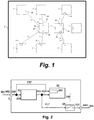
- Fig. 1 depicts a computer network 1 comprising a plurality of network devices 2 and a plurality of communication channels 3, wherein each communication channel 3 directly connects two network devices 2 to allow communication between the network devices 2 of the computer network.
- each network device 2 comprises one or more ports 30, wherein at least one communication channel 3 is connected to a port 30.
- exactly one communication channel 3 may be connected to exactly one port 30.
- the communication mentioned includes an exchange of messages between network devices according to a network protocol e.g., Ethernet, TTEthernet, AFDX, Time Triggered Protocol, wherein said messages contain data.
- a network protocol e.g., Ethernet, TTEthernet, AFDX, Time Triggered Protocol, wherein said messages contain data.
- a computer network 1 according to the invention comprises one or more network devices 2 which are configured and/or construed as network device according to the invention.
- a network device according to the invention may be connected to one or more other network devices according to the invention, to one or more network devices according to the state-of-the art, or to one or more network devices according to the invention and one or more network devices according to the state-of-the art. Examples of a network device according to the invention will be described in more detail in the following.
- the COM module 22 is configured for handling data, in particular said R-data, wherein said handling may include, e.g., buffering said data in data queues, performing error detection by checking a CRC of said data, and transmitting data as "transmission data", abbreviated as T-data, for example on one or more outgoing connection links 211, 211', according to a specifiable or specified scheme and/or according to a specifiable or specified time schedule.
- the COM module 22 is configured to not consume and/or to not change data, in particular said R-data.
- Connection links in the network device 2 may be realized using, e.g., an Media-independent interface MII or a Gigabit media-independent interface GMII.
- the network device 2 comprises at least one monitoring module, "MON module”, in particular one MON module 23, wherein the network device 2 is configured/construed such that the MON module 23 receives, in the case that the COM module 22 receives data (R-data), the same/identical data, i.e. data identical to the R-data received by the COM module 22.
- the MON module 23 receives said data, which are identical to R-data received by the COM module 22, via a connection link 210'.
- the MON module may be connected "directly" to port, wherein directly means that an own connection link is provided which is connecting the MON module to the port, or, as depicted in Fig. 2 , the connection link 210 connecting the COM module 22 and the port 3001 has a branch 210', which branch forms the connection link 210' connecting the MON module 23 to the port 3001.
- the network device is configured such that data transmitted by the COM module 22, the so-called the T-data, towards an output port 3101 of the network device 2, are also transmitted to the MON module 23, and the MON module 23 is configured to receive said T-data.
- the COM module 22 is connected to the MON module 23 with a connection link 211, wherein said connection link has a branch 211', which branch 211' forms a connection link 211' connecting the COM module 22 also with the output port 3101 of the network device 2.
- the output port 3101 of the network device 2 is connected to the network with a link 311.
- the MON module may comprise a data memory 231 to store data.
- the COM module 22 receives data, for example on an incoming link 210, and forwards it, for example to an outgoing link 211, according to a forwarding scheme, without changing the data.
- Data is typically encapsulated in data frames (e.g., Ethernet frames), which data frames are uniquely identifiable.
- frames are identifiable using some combination of bits from a Frame Header and/or payload of the Ethernet frame, for example, using Virtual Link ID (VLID), FCS and a Sequence Number.
- Main function of the MON module 23 is to compare the R-data it has received with the T-data corresponding to said R-data, which T-data the MON module 23 has received from the MON module 22.
- Corresponding in this context means for example that said T-data being forwarded by the COM module 22 (towards the output of the network device and to the MON module) have the same identification as R-Data received by the COM module 22, for example on an incoming link 210.
- the MON module For the purpose of comparing the R-data with the corresponding T-data it is necessary, according to the state of the art, that the MON module stores all R-data it receives.
- the MON module 23 is configured in such a way that it only stores a part of the R-data it has received.
- the R-data form a dataset (a so-called "R-data dataset"), wherein such a dataset comprises a number of data elements, and the MON module 23 stores only a sub-tuple of said R-data dataset.
- R-data sub-tuple We denote said sub-tuple of the R-data dataset as "R-data sub-tuple”.
- the T-data are forming a T-data dataset.
- the MON module 23 creates a sub-tuple of said T-data dataset, the so-called "T-data sub-tuple", and compares the R-data sub-tuple with said T-data sub-tuple. In case that these sub-tuples of corresponding R- and T-data do not match, which means that the data integrity is not preserved (data is unwillingly altered), the MON module 23 will prevent the transmission of the corresponding T-data to the output port 3101 of the network device 2.
- the MON module 23 For generating an R-data sub-tuple based on R-data received by the MON module 23, the MON module 23 applies a specific rule. The same rule as applied for generating said R-data sub-tuple is also applied to generate a T-data sub-tuple based on the T-data corresponding to the before mentioned R-data.
- an R-data set consists of 20 bits (data elements) with a specific order as shown: ⁇ Rbit1, Rbit2, ..., Rbit20 ⁇ .
- Tbit1, Tbit3, Tbit20 T-data sub-tuple
- the network device 2 may comprise an on-off data switch 24, and the MON module 23 is configured to signal the on-off data switch 24, for example via the signalling link (control interface) 230, to drop the corresponding T-data (e.g., an Ethernet frame) and to not forward it.
- the MON module 23 is configured to signal the on-off data switch 24, for example via the signalling link (control interface) 230, to drop the corresponding T-data (e.g., an Ethernet frame) and to not forward it.
- the on-off data switch 24 is arranged between the COM module 22 and the output port 3101 of the network device 2, in particular in the connection link 211', and the on-off data switch 24 may be switched between two states, wherein in one state the data transmitted from the COM module towards the output port 3101 can pass to the output port 3101, and wherein in the other state the transmission via the connection link 211' to the output port 3101 is interrupted.
- Said on-off data switch 24 is, as described above, controlled by the MON module 23.
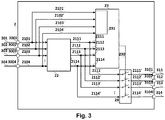
- Fig. 3 depicts a network device 2 according to the invention in more detail and with more complexity.
- the network device according to Fig. 3 works like the network device of Fig. 2 , so that the explanations in connection with Fig. 2 are also valid for a network device according to Fig. 3 . Accordingly, details which are in analogy to details as described in Fig. 2 are not detailed in connection with Fig. 3 .
- the COM module 23 according to a network device 2 shown in Fig. 3 is connected to input ports (in this example ports 3001, 3002, 3003, 3004) via input data connection links 2101, 2102, 2103, 2104, wherein each communication channel (link) 301, 302, 303, 304 of the computer network (compare with Fig. 1 ) is connected to one of said input ports 3001, 3002, 3003, 3004 of the network device 2.
- the COM module 22 is connected to output ports 3101, 3102, 3103, 3104 via connection links 2111, 2111', 2112, 2112', 2113, 2113', 2114, 2114'.
- the output ports 3101, 3102, 3103, 3104 are connected to the network by communication channels (links) 311, 312, 313, 314.
- Main function of the COM module 22 is to forward R-data which it receives from an input port in its entity towards one or more of the output ports 3101, 3102, 3103, 3104 according to a specified or a specifiable scheme and/or according to a specified or a specifiable time schedule.
- the forwarded data is referred as T-data.
- Such a scheme is based on the source and destination addresses of the data. For example, it can be specified that the R-data incoming on the input port 3002 with a particular destination address has to be forwarded towards the output port 3101 and 3103.
- the MON module 23 is also connected to said input ports 3001, 3002, 3003, 3004 via input data connection links 2101', 2102', 2103', 2104' (in analogy to the embodiment of Fig . 2 ) to receive the same data (R-data) which the COM module 22 receives via an input port.
- the network device 2 comprises an on-off data switch 24 which is connected to the output of the COM module 22, in particular the on-off data switch 24 is arranged in the connection links 2111', 2112', 2113', 2114'.
- the MON module 23 is also connected to the output of the COM module 22 via data connection links 2111, 2112, 2113, 2114, so that the MON module 23 receives the same T-data from the COM module 22, which the COM module 22 transmits to the output ports of the network device 2.
- the on-off data switch 24 receives control signals from the MON module 23 via a control link 230 to either forward the T-data via the data output connection links 2111', 2112', 2113', 2114' to the output ports for which said T-data are destined, or to drop or block said transmission data.
- on-off data switch .... to forward does not necessarily mean that the on-off data switch is an active component.
- the switch 24 may be an active component, which in one state actively forwards data which it receives via a connection link, and in the other state actively drops or blocks said data.
- the on off-data switch may also be passive in the way that in one state of the switch the connection to the output port(s) is continuous, so that data can be pass to the port(s), and in the other state the connection is interrupted, so that data cannot pass the switch an cannot reach the port(s).
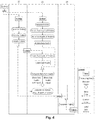
- Fig. 4 shows the show the method according to the invention in a notation similar to Unified Modelling Language (UML) Activity Diagrams.
- the COM module 22 and the MON module 23 receive Receiving Data (R-data).
- the COM module 22 handles the R-data and transmits it towards the output in form of T-data.
- the MON module 23 is configured to receive the same R-data as the COM module 22, to create a R-data sub-tuple of this R-data, and to store, for integrity checking, this R-data data sub-tuple in its memory.
- the MON module 23 is also configured to receive transmission data (T-data), which T-data are R-data forwarded by the COM module 22 (T-data which are originating from specific R-data are denoted as "corresponding" to said R-data), from the COM module 22 and to form a sub-tuple from said T-data (T-data sub-tuple) for comparison with the corresponding R-data data sub-tuple.
- the MON module 23 is configured to compare the R-data sub-tuple with the corresponding T-data sub-tuple.
- the "corresponding T-data sub-tuple” is a sub-tuple formed of T-data, which T-data correspond to the R-data which are the basis for the R-data sub-tuple). Since the COM module 22 requires some amount of time to handle the R-data, and forward said R-data as T-data, the MON module 23 must store the R-data it will compare, that is the R-data sub-tuple, in its memory.
- the MON module 23 signals the on-off data switch 24 to forward the T-data (or to let them pass; or in case that the switch 24 normally is in a state that data may pass, no signal is provided to the switch 24).
- T-data and the T-data sub-tuple derived form said T-data are not stored, but may be buffered.
- the MON module 23 executes at least one action, for example signalling to the on-off data switch 24 to drop the T-data and to stop the transmission of said T-data, or to report an error, etc.
Landscapes
- Engineering & Computer Science (AREA)
- Computer Networks & Wireless Communication (AREA)
- Signal Processing (AREA)
- Computer Security & Cryptography (AREA)
- Computer Hardware Design (AREA)
- Computing Systems (AREA)
- General Engineering & Computer Science (AREA)
- Quality & Reliability (AREA)
- Data Exchanges In Wide-Area Networks (AREA)
- Small-Scale Networks (AREA)
Claims (23)
- Netzwerkgerät (2) für ein Computernetzwerk, wobei das Netzwerkgerät (2) umfasst:- ein Kommunikationsmodul (22), wobei das Kommunikationsmodul (22) mit einem oder mehreren Eingangsports (3001; 3001, 3002, 3003, 3004) des Netzwerkgeräts verbunden ist, und wobei das Kommunikationsmodul (22) mit einem oder mehreren Ausgangsports (3101; 3101, 3102, 3103, 3104) des Netzwerkgeräts verbunden ist, und wobei das Kommunikationsmodul (22) zum Empfangen von Daten aus Eingangsports (3001; 3001, 3002, 3003, 3004) des Netzwerkgeräts (2), zum Verarbeiten der Daten und zum Senden der Daten zu einem oder mehreren Ausgangsports (3101; 3101, 3102, 3103, 3104) des Netzwerkgeräts (2) eingerichtet ist, und- ein Überwachungsmodul (23), wobei das Überwachungsmodul (23) zum Empfangen derselben Daten eingerichtet ist, die seitens eines Kommunikationsmoduls (22) ausgehend von einem Eingangsport (3001; 3001, 3002, 3003, 3004) des Netzwerkgeräts empfangen werden, und/oder wobei das Netzwerkgerät (2) derart eingerichtet ist, dass ein Überwachungsmodul (23) dieselben Daten empfängt, die seitens eines Kommunikationsmoduls (22) ausgehend von einem Eingangsport (3001; 3001, 3002, 3003, 3004) des Netzwerkgeräts empfangen werden, und wobei das Kommunikationsmodul (22) und das Überwachungsmodul (23) miteinander verbunden sind, insbesondere über zumindest eine Datenkommunikationsverbindung (211; 2111, 2112, 2113, 2114), so dass das Überwachungsmodul (23) dieselben Daten empfängt, die das Kommunikationsmodul (22) zu einem oder mehreren Ausgangsports (3101; 3101; 3101, 3102, 3103, 3104) sendet, und wobei in dem Fall, dass das Kommunikationsmodul (22) sogenannte R-Daten empfängt, wobei R-Daten empfangene Daten sind, die n Datenelemente umfassen, wobei die n Datenelemente ein n-Tupel bilden, und wobei die R-Daten Daten sind, die das Kommunikationsmodul (22) von einem Eingangsport (3001; 3001, 3001, 3002, 3003, 3004) empfängt, und wobei die Daten in ihrer Gesamtheit, d.h. alle n Datenelemente der R-Daten, dazu bestimmt sind, durch das Kommunikationsmodul (22) zu einem ausgewählten Ausgangsport (3101; 3101; 3101, 3102, 3103, 3104) oder zu mehreren ausgewählten Ausgangsports (3101; 3101, 3102, 3103, 3104) übertragen zu werden, das Überwachungsmodul (23) dieselben R-Daten empfängt, und wobei das Kommunikationsmodul (22) sogenannte T-Daten - wobei T-Daten basierend auf den Datenelementen der seitens des Kommunikationsmoduls (22) empfangenen R-Daten gesendete Daten sind - zu dem Ausgangsport (3101) oder zu mehreren Ausgangsports (3101; 3101, 3102, 3103, 3104) des Netzwerkgeräts (2) sendet, wobei für den oder die Ausgangsport(s) (3101; 3101, 3102, 3103, 3104) die den T-Daten entsprechenden R-Daten bestimmt sind, und wobei das Überwachungsmodul (23) die T-Daten empfängt,
dadurch gekennzeichnet, dass
das Überwachungsmodul (23) ferner eingerichtet ist- zum Ableiten, nach Empfang derselben R-Daten wie das Kommunikationsmodul (22), eines Subtupels der R-Daten, eines sogenannten "R-Daten-Subtupels", wobei das R-Daten-Subtupel m der n Datenelemente des n-Tupels von R-Daten umfasst, wobei m > 0 und m < n,- zum Speichern, nach Ableiten des R-Daten-Subtupels, nur des R-Daten-Subtupels,- zum Ableiten, nach Erhalt der T-Daten, die den R-Daten entsprechen, eines Subtupels der T-Daten, eines sogenannten "T-Daten-Subtupels", und- zum Vergleichen des gespeicherten R-Daten-Subtupels mit dem T-Daten-Subtupel, und- zum Ausführen zumindest einer spezifizierten oder spezifizierbaren Aktion, wenn der Vergleich des gespeicherten R-Daten-Subtupels mit dem T-Daten-Subtupel als Ergebnis liefert, dass das R-Daten-Subtupel und das T-Daten-Subtupel nicht identisch sind. - Netzwerkgerät nach Anspruch 1, wobei das Kommunikationsmodul (22) mit jedem der Eingangsports (3001; 3001, 3002, 3003, 3004) durch zumindest einen Verbindungsanschluss (210; 2101, 2102, 2103, 2104) und mit jedem der Ausgangsports (3101; 3101, 3102, 3103, 3104) durch jeweils zumindest einen Verbindungsanschluss (211, 211'; 2111, 2111', 2112, 2112', 2113, 2113', 2114, 2114') verbunden ist, wobei die Verbindungsanschlüsse vorzugsweise bidirektionale Verbindungsanschlüsse sind.
- Netzwerkgerät nach Anspruch 1 oder 2, wobei für jeden Eingangsport (3001; 3001, 3002, 3003, 3004) zumindest ein Verbindungsanschluss, insbesondere genau eine Verbindungsanschluss, vorgesehen ist, welcher zumindest eine Verbindungsanschluss pro Eingangsport mit dem Überwachungsmodul (23) verbunden ist, und wobei- der zumindest eine Verbindungsanschluss weiter mit dem Eingangsport verbunden ist, oder- wobei der zumindest eine, insbesondere der eine, Verbindungsanschluss (210'; 2101', 2102', 2103', 2104') zusätzlich mit dem Verbindungsanschluss (210; 2101, 2102, 2103, 2104) verbunden ist, der den Eingangsport (3001; 3001, 3002, 3003, 3004) mit dem Kommunikationsmodul (22) verbindet.
- Netzwerkgerät nach einem der Ansprüche 1 bis 3, wobei das Überwachungsmodul (23) zur Ableitung des R-Daten-Subtupels dieselbe Regel oder dasselbe Schema wie zur Ableitung des T-Daten-Subtupels der den R-Daten entsprechenden T-Daten anwendet.
- Netzwerkgerät (2) nach einem der Ansprüche 1 bis 4, wobei die zumindest eine spezifizierte oder spezifizierbare Aktion eine oder mehrere der folgenden Aktionen ist:- Melden eines Fehlers, vorzugsweise an ein Fehlerbehandlungsmodul, insbesondere ein Hardware- oder Softwaremodul zur Fehlerbehandlung;- Steuern, zum Beispiel über eine Steuerschnittstelle (230), eines Ein/Aus-Datenschalters (24) oder mehrerer Ein/Aus-Datenschalter (24), wobei der zumindest eine Ein/Aus-Datenschalter (24) in der Lage ist, Daten zu stoppen, die an einen Ausgangsport (3101; 3101, 3102, 3103, 3104) des Netzwerkgeräts weiterzuleiten sind, wobei zum Beispiel der zumindest eine Ein/Aus-Datenschalter (24) zwischen dem Kommunikationsmodul (22) und dem einen der mehreren Ausgangsports (3101) angeordnet ist; 3101; 3101, 3102, 3103, 3104) des Netzwerkgeräts angeordnet ist, und den Ein/Aus-Datenschalter (24) davon abzuhalten, die T-Daten des Kommunikationsmoduls (22) an den zumindest einen Ausgangsport (3101; 3101, 3102, 3103, 3104) des Netzwerkgeräts weiterzuleiten oder den zumindest einen Ein/Aus-Datenschalter (24) in einen Zustand zu bringen, in dem die T-Daten den zumindest einen Ein/Aus-Datenschalter (24) nicht passieren können.
- Netzwerkgerät nach einem der Ansprüche 1 bis 5, wobei Daten gemäß dem Ethernet-Protokoll empfangen und gesendet werden und wobei die in den Daten enthaltenen Datenelemente in Ethernet-Rahmen eingekapselt sind, und wobei das Überwachungsmodul (23) dazu eingerichtet ist, ein R-Daten-Subtupel von R-Daten, die in einen oder zumindest einen Ethernet-Rahmen eingekapselt sind, mit dem entsprechenden T-Daten-Subtupel der entsprechenden T-Daten, die in einen oder zumindest einen Ethernet-Rahmen eingekapselt sind, zu vergleichen.
- Netzwerkgerät nach Anspruch 6, wobei ein R-Daten-Subtupel und/oder ein T-Daten-Subtupel eines der folgenden Elemente oder eine Kombination dieser ist:- der Ethernet-Header eines Ethernet-Rahmens oder ein Teil oder Teile eines Ethernet-Headers eines Ethernet-Rahmens;- die Sequenznummer eines Ethernet-Rahmens;- die Nutzlast oder Teile der Nutzlast eines Ethernet-Rahmens;- die Frame-Check-Sequenz, FCS, eines Ethernet-Rahmens;und wobei die folgende Kombination, die einen vollständigen Ethernet-Rahmen darstellt, d.h. einen Ethernet-Rahmen einschließlich eines FCS, ausgeschlossen ist: der Ethernet-Header und die Sequenznummer des Ethernet-Rahmens und die Nutzlast und die Rahmenprüfsequenz FCS des Ethernet-Rahmens,
oder wobei die folgende Kombination, die einen Ethernet-Rahmen darstellt, der ein vollständiger Ethernet-Rahmen ohne FCS ist, ausgeschlossen ist: der Ethernet-Header, und die Sequenznummer des Ethernet-Rahmens, und die Nutzlast. - Netzwerkgerät (2) nach einem der Ansprüche 1 bis 7, wobei das zumindest eine Kommunikationsmodul (22) und das zumindest eine Überwachungsmodul (23) jeweils in Hardware oder in Software implementiert sind.
- Netzwerkgerät (2) nach einem der Ansprüche 1 bis 8, wobei das zumindest eine Kommunikationsmodul (22) und das zumindest eine Überwachungsmodul (23) in verschiedenen Chips oder im selben Chip implementiert sind.
- Netzwerkgerät (2) nach einem der Ansprüche 1 bis 9, wobei das zumindest eine Überwachungsmodul (23) zusätzlich zum Berechnen und Speichern einer ersten Prüfsumme, einer sogenannten R-Daten-Prüfsumme, eingerichtet ist, wobei die R-Daten-Prüfsumme berechnet wird aus- den empfangenen R-Daten, oder- dem R-Daten-Subtupel oder- einem zweiten Subtupel der erhaltenen R-Daten und zum Berechnen einer zweiten Prüfsumme, einer so genannten T-Daten-Prüfsumme,- dem T-Datensatz, der den genannten R-Daten entspricht, oder- dem T-Daten-Subtupel der T-Daten, die den genannten R-Daten entsprechen, oder- einem zweiten T-Daten-Subtupel, das den R-Daten entspricht, wobei vorzugsweise zum Ableiten des zweiten R-Daten-Subtupels und des zweiten T-Daten-Subtupels aus den R-Daten bzw. den entsprechenden T-Daten dieselbe Regel oder dasselbe Schema angewendet wird, und zum Vergleichen der R-Daten-Prüfsumme mit der T-Daten-Prüfsumme, und wobei das Überwachungsmodul (23) dazu eingerichtet ist, zumindest eine spezifizierte oder spezifizierbare Aktion auszuführen, wenn der Vergleich der R-Daten-Prüfsumme mit der T-Daten-Prüfsumme ergibt, dass die Prüfsummen nicht identisch sind, und wobei die zumindest eine spezifizierte oder spezifizierbare Aktion eine oder mehrere der folgenden Aktionen ist:- Melden eines Fehlers, vorzugsweise an ein Fehlerbehandlungsmodul, insbesondere ein Hardware- oder Softwaremodul zur Fehlerbehandlung;- Steuern des Ein/Aus-Datenschalters (24) und Anhalten des Ein/Aus-Datenschalters (24) bei der Weiterleitung der T-Daten des Kommunikationsmoduls (22) an einen Ausgang des Netzwerkgeräts.
- Netzwerkgerät (2) nach einem der Ansprüche 1 bis 10, wobei ein oder mehrere Datenelemente von R-Daten eine Rahmenprüfsequenz, die sogenannte R-Data-FCS, darstellen, und wobei das zumindest eine Überwachungsmodul (23) dazu eingerichtet ist, eine Rahmenprüfsequenz, die sogenannte Monitoring-FCS, von Datenelementen zu berechnen, die in den den R-Daten entsprechenden T-Daten enthalten sind, und die berechneten R-Data-FCS mit der Monitoring-FCS zu vergleichen, und wobei das Überwachungsmodul (23) dazu eingerichtet ist, zumindest eine spezifizierte oder spezifizierbare Aktion auszuführen, wenn der Vergleich der Monitoring-FCS mit der R-Data-FCS Prüfsummen ergibt, die nicht identisch sind, und wobei die zumindest eine spezifizierte oder spezifizierbare Aktion eine oder mehrere der folgenden Aktionen ist:- Melden eines Fehlers, vorzugsweise an ein Fehlerbehandlungsmodul, insbesondere ein Hardware- oder Softwaremodul zur Fehlerbehandlung;- Steuern des Ein/Aus-Datenschalters (24) und Anhalten des Ein/Aus-Datenschalters (24) bei der Weiterleitung der Sendedaten des Kommunikationsmoduls (22) an einen Ausgang des Netzwerkgeräts.
- Netzwerkgerät (2) nach einem der Ansprüche 1 bis 11, wobei das zumindest eine Kommunikationsmodul (22) die Datenübertragung gemäß einem spezifizierten und/oder spezifizierbaren Kommunikationszeitplan, insbesondere einem zeitgesteuerten Kommunikationszeitplan, ausführt, und wobei das zumindest eine Überwachungsmodul (23) Kenntnis von dem Kommunikationszeitplan hat, und wobei das zumindest eine Überwachungsmodul (23) prüft, ob T-Daten des zumindest einen Kommunikationsmoduls (22) entsprechend dem Kommunikationszeitplan auftreten, und wobei das zumindest eine Überwachungsmodul (23) dazu eingerichtet ist, zumindest eine spezifizierte oder spezifizierbare Aktion auszuführen, wenn T-Daten des zumindest einen Kommunikationsmoduls (22) nicht entsprechend dem Kommunikationszeitplan auftreten, und wobei die zumindest eine spezifizierte oder spezifizierbare Aktion eine oder mehrere der folgenden Aktionen ist:- Melden eines Fehlers, vorzugsweise an ein Fehlerbehandlungsmodul, insbesondere ein Hardware- oder Softwaremodul zur Fehlerbehandlung;- Steuern des Ein/Aus-Datenschalters (24) und Anhalten des Ein/Aus-Datenschalters (24) bei der Weiterleitung der T-Daten des zumindest einen Kommunikationsmoduls (22) an einen Ausgang des Netzwerkgeräts.
- Netzwerkgerät (2) nach einem der Ansprüche 1 bis 12, wobei das Netzwerkgerät (2) ein Ethernet-Switch ist und/oder die Kommunikation zwischen dem zumindest einen Kommunikationsmodul (22) und dem zumindest einen Überwachungsmodul (23) über eine medienunabhängige Schnittstelle MII oder über eine medienunabhängige Gigabit-Schnittstelle GMII oder eine "reduzierte medienunabhängige Schnittstelle" (RMII) stattfindet.
- Computernetzwerk (1) mit einer Vielzahl von Netzwerkgeräten (2) und einer Vielzahl von Kommunikationskanälen (3), wobei jeder Kommunikationskanal (3) zumindest zwei Netzwerkgeräte zum Ermöglichen einer Kommunikation zwischen verbundenen Netzwerkgeräten (2) einschließlich eines Austauschs von Nachrichten gemäß einem Netzwerkprotokoll, dadurch gekennzeichnet, dass zumindest ein, vorzugsweise eine Vielzahl von Netzwerkgeräten des Computernetzwerks, ein Netzwerkgerät nach den Ansprüchen 1 bis 13 ist/sind.
- Verfahren zum Prüfen der Datenintegrität in einem Netzwerkgerät (2) eines Computernetzwerks, wobei das Netzwerkgerät (2) umfasst:- ein Kommunikationsmodul (22), wobei das Kommunikationsmodul (22) mit einem oder mehreren Eingangsports (3001; 3001, 3002, 3003, 3004) des Netzwerkgeräts verbunden ist, und wobei das Kommunikationsmodul (22) mit einem oder mehreren Ausgangsports (3101; 3101, 3102, 3103, 3104) des Netzwerkgeräts verbunden ist, und wobei das Kommunikationsmodul (22) zum Empfangen von Daten aus Eingangsports (3001; 3001, 3002, 3003, 3004) des Netzwerkgeräts (2), zum Verarbeiten der Daten und zum Senden der Daten zu einem oder mehreren Ausgangsports (3101; 3101, 3102, 3103, 3104) des Netzwerkgeräts (2) eingerichtet ist, und- ein Überwachungsmodul (23), wobei das Überwachungsmodul (23) zum Empfangen derselben Daten eingerichtet ist, die seitens eines Kommunikationsmoduls (22) ausgehend von einem Eingangsport (3001; 3001, 3002, 3003, 3004) des Netzwerkgeräts empfangen werden, und/oder wobei das Netzwerkgerät (2) derart eingerichtet ist, dass ein Überwachungsmodul (23) dieselben Daten empfängt, die seitens eines Kommunikationsmoduls (22) ausgehend von einem Eingangsport (3001; 3001, 3002, 3003, 3004) des Netzwerkgeräts empfangen werden, und wobei das Kommunikationsmodul (22) und das Überwachungsmodul (23) miteinander verbunden sind, insbesondere über zumindest eine Datenkommunikationsverbindung (211; 2111, 2112, 2113, 2114), so dass das Überwachungsmodul (23) dieselben Daten empfängt, die das Kommunikationsmodul (22) zu einem oder mehreren Ausgangsports (3101; 3101; 3101, 3102, 3103, 3104) sendet, und wobei in dem Fall, dass das Kommunikationsmodul (22) sogenannte R-Daten empfängt, wobei R-Daten empfangene Daten sind, die n Datenelemente umfassen, wobei die n Datenelemente ein n-Tupel bilden, und wobei die R-Daten Daten sind, die das Kommunikationsmodul (22) von einem Eingangsport (3001; 3001, 3001, 3002, 3003, 3004) empfängt, und wobei die Daten in ihrer Gesamtheit, d.h. alle n Datenelemente der R-Daten, dazu bestimmt sind, durch das Kommunikationsmodul (22) zu einem ausgewählten Ausgangsport (3101; 3101; 3101, 3102, 3103, 3104) oder zu mehreren ausgewählten Ausgangsports (3101; 3101, 3102, 3103, 3104) übertragen zu werden, das Überwachungsmodul (23) dieselben R-Daten empfängt, und wobei das Kommunikationsmodul (22) sogenannte T-Daten - wobei T-Daten basierend auf den Datenelementen der seitens des Kommunikationsmoduls (22) empfangenen R-Daten gesendete Daten sind - zu dem Ausgangsport (3101) oder zu mehreren Ausgangsports (3101; 3101, 3102, 3103, 3104) des Netzwerkgeräts (2) sendet, wobei für den oder die Ausgangsport(s) (3101; 3101, 3102, 3103, 3104) die den T-Daten entsprechenden R-Daten bestimmt sind, und wobei das Überwachungsmodul (23) die T-Daten empfängt, dadurch gekennzeichnet, dass
das Überwachungsmodul (23)- nach Empfang derselben R-Daten wie das Kommunikationsmodul (22) ein Subtupels der R-Daten, ein sogenanntes "R-Daten-Subtupel" ableitet, wobei das R-Daten-Subtupel m der n Datenelemente des n-Tupels von R-Daten umfasst, wobei m > 0 und m < n,- nach Ableiten des R-Daten-Subtupels, nur das R-Daten-Subtupel abspeichert,- nach Erhalt der T-Daten, die den R-Daten entsprechen, ein Subtupel der T-Daten, ein sogenanntes "T-Daten-Subtupel" ableitet, und- das gespeicherte R-Daten-Subtupel mit dem T-Daten-Subtupel vergleicht, und- zumindest eine spezifizierte oder spezifizierbare Aktion ausführt, wenn der Vergleich des gespeicherten R-Daten-Subtupels mit dem T-Daten-Subtupel als Ergebnis liefert, dass das R-Daten-Subtupel und das T-Daten-Subtupel nicht identisch sind. - Verfahren nach Anspruch 15, wobei das Überwachungsmodul (23) für die Ableitung des R-Daten-Subtupels dieselbe Regel oder dasselbe Schema wie für die Ableitung des T-Daten-Subtupels der den R-Daten entsprechenden T-Daten anwendet.
- Verfahren nach Anspruch 15 oder 16, wobei die zumindest eine spezifizierte oder spezifizierbare Aktion eine oder mehrere der folgenden Aktionen ist:- Melden eines Fehlers, vorzugsweise an ein Fehlerbehandlungsmodul, insbesondere ein Hardware- oder Softwaremodul zur Fehlerbehandlung;- Steuern, zum Beispiel über eine Steuerschnittstelle (230), eines Ein/Aus-Datenschalters (24) oder mehrerer Ein/Aus-Datenschalter (24), wobei der zumindest eine Ein/Aus-Datenschalter (24) in der Lage ist, Daten zu stoppen, die an einen Ausgangsport (3101; 3101, 3102, 3103, 3104) des Netzwerkgeräts weiterzuleiten sind, wobei zum Beispiel der zumindest eine Ein/Aus-Datenschalter (24) zwischen dem Kommunikationsmodul (22) und dem einen der mehreren Ausgangsports (3101) angeordnet ist; 3101; 3101, 3102, 3103, 3104) des Netzwerkgeräts angeordnet ist, und den Ein/Aus-Datenschalter (24) davon abzuhalten, die T-Daten des Kommunikationsmoduls (22) an den zumindest einen Ausgangsport (3101; 3101, 3102, 3103, 3104) des Netzwerkgeräts weiterzuleiten oder den zumindest einen Ein/Aus-Datenschalter (24) in einen Zustand zu bringen, in dem die T-Daten den zumindest einen Ein/Aus-Datenschalter (24) nicht passieren können.
- Verfahren nach einem der Ansprüche 15 bis 17, wobei Daten gemäß dem Ethernet-Protokoll empfangen und gesendet werden und wobei die in den Daten enthaltenen Datenelemente in Ethernet-Rahmen eingekapselt sind, und wobei das Überwachungsmodul (23) dazu eingerichtet ist, ein R-Daten-Subtupel von R-Daten, die in einen oder zumindest einen Ethernet-Rahmen eingekapselt sind, mit dem entsprechenden T-Daten-Subtupel der entsprechenden T-Daten, die in einen oder zumindest einen Ethernet-Rahmen eingekapselt sind, zu vergleichen.
- Verfahren nach Anspruch 18, wobei ein R-Daten-Subtupel und/oder ein T-Daten-Subtupel eines oder eine Kombination der folgenden Elemente ist:- der Ethernet-Header eines Ethernet-Rahmens oder ein Teil oder Teile eines Ethernet-Headers eines Ethernet-Rahmens;- die Sequenznummer eines Ethernet-Rahmens;- die Nutzlast oder Teile der Nutzlast eines Ethernet-Rahmens;- die Frame-Check-Sequenz, FCS, eines Ethernet-Rahmens;und wobei die folgende Kombination, die einen vollständigen Ethernet-Rahmen darstellt, d.h. einen Ethernet-Rahmen einschließlich eines FCS, ausgeschlossen ist: der Ethernet-Header und die Sequenznummer des Ethernet-Rahmens und die Nutzlast und die Rahmenprüfsequenz FCS des Ethernet-Rahmens,
oder wobei die folgende Kombination, die einen Ethernet-Rahmen darstellt, der ein vollständiger Ethernet-Rahmen ohne FCS ist, ausgeschlossen ist: der Ethernet-Header, und die Sequenznummer des Ethernet-Rahmens, und die Nutzlast. - Verfahren nach einem der Ansprüche 15 bis 19, wobei das zumindest eine Überwachungsmodul (23) zusätzlich eine erste Prüfsumme, eine sogenannte R-Daten-Prüfsumme, berechnet und speichert, wobei die R-Daten-Prüfsumme berechnet wird aus- den empfangenen R-Daten, oder- dem R-Daten-Subtupel oder- einem zweiten Subtupel der erhaltenen R-Daten und Berechnen einer zweiten Prüfsumme, einer so genannten T-Daten-Prüfsumme,- dem T-Datensatz, der den genannten R-Daten entspricht, oder- dem T-Daten-Subtupel der T-Daten, die den genannten R-Daten entsprechen, oder- einem zweiten T-Daten-Subtupel, das den R-Daten entspricht, wobei vorzugsweise zum Ableiten des zweiten R-Daten-Subtupels und des zweiten T-Daten-Subtupels aus den R-Daten bzw. den entsprechenden T-Daten dieselbe Regel oder dasselbe Schema angewendet wird,und die R-Daten-Prüfsumme mit der T-Daten-Prüfsumme vergleicht, und wobei das Überwachungsmodul (23) dazu eingerichtet ist, zumindest eine spezifizierte oder spezifizierbare Aktion auszuführen, wenn der Vergleich der R-Daten-Prüfsumme mit der T-Daten-Prüfsumme ergibt, dass die Prüfsummen nicht identisch sind, und wobei die zumindest eine spezifizierte oder spezifizierbare Aktion eine oder mehrere der folgenden Aktionen ist:- Melden eines Fehlers, vorzugsweise an ein Fehlerbehandlungsmodul, insbesondere ein Hardware- oder Softwaremodul zur Fehlerbehandlung;- Steuern des Ein/Aus-Datenschalters (24) und Anhalten des Ein/Aus-Datenschalters (24) bei der Weiterleitung der T-Daten des Kommunikationsmoduls (22) an einen Ausgang des Netzwerkgeräts.
- Verfahren nach einem der Ansprüche 15 bis 20, wobei ein oder mehrere Datenelemente von R-Daten eine Rahmenprüfsequenz, die sogenannte R-Data-FCS, darstellen, und wobei das zumindest eine Überwachungsmodul (23) eine Rahmenprüfsequenz, die sogenannte Monitoring-FCS, von Datenelementen berechnet, die in den den R-Daten entsprechenden T-Daten enthalten sind, und die berechneten R-Data-FCS mit der Monitoring-FCS vergleicht, und wobei das Überwachungsmodul (23) zumindest eine spezifizierte oder spezifizierbare Aktion ausführt, wenn der Vergleich der Monitoring-FCS mit der R-Data-FCS Prüfsummen ergibt, die nicht identisch sind, und wobei die zumindest eine spezifizierte oder spezifizierbare Aktion eine oder mehrere der folgenden Aktionen ist:- Melden eines Fehlers, vorzugsweise an ein Fehlerbehandlungsmodul, insbesondere ein Hardware- oder Softwaremodul zur Fehlerbehandlung;- Steuern des Ein/Aus-Datenschalters (24) und Anhalten des Ein/Aus-Datenschalters (24) bei der Weiterleitung der Sendedaten des Kommunikationsmoduls (22) an einen Ausgang des Netzwerkgeräts.
- Verfahren nach einem der Ansprüche 15 bis 21, wobei das zumindest eine Kommunikationsmodul (22) die Datenübertragung gemäß einem spezifizierten und/oder spezifizierbaren Kommunikationszeitplan, insbesondere einem zeitgesteuerten Kommunikationszeitplan, ausführt, und wobei das zumindest eine Überwachungsmodul (23) Kenntnis von dem Kommunikationszeitplan hat, und wobei das zumindest eine Überwachungsmodul (23) prüft, ob T-Daten des zumindest einen Kommunikationsmoduls (22) entsprechend dem Kommunikationszeitplan auftreten, und wobei das zumindest eine Überwachungsmodul (23) dazu eingerichtet ist, zumindest eine spezifizierte oder spezifizierbare Aktion auszuführen, wenn T-Daten des zumindest einen Kommunikationsmoduls (22) nicht entsprechend dem Kommunikationszeitplan auftreten, und wobei die zumindest eine spezifizierte oder spezifizierbare Aktion eine oder mehrere der folgenden Aktionen ist:- Melden eines Fehlers, vorzugsweise an ein Fehlerbehandlungsmodul, insbesondere ein Hardware- oder Softwaremodul zur Fehlerbehandlung;- Steuern des Ein/Aus-Datenschalters (24) und Anhalten des Ein/Aus-Datenschalters (24) bei der Weiterleitung der T-Daten des zumindest einen Kommunikationsmoduls (22) an einen Ausgang des Netzwerkgeräts.
- Verfahren nach einem der Ansprüche 15 bis 22, wobei das Netzwerkgerät (2) ein Ethernet-Switch ist und/oder die Kommunikation zwischen dem zumindest einen Kommunikationsmodul (22) und dem zumindest einen Überwachungsmodul (23) über eine medienunabhängige Schnittstelle MII oder über eine medienunabhängige Gigabit-Schnittstelle GMII oder eine "reduzierte medienunabhängige Schnittstelle" (RMII) stattfindet.
Priority Applications (3)
| Application Number | Priority Date | Filing Date | Title |
|---|---|---|---|
| EP18168798.9A EP3562094B1 (de) | 2018-04-23 | 2018-04-23 | Netzwerkvorrichtung und verfahren zur skalierbaren datenintegritätsprüfung |
| US16/387,772 US10911180B2 (en) | 2018-04-23 | 2019-04-18 | Network device and method for scalable data integrity checking |
| CN201910310791.0A CN110392037B (zh) | 2018-04-23 | 2019-04-18 | 用于可扩展数据的完整性校验的网络设备和方法 |
Applications Claiming Priority (1)
| Application Number | Priority Date | Filing Date | Title |
|---|---|---|---|
| EP18168798.9A EP3562094B1 (de) | 2018-04-23 | 2018-04-23 | Netzwerkvorrichtung und verfahren zur skalierbaren datenintegritätsprüfung |
Publications (2)
| Publication Number | Publication Date |
|---|---|
| EP3562094A1 EP3562094A1 (de) | 2019-10-30 |
| EP3562094B1 true EP3562094B1 (de) | 2020-12-02 |
Family
ID=62110862
Family Applications (1)
| Application Number | Title | Priority Date | Filing Date |
|---|---|---|---|
| EP18168798.9A Active EP3562094B1 (de) | 2018-04-23 | 2018-04-23 | Netzwerkvorrichtung und verfahren zur skalierbaren datenintegritätsprüfung |
Country Status (3)
| Country | Link |
|---|---|
| US (1) | US10911180B2 (de) |
| EP (1) | EP3562094B1 (de) |
| CN (1) | CN110392037B (de) |
Families Citing this family (1)
| Publication number | Priority date | Publication date | Assignee | Title |
|---|---|---|---|---|
| FR3143925B1 (fr) * | 2022-12-16 | 2025-10-24 | Thales Sa | Contrôle d’intégrité de bout en bout d’un flux de communication |
Family Cites Families (12)
| Publication number | Priority date | Publication date | Assignee | Title |
|---|---|---|---|---|
| US6263445B1 (en) * | 1998-06-30 | 2001-07-17 | Emc Corporation | Method and apparatus for authenticating connections to a storage system coupled to a network |
| US9009084B2 (en) * | 2002-10-21 | 2015-04-14 | Rockwell Automation Technologies, Inc. | System and methodology providing automation security analysis and network intrusion protection in an industrial environment |
| US7593409B2 (en) * | 2005-12-29 | 2009-09-22 | Honeywell International Inc. | Apparatus and methods for monitoring network traffic |
| FR2914519B1 (fr) * | 2007-03-26 | 2009-06-12 | Airbus France Sas | Procede de controle d'integrite des donnees dans un reseau afdx. |
| US10565229B2 (en) * | 2018-05-24 | 2020-02-18 | People.ai, Inc. | Systems and methods for matching electronic activities directly to record objects of systems of record |
| US8645811B2 (en) * | 2011-10-27 | 2014-02-04 | Dell Products L.P. | System and method for selective error checking |
| US9253062B2 (en) * | 2011-12-23 | 2016-02-02 | Ixia | Byte by byte received data integrity check |
| US20130208630A1 (en) * | 2012-02-15 | 2013-08-15 | Ge Aviation Systems Llc | Avionics full-duplex switched ethernet network |
| CN104468569B (zh) * | 2014-12-04 | 2017-12-22 | 北京国双科技有限公司 | 分布式数据的完整性检测方法和装置 |
| CN107769988B (zh) * | 2016-08-19 | 2021-05-04 | 华为技术有限公司 | 信息发送及检测报文丢失的方法、装置和网络设备 |
| US10929324B2 (en) * | 2016-10-07 | 2021-02-23 | Schneider Electric Systems Usa, Inc. | Systems and methods for communication and/or control of scalable, modular network nodes |
| CN107945430B (zh) * | 2017-11-24 | 2021-09-14 | 上海动联信息技术股份有限公司 | 一种用于智能pos机的基于串口的双向并发通讯方法 |
-
2018
- 2018-04-23 EP EP18168798.9A patent/EP3562094B1/de active Active
-
2019
- 2019-04-18 CN CN201910310791.0A patent/CN110392037B/zh active Active
- 2019-04-18 US US16/387,772 patent/US10911180B2/en active Active
Non-Patent Citations (1)
| Title |
|---|
| None * |
Also Published As
| Publication number | Publication date |
|---|---|
| US20190327025A1 (en) | 2019-10-24 |
| EP3562094A1 (de) | 2019-10-30 |
| CN110392037B (zh) | 2023-01-24 |
| US10911180B2 (en) | 2021-02-02 |
| CN110392037A (zh) | 2019-10-29 |
Similar Documents
| Publication | Publication Date | Title |
|---|---|---|
| US11184267B2 (en) | Intelligent in-band telemetry auto-configuration for IP networks | |
| US12476916B2 (en) | Notification-based load balancing in a network | |
| US20130028072A1 (en) | Method and system for management of flood traffic over multiple 0:n link aggregation groups | |
| US7978690B2 (en) | Method to operate a crossbar switch | |
| US20110170405A1 (en) | multi-path network | |
| US10326681B2 (en) | System and method to analyze route information in a network | |
| US10033664B2 (en) | Ethernet switch and method for establishing forwarding patterns in an Ethernet switch | |
| US20170331767A1 (en) | Method and control device for transmitting safety-relevant data in a motor vehicle by means of an ethernet standard | |
| US10142210B2 (en) | In-line tool performance monitoring and adaptive packet routing | |
| CN112737871B (zh) | 链路故障检测方法、装置、计算机设备及存储介质 | |
| US20230327979A1 (en) | Incorporation of parallel redundancy protocol in a software defined network | |
| US20210234812A1 (en) | Traffic broker for routing data packets through sequences of in-line tools | |
| US9929966B2 (en) | Preservation of a TTL parameter in a network element | |
| US10756848B2 (en) | Electronic device and method for receiving data via a redundant communication network, related communication system and computer program | |
| US10904139B2 (en) | Data transmission method and apparatus and network element | |
| US8929200B2 (en) | Communication device, communication system, and communication method | |
| WO2015146027A1 (ja) | 通信処理システム、通信処理装置、通信処理方法、及び、通信処理プログラムが格納された記憶媒体 | |
| EP3562094B1 (de) | Netzwerkvorrichtung und verfahren zur skalierbaren datenintegritätsprüfung | |
| US10397380B2 (en) | Network device for computer network and method for transmitting data with network device | |
| JP2013046250A (ja) | 障害リンク特定システムおよびその監視経路設定方法 | |
| US20230061215A1 (en) | Detection of parallel redundancy protocol traffic in software defined networks | |
| CN105763441A (zh) | 一种报文传输方法和装置 | |
| EP2197142A1 (de) | System und Verfahren zum Paketschutzwechsel | |
| US20160285699A1 (en) | Communication network and communication node of a communication network | |
| CN117376252A (zh) | 报文发送方法及装置 |
Legal Events
| Date | Code | Title | Description |
|---|---|---|---|
| PUAI | Public reference made under article 153(3) epc to a published international application that has entered the european phase |
Free format text: ORIGINAL CODE: 0009012 |
|
| STAA | Information on the status of an ep patent application or granted ep patent |
Free format text: STATUS: THE APPLICATION HAS BEEN PUBLISHED |
|
| AK | Designated contracting states |
Kind code of ref document: A1 Designated state(s): AL AT BE BG CH CY CZ DE DK EE ES FI FR GB GR HR HU IE IS IT LI LT LU LV MC MK MT NL NO PL PT RO RS SE SI SK SM TR |
|
| AX | Request for extension of the european patent |
Extension state: BA ME |
|
| STAA | Information on the status of an ep patent application or granted ep patent |
Free format text: STATUS: REQUEST FOR EXAMINATION WAS MADE |
|
| 17P | Request for examination filed |
Effective date: 20200428 |
|
| RBV | Designated contracting states (corrected) |
Designated state(s): AL AT BE BG CH CY CZ DE DK EE ES FI FR GB GR HR HU IE IS IT LI LT LU LV MC MK MT NL NO PL PT RO RS SE SI SK SM TR |
|
| GRAP | Despatch of communication of intention to grant a patent |
Free format text: ORIGINAL CODE: EPIDOSNIGR1 |
|
| STAA | Information on the status of an ep patent application or granted ep patent |
Free format text: STATUS: GRANT OF PATENT IS INTENDED |
|
| INTG | Intention to grant announced |
Effective date: 20200625 |
|
| GRAS | Grant fee paid |
Free format text: ORIGINAL CODE: EPIDOSNIGR3 |
|
| GRAA | (expected) grant |
Free format text: ORIGINAL CODE: 0009210 |
|
| STAA | Information on the status of an ep patent application or granted ep patent |
Free format text: STATUS: THE PATENT HAS BEEN GRANTED |
|
| AK | Designated contracting states |
Kind code of ref document: B1 Designated state(s): AL AT BE BG CH CY CZ DE DK EE ES FI FR GB GR HR HU IE IS IT LI LT LU LV MC MK MT NL NO PL PT RO RS SE SI SK SM TR |
|
| REG | Reference to a national code |
Ref country code: GB Ref legal event code: FG4D |
|
| REG | Reference to a national code |
Ref country code: AT Ref legal event code: REF Ref document number: 1342134 Country of ref document: AT Kind code of ref document: T Effective date: 20201215 Ref country code: CH Ref legal event code: EP |
|
| REG | Reference to a national code |
Ref country code: DE Ref legal event code: R096 Ref document number: 602018010250 Country of ref document: DE |
|
| REG | Reference to a national code |
Ref country code: IE Ref legal event code: FG4D |
|
| PG25 | Lapsed in a contracting state [announced via postgrant information from national office to epo] |
Ref country code: FI Free format text: LAPSE BECAUSE OF FAILURE TO SUBMIT A TRANSLATION OF THE DESCRIPTION OR TO PAY THE FEE WITHIN THE PRESCRIBED TIME-LIMIT Effective date: 20201202 Ref country code: RS Free format text: LAPSE BECAUSE OF FAILURE TO SUBMIT A TRANSLATION OF THE DESCRIPTION OR TO PAY THE FEE WITHIN THE PRESCRIBED TIME-LIMIT Effective date: 20201202 Ref country code: NO Free format text: LAPSE BECAUSE OF FAILURE TO SUBMIT A TRANSLATION OF THE DESCRIPTION OR TO PAY THE FEE WITHIN THE PRESCRIBED TIME-LIMIT Effective date: 20210302 Ref country code: GR Free format text: LAPSE BECAUSE OF FAILURE TO SUBMIT A TRANSLATION OF THE DESCRIPTION OR TO PAY THE FEE WITHIN THE PRESCRIBED TIME-LIMIT Effective date: 20210303 |
|
| REG | Reference to a national code |
Ref country code: NL Ref legal event code: MP Effective date: 20201202 |
|
| REG | Reference to a national code |
Ref country code: AT Ref legal event code: MK05 Ref document number: 1342134 Country of ref document: AT Kind code of ref document: T Effective date: 20201202 |
|
| PG25 | Lapsed in a contracting state [announced via postgrant information from national office to epo] |
Ref country code: BG Free format text: LAPSE BECAUSE OF FAILURE TO SUBMIT A TRANSLATION OF THE DESCRIPTION OR TO PAY THE FEE WITHIN THE PRESCRIBED TIME-LIMIT Effective date: 20210302 Ref country code: LV Free format text: LAPSE BECAUSE OF FAILURE TO SUBMIT A TRANSLATION OF THE DESCRIPTION OR TO PAY THE FEE WITHIN THE PRESCRIBED TIME-LIMIT Effective date: 20201202 Ref country code: PL Free format text: LAPSE BECAUSE OF FAILURE TO SUBMIT A TRANSLATION OF THE DESCRIPTION OR TO PAY THE FEE WITHIN THE PRESCRIBED TIME-LIMIT Effective date: 20201202 Ref country code: SE Free format text: LAPSE BECAUSE OF FAILURE TO SUBMIT A TRANSLATION OF THE DESCRIPTION OR TO PAY THE FEE WITHIN THE PRESCRIBED TIME-LIMIT Effective date: 20201202 |
|
| PG25 | Lapsed in a contracting state [announced via postgrant information from national office to epo] |
Ref country code: NL Free format text: LAPSE BECAUSE OF FAILURE TO SUBMIT A TRANSLATION OF THE DESCRIPTION OR TO PAY THE FEE WITHIN THE PRESCRIBED TIME-LIMIT Effective date: 20201202 Ref country code: HR Free format text: LAPSE BECAUSE OF FAILURE TO SUBMIT A TRANSLATION OF THE DESCRIPTION OR TO PAY THE FEE WITHIN THE PRESCRIBED TIME-LIMIT Effective date: 20201202 |
|
| REG | Reference to a national code |
Ref country code: LT Ref legal event code: MG9D |
|
| PG25 | Lapsed in a contracting state [announced via postgrant information from national office to epo] |
Ref country code: LT Free format text: LAPSE BECAUSE OF FAILURE TO SUBMIT A TRANSLATION OF THE DESCRIPTION OR TO PAY THE FEE WITHIN THE PRESCRIBED TIME-LIMIT Effective date: 20201202 Ref country code: RO Free format text: LAPSE BECAUSE OF FAILURE TO SUBMIT A TRANSLATION OF THE DESCRIPTION OR TO PAY THE FEE WITHIN THE PRESCRIBED TIME-LIMIT Effective date: 20201202 Ref country code: PT Free format text: LAPSE BECAUSE OF FAILURE TO SUBMIT A TRANSLATION OF THE DESCRIPTION OR TO PAY THE FEE WITHIN THE PRESCRIBED TIME-LIMIT Effective date: 20210405 Ref country code: SK Free format text: LAPSE BECAUSE OF FAILURE TO SUBMIT A TRANSLATION OF THE DESCRIPTION OR TO PAY THE FEE WITHIN THE PRESCRIBED TIME-LIMIT Effective date: 20201202 Ref country code: SM Free format text: LAPSE BECAUSE OF FAILURE TO SUBMIT A TRANSLATION OF THE DESCRIPTION OR TO PAY THE FEE WITHIN THE PRESCRIBED TIME-LIMIT Effective date: 20201202 Ref country code: CZ Free format text: LAPSE BECAUSE OF FAILURE TO SUBMIT A TRANSLATION OF THE DESCRIPTION OR TO PAY THE FEE WITHIN THE PRESCRIBED TIME-LIMIT Effective date: 20201202 Ref country code: EE Free format text: LAPSE BECAUSE OF FAILURE TO SUBMIT A TRANSLATION OF THE DESCRIPTION OR TO PAY THE FEE WITHIN THE PRESCRIBED TIME-LIMIT Effective date: 20201202 |
|
| PG25 | Lapsed in a contracting state [announced via postgrant information from national office to epo] |
Ref country code: AT Free format text: LAPSE BECAUSE OF FAILURE TO SUBMIT A TRANSLATION OF THE DESCRIPTION OR TO PAY THE FEE WITHIN THE PRESCRIBED TIME-LIMIT Effective date: 20201202 |
|
| REG | Reference to a national code |
Ref country code: DE Ref legal event code: R097 Ref document number: 602018010250 Country of ref document: DE |
|
| PG25 | Lapsed in a contracting state [announced via postgrant information from national office to epo] |
Ref country code: IS Free format text: LAPSE BECAUSE OF FAILURE TO SUBMIT A TRANSLATION OF THE DESCRIPTION OR TO PAY THE FEE WITHIN THE PRESCRIBED TIME-LIMIT Effective date: 20210402 |
|
| PLBE | No opposition filed within time limit |
Free format text: ORIGINAL CODE: 0009261 |
|
| STAA | Information on the status of an ep patent application or granted ep patent |
Free format text: STATUS: NO OPPOSITION FILED WITHIN TIME LIMIT |
|
| PG25 | Lapsed in a contracting state [announced via postgrant information from national office to epo] |
Ref country code: IT Free format text: LAPSE BECAUSE OF FAILURE TO SUBMIT A TRANSLATION OF THE DESCRIPTION OR TO PAY THE FEE WITHIN THE PRESCRIBED TIME-LIMIT Effective date: 20201202 Ref country code: AL Free format text: LAPSE BECAUSE OF FAILURE TO SUBMIT A TRANSLATION OF THE DESCRIPTION OR TO PAY THE FEE WITHIN THE PRESCRIBED TIME-LIMIT Effective date: 20201202 |
|
| 26N | No opposition filed |
Effective date: 20210903 |
|
| REG | Reference to a national code |
Ref country code: DE Ref legal event code: R079 Ref document number: 602018010250 Country of ref document: DE Free format text: PREVIOUS MAIN CLASS: H04L0012240000 Ipc: H04L0041000000 |
|
| PG25 | Lapsed in a contracting state [announced via postgrant information from national office to epo] |
Ref country code: DK Free format text: LAPSE BECAUSE OF FAILURE TO SUBMIT A TRANSLATION OF THE DESCRIPTION OR TO PAY THE FEE WITHIN THE PRESCRIBED TIME-LIMIT Effective date: 20201202 Ref country code: SI Free format text: LAPSE BECAUSE OF FAILURE TO SUBMIT A TRANSLATION OF THE DESCRIPTION OR TO PAY THE FEE WITHIN THE PRESCRIBED TIME-LIMIT Effective date: 20201202 Ref country code: MC Free format text: LAPSE BECAUSE OF FAILURE TO SUBMIT A TRANSLATION OF THE DESCRIPTION OR TO PAY THE FEE WITHIN THE PRESCRIBED TIME-LIMIT Effective date: 20201202 |
|
| PG25 | Lapsed in a contracting state [announced via postgrant information from national office to epo] |
Ref country code: LU Free format text: LAPSE BECAUSE OF NON-PAYMENT OF DUE FEES Effective date: 20210423 |
|
| REG | Reference to a national code |
Ref country code: BE Ref legal event code: MM Effective date: 20210430 |
|
| PG25 | Lapsed in a contracting state [announced via postgrant information from national office to epo] |
Ref country code: ES Free format text: LAPSE BECAUSE OF FAILURE TO SUBMIT A TRANSLATION OF THE DESCRIPTION OR TO PAY THE FEE WITHIN THE PRESCRIBED TIME-LIMIT Effective date: 20201202 Ref country code: CH Free format text: LAPSE BECAUSE OF NON-PAYMENT OF DUE FEES Effective date: 20210430 Ref country code: LI Free format text: LAPSE BECAUSE OF NON-PAYMENT OF DUE FEES Effective date: 20210430 |
|
| PG25 | Lapsed in a contracting state [announced via postgrant information from national office to epo] |
Ref country code: IE Free format text: LAPSE BECAUSE OF NON-PAYMENT OF DUE FEES Effective date: 20210423 |
|
| PG25 | Lapsed in a contracting state [announced via postgrant information from national office to epo] |
Ref country code: IS Free format text: LAPSE BECAUSE OF FAILURE TO SUBMIT A TRANSLATION OF THE DESCRIPTION OR TO PAY THE FEE WITHIN THE PRESCRIBED TIME-LIMIT Effective date: 20210402 |
|
| PG25 | Lapsed in a contracting state [announced via postgrant information from national office to epo] |
Ref country code: BE Free format text: LAPSE BECAUSE OF NON-PAYMENT OF DUE FEES Effective date: 20210430 |
|
| PG25 | Lapsed in a contracting state [announced via postgrant information from national office to epo] |
Ref country code: CY Free format text: LAPSE BECAUSE OF FAILURE TO SUBMIT A TRANSLATION OF THE DESCRIPTION OR TO PAY THE FEE WITHIN THE PRESCRIBED TIME-LIMIT Effective date: 20201202 |
|
| PG25 | Lapsed in a contracting state [announced via postgrant information from national office to epo] |
Ref country code: HU Free format text: LAPSE BECAUSE OF FAILURE TO SUBMIT A TRANSLATION OF THE DESCRIPTION OR TO PAY THE FEE WITHIN THE PRESCRIBED TIME-LIMIT; INVALID AB INITIO Effective date: 20180423 |
|
| PG25 | Lapsed in a contracting state [announced via postgrant information from national office to epo] |
Ref country code: MK Free format text: LAPSE BECAUSE OF FAILURE TO SUBMIT A TRANSLATION OF THE DESCRIPTION OR TO PAY THE FEE WITHIN THE PRESCRIBED TIME-LIMIT Effective date: 20201202 |
|
| PG25 | Lapsed in a contracting state [announced via postgrant information from national office to epo] |
Ref country code: TR Free format text: LAPSE BECAUSE OF FAILURE TO SUBMIT A TRANSLATION OF THE DESCRIPTION OR TO PAY THE FEE WITHIN THE PRESCRIBED TIME-LIMIT Effective date: 20201202 |
|
| PG25 | Lapsed in a contracting state [announced via postgrant information from national office to epo] |
Ref country code: MT Free format text: LAPSE BECAUSE OF FAILURE TO SUBMIT A TRANSLATION OF THE DESCRIPTION OR TO PAY THE FEE WITHIN THE PRESCRIBED TIME-LIMIT Effective date: 20201202 |
|
| PGFP | Annual fee paid to national office [announced via postgrant information from national office to epo] |
Ref country code: DE Payment date: 20250422 Year of fee payment: 8 |
|
| PGFP | Annual fee paid to national office [announced via postgrant information from national office to epo] |
Ref country code: GB Payment date: 20250423 Year of fee payment: 8 |
|
| PGFP | Annual fee paid to national office [announced via postgrant information from national office to epo] |
Ref country code: FR Payment date: 20250425 Year of fee payment: 8 |