EP3562158A1 - Verfahren und vorrichtung für kombinierte intraprädiktionsmodi - Google Patents
Verfahren und vorrichtung für kombinierte intraprädiktionsmodi Download PDFInfo
- Publication number
- EP3562158A1 EP3562158A1 EP18305528.4A EP18305528A EP3562158A1 EP 3562158 A1 EP3562158 A1 EP 3562158A1 EP 18305528 A EP18305528 A EP 18305528A EP 3562158 A1 EP3562158 A1 EP 3562158A1
- Authority
- EP
- European Patent Office
- Prior art keywords
- modes
- combination
- intra prediction
- list
- block
- Prior art date
- Legal status (The legal status is an assumption and is not a legal conclusion. Google has not performed a legal analysis and makes no representation as to the accuracy of the status listed.)
- Withdrawn
Links
- 238000000034 method Methods 0.000 title claims abstract description 39
- 238000004590 computer program Methods 0.000 claims 1
- 230000008569 process Effects 0.000 description 10
- 230000006870 function Effects 0.000 description 8
- 238000010276 construction Methods 0.000 description 5
- 230000006835 compression Effects 0.000 description 3
- 238000007906 compression Methods 0.000 description 3
- 230000001419 dependent effect Effects 0.000 description 3
- 238000010586 diagram Methods 0.000 description 3
- 230000000135 prohibitive effect Effects 0.000 description 3
- 239000000523 sample Substances 0.000 description 3
- 238000013459 approach Methods 0.000 description 2
- 241000023320 Luma <angiosperm> Species 0.000 description 1
- 230000001364 causal effect Effects 0.000 description 1
- 230000008859 change Effects 0.000 description 1
- 230000000295 complement effect Effects 0.000 description 1
- 238000013461 design Methods 0.000 description 1
- 238000001914 filtration Methods 0.000 description 1
- 238000009499 grossing Methods 0.000 description 1
- 230000003993 interaction Effects 0.000 description 1
- 238000013507 mapping Methods 0.000 description 1
- OSWPMRLSEDHDFF-UHFFFAOYSA-N methyl salicylate Chemical compound COC(=O)C1=CC=CC=C1O OSWPMRLSEDHDFF-UHFFFAOYSA-N 0.000 description 1
- 230000004048 modification Effects 0.000 description 1
- 238000012986 modification Methods 0.000 description 1
- 230000001902 propagating effect Effects 0.000 description 1
- 230000009467 reduction Effects 0.000 description 1
- 239000013074 reference sample Substances 0.000 description 1
- 238000000638 solvent extraction Methods 0.000 description 1
- 230000007704 transition Effects 0.000 description 1
Images




Classifications
-
- H—ELECTRICITY
- H04—ELECTRIC COMMUNICATION TECHNIQUE
- H04N—PICTORIAL COMMUNICATION, e.g. TELEVISION
- H04N19/00—Methods or arrangements for coding, decoding, compressing or decompressing digital video signals
- H04N19/10—Methods or arrangements for coding, decoding, compressing or decompressing digital video signals using adaptive coding
- H04N19/102—Methods or arrangements for coding, decoding, compressing or decompressing digital video signals using adaptive coding characterised by the element, parameter or selection affected or controlled by the adaptive coding
- H04N19/103—Selection of coding mode or of prediction mode
- H04N19/105—Selection of the reference unit for prediction within a chosen coding or prediction mode, e.g. adaptive choice of position and number of pixels used for prediction
-
- H—ELECTRICITY
- H04—ELECTRIC COMMUNICATION TECHNIQUE
- H04N—PICTORIAL COMMUNICATION, e.g. TELEVISION
- H04N19/00—Methods or arrangements for coding, decoding, compressing or decompressing digital video signals
- H04N19/50—Methods or arrangements for coding, decoding, compressing or decompressing digital video signals using predictive coding
- H04N19/593—Methods or arrangements for coding, decoding, compressing or decompressing digital video signals using predictive coding involving spatial prediction techniques
-
- H—ELECTRICITY
- H04—ELECTRIC COMMUNICATION TECHNIQUE
- H04N—PICTORIAL COMMUNICATION, e.g. TELEVISION
- H04N19/00—Methods or arrangements for coding, decoding, compressing or decompressing digital video signals
- H04N19/10—Methods or arrangements for coding, decoding, compressing or decompressing digital video signals using adaptive coding
- H04N19/102—Methods or arrangements for coding, decoding, compressing or decompressing digital video signals using adaptive coding characterised by the element, parameter or selection affected or controlled by the adaptive coding
- H04N19/103—Selection of coding mode or of prediction mode
- H04N19/11—Selection of coding mode or of prediction mode among a plurality of spatial predictive coding modes
-
- H—ELECTRICITY
- H04—ELECTRIC COMMUNICATION TECHNIQUE
- H04N—PICTORIAL COMMUNICATION, e.g. TELEVISION
- H04N19/00—Methods or arrangements for coding, decoding, compressing or decompressing digital video signals
- H04N19/10—Methods or arrangements for coding, decoding, compressing or decompressing digital video signals using adaptive coding
- H04N19/134—Methods or arrangements for coding, decoding, compressing or decompressing digital video signals using adaptive coding characterised by the element, parameter or criterion affecting or controlling the adaptive coding
- H04N19/157—Assigned coding mode, i.e. the coding mode being predefined or preselected to be further used for selection of another element or parameter
- H04N19/159—Prediction type, e.g. intra-frame, inter-frame or bidirectional frame prediction
-
- H—ELECTRICITY
- H04—ELECTRIC COMMUNICATION TECHNIQUE
- H04N—PICTORIAL COMMUNICATION, e.g. TELEVISION
- H04N19/00—Methods or arrangements for coding, decoding, compressing or decompressing digital video signals
- H04N19/10—Methods or arrangements for coding, decoding, compressing or decompressing digital video signals using adaptive coding
- H04N19/169—Methods or arrangements for coding, decoding, compressing or decompressing digital video signals using adaptive coding characterised by the coding unit, i.e. the structural portion or semantic portion of the video signal being the object or the subject of the adaptive coding
- H04N19/17—Methods or arrangements for coding, decoding, compressing or decompressing digital video signals using adaptive coding characterised by the coding unit, i.e. the structural portion or semantic portion of the video signal being the object or the subject of the adaptive coding the unit being an image region, e.g. an object
- H04N19/176—Methods or arrangements for coding, decoding, compressing or decompressing digital video signals using adaptive coding characterised by the coding unit, i.e. the structural portion or semantic portion of the video signal being the object or the subject of the adaptive coding the unit being an image region, e.g. an object the region being a block, e.g. a macroblock
-
- H—ELECTRICITY
- H04—ELECTRIC COMMUNICATION TECHNIQUE
- H04N—PICTORIAL COMMUNICATION, e.g. TELEVISION
- H04N19/00—Methods or arrangements for coding, decoding, compressing or decompressing digital video signals
- H04N19/10—Methods or arrangements for coding, decoding, compressing or decompressing digital video signals using adaptive coding
- H04N19/189—Methods or arrangements for coding, decoding, compressing or decompressing digital video signals using adaptive coding characterised by the adaptation method, adaptation tool or adaptation type used for the adaptive coding
- H04N19/196—Methods or arrangements for coding, decoding, compressing or decompressing digital video signals using adaptive coding characterised by the adaptation method, adaptation tool or adaptation type used for the adaptive coding being specially adapted for the computation of encoding parameters, e.g. by averaging previously computed encoding parameters
- H04N19/197—Methods or arrangements for coding, decoding, compressing or decompressing digital video signals using adaptive coding characterised by the adaptation method, adaptation tool or adaptation type used for the adaptive coding being specially adapted for the computation of encoding parameters, e.g. by averaging previously computed encoding parameters including determination of the initial value of an encoding parameter
-
- H—ELECTRICITY
- H04—ELECTRIC COMMUNICATION TECHNIQUE
- H04N—PICTORIAL COMMUNICATION, e.g. TELEVISION
- H04N19/00—Methods or arrangements for coding, decoding, compressing or decompressing digital video signals
- H04N19/46—Embedding additional information in the video signal during the compression process
- H04N19/463—Embedding additional information in the video signal during the compression process by compressing encoding parameters before transmission
-
- H—ELECTRICITY
- H04—ELECTRIC COMMUNICATION TECHNIQUE
- H04N—PICTORIAL COMMUNICATION, e.g. TELEVISION
- H04N19/00—Methods or arrangements for coding, decoding, compressing or decompressing digital video signals
- H04N19/70—Methods or arrangements for coding, decoding, compressing or decompressing digital video signals characterised by syntax aspects related to video coding, e.g. related to compression standards
Definitions
- the present principles relate to video compression and video encoding and decoding.
- the domain of the following embodiments is video coding, focused on a robust way of intra encoding and decoding with a wider variety of prediction modes than in present encoders and decoders.
- existing encoders would have to choose small blocks along an edge of this object to predict it in a piecewise manner.
- JVET Joint Video Exploration Team
- VVC Versatile Video Coding
- H.266/VCC filters have been proposed to smooth the intra predictors.
- Position Dependent Prediction Combination combines predicted values using smoothed and non-filtered reference samples. This enables a filtering of the prediction that originally corresponds to a directional padding of possibly smoothed reference samples.
- this approach has limitations and can require additional parameters to be transmitted, thereby reducing its advantages.
- the described embodiments propose to use such intra prediction using combined modes in an encoder or decoder.
- a method comprises steps of: predicting a current video block based on a combination of intra prediction modes from video blocks neighboring the current video block; and encoding the current video block using said prediction, wherein said combination of intra prediction modes is added to a list of most probable modes used during encoding.
- a second method comprises steps of: predicting a current video block based on a combination of intra prediction modes from video blocks neighboring the current video block; and decoding the current video block using said prediction, wherein said combination of intra prediction modes is added to a list of most probable modes used during decoding.
- an apparatus comprising a memory and a processor.
- the processor can be configured to encode or decode a block of a video image by predicting a current video block based on a combination of intra prediction modes from video blocks neighboring the current video block; and encoding/decode the current video block using said prediction, wherein said combination of intra prediction modes is added to a list of most probable modes used during encoding/decoding.
- This invention is incorporated within the framework of compression of videos, specifically at the intra prediction stage.
- Existing hybrid codecs e.g. H.264/MPEG4-AVC and H.265/HEVC use intra prediction that aims at encoding a current block by first building a prediction using previously reconstructed neighboring samples in the same image and then encode the difference between the prediction and the source, also called residual.
- JEM Joint Exploration Model
- JVET Joint Video Exploration Team
- the syntax element coding the mode index can then represent a prohibitive cost.
- the Most Probable Modes (MPM) method enables reduction of the cost of this information by giving a lighter syntax to modes which are statistically often used and reusing the modes chosen for already reconstructed neighbors. If the MPM is selected, an index is transmitted among the short list of MPM. Several neighboring blocks are then considered and one best mode is selected.
- the MPM list when at least two neighboring blocks are available, it is proposed to add an intra mode to the MPM list, which is a combination of these neighboring blocks' prediction modes. For example, when two neighboring blocks were coded with different directional modes, it is proposed to create a hybrid mode that is a linear mapping of the directions over the surface of the current block.
- the problem solved by these embodiments is to improve the intra prediction efficiency for blocks whose causal neighbors bring complementary information, by adding an extra mode which is a combination of those neighbor prediction modes.
- This invention aims at enabling a new padding of reference samples onto a current block to build an intra prediction.
- Existing directional modes consist in propagating reference samples with a fixed direction.
- Position Dependent Prediction Combination combines predicted values using smoothed and non-filtered reference samples. This enables to filter the prediction that originally corresponds to a directional padding of possibly smoothed reference samples.
- this algorithm does not combine two modes that could be considered on the same block surface.
- At least one of the described embodiments proposes to add an extra mode in the context of the Most Probable Mode (MPM) framework.
- the new mode can be signaled as an additional mode of the list of most probable modes used during encoding.
- one embodiment uses a model that combines the two prediction directional modes over the current block's surface and considers the varying ways the neighbors were encoded.
- this mode corresponds to an extra mode that can be added only when neighboring modes exist. It can be added as an extra MPM, without extending the complete list of intra modes and their corresponding syntax.
- the description of at least one presented solution is based on the exemplary current version of the reference software designed by the joint Video Exploration Team (JVET) to design the next MPEG/ITU standard for video coding, currently known as H.266.
- JVET Video Exploration Team
- the invention is however not limited to this potential version of H.266 and can apply to any future video standards including block-wise intra prediction.
- the coding of the intra mode index is performed via an improved version of the Most Probable Modes of HEVC.
- the current method is based on another algorithm. For a current block, 5 neighboring locations are considered, i.e., left (L), above (A), below left (BL), above right (AR), and above left (AL) as shown in Figure 2 .
- the modes to be added exist (dirMode>0 and dirMode ⁇ 65) and are not already included in the list, they are added at the current last position (pushed back), as described in Figure 3 .
- the existence of the mode to be added is checked by 110. If the neighboring block does not exist or is not intra coded, the list is unchanged. Otherwise, module 120 checks if the mode is already included in the current list. If not, it is included in the list at the last position by module 130, otherwise, the list remains unchanged.
- the syntax for coding is very small.
- the encoder just needs to send a flag informing the decoder that the mode belongs to the MPM list. Then, the MPM index, coded using truncated unary code is very light. Especially for small blocks and in general for blocks with few residuals, i.e. when the syntax cost is not negligible compared to transformed coefficients, this encourages the encoder to select those modes since their cost in terms of syntax is low.
- intra prediction aims at constructing a first version of the current block, called a predictor, which minimizes the energy of the residual signal to be transmitted in the bitstream.
- the residuals are often transformed in frequency domain then quantized and encoded.
- the goal is not to provide a visually satisfying predictor but a construction using available samples that optimizes the cost of transmitted data.
- the encoder has the following options:
- a curvy border of an object will make the encoder choose small blocks along the edge, so that straight directional modes can approximate the shape.
- Textures and edges are mostly encoded with small blocks, except for some straight edges.
- edges of the character are coded with small blocks because they are not efficiently predicted with existing modes. It can be noticed on the jacket that a couple of bigger blocks appear due to straight patterns that are well predicted with straight directional modes. However, this rarely happens in natural videos.
- MPM offers a way to combine neighboring modes with reduced syntax.
- an MPM list can contain the combined mode or two modes contained in the MPM can be combined.
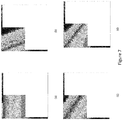
- Figure 7 depicts exemplary propagations related to the intra mode directions shown in Figure 6 .
- Figures 7(a) and (b) correspond to the intra predictor when using the mode chosen for the left, and above, block, respectively.
- Figure 7(c) shows what would happen if using a directional mode corresponding to the average of the left and above block's modes.
- Figure 7(d) shows an exemplary result of the proposed combination.
- ⁇ ( x,y ) represents the angle of the direction for each pixel location
- x and y represent the horizontal and vertical coordinates respectively
- ⁇ L and ⁇ A represent the Left and Above directional modes, respectively.
- no smoothing filter has been used and no interpolation is performed when the directional mode padding points at locations in between reference samples, and the nearest reference sample's value is chosen.
- the sample values correspond to the resultant angle that applies to the pixels.
- the encoder can select one of them at a low syntax cost. Then, several embodiments, described below, consist in different ways to signal this combination. For example, a syntax element can describe how to combine two existing modes, at a low syntax cost.
- a first embodiment for encoding a block of an image use the intra prediction process that propagates neighboring samples and:
- a decoder for decoding a block of an image uses an intra prediction process that propagates neighboring samples and:
- this embodiment checks among the neighboring Left and Above modes. If the modes are different, add at least one mode to the list which corresponds to a combination of the two.
- each new mode is a combination of modes included in the MPM list.
- the required syntax elements then describe the MPM list index of modes that are used.
- a new combination mode is added to the MPM list.
- neighboring modes are checked and when the combination is possible, the mode is added to the list.
- the fourth embodiment can be implemented with at least one new mode added only for certain modes corresponding to Left and Above blocks (see Figure 2 ). It can be included at any location in the MPM list, for instance after Left and Above modes or after Planar and DC, the only constraint being that an encoder and decoder share the same construction process.
- the previous five embodiments can also include the process of adding a new mode that depends on the considered neighbor intra modes. It is for instance performed when the modes are directional and the angle difference is less than 90°.
- the previous six embodiments can also include the at least one new mode being a linear combination of the values of the samples when predicted with the different modes.
- the fifth embodiment can be used with the combination being linear and depending on the horizontal, or vertical distance, of the Left, or Above, respective block.
- p i j S v ⁇ i + 1 S v ⁇ p A i j + S h ⁇ j + 1 S h ⁇ p L i j
- the fifth embodiment is used with the combination being a combination in terms of direction, not pixel values.
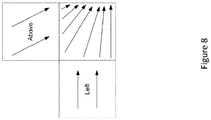
- the directions of the modes are combined. For each pixel of a current block, a combined direction is determined, not a combination of reference samples. For example, angular directions can be linearly interpolated from the top right to the bottom left location. Then, for each location in the current block, there is a single interpolated direction.
- ⁇ x y y . ⁇ L + x . ⁇ A x + y
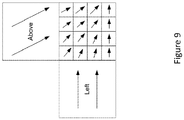
- the eighth embodiment can be implemented where the change of direction is applied at a sub-block level, as depicted in Figure 9 .
- Each sub-block is classically predicted using a given directional mode.
- the center of each sub-block can be considered for computing its angular mode.
- 4x4 sub-blocks are considered for inter prediction.
- Sub-blocks of any size can also be considered for intra prediction under the described embodiments.
- Figure 10 shows a method 1000 for encoding a video block using combined intra prediction modes.
- the method commences at Start block 1001 and control proceeds to block 1010 for predicting a current video block based on a combination of intra prediction modes from video blocks neighboring the current video block.
- Control proceeds from block 1010 to block 1020 for encoding the current video block using said prediction, wherein said combination of intra prediction modes is added to a list of most probable modes used during encoding.
- Figure 11 shows a method 1100 for decoding a video block using combined intra prediction modes.
- the method commences at Start block 1101 and control proceeds to block 1110 for predicting a current video block based on a combination of intra prediction modes from video blocks neighboring the current video block.
- Control proceeds from block 1110 to block 1120 for decoding the current video block using said prediction, wherein said combination of intra prediction modes is added to a list of most probable modes used during decoding.
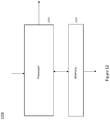
- Figure 12 shows an apparatus 1200 used for encoding or decoding a video block using combined intra prediction modes.
- the apparatus comprises a Processor 1210 and a Memory 1220.
- the Processor 1210 is configured, for encoding, to perform the steps of Figure 10 , that is performing encoding using combined intra prediction modes.
- Processor 1210 When Processor 1210 is configured for decoding, it performs the steps of Figure 11 , that is, performing decoding using combined intra prediction modes.
- processor or “controller” should not be construed to refer exclusively to hardware capable of executing software, and may implicitly include, without limitation, digital signal processor (“DSP”) hardware, read-only memory (“ROM”) for storing software, random access memory (“RAM”), and non-volatile storage.
- DSP digital signal processor
- ROM read-only memory
- RAM random access memory
- any switches shown in the figures are conceptual only. Their function may be carried out through the operation of program logic, through dedicated logic, through the interaction of program control and dedicated logic, or even manually, the particular technique being selectable by the implementer as more specifically understood from the context.
- any element expressed as a means for performing a specified function is intended to encompass any way of performing that function including, for example, a) a combination of circuit elements that performs that function or b) software in any form, including, therefore, firmware, microcode or the like, combined with appropriate circuitry for executing that software to perform the function.
- the present principles as defined by such claims reside in the fact that the functionalities provided by the various recited means are combined and brought together in the manner which the claims call for. It is thus regarded that any means that can provide those functionalities are equivalent to those shown herein.
Landscapes
- Engineering & Computer Science (AREA)
- Multimedia (AREA)
- Signal Processing (AREA)
- Computing Systems (AREA)
- Theoretical Computer Science (AREA)
- Compression Or Coding Systems Of Tv Signals (AREA)
Priority Applications (5)
| Application Number | Priority Date | Filing Date | Title |
|---|---|---|---|
| EP18305528.4A EP3562158A1 (de) | 2018-04-27 | 2018-04-27 | Verfahren und vorrichtung für kombinierte intraprädiktionsmodi |
| PCT/US2019/025479 WO2019209477A1 (en) | 2018-04-27 | 2019-04-03 | Method and apparatus for combined intra prediction modes |
| US17/049,724 US11477436B2 (en) | 2018-04-27 | 2019-04-03 | Method and apparatus for combined intra prediction modes |
| EP19717208.3A EP3785440A1 (de) | 2018-04-27 | 2019-04-03 | Verfahren und vorrichtung für kombinierte intraprädiktionsmodi |
| CN201980027026.6A CN112005552B (zh) | 2018-04-27 | 2019-04-03 | 用于组合的帧内预测模式的方法和装置 |
Applications Claiming Priority (1)
| Application Number | Priority Date | Filing Date | Title |
|---|---|---|---|
| EP18305528.4A EP3562158A1 (de) | 2018-04-27 | 2018-04-27 | Verfahren und vorrichtung für kombinierte intraprädiktionsmodi |
Publications (1)
| Publication Number | Publication Date |
|---|---|
| EP3562158A1 true EP3562158A1 (de) | 2019-10-30 |
Family
ID=62196496
Family Applications (2)
| Application Number | Title | Priority Date | Filing Date |
|---|---|---|---|
| EP18305528.4A Withdrawn EP3562158A1 (de) | 2018-04-27 | 2018-04-27 | Verfahren und vorrichtung für kombinierte intraprädiktionsmodi |
| EP19717208.3A Pending EP3785440A1 (de) | 2018-04-27 | 2019-04-03 | Verfahren und vorrichtung für kombinierte intraprädiktionsmodi |
Family Applications After (1)
| Application Number | Title | Priority Date | Filing Date |
|---|---|---|---|
| EP19717208.3A Pending EP3785440A1 (de) | 2018-04-27 | 2019-04-03 | Verfahren und vorrichtung für kombinierte intraprädiktionsmodi |
Country Status (4)
| Country | Link |
|---|---|
| US (1) | US11477436B2 (de) |
| EP (2) | EP3562158A1 (de) |
| CN (1) | CN112005552B (de) |
| WO (1) | WO2019209477A1 (de) |
Cited By (4)
| Publication number | Priority date | Publication date | Assignee | Title |
|---|---|---|---|---|
| US11012711B2 (en) * | 2018-11-29 | 2021-05-18 | Tencent America LLC | Adaptive most probable modes for multiple reference line intra prediction |
| WO2021162723A1 (en) * | 2020-02-13 | 2021-08-19 | Google Llc | Intra prediction for image and video compression |
| EP3896975A4 (de) * | 2019-01-02 | 2021-12-29 | Guangdong Oppo Mobile Telecommunications Corp., Ltd. | Verfahren und vorrichtung zur intraframe-vorhersage, videocodierungsvorrichtung und speichermedium |
| EP4210327A4 (de) * | 2020-09-28 | 2024-03-13 | Huawei Technologies Co., Ltd. | Intraframe-vorhersageverfahren und -vorrichtung |
Families Citing this family (3)
| Publication number | Priority date | Publication date | Assignee | Title |
|---|---|---|---|---|
| MY199332A (en) * | 2018-09-03 | 2023-10-24 | Huawei Tech Co Ltd | Method and apparatus for intra prediction |
| GB2580036B (en) * | 2018-12-19 | 2023-02-01 | British Broadcasting Corp | Bitstream decoding |
| WO2021037078A1 (en) * | 2019-08-26 | 2021-03-04 | Beijing Bytedance Network Technology Co., Ltd. | Extensions of intra coding modes in video coding |
Citations (3)
| Publication number | Priority date | Publication date | Assignee | Title |
|---|---|---|---|---|
| EP2391130A2 (de) * | 2010-05-30 | 2011-11-30 | LG Electronics Inc. | Verbesserte Signalisierung von Intra Prädiktion Modi |
| US20170272745A1 (en) * | 2016-03-18 | 2017-09-21 | Mediatek Inc. | Method and Apparatus of Intra Prediction in Image and Video Processing |
| WO2018026148A1 (ko) * | 2016-08-01 | 2018-02-08 | 한국전자통신연구원 | 영상 부호화/복호화 방법, 장치 및 비트스트림을 저장한 기록 매체 |
Family Cites Families (21)
| Publication number | Priority date | Publication date | Assignee | Title |
|---|---|---|---|---|
| KR101017094B1 (ko) * | 2002-06-11 | 2011-02-25 | 노키아 코포레이션 | 인트라 코딩에 기반한 공간 예측 |
| JP5321439B2 (ja) * | 2009-12-15 | 2013-10-23 | 株式会社Jvcケンウッド | 画像符号化装置、画像復号化装置、画像符号化方法、及び、画像復号化方法 |
| US8665959B2 (en) * | 2010-04-12 | 2014-03-04 | Qualcomm Incorporated | Block and partition signaling techniques for video coding |
| US20110317757A1 (en) * | 2010-06-25 | 2011-12-29 | Qualcomm Incorporated | Intra prediction mode signaling for finer spatial prediction directions |
| KR101756442B1 (ko) * | 2010-11-29 | 2017-07-11 | 에스케이텔레콤 주식회사 | 인트라예측모드의 중복성을 최소화하기 위한 영상 부호화/복호화 방법 및 장치 |
| CN103636203B (zh) | 2011-06-17 | 2017-07-14 | 寰发股份有限公司 | 内部预测模式编码的方法及装置 |
| US9154796B2 (en) * | 2011-11-04 | 2015-10-06 | Qualcomm Incorporated | Intra-mode video coding |
| GB2504069B (en) | 2012-07-12 | 2015-09-16 | Canon Kk | Method and device for predicting an image portion for encoding or decoding of an image |
| JP2019519972A (ja) * | 2016-05-05 | 2019-07-11 | ヴィド スケール インコーポレイテッド | イントラコーディングのための制御点ベースのイントラ方向表現 |
| US10547854B2 (en) * | 2016-05-13 | 2020-01-28 | Qualcomm Incorporated | Neighbor based signaling of intra prediction modes |
| US10397569B2 (en) | 2016-06-03 | 2019-08-27 | Mediatek Inc. | Method and apparatus for template-based intra prediction in image and video coding |
| CN116708776A (zh) * | 2016-07-18 | 2023-09-05 | 韩国电子通信研究院 | 图像编码/解码方法和装置以及存储比特流的记录介质 |
| WO2018026166A1 (ko) * | 2016-08-01 | 2018-02-08 | 한국전자통신연구원 | 영상 부호화/복호화 방법, 장치 및 비트스트림을 저장한 기록 매체 |
| WO2018048078A1 (ko) * | 2016-09-08 | 2018-03-15 | 가온미디어 주식회사 | 공간적 구조 정보를 이용한 동기화된 다시점 영상의 부호화/복호화 방법 및 그 장치 |
| EP3301916A1 (de) * | 2016-09-30 | 2018-04-04 | Thomson Licensing | Verfahren und vorrichtung zur codierung eines omnidirektionalen videos mit adaptiven wahrscheinlichsten intra-modi |
| EP3692716A1 (de) * | 2017-10-05 | 2020-08-12 | InterDigital VC Holdings, Inc. | Verfahren und vorrichtung zur adaptiven beleuchtungskompensation in der videocodierung und -decodierung |
| CN116405674A (zh) * | 2017-12-22 | 2023-07-07 | 数码士有限公司 | 视频信号处理方法和设备 |
| US11477474B2 (en) * | 2018-06-08 | 2022-10-18 | Mediatek Inc. | Methods and apparatus for multi-hypothesis mode reference and constraints |
| EP3821626A4 (de) * | 2018-08-09 | 2021-08-04 | Huawei Technologies Co., Ltd. | Verfahren und vorrichtung für verlaufsbasierte intramoduscodierung |
| EP3804311A4 (de) * | 2018-08-29 | 2021-07-28 | Huawei Technologies Co., Ltd. | Verfahren und vorrichtung zur intraprädiktion |
| CN111436227B (zh) * | 2018-11-12 | 2024-03-29 | 北京字节跳动网络技术有限公司 | 在视频处理中使用组合帧间-帧内预测 |
-
2018
- 2018-04-27 EP EP18305528.4A patent/EP3562158A1/de not_active Withdrawn
-
2019
- 2019-04-03 CN CN201980027026.6A patent/CN112005552B/zh active Active
- 2019-04-03 WO PCT/US2019/025479 patent/WO2019209477A1/en not_active Ceased
- 2019-04-03 EP EP19717208.3A patent/EP3785440A1/de active Pending
- 2019-04-03 US US17/049,724 patent/US11477436B2/en active Active
Patent Citations (3)
| Publication number | Priority date | Publication date | Assignee | Title |
|---|---|---|---|---|
| EP2391130A2 (de) * | 2010-05-30 | 2011-11-30 | LG Electronics Inc. | Verbesserte Signalisierung von Intra Prädiktion Modi |
| US20170272745A1 (en) * | 2016-03-18 | 2017-09-21 | Mediatek Inc. | Method and Apparatus of Intra Prediction in Image and Video Processing |
| WO2018026148A1 (ko) * | 2016-08-01 | 2018-02-08 | 한국전자통신연구원 | 영상 부호화/복호화 방법, 장치 및 비트스트림을 저장한 기록 매체 |
Non-Patent Citations (3)
| Title |
|---|
| "Algorithm description of Joint Exploration Test Model 7 (JEM7)", 119. MPEG MEETING;17-7-2017 - 21-7-2017; TORINO; (MOTION PICTURE EXPERT GROUP OR ISO/IEC JTC1/SC29/WG11),, no. N17055, 6 October 2017 (2017-10-06), XP030023716 * |
| SHIODERA T ET AL: "CE6 Subset A: Bidirectional intra prediction", 4. JCT-VC MEETING; 95. MPEG MEETING; 20-1-2011 - 28-1-2011; DAEGU;(JOINT COLLABORATIVE TEAM ON VIDEO CODING OF ISO/IEC JTC1/SC29/WG11AND ITU-T SG.16 ); URL: HTTP://WFTP3.ITU.INT/AV-ARCH/JCTVC-SITE/, no. JCTVC-D108, 15 January 2011 (2011-01-15), XP030008148 * |
| YAN YE ET AL: "Improved h.264 intra coding based on bi-directional intra prediction, directional transform, and adaptive coefficient scanning", 15TH IEEE INTERNATIONAL CONFERENCE ON IMAGE PROCESSING : ICIP 2008 ; SAN DIEGO, CALIFORNIA, USA, 12 - 15 OCTOBER 2008, IEEE, PISCATAWAY, NJ, USA, 12 October 2008 (2008-10-12), pages 2116 - 2119, XP031374452, ISBN: 978-1-4244-1765-0 * |
Cited By (13)
| Publication number | Priority date | Publication date | Assignee | Title |
|---|---|---|---|---|
| US11012711B2 (en) * | 2018-11-29 | 2021-05-18 | Tencent America LLC | Adaptive most probable modes for multiple reference line intra prediction |
| US11831817B2 (en) | 2019-01-02 | 2023-11-28 | Guangdong Oppo Mobile Telecommunications Corp., Ltd. | Methods for intra prediction, encoder and decoder |
| EP3896975A4 (de) * | 2019-01-02 | 2021-12-29 | Guangdong Oppo Mobile Telecommunications Corp., Ltd. | Verfahren und vorrichtung zur intraframe-vorhersage, videocodierungsvorrichtung und speichermedium |
| JP2022521037A (ja) * | 2019-01-02 | 2022-04-05 | オッポ広東移動通信有限公司 | イントラ予測方法および装置、ビデオコーディング機器、記憶媒体 |
| US11457223B2 (en) | 2019-01-02 | 2022-09-27 | Guangdong Oppo Mobile Telecommunications Corp., Ltd. | Methods for intra prediction, encoder and decoder |
| US11831882B2 (en) | 2019-01-02 | 2023-11-28 | Guangdong Oppo Mobile Telecommunications Corp., Ltd. | Methods for intra prediction, encoder and decoder |
| US11882293B2 (en) | 2019-01-02 | 2024-01-23 | Guangdong Oppo Mobile Telecommunications Corp., Ltd. | Methods for intra prediction, encoder and decoder |
| JP7460638B2 (ja) | 2019-01-02 | 2024-04-02 | オッポ広東移動通信有限公司 | イントラ予測方法および装置、ビデオコーディング機器、記憶媒体 |
| US12506880B2 (en) | 2019-01-02 | 2025-12-23 | Guangdong Oppo Mobile Telecommunications Corp., Ltd. | Methods for intra prediction, encoder and decoder |
| WO2021162723A1 (en) * | 2020-02-13 | 2021-08-19 | Google Llc | Intra prediction for image and video compression |
| US12075089B2 (en) | 2020-02-13 | 2024-08-27 | Google Llc | Intra prediction for image and video compression |
| US12120345B2 (en) | 2020-02-13 | 2024-10-15 | Google Llc | Intra prediction for image and video compression |
| EP4210327A4 (de) * | 2020-09-28 | 2024-03-13 | Huawei Technologies Co., Ltd. | Intraframe-vorhersageverfahren und -vorrichtung |
Also Published As
| Publication number | Publication date |
|---|---|
| CN112005552A (zh) | 2020-11-27 |
| WO2019209477A1 (en) | 2019-10-31 |
| US11477436B2 (en) | 2022-10-18 |
| EP3785440A1 (de) | 2021-03-03 |
| CN112005552B (zh) | 2024-12-03 |
| US20210243430A1 (en) | 2021-08-05 |
Similar Documents
| Publication | Publication Date | Title |
|---|---|---|
| US11477436B2 (en) | Method and apparatus for combined intra prediction modes | |
| CN113661710B (zh) | 核心转换和次级转换间的交互作用 | |
| US11245922B2 (en) | Shared candidate list | |
| CN112042187B (zh) | 一种解码方法和编码方法 | |
| US20180288439A1 (en) | Multiple Transform Prediction | |
| US20250310519A1 (en) | Region-based implicit intra mode derivation and prediction | |
| CN110546954A (zh) | 二次转换核心尺寸选择 | |
| US20140010295A1 (en) | Methods and Apparatus for Geometric-Based Intra Prediction | |
| US20250260828A1 (en) | Template-based intra mode derivation and prediction | |
| CN112042194B (zh) | 一种编码/解码的方法及电子装置 | |
| KR20120008423A (ko) | 영상의 인트라 예측 부호화, 복호화 방법 및 장치 | |
| US12593037B2 (en) | Adaptive regions for decoder-side intra mode derivation and prediction | |
| TW202423121A (zh) | 使用內預測之寫碼技術 | |
| US20250193451A1 (en) | Signaling for transform coding | |
| CN118985128A (zh) | 用于视频编解码的扩展块分区类型 | |
| US12604013B2 (en) | Threshold of similarity for candidate list | |
| WO2024131778A1 (en) | Intra prediction with region-based derivation | |
| WO2023193769A1 (en) | Implicit multi-pass decoder-side motion vector refinement | |
| CN121970325A (zh) | 帧内合并模式 | |
| CN119487845A (zh) | 利用卷积模型的预测改进 | |
| WO2024146511A1 (en) | Representative prediction mode of a block of pixels | |
| WO2025152878A1 (en) | Regression-based matrix-based intra prediction | |
| WO2026092755A1 (en) | Combined prediction mode for intra block copy with intra mode derivation | |
| US20250220155A1 (en) | Geometric partitioning mode and merge candidate reordering | |
| WO2023241340A1 (en) | Hardware for decoder-side intra mode derivation and prediction |
Legal Events
| Date | Code | Title | Description |
|---|---|---|---|
| PUAI | Public reference made under article 153(3) epc to a published international application that has entered the european phase |
Free format text: ORIGINAL CODE: 0009012 |
|
| AK | Designated contracting states |
Kind code of ref document: A1 Designated state(s): AL AT BE BG CH CY CZ DE DK EE ES FI FR GB GR HR HU IE IS IT LI LT LU LV MC MK MT NL NO PL PT RO RS SE SI SK SM TR |
|
| AX | Request for extension of the european patent |
Extension state: BA ME |
|
| RAP1 | Party data changed (applicant data changed or rights of an application transferred) |
Owner name: INTERDIGITAL VC HOLDINGS, INC. |
|
| STAA | Information on the status of an ep patent application or granted ep patent |
Free format text: STATUS: THE APPLICATION IS DEEMED TO BE WITHDRAWN |
|
| 18D | Application deemed to be withdrawn |
Effective date: 20200603 |