EP3562995B1 - Brown stock wash control - Google Patents
Brown stock wash control Download PDFInfo
- Publication number
- EP3562995B1 EP3562995B1 EP17832677.3A EP17832677A EP3562995B1 EP 3562995 B1 EP3562995 B1 EP 3562995B1 EP 17832677 A EP17832677 A EP 17832677A EP 3562995 B1 EP3562995 B1 EP 3562995B1
- Authority
- EP
- European Patent Office
- Prior art keywords
- brown stock
- defoamer
- stock
- brown
- drainage aid
- Prior art date
- Legal status (The legal status is an assumption and is not a legal conclusion. Google has not performed a legal analysis and makes no representation as to the accuracy of the status listed.)
- Active
Links
Images


Classifications
-
- D—TEXTILES; PAPER
- D21—PAPER-MAKING; PRODUCTION OF CELLULOSE
- D21H—PULP COMPOSITIONS; PREPARATION THEREOF NOT COVERED BY SUBCLASSES D21C OR D21D; IMPREGNATING OR COATING OF PAPER; TREATMENT OF FINISHED PAPER NOT COVERED BY CLASS B31 OR SUBCLASS D21G; PAPER NOT OTHERWISE PROVIDED FOR
- D21H23/00—Processes or apparatus for adding material to the pulp or to the paper
- D21H23/02—Processes or apparatus for adding material to the pulp or to the paper characterised by the manner in which substances are added
- D21H23/04—Addition to the pulp; After-treatment of added substances in the pulp
- D21H23/06—Controlling the addition
-
- D—TEXTILES; PAPER
- D21—PAPER-MAKING; PRODUCTION OF CELLULOSE
- D21C—PRODUCTION OF CELLULOSE BY REMOVING NON-CELLULOSE SUBSTANCES FROM CELLULOSE-CONTAINING MATERIALS; REGENERATION OF PULPING LIQUORS; APPARATUS THEREFOR
- D21C9/00—After-treatment of cellulose pulp, e.g. of wood pulp, or cotton linters ; Treatment of dilute or dewatered pulp or process improvement taking place after obtaining the raw cellulosic material and not provided for elsewhere
- D21C9/02—Washing ; Displacing cooking or pulp-treating liquors contained in the pulp by fluids, e.g. wash water or other pulp-treating agents
-
- B—PERFORMING OPERATIONS; TRANSPORTING
- B01—PHYSICAL OR CHEMICAL PROCESSES OR APPARATUS IN GENERAL
- B01D—SEPARATION
- B01D19/00—Degasification of liquids
- B01D19/0063—Regulation, control including valves and floats
-
- B—PERFORMING OPERATIONS; TRANSPORTING
- B01—PHYSICAL OR CHEMICAL PROCESSES OR APPARATUS IN GENERAL
- B01D—SEPARATION
- B01D19/00—Degasification of liquids
- B01D19/02—Foam dispersion or prevention
- B01D19/04—Foam dispersion or prevention by addition of chemical substances
- B01D19/0404—Foam dispersion or prevention by addition of chemical substances characterised by the nature of the chemical substance
- B01D19/0409—Foam dispersion or prevention by addition of chemical substances characterised by the nature of the chemical substance compounds containing Si-atoms
-
- D—TEXTILES; PAPER
- D21—PAPER-MAKING; PRODUCTION OF CELLULOSE
- D21H—PULP COMPOSITIONS; PREPARATION THEREOF NOT COVERED BY SUBCLASSES D21C OR D21D; IMPREGNATING OR COATING OF PAPER; TREATMENT OF FINISHED PAPER NOT COVERED BY CLASS B31 OR SUBCLASS D21G; PAPER NOT OTHERWISE PROVIDED FOR
- D21H21/00—Non-fibrous material added to the pulp, characterised by its function, form or properties; Paper-impregnating or coating material, characterised by its function, form or properties
- D21H21/06—Paper forming aids
- D21H21/10—Retention agents or drainage improvers
-
- D—TEXTILES; PAPER
- D21—PAPER-MAKING; PRODUCTION OF CELLULOSE
- D21H—PULP COMPOSITIONS; PREPARATION THEREOF NOT COVERED BY SUBCLASSES D21C OR D21D; IMPREGNATING OR COATING OF PAPER; TREATMENT OF FINISHED PAPER NOT COVERED BY CLASS B31 OR SUBCLASS D21G; PAPER NOT OTHERWISE PROVIDED FOR
- D21H21/00—Non-fibrous material added to the pulp, characterised by its function, form or properties; Paper-impregnating or coating material, characterised by its function, form or properties
- D21H21/06—Paper forming aids
- D21H21/12—Defoamers
Definitions
- wash aids e.g., drainage aid, defoamer
- Control of wash aids to a brown stock washing process ranges from manual control where pump flows are changed at a single wash aid pump with no higher level (e.g., feedback) control, to other control systems that utilize only measured entrained air data to control dosing of a single, pre-blended wash aid.
- brown stock washing process control system calculates a pounds-of-wash-aid-per-ton-of-dry-pulp set point and then controls washing aid dosage based on the setpoint.
- "Pounds per ton" control does not base its wash aid dosage control on changes in either measured entrained air concentration data or changes in fiber characteristics that may impact drainage.
- a rarely-used method of brown stock washing process control involves controlling defoamer dosage to maintain a set washer drum speed.
- a method of controlling dosage of drainage aid to brown stock of a brown stock washing process comprises dosing the drainage aid to brown stock according to at least two variables: brown stock washer drum speed and brown stock washer stock flow.
- a method of controlling dosage of drainage aid and defoamer to brown stock of a brown stock washing process comprises dosing the drainage aid and the defoamer to brown stock according to at least three variables: measured entrained air concentration of the brown stock, brown stock washer drum speed, and brown stock washer stock flow.
- the drainage aid is dosed according to a first comparison of the brown stock washer drum speed to the brown stock washer stock flow.
- a system for controlling dosing of drainage aid and defoamer to a brown stock washing process comprises an entrained air concentration measurement device, a brown stock washer drum speed relay, a brown stock washer stock flow rate measuring device, a controller, a drainage aid delivery unit, and a defoamer delivery unit.
- the controller is configured to receive data provided by the entrained air measurement device, the brown stock washer drum speed relay, and the brown stock washer stock flow rate measuring device and transform the data into drainage aid output instructions and defoamer output instructions.
- the drainage aid deliver unit is configured to receive and execute the drainage aid output instructions from the controller.
- the defoamer delivery unit is configured to receive and execute the defoamer output instructions from the controller.
- Entrained air present in the brown stock does not always affect brown stock washing efficiency. It has been discovered that, in addition to entrained air present in brown stock, brown stock washing efficiency can be affected by surface tension characteristics in the brown stock instead of or in addition to the presence of entrained air in the brown stock.
- Independently dosing drainage aid and defoamer to pulp in a brown stock washing process provides flexibility over having a pre-blended, combined drainage aid-defoamer treatment.
- Dosing drainage aid and defoamer according to the methods provided herein is intended to allow the brown stock washing process to adjust dosage of each of drainage aid and defoamer as needed in real time, which should thereby provide for consistent pulp quality and runnability of not only the brown stock washing process but also of a downstream papermaking process.
- a method of controlling dosage of drainage aid, defoamer, or both drainage aid and defoamer to pulp in a brown stock washing process comprises independently dosing the drainage aid and the defoamer to the brown stock washing process according to at least three variables: (1) measured entrained air concentration of the brown stock, (2) brown stock washer drum speed, and (3) brown stock washer stock flow.
- the drainage aid is dosed according to a first linear control formula depending on a comparison of the brown stock washer drum speed to the brown stock washer stock flow.
- the defoamer is dosed according to a second linear control formula depending on a comparison of the measured entrained air concentration of the brown stock to a setpoint.
- brown stock is a term of art that refers to a slurry comprising generally unbleached pulp that is fed to a brown stock washer.
- Brown stock comprises pulp and water (i.e., pulp slurry), and may further comprise, for example, black liquor solids present due to countercurrent washing.
- brown stock is washed to remove solids (e.g., black liquor solids) from the unbleached pulp prior to, for example, bleaching the pulp and/or feeding the pulp to a papermaking process, and to reduce conductivity of the pulp mat to improve efficiency of downstream bleaching. Additionally, brown stock washing helps reduce soda loss in brown stock processing, which generally promotes efficiency in processing as related to soda consumption.
- brown stock washing is performed via a brown stock washing process that comprises a brown stock washer stock being delivered (e.g., flowed) to a brown stock washer drum rotating at a brown stock washer drum speed.
- the brown stock washer stock comprises pulp slurry, and the pulp slurry is taken up by the rotating brown stock washer drum.
- Treatment in the form of, among others, drainage aid, defoamer, or both drainage aid and defoamer are delivered to the pulp slurry via one or more pumps.
- the brown stock washing process may be performed in stages (e.g., delivery of one treatment, followed by delivery of a second treatment that may be the same or different) on a plurality of brown stock washer drums.
- the brown stock washing process may be repeated one or more times.
- the pulp slurry proceeds to a bleaching plant for bleaching.
- the brown stock is washed so as to minimize bleaching costs (e.g., minimize chlorine dioxide consumption and/or hydrogen peroxide consumption).
- drainage aid is dosed to the brown stock washing process so that the washed pulp will have improved drainage properties during papermaking.
- the improved drainage properties are imparted to the pulp by reducing the surface tension of the water in the pulp slurry.
- pulp being formed into paper must be reasonably wet in order to form a sheet.
- a sheet is formed at the wet end of a papermaking process, which then passes to the dry end of the process. Once a sheet is formed at the wet end of the papermaking process, it is preferred to remove as much water as possible in the wet press section prior to the dryer section. Removal of water in the wet press section prior to the steam-heated rollers of the dryer section allows the paper machine to run faster, thereby improving energy efficiency of the papermaking process.
- the drainage aid dosed to pulp of the brown stock washing process can be any suitable drainage aid.
- the presence of drainage aid in the pulp allows for improved drainage of water from the sheet in the wet press section as compared to pulp lacking drainage aid.
- the drainage aid comprises a surfactant, a defoamer as described herein, a solvent, or combinations thereof.
- surfactants include, but are not limited to, nonionic surfactants and anionic surfactants, e.g., ethyleneamines (e.g., ethylenediamine, diethylenetriamine, triethylenetetramine, tetraethylenepentamine, piperazine, aminoethylpiperazine, ethyleneamine mixtures such as mixtures of ethyleneamine oligomers, etc.).
- the solvent is suitable for remiving lignin and/or other black liquor components, and is at least partially soluble or dispersible. Examples of such solvents include, but are not limited to, alcohols, ketones, heterocyclic compounds, polyethers, and the like, and mixtures thereof. Additionally, water may be utilized.
- the drainage aid comprises a polydimethylsiloxane ("PMDS")-containing composition.
- PMDS polydimethylsiloxane
- the dosing of the drainage aid is controlled via manipulation of a drainage aid delivery unit, e.g., a variable speed pump.
- a drainage aid delivery unit e.g., a variable speed pump.
- drainage aid can be dosed to the brown stock washing process via a variable speed pump.
- the methods and systems provided herein can be utilized to control the speed of the drainage aid variable speed pump.
- Defoamer is dosed to pulp in the brown stock washing process so that entrained air can be released from the treated water in the pulp slurry.
- entrained air concentration should be minimized in the brown stock washing process, and in the papermaking process in general.
- the defoamer dosed to pulp of the brown stock washing process can be any suitable defoamer. Generally, the presence of the defoamer in the process will allow for reduction of entrained air in the treated water present in the pulp slurry of the brown stock washing process.
- the defoamer is selected from a hydrocarbon, an oil, a fatty alcohol, a fatty ester, a fatty acid, a poly(alkylene oxide) (e.g., poly(ethylene oxide) or poly(propylene oxide), derivatives thereof, and copolymers thereof), an organic phosphate, hydrophobic silica (e.g., hydrophobic silica present in a hydrocarbon oil), a silicone-containing compound, and combinations thereof.
- the defoamer comprises a silicone-containing compound, and in certain embodiments, the silicone-containing compound is a polydimethylsiloxane ("PMDS")-containing compound.
- the defoamer formulation is custom-determined onsite depending on one or more of several possible variables, including, for example, drainage aid chemistry, drainage aid concentration, and combinations thereof.
- the dosing of the defoamer is controlled via manipulation of a defoamer delivery unit, e.g., a variable speed pump.
- a defoamer delivery unit e.g., a variable speed pump.
- defoamer can be dosed to the brown stock washing process via a variable speed pump.
- the methods and systems provided herein can be utilized to control the speed of the defoamer variable speed pump.
- each variable provides information related to the state of the process. For example, operators of a brown stock washing process monitor brown stock washer drum speed and brown stock washer stock flow to determine how quickly (or alternately, how slowly) the pulp of the brown stock washing process is being washed. A typical operator of a brown stock washer process may not utilize the retrieved data to control the process, but merely collect the data to provide information as to the general production of washed pulp.
- Certain embodiments of the methods provided herein utilize the brown stock washer drum speed, the brown stock washer stock flow, and entrained air measurements to independently dose drainage aid and defoamer to pulp of the brown stock washing process.
- the data gathered is used at least in part to control dosage of drainage aid, defoamer, or both drainage aid and defoamer.
- An excessive amount of entrained air present in the pulp slurry can cause difficulty downstream from the brown stock washing process. For example, as entrained air forms in the washer vat or on the washer mat, drainage of the filtrate through the washer mat can be impacted. In addition, foam can grow rapidly without defoamer being dosed to the pulp slurry of the brown stock washing process, which can result in the foam causing overflow of the washer vat and/or filtrate tanks. Furthermore, cavitation of process pumps can be caused by the presence of excess entrained air in the pulp slurry.
- Entrained air can be measured, for example, via an entrained air measurement device.
- An example of an entrained air measurement device is a PULSE))))AIR entrained air detection system, available from Nalco Water, 1601 West Diehl Road, Naperville, IL 60563.
- defoamer is dosed to the pulp of the brown stock washing process such that the measured entrained air is maintained at from 0 to about 20% of saturation based on mill conditions.
- setpoint should be construed to include any control value or control range where a measurement (e.g., measured entrained air) is compared to a preselected or calculated control value or range thereof.
- brown stock washer drum speed is monitored as part of the brown stock washing process.
- a brown stock washer drum is generally cylindrical, having a diameter of from 2.4 m (8 ft) to 4.6 m (15 ft), and a length of from 3 m (10 ft) to 12.2 m (40 ft), providing a drum surface of from 23 m 2 (250 ft 2 ) to 186 m 2 (2000 ft 2 ) for pulp to contact.
- a brown stock washing process may have a brown stock washer drum speed of from 1 rpm to 5 rpm, or from 1 rpm, or from 2 rpm, to 4 rpm, or to 5 rpm.
- brown stock washer stock flow is monitored as part of the brown stock washing process.
- Brown stock washer stock flow refers to the amount of pulp slurry that is being delivered to the brown stock washer drum. Ideally, brown stock washer stock flow is maintained at a rate that is optimal to maximize production while maintaining cost efficiency. Generally, brown stock washer stock flow is maintained so as to provide a brown stock consistency of from 1% to 4%, including to 3.5%.
- Brown stock consistency is a percentage rating describing the amount of pulp in the brown stock slurry.
- a method for calculating brown stock consistency is as follows: (oven-dry weight of pulp ⁇ 100) / (weight of pulp including water). Pulp can be oven-dried, e.g., by heating pulp to 105 °C until any water has been evaporated away.
- the measured brown stock washer drum speed and brown stock washer stock flow are compared to determine dosage of drainage aid to pulp in a brown stock washing process.
- a setpoint related to brown stock washer drum speed based on brown stock washer stock flow can be determined.
- the brown stock washer drum speed is compared with the setpoint to determine the drainage aid dosage. If the drum speed is higher than the setpoint, which is based on the stock flow, then the drainage aid dosage is increased accordingly, or vice versa for situations where the drum speed is lower than the setpoint.
- the comparison of the brown stock washer drum speed and the brown stock washer stock flow is performed using a first linear control formula.
- the comparison of the measured entrained air concentration to a setpoint is performed using a second linear control formula.
- Additional variables of a brown stock washing process include, but are not limited to, vat level, shower flow, shower conductivity, electrical current of the drum thickener, entrained air bubble size, and combinations thereof.
- the linear control formulae described herein may be manipulated to account for any one, combination of, or all of the aforementioned additional variables. For example, as bubble size of entrained air increases, the impact on drainage and runnability in the brown stock washing process decreases. Estimates of bubble size of entrained air can be obtained via an entrained air measurement device as described herein, with relative bubble size being a function of standard deviation of measured entrained air.
- relatively large numbers for bubble size are better for drainage, as relatively large numbers indicate coalescence of relatively small bubbles into relatively large bubbles, thereby having less impact on drainage of the washed brown stock.
- the pulp has relatively high consistency (e.g., greater than about 4%), which can impact drainage in the brown stock washing process and increase conductivity of the washed brown stock. Relatively high conductivity of the pulp can result in inefficient bleaching downstream from the brown stock washing process. Additionally, changes in charge of the pulp on the paper machine may take place, impacting drainage on the paper machine.
- the methods provided herein generally allow for pulp of relatively low conductivity across a range of consistency levels to be utilized in papermaking because consistent brown stock washing tends to provide consistent brown stock, which tends to improve bleaching and papermaking efficiency downstream.
- the method further comprises increasing the brown stock washer drum speed to prevent overflow of a washer vat of the brown stock washing process.
- the brown stock drum runs more quickly, more pulp slurry is pulled onto the mat, thereby reducing the vat level.
- the method further comprises controlling shower flow of the papermaking process according to drainage aid dosage.
- the method further comprises controlling shower flow of the papermaking process according to drainage aid dosage. With improvement in drainage of the pulp, more shower water can be added for better washing. As vat dilution increases, the displacement of washing improves, thereby improving efficiency of the brown stock washing process.
- the methods further comprise altering the second linear control formula to account for measured shower conductivity, thereby controlling defoamer dosage according to measured entrained air concentration and measured shower conductivity.
- shower conductivity can correlate with measured entrained air.
- a system for controlling dosing of drainage aid and defoamer to a brown stock washing process comprises an entrained air measurement device; a brown stock washer drum speed relay; a brown stock washer stock flow rate measuring device; a controller configured to receive data provided by the entrained air measurement device, the brown stock washer drum speed relay, and the brown stock washer stock flow rate measuring device and transform the data into a drainage aid output instructions and a defoamer output instructions; a drainage aid delivery unit configured to receive and execute the drainage aid output instructions from the controller; and a defoamer delivery unit configured to receive and execute the defoamer output instructions from the controller.
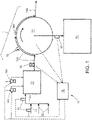
- FIG. 1 is a schematic illustration of a brown stock washing process 1 comprising an embodiment of a system 10 for controlling dosing of drainage aid and defoamer to a brown stock washing process.
- System 10 of FIG. 1 comprises entrained air measurement devices 12 (three shown, though one, two, three, or more may be utilized); brown stock washer drum speed relay 14; brown stock washer stock flow rate measuring device 16; controller 18 configured to receive data provided by the entrained air measurement devices 12, the brown stock washer drum speed relay 14, and the brown stock washer stock flow rate measuring device 16 and transform the data into a drainage aid output instructions and a defoamer output instructions; drainage aid delivery unit 102 configured to receive and execute the drainage aid output instructions from the controller; and a defoamer delivery unit 104 configured to receive and execute the defoamer output instructions from the controller. Drainage aid delivery unit 102 and defoamer delivery unit 104, as shown in FIG. 1 , are configured to deliver drainage aid and defoamer to brown stock inlet vat 30, though over configurations
- brown stock washing process 1 comprises inlet vat lines 22, inlet vat header 24, and brown stock inlet vat 30, which feeds mat 34a onto rotating drum 50.
- Mat 34a is washed via shower 56, thereby forming washed mat 34b.
- Vacuum is drawn on rotating drum 50 via filtrate tank 80, and mat 34b is removed from rotating drum 50, which can be fed to another brown stock washing process 1, to a papermaking system , or to a holding apparatus.
- the entrained air measurement device of the systems and methods is capable of measuring entrained air concentration in a liquid or slurry and relay information related to entrained air to a controller.
- the entrained air concentration measurement device can measure entrained air concentration in a pulp slurry (e.g., brown stock) to a concentration of from 0% to about 20% at conditions present in a brown stock washing process.
- the entrained air concentration measurement device may be operably connected to at least one of an inlet vat line, an inlet vat header, and a filtrate (e.g., a front filtrate).
- an example of an entrained air measurement device is a PULSE)))))AIR entrained air detection system, available from Nalco Water, 1601 West Diehl Road, Naperville, IL 60563.
- the brown stock washer drum speed relay provides the controller with information related to brown stock washer drum speed.
- the data provided by the brown stock washer drum speed may be utilized, for example, to provide input into controlling dosage of drainage aid to the brown stock.
- the brown stock washer drum speed relay provides an electrical input to the controller relative to the drum speed, which is then utilized in Formula A provided herein.
- the brown stock washer stock flow rate measuring device provides the controller with information related to brown stock washer stock flow rate.
- the data provided by the brown stock washer stock flow rate measuring device may be utilized to, for example, provide input into controlling dosage of drainage aid to the brown stock.
- the brown stock washer stock flow rate measuring device provides an electrical input to the controller relative to the brown stock washer stock flow rate, which is then utilized in Formula A provided herein.
- the controller of the systems and methods provided herein is configured to receive data provided by, for example, the entrained air measurement device, the brown stock washer drum speed relay, the brown stock washer stock flow rate measuring device, and optionally other data-generating devices that may measure any one or combination of vat level, shower flow, shower conductivity, electrical current of the drum thickener, and entrained air bubble size.
- the controller is further configured to transform the data received from the entrained air measurement device, the brown stock washer drum speed relay, the brown stock washer stock flow rate measuring device, and optionally other data-generating devices and transform the data into drainage aid output instructions and defoamer output instructions, which are subsequently delivered to a drainage aid delivery unit and a defoamer delivery unit.
- the controller receives data provided by the entrained air measurement device, the brown stock washer drum speed relay, the brown stock washer stock flow rate measuring device, and optionally other data-generating devices (collectively, “the devices"). Each of the devices measures its applicable variable and communicates the measurement in some form to the controller.
- the controller transforms the data into output instructions (e.g., drainage aid output instructions and defoamer output instructions).
- the controller as provided herein refers to an electronic device having components such as a processor, memory device, digital storage medium, cathode ray tube, liquid crystal display, plasma display, touch screen, or other monitor, and/or other components.
- Controllers include, for example, an interactive interface that guides a user, provides prompts to the user, or provides information to the user regarding any portion of the method of the invention. Such information may include, for example, building of calibration models, data collection of one or more parameters, measurement location(s), management of resulting data sets, etc.
- the controller When utilized, the controller is preferably operable for integration and/or communication with one or more application-specific integrated circuits, programs, computer-executable instructions or algorithms, one or more hard-wired devices, wireless devices, and/or one or more mechanical devices such as liquid handlers, hydraulic arms, servos, or other devices. Moreover, the controller is operable to integrate feedback, feedforward, or predictive loop(s) resulting from, inter alia, the parameters measured by practicing the method(s) of the present disclosure. Some or all of the controller system functions may be at a central location, such as a network server, for communication over a local area network, wide area network, wireless network, extranet, the Internet, microwave link, infrared link, and the like, and any combinations of such links or other suitable links. In addition, other components such as a signal conditioner or system monitor may be included to facilitate signal transmission and signal-processing algorithms.
- a signal conditioner or system monitor may be included to facilitate signal transmission and signal-processing algorithms.
- the controller is operable to implement the method of the invention in a semi-automated or fully-automated fashion.
- the controller is operable to implement the method in a manual or semi-manual fashion. Examples of the aforementioned variations of the invention are provided herein in reference to the figures.
- a dataset collected from brown stock may include variables or system parameters such as entrained air concentration, brown stock washer drum speed, brown stock washer stock flow, and other variables or system parameters described herein (e.g., whether determined empirically, automatically, measured directly, calculated, etc.). Such parameters are typically measured with any type of suitable data measuring/sensing/capturing equipment, such as described herein. Such data capturing equipment is preferably in communication with the controller and, according to alternative embodiments, may have advanced functions (including any part of control algorithms described herein) imparted by the controller.
- a drainage aid delivery unit e.g., a drainage aid delivery pump
- a defoamer delivery unit e.g., a defoamer delivery pump
- alarms or other system components
- any suitable device such as a wired or wireless network, cable, digital subscriber line, internet, etc.
- Any suitable interface standard(s) such as an Ethernet interface, wireless interface (e.g., IEEE 802.lla/b/g/n, 802.16, Bluetooth, optical, infrared, other radiofrequency, any other suitable wireless data transmission method, and any combinations of the foregoing), universal serial bus, telephone network, the like, and combinations of such interfaces/connections may be used.
- the term "network” encompasses all of these data transmission methods. Any of the components, devices, sensors, etc., herein described may be connected to one another and/or the controller using the above-described or other suitable interface or connection.
- information (collectively referring to all of the inputs or outputs generated by the method of the invention) is received from the system and archived.
- information is processed according to a timetable or schedule.
- such information is processed in real-time.
- Such real-time reception may also include, for example, "streaming data" over a computer network.
- An example of a controller is a 3D TRASAR control unit, available from Nalco Water, 1601 West Diehl Road, Naperville, IL 60563.
- the controller may be configured to transform the data provided by the brown stock washer drum speed relay and the brown stock washer stock flow rate measuring device according to Formula A described herein.
- the controller may be configured to transform the data provided by the entrained air measurement device according to Formula B described herein.
- a drainage aid delivery unit is configured to receive and execute the drainage aid output instructions from the controller.
- An embodiment of a drainage aid delivery unit is a pump, which may be a variable speed pump, arranged and configured to deliver an amount of drainage aid to the brown stock.
- the drainage aid may be present in a tank, and the drainage aid delivery unit may be arranged and configured to remove drainage aid from the tank via a conduit and deliver the drainage aid to the brown stock.
- An example of a drainage aid delivery unit is a variable speed diaphragm pump.
- a defoamer delivery unit is configured to receive and execute the defoamer output instructions from the controller.
- An embodiment of a defoamer delivery unit is a pump, which may be a variable speed pump, arranged and configured to deliver an amount of defoamer to the brown stock.
- the defoamer may be present in a tank, and the defoamer delivery unit may be arranged and configured to remove defoamer from the tank via a conduit and deliver the defoamer to the brown stock.
- An example of a defoamer delivery unit is a variable speed diaphragm pump.
- the system may further comprise at least one of a vat level detector, a shower flow measurement device, a shower conductivity measurement device, a drum thickener electrical current relay, an entrained air bubble size detector, and combinations thereof, in communication with the controller.
- drainage aid and defoamer were dosed to a brown stock washing process according to a previous dosing regimen.
- dosing of drainage aid and defoamer commenced via the methods described herein, using a system as described herein.
- the drainage aid was dosed according to at least two variables: brown stock washer drum speed and brown stock washer stock flow, in this instance Formula A, and the defoamer was dosed according to a comparison of the measured entrained air concentration of the brown stock to a setpoint, in this instance Formula B.
- drainage aid consumption decreased approximately 7% and defoamer consumption decreased approximately 12%.
- the variability of the drainage aid dosage increased ( see FIG. 2A )
- the overall consumption decreased approximately 7% ( see FIG. 2B ).
- defoamer consumption decreased approximately 12% ( see FIGs. 3A and 3B ).
Landscapes
- Chemical & Material Sciences (AREA)
- Chemical Kinetics & Catalysis (AREA)
- Life Sciences & Earth Sciences (AREA)
- Engineering & Computer Science (AREA)
- Wood Science & Technology (AREA)
- Health & Medical Sciences (AREA)
- Toxicology (AREA)
- Dispersion Chemistry (AREA)
- Paper (AREA)
- Detergent Compositions (AREA)
Description
- Generally, entrained air impacts brown stock washer operation and, therefore, wash aid consumption. Control of wash aids (e.g., drainage aid, defoamer) to a brown stock washing process ranges from manual control where pump flows are changed at a single wash aid pump with no higher level (e.g., feedback) control, to other control systems that utilize only measured entrained air data to control dosing of a single, pre-blended wash aid.
- Many brown stock washing processes utilize manual control. For these processes, pumps are set manually at a given flow rate and have no interface with the brown stock washing process. Generally, chemical feed rates are constant until the operator manually alters the pump speed, and therefore the flow rate. In some cases, changes in flow rate will be made during upset conditions and left at the changed flow rate for an extended (i.e., excessive) period of time.
- Another control method that is commonly utilized in brown stock washing processes is simple "pounds per ton" control, i.e., pounds of wash aid dosed per ton of dry pulp. For "pounds per ton" processes, the brown stock washing process control system calculates a pounds-of-wash-aid-per-ton-of-dry-pulp set point and then controls washing aid dosage based on the setpoint. "Pounds per ton" control does not base its wash aid dosage control on changes in either measured entrained air concentration data or changes in fiber characteristics that may impact drainage.
- A rarely-used method of brown stock washing process control involves controlling defoamer dosage to maintain a set washer drum speed.
- A method of controlling dosage of drainage aid to brown stock of a brown stock washing process is provided. The method comprises dosing the drainage aid to brown stock according to at least two variables: brown stock washer drum speed and brown stock washer stock flow. The drainage aid is dosed according to a comparison of the brown stock washer drum speed to the brown stock washer stock flow. This comparison is performed using a first linear control formula and wherein the first linear control formula is Formula A:

Additionally, a method of controlling dosage of drainage aid and defoamer to brown stock of a brown stock washing process is provided. The method comprises dosing the drainage aid and the defoamer to brown stock according to at least three variables: measured entrained air concentration of the brown stock, brown stock washer drum speed, and brown stock washer stock flow. The drainage aid is dosed according to a first comparison of the brown stock washer drum speed to the brown stock washer stock flow. This first comparison is performed using a first linear control formula and , wherein the first linear control formula is Formula A: dad = m1 ∗ {DS - [(m2 ∗SF)+ b2]} + b1, wherein dad = drainage aid dosage, ml = a first slope, DS = brown stock washer drum speed, m2 = a second slope, SF = brown stock washer stock flow, bI = a first offset, and b2 = a second offset The defoamer is dosed according to a second comparison of the measured entrained air concentration of the brown stock to a setpoint. This second linear control formula is Formula B: dd = m3 ∗ (mEA - sp) + b3, wherein dd = defoamer dosage, m3 = a third slope, mEA = measured entrained air, sp = setpoint, and b3 = a third offset - A system for controlling dosing of drainage aid and defoamer to a brown stock washing process is provided. The system comprises an entrained air concentration measurement device, a brown stock washer drum speed relay, a brown stock washer stock flow rate measuring device, a controller, a drainage aid delivery unit, and a defoamer delivery unit. The controller is configured to receive data provided by the entrained air measurement device, the brown stock washer drum speed relay, and the brown stock washer stock flow rate measuring device and transform the data into drainage aid output instructions and defoamer output instructions. The drainage aid deliver unit is configured to receive and execute the drainage aid output instructions from the controller. The defoamer delivery unit is configured to receive and execute the defoamer output instructions from the controller.
-
-
FIG. 1 shows a schematic diagram of an embodiment of a brown stock washing process comprising a system of the present disclosure that can be utilized for carrying out the methods of the present disclosure. -
FIGs. 2A and 2B graphically illustrate results obtained in the Example related to drainage aid consumption. -
FIGs. 3A and 3B graphically illustrate results obtained in the Example related to defoamer consumption. - Entrained air present in the brown stock does not always affect brown stock washing efficiency. It has been discovered that, in addition to entrained air present in brown stock, brown stock washing efficiency can be affected by surface tension characteristics in the brown stock instead of or in addition to the presence of entrained air in the brown stock. Independently dosing drainage aid and defoamer to pulp in a brown stock washing process provides flexibility over having a pre-blended, combined drainage aid-defoamer treatment. Dosing drainage aid and defoamer according to the methods provided herein is intended to allow the brown stock washing process to adjust dosage of each of drainage aid and defoamer as needed in real time, which should thereby provide for consistent pulp quality and runnability of not only the brown stock washing process but also of a downstream papermaking process.
- A method of controlling dosage of drainage aid, defoamer, or both drainage aid and defoamer to pulp in a brown stock washing process is provided. In certain embodiments, the method comprises independently dosing the drainage aid and the defoamer to the brown stock washing process according to at least three variables: (1) measured entrained air concentration of the brown stock, (2) brown stock washer drum speed, and (3) brown stock washer stock flow. The drainage aid is dosed according to a first linear control formula depending on a comparison of the brown stock washer drum speed to the brown stock washer stock flow. The defoamer is dosed according to a second linear control formula depending on a comparison of the measured entrained air concentration of the brown stock to a setpoint.
- The methods and systems described herein are related to treatment of brown stock. The term "brown stock" is a term of art that refers to a slurry comprising generally unbleached pulp that is fed to a brown stock washer. Brown stock comprises pulp and water (i.e., pulp slurry), and may further comprise, for example, black liquor solids present due to countercurrent washing. Generally, brown stock is washed to remove solids (e.g., black liquor solids) from the unbleached pulp prior to, for example, bleaching the pulp and/or feeding the pulp to a papermaking process, and to reduce conductivity of the pulp mat to improve efficiency of downstream bleaching. Additionally, brown stock washing helps reduce soda loss in brown stock processing, which generally promotes efficiency in processing as related to soda consumption.
- Generally, brown stock washing is performed via a brown stock washing process that comprises a brown stock washer stock being delivered (e.g., flowed) to a brown stock washer drum rotating at a brown stock washer drum speed. The brown stock washer stock comprises pulp slurry, and the pulp slurry is taken up by the rotating brown stock washer drum. Treatment in the form of, among others, drainage aid, defoamer, or both drainage aid and defoamer are delivered to the pulp slurry via one or more pumps. The brown stock washing process may be performed in stages (e.g., delivery of one treatment, followed by delivery of a second treatment that may be the same or different) on a plurality of brown stock washer drums. The brown stock washing process may be repeated one or more times. Generally, after completing the brown stock washing process, the pulp slurry proceeds to a bleaching plant for bleaching. In certain embodiments of the methods provided herein, the brown stock is washed so as to minimize bleaching costs (e.g., minimize chlorine dioxide consumption and/or hydrogen peroxide consumption).
- Generally, drainage aid is dosed to the brown stock washing process so that the washed pulp will have improved drainage properties during papermaking. The improved drainage properties are imparted to the pulp by reducing the surface tension of the water in the pulp slurry. As is known in the art, pulp being formed into paper must be reasonably wet in order to form a sheet. A sheet is formed at the wet end of a papermaking process, which then passes to the dry end of the process. Once a sheet is formed at the wet end of the papermaking process, it is preferred to remove as much water as possible in the wet press section prior to the dryer section. Removal of water in the wet press section prior to the steam-heated rollers of the dryer section allows the paper machine to run faster, thereby improving energy efficiency of the papermaking process.
- The drainage aid dosed to pulp of the brown stock washing process can be any suitable drainage aid. Generally, the presence of drainage aid in the pulp allows for improved drainage of water from the sheet in the wet press section as compared to pulp lacking drainage aid. In certain embodiments of the methods provided herein, the drainage aid comprises a surfactant, a defoamer as described herein, a solvent, or combinations thereof. Examples of surfactants include, but are not limited to, nonionic surfactants and anionic surfactants, e.g., ethyleneamines (e.g., ethylenediamine, diethylenetriamine, triethylenetetramine, tetraethylenepentamine, piperazine, aminoethylpiperazine, ethyleneamine mixtures such as mixtures of ethyleneamine oligomers, etc.). In certain embodiments of the methods provided herein, the solvent is suitable for remiving lignin and/or other black liquor components, and is at least partially soluble or dispersible. Examples of such solvents include, but are not limited to, alcohols, ketones, heterocyclic compounds, polyethers, and the like, and mixtures thereof. Additionally, water may be utilized. In certain embodiments of the methods provided herein, the drainage aid comprises a polydimethylsiloxane ("PMDS")-containing composition.
- In certain embodiments of the methods and systems provided herein, the dosing of the drainage aid is controlled via manipulation of a drainage aid delivery unit, e.g., a variable speed pump. For example, drainage aid can be dosed to the brown stock washing process via a variable speed pump. The methods and systems provided herein can be utilized to control the speed of the drainage aid variable speed pump.
- Defoamer is dosed to pulp in the brown stock washing process so that entrained air can be released from the treated water in the pulp slurry. Generally, entrained air concentration should be minimized in the brown stock washing process, and in the papermaking process in general.
- The defoamer dosed to pulp of the brown stock washing process can be any suitable defoamer. Generally, the presence of the defoamer in the process will allow for reduction of entrained air in the treated water present in the pulp slurry of the brown stock washing process. In certain embodiments of the methods provided herein, the defoamer is selected from a hydrocarbon, an oil, a fatty alcohol, a fatty ester, a fatty acid, a poly(alkylene oxide) (e.g., poly(ethylene oxide) or poly(propylene oxide), derivatives thereof, and copolymers thereof), an organic phosphate, hydrophobic silica (e.g., hydrophobic silica present in a hydrocarbon oil), a silicone-containing compound, and combinations thereof. In certain embodiments of the methods provided herein, the defoamer comprises a silicone-containing compound, and in certain embodiments, the silicone-containing compound is a polydimethylsiloxane ("PMDS")-containing compound. In certain embodiments of the methods provided herein, the defoamer formulation is custom-determined onsite depending on one or more of several possible variables, including, for example, drainage aid chemistry, drainage aid concentration, and combinations thereof.
- In certain embodiments of the methods and systems provided herein, the dosing of the defoamer is controlled via manipulation of a defoamer delivery unit, e.g., a variable speed pump. For example, defoamer can be dosed to the brown stock washing process via a variable speed pump. The methods and systems provided herein can be utilized to control the speed of the defoamer variable speed pump.
- Several variables are monitored in the brown stock washing process, each variable providing information related to the state of the process. For example, operators of a brown stock washing process monitor brown stock washer drum speed and brown stock washer stock flow to determine how quickly (or alternately, how slowly) the pulp of the brown stock washing process is being washed. A typical operator of a brown stock washer process may not utilize the retrieved data to control the process, but merely collect the data to provide information as to the general production of washed pulp.
- Certain embodiments of the methods provided herein utilize the brown stock washer drum speed, the brown stock washer stock flow, and entrained air measurements to independently dose drainage aid and defoamer to pulp of the brown stock washing process. In embodiments of the inventive methods, the data gathered is used at least in part to control dosage of drainage aid, defoamer, or both drainage aid and defoamer.
- An excessive amount of entrained air present in the pulp slurry can cause difficulty downstream from the brown stock washing process. For example, as entrained air forms in the washer vat or on the washer mat, drainage of the filtrate through the washer mat can be impacted. In addition, foam can grow rapidly without defoamer being dosed to the pulp slurry of the brown stock washing process, which can result in the foam causing overflow of the washer vat and/or filtrate tanks. Furthermore, cavitation of process pumps can be caused by the presence of excess entrained air in the pulp slurry.
- Entrained air can be measured, for example, via an entrained air measurement device. An example of an entrained air measurement device is a PULSE))))AIR entrained air detection system, available from Nalco Water, 1601 West Diehl Road, Naperville, IL 60563. In certain embodiments of the methods provided herein, defoamer is dosed to the pulp of the brown stock washing process such that the measured entrained air is maintained at from 0 to about 20% of saturation based on mill conditions. While the aforementioned setpoint is one example of a setpoint, the term "setpoint" should be construed to include any control value or control range where a measurement (e.g., measured entrained air) is compared to a preselected or calculated control value or range thereof.
- Generally, brown stock washer drum speed is monitored as part of the brown stock washing process. A brown stock washer drum is generally cylindrical, having a diameter of from 2.4 m (8 ft) to 4.6 m (15 ft), and a length of from 3 m (10 ft) to 12.2 m (40 ft), providing a drum surface of from 23 m2 (250 ft2) to 186 m2 (2000 ft2) for pulp to contact. A brown stock washing process may have a brown stock washer drum speed of from 1 rpm to 5 rpm, or from 1 rpm, or from 2 rpm, to 4 rpm, or to 5 rpm.
- Generally, brown stock washer stock flow is monitored as part of the brown stock washing process. Brown stock washer stock flow refers to the amount of pulp slurry that is being delivered to the brown stock washer drum. Ideally, brown stock washer stock flow is maintained at a rate that is optimal to maximize production while maintaining cost efficiency. Generally, brown stock washer stock flow is maintained so as to provide a brown stock consistency of from 1% to 4%, including to 3.5%. "Brown stock consistency" is a percentage rating describing the amount of pulp in the brown stock slurry. A method for calculating brown stock consistency is as follows: (oven-dry weight of pulp ∗ 100) / (weight of pulp including water). Pulp can be oven-dried, e.g., by heating pulp to 105 °C until any water has been evaporated away.
- The measured brown stock washer drum speed and brown stock washer stock flow are compared to determine dosage of drainage aid to pulp in a brown stock washing process. Utilizing the methods provided herein, a setpoint related to brown stock washer drum speed based on brown stock washer stock flow can be determined. The brown stock washer drum speed is compared with the setpoint to determine the drainage aid dosage. If the drum speed is higher than the setpoint, which is based on the stock flow, then the drainage aid dosage is increased accordingly, or vice versa for situations where the drum speed is lower than the setpoint.
- The comparison of the brown stock washer drum speed and the brown stock washer stock flow is performed using a first linear control formula. The first linear control formula is Formula A:

- The comparison of the measured entrained air concentration to a setpoint is performed using a second linear control formula. The second linear control formula is Formula B:

- The values of the variables, slopes, and offsets present in Formulae A and B are exemplary in nature. A person of ordinary skill in the art will recognize that the units of the variables of Formulae A and B may be altered, with corresponding alterations of the slopes and offsets, without departing from the spirit of the formulae.
- Additional variables of a brown stock washing process that may be monitored include, but are not limited to, vat level, shower flow, shower conductivity, electrical current of the drum thickener, entrained air bubble size, and combinations thereof. The linear control formulae described herein may be manipulated to account for any one, combination of, or all of the aforementioned additional variables. For example, as bubble size of entrained air increases, the impact on drainage and runnability in the brown stock washing process decreases. Estimates of bubble size of entrained air can be obtained via an entrained air measurement device as described herein, with relative bubble size being a function of standard deviation of measured entrained air. Generally, for brown stock washing, relatively large numbers for bubble size (e.g., greater than about 5%) are better for drainage, as relatively large numbers indicate coalescence of relatively small bubbles into relatively large bubbles, thereby having less impact on drainage of the washed brown stock.
- In certain embodiments of the methods, the pulp has relatively high consistency (e.g., greater than about 4%), which can impact drainage in the brown stock washing process and increase conductivity of the washed brown stock. Relatively high conductivity of the pulp can result in inefficient bleaching downstream from the brown stock washing process. Additionally, changes in charge of the pulp on the paper machine may take place, impacting drainage on the paper machine. The methods provided herein generally allow for pulp of relatively low conductivity across a range of consistency levels to be utilized in papermaking because consistent brown stock washing tends to provide consistent brown stock, which tends to improve bleaching and papermaking efficiency downstream.
- In certain embodiments of the methods, the method further comprises increasing the brown stock washer drum speed to prevent overflow of a washer vat of the brown stock washing process. Generally, as the brown stock drum runs more quickly, more pulp slurry is pulled onto the mat, thereby reducing the vat level.
- In certain embodiments of the methods, the method further comprises controlling shower flow of the papermaking process according to drainage aid dosage. With improvement in drainage of the pulp, more shower water can be added for better washing. As vat dilution increases, the displacement of washing improves, thereby improving efficiency of the brown stock washing process.
- In certain embodiments of the methods provided herein, the methods further comprise altering the second linear control formula to account for measured shower conductivity, thereby controlling defoamer dosage according to measured entrained air concentration and measured shower conductivity. In certain embodiments of the methods provided herein, shower conductivity can correlate with measured entrained air.
- A system for controlling dosing of drainage aid and defoamer to a brown stock washing process is provided. The system comprises an entrained air measurement device; a brown stock washer drum speed relay; a brown stock washer stock flow rate measuring device; a controller configured to receive data provided by the entrained air measurement device, the brown stock washer drum speed relay, and the brown stock washer stock flow rate measuring device and transform the data into a drainage aid output instructions and a defoamer output instructions; a drainage aid delivery unit configured to receive and execute the drainage aid output instructions from the controller; and a defoamer delivery unit configured to receive and execute the defoamer output instructions from the controller.
-
FIG. 1 is a schematic illustration of a brown stock washing process 1 comprising an embodiment of a system 10 for controlling dosing of drainage aid and defoamer to a brown stock washing process. System 10 ofFIG. 1 comprises entrained air measurement devices 12 (three shown, though one, two, three, or more may be utilized); brown stock washerdrum speed relay 14; brown stock washer stock flowrate measuring device 16; controller 18 configured to receive data provided by the entrainedair measurement devices 12, the brown stock washerdrum speed relay 14, and the brown stock washer stock flowrate measuring device 16 and transform the data into a drainage aid output instructions and a defoamer output instructions; drainageaid delivery unit 102 configured to receive and execute the drainage aid output instructions from the controller; and adefoamer delivery unit 104 configured to receive and execute the defoamer output instructions from the controller. Drainageaid delivery unit 102 anddefoamer delivery unit 104, as shown inFIG. 1 , are configured to deliver drainage aid and defoamer to brownstock inlet vat 30, though over configurations are envisioned. - As shown in
FIG. 1 , brown stock washing process 1 comprisesinlet vat lines 22,inlet vat header 24, and brownstock inlet vat 30, which feedsmat 34a onto rotating drum 50.Mat 34a is washed viashower 56, thereby forming washedmat 34b. Vacuum is drawn on rotating drum 50 viafiltrate tank 80, andmat 34b is removed from rotating drum 50, which can be fed to another brown stock washing process 1, to a papermaking system , or to a holding apparatus. - The entrained air measurement device of the systems and methods is capable of measuring entrained air concentration in a liquid or slurry and relay information related to entrained air to a controller. In certain embodiment of the systems and methods described herein, the entrained air concentration measurement device can measure entrained air concentration in a pulp slurry (e.g., brown stock) to a concentration of from 0% to about 20% at conditions present in a brown stock washing process. The entrained air concentration measurement device may be operably connected to at least one of an inlet vat line, an inlet vat header, and a filtrate (e.g., a front filtrate). As described herein, an example of an entrained air measurement device is a PULSE))))AIR entrained air detection system, available from Nalco Water, 1601 West Diehl Road, Naperville, IL 60563.
- The brown stock washer drum speed relay provides the controller with information related to brown stock washer drum speed. The data provided by the brown stock washer drum speed may be utilized, for example, to provide input into controlling dosage of drainage aid to the brown stock. In certain embodiments of the systems and methods provided herein, the brown stock washer drum speed relay provides an electrical input to the controller relative to the drum speed, which is then utilized in Formula A provided herein.
- The brown stock washer stock flow rate measuring device provides the controller with information related to brown stock washer stock flow rate. The data provided by the brown stock washer stock flow rate measuring device may be utilized to, for example, provide input into controlling dosage of drainage aid to the brown stock. In certain embodiments of the systems and methods provided herein, the brown stock washer stock flow rate measuring device provides an electrical input to the controller relative to the brown stock washer stock flow rate, which is then utilized in Formula A provided herein.
- The controller of the systems and methods provided herein is configured to receive data provided by, for example, the entrained air measurement device, the brown stock washer drum speed relay, the brown stock washer stock flow rate measuring device, and optionally other data-generating devices that may measure any one or combination of vat level, shower flow, shower conductivity, electrical current of the drum thickener, and entrained air bubble size. The controller is further configured to transform the data received from the entrained air measurement device, the brown stock washer drum speed relay, the brown stock washer stock flow rate measuring device, and optionally other data-generating devices and transform the data into drainage aid output instructions and defoamer output instructions, which are subsequently delivered to a drainage aid delivery unit and a defoamer delivery unit.
- The controller receives data provided by the entrained air measurement device, the brown stock washer drum speed relay, the brown stock washer stock flow rate measuring device, and optionally other data-generating devices (collectively, "the devices"). Each of the devices measures its applicable variable and communicates the measurement in some form to the controller. The controller transforms the data into output instructions (e.g., drainage aid output instructions and defoamer output instructions).
- The controller as provided herein refers to an electronic device having components such as a processor, memory device, digital storage medium, cathode ray tube, liquid crystal display, plasma display, touch screen, or other monitor, and/or other components. Controllers include, for example, an interactive interface that guides a user, provides prompts to the user, or provides information to the user regarding any portion of the method of the invention. Such information may include, for example, building of calibration models, data collection of one or more parameters, measurement location(s), management of resulting data sets, etc.
- When utilized, the controller is preferably operable for integration and/or communication with one or more application-specific integrated circuits, programs, computer-executable instructions or algorithms, one or more hard-wired devices, wireless devices, and/or one or more mechanical devices such as liquid handlers, hydraulic arms, servos, or other devices. Moreover, the controller is operable to integrate feedback, feedforward, or predictive loop(s) resulting from, inter alia, the parameters measured by practicing the method(s) of the present disclosure. Some or all of the controller system functions may be at a central location, such as a network server, for communication over a local area network, wide area network, wireless network, extranet, the Internet, microwave link, infrared link, and the like, and any combinations of such links or other suitable links. In addition, other components such as a signal conditioner or system monitor may be included to facilitate signal transmission and signal-processing algorithms.
- By way of example, the controller is operable to implement the method of the invention in a semi-automated or fully-automated fashion. In another embodiment, the controller is operable to implement the method in a manual or semi-manual fashion. Examples of the aforementioned variations of the invention are provided herein in reference to the figures.
- For example, a dataset collected from brown stock may include variables or system parameters such as entrained air concentration, brown stock washer drum speed, brown stock washer stock flow, and other variables or system parameters described herein (e.g., whether determined empirically, automatically, measured directly, calculated, etc.). Such parameters are typically measured with any type of suitable data measuring/sensing/capturing equipment, such as described herein. Such data capturing equipment is preferably in communication with the controller and, according to alternative embodiments, may have advanced functions (including any part of control algorithms described herein) imparted by the controller.
- Data transmission of any of the measured parameters or signals to a user, a drainage aid delivery unit (e.g., a drainage aid delivery pump), a defoamer delivery unit (e.g., a defoamer delivery pump), alarms, or other system components is accomplished using any suitable device, such as a wired or wireless network, cable, digital subscriber line, internet, etc. Any suitable interface standard(s), such as an Ethernet interface, wireless interface (e.g., IEEE 802.lla/b/g/n, 802.16, Bluetooth, optical, infrared, other radiofrequency, any other suitable wireless data transmission method, and any combinations of the foregoing), universal serial bus, telephone network, the like, and combinations of such interfaces/connections may be used. As used herein, the term "network" encompasses all of these data transmission methods. Any of the components, devices, sensors, etc., herein described may be connected to one another and/or the controller using the above-described or other suitable interface or connection. In an embodiment, information (collectively referring to all of the inputs or outputs generated by the method of the invention) is received from the system and archived. In another embodiment, such information is processed according to a timetable or schedule. In a further embodiment, such information is processed in real-time. Such real-time reception may also include, for example, "streaming data" over a computer network. An example of a controller is a 3D TRASAR control unit, available from Nalco Water, 1601 West Diehl Road, Naperville, IL 60563.
- The controller may be configured to transform the data provided by the brown stock washer drum speed relay and the brown stock washer stock flow rate measuring device according to Formula A described herein. The controller may be configured to transform the data provided by the entrained air measurement device according to Formula B described herein.
- In certain embodiments of the systems and methods provided herein, a drainage aid delivery unit is configured to receive and execute the drainage aid output instructions from the controller. An embodiment of a drainage aid delivery unit is a pump, which may be a variable speed pump, arranged and configured to deliver an amount of drainage aid to the brown stock. For example, the drainage aid may be present in a tank, and the drainage aid delivery unit may be arranged and configured to remove drainage aid from the tank via a conduit and deliver the drainage aid to the brown stock. An example of a drainage aid delivery unit is a variable speed diaphragm pump.
- In certain embodiments of the systems and methods provided herein, a defoamer delivery unit is configured to receive and execute the defoamer output instructions from the controller. An embodiment of a defoamer delivery unit is a pump, which may be a variable speed pump, arranged and configured to deliver an amount of defoamer to the brown stock. For example, the defoamer may be present in a tank, and the defoamer delivery unit may be arranged and configured to remove defoamer from the tank via a conduit and deliver the defoamer to the brown stock. An example of a defoamer delivery unit is a variable speed diaphragm pump.
- The system may further comprise at least one of a vat level detector, a shower flow measurement device, a shower conductivity measurement device, a drum thickener electrical current relay, an entrained air bubble size detector, and combinations thereof, in communication with the controller.
- The Example presented herewith is intended to be exemplary in nature and not limiting of the scope of the invention.
- As shown in
FIGs. 2 and3 , drainage aid and defoamer were dosed to a brown stock washing process according to a previous dosing regimen. At Time X, dosing of drainage aid and defoamer commenced via the methods described herein, using a system as described herein. In particular, the drainage aid was dosed according to at least two variables: brown stock washer drum speed and brown stock washer stock flow, in this instance Formula A, and the defoamer was dosed according to a comparison of the measured entrained air concentration of the brown stock to a setpoint, in this instance Formula B. Upon implementation of the methods and systems described herein, drainage aid consumption decreased approximately 7% and defoamer consumption decreased approximately 12%. Though the variability of the drainage aid dosage increased (seeFIG. 2A ), the overall consumption decreased approximately 7% (seeFIG. 2B ). Because drainage aid dosage was controlled accordingly, defoamer consumption decreased approximately 12% (seeFIGs. 3A and 3B ). - The use of the terms "a" and "an" and "the" and "at least one" and similar referents in the context of describing the invention (especially in the context of the following claims) are to be construed to cover both the singular and the plural, unless otherwise indicated herein or clearly contradicted by context. The use of the term "at least one" followed by a list of one or more items (for example, "at least one of A and B") is to be construed to mean one item selected from the listed items (A or B) or any combination of two or more of the listed items (A and B), unless otherwise indicated herein or clearly contradicted by context. Ordinal numbers (first, second, third, etc.) are used herein merely for purposes of differentiating certain terms and are not to be construed as limiting of order. The terms "comprising," "having," "including," and "containing" are to be construed as openended terms (i.e., meaning "including, but not limited to,") unless otherwise noted. Recitation of ranges of values herein are merely intended to serve as a shorthand method of referring individually to each separate value falling within the range, unless otherwise indicated herein, and each separate value is incorporated into the specification as if it were individually recited herein. All methods described herein can be performed in any suitable order unless otherwise indicated herein or otherwise clearly contradicted by context. The use of any and all examples, or exemplary language (e.g., "such as") provided herein, is intended merely to better illuminate the invention and does not pose a limitation on the scope of the invention unless otherwise claimed. No language in the specification should be construed as indicating any non-claimed element as essential to the practice of the invention.
- Preferred embodiments of this invention are described herein, including the best mode known to the inventors for carrying out the invention. Variations of those preferred embodiments may become apparent to those of ordinary skill in the art upon reading the foregoing description. The inventors expect skilled artisans to employ such variations as appropriate, and the inventors intend for the invention to be practiced otherwise than as specifically described herein. Accordingly, this invention includes all modifications and equivalents of the subject matter recited in the claims appended hereto as permitted by applicable law. Moreover, any combination of the above-described elements in all possible variations thereof is encompassed by the invention unless otherwise indicated herein or otherwise clearly contradicted by context.
Claims (11)
- A method of controlling dosage of drainage aid to brown stock of a brown stock washing process, the method comprising:dosing the drainage aid to brown stock according to at least two variables: brown stock washer drum speed and brown stock washer stock flow;the drainage aid dosed according to a comparison of the brown stock washer drum speed to the brown stock washer stock flow and wherein this comparison is performed using a first linear control formula and wherein the first linear control formula is Formula A:
 wherein dad = drainage aid dosage, ml = a first slope, DS = brown stock washer drum speed, m2 = a second slope, SF = brown stock washer stock flow, bI = a first offset, and b2 = a second offset.
 - The method of claim 1, further comprising controlling dosage of defoamer to the brown stock of the brown stock washing process, wherein
the defoamer is dosed to the brown stock according to measured entrained air concentration of the brown stock, the measured entrained air concentration of the brown stock compared to a setpoint and controlled accordingly. - A method of controlling dosage of drainage aid and defoamer to brown stock of a brown stock washing process, the method comprising:dosing the drainage aid and the defoamer to brown stock according to at least three variables: measured entrained air concentration of the brown stock, brown stock washer drum speed, and brown stock washer stock flow;the drainage aid dosed according to a first comparison of the brown stock washer drum speed to the brown stock washer stock flow; wherein the first comparison is performed using a first linear control formula and , wherein the first linear control formula is Formula A:
 wherein dad = drainage aid dosage, ml = a first slope, DS = brown stock washer drum speed, m2 = a second slope, SF = brown stock washer stock flow, bI = a first offset, and b2 = a second offset; andthe defoamer dosed according to a second comparison of the measured entrained air concentration of the brown stock to a setpoint, wherein the second comparison is performed using a second linear control formula and wherein the second linear control formula is Formula B:
 wherein dd = defoamer dosage, m3 = a third slope, mEA = measured entrained air, sp = setpoint, and b3 = a third offset.
 - The method of claim 2 or 3, wherein the defoamer comprises a hydrocarbon, an oil, a fatty alcohol, a fatty ester, a fatty acid, a poly(alkylene oxide), an organic phosphate, hydrophobic silica, a silicone-containing compound, and combinations thereof, optionally wherein the defoamer comprises a silicone-containing compound, and optionally wherein the silicone-containing compound is a polydimethylsiloxane-containing compound.
- The method of any one of claims 1-4, wherein the drainage aid comprises a surfactant, a defoamer as described herein, a solvent, or combinations thereof.
- The method of any one of claims 3-5, wherein the drainage aid and the defoamer are independently dosed to the brown stock washing process according to a further variable selected from vat level, shower flow, shower conductivity, electrical current of the drum thickener, entrained air bubble size, and combinations thereof.
- A system for controlling dosing of drainage aid and defoamer to a brown stock washing process, the system comprising:an entrained air concentration measurement device;a brown stock washer drum speed relay;a brown stock washer stock flow rate measuring device;a controller configured to receive data provided by the entrained air measurement device, the brown stock washer drum speed relay, and the brown stock washer stock flow rate measuring device and transform the data into drainage aid output instructions and defoamer output instructions;a drainage aid delivery unit configured to receive and execute the drainage aid output instructions from the controller; anda defoamer delivery unit configured to receive and execute the defoamer output instructions from the controller.
- The system of claim 7, wherein the controller is configured to transform the data provided by the brown stock washer drum speed relay and the brown stock washer stock flow rate measuring device according to Formula A:

- The system of claim 7 or 8, wherein the controller is configured to transform the data provided by the entrained air measurement device according to Formula B:

- The system of any one of claims 7-9, wherein the system further comprises at least one of a vat level detector, a shower flow measurement device, a shower conductivity measurement device, a drum thickener electrical current relay, an entrained air bubble size detector, and combinations thereof, in communication with the controller.
- The system of any one of claims 7-10, wherein the entrained air measurement device is operably connected to at least one of an inlet vat header, an inlet vat line, and a front filtrate.
Applications Claiming Priority (2)
| Application Number | Priority Date | Filing Date | Title |
|---|---|---|---|
| US201662440902P | 2016-12-30 | 2016-12-30 | |
| PCT/US2017/068422 WO2018125869A1 (en) | 2016-12-30 | 2017-12-26 | Brown stock wash control |
Publications (2)
| Publication Number | Publication Date |
|---|---|
| EP3562995A1 EP3562995A1 (en) | 2019-11-06 |
| EP3562995B1 true EP3562995B1 (en) | 2022-07-06 |
Family
ID=61007832
Family Applications (1)
| Application Number | Title | Priority Date | Filing Date |
|---|---|---|---|
| EP17832677.3A Active EP3562995B1 (en) | 2016-12-30 | 2017-12-26 | Brown stock wash control |
Country Status (6)
| Country | Link |
|---|---|
| US (1) | US11072890B2 (en) |
| EP (1) | EP3562995B1 (en) |
| ES (1) | ES2928022T3 (en) |
| PL (1) | PL3562995T3 (en) |
| PT (1) | PT3562995T (en) |
| WO (1) | WO2018125869A1 (en) |
Families Citing this family (2)
| Publication number | Priority date | Publication date | Assignee | Title |
|---|---|---|---|---|
| MX2022005896A (en) * | 2019-11-14 | 2022-06-14 | Buckman Laboratories Int Inc | PREDICTIVE CONTROL SYSTEM AND METHOD FOR THE WASHING TREATMENT OF BROWN PULP IN PULP PLANTS. |
| EP4288602A1 (en) * | 2021-02-08 | 2023-12-13 | Ecolab Usa Inc. | Process to optimize brown stock washing unit operations |
Family Cites Families (13)
| Publication number | Priority date | Publication date | Assignee | Title |
|---|---|---|---|---|
| US4207141A (en) | 1978-05-09 | 1980-06-10 | Seymour George W | Process for controlling pulp washing systems |
| US4624745A (en) | 1984-08-31 | 1986-11-25 | Itt Corporation | Foam controller |
| US4732651A (en) | 1984-08-31 | 1988-03-22 | International Paper Company | Method for monitoring and controlling a pulp washing system |
| US4700561A (en) | 1986-02-24 | 1987-10-20 | Dougherty Steven J | Apparatus for measuring entrained gas-phase content in a liquid |
| US5282131A (en) | 1992-01-21 | 1994-01-25 | Brown And Root Industrial Services, Inc. | Control system for controlling a pulp washing system using a neural network controller |
| US5641385A (en) | 1995-01-17 | 1997-06-24 | The Dow Chemical Company | Use of ethyleneamine for washing pulp containing lignin |
| US6162325A (en) | 1996-11-14 | 2000-12-19 | Vinings Industries, Inc. | Process for treating paper pulp |
| US6074522A (en) | 1997-08-01 | 2000-06-13 | Seymour; George W. | Process to optimize pulp washing variables |
| US5932792A (en) | 1998-04-28 | 1999-08-03 | Dougherty; Steven J. | Apparatus for measuring entrained gas-phase content in a liquid |
| US6491827B1 (en) | 1999-02-12 | 2002-12-10 | Steen Research, Llc | Process for reducing true color in waste liquids |
| US6450006B1 (en) | 1999-05-26 | 2002-09-17 | Steven J. Dougherty | Method and apparatus for control of linear actuation force |
| US20060162887A1 (en) | 2005-01-26 | 2006-07-27 | Weinstein David I | System and method to control press section dewatering on paper and pulp drying machines using chemical dewatering agents |
| EP3102734B1 (en) | 2014-02-04 | 2019-05-22 | Solenis Technologies, L.P. | On-site emulsification of defoamer for brownstock washing of pulp |
-
2017
- 2017-12-26 PL PL17832677.3T patent/PL3562995T3/en unknown
- 2017-12-26 US US15/854,432 patent/US11072890B2/en active Active
- 2017-12-26 EP EP17832677.3A patent/EP3562995B1/en active Active
- 2017-12-26 WO PCT/US2017/068422 patent/WO2018125869A1/en not_active Ceased
- 2017-12-26 PT PT178326773T patent/PT3562995T/en unknown
- 2017-12-26 ES ES17832677T patent/ES2928022T3/en active Active
Also Published As
| Publication number | Publication date |
|---|---|
| US11072890B2 (en) | 2021-07-27 |
| CA3047785A1 (en) | 2018-07-05 |
| EP3562995A1 (en) | 2019-11-06 |
| US20180187376A1 (en) | 2018-07-05 |
| ES2928022T3 (en) | 2022-11-15 |
| PL3562995T3 (en) | 2022-10-24 |
| WO2018125869A1 (en) | 2018-07-05 |
| PT3562995T (en) | 2022-10-11 |
Similar Documents
| Publication | Publication Date | Title |
|---|---|---|
| US11072890B2 (en) | Brown stock wash control | |
| CN114422748B (en) | A real-time control method and system for coal flow in working face based on video monitoring | |
| CA3047785C (en) | Brown stock wash control | |
| CN114829705B (en) | Predictive control system and method for coarse pulp washing treatment in pulp mills | |
| US12331459B2 (en) | Ragger systems and methods for removing solid debris from pulping processes | |
| DE102007042968B4 (en) | Method for detecting foam in a drum washing machine and a suitable drum washing machine | |
| TW202407184A (en) | Estimation apparatus, estimation system, estimation program, and estimation method | |
| US12503814B2 (en) | Process to optimize brown stock washing unit operations | |
| CN114000309B (en) | Intelligent distributor control method, device, equipment and storage medium | |
| CN104220672B (en) | Addition control method of internally added reagents and concentration determination method of suspended substances | |
| CN103496804B (en) | Stone machining wastewater treatment method | |
| JP6277009B2 (en) | How to add slime control agent | |
| CN207891473U (en) | A kind of viscose rayon post-processing production system | |
| CN113292222A (en) | Waste slurry treatment system for continuously adjusting flocculation scheme in real time and implementation method | |
| US6746572B2 (en) | Method for determining a characteristic value for the binding force potential of suspended paper fibers and use of this method | |
| CN207739065U (en) | Pulp density regulating system | |
| CN218913120U (en) | On-line detection control system for gram weight of spun-bonded non-woven fabric | |
| CN210804125U (en) | Static pressure type liquid level control system | |
| CN102169333A (en) | Automatic control system of milling system | |
| JP2023055167A (en) | Solid-liquid separation condition determination device and solid-liquid separation condition determination method | |
| WO2016112203A1 (en) | System and method for monitoring and control of multiple processing zones within pressurized vessels | |
| CN214767537U (en) | Automatic washing device for pipeline | |
| CN114768304B (en) | Kitchen residue percolate grease separation method and system | |
| CN210876013U (en) | Online mould proof liquid coating system of assembly line | |
| CN208151015U (en) | A kind of agricultural chemicals waste water processing system |
Legal Events
| Date | Code | Title | Description |
|---|---|---|---|
| STAA | Information on the status of an ep patent application or granted ep patent |
Free format text: STATUS: UNKNOWN |
|
| STAA | Information on the status of an ep patent application or granted ep patent |
Free format text: STATUS: THE INTERNATIONAL PUBLICATION HAS BEEN MADE |
|
| TPAC | Observations filed by third parties |
Free format text: ORIGINAL CODE: EPIDOSNTIPA |
|
| PUAI | Public reference made under article 153(3) epc to a published international application that has entered the european phase |
Free format text: ORIGINAL CODE: 0009012 |
|
| STAA | Information on the status of an ep patent application or granted ep patent |
Free format text: STATUS: REQUEST FOR EXAMINATION WAS MADE |
|
| 17P | Request for examination filed |
Effective date: 20190613 |
|
| AK | Designated contracting states |
Kind code of ref document: A1 Designated state(s): AL AT BE BG CH CY CZ DE DK EE ES FI FR GB GR HR HU IE IS IT LI LT LU LV MC MK MT NL NO PL PT RO RS SE SI SK SM TR |
|
| AX | Request for extension of the european patent |
Extension state: BA ME |
|
| RIN1 | Information on inventor provided before grant (corrected) |
Inventor name: CLEGG, JON Inventor name: KONOPA, JOSEPH Inventor name: THOMAS, JOHN H. Inventor name: MACKIE, KARRY |
|
| DAV | Request for validation of the european patent (deleted) | ||
| DAX | Request for extension of the european patent (deleted) | ||
| STAA | Information on the status of an ep patent application or granted ep patent |
Free format text: STATUS: EXAMINATION IS IN PROGRESS |
|
| 17Q | First examination report despatched |
Effective date: 20200528 |
|
| TPAC | Observations filed by third parties |
Free format text: ORIGINAL CODE: EPIDOSNTIPA |
|
| GRAP | Despatch of communication of intention to grant a patent |
Free format text: ORIGINAL CODE: EPIDOSNIGR1 |
|
| STAA | Information on the status of an ep patent application or granted ep patent |
Free format text: STATUS: GRANT OF PATENT IS INTENDED |
|
| INTG | Intention to grant announced |
Effective date: 20220203 |
|
| GRAS | Grant fee paid |
Free format text: ORIGINAL CODE: EPIDOSNIGR3 |
|
| GRAA | (expected) grant |
Free format text: ORIGINAL CODE: 0009210 |
|
| STAA | Information on the status of an ep patent application or granted ep patent |
Free format text: STATUS: THE PATENT HAS BEEN GRANTED |
|
| AK | Designated contracting states |
Kind code of ref document: B1 Designated state(s): AL AT BE BG CH CY CZ DE DK EE ES FI FR GB GR HR HU IE IS IT LI LT LU LV MC MK MT NL NO PL PT RO RS SE SI SK SM TR |
|
| REG | Reference to a national code |
Ref country code: AT Ref legal event code: REF Ref document number: 1502963 Country of ref document: AT Kind code of ref document: T Effective date: 20220715 Ref country code: CH Ref legal event code: EP |
|
| REG | Reference to a national code |
Ref country code: DE Ref legal event code: R096 Ref document number: 602017059322 Country of ref document: DE |
|
| REG | Reference to a national code |
Ref country code: IE Ref legal event code: FG4D |
|
| REG | Reference to a national code |
Ref country code: FI Ref legal event code: FGE |
|
| REG | Reference to a national code |
Ref country code: PT Ref legal event code: SC4A Ref document number: 3562995 Country of ref document: PT Date of ref document: 20221011 Kind code of ref document: T Free format text: AVAILABILITY OF NATIONAL TRANSLATION Effective date: 20221004 |
|
| REG | Reference to a national code |
Ref country code: SE Ref legal event code: TRGR Ref country code: LT Ref legal event code: MG9D |
|
| REG | Reference to a national code |
Ref country code: NL Ref legal event code: MP Effective date: 20220706 |
|
| REG | Reference to a national code |
Ref country code: ES Ref legal event code: FG2A Ref document number: 2928022 Country of ref document: ES Kind code of ref document: T3 Effective date: 20221115 |
|
| PG25 | Lapsed in a contracting state [announced via postgrant information from national office to epo] |
Ref country code: RS Free format text: LAPSE BECAUSE OF FAILURE TO SUBMIT A TRANSLATION OF THE DESCRIPTION OR TO PAY THE FEE WITHIN THE PRESCRIBED TIME-LIMIT Effective date: 20220706 Ref country code: NO Free format text: LAPSE BECAUSE OF FAILURE TO SUBMIT A TRANSLATION OF THE DESCRIPTION OR TO PAY THE FEE WITHIN THE PRESCRIBED TIME-LIMIT Effective date: 20221006 Ref country code: NL Free format text: LAPSE BECAUSE OF FAILURE TO SUBMIT A TRANSLATION OF THE DESCRIPTION OR TO PAY THE FEE WITHIN THE PRESCRIBED TIME-LIMIT Effective date: 20220706 Ref country code: LV Free format text: LAPSE BECAUSE OF FAILURE TO SUBMIT A TRANSLATION OF THE DESCRIPTION OR TO PAY THE FEE WITHIN THE PRESCRIBED TIME-LIMIT Effective date: 20220706 Ref country code: LT Free format text: LAPSE BECAUSE OF FAILURE TO SUBMIT A TRANSLATION OF THE DESCRIPTION OR TO PAY THE FEE WITHIN THE PRESCRIBED TIME-LIMIT Effective date: 20220706 |
|
| REG | Reference to a national code |
Ref country code: AT Ref legal event code: MK05 Ref document number: 1502963 Country of ref document: AT Kind code of ref document: T Effective date: 20220706 |
|
| PG25 | Lapsed in a contracting state [announced via postgrant information from national office to epo] |
Ref country code: IS Free format text: LAPSE BECAUSE OF FAILURE TO SUBMIT A TRANSLATION OF THE DESCRIPTION OR TO PAY THE FEE WITHIN THE PRESCRIBED TIME-LIMIT Effective date: 20221106 Ref country code: HR Free format text: LAPSE BECAUSE OF FAILURE TO SUBMIT A TRANSLATION OF THE DESCRIPTION OR TO PAY THE FEE WITHIN THE PRESCRIBED TIME-LIMIT Effective date: 20220706 |
|
| REG | Reference to a national code |
Ref country code: DE Ref legal event code: R097 Ref document number: 602017059322 Country of ref document: DE |
|
| PG25 | Lapsed in a contracting state [announced via postgrant information from national office to epo] |
Ref country code: SM Free format text: LAPSE BECAUSE OF FAILURE TO SUBMIT A TRANSLATION OF THE DESCRIPTION OR TO PAY THE FEE WITHIN THE PRESCRIBED TIME-LIMIT Effective date: 20220706 Ref country code: RO Free format text: LAPSE BECAUSE OF FAILURE TO SUBMIT A TRANSLATION OF THE DESCRIPTION OR TO PAY THE FEE WITHIN THE PRESCRIBED TIME-LIMIT Effective date: 20220706 Ref country code: DK Free format text: LAPSE BECAUSE OF FAILURE TO SUBMIT A TRANSLATION OF THE DESCRIPTION OR TO PAY THE FEE WITHIN THE PRESCRIBED TIME-LIMIT Effective date: 20220706 Ref country code: CZ Free format text: LAPSE BECAUSE OF FAILURE TO SUBMIT A TRANSLATION OF THE DESCRIPTION OR TO PAY THE FEE WITHIN THE PRESCRIBED TIME-LIMIT Effective date: 20220706 Ref country code: AT Free format text: LAPSE BECAUSE OF FAILURE TO SUBMIT A TRANSLATION OF THE DESCRIPTION OR TO PAY THE FEE WITHIN THE PRESCRIBED TIME-LIMIT Effective date: 20220706 |
|
| PLBE | No opposition filed within time limit |
Free format text: ORIGINAL CODE: 0009261 |
|
| STAA | Information on the status of an ep patent application or granted ep patent |
Free format text: STATUS: NO OPPOSITION FILED WITHIN TIME LIMIT |
|
| PG25 | Lapsed in a contracting state [announced via postgrant information from national office to epo] |
Ref country code: SK Free format text: LAPSE BECAUSE OF FAILURE TO SUBMIT A TRANSLATION OF THE DESCRIPTION OR TO PAY THE FEE WITHIN THE PRESCRIBED TIME-LIMIT Effective date: 20220706 Ref country code: EE Free format text: LAPSE BECAUSE OF FAILURE TO SUBMIT A TRANSLATION OF THE DESCRIPTION OR TO PAY THE FEE WITHIN THE PRESCRIBED TIME-LIMIT Effective date: 20220706 |
|
| 26N | No opposition filed |
Effective date: 20230411 |
|
| PG25 | Lapsed in a contracting state [announced via postgrant information from national office to epo] |
Ref country code: AL Free format text: LAPSE BECAUSE OF FAILURE TO SUBMIT A TRANSLATION OF THE DESCRIPTION OR TO PAY THE FEE WITHIN THE PRESCRIBED TIME-LIMIT Effective date: 20220706 |
|
| REG | Reference to a national code |
Ref country code: CH Ref legal event code: PL |
|
| GBPC | Gb: european patent ceased through non-payment of renewal fee |
Effective date: 20221226 |
|
| REG | Reference to a national code |
Ref country code: BE Ref legal event code: MM Effective date: 20221231 |
|
| PG25 | Lapsed in a contracting state [announced via postgrant information from national office to epo] |
Ref country code: SI Free format text: LAPSE BECAUSE OF FAILURE TO SUBMIT A TRANSLATION OF THE DESCRIPTION OR TO PAY THE FEE WITHIN THE PRESCRIBED TIME-LIMIT Effective date: 20220706 Ref country code: LU Free format text: LAPSE BECAUSE OF NON-PAYMENT OF DUE FEES Effective date: 20221226 |
|
| PG25 | Lapsed in a contracting state [announced via postgrant information from national office to epo] |
Ref country code: LI Free format text: LAPSE BECAUSE OF NON-PAYMENT OF DUE FEES Effective date: 20221231 Ref country code: IE Free format text: LAPSE BECAUSE OF NON-PAYMENT OF DUE FEES Effective date: 20221226 Ref country code: GB Free format text: LAPSE BECAUSE OF NON-PAYMENT OF DUE FEES Effective date: 20221226 Ref country code: CH Free format text: LAPSE BECAUSE OF NON-PAYMENT OF DUE FEES Effective date: 20221231 |
|
| PG25 | Lapsed in a contracting state [announced via postgrant information from national office to epo] |
Ref country code: BE Free format text: LAPSE BECAUSE OF NON-PAYMENT OF DUE FEES Effective date: 20221231 |
|
| PG25 | Lapsed in a contracting state [announced via postgrant information from national office to epo] |
Ref country code: IT Free format text: LAPSE BECAUSE OF FAILURE TO SUBMIT A TRANSLATION OF THE DESCRIPTION OR TO PAY THE FEE WITHIN THE PRESCRIBED TIME-LIMIT Effective date: 20220706 |
|
| PG25 | Lapsed in a contracting state [announced via postgrant information from national office to epo] |
Ref country code: HU Free format text: LAPSE BECAUSE OF FAILURE TO SUBMIT A TRANSLATION OF THE DESCRIPTION OR TO PAY THE FEE WITHIN THE PRESCRIBED TIME-LIMIT; INVALID AB INITIO Effective date: 20171226 |
|
| PG25 | Lapsed in a contracting state [announced via postgrant information from national office to epo] |
Ref country code: CY Free format text: LAPSE BECAUSE OF FAILURE TO SUBMIT A TRANSLATION OF THE DESCRIPTION OR TO PAY THE FEE WITHIN THE PRESCRIBED TIME-LIMIT Effective date: 20220706 |
|
| PG25 | Lapsed in a contracting state [announced via postgrant information from national office to epo] |
Ref country code: MK Free format text: LAPSE BECAUSE OF FAILURE TO SUBMIT A TRANSLATION OF THE DESCRIPTION OR TO PAY THE FEE WITHIN THE PRESCRIBED TIME-LIMIT Effective date: 20220706 |
|
| PG25 | Lapsed in a contracting state [announced via postgrant information from national office to epo] |
Ref country code: MC Free format text: LAPSE BECAUSE OF FAILURE TO SUBMIT A TRANSLATION OF THE DESCRIPTION OR TO PAY THE FEE WITHIN THE PRESCRIBED TIME-LIMIT Effective date: 20220706 |
|
| PG25 | Lapsed in a contracting state [announced via postgrant information from national office to epo] |
Ref country code: MC Free format text: LAPSE BECAUSE OF FAILURE TO SUBMIT A TRANSLATION OF THE DESCRIPTION OR TO PAY THE FEE WITHIN THE PRESCRIBED TIME-LIMIT Effective date: 20220706 |
|
| PG25 | Lapsed in a contracting state [announced via postgrant information from national office to epo] |
Ref country code: BG Free format text: LAPSE BECAUSE OF FAILURE TO SUBMIT A TRANSLATION OF THE DESCRIPTION OR TO PAY THE FEE WITHIN THE PRESCRIBED TIME-LIMIT Effective date: 20220706 |
|
| PG25 | Lapsed in a contracting state [announced via postgrant information from national office to epo] |
Ref country code: MT Free format text: LAPSE BECAUSE OF FAILURE TO SUBMIT A TRANSLATION OF THE DESCRIPTION OR TO PAY THE FEE WITHIN THE PRESCRIBED TIME-LIMIT Effective date: 20220706 |
|
| PG25 | Lapsed in a contracting state [announced via postgrant information from national office to epo] |
Ref country code: GR Free format text: LAPSE BECAUSE OF NON-PAYMENT OF DUE FEES Effective date: 20220706 |
|
| PG25 | Lapsed in a contracting state [announced via postgrant information from national office to epo] |
Ref country code: GR Free format text: LAPSE BECAUSE OF NON-PAYMENT OF DUE FEES Effective date: 20220706 |
|
| PG25 | Lapsed in a contracting state [announced via postgrant information from national office to epo] |
Ref country code: TR Free format text: LAPSE BECAUSE OF FAILURE TO SUBMIT A TRANSLATION OF THE DESCRIPTION OR TO PAY THE FEE WITHIN THE PRESCRIBED TIME-LIMIT Effective date: 20220706 |
|
| PGFP | Annual fee paid to national office [announced via postgrant information from national office to epo] |
Ref country code: DE Payment date: 20250930 Year of fee payment: 9 |
|
| PGFP | Annual fee paid to national office [announced via postgrant information from national office to epo] |
Ref country code: PT Payment date: 20251222 Year of fee payment: 9 |
|
| PGFP | Annual fee paid to national office [announced via postgrant information from national office to epo] |
Ref country code: FI Payment date: 20251211 Year of fee payment: 9 |
|
| PGFP | Annual fee paid to national office [announced via postgrant information from national office to epo] |
Ref country code: FR Payment date: 20251110 Year of fee payment: 9 |
|
| PGFP | Annual fee paid to national office [announced via postgrant information from national office to epo] |
Ref country code: SE Payment date: 20251001 Year of fee payment: 9 |
|
| PGFP | Annual fee paid to national office [announced via postgrant information from national office to epo] |
Ref country code: PL Payment date: 20251010 Year of fee payment: 9 |
|
| PGFP | Annual fee paid to national office [announced via postgrant information from national office to epo] |
Ref country code: ES Payment date: 20260112 Year of fee payment: 9 |