EP3564876A1 - Prädiktives system zur verwendung mit einem mobilen sender-empfänger-verfolgungsdienst - Google Patents
Prädiktives system zur verwendung mit einem mobilen sender-empfänger-verfolgungsdienst Download PDFInfo
- Publication number
- EP3564876A1 EP3564876A1 EP19172543.1A EP19172543A EP3564876A1 EP 3564876 A1 EP3564876 A1 EP 3564876A1 EP 19172543 A EP19172543 A EP 19172543A EP 3564876 A1 EP3564876 A1 EP 3564876A1
- Authority
- EP
- European Patent Office
- Prior art keywords
- assets
- subset
- mobile transceivers
- processing system
- data processing
- Prior art date
- Legal status (The legal status is an assumption and is not a legal conclusion. Google has not performed a legal analysis and makes no representation as to the accuracy of the status listed.)
- Ceased
Links
Images




Classifications
-
- G—PHYSICS
- G06—COMPUTING OR CALCULATING; COUNTING
- G06Q—INFORMATION AND COMMUNICATION TECHNOLOGY [ICT] SPECIALLY ADAPTED FOR ADMINISTRATIVE, COMMERCIAL, FINANCIAL, MANAGERIAL OR SUPERVISORY PURPOSES; SYSTEMS OR METHODS SPECIALLY ADAPTED FOR ADMINISTRATIVE, COMMERCIAL, FINANCIAL, MANAGERIAL OR SUPERVISORY PURPOSES, NOT OTHERWISE PROVIDED FOR
- G06Q10/00—Administration; Management
- G06Q10/04—Forecasting or optimisation specially adapted for administrative or management purposes, e.g. linear programming or "cutting stock problem"
-
- G—PHYSICS
- G06—COMPUTING OR CALCULATING; COUNTING
- G06Q—INFORMATION AND COMMUNICATION TECHNOLOGY [ICT] SPECIALLY ADAPTED FOR ADMINISTRATIVE, COMMERCIAL, FINANCIAL, MANAGERIAL OR SUPERVISORY PURPOSES; SYSTEMS OR METHODS SPECIALLY ADAPTED FOR ADMINISTRATIVE, COMMERCIAL, FINANCIAL, MANAGERIAL OR SUPERVISORY PURPOSES, NOT OTHERWISE PROVIDED FOR
- G06Q10/00—Administration; Management
- G06Q10/06—Resources, workflows, human or project management; Enterprise or organisation planning; Enterprise or organisation modelling
-
- G—PHYSICS
- G06—COMPUTING OR CALCULATING; COUNTING
- G06Q—INFORMATION AND COMMUNICATION TECHNOLOGY [ICT] SPECIALLY ADAPTED FOR ADMINISTRATIVE, COMMERCIAL, FINANCIAL, MANAGERIAL OR SUPERVISORY PURPOSES; SYSTEMS OR METHODS SPECIALLY ADAPTED FOR ADMINISTRATIVE, COMMERCIAL, FINANCIAL, MANAGERIAL OR SUPERVISORY PURPOSES, NOT OTHERWISE PROVIDED FOR
- G06Q10/00—Administration; Management
- G06Q10/08—Logistics, e.g. warehousing, loading or distribution; Inventory or stock management
-
- G—PHYSICS
- G06—COMPUTING OR CALCULATING; COUNTING
- G06Q—INFORMATION AND COMMUNICATION TECHNOLOGY [ICT] SPECIALLY ADAPTED FOR ADMINISTRATIVE, COMMERCIAL, FINANCIAL, MANAGERIAL OR SUPERVISORY PURPOSES; SYSTEMS OR METHODS SPECIALLY ADAPTED FOR ADMINISTRATIVE, COMMERCIAL, FINANCIAL, MANAGERIAL OR SUPERVISORY PURPOSES, NOT OTHERWISE PROVIDED FOR
- G06Q10/00—Administration; Management
- G06Q10/08—Logistics, e.g. warehousing, loading or distribution; Inventory or stock management
- G06Q10/087—Inventory or stock management, e.g. order filling, procurement or balancing against orders
-
- H—ELECTRICITY
- H04—ELECTRIC COMMUNICATION TECHNIQUE
- H04W—WIRELESS COMMUNICATION NETWORKS
- H04W4/00—Services specially adapted for wireless communication networks; Facilities therefor
- H04W4/02—Services making use of location information
- H04W4/021—Services related to particular areas, e.g. point of interest [POI] services, venue services or geofences
Definitions
- This invention relates in general to techniques for managing transportation assets such as shipping containers and vehicles.
- GPS Global Positionin>g System
- mobile transceivers affixed to movable assets, such as shipping containers, trailers, and transport vehicles, to track the geographic location of the assets in real time or near-real time.
- Some systems such as the BlackBerry® Radar service offered by BlackBerry Limited, Waterloo, Canada, may provide track fleet status beyond merely geographic location, such as dwell time, door open/close status, and environmental information to provide the operator with more robust management capabilities.
- a Global Navigation Satellite System (GNSS) tracking device such as a GPS tracking device
- the tracking device may measure the location, and optionally other characteristics, of the asset at regular intervals using the GNSS and log the data in internal memory for subsequent download and analysis by a management system or a central system.
- GNSS Global Navigation Satellite System
- typical tracking devices have generally limited power (e.g., battery operated) and/or limited processing resources, they may be equipped with one or more environmental sensors that can gather data such as light level, temperature, pressure, and/or humidity, among other environmental characteristics. Such characteristics can be used in analysis to infer the usage status of the asset; for example, whether it was in use or idle.
- Some tracking devices may include a wireless communication subsystem permitting the device to transmit the data to a remote system, even while the asset is in transit; this permits the operator to have a real-time or near-real time report of the location and status of the asset.
- Implicit to the management of a fleet or similar set of assets is the acquisition of new assets according to predicted need, maintenance of existing assets, and storage of assets not currently in use. Each of these activities incurs a corresponding cost that is not merely financial, but includes the physical resources required for storage and maintenance. Overestimating the number of assets to be purchased and added to the fleet in a future period results in excess inventory occupying additional space and requiring maintenance, not to mention wasted expense. On the other hand, underestimating the number of assets required for the future period may result in the operator having to rent assets at short notice, and at higher cost than if they had previously purchased the asset. To complicate matters, the utilization rate of an operator's assets is not constant during the year; the number of assets actually in use at a given time will fluctuate according to customer need. Thus, historically, it has been found safer to overestimate the required purchases and to simply purchase all assets that are thought would be required, with the concomitant waste of expense and physical resources.
- the present disclosure therefore provides a system and method for managing tracked fleets of assets, such as shipping containers, trailers, vehicles and the like, which may use mobile transceivers to determine an optimal number of new assets to be acquired in a given budget period based on historical utilization rates.
- the present system retrieves historical usage data for an evaluation term (e.g., a calendar year, although another length of time may be selected) to determine a predicted quantity of assets that will be required in a subsequent term (e.g., the subsequent calendar year).
- the prediction may be at least as granular as the historical usage data available.
- the predicted quantity for the subsequent term may likewise be hourly, daily, weekly, or monthly to enable the operator to plan asset acquisition more precisely.
- FIG. 1 illustrates an example networked data processing environment in which the inventive concepts of the system and method maybe implemented, including a number of participant data processing systems and/or data repositories 160, 170, 180, 190 and tracked mobile assets 40.
- Each of the assets 40 may be a shipping container, trailer, vehicle or the like.
- the operator using the system may logically or physically divide the assets 40 in more than one region or grouping 50.
- regions 50 are geographical regions. They may be defined according to jurisdiction (e.g., each region 50 may correspond to a state, province, municipality, county, or the like) or by other rules.
- the boundaries of a region 50 may further be virtually marked by a geofence, for example using GPS techniques known in the art.
- Each asset 40 in this example has a mobile transceiver 200 (not shown in FIG. 1 ) mounted or affixed to it.
- the mobile transceiver 200 is described in more detail in FIGS. 2-4 .
- the mobile transceiver 200 is configured to collect data relating to its associated asset 40 by means of sensors and communication interfaces.
- the mobile transceiver 200 uses the cellular network 100 to access an asset tracking system 160 (e.g., a server or a fleet management system).
- the asset tracking system 160 may be implemented as one or more server modules and is typically located behind a firewall.
- the asset tracking system 160 provides administrative control and management capabilities over the mobile transceivers 200.
- the asset tracking system 160 may be embodied as a variety of configurations, in hardware or software, including a server-based system, an Application Programming Interface (API) and/or endpoint that provides access and abstraction of the functionality of asset tracking system 160 such that no hardware or configuration information is necessary to access the functionality other than the API location and functional definitions. Encryption according to an accepted standard may be applied to the communications between the asset tracking system 160 and the transceivers 200 to ensure secure transmission.
- API Application Programming Interface
- the transceiver 200 may obtain location data from a GNSS, represented by satellite system 110.
- the satellite network 110 comprises a plurality of satellites which are part of at least one Global Navigation Satellite System (GNSS) that provides autonomous geo-spatial positioning with global coverage.
- GNSS Global Navigation Satellite System
- the satellite network 180 may be a constellation of GNSS satellites.
- Example GNSSs include the United States NAVSTAR Global Positioning System (GPS) or the Russian GLObal NAvigation Satellite System (GLONASS).
- GLONASS Global Positioning System
- Other satellite navigation systems which have been deployed or which are in development include the European Union's Galileo positioning system, China's BeiDou Navigation Satellite System (BDS), the Indian regional satellite navigation system (IRNSS), and the Japanese Quasi-Zenith Satellite System.
- the location data and sensor data may be collected by the transceiver 200 according to a fixed schedule, e.g. at regular intervals, or alternatively in response to a detected trigger event.
- the collected data may be stored internally in the mobile transceiver 200 for subsequent download and analysis, or may alternatively be transmitted over a wireless connection for real-time or near-real time analysis according to a defined schedule, or in response to triggering events.
- transmissions from the mobile transceiver 200 of each asset 40 may be sent over a cellular network 110 and thence to the tracking system 160 via a public or private network 150, such as the Internet or any other suitable network.
- the tracking system 160 stores the received data from the transceivers 200 for reports and analysis.
- An operator may access the reports and analyses for their assets 40 via a management system, which may be implemented on a client terminal or computer 190.
- Additional data concerning utilization of assets 40 that are not tracked using the mobile transceivers 200 may be stored in additional data repositories such as external system(s) 170.
- a recommender or predictive system 180 is also provided and operates as described below.
- Each of the predictive system 180, external system(s) 170, client management system 190 and tracking system 160 are depicted in FIG. 1 as independently operating and remote systems communicating over the public or private network 150. However, those skilled in the art will appreciate that the functionality of one or more of these components may be further distributed over the network 150 (i.e., consistent with a cloud computing paradigm) or consolidated; for instance, the tracking system 160 and predictive system 180 may be implemented on the same computer system or site, as may be the management system 190.
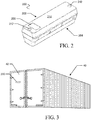
- FIG. 2 illustrates one example transceiver 200 with a housing 210, comprising a mating exterior portion 204 and interior portion 202.
- the exterior and interior portions 204, 202 can be mounted on a wall or a door of a shipping container, for example as illustrated in FIG. 3 , which shows a mobile transceiver 200 affixed in the door 42 of a shipping container.
- holes are drilled in the door 42 to permit passage of mounting screws or bolts and electronics components of the transceiver 200 therethrough.
- the exterior and interior portions 204, 202 are connected to each other through the door 42 by means of the screws or bolts, which pass through holes 212.
- the exterior portion 204 carries at least the antennas required for external communication
- the interior portion contains the remainder of the components.
- the interior portion 202 includes a light transmissive panel 202 which receives light for detection by an interior light sensor.
- the outer surface of the interior portion 202 maybe provided with other sensor devices or interfaces as required to enable the mobile transceiver 200 to monitor any desired environmental conditions associated with the asset. Other sensors may not require such an interface.
- the mobile transceiver 200 mounted in the door 42 may be able to detect a door open or close state by means of a gyroscope or accelerometer inferring movement of the door.
- the mobile transceiver 200 comprises at least one processor 250 which controls its overall operation.
- the processor 250 is coupled to a plurality of components via a communication bus or other means (not shown), such as random access memory (RAM) 260, read-only memory (ROM) 262, optional flash memory (not shown) or other data storage devices.
- RAM random access memory
- ROM read-only memory
- the mobile transceiver 200 may also include a data port 270, which may be a Universal Serial Bus (USB) port or the like; a smart card interface 272; and a set of environmental sensors 258.
- USB Universal Serial Bus
- the sensors 258 may include light sensors, temperature sensors, pressure sensors, humidity sensors, gyroscopes, accelerometers, time-of-flight sensors, and optionally other sensors such as contact switches.
- the example mobile transceiver 200 also includes a satellite receiver 268 for receiving satellite signals from a satellite network 110 (shown in FIG. 1 ), for example satellites that are part of a global or regional satellite navigation system.
- a satellite transceiver capable of both receiving and sending satellite signals may be provided instead of a satellite receiver which can only receive satellite signals. Signals received by the satellite receiver 268 are used to determine the mobile transceiver's position.
- the mobile transceiver 200 also comprises one or more wireless transceivers for exchanging data communication, and optionally voice communication.
- the transceivers may comprise a cellular transceiver 264 for communicating with a plurality of different radio access networks, such as the cellular network 100 (shown in FIG. 1 ), using different wireless data communication protocols and standards.
- the mobile transceiver 200 may communicate with any one of a plurality of fixed transceiver base of the cellular network 100 within its geographic coverage area.
- the mobile transceiver 200 may send and receive signals over the cellular network 100 after the required network registration and/or activation procedures have been completed.
- the cellular transceiver 264 is a multi-band transceiver that supports multiple radio frequency bands which may include, for example, multiple 4G Long-Term Evolution (LTE) or LTE Advanced and/or 5G bands (where available), as well as global 3G and 2G bands.
- multiple dedicated transceivers may be provided to support different wireless services. Examples of technologies that may be used by the cellular transceiver 264 will be known to those skilled in the art. Any encryption/decryption, compression/decompression, and network access protocols that may be used in connection with the radio access network, or indeed in connection with the WLAN and short-range communications discussed below, will likewise be understood by those skilled in the art.
- the smart card interface 272 may be used to receive a suitable subscriber identity module (SIM) to enable wireless access.
- SIM subscriber identity module
- the wireless transceivers may also comprise a wireless local area network (WLAN) transceiver 265 for communicating with a WLAN via a suitable access point.
- WLAN may comprise a Wi-Fi wireless network which conforms to IEEE 802.11x standards (sometimes referred to as Wi-Fi®). Other communication protocols may be used for the WLAN.
- the wireless transceivers may also comprise a short-range wireless transceiver, such as a Bluetooth® transceiver 266, for communicating with a nearby device.
- the mobile transceiver 200 may alternatively communicate with the nearby device using the data port 270.
- the Bluetooth transceiver 266 may be compatible with any suitable version of the Bluetooth protocol including Bluetooth low energy (Bluetooth Smart).
- Bluetooth® Bluetooth low energy
- Other short-range wireless communication technologies may be provided instead of, or in addition to, Bluetooth® including but not limited to Near field communication (NFC), IEEE 802.15.3a (also referred to as UltraWideband (UWB)), Z-Wave, ZigBee, ANT/ANT+ or infrared (e.g., Infrared Data Association (IrDA) communication).
- the mobile transceiver 200 also includes a battery 254 as a power source.
- the battery 254 may be a rechargeable or non-rechargeable battery, and in some embodiments may be a large-capacity, non-rechargeable, sealed battery expected to have a relatively long service life, e.g., 5-7 years of active service.
- the battery 254 provides electrical power to at least some of the components of the mobile transceiver 200.
- a battery interface 252 provides a mechanical and electrical connection for the battery 254.
- the battery interface 252 may be coupled to a regulator (not shown) which provides power V+ to the circuitry of the mobile transceiver 102.
- the mobile transceiver 200 may also include a power interface 256, such as a power port, for connecting to an external power source (not shown) such as an alternating current (AC) power adapter.
- a power interface 256 such as a power port
- an external power source such as an alternating current (AC) power adapter.
- the mobile transceiver 200 can use the external power source rather than the battery 254. If the battery 254 is rechargeable, the external power source may be used to recharge the battery 254. Further description of an exemplary mobile transceiver 200 is provided in United States Patent No. 9,742,479 , which is incorporated herein by reference.
- the following term may be divided into a set of p use periods i.
- C i the cost of owned and rented assets
- C i the cost of owned and rented assets
- C i n o C o n o + C r n i
- n o the number of owned assets
- n i the number of rented assets during the sampling period
- C o is the cost of ownership of an asset
- C r is the cost to rent.
- C o may reflect the consumption of storage and maintenance resources
- C r is assumed to be the same for each rented asset
- n i may vary for each period i.
- the details of obtaining the predicted quantity N i is discussed below.
- n o is presumed to be constant for a given i; however, it may take any value from 0 (i.e., all assets during the term are rented) to the maximum value of N i during period p (all assets during the term are owned).
- n o and n i may be found.
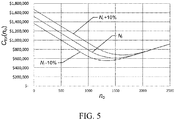
- FIGS. 5 and 6 illustrate the determination of optimal n o , in a scenario where 1 ⁇ i ⁇ 365 days, C o is $1, C r is $3, and N i ranges between 885 and 1963. Referring briefly to FIG. 6 , the fluctuation of N i over the span of p use periods is shown.
- n o is determined to be 1490.
- FIG. 5 also shows examples of varying usage forecasts for the following term, which in this case vary by ⁇ 10%. It can be seen that minimum C tot ( n o ) for N i is obtained at 1490; in other words, when the predicted use of assets follows N i as depicted in FIG. 5 , the operator's associated cost is minimized when the operator owns only 1490 shipping containers (for example) and rents additional shipping containers as needed, despite the fact that rental is more costly.
- the calculations depicted in FIG. 5 including the plus/minus calculations, can be used by the operator to gauge the effect of different predictions.
- N i fluctuates above and below the optimal n o . If the operator owns exactly 1490 assets-the optimal amount to be owned-then during those use periods i where N i > n o , according to this model the operator must obtain N i - n o assets by rental. During those periods i where N i ⁇ n o , the operator only requires the owned assets, and no rental is necessary.
- the predicted quantity of assets N i may be allocated into two subsets: owned assets, and rented assets. The subset of owned assets is substantially invariant for all i (as can be seen in FIG. 6 , the quantity 1490 is constant), but the rented assets subset varies according to i .
- N i can be usefully obtained from tracking data previously collected during an evaluation term or period from the mobile transceivers 200 operating in the environment of FIG. 1 .
- An example process is illustrated in FIG. 7 , in a scenario where the operator already owns a first set of assets, each equipped with mobile transceivers 200.
- the mobile transceivers 200 are associated with their corresponding assets 40 in the tracking system 160, and optionally management system 190.
- the assets are utilized during an initial evaluation term (for example, a calendar year)
- at 405 usage status and associated information is transmitted in messages by the mobile transceivers 200 of each asset 40 to the tracking system 160.
- each mobile transceiver 200 may transmit location and sensor data to the tracking system 160.
- This data may comprise the usage status.
- the mobile transceiver 200 may also be configured to generate an "in use” or “idle” status based on the data collected by the sensors 258; for example, detection of a change to a door open state, or entrance into or exit from a defined geofenced region may correspond to an "in use” status, whereas no detected change to any sensor data may correspond to an "idle” status.
- This "in use” or “idle” status may be included in the usage status 405.
- the tracking system 160 stores the received usage status at 410. If the "in use” or “idle” is not included in the usage status messages 405, then the tracking system 160 may generate this "in use” or “idle” status and also stores it at 410. Periodically or on request, usage reports 415 may be generated and sent by the tracking system 160 to the management system 190 for use by the operator in managing the fleet of assets.
- N i may be computed based on the usage statuses collected during the evaluation term.
- the predictive system 180 requests 420 data from the tracking system 160 about the usage of the assets belonging to the first set (i.e., the assets associated with the operator of the management system 190).
- a data set 430 is returned to the predictive system 180.
- the granularity of the data obtainable by the predictive system 180 will depend on the data available from the tracking system 160.
- the mobile transceivers 200 may be configured to transmit and collect usage status in messages 405 every few seconds or minutes, every hour, once a day, or at any suitable frequency.
- the predictive system 180 may therefore request and receive data with the same granularity as that received by the tracking system 160. However, to reduce the volume of transmitted data, the predictive system 180 may only request a subset of the stored data to be delivered in the data set 430.
- the predictive system 180 since it is computing N i , may request a data set reflecting usage of the assets 40 at a frequency corresponding to i . For example, even if the tracking system 160 stores hourly data for the first set of assets 400, the predictive system 180 will only request daily data for the previous year if it is only required to determine N i on a daily basis for a term of 365 days. Furthermore, the predictive system 180 may not require all types of data collected by the tracking system 160; for instance, location data may be omitted from the data set 430.
- N i calculated by the predictive system 180 is likewise limited by the granularity of data available from the tracking system 160. If the tracking system 160 stores only weekly usage information about the assets, then N i can only be estimated by the predictive system on a weekly basis. It should be noted, however, that additional information relevant to predicted N i may be found in other repositories, such as external system(s) 170. For example, usage information about other assets of the operator that are not tracked using mobile transceivers 200 may be stored in an external system 170; information about projected increases or decreases in usage based on existing contracts or tenders may also be stored in an external system 170 or the management system 190.
- This information may have different granularity than the usage information stored by the tracking system 160.
- Information stored in an external system 170 may be requested 425 by the predictive system 180; the responses 435 may also be used as input along with the data set 430 to generate the predicted N i at 440. The values of N i may then be optionally transmitted to the management system 190 for presentation to the operator at 445.
- the predictive system 180 determines how N i should be allocated between the two subsets of assets: the owned assets n o and rented assets n i . As described above, this may be determined by finding the n o yielding the minimum value of C tot ( n o ) .
- the values n o and n i may be transmitted to the management system 190 for presentation to the operator at 455. The operator may then take steps to acquire additional assets either by purchase or rental according to the computed values.
- the operator's currently owned assets e.g., the assets in the first set of assets
- n o there is no need for the operator to purchase additional assets.
- the operator procures further owned assets and installs mobile transceivers 200 on these new assets these additional assets would be associated with the mobile transceivers 200 by the tracking system 160 at 460.
- owned assets were distinguishable from rented assets by the association of the owned assets with mobile transceivers 200.
- the rented assets may also be associated with different mobile transceivers.
- some or all owned assets may not be associated with mobile transceivers; if this is the case, then historic usage data would likely be obtained by the predictive system 180 from the external system(s) 170.
- the operator may manage a plurality of fleets of assets associated with different regions. These different regions may be defined geographically or by other means, as discussed above.
- the predictive system 180 described above may operate on a region-by-region basis; that is to say, for a given first region, the historic usage data of assets in other regions during the evaluation term is not used to predict N i . Alternatively, the historic usage data of the other regions may be considered as well.
- the predictive system 180 is used to determine N i as well as optimal n o for each of the plurality of regions associated with the operator. If the optimal n o for a first region is smaller than the number of assets owned by the operator in that region in other words, if there are owned assets in the first region that are not required and may be considered "unused", it may be more cost-effective to temporarily move those assets to a second region where optimal n o is greater than the number of owned assets in that region. Thus, in this scenario, unused assets normally associated with the first region may be temporarily associated with the second region and considered to be "owned" assets in the second region, along with the actual owned assets in the second region.
- a method comprising: associating a first plurality of assets with a corresponding first plurality of mobile transceivers in records stored in a data processing system, each mobile transceiver of the first plurality of mobile transceivers being physically affixed to a corresponding asset of the first plurality of assets; the data processing system receiving, during an evaluation term, a first plurality of messages from the first plurality of mobile transceivers, the first plurality of messages comprising asset usage statuses for the first plurality of assets; storing the asset usage data in the data processing system; the data processing system determining, using the stored asset usage data, a predicted quantity of assets expected to be used in a subsequent term; and the data processing system allocating the predicted quantity of assets between a first subset of assets and a second subset of assets according to a minimal cost for the predicted quantity, wherein the first subset of assets is associated with
- the method further comprises associating a second plurality of assets with a corresponding second plurality of mobile transceivers in records stored in the data processing system, each mobile transceiver of the second plurality of mobile transceivers being physically affixed to a corresponding asset of the second plurality of assets; and including the second plurality of assets in the first subset of assets.
- the method further comprises associating a further plurality of assets with a corresponding further plurality of mobile transceivers in records stored in a data processing system, each mobile transceiver of the further plurality of mobile transceivers being physically affixed to a corresponding asset of the further plurality of assets; the data processing system receiving, during the evaluation term, a further plurality of messages from the further plurality of mobile transceivers, the further plurality of messages comprising further asset usage statuses for the further plurality of assets; storing the further asset usage data in the data processing system; the data processing system determining, using the stored further asset usage data, a predicted quantity of unused assets of the further plurality of assets that are expected to be unused in the subsequent term; when a number of assets in the first subset of assets is greater than a number of assets in the first plurality of assets, including at least some of the assets of the further plurality of assets in the first subset of assets.
- the first cost is less than the second cost.
- the assets comprise shipping containers
- the asset usage statuses comprise statuses corresponding to a shipping container in use, and at least one status corresponding to a shipping container not in use
- the predicted quantity of assets is determined at least in part from a number of assets in the first plurality of assets having a status corresponding to a shipping container in use during the evaluation period.
- the statuses correspond to a shipping container in use comprise exit from a geofenced region, entrance into a geofenced region, and door open.
- the evaluation period and the subsequent period each comprises a set of use periods; the messages of the first plurality of messages are received during each of the use periods from each of the assets of the first plurality of assets; and determining the predicted quantity of assets expected to be used in the subsequent term comprises determining a predicted quantity of assets expected to be used for each use period of the subsequent period based on the stored asset usage data for the corresponding use period of the evaluation period.
- determining the predicted quantity of assets expected to be used in the subsequent term further comprises adjusting an initial predicted quantity of assets based on the stored asset usage data according to external information about either a predicted increase or a predicted decrease in usage of assets for the subsequent term.
- determining the predicted quantity of assets expected to be used in the subsequent term further comprises adjusting an initial predicted quantity of assets for a selected use period according to external information about either a predicted increase or a predicted decrease in usage of assets for the selected use period.
- the data employed by the systems, devices, and methods described herein may be stored in one or more data stores.
- the data stores can be of many different types of storage devices and programming constructs, such as RAM, ROM, flash memory, programming data structures, programming variables, and so forth.
- Code adapted to provide the systems and methods described above may be provided on many different types of computer-readable media including computer storage mechanisms (e.g., CD-ROM, diskette, RAM, flash memory, computer hard drive, etc.) that contain instructions for use in execution by one or more processors to perform the operations described herein.
- the media on which the code may be provided is generally considered to be non-transitory or physical.
- Computer components, software modules, engines, functions, and data structures may be connected directly or indirectly to each other in order to allow the flow of data needed for their operations.
- Various functional units have been expressly or implicitly described as modules, engines, or similar terminology, in order to more particularly emphasize their independent implementation and operation. Such units may be implemented in a unit of code, a subroutine unit, object, applet, script or other form of code. Such functional units may also be implemented in hardware circuits comprising custom VLSI circuits or gate arrays; field-programmable gate arrays; programmable array logic; programmable logic devices; commercially available logic chips, transistors, and other such components.
- Functional units need not be physically located together, but may reside in different locations, such as over several electronic devices or memory devices, capable of being logically joined for execution. Functional units may also be implemented as combinations of software and hardware, such as a processor operating on a set of operational data or instructions.
Landscapes
- Business, Economics & Management (AREA)
- Engineering & Computer Science (AREA)
- Economics (AREA)
- Human Resources & Organizations (AREA)
- Strategic Management (AREA)
- Entrepreneurship & Innovation (AREA)
- Operations Research (AREA)
- Quality & Reliability (AREA)
- General Physics & Mathematics (AREA)
- Theoretical Computer Science (AREA)
- Development Economics (AREA)
- Tourism & Hospitality (AREA)
- Physics & Mathematics (AREA)
- General Business, Economics & Management (AREA)
- Marketing (AREA)
- Game Theory and Decision Science (AREA)
- Computer Networks & Wireless Communication (AREA)
- Signal Processing (AREA)
- Accounting & Taxation (AREA)
- Finance (AREA)
- Educational Administration (AREA)
- Mobile Radio Communication Systems (AREA)
Applications Claiming Priority (1)
| Application Number | Priority Date | Filing Date | Title |
|---|---|---|---|
| US15/971,615 US10839472B2 (en) | 2018-05-04 | 2018-05-04 | Predictive system for use with a mobile transceiver tracking service |
Publications (1)
| Publication Number | Publication Date |
|---|---|
| EP3564876A1 true EP3564876A1 (de) | 2019-11-06 |
Family
ID=66397134
Family Applications (1)
| Application Number | Title | Priority Date | Filing Date |
|---|---|---|---|
| EP19172543.1A Ceased EP3564876A1 (de) | 2018-05-04 | 2019-05-03 | Prädiktives system zur verwendung mit einem mobilen sender-empfänger-verfolgungsdienst |
Country Status (3)
| Country | Link |
|---|---|
| US (1) | US10839472B2 (de) |
| EP (1) | EP3564876A1 (de) |
| CA (1) | CA3041144C (de) |
Families Citing this family (1)
| Publication number | Priority date | Publication date | Assignee | Title |
|---|---|---|---|---|
| US20250126435A1 (en) * | 2023-10-16 | 2025-04-17 | Ribbiot, Inc. | Commercial equipment location and status tracker |
Citations (5)
| Publication number | Priority date | Publication date | Assignee | Title |
|---|---|---|---|---|
| WO2013052970A1 (en) * | 2011-10-07 | 2013-04-11 | Telogis, Inc. | Vehicle fleet routing system |
| US20140278630A1 (en) * | 2013-03-15 | 2014-09-18 | Compology, Inc. | System and method for waste material managment |
| US9079505B1 (en) * | 2014-02-25 | 2015-07-14 | Elwah LLC | System and method for management of a fleet of vehicles having an energy storage system |
| US20160358129A1 (en) * | 2015-01-28 | 2016-12-08 | Mtct Group Llc | Methods and systems for fleet management |
| US9742479B2 (en) | 2016-01-04 | 2017-08-22 | Blackberry Limited | Method and apparatus for detecting an abnormal antenna condition |
Family Cites Families (14)
| Publication number | Priority date | Publication date | Assignee | Title |
|---|---|---|---|---|
| US20080015955A1 (en) * | 1999-05-19 | 2008-01-17 | I.D. Systems, Inc. | Mobile asset data management system |
| US7656271B2 (en) * | 2002-01-09 | 2010-02-02 | I.D. Systems, Inc. | System and method for managing a remotely located asset |
| US7783507B2 (en) | 1999-08-23 | 2010-08-24 | General Electric Company | System and method for managing a fleet of remote assets |
| US20050015399A1 (en) | 2003-07-14 | 2005-01-20 | William Melo | Web-based analytical tool for collaborative fleet optimization |
| US7668744B2 (en) | 2003-07-31 | 2010-02-23 | The Boeing Company | Method and system for conducting fleet operations |
| US20070118502A1 (en) | 2005-11-18 | 2007-05-24 | Aragones James K | Methods and systems for managing a fleet of assets |
| US7797205B2 (en) | 2007-12-21 | 2010-09-14 | Exxonmobil Research And Engineering Company | System for optimizing bulk product allocation, transportation and blending |
| WO2012103228A1 (en) * | 2011-01-25 | 2012-08-02 | Nextgen Aerosciences, Llc | Method and apparatus for dynamic aircraft trajectory management |
| US10223655B2 (en) | 2013-09-05 | 2019-03-05 | Toyota Motor Europe Nv/Sa | Systems and methods for managing a vehicle fleet |
| CA2865371A1 (en) * | 2013-09-27 | 2015-03-27 | Trac Rail Inc. | Geo-spatial asset clustering |
| US10140834B2 (en) * | 2016-08-08 | 2018-11-27 | Blackberry Limited | Mobile transceiver having asset-based alarm profile and a method of operation |
| US10489752B2 (en) * | 2016-08-26 | 2019-11-26 | General Electric Company | Failure mode ranking in an asset management system |
| US10936990B2 (en) * | 2016-12-07 | 2021-03-02 | Blackberry Limited | Sending reports of asset transport status |
| US10636280B2 (en) * | 2018-03-08 | 2020-04-28 | Spireon, Inc. | Apparatus and method for determining mounting state of a trailer tracking device |
-
2018
- 2018-05-04 US US15/971,615 patent/US10839472B2/en active Active
-
2019
- 2019-04-25 CA CA3041144A patent/CA3041144C/en active Active
- 2019-05-03 EP EP19172543.1A patent/EP3564876A1/de not_active Ceased
Patent Citations (5)
| Publication number | Priority date | Publication date | Assignee | Title |
|---|---|---|---|---|
| WO2013052970A1 (en) * | 2011-10-07 | 2013-04-11 | Telogis, Inc. | Vehicle fleet routing system |
| US20140278630A1 (en) * | 2013-03-15 | 2014-09-18 | Compology, Inc. | System and method for waste material managment |
| US9079505B1 (en) * | 2014-02-25 | 2015-07-14 | Elwah LLC | System and method for management of a fleet of vehicles having an energy storage system |
| US20160358129A1 (en) * | 2015-01-28 | 2016-12-08 | Mtct Group Llc | Methods and systems for fleet management |
| US9742479B2 (en) | 2016-01-04 | 2017-08-22 | Blackberry Limited | Method and apparatus for detecting an abnormal antenna condition |
Also Published As
| Publication number | Publication date |
|---|---|
| CA3041144C (en) | 2023-03-21 |
| US20190340719A1 (en) | 2019-11-07 |
| CA3041144A1 (en) | 2019-11-04 |
| US10839472B2 (en) | 2020-11-17 |
Similar Documents
| Publication | Publication Date | Title |
|---|---|---|
| US11611868B2 (en) | Mobile transceiver having device-based alarm profile and a method of operation | |
| US11800482B2 (en) | Mobile transceiver having route monitoring and method of operation | |
| US10922949B2 (en) | Mobile transceiver having asset-based alarm profile and a method of operation | |
| EP3482228B1 (de) | Verfahren zur planung von aufweckereignissen, verfahren zum betrieb eines mobilen sender-empfängers und dafür konfigurierte vorrichtungen | |
| US10671965B2 (en) | Mobile transceiver having selectable travel modes and a method of operation | |
| US8065342B1 (en) | Method and system for monitoring a mobile equipment fleet | |
| US9086948B1 (en) | Telematics based on handset movement within a moving vehicle | |
| US10719901B2 (en) | Systems and methods for fueling motor vehicles | |
| US8626193B1 (en) | Method and apparatus for tracking a transported item while accommodating communication gaps | |
| US10614409B2 (en) | System and method for increasing asset utilization using satellite aided location tracking | |
| US8655378B1 (en) | Method and apparatus for tracking a transported item while accommodating communication gaps | |
| US8818351B1 (en) | Method and apparatus for tracking a transported item while accommodating communication gaps | |
| US20140300468A1 (en) | Dynamic Reverse Geofencing | |
| US20210225093A1 (en) | Systems and Methods for Switching Between Communication and Navigation Modes in a Telematics Device | |
| CA3041144C (en) | Predictive system for use with a mobile transceiver tracking service | |
| US20100082479A1 (en) | Proxy-based payment system for portable objects | |
| CN114666757A (zh) | 用于控制使用频带进行无线通信的方法和装置 | |
| EP4094044B1 (de) | Systeme und verfahren zum umschalten zwischen kommunikations- und navigationsmodi in einer telematischen vorrichtung |
Legal Events
| Date | Code | Title | Description |
|---|---|---|---|
| PUAI | Public reference made under article 153(3) epc to a published international application that has entered the european phase |
Free format text: ORIGINAL CODE: 0009012 |
|
| STAA | Information on the status of an ep patent application or granted ep patent |
Free format text: STATUS: THE APPLICATION HAS BEEN PUBLISHED |
|
| AK | Designated contracting states |
Kind code of ref document: A1 Designated state(s): AL AT BE BG CH CY CZ DE DK EE ES FI FR GB GR HR HU IE IS IT LI LT LU LV MC MK MT NL NO PL PT RO RS SE SI SK SM TR |
|
| AX | Request for extension of the european patent |
Extension state: BA ME |
|
| STAA | Information on the status of an ep patent application or granted ep patent |
Free format text: STATUS: REQUEST FOR EXAMINATION WAS MADE |
|
| 17P | Request for examination filed |
Effective date: 20200324 |
|
| RBV | Designated contracting states (corrected) |
Designated state(s): AL AT BE BG CH CY CZ DE DK EE ES FI FR GB GR HR HU IE IS IT LI LT LU LV MC MK MT NL NO PL PT RO RS SE SI SK SM TR |
|
| STAA | Information on the status of an ep patent application or granted ep patent |
Free format text: STATUS: EXAMINATION IS IN PROGRESS |
|
| 17Q | First examination report despatched |
Effective date: 20200629 |
|
| STAA | Information on the status of an ep patent application or granted ep patent |
Free format text: STATUS: THE APPLICATION HAS BEEN REFUSED |
|
| 18R | Application refused |
Effective date: 20220610 |