EP3565032B1 - Composition de bouillie de cathode, cathode de batterie secondaire la comprenant et batterie secondaire au lithium - Google Patents
Composition de bouillie de cathode, cathode de batterie secondaire la comprenant et batterie secondaire au lithium Download PDFInfo
- Publication number
- EP3565032B1 EP3565032B1 EP18879733.6A EP18879733A EP3565032B1 EP 3565032 B1 EP3565032 B1 EP 3565032B1 EP 18879733 A EP18879733 A EP 18879733A EP 3565032 B1 EP3565032 B1 EP 3565032B1
- Authority
- EP
- European Patent Office
- Prior art keywords
- positive electrode
- secondary battery
- slurry composition
- formula
- polymer
- Prior art date
- Legal status (The legal status is an assumption and is not a legal conclusion. Google has not performed a legal analysis and makes no representation as to the accuracy of the status listed.)
- Active
Links
- 0 C*(*)ON(C)C#N Chemical compound C*(*)ON(C)C#N 0.000 description 1
Classifications
-
- H—ELECTRICITY
- H01—ELECTRIC ELEMENTS
- H01M—PROCESSES OR MEANS, e.g. BATTERIES, FOR THE DIRECT CONVERSION OF CHEMICAL ENERGY INTO ELECTRICAL ENERGY
- H01M4/00—Electrodes
- H01M4/02—Electrodes composed of, or comprising, active material
- H01M4/13—Electrodes for accumulators with non-aqueous electrolyte, e.g. for lithium-accumulators; Processes of manufacture thereof
-
- C—CHEMISTRY; METALLURGY
- C08—ORGANIC MACROMOLECULAR COMPOUNDS; THEIR PREPARATION OR CHEMICAL WORKING-UP; COMPOSITIONS BASED THEREON
- C08K—Use of inorganic or non-macromolecular organic substances as compounding ingredients
- C08K3/00—Use of inorganic substances as compounding ingredients
- C08K3/01—Use of inorganic substances as compounding ingredients characterized by their specific function
- C08K3/013—Fillers, pigments or reinforcing additives
-
- C—CHEMISTRY; METALLURGY
- C08—ORGANIC MACROMOLECULAR COMPOUNDS; THEIR PREPARATION OR CHEMICAL WORKING-UP; COMPOSITIONS BASED THEREON
- C08L—COMPOSITIONS OF MACROMOLECULAR COMPOUNDS
- C08L27/00—Compositions of homopolymers or copolymers of compounds having one or more unsaturated aliphatic radicals, each having only one carbon-to-carbon double bond, and at least one being terminated by a halogen; Compositions of derivatives of such polymers
- C08L27/02—Compositions of homopolymers or copolymers of compounds having one or more unsaturated aliphatic radicals, each having only one carbon-to-carbon double bond, and at least one being terminated by a halogen; Compositions of derivatives of such polymers not modified by chemical after-treatment
- C08L27/12—Compositions of homopolymers or copolymers of compounds having one or more unsaturated aliphatic radicals, each having only one carbon-to-carbon double bond, and at least one being terminated by a halogen; Compositions of derivatives of such polymers not modified by chemical after-treatment containing fluorine atoms
- C08L27/16—Homopolymers or copolymers or vinylidene fluoride
-
- C—CHEMISTRY; METALLURGY
- C08—ORGANIC MACROMOLECULAR COMPOUNDS; THEIR PREPARATION OR CHEMICAL WORKING-UP; COMPOSITIONS BASED THEREON
- C08L—COMPOSITIONS OF MACROMOLECULAR COMPOUNDS
- C08L29/00—Compositions of homopolymers or copolymers of compounds having one or more unsaturated aliphatic radicals, each having only one carbon-to-carbon double bond, and at least one being terminated by an alcohol, ether, aldehydo, ketonic, acetal or ketal radical; Compositions of hydrolysed polymers of esters of unsaturated alcohols with saturated carboxylic acids; Compositions of derivatives of such polymers
- C08L29/10—Homopolymers or copolymers of unsaturated ethers
-
- H—ELECTRICITY
- H01—ELECTRIC ELEMENTS
- H01M—PROCESSES OR MEANS, e.g. BATTERIES, FOR THE DIRECT CONVERSION OF CHEMICAL ENERGY INTO ELECTRICAL ENERGY
- H01M10/00—Secondary cells; Manufacture thereof
- H01M10/04—Construction or manufacture in general
- H01M10/049—Processes for forming or storing electrodes in the battery container
-
- H—ELECTRICITY
- H01—ELECTRIC ELEMENTS
- H01M—PROCESSES OR MEANS, e.g. BATTERIES, FOR THE DIRECT CONVERSION OF CHEMICAL ENERGY INTO ELECTRICAL ENERGY
- H01M10/00—Secondary cells; Manufacture thereof
- H01M10/05—Accumulators with non-aqueous electrolyte
- H01M10/052—Li-accumulators
-
- H—ELECTRICITY
- H01—ELECTRIC ELEMENTS
- H01M—PROCESSES OR MEANS, e.g. BATTERIES, FOR THE DIRECT CONVERSION OF CHEMICAL ENERGY INTO ELECTRICAL ENERGY
- H01M10/00—Secondary cells; Manufacture thereof
- H01M10/05—Accumulators with non-aqueous electrolyte
- H01M10/052—Li-accumulators
- H01M10/0525—Rocking-chair batteries, i.e. batteries with lithium insertion or intercalation in both electrodes; Lithium-ion batteries
-
- H—ELECTRICITY
- H01—ELECTRIC ELEMENTS
- H01M—PROCESSES OR MEANS, e.g. BATTERIES, FOR THE DIRECT CONVERSION OF CHEMICAL ENERGY INTO ELECTRICAL ENERGY
- H01M10/00—Secondary cells; Manufacture thereof
- H01M10/42—Methods or arrangements for servicing or maintenance of secondary cells or secondary half-cells
- H01M10/4235—Safety or regulating additives or arrangements in electrodes, separators or electrolyte
-
- H—ELECTRICITY
- H01—ELECTRIC ELEMENTS
- H01M—PROCESSES OR MEANS, e.g. BATTERIES, FOR THE DIRECT CONVERSION OF CHEMICAL ENERGY INTO ELECTRICAL ENERGY
- H01M4/00—Electrodes
- H01M4/02—Electrodes composed of, or comprising, active material
- H01M4/04—Processes of manufacture in general
- H01M4/0402—Methods of deposition of the material
- H01M4/0404—Methods of deposition of the material by coating on electrode collectors
-
- H—ELECTRICITY
- H01—ELECTRIC ELEMENTS
- H01M—PROCESSES OR MEANS, e.g. BATTERIES, FOR THE DIRECT CONVERSION OF CHEMICAL ENERGY INTO ELECTRICAL ENERGY
- H01M4/00—Electrodes
- H01M4/02—Electrodes composed of, or comprising, active material
- H01M4/04—Processes of manufacture in general
- H01M4/043—Processes of manufacture in general involving compressing or compaction
- H01M4/0435—Rolling or calendering
-
- H—ELECTRICITY
- H01—ELECTRIC ELEMENTS
- H01M—PROCESSES OR MEANS, e.g. BATTERIES, FOR THE DIRECT CONVERSION OF CHEMICAL ENERGY INTO ELECTRICAL ENERGY
- H01M4/00—Electrodes
- H01M4/02—Electrodes composed of, or comprising, active material
- H01M4/04—Processes of manufacture in general
- H01M4/0471—Processes of manufacture in general involving thermal treatment, e.g. firing, sintering, backing particulate active material, thermal decomposition, pyrolysis
-
- H—ELECTRICITY
- H01—ELECTRIC ELEMENTS
- H01M—PROCESSES OR MEANS, e.g. BATTERIES, FOR THE DIRECT CONVERSION OF CHEMICAL ENERGY INTO ELECTRICAL ENERGY
- H01M4/00—Electrodes
- H01M4/02—Electrodes composed of, or comprising, active material
- H01M4/13—Electrodes for accumulators with non-aqueous electrolyte, e.g. for lithium-accumulators; Processes of manufacture thereof
- H01M4/139—Processes of manufacture
-
- H—ELECTRICITY
- H01—ELECTRIC ELEMENTS
- H01M—PROCESSES OR MEANS, e.g. BATTERIES, FOR THE DIRECT CONVERSION OF CHEMICAL ENERGY INTO ELECTRICAL ENERGY
- H01M4/00—Electrodes
- H01M4/02—Electrodes composed of, or comprising, active material
- H01M4/36—Selection of substances as active materials, active masses, active liquids
- H01M4/362—Composites
- H01M4/366—Composites as layered products
-
- H—ELECTRICITY
- H01—ELECTRIC ELEMENTS
- H01M—PROCESSES OR MEANS, e.g. BATTERIES, FOR THE DIRECT CONVERSION OF CHEMICAL ENERGY INTO ELECTRICAL ENERGY
- H01M4/00—Electrodes
- H01M4/02—Electrodes composed of, or comprising, active material
- H01M4/62—Selection of inactive substances as ingredients for active masses, e.g. binders, fillers
-
- H—ELECTRICITY
- H01—ELECTRIC ELEMENTS
- H01M—PROCESSES OR MEANS, e.g. BATTERIES, FOR THE DIRECT CONVERSION OF CHEMICAL ENERGY INTO ELECTRICAL ENERGY
- H01M4/00—Electrodes
- H01M4/02—Electrodes composed of, or comprising, active material
- H01M4/62—Selection of inactive substances as ingredients for active masses, e.g. binders, fillers
- H01M4/621—Binders
- H01M4/622—Binders being polymers
-
- H—ELECTRICITY
- H01—ELECTRIC ELEMENTS
- H01M—PROCESSES OR MEANS, e.g. BATTERIES, FOR THE DIRECT CONVERSION OF CHEMICAL ENERGY INTO ELECTRICAL ENERGY
- H01M4/00—Electrodes
- H01M4/02—Electrodes composed of, or comprising, active material
- H01M4/62—Selection of inactive substances as ingredients for active masses, e.g. binders, fillers
- H01M4/621—Binders
- H01M4/622—Binders being polymers
- H01M4/623—Binders being polymers fluorinated polymers
-
- H—ELECTRICITY
- H01—ELECTRIC ELEMENTS
- H01M—PROCESSES OR MEANS, e.g. BATTERIES, FOR THE DIRECT CONVERSION OF CHEMICAL ENERGY INTO ELECTRICAL ENERGY
- H01M4/00—Electrodes
- H01M4/02—Electrodes composed of, or comprising, active material
- H01M4/62—Selection of inactive substances as ingredients for active masses, e.g. binders, fillers
- H01M4/624—Electric conductive fillers
- H01M4/625—Carbon or graphite
-
- H—ELECTRICITY
- H01—ELECTRIC ELEMENTS
- H01M—PROCESSES OR MEANS, e.g. BATTERIES, FOR THE DIRECT CONVERSION OF CHEMICAL ENERGY INTO ELECTRICAL ENERGY
- H01M50/00—Constructional details or processes of manufacture of the non-active parts of electrochemical cells other than fuel cells, e.g. hybrid cells
- H01M50/40—Separators; Membranes; Diaphragms; Spacing elements inside cells
- H01M50/46—Separators, membranes or diaphragms characterised by their combination with electrodes
- H01M50/461—Separators, membranes or diaphragms characterised by their combination with electrodes with adhesive layers between electrodes and separators
-
- C—CHEMISTRY; METALLURGY
- C08—ORGANIC MACROMOLECULAR COMPOUNDS; THEIR PREPARATION OR CHEMICAL WORKING-UP; COMPOSITIONS BASED THEREON
- C08K—Use of inorganic or non-macromolecular organic substances as compounding ingredients
- C08K2201/00—Specific properties of additives
- C08K2201/001—Conductive additives
-
- C—CHEMISTRY; METALLURGY
- C08—ORGANIC MACROMOLECULAR COMPOUNDS; THEIR PREPARATION OR CHEMICAL WORKING-UP; COMPOSITIONS BASED THEREON
- C08K—Use of inorganic or non-macromolecular organic substances as compounding ingredients
- C08K3/00—Use of inorganic substances as compounding ingredients
- C08K3/02—Elements
- C08K3/04—Carbon
-
- C—CHEMISTRY; METALLURGY
- C08—ORGANIC MACROMOLECULAR COMPOUNDS; THEIR PREPARATION OR CHEMICAL WORKING-UP; COMPOSITIONS BASED THEREON
- C08L—COMPOSITIONS OF MACROMOLECULAR COMPOUNDS
- C08L2201/00—Properties
- C08L2201/56—Non-aqueous solutions or dispersions
-
- H—ELECTRICITY
- H01—ELECTRIC ELEMENTS
- H01M—PROCESSES OR MEANS, e.g. BATTERIES, FOR THE DIRECT CONVERSION OF CHEMICAL ENERGY INTO ELECTRICAL ENERGY
- H01M4/00—Electrodes
- H01M4/02—Electrodes composed of, or comprising, active material
- H01M2004/026—Electrodes composed of, or comprising, active material characterised by the polarity
- H01M2004/028—Positive electrodes
-
- H—ELECTRICITY
- H01—ELECTRIC ELEMENTS
- H01M—PROCESSES OR MEANS, e.g. BATTERIES, FOR THE DIRECT CONVERSION OF CHEMICAL ENERGY INTO ELECTRICAL ENERGY
- H01M4/00—Electrodes
- H01M4/02—Electrodes composed of, or comprising, active material
- H01M4/13—Electrodes for accumulators with non-aqueous electrolyte, e.g. for lithium-accumulators; Processes of manufacture thereof
- H01M4/139—Processes of manufacture
- H01M4/1391—Processes of manufacture of electrodes based on mixed oxides or hydroxides, or on mixtures of oxides or hydroxides, e.g. LiCoOx
-
- Y—GENERAL TAGGING OF NEW TECHNOLOGICAL DEVELOPMENTS; GENERAL TAGGING OF CROSS-SECTIONAL TECHNOLOGIES SPANNING OVER SEVERAL SECTIONS OF THE IPC; TECHNICAL SUBJECTS COVERED BY FORMER USPC CROSS-REFERENCE ART COLLECTIONS [XRACs] AND DIGESTS
- Y02—TECHNOLOGIES OR APPLICATIONS FOR MITIGATION OR ADAPTATION AGAINST CLIMATE CHANGE
- Y02E—REDUCTION OF GREENHOUSE GAS [GHG] EMISSIONS, RELATED TO ENERGY GENERATION, TRANSMISSION OR DISTRIBUTION
- Y02E60/00—Enabling technologies; Technologies with a potential or indirect contribution to GHG emissions mitigation
- Y02E60/10—Energy storage using batteries
-
- Y—GENERAL TAGGING OF NEW TECHNOLOGICAL DEVELOPMENTS; GENERAL TAGGING OF CROSS-SECTIONAL TECHNOLOGIES SPANNING OVER SEVERAL SECTIONS OF THE IPC; TECHNICAL SUBJECTS COVERED BY FORMER USPC CROSS-REFERENCE ART COLLECTIONS [XRACs] AND DIGESTS
- Y02—TECHNOLOGIES OR APPLICATIONS FOR MITIGATION OR ADAPTATION AGAINST CLIMATE CHANGE
- Y02P—CLIMATE CHANGE MITIGATION TECHNOLOGIES IN THE PRODUCTION OR PROCESSING OF GOODS
- Y02P70/00—Climate change mitigation technologies in the production process for final industrial or consumer products
- Y02P70/50—Manufacturing or production processes characterised by the final manufactured product
Definitions
- the present invention relates to a positive electrode slurry composition, and a positive electrode for a secondary battery and a lithium secondary battery which include the positive electrode slurry composition.
- Lithium secondary batteries specifically, lithium ion batteries (LIB), as batteries that may best meet the need, have been adopted as power sources of many portable devices due to high energy density and ease of design.
- LIB lithium ion batteries
- a lithium secondary battery which may maintain excellent performance not only at room temperature but also in a more severe outside environment such as a high-temperature or low-temperature environment, is required as the range of the lithium secondary batteries used has expanded from conventional small electronic devices to large electronic devices, cars, or smart grids.
- a lithium secondary battery currently used is composed of a carbon-based negative electrode capable of intercalating and deintercalating lithium ions, a positive electrode including a lithium-containing transition metal oxide, and a non-aqueous electrolyte solution in which an appropriate amount of a lithium salt is dissolved in a carbonate-based organic solvent.
- Charging and discharging of the lithium secondary battery is performed as lithium ions, which are discharged from the positive electrode by charging, transfer energy while a phenomenon is repeated in which the lithium ions are intercalated into the negative electrode, for example, carbon particles, and deintercalated during discharging.
- the lithium ion battery has an advantage of high capacity, since it is unstable to thermal, mechanical and electrical shocks, there is a concern that it is ignited depending on the use environment or an exothermic phenomenon occurs to cause an explosion.
- US2016240854A1 teaches a positive electrode slurry used in the preparation of a lithium ion secondary battery, said slurry comprising a positive electrode active material, a conductive agent (acetylene black carbon nanofiber) a solvent (N-methyl pyrrolidone) and a copolymer binder being a graft copolymer in which a monomer containing acrylonitrile as a main component is grafted onto polyvinyl alcohol.
- a positive electrode slurry used in the preparation of a lithium ion secondary battery, said slurry comprising a positive electrode active material, a conductive agent (acetylene black carbon nanofiber) a solvent (N-methyl pyrrolidone) and a copolymer binder being a graft copolymer in which a monomer containing acrylonitrile as a main component is grafted onto polyvinyl alcohol.
- An aspect of the present invention provides a positive electrode slurry composition including a polymer or oligomer which may be gelated by heat.
- Another aspect of the present invention provides a positive electrode including the positive electrode slurry composition.
- Another aspect of the present invention provides a lithium secondary battery including the positive electrode.
- a positive electrode slurry composition including:
- the fluorine-containing polymer may include at least one selected from the group consisting of polyvinylidene fluoride (PVDF), polyvinylidene fluoride-hexafluoropropylene (PVDF-HFP), and polyvinylidene fluoride-chlorotrifluoroethylene (PVDF-CTFE), and may specifically include polyvinylidene fluoride (PVDF).
- PVDF polyvinylidene fluoride
- PVDF-HFP polyvinylidene fluoride-hexafluoropropylene
- PVDF-CTFE polyvinylidene fluoride-chlorotrifluoroethylene
- the unit represented by Formula 1 may include at least one selected from the group consisting of units represented by the following Formulae 1a and 1b.
- the polymer or oligomer containing the unit represented by Formula 1 may be included in an amount of 0.2 wt% to 1.6 wt%, particularly 0.3 wt% to 1.5 wt%, and more particularly 0.3 wt% to 1.0 wt% based on a total weight of solid content in the positive electrode slurry composition.
- a positive electrode for a lithium secondary battery which is prepared by using the positive electrode slurry composition of the present invention.
- a lithium secondary battery including the positive electrode for a lithium secondary battery of the present invention.
- a gel-type film is preferably formed on the surface of the positive electrode.
- a positive electrode slurry composition including a polymer or oligomer, which may be gelated by heat without a polymerization initiator, is provided and a positive electrode having a gel-type film formed on a surface thereof is prepared by using the positive electrode slurry composition, an interfacial resistance between the positive electrode and a separator may be suppressed and flame retardancy similar to that of a gel polymer electrolyte may be achieved without including the gel polymer electrolyte.
- a lithium ion battery having improved electrical (overcharge) and physical (impact) safety as well as improved high-temperature storage characteristics may be prepared.
- a positive electrode slurry composition including:
- the positive electrode slurry composition of the present invention may include a positive electrode active material, and the positive electrode active material is a compound capable of reversibly intercalating and deintercalating lithium, wherein the positive electrode active material may particularly include a lithium composite metal oxide including lithium and at least one metal such as cobalt, manganese, nickel, or aluminum.
- the lithium composite metal oxide may include lithium-manganese-based oxide (e.g., LiMnO 2 , LiMn 2 O 4 , etc.), lithium-cobalt-based oxide (e.g., LiCoO 2 , etc.), lithium-nickel-based oxide (e.g., LiNiO 2 , etc.), lithium-nickel-manganese-based oxide (e.g., LiNi 1-Y Mn Y O 2 (where 0 ⁇ Y ⁇ 1), LiMn 2-Z Ni z O 4 (where 0 ⁇ Z ⁇ 2), etc.), lithium-nickel-cobalt-based oxide (e.g., LiNi 1-Y1 Co Y1 O 2 (where 0 ⁇ Y1 ⁇ 1), lithium-manganese-cobalt-based oxide (e.g., LiCo 1-Y2 Mn Y2 O 2 (where 0 ⁇ Y2 ⁇ 1), LiMn 2-Z1 Co z1 O 4 (where 0 ⁇ Z1 ⁇ 2), etc.),
- the lithium composite metal oxide may include LiCoO 2 , LiMnO 2 , LiNiO 2 , lithium nickel manganese cobalt oxide (e.g., Li(Ni 1/3 Mn 1/3 Co 1/3 )O 2 , Li(Ni 0.6 Mn 0.2 Co 0.2 )O 2 , Li(Ni 0.5 Mn 0.3 Co 0.2 )O 2 , Li(Ni 0.7 Mn 0.15 Co 0.15 )O 2 , or Li(Ni 0.8 Mn 0.1 Co 0.1 )O 2 ), or lithium nickel cobalt aluminum oxide (e.g., LiNi 0.8 Co 0.15 Al 0.05 O 2 , etc.).
- LiCoO 2 LiMnO 2 , LiNiO 2
- lithium nickel manganese cobalt oxide e.g., Li(Ni 1/3 Mn 1/3 Co 1/3 )O 2 , Li(Ni 0.6 Mn 0.2 Co 0.2 )O 2 , Li(Ni 0.5 Mn 0.3 Co 0.2 )O 2
- the positive electrode active material may be included in an amount of 80 wt% to 98 wt%, for example, 85 wt% to 90 wt% based on a total weight of solid content in the positive electrode slurry composition. In a case in which the amount of the positive electrode active material is less than 80 wt%, since energy density is reduced, capacity may be reduced.
- the positive electrode slurry composition of the present invention may include a fluorine-containing polymer having oxidation stability in a high-voltage environment.
- the fluorine-containing polymer is a material used as a fluorine-based binder that assists in the binding between the active material and a conductive agent and in the binding between a current collector and a positive electrode material mixture layer during the preparation of the positive electrode active material, wherein typical examples thereof may be at least one selected from the group consisting of polyvinylidene fluoride (PVDF), polyvinylidene fluoride-hexafluoropropylene (PVDF-HFP), and polyvinylidene fluoride-chlorotrifluoroethylene (PVDF-CTFE).
- PVDF polyvinylidene fluoride
- PVDF-CTFE polyvinylidene fluoride
- the fluorine-containing polymer may be included in an amount of 1.0 wt% to 10 wt%, for example, 1.0 wt% to 5.0 wt% based on the total weight of the solid content in the positive electrode slurry composition.
- the positive electrode slurry composition of the present invention may include a conductive agent.
- any conductive agent may be used as the conductive agent without particular limitation so long as it has conductivity without causing adverse chemical changes in the battery, and, for example, a conductive material, such as: carbon powder such as carbon black, acetylene black, Ketjen black, channel black, furnace black, lamp black, or thermal black; graphite powder such as natural graphite with a well-developed crystal structure, artificial graphite, or graphite; conductive fibers such as carbon fibers or metal fibers; metal powder such as fluorocarbon powder, aluminum powder, and nickel powder; conductive whiskers such as zinc oxide whiskers and potassium titanate whiskers; conductive metal oxide such as titanium oxide; or polyphenylene derivatives, may be used.
- a conductive material such as: carbon powder such as carbon black, acetylene black, Ketjen black, channel black, furnace black, lamp black, or thermal black; graphite powder such as natural graphite with a well-developed crystal structure, artificial graphite, or graphite; conductive fibers such
- the conductive agent having an average particle diameter (D 50 ) of 10 ⁇ m or less, particularly 0.01 ⁇ m to 10 ⁇ m, and more particularly 0.01 ⁇ m to 1 ⁇ m may be used.
- D 50 average particle diameter
- the average particle diameter of the conductive agent is greater than 10 ⁇ m, since dispersibility is poor, a conductivity improvement effect due to the addition of the conductive agent may be insignificant.
- the average particle diameter (D 50 ) of the conductive agent may be defined as a particle diameter at 50% in a cumulative particle diameter distribution.
- the average particle diameter (D 50 ) of the conductive agent may be measured by a laser diffraction method.
- the conductive agent is dispersed in a solution, the solution is introduced into a commercial laser diffraction particle size measurement instrument (e.g., Microtrac MT 3000) and irradiated with ultrasonic waves having a frequency of about 28 kHz and an output of 60 W, and the average particle diameter (D 50 ) at 50% in a cumulative particle diameter distribution of the measurement instrument may then be calculated.
- a commercial laser diffraction particle size measurement instrument e.g., Microtrac MT 3000
- the conductive agent having a specific surface area of 10 m 2 /g to 500 m 2 /g may be used.
- the carbon powder may have a specific surface area of 40 m 2 /g to 80 m 2 /g, or, in a case in which graphite powder is used as the conductive agent, the graphite powder may have a specific surface area of 10 m 2 /g to 40 m 2 /g.
- the specific surface area is excessively large, particularly, in a case in which the specific surface area is greater than 500 m 2 /g, there is a concern that energy density of the positive electrode may be reduced due to bulky structural features.
- the specific surface area of the conductive agent is excessively small, particularly, less than 10 m 2 /g, there is a concern that the contact area with the positive electrode active material may be reduced and agglomeration of the conductive agent may occur.
- the specific surface area of the conductive agent is a value measured by a nitrogen adsorption method, i.e., a Brunauer-Emmett-Teller (BET) method.
- BET Brunauer-Emmett-Teller
- the specific surface area may be calculated from a nitrogen gas adsorption amount at a liquid nitrogen temperature (77K) using BELSORP-mini II by Bell Japan Inc.
- the conductive agent may be a mixture which includes at least one selected from the group consisting of carbon powder and graphite powder.
- a weight ratio of the carbon powder to the graphite powder may be in a range of 3:1 to 1:3, for example, 2:1 to 1:2. If the amount of the graphite power with respect to the carbon powder is greater than the above range or less than the above range, dispersibility of the slurry and battery performance may be reduced.
- the conductive agent may be typically added in an amount of 10 wt% or less, particularly 0.5 wt% to 7 wt%, and more particularly 0.5 wt% to 5 wt% based on the total weight of the solid content in the positive electrode slurry composition.
- the conductivity improvement effect may be secured, and, in a case in which the amount of the conductive agent is 10 wt% or less, since the amount of the active material may be maximized, capacity of the lithium secondary battery may be secured.
- the solvent may include an organic solvent such as N-methyl-2-pyrrolidone (NMP), and may be used in an amount such that desirable viscosity is obtained when the positive electrode active material, the fluorine-containing polymer, and the conductive agent are all included.
- NMP N-methyl-2-pyrrolidone
- the solvent may be used in an amount such that the solid content of the positive electrode slurry composition including the positive electrode active material, the fluorine-containing polymer, and the conductive agent is in a range of 20 wt% to 85 wt%, for example, 30 wt% to 70 wt%.
- the positive electrode slurry composition of the present invention may include a polymer or oligomer containing a unit represented by Formula 1 which may be gelated by heat.
- the polymer or oligomer containing a unit represented by Formula 1 contains a cyano group (CN) and a hydroxyl group (OH-) in its structure
- PF 5 is generated while a lithium salt, for example, LiPF 6 present in an electrolyte solution is thermally decomposed when applying heat at a temperature of room temperature (25 °C ⁇ 10 °C), for example, 40 °C or more, specifically, 60°C or more, without a separate polymerization initiator, and the PF 5 thus generated may act as a polymerization initiator.
- the cyano group as a substituent contained in the polymer or oligomer containing a unit represented by Formula 1, causes cationic polymerization as shown in the following Reaction Formula 1 so that gelation may occur.
- Reaction Formula 1 When a stable gel-type film is formed on the surface of the positive electrode by such cross-linking, sufficient mechanical strength may not only be secured, but dissolution and diffusion of lithium polysulfide from the positive electrode may also be suppressed. Thus, loss of the positive electrode active material or a side reaction between the positive electrode active material and the electrolyte solution may be prevented.
- interfacial resistance of the battery may not only be reduced, but the interfacial resistance of the battery may also be uniformly maintained.
- a ratio of the number of repeating units n : the number of repeating units m is in a range of 1:1 to 1:5, for example, 1:1 to 1:3.
- the ratio of the number of repeating units m to the number of repeating units n is less than 1, since the amount of the repeating unit containing a hydroxyl group in the polymer or oligomer structure is relatively increased, hygroscopicity is increased to cause a side reaction, and thus, high-temperature storage characteristics may be degraded. Also, if the ratio of the number of repeating units m to the number of repeating units n is greater than 5, since a cross-linking reaction rate is reduced due to an increase in the cyano group causing the cross-linking in the polymer or oligomer structure, a stable gel-type film is difficult to be formed on the surface of the positive electrode. Thus, since an effect of suppressing the interfacial resistance between the positive electrode and the separator is insignificant, an effect of improving safety against thermal, mechanical, and electrical shocks may be insignificant.
- Typical examples of the unit represented by Formula 1 may be at least one selected from the group consisting of units represented by the following Formulae 1a and 1b.
- the polymer or oligomer containing a unit represented by Formula 1 may be a low molecular weight polymer or oligomer having a weight-average molecular weight (Mw) of 380,000 or less.
- the polymer or oligomer containing a unit represented by Formula 1 may have a weight-average molecular weight (Mw) of 130,000 to 380,000, for example, 190,000 to 380,000, and the weight-average molecular weight may be controlled by the number of repeating units constituting the polymer or oligomer containing a unit represented by Formula 1.
- Mw weight-average molecular weight
- excellent gelation cross-linking reaction
- pores may be appropriately maintained to achieve an effect of wetting characteristics of the electrolyte solution.
- the weight-average molecular weight (Mw) of the polymer or oligomer containing a unit represented by Formula 1 is greater than 380,000, since the unreacted polymer or oligomer remains to reduce ionic conductivity of the electrolyte solution, resistance characteristics of the battery are degraded. Also, in a case in which the weight-average molecular weight is less than 130,000, since a stable gel-type film is difficult to be formed on the surface of the positive electrode, it may be difficult to secure sufficient mechanical strength.
- the weight-average molecular weight of the polymer or oligomer may denote a standard polystyrene-equivalent value measured by gel permeation chromatography (GPC), and, unless otherwise specified, a molecular weight may denote the weight-average molecular weight.
- GPC gel permeation chromatography
- the GPC conditions are as follows: the weight-average molecular weight is measured by using 1200 series by Agilent Technologies, a PL mixed B column by Agilent Technologies may be used in this case, and tetrahydrofuran (THF) may be used as a solvent.
- the polymer or oligomer containing a unit represented by Formula 1 may have a viscosity (DMF, 20%, 25°C) of 130 cPs to 160 cPs, for example, 135 cPs to 155 cPs, and the viscosity may be controlled by the number of repeating units constituting the polymer or oligomer containing a unit represented by Formula 1.
- electrolyte solution impregnability may be easily secured. That is, in a case in which the viscosity of the polymer or oligomer containing a unit represented by Formula 1 is 130 cPs or more, an effect of restricting the movement of the sulfide-based compound may be achieved, and, in a case in which the viscosity of the polymer or oligomer containing a unit represented by Formula 1 is 160 cPs or less, over a predetermined range of electrolyte solution impregnability may be secured.
- the polymer or oligomer containing the unit represented by Formula 1 may be included in an amount of 0.2 wt% to 1.6 wt%, particularly 0.3 wt% to 1.5 wt%, and more particularly 0.3 wt% to 1.0 wt% based on the total weight of the solid content in the positive electrode slurry composition.
- the amount of the polymer or oligomer containing the unit represented by Formula 1 is 0.2 wt% or more, since a gel formation effect is improved to form a stable gel-type film on the surface of the positive electrode, sufficient mechanical strength may be secured. Furthermore, since the dissolution of the lithium polysulfide during charge and discharge of the secondary battery may be effectively controlled by the stable film, an excellent safety improvement effect may be achieved.
- the amount of the polymer or oligomer containing the unit represented by Formula 1 is 1.6 wt%, particularly, 1.5 wt% or less, disadvantages, for example, an increase in resistance and a reduction in ionic conductivity due to the excessive amount of the polymer or oligomer may not only be prevented, but wettability of the electrolyte solution may be improved.
- the amount of the polymer or oligomer containing the unit represented by Formula 1 is excessive, greater than 1.6 wt%, some uncrosslinked polymer or oligomer is partially dissolved in the electrolyte solution to reduce the wettability of the electrolyte solution while increasing the viscosity of the electrolyte solution and reduce the ionic conductivity of the electrolyte solution.
- the positive electrode slurry composition of the present invention may further include a binder component to additionally provide adhesiveness between the current collector and a positive electrode active material layer, if necessary.
- the binder component may further include at least one binder selected from the group consisting of polyimide, poly(methyl methacrylate), poly(vinyl acetate), poly(vinyl chloride), poly(vinylpyrrolidone), poly(vinyl alcohol), carboxymethyl cellulose (CMC), hydroxypropyl cellulose, regenerated cellulose, tetrafluoroethylene, polyethylene, polypropylene, an ethylene-propylene-diene monomer (EPDM), a sulfonated EPDM, a styrene-butadiene rubber, and a fluorine rubber.
- binder selected from the group consisting of polyimide, poly(methyl methacrylate), poly(vinyl acetate), poly(vinyl chloride), poly(vinylpyrrolidone), poly(vinyl alcohol), carboxymethyl cellulose (CMC), hydroxypropyl cellulose, regenerated cellulose, tetrafluoroethylene, polyethylene, polypropylene,
- the binder may be included in an amount of 30 parts by weight to 300 parts by weight based on 100 parts by weight of the fluorine-containing polymer.
- the weight ratio of the additional binder is in a range of 30 parts by weight or more to 300 parts by weight or less, an adhesion improvement effect may not only be expected, but an equivalent level of electrode resistance may also be secured to prevent an increase in resistance.
- a positive electrode for a secondary battery prepared by using the positive electrode slurry composition of the present invention may be provided.
- the positive electrode for a secondary battery according to the present invention includes a positive electrode collector and a positive electrode active material layer formed on the positive electrode collector, wherein the positive electrode active material layer may be prepared by using the positive electrode slurry composition according to the present invention.
- the positive electrode collector is not particularly limited so long as it has conductivity without causing adverse chemical changes in the battery, and, for example, stainless steel, aluminum, nickel, titanium, fired carbon, or aluminum or stainless steel that is surface-treated with one of carbon, nickel, titanium, silver, or the like may be used.
- the positive electrode of the present invention may be prepared according to a conventional method of preparing a positive electrode except that the positive electrode slurry composition according to the present invention may be used.
- the positive electrode of the present invention may be prepared by a method including the steps of:
- a conductive agent and selectively a binder may be further added in at least one step of (a) fluorine-containing polymer solution preparation step, (b) mixed solution preparation step, and (c) positive electrode slurry composition preparation step.
- the coating is a process of coating the current collector with the positive electrode slurry composition in a predetermined pattern and thickness by passing the positive electrode slurry composition through a coater head.
- the method of coating the current collector with the positive electrode slurry composition may include a method of distributing the positive electrode slurry composition on the current collector and then uniformly dispersing the composition by using a doctor blade or the like, and methods such as die casting, comma coating, and screen printing. Also, after molding on a separate substrate, the positive electrode slurry composition may be bonded to the current collector by a pressing or lamination method.
- the drying is a process of removing the solvent and moisture in the slurry to dry the slurry coated on the metal current collector, wherein, the slurry, for example, may be dried in a vacuum oven at 50°C to 200°C within 1 day. After the drying, a cooling process at room temperature may be further included to stabilize a positive electrode material mixture.
- a rolling process may be further performed on the positive electrode after the completion of the coating.
- the rolling is to increase capacity density of the positive electrode and increase adhesiveness between the current collector and the active material, wherein the positive electrode may be pressed to a desired thickness by passing the positive electrode through two rolls heated to a high temperature.
- the positive electrode after the completion of the rolling process as described above may be dried in a vacuum oven at 50°C to 200°C, as a range satisfying a temperature above a melting point of the binder, within 1 day, and may be cut to a predetermined length and then dried. After the drying, a cooling process at room temperature for stabilizing the positive electrode may be further included.
- the method may further include rolling after the formation of the positive electrode material mixture layer.
- a lithium secondary battery including the positive electrode for a secondary battery of the present invention may be provided.
- a gel-type film is formed on the surface of the positive electrode active material layer of the positive electrode.
- the lithium secondary battery includes a positive electrode, a negative electrode, a separator disposed between the positive electrode and the negative electrode, and an electrolyte solution, and it is desirable that a gel-type film is additionally formed on the surface of the positive electrode.
- the lithium secondary battery according to the present invention may be prepared by the following method.
- the method of preparing a lithium secondary battery of the present invention may include the steps of:
- the method of preparing a lithium secondary battery of the present invention may include a step of preparing an electrode assembly and then inserting the electrode assembly into a battery case.
- the electrode assembly is formed by sequentially stacking a positive electrode, a separator, and a negative electrode, and, since descriptions of the positive electrode used in this case overlap with those described above, the descriptions thereof will be omitted.
- the negative electrode used in the preparation of the electrode assembly of the present invention may be prepared by a conventional method and used, and the negative electrode may specifically be prepared by forming a negative electrode material mixture layer on a negative electrode collector.
- the negative electrode material mixture layer may be formed by coating the negative electrode collector with a negative electrode slurry including a negative electrode active material, a binder, a conductive agent, and a solvent, and then drying and rolling the coated negative electrode collector.
- the negative electrode collector generally has a thickness of 3 ⁇ m to 500 ⁇ m.
- the negative electrode collector is not particularly limited so long as it has high conductivity without causing adverse chemical changes in the battery, and, for example, copper, stainless steel, aluminum, nickel, titanium, fired carbon, copper or stainless steel that is surface-treated with one of carbon, nickel, titanium, silver, or the like, an aluminum-cadmium alloy, or the like may be used.
- the negative electrode collector may have fine surface roughness to improve bonding strength with the negative electrode active material, and the negative electrode collector may be used in various shapes such as a film, a sheet, a foil, a net, a porous body, a foam body, a non-woven fabric body, and the like.
- the negative electrode active material includes a material capable of reversibly intercalating/deintercalating lithium ions, lithium metal, an alloy of the lithium metal, a metal composite oxide, a material which may be doped and undoped with lithium, or a transition metal oxide.
- the material capable of reversibly intercalating/deintercalating lithium ions is a carbon material, wherein any carbon-based negative electrode active material generally used in a lithium ion secondary battery may be used, and, as a typical example, crystalline carbon, amorphous carbon, or both thereof may be used.
- the crystalline carbon may be graphite such as irregular, planar, flaky, spherical, or fibrous natural graphite or artificial graphite
- examples of the amorphous carbon may be soft carbon (low-temperature sintered carbon) or hard carbon, mesophase pitch carbide, and fired cokes.
- an alloy of lithium and a metal selected from the group consisting of sodium (Na), potassium (K), rubidium (Rb), cesium (Cs), francium (Fr), beryllium (Be), magnesium (Mg), calcium (Ca), strontium (Sr), silicon (Si), antimony (Sb), lead (Pb), indium (In), zinc (Zn), barium (Ba), radium (Ra), germanium (Ge), aluminum (Al), and tin (Sn) may be used.
- the material which may be doped and undoped with lithium, may include Si, SiO x (0 ⁇ x ⁇ 2), a Si-Y alloy (where Y is an element selected from the group consisting of alkali metal, alkaline earth metal, a Group 13 element, a Group 14 element, transition metal, a rare earth element, and a combination thereof, and is not Si), Sn, SnO 2 , and Sn-Y (where Y is an element selected from the group consisting of alkali metal, alkaline earth metal, a Group 13 element, a Group 14 element, transition metal, a rare earth element, and a combination thereof, and is not Sn), and a mixture of SiO 2 and at least one thereof may also be used.
- the element Y may be selected from the group consisting of Mg, Ca, Sr, Ba, Ra, scandium (Sc), yttrium (Y), Ti, zirconium (Zr), hafnium (Hf), rutherfordium (Rf), V, niobium (Nb), Ta, dubidium (Db), Cr, Mo, tungsten (W), seaborgium (Sg), technetium (Tc), rhenium (Re), bohrium (Bh), Fe, Pb, ruthenium (Ru), osmium (Os), hassium (Hs), rhodium (Rh), iridium (Ir), palladium (Pd), platinum (Pt), copper (Cu), silver (Ag), gold (Au), Zn, cadmium (Cd), B, Al, gallium (Ga), Sn, In, Ge, P, arsenic (As), Sb, bismuth (Bi), sulfur (S), selenium (Se),
- the transition metal oxide may include lithium-containing titanium composite oxide (LTO), vanadium oxide, and lithium vanadium oxide.
- LTO lithium-containing titanium composite oxide
- vanadium oxide vanadium oxide
- lithium vanadium oxide lithium vanadium oxide
- the negative electrode active material may be included in an amount of 80 wt% to 99 wt% based on a total weight of solid content in the negative electrode slurry.
- the binder is a component that assists in the binding between the conductive agent, the active material, and the current collector, wherein the binder is commonly added in an amount of 1 wt% to 30 wt% based on the total weight of the solid content in the negative electrode slurry.
- binder may be polyvinylidene fluoride, polyvinyl alcohol, carboxymethylcellulose, starch, hydroxypropylcellulose, regenerated cellulose, polyvinylpyrrolidone, tetrafluoroethylene, polyethylene, polypropylene, an ethylene-propylene-diene polymer (EPDM), a sulfonated EPDM, a styrene-butadiene rubber, a fluoro rubber, and various copolymers thereof.
- EPDM ethylene-propylene-diene polymer
- EPDM ethylene-propylene-diene polymer
- sulfonated EPDM a styrene-butadiene rubber
- fluoro rubber fluoro rubber
- the conductive agent is a component for further improving the conductivity of the negative electrode active material, wherein the conductive agent may be added in an amount of 1 wt% to 20 wt% based on the total weight of the solid content in the negative electrode slurry.
- Any conductive agent may be used without particular limitation so long as it has conductivity without causing adverse chemical changes in the battery, and, for example, a conductive material, such as: carbon powder such as carbon black, acetylene black, Ketjen black, channel black, furnace black, lamp black, or thermal black; graphite powder such as natural graphite with a well-developed crystal structure, artificial graphite, or graphite; conductive fibers such as carbon fibers or metal fibers; metal powder such as fluorocarbon powder, aluminum powder, and nickel powder; conductive whiskers such as zinc oxide whiskers and potassium titanate whiskers; conductive metal oxide such as titanium oxide; or polyphenylene derivatives, may be used.
- the solvent may include water or an organic solvent, such as NMP and alcohol, and may be used in an amount such that desirable viscosity is obtained when the negative electrode active material as well as selectively the binder and the conductive agent are included.
- the solvent may be included in an amount such that a concentration of the solid content in the negative electrode slurry including the negative electrode active material as well as selectively the binder and the conductive agent is in a range of 50 wt% to 75 wt%, for example, 50 wt% to 65 wt%.
- the separator included in the electrode assembly plays a role in blocking an internal short circuit of both electrodes and being impregnated with the electrolyte while physically separating the electrodes, wherein any separator may be used without particular limitation as long as it is typically used as a separator in a secondary battery, and, particularly, a separator having high moisture-retention ability for an electrolyte as well as low resistance to the transfer of electrolyte ions may be used.
- a porous polymer film for example, a porous polymer film prepared from a polyolefin-based polymer, such as an ethylene homopolymer, a propylene homopolymer, an ethylene/butene copolymer, an ethylene/hexene copolymer, and an ethylene/methacrylate copolymer, may be used alone or in a lamination therewith as the separator, and a typical porous nonwoven fabric, for example, a nonwoven fabric formed of high melting point glass fibers or polyethylene terephthalate fibers may be used, but the present invention is not limited thereto.
- a polyolefin-based polymer such as an ethylene homopolymer, a propylene homopolymer, an ethylene/butene copolymer, an ethylene/hexene copolymer, and an ethylene/methacrylate copolymer
- a typical porous nonwoven fabric for example, a nonwoven fabric formed of high melting point glass fibers
- the separator may be formed by preparing a separator composition by mixing a polymer resin, a filler, and a solvent, then directly coating the electrode with the separator composition, and drying the separator composition to form a separator film, or may be formed by casting the separator composition on a support, drying the separator composition, and then laminating a separator film separated from the support on the electrode.
- the porous separator may generally have a pore diameter of 0.01 ⁇ m to 50 ⁇ m and a porosity of 5% to 95%. Also, the porous separator may generally have a thickness of 5 ⁇ m to 300 ⁇ m.
- the inserting of the electrode assembly into the battery case may be performed by using a known method as disclosed in Korean Patent Application Laid-open Publication No. 2017-0111745 , 2018-0087162 , or 2018-0093482 .
- the non-aqueous electrolyte solution used during the preparation of the lithium secondary battery of the present invention includes a lithium salt and a non-aqueous organic solvent, wherein the lithium salt may be used without particular limitation as long as it is a compound capable of providing lithium ions used in a secondary battery as well as the lithium secondary battery, and, as a representative example, the lithium salt may include Li + as a cation, and may include at least one selected from the group consisting of F - , Cl - , Br - , I - , NO 3 - , N(CN) 2 - , ClO 4 - , BF 4 - , AlO 4 - , AlCl 4 - , PF 6 - , SbF 6 - , AsF 6 - , BF 2 C 2 O 4 - , BC 4 O 8 - , PO 2 F 2 - , PF 4 C 2 O 4 - , PF 2 C 4 O 8 - , (CF 3 )
- the lithium salt may be included in a concentration of 0.6 M to 2 M in the electrolyte.
- concentration of the lithium salt is less than 0.6 M, since conductivity of the electrolyte is reduced, electrolyte performance is degraded, and, in a case in which the concentration of the lithium salt is greater than 2 M, since viscosity of the electrolyte is increased, mobility of lithium ions may be reduced.
- the organic solvent is not limited as long as it may minimize decomposition due to an oxidation reaction during charge and discharge of the secondary battery and may exhibit desired characteristics with an additive.
- the organic solvent may include at least one organic solvent selected from the group consisting of a cyclic carbonate-based organic solvent, a linear carbonate-based organic solvent, a linear ester-based organic solvent, and a cyclic ester-based organic solvent.
- the organic solvent may include a cyclic carbonate-based organic solvent and a linear carbonate-based organic solvent.
- cyclic carbonate-based organic solvent may be any one selected from the group consisting of ethylene carbonate (EC), propylene carbonate (PC), 1,2-butylene carbonate, 2,3-butylene carbonate, 1,2-pentylene carbonate, 2,3-pentylene carbonate, and vinylene carbonate, or a mixture of two or more thereof, and, among them, the cyclic carbonate-based organic solvent may include ethylene carbonate which well dissociates the lithium salt in the electrolyte due to high permittivity as a highly viscous organic solvent.
- linear carbonate-based organic solvent having low viscosity and low permittivity may be any one selected from the group consisting of dimethyl carbonate (DMC), diethyl carbonate (DEC), dipropyl carbonate, ethylmethyl carbonate (EMC), methylpropyl carbonate, and ethylpropyl carbonate, or a mixture of two or more thereof, but the present invention is not limited thereto.
- the organic solvent may further include the linear ester-based organic solvent and/or cyclic ester-based organic solvent to prepare an electrolyte solution having high electrical conductivity.
- linear ester-based organic solvent may be at least one organic solvent selected from the group consisting of methyl acetate, ethyl acetate, propyl acetate, methyl propionate, ethyl propionate, propyl propionate, and butyl propionate.
- the cyclic ester-based organic solvent may include at least one organic solvent selected from the group consisting of ⁇ -butyrolactone, ⁇ -valerolactone, ⁇ -caprolactone, ⁇ -valerolactone, and ⁇ -caprolactone.
- the organic solvent may be used by adding an organic solvent typically used in an electrolyte solution for a lithium secondary battery without limitation, if necessary.
- the organic solvent may include at least one organic solvent of an ether-based organic solvent and a nitrile-based organic solvent.
- the ether-based organic solvent may include any one selected from the group consisting of dimethyl ether, diethyl ether, dipropyl ether, methylethyl ether, methylpropyl ether, and ethylpropyl ether or a mixture of two or more thereof, but the present invention is not limited thereto.
- the nitrile-based organic solvent may include at least one selected from the group consisting of acetonitrile, propionitrile, butyronitrile, valeronitrile, caprylonitrile, heptanenitrile, cyclopentane carbonitrile, cyclohexane carbonitrile, 2-fluorobenzonitrile, 4-fluorobenzonitrile, difluorobenzonitrile, trifluorobenzonitrile, phenylacetonitrile, 2-fluorophenylacetonitrile, and 4-fluorophenylacetonitrile.
- the injecting of the non-aqueous electrolyte solution may be performed by using a known method as disclosed in Korean Patent Application Laid-open Publication No. 2017-0111745 , 2018-0087162 , or 2018-0093482 .
- a step of forming the cell is a step of forming a solid electrolyte interface (SEI) on the surface of the negative electrode by partially performing charge and discharge, wherein it may be performed by a method known in the art as disclosed in Korean Patent Application Laid-open Publication No. 2017-0111745 , 2018-0087162 , or 2018-0093482 , and, for example, may be performed by performing charge and discharge once or repeatedly within a predetermined range of constant current or constant voltage.
- SEI solid electrolyte interface
- the formation of the cell may be performed by performing charge and discharge once or repeatedly to a state of charge (SOC) of 30% to 100%, for example, a SOC of 30% to 70% in a voltage range of 2.5 V to 4.8 V at a temperature of 25°C to 70°C, for example, 25°C to 65°C.
- SOC state of charge
- the performing of the heat treatment on the cell for forming a gel-type film on the surface of the positive electrode may be performed by performing a thermal polymerization process in a temperature range of 60°C to 100°C, for example, 60°C to 80°C, for 30 minutes to 12 hours, for example, 2 hours to 12 hours under an inert condition.
- the heat treatment is performed at a temperature of less than 60°C or is performed for less than 2 minutes, since a residue of the uncrosslinked polymer or oligomer containing a unit represented by Formula 1 is present in the form of being dissolved in the electrolyte solution, it may reduce ionic conductivity by increasing the viscosity of the electrolyte solution. Also, in a case in which the heat treatment is performed at a temperature of greater than 100°C or is performed for greater than 12 hours, a side reaction of the electrolyte solution with the polymer or oligomer containing a unit represented by Formula 1 may not only occur, but the battery performance may be degraded due to the high temperature.
- the method of the present invention may further include a step of aging at 25°C to 70°C, for example, 30°C to 60°C, for 1 hour to 24 hours, after the performing of the heat treatment.
- an additional SEI may be formed by allowing the battery after the completion of the charge and discharge and curing process to be left standing for a predetermined period of time at room temperature, and, accordingly, additional gas generation may be induced.
- a step of degassing to remove gas generated in the cell may be further included after the aging.
- a shape of the lithium secondary battery of the present invention is not particularly limited, but the lithium secondary battery may have various shapes, such as a cylindrical shape, a prismatic shape, a pouch shape, or a coin shape, depending on purposes.
- the lithium secondary battery according to the embodiment of the present invention may be a pouch type lithium secondary battery.
- PVDF polyvinylidene fluoride
- NMP N-methyl-2-pyrrolidone
- a 10 ⁇ m thick positive electrode collector (Al foil) was coated with the positive electrode active slurry composition, dried, and roll-pressed to prepare a positive electrode.
- EC/PC/PP volume ratio of 35:10:55
- the secondary battery was charged at a constant current of 1/3 C to 4.15 V and discharged to 3 V to complete a pouch type lithium secondary battery.
- a positive electrode and a secondary battery including the same were prepared in the same manner as in Example 1 except that 1.0 g of the oligomer containing the unit represented by Formula 1a, 2 g of the fluorine-containing polymer (PVDF), and 96 g of the positive electrode active material were added.
- a positive electrode and a secondary battery including the same were prepared in the same manner as in Example 1 except that 1.5 g of the oligomer containing the unit represented by Formula 1a was added and 96.3 g of the positive electrode active material was added.
- a positive electrode and a secondary battery including the same were prepared in the same manner as in Example 1 except that 1.7 g of the oligomer containing the unit represented by Formula 1a was added and 96.1 g of the positive electrode active material was added.
- a positive electrode and a secondary battery including the same were prepared in the same manner as in Example 1 except that 3.5 g of the oligomer containing the unit represented by Formula 1b was added and 94.3 g of the positive electrode active material was added.
- a positive electrode and a secondary battery including the same were prepared in the same manner as in Example 1 except that the oligomer containing the unit represented by Formula la, as an additive, was not included, and the positive electrode active material, the conductive agent, and the fluorine-containing polymer (PVDF) were included in a weight ratio of 97.3:1.0:1.7.
- PVDF polyvinylidene fluoride
- NMP N-methyl-2-pyrrolidone
- a positive electrode active material LiCoO 2
- carbon black as a conductive agent
- a 10 ⁇ m thick positive electrode collector (Al foil) was coated with the positive electrode active slurry composition, dried, and roll-pressed to prepare a positive electrode.
- PVDF polyvinylidene fluoride
- NMP N-methyl-2-pyrrolidone
- a secondary battery was prepared in the same manner as in Example 1 except that the prepared positive electrode and negative electrode were used to prepare an electrode assembly.
- each of the lithium secondary batteries subject to the initial charge and discharge was charged at 4.2 V to a SOC of 100% and stored at 70°C for 24 hours. After 24 hours, a thickness after high-temperature storage was measured using the vernier caliper (Mitutoyo (Japan)).
- Each of the lithium secondary batteries prepared in Examples 1 to 8 was charged at a constant current of 0.2 C to 4.2 V at 25°C, was left standing for 10 minutes, and then discharged at a constant current of 0.2 C to 3.0 V.
- the above charging and discharging were set as one cycle, and discharge capacity after the first cycle was measured using PNE-0506 charge/discharge equipment (manufacturer: PNE SOLUTION Co., Ltd., 5 V, 6 A). The results thereof are listed in Table 1 below.
- the secondary batteries prepared in Examples 1 to 8 of the present invention were not ignited during the overcharge or after the impact test, but, with respect to the secondary batteries of Comparative Examples 1 and 2 which included the positive electrodes prepared by using the positive electrode slurry compositions without the oligomer containing the unit represented by Formula 1, it may be understood that continuous ignition occurred during the overcharge or after the impact test. That is, since gas was generated due to the side reaction between the positive electrode and the electrolyte solution during the overcharge to cause ignition, it may be understood that ignition occurred even in the lithium secondary battery of Comparative Example 2 including the negative electrode which included the oligomer containing the unit represented by Formula 1.
- the secondary batteries prepared in Examples 1 to 8 of the present invention had thickness increase rates (%) after high-temperature storage of about 8.8% or less, but, with respect to the secondary batteries of Comparative Examples 1 and 2 respectively including the positive electrodes prepared by using the positive electrode slurry compositions without the oligomer containing the unit represented by Formula 1, thickness increase rates (%) after high-temperature storage were significantly increased to 12.2% and 11.9%, respectively.
- discharge capacities of the secondary batteries of Examples 7 and 8 respectively including the positive electrodes prepared by using the positive electrode slurry compositions including the excessive amount of the oligomer containing the unit represented by Formula 1 were 3469 mAh/g and 3403 mAh/g, respectively, wherein it may be understood that these values were lower than those of the secondary batteries prepared in Examples 1 to 6.
- the secondary batteries of Examples 7 and 8 since the amount of the positive electrode active material was relatively reduced by including the excessive amount of the oligomer containing the unit represented by Formula 1, the secondary batteries of Examples 7 and 8 did not exhibit energy densities as much as those of the lithium secondary batteries of Examples 1 to 6, and thus, it was predicted that the discharge capacities were lower than those of the secondary batteries of Examples 1 to 6.
Landscapes
- Chemical & Material Sciences (AREA)
- Chemical Kinetics & Catalysis (AREA)
- Electrochemistry (AREA)
- General Chemical & Material Sciences (AREA)
- Engineering & Computer Science (AREA)
- Manufacturing & Machinery (AREA)
- Materials Engineering (AREA)
- Health & Medical Sciences (AREA)
- Medicinal Chemistry (AREA)
- Polymers & Plastics (AREA)
- Organic Chemistry (AREA)
- Composite Materials (AREA)
- Battery Electrode And Active Subsutance (AREA)
- Secondary Cells (AREA)
Claims (10)
- Composition de bouillie d'électrode positive comprenant :un matériau actif d'électrode positive ; un polymère contenant du fluor ; un agent conducteur ; un solvant ; etun polymère ou un oligomère contenant une unité représentée par la Formule 1 :
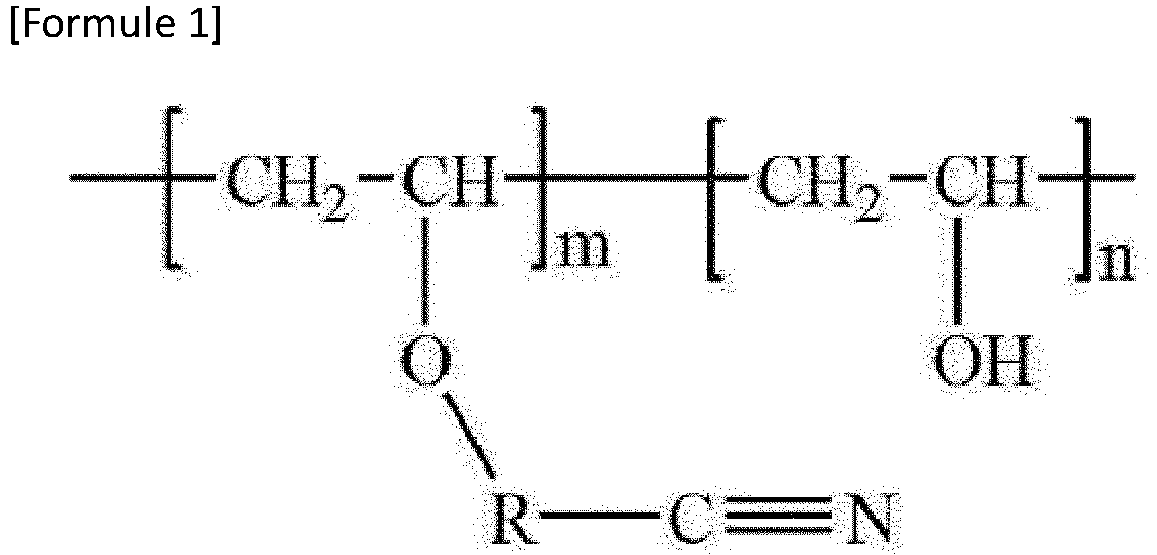 R est un groupe alkylène substitué ou non substitué contenant 1 à 5 atomes de carbone, etm et n sont les nombres d'unités répétitives,où m est un entier compris entre 10 et 5000, etn est un entier compris entre 10 et 5000.
 - Composition de bouillie d'électrode positive selon la revendication 1, dans laquelle le polymère contenant du fluor comprend au moins un sélectionné dans le groupe constitué par le polyfluorure de vinylidène (PVDF), le polyfluorure de vinylidène-hexafluoropropylène (PVDF-HFP) et le polyfluorure de vinylidène-chlorotrifluoroéthylène (PVDF-CTFE).
- Composition de bouillie d'électrode positive selon la revendication 1, dans laquelle le polymère contenant du fluor est du polyfluorure de vinylidène.
- Composition de bouillie d'électrode positive selon la revendication 1, dans laquelle l'unité représentée par la Formule 1 comprend au moins une sélectionnée dans le groupe constitué d'unités représentées par les Formules 1a et 1b :
 m1 et n1 sont les nombres d'unités répétitives,où m1 est un entier compris entre 10 et 5000, etn1 est un entier compris entre 10 et 5000,
 m2 et n2 sont les nombres d'unités répétitives,où m2 est un entier compris entre 10 et 5000, etn2 est un entier compris entre 10 et 5000.
 - Composition de bouillie d'électrode positive selon la revendication 1, dans laquelle le polymère ou l'oligomère contenant l'unité représentée par la Formule 1 est inclus en une quantité de 0,2 % en poids à 1,6 % en poids sur la base d'un poids total de matières solides dans la composition de bouillie d'électrode positive.
- Composition de bouillie d'électrode positive selon la revendication 1, dans laquelle le polymère ou l'oligomère contenant l'unité représentée par la Formule 1 est inclus en une quantité de 0,3 % en poids à 1,5 % en poids sur la base d'un poids total de matières solides dans la composition de bouillie d'électrode positive.
- Composition de bouillie d'électrode positive selon la revendication 1, dans laquelle le polymère ou l'oligomère contenant l'unité représentée par la Formule 1 est inclus en une quantité de 0,3 % en poids à 1,0 % en poids sur la base d'un poids total de matières solides dans la composition de bouillie d'électrode positive.
- Électrode positive pour batterie secondaire au lithium qui est préparée en utilisant la composition de bouillie d'électrode positive selon la revendication 1.
- Batterie secondaire au lithium comprenant l'électrode positive pour batterie secondaire au lithium selon la revendication 8.
- Batterie secondaire au lithium selon la revendication 9, dans laquelle un film de type gel est formé sur une surface de l'électrode positive pour batterie secondaire au lithium.
Applications Claiming Priority (3)
| Application Number | Priority Date | Filing Date | Title |
|---|---|---|---|
| KR20170151249 | 2017-11-14 | ||
| KR1020180136835A KR102268083B1 (ko) | 2017-11-14 | 2018-11-08 | 양극 슬러리 조성물, 이를 포함하는 이차전지용 양극 및 리튬 이차전지 |
| PCT/KR2018/013632 WO2019098612A1 (fr) | 2017-11-14 | 2018-11-09 | Composition de bouillie de cathode, cathode de batterie secondaire la comprenant et batterie secondaire au lithium |
Publications (3)
| Publication Number | Publication Date |
|---|---|
| EP3565032A1 EP3565032A1 (fr) | 2019-11-06 |
| EP3565032A4 EP3565032A4 (fr) | 2020-04-15 |
| EP3565032B1 true EP3565032B1 (fr) | 2020-12-30 |
Family
ID=66680472
Family Applications (1)
| Application Number | Title | Priority Date | Filing Date |
|---|---|---|---|
| EP18879733.6A Active EP3565032B1 (fr) | 2017-11-14 | 2018-11-09 | Composition de bouillie de cathode, cathode de batterie secondaire la comprenant et batterie secondaire au lithium |
Country Status (2)
| Country | Link |
|---|---|
| EP (1) | EP3565032B1 (fr) |
| KR (1) | KR102268083B1 (fr) |
Families Citing this family (2)
| Publication number | Priority date | Publication date | Assignee | Title |
|---|---|---|---|---|
| KR102703193B1 (ko) * | 2023-01-30 | 2024-09-06 | 성림첨단산업(주) | 희토류 영구자석의 제조방법 |
| CN119742314A (zh) * | 2024-12-25 | 2025-04-01 | 惠州亿纬锂能股份有限公司 | 一种正极极片及其制备方法和应用 |
Family Cites Families (5)
| Publication number | Priority date | Publication date | Assignee | Title |
|---|---|---|---|---|
| JPWO2002087003A1 (ja) | 2001-04-20 | 2004-08-12 | 日清紡績株式会社 | 高分子ゲル電解質用組成物および高分子ゲル電解質、ならびに該電解質を用いた二次電池および電気二重層キャパシタ |
| TWI258238B (en) * | 2003-11-05 | 2006-07-11 | Lg Chemical Ltd | Functional polymer film-coated electrode and electrochemical device using the same |
| JP2012138319A (ja) * | 2010-12-28 | 2012-07-19 | Hitachi Ltd | リチウムイオン二次電池 |
| WO2013073288A1 (fr) * | 2011-11-14 | 2013-05-23 | 日本電気株式会社 | Batterie rechargeable au lithium ion |
| US9941518B2 (en) * | 2013-10-09 | 2018-04-10 | Denka Company Limited | Cathode binder composition, cathode slurry, cathode, and lithium ion secondary battery |
-
2018
- 2018-11-08 KR KR1020180136835A patent/KR102268083B1/ko active Active
- 2018-11-09 EP EP18879733.6A patent/EP3565032B1/fr active Active
Non-Patent Citations (1)
| Title |
|---|
| None * |
Also Published As
| Publication number | Publication date |
|---|---|
| EP3565032A1 (fr) | 2019-11-06 |
| EP3565032A4 (fr) | 2020-04-15 |
| KR20190054941A (ko) | 2019-05-22 |
| KR102268083B1 (ko) | 2021-06-23 |
Similar Documents
| Publication | Publication Date | Title |
|---|---|---|
| US10629956B2 (en) | Method of preparing lithium secondary battery having improved high-temperature storage characteristics | |
| CN110998959B (zh) | 具有提高的高温存储特性的锂二次电池 | |
| US11476459B2 (en) | Lithium secondary battery having improved high-temperature storage characteristics | |
| EP3637526B1 (fr) | Batterie secondaire au lithium | |
| US11876191B2 (en) | Method for activating secondary battery | |
| KR20190024761A (ko) | 리튬 이차전지 | |
| EP3780224B1 (fr) | Composition d'électrolyte thermodurcissable pour batterie secondaire au lithium, électrolyte en gel polymérique préparé à partir de ladite composition, et batterie secondaire au lithium incluant l'électrolyte | |
| EP3780223B1 (fr) | Composition d'électrolyte thermodurcissable pour batterie secondaire au lithium, électrolyte en gel polymérique préparé avec ladite composition et batterie secondaire au lithium le comprenant | |
| EP3713004A1 (fr) | Batterie secondaire au lithium à caractéristiques de température élevées améliorées | |
| CN113711408A (zh) | 锂二次电池 | |
| CN114641884A (zh) | 锂二次电池用非水性电解质溶液及包含其的锂二次电池 | |
| KR102389888B1 (ko) | 저온 특성 및 고온 특성이 향상된 리튬 이차전지 | |
| KR102937311B1 (ko) | 리튬 이차전지용 비수 전해액 및 이를 포함하는 리튬 이차전지 | |
| EP3467927B1 (fr) | Composition destinée à un électrolyte polymère en gel et batterie rechargeable au lithium comprenant ce dernier | |
| CN110603683B (zh) | 用于锂二次电池的非水性电解液和包含其的锂二次电池 | |
| EP3565032B1 (fr) | Composition de bouillie de cathode, cathode de batterie secondaire la comprenant et batterie secondaire au lithium | |
| US11233242B2 (en) | Positive electrode slurry composition, and positive electrode for secondary battery and lithium secondary battery which include the composition | |
| KR102473691B1 (ko) | 리튬 이차전지용 전해질 | |
| KR102834571B1 (ko) | 리튬 이차전지용 비수 전해액 및 이를 포함하는 리튬 이차전지 | |
| KR102745354B1 (ko) | 리튬 이차전지용 비수 전해액 및 이를 포함하는 리튬 이차전지 | |
| JP2026512344A (ja) | 低抵抗性能を有するリチウム金属電池およびその製造方法 | |
| JP2010080447A (ja) | リチウムポリマー二次電池 |
Legal Events
| Date | Code | Title | Description |
|---|---|---|---|
| STAA | Information on the status of an ep patent application or granted ep patent |
Free format text: STATUS: THE INTERNATIONAL PUBLICATION HAS BEEN MADE |
|
| PUAI | Public reference made under article 153(3) epc to a published international application that has entered the european phase |
Free format text: ORIGINAL CODE: 0009012 |
|
| STAA | Information on the status of an ep patent application or granted ep patent |
Free format text: STATUS: REQUEST FOR EXAMINATION WAS MADE |
|
| 17P | Request for examination filed |
Effective date: 20190730 |
|
| AK | Designated contracting states |
Kind code of ref document: A1 Designated state(s): AL AT BE BG CH CY CZ DE DK EE ES FI FR GB GR HR HU IE IS IT LI LT LU LV MC MK MT NL NO PL PT RO RS SE SI SK SM TR |
|
| AX | Request for extension of the european patent |
Extension state: BA ME |
|
| A4 | Supplementary search report drawn up and despatched |
Effective date: 20200313 |
|
| RIC1 | Information provided on ipc code assigned before grant |
Ipc: H01M 10/04 20060101ALI20200309BHEP Ipc: H01M 10/42 20060101ALI20200309BHEP Ipc: H01M 4/139 20100101ALI20200309BHEP Ipc: H01M 4/13 20100101AFI20200309BHEP Ipc: H01M 4/04 20060101ALI20200309BHEP Ipc: H01M 4/62 20060101ALI20200309BHEP |
|
| GRAP | Despatch of communication of intention to grant a patent |
Free format text: ORIGINAL CODE: EPIDOSNIGR1 |
|
| STAA | Information on the status of an ep patent application or granted ep patent |
Free format text: STATUS: GRANT OF PATENT IS INTENDED |
|
| DAV | Request for validation of the european patent (deleted) | ||
| DAX | Request for extension of the european patent (deleted) | ||
| INTG | Intention to grant announced |
Effective date: 20200916 |
|
| GRAS | Grant fee paid |
Free format text: ORIGINAL CODE: EPIDOSNIGR3 |
|
| GRAA | (expected) grant |
Free format text: ORIGINAL CODE: 0009210 |
|
| STAA | Information on the status of an ep patent application or granted ep patent |
Free format text: STATUS: THE PATENT HAS BEEN GRANTED |
|
| REG | Reference to a national code |
Ref country code: DE Ref legal event code: R082 Ref document number: 602018011430 Country of ref document: DE Representative=s name: HOFFMANN - EITLE PATENT- UND RECHTSANWAELTE PA, DE |
|
| AK | Designated contracting states |
Kind code of ref document: B1 Designated state(s): AL AT BE BG CH CY CZ DE DK EE ES FI FR GB GR HR HU IE IS IT LI LT LU LV MC MK MT NL NO PL PT RO RS SE SI SK SM TR |
|
| REG | Reference to a national code |
Ref country code: GB Ref legal event code: FG4D |
|
| REG | Reference to a national code |
Ref country code: DE Ref legal event code: R096 Ref document number: 602018011430 Country of ref document: DE |
|
| REG | Reference to a national code |
Ref country code: AT Ref legal event code: REF Ref document number: 1350831 Country of ref document: AT Kind code of ref document: T Effective date: 20210115 |
|
| REG | Reference to a national code |
Ref country code: IE Ref legal event code: FG4D |
|
| PG25 | Lapsed in a contracting state [announced via postgrant information from national office to epo] |
Ref country code: FI Free format text: LAPSE BECAUSE OF FAILURE TO SUBMIT A TRANSLATION OF THE DESCRIPTION OR TO PAY THE FEE WITHIN THE PRESCRIBED TIME-LIMIT Effective date: 20201230 Ref country code: RS Free format text: LAPSE BECAUSE OF FAILURE TO SUBMIT A TRANSLATION OF THE DESCRIPTION OR TO PAY THE FEE WITHIN THE PRESCRIBED TIME-LIMIT Effective date: 20201230 Ref country code: GR Free format text: LAPSE BECAUSE OF FAILURE TO SUBMIT A TRANSLATION OF THE DESCRIPTION OR TO PAY THE FEE WITHIN THE PRESCRIBED TIME-LIMIT Effective date: 20210331 Ref country code: NO Free format text: LAPSE BECAUSE OF FAILURE TO SUBMIT A TRANSLATION OF THE DESCRIPTION OR TO PAY THE FEE WITHIN THE PRESCRIBED TIME-LIMIT Effective date: 20210330 |
|
| REG | Reference to a national code |
Ref country code: AT Ref legal event code: MK05 Ref document number: 1350831 Country of ref document: AT Kind code of ref document: T Effective date: 20201230 |
|
| PG25 | Lapsed in a contracting state [announced via postgrant information from national office to epo] |
Ref country code: BG Free format text: LAPSE BECAUSE OF FAILURE TO SUBMIT A TRANSLATION OF THE DESCRIPTION OR TO PAY THE FEE WITHIN THE PRESCRIBED TIME-LIMIT Effective date: 20210330 Ref country code: SE Free format text: LAPSE BECAUSE OF FAILURE TO SUBMIT A TRANSLATION OF THE DESCRIPTION OR TO PAY THE FEE WITHIN THE PRESCRIBED TIME-LIMIT Effective date: 20201230 Ref country code: LV Free format text: LAPSE BECAUSE OF FAILURE TO SUBMIT A TRANSLATION OF THE DESCRIPTION OR TO PAY THE FEE WITHIN THE PRESCRIBED TIME-LIMIT Effective date: 20201230 |
|
| REG | Reference to a national code |
Ref country code: NL Ref legal event code: MP Effective date: 20201230 |
|
| PG25 | Lapsed in a contracting state [announced via postgrant information from national office to epo] |
Ref country code: HR Free format text: LAPSE BECAUSE OF FAILURE TO SUBMIT A TRANSLATION OF THE DESCRIPTION OR TO PAY THE FEE WITHIN THE PRESCRIBED TIME-LIMIT Effective date: 20201230 |
|
| REG | Reference to a national code |
Ref country code: LT Ref legal event code: MG9D |
|
| PG25 | Lapsed in a contracting state [announced via postgrant information from national office to epo] |
Ref country code: SK Free format text: LAPSE BECAUSE OF FAILURE TO SUBMIT A TRANSLATION OF THE DESCRIPTION OR TO PAY THE FEE WITHIN THE PRESCRIBED TIME-LIMIT Effective date: 20201230 Ref country code: CZ Free format text: LAPSE BECAUSE OF FAILURE TO SUBMIT A TRANSLATION OF THE DESCRIPTION OR TO PAY THE FEE WITHIN THE PRESCRIBED TIME-LIMIT Effective date: 20201230 Ref country code: EE Free format text: LAPSE BECAUSE OF FAILURE TO SUBMIT A TRANSLATION OF THE DESCRIPTION OR TO PAY THE FEE WITHIN THE PRESCRIBED TIME-LIMIT Effective date: 20201230 Ref country code: RO Free format text: LAPSE BECAUSE OF FAILURE TO SUBMIT A TRANSLATION OF THE DESCRIPTION OR TO PAY THE FEE WITHIN THE PRESCRIBED TIME-LIMIT Effective date: 20201230 Ref country code: PT Free format text: LAPSE BECAUSE OF FAILURE TO SUBMIT A TRANSLATION OF THE DESCRIPTION OR TO PAY THE FEE WITHIN THE PRESCRIBED TIME-LIMIT Effective date: 20210430 Ref country code: LT Free format text: LAPSE BECAUSE OF FAILURE TO SUBMIT A TRANSLATION OF THE DESCRIPTION OR TO PAY THE FEE WITHIN THE PRESCRIBED TIME-LIMIT Effective date: 20201230 |
|
| PG25 | Lapsed in a contracting state [announced via postgrant information from national office to epo] |
Ref country code: PL Free format text: LAPSE BECAUSE OF FAILURE TO SUBMIT A TRANSLATION OF THE DESCRIPTION OR TO PAY THE FEE WITHIN THE PRESCRIBED TIME-LIMIT Effective date: 20201230 Ref country code: AT Free format text: LAPSE BECAUSE OF FAILURE TO SUBMIT A TRANSLATION OF THE DESCRIPTION OR TO PAY THE FEE WITHIN THE PRESCRIBED TIME-LIMIT Effective date: 20201230 |
|
| PG25 | Lapsed in a contracting state [announced via postgrant information from national office to epo] |
Ref country code: IS Free format text: LAPSE BECAUSE OF FAILURE TO SUBMIT A TRANSLATION OF THE DESCRIPTION OR TO PAY THE FEE WITHIN THE PRESCRIBED TIME-LIMIT Effective date: 20210430 |
|
| REG | Reference to a national code |
Ref country code: DE Ref legal event code: R097 Ref document number: 602018011430 Country of ref document: DE |
|
| PG25 | Lapsed in a contracting state [announced via postgrant information from national office to epo] |
Ref country code: AL Free format text: LAPSE BECAUSE OF FAILURE TO SUBMIT A TRANSLATION OF THE DESCRIPTION OR TO PAY THE FEE WITHIN THE PRESCRIBED TIME-LIMIT Effective date: 20201230 Ref country code: IT Free format text: LAPSE BECAUSE OF FAILURE TO SUBMIT A TRANSLATION OF THE DESCRIPTION OR TO PAY THE FEE WITHIN THE PRESCRIBED TIME-LIMIT Effective date: 20201230 |
|
| PLBE | No opposition filed within time limit |
Free format text: ORIGINAL CODE: 0009261 |
|
| STAA | Information on the status of an ep patent application or granted ep patent |
Free format text: STATUS: NO OPPOSITION FILED WITHIN TIME LIMIT |
|
| PG25 | Lapsed in a contracting state [announced via postgrant information from national office to epo] |
Ref country code: DK Free format text: LAPSE BECAUSE OF FAILURE TO SUBMIT A TRANSLATION OF THE DESCRIPTION OR TO PAY THE FEE WITHIN THE PRESCRIBED TIME-LIMIT Effective date: 20201230 |
|
| 26N | No opposition filed |
Effective date: 20211001 |
|
| PG25 | Lapsed in a contracting state [announced via postgrant information from national office to epo] |
Ref country code: ES Free format text: LAPSE BECAUSE OF FAILURE TO SUBMIT A TRANSLATION OF THE DESCRIPTION OR TO PAY THE FEE WITHIN THE PRESCRIBED TIME-LIMIT Effective date: 20201230 |
|
| PG25 | Lapsed in a contracting state [announced via postgrant information from national office to epo] |
Ref country code: SI Free format text: LAPSE BECAUSE OF FAILURE TO SUBMIT A TRANSLATION OF THE DESCRIPTION OR TO PAY THE FEE WITHIN THE PRESCRIBED TIME-LIMIT Effective date: 20201230 |
|
| PG25 | Lapsed in a contracting state [announced via postgrant information from national office to epo] |
Ref country code: IS Free format text: LAPSE BECAUSE OF FAILURE TO SUBMIT A TRANSLATION OF THE DESCRIPTION OR TO PAY THE FEE WITHIN THE PRESCRIBED TIME-LIMIT Effective date: 20210430 |
|
| PG25 | Lapsed in a contracting state [announced via postgrant information from national office to epo] |
Ref country code: MC Free format text: LAPSE BECAUSE OF FAILURE TO SUBMIT A TRANSLATION OF THE DESCRIPTION OR TO PAY THE FEE WITHIN THE PRESCRIBED TIME-LIMIT Effective date: 20201230 |
|
| REG | Reference to a national code |
Ref country code: CH Ref legal event code: PL |
|
| PG25 | Lapsed in a contracting state [announced via postgrant information from national office to epo] |
Ref country code: LU Free format text: LAPSE BECAUSE OF NON-PAYMENT OF DUE FEES Effective date: 20211109 Ref country code: BE Free format text: LAPSE BECAUSE OF NON-PAYMENT OF DUE FEES Effective date: 20211130 |
|
| REG | Reference to a national code |
Ref country code: BE Ref legal event code: MM Effective date: 20211130 |
|
| PG25 | Lapsed in a contracting state [announced via postgrant information from national office to epo] |
Ref country code: LI Free format text: LAPSE BECAUSE OF NON-PAYMENT OF DUE FEES Effective date: 20211130 Ref country code: CH Free format text: LAPSE BECAUSE OF NON-PAYMENT OF DUE FEES Effective date: 20211130 |
|
| PG25 | Lapsed in a contracting state [announced via postgrant information from national office to epo] |
Ref country code: IE Free format text: LAPSE BECAUSE OF NON-PAYMENT OF DUE FEES Effective date: 20211109 |
|
| REG | Reference to a national code |
Ref country code: DE Ref legal event code: R081 Ref document number: 602018011430 Country of ref document: DE Owner name: LG ENERGY SOLUTION, LTD., KR Free format text: FORMER OWNER: LG CHEM, LTD., SEOUL, KR |
|
| P01 | Opt-out of the competence of the unified patent court (upc) registered |
Effective date: 20230408 |
|
| PG25 | Lapsed in a contracting state [announced via postgrant information from national office to epo] |
Ref country code: NL Free format text: LAPSE BECAUSE OF NON-PAYMENT OF DUE FEES Effective date: 20201230 Ref country code: CY Free format text: LAPSE BECAUSE OF FAILURE TO SUBMIT A TRANSLATION OF THE DESCRIPTION OR TO PAY THE FEE WITHIN THE PRESCRIBED TIME-LIMIT Effective date: 20201230 |
|
| PG25 | Lapsed in a contracting state [announced via postgrant information from national office to epo] |
Ref country code: SM Free format text: LAPSE BECAUSE OF FAILURE TO SUBMIT A TRANSLATION OF THE DESCRIPTION OR TO PAY THE FEE WITHIN THE PRESCRIBED TIME-LIMIT Effective date: 20201230 Ref country code: HU Free format text: LAPSE BECAUSE OF FAILURE TO SUBMIT A TRANSLATION OF THE DESCRIPTION OR TO PAY THE FEE WITHIN THE PRESCRIBED TIME-LIMIT; INVALID AB INITIO Effective date: 20181109 |
|
| REG | Reference to a national code |
Ref country code: GB Ref legal event code: 732E Free format text: REGISTERED BETWEEN 20230901 AND 20230906 |
|
| PG25 | Lapsed in a contracting state [announced via postgrant information from national office to epo] |
Ref country code: MK Free format text: LAPSE BECAUSE OF FAILURE TO SUBMIT A TRANSLATION OF THE DESCRIPTION OR TO PAY THE FEE WITHIN THE PRESCRIBED TIME-LIMIT Effective date: 20201230 |
|
| PG25 | Lapsed in a contracting state [announced via postgrant information from national office to epo] |
Ref country code: TR Free format text: LAPSE BECAUSE OF FAILURE TO SUBMIT A TRANSLATION OF THE DESCRIPTION OR TO PAY THE FEE WITHIN THE PRESCRIBED TIME-LIMIT Effective date: 20201230 |
|
| PG25 | Lapsed in a contracting state [announced via postgrant information from national office to epo] |
Ref country code: MT Free format text: LAPSE BECAUSE OF FAILURE TO SUBMIT A TRANSLATION OF THE DESCRIPTION OR TO PAY THE FEE WITHIN THE PRESCRIBED TIME-LIMIT Effective date: 20201230 |
|
| PGFP | Annual fee paid to national office [announced via postgrant information from national office to epo] |
Ref country code: DE Payment date: 20251020 Year of fee payment: 8 |
|
| PGFP | Annual fee paid to national office [announced via postgrant information from national office to epo] |
Ref country code: GB Payment date: 20251023 Year of fee payment: 8 |
|
| PGFP | Annual fee paid to national office [announced via postgrant information from national office to epo] |
Ref country code: FR Payment date: 20251021 Year of fee payment: 8 |