EP3566623A1 - Vorrichtung und verfahren zur behandlung von nahrungsmitteln - Google Patents
Vorrichtung und verfahren zur behandlung von nahrungsmitteln Download PDFInfo
- Publication number
- EP3566623A1 EP3566623A1 EP18171938.6A EP18171938A EP3566623A1 EP 3566623 A1 EP3566623 A1 EP 3566623A1 EP 18171938 A EP18171938 A EP 18171938A EP 3566623 A1 EP3566623 A1 EP 3566623A1
- Authority
- EP
- European Patent Office
- Prior art keywords
- foodstuff
- liquid
- treatment
- predefined properties
- temperature
- Prior art date
- Legal status (The legal status is an assumption and is not a legal conclusion. Google has not performed a legal analysis and makes no representation as to the accuracy of the status listed.)
- Withdrawn
Links
- 238000000034 method Methods 0.000 title claims description 35
- 239000007788 liquid Substances 0.000 claims abstract description 98
- CIWBSHSKHKDKBQ-JLAZNSOCSA-N Ascorbic acid Chemical compound OC[C@H](O)[C@H]1OC(=O)C(O)=C1O CIWBSHSKHKDKBQ-JLAZNSOCSA-N 0.000 claims description 46
- ZZZCUOFIHGPKAK-UHFFFAOYSA-N D-erythro-ascorbic acid Natural products OCC1OC(=O)C(O)=C1O ZZZCUOFIHGPKAK-UHFFFAOYSA-N 0.000 claims description 22
- 229930003268 Vitamin C Natural products 0.000 claims description 22
- ATNHDLDRLWWWCB-AENOIHSZSA-M chlorophyll a Chemical group C1([C@@H](C(=O)OC)C(=O)C2=C3C)=C2N2C3=CC(C(CC)=C3C)=[N+]4C3=CC3=C(C=C)C(C)=C5N3[Mg-2]42[N+]2=C1[C@@H](CCC(=O)OC\C=C(/C)CCC[C@H](C)CCC[C@H](C)CCCC(C)C)[C@H](C)C2=C5 ATNHDLDRLWWWCB-AENOIHSZSA-M 0.000 claims description 22
- 235000019154 vitamin C Nutrition 0.000 claims description 22
- 239000011718 vitamin C Substances 0.000 claims description 22
- 238000006731 degradation reaction Methods 0.000 claims description 21
- 230000015556 catabolic process Effects 0.000 claims description 19
- 238000013500 data storage Methods 0.000 claims description 18
- 108010024957 Ascorbate Oxidase Proteins 0.000 claims description 16
- 108090000790 Enzymes Proteins 0.000 claims description 16
- 102000004190 Enzymes Human genes 0.000 claims description 16
- 238000004891 communication Methods 0.000 claims description 12
- 229930002875 chlorophyll Natural products 0.000 claims description 10
- 235000019804 chlorophyll Nutrition 0.000 claims description 10
- 239000011785 micronutrient Substances 0.000 claims description 10
- 235000013369 micronutrients Nutrition 0.000 claims description 10
- 108020004410 pectinesterase Proteins 0.000 claims description 10
- 239000000049 pigment Substances 0.000 claims description 9
- 229920001277 pectin Polymers 0.000 claims description 5
- 238000005303 weighing Methods 0.000 claims description 5
- 230000004913 activation Effects 0.000 claims description 4
- 230000002829 reductive effect Effects 0.000 claims description 4
- 239000012530 fluid Substances 0.000 claims description 3
- 230000006872 improvement Effects 0.000 claims description 2
- 238000012423 maintenance Methods 0.000 claims description 2
- 230000000694 effects Effects 0.000 description 21
- 230000014759 maintenance of location Effects 0.000 description 21
- 230000008569 process Effects 0.000 description 20
- 238000007599 discharging Methods 0.000 description 16
- 238000005868 electrolysis reaction Methods 0.000 description 13
- 229930002868 chlorophyll a Natural products 0.000 description 12
- FAPWRFPIFSIZLT-UHFFFAOYSA-M Sodium chloride Chemical compound [Na+].[Cl-] FAPWRFPIFSIZLT-UHFFFAOYSA-M 0.000 description 11
- 235000013311 vegetables Nutrition 0.000 description 11
- XLYOFNOQVPJJNP-UHFFFAOYSA-N water Substances O XLYOFNOQVPJJNP-UHFFFAOYSA-N 0.000 description 11
- 235000013305 food Nutrition 0.000 description 8
- 150000003839 salts Chemical class 0.000 description 8
- 238000009835 boiling Methods 0.000 description 6
- 244000052616 bacterial pathogen Species 0.000 description 5
- 239000011780 sodium chloride Substances 0.000 description 5
- 235000011299 Brassica oleracea var botrytis Nutrition 0.000 description 4
- 235000017647 Brassica oleracea var italica Nutrition 0.000 description 4
- 240000003259 Brassica oleracea var. botrytis Species 0.000 description 4
- 206010033546 Pallor Diseases 0.000 description 4
- 241000219315 Spinacia Species 0.000 description 4
- 235000009337 Spinacia oleracea Nutrition 0.000 description 4
- 244000000626 Daucus carota Species 0.000 description 3
- 235000002767 Daucus carota Nutrition 0.000 description 3
- 238000006243 chemical reaction Methods 0.000 description 3
- 238000010411 cooking Methods 0.000 description 3
- 230000007423 decrease Effects 0.000 description 3
- 235000013399 edible fruits Nutrition 0.000 description 3
- 238000002360 preparation method Methods 0.000 description 3
- 239000000126 substance Substances 0.000 description 3
- KZBUYRJDOAKODT-UHFFFAOYSA-N Chlorine Chemical compound ClCl KZBUYRJDOAKODT-UHFFFAOYSA-N 0.000 description 2
- ZAMOUSCENKQFHK-UHFFFAOYSA-N Chlorine atom Chemical compound [Cl] ZAMOUSCENKQFHK-UHFFFAOYSA-N 0.000 description 2
- 238000013459 approach Methods 0.000 description 2
- QVGXLLKOCUKJST-UHFFFAOYSA-N atomic oxygen Chemical compound [O] QVGXLLKOCUKJST-UHFFFAOYSA-N 0.000 description 2
- 230000015572 biosynthetic process Effects 0.000 description 2
- 230000001413 cellular effect Effects 0.000 description 2
- 239000000460 chlorine Substances 0.000 description 2
- 229910052801 chlorine Inorganic materials 0.000 description 2
- 229930002869 chlorophyll b Natural products 0.000 description 2
- NSMUHPMZFPKNMZ-VBYMZDBQSA-M chlorophyll b Chemical compound C1([C@@H](C(=O)OC)C(=O)C2=C3C)=C2N2C3=CC(C(CC)=C3C=O)=[N+]4C3=CC3=C(C=C)C(C)=C5N3[Mg-2]42[N+]2=C1[C@@H](CCC(=O)OC\C=C(/C)CCC[C@H](C)CCC[C@H](C)CCCC(C)C)[C@H](C)C2=C5 NSMUHPMZFPKNMZ-VBYMZDBQSA-M 0.000 description 2
- 239000000470 constituent Substances 0.000 description 2
- 230000003247 decreasing effect Effects 0.000 description 2
- 230000001419 dependent effect Effects 0.000 description 2
- 238000005886 esterification reaction Methods 0.000 description 2
- 239000000796 flavoring agent Substances 0.000 description 2
- 235000019634 flavors Nutrition 0.000 description 2
- 230000036541 health Effects 0.000 description 2
- QWPPOHNGKGFGJK-UHFFFAOYSA-N hypochlorous acid Chemical compound ClO QWPPOHNGKGFGJK-UHFFFAOYSA-N 0.000 description 2
- 238000011534 incubation Methods 0.000 description 2
- 150000002500 ions Chemical class 0.000 description 2
- 238000005259 measurement Methods 0.000 description 2
- 230000007935 neutral effect Effects 0.000 description 2
- 239000001301 oxygen Substances 0.000 description 2
- 229910052760 oxygen Inorganic materials 0.000 description 2
- 239000003002 pH adjusting agent Substances 0.000 description 2
- 235000010987 pectin Nutrition 0.000 description 2
- 239000001814 pectin Substances 0.000 description 2
- 238000004321 preservation Methods 0.000 description 2
- 238000003825 pressing Methods 0.000 description 2
- 230000009467 reduction Effects 0.000 description 2
- 240000007087 Apium graveolens Species 0.000 description 1
- 235000015849 Apium graveolens Dulce Group Nutrition 0.000 description 1
- 235000010591 Appio Nutrition 0.000 description 1
- 240000007124 Brassica oleracea Species 0.000 description 1
- 235000003899 Brassica oleracea var acephala Nutrition 0.000 description 1
- 235000011301 Brassica oleracea var capitata Nutrition 0.000 description 1
- 235000001169 Brassica oleracea var oleracea Nutrition 0.000 description 1
- SBJKKFFYIZUCET-JLAZNSOCSA-N Dehydro-L-ascorbic acid Chemical compound OC[C@H](O)[C@H]1OC(=O)C(=O)C1=O SBJKKFFYIZUCET-JLAZNSOCSA-N 0.000 description 1
- SBJKKFFYIZUCET-UHFFFAOYSA-N Dehydroascorbic acid Natural products OCC(O)C1OC(=O)C(=O)C1=O SBJKKFFYIZUCET-UHFFFAOYSA-N 0.000 description 1
- 241000196324 Embryophyta Species 0.000 description 1
- 206010061218 Inflammation Diseases 0.000 description 1
- 240000008415 Lactuca sativa Species 0.000 description 1
- 235000003228 Lactuca sativa Nutrition 0.000 description 1
- 240000007594 Oryza sativa Species 0.000 description 1
- 235000007164 Oryza sativa Nutrition 0.000 description 1
- 230000002378 acidificating effect Effects 0.000 description 1
- 239000003963 antioxidant agent Substances 0.000 description 1
- 230000003078 antioxidant effect Effects 0.000 description 1
- 235000006708 antioxidants Nutrition 0.000 description 1
- 235000010323 ascorbic acid Nutrition 0.000 description 1
- 239000011668 ascorbic acid Substances 0.000 description 1
- 229960005070 ascorbic acid Drugs 0.000 description 1
- 230000008901 benefit Effects 0.000 description 1
- 210000004204 blood vessel Anatomy 0.000 description 1
- 230000006652 catabolic pathway Effects 0.000 description 1
- 235000013339 cereals Nutrition 0.000 description 1
- 150000001875 compounds Chemical class 0.000 description 1
- 239000004020 conductor Substances 0.000 description 1
- 230000007123 defense Effects 0.000 description 1
- 235000020960 dehydroascorbic acid Nutrition 0.000 description 1
- 239000011615 dehydroascorbic acid Substances 0.000 description 1
- 238000010586 diagram Methods 0.000 description 1
- 201000010099 disease Diseases 0.000 description 1
- 208000037265 diseases, disorders, signs and symptoms Diseases 0.000 description 1
- 239000000835 fiber Substances 0.000 description 1
- 229940014144 folate Drugs 0.000 description 1
- OVBPIULPVIDEAO-LBPRGKRZSA-N folic acid Chemical compound C=1N=C2NC(N)=NC(=O)C2=NC=1CNC1=CC=C(C(=O)N[C@@H](CCC(O)=O)C(O)=O)C=C1 OVBPIULPVIDEAO-LBPRGKRZSA-N 0.000 description 1
- 235000019152 folic acid Nutrition 0.000 description 1
- 239000011724 folic acid Substances 0.000 description 1
- 230000006870 function Effects 0.000 description 1
- XLYOFNOQVPJJNP-ZSJDYOACSA-N heavy water Substances [2H]O[2H] XLYOFNOQVPJJNP-ZSJDYOACSA-N 0.000 description 1
- -1 hydroxide ions Chemical class 0.000 description 1
- 238000003384 imaging method Methods 0.000 description 1
- 208000015181 infectious disease Diseases 0.000 description 1
- 230000004054 inflammatory process Effects 0.000 description 1
- 239000004615 ingredient Substances 0.000 description 1
- 229910052500 inorganic mineral Inorganic materials 0.000 description 1
- 239000003014 ion exchange membrane Substances 0.000 description 1
- 238000002386 leaching Methods 0.000 description 1
- 230000000670 limiting effect Effects 0.000 description 1
- 239000012528 membrane Substances 0.000 description 1
- 229910052751 metal Inorganic materials 0.000 description 1
- 239000002184 metal Substances 0.000 description 1
- 239000011707 mineral Substances 0.000 description 1
- 230000007658 neurological function Effects 0.000 description 1
- 235000015097 nutrients Nutrition 0.000 description 1
- 230000003287 optical effect Effects 0.000 description 1
- 230000003647 oxidation Effects 0.000 description 1
- 238000007254 oxidation reaction Methods 0.000 description 1
- 230000004792 oxidative damage Effects 0.000 description 1
- 235000017807 phytochemicals Nutrition 0.000 description 1
- 229930000223 plant secondary metabolite Natural products 0.000 description 1
- 230000001681 protective effect Effects 0.000 description 1
- 238000005086 pumping Methods 0.000 description 1
- 230000004044 response Effects 0.000 description 1
- 230000000717 retained effect Effects 0.000 description 1
- 235000009566 rice Nutrition 0.000 description 1
- 238000010025 steaming Methods 0.000 description 1
- 238000003860 storage Methods 0.000 description 1
- 229940088594 vitamin Drugs 0.000 description 1
- 229930003231 vitamin Natural products 0.000 description 1
- 235000013343 vitamin Nutrition 0.000 description 1
- 239000011782 vitamin Substances 0.000 description 1
Images



Classifications
-
- A—HUMAN NECESSITIES
- A47—FURNITURE; DOMESTIC ARTICLES OR APPLIANCES; COFFEE MILLS; SPICE MILLS; SUCTION CLEANERS IN GENERAL
- A47J—KITCHEN EQUIPMENT; COFFEE MILLS; SPICE MILLS; APPARATUS FOR MAKING BEVERAGES
- A47J27/00—Cooking-vessels
- A47J27/004—Cooking-vessels with integral electrical heating means
Definitions
- the present invention relates to an apparatus and a method for treating foodstuff immersed in a liquid, such as water. Specifically, the present invention relates to an apparatus and a method for treating foodstuff according pH level and temperature conditions which are determined depending on user input which relates to a combination of predefined treatment results.
- Vegetables and fruits are rich sources of essential vitamins, minerals, fibers and disease-fighting phytochemicals which the human body needs to maintain health. Some vegetables can be taken raw but most are commonly cooked before being consumed. Generally, preparations of vegetables at home are based on taste preference and convenience rather than retention of nutrient and health-promoting compounds.
- Embodiments of the present invention provide an apparatus for treating foodstuff while at least partially being immersed in a liquid.
- the apparatus comprises a vessel for receiving the foodstuff and the liquid.
- the apparatus further comprises a pH adjusting system for adjusting a pH level of the liquid and/or a pH level of the foodstuff.
- the apparatus further comprises a temperature adjusting system for adjusting a temperature of the liquid and/or a temperature of the foodstuff.
- the apparatus further comprises an interface which is configured to provide the user with two or more selectable treatment options for the treatment of the foodstuff.
- Each of the treatment options corresponds to a different setting for the pH level and the temperature which is stored in a data storage system of the apparatus, wherein each of the treatment options represents a different predefined property of the foodstuff after the treatment.
- the interface is further configured to allow the user to select a treatment option corresponding to a combination of at least two of the predefined properties.
- the apparatus further comprises a controller which is configured to control the temperature and the pH level so that the combination of the predefined properties is obtained using a setting stored in the data storage system which balances between the settings of the predefined properties which are combined.
- the foodstuff may include vegetables, fruits and/or grains, such as rice.
- the treatment of the foodstuff may include one or a combination of boiling, poaching, simmering, stewing and/or blanching.
- the liquid may be water or substantially water.
- the liquid may comprise water as a primary constituent.
- One or more of the predefined properties may be organoleptic properties of the foodstuff, i.e. properties that an individual experiences via the senses. Additionally or alternatively, one or more of the predefined properties may be chemical properties of the foodstuff.
- the interface may include one or more user-operable, in particular manually-operable interface elements, such as one or more switches and/or one or more buttons.
- the manually-operable interface elements may be provided using a keypad and/or a touch screen.
- the interface is accessible by an input device, which may be, for example, a cellular phone of the user.
- Each of the treatment options may be selectable using the manually-operable interface elements.
- the controller may be configured to read, depending on the selected treatment option, a setting from a plurality of settings stored in a data storage system of the controller so that the read-out setting corresponds to the selected treatment option.
- Each of the settings may include one or more values for a temperature and/or a pH level of the foodstuff and/or the liquid.
- the setting may include further parameters, such as a treatment time.
- the interface may further be configured for allowing the user to select a class from a plurality of classes of foodstuff. Examples of such classes may be "spinach", “carrots” and "broccoli".
- the plurality of classes may be associated with different types of foodstuff, which are to be treated.
- Each of the settings may be associated with a class of foodstuff which is selectable by the user.
- At least a portion of the vessel may be made of a heat conductive material, such as metal.
- a holding capacity of the vessel may be larger than 0.5 liter, larger than 1 liter or larger than 1.5 liter. The holding capacity may be less and then 2,000 liter or less than 1,000 liter or less than 200 liter or less than 100 liter.
- the vessel may include an opening for supplying the foodstuff and/or the liquid to the vessel and/or for removing the foodstuff and/or the liquid from the vessel.
- the vessel may be in the form of a bowl.
- the pH adjusting system may be configured to adjust the pH level of the liquid within an accuracy of +/- 1 pH or within an accuracy of +/- 0.5 pH, or within an accuracy of +/- 0.3 pH.
- the pH adjusting system may be configured to adjust the pH level of the liquid and/or the pH level of the foodstuff when contained in the vessel and/or before being supplied to the vessel.
- the pH adjusting system may include a pH sensor for sensing a pH level of the liquid and/or a pH level of the foodstuff.
- the pH sensor may be in signal communication with the controller.
- the controller may be configured to control the pH adjusting system so as to adjust the pH level of the liquid depending on the sensed pH level.
- the pH sensor of the pH adjusting system may be located inside the vessel and/or outside the vessel.
- the pH sensor may be configured to sense a pH level of an amount of the liquid to be supplied to the vessel.
- the pH adjusting system is configured to perform an electrolysis of at least a portion of the liquid for adjusting the pH level.
- the electrolysis may be performed using an electrolysis cell.
- the electrolysis cell may include an anode chamber and a cathode chamber.
- the anode chamber and the cathode chamber may be separated by an ion-conductive membrane.
- the pH adjusting system is configured to adjust a conductivity of at least a portion of the liquid for performing the electrolysis.
- the conductivity may be adjusted by adding a salt, in particular a neutral salt, such as sodium chloride (NaCl) at least to a portion of the liquid which is supplied to the electrolysis cell.
- a salt in particular a neutral salt, such as sodium chloride (NaCl) at least to a portion of the liquid which is supplied to the electrolysis cell.
- At least one of the predefined properties, which are combined, is indicative of: (a) a color of the foodstuff; (b) a content of a micronutrient contained in the foodstuff; and/or (c) a firmness of a texture of the foodstuff.
- the setting of at least one of the predefined properties is configured to provide an increased heat stability of an enzyme during the treatment, compared to at least one or all of the remaining settings of the predefined properties.
- the heat stability may be measured by measuring a residual activity of the enzyme.
- the enzyme may be involved in an improvement or maintenance of a firmness of a texture of the foodstuff.
- the setting may be configured to control the temperature to values less than 80 °C or less than 70 °C.
- the temperature may be greater than 60° C in order to eliminate pathogenic bacteria contained in the foodstuff.
- the enzyme may be an endogenous enzyme of the foodstuff.
- the enzyme may be involved in the de-esterification of pectin and formation of pectinates.
- the enzyme is a pectic enzyme.
- the pectic enzyme may be pectin methylesterase.
- the setting of at least one of the predefined properties is configured to provide a reduced or suppressed degradation of a pigment of the foodstuff during the treatment, compared to at least one or all of the remaining settings of the predefined properties.
- the degradation may be measured by measuring a reduction of the content of the pigment.
- the pigment is a chlorophyll pigment.
- the setting may be configured to control the temperature to values below 80 °C or below 75 °C or below 70 °C or below 65 °C.
- the temperature may be greater than 60° C in order to eliminate pathogenic bacteria contained in the foodstuff.
- the setting may be configured to control the pH level to values greater than 7 or greater than 8.
- the pH level may be less than 9.
- the setting of at least one of the predefined properties is configured to provide a reduced or suppressed degradation of a micronutrient of the foodstuff during the treatment, compared to at least one or all of the remaining settings of the predefined properties.
- the degradation may be measured by measuring a reduction of the content of the micronutrient.
- the micronutrient is vitamin C.
- the setting of at least one of the predefined properties is configured to reduce or suppress a stability of ascorbate oxidase, compared to at least one or all of the remaining settings of the predefined properties.
- the stability may be measured by measuring a residual activity of the ascorbate oxidase.
- the setting may be configured so that the temperature is controlled to values greater than 60 °C or greater than 65 °C.
- the setting may be configured to control the pH level to values lower than 5 or lower than 4.5.
- the pH level may be greater than 4.
- the interface comprises, for each of the treatment options, an activatable user interface element.
- the interface is configured so that the treatment option, which corresponds to the combination of the predefined properties, is selectable using an activation of the user interface elements of the treatment options of the combined predefined properties.
- the user interface elements may be manually-operable user interface elements.
- the user interface elements may be activatable independently from each other.
- the interface elements may be provided using a graphical user interface.
- the apparatus includes a container for receiving the liquid.
- the container may be in fluid communication with the vessel for supplying the liquid from the container to the vessel.
- the pH adjusting system may be configured to adjust the pH level of the liquid when being contained in the container.
- the temperature adjusting system may be configured to adjust the temperature level of the liquid when being contained in the container.
- the apparatus includes an amount determining system configured to measure an amount of the foodstuff.
- the apparatus may be configured to determine an amount of the liquid to be supplied to the vessel depending on the measured amount of the foodstuff.
- the amount of the liquid is further determined depending on one or more of the treatment options which are selected by the user.
- the amount determining system comprises a weighing system which is configured to determine a weight of the foodstuff when contained in the vessel.
- Embodiments of the present disclosure provide a method of treating foodstuff while at least partially being immersed in a liquid.
- the method comprises receiving, via an interface, user input, wherein the interface is configured to provide the user with two or more selectable treatment options for the treatment of the foodstuff.
- Each of the treatment options may correspond to a different setting for controlling, using a controller, a pH level and/or a temperature of the liquid and/or of the foodstuff, wherein each of the treatment options represents a different predefined property of the foodstuff after the treatment.
- the interface may further be configured to allow the user to select a treatment option corresponding to a combination of at least two of the predefined properties.
- the method may further comprises controlling, using the controller, the temperature and/or the pH level so that the combination of the predefined properties is obtained using a setting stored in the data storage system which balances between the settings of the predefined properties which are combined.
- Fig. 1 is a schematic illustration of an apparatus 1 according to an exemplary embodiment for treating foodstuff 3 using a liquid 4.
- the apparatus 1 of the exemplary embodiment is, for example, configured for treating vegetables and/or fruits. However, it is also conceivable that, additionally or alternatively, other kinds of foodstuff can be treated using the apparatus 1.
- the liquid 4 which is preferably used for treating the foodstuff 3 is water or has water was a primary constituent.
- the foodstuff 3 is contained in a vessel 2 of the apparatus 1 and is at least partially immersed in the liquid 4. Thereby, the treatment process may include boiling, poaching, simmering, stewing and/or blanching.
- the apparatus 1 comprises a temperature adjusting system 16 for adjusting a temperature, which may be a temperature of the liquid 4 and/or a temperature of the foodstuff 3.
- the temperature adjusting system 16 includes a first heater 9 which is in heat conductive communication with the content of the vessel 2 in order to keep the liquid 4 and the foodstuff 3 contained in the vessel at a required temperature level.
- the apparatus further includes a pH adjusting system 10 which is configured to adjust a pH level of the liquid 4 before being supplied to the vessel 2.
- the apparatus 1 includes a liquid reservoir tank 11 which is in fluid communication with the vessel 2 and the pH adjusting system 10 is configured to adjust the pH level of the liquid when contained in the liquid reservoir tank 11.
- the temperature adjusting system 16 further includes a second heater 12 which is in heat conductive communication with the content of the liquid reservoir tank 11.
- the apparatus 1 may include a first sensor unit 15 for measuring a temperature and/or a pH level of the liquid 4 contained in the liquid reservoir tank 11. Additionally or alternatively, the apparatus 1 includes a second sensor unit 44 for measuring a temperature and/or a pH level of the liquid 4 contained in the vessel 2.
- the sensor units 15, 44, the pH adjusting system 10 and the temperature adjusting system 16 are in signal communication with a controller 5 of the apparatus.
- the controller 5 is configured to control the pH adjusting system 10 and the temperature adjusting system 16 depending on control signals received from the sensor units 15 and/or 44.
- the pH adjusting system 10 and/or at least a portion of the temperature adjusting system 16 are provided in a supply line (not illustrated) for supplying the liquid to the vessel.
- the reservoir tank 15 may be omitted.
- the adjustment of the temperature and the pH level of the foodstuff 3 and the liquid 4 during the treatment of the foodstuff 3 allows obtaining a plurality of different predefined properties of the foodstuff after the treatment process, depending on the setting used for controlling the pH adjusting system 10 and the temperature adjusting system 16.
- the controller 5 is in signal communication with an electronic data storage system 46 for storing a plurality of different settings which are used to control the temperature adjusting system and the pH adjusting system.
- Each of the settings corresponds to a treatment option which is selectable by the user using a user interface 6 of the apparatus 1, wherein each of the settings corresponds to a different predefined property of the foodstuff after the treatment process.
- One or more of the predefined properties may correspond to organoleptic properties, such as "retention of green color” and “retention of texture”. Additionally or alternatively, one or more of the predefined properties may correspond to a chemical property, such as "retention of vitamin C”.
- the controller 5 selects the corresponding setting from the plurality of settings stored in the data storage system 46 of the controller 5. Then, the controller 5 controls the temperature adjusting system 16 and the pH adjusting system 10 so that the pH level and temperature correspond to the setting. It has been shown that such a configuration of the user interface allows easy and efficient use of the apparatus for treating the foodstuff.
- a first setting which is stored in the data storage system 46 is configured to reduce the degradation of chlorophyll pigments contained in the foodstuff. This, for example, allows, as a first predefined property, preservation of the natural color of green vegetables, such as broccoli, spinach, cabbage, lettuce and celery.
- a second setting, which is stored in the data storage system 46 is configured to reduce the degradation of vitamin C contained in the foodstuff. This allows, as a second predefined property, preservation of a higher portion of vitamin C contained in the foodstuff.
- a third setting, which is stored in the data storage system 46 is configured so that during the treatment process, an activity of pectin methylesterase is at least partially maintained. Since pectin methylesterase is involved in the de-esterification of pectin and formation of pectinates, this, as a third predefined property, at least partially retains the firm texture of the foodstuff.
- Each of these settings represents a treatment option, which, as will be described in more detail below, is selectable by the user using the interface 6 of the apparatus 1.
- the interface 6 is configured as a graphical user interface which may be presented on a touch-sensitive display screen.
- the interface 6 may be configured to be accessible by an external input device, such as a cellular phone of the user.
- Fig. 4A is a curve chart schematically illustrating the thermal degradation of chlorophyll a .
- T measured in degrees Celsius
- the thermal degradation of chlorophyll a decreases with decreasing temperatures T (measured in degrees Celsius).
- T measured in degrees Celsius
- the temperature setting for better retaining the natural green color of the foodstuff is configured so that the temperature is below 80 °C, or below 75 °C, or below 70 °C.
- the temperature may be greater than 60° C or greater than 65 °C in order to eliminate pathogenic bacteria contained in the foodstuff and to retain more content of vitamin C in the foodstuff.
- Fig. 4B is a curve chart schematically illustrating Arrhenius plots of chlorophyll a degradation, wherein k represents the first-order rate constant for the degradation process and T represents the temperature measured in Kelvin.
- k represents the first-order rate constant for the degradation process
- T represents the temperature measured in Kelvin.
- the controller uses a setting which is based on the temperature dependency of the activity of pectin methylesterase, as is illustrated in Fig. 5.
- Fig. 5 shows a curve chart illustrating the residual activity of pectin methylesterase (expressed in per cent of the maximum value) after exposing the enzyme to different temperatures T (measured in degrees Celsius) for a time period of 1 minute.
- the curve chart exhibits a steep decline of the residual activity in a temperature range of between 50°C and 90°C.
- the setting for the predefined property "retention of firm texture” is configured so that the temperature is controlled to be at most 80 °C during the treatment.
- the temperature may be greater than 60° C or greater than 65 °C in order to eliminate pathogenic bacteria contained in the foodstuff and to retain more content of vitamin C in the foodstuff.
- Fig. 6A is a curve chart illustrating the residual activity of ascorbate oxidase (expressed in per cent of the maximum value) after incubation of the ascorbate oxidase for 4 minutes at different temperatures T (measured in degrees Celsius).
- Ascorbate oxidase is an enzyme that catalyzes the oxidation of ascorbic acid to dehydroascorbic acid. It has been shown that selecting a setting which suppresses the activity of the enzyme allows retaining a higher vitamin C content in the foodstuff.
- the setting for the predefined property "retention of vitamin C" is configured so that the temperature is controlled to be greater than 60 °C, preferably greater than 65 °C.
- Fig. 6B is a curve chart illustrating the residual activity of ascorbate oxidase (expressed in per cent of the maximum value) after incubation of the ascorbate oxidase for 4 minutes at different pH levels.
- the setting for the predefined property "retention of vitamin C" is configured so that the pH level is controlled to be less than 5 or less than 4.5, since the activity of ascorbate oxidase decreases with decreasing pH values.
- the pH level may be greater than 4.
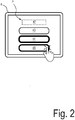
- Fig. 2 is a schematic illustration of a portion of the interface 6 (also shown in Fig. 1 ) for receiving user input to select one of the treatment options.
- the interface 6 includes a graphical user interface 7 which is displayed on a touch-sensitive display screen 8.
- the graphical user interface 7 includes three manually-operable interface elements 43, 44, 45, each of which being configured as a button.
- Each of the interface elements 43, 44, 45 is activatable by the user by pressing a surface area of the touch-sensitive display screen 8, which corresponds to the respective interface element.
- Each of the interface elements 43, 44, 45 corresponds to one of the treatment options.
- the user can activate the respective treatment option so that the treatment of the foodstuff is performed using the setting which corresponds to the selected treatment option. Therefore, the user interface elements 43, 44 and 45 are activatable independently from each other.
- the graphical user interface may be further configured to show a label 47 indicating a class of the foodstuff to be treated. Examples of such classes may be "spinach", “carrots” and "broccoli".
- Fig. 2 shows a state of the graphical user interface in which the user can select a treatment option from a plurality of treatment options for the class of foodstuff which is displayed in the label 47.
- the interface may be configured for allowing the user to select the class from a plurality of predefined classes of foodstuff. Each of the settings of the predefined treatment options, which are stored in the storage system, may be associated with a class of foodstuff which is selectable by the user.
- the graphical user interface 7 is further configured to allow the user to select a treatment option for obtaining a combination of at least two of the predefined properties (i.e. a combination of the predefined properties "retention of vitamin C", “retention of firm texture” and “retention of green color”).
- a treatment option for obtaining a combination of at least two of the predefined properties (i.e. a combination of the predefined properties "retention of vitamin C", “retention of firm texture” and “retention of green color”).
- the controller selects a setting from the settings stored in the data storage system, which is configured so that after the treatment procedure, the green color as well as the firm texture of the foodstuff are retained to a high degree. Therefore, activation of the interface elements 43, 44 and 45 can be combined to define a combination of at least two of the predefined properties.
- a setting is used which is stored in the data storage system and which is determined based on the heat stability of pectin methylesterase, as illustrated by the curve chart shown in Fig. 5 , the effect of heat on ascorbate oxidase, as illustrated by the curve chart shown in Fig. 6A , and the effect of different pH levels on the activity of ascorbate oxidase, as illustrated by the curve chart shown in Fig. 6B .
- the setting for this combination of predefined properties is configured so that the pH level is controlled to be less than 5 or less than 4.5.
- the pH level may be greater than 4.
- the temperature is controlled to be within a range of between 65 °C and 80 °C or within a range of between 70 °C and 80 °C. Therefore, the temperature range represents a balance between the preferred temperature range for retaining vitamin C content (i.e. the temperature should be greater than 60 °C, preferably greater than 65 °C) and the preferred temperature range for retaining the firm texture of the foodstuff (i.e. lower temperatures in a range of less than 80°C are preferred).
- a setting which is stored in the data storage system and which is determined based on the effect of heat on the activity of ascorbate oxidase, as illustrated by the curve chart in Fig. 6A , the effect of different pH levels on the activity of ascorbate oxidase, as illustrated by the curve chart of Fig. 6B , the thermal degradation of chlorophyll, as is illustrated for chlorophyll a by the curve chart in Fig. 4A and the pH-dependent degradation of chlorophyll, as is illustrated for chlorophyll a by the curve chart of Fig. 4B .
- the setting for this combination of predefined properties is configured so that the pH level is controlled to be less than 5 or less than 4.5.
- the pH level may be greater than 4.
- the temperature is controlled to be within a range of between 60 °C and 80 °C or within a range of between 65 °C and 80 °C, or within a range of between 70 °C and 80 °C, or within a range of between 75 °C and 80 °C. Therefore, the temperature range represents a balance between the preferred temperature range for retaining vitamin C content (i.e. the temperature should be greater than 60 °C, preferably greater than 65 °C) and the preferred temperature range for retaining the green color of the foodstuff (i.e. lower temperatures in a range of less than 80°C are preferred).
- a setting which is stored in the data storage system and which is determined based on the heat stability of pectin methylesterase illustrated by the curve chart illustrated in Fig. 5 , the thermal degradation of chlorophyll, as is illustrated for chlorophyll a by the curve chart of Fig. 4A and the pH-dependent degradation of chlorophyll, as illustrated for chlorophyll a by the curve chart of Fig. 4B .
- the setting for this combination of predefined properties is configured so that the pH level is controlled to be greater than 7 or greater than 8.
- the pH level may be less than 9.
- the temperature is controlled to be within a range of between 60 °C and 80 °C, or within a range of between 70 °C and 80 °C. Choosing a lower temperature limit which is greater than 60 °C or greater than 64 °C is more efficient in eliminating pathogenic bacteria contained in the foodstuff and retains more vitamin C (as can be seen from the curve chart of Fig. 6A ).
- the graphical user interface is further configured for allowing the user to select a class from a plurality of classes of foodstuff. Examples of such classes may be "spinach", “carrots” and "broccoli".
- the plurality of classes may be associated with different types of foodstuff, which are to be treated.
- Each of the settings of the predefined treatment options may be associated with a class of foodstuff which is selectable by the user.
- the apparatus 1 may be configured to read the settings from the data storage system depending on the selected class of foodstuff.
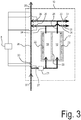
- Fig. 3 is a schematic illustration of the pH adjusting system 10 (also shown in Fig. 1 ) of the exemplary apparatus for treating foodstuff.
- the pH adjusting system 10 includes an electrolysis cell 17 configured to perform an electrolysis of a portion of the liquid which flows through the electrolysis cell 17.
- the electrolysis cell 17 has an anode chamber 18 having an anode 22 and a cathode chamber 19 having a cathode 23.
- the anode chamber 18 and the cathode chamber 19 are separated by an ion-exchange membrane 20 which is permeable to ions.
- the pH adjusting system 10 further includes a salt dosing device 21 for introducing an amount of salt, in particular a neutral salt, such as sodium chloride (NaCl) into the liquid, which is supplied to the anode chamber 18 and to the cathode chamber 19.
- a salt dosing device 21 for introducing an amount of salt, in particular a neutral salt, such as sodium chloride (NaCl) into the liquid, which is supplied to the anode chamber 18 and to the cathode chamber 19.
- the amount of salt is controlled so that in the anode chamber 18 and in the cathode chamber 19, a sodium chloride solution having a concentration of between 1% and 5% or between 1% and 2% is present.
- a DC voltage between the anode 22 and the cathode 23 is within a range of between 5V and 220V, preferably between 20V and 90V. This may result in a current within a range of between 0.1 and 3 A.
- the electrolytic process which takes place in the electrolysis cell 17 produces an anolyte which is discharged from the anode chamber 18 through an anolyte discharging line 24 and a catholyte, which is discharged from the cathode chamber 19 through a catholyte discharging line 25.
- Each of the anolyte discharging line 24 and the catholyte discharging line 25 is connected to a bypass line 26 via valves 35 and 36. Further, each of the anolyte discharging line 24 and the catholyte discharging line 25 are connected to a discharge tank or an outlet (not shown in Fig. 3 ) via valves 33 and 34.
- the bypass line 26 allows a portion of the liquid to bypass the electrolysis cell 17.
- the amount of the liquid which is fed into the anode chamber 18 and the cathode chamber 19 and the amount of liquid which bypasses the anode chamber 18 and the cathode chamber 19 is controlled using a supply valve 27 and a bypass valve 30 which is disposed in the bypass line 26, each of which being in signal communication with the controller 5.
- a greater amount of liquid which is supplied through the bypass line 26 causes the pH level of the liquid which is discharged from the pH adjusting system 10 to be closer to the pH level of the liquid which is contained in the reservoir tank 11 (shown in Fig. 1 ).
- the controller 5 is configured to control the pH level of the liquid which is discharged from the pH adjusting system 10 into the liquid reservoir tank by controlling the valves 27, 30, 33, 34, 35 and 36 depending on the sensor output of the first sensor unit 15 (shown in Fig. 1 ) which senses the pH level of the liquid 4 contained in the reservoir tank 11.
- the generated hydroxide ions (OH-) make the catholyte alkaline.
- the chlorine which is generated in the anode chamber 18 dissociates according to the following reaction: Cl 2 +H 2 O--->HCl+HClO (4)
- the pH adjusting system 10 which has been explained above with reference to Fig. 3 is one of a plurality of possible configurations.
- the pH adjusting system is configured to add a pH adjuster to the liquid.
- a pH adjuster may be defined herein as a chemical ingredient configured to adjust the pH level of the liquid.
- the apparatus 1 of the exemplary embodiment includes an amount determining system which is configured to determine an amount of the liquid 4 to be supplied to the vessel 2 depending on the amount of foodstuff 3 which is to be treated using the liquid.
- the amount determining system is configured to determine the amount of liquid depending on a predefined range of the ratio of the amount of the liquid to the amount of the foodstuff.
- a portion of the amount determining system is implemented within the controller 5.
- the amount determining system is a component of the apparatus 1 which is implemented separately from the controller 5.
- the amount determining system includes a weighing system 37 which is configured to measure a weight of a content of the vessel 2.
- the weighing system 37 has a capacity of up to 3,000 grams.
- the precision of the weighing system 37 is 0.1 gram.
- the interface 6 is configured to receive user input indicative of a class of the foodstuff.
- the amount determining system may be configured to determine the amount of the liquid to be used for the treatment process depending on the selected class of foodstuff.
- the amount determining system may be further configured to determine the amount of the liquid depending on the treatment option which is selected by the user.
- many micronutrients such as vitamin C and folate
- micronutrients leach out to the water through the food itself
- these micronutrients are leached out to the water, they are more easier to be destroyed by heat and oxygen.
- a predefined property which corresponds to or includes "retention of vitamin C"
- it is preferable to use a lesser amount of water if a predefined property is selected which corresponds to or includes "retention of vitamin C", it is preferable to use a lesser amount of water.
- the amount of liquid may further be determined depending on the treatment process which is to be performed.
- the determined amount of liquid for performing a boiling process may be different compared to the determined amount of liquid for performing a blanching process.
- the amount of liquid may be determined so that the ratio of the amount of liquid to the amount of the foodstuff is within a range of between 0.7 and 2.3 or within a range of between 1 and 2. Further, if a blanching process is to be performed, the amount of liquid may be determined so that the ratio of the amount of the liquid to the amount of the foodstuff is within a range of between 0.3 and 1.7 or within a range of between 0.5 and 1.5.
- the amount determining system may be configured to determine the amount of foodstuff 3 using a measurement of a fill level, in particular a vertical fill level within the vessel 2.
- the amount of the foodstuff measured by the amount determining system may represent an amount in volume.
- the vertical fill level may be measured using a laser beam for optical distance measurement wherein the laser beam is directed in a downward direction within the vessel 2 toward a surface 38 formed by the foodstuff 3 contained in the vessel 2.
- the user uses the interface 6 of the apparatus 1 which is in signal communication with the portion of the amount determining system implemented in the controller 5.
- the interface 6 may be configured for receiving input information indicative of the amount of foodstuff 3 which is to be treated.
- the apparatus 1 includes a liquid discharging system 39 for discharging the liquid 4 in which the foodstuff 3 was immersed during the treatment process.
- the liquid discharging system 39 is configured as a liquid drainage system having one or more openings in a bottom surface of the vessel 2 which allows discharging the liquid 4 through a discharging line 40 into a drainage tank 41.
- the discharging process is controlled using a drainage valve 42 which is in signal communication with the controller 5.
- the vessel 2 may be at least partially arranged within the drainage tank 41.
- the liquid drainage system 39 may include a filter 43 that is provided in the discharging line 40 for preventing foodstuff 3 from being discharged through the discharging system 39.
- the liquid discharging system 39 is configured as a liquid suction system, having a suction line extending from above into the vessel 2.
- the liquid suction system may include a suction pump for suctioning the liquid through the suction pipe.
- the above-described exemplary apparatus and exemplary method allow a more efficient food preparation which is flexible and easy to use.
Landscapes
- Engineering & Computer Science (AREA)
- Food Science & Technology (AREA)
- General Preparation And Processing Of Foods (AREA)
Priority Applications (2)
| Application Number | Priority Date | Filing Date | Title |
|---|---|---|---|
| EP18171938.6A EP3566623A1 (de) | 2018-05-11 | 2018-05-11 | Vorrichtung und verfahren zur behandlung von nahrungsmitteln |
| CN201910252851.8A CN110313796A (zh) | 2018-03-30 | 2019-03-29 | 使用多个处理选项处理食物的设备及方法 |
Applications Claiming Priority (1)
| Application Number | Priority Date | Filing Date | Title |
|---|---|---|---|
| EP18171938.6A EP3566623A1 (de) | 2018-05-11 | 2018-05-11 | Vorrichtung und verfahren zur behandlung von nahrungsmitteln |
Publications (1)
| Publication Number | Publication Date |
|---|---|
| EP3566623A1 true EP3566623A1 (de) | 2019-11-13 |
Family
ID=62455320
Family Applications (1)
| Application Number | Title | Priority Date | Filing Date |
|---|---|---|---|
| EP18171938.6A Withdrawn EP3566623A1 (de) | 2018-03-30 | 2018-05-11 | Vorrichtung und verfahren zur behandlung von nahrungsmitteln |
Country Status (1)
| Country | Link |
|---|---|
| EP (1) | EP3566623A1 (de) |
Citations (3)
| Publication number | Priority date | Publication date | Assignee | Title |
|---|---|---|---|---|
| JPH0822216B2 (ja) * | 1989-09-27 | 1996-03-06 | 株式会社是沢鉄工所 | 連続式蒸煮装置 |
| US5891497A (en) * | 1996-10-25 | 1999-04-06 | Fbc Industries, Inc. | In-line/on demand reaction delivery method |
| WO2015101646A1 (en) * | 2013-12-31 | 2015-07-09 | Koninklijke Philips N.V. | An apparatus and method for controlling the taste of coffee, and a coffee maker comprising the apparatus |
-
2018
- 2018-05-11 EP EP18171938.6A patent/EP3566623A1/de not_active Withdrawn
Patent Citations (3)
| Publication number | Priority date | Publication date | Assignee | Title |
|---|---|---|---|---|
| JPH0822216B2 (ja) * | 1989-09-27 | 1996-03-06 | 株式会社是沢鉄工所 | 連続式蒸煮装置 |
| US5891497A (en) * | 1996-10-25 | 1999-04-06 | Fbc Industries, Inc. | In-line/on demand reaction delivery method |
| WO2015101646A1 (en) * | 2013-12-31 | 2015-07-09 | Koninklijke Philips N.V. | An apparatus and method for controlling the taste of coffee, and a coffee maker comprising the apparatus |
Similar Documents
| Publication | Publication Date | Title |
|---|---|---|
| US8425756B2 (en) | Apparatus and method for producing electrolyzed water | |
| US10094812B2 (en) | Cooking control device, cooking control system and computer program product | |
| US20120321760A1 (en) | Electric heating cooker with weighing function and weighing control method thereof | |
| US11547133B2 (en) | Cooking apparatus for reducing a content of phytic acid and phytate contained in foodstuff | |
| KR102646652B1 (ko) | 에스프레소 커피 머신의 물을 모니터링하고 필터링하는 능동 시스템 및 관련된 에스프레소 커피 머신 | |
| US20160150915A1 (en) | Apparatus, system and method of automatic meal preparation | |
| CN104886512B (zh) | 即食脆爽保鲜蔬菜及其制备方法 | |
| JP4904219B2 (ja) | 液体成分測定装置 | |
| CN110313796A (zh) | 使用多个处理选项处理食物的设备及方法 | |
| WILMSHURST | Cardiovascular problems in divers | |
| Singh et al. | Effects of cooking on content of vitamin C in green leafy vegetables | |
| JP2002034791A (ja) | 食品茹で機における塩濃度調節器 | |
| CN113490423A (zh) | 推荐用于制作营养制剂的食材 | |
| JP2020168091A (ja) | 炊飯器 | |
| EP3758566B1 (de) | Küchenmaschine | |
| EP3563694A1 (de) | Kochvorrichtung zur reduzierung des gehalts an phytinsäure und phytat in lebensmitteln | |
| EP3566625A1 (de) | Küchenmaschine | |
| Ko et al. | Effect of vinegar on the perceived saltiness of naengmyeon and onmyeon soup systems | |
| CN115553640B (zh) | 烹饪设备的控制方法、烹饪设备和可读存储介质 | |
| KR20010088573A (ko) | 염도 표시계 | |
| CN113768367B (zh) | 烹饪食材变质检测方法和烹饪器具 | |
| CN103355622A (zh) | 精确泡菜方法 | |
| WO2023157723A1 (ja) | 調理器 | |
| KR20180135564A (ko) | 토마토 및 해조류 유산균 발효 추출물을 포함하는 식초 및 이의 제조방법 | |
| US20120118393A1 (en) | Method for extending the usage life of oil in a deep fat fryer |
Legal Events
| Date | Code | Title | Description |
|---|---|---|---|
| PUAI | Public reference made under article 153(3) epc to a published international application that has entered the european phase |
Free format text: ORIGINAL CODE: 0009012 |
|
| AK | Designated contracting states |
Kind code of ref document: A1 Designated state(s): AL AT BE BG CH CY CZ DE DK EE ES FI FR GB GR HR HU IE IS IT LI LT LU LV MC MK MT NL NO PL PT RO RS SE SI SK SM TR |
|
| AX | Request for extension of the european patent |
Extension state: BA ME |
|
| RAP1 | Party data changed (applicant data changed or rights of an application transferred) |
Owner name: KONINKLIJKE PHILIPS N.V. |
|
| STAA | Information on the status of an ep patent application or granted ep patent |
Free format text: STATUS: THE APPLICATION IS DEEMED TO BE WITHDRAWN |
|
| 18D | Application deemed to be withdrawn |
Effective date: 20200603 |