EP3567896A1 - Procédé de communications, dispositif et système - Google Patents
Procédé de communications, dispositif et système Download PDFInfo
- Publication number
- EP3567896A1 EP3567896A1 EP18836155.4A EP18836155A EP3567896A1 EP 3567896 A1 EP3567896 A1 EP 3567896A1 EP 18836155 A EP18836155 A EP 18836155A EP 3567896 A1 EP3567896 A1 EP 3567896A1
- Authority
- EP
- European Patent Office
- Prior art keywords
- subnet
- information
- identifier
- network
- radio access
- Prior art date
- Legal status (The legal status is an assumption and is not a legal conclusion. Google has not performed a legal analysis and makes no representation as to the accuracy of the status listed.)
- Granted
Links
Images







Classifications
-
- H—ELECTRICITY
- H04—ELECTRIC COMMUNICATION TECHNIQUE
- H04W—WIRELESS COMMUNICATION NETWORKS
- H04W76/00—Connection management
- H04W76/10—Connection setup
- H04W76/12—Setup of transport tunnels
-
- H—ELECTRICITY
- H04—ELECTRIC COMMUNICATION TECHNIQUE
- H04W—WIRELESS COMMUNICATION NETWORKS
- H04W24/00—Supervisory, monitoring or testing arrangements
- H04W24/02—Arrangements for optimising operational condition
-
- H—ELECTRICITY
- H04—ELECTRIC COMMUNICATION TECHNIQUE
- H04L—TRANSMISSION OF DIGITAL INFORMATION, e.g. TELEGRAPHIC COMMUNICATION
- H04L12/00—Data switching networks
- H04L12/28—Data switching networks characterised by path configuration, e.g. LAN [Local Area Networks] or WAN [Wide Area Networks]
- H04L12/46—Interconnection of networks
- H04L12/4641—Virtual LANs, VLANs, e.g. virtual private networks [VPN]
- H04L12/4645—Details on frame tagging
-
- H—ELECTRICITY
- H04—ELECTRIC COMMUNICATION TECHNIQUE
- H04L—TRANSMISSION OF DIGITAL INFORMATION, e.g. TELEGRAPHIC COMMUNICATION
- H04L47/00—Traffic control in data switching networks
- H04L47/10—Flow control; Congestion control
- H04L47/24—Traffic characterised by specific attributes, e.g. priority or QoS
- H04L47/2483—Traffic characterised by specific attributes, e.g. priority or QoS involving identification of individual flows
-
- H—ELECTRICITY
- H04—ELECTRIC COMMUNICATION TECHNIQUE
- H04L—TRANSMISSION OF DIGITAL INFORMATION, e.g. TELEGRAPHIC COMMUNICATION
- H04L41/00—Arrangements for maintenance, administration or management of data switching networks, e.g. of packet switching networks
- H04L41/08—Configuration management of networks or network elements
- H04L41/0895—Configuration of virtualised networks or elements, e.g. virtualised network function or OpenFlow elements
-
- H—ELECTRICITY
- H04—ELECTRIC COMMUNICATION TECHNIQUE
- H04W—WIRELESS COMMUNICATION NETWORKS
- H04W76/00—Connection management
- H04W76/10—Connection setup
- H04W76/11—Allocation or use of connection identifiers
Definitions
- the present invention relates to the field of communications technologies, and in particular, to a communication method, a device, and a system.
- the network slice may be a set that includes a group of network functions, resources, and connection relationships.
- An operator may create, based on a requirement of each specific business case for key performance indicators such as a capacity, coverage, a rate, a latency, and reliability, a set of specific network functions and network resources required for running these network functions, to provide a required telecommunications service and network capability service for a user, suiting a specific market scenario and requirement.
- key performance indicators such as a capacity, coverage, a rate, a latency, and reliability
- a communications network system 100-1 related to slice communication may include the following parts: a slice selection function (slice selection function, SSF) module, a subscriber repository (subscriber repository), a radio access network (radio access network, RAN), a common control plane network function (common control panel network functions, Common CP NFs) module, a user plane network function (user panel network functions) module, and the like.
- the modules exchange information with each other through interfaces between the modules.
- the slice selection function module exchanges information with the radio access network through an interface between the slice selection function module and the radio access network
- the subscriber repository may exchange information with the slice selection function module and the common control plane network function module through an interface between the subscriber repository and the slice selection function module and an interface between the subscriber repository and the common control plane network function module respectively
- the radio access network exchanges information with the common control plane network function module through an interface between the radio access network and the common control plane network function module.
- Various function modules are connected by using dashed lines in FIG. 1-1 , to indicate that there may be a communications interface for information exchange between modules having a connection relationship. Details are not described herein. As shown in the example in FIG.
- Network function modules required for running each network slice include a radio access network, a common control plane network function module, and a control plane network function and a user plane network function that correspond to the slice. Both the radio access network and the common control plane network function module may be shared by a plurality of network slices.
- a network architecture shown in the system 100-1 is only an example, and setting of the function modules in the network architecture is not limited to a relationship in the figure.
- the SSF module may also be deployed in the common CP NFs module.
- Each module may further include a function submodule.
- the common CP NF module may further include at least one of a mobility management function module, an authentication module, a security module, and the like; a CP NF exclusive to a slice may further include a session management module and the like; a UP NF exclusive to a slice may include a user plane function such as a conventional gateway function.
- a function module may be named differently. Details are not described herein.
- a network slice is an end-to-end service chain, and covered domains (Domain) may include an access network (Radio Access Network, RAN), a core network (Core Network, CN), a transport network (Transport Network, TN), and the like.
- RAN Radio Access Network
- Core Network Core Network
- TN Transport Network
- a dedicated network slice management system manages creation, configuration, association, maintenance, collaboration between the parts, and the like.
- a network slice management system 100 may include a manager of an end-to-end network slice, which is, for example, referred to as a network manager, and subdomain managers of parts in the end-to-end network slice, for example, a RAN manager, a CN manager, and a TN manager.
- Each subdomain manager is responsible for overall management in a subdomain of the subdomain manager, and performs corresponding configuration for a node in the subdomain.
- An interface may be disposed between subdomain managers for message exchange and coordination between subdomains.
- a problem existing in designing and implementing an efficient end-to-end communications network is how to manage resources in subnets of domains in collaboration in an end-to-end subnet to achieve consistent end-to-end network service experience.
- the subnet in this application may include a slice and/or a slice instance.
- the slice is a logical network that has a predefined network capability and a predefined network feature and that is provided for a specific service or tenant.
- the slice may include an end-to-end slice and a subdomain slice.
- the subdomain slice may be a part of the end-to-end slice.
- the slice instance is a network function entity that includes a group of network function instances and network resources, and may include an end-to-end slice instance and a subdomain slice instance.
- the subdomain slice instance may be a part of the end-to-end slice instance.
- each subdomain subnet associated with the end-to-end subnet is created, so that when user equipment (user equipment, UE) is associated with an end-to-end network subnet, subdomains can serve the UE by using subnets that are consistent with the end-to-end subnet.
- Subdomains can provide differentiated services for different subnets, and can provide different quality of service for different services of a same subnet, and such differentiated processing is consistent between the subdomains in the end-to-end subnet.
- the embodiments of this application provide a method for mapping subnets (slices) between a RAN subdomain, a CN subdomain, and a TN subdomain belonging to the end-to-end subnet, for example, a method for a mapping between a RAN subnet and a TN subnet and an intra-subnet QoS mapping method.
- This application provides a communication method, a device, a system, and the like, to implement a mapping and collaboration between subnets (slices) of a RAN subdomain, a CN subdomain, and a TN subdomain in a same end-to-end subnet, so that resources in different subdomains can be managed in collaboration in the end-to-end subnet, system efficiency of communication of the end-to-end subnet can be increased, and end-to-end service experience consistency can be improved.
- this application provides a communication method.
- the method includes: receiving, by a radio access network device, an uplink data packet from a terminal device; learning of, by the radio access network device, identity information of the uplink data packet; and adding, by the radio access network device, the uplink data packet to a transport network subnet based on a correspondence between the identity information of the uplink data packet and the transport network subnet.
- the radio access network device can reliably and efficiently add uplink data to a corresponding transport network subnet for transmission.
- the identity information of the uplink data packet includes at least one of the following: information about an identifier of a packet data connection associated with the uplink data packet, information about an identifier of a GPRS tunneling protocol-user plane part associated with the uplink data packet, information about an identifier of a data flow associated with the uplink data packet, and information about an identifier of a data radio bearer (data radio bearer, DRB) associated with the uplink data packet.
- the identity information of the uplink data packet may be obtained based on any one piece of the information or a combination of any two or more pieces of the information.
- the packet data connection described herein may be a session (Session).
- the data flow described herein may be a group of data packets with same or similar quality of service requirements, for example, a QoS flow discussed in a standard setting process.
- the identity information of the uplink data packet is obtained by using (at least one, which is not specifically limited, of) the packet data connection, the GPRS tunneling protocol-user plane part, the data flow, and the data radio bearer that have an association relationship with the uplink data packet.
- the radio access network device may obtain the correspondence between the radio access network subnet (or slice) and the transport network subnet (or slice) in advance.
- the uplink data packet is added, by using the correspondence between the radio access network subnet (or slice) and the transport network subnet (or slice), to the corresponding transport network subnet for transmission.
- the identifier of the radio access network subnet (or slice) may be an identifier of the identity information of the uplink data packet.
- a process in which the radio access network device obtains the correspondence between the radio access network subnet (or slice) and the transport network subnet (or slice) may include the following: Information about the correspondence between the radio access network subnet (or slice) and the transport network subnet (or slice) may be configured by using a system management plane.
- An information exchange interface may be disposed between any two of a network manager, a transport network manager, a radio access network manager, and a core network manager in the system management plane, and the information about the correspondence between the radio access network subnet (or slice) and the transport network subnet (or slice) may be transmitted between the network manager, the transport network manager, the radio access network manager, and the core network manager through information exchange interfaces, so that the network manager, the transport network manager, the radio access network manager, and the core network manager can learn of the correspondence.
- the information about the correspondence is configured on the system management plane before the radio access network device adds the uplink data packet to the transport network subnet (slice) for transmission, so that the radio access network device obtains the information about the correspondence.
- the information about the correspondence between the radio access network subnet (or slice) and the transport network subnet (or slice) may be sent by the transport network manager to the radio access network manager through an information exchange interface between the transport network manager and the radio access network manager, and then the information about the correspondence may be sent by the radio access network manager to the radio access network device through an interface between the radio access network manager and the radio access network device.
- the information about the correspondence may be sent by the transport network manager to the network manager through an interface between the transport network manager and the network manager, the information about the correspondence may be sent by the network manager to the radio access network manager through an interface between the network manager and the radio access network manager, and the information about the correspondence may be sent by the radio access network manager to the radio access network device through an interface between the radio access network manager and the radio access network device.
- the transport network manager obtains the correspondence between the radio access network subnet (or slice) and the transport network subnet (or slice) based on the end-to-end subnet (or slice) created by the network manager.
- the network slice selection assistance information may be carried in a non-access stratum (non-access stratum, NAS) message, and is sent by the terminal device to a related device in a core network; and/or the network slice selection assistance information may be carried in an RRC (Radio Resource Connection) message, and is sent by the terminal device to the radio access network device.
- NAS non-access stratum
- RRC Radio Resource Connection
- the radio access network device may learn of, based on an obtained core network subnet (or slice), a subnet (or slice) corresponding to a radio access network device side belonging to a same end-to-end subnet (or slice).
- that the uplink data packet is added to the transport network subnet includes: the uplink data packet includes information about an identifier of the transport network subnet (or slice). For example, on a radio access network device side, the uplink data packet is processed, and the information about the identifier of the transport network subnet is added to the uplink data packet.
- the transport network subnet (or slice) is a virtual local area network
- the information about the identifier of the transport network subnet (or slice) includes an identifier of the virtual local area network (virtual local area network ID, VLAN ID).
- the information about the identifier of the transport network subnet includes at least one of the following: a port number of an IP network and an Internet protocol address.
- the transport network subnet (or slice) may be identified by using the information about the identifier of the transport network subnet (or slice), for example, the VLAN ID, the port number of the IP network, and the Internet protocol address, so that the uplink data packet can be added to the corresponding transport network subnet.
- this application provides a radio access network device.
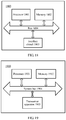
- the radio access network device includes at least one processor, a memory, a first transceiver apparatus, a second transceiver apparatus, and a system bus.
- the at least one processor, the memory, the first transceiver apparatus, and the second transceiver apparatus are coupled by using the system bus.
- the radio access network device communicates with a network side device by using the first transceiver apparatus, and the radio access network device communicates with a terminal device by using the second transceiver apparatus.
- the memory stores a program instruction, and the at least one processor invokes the program instruction stored in the memory to perform the operations of the radio access network device in any one of the first aspect or the possible implementations of the first aspect.
- the first transceiver apparatus described herein may be specifically implemented as a wired communications interface, or may be specifically implemented as a communications interface based on a wireless air interface technology.
- the second transceiver apparatus described herein may be specifically implemented as a communications interface based on the wireless air interface technology.
- both the first transceiver apparatus and the second transceiver apparatus are communications interfaces based on the wireless air interface technology, the first transceiver apparatus and the second transceiver apparatus may be implemented by using one wireless transceiver apparatus, or may be implemented by using two parallel wireless transceiver apparatuses.
- this application provides a system chip.
- the system chip may be applied to a radio access network device. Through processing performed by the system chip, the radio access network device can perform the operations of the radio access network device in any one of the first aspect or the possible implementations of the first aspect.
- the system chip includes at least one processor, a memory, an interface circuit, and a bus. The at least one processor, the memory, and the interface circuit are coupled by using the bus.
- the system chip interacts with the radio access network device/another device in a network by using the interface circuit.
- the memory stores a program instruction, and the at least one processor invokes the program instruction stored in the memory to perform the operations of the radio access network device in any one of the first aspect or the feasible methods of the first aspect.
- this application provides a communication method.
- the method includes: obtaining, by a core network device, identity information of a downlink data packet; and adding, by the core network device based on a correspondence between the identity information of the downlink data packet and a transport network subnet, the downlink data packet to the transport network subnet for transmission.
- the core network device can reliably and efficiently add downlink data to a corresponding transport network subnet for transmission.
- the identity information of the downlink data packet includes at least one of the following: information about an identifier of a packet data connection associated with the downlink data packet, information about an identifier of a GPRS tunneling protocol-user plane part associated with the downlink data packet, information about an identifier of a data flow associated with the downlink data packet, and information about an identifier of a data radio bearer (data radio bearer, DRB) associated with the downlink data packet.
- the identity information of the downlink data packet may be obtained based on any one piece of the information or a combination of any two or more pieces of the information.
- the packet data connection described herein may be a session (session).
- the data flow described herein may be a group of data packets with same or similar quality of service requirements, for example, a QoS flow discussed in a standard setting process.
- the identity information of the downlink data packet is obtained by using (at least one, which is not specifically limited, of) the packet data connection, the GPRS tunneling protocol-user plane part, the data flow, and the data radio bearer that have an association relationship with the downlink data packet.
- the core network device may obtain the correspondence between the core network subnet (or slice) and the transport network subnet (or slice) in advance.
- the identifier of the core network subnet (or slice) may be an identifier of the identity information of the downlink data packet.
- a process in which the core network device obtains the correspondence between the core network subnet (or slice) and the transport network subnet (or slice) may include the following: Information about the correspondence between the core network subnet (or slice) and the transport network subnet (or slice) may be configured by using a system management plane.
- An information exchange interface may be disposed between any two of a network manager, a transport network manager, a radio access network manager, and a core network manager in the system management plane, and the information about the correspondence between the core network subnet (or slice) and the transport network subnet (or slice) may be transmitted between the network manager, the transport network manager, the radio access network manager, and the core network manager through information exchange interfaces, so that the network manager, the transport network manager, the radio access network manager, and the core network manager can learn of the correspondence.
- the information about the correspondence is configured on the system management plane before the core network device adds the downlink data packet to the transport network subnet (slice) for transmission, so that the core network device obtains the information about the correspondence.
- the information about the correspondence between the core network subnet (or slice) and the transport network subnet (or slice) may be sent by the transport network manager to the core network manager through an information exchange interface between the transport network manager and the core network manager, and then the information about the correspondence may be sent by the core network manager to the core network device through an interface between the core network manager and the core network device.
- the information about the correspondence may be sent by the transport network manager to the network manager through an interface between the transport network manager and the network manager
- the information about the correspondence may be sent by the network manager to the core network manager through an interface between the network manager and the core network manager
- the information about the correspondence may be sent by the core network manager to the core network device through an interface between the core network manager and the core network device.
- the transport network manager obtains the correspondence between the core network subnet (or slice) and the transport network subnet (or slice) based on the end-to-end subnet (or slice) created by the network manager.
- the end-to-end subnet or slice
- NSSAI network slice selection assistance information
- an identifier of the end-to-end subnet is network slice selection assistance information.
- the network slice selection assistance information may be carried in a non-access stratum (non-access stratum, NAS) message, and is sent by a terminal device to a related device in a core network; and/or the network slice selection assistance information may be carried in an RRC (Radio Resource Connection) message, and is sent by the terminal device to a radio access network device.
- NAS non-access stratum
- RRC Radio Resource Connection
- that the downlink data packet is added to the transport network subnet includes: the downlink data packet includes information about an identifier of the transport network subnet (or slice). For example, on a core network side, the downlink data packet is processed, and the information about the identifier of the transport network subnet is added to the downlink data packet.
- the transport network subnet (or slice) is a virtual local area network
- the information about the identifier of the transport network subnet (or slice) includes an identifier of the virtual local area network (virtual local area network ID, VLAN ID).
- the information about the identifier of the transport network subnet may further include at least one of the following: a port number of an IP network and an Internet protocol address.
- the transport network subnet (or slice) may be identified by using the information about the identifier of the transport network subnet (or slice), for example, the VLAN ID, the port number of the IP network, and the Internet protocol address, so that the downlink data packet can be added to the corresponding transport network subnet.
- this application provides a core network device.
- the core network device includes at least one processor, a memory, a transceiver apparatus, and a system bus.
- the at least one processor, the memory, and the transceiver apparatus are coupled by using the system bus.
- the core network device communicates with a network side device by using the transceiver apparatus.
- the memory stores a program instruction, and the at least one processor invokes the program instruction stored in the memory to perform the operations of the core network device in any one of the fourth aspect or the possible implementations of the fourth aspect.
- this application provides a system chip.
- the system chip may be applied to a core network device. Through processing performed by the system chip, the core network device can perform the operations of the core network device in any one of the fourth aspect or the possible implementations of the fourth aspect.
- the system chip includes at least one processor, a memory, an interface circuit, and a bus. The at least one processor, the memory, and the interface circuit are coupled by using the bus.
- the system chip interacts with the core network device/another device in a network by using the interface circuit.
- the memory stores a program instruction, and the at least one processor invokes the program instruction stored in the memory to perform the operations of the core network device in any one of the fourth aspect or the possible implementations of the fourth aspect.
- this application provides a communications system.
- the system includes the radio access network device according to the second aspect and/or the core network device according to the fifth aspect.
- this application provides a computer storage medium.
- the computer-readable storage medium stores a program instruction, and when the program instruction runs on a computer, the operations of the radio access network device in any one of the first aspect or the possible implementations of the first aspect are performed, or when the program instruction runs on a computer, the operations of the core network device in any one of the fourth aspect or the possible implementations of the fourth aspect are performed.
- this application provides a computer program product.
- the computer program product includes a program instruction, and when the program instruction is invoked, the operations of the radio access network device in any one of the first aspect or the possible implementations of the first aspect are performed, or when the program instruction is invoked, the operations of the core network device in any one of the fourth aspect or the possible implementations of the fourth aspect are performed.
- a mapping and collaboration can be implemented between subnets (or slices) of a RAN subdomain, a CN subdomain, and a TN subdomain that belong to a same end-to-end subnet, so that data can be reliably and efficiently processed in the subdomains in the end-to-end subnet, thereby increasing system efficiency of communication of the end-to-end subnet and improving end-to-end service experience consistency.
- the method may relate to a radio access network device, a core network device, a transport network device, a terminal device, a wireless communications system configured to run the method, and a management plane system of the wireless communications system.
- the management plane system may include a network manager, a RAN subdomain manager, a CN subdomain manager, a TN subdomain manager, and the like.
- the radio access network device in this application may also be referred to as a base station in a wireless communication standard, and in most scenarios, is an apparatus deployed in a radio access network to provide a wireless communication function for the terminal device.
- the radio access network device in this application includes but is not limited to various forms of macro base stations, micro base stations (also referred to as small cells), relay stations, transmission reception points (Transmission Reception Point, TRP), evolved NodeBs (evolved NodeB, eNB), radio network controllers (radio network controller, RNC), NodeBs (NodeB, NB), base station controllers (Base Station Controller, BSC), base transceiver stations (Base Transceiver Station, BTS), home eNodeBs or home NodeBs (for example, Home evolved NodeBs or Home NodeBs, HNB), and baseband units (Base Band Unit, BBU) for processing communication data, and the like.
- macro base stations also referred to as small cells
- relay stations transmission reception points (Trans
- the radio access network device may further include a radio access network device in a non-3rd generation partnership project (Third Generation Partnership Project, 3GPP) system, for example, a wireless local area network (wireless local area network, WLAN) access device.
- a radio access network device in a non-3rd generation partnership project (Third Generation Partnership Project, 3GPP) system, for example, a wireless local area network (wireless local area network, WLAN) access device.
- 3GPP Third Generation Partnership Project
- WLAN wireless local area network
- names of radio access network devices with similar wireless communication functions may be different.
- a RAN subdomain in the embodiments of this application may include at least one radio access network device described herein, or may correspond to at least one radio access network device described herein.
- the core network device in this application is usually an entity with a core network processing function, for example, may be any one of the following devices: a device with an access and/or mobility management network function, a device with a control plane function of session management, a device with a user plane function that is responsible for data transmission, a device with an authentication management network function, and a device that performs another type of function required by a core network.
- the core network device described herein is a device with at least any one or any combination of the core network functions mentioned above.
- the foregoing entities with a core network function are collectively referred to as a core network device.
- a CN subdomain in the embodiments of this application may include at least one core network device described herein, or may correspond to at least one core network device described herein.
- a transport network in this application is usually a network that is used to provide a data transmission and conversion function.
- a transport type may be any one of an optical transport network, an IP transport network, or a flexible ethernet (flexible ethernet) transport network, or another type of transport network. This is not limited herein.
- the transport network device may usually include at least one of the following: a routing and forwarding node, a switch, a hub, a repeater, a bridge, and the like, or a device with at least one or any combination of the foregoing functions.
- the foregoing entities with a data transmission and conversion function are collectively referred to as a transport network device.
- a TN subdomain in the embodiments of this application may include at least one transport network device described herein, or may correspond to at least one transport network device described herein.
- the terminal device in this application is a device with a wireless transceiver function, and the terminal device may be deployed on land, for example, an indoor device, an outdoor device, a handheld device, or an in-vehicle device, or may be deployed on the water (for example, on a ship), or may be deployed in the air (for example, on a plane, a balloon, or a satellite).
- the terminal device may include various types of mobile phones (mobile phone), tablet computers (Pad), computers with a wireless transceiver function, wireless data cards, virtual reality (Virtual Reality, VR) terminal devices, augmented reality (augmented reality, AR) terminal devices, machine type communication (machine type communication, MTC) terminal devices, terminal devices in industrial control (industrial control), self-driving (self driving) terminal devices, remote medical (remote medical) terminal devices, terminal devices in a smart grid (smart grid), terminal devices in transportation safety (transportation safety), terminal devices in a smart city (smart city), smart households (household devices with a wireless communication function, for example, refrigerators, television sets, washers, or furniture), wearable devices (for example, smartwatches, smart bands, and pedometers), and the like.
- VR Virtual Reality
- AR augmented reality
- MTC machine type communication
- MTC machine type communication
- MTC machine type communication
- terminal devices in a smart grid smart grid
- terminal devices in transportation safety transportation safety
- the terminal device in this application may be a device that is disposed in a fixed position and that has a wireless communication function similar to that of the foregoing terminal device.
- names of terminal devices with similar wireless communication functions may be different.
- the foregoing apparatuses with a wireless transceiver communication function are collectively referred to as a terminal device.
- uplink and downlink in this application are used to describe data/information transmission directions in some scenarios.
- an “uplink” direction is a direction in which data/information is transmitted from the terminal device to the core network device
- a “downlink” direction is a direction in which data/information is transmitted from the core network device to the terminal device.
- Uplink and downlink are used to describe only directions. Neither a specific device from which data/information transmission starts nor a specific device at which data/information transmission stops is limited.
- a and/or B may represent the following three cases: Only A exists, both A and B exist, and only B exists.
- the character "/" in this application generally indicates an "or" relationship between the associated objects.
- the character "-" in this application is usually used to indicate that there is an association/mapping relationship between objects before and after the character.
- "A-B" indicates that there is an association/mapping relationship between A and B.
- an end-to-end subnet is created in a system, and a subdomain subnet is created by each of a RAN subdomain, a CN subdomain, and a TN subdomain that correspond to the end-to-end subnet, to implement the end-to-end subnet.
- a correspondence/mapping relationship based on the end-to-end subnet exists between a RAN, a CN, and a TN, and is denoted as RAN-CN-TN.
- names may be assigned to various types of objects such as messages/information/ devices/network elements/systems/apparatuses/actions/operations/procedures/concepts.
- these specific names do not constitute a limitation on the related objects.
- the assigned names may vary with a factor such as a scenario, a context, or a usage habit.
- An understanding of a technical meaning of a related object should be mainly determined from a function and a technical effect that are embodied/performed in a technical solution.
- the network architecture and the service scenario described in the embodiments of the present invention are intended to describe the technical solutions in the embodiments of the present invention more clearly, and do not constitute a limitation on the technical solutions provided in the embodiments of the present invention.
- a person of ordinary skill in the art can learn that with evolution of the network architecture and emergence of a new service scenario, the technical solutions provided in the embodiments of the present invention are also applicable to similar technical problems.
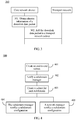
- an embodiment of this application provides a communication method 200.
- An implementation process based on an idea of the method 200 includes the following operations:
- the method 200 is described from a perspective of a radio access network side. It may be understood that the method 200 may be applied to a communications system including a terminal device, a radio access network device, and a transport network. According to the method 200, the radio access network device can reliably and efficiently add uplink data to a corresponding transport network subnet (slice) for transmission.
- a transport network subnet slice
- the identity information of the uplink data packet may include at least one of the following: information about an identifier of a packet data connection associated with the uplink data packet, information about an identifier of a GPRS tunneling protocol-user plane part associated with the uplink data packet, information about an identifier of a data flow associated with the uplink data packet, and information about an identifier of a data radio bearer (data radio bearer, DRB) associated with the uplink data packet.
- the identity information of the uplink data packet may be obtained based on any one piece of the information or a combination of any two or more pieces of the information.
- the packet data connection described herein may be a session (session).
- the data flow described herein may be a group of data packets with same or similar quality of service requirements, for example, a QoS flow discussed in a standard setting process.
- the identity information of the uplink data packet is obtained by using (at least one, which is not specifically limited, of) the packet data connection, the GPRS tunneling protocol-user plane part, the data flow, and the data radio bearer that have an association relationship with the uplink data packet.
- the identity information of the uplink data packet may be at least one of the following: the identifier of the packet data connection associated with the uplink data packet, the identifier of the GPRS tunneling protocol-user plane part associated with the uplink data packet, the identifier of the data flow associated with the uplink data packet, and the identifier of the data radio bearer (data radio bearer, DRB) associated with the uplink data packet.
- the radio access network device may obtain the correspondence between the radio access network subnet (or slice) and the transport network subnet (or slice) in advance.
- the uplink data packet is added, by using the correspondence between the radio access network subnet (or slice) and the transport network subnet (or slice), to the corresponding transport network subnet for transmission.
- the identifier of the radio access network subnet (or slice) may be an identifier of the identity information of the uplink data packet.
- a process in which the radio access network device obtains the correspondence between the radio access network subnet (or slice) and the transport network subnet (or slice) may include the following: Information about the correspondence between the radio access network subnet (or slice) and the transport network subnet (or slice) may be configured by using a system management plane.
- An information exchange interface may be disposed between any two of a network manager, a transport network manager, a radio access network manager, and a core network manager in the system management plane, and the information about the correspondence between the radio access network subnet (or slice) and the transport network subnet (or slice) may be transferred between the network manager, the transport network manager, the radio access network manager, and the core network manager through information exchange interfaces, so that the network manager, the transport network manager, the radio access network manager, and the core network manager can learn of the correspondence.
- the information about the correspondence is configured on the system management plane before the radio access network device adds the uplink data packet to the transport network subnet (slice) for transmission, so that the radio access network device obtains the information about the correspondence.
- the information about the correspondence between the radio access network subnet (or slice) and the transport network subnet (or slice) may be sent by the transport network manager to the radio access network manager through an information exchange interface between the transport network manager and the radio access network manager, and then the information about the correspondence may be sent by the radio access network manager to the radio access network device through an interface between the radio access network manager and the radio access network device.
- the information about the correspondence may be sent by the transport network manager to the network manager through an interface between the transport network manager and the network manager, the information about the correspondence may be sent by the network manager to the radio access network manager through an interface between the network manager and the radio access network manager, and the information about the correspondence may be sent by the radio access network manager to the radio access network device through an interface between the radio access network manager and the radio access network device.
- the transport network manager obtains the correspondence between the radio access network subnet (or slice) and the transport network subnet (or slice) based on the end-to-end subnet (or slice) created by the network manager.
- the network slice selection assistance information may be carried in a non-access stratum (non-access stratum, NAS) message, and is sent by the terminal device to a related device in a core network; and/or the network slice selection assistance information may be carried in an RRC (Radio Resource Connection) message, and is sent by the terminal device to the radio access network device.
- NAS non-access stratum
- RRC Radio Resource Connection
- the radio access network device may learn of, based on an obtained core network subnet (or slice), a subnet (or slice) corresponding to a radio access network device side belonging to a same end-to-end subnet (or slice).
- the uplink data packet is added to the transport network subnet includes: the uplink data packet includes information about an identifier of the transport network subnet (or slice). For example, on a radio access network device side, the uplink data packet is processed, and the information about the identifier of the transport network subnet is added to the uplink data packet.
- the transport network subnet (or slice) is a virtual local area network
- the information about the identifier of the transport network subnet (or slice) includes an identifier of the virtual local area network (virtual local area network ID, VLAN ID).
- the information about the identifier of the transport network subnet includes at least one of the following: a port number of an IP network and an Internet protocol address.
- the transport network subnet (or slice) may be identified by using the information about the identifier of the transport network subnet (or slice), for example, the VLAN ID, the port number of the IP network, and the Internet protocol address, so that the uplink data packet can be added to the corresponding transport network subnet.
- the involved devices, and the involved system a mapping and collaboration can be implemented between subnets (or slices) of a RAN subdomain, a CN subdomain, and a TN subdomain that belong to a same end-to-end subnet, so that data can be reliably and efficiently processed in the subdomains in the end-to-end subnet, thereby increasing system efficiency of communication of the end-to-end subnet and improving end-to-end service experience consistency.
- this application provides a communication method 300.
- An implementation process based on an idea of the method 300 includes the following operations:
- the method 300 is described from a perspective of a core network side. It may be understood that the method 300 may be applied to a communications system including a core network device and a transport network. According to the method, the core network device can reliably and efficiently add downlink data to a corresponding transport network subnet (or slice) for transmission.
- the identity information of the downlink data packet includes at least one of the following: information about an identifier of a packet data connection associated with the downlink data packet, information about an identifier of a GPRS tunneling protocol-user plane part associated with the downlink data packet, information about an identifier of a data flow associated with the downlink data packet, and information about an identifier of a data radio bearer (data radio bearer, DRB) associated with the downlink data packet.
- the identity information of the downlink data packet may be obtained based on any one piece of the information or a combination of any two or more pieces of the information.
- the packet data connection described herein may be a session (session).
- the data flow described herein may be a group of data packets with same or similar quality of service requirements, for example, a QoS flow discussed in a standard setting process.
- the identity information of the downlink data packet is obtained by using (at least one, which is not specifically limited, of) the packet data connection, the GPRS tunneling protocol-user plane part, the data flow, and the data radio bearer that have an association relationship with the downlink data packet.
- the identity information of the downlink data packet may be at least one of the following: the identifier of the packet data connection associated with the downlink data packet, the identifier of the GPRS tunneling protocol-user plane part associated with the downlink data packet, the identifier of the data flow associated with the downlink data packet, and the identifier of the data radio bearer (data radio bearer, DRB) associated with the downlink data packet.
- the core network device may obtain the correspondence between the core network subnet (or slice) and the transport network subnet (or slice) in advance.
- the identifier of the core network subnet (or slice) may be an identifier of the identity information of the downlink data packet.
- a process in which the core network device obtains the correspondence between the core network subnet (or slice) and the transport network subnet (or slice) may include the following: Information about the correspondence between the core network subnet (or slice) and the transport network subnet (or slice) may be configured by using a system management plane.
- An information exchange interface may be disposed between any two of a network manager, a transport network manager, a radio access network manager, and a core network manager in the system management plane, and the information about the correspondence between the core network subnet (or slice) and the transport network subnet (or slice) may be transmitted between the network manager, the transport network manager, the radio access network manager, and the core network manager through information exchange interfaces, so that the network manager, the transport network manager, the radio access network manager, and the core network manager can learn of the correspondence.
- the information about the correspondence is configured on the system management plane before the core network device adds the downlink data packet to the transport network subnet (slice) for transmission, so that the core network device obtains the information about the correspondence.
- the information about the correspondence between the core network subnet (or slice) and the transport network subnet (or slice) may be sent by the transport network manager to the core network manager through an information exchange interface between the transport network manager and the core network manager, and then the information about the correspondence may be sent by the core network manager to the core network device through an interface between the core network manager and the core network device.
- the information about the correspondence may be sent by the transport network manager to the network manager through an interface between the transport network manager and the network manager
- the information about the correspondence may be sent by the network manager to the core network manager through an interface between the network manager and the core network manager
- the information about the correspondence may be sent by the core network manager to the core network device through an interface between the core network manager and the core network device.
- the transport network manager obtains the correspondence between the core network subnet (or slice) and the transport network subnet (or slice) based on the end-to-end subnet (or slice) created by the network manager.
- the network slice selection assistance information may be carried in a non-access stratum (non-access stratum, NAS) message, and is sent by a terminal device to a related device in a core network; and/or the network slice selection assistance information may be carried in an RRC (Radio Resource Connection) message, and is sent by the terminal device to a radio access network device.
- NAS non-access stratum
- RRC Radio Resource Connection
- the downlink data packet is added to the transport network subnet includes: the downlink data packet includes information about an identifier of the transport network subnet (or slice). For example, on the core network side, the downlink data packet is processed, and the information about the identifier of the transport network subnet is added to the downlink data packet.
- the transport network subnet (or slice) is a virtual local area network
- the information about the identifier of the transport network subnet (or slice) includes an identifier of the virtual local area network (virtual local area network ID, VLAN ID).
- the information about the identifier of the transport network subnet may further include at least one of the following: a port number of an IP network and an Internet protocol address.
- the transport network subnet (or slice) may be identified by using the information about the identifier of the transport network subnet (or slice), for example, the VLAN ID, the port number of the IP network, and the Internet protocol address, so that the downlink data packet can be added to the corresponding transport network subnet.
- the involved devices, and the involved system a mapping and collaboration can be implemented between subnets (or slices) of a CN subdomain and a TN subdomain that belong to a same end-to-end subnet, so that data can be reliably and efficiently processed in the subdomains in the end-to-end subnet, thereby increasing system efficiency of communication of the end-to-end subnet and improving end-to-end service experience consistency.
- the communication method 200 is mainly described from a perspective of an uplink transmission direction of data and processing on the radio access network device side, and the communication method 300 is described from a perspective of a downlink transmission direction of data and processing on a core network device side.
- the communication method 200 and the communication method 300 may be used in combination to complete processing of uplink/downlink data.
- a hierarchical domain-based management system in a next generation 5G network is used as an example.
- this application further provides a communication method 400.
- An implementation process based on an idea of the method 400 includes the following operations. Operation 401: Create an end-to-end subnet.
- a network manager for end-to-end slice management may be disposed, and the network manager creates the end-to-end subnet based on an input parameter such as a quality of service requirement of a customer.
- Operation 402 Notify a subdomain manager.
- the network manager configures a corresponding performance counter requirement and/or parameter of each subdomain subnet for the subnet created in operation 401, and sends the subdomain performance counter requirement and/or a required configuration parameter of each subdomain subnet to an involved subdomain manager.
- the network manager may further send information about an identifier of the end-to-end subnet to each subdomain.
- the information about the identifier of the end-to-end subnet may be sent when the performance counter requirement and/or the required configuration parameter are delivered, or may be separately sent to each subdomain.
- the information about the identifier of the subnet may include any one or any combination of the following parameters: network slice selection assistance information (network slice selection assistance information, NSSAI), a slice type identifier (slice type ID), service management NSSAI (session management NSSAI, SM-NSSAI), single NSSAI (single NSSAI), a service type identifier (service type ID), a service type identifier of a subdomain, a tenant identifier (tenant ID), a user group identifier (user group ID), an index value (slice index) used to represent a slice type or a slice identifier, the identifier of the end-to-end subnet (subnet work ID), and information about an identifier of a subdomain subnet (for example, an identifier of a RAN subnet, an identifier of a CN subnet, or an identifier of a TN subnet).
- the identifier of the subnet may be a slice identifier or a slice instance
- Operation 403 Create a subnet for each subdomain.
- Each subdomain manager receives various types of information sent by the network manager shown in operation 402.
- the information may be received from one piece of same information sent by the network manager, or may be received from a plurality of different information sent by the network manager.
- each subdomain manager obtains at least a requirement corresponding to a performance counter of a subdomain of the subdomain manager, creates a subnet that is of the subdomain of the subdomain manager and that corresponds to the end-to-end subnet, and feeds back a result of creating the subnet of the subdomain of the subdomain manager.
- the result that is fed back includes but is not limited to "creation succeeds" or "creation fails".
- Operation 404 (The operation is optional.) The subdomain manager notifies a subdomain configuration.
- Each subdomain manager notifies the network manager and/or another subdomain manager of a specific configuration of the subnet of the subdomain of the subdomain manager and/or information about an identifier of an end-to-end subnet (slice) corresponding to the subnet created for the subdomain, so that subdomains collaborate with each other in the end-to-end subnet and subdomain subnets are associated with each other.
- a TN manager notifies at least one of the network manager, a RAN manager, and a CN manager of a TN subnet (and optionally, information about an identifier of the TN subnet) created for an end-to-end subnet.
- the information about the identifier of the TN subnet may be information about an identifier of a TN subnet on a RAN internal interface (for example, an X2 interface or an Xn interface between base stations), or may be information about an identifier of a TN subnet on a CN internal interface (for example, an interface between an AMF and an SMF), or may be information about an identifier of a TN subnet on a RAN-CN interface (for example, an SI interface in 4G or an NG interface in 5G).
- a RAN internal interface for example, an X2 interface or an Xn interface between base stations
- CN internal interface for example, an interface between an AMF and an SMF
- an identifier of a TN subnet on a RAN-CN interface for example, an SI interface in 4G or an NG interface in 5G.
- Operation 405 (The operation is optional.) The network manager notifies a subdomain configuration.
- the network manager sends the subdomain configuration performed in a subdomain for an end-to-end subnet to another subdomain manager, so that the subdomain collaborates with another subdomain.
- the TN manager notifies the network manager of a TN subnet created for an end-to-end subnet and information about an identifier of the TN subnet, and then the network manager separately sends the identifier of the transport subnet to the RAN manager and/or the CN manager through an interface between the network manager and the RAN manager or an interface between the network manager and the CN manager.
- the network manager sends a parameter required for creating a subnet (or a subdomain slice) in a TN subdomain to the TN manager.
- the network manager feeds back information (for example, an identifier of the created TN subnet) about an identifier of the transport subdomain subnet (slice) created by the TN manager to the network manager, the network manager sends the identifier of the TN subnet and a RAN/CN related parameter to the RAN/CN manager; or optionally, the TN manager directly sends the information about the identifier of the TN subdomain subnet to the RAN/CN manager, so that the RAN manager and/or the CN manager can learn of the TN subnet and the information about the identifier of the TN subnet.
- a radio access network device can learn of the TN subnet and the information about the identifier of the TN subnet through interaction between the RAN manager and the radio access network device, and/or a core network device can learn of the TN subnet and the information about the identifier of the TN subnet through interaction between the CN manager and the core network device. It can be learned from the foregoing description that there are at least two optional manners in which a RAN domain and a CN domain learn of the information about the identifier of the TN subnet:
- the RAN manager and/or the CN manager can learn of the TN subnet and the information about the identifier of the TN subnet, so that the radio access network device and/or the core network device can learn of the TN subnet (and optionally, can further learn of the information about the identifier of the TN subnet).
- a mapping and collaboration can be implemented between subnets (slices) of a RAN subdomain, a CN subdomain, and a TN subdomain that belong to a same end-to-end subnet, so that resources in different subdomains can be managed through collaboration in the end-to-end subnet, thereby increasing system efficiency of communication of the end-to-end subnet and improving end-to-end service experience consistency.
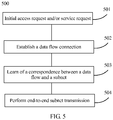
- an embodiment of this application further provides a communication method 500.
- the method 500 includes the following operations.
- Operation 501 Initial access request and/or service request.
- a terminal device initiates the initial access request and/or the service request.
- the initial access request and/or the service request carry or carries a parameter used to select a network slice, and the initial access request and/or the service request may be sent by the UE to a CN by using a NAS message.
- Operation 502 Establish a data flow connection.
- the CN establishes the data flow connection (the data flow connection may be a session connection, a QoS flow, a plurality of QoS flows, an IP data flow, or a plurality of IP data flows) for the UE, and associates the data flow connection with a subnet.
- the subnet herein may be an end-to-end subnet configured by a network manager or a CN domain subnet. If the subnet is a CN domain subnet, there is a correspondence between the CN domain subnet and an end-to-end subnet, and the subnet has information about an identifier of the subnet.
- the CN may further allocate a data transmission channel between the core network and a RAN to the data flow connection, and the CN notifies the UE of at least one of information about an identifier of the data flow connection, information about an identifier of a corresponding subnet (for example, at least one of information about an identifier of the end-to-end subnet, the information about the identifier of the CN subnet, and information about an identifier that is of a subnet and that is authenticated by the CN), information about the data transmission channel, and QoS related information.
- Operation 503 Learn of a correspondence between a data flow and a subnet.
- the RAN learns of at least one of the information about the identifier of the subnet, the information about the identifier of the data flow connection, and the information about the corresponding transmission channel, so that a data packet can be correctly added to a corresponding TN subnet for transmission.
- the RAN may learn of at least one of the information about the identifier of the subnet, the information about the identifier of the data flow connection, and the information about the corresponding transmission channel in either of the following manners:
- Operation 504 Perform end-to-end subnet transmission.
- the RAN Based on the information that is about the identifier of the subnet and that is obtained in operation 503, in this operation, the RAN associates the data flow connection with a RAN subdomain subnet, and allocates a corresponding air interface transmission resource (for example, a DRB) to the data flow connection.
- the CN and the RAN learn of, through a management plane interface, information about a TN subnet corresponding to the subnet (for example, for a manner of learning of the information about the TN subnet, refer to the operations 403, 404, and 405 in the method 400), so that user data can be transmitted in the corresponding TN subnet.
- this application provides a communications system, namely, a system 600 shown in FIG. 6 .
- a communications system namely, a system 600 shown in FIG. 6 .
- two parts are described in the embodiments. From a perspective of a management plane signaling procedure in the system 600, in a first part (a part 1 shown in the figure), a case in which a network manager and each subdomain manager perform parameter configuration and collaboration is mainly described.
- a signaling procedure for a RAN and a CN in the system is mainly described, so that user data belonging to a same end-to-end subnet can be added, in a RAN subdomain, a CN subdomain, and a TN subdomain, to a subdomain subnet belonging to the end-to-end subnet.
- the management plane signaling procedure in the part 1 may be designed as an independent system management plane procedure, to complete related signaling configuration on a management plane, or may be used as a shared part of solutions in the embodiments of this application, for example, a shared part of solutions in the part 2.
- FIG. 6 shows only the part 1 and the part 2 in the system 600, but does not further show various possible procedure designs of each of the part 1 and the part 2. Detailed descriptions are provided below one by one. It may be understood that in the part 1 in a dashed-line box in the system 600, an information exchange interface may be disposed between any two of the network manager, a RAN manager, a TN manager, and a CN manager.
- management plane signaling interworking procedures of the network manager, the RAN manager, the TN manager, and the CN manager may be implemented in various manners, provided that information about subnets of the RAN subdomain, the TN subdomain, the CN subdomain, and the like can be transmitted between any two of the network manager, the RAN manager, the TN manager, and the CN manager.
- the information that needs to be transmitted includes but is not limited to any one or more of the following: information about an identifier of at least one subdomain subnet, information about a correspondence/mapping relationship between any two subdomain subnets, information about a correspondence/mapping relationship between each subdomain subnet and an end-to-end network subnet created by the system, and at least one type of the following information that may be used in slice management and slice mapping: a UE ID, a session ID, a tunnel ID, information about an identifier of a subnet, a core network user plane IP address, information about an identifier of a QoS flow, an identifier of a DRB, information about an identifier of an IP data flow, and the like.
- FIG. 6 currently shows a general procedure of data transmission in subdomains that is performed through signaling interworking between a terminal device, a radio access device, a transport network, and the core network. Further, there is a signaling interface between the RAN manager and the radio access network, there is a signaling interface between the TN manager and a transport network device, and there is a signaling interface between the CN manager and the core network. Each of these signaling interfaces can be used to exchange the information that needs to be transmitted.
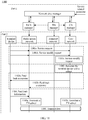
- a specific signaling procedure may be designed in a plurality of following optional implementations: As shown in FIG. 7 , an optional manner 1 of the part 1 provides a communication method 700.
- An implementation process based on the method 700 includes the following operations.
- Operation 701 Create an end-to-end subnet.
- a network manager creates the end-to-end subnet based on an input parameter such as a quality of service (quality of service, QoS) parameter (a quality of service requirement of a customer for a service type) related to a service level agreement (service level agreement, SLA), and configures a configuration parameter of each subdomain based on a capability requirement of the end-to-end subnet.
- the configuration parameter may include a specific configuration of each subdomain, for example, at least one of a resource usage manner, a resource usage policy, and a resource usage limitation.
- the configuration parameter may further include a key performance counter requirement for each subdomain (a specific parameter may be flexibly configured for each subdomain provided that the parameter configured for each subdomain meets the counter requirement).
- Operation 702 Configure a parameter of each subdomain subnet.
- the network manager sends an involved configuration parameter of each subdomain to each subdomain manager.
- the network manager may also send information about an identifier of the end-to-end subnet to each subdomain manager.
- the information about the identifier of the subnet may include any one or any combination of the following parameters: network slice selection assistance information (network slice selection assistance information, NSSAI), a slice type identifier (slice type ID), service management NSSAI (session management NSSAI, SM-NSSAI), single NSSAI (single NSSAI), a service type identifier (service type ID), a service type identifier of a subdomain, a tenant identifier (tenant ID), a user group identifier (user group ID), an index value (slice index) used to represent a slice type or a slice identifier, the identifier of the end-to-end subnet (subnet work ID), and information about an identifier of a subdomain subnet (for example, at least one of an identifier of
- a configuration parameter that is sent by the network manager to a RAN manager and that is used for a RAN subdomain may include information about an identifier of a corresponding TN subnet and/or a correspondence between a RAN subdomain subnet and a TN subnet.
- a configuration parameter that is sent by the network manager to a CN manager and that is used for a CN subdomain includes information about an identifier of a corresponding TN subnet and/or a correspondence between a RAN subdomain subnet and a TN subnet.
- Operation 703 Create a subnet for each subdomain, and feed back, for the subdomain, a creation result and/or information about an identifier of the subdomain subnet created for the subdomain to the network manager.
- each subdomain manager creates a subnet corresponding to the subdomain, and then feeds back information about an identifier of the subdomain subnet created by the subdomain manager to the network manager, for example, feeds back the information about the identifier by sending a response message.
- the configuration information related to creation of the end-to-end subnet may be various types of information delivered by the manager to each subdomain manager in operation 702; or the configuration information may be sent by the network manager to a subdomain manager and then forwarded by the subdomain manager to another involved subdomain manager through an interconnection interface.
- a response message returned by a TN manager to the network manager may include at least one or any combination of the following: information about an identifier of a TN subnet created by the TN manager for a RAN/CN, information about an identifier of a TN subnet created by the TN manager for a RAN-CN interface, and information about an identifier of a global TN subnet created by the TN manager without distinguishing between the CN, the RAN, and the RAN-CN interface.
- the TN subnet created by the TN manager may be used to distinguish between a control plane transmission bearer and a user plane transmission bearer.
- the TN manager may further create different TN subnets for transmitting a control plane data packet and a user plane data packet.
- the TN subnet created by the TN manager may be used to distinguish between data flows in a subnet.
- TN subnets are created for an IP data flow, a plurality of IP data flows, a QoS flow, and a plurality of QoS flows.
- the information about the identifier of the TN subnet may be fed back to the network manager.
- the information about the identifier of the TN subnet is also included in the foregoing response message.
- information about an identifier of an end-to-end subnet corresponding to the TN subnet may also be carried in the response message.
- the response message in this embodiment is a message that can carry the foregoing various types of configuration information.
- a specific name is not limited, and the response message may have another message name.
- the information about the identifier of the TN subnet may be expressed differently based on different manners of creating a TN subnet (a TN domain subnet corresponding to an end-to-end subnet). For example, if a network slice manner of a TN domain is creating a virtual local area network (virtual local area network, VLAN), the identifier of the TN subnet may be a VLAN ID; or if a network slice manner of a TN domain is another method and technology for creating a virtual subnet, the identifier of the TN subnet is a corresponding identifier that can be used to distinguish between virtual subnets. This is not limited herein.
- the information about the identifier of the TN subnet includes information, for example, a port number or an IP address, used to distinguish between different TN subnets.
- the information about the identifier of the TN subnet may include information used to distinguish between signaling plane transmission and data plane transmission, so that different subnets for bearer signaling plane transmission and data plane transmission can be distinguished.
- the information about the identifier of the TN subnet may include information used to distinguish between different data flows, for example, information about an identifier of an IP data flow, information about a group identifier of a plurality of IP data flows, information about an identifier of a QoS flow, and information about a group identifier of a plurality of QoS flows.
- Operation 704 Notify the RAN/CN manager of the information about the identifier of the TN subnet.
- Optional implementation 1 of operation 704 The network manager sends the information about the identifier of the TN subnet configured by the TN manager to the RAN/CN manager by using an interface message.
- the information about the identifier of the TN subnet may be obtained by the network manager in operation 703.
- the interface message may further carry the information about the identifier of the end-to-end subnet corresponding to the information about the identifier of the TN subnet.
- the TN manager creates a plurality of TN subnets for a same end-to-end subnet
- the information about the identifier of the TN subnet further needs to include a parameter used to distinguish between the TN subnets in the same end-to-end subnet.
- the TN manager may send an interface message through an interface between the TN manager and the RAN/CN manager.
- the interface message carries the information about the identifier of the TN subnet configured for the RAN/CN, so that the information about the identifier of the TN subnet configured by the TN for the RAN/CN can be sent to the RAN/CN manager.
- the TN manager may further add, to the interface message, the information about the identifier of the end-to-end subnet corresponding to the information about the identifier of the TN subnet.
- the information about the identifier of the TN subnet further needs to include a parameter used to distinguish between the TN subnets in the same end-to-end subnet.
- Operation 705 The RAN/CN associates a TN subnet.
- the RAN/CN associates a RAN/CN subdomain subnet created by the RAN/CN for the end-to-end subnet with a corresponding TN subnet based on obtained information about an identifier of a subnet (for example, information obtained in operation 702 and/or operation 704), so that the RAN/CN and the TN correspond to the same end-to-end subnet.
- Operation 706 The TN manager configures a TN parameter for an involved TN subnet.
- the TN manager configures the corresponding TN parameter for the involved corresponding TN subnet based on a requirement of the end-to-end subnet for the TN domain.
- the TN parameter may include at least one of the following: a configuration of a topology table, a configuration of a routing table, and a mapping relationship between a forwarding priority and an intra-RAN/CN parameter/RAN-CN interface parameter.
- the mapping relationship may include a mapping relationship between a forwarding priority of a VLAN and an intra-RAN/CN data packet QoS parameter/RAN-CN interface data packet QoS parameter (at least one of the intra-RAN data packet QoS parameter, the intra-CN data packet QoS parameter, and the RAN-CN interface data packet QoS parameter), and/or a mapping relationship between a forwarding priority of a VLAN and an IP-bearer differentiated services code point (differentiated services code point, DSCP) of an intra-RAN/CN data packet/RAN-CN interface data packet (at least one of the intra-RAN data packet, the intra-CN data packet, and the RAN-CN interface data packet).
- the TN manager sends a parameter configuration of the TN subnet to a corresponding TN domain node.
- an action of performing configuration for the TN subnet in operation 706 may be performed at any time after operation 702 in the method 700.
- an optional manner 2 of the part 1 provides a communication method 800.
- An implementation process based on the method 800 includes the following operations.
- Operation 801 Create an end-to-end subnet and determine a configuration parameter of each subdomain.
- Operation 801 is similar to operation 701, and therefore details are not described herein again.
- Operation 802 Configure a parameter of a TN subnet.
- a network manager sends a configuration parameter of a TN domain to a TN manager.
- the network manager may also send information about an identifier of the end-to-end subnet to the TN domain manager.
- the information about the identifier of the subnet may include any one or any combination of the following parameters: network slice selection assistance information (network slice selection assistance information, NSSAI), a slice type identifier (slice type ID), service management NSSAI (session management NSSAI, SM-NSSAI), single NSSAI (single NSSAI), a service type identifier (service type ID), a service type identifier of a subdomain, a tenant identifier (tenant ID), a user group identifier (user group ID), an index value (slice index) used to represent a slice type or a slice identifier, the identifier of the end-to-end subnet (subnet work ID), and information about an identifier of a subdomain subnet (for example, at least one of an
- Operation 803 Create a TN subdomain subnet, and feed back a creation result and/or information about an identifier of the created TN domain subnet to the network manager.
- the TN manager creates the TN subdomain subnet, and then feeds back information about an identifier of the subdomain subnet created by the TN manager to the network manager, for example, feeds back the information about the identifier by sending a response message.
- the response message sent by the TN manager to the network manager may include at least one or any combination of the following: information about an identifier of a TN subnet created by the TN manager for a RAN/CN, information about an identifier of a TN subnet created by the TN manager for a RAN-CN interface, and information about an identifier of a global TN subnet created by the TN manager without distinguishing between the CN, the RAN, and the RAN-CN interface.
- the TN subnet created by the TN manager may be used to distinguish between a control plane transmission bearer and a user plane transmission bearer.
- the manager may further create different TN subnets for transmitting a control plane data packet and a user plane data packet.
- the TN subnet created by the TN manager may be used to distinguish between data flows in a subnet.
- TN subnets are created for an IP data flow, a plurality of IP data flows, a QoS flow, and a plurality of QoS flows.
- the information about the identifier of the TN subnet may be fed back to the network manager.
- the information about the identifier of the TN subnet is also included in the foregoing response message and fed back.
- information about an identifier of an end-to-end subnet corresponding to the TN subnet may also be carried in the response message.
- the response message in this embodiment is a message that can carry the foregoing various types of configuration information.
- a specific name is not limited, and the response message may have another message name.
- the information about the identifier of the TN subnet may be expressed differently based on different manners of creating a TN subnet (a TN domain subnet corresponding to an end-to-end subnet). For example, if a network slice manner of the TN domain is creating a virtual local area network (virtual local area network, VLAN), the identifier of the TN subnet may be a VLAN ID; or if a network slice manner of the TN domain is another method and technology for creating a virtual subnet, the identifier of the TN subnet is a corresponding identifier that can be used to distinguish between virtual subnets. This is not limited herein.
- the information about the identifier of the TN subnet includes information, for example, a port number or an IP address, used to distinguish between different TN subnets.
- the information about the identifier of the TN subnet may include information used to distinguish between signaling plane transmission and data plane transmission, so that different subnets for bearer signaling plane transmission and data plane transmission can be distinguished.
- the information about the identifier of the TN subnet may include information used to distinguish between different data flows, for example, information about an identifier of an IP data flow, information about a group identifier of a plurality of IP data flows, information about an identifier of a QoS flow, and information about a group identifier of a plurality of QoS flows.
- Operation 804 Notify a RAN/CN manager of the information about the identifier of the TN subnet.
- the network manager sends, to the RAN manager by using an interface message between the network manager and the RAN manager, a configuration parameter of a RAN subdomain corresponding to the end-to-end subnet and/or information about an identifier of a TN subnet configured by the TN manager for the RAN.
- the interface message may further carry a RAN subdomain configuration and/or the information about the identifier of the end-to-end subnet corresponding to the identifier of the TN subnet.
- the network manager sends, to the CN manager by using an interface message between the network manager and the CN manager, a configuration parameter of a CN subdomain corresponding to the information about the identifier of the end-to-end subnet and/or information about an identifier of a TN subnet configured by the TN manager for the CN.
- the interface message may further carry configuration information of the CN subdomain and/or the information about the identifier of the end-to-end subnet corresponding to the TN subnet.
- Operation 805 The RAN/CN associates a TN subnet.
- the RAN/CN associates a RAN/CN subdomain subnet created by the RAN/CN for the end-to-end subnet with a corresponding TN subnet based on obtained information about an identifier of a subnet (for example, information obtained in operation 804), so that the RAN/CN and the TN correspond to the same end-to-end subnet.
- Operation 806 The TN manager configures a TN parameter for a TN subnet.
- the TN manager configures the corresponding TN parameter for the involved corresponding TN subnet based on a requirement of the end-to-end subnet for the TN subdomain.
- the TN parameter may include at least one of the following: a configuration of a topology table, a configuration of a routing table, and a mapping relationship between a forwarding priority and an intra-RAN/CN parameter/RAN-CN interface parameter.
- the mapping relationship may include a mapping relationship between a forwarding priority of a VLAN and an intra-RAN/CN data packet QoS parameter/RAN-CN interface data packet QoS parameter (at least one of the intra-RAN data packet QoS parameter, the intra-CN data packet QoS parameter, and the RAN-CN interface data packet QoS parameter), and/or a mapping relationship between a forwarding priority of a VLAN and an IP-bearer differentiated services code point (differentiated services code point, DSCP) of an intra-RAN/CN data packet/RAN-CN interface data packet (at least one of the intra-RAN data packet, the intra-CN data packet, and the RAN-CN interface data packet).
- An action of performing configuration for the TN subnet in operation 806 may be performed at any time after operation 802 in the method 800.
- an optional manner 3 of the part 1 provides a communication method 900.
- An implementation process based on the method 900 includes the following operations.
- Operation 901 Create an end-to-end subnet.
- a network manager creates the end-to-end subnet based on an input parameter (for example, a parameter related to a quality of service requirement of a customer for a service type), and configures a configuration parameter of each subdomain based on a capability requirement of the end-to-end subnet.
- the configuration parameter may be a specific configuration of each subdomain, for example, a resource usage manner, a resource usage policy, and a resource usage limitation.
- the configuration parameter may further include a key performance counter requirement for each subdomain (a specific parameter may be flexibly configured for each subdomain provided that the parameter configured for each subdomain meets the counter requirement).
- Operation 901 is similar to operation 701 in the method 700 or operation 801 in the method 800.
- a configuration parameter of a TN subdomain may include at least any one or more of the following information: information about an identifier of a TN subnet configured for a RAN domain/CN domain in the end-to-end network subnet, information about an identifier of a TN subnet created for a RAN-CN interface, and information about an identifier of a global TN subnet created without distinguishing between a CN, a RAN, and the RAN-CN interface.
- the configuration parameter of the TN subdomain may further include a TN parameter configured for each TN subnet.
- the TN parameter may include at least one of the following: a configuration of a topology table, a configuration of a routing table, and a mapping relationship between a forwarding priority and an intra-RAN/CN parameter/RAN-CN interface parameter.
- the mapping relationship may include a mapping relationship between a forwarding priority of a VLAN and an intra-RAN/CN data packet QoS parameter/RAN-CN interface data packet QoS parameter (at least one of the intra-RAN data packet QoS parameter, the intra-CN data packet QoS parameter, and the RAN-CN interface data packet QoS parameter), and/or a mapping relationship between a forwarding priority of a VLAN and an IP-bearer differentiated services code point (differentiated services code point, DSCP) of an intra-RAN/CN data packet/RAN-CN interface data packet (at least one of the intra-RAN data packet, the intra-CN data packet, and the RAN-CN interface data packet).
- DSCP IP-bearer differentiated services code point
- the information about the identifier of the TN subnet may be expressed differently based on different manners of creating a TN subnet (a TN domain subnet corresponding to an end-to-end subnet). For example, if a subnet creation manner of the TN domain is creating a virtual local area network (virtual local area network, VLAN), the information about the identifier of the TN subnet is a VLAN ID; or if a subnet creation manner of the TN domain is another method and technology for creating a virtual subnet, the information about the identifier of the TN subnet is a corresponding identifier that can be used to distinguish between virtual subnets. This is not limited herein.
- VLAN virtual local area network
- the information about the identifier of the TN subnet includes information, for example, a port number or an IP address, used to distinguish between different TN subnets.
- the information about the identifier of the TN subnet may include information used to distinguish between signaling plane transmission and data plane transmission, so that different subnets for bearer signaling plane transmission and data plane transmission can be distinguished.
- the information about the identifier of the TN subnet may include information used to distinguish between different data flows, for example, information about an identifier of an IP data flow, information about a group identifier of a plurality of IP data flows, information about an identifier of a QoS flow, and information about a group identifier of a plurality of QoS flows.
- Operation 902 Configure a parameter of each subdomain subnet.
- the network manager sends an involved configuration parameter of each subdomain to each subdomain manager by using an interface message.
- the interface message may further carry information about an identifier of the end-to-end subnet.
- the information about the identifier of the subnet may include any one or any combination of the following parameters: network slice selection assistance information (network slice selection assistance information, NSSAI), a slice type identifier (slice type ID), service management NSSAI (session management NSSAI, SM-NSSAI), single NSSAI (single NSSAI), a service type identifier (service type ID), a service type identifier of a subdomain, a tenant identifier (tenant ID), a user group identifier (user group ID), an index value (slice index) used to represent a slice type or a slice identifier, the identifier of the end-to-end subnet (subnet work ID), and information about an identifier of a subdomain subnet (for example, at least one of an identifier of a RAN subnet, an identifier of a CN subnet, and an identifier of a TN subnet).
- NSSAI network slice selection assistance information
- slice type ID slice type ID
- a configuration parameter that is sent by the network manager to a RAN manager and that is used for the RAN subdomain may include information about an identifier of a corresponding TN subnet and/or a correspondence between a RAN subdomain subnet and a TN subnet.
- a configuration parameter that is sent by the network manager to a CN manager and that is used for the CN subdomain includes information about an identifier of a corresponding TN subnet and/or a correspondence between a RAN subdomain subnet and a TN subnet.
- the configuration parameter that is sent by the network manager to the TN manager and that is used for the TN subdomain includes information about an identifier of a TN subnet created for the end-to-end subnet (optionally, may correspond to a configured intra-RAN/CN TN subnet/RAN-CN interface TN subnet) and/or a configuration parameter required for each involved TN subnet.
- (Optional) Operation 903 Create a subnet for each subdomain, and feed back, for the subdomain, information about an identifier of the subdomain subnet created for the subdomain to the network manager.
- each subdomain manager creates a subnet corresponding to the subdomain, and then feeds back information about an identifier of the subdomain subnet created by the subdomain manager to the network manager, for example, feeds back the information about the identifier by sending a response message.
- the configuration information related to creation of the end-to-end subnet may be various types of configuration information that is determined by the manager in operation 902 and that is related to each subdomain manager; or the configuration information may be sent by the network manager to a subdomain manager and then forwarded by the subdomain manager to another involved subdomain manager through an interconnection interface.
- Operation 903 may be similar to operation 703 in the method 700.
- (Optional) Operation 904 Notify the RAN/CN manager of the information about the identifier of the TN subnet.
- Optional implementation 1 of operation 904 The network manager sends the information about the identifier of the TN subnet configured by the TN manager to the RAN/CN manager by using an interface message.
- the information about the identifier of the TN subnet may be obtained by the network manager in operation 903.
- the interface message may further carry the information about the identifier of the end-to-end subnet corresponding to the information about the identifier of the TN subnet.
- the TN manager creates a plurality of TN subnets for a same end-to-end subnet
- the information about the identifier of the TN subnet further needs to include a parameter used to distinguish between the TN subnets in the same end-to-end subnet.
- the TN manager may send an interface message through an interface between the TN manager and the RAN/CN manager.
- the interface message carries the information about the identifier of the TN subnet configured for the RAN/CN, so that the information about the identifier of the TN subnet configured by the TN for the RAN/CN can be sent to the RAN/CN manager.
- the TN manager may further add, to the interface message, the information about the identifier of the end-to-end subnet corresponding to the information about the identifier of the TN subnet.
- the information about the identifier of the TN subnet further needs to include a parameter used to distinguish between the TN subnets in the same end-to-end subnet.
- Operation 904 may be similar to operation 704 in the method 700.
- Operation 905 The RAN/CN associates a TN subnet.
- the RAN subdomain/CN subdomain may associate a RAN/CN part created by the RAN subdomain/CN subdomain for the end-to-end subnet with a TN subnet based on information that is about an identifier of a subnet and that is obtained in operation 902, so that a RAN subdomain subnet/CN subdomain subnet and the TN subnet can correspond to the same end-to-end network subnet.
- the information about the identifier of the subnet may include any one or any combination of the following parameters: network slice selection assistance information (network slice selection assistance information, NSSAI), a slice type identifier (slice type ID), service management NSSAI (session management NSSAI, SM-NSSAI), single NSSAI (single NSSAI), a service type identifier (service type ID), a service type identifier of a subdomain, a tenant identifier (tenant ID), a user group identifier (user group ID), an index value (slice index) used to represent a slice type or a slice identifier, the identifier of the end-to-end subnet (subnet work ID), and information about an identifier of a subdomain subnet (for example, at least one of an identifier of a RAN subnet, an identifier of a CN subnet, and an identifier of a TN subnet).
- NSSAI network slice selection assistance information
- slice type ID slice type ID
- the RAN subdomain/CN subdomain may associate a RAN/CN subnet created by the RAN subdomain/CN subdomain for the end-to-end subnet with a corresponding TN subnet based on related information obtained in operation 904, so that the RAN subdomain subnet/CN subdomain subnet and the TN subnet can correspond to the same end-to-end network subnet, and data can be transmitted between the RAN, the TN, and the CN.
- Operation 906 Correspondingly configure a TN domain node.
- the TN manager sends a TN subnet parameter to a corresponding TN domain device.
- the TN manager configures a corresponding TN parameter for an involved corresponding TN subnet based on a requirement of the end-to-end subnet for the TN domain.
- the TN parameter may include at least one of the following: a configuration of a topology table, a configuration of a routing table, and a mapping relationship between a forwarding priority and an intra-RAN/CN parameter/RAN-CN interface parameter.
- the mapping relationship may include a mapping relationship between a forwarding priority of a VLAN and an intra-RAN/CN data packet QoS parameter/RAN-CN interface data packet QoS parameter (at least one of the intra-RAN data packet QoS parameter, the intra-CN data packet QoS parameter, and the RAN-CN interface data packet QoS parameter), and/or a mapping relationship between a forwarding priority of a VLAN and an IP-bearer differentiated services code point (differentiated services code point, DSCP) of an intra-RAN/CN data packet/RAN-CN interface data packet (at least one of the intra-RAN data packet, the intra-CN data packet, and the RAN-CN interface data packet).
- an action of performing configuration for the TN subnet in operation 906 may be performed at any time after operation 902 in the method 900.
- an embodiment of the present invention provides a communication method and a system 1000.
- One of key points of the method may be described as follows: A core network device identifies, by using information about an identifier of a session connection between a RAN and a CN, a subnet to which data transmitted between the RAN and the CN belongs.
- a radio access network device may obtain a correspondence between a subnet, a tunnel ID, and a transport network subnet (for example, a VLAN), and/or the core network device establishes a correspondence between a subnet, a tunnel ID, and a transport network subnet (for example, a VLAN).
- a transport network subnet for example, a VLAN
- an implementation process of the method 1000 includes the following operations.
- Operation 1001 A terminal device initiates a service request.
- the terminal device is UE.
- the UE sends the service request to the RAN.
- the RAN forwards the service request to the core network; or the RAN extracts content from the service request, and then sends the content in the service request to the core network by using a signaling message between the RAN and the core network.
- the service request includes reference information used to assist in network slice selection.
- the reference information may be any one or any combination of the following parameters: (1) information about an identifier of the UE, where the information about the identifier of the UE may include an international mobile subscriber identity (international mobile subscriber identifier, IMSI), a temporary mobile subscriber identity (temporary mobile subscriber identity, TMSI), or a temporary UE identifier (temp UE ID), (2) network slice selection assistance information (network slice selection assistance information, NSSAI), (3) a slice type identifier (slice type ID), (4) service management NSSAI (session management NSSAI, SM-NSSAI), (5) a service type identifier (service type ID) of a subdomain, (6) a tenant identifier (tenant ID), (7) a user group identifier (user group ID), (8) single NSSAI (single NSSAI), (9) an index value (slice index) used to represent a slice type or a slice identifier, (
- Operation 1002 Associate the terminal device with a slice.
- the core network device After receiving the service request in operation 1001, the core network device associates the UE with a slice, and/or selects a corresponding core network function entity for the UE, for example, selects a core network access and mobility management function entity, a session management function entity, and a user plane function entity.
- the session management function entity is responsible for creating a session and selecting a corresponding user plane function entity.
- Operation 1003 Feed back a response.
- the CN device feeds back response information to the UE.
- the response information may be sent in the following manner: The CN directly forwards the response information to the UE by using the RAN; or after the CN sends the response information to the RAN, the RAN obtains content in the response information, and then sends the content in the response information to the UE by using an air interface message between the RAN and the UE.
- the response information in this step may include information about an identifier of a subnet that the CN associates with the UE and/or a session ID, and the like.
- the CN may send any one or more of the information about the identifier of the subnet that the CN associates with the UE, and/or a core network user plane IP address, a session ID, a tunnel ID (uplink and/or downlink), and the like to the RAN by using the response information in 1003a or an interface message between the RAN and the CN. If information is transmitted by using different messages in 1003a and 1003b, a time sequence of the actions 1003a and 1003b is not limited herein.
- the information about the identifier of the subnet may include any one or any combination of the following parameters: network slice selection assistance information (network slice selection assistance information, NSSAI), a slice type identifier (slice type ID), service management NSSAI (session management NSSAI, SM-NSSAI), single NSSAI (single NSSAI), a service type identifier (service type ID), a service type identifier of a subdomain, a tenant identifier (tenant ID), a user group identifier (user group ID), an index value (slice index) used to represent a slice type or a slice identifier, an identifier of an end-to-end subnet (subnet work ID), and information about an identifier of a subdomain subnet (for example, at least one of an identifier of a RAN subnet, an identifier of a CN subnet, and an identifier of a TN subnet).
- NSSAI network slice selection assistance information
- slice type ID slice type identifie
- the UE may send any one or more of the information about the identifier of the subnet that the CN associates with the UE, and/or the core network user plane IP address, the session ID, the tunnel ID (uplink and/or downlink), and the like to the RAN device by using an air interface signaling message such as a Uu interface message.
- an air interface signaling message such as a Uu interface message.
- the information about the identifier of the subnet may include any one or any combination of the following parameters: network slice selection assistance information (network slice selection assistance information, NSSAI), a slice type identifier (slice type ID), service management NSSAI (session management NSSAI, SM-NSSAI), single NSSAI (single NSSAI), a service type identifier (service type ID), a service type identifier of a subdomain, a tenant identifier (tenant ID), a user group identifier (user group ID), an index value (slice index) used to represent a slice type or a slice identifier, an identifier of an end-to-end subnet (subnet work ID), and information about an identifier of a subdomain subnet (for example, at least one of an identifier of a RAN subnet, an identifier of a CN subnet, and an identifier of a TN subnet).
- NSSAI network slice selection assistance information
- slice type ID slice type identifie
- Operation 1005 Associate a TN subnet.
- an optional design in which the radio access network device associates a RAN subdomain subnet (or data) with a TN subdomain subnet is as follows: The radio access network device associates a TN subnet with an end-to-end subnet created by a system and a corresponding RAN subnet based on the information that is about the identifier of the subnet and that is reported by the UE (for example, in operation 1004) or provided by the CN (for example, in operation 1003b or 1003a).
- the radio access network device obtains a mapping relationship between information about a RAN subnet, information about an identifier of a session connection, tunnel establishment related information, information about an identifier of a TN subnet, and the like based on information (for example, a VLAN ID) that is about an identifier of a TN subnet and that is obtained by the RAN.
- the mapping relationship is specifically represented as (information about an identifier of a subnet, information about an identifier of a session connection, tunnel establishment related information, information (for example, a VLAN ID) about an identifier of a TN subnet).
- the identifier of the session connection may be an identifier of a packet data connection
- the tunnel establishment related information may be a GPRS tunneling protocol-user plane tunnel endpoint identifier (GPRS Tunneling Protocol-User Plane tunnel endpoint identifier, GTP-U TEID) and/or an IP address
- the VLAN ID is a VLAN identifier of a TN subnet associated with the RAN side
- the information about the identifier of the TN subnet may include a network slice instance identifier on a side (TN slice instance ID).
- a solution design in which the RAN obtains the information about the identifier of the TN subnet is as follows:
- the radio access network device may obtain the information about the identifier of the TN subnet through various feasible management plane signaling procedures in the part 1 in this application.
- an optional design in which the core network device associates a CN subdomain subnet (or data) with a TN subdomain subnet is as follows:
- the core network device obtains information about an identifier of a subnet based on the network slice selection assistance information included in the service request reported by the UE (for example, in operation 1001a and/or 1001b), and obtains a mapping relationship between information about an identifier of a CN subnet, information about an identifier of a session connection, tunnel establishment related information, information about an identifier of a TN subnet, and the like based on information (for example, a VLAN ID) that is about an identifier of a TN subnet and that is obtained by the CN.
- information for example, a VLAN ID
- the mapping relationship is specifically represented as (information about an identifier of a subnet, information about an identifier of a session connection, tunnel establishment related information, information (for example, a VLAN ID) about an identifier of a TN subnet).
- the identifier of the session connection may be an identifier of a packet data connection
- the tunnel establishment related information may be a GTP-U TEID and/or an IP address
- the VLAN ID is a VLAN identifier of a TN subnet associated with the CN side
- the information about the identifier of the TN subnet may include a network slice instance identifier on a side (TN slice instance ID).
- a solution design in which the CN device obtains the information about the identifier of the TN subnet is as follows:
- the CN may obtain the information about the identifier of the TN subnet through various feasible management plane signaling procedures in the part 1 in this application.
- 1005a and 1005b a correspondence between a RAN subdomain subnet, a CN subdomain subnet, and a TN subdomain subnet that belong to a same end-to-end subnet can be established, subnet-based uplink/downlink data transmission is performed through collaboration between subdomains, and end-to-end transmission performance is enhanced.
- Operation 1006 Transmit data.
- the RAN side device For data transmission between the RAN and the CN, for a session connection of the UE, the RAN side device establishes an association relationship between any two or all of information about an identifier of a session connection, tunnel identifier information, and information about an identifier of a TN subnet.
- the RAN encapsulates an uplink data packet that comes from the session connection of the UE into a corresponding tunneling protocol data packet.
- the tunneling protocol data packet carries a GTP-U TEID and/or an IP address.
- the RAN transmits the tunneling protocol data packet in a corresponding TN subnet.
- the RAN processes the tunneling protocol data packet so that the tunneling protocol data packet carries an identifier (for example, a VLAN identifier) of a TN subnet.
- the CN establishes an association relationship between any two or all of information about an identifier of a session connection, tunnel identifier information, and information about an identifier of a TN subnet.
- the CN encapsulates a downlink data packet that comes from the session connection of the UE into a corresponding tunneling protocol data packet.
- the tunneling protocol data packet carries a GTP-U TEID and/or an IP address.
- the CN transmits the tunneling protocol data packet in a corresponding TN subnet.
- the CN processes the tunneling protocol data packet so that the tunneling protocol data packet carries an identifier (for example, a VLAN identifier) of a TN subnet.
- an identifier for example, a VLAN identifier
- a possible implementation is as follows: For a session connection of the UE, a first base station learns of, by using an interface message between the first base station and a second base station, information (for example, a GTP-U TEID and/or an IP address) related to a tunnel established by the second base station for the session connection of the UE.
- the first base station establishes an association relationship between any two or all of information about an identifier of a session connection that needs to be used to forward data to the second base station, tunnel identifier information, and information about an identifier of a TN subnet.
- the RAN of the first base station When the first base station sends data of the session connection of the UE to the second base station, the RAN of the first base station encapsulates a data packet into a corresponding tunneling protocol data packet.
- the tunneling protocol data packet carries a GTP-U TEID and/or an IP address.
- the RAN transmits the tunneling protocol data packet in a corresponding TN subnet.
- the RAN processes the tunneling protocol data packet so that the tunneling protocol data packet carries an identifier (for example, a VLAN identifier) of a TN subnet.
- the RAN For a session connection of the UE, when the session connection is transmitted in the RAN, the RAN allocates one or more data radio bearer resources (for example, DRBs) to the session connection.
- a first base station learns of, by using an interface message between the first base station and a second base station, information (for example, a GTP-U TEID and/or an IP address) about a tunnel established by the second base station for a data radio bearer of the UE.
- the first base station establishes an association relationship between any two or three or all of information about an identifier of a session connection that needs to be used to forward data to the second base station, information about an identifier of a data radio bearer, tunnel identifier information, and information about an identifier of a TN subnet.
- the RAN of the first base station encapsulates a data packet into a corresponding tunneling protocol data packet.
- the tunneling protocol data packet carries a GTP-U TEID and/or an IP address.
- the RAN transmits the tunneling protocol data packet in a corresponding TN subnet.
- the RAN processes the tunneling protocol data packet so that the tunneling protocol data packet carries an identifier (for example, a VLAN identifier) of a TN subnet.
- a correspondence between a session connection and a data transmission tunnel is not limited.
- One data transmission tunnel is established for one session connection, a plurality of data transmission tunnels are established for one session connection, or one data transmission tunnel is established for a plurality of session connections.
- subdomains can serve the UE by using consistent subnet configurations, so that a subnet mapping between the RAN, the CN, and a TN, especially a mapping between a RAN subdomain subnet and a TN subdomain subnet, and/or an intra-RAN/CN subnet mapping such as an intra-RAN/CN subnet QoS mapping method are or is implemented.
- End-to-end subnet information is transmitted by using management plane signaling, and a mapping is implemented between subdomain subnets, to provide effective procedure support for conversion on the RAN side from transmitting a data packet in a RAN subnet to transmitting a data packet in a TN subnet.
- the core network device identifies a subnet (or a network slice) by using information about an identifier of a session connection between the RAN and the CN, and the radio access network device obtains a correspondence between information about an identifier of a session connection and a VLAN (on the RAN side), and/or the core network device establishes a correspondence between information about an identifier of a session connection and a VLAN (on the CN side), to establish a slice mapping between the RAN, the CN, and the TN.
- an embodiment of the present invention further provides a communication method 1100.
- the method may be applied to the system 1000. It should be noted that in a part 1 in a dashed-line box in the system 1000, only a case in which information exchange interfaces exist between a network manager, a RAN manager, a TN manager, and a CN manager is shown.
- management plane signaling interworking procedures of the network manager, the RAN manager, the TN manager, and the CN manager may be implemented in various manners, provided that information required for associating subnets of a RAN subdomain, a TN subdomain, and a CN subdomain can be transmitted between the network manager, the RAN manager, the TN manager, and the CN manager.
- the information includes but is not limited to information about an identifier of each subdomain subnet, information about a correspondence/mapping relationship between any two subdomain slices, information about a correspondence/mapping relationship between each subdomain subnet and an end-to-end network subnet created by the system, and at least one type of the following information that may be used in slice management and slice mapping: a UE ID, a session ID, a tunnel ID, information about an identifier of a subnet, a core network user plane IP address, information about an identifier of a QoS flow, an ID of a DRB, information about an identifier of an IP data flow, information about a group identifier of IP data flows, and the like.
- a core network identifies, by using data flows with same or similar quality of service requirements, a subnet to which transmitted data belongs, and a RAN side obtains a correspondence between a RAN subdomain subnet (transmitted data), the data flow, and a TN subnet.
- a RAN obtains a correspondence between information about an identifier of a subnet, information about an identifier of a QoS flow, and a VLAN ID.
- information about an identifier of the data flow is carried in information about an identifier of a user plane tunnel, for example, the identifier of the data flow is an identifier of a QoS flow and the identifier of the QoS flow is included in a GTP-U header
- the method 1100 is similar to the method 900 in terms of this point.
- the method 1100 includes operation 1101, operation 1102, operation 1103, operation 1104, operation 1105, and operation 1106 that are respectively similar to operation 1001, operation 1002, operation 1003, operation 1004, operation 1005, and operation 1006 in FIG. 10 in terms of procedures.
- operation 1101, operation 1102, operation 1103, operation 1104, operation 1105, and operation 1106 that are respectively similar to operation 1001, operation 1002, operation 1003, operation 1004, operation 1005, and operation 1006 in FIG. 10 in terms of procedures.
- information transmitted between execution bodies in specific procedures may be different, and some operations may have alternatives.
- Operation 1101 A terminal device initiates a service request/service modify request; or a core network device initiates a service modify request.
- an operation of initiating the service request by the terminal device is similar to operation 1001.
- the terminal device sends a request message to a core network, where the request message is used to modify an established session connection, for example, add one or more QoS flows or a group of QoS flows.
- the request message may include reference information used to assist in network slice selection.
- the reference information may be any one or any combination of the following parameters: (1) information about an identifier of the UE, where the information about the identifier of the UE may include an international mobile subscriber identity (international mobile subscriber identifier, IMSI), a temporary mobile subscriber identity (temporary mobile subscriber identity, TMSI), or a temporary UE identifier (temp UE ID), (2) network slice selection assistance information (network slice selection assistance information, NSSAI), (3) a slice type identifier (slice type ID), (4) service management NSSAI (session management NSSAI, SM-NSSAI), (5) a service type identifier (service type ID) of a subdomain, (6) a tenant identifier (tenant ID), (7) a user group identifier (user group ID), (8) single NSSAI (single NSSAI), (9) an index value (slice index) used to represent a slice type or a slice identifier, (10) an identifier of an end-to-end subnet (subnet
- the core network device may send a request message, where the request message is used to modify an established session connection of the UE, for example, add one or more QoS flows or a group of QoS flows.
- the request message may further include at least one of service information of the UE, core network information, operator policy information, and the like, to assist the core network in associating the UE with a subnet.
- Operation 1102 Associate the terminal device with a subnet.
- the core network device After receiving the service request in operation 1101, the core network device creates a session and/or a QoS flow accordingly, or after receiving the service modify request in operation 1101, the core network device modifies a session and/or a QoS flow accordingly, associates the UE with a subnet, and allocates a corresponding QoS parameter to the subnet.
- the QoS parameter includes information about an identifier of a QoS flow. In an implementation, the information about the identifier of the QoS flow is carried in a GTP-U header.
- Operation 1103 Feed back a response.
- the CN feeds back information to the UE, and the information includes but is not limited to any one or more of the following information: information about an identifier of the subnet that the CN associates with the UE, information about an identifier of a session connection, the information about the identifier of the QoS flow, and the like.
- the CN feeds back information to a RAN, and the information includes but is not limited to any one or more of the following information: information about an identifier of the subnet that the CN associates with the UE, information about a core network user plane IP address, information about an identifier of a session connection, tunnel establishment related information (uplink and/or downlink), the information about the identifier of the QoS flow, and the like.
- the information about the identifier of the subnet may include any one or any combination of the following parameters: network slice selection assistance information (network slice selection assistance information, NSSAI), a slice type identifier (slice type ID), service management NSSAI (session management NSSAI, SM-NSSAI), single NSSAI (single NSSAI), a service type identifier (service type ID), a service type identifier of a subdomain, a tenant identifier (tenant ID), a user group identifier (user group ID), an index value (slice index) used to represent a slice type or a slice identifier, an identifier of an end-to-end subnet (subnet work ID), and an identifier of a subdomain subnet (for example, an identifier of a RAN subnet, an identifier of a CN subnet, or an identifier of a TN subnet).
- network slice selection assistance information network slice selection assistance information
- NSSAI network slice selection assistance information
- the UE may send any one or more of the information about the identifier of the subnet that the CN associates with the UE, the information about the identifier of the session connection, the information about the identifier of the QoS flow, and the like to a RAN side device by using an air interface signaling message such as a Uu interface message.
- an air interface signaling message such as a Uu interface message.
- Operation 1105 Associate a TN subnet.
- an optional design in which the radio access network device associates a RAN side subnet (or data) with a TN side subnet is as follows: The radio access network device associates a TN subnet with an end-to-end network subnet created by a system and a corresponding RAN subdomain subnet based on the information that is about the identifier of the subnet and that is reported by the UE (for example, in operation 1104) or provided by the CN (for example, in operation 1103).
- the radio access network device obtains a mapping relationship between information (for example, a VLAN ID obtained in various procedures in the part 1) about an identifier of a subnet, information about an identifier of a QoS flow, information about an identifier of a TN subnet, and the like based on information that is about an identifier of a TN subnet and that is obtained by the RAN.
- the mapping relationship is specifically represented as a mapping between information about an identifier of a subnet, information about an identifier of a session connection, information (for example, a VLAN ID) about an identifier of a TN subnet, and a QoS range.
- the information about the identifier of the subnet may be information about an identifier of the end-to-end subnet created by the system, information about an identifier of a RAN subdomain subnet corresponding to the end-to-end subnet, or information about the end-to-end subnet or the RAN subdomain subnet.
- the QoS range is a QoS flow related parameter. For example, when a plurality of QoS flows belong to a same slice, the QoS range is used to describe information about the plurality of QoS flows, and in this case, the QoS range is equivalently used to represent a set of QoS flows.
- the QoS range may be replaced with information about an identifier of the QoS flow or quantity information of the QoS flow.
- the VLAN ID is a VLAN identifier of a TN subnet associated with the RAN side.
- an optional design in which the core network device associates a CN side subnet (or data) with a TN side subnet is as follows:
- the core network device obtains information about an identifier of a subnet based on a message reported by the UE or another core network device, and obtains a mapping relationship between information about an identifier of a subnet, information about an identifier of a QoS flow, information about an identifier of a TN subnet, and the like based on information (for example, a VLAN ID obtained in various feasible procedures in the part 1) that is about an identifier of a TN subnet and that is obtained by the CN and an association relationship between information about an identifier of a subnet and information about an identifier of a TN subnet.
- the mapping relationship is specifically represented as a mapping relationship between information about an identifier of a subnet, information about an identifier of a session connection, tunnel establishment related information, information (for example, a VLAN ID) about an identifier of a TN subnet, and a QoS range.
- the information about the identifier of the subnet may be information about an identifier of the end-to-end subnet created by the system, information about an identifier of a RAN subdomain subnet corresponding to the end-to-end subnet, or information about the end-to-end subnet or the RAN subdomain subnet. This is not limited herein.
- the QoS range is a QoS flow related parameter.
- the QoS range represents information about the plurality of QoS flows, and in this case, the QoS range is equivalently used to represent a set of QoS flows.
- the QoS range may be replaced with information about an identifier of the QoS flow or quantity information of the QoS flow.
- the VLAN ID is a VLAN identifier of a TN subnet associated with the CN side.
- a correspondence between a RAN subnet, a CN subnet, and a TN subnet that belong to a same end-to-end subnet can be obtained, network subnet-based uplink/downlink data transmission is performed through collaboration between subdomains, and end-to-end transmission performance is enhanced.
- Operation 1106 Transmit data.
- the RAN/CN may add, based on at least QoS flow related information such as a QoS range or information about an identifier of a QoS flow, a data packet corresponding to a subnet to a corresponding TN subnet for sending.
- QoS flow related information such as a QoS range or information about an identifier of a QoS flow
- a data packet corresponding to a subnet to a corresponding TN subnet for sending.
- a specific implementation method may be as follows: For a QoS flow of the UE, the RAN establishes an association relationship between any two or three or all of information about an identifier of a session connection, tunnel identifier information, information about an identifier of a QoS flow, and information about an identifier of a TN subnet.
- the RAN encapsulates an uplink data packet that comes from the QoS flow of the UE into a corresponding tunneling protocol data packet.
- the tunneling protocol data packet carries a GTP-U TEID and/or an IP address.
- the RAN transmits the tunneling protocol data packet in a corresponding TN subnet.
- the RAN processes the tunneling protocol data packet so that the tunneling protocol data packet carries an identifier (for example, a VLAN identifier) of a TN subnet.
- the CN establishes an association relationship between any two or three or all of information about an identifier of a session connection, tunnel identifier information, information about an identifier of a QoS flow, and information about an identifier of a TN subnet.
- the CN encapsulates a downlink data packet that comes from the QoS flow of the UE into a corresponding tunneling protocol data packet.
- the tunneling protocol data packet carries a GTP-U TEID and/or an IP address.
- the CN transmits the tunneling protocol data packet in a corresponding TN subnet.
- the CN processes the tunneling protocol data packet so that the tunneling protocol data packet carries an identifier (for example, a VLAN identifier) of a TN subnet.
- a possible implementation is as follows: For a QoS flow/a group of QoS flows of the UE, a first base station learns of, by using an interface message between the first base station and a second base station, information (for example, a GTP-U TEID and/or an IP address) about a tunnel established by the second base station for the QoS flow/QoS flow set of the UE.
- information for example, a GTP-U TEID and/or an IP address
- the first base station establishes an association relationship between any two or three or all of information about an identifier of a session connection that needs to be used to forward data to the second base station, tunnel identifier information, information about a QoS range, and information about an identifier of a TN subnet.
- the first base station sends data of the QoS flow/QoS flow set of the UE to the second base station
- the first base station encapsulates a data packet into a corresponding tunneling protocol data packet.
- the tunneling protocol data packet carries a GTP-U TEID and/or an IP address.
- the RAN transmits the tunneling protocol data packet in a corresponding TN subnet.
- the RAN processes the tunneling protocol data packet so that the tunneling protocol data packet carries an identifier (for example, a VLAN identifier) of a TN subnet.
- Another possible implementation is as follows: For a QoS flow/a group of QoS flows of the UE, when the QoS flow/the group of QoS flows are transmitted in the RAN, the RAN allocates one or more data radio bearer resources (for example, DRBs) to the QoS flow/the group of QoS flows.
- a first base station learns of, by using an interface message between the first base station and a second base station, information (for example, a GTP-U TEID and/or an IP address) about a tunnel established by the second base station for a data radio bearer of the UE.
- the first base station establishes an association relationship between any two or three or all of information about an identifier of a session connection that needs to be used to forward data to the second base station, information about an identifier of a data radio bearer, tunnel identifier information, and information about an identifier of a TN subnet.
- the RAN of the first base station encapsulates a data packet into a corresponding tunneling protocol data packet.
- the tunneling protocol data packet carries a GTP-U TEID and/or an IP address.
- the RAN transmits the tunneling protocol data packet in a corresponding TN subnet.
- the RAN processes the tunneling protocol data packet so that the tunneling protocol data packet carries an identifier (for example, a VLAN identifier) of a TN subnet.
- a correspondence between a QoS flow/a group of QoS flows and a data transmission tunnel is not limited.
- One data transmission tunnel is established for one QoS flow/one group of QoS flows, a plurality of data transmission tunnels are established for one QoS flow/one group of QoS flows, or one data transmission tunnel is established for a plurality of QoS flows/a plurality of groups of QoS flows.
- subdomains can serve the UE by using consistent subnet configurations, so that a subdomain subnet mapping between the RAN, the CN, and a TN, especially a mapping between a RAN subdomain subnet and a TN subdomain subnet, and/or an intra-RAN/CN subnet QoS mapping are or is implemented.
- End-to-end subnet information is transmitted by using management plane signaling, and a mapping is implemented between subdomain subnets, to provide effective procedure support for conversion on the RAN side from transmitting a data packet in a RAN subnet to transmitting a data packet in a TN subnet, so that the RAN can establish an association relationship between a RAN slice instance (or subnet) and a TN slice instance (or subnet).
- the core network identifies, by using data flows with same or similar quality of service requirements, a subnet to which transmitted data belongs, and the RAN side obtains a correspondence between a RAN side subnet (transmitted data), the data flow, and a transport network subnet, and/or the core network device obtains a correspondence between a CN side subnet (transmitted data), the data flow, and a transport network subnet, to establish a slice mapping between the RAN, the CN, and the TN.
- an embodiment of this application further provides a communication method 1200.
- the method and a system 1200 may be used in an independent solution in which a radio access network device side establishes a mapping between a RAN subnet and a TN subnet for data transmission, to resolve a problem of a data mapping in network slice-based transmission between a RAN and a TN, and also help resolve a problem of collaborated transmission between subdomains in an end-to-end subnet of a system in a more macro procedure of the entire system based on various possible implementations of the part 1 and the part 2.
- a process in which a slice mapping is established between a RAN subdomain and a TN subdomain when a radio access network device transmits a data packet of a user over a RAN-CN interface is described from a perspective of distinguishing between end-to-end slices at a granularity of a session (session).
- a design of the method 1200 includes the following operations.
- Operation 1201 Create a protocol data unit session.
- the radio access network device creates the protocol data unit session (protocol data unit session, PDU session) for UE, and obtains information about a subnet (slice) corresponding to the PDU session, so that the subnet (slice) corresponding to the PDU session is aligned with a core network subnet (slice). For example, data of a session x belongs to a slice y, the session x is mapped to a DRB m and a DRB n on an air interface, and the radio access network device may learn, through management plane configuration, that a TN slice of the slice y is a VLAN k.
- PDU session protocol data unit session
- Operation 1202 Identify a data packet.
- the radio access network device receives data of a user on the DRB m, and adds the data to a GTP-U tunnel, for example, adds an identifier TE ID z (corresponding to the session x) to a GTP-U data packet, so that a core network device distinguishes between data of different subnets (slices).
- a VLAN ID needs to be added to a data packet.
- FIG. 13 shows a protocol stack 1300 of a radio access network device (for example, a base station) on a RAN-CN interface.
- User plane PDUs are user plane protocol data units
- UDP is a user datagram protocol (user datagram protocol)
- GTP-U is a GPRS tunneling protocol-user plane protocol
- Data link layer is a data link layer
- Physical layer is a physical layer.
- An identifier, for example, a VLAN ID, of a transport subnet may be added to a data packet at an IP layer, the data link layer, or the physical layer in a protocol stack shown in FIG. 13(a) .
- a protocol layer may be newly added in FIG. 13(b) to identify an identifier (for example, a VLAN ID) of a transport subnet.
- an identifier for example, a VLAN ID
- a protocol layer is newly added to an IP layer, and an identifier (for example, the VLAN k) of a transport subnet is added to protocol data at the layer.
- Operation 1203 Uplink transmission bearer.
- the data packet is sent through a physical port of the radio access network device (base station).
- the data packet is sent on a physical port corresponding to the subnet (slice), so that the data packet is added to a corresponding TN subnet.
- the data packet carries a corresponding IP address, so that the data packet is added to a corresponding TN subnet.
- the values m, n, k, and z may all be natural numbers.
- An embodiment of this application further provides a communication method 1400.
- an implementation process of the method includes the following operations: Operation 1401: Obtain a service load transmission status of each transport network subnet.
- a radio access network device detects and collects statistics about the service load transmission status of each transport subnet, so that a RAN system can learn of a load status of the transport subnet (for example, a VLAN).
- Operation 1402 Exchange load information of a bearer network slice through a radio access network system internal interface.
- the RAN internal interface is usually an interface between base stations.
- the base station described herein may be a base station that belongs to 2G, 3G, 4G, 5G, or a future evolved wireless network.
- the load information of the bearer network slice is exchanged through the RAN internal interface such as an X2 or Xn interface.
- the information relates to the bearer network slice and includes at least one type of the following information: (1) information about an identifier of at least one TN subnet, (2) information about an identifier of a subnet, (3) load information of the at least one TN subnet (for example, the load information may be a specific value or a qualitative description such as low/medium/high), and (4) a coverage used to identify a related TN subnet, for example, in a RAN/CN/on a RAN-CN interface/in an entire network.
- the Xn interface is an interface between 5G radio access network devices, for example, an interface between gNBs.
- the gNB is a base station device in a 5G system.
- An eNB may be usually considered as a base station device in a 4G LTE system.
- An eNB and a gNB that are interconnected through an Xn interface may be connected to a core network in the 5G system.
- the X2 interface is also an interface between radio access network devices, for example, an interface between eNBs.
- a purpose of this embodiment is to exchange load information of a TN subnet in a RAN system internal interface, to increase system efficiency of a subsequent handover procedure, load balancing, and an SON procedure. Therefore, neither a specific interface name nor a specific interface type is limited herein.
- a base station In a radio access network, base stations need to be interconnected and communicate with each other by using an interface message, to complete a handover procedure and a dual/multi-connectivity process.
- interference may exist between base stations, and interference coordination needs to be performed, or a self-organizing network needs to be created and maintained.
- a base station needs to exchange usage of a resource with a neighboring base station.
- the resource includes an air interface resource, an interface resource, and the like.
- resource usage of a base station may be reported in a dimension of a subnet/TN subnet, so that network management, handover determining, a load balancing decision, and the like can be performed in the radio access network based on the subnet.
- the method and a system 1400 provided in this embodiment may run independently, or may run in combination with any one of the foregoing embodiments of the methods/systems 200 to 1200.
- an embodiment of this application further provides a communication method 1500.
- the method 1500 includes the following operation: 1501. Notify RAN system internal interface information.
- a RAN side device may notify a CN device of RAN internal interface establishment information through an interface between a RAN and the CN device.
- An internal interface on a RAN side is usually an interface between base stations.
- the base station described herein may be a base station that belongs to 2G, 3G, 4G, 5G, or a future evolved wireless network.
- the Xn interface is an interface between gNBs.
- the gNB is a base station device in a 5G system.
- An eNB is usually a base station device in a 4G LTE system.
- An eNB and a gNB that are interconnected through an Xn interface may be connected to a core network in the 5G system.
- the X2 interface is an interface between eNBs.
- interface establishment information may be information defined in the section 9.2.3.29 X2 TNL Configuration Info in the communication protocol version 3GPP TS36.423.
- a CN is notified of the RAN internal interface establishment information, to support an automatic RAN internal interface establishment procedure in a self-organizing network (self-organizing network, SON), for example, a stream control transmission protocol connection establishment process on an Xn/X2 control plane (Xn/X2 SCTP association).
- the RAN internal interface establishment information may further include at least one type of the following information: information about an identifier of a control plane TN subnet, information about an identifier of a subnet (corresponding to the control plane TN subnet), information about a TN transmission resource used for an interface control plane (for example, a transport layer address corresponding to each TN subnet), and corresponding control plane indication information (if there is no slice on the control plane, the information does not exist).
- the RAN interface establishment information may include at least one type of the following information: an identifier of a user plane TN subnet, information about an identifier of a subnet (corresponding to the user plane TN subnet), information about a TN transmission resource used for an interface user plane (for example, a transport layer address and/or tunnel establishment information corresponding to each TN subnet), and corresponding user plane indication information.
- the RAN internal interface establishment information may be exchanged during establishment of a RAN internal interface control plane.
- a RAN internal interface control plane for example, in an SCTP association procedure related to an X2/Xn interface
- at least one piece of the following information is exchanged through an interface between base stations: information about an identifier of a user plane TN subnet and information about an identifier of a subnet (corresponding to the identifier of the user plane TN subnet).
- an interface needs to be established between a base station and the core network, to exchange control information/transmit user data.
- an interface also needs to be established between base stations, and transport layer information for establishing the interface between base stations may be forwarded by the core network. Therefore, a base station needs to notify the core network of necessary information for establishing an interface (including a control plane and a user plane) between the base station and a neighboring base station.
- different transport layer establishment information may be configured for different network slices on an interface between base stations, so that control plane connections and/or user data transmission tunnels belonging to different network slices are established on the interface between base stations.
- the method and a system 1500 provided in this embodiment may run independently, or may run in combination with any one of the foregoing embodiments of the methods/systems 200 to 1400.
- the foregoing describes in detail the communication method and the system in the embodiments of this application with reference to FIG. 3 to FIG. 15 .
- the following describes in detail apparatuses in the embodiments of this application with reference to FIG. 16 to FIG. 22 .
- FIG. 16 is a schematic block diagram of the radio access network device 1600 according to an embodiment of this application.
- the radio access network device 1600 includes a first transceiver apparatus 1601, a second transceiver apparatus 1602, and at least one processor 1603.
- the radio access network device 1600 may further include a memory 1604.
- the first transceiver apparatus 1601, the second transceiver apparatus 1602, the at least one processor 1603, and the memory 1604 communicate with each other and transmit a control signal and/or a data signal to each other through an internal connection channel (for example, a system bus 1605 shown in the figure).
- an internal connection channel for example, a system bus 1605 shown in the figure.
- the memory 1604 is configured to store a computer program
- the processor 1603 is configured to invoke the computer program from the memory 1604 and run the computer program, to control the first transceiver apparatus 1601 and the second transceiver apparatus 1602 to receive or send a signal, so that the radio access network device communicates with a network side device by using the first transceiver apparatus, and the radio access network device communicates with a terminal device by using the second transceiver apparatus.
- the radio access network device 1600 can perform the operations of the radio access network device in any possible design scheme of the communication methods/systems 200 to 1500 provided in the embodiments of this application. For brevity, details are not described herein again.
- the processor 1603 and the memory 1604 may be combined into a processing apparatus, and the processor 1603 is configured to execute program code stored in the memory 1604 to implement the foregoing functions.
- the memory 1604 may be integrated into the processor 1603, or may be independent of the processor 1603.
- the first transceiver apparatus in the radio access network device 1600 may be specifically implemented as a wired communications interface, or may be specifically implemented as a communications interface based on a wireless air interface technology.
- the second transceiver apparatus described herein may be specifically implemented as a communications interface based on the wireless air interface technology.
- the first transceiver apparatus and the second transceiver apparatus may be implemented by using one wireless transceiver apparatus, or may be implemented by using two parallel wireless transceiver apparatuses.
- FIG. 17 is a schematic block diagram of the radio access network device 1700 according to an embodiment of this application.
- the radio access network device 1700 includes a transceiver module 1701 and a processing module 1702.
- the transceiver module 1701 and the processing module 1702 communicate with each other and transmit a control signal and/or a data signal to each other through an internal connection channel.
- the processing module 1702 is configured to control the transceiver module 1701 to receive or send a signal, so that the radio access network device communicates with a network side device and/or a terminal device by using the transceiver module 1701.
- the radio access network device 1700 can perform the operations of the radio access network device in any possible design scheme of the communication methods/systems 200 to 1500 provided in the embodiments of this application.
- the transceiver module 1701 in the radio access network device 1700 may include a wired communications interface module, or may include a communications interface module based on a wireless air interface technology, or may include a communications interface module with a wired communication function and a communications interface module with a wireless communication function.
- the transceiver module 1701 when the transceiver module 1701 includes a communications interface module with a wired communication function and a communications interface module with a wireless communication function, the wired communication function module is configured to communicate with the network side device, and the wireless communication function module is configured to communicate with the terminal device.
- the transceiver module 1701 may further include a first transceiver apparatus and a second transceiver apparatus. Both the first transceiver apparatus and the second transceiver apparatus are communications interfaces based on a wireless air interface technology.
- the first transceiver apparatus and the second transceiver apparatus may be implemented by using one wireless transceiver apparatus or by using two parallel wireless transceiver apparatuses.
- FIG. 18 is a schematic block diagram of the system chip 1800 according to an embodiment of this application.
- the system chip 1800 includes at least one processor 1801, a memory 1802, an interface circuit 1803, and a bus 1804.
- the at least one processor 1801, the memory 1802, and the interface circuit 1803 are coupled by using the bus 1804.
- the system chip 1800 interacts with the radio access network device/another device in a network by using the interface circuit 1803.
- the memory 1802 stores a program instruction, and the at least one processor 1801 invokes the program instruction stored in the memory 1802, so that the radio access network device 1600 or the radio access network device 1700 can perform the operations of the radio access network device in any possible design scheme of the communication methods/systems 200 to 1500 provided in the embodiments of this application.
- the processor 1801 and the memory 1802 may be combined into a processing apparatus, and the processor 1801 is configured to execute program code stored in the memory 1802 to implement the foregoing functions.
- the memory 1802 may be integrated into the processor 1801, or may be independent of the processor 1801.
- An embodiment of this application provides a core network device 1900.
- the following describes a structure and a function of the core network device 1900 with reference to FIG. 19 .
- FIG. 19 is a schematic block diagram of the core network device 1900 according to an embodiment of this application.
- the core network device 1900 includes at least one processor 1901, a memory 1902, a transceiver apparatus 1903, and a system bus 1904.
- the at least one processor 1901, the memory 1902, and the transceiver apparatus 1903 are coupled by using the system bus 1904.
- the processor 1901 controls the transceiver apparatus 1903, so that the core network device communicates with a network side device by using the transceiver apparatus 1903.
- the memory 1902 stores a program instruction, and the at least one processor 1901 invokes the program instruction stored in the memory 1902 to perform the operations of the core network device in any possible design scheme of the communication methods/systems 200 to 1500 provided in the embodiments of this application. For brevity, details are not described herein again.
- the processor 1901 and the memory 1902 may be combined into a processing apparatus, and the processor 1901 is configured to execute program code stored in the memory 1902 to implement the foregoing functions.
- the memory 1902 may be integrated into the processor 1901, or may be independent of the processor 1901.
- An embodiment of this application provides a core network device 2000.
- the following describes a structure and a function of the core network device 2000 with reference to FIG. 20 .
- FIG. 20 is a schematic block diagram of the core network device 2000 according to an embodiment of this application.
- the core network device 2000 includes a transceiver module 2001 and a processing module 2002.
- the transceiver module 2001 and the processing module 2002 communicate with each other and transmit a control signal and/or a data signal to each other through an internal connection channel.
- the processing module 2002 is configured to control the transceiver module 2001 to receive or send a signal, so that the core network device 2000 communicates with a network side device and/or a terminal device by using the transceiver module 2001.
- the core network device 2000 can perform the operations of the core network device in any possible design scheme of the communication methods/systems 200 to 1500 provided in the embodiments of this application.
- the transceiver module 2001 in the core network device 2000 may include a wired communications interface module, or may include a communications interface module based on a wireless air interface technology, or may include a communications interface module with a wired communication function and a communications interface module with a wireless communication function.
- FIG. 21 is a schematic block diagram of the system chip 2100 according to an embodiment of this application.
- the system chip 2100 includes at least one processor 2101, a memory 2102, an interface circuit 2103, and a bus 2104.
- the at least one processor 2101, the memory 2102, and the interface circuit 2103 are coupled by using the bus 2104.
- the system chip 2100 interacts with the core network device/another device in a network by using the interface circuit 2103.
- the memory 2102 stores a program instruction, and the at least one processor 2101 invokes the program instruction stored in the memory 2102, so that the core network device 1900 or the core network device 2000 can perform the operations of the core network device in any possible design scheme of the communication methods/systems 200 to 1500 provided in the embodiments of this application.
- the processor 2101 and the memory 2102 may be disposed as a processing apparatus, and the processor 2101 is configured to execute program code stored in the memory 2102 to implement the foregoing functions.
- the memory 2102 may be integrated into the processor 2101, or may be independent of the processor 2101.
- the processor in the embodiments of this application may be a central processing unit (central processing unit, CPU), or may be another general-purpose processor, a digital signal processor (digital signal processor, DSP), an application-specific integrated circuit (application specific integrated circuit, ASIC), a field programmable gate array (field programmable gate array, FPGA) or another programmable logical device, a discrete gate or a transistor logical device, a discrete hardware component, or the like.
- the general-purpose processor may be a microprocessor, or the processor may be any conventional processor or the like.
- the memory in the embodiments of this application may be a volatile memory or a nonvolatile memory, or may include a volatile memory and a nonvolatile memory.
- the nonvolatile memory may be a read-only memory (read-only memory, ROM), a programmable read-only memory (programmable ROM, PROM), an erasable programmable read-only memory (erasable PROM, EPROM), an electrically erasable programmable read-only memory (electrically EPROM, EEPROM), or a flash memory.
- the volatile memory may be a random access memory (random access memory, RAM), used as an external cache.
- random access memory random access memory
- static random access memory static random access memory
- DRAM dynamic random access memory
- DRAM dynamic random access memory
- SDRAM synchronous dynamic random access memory
- double data rate SDRAM double data rate SDRAM
- DDR SDRAM double data rate SDRAM
- ESDRAM enhanced synchronous dynamic random access memory
- SLDRAM synchronous link dynamic random access memory
- direct rambus RAM direct rambus RAM, DR RAM
- the wireless communications system 2200 includes a first network node 2201 and a second network node 2202.
- the first network node 2201 may be the radio access network device in any possible design scheme of the communication methods/systems 200 to 1500 provided in the embodiments of this application.
- the second network node 2202 is the core network device that cooperates with the radio access network device in any possible design scheme of the communication methods/systems 200 to 1500.
- the disclosed system, apparatus, and method may be implemented in other manners.
- the described apparatus embodiment is merely an example.
- the unit division is merely logical function division and there may be other division in actual implementation.
- a plurality of units or components may be combined or integrated into another system, or some features may be ignored or not performed.
- the displayed or discussed mutual couplings or direct couplings or communication connections may be implemented through some interfaces.
- the indirect couplings or communication connections between the apparatuses or units may be implemented in electronic, mechanical, or other forms.
- the units described as separate parts may or may not be physically separate, and parts displayed as units may or may not be physical units, and may be located in one position, or may be distributed on a plurality of network units. Some or all of the units may be selected based on actual requirements to achieve the objectives of the solutions of the embodiments.
- the functions When the functions are implemented in the form of a software functional unit and sold or used as an independent product, the functions may be stored in a computer-readable storage medium. Based on such an understanding, the technical solutions of this application essentially, or the part contributing to the prior art, or some of the technical solutions may be implemented in a form of a software product.
- the computer software product is stored in a storage medium, and includes several instructions for instructing a computer device (which may be a personal computer, a server, a network device, or the like) to perform all or some of the steps of the methods described in the embodiments of this application.
- the foregoing storage medium includes any medium that can store program code, such as a USB flash drive, a removable hard disk, a read-only memory (ROM), a random access memory (RAM), a magnetic disk, or an optical disc.
Landscapes
- Engineering & Computer Science (AREA)
- Computer Networks & Wireless Communication (AREA)
- Signal Processing (AREA)
- Computer Security & Cryptography (AREA)
- Mobile Radio Communication Systems (AREA)
Applications Claiming Priority (2)
| Application Number | Priority Date | Filing Date | Title |
|---|---|---|---|
| CN201710582415.8A CN109275151B (zh) | 2017-07-17 | 2017-07-17 | 一种通信方法、设备和系统 |
| PCT/CN2018/093993 WO2019015472A1 (fr) | 2017-07-17 | 2018-07-02 | Procédé de communications, dispositif et système |
Publications (3)
| Publication Number | Publication Date |
|---|---|
| EP3567896A1 true EP3567896A1 (fr) | 2019-11-13 |
| EP3567896A4 EP3567896A4 (fr) | 2020-01-15 |
| EP3567896B1 EP3567896B1 (fr) | 2021-09-01 |
Family
ID=65015417
Family Applications (1)
| Application Number | Title | Priority Date | Filing Date |
|---|---|---|---|
| EP18836155.4A Active EP3567896B1 (fr) | 2017-07-17 | 2018-07-02 | Procédé de communications, dispositif et système |
Country Status (4)
| Country | Link |
|---|---|
| US (1) | US20200015293A1 (fr) |
| EP (1) | EP3567896B1 (fr) |
| CN (1) | CN109275151B (fr) |
| WO (1) | WO2019015472A1 (fr) |
Families Citing this family (24)
| Publication number | Priority date | Publication date | Assignee | Title |
|---|---|---|---|---|
| US20200267051A1 (en) * | 2017-10-06 | 2020-08-20 | Telefonaktiebolaget Lm Ericsson (Publ) | Remotely controlling network slices in a network |
| US10909067B2 (en) | 2018-08-07 | 2021-02-02 | Futurewei Technologies, Inc. | Multi-node zero-copy mechanism for packet data processing |
| US10986041B2 (en) * | 2018-08-07 | 2021-04-20 | Futurewei Technologies, Inc. | Method and apparatus for virtual network functions and packet forwarding |
| US11477289B2 (en) * | 2018-10-09 | 2022-10-18 | Nokia Solutions And Networks Oy | Supporting a routing protocol with a transport layer protocol |
| US10992385B2 (en) | 2019-04-08 | 2021-04-27 | Netsia, Inc. | Apparatus and method for joint profile-based slicing of mobile access and optical backhaul |
| CN111954233B (zh) * | 2019-05-17 | 2025-04-29 | 中兴通讯股份有限公司 | 一种传送网子切片的创建方法、装置和系统 |
| CN112019363B (zh) * | 2019-05-30 | 2021-12-14 | 华为技术有限公司 | 确定业务传输需求的方法、设备及系统 |
| CN112055423B (zh) * | 2019-06-06 | 2022-09-02 | 华为技术有限公司 | 一种通信方法及相关设备 |
| CN110581776B (zh) * | 2019-06-10 | 2022-06-21 | 阿里巴巴集团控股有限公司 | QoS处理及控制方法及网络接口控制器 |
| CN112243227B (zh) * | 2019-07-18 | 2022-04-22 | 华为技术有限公司 | 网络切片架构下的数据传输的方法和装置 |
| US11070422B2 (en) | 2019-09-16 | 2021-07-20 | Cisco Technology, Inc. | Enabling enterprise segmentation with 5G slices in a service provider network |
| JP6765572B1 (ja) * | 2019-09-18 | 2020-10-07 | 三菱電機株式会社 | ネットワーク制御装置、通信リソース割り当て方法および通信システム |
| CN110730478B (zh) * | 2019-10-18 | 2021-12-21 | 腾讯科技(深圳)有限公司 | 切片关联方法、装置、端到端切片编排器及存储介质 |
| CN113132142B (zh) * | 2019-12-31 | 2022-08-09 | 华为技术有限公司 | 用于获取网络切片标识的方法和装置 |
| CN115244975A (zh) * | 2020-05-21 | 2022-10-25 | 中兴通讯股份有限公司 | 无线通信中的切片级负载上报及均衡 |
| CN114125888B (zh) * | 2020-09-01 | 2024-10-15 | 中国移动通信有限公司研究院 | 标识分配方法、装置、设备及存储介质 |
| CN114615352B (zh) * | 2020-12-09 | 2025-03-21 | 中国移动通信有限公司研究院 | 业务数据报文的传输方法及网络设备 |
| WO2022126437A1 (fr) * | 2020-12-16 | 2022-06-23 | 华为技术有限公司 | Procédé et appareil de communication |
| CN115226163A (zh) * | 2021-04-20 | 2022-10-21 | 华为技术有限公司 | 一种通信方法及装置 |
| CN115701035B (zh) * | 2021-07-15 | 2025-03-04 | 北京车和家信息技术有限公司 | 数据传输方法、装置及汽车 |
| CN115996374A (zh) * | 2021-10-19 | 2023-04-21 | 华为技术有限公司 | 一种通信方法、装置及系统 |
| US20250150949A1 (en) * | 2022-02-17 | 2025-05-08 | Nokia Technologies Oy | Method and apparatus for subnetwork configuration and procedures |
| US12425922B2 (en) * | 2022-11-10 | 2025-09-23 | Verizon Patent And Licensing Inc. | Systems and methods for supporting network slice services using transport devices |
| JPWO2024134851A1 (fr) * | 2022-12-22 | 2024-06-27 |
Family Cites Families (11)
| Publication number | Priority date | Publication date | Assignee | Title |
|---|---|---|---|---|
| CN100499683C (zh) * | 2006-10-18 | 2009-06-10 | 中国移动通信集团公司 | 个性化呼叫提示系统及方法 |
| CN101094237B (zh) * | 2007-07-30 | 2010-06-16 | 中兴通讯股份有限公司 | 一种ip多媒体子系统中网元间的负荷分担方法 |
| CN103348740B (zh) * | 2011-09-29 | 2017-09-19 | 华为技术有限公司 | 一种接入处理方法、设备和系统 |
| CN103533536B (zh) * | 2012-07-06 | 2019-05-10 | 深圳市共进电子股份有限公司 | 无线ap隔离方法及无线ap |
| US9106711B2 (en) * | 2012-09-04 | 2015-08-11 | Telefonaktiebolaget L M Ericsson (Publ) | Minimizing mapping and signaling for data path aggregation |
| US10200883B2 (en) * | 2013-08-19 | 2019-02-05 | Nokia Solutions And Networks Oy | Radio access network (RAN) transport evolved packet core (EPC) synergy |
| CN103533090A (zh) * | 2013-10-23 | 2014-01-22 | 中国科学院声学研究所 | 单个物理网口模拟为多个逻辑网口的映射方法与装置 |
| JP6540283B2 (ja) * | 2015-06-30 | 2019-07-10 | 富士通株式会社 | 通信装置、通信方法、および、通信プログラム |
| CN106487695B (zh) * | 2015-08-25 | 2019-10-01 | 华为技术有限公司 | 一种数据传输方法、虚拟网络管理装置及数据传输系统 |
| CN106550410B (zh) * | 2015-09-17 | 2020-07-07 | 华为技术有限公司 | 一种通信控制方法和控制器、用户设备、相关装置 |
| CN106953849B (zh) * | 2017-02-28 | 2021-01-12 | 华为技术有限公司 | 一种基于IPv6地址的数据报文匹配方法及装置 |
-
2017
- 2017-07-17 CN CN201710582415.8A patent/CN109275151B/zh active Active
-
2018
- 2018-07-02 WO PCT/CN2018/093993 patent/WO2019015472A1/fr not_active Ceased
- 2018-07-02 EP EP18836155.4A patent/EP3567896B1/fr active Active
-
2019
- 2019-09-18 US US16/574,769 patent/US20200015293A1/en not_active Abandoned
Also Published As
| Publication number | Publication date |
|---|---|
| EP3567896B1 (fr) | 2021-09-01 |
| WO2019015472A1 (fr) | 2019-01-24 |
| US20200015293A1 (en) | 2020-01-09 |
| CN109275151A (zh) | 2019-01-25 |
| EP3567896A4 (fr) | 2020-01-15 |
| CN109275151B (zh) | 2020-12-08 |
Similar Documents
| Publication | Publication Date | Title |
|---|---|---|
| EP3567896B1 (fr) | Procédé de communications, dispositif et système | |
| US10412650B2 (en) | Data transmission method, apparatus and system | |
| JP5970614B2 (ja) | マルチネットワークジョイント伝送に基づくオフロード方法、システム及びアクセスネットワーク要素 | |
| US20240015533A1 (en) | Control apparatus for gateway in mobile communication system | |
| KR102469973B1 (ko) | 통신 방법 및 장치 | |
| EP3496448A1 (fr) | Procédé et dispositif de configuration de cellule | |
| JP6567686B2 (ja) | データ・オフロードのためのパスを確立する方法及び装置 | |
| CN112997576A (zh) | Iab系统中的ipv6地址管理 | |
| US20170347251A1 (en) | Signaling method in mobile communication core network and system thereof | |
| BR112014002435B1 (pt) | Sistema de computação em nuvem, método de divergência de enlace descendente, e nó de portal de rádio em nuvem | |
| US10405243B2 (en) | Control and user plane decoupling in radio access network | |
| JP6219500B2 (ja) | 電気通信方法、電気通信システム、1次ノード、2次ノードおよびユーザ機器 | |
| JP2022549953A (ja) | データパケット送信方法および装置 | |
| CN105228169A (zh) | 一种基站管理控制方法和装置 | |
| CN114079981A (zh) | 一种网络设备切换方法及网络设备 | |
| JP7704302B2 (ja) | 無線ルーティング方法と装置 | |
| EP3138256B1 (fr) | Rupture locale résidentielle dans un système de communication | |
| CN106034363B (zh) | 一种数据转发方法及移动锚点 | |
| KR20210115927A (ko) | 무선 통신 시스템에서 pdu 세션 관리를 위한 방법 및 장치 | |
| CN102647806A (zh) | Ip报文处理方法、系统和设备 | |
| CN105792175A (zh) | 移动性管理方法及装置 |
Legal Events
| Date | Code | Title | Description |
|---|---|---|---|
| STAA | Information on the status of an ep patent application or granted ep patent |
Free format text: STATUS: THE INTERNATIONAL PUBLICATION HAS BEEN MADE |
|
| PUAI | Public reference made under article 153(3) epc to a published international application that has entered the european phase |
Free format text: ORIGINAL CODE: 0009012 |
|
| STAA | Information on the status of an ep patent application or granted ep patent |
Free format text: STATUS: REQUEST FOR EXAMINATION WAS MADE |
|
| 17P | Request for examination filed |
Effective date: 20190805 |
|
| AK | Designated contracting states |
Kind code of ref document: A1 Designated state(s): AL AT BE BG CH CY CZ DE DK EE ES FI FR GB GR HR HU IE IS IT LI LT LU LV MC MK MT NL NO PL PT RO RS SE SI SK SM TR |
|
| AX | Request for extension of the european patent |
Extension state: BA ME |
|
| A4 | Supplementary search report drawn up and despatched |
Effective date: 20191216 |
|
| RIC1 | Information provided on ipc code assigned before grant |
Ipc: H04W 24/02 20090101AFI20191210BHEP Ipc: H04W 76/12 20180101ALI20191210BHEP Ipc: H04W 76/11 20180101ALI20191210BHEP |
|
| STAA | Information on the status of an ep patent application or granted ep patent |
Free format text: STATUS: EXAMINATION IS IN PROGRESS |
|
| 17Q | First examination report despatched |
Effective date: 20200622 |
|
| DAV | Request for validation of the european patent (deleted) | ||
| DAX | Request for extension of the european patent (deleted) | ||
| GRAP | Despatch of communication of intention to grant a patent |
Free format text: ORIGINAL CODE: EPIDOSNIGR1 |
|
| STAA | Information on the status of an ep patent application or granted ep patent |
Free format text: STATUS: GRANT OF PATENT IS INTENDED |
|
| INTG | Intention to grant announced |
Effective date: 20210219 |
|
| GRAS | Grant fee paid |
Free format text: ORIGINAL CODE: EPIDOSNIGR3 |
|
| GRAA | (expected) grant |
Free format text: ORIGINAL CODE: 0009210 |
|
| STAA | Information on the status of an ep patent application or granted ep patent |
Free format text: STATUS: THE PATENT HAS BEEN GRANTED |
|
| AK | Designated contracting states |
Kind code of ref document: B1 Designated state(s): AL AT BE BG CH CY CZ DE DK EE ES FI FR GB GR HR HU IE IS IT LI LT LU LV MC MK MT NL NO PL PT RO RS SE SI SK SM TR |
|
| REG | Reference to a national code |
Ref country code: GB Ref legal event code: FG4D |
|
| REG | Reference to a national code |
Ref country code: CH Ref legal event code: EP Ref country code: AT Ref legal event code: REF Ref document number: 1427558 Country of ref document: AT Kind code of ref document: T Effective date: 20210915 |
|
| REG | Reference to a national code |
Ref country code: DE Ref legal event code: R096 Ref document number: 602018023055 Country of ref document: DE |
|
| REG | Reference to a national code |
Ref country code: IE Ref legal event code: FG4D |
|
| REG | Reference to a national code |
Ref country code: LT Ref legal event code: MG9D |
|
| REG | Reference to a national code |
Ref country code: NL Ref legal event code: MP Effective date: 20210901 |
|
| PG25 | Lapsed in a contracting state [announced via postgrant information from national office to epo] |
Ref country code: FI Free format text: LAPSE BECAUSE OF FAILURE TO SUBMIT A TRANSLATION OF THE DESCRIPTION OR TO PAY THE FEE WITHIN THE PRESCRIBED TIME-LIMIT Effective date: 20210901 Ref country code: ES Free format text: LAPSE BECAUSE OF FAILURE TO SUBMIT A TRANSLATION OF THE DESCRIPTION OR TO PAY THE FEE WITHIN THE PRESCRIBED TIME-LIMIT Effective date: 20210901 Ref country code: RS Free format text: LAPSE BECAUSE OF FAILURE TO SUBMIT A TRANSLATION OF THE DESCRIPTION OR TO PAY THE FEE WITHIN THE PRESCRIBED TIME-LIMIT Effective date: 20210901 Ref country code: SE Free format text: LAPSE BECAUSE OF FAILURE TO SUBMIT A TRANSLATION OF THE DESCRIPTION OR TO PAY THE FEE WITHIN THE PRESCRIBED TIME-LIMIT Effective date: 20210901 Ref country code: BG Free format text: LAPSE BECAUSE OF FAILURE TO SUBMIT A TRANSLATION OF THE DESCRIPTION OR TO PAY THE FEE WITHIN THE PRESCRIBED TIME-LIMIT Effective date: 20211201 Ref country code: LT Free format text: LAPSE BECAUSE OF FAILURE TO SUBMIT A TRANSLATION OF THE DESCRIPTION OR TO PAY THE FEE WITHIN THE PRESCRIBED TIME-LIMIT Effective date: 20210901 Ref country code: NO Free format text: LAPSE BECAUSE OF FAILURE TO SUBMIT A TRANSLATION OF THE DESCRIPTION OR TO PAY THE FEE WITHIN THE PRESCRIBED TIME-LIMIT Effective date: 20211201 Ref country code: HR Free format text: LAPSE BECAUSE OF FAILURE TO SUBMIT A TRANSLATION OF THE DESCRIPTION OR TO PAY THE FEE WITHIN THE PRESCRIBED TIME-LIMIT Effective date: 20210901 |
|
| REG | Reference to a national code |
Ref country code: AT Ref legal event code: MK05 Ref document number: 1427558 Country of ref document: AT Kind code of ref document: T Effective date: 20210901 |
|
| PG25 | Lapsed in a contracting state [announced via postgrant information from national office to epo] |
Ref country code: PL Free format text: LAPSE BECAUSE OF FAILURE TO SUBMIT A TRANSLATION OF THE DESCRIPTION OR TO PAY THE FEE WITHIN THE PRESCRIBED TIME-LIMIT Effective date: 20210901 Ref country code: LV Free format text: LAPSE BECAUSE OF FAILURE TO SUBMIT A TRANSLATION OF THE DESCRIPTION OR TO PAY THE FEE WITHIN THE PRESCRIBED TIME-LIMIT Effective date: 20210901 Ref country code: GR Free format text: LAPSE BECAUSE OF FAILURE TO SUBMIT A TRANSLATION OF THE DESCRIPTION OR TO PAY THE FEE WITHIN THE PRESCRIBED TIME-LIMIT Effective date: 20211202 |
|
| PG25 | Lapsed in a contracting state [announced via postgrant information from national office to epo] |
Ref country code: AT Free format text: LAPSE BECAUSE OF FAILURE TO SUBMIT A TRANSLATION OF THE DESCRIPTION OR TO PAY THE FEE WITHIN THE PRESCRIBED TIME-LIMIT Effective date: 20210901 |
|
| PG25 | Lapsed in a contracting state [announced via postgrant information from national office to epo] |
Ref country code: IS Free format text: LAPSE BECAUSE OF FAILURE TO SUBMIT A TRANSLATION OF THE DESCRIPTION OR TO PAY THE FEE WITHIN THE PRESCRIBED TIME-LIMIT Effective date: 20220101 Ref country code: SM Free format text: LAPSE BECAUSE OF FAILURE TO SUBMIT A TRANSLATION OF THE DESCRIPTION OR TO PAY THE FEE WITHIN THE PRESCRIBED TIME-LIMIT Effective date: 20210901 Ref country code: SK Free format text: LAPSE BECAUSE OF FAILURE TO SUBMIT A TRANSLATION OF THE DESCRIPTION OR TO PAY THE FEE WITHIN THE PRESCRIBED TIME-LIMIT Effective date: 20210901 Ref country code: RO Free format text: LAPSE BECAUSE OF FAILURE TO SUBMIT A TRANSLATION OF THE DESCRIPTION OR TO PAY THE FEE WITHIN THE PRESCRIBED TIME-LIMIT Effective date: 20210901 Ref country code: PT Free format text: LAPSE BECAUSE OF FAILURE TO SUBMIT A TRANSLATION OF THE DESCRIPTION OR TO PAY THE FEE WITHIN THE PRESCRIBED TIME-LIMIT Effective date: 20220103 Ref country code: NL Free format text: LAPSE BECAUSE OF FAILURE TO SUBMIT A TRANSLATION OF THE DESCRIPTION OR TO PAY THE FEE WITHIN THE PRESCRIBED TIME-LIMIT Effective date: 20210901 Ref country code: EE Free format text: LAPSE BECAUSE OF FAILURE TO SUBMIT A TRANSLATION OF THE DESCRIPTION OR TO PAY THE FEE WITHIN THE PRESCRIBED TIME-LIMIT Effective date: 20210901 Ref country code: CZ Free format text: LAPSE BECAUSE OF FAILURE TO SUBMIT A TRANSLATION OF THE DESCRIPTION OR TO PAY THE FEE WITHIN THE PRESCRIBED TIME-LIMIT Effective date: 20210901 Ref country code: AL Free format text: LAPSE BECAUSE OF FAILURE TO SUBMIT A TRANSLATION OF THE DESCRIPTION OR TO PAY THE FEE WITHIN THE PRESCRIBED TIME-LIMIT Effective date: 20210901 |
|
| REG | Reference to a national code |
Ref country code: DE Ref legal event code: R097 Ref document number: 602018023055 Country of ref document: DE |
|
| PLBE | No opposition filed within time limit |
Free format text: ORIGINAL CODE: 0009261 |
|
| STAA | Information on the status of an ep patent application or granted ep patent |
Free format text: STATUS: NO OPPOSITION FILED WITHIN TIME LIMIT |
|
| PG25 | Lapsed in a contracting state [announced via postgrant information from national office to epo] |
Ref country code: IT Free format text: LAPSE BECAUSE OF FAILURE TO SUBMIT A TRANSLATION OF THE DESCRIPTION OR TO PAY THE FEE WITHIN THE PRESCRIBED TIME-LIMIT Effective date: 20210901 Ref country code: DK Free format text: LAPSE BECAUSE OF FAILURE TO SUBMIT A TRANSLATION OF THE DESCRIPTION OR TO PAY THE FEE WITHIN THE PRESCRIBED TIME-LIMIT Effective date: 20210901 |
|
| 26N | No opposition filed |
Effective date: 20220602 |
|
| PG25 | Lapsed in a contracting state [announced via postgrant information from national office to epo] |
Ref country code: SI Free format text: LAPSE BECAUSE OF FAILURE TO SUBMIT A TRANSLATION OF THE DESCRIPTION OR TO PAY THE FEE WITHIN THE PRESCRIBED TIME-LIMIT Effective date: 20210901 |
|
| REG | Reference to a national code |
Ref country code: DE Ref legal event code: R119 Ref document number: 602018023055 Country of ref document: DE |
|
| PG25 | Lapsed in a contracting state [announced via postgrant information from national office to epo] |
Ref country code: MC Free format text: LAPSE BECAUSE OF FAILURE TO SUBMIT A TRANSLATION OF THE DESCRIPTION OR TO PAY THE FEE WITHIN THE PRESCRIBED TIME-LIMIT Effective date: 20210901 |
|
| REG | Reference to a national code |
Ref country code: CH Ref legal event code: PL |
|
| REG | Reference to a national code |
Ref country code: BE Ref legal event code: MM Effective date: 20220731 |
|
| PG25 | Lapsed in a contracting state [announced via postgrant information from national office to epo] |
Ref country code: LU Free format text: LAPSE BECAUSE OF NON-PAYMENT OF DUE FEES Effective date: 20220702 Ref country code: LI Free format text: LAPSE BECAUSE OF NON-PAYMENT OF DUE FEES Effective date: 20220731 Ref country code: FR Free format text: LAPSE BECAUSE OF NON-PAYMENT OF DUE FEES Effective date: 20220731 Ref country code: CH Free format text: LAPSE BECAUSE OF NON-PAYMENT OF DUE FEES Effective date: 20220731 |
|
| PG25 | Lapsed in a contracting state [announced via postgrant information from national office to epo] |
Ref country code: DE Free format text: LAPSE BECAUSE OF NON-PAYMENT OF DUE FEES Effective date: 20230201 Ref country code: BE Free format text: LAPSE BECAUSE OF NON-PAYMENT OF DUE FEES Effective date: 20220731 |
|
| PG25 | Lapsed in a contracting state [announced via postgrant information from national office to epo] |
Ref country code: IE Free format text: LAPSE BECAUSE OF NON-PAYMENT OF DUE FEES Effective date: 20220702 |
|
| PG25 | Lapsed in a contracting state [announced via postgrant information from national office to epo] |
Ref country code: HU Free format text: LAPSE BECAUSE OF FAILURE TO SUBMIT A TRANSLATION OF THE DESCRIPTION OR TO PAY THE FEE WITHIN THE PRESCRIBED TIME-LIMIT; INVALID AB INITIO Effective date: 20180702 |
|
| PG25 | Lapsed in a contracting state [announced via postgrant information from national office to epo] |
Ref country code: MK Free format text: LAPSE BECAUSE OF FAILURE TO SUBMIT A TRANSLATION OF THE DESCRIPTION OR TO PAY THE FEE WITHIN THE PRESCRIBED TIME-LIMIT Effective date: 20210901 Ref country code: CY Free format text: LAPSE BECAUSE OF FAILURE TO SUBMIT A TRANSLATION OF THE DESCRIPTION OR TO PAY THE FEE WITHIN THE PRESCRIBED TIME-LIMIT Effective date: 20210901 |
|
| PG25 | Lapsed in a contracting state [announced via postgrant information from national office to epo] |
Ref country code: TR Free format text: LAPSE BECAUSE OF FAILURE TO SUBMIT A TRANSLATION OF THE DESCRIPTION OR TO PAY THE FEE WITHIN THE PRESCRIBED TIME-LIMIT Effective date: 20210901 |
|
| PG25 | Lapsed in a contracting state [announced via postgrant information from national office to epo] |
Ref country code: MT Free format text: LAPSE BECAUSE OF FAILURE TO SUBMIT A TRANSLATION OF THE DESCRIPTION OR TO PAY THE FEE WITHIN THE PRESCRIBED TIME-LIMIT Effective date: 20210901 |
|
| PGFP | Annual fee paid to national office [announced via postgrant information from national office to epo] |
Ref country code: GB Payment date: 20250529 Year of fee payment: 8 |