EP3568982B1 - Skalierung von transformkoeffizienten für nicht-dyadische transformblöcke - Google Patents
Skalierung von transformkoeffizienten für nicht-dyadische transformblöcke Download PDFInfo
- Publication number
- EP3568982B1 EP3568982B1 EP17822705.4A EP17822705A EP3568982B1 EP 3568982 B1 EP3568982 B1 EP 3568982B1 EP 17822705 A EP17822705 A EP 17822705A EP 3568982 B1 EP3568982 B1 EP 3568982B1
- Authority
- EP
- European Patent Office
- Prior art keywords
- scaling factor
- block
- case
- equal
- substantially equal
- Prior art date
- Legal status (The legal status is an assumption and is not a legal conclusion. Google has not performed a legal analysis and makes no representation as to the accuracy of the status listed.)
- Active
Links
Images


Classifications
-
- H—ELECTRICITY
- H04—ELECTRIC COMMUNICATION TECHNIQUE
- H04N—PICTORIAL COMMUNICATION, e.g. TELEVISION
- H04N19/00—Methods or arrangements for coding, decoding, compressing or decompressing digital video signals
- H04N19/10—Methods or arrangements for coding, decoding, compressing or decompressing digital video signals using adaptive coding
- H04N19/102—Methods or arrangements for coding, decoding, compressing or decompressing digital video signals using adaptive coding characterised by the element, parameter or selection affected or controlled by the adaptive coding
- H04N19/124—Quantisation
- H04N19/126—Details of normalisation or weighting functions, e.g. normalisation matrices or variable uniform quantisers
-
- H—ELECTRICITY
- H04—ELECTRIC COMMUNICATION TECHNIQUE
- H04N—PICTORIAL COMMUNICATION, e.g. TELEVISION
- H04N19/00—Methods or arrangements for coding, decoding, compressing or decompressing digital video signals
- H04N19/10—Methods or arrangements for coding, decoding, compressing or decompressing digital video signals using adaptive coding
- H04N19/102—Methods or arrangements for coding, decoding, compressing or decompressing digital video signals using adaptive coding characterised by the element, parameter or selection affected or controlled by the adaptive coding
- H04N19/124—Quantisation
-
- H—ELECTRICITY
- H04—ELECTRIC COMMUNICATION TECHNIQUE
- H04N—PICTORIAL COMMUNICATION, e.g. TELEVISION
- H04N19/00—Methods or arrangements for coding, decoding, compressing or decompressing digital video signals
- H04N19/10—Methods or arrangements for coding, decoding, compressing or decompressing digital video signals using adaptive coding
- H04N19/134—Methods or arrangements for coding, decoding, compressing or decompressing digital video signals using adaptive coding characterised by the element, parameter or criterion affecting or controlling the adaptive coding
- H04N19/157—Assigned coding mode, i.e. the coding mode being predefined or preselected to be further used for selection of another element or parameter
-
- H—ELECTRICITY
- H04—ELECTRIC COMMUNICATION TECHNIQUE
- H04N—PICTORIAL COMMUNICATION, e.g. TELEVISION
- H04N19/00—Methods or arrangements for coding, decoding, compressing or decompressing digital video signals
- H04N19/10—Methods or arrangements for coding, decoding, compressing or decompressing digital video signals using adaptive coding
- H04N19/169—Methods or arrangements for coding, decoding, compressing or decompressing digital video signals using adaptive coding characterised by the coding unit, i.e. the structural portion or semantic portion of the video signal being the object or the subject of the adaptive coding
- H04N19/17—Methods or arrangements for coding, decoding, compressing or decompressing digital video signals using adaptive coding characterised by the coding unit, i.e. the structural portion or semantic portion of the video signal being the object or the subject of the adaptive coding the unit being an image region, e.g. an object
- H04N19/176—Methods or arrangements for coding, decoding, compressing or decompressing digital video signals using adaptive coding characterised by the coding unit, i.e. the structural portion or semantic portion of the video signal being the object or the subject of the adaptive coding the unit being an image region, e.g. an object the region being a block, e.g. a macroblock
-
- H—ELECTRICITY
- H04—ELECTRIC COMMUNICATION TECHNIQUE
- H04N—PICTORIAL COMMUNICATION, e.g. TELEVISION
- H04N19/00—Methods or arrangements for coding, decoding, compressing or decompressing digital video signals
- H04N19/60—Methods or arrangements for coding, decoding, compressing or decompressing digital video signals using transform coding
Definitions
- the present principles generally relate to a method and a device for image encoding and decoding, and more particularly, to a method and a device for image encoding and decoding with quantizing and inverse quantizing.
- video coding schemes usually employ prediction and transform to leverage spatial and temporal redundancy in the video content.
- intra or inter prediction is used to exploit the intra or inter frame correlation, then the differences between group of samples in the original image and in the prediction image, often denoted as residuals, are transformed, quantized and entropy coded.
- residuals the differences between group of samples in the original image and in the prediction image, often denoted as residuals.
- the compressed data is decoded by inverse processes corresponding to the prediction, transform, quantization and entropy coding.
- transform and quantization are applied on square blocks whose size in each dimension is equal to a power of 2, i.e. of size 2 M ⁇ 2 M .
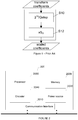
- quantization comprises quantization by Qstep (S10) followed by scaling (S12) by a scaling factor S Q equal to 2 -(29- M - B ) , where B is the bitdepth of the original image.
- the HEVC quantization and scaling are only adapted to square blocks whose width and/or height are/is a power of 2.
- a picture is an array of luma samples in monochrome format or an array of luma samples and two corresponding arrays of chroma samples in 4:2:0, 4:2:2, and 4:4:4 colour format.
- a "block” addresses a specific area in a sample array (e.g., luma Y), and a "unit” includes the collocated block of all encoded color components (luma Y and possibly chroma Cb and chroma Cr).
- the term "block” or "image block” is used herein to refer to a block (e.g. a coding block or CB) or a unit (e.g. a coding unit or CU). In the present principles, a block may also refer to an array of residuals.
- HEVC High Efficiency Video Coding
- present principles are not limited to HEVC, and can be applied to other standards, recommendations, and extensions thereof, including for example HEVC or HEVC extensions like Format Range (RExt), Scalability (SHVC), and Multi-View (MV-HEVC) Extensions.
- HEVC or HEVC extensions like Format Range (RExt), Scalability (SHVC), and Multi-View (MV-HEVC) Extensions.
- RExt Format Range
- SHVC Scalability
- MV-HEVC Multi-View
- Figure 2 represents an exemplary architecture of a transmitter 200 configured to encode an image block in a bitstream according to a specific and non-limiting embodiment.
- the transmitter 200 comprises one or more processor(s) 2000, which could comprise, for example, a CPU, a GPU and/or a DSP (English acronym of Digital Signal Processor), along with internal memory 2030 (e.g. RAM, ROM, and/or EPROM).
- the transmitter 200 comprises one or more communication interface(s) 2010 (e.g. a keyboard, a mouse, a touchpad, a webcam), each adapted to display output information and/or allow a user to enter commands and/or data (e.g. a stream); and a power source 2020 which may be external to the transmitter 200.
- the transmitter 200 may also comprise one or more network interface(s) (not shown).
- Encoder module 2040 represents the module that may be included in a device to perform the coding functions.
- encoder module 2040 may be implemented as a separate element of the transmitter 200 or may be incorporated within processor(s) 2000 as a combination of hardware and software as known to those skilled in the art.
- the image block may be obtained from a source. According to different embodiments, the source can be, but is not limited to:
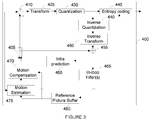
- Figure 3 illustrates an exemplary video encoder 400 adapted to execute the encoding method of figure 4 .
- the encoder 400 is an example of a transmitter 200 or may be part of such a transmitter 200.
- a picture may be partitioned into coding tree units (CTU) of square shape with a configurable size.
- CTU coding tree units
- a consecutive set of coding tree units may be grouped into a slice.
- a CTU is the root of a tree partitioning into Coding Units.
- an image is partitioned into one or more slices where each slice can include one or more slice segments.
- a slice segment is organized into coding units, prediction units and transform units.
- the HEVC specification distinguishes between “blocks” and “units,” where a "block” addresses a specific area in a sample array (e.g., luma, Y), and the “unit” includes the collocated block of all encoded color components (Y, Cb, Cr, or monochrome), syntax elements and prediction data that are associated with the block (e.g., motion vectors).
- a "block” addresses a specific area in a sample array (e.g., luma, Y)
- the “unit” includes the collocated block of all encoded color components (Y, Cb, Cr, or monochrome), syntax elements and prediction data that are associated with the block (e.g., motion vectors).
- an image is partitioned into basic coding blocks, e.g. into coding tree blocks (CTB) of square shape with a configurable size in HEVC or into macroblocks in H.264, and a set of possibly consecutive basic coding blocks is grouped into a slice.
- CTB
- the basic coding units are of square shape of 2 n x2 n samples, where n is an integer, e.g. n ⁇ ⁇ 4, 5, 6 ⁇ .
- n is an integer, e.g. n ⁇ ⁇ 4, 5, 6 ⁇ .
- the smallest CTU size 16x16 corresponds to a macroblock size as used in previous video coding standards.
- CTU and CTB are used herein to describe encoding/decoding methods and encoding/decoding apparatus, these methods and apparatus should not be limited by these specific terms that may be worded differently (e.g. macroblock) in other standards such as H.264 or H.266.
- a Coding Tree Unit (CTU) corresponding to a CTB contains the CTBs of the encoded color components.
- a basic coding unit corresponding to a basic coding block contains the basic coding blocks of the encoded color components.
- a CTB is the root of a quadtree partitioning into Coding Blocks (CB), and a Coding Block is partitioned into one or more Prediction Blocks (PB) and forms the root of a quadtree partitioning into Transform Blocks (TBs).
- a Coding Unit includes the Prediction Units (PUs) and the tree-structured set of Transform Units (TUs), a PU includes the prediction information for all color components, and a TU includes residual coding syntax structure for each color component.
- the size of a CB, PB and TB of the luma component applies to the corresponding CU, PU and TU.
- the term "block” can be used to refer to any of CTU, CU, PU, TU, CB, PB and TB.
- the "block” can be used to refer to a macroblock, a partition and a sub-block as specified in H.264/AVC or other video coding standards, and more generally to refer to an array of samples of various sizes.
- a picture is encoded by the encoder modules as described below.
- Each block is encoded using either an intra or inter mode.
- the encoder 400 performs intra prediction (module 460).
- an inter mode motion estimation (module 475) and compensation (module 470) are performed.
- the encoder decides (module 405) which one of the intra mode or inter mode to use for encoding the block, and indicates the intra/inter decision by a prediction mode flag. Residuals are calculated by subtracting (module 410) a block of prediction samples (also known as a predictor) from the original image block.
- blocks in intra mode are predicted from reconstructed neighboring samples.
- Inter prediction is performed by motion-compensating a reference block stored in a reference picture buffer 480.
- the residuals are transformed (module 425) and quantized (module 430).
- the quantized transform coefficients, as well as motion vectors and other syntax elements, are entropy coded (module 445) to output a bitstream.
- the encoder may also skip the transform and apply quantization directly to the non-transformed residual signal.
- the encoder may also bypass both transform and quantization, i.e., the residual is coded directly without the application of the transform or quantization process. In direct PCM coding, no prediction is applied and the block samples are directly coded into the bitstream.
- the quantized transform coefficients are de-quantized (module 440) and inverse transformed (module 450) to decode residuals.
- An image block is reconstructed by combining (module 455) the decoded residuals and the block of prediction samples.
- An in-loop filter (465) may be applied to the reconstructed picture, for example, to perform deblocking/SAO (Sample Adaptive Offset) filtering to reduce coding artifacts.
- the filtered image is stored in the reference picture buffer 480.
- the transform and quantization are implemented in a fixed-point way. These operations may thus comprise some scaling steps.
- the quantization is implemented by multiplying the transform coefficients by 2 14 and then dividing them by Qstep and de-quantization by multiplying the quantized transform coefficients by 2 6 and Qstep.
- a quantization parameter QP
- QP can take 52 values from 0 to 51.
- An increase of 1 in QP means an increase of the quantization step size by approximately 12% (i.e., 2 1/6 ).
- An increase of 6 leads to an increase in the quantization step size by a factor of 2.
- QP the quantization parameter
- coeff the transform coefficient
- level the resulting quantized transform coefficient
- offset Q the offset used for appropriate rounding in the division by Q step
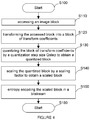
- Figure 4 represents a flowchart of a method for encoding an image in a bitstream according to a specific and non-limiting embodiment.
- an image block is an array of luma or chroma samples, or an array of residuals.
- a block of residuals may be obtained by subtracting a predictor, i.e. an array of prediction samples, from a block of luma or chroma samples.
- the transmitter transforms the accessed block into a block of transform coefficients, e.g. a block of DCT coefficients in the case where the transform is a DCT transform (Discrete Cosine Transform). It will be appreciated, however, that the present principles are not restricted to this specific transform.
- a DCT transform Discrete Cosine Transform
- the transmitter quantizes the block of transform coefficients by a quantization step size Qstep to obtain a quantized block.
- quantization comprises dividing the transform coefficients by the quantization step size Qstep.
- the transform and quantization are implemented in a fixed-point way. These operations may require some scaling steps.
- the transmitter scales the quantized block, i.e. the block of quantized transform coefficients, by a scaling factor S Q to obtain a scaled block.
- Scaling a block includes scaling each coefficient of the block.
- the value of the scaling factor depends on whether at least one of the width and the height of the block is equal to a power of 2, i.e. is equal to 2 n , where n is an integer.
- the scaling factor S Q according to the present principles is thus adapted to scale a block whose width and/or height is not a power of 2, e.g. is equal to 3x2 n , n being an integer.
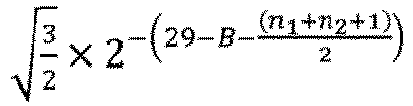
- the scaling factor S Q is defined to ensure that the norm of a corresponding residual block is preserved between the spatial domain and the transform domain.
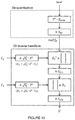
- Figure 9 depicts the forward transform and forward quantization processes to be applied on a residual block U with generic size ( s 1 ,s 2 ).
- the forward transform is implemented as separable 1D column and row transforms (D1 and D2 t respectively).
- C1 and C2 represent the coefficients of the vectors of each separable transform 1D transform, respectively applied in each direction to obtain a 2D transform of the input block. They contain floating point coefficients of each 1D inverse transform successively applied in the vertical and horizontal directions.
- the successive scaling operations that take place during the forward transform and forward quantization processes are the following ones:
- the scaling factor S Q is equal to : s 1 s 1 ⁇ ⁇ s 1 ⁇ s 2 ⁇ 2 ⁇ 15 ⁇ B ⁇ 1 f 4
- S Q s 1 s 1 ⁇ ⁇ s 1 ⁇ s 2 ⁇ 2 ⁇ 15 + f ⁇ B
- S Q s 1 s 1 ⁇ ⁇ s 1 ⁇ s 2 ⁇ 2 ⁇ 29 ⁇ B
- B is the bitdepth of the image block
- s1 is the width and s2 the height of the block or vice versa
- s 1 * is the smallest integer equal to a power of 2 that is greater than s1.
- the scaling factor S Q is proportional to 3 4 ⁇ s 1 ⁇ s 2 .
- S Q s 1 s 1 ⁇ ⁇ s 2 s 2 ⁇ ⁇ s 1 ⁇ s 2 ⁇ ⁇ 2 ⁇ 15 + f ⁇ B ⁇ 1 f 4
- S Q s 1 s 1 ⁇ ⁇ s 2 s 2 ⁇ ⁇ s 1 ⁇ s 2 ⁇ ⁇ 2 ⁇ 15 + f ⁇ B ⁇ 1 f 4
- S Q s 1 s 1 ⁇ ⁇ s 2 s 2 ⁇ ⁇ s 1 ⁇ s 2 ⁇ ⁇ 2 ⁇ 29 ⁇ B
- s 1 * is the smallest integer equal to a power of 2 that is greater than s1
- s 2 * is the smallest integer equal to a power of 2 that is greater than s2.
- the scaling S Q factor is proportional to 3 4 ⁇ s 1 ⁇ s 2 ⁇ .
- the transmitter encodes the scaled block in a bitstream by entropy coding, e.g. CABAC or CALVC. It will be appreciated, however, that the present principles are not restricted to these specific entropy coding processes.
- Steps S110 to S150 may be iterated to encode all the blocks of an image.
- the method ends at step S180.
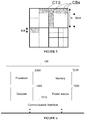
- the encoding method according to the present principles is advantageously applied on coding block split into asymmetric sub-blocks as depicted on figure 5 .
- a CTB is split into asymmetric CBs.
- a coding block may be split horizontally into one sub-block of height h/4 and one sub-block of height 3h/4.
- the sub-block of height h/4 is either above or below the sub-block of height 3h/4.
- the coding block may be split vertically into one sub-block of width w/4 and one sub-block of width 3w/4.
- the sub-block of width w/4 is either on the left or right of the sub-block of width 3w/4.
- the coding block is split either horizontally or vertically into sub-blocks whose size is not a power of two, e.g. their size in width w or height h is equal to 3x2 n pixels with n being an integer.
- Figure 6 represents an exemplary architecture of a receiver 100 configured to decode an image block from a bitstream to obtain a decoded image block according to a non-limiting embodiment.
- the receiver 100 comprises one or more processor(s) 1000, which could comprise, for example, a CPU, a GPU and/or a DSP (English acronym of Digital Signal Processor), along with internal memory 1030 (e.g. RAM, ROM and/or EPROM).
- the receiver 100 comprises one or more communication interface(s) 1010 (e.g. a keyboard, a mouse, a touchpad, a webcam), each adapted to display output information and/or allow a user to enter commands and/or data (e.g. the decoded image block); and a power source 1020 which may be external to the receiver 100.
- the receiver 100 may also comprise one or more network interface(s) (not shown).
- the decoder module 1040 represents the module that may be included in a device to perform the decoding functions. Additionally, the decoder module 1040 may be implemented as a separate element of the receiver 100 or may be incorporated within processor(s) 1000 as a combination of hardware and software as known to those skilled in the art.
- the bitstream may be obtained from a source.
- the source can be, but is not limited to:
- Figure 7 illustrates a block diagram of an exemplary video decoder 300 adapted to execute the decoding method of figure 8 .
- the video decoder 300 is an example of a receiver 100 or part of such a receiver 100.
- a bitstream is decoded by the decoder elements as described below.
- Video decoder 300 generally performs a decoding pass reciprocal to the encoding pass as described in Figure 3 , which performs video decoding as part of encoding video data.
- the input of the decoder includes a video bitstream, which may be generated by the video encoder 400.
- the bitstream is first entropy decoded (330) to obtain transform coefficients, motion vectors, and other coded information.
- the transform coefficients are de-quantized (340) and inverse transformed (350) which provides decoded residuals.
- the decoded residuals are then combined (355) with a block of prediction samples (also known as a predictor) to obtain a decoded/reconstructed image block.
- the block of prediction samples may be obtained (370) from intra prediction (360) or motion-compensated prediction (i.e., inter prediction) (375).
- AMVP and merge mode techniques may be used during motion compensation, which may use interpolation filters to calculate interpolated values for sub-integer samples of a reference block.
- An in-loop filter (365) may be applied to the reconstructed image.
- the in-loop filter may comprise a deblocking filter and a SAO filter.
- the filtered image is stored at a reference picture buffer (380).
- Figure 8 represents a flowchart of a method for decoding an image block from a bitstream according to a specific and non-limiting embodiment.
- the method starts at step S200.
- a receiver 100 such as the decoder 300 accesses a bitstream.
- the receiver decodes at least one block of transform coefficients from the bitstream by entropy decoding.
- the receiver de-quantizes the decoded block of transform coefficients by a quantization step size Qstep to obtain a de-quantized block.
- de-quantization comprises multiplying the transform coefficients by the quantization step size Qstep.
- the transform and quantization are implemented in a fixed-point way. These operations may thus comprise some scaling steps.
- the de-quantization is implemented by multiplying the transform coefficients by 2 6 and by Qstep.
- the receiver scales the de-quantized block by a scaling factor S IQ to obtain a scaled block.
- Scaling a block includes scaling each coefficient of the block.
- the value of the scaling factor S IQ depends on whether at least one of the width and the height of the block to be scaled is equal to a power of 2, i.e. is equal or not to 2 n , where n is an integer.
- the scaling factor S IQ according to the present principles is thus adapted to scale a block whose width and/or height is not a power of 2, e.g. is equal to 3x2 n , n being an integer.
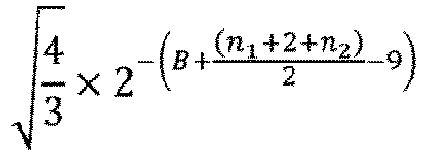
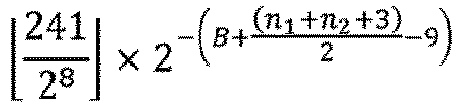
- the scaling factor S IQ is defined to ensure that the norm of a corresponding residual block is preserved between the spatial domain and the transform domain.
- Figure 10 depicts the inverse transform and inverse quantization processes to be applied on a block of quantized coefficients (level) with generic size ( s 1 , s 2 ).
- the inverse transform is implemented as separable 1D column and row transforms (D1 t and D2 respectively).
- C1 and C2 represent the coefficients of the vectors of each separable transform 1D transform, respectively applied in each direction to obtain a 2D transform of the input block. They contain floating point coefficients of each 1D inverse transform successively applied in the vertical and horizontal directions.
- the scaling factor S IQ is equal to s 1 ⁇ s 1 ⁇ 1 s 1 ⁇ s 2 ⁇ 2 ⁇ B ⁇ 15 ⁇ 1 g 4
- S IQ s 1 ⁇ s 1 ⁇ 1 s 1 ⁇ s 2 ⁇ 2 ⁇ 15 + g ⁇ B
- S IQ s 1 ⁇ s 1 ⁇ 1 s 1 ⁇ s 2 ⁇ 2 ⁇ 9
- B is the bitdepth of the image block
- s1 is the width and s2 the height of the block or vice versa
- s 1 * is the smallest integer equal to a power of 2 that is greater than s1.
- the scaling S IQ factor is proportional to 4 3 ⁇ 1 s 1 ⁇ s 2 .
- S Q s 1 ⁇ s 1 ⁇ s 2 ⁇ s 2 ⁇ 1 s 1 ⁇ s 2 ⁇ ⁇ 2 ⁇ B ⁇ 15 + g
- S IQ s 1 ⁇ s 1 ⁇ s 2 ⁇ s 2 ⁇ 1 s 1 ⁇ s 2 ⁇ 2 ⁇ B ⁇ 9
- s 1 * is the smallest integer equal to a power of 2 that is greater than s1
- s 2 * is the smallest integer equal to a power of 2 that is greater than s2.
- the scaling factor S IQ is proportional to 4 3 ⁇ 1 s 1 ⁇ s 2 ⁇ .
- the receiver transforms the scaled block into an image block, i.e. a block of luma or chroma samples, or a block of residuals.
- a block of luma or chroma samples may be obtained by adding a predictor, i.e. an array of prediction samples, to a block of residuals.
- the transform may be an IDCT transform (Inverse Discrete Cosine Transform).
- the transform of step S250 is the inverse transform applied on the encoder side at step S120.
- the transform used is an inverse transform of the transform used at step S120 of the encoding method.
- Steps S210 to S250 may be iterated to encode all the blocks of an image.
- the method ends at step S280.
- the implementations described herein may be implemented in, for example, a method or a process, an apparatus, a software program, a data stream, or a signal. Even if only discussed in the context of a single form of implementation (for example, discussed only as a method or a device), the implementation of features discussed may also be implemented in other forms (for example a program).
- An apparatus may be implemented in, for example, appropriate hardware, software, and firmware.
- the methods may be implemented in, for example, an apparatus such as, for example, a processor, which refers to processing devices in general, including, for example, a computer, a microprocessor, an integrated circuit, or a programmable logic device. Processors also include communication devices, such as, for example, computers, cell phones, portable/personal digital assistants ("PDAs”), and other devices that facilitate communication of information between end-users.
- PDAs portable/personal digital assistants
- Implementations of the various processes and features described herein may be embodied in a variety of different equipment or applications, particularly, for example, equipment or applications.
- equipment examples include an encoder, a decoder, a post-processor processing output from a decoder, a pre-processor providing input to an encoder, a video coder, a video decoder, a video codec, a web server, a set-top box, a laptop, a personal computer, a cell phone, a PDA, and other communication devices.
- the equipment may be mobile and even installed in a mobile vehicle.
- the methods may be implemented by instructions being performed by a processor, and such instructions (and/or data values produced by an implementation) may be stored on a processor-readable medium such as, for example, an integrated circuit, a software carrier or other storage device such as, for example, a hard disk, a compact diskette (“CD"), an optical disc (such as, for example, a DVD, often referred to as a digital versatile disc or a digital video disc), a random access memory (“RAM”), or a read-only memory (“ROM”).
- the instructions may form an application program tangibly embodied on a processor-readable medium. Instructions may be, for example, in hardware, firmware, software, or a combination.
- a processor may be characterized, therefore, as, for example, both a device configured to carry out a process and a device that includes a processor-readable medium (such as a storage device) having instructions for carrying out a process. Further, a processor-readable medium may store, in addition to or in lieu of instructions, data values produced by an implementation.
- implementations may produce a variety of signals formatted to carry information that may be, for example, stored or transmitted.
- the information may include, for example, instructions for performing a method, or data produced by one of the described implementations.
- a signal may be formatted to carry as data the rules for writing or reading the syntax of a described embodiment, or to carry as data the actual syntax-values written by a described embodiment.
- Such a signal may be formatted, for example, as an electromagnetic wave (for example, using a radio frequency portion of spectrum) or as a baseband signal.
- the formatting may include, for example, encoding a data stream and modulating a carrier with the encoded data stream.
- the information that the signal carries may be, for example, analog or digital information.
- the signal may be transmitted over a variety of different wired or wireless links, as is known.
- the signal may be stored on a processor-readable medium.
Landscapes
- Engineering & Computer Science (AREA)
- Multimedia (AREA)
- Signal Processing (AREA)
- Compression Or Coding Systems Of Tv Signals (AREA)
Claims (20)
- Decodierungsverfahren, das umfasst:- Decodieren (S220) eines Blocks von Transformationskoeffizienten aus einem Bitstrom;- Dequantisieren (S230, S240) des decodierten Blocks von Transformationskoeffizienten reagierend auf eine Quantisierungsschrittweite und auf einen Skalierungsfaktor, um einen dequantisierten Block zu erhalten; und- Transformieren (S250) des dequantisierten Blocks in einen Bildblock der Bittiefe B,dadurch gekennzeichnet, dass,
falls s1 = 3 × 2n1 und s2 = 2n2 ist, der Skalierungsfaktor SIQ im Wesentlichen gleich
und wobei, falls s1 = 3 × 2n1 und s2 = 3 × 2n2 ist, der Skalierungsfaktor SIQ im Wesentlichen gleich
- Decodierungsverfahren nach Anspruch 1, wobei, falls s1 = 3 × 2n1 und s2 = 2n2 ist, der Skalierungsfaktor SIQ im Wesentlichen gleich

- Decodierungsverfahren nach Anspruch 2, wobei in einer Festkommaimplementierung, falls s1 = 3 × 2n1 und s2 = 2n2 ist, der Skalierungsfaktor SIQ gleich


- Decodierungsverfahren nach einem der Ansprüche 1 bis 3, wobei, falls s1 = 3 × 2n1 und s2 = 3 × 2n2 ist, der Skalierungsfaktor SIQ im Wesentlichen gleich


- Decodierungsverfahren nach Anspruch 4, wobei in einer Festkommaimplementierung, falls s1 = 3 × 2n1 und s2 = 3 × 2n2 ist, der Skalierungsfaktor SIQ gleich

- Codierungsverfahren, das umfasst:- Transformieren (S120) eines Bildblocks der Bittiefe B in einen Block von Transformationskoeffizienten;- Quantisieren (S130, S140) des Blocks von Transformationskoeffizienten reagierend auf eine Quantisierungsschrittweite und auf einen Skalierungsfaktor, um einen quantisierten Block zu erhalten; und- Codieren (S150) des dequantisierten Blocks in einen Bitstrom;dadurch gekennzeichnet, dass,
falls s1 = 3 × 2n1 und s2 = 2n2 ist, der Skalierungsfaktor SQ im Wesentlichen gleich

- Codierungsverfahren nach Anspruch 6, wobei, falls s1 = 3 × 2n1 und s2 = 2n2 ist, der Skalierungsfaktor SQ im Wesentlichen gleich

- Codierungsverfahren nach Anspruch 7, wobei in einer Festkommaimplementierung, falls s1 = 3 × 2n1 und s2 = 2n2 ist, der Skalierungsfaktor SQ gleich


- Codierungsverfahren nach einem der Ansprüche 6 bis 8, wobei, falls s1 = 3 × 2n1 und s2 = 3 × 2n2 ist, der Skalierungsfaktor SQ im Wesentlichen gleich
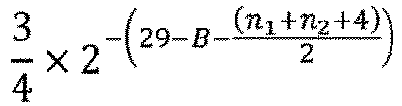

- Codierungsverfahren nach Anspruch 9, wobei in einer Festkommaimplementierung, falls s1 = 3 x 2n1 und s2 = 3 × 2n2 ist, der Skalierungsfaktor SQ gleich


- Decodierungsvorrichtung, die eine Kommunikationsschnittstelle, die dafür konfiguriert ist, auf einen Bitstrom zuzugreifen, und mindestens einen Prozessor umfasst, wobei der mindestens eine Prozessor konfiguriert ist zum:- Decodieren eines Blocks von Transformationskoeffizienten aus dem Bitstrom, auf den zugegriffen wird;- Dequantisieren des decodierten Blocks von Transformationskoeffizienten reagierend auf eine Quantisierungsschrittweite und auf einen Skalierungsfaktor, um einen dequantisierten Block zu erhalten; und- Transformieren des dequantisierten Blocks in einen Bildblock der Bittiefe B,dadurch gekennzeichnet, dass,
falls s1 = 3 × 2n1 und s2 = 2n2 ist, der Skalierungsfaktor SIQ im Wesentlichen gleich
und wobei, falls s1 = 3 × 2n1 und s2 = 3 × 2n2 ist, der Skalierungsfaktor SIQ im Wesentlichen gleich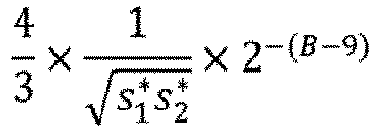
- Decodierungsvorrichtung nach Anspruch 11, wobei, falls s1 = 3 × 2n1 und s2 = 2n2 ist, der Skalierungsfaktor SIQ im Wesentlichen gleich
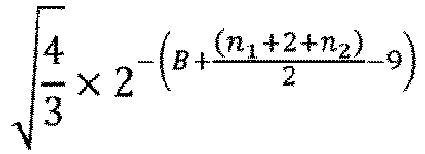

- Decodierungsvorrichtung nach Anspruch 12, wobei in einer Festkommaimplementierung, falls s1 = 3 x 2n1 und s2 = 2n2 ist, der Skalierungsfaktor SIQ gleich


- Decodierungsvorrichtung nach einem der Ansprüche 11 bis 13, wobei, falls s1 = 3 × 2n1 und s2 = 3 × 2n2 ist, der Skalierungsfaktor SIQ im Wesentlichen gleich
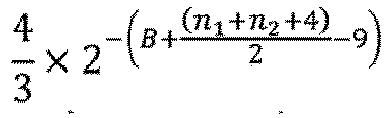
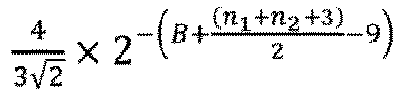
- Decodierungsvorrichtung nach Anspruch 14, wobei in einer Festkommaimplementierung, falls s1 = 3 × 2n1 und s2 = 3 × 2n2 ist, der Skalierungsfaktor SIQ gleich


- Codierungsvorrichtung, die eine Kommunikationsschnittstelle, die dafür konfiguriert ist, auf einen Bildblock zuzugreifen, und mindestens einen Prozessor umfasst, wobei der mindestens eine Prozessor konfiguriert ist zum:- Transformieren des Bildblocks, auf den zugegriffen wird, der Bittiefe B in einen Block von Transformationskoeffizienten;- Quantisieren des Blocks von Transformationskoeffizienten reagierend auf eine Quantisierungsschrittweite und auf einen Skalierungsfaktor, um einen quantisierten Block zu erhalten; und- Codieren des dequantisierten Blocks in einen Bitstrom;dadurch gekennzeichnet, dass,
falls s1 = 3 × 2n1 und s2 = 2n2 ist, der Skalierungsfaktor SQ im Wesentlichen gleich

- Codierungsvorrichtung nach Anspruch 16, wobei, falls s1 = 3 × 2n1 und s2 = 2n2 ist, der Skalierungsfaktor SQ im Wesentlichen gleich
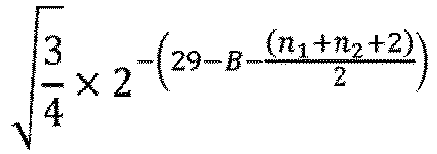

- Codierungsvorrichtung nach Anspruch 17, wobei in einer Festkommaimplementierung, falls s1 = 3 × 2n1 und s2 = 2n2 ist, der Skalierungsfaktor SQ gleich


- Codierungsvorrichtung nach einem der Ansprüche 16 bis 18, wobei, falls s1 = 3 × 2n1 und s2 = 3 × 2n2 ist, der Skalierungsfaktor SQ im Wesentlichen gleich
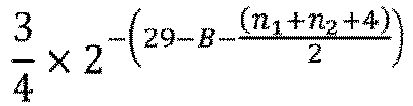
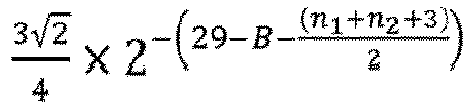
- Codierungsvorrichtung nach Anspruch 19, wobei in einer Festkommaimplementierung, falls s1 = 3 × 2n1 und s2 = 3 × 2n2 ist, der Skalierungsfaktor SQ gleich


Applications Claiming Priority (2)
| Application Number | Priority Date | Filing Date | Title |
|---|---|---|---|
| EP17305034.5A EP3349452A1 (de) | 2017-01-11 | 2017-01-11 | Skalierung von transformkoeffizienten für nicht-dyadische transformblöcke |
| PCT/EP2017/084599 WO2018130414A1 (en) | 2017-01-11 | 2017-12-27 | Scaling of transform coefficients for non-dyadic transform blocks |
Publications (2)
| Publication Number | Publication Date |
|---|---|
| EP3568982A1 EP3568982A1 (de) | 2019-11-20 |
| EP3568982B1 true EP3568982B1 (de) | 2020-12-02 |
Family
ID=57868187
Family Applications (2)
| Application Number | Title | Priority Date | Filing Date |
|---|---|---|---|
| EP17305034.5A Withdrawn EP3349452A1 (de) | 2017-01-11 | 2017-01-11 | Skalierung von transformkoeffizienten für nicht-dyadische transformblöcke |
| EP17822705.4A Active EP3568982B1 (de) | 2017-01-11 | 2017-12-27 | Skalierung von transformkoeffizienten für nicht-dyadische transformblöcke |
Family Applications Before (1)
| Application Number | Title | Priority Date | Filing Date |
|---|---|---|---|
| EP17305034.5A Withdrawn EP3349452A1 (de) | 2017-01-11 | 2017-01-11 | Skalierung von transformkoeffizienten für nicht-dyadische transformblöcke |
Country Status (3)
| Country | Link |
|---|---|
| US (1) | US10939108B2 (de) |
| EP (2) | EP3349452A1 (de) |
| WO (1) | WO2018130414A1 (de) |
Families Citing this family (14)
| Publication number | Priority date | Publication date | Assignee | Title |
|---|---|---|---|---|
| EP3846470A4 (de) | 2018-08-31 | 2022-05-11 | Samsung Electronics Co., Ltd. | Videodecodierungsverfahren und -vorrichtung sowie videocodierungsverfahren und -vorrichtung |
| CN114616826B (zh) | 2019-08-06 | 2026-04-28 | Op方案有限责任公司 | 基于帧类型的自适应分辨率管理的隐式标识 |
| WO2021026322A1 (en) | 2019-08-06 | 2021-02-11 | Op Solutions | Block-based adaptive resolution management |
| WO2021026334A1 (en) * | 2019-08-06 | 2021-02-11 | Op Solutions | Adaptive resolution management signaling |
| MX2022001592A (es) | 2019-08-06 | 2022-03-11 | Op Solutions Llc | Método de gestión de resolución adaptativa para reajuste de predicción. |
| BR112022002195A2 (pt) * | 2019-08-06 | 2022-10-18 | Op Solutions Llc | Sinalização de gerenciamento de resolução adaptativa |
| JP7528944B2 (ja) * | 2019-09-06 | 2024-08-06 | ソニーグループ株式会社 | 画像処理装置および方法 |
| KR20220092962A (ko) | 2019-11-08 | 2022-07-04 | 오피 솔루션즈, 엘엘씨 | 적응적 크롭핑을 위한 방법들 및 시스템들 |
| WO2022174762A1 (en) | 2021-02-20 | 2022-08-25 | Beijing Bytedance Network Technology Co., Ltd. | Transforms on non-dyadic blocks |
| WO2022179404A1 (en) | 2021-02-23 | 2022-09-01 | Beijing Bytedance Network Technology Co., Ltd. | Residual coding on non-dyadic blocks |
| WO2022179414A1 (en) * | 2021-02-23 | 2022-09-01 | Beijing Bytedance Network Technology Co., Ltd. | Transform and quantization on non-dyadic blocks |
| CN118266216A (zh) * | 2021-11-10 | 2024-06-28 | 抖音视界有限公司 | 非二进分数块的基于数组的残差编解码 |
| US12610082B2 (en) * | 2021-12-06 | 2026-04-21 | Intel Corporation | Unrestricted intra content to improve video quality of real-time encoding |
| US20250113031A1 (en) * | 2023-09-29 | 2025-04-03 | Tencent America LLC | Adaptive quantization shifting offset for video and image compression |
Family Cites Families (4)
| Publication number | Priority date | Publication date | Assignee | Title |
|---|---|---|---|---|
| US20120189052A1 (en) | 2011-01-24 | 2012-07-26 | Qualcomm Incorporated | Signaling quantization parameter changes for coded units in high efficiency video coding (hevc) |
| CA2828013C (en) | 2011-02-25 | 2016-07-26 | Blackberry Limited | Methods and devices for data compression using offset-based adaptive reconstruction levels |
| US10091504B2 (en) * | 2015-01-08 | 2018-10-02 | Microsoft Technology Licensing, Llc | Variations of rho-domain rate control |
| EP3306927A1 (de) | 2016-10-05 | 2018-04-11 | Thomson Licensing | Codierungs- und decodierungsverfahren und entsprechende vorrichtungen |
-
2017
- 2017-01-11 EP EP17305034.5A patent/EP3349452A1/de not_active Withdrawn
- 2017-12-27 WO PCT/EP2017/084599 patent/WO2018130414A1/en not_active Ceased
- 2017-12-27 EP EP17822705.4A patent/EP3568982B1/de active Active
- 2017-12-27 US US16/477,452 patent/US10939108B2/en active Active
Non-Patent Citations (1)
| Title |
|---|
| None * |
Also Published As
| Publication number | Publication date |
|---|---|
| WO2018130414A1 (en) | 2018-07-19 |
| EP3349452A1 (de) | 2018-07-18 |
| EP3568982A1 (de) | 2019-11-20 |
| US10939108B2 (en) | 2021-03-02 |
| US20200045313A1 (en) | 2020-02-06 |
Similar Documents
| Publication | Publication Date | Title |
|---|---|---|
| EP3568982B1 (de) | Skalierung von transformkoeffizienten für nicht-dyadische transformblöcke | |
| US20250317563A1 (en) | Methods and apparatus for picture encoding and decoding | |
| US12581133B2 (en) | Video encoding method for encoding division block, video decoding method for decoding division block, and recording medium for implementing the same | |
| EP3804337B1 (de) | Blockbasiertes adaptives schleifenfilterdesign und signalisierung | |
| CN112789863B (zh) | 帧内预测方法及设备 | |
| EP3639518B1 (de) | Anwendung von intrafilterung gemeinsam mit transformationsverarbeitung in der videocodierung | |
| EP2774360B1 (de) | Intraprädiktion mit differentieller pulscodemodulation für hocheffiziente videocodierung | |
| EP3381186B1 (de) | Videocodierung mit codiereinheiten die sowohl inter- als auch intra-prädiktionseinheiten enthalten | |
| EP4207759A1 (de) | Verfahren und vorrichtung zur bildcodierung und -decodierung | |
| US11032542B2 (en) | Method and a device for image encoding and decoding | |
| CN111213382B (zh) | 用于视频编码和解码中的自适应变换的方法和装置 | |
| KR20200096227A (ko) | 블록 형상에 기초한 비디오 인코딩 및 디코딩을 위한 방법 및 장치 | |
| EP3364656A1 (de) | Verfahren zur kodierung von sao filterwerten | |
| US11483576B2 (en) | Method and a device for picture encoding and decoding | |
| KR20190031558A (ko) | 이미지 블록 인코딩 및 디코딩을 위한 방법 및 장치 | |
| CN117044213A (zh) | 对非二元块的变换与量化 | |
| KR102950841B1 (ko) | 차등 부호화를 이용하는 영상 복호화 장치 | |
| EP3709647A1 (de) | Transformationsauswahl und signalisierung zur videocodierung oder -decodierung | |
| CN119496895A (zh) | 视频编解码方法、装置、电子设备和计算机可读存储介质 | |
| KR20110087871A (ko) | 인트라 모드를 이용한 쿼터 픽셀 해상도를 갖는 영상 보간 방법 및 장치 | |
| EP3518542A1 (de) | Verfahren und vorrichtungen zur bildcodierung und -decodierung unter verwendung mehrerer tranformationen | |
| KR20260053257A (ko) | 차등 부호화를 이용하는 영상 복호화 장치 | |
| KR20190091431A (ko) | 인트라 모드를 이용한 쿼터 픽셀 해상도를 갖는 영상 보간 방법 및 장치 |
Legal Events
| Date | Code | Title | Description |
|---|---|---|---|
| STAA | Information on the status of an ep patent application or granted ep patent |
Free format text: STATUS: UNKNOWN |
|
| STAA | Information on the status of an ep patent application or granted ep patent |
Free format text: STATUS: THE INTERNATIONAL PUBLICATION HAS BEEN MADE |
|
| PUAI | Public reference made under article 153(3) epc to a published international application that has entered the european phase |
Free format text: ORIGINAL CODE: 0009012 |
|
| STAA | Information on the status of an ep patent application or granted ep patent |
Free format text: STATUS: REQUEST FOR EXAMINATION WAS MADE |
|
| 17P | Request for examination filed |
Effective date: 20190711 |
|
| AK | Designated contracting states |
Kind code of ref document: A1 Designated state(s): AL AT BE BG CH CY CZ DE DK EE ES FI FR GB GR HR HU IE IS IT LI LT LU LV MC MK MT NL NO PL PT RO RS SE SI SK SM TR |
|
| AX | Request for extension of the european patent |
Extension state: BA ME |
|
| RAP1 | Party data changed (applicant data changed or rights of an application transferred) |
Owner name: INTERDIGITAL VC HOLDINGS, INC. |
|
| DAV | Request for validation of the european patent (deleted) | ||
| DAX | Request for extension of the european patent (deleted) | ||
| GRAP | Despatch of communication of intention to grant a patent |
Free format text: ORIGINAL CODE: EPIDOSNIGR1 |
|
| STAA | Information on the status of an ep patent application or granted ep patent |
Free format text: STATUS: GRANT OF PATENT IS INTENDED |
|
| INTG | Intention to grant announced |
Effective date: 20200811 |
|
| GRAS | Grant fee paid |
Free format text: ORIGINAL CODE: EPIDOSNIGR3 |
|
| GRAA | (expected) grant |
Free format text: ORIGINAL CODE: 0009210 |
|
| STAA | Information on the status of an ep patent application or granted ep patent |
Free format text: STATUS: THE PATENT HAS BEEN GRANTED |
|
| AK | Designated contracting states |
Kind code of ref document: B1 Designated state(s): AL AT BE BG CH CY CZ DE DK EE ES FI FR GB GR HR HU IE IS IT LI LT LU LV MC MK MT NL NO PL PT RO RS SE SI SK SM TR |
|
| REG | Reference to a national code |
Ref country code: GB Ref legal event code: FG4D |
|
| REG | Reference to a national code |
Ref country code: AT Ref legal event code: REF Ref document number: 1342229 Country of ref document: AT Kind code of ref document: T Effective date: 20201215 Ref country code: CH Ref legal event code: EP |
|
| REG | Reference to a national code |
Ref country code: IE Ref legal event code: FG4D |
|
| REG | Reference to a national code |
Ref country code: DE Ref legal event code: R096 Ref document number: 602017028988 Country of ref document: DE |
|
| PG25 | Lapsed in a contracting state [announced via postgrant information from national office to epo] |
Ref country code: RS Free format text: LAPSE BECAUSE OF FAILURE TO SUBMIT A TRANSLATION OF THE DESCRIPTION OR TO PAY THE FEE WITHIN THE PRESCRIBED TIME-LIMIT Effective date: 20201202 Ref country code: FI Free format text: LAPSE BECAUSE OF FAILURE TO SUBMIT A TRANSLATION OF THE DESCRIPTION OR TO PAY THE FEE WITHIN THE PRESCRIBED TIME-LIMIT Effective date: 20201202 Ref country code: NO Free format text: LAPSE BECAUSE OF FAILURE TO SUBMIT A TRANSLATION OF THE DESCRIPTION OR TO PAY THE FEE WITHIN THE PRESCRIBED TIME-LIMIT Effective date: 20210302 Ref country code: GR Free format text: LAPSE BECAUSE OF FAILURE TO SUBMIT A TRANSLATION OF THE DESCRIPTION OR TO PAY THE FEE WITHIN THE PRESCRIBED TIME-LIMIT Effective date: 20210303 |
|
| REG | Reference to a national code |
Ref country code: NL Ref legal event code: MP Effective date: 20201202 |
|
| REG | Reference to a national code |
Ref country code: AT Ref legal event code: MK05 Ref document number: 1342229 Country of ref document: AT Kind code of ref document: T Effective date: 20201202 |
|
| PG25 | Lapsed in a contracting state [announced via postgrant information from national office to epo] |
Ref country code: PL Free format text: LAPSE BECAUSE OF FAILURE TO SUBMIT A TRANSLATION OF THE DESCRIPTION OR TO PAY THE FEE WITHIN THE PRESCRIBED TIME-LIMIT Effective date: 20201202 Ref country code: LV Free format text: LAPSE BECAUSE OF FAILURE TO SUBMIT A TRANSLATION OF THE DESCRIPTION OR TO PAY THE FEE WITHIN THE PRESCRIBED TIME-LIMIT Effective date: 20201202 Ref country code: SE Free format text: LAPSE BECAUSE OF FAILURE TO SUBMIT A TRANSLATION OF THE DESCRIPTION OR TO PAY THE FEE WITHIN THE PRESCRIBED TIME-LIMIT Effective date: 20201202 Ref country code: BG Free format text: LAPSE BECAUSE OF FAILURE TO SUBMIT A TRANSLATION OF THE DESCRIPTION OR TO PAY THE FEE WITHIN THE PRESCRIBED TIME-LIMIT Effective date: 20210302 |
|
| PG25 | Lapsed in a contracting state [announced via postgrant information from national office to epo] |
Ref country code: NL Free format text: LAPSE BECAUSE OF FAILURE TO SUBMIT A TRANSLATION OF THE DESCRIPTION OR TO PAY THE FEE WITHIN THE PRESCRIBED TIME-LIMIT Effective date: 20201202 Ref country code: HR Free format text: LAPSE BECAUSE OF FAILURE TO SUBMIT A TRANSLATION OF THE DESCRIPTION OR TO PAY THE FEE WITHIN THE PRESCRIBED TIME-LIMIT Effective date: 20201202 |
|
| REG | Reference to a national code |
Ref country code: LT Ref legal event code: MG9D |
|
| PG25 | Lapsed in a contracting state [announced via postgrant information from national office to epo] |
Ref country code: PT Free format text: LAPSE BECAUSE OF FAILURE TO SUBMIT A TRANSLATION OF THE DESCRIPTION OR TO PAY THE FEE WITHIN THE PRESCRIBED TIME-LIMIT Effective date: 20210405 Ref country code: SK Free format text: LAPSE BECAUSE OF FAILURE TO SUBMIT A TRANSLATION OF THE DESCRIPTION OR TO PAY THE FEE WITHIN THE PRESCRIBED TIME-LIMIT Effective date: 20201202 Ref country code: RO Free format text: LAPSE BECAUSE OF FAILURE TO SUBMIT A TRANSLATION OF THE DESCRIPTION OR TO PAY THE FEE WITHIN THE PRESCRIBED TIME-LIMIT Effective date: 20201202 Ref country code: SM Free format text: LAPSE BECAUSE OF FAILURE TO SUBMIT A TRANSLATION OF THE DESCRIPTION OR TO PAY THE FEE WITHIN THE PRESCRIBED TIME-LIMIT Effective date: 20201202 Ref country code: EE Free format text: LAPSE BECAUSE OF FAILURE TO SUBMIT A TRANSLATION OF THE DESCRIPTION OR TO PAY THE FEE WITHIN THE PRESCRIBED TIME-LIMIT Effective date: 20201202 Ref country code: CZ Free format text: LAPSE BECAUSE OF FAILURE TO SUBMIT A TRANSLATION OF THE DESCRIPTION OR TO PAY THE FEE WITHIN THE PRESCRIBED TIME-LIMIT Effective date: 20201202 Ref country code: LT Free format text: LAPSE BECAUSE OF FAILURE TO SUBMIT A TRANSLATION OF THE DESCRIPTION OR TO PAY THE FEE WITHIN THE PRESCRIBED TIME-LIMIT Effective date: 20201202 |
|
| REG | Reference to a national code |
Ref country code: CH Ref legal event code: PL |
|
| PG25 | Lapsed in a contracting state [announced via postgrant information from national office to epo] |
Ref country code: AT Free format text: LAPSE BECAUSE OF FAILURE TO SUBMIT A TRANSLATION OF THE DESCRIPTION OR TO PAY THE FEE WITHIN THE PRESCRIBED TIME-LIMIT Effective date: 20201202 |
|
| REG | Reference to a national code |
Ref country code: DE Ref legal event code: R097 Ref document number: 602017028988 Country of ref document: DE Ref country code: BE Ref legal event code: MM Effective date: 20201231 |
|
| PG25 | Lapsed in a contracting state [announced via postgrant information from national office to epo] |
Ref country code: IS Free format text: LAPSE BECAUSE OF FAILURE TO SUBMIT A TRANSLATION OF THE DESCRIPTION OR TO PAY THE FEE WITHIN THE PRESCRIBED TIME-LIMIT Effective date: 20210402 Ref country code: MC Free format text: LAPSE BECAUSE OF FAILURE TO SUBMIT A TRANSLATION OF THE DESCRIPTION OR TO PAY THE FEE WITHIN THE PRESCRIBED TIME-LIMIT Effective date: 20201202 |
|
| PLBE | No opposition filed within time limit |
Free format text: ORIGINAL CODE: 0009261 |
|
| STAA | Information on the status of an ep patent application or granted ep patent |
Free format text: STATUS: NO OPPOSITION FILED WITHIN TIME LIMIT |
|
| PG25 | Lapsed in a contracting state [announced via postgrant information from national office to epo] |
Ref country code: IT Free format text: LAPSE BECAUSE OF FAILURE TO SUBMIT A TRANSLATION OF THE DESCRIPTION OR TO PAY THE FEE WITHIN THE PRESCRIBED TIME-LIMIT Effective date: 20201202 Ref country code: LU Free format text: LAPSE BECAUSE OF NON-PAYMENT OF DUE FEES Effective date: 20201227 Ref country code: AL Free format text: LAPSE BECAUSE OF FAILURE TO SUBMIT A TRANSLATION OF THE DESCRIPTION OR TO PAY THE FEE WITHIN THE PRESCRIBED TIME-LIMIT Effective date: 20201202 Ref country code: IE Free format text: LAPSE BECAUSE OF NON-PAYMENT OF DUE FEES Effective date: 20201227 |
|
| 26N | No opposition filed |
Effective date: 20210903 |
|
| PG25 | Lapsed in a contracting state [announced via postgrant information from national office to epo] |
Ref country code: SI Free format text: LAPSE BECAUSE OF FAILURE TO SUBMIT A TRANSLATION OF THE DESCRIPTION OR TO PAY THE FEE WITHIN THE PRESCRIBED TIME-LIMIT Effective date: 20201202 Ref country code: CH Free format text: LAPSE BECAUSE OF NON-PAYMENT OF DUE FEES Effective date: 20201231 Ref country code: DK Free format text: LAPSE BECAUSE OF FAILURE TO SUBMIT A TRANSLATION OF THE DESCRIPTION OR TO PAY THE FEE WITHIN THE PRESCRIBED TIME-LIMIT Effective date: 20201202 Ref country code: LI Free format text: LAPSE BECAUSE OF NON-PAYMENT OF DUE FEES Effective date: 20201231 |
|
| PG25 | Lapsed in a contracting state [announced via postgrant information from national office to epo] |
Ref country code: ES Free format text: LAPSE BECAUSE OF FAILURE TO SUBMIT A TRANSLATION OF THE DESCRIPTION OR TO PAY THE FEE WITHIN THE PRESCRIBED TIME-LIMIT Effective date: 20201202 |
|
| PG25 | Lapsed in a contracting state [announced via postgrant information from national office to epo] |
Ref country code: IS Free format text: LAPSE BECAUSE OF FAILURE TO SUBMIT A TRANSLATION OF THE DESCRIPTION OR TO PAY THE FEE WITHIN THE PRESCRIBED TIME-LIMIT Effective date: 20210402 Ref country code: TR Free format text: LAPSE BECAUSE OF FAILURE TO SUBMIT A TRANSLATION OF THE DESCRIPTION OR TO PAY THE FEE WITHIN THE PRESCRIBED TIME-LIMIT Effective date: 20201202 Ref country code: MT Free format text: LAPSE BECAUSE OF FAILURE TO SUBMIT A TRANSLATION OF THE DESCRIPTION OR TO PAY THE FEE WITHIN THE PRESCRIBED TIME-LIMIT Effective date: 20201202 Ref country code: CY Free format text: LAPSE BECAUSE OF FAILURE TO SUBMIT A TRANSLATION OF THE DESCRIPTION OR TO PAY THE FEE WITHIN THE PRESCRIBED TIME-LIMIT Effective date: 20201202 |
|
| PG25 | Lapsed in a contracting state [announced via postgrant information from national office to epo] |
Ref country code: MK Free format text: LAPSE BECAUSE OF FAILURE TO SUBMIT A TRANSLATION OF THE DESCRIPTION OR TO PAY THE FEE WITHIN THE PRESCRIBED TIME-LIMIT Effective date: 20201202 |
|
| PG25 | Lapsed in a contracting state [announced via postgrant information from national office to epo] |
Ref country code: BE Free format text: LAPSE BECAUSE OF NON-PAYMENT OF DUE FEES Effective date: 20201231 |
|
| P01 | Opt-out of the competence of the unified patent court (upc) registered |
Effective date: 20230514 |
|
| PGFP | Annual fee paid to national office [announced via postgrant information from national office to epo] |
Ref country code: GB Payment date: 20251223 Year of fee payment: 9 |
|
| PGFP | Annual fee paid to national office [announced via postgrant information from national office to epo] |
Ref country code: FR Payment date: 20251223 Year of fee payment: 9 |
|
| PGFP | Annual fee paid to national office [announced via postgrant information from national office to epo] |
Ref country code: DE Payment date: 20251229 Year of fee payment: 9 |