EP3569089A1 - Kreuzstichverfahren zur montage von obermaterial anhand des schnürleistensystems - Google Patents
Kreuzstichverfahren zur montage von obermaterial anhand des schnürleistensystems Download PDFInfo
- Publication number
- EP3569089A1 EP3569089A1 EP17891697.9A EP17891697A EP3569089A1 EP 3569089 A1 EP3569089 A1 EP 3569089A1 EP 17891697 A EP17891697 A EP 17891697A EP 3569089 A1 EP3569089 A1 EP 3569089A1
- Authority
- EP
- European Patent Office
- Prior art keywords
- string
- stitching
- assembly
- traction
- mold
- Prior art date
- Legal status (The legal status is an assumption and is not a legal conclusion. Google has not performed a legal analysis and makes no representation as to the accuracy of the status listed.)
- Granted
Links
Images




Classifications
-
- A—HUMAN NECESSITIES
- A43—FOOTWEAR
- A43B—CHARACTERISTIC FEATURES OF FOOTWEAR; PARTS OF FOOTWEAR
- A43B9/00—Footwear characterised by the assembling of the individual parts
- A43B9/02—Footwear stitched or nailed through
-
- A—HUMAN NECESSITIES
- A43—FOOTWEAR
- A43D—MACHINES, TOOLS, EQUIPMENT OR METHODS FOR MANUFACTURING OR REPAIRING FOOTWEAR
- A43D119/00—Driving or controlling mechanisms of shoe machines; Frames for shoe machines
-
- A—HUMAN NECESSITIES
- A43—FOOTWEAR
- A43D—MACHINES, TOOLS, EQUIPMENT OR METHODS FOR MANUFACTURING OR REPAIRING FOOTWEAR
- A43D21/00—Lasting machines
-
- A—HUMAN NECESSITIES
- A43—FOOTWEAR
- A43D—MACHINES, TOOLS, EQUIPMENT OR METHODS FOR MANUFACTURING OR REPAIRING FOOTWEAR
- A43D21/00—Lasting machines
- A43D21/003—Lasting machines with lasting strings, stretching straps or the like, for forming the shank portions of shoes
-
- A—HUMAN NECESSITIES
- A43—FOOTWEAR
- A43D—MACHINES, TOOLS, EQUIPMENT OR METHODS FOR MANUFACTURING OR REPAIRING FOOTWEAR
- A43D9/00—Devices for binding the uppers upon the lasts
Definitions
- the invention particularly concerns a "X" stitching method, intended for the mounting of uppers using the so-called stringlaster system, with particular application in the footwear segment.
- the string stitching method commonly used for the manual assembly of uppers, adopted a fabric latch in the region of the shank, or central region of the sole of the shoe, with the aim of fitting and sealing the upper to the mold, in this region.
- the string traction acted on the whole region of the toe and the rear, in order to complete the assembly.
- the method hereby proposed arises associated with a new shoe-assembly technology, which includes a machine for the shoe-assembly by string-traction, with tools, a modeling technique and a stitching strategy, capable of assembling shoes, in a single procedure, with greater productivity, quality and comfort, and at a reduced cost.
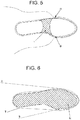
- Assembly by string traction with a strategy of only stitching the outer edge of the upper, without the X stitching, causes a separation and an undesirable gap between the upper and the mold, figure 6 , position T and Figure 7 , position T, when the profile of the mold is a negative curve, Figure 6 , position N and Figure 7 , position N, at the time of assembly, which is to say, in the string traction.
- the curve of the mold is negative in two situations: on the reference plane Z or vertical plane ( Figure 6 ), and on the references plane X or Y ( Figure 7 ).
- the string traction s the upper and applies pressure to the mold only when the curves are positive.
- the invention comprises a methodology with X stitching, using an overlock machine or one with a similar function, applied to an upper, for assembling shoes, in order to provide cross vector tractioning, resulting in full, proportional, symmetric and simultaneous fitting of the upper, to the body and the sole of the mold, in the region of the insole, fully encompassing the three different areas of the assembly of shoes, such as the toe, the area in the region of the shank and the rear.
- the order of the stitching of the "X" methodology hereby described can be reversed, or mirrored, or initiated or terminated, at other points of the circuit, depending on the stitching equipment available, or the operator's preference.
- the method of this invention has the aim, through this methodology or stitching strategy, of developing the system known as string (stringlaster), which was restricted to the assembly of light shoes, and to revolutionize the current form of assembly, of any models of industrialized shoes, in the world.
- string stringlaster
- This methodology was developed to complement and encompass the use of the machine already mentioned in this patent application, for full assembly of shoe uppers, of all known types and designs (models), made from synthetic materials or leather, of various levels of thickness, structured by internal components, or not, such as: men's, women's and children's shoes, for various fields of application, such as sports, casual, social, orthopedics, safety shoes, of different models, such as boots, booties, closed toe shoes, sneakers, peep toes, sandals, tennis shoes, moccasins, etc.
- the "X” stitching strategy was developed to resolve technical and economic limitations, concerning the assembly of shoes using the string traction system, allowing for the assembly of shoes in a single operation, with gains in quality and comfort, and remaining faithful to the aesthetic concepts of the model, through new concepts of technical modeling of shoes, associated with the equipment previously cited, developed, conceived and improved, for this process, by the applicant. It has a principal objective of reducing various operating costs, including savings regarding electricity, raw materials, industrial waste, rationalization of labor and complementary operations; moreover, the method is responsible for improving the quality of work of the operators and brings speed to the production of shoes, becoming fundamental to the increase in "percapta" productivity of assembly lines.
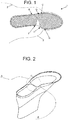
- the methodology of the "X" string stitching system fulfills, by itself, all the needs of traction vectorization, applied to the "X" upper as shown in Figure 4 , at the time of the assembly of this upper on the mold or "Z” matrix of Figure 4 , in accordance with the "V" vectors indicated in Figure 3 , when the ends of the string A and B are tractioned in the direction also indicated in Figure 3 .
- the correct positioning and sequence of application of the stitching wholly fulfill the sealing of the upper to the body and sole of the mold, in the region of the insole, completely covering the three different areas of the assembly of shoes, such as as the toe, the area in the region of the shank and the rear, in the act of assembly, as shown in Figure 3 .
- the assembly of string traction occurs by applying a traction force to a string, stitched in the lower edges of an upper, which will be compressed, by traction, against a mold, until these edges close.
- the direction of the movement of the edges, exerted by the traction of the string is downwards and towards the center of the mold.
- This traction is intended to fully seal the upper and eliminate any spaces or wrinkles that might affect the perfect sealing of the upper, originally on a 2D plane, as it is produced on and around a three-dimensional 3D mold, which translates the anatomical mold of the human foot.
- This "X" methodology of stitching and assembling shoes can be applied to all models of shoes and all known heights of heels, such as shoes without heels or flat type sneakers, tennis and children's shoes, sandals, men's shoes, safety and occupational shoes, and even pumps and high-heeled women's boots.
- the sole can be glued or directly injected.
- the "X" stitching methodology and strategy is the link that was missing for the evolution of the process of assembling shoes using the string method, considering that, when associated with other developments of the process such as directed modeling, string traction machinery (stringlaster), with proportional control and with directed tools (String Guide Module, for example), in accordance with the development and patent of the applicant, with its techniques of application, provide the market with a new and efficient assembly technology capable of covering all known models of shoes, with gains in quality, comfort, production cost, reduction of raw material consumption and a consequent reduction in the production of waste, energy savings and improvements in the quality of operators' work.
- the applicant has developed and requested the patent of a device for assembling uppers by string traction, with intelligent control of speed and power, rear support for the mold, string guide roll, verticals and horizontal adjustments, and transparent protection, among other resources, capable of assembling, in a single procedure, all known models of shoes, no longer restricting the string method to the assembly of light shoes.
- the applicant developed a modeling methodology for the adaptation of models assembled by the traditional methods, to the string method. This methodology had already created advances when compared to the traditional modelling methods, because it enabled a more economical and assertive constructive mold, bringing greater quality and comfort to the shoe, reducing assembly margins, replacing more rigid components, with more flexible and cheaper components, consequently reducing the production of waste.
- the assembly system proposed by the applicant also reduced the need for multiple reheating of the upper, for gluing and shaping, which led to a reduction in the consumption of electrical energy.
- "X” STITCHIING METHOD FOR THE MOUNTING OF UPPERS BY THE STRING-LASTING SYSTEM comprises a methodology with "X” stitching, using an overlock machine or one with a similar function, applied to an upper (1), for the assembly of shoes, in order to provide cross vector traction, resulting in the full, proportional, symmetric and simultaneous fitting of the upper (1), to the body and sole of the mold (3), in the region of the insole, completely covering the three different areas of assembly of shoes, such as the toe, the area in the region of the shank and the rear.
- the order of the "X" stitching methodology, described herein, can be reversed, or mirrored, or initiated or terminated, at other points of the circuit, depending on the stitching equipment available, or the operator's preference.
- An alternative example to the overlock stitching can be the application of the "X" stitching methodology using a programmable automatic sewing machine, CNC, with a Cartesian coordinate table, with or without the third or fourth axle integrated, with a view to increasing the speed of the process, but without discarding other sewing machines, such as zigzag, or even manual sewing.
- the example of realization hereby used will be the overlock stitching type applied to an upper (1), for the full assembly of shoes, using string traction (2) as the element responsible for closing the edges of this upper (1), against a mold (3), whose shape reproduces the anatomy of the human foot. It is important to clarify that the position in which the upper (1) is found in the mold, at the time of the stitching - front or back -, does not modify the result of the stitching.
- the assembly of shoes by string traction occurs by exerting a traction force on a string (2), sewn on the lower edges of an upper (1), which is compressed, by the traction, against a mold (3), until these edges close.
- the direction of the movement of the edges, exerted by the string traction (2) is downward and towards the center of the mold.
- This tractioning is intended to fully seal the upper (1) and remove any gaps or wrinkles that may prejudice the perfect sealing of the upper, originally on a 2D plane, as it is produced, on and around a three-dimensional mold (3D) (3), which translates the anatomical mold of the human foot.
- This "X" stitching and assembly methodology of shoes applies to all models of shoes and all known heights of heels, such as shoes without heels or flat type sneakers, tennis and children's shoes, sandals, men's shoes, safety and occupational shoes, and even pumps and high-heeled women's boots.
- the sole can be glued or directly injected.
- sequence of the methodology and strategy of the directional sequence of the overlock stitching (hereby used as an example of realization) on the edge of the upper (1), involving the string traction (2), comprises the following steps, with the direction of the stitching being from right to left or left to right:
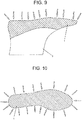
- the modeler can decide, based on the combined choice of the position of the "X" and the angle of the string traction (2), which region of the upper needs to be assembled first, so that the fitting of the upper (1) to the mold (3) is complete, proportional, symmetric and simultaneous.
- this model of shoe requires that the region of the instep of the foot, is the first region to be compressed against the mold, so that the fit is perfect and lateral wrinkles do not form during the assembly;
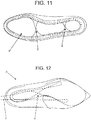
- Figure 11 shows a version of an upper (1) and insole (P) with a double "X" (X), with proportional fitting of the upper (1), at negative angles of the mold (3), without the need for metal or fabric latches.
- Figure 12 shows a model of pumps (S), with an enlarged upper (1) in the area of the shank (C), to enable fitting without a metal or fabric latch.
- Figure 13 shows a semi-bagged sneaker (S1), which is to say, with a fabric latch.
- Figure 14 shows the process of string traction (2), in a moccasin (M) with "X" (X) stitching, with said tractioning carried out on a tractioning machine (M1) in accordance with the patent application of the same applicant, where one observes the mold (3) and string traction module (M2), which performs the tractioning operation, once the "X" is realized.
- Figure 15 shows the process of the tractioning of the strings (2) in a boot (B1) with "X” stitching, with said tractioning being realized on a tractioning machine (M1) in accordance with the patent application of the same application, where one observes the mold (3) and the string traction module (M2), which performs the string tractioning operation, once the "X" is realized.
- M1 tractioning machine
Landscapes
- Footwear And Its Accessory, Manufacturing Method And Apparatuses (AREA)
Applications Claiming Priority (2)
| Application Number | Priority Date | Filing Date | Title |
|---|---|---|---|
| BR102017000611-5A BR102017000611B1 (pt) | 2017-01-11 | 2017-01-11 | Método de costura em "x" para montagem de cabedais pelo sistema cordão amarrado |
| PCT/BR2017/050057 WO2018129601A1 (pt) | 2017-01-11 | 2017-03-15 | Método de costura em "x" para montagem de cabedais pelo sistema cordão amarrado |
Publications (3)
| Publication Number | Publication Date |
|---|---|
| EP3569089A1 true EP3569089A1 (de) | 2019-11-20 |
| EP3569089A4 EP3569089A4 (de) | 2020-01-22 |
| EP3569089B1 EP3569089B1 (de) | 2025-05-07 |
Family
ID=62839169
Family Applications (1)
| Application Number | Title | Priority Date | Filing Date |
|---|---|---|---|
| EP17891697.9A Active EP3569089B1 (de) | 2017-01-11 | 2017-03-15 | Kreuzstichverfahren zur montage von obermaterial anhand des schnürleistensystems |
Country Status (9)
| Country | Link |
|---|---|
| US (1) | US11253031B2 (de) |
| EP (1) | EP3569089B1 (de) |
| CN (1) | CN110213974B (de) |
| BR (1) | BR102017000611B1 (de) |
| CO (1) | CO2019007403A2 (de) |
| ES (1) | ES3035569T3 (de) |
| MX (1) | MX2019008339A (de) |
| PT (1) | PT3569089T (de) |
| WO (1) | WO2018129601A1 (de) |
Cited By (1)
| Publication number | Priority date | Publication date | Assignee | Title |
|---|---|---|---|---|
| WO2023278345A1 (en) * | 2021-06-30 | 2023-01-05 | Nike Innovate C.V. | Methods of forming an article of footwear using a gathering system and articles formed by the same |
Families Citing this family (2)
| Publication number | Priority date | Publication date | Assignee | Title |
|---|---|---|---|---|
| US10993497B2 (en) | 2018-11-15 | 2021-05-04 | Under Armour, Inc. | Article with ribbon loops for string lasting |
| CN115644564B (zh) * | 2022-10-31 | 2024-12-24 | 际华三五一五皮革皮鞋有限公司 | 一种皮鞋鞋帮帮脚收口的工艺方法 |
Family Cites Families (10)
| Publication number | Priority date | Publication date | Assignee | Title |
|---|---|---|---|---|
| US1469222A (en) * | 1919-07-14 | 1923-10-02 | United Shoe Machinery Corp | Method of lasting shoes |
| US1833229A (en) * | 1930-01-29 | 1931-11-24 | Sahr Frank | Machine for lasting shoes |
| US3474475A (en) | 1968-03-04 | 1969-10-28 | Usm Corp | String lasting apparatus |
| IT1015280B (it) * | 1974-06-21 | 1977-05-10 | Toja E | Macchina per il montaggio di to tomaie direttamente sulle forme da montaggio |
| GB1551037A (en) * | 1976-06-25 | 1979-08-22 | Clarks Ltd | Manufacture of footwear |
| DE19738744A1 (de) * | 1997-09-04 | 1999-04-08 | Gore W L & Ass Gmbh | Schuh und Verfahren zu dessen Herstellung |
| DE10300012A1 (de) * | 2003-01-02 | 2004-07-22 | W.L. Gore & Associates Gmbh | Wasserdichtes Schuhwerk mit elastischem Verbindungsband |
| BR8300314U (pt) * | 2003-02-28 | 2004-11-30 | Urias Francisco Cintra | Sistema construtivo para calçados |
| BR102015013357B1 (pt) * | 2015-06-09 | 2019-02-05 | I.S.A. Indústria de Tecnologia e Automação LTDA - EPP | máquina para montagem de cabedal com tracionador de cordões |
| CN106263287B (zh) * | 2016-09-14 | 2021-09-07 | 台州市创先电子科技有限公司 | 鞋帮和鞋帮缩口定型方法 |
-
2017
- 2017-01-11 BR BR102017000611-5A patent/BR102017000611B1/pt active IP Right Grant
- 2017-03-15 CN CN201780083222.6A patent/CN110213974B/zh active Active
- 2017-03-15 ES ES17891697T patent/ES3035569T3/es active Active
- 2017-03-15 US US16/477,069 patent/US11253031B2/en active Active
- 2017-03-15 WO PCT/BR2017/050057 patent/WO2018129601A1/pt not_active Ceased
- 2017-03-15 MX MX2019008339A patent/MX2019008339A/es unknown
- 2017-03-15 EP EP17891697.9A patent/EP3569089B1/de active Active
- 2017-03-15 PT PT178916979T patent/PT3569089T/pt unknown
-
2019
- 2019-07-10 CO CONC2019/0007403A patent/CO2019007403A2/es unknown
Cited By (2)
| Publication number | Priority date | Publication date | Assignee | Title |
|---|---|---|---|---|
| WO2023278345A1 (en) * | 2021-06-30 | 2023-01-05 | Nike Innovate C.V. | Methods of forming an article of footwear using a gathering system and articles formed by the same |
| US12285081B2 (en) | 2021-06-30 | 2025-04-29 | Nike, Inc. | Methods of forming an article of footwear using a gathering system and articles formed by the same |
Also Published As
| Publication number | Publication date |
|---|---|
| PT3569089T (pt) | 2025-07-04 |
| MX2019008339A (es) | 2019-10-15 |
| EP3569089A4 (de) | 2020-01-22 |
| CO2019007403A2 (es) | 2019-10-09 |
| CN110213974A (zh) | 2019-09-06 |
| US11253031B2 (en) | 2022-02-22 |
| WO2018129601A1 (pt) | 2018-07-19 |
| CN110213974B (zh) | 2022-09-06 |
| BR102017000611B1 (pt) | 2020-02-18 |
| BR102017000611A2 (pt) | 2018-07-31 |
| EP3569089B1 (de) | 2025-05-07 |
| US20190328086A1 (en) | 2019-10-31 |
| ES3035569T3 (en) | 2025-09-04 |
Similar Documents
| Publication | Publication Date | Title |
|---|---|---|
| Luximon et al. | Shoe-last design innovation for better shoe fitting | |
| CN102626995B (zh) | 鞋及相关制造方法 | |
| EP3569089B1 (de) | Kreuzstichverfahren zur montage von obermaterial anhand des schnürleistensystems | |
| US2420466A (en) | Welted moccasin and method of making it | |
| US1844885A (en) | Ballet slipper and method of making the same | |
| EP3578071B1 (de) | Schnürenführungsmodul für schuhe | |
| US2147455A (en) | Rigid-bottomed shoe with skate attached | |
| FI90302C (fi) | Laskettelukenkien muokkausmenetelmä | |
| US2354903A (en) | Shoe | |
| US2595894A (en) | Insole having separate attached sewing ribs | |
| US2266774A (en) | Machine for use in operating upon shoe uppers | |
| US2301311A (en) | Manufacture of welt shoes | |
| US2186141A (en) | Method of preparing prewelt shoe uppers | |
| US2845724A (en) | Turned slipper having vamp portions free of outsole | |
| US1103937A (en) | Method of making shoes. | |
| CN105962534A (zh) | 一种皮鞋及其制作工艺 | |
| US2448301A (en) | Method of making shoes with upwardly deflected soles | |
| US2946070A (en) | Method of making turned slippers | |
| US212131A (en) | Improvement in dies for cutting the uppers of boots and shoes | |
| US2719311A (en) | Method of making shoes | |
| Luximona et al. | Design and manufacture | |
| US2131838A (en) | Insole and method of making the same | |
| US1274665A (en) | Shoe and method of making the same. | |
| CN106617463A (zh) | 一种缠绕式鞋子 | |
| JP5933772B1 (ja) | 靴の製造方法 |
Legal Events
| Date | Code | Title | Description |
|---|---|---|---|
| STAA | Information on the status of an ep patent application or granted ep patent |
Free format text: STATUS: THE INTERNATIONAL PUBLICATION HAS BEEN MADE |
|
| PUAI | Public reference made under article 153(3) epc to a published international application that has entered the european phase |
Free format text: ORIGINAL CODE: 0009012 |
|
| STAA | Information on the status of an ep patent application or granted ep patent |
Free format text: STATUS: REQUEST FOR EXAMINATION WAS MADE |
|
| 17P | Request for examination filed |
Effective date: 20190711 |
|
| AK | Designated contracting states |
Kind code of ref document: A1 Designated state(s): AL AT BE BG CH CY CZ DE DK EE ES FI FR GB GR HR HU IE IS IT LI LT LU LV MC MK MT NL NO PL PT RO RS SE SI SK SM TR |
|
| AX | Request for extension of the european patent |
Extension state: BA ME |
|
| A4 | Supplementary search report drawn up and despatched |
Effective date: 20191220 |
|
| RIC1 | Information provided on ipc code assigned before grant |
Ipc: A43B 9/02 20060101ALI20191216BHEP Ipc: A43D 21/00 20060101ALI20191216BHEP Ipc: A43D 119/00 20060101AFI20191216BHEP Ipc: A43D 9/00 20060101ALI20191216BHEP |
|
| DAV | Request for validation of the european patent (deleted) | ||
| DAX | Request for extension of the european patent (deleted) | ||
| STAA | Information on the status of an ep patent application or granted ep patent |
Free format text: STATUS: EXAMINATION IS IN PROGRESS |
|
| 17Q | First examination report despatched |
Effective date: 20221005 |
|
| GRAP | Despatch of communication of intention to grant a patent |
Free format text: ORIGINAL CODE: EPIDOSNIGR1 |
|
| STAA | Information on the status of an ep patent application or granted ep patent |
Free format text: STATUS: GRANT OF PATENT IS INTENDED |
|
| INTG | Intention to grant announced |
Effective date: 20241112 |
|
| GRAS | Grant fee paid |
Free format text: ORIGINAL CODE: EPIDOSNIGR3 |
|
| GRAA | (expected) grant |
Free format text: ORIGINAL CODE: 0009210 |
|
| STAA | Information on the status of an ep patent application or granted ep patent |
Free format text: STATUS: THE PATENT HAS BEEN GRANTED |
|
| AK | Designated contracting states |
Kind code of ref document: B1 Designated state(s): AL AT BE BG CH CY CZ DE DK EE ES FI FR GB GR HR HU IE IS IT LI LT LU LV MC MK MT NL NO PL PT RO RS SE SI SK SM TR |
|
| REG | Reference to a national code |
Ref country code: GB Ref legal event code: FG4D |
|
| REG | Reference to a national code |
Ref country code: CH Ref legal event code: EP |
|
| REG | Reference to a national code |
Ref country code: DE Ref legal event code: R096 Ref document number: 602017089393 Country of ref document: DE |
|
| REG | Reference to a national code |
Ref country code: IE Ref legal event code: FG4D |
|
| P01 | Opt-out of the competence of the unified patent court (upc) registered |
Free format text: CASE NUMBER: APP_24700/2025 Effective date: 20250523 |
|
| REG | Reference to a national code |
Ref country code: PT Ref legal event code: SC4A Ref document number: 3569089 Country of ref document: PT Date of ref document: 20250704 Kind code of ref document: T Free format text: AVAILABILITY OF NATIONAL TRANSLATION Effective date: 20250627 |
|
| REG | Reference to a national code |
Ref country code: ES Ref legal event code: FG2A Ref document number: 3035569 Country of ref document: ES Kind code of ref document: T3 Effective date: 20250904 |
|
| REG | Reference to a national code |
Ref country code: NL Ref legal event code: MP Effective date: 20250507 |
|
| PG25 | Lapsed in a contracting state [announced via postgrant information from national office to epo] |
Ref country code: FI Free format text: LAPSE BECAUSE OF FAILURE TO SUBMIT A TRANSLATION OF THE DESCRIPTION OR TO PAY THE FEE WITHIN THE PRESCRIBED TIME-LIMIT Effective date: 20250507 |
|
| REG | Reference to a national code |
Ref country code: LT Ref legal event code: MG9D |
|
| PG25 | Lapsed in a contracting state [announced via postgrant information from national office to epo] |
Ref country code: GR Free format text: LAPSE BECAUSE OF FAILURE TO SUBMIT A TRANSLATION OF THE DESCRIPTION OR TO PAY THE FEE WITHIN THE PRESCRIBED TIME-LIMIT Effective date: 20250808 Ref country code: NO Free format text: LAPSE BECAUSE OF FAILURE TO SUBMIT A TRANSLATION OF THE DESCRIPTION OR TO PAY THE FEE WITHIN THE PRESCRIBED TIME-LIMIT Effective date: 20250807 |
|
| PG25 | Lapsed in a contracting state [announced via postgrant information from national office to epo] |
Ref country code: PL Free format text: LAPSE BECAUSE OF FAILURE TO SUBMIT A TRANSLATION OF THE DESCRIPTION OR TO PAY THE FEE WITHIN THE PRESCRIBED TIME-LIMIT Effective date: 20250507 Ref country code: NL Free format text: LAPSE BECAUSE OF FAILURE TO SUBMIT A TRANSLATION OF THE DESCRIPTION OR TO PAY THE FEE WITHIN THE PRESCRIBED TIME-LIMIT Effective date: 20250507 |
|
| REG | Reference to a national code |
Ref country code: AT Ref legal event code: MK05 Ref document number: 1791452 Country of ref document: AT Kind code of ref document: T Effective date: 20250507 |
|
| PG25 | Lapsed in a contracting state [announced via postgrant information from national office to epo] |
Ref country code: BG Free format text: LAPSE BECAUSE OF FAILURE TO SUBMIT A TRANSLATION OF THE DESCRIPTION OR TO PAY THE FEE WITHIN THE PRESCRIBED TIME-LIMIT Effective date: 20250507 |
|
| PG25 | Lapsed in a contracting state [announced via postgrant information from national office to epo] |
Ref country code: HR Free format text: LAPSE BECAUSE OF FAILURE TO SUBMIT A TRANSLATION OF THE DESCRIPTION OR TO PAY THE FEE WITHIN THE PRESCRIBED TIME-LIMIT Effective date: 20250507 |
|
| PG25 | Lapsed in a contracting state [announced via postgrant information from national office to epo] |
Ref country code: AT Free format text: LAPSE BECAUSE OF FAILURE TO SUBMIT A TRANSLATION OF THE DESCRIPTION OR TO PAY THE FEE WITHIN THE PRESCRIBED TIME-LIMIT Effective date: 20250507 |
|
| PG25 | Lapsed in a contracting state [announced via postgrant information from national office to epo] |
Ref country code: RS Free format text: LAPSE BECAUSE OF FAILURE TO SUBMIT A TRANSLATION OF THE DESCRIPTION OR TO PAY THE FEE WITHIN THE PRESCRIBED TIME-LIMIT Effective date: 20250807 |
|
| PG25 | Lapsed in a contracting state [announced via postgrant information from national office to epo] |
Ref country code: IS Free format text: LAPSE BECAUSE OF FAILURE TO SUBMIT A TRANSLATION OF THE DESCRIPTION OR TO PAY THE FEE WITHIN THE PRESCRIBED TIME-LIMIT Effective date: 20250907 |
|
| PG25 | Lapsed in a contracting state [announced via postgrant information from national office to epo] |
Ref country code: LV Free format text: LAPSE BECAUSE OF FAILURE TO SUBMIT A TRANSLATION OF THE DESCRIPTION OR TO PAY THE FEE WITHIN THE PRESCRIBED TIME-LIMIT Effective date: 20250507 |
|
| PG25 | Lapsed in a contracting state [announced via postgrant information from national office to epo] |
Ref country code: SM Free format text: LAPSE BECAUSE OF FAILURE TO SUBMIT A TRANSLATION OF THE DESCRIPTION OR TO PAY THE FEE WITHIN THE PRESCRIBED TIME-LIMIT Effective date: 20250507 Ref country code: DK Free format text: LAPSE BECAUSE OF FAILURE TO SUBMIT A TRANSLATION OF THE DESCRIPTION OR TO PAY THE FEE WITHIN THE PRESCRIBED TIME-LIMIT Effective date: 20250507 |
|
| PG25 | Lapsed in a contracting state [announced via postgrant information from national office to epo] |
Ref country code: CZ Free format text: LAPSE BECAUSE OF FAILURE TO SUBMIT A TRANSLATION OF THE DESCRIPTION OR TO PAY THE FEE WITHIN THE PRESCRIBED TIME-LIMIT Effective date: 20250507 |
|
| PG25 | Lapsed in a contracting state [announced via postgrant information from national office to epo] |
Ref country code: EE Free format text: LAPSE BECAUSE OF FAILURE TO SUBMIT A TRANSLATION OF THE DESCRIPTION OR TO PAY THE FEE WITHIN THE PRESCRIBED TIME-LIMIT Effective date: 20250507 |
|
| PG25 | Lapsed in a contracting state [announced via postgrant information from national office to epo] |
Ref country code: SK Free format text: LAPSE BECAUSE OF FAILURE TO SUBMIT A TRANSLATION OF THE DESCRIPTION OR TO PAY THE FEE WITHIN THE PRESCRIBED TIME-LIMIT Effective date: 20250507 Ref country code: RO Free format text: LAPSE BECAUSE OF FAILURE TO SUBMIT A TRANSLATION OF THE DESCRIPTION OR TO PAY THE FEE WITHIN THE PRESCRIBED TIME-LIMIT Effective date: 20250507 |
|
| REG | Reference to a national code |
Ref country code: DE Ref legal event code: R097 Ref document number: 602017089393 Country of ref document: DE |
|
| PLBE | No opposition filed within time limit |
Free format text: ORIGINAL CODE: 0009261 |
|
| STAA | Information on the status of an ep patent application or granted ep patent |
Free format text: STATUS: NO OPPOSITION FILED WITHIN TIME LIMIT |
|
| REG | Reference to a national code |
Ref country code: CH Ref legal event code: L10 Free format text: ST27 STATUS EVENT CODE: U-0-0-L10-L00 (AS PROVIDED BY THE NATIONAL OFFICE) Effective date: 20260318 |
|
| PGFP | Annual fee paid to national office [announced via postgrant information from national office to epo] |
Ref country code: DE Payment date: 20260327 Year of fee payment: 10 |
|
| 26N | No opposition filed |
Effective date: 20260210 |
|
| PGFP | Annual fee paid to national office [announced via postgrant information from national office to epo] |
Ref country code: IT Payment date: 20260319 Year of fee payment: 10 |
|
| PGFP | Annual fee paid to national office [announced via postgrant information from national office to epo] |
Ref country code: PT Payment date: 20260318 Year of fee payment: 10 |