EP3569208B1 - Article absorbant comportant un élément d'espacement - Google Patents
Article absorbant comportant un élément d'espacement Download PDFInfo
- Publication number
- EP3569208B1 EP3569208B1 EP18172153.1A EP18172153A EP3569208B1 EP 3569208 B1 EP3569208 B1 EP 3569208B1 EP 18172153 A EP18172153 A EP 18172153A EP 3569208 B1 EP3569208 B1 EP 3569208B1
- Authority
- EP
- European Patent Office
- Prior art keywords
- spacer element
- absorbent article
- absorbent
- topsheet
- backsheet
- Prior art date
- Legal status (The legal status is an assumption and is not a legal conclusion. Google has not performed a legal analysis and makes no representation as to the accuracy of the status listed.)
- Active
Links
Images



Classifications
-
- A—HUMAN NECESSITIES
- A61—MEDICAL OR VETERINARY SCIENCE; HYGIENE
- A61F—FILTERS IMPLANTABLE INTO BLOOD VESSELS; PROSTHESES; DEVICES PROVIDING PATENCY TO, OR PREVENTING COLLAPSING OF, TUBULAR STRUCTURES OF THE BODY, e.g. STENTS; ORTHOPAEDIC, NURSING OR CONTRACEPTIVE DEVICES; FOMENTATION; TREATMENT OR PROTECTION OF EYES OR EARS; BANDAGES, DRESSINGS OR ABSORBENT PADS; FIRST-AID KITS
- A61F13/00—Bandages or dressings; Absorbent pads
- A61F13/15—Absorbent pads, e.g. sanitary towels, swabs or tampons for external or internal application to the body; Supporting or fastening means therefor; Tampon applicators
- A61F13/51—Absorbent pads, e.g. sanitary towels, swabs or tampons for external or internal application to the body; Supporting or fastening means therefor; Tampon applicators characterised by the outer layers of the pads
- A61F13/515—Absorbent pads, e.g. sanitary towels, swabs or tampons for external or internal application to the body; Supporting or fastening means therefor; Tampon applicators characterised by the outer layers of the pads characterised by the interconnection of the topsheet and the backsheet
-
- A—HUMAN NECESSITIES
- A61—MEDICAL OR VETERINARY SCIENCE; HYGIENE
- A61F—FILTERS IMPLANTABLE INTO BLOOD VESSELS; PROSTHESES; DEVICES PROVIDING PATENCY TO, OR PREVENTING COLLAPSING OF, TUBULAR STRUCTURES OF THE BODY, e.g. STENTS; ORTHOPAEDIC, NURSING OR CONTRACEPTIVE DEVICES; FOMENTATION; TREATMENT OR PROTECTION OF EYES OR EARS; BANDAGES, DRESSINGS OR ABSORBENT PADS; FIRST-AID KITS
- A61F13/00—Bandages or dressings; Absorbent pads
- A61F13/15—Absorbent pads, e.g. sanitary towels, swabs or tampons for external or internal application to the body; Supporting or fastening means therefor; Tampon applicators
- A61F13/53—Absorbent pads, e.g. sanitary towels, swabs or tampons for external or internal application to the body; Supporting or fastening means therefor; Tampon applicators characterised by the absorbing medium
- A61F13/534—Absorbent pads, e.g. sanitary towels, swabs or tampons for external or internal application to the body; Supporting or fastening means therefor; Tampon applicators characterised by the absorbing medium having an inhomogeneous composition through the thickness of the pad
- A61F13/537—Absorbent pads, e.g. sanitary towels, swabs or tampons for external or internal application to the body; Supporting or fastening means therefor; Tampon applicators characterised by the absorbing medium having an inhomogeneous composition through the thickness of the pad characterised by a layer facilitating or inhibiting flow in one direction or plane, e.g. a wicking layer
- A61F13/53743—Absorbent pads, e.g. sanitary towels, swabs or tampons for external or internal application to the body; Supporting or fastening means therefor; Tampon applicators characterised by the absorbing medium having an inhomogeneous composition through the thickness of the pad characterised by a layer facilitating or inhibiting flow in one direction or plane, e.g. a wicking layer characterised by the position of the layer relative to the other layers
- A61F13/53756—Absorbent pads, e.g. sanitary towels, swabs or tampons for external or internal application to the body; Supporting or fastening means therefor; Tampon applicators characterised by the absorbing medium having an inhomogeneous composition through the thickness of the pad characterised by a layer facilitating or inhibiting flow in one direction or plane, e.g. a wicking layer characterised by the position of the layer relative to the other layers the layer facing the back-sheet
-
- A—HUMAN NECESSITIES
- A61—MEDICAL OR VETERINARY SCIENCE; HYGIENE
- A61F—FILTERS IMPLANTABLE INTO BLOOD VESSELS; PROSTHESES; DEVICES PROVIDING PATENCY TO, OR PREVENTING COLLAPSING OF, TUBULAR STRUCTURES OF THE BODY, e.g. STENTS; ORTHOPAEDIC, NURSING OR CONTRACEPTIVE DEVICES; FOMENTATION; TREATMENT OR PROTECTION OF EYES OR EARS; BANDAGES, DRESSINGS OR ABSORBENT PADS; FIRST-AID KITS
- A61F13/00—Bandages or dressings; Absorbent pads
- A61F13/15—Absorbent pads, e.g. sanitary towels, swabs or tampons for external or internal application to the body; Supporting or fastening means therefor; Tampon applicators
- A61F13/53—Absorbent pads, e.g. sanitary towels, swabs or tampons for external or internal application to the body; Supporting or fastening means therefor; Tampon applicators characterised by the absorbing medium
- A61F13/531—Absorbent pads, e.g. sanitary towels, swabs or tampons for external or internal application to the body; Supporting or fastening means therefor; Tampon applicators characterised by the absorbing medium having a homogeneous composition through the thickness of the pad
- A61F13/532—Absorbent pads, e.g. sanitary towels, swabs or tampons for external or internal application to the body; Supporting or fastening means therefor; Tampon applicators characterised by the absorbing medium having a homogeneous composition through the thickness of the pad inhomogeneous in the plane of the pad
- A61F13/5323—Absorbent pads, e.g. sanitary towels, swabs or tampons for external or internal application to the body; Supporting or fastening means therefor; Tampon applicators characterised by the absorbing medium having a homogeneous composition through the thickness of the pad inhomogeneous in the plane of the pad having absorbent material located in discrete regions, e.g. pockets
-
- A—HUMAN NECESSITIES
- A61—MEDICAL OR VETERINARY SCIENCE; HYGIENE
- A61F—FILTERS IMPLANTABLE INTO BLOOD VESSELS; PROSTHESES; DEVICES PROVIDING PATENCY TO, OR PREVENTING COLLAPSING OF, TUBULAR STRUCTURES OF THE BODY, e.g. STENTS; ORTHOPAEDIC, NURSING OR CONTRACEPTIVE DEVICES; FOMENTATION; TREATMENT OR PROTECTION OF EYES OR EARS; BANDAGES, DRESSINGS OR ABSORBENT PADS; FIRST-AID KITS
- A61F13/00—Bandages or dressings; Absorbent pads
- A61F13/15—Absorbent pads, e.g. sanitary towels, swabs or tampons for external or internal application to the body; Supporting or fastening means therefor; Tampon applicators
- A61F13/53—Absorbent pads, e.g. sanitary towels, swabs or tampons for external or internal application to the body; Supporting or fastening means therefor; Tampon applicators characterised by the absorbing medium
- A61F13/534—Absorbent pads, e.g. sanitary towels, swabs or tampons for external or internal application to the body; Supporting or fastening means therefor; Tampon applicators characterised by the absorbing medium having an inhomogeneous composition through the thickness of the pad
-
- A—HUMAN NECESSITIES
- A61—MEDICAL OR VETERINARY SCIENCE; HYGIENE
- A61F—FILTERS IMPLANTABLE INTO BLOOD VESSELS; PROSTHESES; DEVICES PROVIDING PATENCY TO, OR PREVENTING COLLAPSING OF, TUBULAR STRUCTURES OF THE BODY, e.g. STENTS; ORTHOPAEDIC, NURSING OR CONTRACEPTIVE DEVICES; FOMENTATION; TREATMENT OR PROTECTION OF EYES OR EARS; BANDAGES, DRESSINGS OR ABSORBENT PADS; FIRST-AID KITS
- A61F13/00—Bandages or dressings; Absorbent pads
- A61F13/15—Absorbent pads, e.g. sanitary towels, swabs or tampons for external or internal application to the body; Supporting or fastening means therefor; Tampon applicators
- A61F13/53—Absorbent pads, e.g. sanitary towels, swabs or tampons for external or internal application to the body; Supporting or fastening means therefor; Tampon applicators characterised by the absorbing medium
- A61F13/534—Absorbent pads, e.g. sanitary towels, swabs or tampons for external or internal application to the body; Supporting or fastening means therefor; Tampon applicators characterised by the absorbing medium having an inhomogeneous composition through the thickness of the pad
- A61F13/535—Absorbent pads, e.g. sanitary towels, swabs or tampons for external or internal application to the body; Supporting or fastening means therefor; Tampon applicators characterised by the absorbing medium having an inhomogeneous composition through the thickness of the pad inhomogeneous in the plane of the pad, e.g. core absorbent layers being of different sizes
-
- A—HUMAN NECESSITIES
- A61—MEDICAL OR VETERINARY SCIENCE; HYGIENE
- A61F—FILTERS IMPLANTABLE INTO BLOOD VESSELS; PROSTHESES; DEVICES PROVIDING PATENCY TO, OR PREVENTING COLLAPSING OF, TUBULAR STRUCTURES OF THE BODY, e.g. STENTS; ORTHOPAEDIC, NURSING OR CONTRACEPTIVE DEVICES; FOMENTATION; TREATMENT OR PROTECTION OF EYES OR EARS; BANDAGES, DRESSINGS OR ABSORBENT PADS; FIRST-AID KITS
- A61F13/00—Bandages or dressings; Absorbent pads
- A61F13/15—Absorbent pads, e.g. sanitary towels, swabs or tampons for external or internal application to the body; Supporting or fastening means therefor; Tampon applicators
- A61F13/53—Absorbent pads, e.g. sanitary towels, swabs or tampons for external or internal application to the body; Supporting or fastening means therefor; Tampon applicators characterised by the absorbing medium
- A61F13/534—Absorbent pads, e.g. sanitary towels, swabs or tampons for external or internal application to the body; Supporting or fastening means therefor; Tampon applicators characterised by the absorbing medium having an inhomogeneous composition through the thickness of the pad
- A61F13/537—Absorbent pads, e.g. sanitary towels, swabs or tampons for external or internal application to the body; Supporting or fastening means therefor; Tampon applicators characterised by the absorbing medium having an inhomogeneous composition through the thickness of the pad characterised by a layer facilitating or inhibiting flow in one direction or plane, e.g. a wicking layer
-
- A—HUMAN NECESSITIES
- A61—MEDICAL OR VETERINARY SCIENCE; HYGIENE
- A61F—FILTERS IMPLANTABLE INTO BLOOD VESSELS; PROSTHESES; DEVICES PROVIDING PATENCY TO, OR PREVENTING COLLAPSING OF, TUBULAR STRUCTURES OF THE BODY, e.g. STENTS; ORTHOPAEDIC, NURSING OR CONTRACEPTIVE DEVICES; FOMENTATION; TREATMENT OR PROTECTION OF EYES OR EARS; BANDAGES, DRESSINGS OR ABSORBENT PADS; FIRST-AID KITS
- A61F13/00—Bandages or dressings; Absorbent pads
- A61F13/15—Absorbent pads, e.g. sanitary towels, swabs or tampons for external or internal application to the body; Supporting or fastening means therefor; Tampon applicators
- A61F13/53—Absorbent pads, e.g. sanitary towels, swabs or tampons for external or internal application to the body; Supporting or fastening means therefor; Tampon applicators characterised by the absorbing medium
- A61F13/534—Absorbent pads, e.g. sanitary towels, swabs or tampons for external or internal application to the body; Supporting or fastening means therefor; Tampon applicators characterised by the absorbing medium having an inhomogeneous composition through the thickness of the pad
- A61F13/537—Absorbent pads, e.g. sanitary towels, swabs or tampons for external or internal application to the body; Supporting or fastening means therefor; Tampon applicators characterised by the absorbing medium having an inhomogeneous composition through the thickness of the pad characterised by a layer facilitating or inhibiting flow in one direction or plane, e.g. a wicking layer
- A61F13/53743—Absorbent pads, e.g. sanitary towels, swabs or tampons for external or internal application to the body; Supporting or fastening means therefor; Tampon applicators characterised by the absorbing medium having an inhomogeneous composition through the thickness of the pad characterised by a layer facilitating or inhibiting flow in one direction or plane, e.g. a wicking layer characterised by the position of the layer relative to the other layers
- A61F13/53747—Absorbent pads, e.g. sanitary towels, swabs or tampons for external or internal application to the body; Supporting or fastening means therefor; Tampon applicators characterised by the absorbing medium having an inhomogeneous composition through the thickness of the pad characterised by a layer facilitating or inhibiting flow in one direction or plane, e.g. a wicking layer characterised by the position of the layer relative to the other layers the layer is facing the topsheet
-
- A—HUMAN NECESSITIES
- A61—MEDICAL OR VETERINARY SCIENCE; HYGIENE
- A61F—FILTERS IMPLANTABLE INTO BLOOD VESSELS; PROSTHESES; DEVICES PROVIDING PATENCY TO, OR PREVENTING COLLAPSING OF, TUBULAR STRUCTURES OF THE BODY, e.g. STENTS; ORTHOPAEDIC, NURSING OR CONTRACEPTIVE DEVICES; FOMENTATION; TREATMENT OR PROTECTION OF EYES OR EARS; BANDAGES, DRESSINGS OR ABSORBENT PADS; FIRST-AID KITS
- A61F13/00—Bandages or dressings; Absorbent pads
- A61F13/15—Absorbent pads, e.g. sanitary towels, swabs or tampons for external or internal application to the body; Supporting or fastening means therefor; Tampon applicators
- A61F13/51—Absorbent pads, e.g. sanitary towels, swabs or tampons for external or internal application to the body; Supporting or fastening means therefor; Tampon applicators characterised by the outer layers of the pads
- A61F2013/51002—Absorbent pads, e.g. sanitary towels, swabs or tampons for external or internal application to the body; Supporting or fastening means therefor; Tampon applicators characterised by the outer layers of the pads with special fibres
- A61F2013/51019—Absorbent pads, e.g. sanitary towels, swabs or tampons for external or internal application to the body; Supporting or fastening means therefor; Tampon applicators characterised by the outer layers of the pads with special fibres being cellulosic material
-
- A—HUMAN NECESSITIES
- A61—MEDICAL OR VETERINARY SCIENCE; HYGIENE
- A61F—FILTERS IMPLANTABLE INTO BLOOD VESSELS; PROSTHESES; DEVICES PROVIDING PATENCY TO, OR PREVENTING COLLAPSING OF, TUBULAR STRUCTURES OF THE BODY, e.g. STENTS; ORTHOPAEDIC, NURSING OR CONTRACEPTIVE DEVICES; FOMENTATION; TREATMENT OR PROTECTION OF EYES OR EARS; BANDAGES, DRESSINGS OR ABSORBENT PADS; FIRST-AID KITS
- A61F13/00—Bandages or dressings; Absorbent pads
- A61F13/15—Absorbent pads, e.g. sanitary towels, swabs or tampons for external or internal application to the body; Supporting or fastening means therefor; Tampon applicators
- A61F13/51—Absorbent pads, e.g. sanitary towels, swabs or tampons for external or internal application to the body; Supporting or fastening means therefor; Tampon applicators characterised by the outer layers of the pads
- A61F2013/51002—Absorbent pads, e.g. sanitary towels, swabs or tampons for external or internal application to the body; Supporting or fastening means therefor; Tampon applicators characterised by the outer layers of the pads with special fibres
- A61F2013/51019—Absorbent pads, e.g. sanitary towels, swabs or tampons for external or internal application to the body; Supporting or fastening means therefor; Tampon applicators characterised by the outer layers of the pads with special fibres being cellulosic material
- A61F2013/51021—Absorbent pads, e.g. sanitary towels, swabs or tampons for external or internal application to the body; Supporting or fastening means therefor; Tampon applicators characterised by the outer layers of the pads with special fibres being cellulosic material being chemically modified
-
- A—HUMAN NECESSITIES
- A61—MEDICAL OR VETERINARY SCIENCE; HYGIENE
- A61F—FILTERS IMPLANTABLE INTO BLOOD VESSELS; PROSTHESES; DEVICES PROVIDING PATENCY TO, OR PREVENTING COLLAPSING OF, TUBULAR STRUCTURES OF THE BODY, e.g. STENTS; ORTHOPAEDIC, NURSING OR CONTRACEPTIVE DEVICES; FOMENTATION; TREATMENT OR PROTECTION OF EYES OR EARS; BANDAGES, DRESSINGS OR ABSORBENT PADS; FIRST-AID KITS
- A61F13/00—Bandages or dressings; Absorbent pads
- A61F13/15—Absorbent pads, e.g. sanitary towels, swabs or tampons for external or internal application to the body; Supporting or fastening means therefor; Tampon applicators
- A61F13/53—Absorbent pads, e.g. sanitary towels, swabs or tampons for external or internal application to the body; Supporting or fastening means therefor; Tampon applicators characterised by the absorbing medium
- A61F2013/530007—Absorbent pads, e.g. sanitary towels, swabs or tampons for external or internal application to the body; Supporting or fastening means therefor; Tampon applicators characterised by the absorbing medium being made from pulp
-
- A—HUMAN NECESSITIES
- A61—MEDICAL OR VETERINARY SCIENCE; HYGIENE
- A61F—FILTERS IMPLANTABLE INTO BLOOD VESSELS; PROSTHESES; DEVICES PROVIDING PATENCY TO, OR PREVENTING COLLAPSING OF, TUBULAR STRUCTURES OF THE BODY, e.g. STENTS; ORTHOPAEDIC, NURSING OR CONTRACEPTIVE DEVICES; FOMENTATION; TREATMENT OR PROTECTION OF EYES OR EARS; BANDAGES, DRESSINGS OR ABSORBENT PADS; FIRST-AID KITS
- A61F13/00—Bandages or dressings; Absorbent pads
- A61F13/15—Absorbent pads, e.g. sanitary towels, swabs or tampons for external or internal application to the body; Supporting or fastening means therefor; Tampon applicators
- A61F13/53—Absorbent pads, e.g. sanitary towels, swabs or tampons for external or internal application to the body; Supporting or fastening means therefor; Tampon applicators characterised by the absorbing medium
- A61F2013/530481—Absorbent pads, e.g. sanitary towels, swabs or tampons for external or internal application to the body; Supporting or fastening means therefor; Tampon applicators characterised by the absorbing medium having superabsorbent materials, i.e. highly absorbent polymer gel materials
-
- A—HUMAN NECESSITIES
- A61—MEDICAL OR VETERINARY SCIENCE; HYGIENE
- A61F—FILTERS IMPLANTABLE INTO BLOOD VESSELS; PROSTHESES; DEVICES PROVIDING PATENCY TO, OR PREVENTING COLLAPSING OF, TUBULAR STRUCTURES OF THE BODY, e.g. STENTS; ORTHOPAEDIC, NURSING OR CONTRACEPTIVE DEVICES; FOMENTATION; TREATMENT OR PROTECTION OF EYES OR EARS; BANDAGES, DRESSINGS OR ABSORBENT PADS; FIRST-AID KITS
- A61F13/00—Bandages or dressings; Absorbent pads
- A61F13/15—Absorbent pads, e.g. sanitary towels, swabs or tampons for external or internal application to the body; Supporting or fastening means therefor; Tampon applicators
- A61F13/53—Absorbent pads, e.g. sanitary towels, swabs or tampons for external or internal application to the body; Supporting or fastening means therefor; Tampon applicators characterised by the absorbing medium
- A61F2013/530868—Absorbent pads, e.g. sanitary towels, swabs or tampons for external or internal application to the body; Supporting or fastening means therefor; Tampon applicators characterised by the absorbing medium characterized by the liquid distribution or transport means other than wicking layer
-
- A—HUMAN NECESSITIES
- A61—MEDICAL OR VETERINARY SCIENCE; HYGIENE
- A61F—FILTERS IMPLANTABLE INTO BLOOD VESSELS; PROSTHESES; DEVICES PROVIDING PATENCY TO, OR PREVENTING COLLAPSING OF, TUBULAR STRUCTURES OF THE BODY, e.g. STENTS; ORTHOPAEDIC, NURSING OR CONTRACEPTIVE DEVICES; FOMENTATION; TREATMENT OR PROTECTION OF EYES OR EARS; BANDAGES, DRESSINGS OR ABSORBENT PADS; FIRST-AID KITS
- A61F13/00—Bandages or dressings; Absorbent pads
- A61F13/15—Absorbent pads, e.g. sanitary towels, swabs or tampons for external or internal application to the body; Supporting or fastening means therefor; Tampon applicators
- A61F13/53—Absorbent pads, e.g. sanitary towels, swabs or tampons for external or internal application to the body; Supporting or fastening means therefor; Tampon applicators characterised by the absorbing medium
- A61F13/534—Absorbent pads, e.g. sanitary towels, swabs or tampons for external or internal application to the body; Supporting or fastening means therefor; Tampon applicators characterised by the absorbing medium having an inhomogeneous composition through the thickness of the pad
- A61F2013/5349—Absorbent pads, e.g. sanitary towels, swabs or tampons for external or internal application to the body; Supporting or fastening means therefor; Tampon applicators characterised by the absorbing medium having an inhomogeneous composition through the thickness of the pad being a tissue-wrapped core
Definitions
- the present invention pertains to the technical field of absorbent articles, more preferably disposable personal care articles such as diapers, baby pants, adult incontinent garments, and the like.
- Disposable absorbent articles have an absorbent structure for absorbing bodily exudates, a soft liquid-permeable top sheet on the wearer side and a liquid- impermeable back sheet on the garment side.
- the absorbent structure in between is normally made from a mixture of cellulose fibers or other fibrous substance and an absorbent polymer material. These fibrous substances make these absorbent articles typically quite fluffy and bulky.
- absorbent articles The most common method currently used to meet these demands in disposable absorbent articles is to reduce the amount of cellulose fibre or other support material within and to surround the absorbent structure and/or use larger amounts of absorbent polymer materials. Consequently such absorbent articles have a smaller proportion of hydrophilic cellulose fibres and/or a higher proportion of absorbent polymers materials. Some of these absorbent articles may be better at storing liquid, however they are not necessarily good at absorbing and distributing liquid when the absorbent article is actually being used.
- EP 2 627 294 relates to a method and apparatus for forming a composite structure, preferably for use in an absorbent structure used within the personal hygiene industry, such as for instance feminine hygiene garments, baby diapers and pants and adult incontinence garments. Particulate materials are deposited and positioned in a desired pattern onto a moving carrier layer. The method allows accurate forming of a pattern of particulate material clusters at high production speed having improved attachment properties, with reduced raw material usage and relative low cost.
- WO 2012/052173 relates to a method and apparatus for forming a composite structure, preferably for use in an absorbent structure used within the personal hygiene industry, such as for instance feminine hygiene garments, baby diapers and pants and adult incontinence garments.
- the method comprises depositing particulate material in a desired pattern onto a moving carrier layer and positioning it into a pocketing pattern.
- the method allows accurate forming of a pre-determined pattern of particulate material clusters at high production speed, with reduced raw material usage and relative low cost. As such method allows manufacturing of absorbent structures being substantially cellulose free and substantially glue free, considered technically, economically and environmentally friendly.
- US2015209200A1 relates to an item having liquid storage and/or discharge properties, in particular a bandage, which is capable of locally limiting the exchange of liquid between the distal and proximal structures by maintaining a gap between said structures.
- a bandage which is capable of locally limiting the exchange of liquid between the distal and proximal structures by maintaining a gap between said structures.
- WO9947095A1 relates to an absorbent composite (10) that includes a fibrous matrix having absorbent material dispersed in bands (12) along the length. On liquid contact, absorbent material swelling occurs and produces a wetted composite having flutes that include swollen absorbent material separated by distribution zones (14) which are substantially free of absorbent material.
- WO9711659A1 relates to an absorbent core structure with storage cells (36) and acquisition cells (40) in a honeycomb-like configuration.
- a quantity of a superabsorbent material (34) is deposited in the storage cells (36) and the acquisition cells (40) are devoid of superabsorbent material (34) and are preferably open.
- the acquisition cells (40) can function as channels that allow liquids to be freely distributed within the absorbent core structure by mass flow and/or capillary action.
- the object of embodiments of the invention is to provide an absorbent article of the type stated in the preamble, with reduced manufacturing cost, light weight, thin, and good liquid distribution and absorption capacities.
- an absorbent article according to claim 1.
- the absorbent article has a front edge intended to be positioned at a front side of a person and a rear edge intended to be positioned at a rear side of a person.
- the absorbent article comprises a liquid pervious topsheet, a liquid impervious backsheet, and an absorbent material between the topsheet and the backsheet.
- At least a first spacer element is included between the topsheet and the backsheet.
- the spacer element has a top side facing the topsheet, a backside facing the backsheet, and a number of lateral sides between the topside and the backside.
- the absorbent material extends along at least two opposite lateral sides of the first spacer element.
- the first spacer element is configured to guide liquid to the absorbent material upon wetting of the absorbent article.
- the lateral sides of the first spacer element are surrounded by the absorbent material, such that seen from a top view, a contour of the spacer element is adjacent to the absorbent material.
- a channel is created at the corresponding location of the first spacer element, such that liquid can be distributed and absorbed in an improved manner.
- a quantity of liquid can be temporarily held in the formed channel, and the chance of liquid overflow and leakage during a liquid insult is decreased.
- the absorbent article absorbs no or less liquid at the corresponding location of the first spacer element, and as a result it expands less in volume at the corresponding location of the first spacer element compared to an absorbent material area extending along the at least two lateral sides, such that a valley is created at the location of the first spacer element.
- the manufacturing process may be simplified, and the manufacturing cost may be reduced compared to an absorbent article with channels of the prior art, meanwhile an absorbent article with good liquid distribution and absorbent capacities can still be provided.
- the first spacer element is configured to absorb no or less liquid than a same volume of the absorbent material, upon wetting.
- the first spacer element has at least an outer surface which is liquid-impervious.
- the first spacer element may be made entirely out of a non-liquid absorbing material.
- the first spacer element may be made of a material configured to absorb no or less liquid than the absorbent material.
- the material of the spacer element has a water absorption capacity which is at least 50% lower that the water absorption capacity of the absorbent material.
- the first spacer element is an elongated element, such that an elongated channel is formed upon wetting.
- the absorbent article has a crotch region in between the front edge and the rear edge, and the first spacer element extends from the crotch region in the direction of the front and/or rear edge. In this manner, liquid absorbent and distribution capacities is improved throughout the entire absorbent article in both front and rear portions.
- the first spacer element is attached to the topsheet and/or to the backsheet, which allows the formation of channel with a sufficient depth upon wetting of the absorbent article.
- the structure of the absorbent core is more stable and integrated/interconnected.
- the absorbent material is part of an absorbent core comprising a top core wrap sheet and a back core wrap sheet with the absorbent material positioned in between the top core wrap sheet and the bottom core wrap sheet.
- the first spacer element may be attached to the top core wrap sheet and/or to the back core wrap sheet, which may further improve the formation of a channel with a sufficient depth upon wetting of the absorbent core.
- the structure of the absorbent core is more stable and integrated/interconnected.
- the spacer element may be made of waste material, for example waste from other layers of the absorbent article.
- the waste material may be treated mechanically (e.g. milled or cut) and/or chemically (e.g. coated).
- the spacer element may be made of any one or any combination of the following materials: a non-water-absorbing polymer material such as a PE or PP material, chemically and/or mechanically treated fibers such as cellulose fibers.
- the absorbent article has a length between the front edge and the rear edge
- the first spacer element has a length which is at least 5%, preferably at least 10%, more preferably at least 20%, and even more preferably at least 30% of the length of the absorbent article.
- the length may even be larger than 50% of the length of the absorbent core. This improves the liquid distribution over a large area of the absorbent article.
- the absorbent article has a transverse crotch line dividing the absorbent core in a front portion and a rear portion on either side of the transverse crotch line, and the first spacer element extends in the front portion and in the rear portion, which allows a better liquid distribution between the front and rear portion of the absorbent article.
- the absorbent article further comprises a second spacer element between the topsheet and the backsheet. In this manner the liquid distribution and absorbent capacities are further improved.
- the absorbent article has a longitudinal center line dividing the absorbent article in a first longitudinal portion and a second longitudinal portion on either side of the longitudinal center line.
- the first spacer element is arranged in the first longitudinal portion and the second spacer element is arranged in the second longitudinal portion.
- the first and the second spacer element extend symmetrically with respect to the longitudinal center line. In this manner the liquid distribution and absorbent capacities are improved on both longitudinal portions of the absorbent article.
- the second spacer element extends in the front portion and in the rear portion, which further improves the liquid distribution between the front and rear portion of the absorbent article.
- the absorbent article has a transverse crotch line dividing the absorbent core in a front portion and a rear portion on either side of the transverse crotch line, and the absorbent article further comprises a third spacer element between the topsheet and the backsheet.
- the first and second spacer elements extend at least in the front portion and the third spacer element extends at least in the rear portion.
- the absorbent article may be tailored for male user, as during a liquid insult of a male user the volume of liquid is larger in the front portion than in the rear portion.
- the absorbent article further comprises a fourth spacer element between the topsheet and the backsheet.
- the fourth spacer element extends at least in the rear portion, and preferably the third and the fourth spacer element are arranged symmetrically with respect to a longitudinal center line of the absorbent article, which further improves the liquid distribution and absorbent capacities in the rear portion of the absorbent article.
- a maximum distance between the first and the second spacer element is different from a maximum distance between the third and the fourth spacer element.
- the first and the second spacer element diverge in a direction of the front edge and/or the rear edge, which allows better liquid communication between the left/right portions of absorbent article near the front edge and/or the rear edge to the crotch region of the absorbent article.
- the first and second spacer elements together form a substantially X-shaped zone.
- liquid is guided in the first and/or second elongate channel from left to right and/or from right to left, respectively, whilst flowing towards the crotch region or away from the crotch region, improving the liquid distribution, whereupon the liquid can be absorbed by the absorbent material.
- the zones may be longer compared to similar zones extending parallel to the longitudinal center line, resulting in a larger liquid distribution zone.
- a maximum distance between the first and the second spacer element is between 5 and 70% of the width of the absorbent article, more preferably between 10 and 50%.
- the length of the first and second spacer is larger than 10% of the length of the absorbent article, more preferably larger than 20%, even more preferably larger than 30%, which allows formation of a channel sufficient long enough over a longitudinal dimension of the absorbent article and a better liquid distribution over the absorbent article.
- substantially no absorbent material is present between the first spacer element and the topsheet, and/or between the first spacer element and the backsheet, which allows the formation of channel with a sufficient depth upon wetting of the absorbent article.
- the first spacer element extends, seen in the transverse direction of the absorbent article, over a transverse distance which is at least 1 mm, preferably at least 3 mm, more preferably at least 4 mm, even more preferably at least 5 mm, most preferably at least 6 mm. In that manner the channels created upon wetting will be sufficiently wide to cause a good liquid distribution.
- the first spacer element extends, seen in the transverse direction of the absorbent article, over a transverse distance which is smaller than 20 mm, more preferably smaller than 10 mm.
- the first spacer element extends, seen in the thickness direction of the absorbent article, over a distance which is at least 0.5 mm, preferably at least 1 mm, more preferably at least 2 mm, which allows the formation of channel with a sufficient depth upon wetting of the absorbent article.
- the absorbent material comprises cellulosic fluff pulp and/or superabsorbent particles.
- the spacer element may be provided with an indication, e.g. a color and/or a pattern which is different from the color and/or pattern of topsheet and/or backsheet, and which is visible through the topsheet and/or backsheet, allowing a user to visually distinguish the channel.
- this indication may be arranged on the topsheet 100, on the backsheet 200, or on any sheet in between the topsheet 100 and the backsheet 200, as long as it is visible for a user.
- the sheets may be partially transparent, the print may be arranged on the spacer element or on a sheet in between the topsheet and the backsheet, as long as it is visible through the topsheet and/or the backsheet. Preferably the print is visible when looking at the topsheet of the absorbent article.
- an absorbent core comprising a top core wrap sheet, a back core wrap sheet, and absorbent material positioned in between the top core wrap sheet and the bottom core wrap sheet.
- At least a first spacer element is included between the top core wrap sheet and the back core wrap sheet, the first spacer element being configured to guide liquid upon wetting of the absorbent core.
- the spacer element has a topside facing the topsheet, a backside facing the backsheet, and a number of lateral sides between the topside and the backside.
- the absorbent material extends along at least two opposite lateral sides of the first spacer element.
- a channel is created at the corresponding location of the first spacer element, such that liquid can be distributed and absorbed in an improved manner.
- a quantity of liquid can be temporarily held in the formed channel, and the chance of liquid overflow and leakage during a liquid insult is decreased.
- the absorbent core absorbs no or less liquid at the corresponding location of the first spacer element, and as a result it expands less in volume at the corresponding location of the first spacer element.
- the manufacturing process may be simplified and the manufacturing cost may be reduced compared to absorbent cores with channels of the prior art. Meanwhile an absorbent core with good liquid distribution and absorbent capacities can still be provided.
- the absorbent article may, where possible, also be included in the absorbent core.
- the absorbent core may be provided with a plurality of spacer elements as described above.
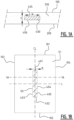
- Figure 1A and 1B illustrate an exemplary embodiment of an absorbent article, here a diaper.
- Figure 1A shows a cross-section of the absorbent article along line 1A-1A of Figure 1B
- Figure 1B shows the absorbent article in its flat out, un-contracted state with the wearer side facing the viewer.
- the skilled person understands that the absorbent article may also be a pant or an adult incontinence garment or the like.
- the absorbent article has a front edge 101 intended to be positioned at a front side of a person and a rear edge 102 intended to be positioned at a rear side of a person.
- the absorbent article also has a first longitudinal edge 103 and a second longitudinal edge 104.
- the absorbent article comprises a liquid pervious topsheet 100, a liquid impervious backsheet 200, and an absorbent material 330 between the topsheet 100 and the backsheet 200.
- the absorbent material 330 comprises cellulosic fluff pulp and/or superabsorbent particles.
- a spacer element 400 of an elongated shape is included between the topsheet 100 and the backsheet 200.
- the spacer element 400 is made of a material configured to absorb no or less liquid than the absorbent material 330 upon wetting of the absorbent article. In practice the liquid is typically urine. However, for determining whether a material is suitable for the spacer element 400, the absorption properties for water may be considered. Preferably the material does not absorb water or absorbs at least 80 percent less water compared to a same volume of absorbent material used in the absorbent article.
- the spacer element may be made of waste material, for example waste from other layers of the absorbent article. Optionally the waste material may be treated mechanically (e.g. milled or cut) and/or chemically (e.g.
- the spacer element 400 may be made of any one or any combination of the following materials: a non-water-absorbing polymer material such as a PE or PP material, chemically and/or mechanically treated fibers such as cellulose fibers.
- the spacer element may be a possibly breathable polyethylene (PE) or polypropylene (PP) layer, e.g. a coated polyethylene or polypropylene film.
- the spacer element 400 has a topside 405 facing the topsheet 100, a backside 406 facing the backsheet 200, and a plurality of lateral sides between the topside 405 and the backside 406.
- the lateral sides consist of a front side 401, a rear side 402, and two longitudinal sides 403, 404.
- the absorbent material 330 extends along at least two opposite lateral sides of the spacer element 400. In the embodiment of figures 1A and 1B the absorbent material 330 extends along all four lateral sides 401, 402, 403, 404, and there even some absorbent material above the topside 405 and below the bottom side 406. In other words, from a 3-D perspective, the spacer element 400 surrounded by the absorbent material 330.
- a contour of the spacer element is adjacent to the absorbent material 330.
- substantially no absorbent material 330 is present between the topside 405 and the topsheet 100 and between the backside 406 and the backsheet 200.
- the absorbent material 330 absorbing liquid expands in volume.
- the spacer element 400 absorbs no or less liquid
- the absorbent article expands less in volume at the corresponding location of the spacer element 400.
- a channel is created at the corresponding location of the spacer element 400 of the absorbent article. The created channel facilitates liquid distribution towards the absorbent material 330 and an improved absorption by the absorbent material 330.
- the absorbent article has a simple structure, the manufacturing process may be simplified and the manufacturing cost may be reduced, compared to other absorbent article with channels of the prior art, while an absorbent article with good liquid distribution and absorbent capacities can still be provided.
- no core wrap is used to encapsulate the absorbent material 330, and that the absorbent material is directly included between the topsheet 100 and the backsheet 200.
- the absorbent article has a crotch region in between the front edge 101 and the rear edge 102, and a transverse crotch line L dividing the absorbent article into a front portion and a rear portion on either side of the transverse crotch line L.
- the absorbent article has a length between the front edge 101 and the rear edge 102.
- the spacer element 400 extends from the crotch region in the direction of the front edge 101 and the rear edge 102 in both the front portion and the rear portion, and has a length which is at least 20%, more preferably at least 30% of the length of the absorbent article. This embodiment allows a better liquid communication between the front portion and the rear portion of the absorbent article, and overall improved liquid absorption and distribution capacities of the absorbent article.
- the spacer element 400 may extend in the direction from the first longitudinal edge 103 to the second longitudinal edge 104 of the absorbent article, which allows a better liquid distribution between left and right portions of absorbent article. It is also possible for the spacer element to extend under a small angle with respect to the longitudinal direction of absorbent article, e.g. an angle between 5 and 10°.
- the spacer element 400 extends over a transverse distance w which is at least 1 mm, preferably at least 3 mm, more preferably at least 4 mm, even more preferably at least 5 mm, most preferably at least 6 mm. In this manner the channel created upon wetting will be sufficiently wide to cause a good liquid distribution.
- the width is smaller than 20 mm, more preferably smaller than 15 mm.
- the width w of the spacer element 400 may be constant through substantially the whole length of the spacer element 400 or may vary along its length.
- the spacer element 400 is arranged symmetrically with respect to the longitudinal center line CL of absorbent article. Here the spacer element 400 is arranged on the longitudinal center line CL.
- the spacer element 400 extends, seen in the thickness direction of the absorbent article, over a distance which is at least 0.5 mm, preferably at least 1 mm, more preferably at least 2 mm.
- the thickness t of the spacer element 400 may be constant through substantially the whole length of the spacer element 400 or may vary along its length.
- the spacer element 400 is not attached to the topsheet 100 and/or to the backsheet 200, and there is absorbent material 330 between the spacer element 400 and the topsheet 100 and between the spacer element 400 and the backsheet 200.
- the spacer element 400 may be attached to the absorbent material above and below, e.g. by glue, which improves the overall structural stability of the absorbent article.
- the spacer element 400 is attached to the topsheet 100 and/or to the backsheet 200. That's to say, there may be no absorbent material 330 between the spacer element 400 and the topsheet 100, and/or between the spacer element 400 and the backsheet 200.
- the attachment may be realized by adding binder layers, such as glue, to strengthen the bond between the spacer element 400 and the topsheet 100 and/or backsheet 200.
- binder layers such as glue
- other bonding techniques may be used, such as ultrasonic bonding, heat bonding, pressure bonding, and combinations thereof.
- the difference in thickness of the absorbent article is even larger, between an area corresponding to the spacer element S0 and an area without the spacer element S1.
- the formed channel has a sufficient depth, is able to hold more liquid and allows better liquid distribution and absorbance.
- the structure of the absorbent article is more stable and more integrated/interconnected, which improves the stability of the absorbent article and wearing comfort.
- the spacer element 400 has a center line, which is a straight line.
- the center line of the spacer element 400 may have other shapes, e.g. a curve, or a polyline.
- the center line is a line which is at the same distance of opposite sides 403, 404 of the spacer element 400 and which preferably extends in a length direction of the spacer element 400.
- the channel created by the spacer element 400 may be indicated with a color and/or with a pattern which is different from the color and/or pattern of topsheet 100. More in particular the area of the channel may comprise a print allowing a user to visually distinguish the channel.
- This print may be arranged on the spacer element 400, on the topsheet 100, on the backsheet 200, or on any sheet in between the topsheet 100 and the backsheet 200, as long as it is visible for a user.
- the sheets may be partially transparent, the print may be arranged on the spacer element 400 or on a sheet in between the topsheet 100 and the backsheet 200, as long as it is visible through the topsheet 100 and/or the backsheet 200.
- the print is visible when looking at the topsheet 100 of the diaper.
- Figures 2A and 2B illustrate another exemplary embodiment of an absorbent article, here a diaper.
- Figure 2A shows the cross-section of the absorbent article along line 2A-2A of Figure 2B
- Figure 2B shows a top view of the absorbent article in its flat out, un-contracted state with the wearer side facing the viewer.
- the absorbent material 330 is part of an absorbent core 300 comprising a top core wrap sheet 310 and a back core wrap sheet 320 with the absorbent material 330 positioned in between the top core wrap sheet 310 and the bottom core wrap sheet 320.
- the absorbent article comprises a liquid pervious topsheet 100, a liquid impervious backsheet 200, and the absorbent core 300 between the topsheet 100 and the backsheet 200.
- the absorbent core 300 has a rectangular shape, having a front edge 311, a rear edge, 312, a first longitudinal edge 313, and a second longitudinal edge 314.
- a spacer element 400 is included between the top core wrap sheet 310 and the back core wrap sheet 320.
- the spacer element 400 is made of a material configured to absorb no or less liquid than the absorbent material 330 upon wetting of the absorbent core 300.
- the spacer element 400 has a topside 405 facing the top core wrap sheet 310 and the topsheet 100, a backside 406 facing the back core wrap sheet 320 and the backsheet 200, and a plurality of lateral sides between the topside 405 and the backside 406.
- the lateral sides consist of a front side 401, a rear side 402, and two longitudinal sides 403, 404.
- the absorbent material 330 extends along at least two lateral opposite sides 401, 402, 403, 404 of the spacer element 400. Seen from a top view, a contour of the spacer element 400 is adjacent to the absorbent material 330.
- the spacer element 400 is attached to the top core wrap sheet 310 and to the back core wrap sheet 320. There may be substantially no absorbent material 330 between the spacer element 400 and the top core wrap sheet 310, and/or between the spacer element 400 and the back core wrap sheet 320.
- the attachment may be realized by adding binder layers, such as glue, to strengthen the bond between the spacer element 400 and the top core wrap sheet 310 and/or back core wrap sheet 320.
- other bonding techniques may be used, such as ultrasonic bonding, heat bonding, pressure bonding, and combinations thereof. In this manner, upon wetting of the absorbent core 300, the difference in thickness of the absorbent core is even larger, between the area corresponding to the spacer element S0 and the area without the spacer element S1.
- the formed channel has a sufficient depth, is able to hold more liquid and allows better liquid distribution and absorbance.
- the absorbent article is even more structured and interconnected, resulting in a more stable channel forming and even less leakage risks.
- the spacer element 400 is not attached to the top core wrap sheet 310 and/or to the back wrap sheet 320, and there may be absorbent material 330 between the spacer element 400 and the top core wrap sheet 310 and between the spacer element 400 and the back core wrap sheet 320.
- the spacer element 400 may be attached to the absorbent material 330 above and/or below, e.g. by glue or any other suitable bonding technique, which improves the overall structural stability of the absorbent core.
- the absorbent core 300 has a crotch region in between the front edge 311 and the rear edge 312, and a transverse crotch line L dividing the absorbent core 300 into a front portion and a rear portion on either side of the transverse crotch line L.
- the absorbent core 300 has a length between the front edge 311 and the rear edge 312.
- the spacer element 400 extends from the crotch region in the direction of the front edge 311 and the rear edge 312 of the absorbent core in both the front portion and the rear portion, and has a length which is at least 20% more preferably at least 30% of the length of the absorbent core 300.
- the absorbent material absorbing liquid expands in volume.
- the absorbent core 300 expands less in volume at the corresponding location of the spacer element S0.
- a channel is created at the corresponding location S0 of the spacer element 400 of the absorbent core.
- the created channel facilitates liquid distribution over the absorbent core 300, and a larger quantity of liquid can be temporarily held in the created channel.
- the absorbent core has a simple structure, the manufacturing process may be simplified and the manufacturing cost may be reduced, compared to other absorbent core with channels of the prior art, while an absorbent core with good liquid distribution and absorption capacities can still be provided.
- the absorbent core 300 can be directly used in the manufacturing of absorbent articles of various types.
- the absorbent article may further comprise an acquisition and distribution layer ADL (not shown) positioned between the absorbent core 300 and the liquid pervious topsheet 100. This serves to slow down the flow so that the liquid has adequate time to be absorbed by and evenly distributed over the absorbent core 300.
- the absorbent article may further comprise adhesive between the absorbent core 300 and the ADL, and/or the absorbent article comprises adhesive between the ADL and the liquid pervious topsheet 100. If no ADL is present the absorbent article may comprise adhesive between the absorbent core 300 and the topsheet 100.
- Figures 3A, 3B and 3C illustrate another exemplary embodiment of an absorbent article.
- Figures 3A and 3B show a cross-section of the absorbent article along line 3A-3A of Figure 3C , in a dry and wetted state, respectively, and
- Figure 3C shows a top view of the absorbent article in its flat out, un-contracted state with the wearer side facing the viewer.
- the absorbent article comprises a liquid pervious topsheet 100, a liquid impervious backsheet 200, and the absorbent material 330 between the topsheet 100 and the backsheet 200.
- Two spacer elements 400a, 400b are arranged at a distance of each other between the topsheet 100 and the backsheet 200.
- the first and second spacer element 400a, 400b are configured to guide liquid to the absorbent material 330 upon wetting of the absorbent article. This may be realized by configuring the first and second spacer element 400a, 400b to absorb no or less liquid than a same volume of the absorbent material 330.
- the first and second spacer element may have at least an outer surface which is liquid-impervious. More preferably the entire first and second spacer elements are liquid impervious.
- the first spacer element may be made of a material configured to absorb no or less liquid than the absorbent material.
- the absorbent article has a longitudinal center line CL dividing the absorbent article in a first longitudinal portion and a second longitudinal portion on either side of the longitudinal center line, and the first spacer element is arranged in the first longitudinal portion and the second spacer element is arranged in the second longitudinal portion, preferably symmetrically with respect to the longitudinal center line CL.
- the first and second spacer element 400a, 400b extend in the front portion and in the rear portion.
- the first and second spacer element are substantially parallel.
- the first and the second spacer element diverge in a direction of the front edge and/or the rear edge.
- a maximum distance Ds between the first and the second spacer element is between 15 and 70% of the width Wa of the absorbent article, more preferably between 20 and 50%.
- the length ls of the first and second spacer is larger than 10% of the length La of the absorbent article, more preferably larger than 20%, even more preferably larger than 30%.
- Figure 4 illustrates another exemplary embodiment of an absorbent article comprising a first and second spacer element 400a, 400b between the topsheet 100 and the backsheet 200.
- the absorbent article comprises a liquid pervious topsheet 100, a liquid impervious backsheet 200, and an absorbent core 300 between the topsheet 100 and the backsheet 200.
- the absorbent core 300 may be similar to the absorbent core 300 of Figures 2A and 2B with this difference that a second spacer element 400b is provided.
- the absorbent core 300 has rectangular shape, having a front edge 311, a rear edge, 312, a first longitudinal edge 313, and a second longitudinal edge 314.
- the first spacer element 400a and the second spacer element 400b are included between the top core wrap sheet 310 and the back core wrap sheet 320.
- the absorbent material 330 extends along the lateral sides of the first spacer element 400a and the second spacer element 400b, in a similar manner as described above for Figures 2A and 2B . Seen from a top view, contours of the first spacer element 400a and the second spacer element 400b are adjacent to the absorbent material 330.
- the absorbent article has a longitudinal center line CL dividing the absorbent article in a first longitudinal portion and a second longitudinal portion on either side of the longitudinal center line CL.
- the first spacer element 400a is arranged in the first longitudinal portion and the second spacer element 400b is arranged in the second longitudinal portion.
- the first and the second spacer element 400a, 400b extend symmetrically with respect to the longitudinal center line CL. In this manner the liquid distribution and absorbent capacities of the absorbent core are improved on both longitudinal portions of the absorbent core.
- the first and the second spacer element 400a, 400b extend in parallel in the longitudinal direction of the absorbent core 300, from the crotch region of the absorbent core to the front and the rear transverse edge 311, 312 of the absorbent core, in both the front portion and the rear portion of the absorbent core.
- the first spacer element 400a and the second spacer element 400b have substantially the same length, which is at least 10%, preferably at least 20%, more preferably at least 30% of the length of the absorbent core 300.
- two channels are created on both longitudinal portions of the absorbent core respectively.
- the first and second spacer element 400a, 400b extend in the front portion and in the rear portion.
- a maximum distance Ds between the first and the second spacer element is between 5 and 70% of the width Wa of the absorbent article, more preferably between 10 and 50%.
- the first and second spacer element are substantially parallel.
- the first and the second spacer element may diverge in a direction of the front edge 311 and/or the rear edge 312, which allows better liquid communication between the left/right portions of absorbent core near the front edge and/or the rear edge to the crotch region of the absorbent core.
- Figure 5 illustrates another exemplary embodiment of an absorbent article further comprising a third spacer element 400c and a fourth spacer element 400d between the topsheet 100 and the backsheet 200.
- the third spacer element 400a and the fourth spacer element 400d may be included between the top core wrap sheet 310 and the back core wrap sheet 320 of the absorbent core 300 (cf. Figure 4 ), or directly between the topsheet 100 and the backsheet 200 (cf. Figures 3A-3C ).
- the spacer elements 400a, 400b, 400c, 400b may have similar properties as described above for embodiments with one or two spacer elements.
- All spacer elements 400a, 400b, 400c, 400d may be attached to the top core wrap sheet 310 or to the topsheet 100 (if no core wrap is present) and/or to the back core wrap sheet 320 or to the backsheet 200 (in no core wrap is present), and there may be substantially no absorbent material above and/or below each spacer element 400a, 400b, 400c, 400d. Upon wetting of the absorbent material, four channels are created.
- the first and second spacer 400a, 400b elements extend next to each other from the crotch region CR in the direction of the front edge 101 in the front portion of the absorbent article.
- the third and fourth spacer elements 400c, 400d extend next to each other from the crotch region CR in the direction of the rear edge 101 in the rear portion of the absorbent article.
- the first and the second spacer elements 400a, 400b are located a distance d12 of each other.
- the distance d12 is between 5 and 70% of the width of the absorbent article, more preferably between 10 and 50%.
- the first and second spacer elements 400a, 400b have substantially the same length 112, which is at least 5%, preferably at least 10% of the absorbent article.
- the first and second spacer elements 400a, 400b have substantially the same width w12, which is at least 2 mm, preferably at least 4 mm, more preferably at least 5 mm, even more preferably at least 6 mm, most preferably at least 7 mm.
- the first and the second spacer elements 400a, 400b are substantially parallel and run in the longitudinal direction of absorbent article.
- first and the second spacer elements 400a, 400b may extend under a small angle with respect to the longitudinal direction of absorbent article, e.g. an angle between 5 and 10°.
- first and the second spacer elements 400a, 400b may be diverging slightly outwardly in the direction of front edge 101.
- the first and the second spacer elements 400a, 400b are arranged symmetrically with respect to a longitudinal center line CL of absorbent article.
- the third and the fourth spacer elements 400c, 400d are located a distance d34 of each other, preferably the distance d34 is between 5 and 70% of the width of the absorbent article, more preferably between 10 and 50%.
- the third and the fourth spacer elements 400c, 400d have substantially the same length 134, which is at least 5%, preferably at least 10% of the absorbent article.
- the third and the fourth spacer elements 400c, 400d have substantially the same width w34, which is at least 1 mm, preferably at least 3 mm, more preferably at least 4 mm, even more preferably at least 5 mm, most preferably at least 6 mm.
- the third and the fourth spacer elements 400c, 400d are substantially parallel and run in the longitudinal direction of absorbent article.
- the third and the fourth spacer elements 400c, 400d may extend under a small angle with respect to the longitudinal direction of absorbent article, e.g. an angle between 5 and 10°.
- the third and the fourth spacer elements 400c, 400d may be diverging slightly outwardly in the direction of rear edge 102.
- the third and the fourth spacer elements 400c, 400d are arranged symmetrically with respect to a longitudinal center line CL of the absorbent article.
- d12 is different from d34, more preferably d12 is larger than d34, even more preferably d12 is at least 10 % larger than d34.
- w12 may be different from w34, preferably w12 is larger than w34, even more preferably w12 is at least 1 mm or at least 10% larger than w34.
- 112 is different from 134, more preferably 112 is smaller than 134, even more preferably 112 is at least 10 % smaller than 134. In this manner, the absorbent article is tailored for male user, as during a liquid insult of a male user the volume of liquid is larger in the front portion than in the rear portion. Further it is possible to optimize the differences between the front and the rear portion for obtaining a unisex absorbent article.
- the first spacer element 400a is separated from the third spacer element 400c by a distance B, and the second spacer element 400b is also separated from the fourth spacer element 400d by substantial the same distance.
- the distance is measure between the ends of spacer elements by a projection on the longitudinal center line.
- the distance B is smaller than 40 mm, more preferably smaller than 25 mm, even more preferably smaller than 20 mm.
- endpoints of the spacer elements 400a, 400b, 400c, 400d in the crotch region may be located on substantially the same transverse line L functioning as a fold line along which the diaper can be folded in two.
- Figure 6 illustrates an exemplary embodiment, in which the first and second spacer elements 400a, 400b together form a substantially X-shaped spacer element 400.
- the absorbent article comprises a liquid pervious topsheet 100, a liquid impervious backsheet 200, and an absorbent material 330 between the topsheet 100 and the backsheet 200.
- a first spacer element 400a and a second spacer element 400b of an elongated shape are included between the topsheet 100 and the backsheet 200.
- the first and second spacer elements 400a, 400b may also be provided as a single integral element 400.
- the spacer elements 400a, 400b may have similar properties as described above for other embodiments with one or two spacer elements.
- first spacer element 400a and a second spacer element 400b may be attached to the topsheet 100 and/or backsheet 200, and there may be no absorbent material between the spacer elements and the topsheet, and/or between the spacer elements and the backsheet.
- a core wrap may be provided as in the embodiment of Figure 4 .
- the first spacer element 400a extends from the front portion of the first longitudinal portion of the absorbent article to the rear portion of the second longitudinal portion of the absorbent article.
- the second spacer element 400b extends from the front portion of the second longitudinal portion of the absorbent article to the rear portion of the first longitudinal portion of the absorbent article.
- the first spacer element 400a and the second spacer element 400b form a crossing point CP.
- the crossing point CP is located on the longitudinal center line CL of the absorbent article, and/or the crossing point CP is located in the crotch region CR of the absorbent article.
- the first and second spacer elements 400a, 400b form a substantially X-shaped zone.
- the overlapping region of the first and second spacer elements 400a, 400b are shared by the first and second spacer elements 400a, 400b. That's to say, physically the first and second spacer elements 400a, 400b share the same portion at the crossing point CP.
- the contour of the X-shaped spacer element 400 is adjacent to the absorbent material 330. Upon wetting of the absorbent article, an X-shaped channel is formed.
- Figure 7 illustrates an absorbent article comprising a first spacer element 400a and a second spacer element 400b of an elongated shape included between the topsheet 100 and the backsheet 200, as in figures 3A-3C .
- a core wrap may be provided as in the embodiment of Figure 4 .
- the spacer elements 400a, 400b may have similar properties as described above for other embodiments with one or two spacer elements.
- the first and the second spacer element 400a, 400b diverge in a direction of the front edge 101 and the rear edge 102, which allows better liquid communication between the left/right portions of absorbent article near the front edge and the rear edge to the crotch region of the absorbent article.
- the first spacer element and the second spacer element 400a, 400b have a curved-shape, and preferably are arranged symmetrically with respect to the longitudinal center line CL of the absorbent article.
- the first spacer element and the second spacer element 400a, 400b are concave towards the longitudinal center line CL of the absorbent article such that they bend towards the longitudinal center line CL.
- the first spacer element and the second spacer element 400a, 400b may also be convex, such they bend away from the longitudinal center line CL, or they have any other suitable arrangement.
- the maximum distance between the first spacer element and the second spacer element in the front portion d1 is substantially the same as the maximum distance between the first spacer element and the second spacer element in the rear portion d2.
- maximum distance at the front portion d1 is different from the maximum distance at the rear portion d2, e.g. the maximum distance at the front portion d1 is 10% larger than the maximum distance at the rear portion d2.
- the minimum distance between the first spacer element and the second spacer element 400a, 400b d3 is preferably at least 5mm.
- the minimum distance between d3 may be substantially zero, or even zero, for example, when the first spacer element and the second spacer element 400a, 400b form a joint point in the crotch region and connect to each other.
- Figure 8 illustrates another exemplary embodiment of an absorbent article comprising a spacer element 400 which form an enclosed region.
- the absorbent article comprises a liquid pervious topsheet 100, a liquid impervious backsheet 200, and an absorbent material between the topsheet 100 and the backsheet 200.
- a first spacer element 400a, a second spacer element 400b, a third spacer element 400c, and a fourth spacer element 400d of an elongated shape are included between the topsheet 100 and the backsheet 200, as in figures 3A-3C .
- Alternatively a core wrap may be provided as in the embodiment of Figure 4 .
- the spacer elements 400a, 400b may have similar properties as described above for other embodiments with one or two spacer elements.
- the first spacer element 400a and the second spacer element 400b may have substantially the same length and width, and may be substantially parallel and run in the longitudinal direction of absorbent article.
- the third spacer element 400c and the fourth spacer element 400d may also have substantially the same length and width, and may be substantially parallel and run in the transverse direction of absorbent article.
- the front end of the first spacer element 400a connects to the left end of the third spacer element 400c, and the rear end of the first spacer element 400a connects to the left end of the fourth spacer element 400d.
- the front end of the second spacer element 400b connects to the right end of the third spacer element 400c, and the rear end of the second spacer element 400b connects to the right end of the fourth spacer element 400d.
- the enclosed region may also have a substantially "O" shaped region, or a substantially polygon shaped region, a substantially triangular shaped region, a diamond shaped region, a substantially hexagonal shaped region, or any other shape.
- liquid can be distributed around the boundary of the enclosed region, such that it can be absorbed from the entire boundary by the absorbent material in the enclosed region and by the absorbent material in a region surrounding the enclosed region.
- Figure 9 illustrates another exemplary embodiment of an absorbent article comprising a plurality of transverse spacer elements 400a, 400b, 400c, 400d.
- the absorbent article comprises a liquid pervious topsheet 100, a liquid impervious backsheet 200, and an absorbent material between the topsheet 100 and the backsheet 200.
- a first spacer element 400a, a second spacer element 400b, a third spacer element 400c, and a fourth spacer element 400d of an elongated shape is included between the topsheet 100 and the backsheet 200, as in figures 3A-3C .
- Alternatively a core wrap may be provided as in the embodiment of Figure 4 .
- the spacer elements 400a, 400b may have similar properties as described above for other embodiments with one or two spacer elements.
- the first spacer element 400a, the second spacer element 400b, the third spacer element 400c, and the fourth spacer element 400d extend from the first longitudinal portion of the absorbent article to the second longitudinal portion of the absorbent article and are substantially parallel and run in the transverse direction of absorbent article.
- the spacer elements 400a, 400b, 400c, 400d may have substantially the same length in the transverse direction and the same width in the longitudinal direction of the absorbent article. However, it is also possible that they may have a different length and/or width. For example, the spacer elements in the front portion of the absorbent article may be longer and/or wider, compared to the spacer elements in the rear portion of the absorbent article.
- the distance between each part of the neighboring spacer elements in the longitudinal direction of the absorbent article Dab, Dbc, Dcd may substantially be the same, preferably the distance is at least 5 mm, more preferably at least 10 mm.
- the distance between each part of the neighboring spacer elements in the longitudinal direction of the absorbent article may also be different, for example, the spacer elements in the front portion of the absorbent article may be closer to each other compared to the spacer elements in the rear portion of the absorbent article.
- This embodiment has the advantage that the liquid distribution and communication in a transverse direction, between the left and right portion of the absorbent article is further improved.
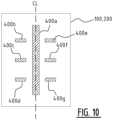
- Figure 10 illustrates another exemplary embodiment of an absorbent article comprising a longitudinal spacer element 400a and a plurality of transverse spacer elements 400b.
- the absorbent article comprises a liquid pervious topsheet 100, a liquid impervious backsheet 200, and an absorbent material between the topsheet 100 and the backsheet 200.
- a first spacer element 400a, a second spacer element 400b, a third spacer element 400c, a fourth spacer element 400d, a fifth spacer element 400e, a sixth spacer element 400f, and a seventh spacer element 400g are included between the topsheet 100 and the backsheet 200, e.g. as in figures 3A-3C .
- Alternatively a core wrap may be provided as in the embodiment of Figure 4 .
- the spacer elements 400a, 400b may have similar properties as described above for other embodiments with one or two spacer elements.
- the first spacer element 400a extends in the longitudinal direction of absorbent article, from the crotch region to the front and rear edge of the absorbent article, preferably located on the longitudinal center line CL of the absorbent article.
- the second to the seventh spacer elements 400b, 400c, 400d, 400e, 400f, 400g may have substantially the same length, which is shorter than the length of the first spacer element, and they may run in the transverse direction of the absorbent article.
- the second to the fourth spacer elements 400b, 400c, 400d are located on the left portion of the absorbent article and are substantially parallel
- the fifth to the seventh spacer elements 400e, 400f, 400g are located on the right portion of the absorbent article and are also substantially parallel.
- the first spacer element 400a may be permanently attached to the topsheet 100 and/or the backsheet 200, and there may be substantially no absorbent material between the first spacer element and the topsheet and between the first spacer element and the backsheet.
- the first spacer element 400a may be permanently attached to the top core wrap sheet and/or the back core wrap sheet, and there may be substantially no absorbent material between the first spacer element and the top core wrap sheet and between the first spacer element and the back core backsheet.
- the second to the seventh spacer elements 400b, 400c, 400d, 400e, 400f, 400g may be semi-permanently attached to the topsheet 100 and/or the backsheet 200 (or if a core wrap is present, to the core wrap), such that the attachment loosens upon wetting. In that way temporary transverse channels are created which disappear as the absorbent material starts swelling.
- the spacer elements 400a, 400b, 400c, 400d, 400e, 400f, 400g may have a different thickness.
- the first spacer element 400a may be thicker than the second to the seventh spacer elements 400b, 400c, 400d, 400e, 400f, 400g.
- a skilled person understands that other embodiments may be envisaged combining a spacer element which attaches to the topsheet and/or the backsheet (or to the core wrap), and a spacer element which does not attach to the topsheet and/or the backsheet (or to the core wrap), and/or combining a spacer element running in the transverse direction and a spacer element running in the longitudinal direction of the absorbent article.
- FIG 11 illustrates in more detail an embodiment of a diaper.
- the chassis of the diaper in figures 11 comprises a liquid pervious topsheet 100 and liquid impervious backsheet 200.
- the chassis further includes side panels or ears 210, elasticized leg cuffs 230 and elastic waist elements (not shown).
- a front end portion of diaper is configured as a front waist region 100a.
- the opposite rear end portion is configured as a back waist region 100b of the diaper.
- An intermediate portion of the diaper is configured as crotch region CR, which extends longitudinally between first and second waist regions 100a and 100b.
- Waist regions 100a and 100b may include elastic waist elements such that they gather about the waist of the wearer to provide improved fit and containment.
- Crotch region CR is that portion of the diaper which, when the diaper is worn, is generally positioned between the wearer's legs.
- the periphery of diaper is defined by the outer edges of the diaper in which longitudinal edges 103, 104 run generally parallel to a longitudinal axis of diaper and transverse end edges 101, 102 run between the longitudinal edges 103, 104 generally parallel to a transverse axis of diaper.
- the chassis also comprises a fastening system, which may include at least one fastening or securing member 212 and at least one landing zone 220.
- the various components within diaper may be bound, joined or secured by any method known in the art, for example by adhesives in uniform continuous layers, patterned layers or arrays of separate lines, spirals or spots.
- Optional top core wrap sheet, topsheet, optional back core wrap sheet, backsheet, absorbent material and other components may be assembled in a variety of well-known configurations and are well known in the art.
- Backsheet 200 covers absorbent material and preferably extends toward longitudinal edges 103, 104 and front and rear edges 101, 102 of the diaper and may be joined with top sheet 100. Backsheet 200 prevents bodily exudates absorbed by the absorbent material and contained within diaper from soiling other external articles that may contact the wearer, such as bed sheets and undergarments.
- backsheet 200 is substantially impervious to bodily exudates and comprises a laminate of a nonwoven and a thin plastic film such as a thermoplastic film.
- Backsheet may comprise breathable materials that permit vapor to escape from diaper while still preventing bodily exudates from passing through backsheet. It may be semi-rigid, non-elastic and can be made fully or partially elasticized and include backing.
- the topsheet 100 which is located above the absorbent material, is preferably soft, exhibits good strikethroughs and has a reduced tendency to rewet from the liquid absorbent material.
- Top sheet may be semi-rigid and non-elastic, or may be fully or partially elasticized.
- Topsheet 100 is intended to be placed in close proximity to the skin of the wearer when the diaper is worn. Topsheet 100 permits bodily exudates to rapidly penetrate it so as to flow more quickly toward the absorbent material via a top surface thereof and via one or more channels created as a consequence of the presence of one or more spacer elements 400, preferably not allowing such bodily exudates to flow back through topsheet 100.
- the spacer element 400 has a first width (w1) at a first position (P1) and a second width (w2) at a second position (P2).
- the first width w1 may be the same of different from the second width w2.
- the first width may be larger than the second width w2, and the width of the spacer element may increase from the second position P2 to the first position P1.
- the width of the spacer element 400 is measured perpendicularly to a center line CLs of the spacer element 400.
- the center line CLs is a line which is at the same distance of opposite edges of the first spacer element 400. Preferably the opposite edges extend in a length direction of the spacer element 400.
- the center line CLs is a straight line.
- the center line CLs may be a curve, or a polyline, etc.
- Topsheet 100 may be constructed from any one of a wide range of liquid and vapor permeable, preferably hydrophilic, materials. The upper and lower surface of topsheet 100 may be treated differently. Topsheet 100 may include e.g. a surfactant on the upper surface so as to facilitate liquid transfer there through, especially at a central zone or area of topsheet located over the absorbent material, and/or a hydrophobic agent on the lower surface to minimize the liquid contained within absorbent material from contact wetting topsheet 100 thereby reducing rewet values. Topsheet 100 may be coated with a substance having rash preventing or rash reducing properties.
- topsheet 100 covers substantially the entire wearer facing area of diaper, including substantially all of front waist region 100a, back waist region 100b, and crotch region CR.
- side panels 210, 210' and/or waist feature layers of the inner region may be formed from the same single topsheet material.
- topsheet may be formed from multiple different materials which vary across of topsheet. Such a multiple piece design allows for creation of preferred properties and different zones of the topsheet 100.
- the absorbent material may comprise any absorbent material that is generally compressible, conformable, non-irritating to the wearer's skin, and capable of absorbing and retaining bodily exudates.
- the absorbent material comprises fluff material, typically cellulosic fluff pulp.
- the absorbent material may be substantially fluffless and comprise superabsorbent polymers.
- the absorbent material may comprise a combination of cellulosic fluff pulp and superabsorbent polymers. The absorbent material extend over substantially the full length and/or width of diaper.
- the absorbent material is not coextensive with the entire diaper and is limited to certain regions of diaper including the crotch region CR.
- the absorbent material extends more or less to the edges of diaper but the absorbent material is concentrated in the crotch region CR or another target zone of the diaper and does not extend over the full length.
- the absorbent core 300 is shown as having a substantially rectangular configuration, however, absorbent core 300 may be shaped differently, such as, elliptical, dogbane shaped, T-shaped or I-shaped.
- the area covered by absorbent material is substantially rectangular, but also this area may be shaped differently, such as, elliptical, dogbane shaped, T-shaped or I-shaped. More in particular the width of a front portion of the absorbent core or area where absorbent materials is present may be smaller than the width of a rear portion of the absorbent core or area where absorbent materials is present.
- absorbent materials are cellulosic fluff pulp, tissue layers, highly absorbent polymers (so called superabsorbents), absorbent foam materials, absorbent nonwoven materials or the like. It is common to combine cellulosic fluff pulp with superabsorbent polymers.
- superabsorbent polymers are water-swellable, water-insoluble organic or inorganic materials capable of absorbing at least about 20 times its weight and in an aqueous solution containing 0.9 weight percent of sodium chloride.
- Diaper may also utilize a pair of containment walls or cuffs 230.
- Each cuff 230 is a longitudinally extending wall structure preferably positioned on each side of absorbent material and spaced laterally from the center line CL.
- cuffs 230 are attached, for example, by adhesive or sonic bonding to the lower structure.
- cuffs 230 are equipped with elastic members. When released or otherwise allowed relaxing, the elastic members retract inwardly. When diaper is worn, the elastic members function to contract cuffs 230 about the buttocks and the thighs of the wearer in a manner, which forms a seal between diaper, the buttocks and the thighs.
- the waist regions 100a and 100b each comprise a central region and a pair of side panels or ears 210, 210' which typically comprise the outer lateral portions of the waist regions. These side panels 210, 210' may be unitary with the chassis or may be attached or joined thereto by any means know in the art.
- the side panels 210 positioned in the back waist region 100b are flexible, extensible and/or elastic in at least the lateral direction.
- the side panels 210 are non-elastic, semi-rigid, rigid and/or stiff.
- at least a portion of the back waist region 100b is attached by fastening or securing members 212 to at least a portion of the front waist region 100a.
- the fastening or securing members 212 may be e.g. adhesive, mechanical fasteners, hook and loop features, conceivable strings and/or combinations thereof.
- the fastening or securing members 212 may also be co-adhesive such that they adhere to each other but not other materials.
- the materials making up the fastening or securing members 212 are flexible, extensible and/or elastic, allowing them to better conform to the shape and movements of the body and thus, to reduce the likelihood that the fastening system will irritate or injure the wearer's skin.
- the absorbent article may be pants and the like. In this configuration, the absorbent article may or may not have fastening members.
- Diaper may also employ additional layers, such as an acquisition layer and/or dispersion layer situated between topsheet and absorbent material, and/or coverstock layers, and/or other layers situated between absorbent material and backsheet.
- An acquisition layer and/or dispersion layer serves to slow down the flow so that the liquid has adequate time to be absorbed by absorbent material.
- Diaper may also include such other features, components and elements as are known in the art including waistbands, waist cap features, elastics and the like to provide better fit, containment and aesthetic characteristics. These features may be assembled in a variety of well-known configurations and are well known in the art.
Landscapes
- Health & Medical Sciences (AREA)
- Epidemiology (AREA)
- Engineering & Computer Science (AREA)
- Biomedical Technology (AREA)
- Heart & Thoracic Surgery (AREA)
- Vascular Medicine (AREA)
- Life Sciences & Earth Sciences (AREA)
- Animal Behavior & Ethology (AREA)
- General Health & Medical Sciences (AREA)
- Public Health (AREA)
- Veterinary Medicine (AREA)
- Absorbent Articles And Supports Therefor (AREA)
Claims (15)
- Article absorbant ayant un bord avant (101) prévu pour être positionné au niveau d'un côté avant d'une personne et un bord arrière (102) prévu pour être positionné au niveau d'un côté arrière d'une personne, ledit article absorbant comprenant une feuille de dessus perméable aux liquides (100), une feuille de fond imperméable aux liquides (200) et un matériau absorbant (330) entre ladite feuille de dessus et ladite feuille de fond, dans lequel au moins un premier élément espaceur (400) est inclus entre ladite feuille de dessus et ladite feuille de fond, dans lequel le premier élément espaceur a un côté supérieur faisant face vers la feuille de dessus, un côté inférieur faisant face vers la feuille de fond, et un certain nombre de côtés latéraux entre le côté supérieur et le côté inférieur, et dans lequel le matériau absorbant s'étend le long d'au moins deux côtés latéraux opposés du premier élément espaceur ; ledit premier élément espaceur étant conçu pour guider un liquide vers le matériau absorbant lors d'un mouillage de l'article absorbant ; dans lequel les côtés latéraux du premier élément espaceur sont entourés par le matériau absorbant, de telle sorte que, observé dans une vue du dessus, un contour de l'élément espaceur est adjacent au matériau absorbant.
- Article absorbant selon la revendication 1, dans lequel le premier élément espaceur est conçu pour n'absorber aucun liquide ou absorber moins de liquide qu'un même volume du matériau absorbant et/ou dans lequel le premier élément espaceur a au moins une surface externe qui est imperméable aux liquides.
- Article absorbant selon la revendication 1 ou 2, dans lequel les côtés latéraux du premier élément espaceur consistent en un côté avant, un côté arrière et deux côtés longitudinaux.
- Article absorbant selon l'une quelconque des revendications précédentes, dans lequel le premier élément espaceur est fabriqué dans un matériau conçu pour n'absorber aucun liquide ou absorber moins de liquide que le matériau absorbant.
- Article absorbant selon l'une quelconque des revendications précédentes, dans lequel le premier élément espaceur est un élément allongé.
- Article absorbant selon l'une quelconque des revendications précédentes, dans lequel l'article absorbant a une région d'entrejambe entre le bord avant et le bord arrière ; dans lequel le premier élément espaceur s'étend à partir de la région d'entrejambe dans la direction du bord avant et/ou arrière.
- Article absorbant selon l'une quelconque des revendications précédentes, dans lequel le premier élément espaceur est fixé à la feuille de dessus et/ou à la feuille de fond.
- Article absorbant selon l'une quelconque des revendications précédentes, dans lequel le matériau absorbant fait partie d'une âme absorbante comprenant une feuille d'enveloppement d'âme supérieure et une feuille d'enveloppement d'âme arrière avec le matériau absorbant positionné entre la feuille d'enveloppement d'âme supérieure et la feuille d'enveloppement d'âme inférieure, dans lequel le premier élément espaceur est de préférence fixé à la feuille d'enveloppement d'âme supérieure et/ou à la feuille d'enveloppement d'âme arrière.
- Article absorbant selon l'une quelconque des revendications précédentes, dans lequel le premier élément espaceur s'étend, observé dans la direction d'épaisseur de l'article absorbant, sur une distance qui est d'au moins 0,5 mm, de préférence au moins 1 mm, plus préférablement au moins 2 mm.
- Article absorbant selon l'une quelconque des revendications précédentes, dans lequel le premier élément espaceur est fabriqué dans l'un quelconque des matériaux suivants : un matériau polymère n'absorbant pas l'eau, des fibres telles que des fibres de cellulose, dans lequel facultativement les matériaux sont traités chimiquement et/ou mécaniquement.
- Article absorbant selon l'une quelconque des revendications précédentes, dans lequel l'article absorbant a une longueur entre le bord avant et le bord arrière ; dans lequel le premier élément espaceur a une longueur qui vaut au moins 5 %, de préférence au moins 10 %, plus préférablement au moins 20 %, et encore plus préférablement au moins 30 % de la longueur de l'article absorbant.
- Article absorbant selon l'une quelconque des revendications précédentes, dans lequel l'article absorbant a une ligne transversale d'entrejambe (L) divisant l'âme absorbante en une partie avant et une partie arrière de chaque côté de la ligne transversale d'entrejambe (L), dans lequel le premier élément espaceur s'étend dans la partie avant et dans la partie arrière.
- Article absorbant selon l'une quelconque des revendications précédentes, comprenant en outre un second élément espaceur entre la feuille de dessus et la feuille de fond.
- Article absorbant selon la revendication précédente, dans lequel l'article absorbant a une ligne médiane longitudinale (CL) divisant l'article absorbant en une première partie longitudinale et une seconde partie longitudinale de chaque côté de la ligne médiane longitudinale ; dans lequel le premier élément espaceur est agencé dans la première partie longitudinale et le second élément espaceur est agencé dans la seconde partie longitudinale ; dans lequel de préférence le premier et le second élément espaceur s'étendent symétriquement par rapport à la ligne médiane longitudinale (CL).
- Article absorbant selon l'une quelconque des revendications précédentes, dans lequel sensiblement aucun matériau absorbant n'est présent entre le premier élément espaceur et la feuille de dessus et entre le premier élément espaceur et la feuille de fond.
Priority Applications (6)
| Application Number | Priority Date | Filing Date | Title |
|---|---|---|---|
| EP18172153.1A EP3569208B1 (fr) | 2018-05-14 | 2018-05-14 | Article absorbant comportant un élément d'espacement |
| ES18172153T ES3021234T3 (en) | 2018-05-14 | 2018-05-14 | Absorbent article with spacer element |
| EP19725666.2A EP3793498B1 (fr) | 2018-05-14 | 2019-05-14 | Article absorbant comportant un élément d'espacement |
| BR112020022884-2A BR112020022884B1 (pt) | 2018-05-14 | 2019-05-14 | Artigo absorvente tendo uma margem frontal destinada a ser posicionada em um lado frontal de uma pessoa e uma margem traseira destinada a ser posicionada em um lado traseiro de uma pessoa |
| PCT/EP2019/062301 WO2019219655A1 (fr) | 2018-05-14 | 2019-05-14 | Article absorbant comportant un élément d'espacement |
| US17/250,037 US12357515B2 (en) | 2018-05-14 | 2019-05-14 | Absorbent article with spacer element |
Applications Claiming Priority (1)
| Application Number | Priority Date | Filing Date | Title |
|---|---|---|---|
| EP18172153.1A EP3569208B1 (fr) | 2018-05-14 | 2018-05-14 | Article absorbant comportant un élément d'espacement |
Publications (3)
| Publication Number | Publication Date |
|---|---|
| EP3569208A1 EP3569208A1 (fr) | 2019-11-20 |
| EP3569208B1 true EP3569208B1 (fr) | 2025-02-12 |
| EP3569208C0 EP3569208C0 (fr) | 2025-02-12 |
Family
ID=62165477
Family Applications (2)
| Application Number | Title | Priority Date | Filing Date |
|---|---|---|---|
| EP18172153.1A Active EP3569208B1 (fr) | 2018-05-14 | 2018-05-14 | Article absorbant comportant un élément d'espacement |
| EP19725666.2A Active EP3793498B1 (fr) | 2018-05-14 | 2019-05-14 | Article absorbant comportant un élément d'espacement |
Family Applications After (1)
| Application Number | Title | Priority Date | Filing Date |
|---|---|---|---|
| EP19725666.2A Active EP3793498B1 (fr) | 2018-05-14 | 2019-05-14 | Article absorbant comportant un élément d'espacement |
Country Status (4)
| Country | Link |
|---|---|
| US (1) | US12357515B2 (fr) |
| EP (2) | EP3569208B1 (fr) |
| ES (1) | ES3021234T3 (fr) |
| WO (1) | WO2019219655A1 (fr) |
Families Citing this family (5)
| Publication number | Priority date | Publication date | Assignee | Title |
|---|---|---|---|---|
| USD979181S1 (en) * | 2019-05-10 | 2023-02-28 | Drylock Technologies N.V. | Absorbent underpants |
| USD1076328S1 (en) | 2019-05-10 | 2025-05-27 | Drylock Technologies N.V. | Absorbent underpants |
| KR102597848B1 (ko) * | 2020-04-30 | 2023-11-03 | 킴벌리-클라크 월드와이드, 인크. | 반응성 흡수 용품 |
| EP4112028A1 (fr) * | 2021-06-28 | 2023-01-04 | Ontex BV | Article absorbant amélioré de gestion de selles liquides |
| WO2024182504A1 (fr) * | 2023-02-28 | 2024-09-06 | The Procter & Gamble Company | Article absorbant à élément de stabilisation étroit |
Citations (2)
| Publication number | Priority date | Publication date | Assignee | Title |
|---|---|---|---|---|
| WO1999047095A1 (fr) * | 1998-03-19 | 1999-09-23 | Weyerhaeuser Company | Composites canneles et articles absorbants associes |
| EP3536294A1 (fr) * | 2018-03-09 | 2019-09-11 | Drylock Technologies NV | Article absorbant comprenant des canaux |
Family Cites Families (40)
| Publication number | Priority date | Publication date | Assignee | Title |
|---|---|---|---|---|
| GB1277216A (en) * | 1968-07-31 | 1972-06-07 | Yamanouchi Pharma Co Ltd | Sanitary napkin |
| US3595235A (en) * | 1969-05-16 | 1971-07-27 | Georgia Pacific Corp | Multilayer absorbent pad |
| US4678464A (en) * | 1983-04-29 | 1987-07-07 | Personal Products Company | Absorbent structure with reservoirs and a channel |
| US4960477A (en) * | 1983-12-01 | 1990-10-02 | Mcneil-Ppc, Inc. | Disposable diaper with folded absorbent batt |
| US4670011A (en) * | 1983-12-01 | 1987-06-02 | Personal Products Company | Disposable diaper with folded absorbent batt |
| US4963139A (en) * | 1988-09-22 | 1990-10-16 | Mcneil-Ppc, Inc. | Absorbent body having hydrophobic insert |
| US5342337A (en) * | 1989-05-16 | 1994-08-30 | Molnlycke Ab | Disposable absorbent article which comprises a hose-like absorption body |
| US5185009A (en) * | 1989-07-10 | 1993-02-09 | Elmo Sitnam | Biodegradable diaper |
| US5514120A (en) * | 1991-12-18 | 1996-05-07 | Minnesota Mining And Manufacturing Company | Liquid management member for absorbent articles |
| JP3058572B2 (ja) * | 1994-12-13 | 2000-07-04 | ユニ・チャーム株式会社 | 体液吸収性物品 |
| US5643238A (en) * | 1995-09-29 | 1997-07-01 | Paragon Trade Brands, Inc. | Absorbent core structure comprised of storage and acquisition cells |
| AU2216697A (en) * | 1996-03-22 | 1997-10-10 | Procter & Gamble Company, The | Absorbent cores having improved acquisition capability, and absorbent articles containing them |
| JP4109068B2 (ja) * | 2002-09-30 | 2008-06-25 | ユニ・チャーム株式会社 | 尿誘導シート |
| EP3292848A1 (fr) | 2010-10-13 | 2018-03-14 | Drylock Technologies NV | Structure absorbante |
| JP5868110B2 (ja) * | 2010-10-18 | 2016-02-24 | 花王株式会社 | 吸収性物品 |
| EP2444046A1 (fr) * | 2010-10-20 | 2012-04-25 | Vynka Bvba | Structure absorbante sans danger pour l'environnement |
| EP2444045A1 (fr) | 2010-10-20 | 2012-04-25 | Vynka Bvba | Procédé et appareil de production d'une structure absorbante sans danger pour l'environnement |
| US9498384B2 (en) * | 2011-12-01 | 2016-11-22 | Leigh E. Wood | Assembled intermediate comprising staple fiber nonwoven web and articles |
| FR2993465B1 (fr) * | 2012-07-23 | 2015-06-26 | Commissariat Energie Atomique | Article destine a venir en contact avec un liquide, notamment pansement. |
| US9216118B2 (en) * | 2012-12-10 | 2015-12-22 | The Procter & Gamble Company | Absorbent articles with channels and/or pockets |
| US10639215B2 (en) * | 2012-12-10 | 2020-05-05 | The Procter & Gamble Company | Absorbent articles with channels and/or pockets |
| WO2014101928A1 (fr) * | 2012-12-28 | 2014-07-03 | Sca Hygiene Products Ab | Article absorbant comprenant un textile 3d comme élément de régulation d'écoulement de fluide |
| EP2938309B1 (fr) * | 2012-12-28 | 2019-02-27 | Essity Hygiene and Health Aktiebolag | Article absorbant comprenant un textile 3d comme élément de régulation d'écoulement de fluide |
| EP3038578B1 (fr) * | 2013-08-27 | 2019-08-07 | The Procter and Gamble Company | Articles absorbants disposant de canaux |
| EP3023084B1 (fr) * | 2014-11-18 | 2020-06-17 | The Procter and Gamble Company | Article absorbant et matière de distribution |
| US20160136013A1 (en) * | 2014-11-18 | 2016-05-19 | The Procter & Gamble Company | Absorbent articles having distribution materials |
| US10517775B2 (en) * | 2014-11-18 | 2019-12-31 | The Procter & Gamble Company | Absorbent articles having distribution materials |
| US10376428B2 (en) * | 2015-01-16 | 2019-08-13 | The Procter & Gamble Company | Absorbent pant with advantageously channeled absorbent core structure and bulge-reducing features |
| EP3058918B1 (fr) * | 2015-02-17 | 2019-04-17 | The Procter and Gamble Company | Articles absorbants formant un bassin tridimensionnel |
| BR112017019872A2 (pt) * | 2015-03-18 | 2018-05-29 | The Procter & Gamble Company | artigo absorvente com punhos para as pernas |
| CA2999745A1 (fr) * | 2015-09-22 | 2017-03-30 | The Procter & Gamble Company | Articles absorbants dotes de canaux incurves |
| EP3238679B1 (fr) * | 2016-04-29 | 2019-08-07 | The Procter and Gamble Company | Article absorbant avec une couche de distribution comprenant des canaux |
| JP6381588B2 (ja) * | 2016-07-07 | 2018-08-29 | ユニ・チャーム株式会社 | 吸収性物品 |
| EP3315106B1 (fr) * | 2016-10-31 | 2019-08-07 | The Procter and Gamble Company | Article absorbant comportant une couche intermédiaire comprenant des canaux et une poche arrière |
| US10828208B2 (en) * | 2016-11-21 | 2020-11-10 | The Procte & Gamble Company | Low-bulk, close-fitting, high-capacity disposable absorbent pant |
| JP6360540B2 (ja) * | 2016-11-29 | 2018-07-18 | 大王製紙株式会社 | 吸収性物品 |
| RU2720695C1 (ru) * | 2016-11-30 | 2020-05-12 | Кимберли-Кларк Ворлдвайд, Инк. | Трехмерные фигурные формы для использования в одноразовых впитывающих изделиях |
| EP3600199B1 (fr) * | 2017-03-21 | 2022-05-18 | The Procter & Gamble Company | Article absorbant ayant une feuille supérieure multi-composants et des revers de jambe |
| BE1025887B1 (nl) * | 2017-05-15 | 2019-08-07 | Drylock Technologies Nv | Absorberend voorwerp met vier kanalen |
| CN109953853B (zh) * | 2017-12-26 | 2021-10-22 | 大王制纸株式会社 | 吸收性物品 |
-
2018
- 2018-05-14 ES ES18172153T patent/ES3021234T3/es active Active
- 2018-05-14 EP EP18172153.1A patent/EP3569208B1/fr active Active
-
2019
- 2019-05-14 WO PCT/EP2019/062301 patent/WO2019219655A1/fr not_active Ceased
- 2019-05-14 EP EP19725666.2A patent/EP3793498B1/fr active Active
- 2019-05-14 US US17/250,037 patent/US12357515B2/en active Active
Patent Citations (2)
| Publication number | Priority date | Publication date | Assignee | Title |
|---|---|---|---|---|
| WO1999047095A1 (fr) * | 1998-03-19 | 1999-09-23 | Weyerhaeuser Company | Composites canneles et articles absorbants associes |
| EP3536294A1 (fr) * | 2018-03-09 | 2019-09-11 | Drylock Technologies NV | Article absorbant comprenant des canaux |
Also Published As
| Publication number | Publication date |
|---|---|
| BR112020022884A2 (pt) | 2021-02-23 |
| ES3021234T3 (en) | 2025-05-26 |
| EP3793498A1 (fr) | 2021-03-24 |
| WO2019219655A1 (fr) | 2019-11-21 |
| EP3793498B1 (fr) | 2026-03-25 |
| US12357515B2 (en) | 2025-07-15 |
| EP3569208A1 (fr) | 2019-11-20 |
| EP3569208C0 (fr) | 2025-02-12 |
| US20210161731A1 (en) | 2021-06-03 |
Similar Documents
| Publication | Publication Date | Title |
|---|---|---|
| EP3403626B1 (fr) | Article absorbant comprenant des canaux et son procédé de fabrication | |
| EP3453368B1 (fr) | Article absorbant comprenant des canaux et son procédé de fabrication | |
| US12396897B2 (en) | Absorbent article with channels and method for manufacturing thereof | |
| EP3403628B1 (fr) | Article absorbant comprenant des canaux et son procédé de fabrication | |
| EP3403632B1 (fr) | Article absorbant comprenant des canaux et son procédé de fabrication | |
| EP3560469B1 (fr) | Article absorbant | |
| EP2444046A1 (fr) | Structure absorbante sans danger pour l'environnement | |
| EP3793498B1 (fr) | Article absorbant comportant un élément d'espacement | |
| EP3403629B1 (fr) | Article absorbant comprenant des canaux | |
| US20250248865A1 (en) | Absorbent insert | |
| US20210015686A1 (en) | Absorbent article with reduced absorbent core | |
| EP2992864B1 (fr) | Structure absorbante avec barrière de bord | |
| EP2450012A1 (fr) | Structure absorbante améliorée | |
| EP2444043A1 (fr) | Structure absorbante améliorée | |
| EP3824855B1 (fr) | Couche de bain | |
| RU2851341C2 (ru) | Впитывающее изделие с каналами и способ его изготовления |
Legal Events
| Date | Code | Title | Description |
|---|---|---|---|
| PUAI | Public reference made under article 153(3) epc to a published international application that has entered the european phase |
Free format text: ORIGINAL CODE: 0009012 |
|
| STAA | Information on the status of an ep patent application or granted ep patent |
Free format text: STATUS: THE APPLICATION HAS BEEN PUBLISHED |
|
| AK | Designated contracting states |
Kind code of ref document: A1 Designated state(s): AL AT BE BG CH CY CZ DE DK EE ES FI FR GB GR HR HU IE IS IT LI LT LU LV MC MK MT NL NO PL PT RO RS SE SI SK SM TR |
|
| AX | Request for extension of the european patent |
Extension state: BA ME |
|
| STAA | Information on the status of an ep patent application or granted ep patent |
Free format text: STATUS: REQUEST FOR EXAMINATION WAS MADE |
|
| TPAC | Observations filed by third parties |
Free format text: ORIGINAL CODE: EPIDOSNTIPA |
|
| 17P | Request for examination filed |
Effective date: 20200520 |
|
| RBV | Designated contracting states (corrected) |
Designated state(s): AL AT BE BG CH CY CZ DE DK EE ES FI FR GB GR HR HU IE IS IT LI LT LU LV MC MK MT NL NO PL PT RO RS SE SI SK SM TR |
|
| STAA | Information on the status of an ep patent application or granted ep patent |
Free format text: STATUS: EXAMINATION IS IN PROGRESS |
|
| 17Q | First examination report despatched |
Effective date: 20220513 |
|
| GRAP | Despatch of communication of intention to grant a patent |
Free format text: ORIGINAL CODE: EPIDOSNIGR1 |
|
| STAA | Information on the status of an ep patent application or granted ep patent |
Free format text: STATUS: GRANT OF PATENT IS INTENDED |
|
| INTG | Intention to grant announced |
Effective date: 20240906 |
|
| GRAS | Grant fee paid |
Free format text: ORIGINAL CODE: EPIDOSNIGR3 |
|
| GRAA | (expected) grant |
Free format text: ORIGINAL CODE: 0009210 |
|
| STAA | Information on the status of an ep patent application or granted ep patent |
Free format text: STATUS: THE PATENT HAS BEEN GRANTED |
|
| AK | Designated contracting states |
Kind code of ref document: B1 Designated state(s): AL AT BE BG CH CY CZ DE DK EE ES FI FR GB GR HR HU IE IS IT LI LT LU LV MC MK MT NL NO PL PT RO RS SE SI SK SM TR |
|
| REG | Reference to a national code |
Ref country code: GB Ref legal event code: FG4D |
|
| REG | Reference to a national code |
Ref country code: CH Ref legal event code: EP |
|
| REG | Reference to a national code |
Ref country code: DE Ref legal event code: R096 Ref document number: 602018079021 Country of ref document: DE |
|
| REG | Reference to a national code |
Ref country code: IE Ref legal event code: FG4D |
|
| U01 | Request for unitary effect filed |
Effective date: 20250212 |
|
| U07 | Unitary effect registered |
Designated state(s): AT BE BG DE DK EE FI FR IT LT LU LV MT NL PT RO SE SI Effective date: 20250220 |
|
| REG | Reference to a national code |
Ref country code: ES Ref legal event code: FG2A Ref document number: 3021234 Country of ref document: ES Kind code of ref document: T3 Effective date: 20250526 |
|
| U20 | Renewal fee for the european patent with unitary effect paid |
Year of fee payment: 8 Effective date: 20250527 |
|
| PG25 | Lapsed in a contracting state [announced via postgrant information from national office to epo] |
Ref country code: RS Free format text: LAPSE BECAUSE OF FAILURE TO SUBMIT A TRANSLATION OF THE DESCRIPTION OR TO PAY THE FEE WITHIN THE PRESCRIBED TIME-LIMIT Effective date: 20250512 |
|
| PG25 | Lapsed in a contracting state [announced via postgrant information from national office to epo] |
Ref country code: PL Free format text: LAPSE BECAUSE OF FAILURE TO SUBMIT A TRANSLATION OF THE DESCRIPTION OR TO PAY THE FEE WITHIN THE PRESCRIBED TIME-LIMIT Effective date: 20250212 |
|
| PGFP | Annual fee paid to national office [announced via postgrant information from national office to epo] |
Ref country code: ES Payment date: 20250602 Year of fee payment: 8 Ref country code: GB Payment date: 20250527 Year of fee payment: 8 |
|
| PG25 | Lapsed in a contracting state [announced via postgrant information from national office to epo] |
Ref country code: IS Free format text: LAPSE BECAUSE OF FAILURE TO SUBMIT A TRANSLATION OF THE DESCRIPTION OR TO PAY THE FEE WITHIN THE PRESCRIBED TIME-LIMIT Effective date: 20250612 Ref country code: NO Free format text: LAPSE BECAUSE OF FAILURE TO SUBMIT A TRANSLATION OF THE DESCRIPTION OR TO PAY THE FEE WITHIN THE PRESCRIBED TIME-LIMIT Effective date: 20250512 |
|
| PG25 | Lapsed in a contracting state [announced via postgrant information from national office to epo] |
Ref country code: HR Free format text: LAPSE BECAUSE OF FAILURE TO SUBMIT A TRANSLATION OF THE DESCRIPTION OR TO PAY THE FEE WITHIN THE PRESCRIBED TIME-LIMIT Effective date: 20250212 |
|
| PG25 | Lapsed in a contracting state [announced via postgrant information from national office to epo] |
Ref country code: GR Free format text: LAPSE BECAUSE OF FAILURE TO SUBMIT A TRANSLATION OF THE DESCRIPTION OR TO PAY THE FEE WITHIN THE PRESCRIBED TIME-LIMIT Effective date: 20250513 |
|
| PGFP | Annual fee paid to national office [announced via postgrant information from national office to epo] |
Ref country code: CZ Payment date: 20250425 Year of fee payment: 8 |
|
| PG25 | Lapsed in a contracting state [announced via postgrant information from national office to epo] |
Ref country code: SM Free format text: LAPSE BECAUSE OF FAILURE TO SUBMIT A TRANSLATION OF THE DESCRIPTION OR TO PAY THE FEE WITHIN THE PRESCRIBED TIME-LIMIT Effective date: 20250212 |
|
| PG25 | Lapsed in a contracting state [announced via postgrant information from national office to epo] |
Ref country code: SK Free format text: LAPSE BECAUSE OF FAILURE TO SUBMIT A TRANSLATION OF THE DESCRIPTION OR TO PAY THE FEE WITHIN THE PRESCRIBED TIME-LIMIT Effective date: 20250212 |
|
| PLBE | No opposition filed within time limit |
Free format text: ORIGINAL CODE: 0009261 |
|
| STAA | Information on the status of an ep patent application or granted ep patent |
Free format text: STATUS: NO OPPOSITION FILED WITHIN TIME LIMIT |
|
| REG | Reference to a national code |
Ref country code: CH Ref legal event code: H13 Free format text: ST27 STATUS EVENT CODE: U-0-0-H10-H13 (AS PROVIDED BY THE NATIONAL OFFICE) Effective date: 20251223 |
|
| REG | Reference to a national code |
Ref country code: CH Ref legal event code: L10 Free format text: ST27 STATUS EVENT CODE: U-0-0-L10-L00 (AS PROVIDED BY THE NATIONAL OFFICE) Effective date: 20251224 |
|
| PG25 | Lapsed in a contracting state [announced via postgrant information from national office to epo] |
Ref country code: CH Free format text: LAPSE BECAUSE OF NON-PAYMENT OF DUE FEES Effective date: 20250531 |
|
| 26N | No opposition filed |
Effective date: 20251113 |
|
| PG25 | Lapsed in a contracting state [announced via postgrant information from national office to epo] |
Ref country code: MC Free format text: LAPSE BECAUSE OF FAILURE TO SUBMIT A TRANSLATION OF THE DESCRIPTION OR TO PAY THE FEE WITHIN THE PRESCRIBED TIME-LIMIT Effective date: 20250212 |
|
| PG25 | Lapsed in a contracting state [announced via postgrant information from national office to epo] |
Ref country code: IE Free format text: LAPSE BECAUSE OF NON-PAYMENT OF DUE FEES Effective date: 20250514 |