EP3570141A1 - Informationsverarbeitungsendgerät, informationsverarbeitungsvorrichtung und informationsverarbeitungsverfahren - Google Patents
Informationsverarbeitungsendgerät, informationsverarbeitungsvorrichtung und informationsverarbeitungsverfahren Download PDFInfo
- Publication number
- EP3570141A1 EP3570141A1 EP18878630.5A EP18878630A EP3570141A1 EP 3570141 A1 EP3570141 A1 EP 3570141A1 EP 18878630 A EP18878630 A EP 18878630A EP 3570141 A1 EP3570141 A1 EP 3570141A1
- Authority
- EP
- European Patent Office
- Prior art keywords
- user
- information processing
- information
- processing terminal
- content
- Prior art date
- Legal status (The legal status is an assumption and is not a legal conclusion. Google has not performed a legal analysis and makes no representation as to the accuracy of the status listed.)
- Ceased
Links
Images







Classifications
-
- G—PHYSICS
- G10—MUSICAL INSTRUMENTS; ACOUSTICS
- G10L—SPEECH ANALYSIS TECHNIQUES OR SPEECH SYNTHESIS; SPEECH RECOGNITION; SPEECH OR VOICE PROCESSING TECHNIQUES; SPEECH OR AUDIO CODING OR DECODING
- G10L15/00—Speech recognition
- G10L15/22—Procedures used during a speech recognition process, e.g. man-machine dialogue
-
- G—PHYSICS
- G06—COMPUTING OR CALCULATING; COUNTING
- G06F—ELECTRIC DIGITAL DATA PROCESSING
- G06F3/00—Input arrangements for transferring data to be processed into a form capable of being handled by the computer; Output arrangements for transferring data from processing unit to output unit, e.g. interface arrangements
- G06F3/01—Input arrangements or combined input and output arrangements for interaction between user and computer
- G06F3/011—Arrangements for interaction with the human body, e.g. for user immersion in virtual reality
- G06F3/013—Eye tracking input arrangements
-
- G—PHYSICS
- G06—COMPUTING OR CALCULATING; COUNTING
- G06F—ELECTRIC DIGITAL DATA PROCESSING
- G06F3/00—Input arrangements for transferring data to be processed into a form capable of being handled by the computer; Output arrangements for transferring data from processing unit to output unit, e.g. interface arrangements
- G06F3/01—Input arrangements or combined input and output arrangements for interaction between user and computer
- G06F3/048—Interaction techniques based on graphical user interfaces [GUI]
- G06F3/0481—Interaction techniques based on graphical user interfaces [GUI] based on specific properties of the displayed interaction object or a metaphor-based environment, e.g. interaction with desktop elements like windows or icons, or assisted by a cursor's changing behaviour or appearance
-
- G—PHYSICS
- G06—COMPUTING OR CALCULATING; COUNTING
- G06F—ELECTRIC DIGITAL DATA PROCESSING
- G06F3/00—Input arrangements for transferring data to be processed into a form capable of being handled by the computer; Output arrangements for transferring data from processing unit to output unit, e.g. interface arrangements
- G06F3/16—Sound input; Sound output
- G06F3/167—Audio in a user interface, e.g. using voice commands for navigating, audio feedback
-
- G—PHYSICS
- G10—MUSICAL INSTRUMENTS; ACOUSTICS
- G10L—SPEECH ANALYSIS TECHNIQUES OR SPEECH SYNTHESIS; SPEECH RECOGNITION; SPEECH OR VOICE PROCESSING TECHNIQUES; SPEECH OR AUDIO CODING OR DECODING
- G10L13/00—Speech synthesis; Text to speech systems
-
- G—PHYSICS
- G10—MUSICAL INSTRUMENTS; ACOUSTICS
- G10L—SPEECH ANALYSIS TECHNIQUES OR SPEECH SYNTHESIS; SPEECH RECOGNITION; SPEECH OR VOICE PROCESSING TECHNIQUES; SPEECH OR AUDIO CODING OR DECODING
- G10L25/00—Speech or voice analysis techniques not restricted to a single one of groups G10L15/00 - G10L21/00
- G10L25/48—Speech or voice analysis techniques not restricted to a single one of groups G10L15/00 - G10L21/00 specially adapted for particular use
- G10L25/51—Speech or voice analysis techniques not restricted to a single one of groups G10L15/00 - G10L21/00 specially adapted for particular use for comparison or discrimination
- G10L25/57—Speech or voice analysis techniques not restricted to a single one of groups G10L15/00 - G10L21/00 specially adapted for particular use for comparison or discrimination for processing of video signals
-
- G—PHYSICS
- G10—MUSICAL INSTRUMENTS; ACOUSTICS
- G10L—SPEECH ANALYSIS TECHNIQUES OR SPEECH SYNTHESIS; SPEECH RECOGNITION; SPEECH OR VOICE PROCESSING TECHNIQUES; SPEECH OR AUDIO CODING OR DECODING
- G10L25/00—Speech or voice analysis techniques not restricted to a single one of groups G10L15/00 - G10L21/00
- G10L25/48—Speech or voice analysis techniques not restricted to a single one of groups G10L15/00 - G10L21/00 specially adapted for particular use
- G10L25/51—Speech or voice analysis techniques not restricted to a single one of groups G10L15/00 - G10L21/00 specially adapted for particular use for comparison or discrimination
- G10L25/63—Speech or voice analysis techniques not restricted to a single one of groups G10L15/00 - G10L21/00 specially adapted for particular use for comparison or discrimination for estimating an emotional state
-
- G—PHYSICS
- G06—COMPUTING OR CALCULATING; COUNTING
- G06F—ELECTRIC DIGITAL DATA PROCESSING
- G06F3/00—Input arrangements for transferring data to be processed into a form capable of being handled by the computer; Output arrangements for transferring data from processing unit to output unit, e.g. interface arrangements
- G06F3/01—Input arrangements or combined input and output arrangements for interaction between user and computer
- G06F3/011—Arrangements for interaction with the human body, e.g. for user immersion in virtual reality
-
- G—PHYSICS
- G10—MUSICAL INSTRUMENTS; ACOUSTICS
- G10L—SPEECH ANALYSIS TECHNIQUES OR SPEECH SYNTHESIS; SPEECH RECOGNITION; SPEECH OR VOICE PROCESSING TECHNIQUES; SPEECH OR AUDIO CODING OR DECODING
- G10L15/00—Speech recognition
- G10L15/22—Procedures used during a speech recognition process, e.g. man-machine dialogue
- G10L2015/223—Execution procedure of a spoken command
-
- G—PHYSICS
- G10—MUSICAL INSTRUMENTS; ACOUSTICS
- G10L—SPEECH ANALYSIS TECHNIQUES OR SPEECH SYNTHESIS; SPEECH RECOGNITION; SPEECH OR VOICE PROCESSING TECHNIQUES; SPEECH OR AUDIO CODING OR DECODING
- G10L15/00—Speech recognition
- G10L15/22—Procedures used during a speech recognition process, e.g. man-machine dialogue
- G10L2015/225—Feedback of the input speech
-
- H—ELECTRICITY
- H04—ELECTRIC COMMUNICATION TECHNIQUE
- H04L—TRANSMISSION OF DIGITAL INFORMATION, e.g. TELEGRAPHIC COMMUNICATION
- H04L67/00—Network arrangements or protocols for supporting network services or applications
- H04L67/50—Network services
- H04L67/535—Tracking the activity of the user
-
- H—ELECTRICITY
- H04—ELECTRIC COMMUNICATION TECHNIQUE
- H04N—PICTORIAL COMMUNICATION, e.g. TELEVISION
- H04N13/00—Stereoscopic video systems; Multi-view video systems; Details thereof
- H04N13/30—Image reproducers
- H04N13/356—Image reproducers having separate monoscopic and stereoscopic modes
- H04N13/359—Switching between monoscopic and stereoscopic modes
-
- H—ELECTRICITY
- H04—ELECTRIC COMMUNICATION TECHNIQUE
- H04N—PICTORIAL COMMUNICATION, e.g. TELEVISION
- H04N13/00—Stereoscopic video systems; Multi-view video systems; Details thereof
- H04N13/30—Image reproducers
- H04N13/366—Image reproducers using viewer tracking
- H04N13/383—Image reproducers using viewer tracking for tracking with gaze detection, i.e. detecting the lines of sight of the viewer's eyes
Definitions
- the present technology relates to an information processing terminal, an information processing apparatus, and an information processing method, and particularly to, an information processing terminal, an information processing apparatus, and an information processing method that are capable of presenting information by a method corresponding to the state of a user.
- Devices having a voice assistant function that can be operated by a voice are attracting attention.
- a device equipped with a display there is a device equipped with a display.
- a user can request presentation of certain information by using a voice and can thus look at the information presented in response to the request or look at information presented actively by the device itself.
- Patent Literature 1 discloses the technology of detecting an object, to which a user pays attention, on the basis of the user's line of sight to a display screen during reproduction of content and of presenting information regarding the detected object.
- Patent Literature 1 Japanese Patent Application Laid-open No. 2015-46089
- Patent Literature 1 It is conceived that the case of the technology disclosed in Patent Literature 1 is effective if the user stays focused on looking at the content. However, it is conceived that, when viewing the content actually, the user looks at the content while performing another work or looks at the content while taking interest or losing interest in the matter.
- the present technology has been made in view of the circumstances described above and is to enable information to be presented by a method corresponding to the state of a user.
- An information processing terminal of an aspect of the present technology includes: an estimation unit that estimates an attention state of a user; and a presentation controller unit that switches an output modal of content to be presented to the user according to the attention state of the user.
- An information processing apparatus of another aspect of the present technology includes: a communication unit that transmits content to an information processing terminal connected via a network, and receives information indicating a state of a user during presentation of the content, the information being transmitted from the information processing terminal; and a presentation controller unit that transmits presentation control information to the information processing terminal, the presentation control information specifying a presentation method for the content according to an attention state of the user with respect to the content, and controls an output modal of the content in the information processing terminal.
- the attention state of the user is estimated, and the output modal of the content to be presented to the user is switched according to the attention state of the user.
- Fig. 1 is a diagram showing a configuration example of an information processing system according to an embodiment of the present technology.
- the information processing system of Fig. 1 is configured when an information processing terminal 1 and an information presentation server 2 are connected to each other via the Internet 3.
- the information processing terminal 1 is an apparatus equipped with a so-called voice assistant function of performing various types of processing for supporting an action of a user by using AI (Artificial Intelligence).
- AI Artificial Intelligence
- the function of the information processing terminal 1 is achieved by, for example, communicating with the information presentation server 2.
- the information processing terminal 1 and the information presentation server 2 achieve various functions such as a function of retrieving information requested by the user and presenting the information, a function of managing a task of the user, and a function of transmitting an e-mail or a message of SNS (Social Networking Service).
- SNS Social Networking Service
- the information processing terminal 1 is installed, for example, at a predetermined position of the home.
- the information processing terminal 1 is connected to the Internet 3 via a router (not shown) installed in the home, or the like.
- the information processing terminal 1 is a stationary apparatus, but it may be a portable apparatus such as a smartphone, a tablet terminal, or a wristwatch-type wearable apparatus.
- the information processing terminal 1 is mainly operated by a sound UI (User Interface).
- the information processing terminal 1 includes a microphone for collecting a voice uttered by the user and a speaker for outputting a synthetic sound to present various types of information to the user.
- the information processing terminal 1 includes an image display device for displaying various screens, such as a projector or a display.
- the information processing terminal 1 is a device having a role as an interface between the user and the information presentation server 2.
- the voice of the user is detected by the information processing terminal 1, and voice data is transmitted from the information processing terminal 1 to the information presentation server 2.
- voice recognition, a semantic analysis of the details of the speech, and the like are performed on the basis of the voice data transmitted from the information processing terminal 1. For example, in a case where the user requests an information search, the information search is performed and search results are acquired as presentation information that is to be presented to the user. In the information presentation server 2, for example, a plurality of pieces of presentation information are acquired and transmitted to the information processing terminal 1.
- the presentation information transmitted from the information presentation server 2 is received by the information processing terminal 1 and presented to the user by the image display device such as a projector.
- the user requests an information search by using a voice and can thus confirm search results from a screen displayed by the information processing terminal 1.
- the presentation of information by using the output of a sound or the display on a screen is also performed by actively presenting the information acquired by the information presentation server 2 without needing a request of the user, in addition to presenting information corresponding to a request of the user.
- Such information actively presented to the user from the information presentation server 2 side (information processing terminal 1 side) is referred to as recommended content.
- the advertisements of content such as commodities, services, movies, and music are presented to the user as recommended content.
- the recommended content includes, for example, an image such as a still image or a moving image, a text for display, and a text for TTS (Text-to-Speech) to be output as a sound after being subjected to TTS.
- a text for TTS Text-to-Speech
- sound data for explaining the matter of content may be included in the recommended content.
- the presentation of the recommended content is achieved by the information processing terminal 1 and the information presentation server 2, but it will be described that the information processing terminal 1 presents the recommended content as appropriate, for the sake of description.
- a presentation screen including an image P is projected onto a wall surface near the information processing terminal 1, so that the presentation of the recommended content is performed.
- the image P is an image regarding the recommended content.
- a construction appears in the image.
- music of BGM is output from the information processing terminal 1.
- the recommended content including the image P is acquired from the information presentation server 2 via the Internet 3.
- a plurality of recommended content items are acquired from the information presentation server 2.
- the information processing terminal 1 has a function of producing a space by actively projecting an image of the recommended content and outputting the BGM without needing a request of the user.
- Such presentation of recommended content by using the display of a screen is performed in a slide-show format in which the images of a plurality of recommended content items are sequentially switched for display at predetermined time intervals.
- the user performs various types of work.
- the presentation of recommended content may be performed not in the slide-show format in which the images of a plurality of recommended content items are sequentially switched at predetermined time intervals, but by displaying a moving image.
- an attention state of the user is repetitively detected.
- a presentation method for the recommended content is switched according to the attention state of the user.
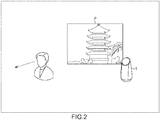
- Fig. 2 is a diagram showing an example of presenting the recommended content.
- the slide-show reproduction of the images of the recommended content items is continued.
- the recommended content items are switched at predetermined time intervals, and the images of each recommended content item are displayed. At that time, a narration sound is not output.
- the state where the user's attention is focused represents a state where the user is paying attention to the recommended content. Whether the user is paying attention to the recommended content or not is determined on the basis of a direction of the user's line of sight, for example.
- the information processing terminal 1 also has functions of detecting the direction of the user's line of sight by analyzing an image captured by a camera and of detecting the attention state of the user.
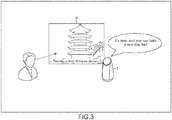
- Fig. 3 is a diagram showing an example of presenting the recommended content according to the attention state.
- the information processing terminal 1 stops the slide-show reproduction of the images of the recommended content items and displays only an image regarding the recommended content that the user is looking at. In a case where there are a plurality of images regarding the recommended content that the user is looking at, the plurality of images are displayed.
- the information processing terminal 1 outputs a narration sound regarding the matter of the recommended content as shown in a speech balloon.
- the narration sound is output on the basis of the text for TTS that is included in the recommended content.
- the recommended content may include voice data obtained by recording a voice of a person, and the narration sound may be output on the basis of the voice data.
- the information processing terminal 1 causes a text regarding the matter of the recommended content to be superimposed on the image P of the recommended content for display.
- the display of the text is performed on the basis of the text for display, which is included in the recommended content.
- a text having the matter different from that of the text output by a sound is superimposed on the image P of the recommended content for display.
- the sound of "It's near and you can take a one-day trip!” is output, whereas the text of "Two hours from the Shinjuku station.”, which has the matter different from that of the sound, is displayed.
- the text for TTS is the same as the text for display and a sound of the same matter as that presented in the text for display is output, the same information as information that can be confirmed when seen is also presented by the sound, and the user feels intrusive with respect to that sound in some cases.
- the information processing terminal 1 can avoid giving such a feeling to the user.
- the narration sound is configured by, for example, selecting adjective or adverbial sentences that modify the recommended content.
- the quantitative information is information that is difficult to understand when it is presented by a sound only.
- the quantitative information is presented in text, the user can efficiently understand presented information.
- the presentation of the recommended content as shown in Fig. 3 is continued while the user's attention is focused.
- the user can confirm the details of information regarding recommended content in which the user is interested, by reading a text superimposed and displayed on the image P and also by listening to a narration sound.
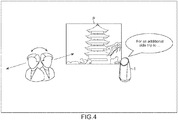
- Fig. 4 is a diagram showing another example of presenting the recommended content according to the attention state.
- the information processing terminal 1 causes the slide-show reproduction of the images of the recommended content items to be continued.
- the information processing terminal 1 causes a narration sound regarding the matter of the recommended content that the user has glanced at to be output.
- the sound of "For an additional side trip to " is output.
- the information regarding the recommended content is presented by a sound. At that time, the superimposition display of the text on the image of the recommended content is not performed.
- the user can listen to the information regarding the interesting recommended content by the narration sound while continuing working.
- Fig. 5 is a diagram showing a relationship between the attention state of the user and a modal used for outputting the recommended content.
- an output modal (output system) of the recommended content includes screen display and sound output.
- the images of the respective recommended content items are displayed in the slide-show format by using the output modal of the screen display. At that time, a narration sound regarding the matter of the recommended content is not output.
- the images of the respective recommended content items are displayed in the slide-show format by using the output modal of the screen display.
- a narration sound regarding the matter of the recommended content in which the user is interested is output by using the output modal of the sound output.
- the output of the narration sound has priority as the output modal used in the presentation of the recommended content. Also in a case where it is recognized that the user looks at the recommended content while working, processing similar to that performed when the period of time during which the user's attention is focused is short may be performed.
- the presentation of the recommended content is configured mainly by the output of images such as a photo, a picture, and an illustration, and the output modal of supplementary information such as explanation is switched according to the attention state of the user.
- Such presentation of the recommended content by using the screen display and sound output is dynamically switched according to the attention state of the user.
- the output modal is switched in convenient units.
- the presentation before and after the switching may overlap each other such that the narration sound or the text is not missed.
- the presentation of the recommended content according to the attention state of the user is performed not only in a case where the information processing terminal 1 actively presents the recommended content but also in a case where the information processing terminal 1 presents the recommended content in response to a request of the user.
- Fig. 6 is a diagram showing another example of presenting the recommended content according to the attention state.
- the information processing terminal 1 judges that the user's attention is focused. Further, the voice data of the user is transmitted to the information presentation server 2.
- an information search for coffee shops located near the sightseeing spot is performed on the basis of the voice of the user, and search results are transmitted to the information processing terminal 1.
- the information processing terminal 1 presents information corresponding to the inquiry of the user by using the output modal of the screen display.
- information of coffee shops located near the sightseeing spot specified by the user is displayed as search results.
- the information processing terminal 1 performs presentation of information by switching the output modal according to the attention state of the user as described above, also in a case where the information corresponding to the inquiry of the user is presented.
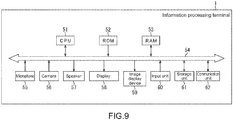
- Fig. 9 is a block diagram showing a hardware configuration example of the information processing terminal 1.
- a CPU Central Processing Unit
- ROM Read Only Memory
- RAM Random Access Memory
- the CPU 51 executes a predetermined program and controls the whole operations of the information processing terminal 1.
- a microphone 55, a camera 56, a speaker 57, a display 58, an image display device 59, an input unit 60, a storage unit 61, and a communication unit 62 are connected to the bus 54.
- the microphone 55 detects a voice uttered by the user. Data of the voice detected by the microphone 55 is supplied to the communication unit 62 and transmitted to the information presentation server 2.
- the camera 56 photographs the surroundings of the information processing terminal 1 and outputs a photographed image to the CPU 51.
- the image photographed by the camera 56 is also transmitted to the information presentation server 2 as appropriate. Various situations are determined on the basis of the image photographed by the camera 56.
- the speaker 57 outputs a sound and music such as BGM.
- the display 58 includes an LCD (Liquid Crystal Display), an organic EL (Electro Luminescence) display, or the like.
- the display 58 displays various screens such as a menu screen and a screen for search results.
- the image display device 59 is a projector, for example.
- the image display device 59 projects various screens such as a presentation screen for recommended content on a wall surface, a floor surface, or the like.
- the input unit 60 includes a touch panel provided to be superimposed on the display 58, and various buttons provided to the casing of the information processing terminal 1.
- the input unit 60 detects an operation made by the user and outputs information representing the details of the operation.
- the storage unit 61 includes a nonvolatile memory or the like.
- the storage unit 61 stores various types of data such as a program to be executed by the CPU 51.
- the communication unit 62 includes a network interface and the like.
- the communication unit 62 performs communication with the information presentation server 2 via the Internet 3.
- the information processing terminal 1 may include various sensors such as an acceleration sensor, a gyro sensor, and a positioning sensor.
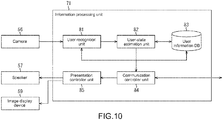
- Fig. 10 is a block diagram showing a functional configuration example of the information processing terminal 1. At least a part of the configuration shown in Fig. 10 is achieved by the CPU 51 of Fig. 9 when executing a predetermined program.
- the information processing unit 71 includes a user recognition unit 81, a user-state estimation unit 82, a user information DB 83, a communication controller unit 84, and a presentation controller unit 85.
- the user recognition unit 81 analyzes the image photographed by the camera 56 and detects (recognizes) a user around the information processing terminal 1. Further, the user recognition unit 81 detects a direction of the line of sight of the recognized user, or the like.
- the user information DB 83 stores information used for recognition of the user, determination of a direction of the line of sight, or the like. The processing of the user recognition unit 81 is performed as appropriate on the basis of the information stored in the user information DB 83.
- the user recognition unit 81 outputs the information indicating the direction of the line of sight of the recognized user to the user-state estimation unit 82.
- the user recognition unit 81 determines those states of the user on the basis of the image photographed by the camera 56. Various types of information indicating the state of the user, which is determined by the user recognition unit 81, are supplied to the user-state estimation unit 82.
- the state of the user may be determined not only on the basis of the image photographed by the camera 56 but also on the basis of information detected by another sensor provided to the information processing terminal 1. Further, the state of the user may be determined on the basis of the information detected by an apparatus external to the information processing terminal 1, such as a portable terminal carried by the user.
- the user-state estimation unit 82 refers to the information stored in the user information DB 83 as appropriate and estimates the attention state of the user recognized by the user recognition unit 81.
- the information indicating an estimation result of the attention state, which is estimated by the user-state estimation unit 82, is supplied to the communication controller unit 84.
- the communication controller unit 84 controls the communication unit 62 to perform communication with the information presentation server 2. For example, the communication controller unit 84 transmits the information indicating an estimation result of the attention state, which is supplied from the user-state estimation unit 82, to the information presentation server 2. The information presentation server 2 receives the information indicating an estimation result of the attention state and then transmits presentation control information that specifies a presentation method for the recommended content.
- the communication controller unit 84 receives the presentation control information transmitted from the information presentation server 2, outputs the presentation control information to the presentation controller unit 85.
- the communication controller unit 84 also receives the recommended content transmitted from the information presentation server 2.
- the presentation controller unit 85 controls the speaker 57 and the image display device 59 to present the recommended content transmitted from the information presentation server 2. Further, the presentation controller unit 85 controls the presentation of the recommended content by, for example, switching the output modal according to the presentation control information transmitted from the information presentation server 2.
- Fig. 11 is a block diagram showing a hardware configuration example of the information presentation server 2.
- a CPU 101, a ROM 102, and a RAM 103 are connected to one another via a bus 104.
- An input/output interface 105 is further connected to the bus 104.
- An input unit 106 including a keyboard, a mouse, or the like, and an output unit 107 including a display, a speaker, or the like are connected to the input/output interface 105.
- a storage unit 108 including a hard disk, a nonvolatile memory, or the like, a communication unit 109 including a network interface or the like, and a drive 110 that drives a removable medium 111 are connected to the input/output interface 105.
- the information presentation server 2 is configured by a single computer, but it may be configured by a plurality of computers. When the plurality of computers cooperate to perform processing, the function of the information presentation server 2 is achieved.
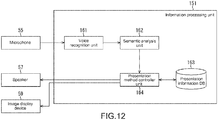
- Fig. 12 is a block diagram showing a functional configuration example of the information presentation server 2. At least a part of the configuration shown in Fig. 12 is achieved by the CPU 101 of Fig. 11 when executing a predetermined program.
- the information processing unit 151 includes a voice recognition unit 161, a semantic analysis unit 162, a presentation information DB 163, and a presentation method controller unit 164.
- Fig. 12 shows the microphone 55, the speaker 57, and the image display device 59 that are the configuration of the information processing terminal 1 for the sake of description.
- the speech is detected by the microphone 55 accordingly, and voice data transmitted from the information processing terminal 1 is received in the communication unit 109 and input to the voice recognition unit 161.
- the recommended content and the presentation control information that are output by the presentation method controller unit 164 are transmitted from the communication unit 109 to the information processing terminal 1 and then used for reproduction of a sound in the speaker 57 and used for display of a screen in the image display device 59.
- the information indicating the attention state of the user which is estimated in the information processing terminal 1 and transmitted from the information processing terminal 1, is received in the communication unit 109 and input to the presentation method controller unit 164.
- the voice recognition unit 161 recognizes the voice of the user and outputs a character string indicating a recognition result to the semantic analysis unit 162.
- the semantic analysis unit 162 analyzes the meaning of the details of the user's speech on the basis of the character string supplied from the voice recognition unit 161. Information indicating an analysis result of the meaning of the user's speech is supplied to the presentation method controller unit 164.
- the presentation method controller unit 164 reads the recommended content from the presentation information DB 163 and acquires and transmits the recommended content to the information processing terminal 1. Further, the presentation method controller unit 164 generates presentation control information that specifies a presentation method for the recommended content, on the basis of the information indicating the attention state of the user, which is transmitted from the information processing terminal 1, and transmits the presentation control information to the information processing terminal 1.
- the presentation control information includes information that specifies the output modal, and the like.
- the presentation method controller unit 164 reads information to be presented as a search result, from the presentation information DB 163, on the basis of the analysis result of the semantic analysis unit 162, and acquires that information.
- the presentation information DB 163 stores various types of information to be presented to the user.
- the information to be presented to the user may be acquired from another server on the Internet 3 or another apparatus such as a portable terminal of the user.
- the presentation method controller unit 164 transmits the information to be presented to the user to the information processing terminal 1.
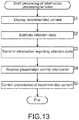
- the processing of Fig. 13 is started when, for example, the recommended content is transmitted from the information presentation server 2.
- the recommended content received in the communication unit 62 is acquired by the communication controller unit 84 and supplied to the presentation controller unit 85.
- Step S1 the presentation controller unit 85 controls the image display device 59 to display the recommended content transmitted from the information presentation server 2.
- the slide-show reproduction of images of a plurality of recommended content items is performed.
- the user recognition unit 81 recognizes a user and detects the direction of the line of sight on the basis of the image photographed by the camera 56.
- Step S2 the user-state estimation unit 82 estimates the attention state of the user near the information processing terminal 1 on the basis of information indicating the direction of the line of sight, which is detected by the user recognition unit 81.
- Step S3 the communication controller unit 84 transmits information indicating an estimation result of the attention state to the information presentation server 2. Transmission of the information indicating an estimation result of the attention state to the information presentation server 2 is repetitively performed while the slide-show reproduction of the images of the recommended content items is being performed.
- the information presentation server 2 which receives the information indicating an estimation result of the attention state, transmits presentation control information that specifies a presentation method for the recommended content.
- Step S4 the communication controller unit 84 receives the presentation control information transmitted from the information presentation server 2.
- Step S5 the presentation controller unit 85 controls the presentation of the recommended content on the basis of the presentation control information. Under the control of the presentation controller unit 85, the presentation of the recommended content is performed by using each of the output modals described with reference to Fig. 5 .
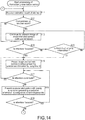
- Fig. 14 The processing of Fig. 14 is started when the information indicating an estimation result of the attention state of the user is transmitted from the information processing terminal 1.
- Step S11 the presentation method controller unit 164 receives the information indicating an estimation result of the attention state, which is transmitted from the information processing terminal 1.
- Step S12 the presentation method controller unit 164 judges whether the user concentrates on another work or not on the basis of the estimation result of the attention state.
- Step S13 the presentation method controller unit 164 transmits the presentation control information to the information processing terminal 1 and causes the information processing terminal 1 to continue the slide-show reproduction of the images of the recommended content items.
- the images of the recommended content items are presented in the slide-show format, and a narration sound is not output.
- Step S13 When judging in Step S12 that the user does not concentrate on another work, the processing of Step S13 is skipped. For example, in a case where the line of sight of the user is directed to the images of the recommended content even for a short period of time, it is judged that the user does not concentrate on another work.
- Step S14 the presentation method controller unit 164 judges whether the user's attention is focused or not.
- Step S15 the presentation method controller unit 164 judges whether or not there is high-priority information necessary to be presented to the user.
- Step S15 When judging in Step S15 that there is no high-priority information, the presentation method controller unit 164 returns to Step S13 and repeats similar processing.
- Step S16 the presentation method controller unit 164 transmits the presentation control information to the information processing terminal 1 and causes the information processing terminal 1 to present an image and text with narration.
- the text for display which is superimposed on the image of the recommended content, is displayed and a narration sound is also output.
- quantitative information is not presented by the output sound.
- Step S16 an image and text with narration is presented.
- the user's line of sight may be caused to be directed to the image of the recommended content such that the attention is forcibly focused, and then information may be presented.
- the user-state estimation unit 82 estimates a subsequent reaction of the user.
- the reaction of the user is estimated.
- the user's line of sight follows the motion in the image of the recommended content
- the information indicating an estimation result of the user-state estimation unit 82 is transmitted to the information presentation server 2.
- the presentation method controller unit 164 which receives the information indicating an estimation result of the user-state estimation unit 82, controls the presentation of the recommended content in the information processing terminal 1 so as to return to a normal state in which the slide-show reproduction is performed.
- Step S17 the presentation method controller unit 164 judges whether the state where the user's attention is focused is continued or not.
- Step S17 When judging in Step S17 that the state where the attention is focused is continued, the presentation method controller unit 164 returns to Step S16, and the presentation of an image and text with narration is continued.
- Step S18 the presentation method controller unit 164 transmits the presentation control information to the information processing terminal 1 and causes the information processing terminal 1 to present the recommended content with priority to narration.
- the slide-show reproduction of the images of the recommended content items is continued, and a narration sound for explaining the matter of the recommended content is output.
- quantitative information may be presented or may not be presented to the user by the output sound.
- Step S19 the presentation method controller unit 164 judges whether the user's attention is focused or not.
- Step S19 When judging in Step S19 that the attention is focused, the presentation method controller unit 164 returns to Step S17, and the presentation of the recommended content is continued according to the attention state of the user.
- Step S19 when judging in Step S19 that the attention is not focused, the presentation method controller unit 164 returns to Step S11 and repeats the above processing.
- the information processing terminal 1 can present the recommended content on the basis of the attention state of the user.
- the presentation of the recommended content is controlled on the basis of the attention state of the user, but it may be controlled on the basis of another state of the user, such as the position of the user.
- the quantitative information may be exceptionally presented by a narration sound together with the matter of the recommended content.
- the presentation of the quantitative information by using the sound is performed by reducing a speech rate or repeating the speech.
- qualitative information to be presented by the speech may also be presented exceptionally by using the output modal of the screen display.
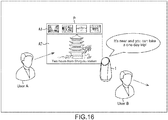
- Fig. 15 is a diagram showing an example of presenting information in a case where there are a plurality of users.
- a user A and a user B are around the information processing terminal 1 that is performing the slide-show reproduction of images of recommended content items.
- Each of the user A and the user B is a user who is performing predetermined work.
- images of respective recommended content items C1 to C3 are displayed on an image P displayed by the information processing terminal 1.
- the images of the recommended content items C1 to C3 are displayed, for example, so as to move from the left to the right.
- the slide-show reproduction may be performed by not switching the images of the recommended content items one by one in sequence but moving the sequence of the images of a plurality of recommended content items in a certain direction.
- the image P is divided into a region A1 and a region A2, and the presentation of the recommended content according to the attention state of the user A is performed by using the region A2.
- the user B does not turn the line of sight to the image of the recommended content item C1.
- the image of the recommended content item C1 is displayed in the region A2 in an enlarged manner, and a text for display is displayed to be superimposed on the image of the recommended content item C1. Further, along with the display of the image of the recommended content item C1, a narration sound for explaining the matter of the recommended content item C1 is output as shown in a speech balloon.
- the screen displayed by the information processing terminal 1 may be divided into a plurality of regions, and the presentation corresponding to the attention state of the user whose line of sight is directed to the recommended content may be performed by using a predetermined region.
- the output modal of transmitting information to a portable terminal is used to perform the presentation of recommended content.
- the matter of recommended content to be presented by using the output of a sound may be controlled according to a level at which the user concentrates on the work. For example, as the level at which the user concentrates on the work increases, the matter to be output is switched in the order of the output of BGM, the output of a brand sound, and the output of a narration sound (BGM ⁇ brand sound ⁇ narration).
- an image of a color tone that does not affect the color tone of the space may be displayed, and when the user's attention is focused, an image desired to be presented to the user may be displayed.
- an image of a color tone that suits the color tone of a room, or an image of a color tone that suits the color tone of an image of the recommended content that has been presented so far are displayed at the start of displaying the images of the recommended content.
- the images of the recommended content may be processed to generate an image of such a color tone.
- a filter used for generating a pink-based image is applied to the image of the recommended content, so that an image for the display start is generated.
- the pink-based image generated by being subjected to such filter processing is performed, when the user's attention is focused, the original image of the recommended content is displayed.
- each processing for presenting the recommended content is performed by the information processing terminal 1 and the information presentation server 2, but at least a part of the functions of the above-mentioned information processing terminal 1 may be provided to the information presentation server 2.
- At least a part of the functional unit of the information processing unit 71 shown in Fig. 10 is provided to the information presentation server 2.
- Fig. 17 is a diagram showing another functional configuration example of the information presentation server 2.
- a configuration of an information processing unit 151 shown in Fig. 17 is different from the configuration described with reference to Fig. 12 in that the user recognition unit 81, the user-state estimation unit 82, and the user information DB 83 are additionally provided.
- the recognition of a user and the estimation of the attention state of the user are performed in the information presentation server 2 on the basis of the information (image photographed by camera 56) transmitted from the information processing terminal 1.
- Fig. 18 is a diagram showing another functional configuration example of the information processing terminal 1.
- a configuration of an information processing unit 71 shown in Fig. 18 is different from the configuration described with reference to Fig. 10 in that the voice recognition unit 161, the semantic analysis unit 162, the presentation information DB 163, and the presentation method controller unit 164 are additionally provided.
- voice recognition a semantic analysis of the details of a speech, and control of a presentation method are performed by the information processing terminal 1 itself.
- the series of processing described above can be executed by hardware or executed by software.
- a program constituting the software is installed from a program recording medium in a computer built in dedicated hardware, a general-purpose personal computer, or the like.
- a program to be installed is provided by being recorded on the removable medium 111 shown in Fig. 11 , such as an optical disc (CD-ROM (Compact Disc-Read Only Memory), a DVD (Digital Versatile Disc) or the like), or a semiconductor memory. Further, the program to be installed may be provided via a wired or wireless transmission medium such as a local area network, the Internet, and digital broadcasting. The program can be installed in advance in the ROM 102 or the storage unit 108.
- the program to be executed by the computer may be a program that is processed chronologically along the order described in this specification or may be a program that is processed in parallel or at a necessary timing such as when an invocation is performed.
- a system means an aggregation of a plurality of constituent elements (apparatus, module (parts), and the like), regardless of whether all constituent elements are included in the same casing or not. Therefore, a plurality of apparatuses housed in separate casings and connected to one another via a network is a system, and one apparatus including a plurality of modules in one casing is also a system.
- the embodiment of the present technology is not limited to the embodiment described above and can be variously modified without departing from the gist of the present technology.
- the present technology can have a configuration of cloud computing in which a plurality of apparatuses share one function and cooperate to perform processing via a network.
- one step includes a plurality of processing steps
- the plurality of processing steps in one step can be executed by one apparatus or shared and executed by a plurality of apparatuses.
- the present technology can have the following configurations.
Landscapes
- Engineering & Computer Science (AREA)
- Human Computer Interaction (AREA)
- Physics & Mathematics (AREA)
- Health & Medical Sciences (AREA)
- Theoretical Computer Science (AREA)
- Multimedia (AREA)
- Audiology, Speech & Language Pathology (AREA)
- General Engineering & Computer Science (AREA)
- Computational Linguistics (AREA)
- Acoustics & Sound (AREA)
- Signal Processing (AREA)
- General Physics & Mathematics (AREA)
- General Health & Medical Sciences (AREA)
- Child & Adolescent Psychology (AREA)
- Hospice & Palliative Care (AREA)
- Psychiatry (AREA)
- User Interface Of Digital Computer (AREA)
Applications Claiming Priority (2)
| Application Number | Priority Date | Filing Date | Title |
|---|---|---|---|
| JP2017219984 | 2017-11-15 | ||
| PCT/JP2018/040662 WO2019098037A1 (ja) | 2017-11-15 | 2018-11-01 | 情報処理端末、情報処理装置、および情報処理方法 |
Publications (2)
| Publication Number | Publication Date |
|---|---|
| EP3570141A1 true EP3570141A1 (de) | 2019-11-20 |
| EP3570141A4 EP3570141A4 (de) | 2020-03-11 |
Family
ID=66539020
Family Applications (1)
| Application Number | Title | Priority Date | Filing Date |
|---|---|---|---|
| EP18878630.5A Ceased EP3570141A4 (de) | 2017-11-15 | 2018-11-01 | Informationsverarbeitungsendgerät, informationsverarbeitungsvorrichtung und informationsverarbeitungsverfahren |
Country Status (4)
| Country | Link |
|---|---|
| US (1) | US11120797B2 (de) |
| EP (1) | EP3570141A4 (de) |
| JP (1) | JP7283384B2 (de) |
| WO (1) | WO2019098037A1 (de) |
Cited By (2)
| Publication number | Priority date | Publication date | Assignee | Title |
|---|---|---|---|---|
| WO2021112536A1 (en) * | 2019-12-02 | 2021-06-10 | Samsung Electronics Co., Ltd. | Electronic apparatus providing voice-based interface and method for controlling the same |
| EP4220443A4 (de) * | 2021-03-15 | 2024-04-24 | Samsung Electronics Co., Ltd. | Elektronische vorrichtung zur bereitstellung von alternativinhalt und betriebsverfahren dafür |
Families Citing this family (6)
| Publication number | Priority date | Publication date | Assignee | Title |
|---|---|---|---|---|
| WO2019021553A1 (ja) * | 2017-07-26 | 2019-01-31 | ソニー株式会社 | 情報処理装置、情報処理方法、およびプログラム |
| US11942081B2 (en) * | 2018-12-07 | 2024-03-26 | Sony Group Corporation | Information processing device and information processing method for response presentation |
| JP7654390B2 (ja) * | 2020-11-26 | 2025-04-01 | キヤノン株式会社 | 画像処理装置およびその制御方法、撮像装置、プログラム |
| US11984112B2 (en) * | 2021-04-29 | 2024-05-14 | Rovi Guides, Inc. | Systems and methods to alter voice interactions |
| US12272366B2 (en) | 2021-04-29 | 2025-04-08 | Adeia Guides Inc. | Systems and methods to alter voice interactions |
| JP2024002167A (ja) * | 2022-06-23 | 2024-01-11 | ソニーグループ株式会社 | 情報処理装置 |
Family Cites Families (11)
| Publication number | Priority date | Publication date | Assignee | Title |
|---|---|---|---|---|
| US7284201B2 (en) * | 2001-09-20 | 2007-10-16 | Koninklijke Philips Electronics N.V. | User attention-based adaptation of quality level to improve the management of real-time multi-media content delivery and distribution |
| US8292433B2 (en) * | 2003-03-21 | 2012-10-23 | Queen's University At Kingston | Method and apparatus for communication between humans and devices |
| CN101495945A (zh) * | 2006-07-28 | 2009-07-29 | 皇家飞利浦电子股份有限公司 | 用于被凝视物品的信息显示的凝视交互 |
| US9030536B2 (en) * | 2010-06-04 | 2015-05-12 | At&T Intellectual Property I, Lp | Apparatus and method for presenting media content |
| JP2012022589A (ja) * | 2010-07-16 | 2012-02-02 | Hitachi Ltd | 商品選択支援方法 |
| US9619018B2 (en) * | 2011-05-23 | 2017-04-11 | Hewlett-Packard Development Company, L.P. | Multimodal interactions based on body postures |
| US10120438B2 (en) * | 2011-05-25 | 2018-11-06 | Sony Interactive Entertainment Inc. | Eye gaze to alter device behavior |
| US9426242B2 (en) * | 2013-01-29 | 2016-08-23 | Apple Inc. | Determining an invitational content item type based on predicted user attention |
| JP6299113B2 (ja) * | 2013-08-28 | 2018-03-28 | 株式会社リコー | 画像表示装置、画像表示制御方法及び画像表示制御プログラム |
| JP2015046089A (ja) | 2013-08-29 | 2015-03-12 | ソニー株式会社 | 情報処理装置および情報処理方法 |
| US9958939B2 (en) * | 2013-10-31 | 2018-05-01 | Sync-Think, Inc. | System and method for dynamic content delivery based on gaze analytics |
-
2018
- 2018-11-01 EP EP18878630.5A patent/EP3570141A4/de not_active Ceased
- 2018-11-01 US US16/473,105 patent/US11120797B2/en active Active
- 2018-11-01 WO PCT/JP2018/040662 patent/WO2019098037A1/ja not_active Ceased
- 2018-11-01 JP JP2019527272A patent/JP7283384B2/ja active Active
Cited By (3)
| Publication number | Priority date | Publication date | Assignee | Title |
|---|---|---|---|---|
| WO2021112536A1 (en) * | 2019-12-02 | 2021-06-10 | Samsung Electronics Co., Ltd. | Electronic apparatus providing voice-based interface and method for controlling the same |
| US11900929B2 (en) | 2019-12-02 | 2024-02-13 | Samsung Electronics Co., Ltd. | Electronic apparatus providing voice-based interface and method for controlling the same |
| EP4220443A4 (de) * | 2021-03-15 | 2024-04-24 | Samsung Electronics Co., Ltd. | Elektronische vorrichtung zur bereitstellung von alternativinhalt und betriebsverfahren dafür |
Also Published As
| Publication number | Publication date |
|---|---|
| JP7283384B2 (ja) | 2023-05-30 |
| US20190348043A1 (en) | 2019-11-14 |
| US11120797B2 (en) | 2021-09-14 |
| JPWO2019098037A1 (ja) | 2020-10-01 |
| WO2019098037A1 (ja) | 2019-05-23 |
| EP3570141A4 (de) | 2020-03-11 |
Similar Documents
| Publication | Publication Date | Title |
|---|---|---|
| US11120797B2 (en) | Information processing terminal, information processing apparatus, and information processing method | |
| JP6941406B2 (ja) | 視覚的または聴覚的効果の双方向伝達を利用した映像通話方法およびシステム | |
| JP5556911B2 (ja) | コンテンツ表現を作成する、方法、プログラム、及びシステム | |
| EP3335190B1 (de) | Verfahren und system zur bereitstellung von benutzerpersonalisiertem inhalt | |
| CN109478106B (zh) | 利用环境上下文以用于增强的通信吞吐量 | |
| US10498673B2 (en) | Device and method for providing user-customized content | |
| EP2869162A2 (de) | Anzeigen von Nachrichten mit Zeichtrickbildern in einer elektronischen Vorrichtung | |
| US20130337853A1 (en) | System and method for interacting with a mobile communication device | |
| KR20140089829A (ko) | 전자 장치에서 움직이는 사진 제어 장치 및 방법 | |
| US10685642B2 (en) | Information processing method | |
| US10950240B2 (en) | Information processing device and information processing method | |
| EP3550438A1 (de) | Informationsverarbeitungsvorrichtung, informationsverarbeitungsverfahren, programm und informationsverarbeitungssystem | |
| CN110945473A (zh) | 信息处理装置和信息处理方法 | |
| CN113552984A (zh) | 文本提取方法、装置、设备及介质 | |
| US10331330B2 (en) | Capturing objects in editable format using gestures | |
| JP2022047550A (ja) | 情報処理装置、及び情報処理方法 | |
| US12265755B2 (en) | Display of text images of overlapping voices in a teleconference | |
| EP3236360A1 (de) | Informationsverarbeitungsvorrichtung, informationsverarbeitungsverfahren, programm und informationsverarbeitungssystem | |
| JP5907231B1 (ja) | 入力情報支援装置、入力情報支援方法および入力情報支援プログラム | |
| CN114398135B (zh) | 交互方法、装置、电子设备、存储介质和程序产品 | |
| JP2017182822A (ja) | 入力情報支援装置、入力情報支援方法および入力情報支援プログラム | |
| JP6496220B2 (ja) | 情報配信装置および情報配信プログラム | |
| US12541902B2 (en) | Sign language generation and display | |
| KR20150106565A (ko) | 메신저 서비스 시스템, 그 시스템에서 프레즌스 정보를 이용한 인스턴트 메시지 서비스 방법 및 장치 | |
| CN115248655B (zh) | 用于显示信息的方法和装置 |
Legal Events
| Date | Code | Title | Description |
|---|---|---|---|
| STAA | Information on the status of an ep patent application or granted ep patent |
Free format text: STATUS: THE INTERNATIONAL PUBLICATION HAS BEEN MADE |
|
| PUAI | Public reference made under article 153(3) epc to a published international application that has entered the european phase |
Free format text: ORIGINAL CODE: 0009012 |
|
| STAA | Information on the status of an ep patent application or granted ep patent |
Free format text: STATUS: REQUEST FOR EXAMINATION WAS MADE |
|
| 17P | Request for examination filed |
Effective date: 20190814 |
|
| AK | Designated contracting states |
Kind code of ref document: A1 Designated state(s): AL AT BE BG CH CY CZ DE DK EE ES FI FR GB GR HR HU IE IS IT LI LT LU LV MC MK MT NL NO PL PT RO RS SE SI SK SM TR |
|
| AX | Request for extension of the european patent |
Extension state: BA ME |
|
| A4 | Supplementary search report drawn up and despatched |
Effective date: 20200211 |
|
| RIC1 | Information provided on ipc code assigned before grant |
Ipc: G06F 3/16 20060101ALI20200205BHEP Ipc: G06F 3/0481 20130101ALI20200205BHEP Ipc: G06F 3/01 20060101AFI20200205BHEP Ipc: G10L 13/00 20060101ALI20200205BHEP |
|
| DAV | Request for validation of the european patent (deleted) | ||
| DAX | Request for extension of the european patent (deleted) | ||
| RAP3 | Party data changed (applicant data changed or rights of an application transferred) |
Owner name: SONY GROUP CORPORATION |
|
| STAA | Information on the status of an ep patent application or granted ep patent |
Free format text: STATUS: EXAMINATION IS IN PROGRESS |
|
| 17Q | First examination report despatched |
Effective date: 20211015 |
|
| REG | Reference to a national code |
Ref country code: DE Ref legal event code: R003 |
|
| STAA | Information on the status of an ep patent application or granted ep patent |
Free format text: STATUS: THE APPLICATION HAS BEEN REFUSED |
|
| 18R | Application refused |
Effective date: 20230609 |