EP3570209A1 - Verfahren zu erkennung eines menschlichen kopfes, elektronische vorrichtung und speichermedium - Google Patents
Verfahren zu erkennung eines menschlichen kopfes, elektronische vorrichtung und speichermedium Download PDFInfo
- Publication number
- EP3570209A1 EP3570209A1 EP18738888.9A EP18738888A EP3570209A1 EP 3570209 A1 EP3570209 A1 EP 3570209A1 EP 18738888 A EP18738888 A EP 18738888A EP 3570209 A1 EP3570209 A1 EP 3570209A1
- Authority
- EP
- European Patent Office
- Prior art keywords
- human head
- head position
- image
- sub
- layer
- Prior art date
- Legal status (The legal status is an assumption and is not a legal conclusion. Google has not performed a legal analysis and makes no representation as to the accuracy of the status listed.)
- Pending
Links
Images


Classifications
-
- G—PHYSICS
- G06—COMPUTING OR CALCULATING; COUNTING
- G06V—IMAGE OR VIDEO RECOGNITION OR UNDERSTANDING
- G06V40/00—Recognition of biometric, human-related or animal-related patterns in image or video data
- G06V40/10—Human or animal bodies, e.g. vehicle occupants or pedestrians; Body parts, e.g. hands
-
- G—PHYSICS
- G06—COMPUTING OR CALCULATING; COUNTING
- G06V—IMAGE OR VIDEO RECOGNITION OR UNDERSTANDING
- G06V10/00—Arrangements for image or video recognition or understanding
- G06V10/70—Arrangements for image or video recognition or understanding using pattern recognition or machine learning
- G06V10/82—Arrangements for image or video recognition or understanding using pattern recognition or machine learning using neural networks
-
- G—PHYSICS
- G06—COMPUTING OR CALCULATING; COUNTING
- G06F—ELECTRIC DIGITAL DATA PROCESSING
- G06F18/00—Pattern recognition
- G06F18/20—Analysing
- G06F18/21—Design or setup of recognition systems or techniques; Extraction of features in feature space; Blind source separation
- G06F18/214—Generating training patterns; Bootstrap methods, e.g. bagging or boosting
-
- G—PHYSICS
- G06—COMPUTING OR CALCULATING; COUNTING
- G06F—ELECTRIC DIGITAL DATA PROCESSING
- G06F18/00—Pattern recognition
- G06F18/20—Analysing
- G06F18/22—Matching criteria, e.g. proximity measures
-
- G—PHYSICS
- G06—COMPUTING OR CALCULATING; COUNTING
- G06N—COMPUTING ARRANGEMENTS BASED ON SPECIFIC COMPUTATIONAL MODELS
- G06N3/00—Computing arrangements based on biological models
- G06N3/02—Neural networks
- G06N3/04—Architecture, e.g. interconnection topology
- G06N3/045—Combinations of networks
-
- G—PHYSICS
- G06—COMPUTING OR CALCULATING; COUNTING
- G06N—COMPUTING ARRANGEMENTS BASED ON SPECIFIC COMPUTATIONAL MODELS
- G06N3/00—Computing arrangements based on biological models
- G06N3/02—Neural networks
- G06N3/04—Architecture, e.g. interconnection topology
- G06N3/0464—Convolutional networks [CNN, ConvNet]
-
- G—PHYSICS
- G06—COMPUTING OR CALCULATING; COUNTING
- G06N—COMPUTING ARRANGEMENTS BASED ON SPECIFIC COMPUTATIONAL MODELS
- G06N3/00—Computing arrangements based on biological models
- G06N3/02—Neural networks
- G06N3/08—Learning methods
- G06N3/082—Learning methods modifying the architecture, e.g. adding, deleting or silencing nodes or connections
-
- G—PHYSICS
- G06—COMPUTING OR CALCULATING; COUNTING
- G06N—COMPUTING ARRANGEMENTS BASED ON SPECIFIC COMPUTATIONAL MODELS
- G06N3/00—Computing arrangements based on biological models
- G06N3/02—Neural networks
- G06N3/08—Learning methods
- G06N3/09—Supervised learning
-
- G—PHYSICS
- G06—COMPUTING OR CALCULATING; COUNTING
- G06T—IMAGE DATA PROCESSING OR GENERATION, IN GENERAL
- G06T7/00—Image analysis
- G06T7/10—Segmentation; Edge detection
-
- G—PHYSICS
- G06—COMPUTING OR CALCULATING; COUNTING
- G06T—IMAGE DATA PROCESSING OR GENERATION, IN GENERAL
- G06T7/00—Image analysis
- G06T7/20—Analysis of motion
-
- G—PHYSICS
- G06—COMPUTING OR CALCULATING; COUNTING
- G06T—IMAGE DATA PROCESSING OR GENERATION, IN GENERAL
- G06T7/00—Image analysis
- G06T7/20—Analysis of motion
- G06T7/246—Analysis of motion using feature-based methods, e.g. the tracking of corners or segments
-
- G—PHYSICS
- G06—COMPUTING OR CALCULATING; COUNTING
- G06T—IMAGE DATA PROCESSING OR GENERATION, IN GENERAL
- G06T7/00—Image analysis
- G06T7/70—Determining position or orientation of objects or cameras
- G06T7/73—Determining position or orientation of objects or cameras using feature-based methods
-
- G—PHYSICS
- G06—COMPUTING OR CALCULATING; COUNTING
- G06T—IMAGE DATA PROCESSING OR GENERATION, IN GENERAL
- G06T7/00—Image analysis
- G06T7/70—Determining position or orientation of objects or cameras
- G06T7/73—Determining position or orientation of objects or cameras using feature-based methods
- G06T7/74—Determining position or orientation of objects or cameras using feature-based methods involving reference images or patches
-
- G—PHYSICS
- G06—COMPUTING OR CALCULATING; COUNTING
- G06V—IMAGE OR VIDEO RECOGNITION OR UNDERSTANDING
- G06V10/00—Arrangements for image or video recognition or understanding
- G06V10/40—Extraction of image or video features
- G06V10/44—Local feature extraction by analysis of parts of the pattern, e.g. by detecting edges, contours, loops, corners, strokes or intersections; Connectivity analysis, e.g. of connected components
- G06V10/443—Local feature extraction by analysis of parts of the pattern, e.g. by detecting edges, contours, loops, corners, strokes or intersections; Connectivity analysis, e.g. of connected components by matching or filtering
- G06V10/449—Biologically inspired filters, e.g. difference of Gaussians [DoG] or Gabor filters
- G06V10/451—Biologically inspired filters, e.g. difference of Gaussians [DoG] or Gabor filters with interaction between the filter responses, e.g. cortical complex cells
- G06V10/454—Integrating the filters into a hierarchical structure, e.g. convolutional neural networks [CNN]
-
- G—PHYSICS
- G06—COMPUTING OR CALCULATING; COUNTING
- G06V—IMAGE OR VIDEO RECOGNITION OR UNDERSTANDING
- G06V10/00—Arrangements for image or video recognition or understanding
- G06V10/70—Arrangements for image or video recognition or understanding using pattern recognition or machine learning
- G06V10/74—Image or video pattern matching; Proximity measures in feature spaces
- G06V10/75—Organisation of the matching processes, e.g. simultaneous or sequential comparisons of image or video features; Coarse-fine approaches, e.g. multi-scale approaches; using context analysis; Selection of dictionaries
- G06V10/751—Comparing pixel values or logical combinations thereof, or feature values having positional relevance, e.g. template matching
-
- G—PHYSICS
- G06—COMPUTING OR CALCULATING; COUNTING
- G06V—IMAGE OR VIDEO RECOGNITION OR UNDERSTANDING
- G06V10/00—Arrangements for image or video recognition or understanding
- G06V10/70—Arrangements for image or video recognition or understanding using pattern recognition or machine learning
- G06V10/764—Arrangements for image or video recognition or understanding using pattern recognition or machine learning using classification, e.g. of video objects
-
- G—PHYSICS
- G06—COMPUTING OR CALCULATING; COUNTING
- G06V—IMAGE OR VIDEO RECOGNITION OR UNDERSTANDING
- G06V20/00—Scenes; Scene-specific elements
- G06V20/50—Context or environment of the image
- G06V20/52—Surveillance or monitoring of activities, e.g. for recognising suspicious objects
- G06V20/53—Recognition of crowd images, e.g. recognition of crowd congestion
-
- G—PHYSICS
- G07—CHECKING-DEVICES
- G07C—TIME OR ATTENDANCE REGISTERS; REGISTERING OR INDICATING THE WORKING OF MACHINES; GENERATING RANDOM NUMBERS; VOTING OR LOTTERY APPARATUS; ARRANGEMENTS, SYSTEMS OR APPARATUS FOR CHECKING NOT PROVIDED FOR ELSEWHERE
- G07C9/00—Individual registration on entry or exit
-
- G—PHYSICS
- G06—COMPUTING OR CALCULATING; COUNTING
- G06T—IMAGE DATA PROCESSING OR GENERATION, IN GENERAL
- G06T2207/00—Indexing scheme for image analysis or image enhancement
- G06T2207/10—Image acquisition modality
- G06T2207/10016—Video; Image sequence
-
- G—PHYSICS
- G06—COMPUTING OR CALCULATING; COUNTING
- G06T—IMAGE DATA PROCESSING OR GENERATION, IN GENERAL
- G06T2207/00—Indexing scheme for image analysis or image enhancement
- G06T2207/20—Special algorithmic details
- G06T2207/20021—Dividing image into blocks, subimages or windows
-
- G—PHYSICS
- G06—COMPUTING OR CALCULATING; COUNTING
- G06T—IMAGE DATA PROCESSING OR GENERATION, IN GENERAL
- G06T2207/00—Indexing scheme for image analysis or image enhancement
- G06T2207/20—Special algorithmic details
- G06T2207/20081—Training; Learning
-
- G—PHYSICS
- G06—COMPUTING OR CALCULATING; COUNTING
- G06T—IMAGE DATA PROCESSING OR GENERATION, IN GENERAL
- G06T2207/00—Indexing scheme for image analysis or image enhancement
- G06T2207/20—Special algorithmic details
- G06T2207/20084—Artificial neural networks [ANN]
-
- G—PHYSICS
- G06—COMPUTING OR CALCULATING; COUNTING
- G06T—IMAGE DATA PROCESSING OR GENERATION, IN GENERAL
- G06T2207/00—Indexing scheme for image analysis or image enhancement
- G06T2207/30—Subject of image; Context of image processing
- G06T2207/30196—Human being; Person
-
- G—PHYSICS
- G06—COMPUTING OR CALCULATING; COUNTING
- G06T—IMAGE DATA PROCESSING OR GENERATION, IN GENERAL
- G06T2207/00—Indexing scheme for image analysis or image enhancement
- G06T2207/30—Subject of image; Context of image processing
- G06T2207/30242—Counting objects in image
Definitions
- This application relates to the technical field of image processing, and in particular, to a method, an electronic device and a storage medium for human head detection.
- Human head detection refers to the detection of the head of a human body in an image, and a result of the human head detection has various applications, such as the application in the field of security.
- the human head detection is implemented mainly based on a shape and color of a human head.
- a specific process of the human head detection includes: first, binarizing an image, and then performing edge detection to acquire a substantially circular edge; and then using circle detection to acquire a position and size of the circular edge, and then performing gray scale and size determination on a corresponding circular area in the original image to obtain a result of the human head detection.
- the human head detection relies on an assumption that the shape of the human head is circular.
- the shape of the human head is not strictly circular, and the shapes of the human heads of different person are also different.
- some human heads miss the detection and accuracy of the result of the human head detection is relatively low.
- a human head detection method an electronic device and a storage medium are provided.
- a human head detection method includes:
- An electronic device includes a memory and a processor, the memory storing a computer readable instruction, the computer readable instruction, when executed by the processor, causing the processor to perform the following steps:
- One or more non-volatile storage media storing a computer readable instruction is provided, the computer readable instruction, when executed by one or more processors, causing the processor to perform the following steps:
- FIG. 1 is an application environment diagram of a human head detection method according to an embodiment.
- the human head detection method is applied to a human head detection system, which includes an electronic device 110 and a top view camera 120 connected to the electronic device 110.
- the top view camera 120 is configured to capture an image to be detected and send the image to be detected to the electronic device 110.
- the top view camera may be mounted on the top of a building or at a wall above the height of a person or at a corner of the top of the building, so that the top view camera can capture images of a top view angle.
- the top view may be front top view or top view of an oblique angle.
- the electronic device 110 may be configured to segment an image to be detected into more than one sub-image; input each sub-image to a convolutional neural network trained according to a training image having a marked human head position respectively, and output, by a preprocessing layer including a convolutional layer and a pooling layer in the convolutional neural network, a first feature corresponding to each sub-image; map, through a convolutional layer after the preprocessing layer in the convolutional neural network, the first feature corresponding to each sub-image to a second feature corresponding to each sub-image; map, through a regression layer of the convolutional neural network, the second feature corresponding to each sub-image to a human head position corresponding to each sub-image and a corresponding confidence level of the human head position; and filter, according to the corresponding confidence level, the human head position corresponding to each sub-image, to acquire a human head position detected in the image to be detected.
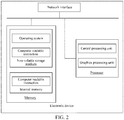
- FIG. 2 is a schematic diagram of an internal structure of an electronic device according to an embodiment.
- the electronic device includes a processor, a memory and a network interface which are connected by a system bus.
- the memory includes a non-volatile storage medium and an internal memory.
- the non-volatile storage medium of the electronic device may store an operating system and computer readable instructions. When being executed, the computer readable instruction may cause the processor to perform a human head detection method.
- the processor of the electronic device may include a central processing unit and a graphics processing unit. The processor is configured to provide computing and control capabilities to support operation of the electronic device.
- the internal memory may store the computer readable instruction. When being executed by the processor, the computer readable instruction may cause the processor to perform a human head detection method.
- the network interface of the electronic device is configured to be connected to the top view camera.
- the electronic device may be implemented by a separate electronic device or a cluster including multiple electronic devices.
- the electronic device may be a personal computer, a server or a dedicated human head detection device.
- FIG. 2 is only a block diagram of a part of the structure related to the solution of this application, and does not constitute limitation on the electronic device to which the solution of this application is applied.
- the specific electronic device may include more or fewer components than those shown in the figure, or may combine some components, or have different component arrangement.
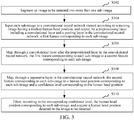
- FIG. 3 is a schematic flowchart of a human head detection method according to an embodiment. This embodiment is mainly illustrated by applying the method to the electronic device 110 in above FIG. 1 and FIG. 2 .
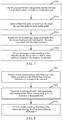
- the human head detection method specifically includes the following steps: S302: Segment an image to be detected into more than one sub-image.
- the image to be detected is an image on which human head detection needs to be performed.
- the image to be detected may be a picture or a video frame in a video.
- the sub-images are images which are segmented from the image to be detected and have a size smaller than the image to be detected. All segmented sub-images may have the same size.
- the electronic device may traverse a window of a fixed size in the image to be detected according to a transverse step size and a longitudinal step size, thereby segmenting the sub-images having the same size as the window size from the image to be detected during the traversal process.
- the segmented sub-images may be combined to the image to be detected.
- step S302 includes: segmenting the image to be detected to more than one sub-image of a fixed size, adjacent sub-images in the segmented sub-images having an overlapping part.
- the adjacent sub-images refer to that positions of the sub-images in the image to be detected are adjacent, and the adjacent sub-images may partially overlapp.
- the electronic device may traverse the window of a fixed size in the image to be detected according to the transverse step size smaller than a window width and the longitudinal step size smaller than a window height, to acquire more than one sub-image of the same size, and adjacent sub-images have an overlapping part.
- S304 Input each sub-image to a convolutional neural network trained according to a training image having a marked human head position, and output, by a preprocessing layer including a convolutional layer and a pooling layer in the convolutional neural network, a first feature corresponding to each sub-image.
- the Convolutional Neural Network is an artificial neural network.
- the convolutional neural network includes a convolutional layer and a pooling layer.
- the convolutional neural network used in this embodiment may be directly constructed, and may alternatively be acquired by reconstructing an existing convolutional neural network.
- a computational task in the convolutional neural network may be implemented by a central processing unit or a graphics processing unit. Time consumed by the central processing unit for human head detection is proximately a level of seconds, and time consumed by the graphics processing unit for human head detection may be reduced to a level of hundred milliseconds, thereby realizing real-time human head detection basically.
- each feature map includes a plurality of neurons, and all neurons of the same feature map share one convolution kernel.
- the convolution kernel provides a weight of the corresponding neuron, and the convolution kernel represents a feature.
- the convolution kernel is generally initialized in a form of a random decimal matrix, and a proper convolution kernel will be learned during training of the network.
- the convolutional layer can reduce connection between various layers in the neural network, and in addition, a risk of overfitting is reduced.
- Pooling may take two exemplary forms of implementation: mean pooling and max pooling. Pooling may be considered as a special convolutional process. Convolution and pooling greatly simplify complexity of the neural network and reduce parameters of the neural network.
- the training image having the marked human head position means that the training image corresponds to the human head position which is artificially marked.
- the training image having the marked human head position and the image to be detected may be the images captured in the same scene, thereby further improving the accuracy of human head detection.
- the training image having the marked human head position can be the same size as the image to be detected.
- a confidence level may be assigned to the human head position marked in the training image.
- the training image is segmented into more than one sub-image according to the same segmentation manner as that of the image to be detected.
- the segmented sub-images are separately input to the convolutional neural network, and the convolutional neural network outputs human head positions and confidence levels.
- a difference between the output head positions and the marked head position is calculated, and a difference between the corresponding confidence levels is calculated.
- parameters of the convolutional neural network are adjusted.
- the training is continued until a termination condition is reached.
- the termination condition may be that the difference is less than a preset difference, or the number of iterations reaches a preset number of times.
- the preprocessing layer is a general term of other layers in the convolutional neural network except for the regression layer and a convolutional layer before the regression layer.
- the preprocessing layer may include a convolutional layer and a pooling layer.
- the preprocessing layer may include parallel convolutional layers, and data output by the parallel convolutional layers may be spliced and input to a next layer.
- the last layer in the preprocessing layer may be a convolutional layer or a pooling layer.
- S306 Map, through a convolutional layer after the preprocessing layer in the convolutional neural network, a first feature corresponding to each sub-image to a second feature corresponding to each sub-image.
- a conventional convolutional neural network is generally used for classification, and the preprocessing layer in the convolutional neural network for classification is followed by a fully connected layer.
- the fully connected layer may map the first feature output by the preprocessing layer to probability data corresponding to each preset type. Therefore, a type to which an input image belongs may be determined by the regression layer.
- the convolutional neural network is used for human head detection, the convolutional layer is configured to replace the fully connected layer, and to output the second feature for describing the sub-image features.
- the number of the second features corresponding to each sub-image may be plural.
- S308 Map, through a regression layer in the convolutional neural network, the second feature corresponding to each sub-image to a human head position corresponding to each sub-image and a confidence level corresponding to the human head position.
- the human head position may be represented by a position of a rectangular box including a human head image.
- the position of the rectangular box may be represented by a quadruple.
- the quadruple may include a horizontal coordinate and a longitudinal coordinate of one vertex of the rectangular box and a width and a height of the rectangular box.
- the quadruple may include a horizontal coordinate and a longitudinal coordinate of each of two vertexes of the rectangular box in a diagonal relationship.
- the confidence level output by the regression layer are in a one-to-one correspondence with the human head position output by the regression layer, thereby indicating a probability that the corresponding human head position includes the human head image.
- the regression layer may use a support vector machine (SVM).
- SVM support vector machine
- step S308 includes: mapping, through the convolutional layer in the regression layer in the convolutional neural network, the second feature corresponding to each sub-image to the human head position corresponding to each sub-image and the confidence level corresponding to the human head position.
- the electronic device may directly map the second feature corresponding to each sub-image to the human head position corresponding to each sub-image and the confidence level corresponding to the human head position through the same convolutional layer in the regression layer in the convolutional neural network.
- step S308 includes: mapping, through a first convolutional layer in the regression layer in the convolutional neural network, the second feature corresponding to each sub-image to the human head position corresponding to each sub-image; and mapping, through a second convolutional layer in the regression layer in the convolutional neural network, the second feature corresponding to each sub-image to the confidence level corresponding to the output human head position.
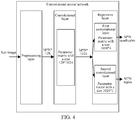
- the sub-image outputs 128 feature matrices with a size M*N through the preprocessing layer in the convolutional neural network.
- 128 is a preset value for number of features, and can be set as needed.
- M and N are determined by parameters of the preprocessing layer.
- the 128 feature matrices with the size M*N are input to the convolutional layer after the preprocessing layer.
- M ⁇ N feature vectors with a length 1024 are output.
- the M ⁇ N feature vectors with the length 1024 are input to the first convolutional layer in the regression layer, and are convoluted by a parameter matrix with a size 1024 ⁇ 4 in the first convolutional layer, and M*N quadruples representing the human head position are output.
- the M*N feature vectors with the length 1024 are input to the second convolutional layer in the regression layer, and are convoluted by a parameter vector with a size 1024 ⁇ 1 in the second convolutional layer, and M*N tuples indicating the confidence level the human head position are output.
- a positional relationship between the human head position and the confidence level is embodied in an order of the output M*N quadruples and the tuples.
- S310 Filter, according to the corresponding confidence level, the human head position corresponding to each sub-image, and acquire a human head position detected in the image to be detected.
- the electronic device may compare the confidence level of each human head position output by the convolutional neural network with a confidence level threshold, and filter out human head positions of which confidence levels are less than the confidence level threshold.
- the electronic device may further filter the human head positions, of which areas are smaller than a preset area, in the human head positions filtered by using the confidence level threshold.
- the electronic device may cluster the filtered human head positions to combine the plurality of human head positions of the same type to acquire one combined human head position in the image to be detected, or select one of the plurality of human head positions clustered to the same type as the human head position in the image to be detected.
- the convolutional neural network is trained in advance based on the training image having the marked human head position, and the convolutional neural network can automatically learn human head features.
- the trained convolutional neural network can automatically extract appropriate features from the sub-images to output candidate human head positions and corresponding confidence levels, and then filter, according to the confidence levels, to acquire the human head position in the image to be detected.
- the human head shape is learned rather than pre-assumed. As such a missed detection caused by presuming the shape of the human head shape can be avoided, and accuracy of the human head detection is improved.
- the first features of the sub-images are output by the preprocessing layer including the convolutional layer and the pooling layer, and the second features are outputted by the convolutional layer after the preprocessing layer and before the regression layer to accurately describe human head features in the sub-images. Therefore, the second features are directly mapped to the human head positions and confidence levels by the regression layer, which is new application of the convolutional neural network of the new structure. Compared with the traditional circle detection, the accuracy of the human head detection is greatly improved.
- the human head detection method further includes a step of converting and training the convolutional neural network for classification to a convolutional neural network for human head detection.
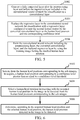
- the step of converting and training the convolutional neural network for classification to a convolutional neural network for human head detection includes the following steps: S502: Convert a fully connected layer after the preprocessing layer and before the regression layer included in the convolutional neural network for classification to a convolutional layer.
- the convolutional neural network for classification is a trained convolutional neural network which can classify images input to the convolutional neural network, such as GoogleNet, VGGNET, or AlexNet.
- the convolutional neural network for classification includes the preprocessing layer, the fully connected layer, and the regression layer.
- the fully connected layer is configured to output second features corresponding to each preset type.
- the sparse connection and weight sharing of the fully connected layer and the convolutional layer are different.
- Each neuron of the fully connected layer is connected to all neurons of a preceding layer.
- Both the convolutional layer and the fully connected layer acquire input of a next layer by multiplying output of the preceding layer by a parameter matrix, so that the fully connected layer can be converted to the convolutional layer by changing an arrangement manner of parameters of the fully connected layer.
- the regression layer is configured to map the second features of each preset type output by the fully connected layer to a probability corresponding to each preset type, and determine, according to the mapped probability, a preset type to which the image belongs. For example, a preset type corresponding to a maximum probability is selected as the preset type to which the input image belongs.
- the regression layer is configured to map a preset number of second features output by the converted convolutional layer to the human head positions and the confidence levels corresponding to the human head positions.
- the regression layer may use a convolutional layer.
- the convolutional layer directly maps the second features to the human head positions and the confidence levels corresponding to the human head positions.
- the regression layer may also use two convolutional layers in parallel. One convolutional layer is configured to map the second features to the human head positions, and the other convolutional layer is configured to map the second features to the confidence levels corresponding to the mapped human head positions.
- S506 Train the convolutional neural network including the preprocessing layer, the converted convolutional layer, and the replaced regression layer by using the training image having the marked human head position.
- the convolutional neural network including the preprocessing layer, the converted convolutional layer and the replaced regression layer is reconstructed from the convolutional neural network for classification, and parameters of the preprocessing layer are already trained. Then for the reconstructed convolutional neural network, mainly the parameters in the converted convolutional layer and the replaced regression layer need to be trained.
- the confidence level may be pre-assigned to the marked human head positions of the training image.
- the training image is segmented into more than one sub-image according to the same segmenting manner as that of the image to be detected.
- the segmented sub-images are respectively input to the convolutional neural network, and the human head positions and the confidence levels are output by the preprocessing layer, the convolutional layer after the preprocessing layer, and the regression layer of the convolutional neural network.
- the difference between the output human head positions and the marked human head position is calculated, and the difference between the corresponding confidence levels is calculated, and the parameters in the preprocessing layer, the convolutional layer after the preprocessing layer, and the regression layer in the convolutional neural network are adjusted according to the two differences.
- the training is continued until a termination condition is reached.
- the termination condition may be that the difference is less than a preset difference, or the number of iterations reaches a preset number of times.
- the training is performed after reconstruction of conventional neural network for classification into a convolutional neural network for human head detection.
- the reconstruction does not require complete redesign of the neural network, training duration can be reduced and efficiency of human head detection is improved.
- step S310 specifically includes the following steps:
- the accuracy of human head detection can be further improved by using the confidence levels and the intersection or not as the basis for determining the human head position in the image to be detected.
- step S606 specifically includes the following steps:
- the matching in the bipartite graph is a set of edges, and the edges in the set have no common nodes. If a weight sum of edges of one of all the matching of one bipartite graph is largest, the matching is the maximum weight matching.
- the electronic device may traverse all combinations of the edges in the bipartite graph to find the maximum weight matching.
- the electronic device may also use a Kuhn-Munkres algorithm to solve the maximum weight matching of the bipartite graph. After the maximum weight matching is solved, the human head position associated with the edges in the maximum weight matching can be used as the human head position detected in the image to be detected.
- the intersecting human head positions may correspond to the same human head
- the human head positions output by the convolutional neural network are mostly gathered near the actual human head position in the image to be detected. Therefore, the acquired human head positions and the selected human head positions are used as the nodes in the bipartite graph to construct the bipartite graph, and weights of the corresponding edges of the intersecting human head positions are relatively small. By solving the maximum weight matching, the detected human head position in the image to be detected are acquired, and the human head detection can be performed more accurately.
- the image to be detected is a video frame in a video
- the human head detection method further includes a step of performing human head tracking video frame by video frame and performing people counting.
- the step of performing human head tracking video frame by video frame and performing people counting specifically includes the following steps:
- the people counting may be specifically counting a combination of one or more of the number of accumulated people entering the designated area, the number of accumulated people leaving the designated area, and the dynamic number of people entering the designated area. Specifically, the electronic device may add 1 to the number of statistically accumulated people entering the designated area, and/or add 1 to the number of dynamic people entering the designated area when one tracked human head position enters the designated area. The electronic device may add 1 to the number of statistically accumulated people leaving the designated area, and/or subtract 1 from the number of dynamic people entering the designated area when one tracked human head position leaves the designated area.
- the human head detection is applied to the field of security.
- the people counting is performed according to the moving direction and the positional relationship of the tracked human head position relative to the designated area. Based on accurate human head detection, the accuracy of people counting can be improved.
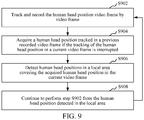
- the human head detection method further includes a step of detecting the human head position tracked near the human head position tracked in a previous video frame when the tracking of the human head position is interrupted.
- the step specifically includes the following steps:
- the human head positions when the tracking of the human head positions is interrupted, the human head positions can be detected from the vicinity of the human head positions detected in the previous frame, and the interrupted human head tracking can be continued.
- the human head detection and the human head tracking are combined to ensure the continuity of the tracking. Further, the accuracy of people counting is ensured.
- a large number of top view images at an elevator entrance scene are acquired in advance, and the human head positions in these top view images are marked.
- a quadruple is used to indicate the position of the human head image in a rectangular box 1001 in FIG. 10 .
- a convolutional neural network for classification is selected, the fully connected layer after the preprocessing layer and before the regression layer is converted to a convolutional layer, and the regression layer therein is replaced with the regression layer configured to map the second feature output by the converted convolutional layer to the human head position and the corresponding confidence level, thereby retraining the convolutional neural network by using the marked top view image.
- a top view camera is disposed above a gate, and the videos are captured by the top view camera and transmitted to an electronic device connected to the top view camera.
- the electronic device uses an image area sandwiched by a line 1101 and a line 1104 in one of the video frames as an image to be detected, and segments the image to be detected into more than one sub-image.
- Each sub-image is input to a convolutional neural network trained by a training image having a marked human head position respectively.
- the convolutional neural network outputs the human head position corresponding to each sub-image and the confidence level corresponding to the human head position, thereby filtering, according to the corresponding confidence level, the human head position corresponding to each sub-image, and acquiring the human head position detected in the image to be detected.
- the electronic device performs human head tracking video frame by video frame according to the human head position detected in the image to be detected, and it is determined that a tracked human head position 1105 enters a designated area when the tracked human head position 1105 sequentially crosses a first line 1102 and a second line 1103 parallel with the first line 1102.
- a tracked human head position 1106 sequentially crosses the second line 1103 and the first line 1102
- the designated area in FIG. 11 may be specifically the area sandwiched by the second line 1103 and a line 1104.
- an electronic device is further provided, and an internal structure of the electronic device may be shown in FIG. 2 .
- the electronic device includes a human head detection apparatus.
- the human head detection apparatus includes various modules, and the modules may be all or partially implemented by software, hardware or a combination thereof.
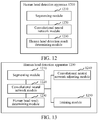
- FIG. 12 is a structural block diagram of a human head detection apparatus 1200 according to an embodiment.
- the human head detection apparatus 1200 includes a segmenting module 1210, a convolutional neural network module 1220, and a human head detection result determining module 1230.
- the segmenting module 1210 is configured to segment an image to be detected into more than one sub-image.
- the convolutional neural network module 1220 is configured to segment the image to be detected into more than one sub-image; input each sub-image to a convolutional neural network trained according to a training image having a marked human head position respectively, and output, by a preprocessing layer including a convolutional layer and a pooling layer in the convolutional neural network, a first feature corresponding to each sub-image; map, through the convolutional layer after the preprocessing layer in the convolutional neural network, the first feature corresponding to each sub-image to a second feature corresponding to each sub-image; and map, through a regression layer of the convolutional neural network, the second feature corresponding to each sub-image to a human head position corresponding to each sub-image and a corresponding confidence level of the human head position.
- the human head detection result determining module 1230 is configured to filter, according to the corresponding confidence level, the human head position corresponding to each sub-image, to acquire a human head position detected in the image to be detected.
- the convolutional neural network is trained in advance based on the training image having the marked human head position, and the convolutional neural network can automatically learn human head features.
- the trained convolutional neural network can automatically extract appropriate features from the sub-images to output candidate human head positions and corresponding confidence levels, and then filter, according to the confidence levels, to acquire the human head position in the image to be detected.
- the human head shape is not required to be assumed in advance, a missed detection caused by setting the human head shape can be avoided, and accuracy of the human head detection is improved.
- the first features of the sub-images are output by the preprocessing layer including the convolutional layer and the pooling layer, and the second features are outputted by the convolutional layer after the preprocessing layer and before the regression layer to accurately describe human head features in the sub-images. Therefore, the second features are directly mapped to the human head positions and confidence levels by the regression layer, which is new application of the convolutional neural network of the new structure. Compared with the traditional circle detection, the accuracy of the human head detection is greatly improved.
- the segmenting module 1210 is further configured to segment the image to be detected into more than one sub-image of a fixed size, and adjacent sub-images in the segmented sub-images have an overlapping part. In this embodiment, there is an overlapping part between the adjacent segmented sub-images, thereby ensuring that the adjacent sub-images have stronger correlation, and improving accuracy of detecting a human head position from the image to be detected.
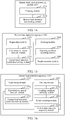
- the human head detection apparatus 1200 further includes a convolutional neural network adjusting module 1240 and a training module 1250.
- the convolutional neural network adjusting module 1240 is configured to convert a fully connected layer after the preprocessing layer and before the regression layer included in the convolutional neural network for classification to a convolutional layer; and replace a regression layer in the convolutional neural network for classification with a regression layer configured to map the second feature output by the converted convolutional layer to the human head position and the corresponding confidence level.
- the training module 1250 is configured to train the convolutional neural network including the preprocessing layer, the converted convolutional layer and the replaced regression layer by using the training image having the marked human head position.
- the training after reconstruction is performed based on the convolutional neural network for classification, to acquire the convolutional neural network for human head detection.
- the reconstruction of the convolutional neural network is not required, the training duration can be reduced and the efficiency of human head detection is improved.
- the convolutional neural network module 1220 is further configured to map, through a first convolutional layer in the regression layer in the convolutional neural network, the second feature corresponding to each sub-image to a human head position corresponding to each sub-image; and map, through a second convolutional layer in the regression layer in the convolutional neural network, the second feature corresponding to each sub-image to a confidence level corresponding to the output human head position.
- the human head detection result determining module 1230 includes a filtering module 1231 and a head position determining module 1232.
- the filtering module 1231 is configured to screen, from the human head positions corresponding to the sub-images, to acquire a human head position corresponding to a confidence level greater than or equal to a confidence level threshold; and select a human head position intersecting with the acquired human head position in the image to be detected from the human head positions corresponding to the sub-images.
- the human head position determining module 1232 is configured to determine, according to the acquired human head position and the selected human head position, the human head position detected in the image to be detected.
- the accuracy of the human head detection can be further improved by using the confidence levels and the intersection or not as the basis for determining the human head position in the image to be detected.
- the human head position determining module 1232 is further configured to use the acquired human head position and the selected human head position as nodes in a bipartite graph; assign default and positive weights to edges between the nodes in the bipartite graph; reduce the corresponding assigned weights when the human head positions indicated by the nodes associated with the edges intersect; and solve a maximum weight matching of the bipartite graph, to acquire the head position detected in the image to be detected.
- the human head positions output by the convolutional neural network are mostly gathered near the actual human head position in the image to be detected. Therefore, the acquired human head positions and the selected human head positions are used as nodes in the bipartite graph to construct the bipartite graph, and weights of the corresponding edges of the intersecting human head positions are relatively small. By solving the maximum weight matching, the human head position detected in the image to be detected are acquired, and the human head detection can be performed more accurately.
- the image to be detected is a video frame in a video.
- the human head detection apparatus 1200 further includes:
- the human head detection is applied to the field of security.
- the people counting is performed according to the moving direction and the positional relationship of the tracked human head position relative to the designated area. Based on accurate human head detection, the accuracy of people counting can be ensured.
- the counting condition detecting module 1270 is further configured to: determine that the tracked human head position enters the designated area when the tracked human head position sequentially spans a first line and a second line parallel with the first line; and determine that the tracked human head position leaves the designated area when the tracked human head position sequentially span the second line and the first line.
- the moving direction and the positional relationship of the tracked human head position relative to the designated area are determined by two lines, thereby preventing a judgment error caused by the moving of the human head position near a boundary of the designated area, thereby ensuring the correctness of people counting.
- the human head detecting module 1200 further includes a human head position acquiring module 1290.
- the tracking module 1260 is further configured to track and record the human head position video frame by video frame.
- the human head position acquiring module 1290 is configured to acquire a human head position tracked in a previous recorded video frame if the tracking of the human head position in a current video frame is interrupted.
- the convolutional neural network module 1220 is further configured to detect human head positions in a local area covering the acquired head position in the current video frame.
- the tracking module 1260 is further configured to continue to perform the step of tracking and recording the human head position video frame by video frame from the human head positions detected in the local area.
- the human head positions when the tracking of the human head positions is interrupted, the human head positions can be detected from the vicinity of the human head positions detected in the previous frame, and the interrupted human head tracking can be continued.
- the human head detection and the human head tracking are combined to ensure the continuity of the tracking. Further, the accuracy of people counting is ensured.
- steps in various embodiments of this application are not necessarily performed in an order indicated by the step numbers. Unless explicitly described in this specification, there is no strict sequence for execution of the steps.
- at least some steps in the embodiments may include a plurality of substeps or a plurality of stages.
- the substeps or the stages are not necessarily performed at a same moment, and instead may be performed at different moments.
- a performing sequence of the substeps or the stages is not necessarily performing in sequence, and instead may be performed in turn or alternately with another step or at least some of substeps or stages of the another step.
- the non-volatile memory may include: a read-only memory (ROM), a programmable ROM (PROM), an electrically programmable ROM (EPROM), an electrically erasable programmable ROM (EEPROM), or a flash memory.
- ROM read-only memory
- PROM programmable ROM
- EPROM electrically programmable ROM
- EEPROM electrically erasable programmable ROM
- the volatile memory may include a random access memory (RAM) or an external cache memory.
- the RAM may be implemented in various forms, such as a static RAM (SRAM), a dynamic RAM (DRAM), a synchronous DRAM (SDRAM), a double data rate SDRAM (DDRSDRAM), an enhanced SDRAM (ESDRAM), a synchlink DRAM (SLDRAM), a rambus direct RAM (RDRAM), a direct rambus dynamic RAM (DRDRAM), and a rambus dynamic RAM (RDRAM).
- SRAM static RAM
- DRAM dynamic RAM
- SDRAM synchronous DRAM
- DDRSDRAM double data rate SDRAM
- ESDRAM enhanced SDRAM
- SLDRAM synchlink DRAM
- RDRAM rambus direct RAM
- DRAM direct rambus dynamic RAM
- RDRAM rambus dynamic RAM
Landscapes
- Engineering & Computer Science (AREA)
- Theoretical Computer Science (AREA)
- Physics & Mathematics (AREA)
- General Physics & Mathematics (AREA)
- Computer Vision & Pattern Recognition (AREA)
- Evolutionary Computation (AREA)
- Artificial Intelligence (AREA)
- Multimedia (AREA)
- Health & Medical Sciences (AREA)
- Data Mining & Analysis (AREA)
- General Health & Medical Sciences (AREA)
- Life Sciences & Earth Sciences (AREA)
- Software Systems (AREA)
- Computing Systems (AREA)
- General Engineering & Computer Science (AREA)
- Molecular Biology (AREA)
- Biomedical Technology (AREA)
- Computational Linguistics (AREA)
- Biophysics (AREA)
- Mathematical Physics (AREA)
- Databases & Information Systems (AREA)
- Medical Informatics (AREA)
- Bioinformatics & Cheminformatics (AREA)
- Bioinformatics & Computational Biology (AREA)
- Evolutionary Biology (AREA)
- Human Computer Interaction (AREA)
- Biodiversity & Conservation Biology (AREA)
- Image Analysis (AREA)
Applications Claiming Priority (2)
| Application Number | Priority Date | Filing Date | Title |
|---|---|---|---|
| CN201710029244.6A CN106845383B (zh) | 2017-01-16 | 2017-01-16 | 人头检测方法和装置 |
| PCT/CN2018/070008 WO2018130104A1 (zh) | 2017-01-16 | 2018-01-02 | 人头检测方法、电子设备和存储介质 |
Publications (2)
| Publication Number | Publication Date |
|---|---|
| EP3570209A1 true EP3570209A1 (de) | 2019-11-20 |
| EP3570209A4 EP3570209A4 (de) | 2020-12-23 |
Family
ID=59123959
Family Applications (1)
| Application Number | Title | Priority Date | Filing Date |
|---|---|---|---|
| EP18738888.9A Pending EP3570209A4 (de) | 2017-01-16 | 2018-01-02 | Verfahren zu erkennung eines menschlichen kopfes, elektronische vorrichtung und speichermedium |
Country Status (4)
| Country | Link |
|---|---|
| US (2) | US20190206085A1 (de) |
| EP (1) | EP3570209A4 (de) |
| CN (1) | CN106845383B (de) |
| WO (1) | WO2018130104A1 (de) |
Families Citing this family (45)
| Publication number | Priority date | Publication date | Assignee | Title |
|---|---|---|---|---|
| CN106845383B (zh) | 2017-01-16 | 2023-06-06 | 腾讯科技(上海)有限公司 | 人头检测方法和装置 |
| US10019654B1 (en) * | 2017-06-28 | 2018-07-10 | Accenture Global Solutions Limited | Image object recognition |
| CN107886098A (zh) * | 2017-10-25 | 2018-04-06 | 昆明理工大学 | 一种基于深度学习的识别太阳黑子的方法 |
| CN107832807B (zh) | 2017-12-07 | 2020-08-07 | 上海联影医疗科技有限公司 | 一种图像处理方法和系统 |
| CN108073898B (zh) * | 2017-12-08 | 2022-11-18 | 腾讯科技(深圳)有限公司 | 人头区域识别方法、装置及设备 |
| CN108154110B (zh) * | 2017-12-22 | 2022-01-11 | 任俊芬 | 一种基于深度学习人头检测的密集人流量统计方法 |
| CN108090454A (zh) * | 2017-12-26 | 2018-05-29 | 上海理工大学 | 校园公共浴室人流量统计系统 |
| CN108345832A (zh) * | 2017-12-28 | 2018-07-31 | 新智数字科技有限公司 | 一种人脸检测的方法、装置及设备 |
| CN108198191B (zh) * | 2018-01-02 | 2019-10-25 | 武汉斗鱼网络科技有限公司 | 图像处理方法及装置 |
| CN108154196B (zh) * | 2018-01-19 | 2019-10-22 | 百度在线网络技术(北京)有限公司 | 用于输出图像的方法和装置 |
| CN108881740B (zh) * | 2018-06-28 | 2021-03-02 | Oppo广东移动通信有限公司 | 图像方法和装置、电子设备、计算机可读存储介质 |
| CN109241871A (zh) * | 2018-08-16 | 2019-01-18 | 北京此时此地信息科技有限公司 | 一种基于视频数据的公共区域人流跟踪方法 |
| TWI686748B (zh) * | 2018-12-07 | 2020-03-01 | 國立交通大學 | 人流分析系統及人流分析方法 |
| CN109816011B (zh) * | 2019-01-21 | 2021-09-07 | 厦门美图之家科技有限公司 | 视频关键帧提取方法 |
| CN110490110B (zh) * | 2019-01-29 | 2024-07-16 | 王馨悦 | 基于人体工程学特征检测的客流计数装置及方法 |
| US11048948B2 (en) * | 2019-06-10 | 2021-06-29 | City University Of Hong Kong | System and method for counting objects |
| US11182903B2 (en) | 2019-08-05 | 2021-11-23 | Sony Corporation | Image mask generation using a deep neural network |
| CN112347814B (zh) * | 2019-08-07 | 2025-08-05 | 中兴通讯股份有限公司 | 客流估计与展示方法、系统及计算机可读存储介质 |
| CN110688914A (zh) * | 2019-09-09 | 2020-01-14 | 苏州臻迪智能科技有限公司 | 一种手势识别的方法、智能设备、存储介质和电子设备 |
| CN111008631B (zh) * | 2019-12-20 | 2023-06-16 | 浙江大华技术股份有限公司 | 图像的关联方法及装置、存储介质和电子装置 |
| CN111680569B (zh) * | 2020-05-13 | 2024-04-19 | 北京中广上洋科技股份有限公司 | 基于图像分析的出勤率检测方法、装置、设备及存储介质 |
| CN111915779B (zh) * | 2020-07-31 | 2022-04-15 | 浙江大华技术股份有限公司 | 一种闸机控制方法、装置、设备和介质 |
| CN111931670B (zh) * | 2020-08-14 | 2024-05-31 | 成都数城科技有限公司 | 基于卷积神经网的深度图像头部检测与定位方法及系统 |
| CN114202735B (zh) * | 2020-09-03 | 2025-10-10 | 财团法人工业技术研究院 | 判断人员进出场域的系统、方法及存储介质 |
| US11587325B2 (en) * | 2020-09-03 | 2023-02-21 | Industrial Technology Research Institute | System, method and storage medium for detecting people entering and leaving a field |
| WO2022067514A1 (zh) * | 2020-09-29 | 2022-04-07 | 京东方科技集团股份有限公司 | 区域人数统计方法、计算机设备、计算机可读存储介质 |
| CN112364716A (zh) * | 2020-10-23 | 2021-02-12 | 岭东核电有限公司 | 核电设备异常信息检测方法、装置和计算机设备 |
| JP7608136B2 (ja) * | 2020-12-07 | 2025-01-06 | キヤノン株式会社 | 画像処理装置、画像処理方法、及びプログラム |
| CN114973114A (zh) * | 2021-02-19 | 2022-08-30 | 阿里巴巴集团控股有限公司 | 压线检测和车辆压线检测方法、设备、系统及存储介质 |
| CN113011297B (zh) * | 2021-03-09 | 2024-07-19 | 全球能源互联网研究院有限公司 | 基于边云协同的电力设备检测方法、装置、设备及服务器 |
| CN114419660B (zh) * | 2021-12-13 | 2025-08-08 | 上海悠络客电子科技股份有限公司 | 一种基于深度学习的人形分割方法 |
| CN114445697A (zh) * | 2022-01-28 | 2022-05-06 | 青岛海尔工业智能研究院有限公司 | 一种目标检测方法、装置、电子设备及存储介质 |
| CN115082836B (zh) * | 2022-07-23 | 2022-11-11 | 深圳神目信息技术有限公司 | 一种行为识别辅助的目标物体检测方法及装置 |
| US12465845B2 (en) | 2022-10-28 | 2025-11-11 | Dell Products L.P. | Information handling system head position detection for commanding an application function |
| US11983061B1 (en) | 2022-10-28 | 2024-05-14 | Dell Products L.P. | Information handling system peripheral device sleep power management |
| US12465850B2 (en) | 2022-10-28 | 2025-11-11 | Dell Products L.P. | Information handling system display grid and head position monitoring to present a boundary tracking highlight |
| US12307057B2 (en) | 2022-10-28 | 2025-05-20 | Dell Products L.P. | Information handling system keyboard with four dimensional control pad |
| US12332822B2 (en) | 2022-10-28 | 2025-06-17 | Dell Products L.P. | Information handling system high bandwidth GPU hub |
| US12284474B2 (en) | 2022-10-28 | 2025-04-22 | Dell Products L.P. | Information handling system neck speaker and head movement sensor |
| US12284501B2 (en) | 2022-10-28 | 2025-04-22 | Dell Products L.P. | Information handling system immersive sound system |
| US12242674B2 (en) | 2022-10-28 | 2025-03-04 | Dell Products L.P. | Information handling system keyboard assymetric magnetic charger |
| US11914800B1 (en) | 2022-10-28 | 2024-02-27 | Dell Products L.P. | Information handling system stylus with expansion bay and replaceable module |
| US11983337B1 (en) | 2022-10-28 | 2024-05-14 | Dell Products L.P. | Information handling system mouse with strain sensor for click and continuous analog input |
| CN115797341B (zh) * | 2023-01-16 | 2023-04-14 | 四川大学 | 一种自动即时判定头颅侧位x光片自然头位的方法 |
| CN116245911B (zh) * | 2023-02-08 | 2023-11-03 | 珠海安联锐视科技股份有限公司 | 一种视频过线统计方法 |
Family Cites Families (25)
| Publication number | Priority date | Publication date | Assignee | Title |
|---|---|---|---|---|
| US7127087B2 (en) * | 2000-03-27 | 2006-10-24 | Microsoft Corporation | Pose-invariant face recognition system and process |
| GB2409028A (en) * | 2003-12-11 | 2005-06-15 | Sony Uk Ltd | Face detection |
| US20050286753A1 (en) * | 2004-06-25 | 2005-12-29 | Triant Technologies Inc. | Automated inspection systems and methods |
| US20100014755A1 (en) * | 2008-07-21 | 2010-01-21 | Charles Lee Wilson | System and method for grid-based image segmentation and matching |
| US8582807B2 (en) * | 2010-03-15 | 2013-11-12 | Nec Laboratories America, Inc. | Systems and methods for determining personal characteristics |
| CN102156863B (zh) * | 2011-05-16 | 2012-11-14 | 天津大学 | 跨摄像头的多运动目标跟踪方法 |
| CN102902967B (zh) * | 2012-10-16 | 2015-03-11 | 第三眼(天津)生物识别科技有限公司 | 基于人眼结构分类的虹膜和瞳孔的定位方法 |
| US20140307076A1 (en) * | 2013-10-03 | 2014-10-16 | Richard Deutsch | Systems and methods for monitoring personal protection equipment and promoting worker safety |
| CN103559478B (zh) * | 2013-10-07 | 2018-12-04 | 唐春晖 | 俯视行人视频监控中的客流计数与事件分析方法 |
| JP6488380B2 (ja) * | 2014-12-17 | 2019-03-20 | ノキア テクノロジーズ オーユー | ニューラルネットワークによるオブジェクト検出 |
| US9524450B2 (en) * | 2015-03-04 | 2016-12-20 | Accenture Global Services Limited | Digital image processing using convolutional neural networks |
| US10074041B2 (en) * | 2015-04-17 | 2018-09-11 | Nec Corporation | Fine-grained image classification by exploring bipartite-graph labels |
| CN104922167B (zh) | 2015-07-16 | 2018-09-18 | 袁学军 | 一种灵芝孢子粉冲剂及其制备方法 |
| CN104992167B (zh) * | 2015-07-28 | 2018-09-11 | 中国科学院自动化研究所 | 一种基于卷积神经网络的人脸检测方法及装置 |
| CN105005774B (zh) * | 2015-07-28 | 2019-02-19 | 中国科学院自动化研究所 | 一种基于卷积神经网络的人脸亲属关系识别方法及装置 |
| CN105374050B (zh) * | 2015-10-12 | 2019-10-18 | 浙江宇视科技有限公司 | 运动目标跟踪恢复方法及装置 |
| CN105608690B (zh) * | 2015-12-05 | 2018-06-08 | 陕西师范大学 | 一种基于图论和半监督学习相结合的图像分割方法 |
| CN105740758A (zh) * | 2015-12-31 | 2016-07-06 | 上海极链网络科技有限公司 | 基于深度学习的互联网视频人脸识别方法 |
| CN106022237B (zh) * | 2016-05-13 | 2019-07-12 | 电子科技大学 | 一种端到端的卷积神经网络的行人检测方法 |
| CN106022295B (zh) * | 2016-05-31 | 2019-04-12 | 北京奇艺世纪科技有限公司 | 一种数据位置的确定方法及装置 |
| EP3545466A4 (de) * | 2016-12-29 | 2019-11-27 | Zhejiang Dahua Technology Co., Ltd. | Systeme und verfahren zur erfassung von objekten in bildern |
| CN106845383B (zh) * | 2017-01-16 | 2023-06-06 | 腾讯科技(上海)有限公司 | 人头检测方法和装置 |
| WO2019092672A2 (en) * | 2017-11-13 | 2019-05-16 | Way2Vat Ltd. | Systems and methods for neuronal visual-linguistic data retrieval from an imaged document |
| US11551026B2 (en) * | 2018-11-27 | 2023-01-10 | Raytheon Company | Dynamic reconfiguration training computer architecture |
| US10607331B1 (en) * | 2019-06-28 | 2020-03-31 | Corning Incorporated | Image segmentation into overlapping tiles |
-
2017
- 2017-01-16 CN CN201710029244.6A patent/CN106845383B/zh active Active
-
2018
- 2018-01-02 EP EP18738888.9A patent/EP3570209A4/de active Pending
- 2018-01-02 WO PCT/CN2018/070008 patent/WO2018130104A1/zh not_active Ceased
-
2019
- 2019-03-12 US US16/351,093 patent/US20190206085A1/en not_active Abandoned
- 2019-03-12 US US16/299,866 patent/US10796450B2/en active Active
Also Published As
| Publication number | Publication date |
|---|---|
| EP3570209A4 (de) | 2020-12-23 |
| US20190206083A1 (en) | 2019-07-04 |
| CN106845383B (zh) | 2023-06-06 |
| WO2018130104A1 (zh) | 2018-07-19 |
| US20190206085A1 (en) | 2019-07-04 |
| US10796450B2 (en) | 2020-10-06 |
| CN106845383A (zh) | 2017-06-13 |
Similar Documents
| Publication | Publication Date | Title |
|---|---|---|
| EP3570209A1 (de) | Verfahren zu erkennung eines menschlichen kopfes, elektronische vorrichtung und speichermedium | |
| RU2730687C1 (ru) | Стереоскопическая система обнаружения пешеходов с двухпоточной нейронной сетью с глубоким обучением и способы ее применения | |
| CN110599503B (zh) | 检测模型训练方法、装置、计算机设备和存储介质 | |
| CN110458095B (zh) | 一种有效手势的识别方法、控制方法、装置和电子设备 | |
| CN109117876B (zh) | 一种稠密小目标检测模型构建方法、模型及检测方法 | |
| US10452893B2 (en) | Method, terminal, and storage medium for tracking facial critical area | |
| CN110852703B (zh) | 基于侧脸多特征融合人脸识别的考勤方法、系统、设备及介质 | |
| WO2020048396A1 (zh) | 一种连续图像的目标检测方法、装置、设备及存储介质 | |
| WO2019096029A1 (zh) | 活体识别方法、存储介质和计算机设备 | |
| CN114973112B (zh) | 一种基于对抗学习网络的尺度自适应密集人群计数方法 | |
| WO2022252642A1 (zh) | 基于视频图像的行为姿态检测方法、装置、设备及介质 | |
| WO2021249114A1 (zh) | 目标跟踪方法和目标跟踪装置 | |
| CN110472539B (zh) | 一种文本检测方法、装置及计算机存储介质 | |
| CN115035429A (zh) | 一种基于复合主干网络和多预测头的航拍目标检测方法 | |
| CN119151875B (zh) | 一种基于YOLOv8模型的转辙机零件检测方法、设备及介质 | |
| CN112966556B (zh) | 一种运动物体检测方法及系统 | |
| CN114674826A (zh) | 基于布匹的视觉检测方法及检测系统 | |
| CN105825219A (zh) | 机器视觉检测系统 | |
| Midwinter et al. | Unsupervised defect segmentation with pose priors | |
| JP2021077091A (ja) | 画像処理装置および画像処理方法 | |
| CN113657218A (zh) | 一种能够减少冗余数据的视频对象检测方法及装置 | |
| WO2024212297A1 (zh) | 基于共同性-特异性监督机制的弱监督语义分割方法和装置 | |
| CN113033551B (zh) | 对象检测的方法、装置、设备和存储介质 | |
| Lu et al. | Hdplifter: Hierarchical dynamics perception for 2d-to-3d human pose lifting | |
| Janampa et al. | Dt-lsd: Deformable transformer-based line segment detection |
Legal Events
| Date | Code | Title | Description |
|---|---|---|---|
| STAA | Information on the status of an ep patent application or granted ep patent |
Free format text: STATUS: THE INTERNATIONAL PUBLICATION HAS BEEN MADE |
|
| PUAI | Public reference made under article 153(3) epc to a published international application that has entered the european phase |
Free format text: ORIGINAL CODE: 0009012 |
|
| STAA | Information on the status of an ep patent application or granted ep patent |
Free format text: STATUS: REQUEST FOR EXAMINATION WAS MADE |
|
| 17P | Request for examination filed |
Effective date: 20190510 |
|
| AK | Designated contracting states |
Kind code of ref document: A1 Designated state(s): AL AT BE BG CH CY CZ DE DK EE ES FI FR GB GR HR HU IE IS IT LI LT LU LV MC MK MT NL NO PL PT RO RS SE SI SK SM TR |
|
| AX | Request for extension of the european patent |
Extension state: BA ME |
|
| DAV | Request for validation of the european patent (deleted) | ||
| DAX | Request for extension of the european patent (deleted) | ||
| A4 | Supplementary search report drawn up and despatched |
Effective date: 20201123 |
|
| RIC1 | Information provided on ipc code assigned before grant |
Ipc: G06K 9/00 20060101AFI20201117BHEP |
|
| RAP3 | Party data changed (applicant data changed or rights of an application transferred) |
Owner name: TENCENT TECHNOLOGY (SHENZHEN) COMPANY LIMITED |
|
| STAA | Information on the status of an ep patent application or granted ep patent |
Free format text: STATUS: EXAMINATION IS IN PROGRESS |
|
| 17Q | First examination report despatched |
Effective date: 20230927 |