EP3572038A1 - Vorrichtung zum sammeln von tiersamen - Google Patents
Vorrichtung zum sammeln von tiersamen Download PDFInfo
- Publication number
- EP3572038A1 EP3572038A1 EP19176338.2A EP19176338A EP3572038A1 EP 3572038 A1 EP3572038 A1 EP 3572038A1 EP 19176338 A EP19176338 A EP 19176338A EP 3572038 A1 EP3572038 A1 EP 3572038A1
- Authority
- EP
- European Patent Office
- Prior art keywords
- orifices
- bag
- predetermined pattern
- tubular portion
- filter
- Prior art date
- Legal status (The legal status is an assumption and is not a legal conclusion. Google has not performed a legal analysis and makes no representation as to the accuracy of the status listed.)
- Withdrawn
Links
Images


Classifications
-
- A—HUMAN NECESSITIES
- A61—MEDICAL OR VETERINARY SCIENCE; HYGIENE
- A61B—DIAGNOSIS; SURGERY; IDENTIFICATION
- A61B10/00—Instruments for taking body samples for diagnostic purposes; Other methods or instruments for diagnosis, e.g. for vaccination diagnosis, sex determination or ovulation-period determination; Throat striking implements
- A61B10/0045—Devices for taking samples of body liquids
- A61B10/0058—Devices for taking samples of body liquids for taking sperm samples
-
- A—HUMAN NECESSITIES
- A61—MEDICAL OR VETERINARY SCIENCE; HYGIENE
- A61D—VETERINARY INSTRUMENTS, IMPLEMENTS, TOOLS, OR METHODS
- A61D19/00—Instruments or methods for reproduction or fertilisation
- A61D19/02—Instruments or methods for reproduction or fertilisation for artificial insemination
- A61D19/021—Apparatus for collecting seminal fluids; Artificial vaginas
-
- A—HUMAN NECESSITIES
- A61—MEDICAL OR VETERINARY SCIENCE; HYGIENE
- A61D—VETERINARY INSTRUMENTS, IMPLEMENTS, TOOLS, OR METHODS
- A61D19/00—Instruments or methods for reproduction or fertilisation
- A61D19/02—Instruments or methods for reproduction or fertilisation for artificial insemination
- A61D19/022—Containers for animal semen, e.g. pouches or vials ; Methods or apparatus for treating or handling animal semen containers, e.g. filling or closing
Definitions
- the present invention relates to the general field of animal semen collection, including porcine semen, and more specifically to the devices for collecting this seed.
- WO 2006/131781 a device for collecting animal semen, comprising a rigid frame on which are fixed a nonwoven textile filter bag and a collection bag, the filtration bag being positioned inside the collection bag.
- the rigid frame includes an adapter portion for assembling the device with an artificial vagina and a frame that maintains the shape of the filtration bag over its entire height.
- the adaptation part has a geometry adapted to the exit of the artificial vagina and delimits a passage for the flow of animal semen from the artificial vagina to the filtration bag.
- the collection bag has a precut line in order to be able to separate the portion of the bag for collecting seed from the portion of the bag attached to the frame.
- the animal semen flowing from the artificial vagina is filtered by the bag and then collected in the bag.
- the filtration carried out by the bag makes it possible to rid the seed of an undesirable substance forming a kind of gel, called "tapioca".
- the animal semen is analyzed in a specific room often called laboratory, then it is diluted, before being preserved in unit packs.
- the invention aims to provide a device for collecting animal semen that is more efficient than known devices, while remaining simple, convenient and economical.
- the device according to the invention is particularly simple and economical to manufacture.
- the piece forming both the filter and the input member can be manufactured in a simple manner, for example injection molded.
- the seed collection device 1 illustrated on the Figures 1 to 4 includes a collection bag 4 (visible only on figures 1 and 2 ) and a filtration cup 5.
- the collection device 1 is here configured to be connected to an artificial vagina (not shown) to collect the leaking semen.
- the filtration cup 5 is configured to rid the seed entering the collection device 1 of an undesirable substance forming a sort of gel called "tapioca", found in particular in pigs.
- the collection bag 4 is itself configured to collect and condition the seed once filtered by the bucket 5, that is to say the liquid fraction of the seed.
- the collection bag 4 extends longitudinally between a proximal end zone where it has a proximal end 7 facing upwards on the figure 1 , and a distal end zone where it has a distal end 8 facing down on the figure 1 .
- the bag 4 has an opening 6, which is here facing upwards, while the bottom of the bag 4 is at the end 8.
- the collection bag 4 is here formed by two thermoplastic films extruded and welded edge to edge, except the edges located at the end 7 so as to form the opening 6.
- the bottom of the bag 4 is thus formed by the welded edges located at the end 8.
- the bag 4 has at rest a generally flattened shape, the films tend to press against each other.
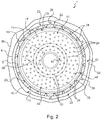
- the bag 4 When the bag 4 is set in volume, it has a generally tubular shape, visible in section on the figure 2 , with its internal space 10 which is delimited by its internal face 11.
- the bag 4 placed in volume has in cross section a shape which is here generally circular.
- the inner face 11 of the bag 4 extends generally vertically between the ends 7 and 8.
- the filtration cup 5 extends longitudinally between an end 12 facing upwards on the figures 1 , 3 and 4 , and an end 13 facing down on these same figures.
- the bucket 5 has an opening 14, which is here facing upwards, while the bottom of the bucket 5 is at the end 13.
- the opening 14 forms an inlet opening for the seed in the collection device 1.
- the bucket 5 is here made of a thermoplastic material comprising a polymer of the polyolefin type, here more specifically polypropylene.
- Polypropylene is here in a 95% transparent state.
- the material forming the cup 5 is chosen so as to be sufficiently translucent or transparent in order to be able to judge the quality of the seed (visualize any impurities or traces of blood) and / or visualize the level of filling of the bucket 5 with the seed.
- This material is furthermore sufficiently rigid so that the cup 5 can maintain a predetermined stable shape, in the presence of forces exerted on it.
- the bucket 5 is here formed of one and the same injection molded part. Therefore, all parts of the bucket 5 are material.
- the bucket 5 has an axisymmetric shape.
- the bucket 5 comprises a bottom wall 15 which extends opposite its opening 14 and a side wall 16 which extends from the bottom wall 15, transversely to the latter, to the opening 14 that this wall lateral 16 delimits.
- the bottom wall 15 thus forms the bottom of the bucket 5.
- the thickness of the bottom wall 15 and the side wall 16 is here about 2 mm.
- this thickness can be between 1 mm and 4 mm.
- the bottom wall 15 is here flat and extends generally horizontally when the bucket 5 is held upright as shown in FIGS. figures 1 , 3 and 4 .
- bottom wall 15 has an inner face 17 which delimits the internal space in the bucket 5, and an outer face 18 opposite to the inner face 17.
- the side wall 16 has a generally tubular shape and extends axially in a generally vertical direction when the bucket 5 is held upright as shown in the drawings. figures 1 , 3 and 4 .
- the side wall 16 has a generally circular shape in cross section.
- the side wall 16 has an inner face 19 which defines the internal space of the bucket 5, and an outer face 20 opposite the inner face 19.
- the side wall 16 has an upper portion 21, located on the side of the opening 14 and defining the latter, a lower portion 22 located on the side of the bottom wall 15 and connected thereto, and an intermediate portion 23 connecting the portion upper 21 to the lower portion 22.
- the lower portion 22 extends axially between a first end 49 facing the proximal end zone 7 of the bag 4 and connected to the intermediate portion 23, and a second end 50 facing the distal end zone 8 of the bag 4 and connected to the bottom wall 15, which bottom wall 15 extends transversely to the lower portion 22 by closing the latter (that is to say, by closing the internal space it defines).
- the external diameter of the side wall 16 decreases from the opening 14 to the bottom wall 15.
- the side wall 16 thus has a certain conicity favorable to the demolding of the bucket 5 during its manufacture.
- this decrease in diameter is much more pronounced in the intermediate portion 23 than in the upper 21 and lower 22 portions, so that the outer face 20 has a shoulder at this point.
- the external diameter of the side wall 16 is greater in the upper portion 21 than in the lower portion 22.
- portion of the outer face 20 located in the lower portion 22 is generally recessed (towards the inside of the cup 5) relative to the portion of the outer face 20 located in the upper portion 21.
- the average outer diameter of the upper portion 21 is here about 54 mm.
- the average outer diameter of the lower portion 22 is here about 49 mm.
- the difference in average outer diameter between the upper portion 21 and the lower portion 22 is here about 5 mm.
- the difference in external diameter between the upper portion 21 and the lower portion 22, that is to say the width of the shoulder, is here about 3 mm.
- the cup 5 further has a plurality of orifices 24, here formed both in a region 43 of the lower portion 22 of the side wall 16 and in a region 44 of the bottom wall 15.
- the region 43 has a tubular shape and extends between a lower edge 45 facing the bottom wall 15 and an upper edge 46 facing the upper portion 21.
- the region 44 has a flat ring shape and extends radially between an inner edge 47 and an outer edge 48.
- the orifices 24 are configured to allow the seed to escape from the filtration cup 5 while retaining in the latter the substance "tapioca".
- the minimum diameter of the orifices 24 is chosen to retain the substance "tapioca”.
- the lower portion 22 of the side wall 16 and the bottom wall 15 together form a perforated wall 30 configured to filter the seed, the lower portion 22 forming a tubular portion of the perforated wall 30 while the bottom wall 15 forms a bottom portion of the perforated wall 30.
- the orifices 24 are each delimited by a surface here having a cylindrical portion 34, of circular section here, followed by a funnel portion 35.
- the cylindrical portion 34 is turned towards the inside of the cup 5 while the funnel portion 35 is turned towards the outside of the cup 5 and increases in diameter towards the outside of the cup 5; that is to say towards the outer face 20 for the orifices 24 formed in the side wall 16, and to the outer face 18 for the orifices 24 formed in the bottom wall 15.
- the diameter of the cylindrical portion 34 corresponds to the minimum diameter of the orifice 24, which is here about 0.8 mm.
- this minimum diameter may be between 0.5 mm and 1.5 mm.
- the diameter of the funnel portion increases from the minimum diameter to a maximum diameter of about 2 mm.
- the orifices 24 are distributed in being arranged in a predetermined pattern.
- the orifices 24 are arranged in a first predetermined pattern having a succession of columns, here twenty-four columns, distributed around the lower portion 22 in a predetermined angular pitch of about 15 degrees.
- Each column is oriented longitudinally as the axial orientation of the side wall 16, that is to say here substantially vertically.
- the corresponding orifices 24 are situated at the same height (that is to say that these orifices 24 are aligned horizontally), so that, in accordance with this first predetermined pattern, the orifices 24 are moreover globally arranged in a grid, here more precisely rectangles (the vertical difference between two adjacent orifices 24 of the same column is here smaller than the horizontal distance between two corresponding orifices 24 of two adjacent columns).
- the orifices 24 corresponding could be vertically offset so that the orifices 24 would be arranged in a staggered manner.
- the orifices 24 are arranged according to a second pattern predetermined having a succession of concentric circles 51, here 8 circles 51 (two of which are shown in dashed line on the figure 2 ).
- the corresponding orifices 24 have an angular offset so that they are not aligned radially and are arranged in staggered rows.
- the surface density of orifices is here defined by the maximum number of orifices 24 that can be fully included in a square centimeter (1 cm 2 ) perforated wall surface 30, the surface considered here being that of the inner face of the perforated wall 30, that is to say the one defining the internal space of the bucket 5.
- This inner face of the perforated wall 30 is here formed by the inner face 17 of the bottom wall 15 and the portion of the inner face 19 of the side wall 16 located on its lower portion 22.
- the surface density of orifices 24 on the perforated wall 30 is between 3 and 16 holes per cm 2 .
- first predetermined pattern and the second predetermined pattern provide a greater surface density of orifices 24 on the bottom wall 15 than on the side wall 16.
- a zone 37 representing 1 cm 2 of internal surface of the perforated wall 30 is represented on the figure 4 .
- Area 37 is positioned to fully include a maximum number of orifices, here four orifices 24.
- the first predetermined pattern thus provides a surface density of orifices 24 on the lower portion 22 of the side wall 16 which here is 4 holes per cm 2 .
- the surface density of orifices 24 on the lower portion 22 may be between 3 and 7 orifices per cm 2 .
- a zone 38 representing 1 cm 2 of internal surface of the perforated wall 30 is represented on the figure 2 .
- Area 38 is positioned to fully include a maximum number of orifices 24, which is here twelve orifices 24 (orifices not fully included in area 38 are not counted).
- the second predetermined pattern thus provides a surface density of orifices 24 on the bottom wall 15 which is here 12 holes per cm 2 .
- the surface density of orifices 24 on the bottom wall 15 may be between 10 and 16 orifices per cm 2 .
- first predetermined pattern and the second predetermined pattern provide a uniform surface density of holes respectively over the whole of the perforated region 43 of the side wall 16 and over the whole of the openwork region 44 of the bottom wall 15.
- the first and / or second predetermined pattern could provide a surface density of orifices 24 which would be variable depending on the positioning of the zone 37 and / or 38 on the perforated region 43 and / or 44 respectively.
- the surface density of orifices 24 would be defined as being an average surface density 24 over the entire region 43 and / or 44 considered, calculated for example by dividing the number of orifices 24 by the surface of the inner surface of the perforated wall 30 in the region 43 and / or 44 considered.
- the outer face of the lower portion 22 is ribbed here. More specifically, the cup 5 has a plurality of ribs 26 formed on the lower portion 22, projecting from the outer face 20.
- the ribs 26 are here six in number and are distributed around the lower portion 22 in a predetermined angular pitch of about 60 degrees.
- Each rib 26 is straight and longitudinally oriented as the axial orientation of the side wall 16, that is to say here substantially vertically.
- Each rib 26 takes root in the intermediate portion 23 forming a shoulder and extends towards the bottom wall 15 to a distal end 27 located near the bottom wall 15.
- each rib 26 has a height substantially equal to the width of the shoulder, then maintains a constant height from the intermediate portion 23 to about half length, then decreases in height until its distal end 27 where the rib 26 is then flush with the outer face 20.
- the bucket 5 also has two locking fingers 25 projecting from both sides of the upper portion 21 and here located near the opening 14.
- These locking fingers 25 form with the portion of the upper portion 21 which carries them a mechanical connection interface 40, to connect the collection device 1 to the artificial vagina.
- the upper portion 21 and the locking fingers 25 form an input member 52 of the collection device 1, comprising the mechanical connection interface 40 and delimiting the opening 14.
- the perforated wall 30 forms a filter associated with this input member 52 and delimiting with the input member 52 an inlet chamber 41 ( figure 4 ) for the seed in the collection device 1; which inlet chamber 41 extends on the side of a first face of the filter facing the opening 14.
- the inlet chamber 41 here corresponds to the internal space of the bucket 5, whereas the first face of the filter corresponds here to the internal face of the perforated wall 30.
- the bucket 5 is partially received in the bag 4, through its opening 6, to a depth such that the lower portion 22 is completely received in the bag 4.
- the perforated wall 30 is entirely received in the bag 4.
- the perforated wall 30 delimits with the bag 4 a collection chamber 42 for the filtered seed, which collection chamber 42 extends on the side of a second face of the filter (that forms the perforated wall 30) facing the distal end zone 8 of the sachet 4.
- the second face of the filter corresponds here to the outer face of the perforated wall 30, that is to say the face here formed by the outer face 18 of the bottom wall 15 and the part of the outer face 20 of the side wall. 16 located on its lower portion 22.
- the upper portion 21 is engaged in the proximal end zone 7 of the bag 4, in particular in the opening 6, so as to keep the bag 4 open.
- the average external diameter of the upper portion 21 substantially corresponds to the internal diameter of the bag 4.
- the chamber 42 comprises a space 33 extending between the portion of the outer face 20 located in the lower portion 22 and the inner face 11 of the bag 4.
- the upper portion 21 here has an outer portion 31 protruding outwardly beyond the end 7 of the bag 4 and an inner portion 32 received in the bag 4.
- the locking fingers 25 are carried by the outer portion 31.
- the inner face 11 of the bag 4 is fixed to the outer face 20 of the side wall 16, that is to say the outer periphery of the inlet member 52, here by thermal welding.
- thermoplastic material of the films forming the bag 4 here comprises a polyolefin-type polymer, which has been selected so as to be chemically miscible with the polypropylene forming the cup 5.
- the collection device 1 here further comprises a protective bag 36, similar to the collection bag 4 and covering the latter to protect it from any contamination, particularly bacterial contamination.
- the collection bag 4 is here entirely received in the protective bag 36.
- the bag 36 is fixed to the upper portion 21 of the cup 5 in the same manner as the collection bag 4, the weld between the bag 36 and the upper portion 21 being made between the end 7 of the collection bag 4 and the end 12 of the bucket 5.
- the material forming pouches 4 and 36 is chosen so as to be sufficiently translucent or transparent in order to be able to judge the quality of the seed (to visualize any impurities or traces of blood) and / or to visualize the level of filling. bucket 5 or bag 4 with the seed.
- the collection device 1 is connected to the output of the artificial vagina through the connection interface 40 of the bucket 5.
- the artificial vagina is mounted on the rod of an animal and operated to stimulate it.
- the semen leaving the artificial vagina enters through the opening 14 and flows into the inlet chamber 41, which it partially fills, then passes through the perforated wall 30 and is collected in the collection chamber 42.
- the volume of semen produced by the animal (the ejaculate) is thus progressively filtered by the perforated wall 30.
- the substance "tapioca” tends to accumulate at the bottom of the cup 5 and to plug the orifices 24 of the bottom wall 15, so that from a certain time the seed, and more precisely its liquid fraction, hardly flow through the orifices 24 of the bottom wall 15.
- the orifices 24 of the side wall 16 allow the liquid fraction of the seed to continue to flow through the perforated wall 30 in the best conditions.
- the seed filtered by the side wall 16 thus flows into the space 33 before falling to the bottom of the bag 4.
- the ribs 26 projecting into the space 33 make it possible to further reduce this risk by keeping the films of the bag 4 away from the outer face 20 even when these films tend to come closer to it, for example if the bucket 5 is inclined.
- the space 33 and the ribs 26 it is thus possible to give the perforated wall 30 a substantially cylindrical shape without the risk of clogging the orifices 24 of the perforated wall 30.
- this cylindrical shape provides a larger surface to provide the holes 24 in the side wall 16 and in the bottom wall 15 of the bucket 5, the orifices 24 may be more numerous than on a similar wall but conical .
- the cylindrical shape further allows the volume defined by the perforated wall 30 is greater than if the latter was conical. In this way, a greater amount of "tapioca” may be received in the cup 5 while maintaining sufficient unobstructed orifices 24 on the sidewall 16 to allow the liquid fraction to flow.
- the Applicant has found that for a given volume of seed to be filtered resulting in a volume of collected filtered seed of between 300 and 400 ml, when the time Filtration time is between 2 and 4 minutes when a collection device having a non-woven textile filtration bag is used, this filtration time is between 15 and 60 seconds when using the collection device 1 provided with the perforated wall 30.
- the volume of the liquid fraction of seed retained by wetting is much smaller when this seed is filtered with the perforated wall 30 than when it is filtered with the non-textile bag. -woven.
- the concentration and motility of the spermatozoa are not impaired by the perforated wall 30 and are instead similar to those observed when the seed is filtered through the nonwoven fabric filtration bag.
- the polypropylene forming the cup 5 has a relatively low surface tension, here about 29 dynes, which gives hydrophobic properties to the surface of the perforated wall 30 and promotes the flow of the seed through the orifices 24.
- the material of which the cup 5 is made may be chosen to have a surface tension of less than 30 dynes.
- the bag 36 is removed and the portion of the bag 4 in which the filtered seed is received can then be separated from the rest of the device 1, for example by tearing the films, and carried into a analysis and packaging laboratory, where the seed is analyzed, diluted, before being kept in unit packs.
- the collection bag 4 and / or the protection bag 36 may each be provided with a notch (not shown), formed in the welded portions of the films so as to form a precut.
- the sachets 4 and / or 36 are opaque to light, or to certain wavelengths of the electromagnetic radiation that are detrimental to the preservation of the seed, for example UV and / or IR rays.
- protective pigments against such rays may be introduced into the material of which pouches 4 and 36 are made and / or may be printed on the surface of this material.
Landscapes
- Health & Medical Sciences (AREA)
- Life Sciences & Earth Sciences (AREA)
- Veterinary Medicine (AREA)
- Reproductive Health (AREA)
- Engineering & Computer Science (AREA)
- Animal Behavior & Ethology (AREA)
- General Health & Medical Sciences (AREA)
- Public Health (AREA)
- Wood Science & Technology (AREA)
- Zoology (AREA)
- Hematology (AREA)
- Pathology (AREA)
- Biomedical Technology (AREA)
- Heart & Thoracic Surgery (AREA)
- Medical Informatics (AREA)
- Molecular Biology (AREA)
- Surgery (AREA)
- Orthopedics, Nursing, And Contraception (AREA)
- Apparatus Associated With Microorganisms And Enzymes (AREA)
- Prostheses (AREA)
Applications Claiming Priority (1)
| Application Number | Priority Date | Filing Date | Title |
|---|---|---|---|
| FR1854410A FR3081321B1 (fr) | 2018-05-24 | 2018-05-24 | Dispositif de collecte de semence animale |
Publications (1)
| Publication Number | Publication Date |
|---|---|
| EP3572038A1 true EP3572038A1 (de) | 2019-11-27 |
Family
ID=63557576
Family Applications (1)
| Application Number | Title | Priority Date | Filing Date |
|---|---|---|---|
| EP19176338.2A Withdrawn EP3572038A1 (de) | 2018-05-24 | 2019-05-24 | Vorrichtung zum sammeln von tiersamen |
Country Status (5)
| Country | Link |
|---|---|
| US (1) | US20190358012A1 (de) |
| EP (1) | EP3572038A1 (de) |
| CN (1) | CN110522476A (de) |
| BR (1) | BR102019010432A2 (de) |
| FR (1) | FR3081321B1 (de) |
Families Citing this family (1)
| Publication number | Priority date | Publication date | Assignee | Title |
|---|---|---|---|---|
| US10973617B2 (en) * | 2018-03-27 | 2021-04-13 | Bruce Eilts | Artificial vagina set |
Citations (6)
| Publication number | Priority date | Publication date | Assignee | Title |
|---|---|---|---|---|
| US4882055A (en) * | 1986-09-11 | 1989-11-21 | Suratco Products Company | Unitary injection molded filter |
| US5590581A (en) * | 1995-03-09 | 1997-01-07 | Maxs Ag | Assembly kit for a filter coffee maker |
| US5961503A (en) * | 1998-05-13 | 1999-10-05 | Minitube Of America, Inc. | Boar semen collection bag |
| WO2006131781A1 (en) | 2005-06-08 | 2006-12-14 | Genes Diffusion | Device for collection of animal semen adaptable to an artificial vagina |
| US20150150666A1 (en) * | 2013-12-04 | 2015-06-04 | Richard Muller | Mammal Semen Collection and Filtration Device |
| CN106479869A (zh) * | 2016-12-29 | 2017-03-08 | 山东省职业卫生与职业病防治研究院 | 一种细胞过滤器 |
Family Cites Families (18)
| Publication number | Priority date | Publication date | Assignee | Title |
|---|---|---|---|---|
| US20060008512A1 (en) * | 2004-07-07 | 2006-01-12 | Hooge Danny M | Composition and methods for improved animal performance |
| JP4478588B2 (ja) * | 2005-01-31 | 2010-06-09 | 富士フイルム株式会社 | 特定物質回収装置及びこれを用いた核酸抽出装置 |
| US8979734B2 (en) * | 2007-02-07 | 2015-03-17 | Gregory Minow | Reproductive infusion device |
| CN101055270B (zh) * | 2007-05-30 | 2011-01-26 | 北京望升伟业科技发展有限公司 | 精子活力快速检测试剂盒及其制备和使用方法 |
| CN101801431B (zh) * | 2007-06-22 | 2014-11-19 | 循环生物制品有限责任公司 | 流体浓缩器和自体浓缩体液及其使用方法 |
| CN101271105B (zh) * | 2008-05-21 | 2012-12-19 | 北京望升伟业科技发展有限公司 | 精子活性快速检测试剂盒及其制备和使用方法 |
| CN101418282A (zh) * | 2008-12-15 | 2009-04-29 | 郑州牧业工程高等专科学校 | 猪袋装冷冻精液保存液及其保存方法 |
| US9108794B2 (en) * | 2009-09-29 | 2015-08-18 | Lbp Manufacturing, Inc. | Disposable single use beverage package |
| WO2011143606A1 (en) * | 2010-05-14 | 2011-11-17 | Beckman Coulter, Inc. | Homogeneous chemiluminescence assay methods with increased sensitivity |
| CN103462724B (zh) * | 2013-08-28 | 2015-05-27 | 武汉市畜牧兽医科学研究所 | 使用染料木黄酮提高牛冷冻精液精子运动性及体外受精率的方法 |
| FR3011731B1 (fr) * | 2013-10-15 | 2016-10-28 | Imv Tech | Paillette pour la conservation d'une dose predeterminee de substance a base liquide, notamment de la semence animale pure ou diluee; et ensemble la comportant |
| CN103636542B (zh) * | 2013-12-18 | 2017-09-22 | 上海市水产研究所 | 一种鳑鲏室内人工繁殖方法 |
| CN104337588A (zh) * | 2014-06-19 | 2015-02-11 | 新疆维吾尔自治区畜牧科学院畜牧研究所 | 人工采精专用假台驴 |
| US10125399B2 (en) * | 2014-10-30 | 2018-11-13 | Personalis, Inc. | Methods for using mosaicism in nucleic acids sampled distal to their origin |
| US20160281166A1 (en) * | 2015-03-23 | 2016-09-29 | Parabase Genomics, Inc. | Methods and systems for screening diseases in subjects |
| CN106073938A (zh) * | 2016-08-05 | 2016-11-09 | 思南县种公猪站 | 一种假母猪台及其使用方法 |
| CN106725993A (zh) * | 2016-11-24 | 2017-05-31 | 刘绍兵 | 一种牲畜人工受精的系统 |
| CN107802373A (zh) * | 2017-10-30 | 2018-03-16 | 石阡裕和原生态农牧发展有限公司 | 一种公猪采精台及其采精方法 |
-
2018
- 2018-05-24 FR FR1854410A patent/FR3081321B1/fr active Active
-
2019
- 2019-05-22 BR BR102019010432A patent/BR102019010432A2/pt not_active Application Discontinuation
- 2019-05-23 US US16/421,127 patent/US20190358012A1/en not_active Abandoned
- 2019-05-24 EP EP19176338.2A patent/EP3572038A1/de not_active Withdrawn
- 2019-05-24 CN CN201910436799.1A patent/CN110522476A/zh active Pending
Patent Citations (6)
| Publication number | Priority date | Publication date | Assignee | Title |
|---|---|---|---|---|
| US4882055A (en) * | 1986-09-11 | 1989-11-21 | Suratco Products Company | Unitary injection molded filter |
| US5590581A (en) * | 1995-03-09 | 1997-01-07 | Maxs Ag | Assembly kit for a filter coffee maker |
| US5961503A (en) * | 1998-05-13 | 1999-10-05 | Minitube Of America, Inc. | Boar semen collection bag |
| WO2006131781A1 (en) | 2005-06-08 | 2006-12-14 | Genes Diffusion | Device for collection of animal semen adaptable to an artificial vagina |
| US20150150666A1 (en) * | 2013-12-04 | 2015-06-04 | Richard Muller | Mammal Semen Collection and Filtration Device |
| CN106479869A (zh) * | 2016-12-29 | 2017-03-08 | 山东省职业卫生与职业病防治研究院 | 一种细胞过滤器 |
Also Published As
| Publication number | Publication date |
|---|---|
| FR3081321A1 (fr) | 2019-11-29 |
| BR102019010432A2 (pt) | 2019-12-10 |
| US20190358012A1 (en) | 2019-11-28 |
| FR3081321B1 (fr) | 2020-06-12 |
| CN110522476A (zh) | 2019-12-03 |
Similar Documents
| Publication | Publication Date | Title |
|---|---|---|
| EP3572039B1 (de) | Vorrichtung zum auffangen von tiersperma | |
| CH616052A5 (en) | Container for growing plant which is to be transplanted | |
| CA2943917C (fr) | Dispositif de separation de parasites | |
| FR2511971A1 (fr) | Tubulure de sortie pour dispositifs de remplissage de liquides | |
| FR2631850A1 (fr) | Element filtrant tubulaire | |
| FR3081321A1 (fr) | Dispositif de collecte de semence animale | |
| EP4335384B1 (de) | Vorrichtung zur behandlung einer fäkalen materialprobe | |
| FR2634672A1 (fr) | Perfectionnements aux dispositifs pour eliminer les boules usees des installations de nettoyage de faisceaux tubulaires | |
| WO2015001259A1 (fr) | Dispositif de récupération de la substance aqueuse d'un arbre et procédé pour sa mise en oeuvre dans le gemmage | |
| EP0019554A1 (de) | Filtrationsvorrichtung | |
| EP1704289A1 (de) | Flüssigkeitsevakuierungsvorrichtung und entsprechende flüssigkeitsführungsvorrichtung | |
| FR2967916A3 (fr) | Ensemble colonne de chromatographie et procede de production dudit ensemble colonne de chromatographie | |
| FR2521065A1 (fr) | Structure reticulaire en matiere plastique, utilisable notamment pour la realisation de grillages et de poches d'elevage ostreicole, son procede de fabrication et dispositif pour sa mise en oeuvre | |
| FR2730512A1 (fr) | Diffuseur septique | |
| EP3603381B1 (de) | Anbauvorrichtung, insbesondere anbauvorrichtung für tomaten | |
| FR3138755A1 (fr) | Dispositif de protection de plants | |
| EP3636857B1 (de) | Vorrichtung zur oberflächenabschöpfung für schwimmbad, und mit einer solchen vorrichtung ausgestattetes schwimmbad | |
| FR2948294A1 (fr) | Dispositif de filtration | |
| EP3740303A1 (de) | Wasserfiltrationsmodul mit hohlfaserfiltrationselementen | |
| FR3009198A1 (fr) | Dispositif de diffusion d'une fragrance telle qu'un parfum | |
| FR2625916A1 (fr) | Dispositif d'accrochage de manches filtrantes dans un appareil de depoussierage | |
| FR2770082A1 (fr) | Conteneur pour la culture d'un plant, procede de culture et pince pour la mise en place du conteneur | |
| EP1535728A1 (de) | Presswanne, insbesondere für pneumatische Presse | |
| FR2517983A1 (fr) | Crapaudine equipee d'un filtre de type panier, pour filtrer des liquides | |
| BE1024316B1 (fr) | Butee pour poche a parois souples et poche a parois souples |
Legal Events
| Date | Code | Title | Description |
|---|---|---|---|
| PUAI | Public reference made under article 153(3) epc to a published international application that has entered the european phase |
Free format text: ORIGINAL CODE: 0009012 |
|
| STAA | Information on the status of an ep patent application or granted ep patent |
Free format text: STATUS: REQUEST FOR EXAMINATION WAS MADE |
|
| 17P | Request for examination filed |
Effective date: 20190730 |
|
| AK | Designated contracting states |
Kind code of ref document: A1 Designated state(s): AL AT BE BG CH CY CZ DE DK EE ES FI FR GB GR HR HU IE IS IT LI LT LU LV MC MK MT NL NO PL PT RO RS SE SI SK SM TR |
|
| AX | Request for extension of the european patent |
Extension state: BA ME |
|
| RBV | Designated contracting states (corrected) |
Designated state(s): AL AT BE BG CH CY CZ DE DK EE ES FI FR GB GR HR HU IE IS IT LI LT LU LV MC MK MT NL NO PL PT RO RS SE SI SK SM TR |
|
| STAA | Information on the status of an ep patent application or granted ep patent |
Free format text: STATUS: EXAMINATION IS IN PROGRESS |
|
| 17Q | First examination report despatched |
Effective date: 20230509 |
|
| GRAP | Despatch of communication of intention to grant a patent |
Free format text: ORIGINAL CODE: EPIDOSNIGR1 |
|
| STAA | Information on the status of an ep patent application or granted ep patent |
Free format text: STATUS: GRANT OF PATENT IS INTENDED |
|
| INTG | Intention to grant announced |
Effective date: 20250113 |
|
| STAA | Information on the status of an ep patent application or granted ep patent |
Free format text: STATUS: THE APPLICATION IS DEEMED TO BE WITHDRAWN |
|
| 18D | Application deemed to be withdrawn |
Effective date: 20250514 |