EP3572229A1 - Verfahren zur herstellung von verbundglasstrukturen - Google Patents
Verfahren zur herstellung von verbundglasstrukturen Download PDFInfo
- Publication number
- EP3572229A1 EP3572229A1 EP19177914.9A EP19177914A EP3572229A1 EP 3572229 A1 EP3572229 A1 EP 3572229A1 EP 19177914 A EP19177914 A EP 19177914A EP 3572229 A1 EP3572229 A1 EP 3572229A1
- Authority
- EP
- European Patent Office
- Prior art keywords
- laminated glass
- cutting
- glass structure
- cut
- flexible
- Prior art date
- Legal status (The legal status is an assumption and is not a legal conclusion. Google has not performed a legal analysis and makes no representation as to the accuracy of the status listed.)
- Granted
Links
- 239000005340 laminated glass Substances 0.000 title claims abstract description 110
- 238000000034 method Methods 0.000 title claims abstract description 67
- 239000011521 glass Substances 0.000 claims abstract description 141
- 239000000758 substrate Substances 0.000 claims abstract description 35
- 239000000853 adhesive Substances 0.000 claims abstract description 33
- 230000001070 adhesive effect Effects 0.000 claims abstract description 33
- 239000000463 material Substances 0.000 claims abstract description 27
- 238000007493 shaping process Methods 0.000 claims abstract description 15
- 238000005520 cutting process Methods 0.000 claims description 71
- 238000007906 compression Methods 0.000 claims description 17
- 230000006835 compression Effects 0.000 claims description 17
- 238000009434 installation Methods 0.000 claims description 13
- 244000137852 Petrea volubilis Species 0.000 claims description 12
- 239000002245 particle Substances 0.000 claims description 12
- 229910003460 diamond Inorganic materials 0.000 claims description 9
- 239000010432 diamond Substances 0.000 claims description 9
- 239000012530 fluid Substances 0.000 claims description 7
- 238000000576 coating method Methods 0.000 claims description 4
- 239000000843 powder Substances 0.000 claims description 4
- 239000011248 coating agent Substances 0.000 claims description 3
- 239000010410 layer Substances 0.000 description 15
- -1 particleboard Substances 0.000 description 11
- 230000001419 dependent effect Effects 0.000 description 10
- 238000003475 lamination Methods 0.000 description 7
- 229920000642 polymer Polymers 0.000 description 7
- 239000000203 mixture Substances 0.000 description 6
- 239000002173 cutting fluid Substances 0.000 description 5
- 229910017107 AlOx Inorganic materials 0.000 description 4
- PXHVJJICTQNCMI-UHFFFAOYSA-N Nickel Chemical compound [Ni] PXHVJJICTQNCMI-UHFFFAOYSA-N 0.000 description 4
- 239000004698 Polyethylene Substances 0.000 description 4
- 230000008901 benefit Effects 0.000 description 4
- 229920000573 polyethylene Polymers 0.000 description 4
- 239000012790 adhesive layer Substances 0.000 description 3
- 230000000845 anti-microbial effect Effects 0.000 description 3
- 238000005336 cracking Methods 0.000 description 3
- 238000007499 fusion processing Methods 0.000 description 3
- 229920001296 polysiloxane Polymers 0.000 description 3
- XLYOFNOQVPJJNP-UHFFFAOYSA-N water Substances O XLYOFNOQVPJJNP-UHFFFAOYSA-N 0.000 description 3
- 239000002023 wood Substances 0.000 description 3
- 229910001369 Brass Inorganic materials 0.000 description 2
- 229910000906 Bronze Inorganic materials 0.000 description 2
- 229910001018 Cast iron Inorganic materials 0.000 description 2
- RYGMFSIKBFXOCR-UHFFFAOYSA-N Copper Chemical compound [Cu] RYGMFSIKBFXOCR-UHFFFAOYSA-N 0.000 description 2
- 239000004743 Polypropylene Substances 0.000 description 2
- VYPSYNLAJGMNEJ-UHFFFAOYSA-N Silicium dioxide Chemical compound O=[Si]=O VYPSYNLAJGMNEJ-UHFFFAOYSA-N 0.000 description 2
- RTAQQCXQSZGOHL-UHFFFAOYSA-N Titanium Chemical compound [Ti] RTAQQCXQSZGOHL-UHFFFAOYSA-N 0.000 description 2
- 229910052782 aluminium Inorganic materials 0.000 description 2
- XAGFODPZIPBFFR-UHFFFAOYSA-N aluminium Chemical compound [Al] XAGFODPZIPBFFR-UHFFFAOYSA-N 0.000 description 2
- 230000015572 biosynthetic process Effects 0.000 description 2
- 239000010951 brass Substances 0.000 description 2
- 239000010974 bronze Substances 0.000 description 2
- 239000002131 composite material Substances 0.000 description 2
- 229910052802 copper Inorganic materials 0.000 description 2
- 239000010949 copper Substances 0.000 description 2
- KUNSUQLRTQLHQQ-UHFFFAOYSA-N copper tin Chemical compound [Cu].[Sn] KUNSUQLRTQLHQQ-UHFFFAOYSA-N 0.000 description 2
- 229920000840 ethylene tetrafluoroethylene copolymer Polymers 0.000 description 2
- 238000007730 finishing process Methods 0.000 description 2
- 239000007788 liquid Substances 0.000 description 2
- 229910052751 metal Inorganic materials 0.000 description 2
- 239000002184 metal Substances 0.000 description 2
- 229910001092 metal group alloy Inorganic materials 0.000 description 2
- 238000012986 modification Methods 0.000 description 2
- 230000004048 modification Effects 0.000 description 2
- 229910052759 nickel Inorganic materials 0.000 description 2
- 229920002037 poly(vinyl butyral) polymer Polymers 0.000 description 2
- 229920001155 polypropylene Polymers 0.000 description 2
- 239000004814 polyurethane Substances 0.000 description 2
- 229920002635 polyurethane Polymers 0.000 description 2
- 239000000047 product Substances 0.000 description 2
- 229910052709 silver Inorganic materials 0.000 description 2
- 239000004332 silver Substances 0.000 description 2
- 239000010935 stainless steel Substances 0.000 description 2
- 229910001220 stainless steel Inorganic materials 0.000 description 2
- 239000010936 titanium Substances 0.000 description 2
- 229910052719 titanium Inorganic materials 0.000 description 2
- WFKWXMTUELFFGS-UHFFFAOYSA-N tungsten Chemical compound [W] WFKWXMTUELFFGS-UHFFFAOYSA-N 0.000 description 2
- 229910052721 tungsten Inorganic materials 0.000 description 2
- 239000010937 tungsten Substances 0.000 description 2
- FYYHWMGAXLPEAU-UHFFFAOYSA-N Magnesium Chemical compound [Mg] FYYHWMGAXLPEAU-UHFFFAOYSA-N 0.000 description 1
- 229920000877 Melamine resin Polymers 0.000 description 1
- 229920001730 Moisture cure polyurethane Polymers 0.000 description 1
- KKCBUQHMOMHUOY-UHFFFAOYSA-N Na2O Inorganic materials [O-2].[Na+].[Na+] KKCBUQHMOMHUOY-UHFFFAOYSA-N 0.000 description 1
- 238000006124 Pilkington process Methods 0.000 description 1
- 239000004952 Polyamide Substances 0.000 description 1
- 229920000331 Polyhydroxybutyrate Polymers 0.000 description 1
- 239000004642 Polyimide Substances 0.000 description 1
- 239000004372 Polyvinyl alcohol Substances 0.000 description 1
- 239000004820 Pressure-sensitive adhesive Substances 0.000 description 1
- BQCADISMDOOEFD-UHFFFAOYSA-N Silver Chemical compound [Ag] BQCADISMDOOEFD-UHFFFAOYSA-N 0.000 description 1
- ATJFFYVFTNAWJD-UHFFFAOYSA-N Tin Chemical compound [Sn] ATJFFYVFTNAWJD-UHFFFAOYSA-N 0.000 description 1
- 230000006750 UV protection Effects 0.000 description 1
- 150000001252 acrylic acid derivatives Chemical class 0.000 description 1
- NIXOWILDQLNWCW-UHFFFAOYSA-N acrylic acid group Chemical group C(C=C)(=O)O NIXOWILDQLNWCW-UHFFFAOYSA-N 0.000 description 1
- 238000005452 bending Methods 0.000 description 1
- 230000009286 beneficial effect Effects 0.000 description 1
- 229920001400 block copolymer Polymers 0.000 description 1
- 229920003174 cellulose-based polymer Polymers 0.000 description 1
- 239000000919 ceramic Substances 0.000 description 1
- 229910010293 ceramic material Inorganic materials 0.000 description 1
- 239000007795 chemical reaction product Substances 0.000 description 1
- 239000011093 chipboard Substances 0.000 description 1
- 229910052681 coesite Inorganic materials 0.000 description 1
- 150000001875 compounds Chemical class 0.000 description 1
- 238000011109 contamination Methods 0.000 description 1
- 239000006059 cover glass Substances 0.000 description 1
- 229910052906 cristobalite Inorganic materials 0.000 description 1
- 230000001186 cumulative effect Effects 0.000 description 1
- 238000005034 decoration Methods 0.000 description 1
- 230000007547 defect Effects 0.000 description 1
- 238000009826 distribution Methods 0.000 description 1
- 238000003280 down draw process Methods 0.000 description 1
- 229920001971 elastomer Polymers 0.000 description 1
- 239000003822 epoxy resin Substances 0.000 description 1
- QHSJIZLJUFMIFP-UHFFFAOYSA-N ethene;1,1,2,2-tetrafluoroethene Chemical group C=C.FC(F)=C(F)F QHSJIZLJUFMIFP-UHFFFAOYSA-N 0.000 description 1
- 239000011094 fiberboard Substances 0.000 description 1
- 239000000945 filler Substances 0.000 description 1
- 238000001914 filtration Methods 0.000 description 1
- 239000002241 glass-ceramic Substances 0.000 description 1
- 239000003292 glue Substances 0.000 description 1
- 238000000227 grinding Methods 0.000 description 1
- LNEPOXFFQSENCJ-UHFFFAOYSA-N haloperidol Chemical compound C1CC(O)(C=2C=CC(Cl)=CC=2)CCN1CCCC(=O)C1=CC=C(F)C=C1 LNEPOXFFQSENCJ-UHFFFAOYSA-N 0.000 description 1
- 230000000977 initiatory effect Effects 0.000 description 1
- 239000011229 interlayer Substances 0.000 description 1
- 229920000554 ionomer Polymers 0.000 description 1
- 150000002500 ions Chemical class 0.000 description 1
- 239000002648 laminated material Substances 0.000 description 1
- 239000006193 liquid solution Substances 0.000 description 1
- 238000003754 machining Methods 0.000 description 1
- 239000011777 magnesium Substances 0.000 description 1
- 229910052749 magnesium Inorganic materials 0.000 description 1
- 238000004519 manufacturing process Methods 0.000 description 1
- 230000000873 masking effect Effects 0.000 description 1
- 229910000510 noble metal Inorganic materials 0.000 description 1
- 229940078707 opticlear Drugs 0.000 description 1
- 230000008520 organization Effects 0.000 description 1
- 229920001568 phenolic resin Polymers 0.000 description 1
- 229920003023 plastic Polymers 0.000 description 1
- 239000004033 plastic Substances 0.000 description 1
- 238000005498 polishing Methods 0.000 description 1
- 229920001200 poly(ethylene-vinyl acetate) Polymers 0.000 description 1
- 239000005015 poly(hydroxybutyrate) Substances 0.000 description 1
- 229920003229 poly(methyl methacrylate) Polymers 0.000 description 1
- 229920002492 poly(sulfone) Polymers 0.000 description 1
- 229920000058 polyacrylate Polymers 0.000 description 1
- 229920002647 polyamide Polymers 0.000 description 1
- 229920002857 polybutadiene Polymers 0.000 description 1
- 239000004417 polycarbonate Substances 0.000 description 1
- 229920000515 polycarbonate Polymers 0.000 description 1
- 229920002721 polycyanoacrylate Polymers 0.000 description 1
- 229920000647 polyepoxide Polymers 0.000 description 1
- 229920000728 polyester Polymers 0.000 description 1
- 229920000570 polyether Polymers 0.000 description 1
- 229920001601 polyetherimide Polymers 0.000 description 1
- 239000011112 polyethylene naphthalate Substances 0.000 description 1
- 229920001721 polyimide Polymers 0.000 description 1
- 239000002861 polymer material Substances 0.000 description 1
- 229920000193 polymethacrylate Polymers 0.000 description 1
- 239000004926 polymethyl methacrylate Substances 0.000 description 1
- 229920000098 polyolefin Polymers 0.000 description 1
- 229920001021 polysulfide Polymers 0.000 description 1
- 229920002451 polyvinyl alcohol Polymers 0.000 description 1
- 235000019422 polyvinyl alcohol Nutrition 0.000 description 1
- 229920000915 polyvinyl chloride Polymers 0.000 description 1
- 239000004800 polyvinyl chloride Substances 0.000 description 1
- 230000008569 process Effects 0.000 description 1
- 230000004224 protection Effects 0.000 description 1
- 230000009467 reduction Effects 0.000 description 1
- 229920005989 resin Polymers 0.000 description 1
- 239000011347 resin Substances 0.000 description 1
- 239000005060 rubber Substances 0.000 description 1
- 238000006748 scratching Methods 0.000 description 1
- 230000002393 scratching effect Effects 0.000 description 1
- 239000000377 silicon dioxide Substances 0.000 description 1
- 238000003283 slot draw process Methods 0.000 description 1
- 230000003068 static effect Effects 0.000 description 1
- 229910052682 stishovite Inorganic materials 0.000 description 1
- 239000000126 substance Substances 0.000 description 1
- BYJAVTDNIXVSPW-UHFFFAOYSA-N tetryzoline Chemical compound N1CCN=C1C1C2=CC=CC=C2CCC1 BYJAVTDNIXVSPW-UHFFFAOYSA-N 0.000 description 1
- 229920006352 transparent thermoplastic Polymers 0.000 description 1
- 229910052905 tridymite Inorganic materials 0.000 description 1
Images




Classifications
-
- B—PERFORMING OPERATIONS; TRANSPORTING
- B32—LAYERED PRODUCTS
- B32B—LAYERED PRODUCTS, i.e. PRODUCTS BUILT-UP OF STRATA OF FLAT OR NON-FLAT, e.g. CELLULAR OR HONEYCOMB, FORM
- B32B17/00—Layered products essentially comprising sheet glass, or glass, slag, or like fibres
- B32B17/06—Layered products essentially comprising sheet glass, or glass, slag, or like fibres comprising glass as the main or only constituent of a layer, next to another layer of a specific material
- B32B17/10—Layered products essentially comprising sheet glass, or glass, slag, or like fibres comprising glass as the main or only constituent of a layer, next to another layer of a specific material of synthetic resin
-
- B—PERFORMING OPERATIONS; TRANSPORTING
- B24—GRINDING; POLISHING
- B24B—MACHINES, DEVICES, OR PROCESSES FOR GRINDING OR POLISHING; DRESSING OR CONDITIONING OF ABRADING SURFACES; FEEDING OF GRINDING, POLISHING, OR LAPPING AGENTS
- B24B9/00—Machines or devices designed for grinding edges or bevels on work or for removing burrs; Accessories therefor
- B24B9/02—Machines or devices designed for grinding edges or bevels on work or for removing burrs; Accessories therefor characterised by a special design with respect to properties of materials specific to articles to be ground
- B24B9/06—Machines or devices designed for grinding edges or bevels on work or for removing burrs; Accessories therefor characterised by a special design with respect to properties of materials specific to articles to be ground of non-metallic inorganic material, e.g. stone, ceramics, porcelain
- B24B9/08—Machines or devices designed for grinding edges or bevels on work or for removing burrs; Accessories therefor characterised by a special design with respect to properties of materials specific to articles to be ground of non-metallic inorganic material, e.g. stone, ceramics, porcelain of glass
- B24B9/10—Machines or devices designed for grinding edges or bevels on work or for removing burrs; Accessories therefor characterised by a special design with respect to properties of materials specific to articles to be ground of non-metallic inorganic material, e.g. stone, ceramics, porcelain of glass of plate glass
-
- B—PERFORMING OPERATIONS; TRANSPORTING
- B28—WORKING CEMENT, CLAY, OR STONE
- B28D—WORKING STONE OR STONE-LIKE MATERIALS
- B28D1/00—Working stone or stone-like materials, e.g. brick, concrete or glass, not provided for elsewhere; Machines, devices, tools therefor
- B28D1/02—Working stone or stone-like materials, e.g. brick, concrete or glass, not provided for elsewhere; Machines, devices, tools therefor by sawing
-
- B—PERFORMING OPERATIONS; TRANSPORTING
- B28—WORKING CEMENT, CLAY, OR STONE
- B28D—WORKING STONE OR STONE-LIKE MATERIALS
- B28D1/00—Working stone or stone-like materials, e.g. brick, concrete or glass, not provided for elsewhere; Machines, devices, tools therefor
- B28D1/02—Working stone or stone-like materials, e.g. brick, concrete or glass, not provided for elsewhere; Machines, devices, tools therefor by sawing
- B28D1/04—Working stone or stone-like materials, e.g. brick, concrete or glass, not provided for elsewhere; Machines, devices, tools therefor by sawing with circular or cylindrical saw-blades or saw-discs
-
- B—PERFORMING OPERATIONS; TRANSPORTING
- B28—WORKING CEMENT, CLAY, OR STONE
- B28D—WORKING STONE OR STONE-LIKE MATERIALS
- B28D1/00—Working stone or stone-like materials, e.g. brick, concrete or glass, not provided for elsewhere; Machines, devices, tools therefor
- B28D1/18—Working stone or stone-like materials, e.g. brick, concrete or glass, not provided for elsewhere; Machines, devices, tools therefor by milling, e.g. channelling by means of milling tools
-
- B—PERFORMING OPERATIONS; TRANSPORTING
- B28—WORKING CEMENT, CLAY, OR STONE
- B28D—WORKING STONE OR STONE-LIKE MATERIALS
- B28D1/00—Working stone or stone-like materials, e.g. brick, concrete or glass, not provided for elsewhere; Machines, devices, tools therefor
- B28D1/18—Working stone or stone-like materials, e.g. brick, concrete or glass, not provided for elsewhere; Machines, devices, tools therefor by milling, e.g. channelling by means of milling tools
- B28D1/183—Hand tools, e.g. portable, motor driven
-
- B—PERFORMING OPERATIONS; TRANSPORTING
- B28—WORKING CEMENT, CLAY, OR STONE
- B28D—WORKING STONE OR STONE-LIKE MATERIALS
- B28D1/00—Working stone or stone-like materials, e.g. brick, concrete or glass, not provided for elsewhere; Machines, devices, tools therefor
- B28D1/22—Working stone or stone-like materials, e.g. brick, concrete or glass, not provided for elsewhere; Machines, devices, tools therefor by cutting, e.g. incising
-
- B—PERFORMING OPERATIONS; TRANSPORTING
- B28—WORKING CEMENT, CLAY, OR STONE
- B28D—WORKING STONE OR STONE-LIKE MATERIALS
- B28D1/00—Working stone or stone-like materials, e.g. brick, concrete or glass, not provided for elsewhere; Machines, devices, tools therefor
- B28D1/22—Working stone or stone-like materials, e.g. brick, concrete or glass, not provided for elsewhere; Machines, devices, tools therefor by cutting, e.g. incising
- B28D1/228—Hand-held or hand-operated tools
-
- B—PERFORMING OPERATIONS; TRANSPORTING
- B28—WORKING CEMENT, CLAY, OR STONE
- B28D—WORKING STONE OR STONE-LIKE MATERIALS
- B28D7/00—Accessories specially adapted for use with machines or devices of the preceding groups
- B28D7/02—Accessories specially adapted for use with machines or devices of the preceding groups for removing or laying dust, e.g. by spraying liquids; for cooling work
-
- B—PERFORMING OPERATIONS; TRANSPORTING
- B32—LAYERED PRODUCTS
- B32B—LAYERED PRODUCTS, i.e. PRODUCTS BUILT-UP OF STRATA OF FLAT OR NON-FLAT, e.g. CELLULAR OR HONEYCOMB, FORM
- B32B17/00—Layered products essentially comprising sheet glass, or glass, slag, or like fibres
- B32B17/06—Layered products essentially comprising sheet glass, or glass, slag, or like fibres comprising glass as the main or only constituent of a layer, next to another layer of a specific material
- B32B17/10—Layered products essentially comprising sheet glass, or glass, slag, or like fibres comprising glass as the main or only constituent of a layer, next to another layer of a specific material of synthetic resin
- B32B17/10005—Layered products essentially comprising sheet glass, or glass, slag, or like fibres comprising glass as the main or only constituent of a layer, next to another layer of a specific material of synthetic resin laminated safety glass or glazing
- B32B17/10009—Layered products essentially comprising sheet glass, or glass, slag, or like fibres comprising glass as the main or only constituent of a layer, next to another layer of a specific material of synthetic resin laminated safety glass or glazing characterized by the number, the constitution or treatment of glass sheets
- B32B17/10018—Layered products essentially comprising sheet glass, or glass, slag, or like fibres comprising glass as the main or only constituent of a layer, next to another layer of a specific material of synthetic resin laminated safety glass or glazing characterized by the number, the constitution or treatment of glass sheets comprising only one glass sheet
-
- B—PERFORMING OPERATIONS; TRANSPORTING
- B32—LAYERED PRODUCTS
- B32B—LAYERED PRODUCTS, i.e. PRODUCTS BUILT-UP OF STRATA OF FLAT OR NON-FLAT, e.g. CELLULAR OR HONEYCOMB, FORM
- B32B17/00—Layered products essentially comprising sheet glass, or glass, slag, or like fibres
- B32B17/06—Layered products essentially comprising sheet glass, or glass, slag, or like fibres comprising glass as the main or only constituent of a layer, next to another layer of a specific material
- B32B17/10—Layered products essentially comprising sheet glass, or glass, slag, or like fibres comprising glass as the main or only constituent of a layer, next to another layer of a specific material of synthetic resin
- B32B17/10005—Layered products essentially comprising sheet glass, or glass, slag, or like fibres comprising glass as the main or only constituent of a layer, next to another layer of a specific material of synthetic resin laminated safety glass or glazing
- B32B17/10165—Functional features of the laminated safety glass or glazing
- B32B17/10247—Laminated safety glass or glazing containing decorations or patterns for aesthetic reasons
-
- B—PERFORMING OPERATIONS; TRANSPORTING
- B32—LAYERED PRODUCTS
- B32B—LAYERED PRODUCTS, i.e. PRODUCTS BUILT-UP OF STRATA OF FLAT OR NON-FLAT, e.g. CELLULAR OR HONEYCOMB, FORM
- B32B17/00—Layered products essentially comprising sheet glass, or glass, slag, or like fibres
- B32B17/06—Layered products essentially comprising sheet glass, or glass, slag, or like fibres comprising glass as the main or only constituent of a layer, next to another layer of a specific material
- B32B17/10—Layered products essentially comprising sheet glass, or glass, slag, or like fibres comprising glass as the main or only constituent of a layer, next to another layer of a specific material of synthetic resin
- B32B17/10005—Layered products essentially comprising sheet glass, or glass, slag, or like fibres comprising glass as the main or only constituent of a layer, next to another layer of a specific material of synthetic resin laminated safety glass or glazing
- B32B17/10807—Making laminated safety glass or glazing; Apparatus therefor
- B32B17/1099—After-treatment of the layered product, e.g. cooling
-
- B—PERFORMING OPERATIONS; TRANSPORTING
- B32—LAYERED PRODUCTS
- B32B—LAYERED PRODUCTS, i.e. PRODUCTS BUILT-UP OF STRATA OF FLAT OR NON-FLAT, e.g. CELLULAR OR HONEYCOMB, FORM
- B32B7/00—Layered products characterised by the relation between layers; Layered products characterised by the relative orientation of features between layers, or by the relative values of a measurable parameter between layers, i.e. products comprising layers having different physical, chemical or physicochemical properties; Layered products characterised by the interconnection of layers
- B32B7/04—Interconnection of layers
- B32B7/12—Interconnection of layers using interposed adhesives or interposed materials with bonding properties
- B32B7/14—Interconnection of layers using interposed adhesives or interposed materials with bonding properties applied in spaced arrangements, e.g. in stripes
-
- C—CHEMISTRY; METALLURGY
- C03—GLASS; MINERAL OR SLAG WOOL
- C03B—MANUFACTURE, SHAPING, OR SUPPLEMENTARY PROCESSES
- C03B33/00—Severing cooled glass
- C03B33/07—Cutting armoured, multi-layered, coated or laminated, glass products
- C03B33/076—Laminated glass comprising interlayers
- C03B33/078—Polymeric interlayers
-
- B—PERFORMING OPERATIONS; TRANSPORTING
- B32—LAYERED PRODUCTS
- B32B—LAYERED PRODUCTS, i.e. PRODUCTS BUILT-UP OF STRATA OF FLAT OR NON-FLAT, e.g. CELLULAR OR HONEYCOMB, FORM
- B32B2315/00—Other materials containing non-metallic inorganic compounds not provided for in groups B32B2311/00 - B32B2313/04
- B32B2315/08—Glass
Definitions
- the present disclosure relates to glass-laminate structures and, more particularly, to methods of shaping laminated glass structures.
- Laminated glass structures may be used as components in the fabrication of various appliances, automobile components and architectural structures or electronic devices.
- laminated glass structures may be incorporated as cover glass for various end products such as refrigerators, backsplashes, decorative glazing or televisions.
- it may be difficult to cut or otherwise shape the laminated glass structures in the field e.g., at the place of installation
- it may be difficult to cut or otherwise shape the laminated glass structures in the field e.g., at the place of installation
- it may be difficult to cut or otherwise shape the laminated glass structures in the field e.g., at the place of installation
- many hand tools used by contractors are not typically used to cut glass, plastic or adhesives. Accordingly, there is a need for methods of field shaping laminated glass structures using these hand tools to minimize the effort and cost of glass laminate use and installation.
- Flexible glass may be glass having a thickness of 300 microns or less, including but not limited to, 300, 275, 250, 225, 200, 190, 180, 170, 160, 150, 140, 130, 120, 110, 100, 90, 80, 70, 60, 50, 40, 30, 20, or 10 microns. Additionally, the flexible glass may have a thickness in a range of from 100 to 200 microns.
- a laminated glass structure can be designed to meet various mechanical requirements. When used properly, the laminated glass structures can offer improved mechanical reliability and impact resistance performance over unlaminated flexible glass.
- the laminated glass structures Once the laminated glass structures are formed, it can become necessary to cut or otherwise shape them in the field (e.g., at an installation location or some other location away from the lamination location), for example, once exact dimensions for the installation are determined.
- methods of field shaping the laminated glass structures are described herein where power hand tools are used to effectively cut the laminated glass structures to desired shapes while minimizing damage to the flexible glass sufficient to diminish edge strength below a predetermined amount and/or initiate radial or circumferential crack propagation.
- hand tools and "handheld power tools” are meant to encompass normally portable equipment that would be used by a wood-worker at a job site (i.e., in the field), and is meant to include, by way of example and not limitation, routers, drill motors, dremel tools, zip saws, tile saws, circular saws, jig saws, band saws, table saws, and radial arm saws.
- the goal is to cause as little a reduction in the properties of the laminate with respect to strength, flexibility, esthetics, and overall life cycle of the part.
- the laminated glass structures can be shaped in the field, they may be used in much the same manner as typical carpentry materials.
- the laminated glass structures can be used as a backsplash for kitchen installation, wherein a larger laminated glass structure can be cut down, in the field, to the particular size of the wall on which the backsplash is desired.
- a method of field shaping a preform laminated glass structure comprises:
- the method of aspect 1 wherein the step of field cutting comprises cutting the preform laminated glass structure at an installation location for the shaped laminated glass structure.
- aspect 1 or aspect 2 further comprising supporting the preformed laminated glass structure on a support surface such that the non-glass substrate is located between the flexible glass sheet and the support surface.
- the handheld power tool comprises a cutting tool applying a compressive stress to the flexible glass sheet during the step of field cutting.
- any one of aspects 1-4 further comprising applying a mask along an intended cutting line on a surface of the flexible glass sheet.
- any one of aspects 1-5 further comprising applying a fluid to a surface of the flexible glass sheet.
- a seventh aspect there is provided the method of any one of aspects 1-6, further comprising sanding the shaped laminated glass structure along the cut edge using a sand paper.
- the handheld power tool is a router comprising a compression router bit, a chip breaker bit, or a downward fluted bit that puts the glass surface in compression.
- the handheld power tool is a tile saw.
- the power tool includes a cutting tool having an abrasive coating of abrasive particles having an average diameter of at most about 1 ⁇ 4 of a thickness of the flexible glass sheet.
- a method of field shaping a preform laminated glass structure comprises:
- a glass edge strength of an cut edge of the shaped laminated glass structure is at least about 20 MPa.
- the step of field cutting comprises cutting the preform laminated glass structure at an installation location for the shaped laminated glass structure.
- any one of aspects 13-15 further comprising applying a mask along an intended cutting line on a surface of the flexible glass sheet.
- any one of aspects 13-16 further comprising applying a fluid to a surface of the flexible glass sheet.
- any one of aspects 13-17 further comprising sanding the shaped laminated glass structure along the cut edge using a sand paper.
- the handheld power tool is a router comprising a compression router bit, a chip breaker bit, or a downward fluted bit that puts the glass surface in compression.
- the handheld power tool is a tile saw.
- the handheld power tool is a table saw.
- the handheld power tool includes a cutting tool having an abrasive coating of abrasive particles having an average diameter of at most about 1 ⁇ 4 of a thickness of the flexible glass sheet.
- the power tool is a table saw utilizing a carbide toothed blade, having between 60 and 90 teeth, for example 80 teeth, with 3 pitch settings (left, right, and center alignment).
- Ranges can be expressed herein as from “about” one particular value, and/or to "about” another particular value. When such a range is expressed, another embodiment includes from the one particular value and/or to the other particular value. Similarly, when values are expressed as approximations, by use of the antecedent "about,” it will be understood that the particular value forms another embodiment. It will be further understood that the endpoints of each of the ranges are significant both in relation to the other endpoint, and independently of the other endpoint.
- a laminated glass structure may be subjected to various kinds of static and dynamic mechanical stresses.
- Embodiments described herein generally relate to methods of shaping (e.g., cutting) laminated glass structures in the field, such as at an installation location that is remote from the location where the lamination took place.
- Particular examples discussed herein relate to laminated glass structures where the non-glass substrate is a polymer and/or metal or metal alloy, such as stainless steel, aluminum, nickel, magnesium, brass, bronze, titanium, tungsten, copper, cast iron or a noble metal.
- the laminated glass structure 10 includes a flexible glass layer 12 that is formed of a flexible glass sheet 14 and a non-glass substrate layer 16 that is laminated to the flexible glass layer 12.
- the non-glass substrate layer 16 is formed of a non-glass substrate 18, such as polymer, wood or wood-based products such as chipboard, particleboard, fiberboard, and cardboard, hardboard, or low pressure laminate, high pressure laminate, or veneer, or metal or metal alloys such as stainless steel, copper, nickel, brass, bronze, titanium, tungsten, cast iron, aluminum, ceramic, composite, or another polymer or rigid material or combinations of these materials.
- the non-glass substrate 18 may be formed using a polymer material, for example, any one or more of polyethylene teraphthalate (PET), polyethylene Naphthalate (PEN), ethylene tetrafluoroethylene (ETFE), or thermopolymer polyolefin (TPOTM - polymer/filler blends of polyethylene, polypropylene, block copolymer polypropylene (BCPP), or rubber), polyesters, polycarbonate, polyvinylbuterate, polyvinyl chloride, polyethylene and substituted polyethylenes, polyhydroxybutyrates, polyhydroxyvinylbutyrates, polyetherimides, polyamides, polyethylenenaphalate, polyimides, polyethers, polysulphones, polyvinylacetylenes, transparent thermoplastics, transparent polybutadienes, polycyanoacrylates, cellulose-based polymers, polyacrylates and polymethacrylates, polyvinylalcohol, polysulphides, polyvinyl butyral, polymethyl methacrylate
- polymers which can be deposited/coated as pre-polymers or pre-compounds and then converted, such as epoxy-resins, polyurethanes, phenol-formaldehyde resins, and melamine-formaldehyde resins.
- polymers which can be deposited/coated as pre-polymers or pre-compounds and then converted, such as epoxy-resins, polyurethanes, phenol-formaldehyde resins, and melamine-formaldehyde resins.
- Many display and electrical applications may prefer acrylic based polymers, silicones and such structural aiding layers, for example, commercially available SentryGlas® from DuPont.
- the polymer layers may be transparent for some applications, but need not be for other applications.
- An adhesive layer 20 may be formed of an adhesive material 22 that may be used to laminate the flexible glass layer 12 to the non-glass substrate layer 16 at the interfaces between their respective broad surfaces 24 and 26.
- the adhesive material 22 may be a non-adhesive interlayer, an adhesive, a sheet or film of adhesive, a liquid adhesive, a powder adhesive, a pressure sensitive adhesive, an ultraviolet-light curable adhesive, a thermally curable adhesive, or other similar adhesive or combination thereof.
- the adhesive material 22 may assist in attaching the flexible glass 14 to the non-glass substrate 18 during lamination.
- low temperature adhesive materials include Norland 68 cured by UV, Flexcon V29TT, 3M OCA 8211, 8212 , 8146,and 8172 (bonded by pressure at room temperature), 3M 4905, OptiClear® adhesive, silicones, acrylates, optically clear adhesives, encaptulant material, polyurethane polyvinylbutyrates, ethylenevinylacetates, ionomers, and wood glues.
- Typical graphic adhesives such as Graphicmount and Facemount may also be used (as available from LexJet Corporation, located in Sarasota FL, for example).
- Some examples of higher temperature adhesive materials include DuPont SentryGlas, DuPont PV 5411, Japan World Corporation material FAS and polyvinyl butyral resin.
- the adhesive layer 20 may be thin, having a thickness less than or equal to about 1000 ⁇ m, including less than or equal to about 500 ⁇ m, about 250 ⁇ m, less than or equal to about 50 ⁇ m, less than or equal to 40 ⁇ m, less than or equal to about 25 ⁇ m, or between about 0.1 mm and about 5 mm.
- the adhesives may also contain other functional components such as color, decoration, heat or UV resistance, AR filtration etc.
- the adhesive material 22 may be optically clear on cure, or may otherwise be opaque. In embodiments where the adhesive material 22 is a sheet or film of adhesive, the adhesive material 22 may have a decorative pattern or design visible through the thickness of the flexible glass, as shown in FIG. 2 .
- the laminated glass structure 10 includes an adhesive layer 20 formed of a sheet or film of adhesive material 22.
- the adhesive material 22 has a pattern of stripes 30 that are visible from an outer surface 32 of the flexible glass layer 12.
- the non-glass substrate layer may provide a decorative pattern and/or the decorative pattern may be provided on either surface of the flexible glass sheet 14.
- the decorative pattern may be provided on multiple layers 12, 16 and/or 20.
- the flexible glass sheet 14 may have a thickness 34 of about 0.3 mm or less including but not limited to thicknesses of, for example, about 0.01-0.05 mm, about 0.05-0.1 mm, about 0.1-0.15 mm, about 0.15-0.3 mm, about .100 to about .200 mm, 0.3, 0.275, 0.25, 0.225, 0.2, 0.19, 0.18, 0.17, 0.16, 0.15, 0.14, 0.13, 0.12, 0.11, 0.10, 0.09, 0.08 0.07, 0.06, 0.05, 0.04, 0.03, 0.02, or 0.01 mm.
- the flexible glass sheet 14 may be formed of glass, a glass ceramic, a ceramic material or composites thereof.
- a fusion process that forms high quality flexible glass sheets can be used in a variety of devices and one such application is flat panel displays.
- Glass sheets produced in a fusion process have surfaces with superior flatness and smoothness when compared to glass sheets produced by other methods.
- the fusion process is described in U.S. Patent Serial Nos. 3,338,696 and 3,682,609 .
- Other suitable glass sheet forming methods include a float process, updraw and slot draw methods.
- the flexible glass sheet 14 may also contain anti-microbial properties by using a chemical composition for the glass including an Ag ion concentration on the surface in the range greater than 0 to 0.047 ⁇ g/cm 2 , further described in U.S. Patent Application Publication No.
- the flexible glass 14 may also be coated with a glaze composed of silver, or otherwise doped with silver ions, to gain the desired anti-microbial properties, as further described in U.S. Patent Application Publication No. 2011/0081542 A1 . Additionally, the flexible glass 14 may have a molar composition of 50% SiO 2 , 25% CaO, and 25% Na 2 O to achieve the desired anti-microbial effects.
- the flexible glass sheet 14 may be laminated to the non-glass substrate 18 using a variety of apparatus and processes. Some examples include sheet-to-sheet lamination where pressure and/or heat are used to bond the flexible glass sheet 14 to the non-glass substrate 18, for example, using the adhesive material 22. As another example, a roll-to-sheet or roll-to-roll lamination method may be used where; again, pressure is used to bond a continuous ribbon of flexible glass sheet 14 from a supply roll to a non-glass substrate 18 either as a continuous substrate from a supply roll or a plurality of individual substrates.
- the laminated glass structure While it may be possible to form the laminated glass structure to a final, desired dimension, it may be the case that some type of shaping (e.g., cutting) of the laminated glass structure will be needed after the laminated glass structure is formed.
- the laminated glass structure may be referred to as a preform laminated glass structure in that the preform laminated glass structure will undergo final processing in the field, for example, at an installation site to desired dimensions.
- one difficulty that may be encountered during cutting of the laminated glass structures to a predetermined dimension in the field is maintaining an acceptable edge quality of the flexible glass sheet 14.
- Edge quality of the flexible glass sheet 14 is related to edge strength and the possibility of initiation/formation of undesirable or unintended cracks and fractures in the flexible glass sheet 14.
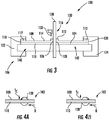
- a method 100 of field shaping a preform laminated glass structure 102 using a handheld tile saw 130 is illustrated.
- the preform laminated glass structure 102 may be supported on a surface 104 of a support structure 106, such as a workbench or table at an installation site, with a flexible glass sheet 108 of the preform laminated glass structure 102 facing away from the surface 104 of the support structure 106 and a non-glass substrate 110 sandwiched between the flexible glass sheet 108 and the support structure 106.
- a mask 112 e.g., a tape
- the mask 112 may be strips of tape applied along an intended cutting line 116 and at outer edges 118 and 120 where clamps 122 and 124 may be applied to support the preform laminated glass structure 102 and inhibit vibration.
- the mask 112 can be used to protect the surface 114 and also to inhibit bonding and collection of glass chips along the cut edges 126 and 128 and on the surface 114. Where the mask 112 is applied can depend on a number of factors, such as the cutting tool used, the pattern being cut, where the preform laminated glass structure 102 is being supported and the final (or useful) laminated glass structure versus the scrap.
- each piece of the preform laminated glass structure 102 may be useful, while in other embodiments, one or more pieces of the preform laminated glass structure 102 may be scrap. In some embodiments, both of the scrap portion and useful portion of the preform laminated glass structure 102 may be supported (e.g., using the clamps 122 and 124).
- a liquid or fluid for example, a cutting fluid 132, such as water or other liquid solution, may be supplied to the surface 114 of the preform laminated glass structure 102 from a fluid supply (e.g., a water tap).
- the cutting fluid 132 may be applied through the handheld tile saw 130 or by any other suitable method, such as from a container or using a hose.
- the cutting fluid 132 can reduce friction between a cutting edge 136 of a cutting wheel 138 of the handheld tile saw 130, while also protecting the cut edges 126 and 128 and surface 114 of the preform laminated glass structure 102 from scratches and contamination caused by the deposit of abrasive particles or chips made during the machining process.
- dry cutting is beneficial in some instances.
- a cut may be initiated by the operator using the handheld tile saw 130 (e.g., such as commercially available from Ryobi Limited) while the cutting fluid 132 is applied.
- the handheld tile saw may be power operated, for example, using an electrical outlet or battery.
- the cutting wheel 138 may be operated in a climb cut orientation.
- a "climb cut orientation" refers to the cutting tool applying a compressive stress Sc to the flexible glass sheet during a cutting operation moving in direction D ( FIG. 4A ) as opposed to an "anti-climb cut operation," which applies a tensile stress St to the flexible glass sheet using the cutting tool moving in direction D ( FIG. 4B ).
- Use of the climb cut can avoid fracturing the flexible glass layer of the laminated glass structure 102.
- the feed or cutting rate can be dependent on the preform laminated glass structure 102 (glass thickness, type and thickness of the non-glass substrate and adhesive).
- the cutting rate may be about four feet per minute. Real time observation by the operator may be used to adjust the cutting rate.
- the cutting wheel 138 may be any suitable type, such as a four inch diamond powder-coated cutting wheel (e.g., commercially available from Ryobi Limited).
- the abrasive (e.g., diamond) grit size, or diameter of the abrasive particles, can play a significant role in quality of the cut.
- the surface finish quality, smoothness, and amount of chipping can all be affected by the grit size.
- the cut may be made the entire length of the intended cutting line 116 to inhibit or reduce cracking of the flexible glass sheet 108 and to produce cut laminated glass structures 140 and 142.
- the mask 112 can be removed and the cut laminated glass structures 140 and 142 can be rinsed and dried.
- FIG. 5 illustrates a cut edge 150 of a flexible glass sheet 152 (e.g., cut in the manner described above). Due to the cutting process, rounded and/or straight chips 154 may be created along the cut edge 150. In some embodiments, a finishing operation or multiple finishing operations may be desired to remove or reduce the size of the chips 154 and create a smoother or cleaner cut edge 150 ( FIG. 6 ).
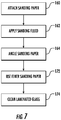
- a suitable sand paper e.g., AlOx, SiC; at least 180 grit
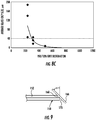
- FIGS. 8A-8C charts comparing grit size to flexible glass sheet thickness and glass chip sizes are illustrated.
- Power finishing may also be achieved using several commonly utilized tools such as belt sanders and orbital sanders, for example.
- the grit size used should be much smaller than the thickness of the flexible glass sheet to produce any chip sizes less than a predetermined depth (e.g., about 20 ⁇ m or less).
- grit size designations of 180 or finer for example, 220 grit, 400 grit, 600 grit and 800 grit, or finer may be used. A shown in FIG.
- a grit size of 600 when a flexible glass thickness of 100 to 200 microns is used, a grit size of 600 has a grit particle size of less than 50 microns, i.e., about 30 microns and much smaller than the thickness of the flexible glass.
- a grit size of 180 or more when a flexible glass thickness of 200 microns is used, a grit size of 180 or more has a grit particle size of less than 200 microns, and can successfully be used as a starting point for finishing the glass edge.
- abrasive particles during the cutting process having an average diameter of less than about 1/4, such as less than about 1/5 of the thickness of the flexible glass sheet can significantly reduce edge chipping and obtain glass edge strengths of about 20 MPa or more, for example 50 MPa or more.
- an abrasive grit particle size of 30 microns (from ISO/FEPA Grit Designation 600) produces negligible average glass chip sizes.
- an ISO/FEPA Grit Desingnation of 180 ore more can produce negligible average glass chip sizes. Finishing angles are also beneficially selected to successfully preserve the attributes of the cut and finished laminate structure. Andgles from 23 degrees to 87 degrees can be effective. In some instances angles of 70 - 85 degrees are desired.
- a fluid for example, a sanding fluid such as water may be applied along the cut edge 150.
- the sand paper and sanding block may be held at an angle to the cut edge 150 (i.e., at an angle to a plane transverse to the broad surface of the flexible glass sheet).
- FIG. 9 illustrates the sand paper 166 contacting the cut edge 150 at angle ⁇ to the cut edge 150 (e.g., from about five to about 85 degrees, for example, from about five to about 45 degrees, for example 45 degrees).
- Such an arrangement can produce an edge 168 of the flexible glass sheet 152 offset inwardly of an edge 170 of the non-glass substrate 110 and can provide some protection for the edge 168, for example, during handling by extending the edge 170 beyond the edge 168.
- finer grit sand paper 800 grit may be used at the same angle ⁇ for a finishing operation at step 172.
- a range of grit sizes from 180 to 800 may be successively used, for example, an initial 180 grit sandpaper may be used, and then one or more of 220 grit, 400 grit, 600 grit, 800 grit, or finer.
- the laminated glass structure may be rinsed and dried.
- Vibratory, belt or disc sanders may be used in a fashion similar to that described above.
- FIG. 10 another method 180 of field shaping a preform laminated glass structure 182 using a handheld router 184 is illustrated.
- the preform laminated glass structure 182 may be supported on a surface 185 of a support structure 186 with a flexible glass sheet 188 of the preform laminated glass structure 182 facing away from the surface 185 of the support structure 186 and a non-glass substrate 190 sandwiched between the flexible glass sheet 188 and the support structure 186.
- a mask 192 may be applied to a broad surface 194 along with clamps 196 and 198, as described above.
- a pattern may be drawn on the mask 192, including any center cut marking illustrating the center of the cut (or where routing will begin for an internal cut).
- a cut may be initiated by the operator using the handheld router 184 (e.g., such as commercially available from Porter-Cable Corporation).
- the handheld router 184 may be power operated, for example, using an electrical outlet or battery.
- a router bit 200 may be operated in a climb cut orientation using a compression bit.
- the feed or cutting rate can be dependent on the preform laminated glass structure 182 (glass thickness, type and thickness of the non-glass substrate and adhesive).
- the cutting rate may be between about 10 inches per minute and about eight feet per minute.
- the cutting rate may be between about 1 inch per minute and about 10 inches per minute. Real time observation may be used to adjust the cutting rate.
- the router bit 200 may be any suitable compression type, such as a diamond coated or carbide compression cutting bit (e.g., commercially available from Harvey Tool, or SGS) having counteracting flute geometries that compress the glass material inwardly. Router bits may also be downward fluted bits having various coatings such as TiN, TiCN, ZrCr and others. Additionally, chip breaker bits may be used as well.
- the cut may be made along the entire length of the intended cutting line 202 to inhibit or reduce cracking of the flexible glass sheet 188 and to produce cut laminated glass structures 204 and 206. Once the cut is complete, the mask 192 can be removed and the cut laminated glass structures 204 and 206 can be rinsed and dried.
- Router cuts can be made unmasked and without a cutting fluid.
- a masking e.g., with tape
- Router cuts may also follow a specified tool path to provide the climb cut orientation (depending on the flute direction of the router bit), compression and to minimize glass edge and substrate damage.
- Router bits that do not apply compression to the flexible glass layer burring the initial plunge or puncture of the laminated glass structure 210 can result in significant glass fracturing. For example, referring to FIG.
- a router cut along cut line L of a preform laminated glass structure 210 may begin by piercing the preform laminated glass structure 210, within an area A to be cut and discarded at a location 212 entirely through its thickness.
- a clockwise cutting path P may be followed by the compression router bit, which applies a compressive force at the cut edge 214 of the useful laminated glass structure portion 216.
- a template may be used to guide the operator when using the handheld router. As the size of the cut out increases, the area A of the preform laminated glass structure 210 may be secured to stabilize or prevent the area A from excessively vibrating and creating stresses that can lead to glass chipping and/or cracking.
- Table I illustrates various cutting parameters for shaping laminated glass structures. Table I is exemplary and not meant to be exhaustive as other cutting tools may be employed and due to variation in equipment from manufacturer to manufacturer.
- Table I Cutting Finishing Router Tile Saw Table Saw Router Tile Saw Table Saw Cutter Router and/or Mill Bit Diamond Coated Blade Carbide Tip Blade Style Compression/Down Flute and Chip Breaker Bits Can Vary with Laminate Composition Cross Cut Can Vary with Laminate Composition Diameters Variable depending upon Laminate stack-up and Radius requirements Variable depending upon Laminate stack-up 10" Speed 5,000 - 30,000 rpm Can Vary with Laminate Composition 3500 - 6000 rpm Cutting Rate 10 in. to 8 ft./min. ⁇ 4 ft./min.
- the systems and methods of field shaping laminated glass structures described above allow for use of hand held and semi-automated cutting and finishing tools, such as tile saws, diamond saws, table saws, routers, wire saws, orbital sanders and other grinding and polishing tools (e.g., Dremel® rotary tools, RotoZip® saws, orbital sanders, and belt sanders) with minimal damage while maintaining edge strengths of the flexible glass sheets of at least about 20 MPa, for example about 40 MPa, 50 MPa, 60 MPa, 70 MPa, 80 MPa, 90MPa, 100 MPa, or higher, for example.
- hand held and semi-automated cutting and finishing tools such as tile saws, diamond saws, table saws, routers, wire saws, orbital sanders and other grinding and polishing tools (e.g., Dremel® rotary tools, RotoZip® saws, orbital sanders, and belt sanders) with minimal damage while maintaining edge strengths of the flexible glass
- the laminated glass structures may be masked to prevent incidental scratching of the flexible glass sheets by the tools and inhibit attachment of glass particles to the flexible glass sheet.
- Glass chips as large as 900 to 1200 microns, and in other examples as large as 900 to 3000 ⁇ m can be created during cutting which can be finished with a secondary one or two-step finishing process to obtain glass chip sizes less than 10 microns, such as less than five microns in depth.
- Use of climb cutting orientations apply a compressive force to the flexible glass sheet during cutting using the cutting tool which allows for edge strengths of the flexible glass sheets to be maintained above 20 MPa, for example, about 40 MPa, 50 MPa, 60 MPa, 70 MPa, 80 MPa, 90MPa, 100 MPa, or higher, for example.
- the rotation of the cutting wheel should be in the climb direction, contacting the flexible glass sheet first as the cutting wheel is rotated.
- compression bits with downwardly turned flutes may be utilized.
Landscapes
- Engineering & Computer Science (AREA)
- Mechanical Engineering (AREA)
- Mining & Mineral Resources (AREA)
- Chemical & Material Sciences (AREA)
- Ceramic Engineering (AREA)
- Inorganic Chemistry (AREA)
- Materials Engineering (AREA)
- Organic Chemistry (AREA)
- Re-Forming, After-Treatment, Cutting And Transporting Of Glass Products (AREA)
- Laminated Bodies (AREA)
- Joining Of Glass To Other Materials (AREA)
Applications Claiming Priority (3)
| Application Number | Priority Date | Filing Date | Title |
|---|---|---|---|
| US201461937133P | 2014-02-07 | 2014-02-07 | |
| PCT/US2015/014543 WO2015120109A1 (en) | 2014-02-07 | 2015-02-05 | Methods of forming laminated glass structures |
| EP15746585.7A EP3102408B1 (de) | 2014-02-07 | 2015-02-05 | Verfahren zur herstellung von verbundglasstrukturen |
Related Parent Applications (2)
| Application Number | Title | Priority Date | Filing Date |
|---|---|---|---|
| EP15746585.7A Division EP3102408B1 (de) | 2014-02-07 | 2015-02-05 | Verfahren zur herstellung von verbundglasstrukturen |
| EP15746585.7A Division-Into EP3102408B1 (de) | 2014-02-07 | 2015-02-05 | Verfahren zur herstellung von verbundglasstrukturen |
Publications (2)
| Publication Number | Publication Date |
|---|---|
| EP3572229A1 true EP3572229A1 (de) | 2019-11-27 |
| EP3572229B1 EP3572229B1 (de) | 2021-10-27 |
Family
ID=53778426
Family Applications (2)
| Application Number | Title | Priority Date | Filing Date |
|---|---|---|---|
| EP19177914.9A Not-in-force EP3572229B1 (de) | 2014-02-07 | 2015-02-05 | Verfahren zur herstellung von verbundglasstrukturen |
| EP15746585.7A Active EP3102408B1 (de) | 2014-02-07 | 2015-02-05 | Verfahren zur herstellung von verbundglasstrukturen |
Family Applications After (1)
| Application Number | Title | Priority Date | Filing Date |
|---|---|---|---|
| EP15746585.7A Active EP3102408B1 (de) | 2014-02-07 | 2015-02-05 | Verfahren zur herstellung von verbundglasstrukturen |
Country Status (8)
| Country | Link |
|---|---|
| US (1) | US11318717B2 (de) |
| EP (2) | EP3572229B1 (de) |
| KR (1) | KR102364707B1 (de) |
| CN (1) | CN105980149B (de) |
| AU (1) | AU2015214158B2 (de) |
| CA (1) | CA2938842A1 (de) |
| TW (1) | TWI702139B (de) |
| WO (1) | WO2015120109A1 (de) |
Families Citing this family (4)
| Publication number | Priority date | Publication date | Assignee | Title |
|---|---|---|---|---|
| CN106313805A (zh) * | 2015-06-17 | 2017-01-11 | 镇江市中能机械设备有限公司 | 防潮板 |
| KR102245175B1 (ko) * | 2016-10-12 | 2021-04-28 | 코닝 인코포레이티드 | 글라스 라미네이트 에지 다듬질을 위한 방법 및 장치 및 이에 의하여 형성되는 글라스 라미네이트 |
| CN109202546A (zh) * | 2018-09-29 | 2019-01-15 | 信利半导体有限公司 | 改善柔性基板切割毛刺的方法 |
| KR102963501B1 (ko) * | 2021-02-16 | 2026-05-14 | 삼성디스플레이 주식회사 | 윈도우의 제조 방법 및 표시 장치용 윈도우 |
Citations (7)
| Publication number | Priority date | Publication date | Assignee | Title |
|---|---|---|---|---|
| US3338696A (en) | 1964-05-06 | 1967-08-29 | Corning Glass Works | Sheet forming apparatus |
| US3682609A (en) | 1969-10-06 | 1972-08-08 | Corning Glass Works | Controlling thickness of newly drawn glass sheet |
| GB2144363A (en) * | 1983-08-02 | 1985-03-06 | Central Glass Co Ltd | Cutting device |
| US20110081542A1 (en) | 2004-12-16 | 2011-04-07 | Agc Flat Glass Europe S.A. | Substrate with antimicrobial properties |
| US20120034435A1 (en) | 2010-08-06 | 2012-02-09 | Nicholas Francis Borrelli | Coated, antimicrobial, chemically strengthened glass and method of making |
| US20120052302A1 (en) * | 2010-08-24 | 2012-03-01 | Matusick Joseph M | Method of strengthening edge of glass article |
| US8486535B1 (en) * | 2010-05-24 | 2013-07-16 | Rockwell Collins, Inc. | Systems and methods for adherable and removable thin flexible glass |
Family Cites Families (16)
| Publication number | Priority date | Publication date | Assignee | Title |
|---|---|---|---|---|
| US1805457A (en) * | 1929-04-17 | 1931-05-12 | Bessie L Gregg | Method for cutting glass |
| US3089801A (en) | 1957-05-27 | 1963-05-14 | Minnesota Mining & Mfg | Ultra-thin glass sheet |
| US4196760A (en) * | 1978-03-03 | 1980-04-08 | Baseman James H | Material feeding machine |
| US4428159A (en) * | 1981-07-29 | 1984-01-31 | Sigetich John D | Portable, direct drive abrasive saw |
| DE19851353C1 (de) | 1998-11-06 | 1999-10-07 | Schott Glas | Verfahren und Vorrichtung zum Schneiden eines Laminats aus einem sprödbrüchigen Werkstoff und einem Kunststoff |
| US6568990B2 (en) * | 2000-01-18 | 2003-05-27 | Ncrx Optical Solutions, Inc. | System and method for ophthalmic lens manufacture |
| US20080301953A1 (en) * | 2007-01-31 | 2008-12-11 | Gemini Saw Company, Inc. | Cutting guide system and method |
| US20100279067A1 (en) * | 2009-04-30 | 2010-11-04 | Robert Sabia | Glass sheet having enhanced edge strength |
| KR20130010899A (ko) | 2010-03-05 | 2013-01-29 | 세이지 일렉트로크로믹스, 인크. | 유리 기판에 전기변색 소자의 적층체 |
| JP5035382B2 (ja) | 2010-04-19 | 2012-09-26 | コニカミノルタアドバンストレイヤー株式会社 | 情報記録媒体用ガラスディスクの製造方法及び当該方法に使用する製造装置 |
| US8974268B2 (en) * | 2010-06-25 | 2015-03-10 | Corning Incorporated | Method of preparing an edge-strengthened article |
| US8986072B2 (en) * | 2011-05-26 | 2015-03-24 | Corning Incorporated | Methods of finishing an edge of a glass sheet |
| US8721392B2 (en) * | 2011-06-28 | 2014-05-13 | Corning Incorporated | Glass edge finishing method |
| JPWO2013031547A1 (ja) * | 2011-08-29 | 2015-03-23 | 旭硝子株式会社 | ガラス板、およびガラス板の製造方法 |
| US9676114B2 (en) * | 2012-02-29 | 2017-06-13 | Taiwan Semiconductor Manufacturing Company, Ltd. | Wafer edge trim blade with slots |
| US9090027B2 (en) * | 2012-10-23 | 2015-07-28 | Bell Helicopter Textron Inc. | System and method of constructing composite structures |
-
2015
- 2015-02-05 EP EP19177914.9A patent/EP3572229B1/de not_active Not-in-force
- 2015-02-05 CA CA2938842A patent/CA2938842A1/en not_active Abandoned
- 2015-02-05 US US15/117,055 patent/US11318717B2/en not_active Expired - Fee Related
- 2015-02-05 KR KR1020167024341A patent/KR102364707B1/ko not_active Expired - Fee Related
- 2015-02-05 CN CN201580007567.4A patent/CN105980149B/zh not_active Expired - Fee Related
- 2015-02-05 EP EP15746585.7A patent/EP3102408B1/de active Active
- 2015-02-05 AU AU2015214158A patent/AU2015214158B2/en not_active Ceased
- 2015-02-05 WO PCT/US2015/014543 patent/WO2015120109A1/en not_active Ceased
- 2015-02-06 TW TW104104105A patent/TWI702139B/zh not_active IP Right Cessation
Patent Citations (7)
| Publication number | Priority date | Publication date | Assignee | Title |
|---|---|---|---|---|
| US3338696A (en) | 1964-05-06 | 1967-08-29 | Corning Glass Works | Sheet forming apparatus |
| US3682609A (en) | 1969-10-06 | 1972-08-08 | Corning Glass Works | Controlling thickness of newly drawn glass sheet |
| GB2144363A (en) * | 1983-08-02 | 1985-03-06 | Central Glass Co Ltd | Cutting device |
| US20110081542A1 (en) | 2004-12-16 | 2011-04-07 | Agc Flat Glass Europe S.A. | Substrate with antimicrobial properties |
| US8486535B1 (en) * | 2010-05-24 | 2013-07-16 | Rockwell Collins, Inc. | Systems and methods for adherable and removable thin flexible glass |
| US20120034435A1 (en) | 2010-08-06 | 2012-02-09 | Nicholas Francis Borrelli | Coated, antimicrobial, chemically strengthened glass and method of making |
| US20120052302A1 (en) * | 2010-08-24 | 2012-03-01 | Matusick Joseph M | Method of strengthening edge of glass article |
Also Published As
| Publication number | Publication date |
|---|---|
| US11318717B2 (en) | 2022-05-03 |
| WO2015120109A1 (en) | 2015-08-13 |
| EP3102408A1 (de) | 2016-12-14 |
| KR20160120302A (ko) | 2016-10-17 |
| CN105980149B (zh) | 2018-10-30 |
| CN105980149A (zh) | 2016-09-28 |
| EP3102408A4 (de) | 2017-09-06 |
| TW201536540A (zh) | 2015-10-01 |
| KR102364707B1 (ko) | 2022-02-18 |
| EP3572229B1 (de) | 2021-10-27 |
| AU2015214158A1 (en) | 2016-08-18 |
| US20170165871A1 (en) | 2017-06-15 |
| EP3102408B1 (de) | 2019-07-10 |
| AU2015214158B2 (en) | 2018-03-15 |
| CA2938842A1 (en) | 2015-08-13 |
| TWI702139B (zh) | 2020-08-21 |
Similar Documents
| Publication | Publication Date | Title |
|---|---|---|
| US10029941B2 (en) | Machining methods of forming laminated glass structures | |
| US10549401B2 (en) | Abrasive jet forming laminated glass structures | |
| US20180154493A1 (en) | Methods of edge finishing laminated glass structures | |
| EP3572229B1 (de) | Verfahren zur herstellung von verbundglasstrukturen | |
| EP3347165A1 (de) | Abrasives rotierendes werkzeug mit abrasiven agglomeraten | |
| EP3347162A1 (de) | Flexibles schleifdrehwerkzeug | |
| CN108137376B (zh) | 用于切割玻璃层压件的方法和设备 | |
| CN110573296A (zh) | 用于玻璃层压板边缘精整的方法和设备以及借此形成的玻璃层压板 | |
| WO2011104227A1 (en) | Method for manufacturing stratified panels made of stone-like material and glass, particularly for providing furniture components or light diffusers | |
| JP2003525759A (ja) | エッジを賦形するための方法と機械 | |
| JP6993614B2 (ja) | ガラス樹脂積層体の製造方法 | |
| KR102109766B1 (ko) | 패널의 엣지 접착 장치 |
Legal Events
| Date | Code | Title | Description |
|---|---|---|---|
| PUAI | Public reference made under article 153(3) epc to a published international application that has entered the european phase |
Free format text: ORIGINAL CODE: 0009012 |
|
| STAA | Information on the status of an ep patent application or granted ep patent |
Free format text: STATUS: THE APPLICATION HAS BEEN PUBLISHED |
|
| AC | Divisional application: reference to earlier application |
Ref document number: 3102408 Country of ref document: EP Kind code of ref document: P |
|
| AK | Designated contracting states |
Kind code of ref document: A1 Designated state(s): AL AT BE BG CH CY CZ DE DK EE ES FI FR GB GR HR HU IE IS IT LI LT LU LV MC MK MT NL NO PL PT RO RS SE SI SK SM TR |
|
| STAA | Information on the status of an ep patent application or granted ep patent |
Free format text: STATUS: REQUEST FOR EXAMINATION WAS MADE |
|
| 17P | Request for examination filed |
Effective date: 20200526 |
|
| RBV | Designated contracting states (corrected) |
Designated state(s): AL AT BE BG CH CY CZ DE DK EE ES FI FR GB GR HR HU IE IS IT LI LT LU LV MC MK MT NL NO PL PT RO RS SE SI SK SM TR |
|
| GRAP | Despatch of communication of intention to grant a patent |
Free format text: ORIGINAL CODE: EPIDOSNIGR1 |
|
| STAA | Information on the status of an ep patent application or granted ep patent |
Free format text: STATUS: GRANT OF PATENT IS INTENDED |
|
| INTG | Intention to grant announced |
Effective date: 20210507 |
|
| GRAS | Grant fee paid |
Free format text: ORIGINAL CODE: EPIDOSNIGR3 |
|
| GRAA | (expected) grant |
Free format text: ORIGINAL CODE: 0009210 |
|
| STAA | Information on the status of an ep patent application or granted ep patent |
Free format text: STATUS: THE PATENT HAS BEEN GRANTED |
|
| AC | Divisional application: reference to earlier application |
Ref document number: 3102408 Country of ref document: EP Kind code of ref document: P |
|
| AK | Designated contracting states |
Kind code of ref document: B1 Designated state(s): AL AT BE BG CH CY CZ DE DK EE ES FI FR GB GR HR HU IE IS IT LI LT LU LV MC MK MT NL NO PL PT RO RS SE SI SK SM TR |
|
| REG | Reference to a national code |
Ref country code: GB Ref legal event code: FG4D |
|
| REG | Reference to a national code |
Ref country code: CH Ref legal event code: EP |
|
| REG | Reference to a national code |
Ref country code: AT Ref legal event code: REF Ref document number: 1441445 Country of ref document: AT Kind code of ref document: T Effective date: 20211115 |
|
| REG | Reference to a national code |
Ref country code: DE Ref legal event code: R096 Ref document number: 602015074593 Country of ref document: DE |
|
| REG | Reference to a national code |
Ref country code: IE Ref legal event code: FG4D |
|
| REG | Reference to a national code |
Ref country code: LT Ref legal event code: MG9D |
|
| REG | Reference to a national code |
Ref country code: NL Ref legal event code: MP Effective date: 20211027 |
|
| REG | Reference to a national code |
Ref country code: AT Ref legal event code: MK05 Ref document number: 1441445 Country of ref document: AT Kind code of ref document: T Effective date: 20211027 |
|
| PG25 | Lapsed in a contracting state [announced via postgrant information from national office to epo] |
Ref country code: RS Free format text: LAPSE BECAUSE OF FAILURE TO SUBMIT A TRANSLATION OF THE DESCRIPTION OR TO PAY THE FEE WITHIN THE PRESCRIBED TIME-LIMIT Effective date: 20211027 Ref country code: LT Free format text: LAPSE BECAUSE OF FAILURE TO SUBMIT A TRANSLATION OF THE DESCRIPTION OR TO PAY THE FEE WITHIN THE PRESCRIBED TIME-LIMIT Effective date: 20211027 Ref country code: FI Free format text: LAPSE BECAUSE OF FAILURE TO SUBMIT A TRANSLATION OF THE DESCRIPTION OR TO PAY THE FEE WITHIN THE PRESCRIBED TIME-LIMIT Effective date: 20211027 Ref country code: BG Free format text: LAPSE BECAUSE OF FAILURE TO SUBMIT A TRANSLATION OF THE DESCRIPTION OR TO PAY THE FEE WITHIN THE PRESCRIBED TIME-LIMIT Effective date: 20220127 Ref country code: AT Free format text: LAPSE BECAUSE OF FAILURE TO SUBMIT A TRANSLATION OF THE DESCRIPTION OR TO PAY THE FEE WITHIN THE PRESCRIBED TIME-LIMIT Effective date: 20211027 |
|
| PGFP | Annual fee paid to national office [announced via postgrant information from national office to epo] |
Ref country code: GB Payment date: 20220125 Year of fee payment: 8 Ref country code: DE Payment date: 20220112 Year of fee payment: 8 |
|
| PG25 | Lapsed in a contracting state [announced via postgrant information from national office to epo] |
Ref country code: IS Free format text: LAPSE BECAUSE OF FAILURE TO SUBMIT A TRANSLATION OF THE DESCRIPTION OR TO PAY THE FEE WITHIN THE PRESCRIBED TIME-LIMIT Effective date: 20220227 Ref country code: SE Free format text: LAPSE BECAUSE OF FAILURE TO SUBMIT A TRANSLATION OF THE DESCRIPTION OR TO PAY THE FEE WITHIN THE PRESCRIBED TIME-LIMIT Effective date: 20211027 Ref country code: PT Free format text: LAPSE BECAUSE OF FAILURE TO SUBMIT A TRANSLATION OF THE DESCRIPTION OR TO PAY THE FEE WITHIN THE PRESCRIBED TIME-LIMIT Effective date: 20220228 Ref country code: PL Free format text: LAPSE BECAUSE OF FAILURE TO SUBMIT A TRANSLATION OF THE DESCRIPTION OR TO PAY THE FEE WITHIN THE PRESCRIBED TIME-LIMIT Effective date: 20211027 Ref country code: NO Free format text: LAPSE BECAUSE OF FAILURE TO SUBMIT A TRANSLATION OF THE DESCRIPTION OR TO PAY THE FEE WITHIN THE PRESCRIBED TIME-LIMIT Effective date: 20220127 Ref country code: NL Free format text: LAPSE BECAUSE OF FAILURE TO SUBMIT A TRANSLATION OF THE DESCRIPTION OR TO PAY THE FEE WITHIN THE PRESCRIBED TIME-LIMIT Effective date: 20211027 Ref country code: LV Free format text: LAPSE BECAUSE OF FAILURE TO SUBMIT A TRANSLATION OF THE DESCRIPTION OR TO PAY THE FEE WITHIN THE PRESCRIBED TIME-LIMIT Effective date: 20211027 Ref country code: HR Free format text: LAPSE BECAUSE OF FAILURE TO SUBMIT A TRANSLATION OF THE DESCRIPTION OR TO PAY THE FEE WITHIN THE PRESCRIBED TIME-LIMIT Effective date: 20211027 Ref country code: GR Free format text: LAPSE BECAUSE OF FAILURE TO SUBMIT A TRANSLATION OF THE DESCRIPTION OR TO PAY THE FEE WITHIN THE PRESCRIBED TIME-LIMIT Effective date: 20220128 Ref country code: ES Free format text: LAPSE BECAUSE OF FAILURE TO SUBMIT A TRANSLATION OF THE DESCRIPTION OR TO PAY THE FEE WITHIN THE PRESCRIBED TIME-LIMIT Effective date: 20211027 |
|
| PGFP | Annual fee paid to national office [announced via postgrant information from national office to epo] |
Ref country code: FR Payment date: 20220119 Year of fee payment: 8 |
|
| REG | Reference to a national code |
Ref country code: DE Ref legal event code: R097 Ref document number: 602015074593 Country of ref document: DE |
|
| PG25 | Lapsed in a contracting state [announced via postgrant information from national office to epo] |
Ref country code: SM Free format text: LAPSE BECAUSE OF FAILURE TO SUBMIT A TRANSLATION OF THE DESCRIPTION OR TO PAY THE FEE WITHIN THE PRESCRIBED TIME-LIMIT Effective date: 20211027 Ref country code: SK Free format text: LAPSE BECAUSE OF FAILURE TO SUBMIT A TRANSLATION OF THE DESCRIPTION OR TO PAY THE FEE WITHIN THE PRESCRIBED TIME-LIMIT Effective date: 20211027 Ref country code: RO Free format text: LAPSE BECAUSE OF FAILURE TO SUBMIT A TRANSLATION OF THE DESCRIPTION OR TO PAY THE FEE WITHIN THE PRESCRIBED TIME-LIMIT Effective date: 20211027 Ref country code: EE Free format text: LAPSE BECAUSE OF FAILURE TO SUBMIT A TRANSLATION OF THE DESCRIPTION OR TO PAY THE FEE WITHIN THE PRESCRIBED TIME-LIMIT Effective date: 20211027 Ref country code: DK Free format text: LAPSE BECAUSE OF FAILURE TO SUBMIT A TRANSLATION OF THE DESCRIPTION OR TO PAY THE FEE WITHIN THE PRESCRIBED TIME-LIMIT Effective date: 20211027 Ref country code: CZ Free format text: LAPSE BECAUSE OF FAILURE TO SUBMIT A TRANSLATION OF THE DESCRIPTION OR TO PAY THE FEE WITHIN THE PRESCRIBED TIME-LIMIT Effective date: 20211027 |
|
| PLBE | No opposition filed within time limit |
Free format text: ORIGINAL CODE: 0009261 |
|
| STAA | Information on the status of an ep patent application or granted ep patent |
Free format text: STATUS: NO OPPOSITION FILED WITHIN TIME LIMIT |
|
| PG25 | Lapsed in a contracting state [announced via postgrant information from national office to epo] |
Ref country code: MC Free format text: LAPSE BECAUSE OF FAILURE TO SUBMIT A TRANSLATION OF THE DESCRIPTION OR TO PAY THE FEE WITHIN THE PRESCRIBED TIME-LIMIT Effective date: 20211027 |
|
| 26N | No opposition filed |
Effective date: 20220728 |
|
| REG | Reference to a national code |
Ref country code: CH Ref legal event code: PL |
|
| REG | Reference to a national code |
Ref country code: BE Ref legal event code: MM Effective date: 20220228 |
|
| PG25 | Lapsed in a contracting state [announced via postgrant information from national office to epo] |
Ref country code: LU Free format text: LAPSE BECAUSE OF NON-PAYMENT OF DUE FEES Effective date: 20220205 Ref country code: AL Free format text: LAPSE BECAUSE OF FAILURE TO SUBMIT A TRANSLATION OF THE DESCRIPTION OR TO PAY THE FEE WITHIN THE PRESCRIBED TIME-LIMIT Effective date: 20211027 |
|
| PG25 | Lapsed in a contracting state [announced via postgrant information from national office to epo] |
Ref country code: SI Free format text: LAPSE BECAUSE OF FAILURE TO SUBMIT A TRANSLATION OF THE DESCRIPTION OR TO PAY THE FEE WITHIN THE PRESCRIBED TIME-LIMIT Effective date: 20211027 |
|
| PG25 | Lapsed in a contracting state [announced via postgrant information from national office to epo] |
Ref country code: LI Free format text: LAPSE BECAUSE OF NON-PAYMENT OF DUE FEES Effective date: 20220228 Ref country code: IE Free format text: LAPSE BECAUSE OF NON-PAYMENT OF DUE FEES Effective date: 20220205 Ref country code: CH Free format text: LAPSE BECAUSE OF NON-PAYMENT OF DUE FEES Effective date: 20220228 |
|
| PG25 | Lapsed in a contracting state [announced via postgrant information from national office to epo] |
Ref country code: BE Free format text: LAPSE BECAUSE OF NON-PAYMENT OF DUE FEES Effective date: 20220228 |
|
| PG25 | Lapsed in a contracting state [announced via postgrant information from national office to epo] |
Ref country code: IT Free format text: LAPSE BECAUSE OF FAILURE TO SUBMIT A TRANSLATION OF THE DESCRIPTION OR TO PAY THE FEE WITHIN THE PRESCRIBED TIME-LIMIT Effective date: 20211027 |
|
| REG | Reference to a national code |
Ref country code: DE Ref legal event code: R119 Ref document number: 602015074593 Country of ref document: DE |
|
| GBPC | Gb: european patent ceased through non-payment of renewal fee |
Effective date: 20230205 |
|
| PG25 | Lapsed in a contracting state [announced via postgrant information from national office to epo] |
Ref country code: GB Free format text: LAPSE BECAUSE OF NON-PAYMENT OF DUE FEES Effective date: 20230205 |
|
| PG25 | Lapsed in a contracting state [announced via postgrant information from national office to epo] |
Ref country code: GB Free format text: LAPSE BECAUSE OF NON-PAYMENT OF DUE FEES Effective date: 20230205 Ref country code: FR Free format text: LAPSE BECAUSE OF NON-PAYMENT OF DUE FEES Effective date: 20230228 Ref country code: DE Free format text: LAPSE BECAUSE OF NON-PAYMENT OF DUE FEES Effective date: 20230901 |
|
| PG25 | Lapsed in a contracting state [announced via postgrant information from national office to epo] |
Ref country code: MK Free format text: LAPSE BECAUSE OF FAILURE TO SUBMIT A TRANSLATION OF THE DESCRIPTION OR TO PAY THE FEE WITHIN THE PRESCRIBED TIME-LIMIT Effective date: 20211027 Ref country code: CY Free format text: LAPSE BECAUSE OF FAILURE TO SUBMIT A TRANSLATION OF THE DESCRIPTION OR TO PAY THE FEE WITHIN THE PRESCRIBED TIME-LIMIT Effective date: 20211027 |
|
| PG25 | Lapsed in a contracting state [announced via postgrant information from national office to epo] |
Ref country code: HU Free format text: LAPSE BECAUSE OF FAILURE TO SUBMIT A TRANSLATION OF THE DESCRIPTION OR TO PAY THE FEE WITHIN THE PRESCRIBED TIME-LIMIT; INVALID AB INITIO Effective date: 20150205 |
|
| PG25 | Lapsed in a contracting state [announced via postgrant information from national office to epo] |
Ref country code: TR Free format text: LAPSE BECAUSE OF FAILURE TO SUBMIT A TRANSLATION OF THE DESCRIPTION OR TO PAY THE FEE WITHIN THE PRESCRIBED TIME-LIMIT Effective date: 20211027 |
|
| PG25 | Lapsed in a contracting state [announced via postgrant information from national office to epo] |
Ref country code: MT Free format text: LAPSE BECAUSE OF FAILURE TO SUBMIT A TRANSLATION OF THE DESCRIPTION OR TO PAY THE FEE WITHIN THE PRESCRIBED TIME-LIMIT Effective date: 20211027 |