EP3572293A1 - Procédé d'aide à la conduite d'au moins un véhicule automobile et système d'assistance - Google Patents
Procédé d'aide à la conduite d'au moins un véhicule automobile et système d'assistance Download PDFInfo
- Publication number
- EP3572293A1 EP3572293A1 EP19170734.8A EP19170734A EP3572293A1 EP 3572293 A1 EP3572293 A1 EP 3572293A1 EP 19170734 A EP19170734 A EP 19170734A EP 3572293 A1 EP3572293 A1 EP 3572293A1
- Authority
- EP
- European Patent Office
- Prior art keywords
- motor vehicle
- road
- way
- determined
- rules
- Prior art date
- Legal status (The legal status is an assumption and is not a legal conclusion. Google has not performed a legal analysis and makes no representation as to the accuracy of the status listed.)
- Granted
Links
Images

Classifications
-
- B—PERFORMING OPERATIONS; TRANSPORTING
- B60—VEHICLES IN GENERAL
- B60W—CONJOINT CONTROL OF VEHICLE SUB-UNITS OF DIFFERENT TYPE OR DIFFERENT FUNCTION; CONTROL SYSTEMS SPECIALLY ADAPTED FOR HYBRID VEHICLES; ROAD VEHICLE DRIVE CONTROL SYSTEMS FOR PURPOSES NOT RELATED TO THE CONTROL OF A PARTICULAR SUB-UNIT
- B60W30/00—Purposes of road vehicle drive control systems not related to the control of a particular sub-unit, e.g. of systems using conjoint control of vehicle sub-units
- B60W30/18—Propelling the vehicle
- B60W30/18009—Propelling the vehicle related to particular drive situations
- B60W30/18154—Approaching an intersection
-
- B—PERFORMING OPERATIONS; TRANSPORTING
- B60—VEHICLES IN GENERAL
- B60W—CONJOINT CONTROL OF VEHICLE SUB-UNITS OF DIFFERENT TYPE OR DIFFERENT FUNCTION; CONTROL SYSTEMS SPECIALLY ADAPTED FOR HYBRID VEHICLES; ROAD VEHICLE DRIVE CONTROL SYSTEMS FOR PURPOSES NOT RELATED TO THE CONTROL OF A PARTICULAR SUB-UNIT
- B60W30/00—Purposes of road vehicle drive control systems not related to the control of a particular sub-unit, e.g. of systems using conjoint control of vehicle sub-units
- B60W30/08—Active safety systems predicting or avoiding probable or impending collision or attempting to minimise its consequences
- B60W30/09—Taking automatic action to avoid collision, e.g. braking and steering
-
- B—PERFORMING OPERATIONS; TRANSPORTING
- B60—VEHICLES IN GENERAL
- B60W—CONJOINT CONTROL OF VEHICLE SUB-UNITS OF DIFFERENT TYPE OR DIFFERENT FUNCTION; CONTROL SYSTEMS SPECIALLY ADAPTED FOR HYBRID VEHICLES; ROAD VEHICLE DRIVE CONTROL SYSTEMS FOR PURPOSES NOT RELATED TO THE CONTROL OF A PARTICULAR SUB-UNIT
- B60W30/00—Purposes of road vehicle drive control systems not related to the control of a particular sub-unit, e.g. of systems using conjoint control of vehicle sub-units
- B60W30/08—Active safety systems predicting or avoiding probable or impending collision or attempting to minimise its consequences
-
- B—PERFORMING OPERATIONS; TRANSPORTING
- B60—VEHICLES IN GENERAL
- B60W—CONJOINT CONTROL OF VEHICLE SUB-UNITS OF DIFFERENT TYPE OR DIFFERENT FUNCTION; CONTROL SYSTEMS SPECIALLY ADAPTED FOR HYBRID VEHICLES; ROAD VEHICLE DRIVE CONTROL SYSTEMS FOR PURPOSES NOT RELATED TO THE CONTROL OF A PARTICULAR SUB-UNIT
- B60W30/00—Purposes of road vehicle drive control systems not related to the control of a particular sub-unit, e.g. of systems using conjoint control of vehicle sub-units
- B60W30/08—Active safety systems predicting or avoiding probable or impending collision or attempting to minimise its consequences
- B60W30/095—Predicting travel path or likelihood of collision
- B60W30/0956—Predicting travel path or likelihood of collision the prediction being responsive to traffic or environmental parameters
-
- B—PERFORMING OPERATIONS; TRANSPORTING
- B60—VEHICLES IN GENERAL
- B60W—CONJOINT CONTROL OF VEHICLE SUB-UNITS OF DIFFERENT TYPE OR DIFFERENT FUNCTION; CONTROL SYSTEMS SPECIALLY ADAPTED FOR HYBRID VEHICLES; ROAD VEHICLE DRIVE CONTROL SYSTEMS FOR PURPOSES NOT RELATED TO THE CONTROL OF A PARTICULAR SUB-UNIT
- B60W40/00—Estimation or calculation of non-directly measurable driving parameters for road vehicle drive control systems not related to the control of a particular sub unit, e.g. by using mathematical models
- B60W40/02—Estimation or calculation of non-directly measurable driving parameters for road vehicle drive control systems not related to the control of a particular sub unit, e.g. by using mathematical models related to ambient conditions
- B60W40/04—Traffic conditions
-
- B—PERFORMING OPERATIONS; TRANSPORTING
- B60—VEHICLES IN GENERAL
- B60W—CONJOINT CONTROL OF VEHICLE SUB-UNITS OF DIFFERENT TYPE OR DIFFERENT FUNCTION; CONTROL SYSTEMS SPECIALLY ADAPTED FOR HYBRID VEHICLES; ROAD VEHICLE DRIVE CONTROL SYSTEMS FOR PURPOSES NOT RELATED TO THE CONTROL OF A PARTICULAR SUB-UNIT
- B60W50/00—Details of control systems for road vehicle drive control not related to the control of a particular sub-unit, e.g. process diagnostic or vehicle driver interfaces
- B60W50/08—Interaction between the driver and the control system
-
- B—PERFORMING OPERATIONS; TRANSPORTING
- B60—VEHICLES IN GENERAL
- B60W—CONJOINT CONTROL OF VEHICLE SUB-UNITS OF DIFFERENT TYPE OR DIFFERENT FUNCTION; CONTROL SYSTEMS SPECIALLY ADAPTED FOR HYBRID VEHICLES; ROAD VEHICLE DRIVE CONTROL SYSTEMS FOR PURPOSES NOT RELATED TO THE CONTROL OF A PARTICULAR SUB-UNIT
- B60W50/00—Details of control systems for road vehicle drive control not related to the control of a particular sub-unit, e.g. process diagnostic or vehicle driver interfaces
- B60W50/08—Interaction between the driver and the control system
- B60W50/14—Means for informing the driver, warning the driver or prompting a driver intervention
-
- G—PHYSICS
- G06—COMPUTING OR CALCULATING; COUNTING
- G06V—IMAGE OR VIDEO RECOGNITION OR UNDERSTANDING
- G06V20/00—Scenes; Scene-specific elements
- G06V20/50—Context or environment of the image
- G06V20/56—Context or environment of the image exterior to a vehicle by using sensors mounted on the vehicle
- G06V20/58—Recognition of moving objects or obstacles, e.g. vehicles or pedestrians; Recognition of traffic objects, e.g. traffic signs, traffic lights or roads
-
- G—PHYSICS
- G06—COMPUTING OR CALCULATING; COUNTING
- G06V—IMAGE OR VIDEO RECOGNITION OR UNDERSTANDING
- G06V20/00—Scenes; Scene-specific elements
- G06V20/50—Context or environment of the image
- G06V20/56—Context or environment of the image exterior to a vehicle by using sensors mounted on the vehicle
- G06V20/58—Recognition of moving objects or obstacles, e.g. vehicles or pedestrians; Recognition of traffic objects, e.g. traffic signs, traffic lights or roads
- G06V20/582—Recognition of moving objects or obstacles, e.g. vehicles or pedestrians; Recognition of traffic objects, e.g. traffic signs, traffic lights or roads of traffic signs
-
- G—PHYSICS
- G06—COMPUTING OR CALCULATING; COUNTING
- G06V—IMAGE OR VIDEO RECOGNITION OR UNDERSTANDING
- G06V20/00—Scenes; Scene-specific elements
- G06V20/50—Context or environment of the image
- G06V20/56—Context or environment of the image exterior to a vehicle by using sensors mounted on the vehicle
- G06V20/58—Recognition of moving objects or obstacles, e.g. vehicles or pedestrians; Recognition of traffic objects, e.g. traffic signs, traffic lights or roads
- G06V20/584—Recognition of moving objects or obstacles, e.g. vehicles or pedestrians; Recognition of traffic objects, e.g. traffic signs, traffic lights or roads of vehicle lights or traffic lights
-
- G—PHYSICS
- G06—COMPUTING OR CALCULATING; COUNTING
- G06V—IMAGE OR VIDEO RECOGNITION OR UNDERSTANDING
- G06V20/00—Scenes; Scene-specific elements
- G06V20/50—Context or environment of the image
- G06V20/56—Context or environment of the image exterior to a vehicle by using sensors mounted on the vehicle
- G06V20/588—Recognition of the road, e.g. of lane markings; Recognition of the vehicle driving pattern in relation to the road
-
- G—PHYSICS
- G08—SIGNALLING
- G08G—TRAFFIC CONTROL SYSTEMS
- G08G1/00—Traffic control systems for road vehicles
- G08G1/01—Detecting movement of traffic to be counted or controlled
- G08G1/0104—Measuring and analyzing of parameters relative to traffic conditions
- G08G1/0108—Measuring and analyzing of parameters relative to traffic conditions based on the source of data
- G08G1/0112—Measuring and analyzing of parameters relative to traffic conditions based on the source of data from the vehicle, e.g. floating car data [FCD]
-
- G—PHYSICS
- G08—SIGNALLING
- G08G—TRAFFIC CONTROL SYSTEMS
- G08G1/00—Traffic control systems for road vehicles
- G08G1/01—Detecting movement of traffic to be counted or controlled
- G08G1/0104—Measuring and analyzing of parameters relative to traffic conditions
- G08G1/0108—Measuring and analyzing of parameters relative to traffic conditions based on the source of data
- G08G1/0116—Measuring and analyzing of parameters relative to traffic conditions based on the source of data from roadside infrastructure, e.g. beacons
-
- G—PHYSICS
- G08—SIGNALLING
- G08G—TRAFFIC CONTROL SYSTEMS
- G08G1/00—Traffic control systems for road vehicles
- G08G1/01—Detecting movement of traffic to be counted or controlled
- G08G1/0104—Measuring and analyzing of parameters relative to traffic conditions
- G08G1/0125—Traffic data processing
- G08G1/0129—Traffic data processing for creating historical data or processing based on historical data
-
- G—PHYSICS
- G08—SIGNALLING
- G08G—TRAFFIC CONTROL SYSTEMS
- G08G1/00—Traffic control systems for road vehicles
- G08G1/01—Detecting movement of traffic to be counted or controlled
- G08G1/048—Detecting movement of traffic to be counted or controlled with provision for compensation of environmental or other condition, e.g. snow, vehicle stopped at detector
-
- G—PHYSICS
- G08—SIGNALLING
- G08G—TRAFFIC CONTROL SYSTEMS
- G08G1/00—Traffic control systems for road vehicles
- G08G1/09—Arrangements for giving variable traffic instructions
- G08G1/0962—Arrangements for giving variable traffic instructions having an indicator mounted inside the vehicle, e.g. giving voice messages
- G08G1/0967—Systems involving transmission of highway information, e.g. weather, speed limits
- G08G1/096708—Systems involving transmission of highway information, e.g. weather, speed limits where the received information might be used to generate an automatic action on the vehicle control
-
- G—PHYSICS
- G08—SIGNALLING
- G08G—TRAFFIC CONTROL SYSTEMS
- G08G1/00—Traffic control systems for road vehicles
- G08G1/09—Arrangements for giving variable traffic instructions
- G08G1/0962—Arrangements for giving variable traffic instructions having an indicator mounted inside the vehicle, e.g. giving voice messages
- G08G1/0967—Systems involving transmission of highway information, e.g. weather, speed limits
- G08G1/096708—Systems involving transmission of highway information, e.g. weather, speed limits where the received information might be used to generate an automatic action on the vehicle control
- G08G1/096716—Systems involving transmission of highway information, e.g. weather, speed limits where the received information might be used to generate an automatic action on the vehicle control where the received information does not generate an automatic action on the vehicle control
-
- G—PHYSICS
- G08—SIGNALLING
- G08G—TRAFFIC CONTROL SYSTEMS
- G08G1/00—Traffic control systems for road vehicles
- G08G1/09—Arrangements for giving variable traffic instructions
- G08G1/0962—Arrangements for giving variable traffic instructions having an indicator mounted inside the vehicle, e.g. giving voice messages
- G08G1/0967—Systems involving transmission of highway information, e.g. weather, speed limits
- G08G1/096766—Systems involving transmission of highway information, e.g. weather, speed limits where the system is characterised by the origin of the information transmission
-
- G—PHYSICS
- G08—SIGNALLING
- G08G—TRAFFIC CONTROL SYSTEMS
- G08G1/00—Traffic control systems for road vehicles
- G08G1/123—Traffic control systems for road vehicles indicating the position of vehicles, e.g. scheduled vehicles; Managing passenger vehicles circulating according to a fixed timetable, e.g. buses, trains, trams
- G08G1/127—Traffic control systems for road vehicles indicating the position of vehicles, e.g. scheduled vehicles; Managing passenger vehicles circulating according to a fixed timetable, e.g. buses, trains, trams to a central station ; Indicators in a central station
-
- G—PHYSICS
- G08—SIGNALLING
- G08G—TRAFFIC CONTROL SYSTEMS
- G08G1/00—Traffic control systems for road vehicles
- G08G1/123—Traffic control systems for road vehicles indicating the position of vehicles, e.g. scheduled vehicles; Managing passenger vehicles circulating according to a fixed timetable, e.g. buses, trains, trams
- G08G1/133—Traffic control systems for road vehicles indicating the position of vehicles, e.g. scheduled vehicles; Managing passenger vehicles circulating according to a fixed timetable, e.g. buses, trains, trams within the vehicle ; Indicators inside the vehicles or at stops
- G08G1/137—Traffic control systems for road vehicles indicating the position of vehicles, e.g. scheduled vehicles; Managing passenger vehicles circulating according to a fixed timetable, e.g. buses, trains, trams within the vehicle ; Indicators inside the vehicles or at stops the indicator being in the form of a map
-
- G—PHYSICS
- G08—SIGNALLING
- G08G—TRAFFIC CONTROL SYSTEMS
- G08G1/00—Traffic control systems for road vehicles
- G08G1/16—Anti-collision systems
-
- G—PHYSICS
- G08—SIGNALLING
- G08G—TRAFFIC CONTROL SYSTEMS
- G08G1/00—Traffic control systems for road vehicles
- G08G1/16—Anti-collision systems
- G08G1/166—Anti-collision systems for active traffic, e.g. moving vehicles, pedestrians, bikes
-
- G—PHYSICS
- G08—SIGNALLING
- G08G—TRAFFIC CONTROL SYSTEMS
- G08G1/00—Traffic control systems for road vehicles
- G08G1/20—Monitoring the location of vehicles belonging to a group, e.g. fleet of vehicles, countable or determined number of vehicles
-
- H—ELECTRICITY
- H04—ELECTRIC COMMUNICATION TECHNIQUE
- H04W—WIRELESS COMMUNICATION NETWORKS
- H04W4/00—Services specially adapted for wireless communication networks; Facilities therefor
- H04W4/30—Services specially adapted for particular environments, situations or purposes
- H04W4/40—Services specially adapted for particular environments, situations or purposes for vehicles, e.g. vehicle-to-pedestrians [V2P]
- H04W4/44—Services specially adapted for particular environments, situations or purposes for vehicles, e.g. vehicle-to-pedestrians [V2P] for communication between vehicles and infrastructures, e.g. vehicle-to-cloud [V2C] or vehicle-to-home [V2H]
-
- B—PERFORMING OPERATIONS; TRANSPORTING
- B60—VEHICLES IN GENERAL
- B60W—CONJOINT CONTROL OF VEHICLE SUB-UNITS OF DIFFERENT TYPE OR DIFFERENT FUNCTION; CONTROL SYSTEMS SPECIALLY ADAPTED FOR HYBRID VEHICLES; ROAD VEHICLE DRIVE CONTROL SYSTEMS FOR PURPOSES NOT RELATED TO THE CONTROL OF A PARTICULAR SUB-UNIT
- B60W40/00—Estimation or calculation of non-directly measurable driving parameters for road vehicle drive control systems not related to the control of a particular sub unit, e.g. by using mathematical models
- B60W40/08—Estimation or calculation of non-directly measurable driving parameters for road vehicle drive control systems not related to the control of a particular sub unit, e.g. by using mathematical models related to drivers or passengers
- B60W2040/0872—Driver physiology
-
- B—PERFORMING OPERATIONS; TRANSPORTING
- B60—VEHICLES IN GENERAL
- B60W—CONJOINT CONTROL OF VEHICLE SUB-UNITS OF DIFFERENT TYPE OR DIFFERENT FUNCTION; CONTROL SYSTEMS SPECIALLY ADAPTED FOR HYBRID VEHICLES; ROAD VEHICLE DRIVE CONTROL SYSTEMS FOR PURPOSES NOT RELATED TO THE CONTROL OF A PARTICULAR SUB-UNIT
- B60W2552/00—Input parameters relating to infrastructure
-
- B—PERFORMING OPERATIONS; TRANSPORTING
- B60—VEHICLES IN GENERAL
- B60W—CONJOINT CONTROL OF VEHICLE SUB-UNITS OF DIFFERENT TYPE OR DIFFERENT FUNCTION; CONTROL SYSTEMS SPECIALLY ADAPTED FOR HYBRID VEHICLES; ROAD VEHICLE DRIVE CONTROL SYSTEMS FOR PURPOSES NOT RELATED TO THE CONTROL OF A PARTICULAR SUB-UNIT
- B60W2552/00—Input parameters relating to infrastructure
- B60W2552/53—Road markings, e.g. lane marker or crosswalk
-
- B—PERFORMING OPERATIONS; TRANSPORTING
- B60—VEHICLES IN GENERAL
- B60W—CONJOINT CONTROL OF VEHICLE SUB-UNITS OF DIFFERENT TYPE OR DIFFERENT FUNCTION; CONTROL SYSTEMS SPECIALLY ADAPTED FOR HYBRID VEHICLES; ROAD VEHICLE DRIVE CONTROL SYSTEMS FOR PURPOSES NOT RELATED TO THE CONTROL OF A PARTICULAR SUB-UNIT
- B60W2554/00—Input parameters relating to objects
-
- B—PERFORMING OPERATIONS; TRANSPORTING
- B60—VEHICLES IN GENERAL
- B60W—CONJOINT CONTROL OF VEHICLE SUB-UNITS OF DIFFERENT TYPE OR DIFFERENT FUNCTION; CONTROL SYSTEMS SPECIALLY ADAPTED FOR HYBRID VEHICLES; ROAD VEHICLE DRIVE CONTROL SYSTEMS FOR PURPOSES NOT RELATED TO THE CONTROL OF A PARTICULAR SUB-UNIT
- B60W2554/00—Input parameters relating to objects
- B60W2554/20—Static objects
-
- B—PERFORMING OPERATIONS; TRANSPORTING
- B60—VEHICLES IN GENERAL
- B60W—CONJOINT CONTROL OF VEHICLE SUB-UNITS OF DIFFERENT TYPE OR DIFFERENT FUNCTION; CONTROL SYSTEMS SPECIALLY ADAPTED FOR HYBRID VEHICLES; ROAD VEHICLE DRIVE CONTROL SYSTEMS FOR PURPOSES NOT RELATED TO THE CONTROL OF A PARTICULAR SUB-UNIT
- B60W2554/00—Input parameters relating to objects
- B60W2554/40—Dynamic objects, e.g. animals, windblown objects
- B60W2554/402—Type
- B60W2554/4026—Cycles
-
- B—PERFORMING OPERATIONS; TRANSPORTING
- B60—VEHICLES IN GENERAL
- B60W—CONJOINT CONTROL OF VEHICLE SUB-UNITS OF DIFFERENT TYPE OR DIFFERENT FUNCTION; CONTROL SYSTEMS SPECIALLY ADAPTED FOR HYBRID VEHICLES; ROAD VEHICLE DRIVE CONTROL SYSTEMS FOR PURPOSES NOT RELATED TO THE CONTROL OF A PARTICULAR SUB-UNIT
- B60W2554/00—Input parameters relating to objects
- B60W2554/40—Dynamic objects, e.g. animals, windblown objects
- B60W2554/402—Type
- B60W2554/4029—Pedestrians
-
- B—PERFORMING OPERATIONS; TRANSPORTING
- B60—VEHICLES IN GENERAL
- B60W—CONJOINT CONTROL OF VEHICLE SUB-UNITS OF DIFFERENT TYPE OR DIFFERENT FUNCTION; CONTROL SYSTEMS SPECIALLY ADAPTED FOR HYBRID VEHICLES; ROAD VEHICLE DRIVE CONTROL SYSTEMS FOR PURPOSES NOT RELATED TO THE CONTROL OF A PARTICULAR SUB-UNIT
- B60W2554/00—Input parameters relating to objects
- B60W2554/40—Dynamic objects, e.g. animals, windblown objects
- B60W2554/404—Characteristics
- B60W2554/4041—Position
-
- B—PERFORMING OPERATIONS; TRANSPORTING
- B60—VEHICLES IN GENERAL
- B60W—CONJOINT CONTROL OF VEHICLE SUB-UNITS OF DIFFERENT TYPE OR DIFFERENT FUNCTION; CONTROL SYSTEMS SPECIALLY ADAPTED FOR HYBRID VEHICLES; ROAD VEHICLE DRIVE CONTROL SYSTEMS FOR PURPOSES NOT RELATED TO THE CONTROL OF A PARTICULAR SUB-UNIT
- B60W2555/00—Input parameters relating to exterior conditions, not covered by groups B60W2552/00, B60W2554/00
- B60W2555/60—Traffic rules, e.g. speed limits or right of way
-
- B—PERFORMING OPERATIONS; TRANSPORTING
- B60—VEHICLES IN GENERAL
- B60W—CONJOINT CONTROL OF VEHICLE SUB-UNITS OF DIFFERENT TYPE OR DIFFERENT FUNCTION; CONTROL SYSTEMS SPECIALLY ADAPTED FOR HYBRID VEHICLES; ROAD VEHICLE DRIVE CONTROL SYSTEMS FOR PURPOSES NOT RELATED TO THE CONTROL OF A PARTICULAR SUB-UNIT
- B60W2556/00—Input parameters relating to data
- B60W2556/45—External transmission of data to or from the vehicle
- B60W2556/65—Data transmitted between vehicles
Definitions
- the invention relates to a method for supporting a guidance of at least one motor vehicle, a corresponding assistance system for a motor vehicle and a motor vehicle with such an assistance system.
- the DE 10 2011 082 761 A1 describes a computer-implemented method. It is determined that a vehicle running characteristic has exceeded an expected parameter and then a recording of vehicle GPS coordinates is aborted when an abort tolerance is exceeded. Depending on a predetermined number of recorded vehicle GPS coordinates, a traffic control feature associated with at least one set of GPS coordinates is determined and stored.
- the DE 10 2012 219 721 A1 discloses a driving assistance method for increasing the driving comfort, wherein a state of a running road section and lanes of this road section are detected and a lane recommendation for the road section is issued. For example, as a lane recommendation the message can be issued that due to potholes in 500 m distance a lane change is recommended.
- a method of relieving a driver when driving a vehicle is known.
- the driver makes a request to a controller, whether the controller can take over at least a partial function of guiding the vehicle. After a corresponding check, the controller takes over the management of the partial function of the vehicle, if a defined parameter is fulfilled.
- the controller can take over the management of the sub-function if the review has shown that no congestion, no construction site, no intersections, no junction, no diversion and no special danger situations exist or can occur.
- Object of the present invention is to enable a safe and reliable driving a motor vehicle.
- a method according to the invention serves to assist in guiding at least one motor vehicle.
- a respective environmental sensor system of a large number of motor vehicles by means of a respective environmental sensor system of a large number of motor vehicles, respective environmental data are recorded which characterize a respective surrounding traffic situation.
- each of the motor vehicles has its own environmental sensor system, which detects the environment of the respective motor vehicle.
- the ambient sensor system may comprise, for example, one or more cameras and / or further sensors, for example radar, lidar and / or laser sensors with respective transmitting and receiving devices.
- the surroundings data are automatically detected in areas in which a respective first road traveled by the respective motor vehicle and a respective second road on which a respective other road user is located meet.
- a respective right of way behavior whether the respective motor vehicle has granted or granted the respective other road users priority, so that the respective other road user has traversed or crossed the respective area in front of the respective motor vehicle, or vice versa.
- the priority behavior thus indicates how the respective road users involved have reacted or reacted in the respective traffic situation.
- right-of-way rules for the areas are automatically determined.
- the determined priority rules are then provided in the at least one motor vehicle to be guided.
- the plurality of motor vehicles that perform this can detect one or more areas or corresponding traffic situations in each case and in total.
- a particular area can be traveled several times, for example at different times and thus in particular in different traffic situations, by the same motor vehicle and / or by different motor vehicles and detected accordingly. Capturing the range is the same as collecting the environmental data for that range or in this range.
- the multiplicity of motor vehicles can act independently of one another, but nevertheless be collectively referred to as fleet or swarm.
- the environment data individually acquired by these motor vehicles of the fleet or the swarm and / or the ascent behavior determined therefrom can be summarized, that is to say in total, correspondingly referred to as swarm data.
- the right of way rules are therefore determined not on the basis of an individual case or an individual situation, but from or based on the swarm data.
- advantageous one-time or special situations in which the respective motor vehicle and / or the respective other road user behave in an irregular manner can not lead to a wrong priority rule being determined for the respective area. It is an acknowledgment of the invention that most road users in most situations comply compliant, so in accordance with legal traffic rules.
- the inventive method is advantageous not on an automatically recognizable or even existing signage or Road equipment in the respective areas instructed.
- the circumstance can be exploited technically that even in the case of missing or incomplete or, for example, damaged signage or street equipment, human drivers can generally reliably recognize or estimate the respective traffic situation and the legally valid and applicable priority rule, at least in majority or on average.
- the term road is to be interpreted generally in the sense of the present invention and may mean or include any type of traffic route. The invention applies, is therefore applicable, for example, for areas or traffic situations in which an unpaved forest or dirt road meets a street in the true sense.
- the first or the second road may be an entrance or exit of a demarcated area, for example a private property.
- a priority rule for a region is not determined until at least a predefined number of given priority behavior has been present for this region, ie it has been determined.
- the right-of-way rule for an area may be redetermined, updated, adjusted, and / or reviewed, for example, with any priority behavior determined for that area.
- the priority rule can preferably only be provided in the at least one motor vehicle to be guided if a predefined confidence value for the respective priority rule has been reached. This may be the case, for example, when the right of way rule has been determined from at least the predetermined number of determined right-of-way behavior, that is to say based on at least one predetermined number of determined right-of-way behavior.
- a spread or variance of the priority behavior can be taken into account.
- the confidence value can then be achieved, for example, if any right-of-way behavior, which is additionally taken into account, has less than a predetermined influence on the resulting right-of-way rule. In this way, the safety and reliability of the certain rules of priority and driving the motor vehicle, so the safety in traffic are increased.
- the at least one motor vehicle to be guided can or should be one of the plurality of motor vehicles which detect the environmental data.
- the motor vehicles can advantageously also be supported by the priority rules determined based on the swarm data, which are not themselves configured to acquire the surrounding data or determine the respective priority behavior and / or transmit the environmental data and / or the respective priority behavior to a corresponding data processing device or are set up.
- the particular priority rules may be provided to one, several or all of the plurality of motor vehicles, ie fleet or swarm vehicles.
- the environment data can be processed in a preferred embodiment of the invention in each case in the motor vehicle, which has detected the respective environment data by means of a respective local data processing device of the motor vehicle for determining the right of way rules.
- the respective forward drive behavior can thus be determined locally, for example, by respective assistance systems or data processing devices of one, some or all of the motor vehicles.
- the right of way rules are advantageous directly and directly for use, so to guide the respective motor vehicle ready.
- the detected environment data and / or the driving behavior determined therefrom can also be transmitted or exchanged directly from motor vehicle to motor vehicle, for example by means of car-2-car communication.
- the transmission or exchange of the environmental data and / or the priority behavior between the individual motor vehicles can be carried out by means of a vehicle-external server device.
- Vortexs On the basis of the available in one or more of the motor vehicles from several, ie the plurality of vehicles detected environmental data and / or determined by the plurality of motor vehicles Vortexs can then in one, several or all of the vehicles, for example by means of the respective assistance system or the respective data processing device, the respective priority rule or the right of way rules are determined.
- the detected environment data for determining the priority behavior can be transmitted to the vehicle-external server device, which then also determines the right-of-way rules.
- the environment data and / or the particular right-of-way behavior of the motor vehicles is automatically transmitted to a, in particular external, central server device - such as a cloud or back-end server.
- This central server device automatically determines the right of way rules.
- the central server device can automatically transmit the determined priority rules to the at least one motor vehicle to be driven, in particular to the plurality of motor vehicles.
- data from many different motor vehicles, which have been detected in particular in different, spatially distributed intersection and / or junction areas are processed at a central location.
- the right of way rules can be determined particularly quickly and reliably, with a particularly low communication overhead, ie particularly efficiently and for a particularly large spatial area.
- the central server device advantageously also makes it possible for the automatically determined priority rules to be checked particularly easily at a central location before they are transmitted or made available for supporting the guidance of the at least one motor vehicle. As a result, improved security can be achieved.
- the priority behavior can thus be determined locally in the individual motor vehicles and then transmitted to the vehicle-external server device, which determines therefrom the right-of-way rules.
- the motor vehicle may enter an area driving about on a road by opening a second road from the right.
- the motor vehicle can then detect that another road user, for example another motor vehicle, is on the second road, which likewise approaches this junction area.
- the position and movement of the own motor vehicle can then be determined, for example, that the own motor vehicle stops before the confluence of the second road and the other road users passes through the junction area first.
- This or a similar traffic situation can be traversed by several of the plurality of motor vehicles.
- the other road user may be one of the plurality of motor vehicles and thus capture the same traffic situation in the same area from a different perspective.
- the driver of the motor vehicle to be guided can be assisted, for example, by displaying the determined priority rule or by a corresponding visual and / or audible indication or a warning when driving the motor vehicle, when he enters an area in the future for which already one Right of way has been determined.
- a proper movement of the respective motor vehicle and a movement of the respective other road user in the respective area are detected and tracked to determine the respective priority behavior.
- a traffic flow in the respective area or by the respective area is detected or determined from the environmental data.
- a movement in this sense is to be understood as a state of motion, which also includes determining a standstill or a standstill of the motor vehicle and / or the other road user.
- a motor control, a gear position, a tachometer, at least one Radencoder, a steering angle and / or the like can be monitored more and evaluated accordingly.
- the movement of the respective other road user can be detected as part of the environment data.
- the environmental data can in particular be recorded continuously or, for example, depending on the technical design, with a frequency of, for example, at least 10 Hz. In this way, the respective traffic flow, ie the forward travel behavior for the area, can be determined particularly reliably from the environmental data.
- a respective geographical position for the areas are automatically determined and the particular right of way rules depending on the specific positions automatically integrated as a data layer in a map.
- the particular right of way rules are thus assigned to geographical or spatial data by linking with the particular geographical positions of the areas for which the right of way rules have been determined.
- the map is to be understood in the conventional sense as a record indicating a spatial arrangement of physical features, in particular a road course, for an area that is significantly larger than each one of the areas, so the crossing or confluence areas, in the sense of the present Invention.
- the incorporation of the particular right of way rules into the card as a data layer advantageously allows a standardized handling of this additional or supplementary data layer.
- a map ie a map dataset, is present anyway in a large number of today's motor vehicles and in all autonomous motor vehicles, a particularly simple updating of these maps or navigation data sets which are available anyway is made possible.
- a street equipment present in the respective area in particular a traffic sign, a traffic signal system and / or a lane marking, is detected.
- the detected road equipment is then automatically taken into account when determining the right of way rules.
- the right of way rules are thus determined depending on the particular street equipment.
- the respective priority rule can advantageously be determined particularly reliably correctly. For example, a particular traffic situation in an area may develop or unfold in a particular manner that would be consistent with two different right of way rules for that area. For example, it may be determined from the environmental data that another road user approaching on a right-bank road passes through the respective area first.
- the right of way to the left applies to the area in question or that the right-of-way road is declared as a priority road, as indicated for example by traffic sign no. 301 or traffic sign no which can then be recorded as part of the street equipment. Additionally or alternatively, for example, an additional sign may be present, which indicates a bend in the priority road. Due to the automatic detection and consideration of these traffic signs, ie the respective street equipment, therefore, the respectively applicable priority rule can be clearly selected and determined. Likewise, for example, the street equipment may be detected and evaluated to determine whether the particular approach behavior is consistent with the detected street equipment.
- the respective street equipment can also be detected, for example, by means of the environmental sensor system, ie determined from the environmental data. Additionally or alternatively, the street equipment may be retrieved, for example, from one or more other data sources. Such a data source can be, for example, a corresponding data layer of the card.
- a type of the respective other road user is automatically determined and taken into account when determining the right of way rules.
- the right of way rules can therefore depend on the Or of a type of the other road user.
- the right of way rules can therefore be determined specifically for, for example, one type or one type or a combination of types or types of all road users involved in the respective traffic situation.
- the other road users can be automatically classified by appropriate processing of the environmental data in terms of their nature or their type, for example as a pedestrian, as a cyclist, as a motor vehicle or the like.
- an image processing and / or object recognition algorithm can be used.
- complex right of way rules can be identified and determined.
- a one-way road leading away from the first road can branch off, which, however, may be driven in the opposite direction by cyclists.
- a then from the branching one-way street opposite to the direction of travel allowed for motor vehicles of the first street approaching cyclists can then according to the "right to left" rule have priority in front of the motor vehicle. In this situation, however, this is specifically valid for cyclists, ie only for a certain type of road user.
- the rule automatically determined so be determined that at a pedestrian crossing or pedestrian crossing (crosswalk) pedestrians have absolute priority over motor vehicles, but this does not apply to cyclists who drive on their bike instead of this slide.
- a behavior of a driver of the respective motor vehicle in particular a respective viewing direction and / or a respective gesture, detected and taken into account in determining the right of way rules. For example, it regularly happens that a driver renounces his right of way, which is actually due to him in accordance with the prevailing priority rule, and lets the other road users drive through or pass through the respective area first, indicating this by looking towards the respective other road user and a corresponding request gesture.
- the behavior of the respective driver detected by means of the occupant monitoring device can automatically be used as an indication as to whether it is automatic particular approach behavior is a standard situation or a particular or exceptional situation exists.
- a plurality of predetermined gestures, gesture types and / or characteristics or characterizations of typical gestures that may indicate granting the right of way or disclaiming one's own right of way can be predefined in a corresponding database and then compared with the respective detected gesture.
- a method of machine learning can be used to learn the behavior of the respective driver, so that then driver-specific the particular behavior can be detected particularly accurately and reliably in its meaning and considered accordingly for determining the right of way rules.
- the at least one motor vehicle to be guided is automatically controlled in an at least partially automated driving mode as a function of the determined priority rules by the areas for which the right of way rules have been determined.
- This driving operation can therefore be a partially, highly or fully automated or driverless or autonomous driving, for example according to the corresponding known five-stage system.
- the at least one motor vehicle to be guided is that motor vehicle whose guidance or guidance is supported by the method according to the invention.
- an autonomous motor vehicle could individually and reevaluate each traffic situation on the basis of currently acquired environmental data in order to determine a driving strategy.
- Controlling or operating the motor vehicle in the at least partially automated driving mode as a function of the determined priority rules can advantageously make a behavior of the respective autonomous motor vehicle more predictable and assessable, for example for other road users. As a result, a more fluent and secure traffic flow can advantageously be achieved.
- the assistance system has a data processing device, which in turn has a communication interface and is configured to receive environmental data acquired via the communication interface by means of an environmental sensor system, which characterize a traffic situation in an environment of the motor vehicle.
- the assistance system in particular the data processing device, is set up to receive from the received environmental data for a region in which a first road traveled by the motor vehicle meets a second road on which another road user is located determine whether the motor vehicle granted the other road users right of way, so that this traverses the area in front of the motor vehicle, or vice versa.
- the assistance system in particular the data processing device, is set up to automatically determine therefrom a priority rule for the respective area and to provide support for guiding the motor vehicle.
- the assistance system may comprise a data memory in which a program code is stored which codes or represents the method steps of the method according to the invention.
- the data processing device may include a processor device coupled to this data memory for executing this program code.
- the assistance system according to the invention is therefore set up to carry out or carry out at least one variant of the method according to the invention.
- the components and devices mentioned in connection with the method according to the invention may in particular be the corresponding components and devices of the assistance system according to the invention.
- the assistance system according to the invention may comprise said central server device.
- the central server device may then be the data processing device.
- the data processing device may be part of the central server device or vice versa.
- the data processing device can be provided, for example, completely on the vehicle side.
- the assistance system according to the invention is then a device for the respective motor vehicle.
- the assistance system may comprise further components or devices, for example the ambient sensor system, the occupant monitoring device, a device for carrying out said machine learning, a sensor system for detecting and tracking the self-motion of the motor vehicle, for determining the respective geographical position of the respective regions and / or the like more.
- Another aspect of the present invention is a motor vehicle having an assistance system according to the invention.
- the motor vehicle according to the invention can therefore be set up to carry out or carry out at least one variant of the method according to the invention.
- the motor vehicle according to the invention may be the motor vehicle mentioned in connection with the method according to the invention and / or in connection with the assistance system according to the invention.
- the exemplary embodiment explained below is a preferred embodiment of the invention.
- the described components of the embodiment each represent individual features of the invention that are to be considered independently of one another, which also each independently further develop the invention and thus also individually or in a different combination than the one shown as part of the invention.
- the described embodiment can also be supplemented by further features of the invention already described.
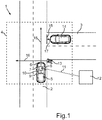
- Fig. 1 shows a schematic overview of an exemplary traffic situation 1.
- a first road 2 is shown, in which a second road 3 opens.
- Schematically indicated here is an immediate junction 4, in which the currently displayed traffic situation 1 takes place.
- a motor vehicle 5 is located on the first street 1.
- the motor vehicle 5 has an ambient sensor system 6, a data processing device 7 coupled to it, a communication module 8, a navigation device 9 connected to the data processing device 7 and an occupant monitoring device likewise connected to the data processing device 7 10 on.
- the data processing device 7 is set up by means of the communication module 8 via a - here schematically indicated bidirectional wireless data connection 11 - to communicate with a vehicle external server 12.
- a pedestrian 13 and a third-party vehicle 14 located on the second street 3 are present as further road users.
- a dynamic of the traffic situation 1 is indicated here by corresponding arrows.
- a path 15 of the motor vehicle 5 is indicated by a first arrow, a path 16 of the pedestrian 13 by a second case, and a path 17 of the other vehicle 14 by a third arrow.
- the motor vehicle 5 would therefore like to drive through the junction area 4 on the first street 2 along the path 15.
- the pedestrian 13 would like to cross the first street 2 along the path 16 coming from the second street 3.
- the foreign vehicle 14 travels along the path 17 on the second road 3 to a stop line 18, which indicates where the second road 3 meets the first road 2.
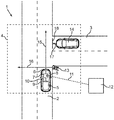
- Fig. 2 shows an exemplary schematic flowchart 19 of a method for supporting a guidance of a motor vehicle, in particular of the motor vehicle 5. This method, ie the flowchart 19 will be described below with reference to Fig. 1 be explained.
- the method begins with a method step S1.
- an assistance system of the motor vehicle 5 is activated.
- this assistance system comprises the ambient sensor system 6, the data processing device 7, the occupant monitoring device 10 and the navigation device 9.
- a method step S2 the motor vehicle 5 travels along the road 2, environmental data, including street equipment in the area of the first road 2, being continuously detected by means of the environmental sensor system 6. As roadside equipment here about the stop line 18 is detected. This continuous acquisition of the environmental data is indicated here schematically by a loop path 20 and can also be carried out during the subsequent method steps.
- step S3 the motor vehicle 5 enters the junction region 4, that is to say in FIG Fig. 1 illustrated traffic situation 1.
- the data processing device 7 of the junction area 4 is detected automatically.
- the method steps S2 and S3 can also be carried out essentially in the reverse order. So could after the process step S1 first - for example, based on existing map data and a continuously determined position of the motor vehicle 5 - be automatically recognized that the motor vehicle 5 has reached the junction area 4 and then the automatic detection of the environmental data for this junction area 4 are activated.
- a method step S4 the other road users present in the junction area 4, here the pedestrian 13 and the foreign vehicle 14, including their respective type and their respective movement behavior, are detected by processing the environmental data.
- a particular trajectory determined from a plurality of detected positions can in particular be extrapolated in order to determine a respective prospective movement.
- the positions and movements of other road users are determined in particular relative to the motor vehicle 5.
- the positions and movements of the motor vehicle 5, the pedestrian 13 and the foreign vehicle 14 are determined in particular with respect to the junction 4.
- a driver behavior of a driver of the motor vehicle 5 is monitored by means of the occupant monitoring device 10, in particular toward a viewing direction and a gesture which can be interpreted as communication with the pedestrian 13 and / or with a driver of the foreign vehicle 14.
- a Vorfahrts for the junction area 4 is determined.
- the motor vehicle 5 first in the in Fig. 1 shown position, wherein the driver has given the pedestrian 13 to understand by a corresponding gesture that this may cross the first road 2 along the path 16 in front of the motor vehicle 5.
- the foreign vehicle 14 has come to a halt on the stop line 18.
- the motor vehicle 5 has crossed the junction area 4 along the path 15 in front of the other vehicle 14.
- a method step S7 the motor vehicle 5 transmits, via the data connection 11, the forward travel behavior determined for the junction area 4 together with its geographical position, an indication of the detected gesture of the driver of the motor vehicle 5 - for example in the form of a reduced confidence value - and with a detected street equipment of the Mouth areas 4, in this case the stop line 18 at the server 12.
- the previous method steps are performed in a similar manner as for the junction area 4 for other, not shown here in detail traffic situations with each other road users a total of multiple.
- the motor vehicle 5 and the motor vehicles corresponding thereto in the other traffic situations form a swarm of motor vehicles, which schematically indicates corresponding swarm data 21, 22 to the server 12.
- the swarm data 21, 22 correspond to the forward drive behavior, positions, road equipment, types of the road users involved, etc. transmitted by the other vehicles of the swarm, as has been transmitted to the server 12 by the motor vehicle 5 in the described manner.
- the server 12 processes the data transmitted by the motor vehicle 5 and the swarm data 21, 22 and determines therefrom a right-of-way rule valid for the junction area 4.
- the server 12 can also determine for the junction area 4 a plurality of right of way rules for specific types of road users or combinations of road users meeting in the junction area 4.
- it is determined for the junction area 4, taking into account the gesture of the driver of the motor vehicle 5 that preceded the crossing of the first street 2 by the pedestrian 13, and taking into account the stop line 18 as the right of way for the junction area 4 that driving on the first street 2 Motor vehicles right of way the first street 2 on the inflowing second street 3 approaching motor vehicles.
- the server 12 In a method step S9, the server 12 generates a data layer for a map from the priority rule for the junction area 4 and the geographical position of the junction area 4 as well as for other right of way rules and positions not shown here, and binds this data layer into the map. So in a map data set.
- step S10 the generated data layer, the complete map data record, or a respective change, which has resulted from a previous execution of the method, is transmitted to the motor vehicle 5.
- the data layer that is to say the determined priority rules
- the data layer are displayed in the motor vehicle 5 by means of the navigation device 9 as part of a navigation map in order to assist the driver in guiding the motor vehicle 5 when the latter enters the junction area 4 or one of the other areas. For which a respective right of way rules has been determined reached.
- the motor vehicle 5 can now rely on the determined priority rules as supporting data when reaching and crossing the junction areas 4 again or when reaching and traversing one of the other areas in an autonomous driving mode.
Landscapes
- Engineering & Computer Science (AREA)
- Physics & Mathematics (AREA)
- General Physics & Mathematics (AREA)
- Automation & Control Theory (AREA)
- Mechanical Engineering (AREA)
- Transportation (AREA)
- Theoretical Computer Science (AREA)
- Multimedia (AREA)
- Human Computer Interaction (AREA)
- Atmospheric Sciences (AREA)
- Life Sciences & Earth Sciences (AREA)
- Chemical & Material Sciences (AREA)
- Analytical Chemistry (AREA)
- Remote Sensing (AREA)
- Radar, Positioning & Navigation (AREA)
- Computer Networks & Wireless Communication (AREA)
- Signal Processing (AREA)
- Mathematical Physics (AREA)
- Traffic Control Systems (AREA)
Applications Claiming Priority (1)
| Application Number | Priority Date | Filing Date | Title |
|---|---|---|---|
| DE102018208105.0A DE102018208105B3 (de) | 2018-05-23 | 2018-05-23 | Verfahren zum Unterstützen eines Führens wenigstens eines Kraftfahrzeugs und Assistenzsystem |
Publications (2)
| Publication Number | Publication Date |
|---|---|
| EP3572293A1 true EP3572293A1 (fr) | 2019-11-27 |
| EP3572293B1 EP3572293B1 (fr) | 2023-01-11 |
Family
ID=65527139
Family Applications (1)
| Application Number | Title | Priority Date | Filing Date |
|---|---|---|---|
| EP19170734.8A Active EP3572293B1 (fr) | 2018-05-23 | 2019-04-24 | Procédé d'aide à la conduite d'au moins un véhicule automobile et système d'assistance |
Country Status (5)
| Country | Link |
|---|---|
| US (1) | US11161511B2 (fr) |
| EP (1) | EP3572293B1 (fr) |
| KR (1) | KR20190133623A (fr) |
| CN (1) | CN110533900B (fr) |
| DE (1) | DE102018208105B3 (fr) |
Cited By (3)
| Publication number | Priority date | Publication date | Assignee | Title |
|---|---|---|---|---|
| WO2023156277A1 (fr) * | 2022-02-15 | 2023-08-24 | Bayerische Motoren Werke Aktiengesellschaft | Dispositif et procédé de détection d'une voie de dérivation d'une unité de signalisation |
| DE102022002082A1 (de) | 2022-06-10 | 2023-12-21 | Mercedes-Benz Group AG | Verfahren zur Erkennung von semantischen Beziehungen zwischen Verkehrsobjekten |
| DE102023202937A1 (de) | 2023-03-30 | 2024-10-02 | Volkswagen Aktiengesellschaft | Verfahren und Fahrerassistenzvorrichtung zur Unterstützung eines Fahrer eines Fahrzeugs in komplexen Vorfahrtssituationen |
Families Citing this family (19)
| Publication number | Priority date | Publication date | Assignee | Title |
|---|---|---|---|---|
| US11100801B2 (en) * | 2019-08-12 | 2021-08-24 | Toyota Motor North America, Inc. | Utilizing sensors to detect hazard from other vehicle while driving |
| DE102019124118A1 (de) * | 2019-09-09 | 2021-03-11 | Valeo Schalter Und Sensoren Gmbh | Verfahren zur Kollisionsvermeidung im Straßenverkehr auf Basis einer adaptiven Festlegung von Aufenthaltsbereichen |
| EP3839916B1 (fr) * | 2019-12-19 | 2023-10-25 | Ningbo Geely Automobile Research & Development Co., Ltd. | Système et procédé pour fournir des suggestions de décision à un opérateur d'un véhicule et produit-programme d'ordinateur |
| US20210304617A1 (en) * | 2020-03-31 | 2021-09-30 | Toyota Motor North America, Inc. | Transport to transport communication initiated by user gestures |
| US20210304595A1 (en) | 2020-03-31 | 2021-09-30 | Toyota Motor North America, Inc. | Traffic manager transports |
| US11290856B2 (en) | 2020-03-31 | 2022-03-29 | Toyota Motor North America, Inc. | Establishing connections in transports |
| US20210300423A1 (en) | 2020-03-31 | 2021-09-30 | Toyota Motor North America, Inc. | Identifying roadway concerns and taking preemptive actions |
| EP3896671B1 (fr) * | 2020-04-15 | 2026-05-20 | Zenuity Ab | Détection d'un véhicule de secours s'approchant à l'arrière |
| DE102020005013B3 (de) * | 2020-08-17 | 2021-08-12 | Daimler Ag | Verfahren zum Betrieb eines automatisiert fahrenden Fahrzeuges |
| CN116457261B (zh) * | 2020-11-02 | 2024-02-06 | 梅赛德斯-奔驰集团股份公司 | 用于控制自动驾驶车辆的方法 |
| DE102021104349A1 (de) * | 2021-05-14 | 2022-11-17 | Robert Bosch Gesellschaft mit beschränkter Haftung | Verfahren zur Ausgabe wenigstens eines Warnsignals eines vollautomatisiert betriebenen Fahrzeugs an einen Verkehrsteilnehmer |
| US12360529B2 (en) * | 2021-06-23 | 2025-07-15 | The Boeing Company | Predictive modeling of aircraft dynamics |
| DE102021207181B3 (de) | 2021-07-07 | 2022-10-20 | Volkswagen Aktiengesellschaft | Verfahren zur automatischen Erkennung einer Rechts-Vor-Links-Situation und Kraftfahrzeug |
| KR20230021457A (ko) * | 2021-08-05 | 2023-02-14 | 현대모비스 주식회사 | 차량의 장애물 감지 시스템 및 방법 |
| CN114347019B (zh) * | 2021-12-22 | 2023-09-08 | 深圳优地科技有限公司 | 机器人控制方法、机器人及控制系统 |
| CN114528358A (zh) * | 2021-12-27 | 2022-05-24 | 广州市公共交通集团有限公司 | 多设备异构数据融合方法、系统、装置及存储介质 |
| CN115123211A (zh) * | 2021-12-29 | 2022-09-30 | 长城汽车股份有限公司 | 车辆驾驶辅助方法、装置、车辆和云端服务器 |
| DE102022117986A1 (de) * | 2022-07-19 | 2024-01-25 | Valeo Schalter Und Sensoren Gmbh | Führen eines Fahrzeugs in Abhängigkeit von einer Intention zum Vorfahrt gewähren eines Verkehrsteilnehmers |
| US12249237B2 (en) * | 2023-01-06 | 2025-03-11 | Qualcomm Incorporated | Automotive traffic flow control in the absence of smart infrastructure |
Citations (8)
| Publication number | Priority date | Publication date | Assignee | Title |
|---|---|---|---|---|
| DE102011082761A1 (de) | 2010-09-29 | 2012-03-29 | Ford Global Technologies, Llc | Lieferung, Verarbeitung und Aktualisierung von fortgeschrittenen Karteninformationen |
| DE102011082375A1 (de) | 2011-09-08 | 2013-03-14 | Robert Bosch Gmbh | Verfahren zum Entlasten eines Fahrers beim Führen eines Fahrzeuges |
| DE102012219721A1 (de) | 2012-10-29 | 2014-04-30 | Robert Bosch Gmbh | Fahrassistenzverfahren und Fahrassistenzsystem zur Erhöhung des Fahrkomforts |
| US20160161270A1 (en) * | 2014-12-09 | 2016-06-09 | Toyota Motor Engineering & Manufacturing North America, Inc. | Autonomous vehicle detection of and response to yield scenarios |
| US20160161271A1 (en) * | 2014-12-09 | 2016-06-09 | Toyota Motor Engineering & Manufacturing North America, Inc. | Autonomous vehicle detection of and response to intersection priority |
| US9459623B1 (en) * | 2015-04-29 | 2016-10-04 | Volkswagen Ag | Stop sign intersection decision system |
| US20170158193A1 (en) * | 2015-12-04 | 2017-06-08 | Volkswagen Ag | Method and apparatus in a motor vehicle for automated driving |
| US20170337819A1 (en) * | 2016-05-19 | 2017-11-23 | Delphi Technologies, Inc. | Safe-to-proceed system for an automated vehicle |
Family Cites Families (20)
| Publication number | Priority date | Publication date | Assignee | Title |
|---|---|---|---|---|
| JP3902543B2 (ja) * | 2002-12-17 | 2007-04-11 | 本田技研工業株式会社 | 道路交通シミュレーション装置 |
| JP2005332297A (ja) | 2004-05-21 | 2005-12-02 | Fujitsu Ten Ltd | 運転者意志通知装置 |
| JP4623145B2 (ja) * | 2008-06-16 | 2011-02-02 | トヨタ自動車株式会社 | 運転支援装置 |
| JP2010026618A (ja) | 2008-07-16 | 2010-02-04 | Alpine Electronics Inc | 車載用ナビゲーション装置及び交差点進入案内方法 |
| EP2858039B1 (fr) * | 2013-07-25 | 2017-11-08 | Deutsches Zentrum für Luft- und Raumfahrt e.V. | Procédé de contrôle automatique de l'arrivée d'un véhicule routier dans une section de route contrôlée, système de contrôle et son système côté véhicule et programme informatique |
| DE102013016436A1 (de) * | 2013-10-02 | 2015-04-02 | Audi Ag | Verfahren zum Betrieb eines Sicherheitssystems eines Kraftfahrzeugs |
| EP2869283B1 (fr) | 2013-10-31 | 2017-08-16 | Inria Institut National de Recherche en Informatique et en Automatique | Procédé et système d'assistance à la conduite pour l'évitement de collisions |
| US9470536B2 (en) * | 2014-08-08 | 2016-10-18 | Here Global B.V. | Apparatus and associated methods for navigation of road intersections |
| US9947215B2 (en) | 2014-09-26 | 2018-04-17 | Harman International Industries, Incorporated | Pedestrian information system |
| EP3204927B1 (fr) | 2014-10-10 | 2021-01-13 | Continental Teves AG & Co. OHG | Procédé pour exploiter un serveur central et procédé pour utiliser une carte de règles de circulation |
| DE102015200182A1 (de) | 2015-01-09 | 2016-07-14 | Robert Bosch Gmbh | Verfahren und Vorrichtung zur Detektion einer Durchfahrt eines Kraftfahrzeuges durch ein Verkehrszeichentor |
| US10186150B2 (en) * | 2015-07-21 | 2019-01-22 | Nissan Motor Co., Ltd. | Scene determination device, travel assistance apparatus, and scene determination method |
| DE102015012812B4 (de) * | 2015-10-02 | 2021-10-21 | Audi Ag | Verfahren zum Betrieb von Radarsensoren in einem Kraftfahrzeug und Kraftfahrzeug |
| US9792575B2 (en) * | 2016-03-11 | 2017-10-17 | Route4Me, Inc. | Complex dynamic route sequencing for multi-vehicle fleets using traffic and real-world constraints |
| US9672734B1 (en) * | 2016-04-08 | 2017-06-06 | Sivalogeswaran Ratnasingam | Traffic aware lane determination for human driver and autonomous vehicle driving system |
| RU2741129C1 (ru) * | 2017-01-20 | 2021-01-22 | Ниссан Мотор Ко., Лтд. | Способ прогнозирования поведения транспортного средства и устройство прогнозирования поведения транспортного средства |
| DE102017206343A1 (de) * | 2017-04-12 | 2018-10-18 | Robert Bosch Gmbh | Verfahren zum Ermitteln von Daten eines Verkehrsszenarios |
| JP7077547B2 (ja) * | 2017-08-31 | 2022-05-31 | 日産自動車株式会社 | 自動運転車両の走行管制方法及び走行管制装置 |
| CN107886740A (zh) * | 2017-10-25 | 2018-04-06 | 华为技术有限公司 | 一种车辆合流的方法及装置 |
| US11094193B2 (en) * | 2018-06-28 | 2021-08-17 | Intel Corporation | Real-time vehicle-based data gathering |
-
2018
- 2018-05-23 DE DE102018208105.0A patent/DE102018208105B3/de active Active
-
2019
- 2019-04-24 EP EP19170734.8A patent/EP3572293B1/fr active Active
- 2019-05-15 US US16/412,466 patent/US11161511B2/en active Active
- 2019-05-23 KR KR1020190060631A patent/KR20190133623A/ko not_active Ceased
- 2019-05-23 CN CN201910433734.1A patent/CN110533900B/zh active Active
Patent Citations (8)
| Publication number | Priority date | Publication date | Assignee | Title |
|---|---|---|---|---|
| DE102011082761A1 (de) | 2010-09-29 | 2012-03-29 | Ford Global Technologies, Llc | Lieferung, Verarbeitung und Aktualisierung von fortgeschrittenen Karteninformationen |
| DE102011082375A1 (de) | 2011-09-08 | 2013-03-14 | Robert Bosch Gmbh | Verfahren zum Entlasten eines Fahrers beim Führen eines Fahrzeuges |
| DE102012219721A1 (de) | 2012-10-29 | 2014-04-30 | Robert Bosch Gmbh | Fahrassistenzverfahren und Fahrassistenzsystem zur Erhöhung des Fahrkomforts |
| US20160161270A1 (en) * | 2014-12-09 | 2016-06-09 | Toyota Motor Engineering & Manufacturing North America, Inc. | Autonomous vehicle detection of and response to yield scenarios |
| US20160161271A1 (en) * | 2014-12-09 | 2016-06-09 | Toyota Motor Engineering & Manufacturing North America, Inc. | Autonomous vehicle detection of and response to intersection priority |
| US9459623B1 (en) * | 2015-04-29 | 2016-10-04 | Volkswagen Ag | Stop sign intersection decision system |
| US20170158193A1 (en) * | 2015-12-04 | 2017-06-08 | Volkswagen Ag | Method and apparatus in a motor vehicle for automated driving |
| US20170337819A1 (en) * | 2016-05-19 | 2017-11-23 | Delphi Technologies, Inc. | Safe-to-proceed system for an automated vehicle |
Cited By (3)
| Publication number | Priority date | Publication date | Assignee | Title |
|---|---|---|---|---|
| WO2023156277A1 (fr) * | 2022-02-15 | 2023-08-24 | Bayerische Motoren Werke Aktiengesellschaft | Dispositif et procédé de détection d'une voie de dérivation d'une unité de signalisation |
| DE102022002082A1 (de) | 2022-06-10 | 2023-12-21 | Mercedes-Benz Group AG | Verfahren zur Erkennung von semantischen Beziehungen zwischen Verkehrsobjekten |
| DE102023202937A1 (de) | 2023-03-30 | 2024-10-02 | Volkswagen Aktiengesellschaft | Verfahren und Fahrerassistenzvorrichtung zur Unterstützung eines Fahrer eines Fahrzeugs in komplexen Vorfahrtssituationen |
Also Published As
| Publication number | Publication date |
|---|---|
| CN110533900B (zh) | 2022-10-21 |
| DE102018208105B3 (de) | 2019-03-21 |
| CN110533900A (zh) | 2019-12-03 |
| US11161511B2 (en) | 2021-11-02 |
| EP3572293B1 (fr) | 2023-01-11 |
| US20190359214A1 (en) | 2019-11-28 |
| KR20190133623A (ko) | 2019-12-03 |
Similar Documents
| Publication | Publication Date | Title |
|---|---|---|
| DE102018208105B3 (de) | Verfahren zum Unterstützen eines Führens wenigstens eines Kraftfahrzeugs und Assistenzsystem | |
| EP3181422B1 (fr) | Procédé et système de commande automatique d'un véhicule suiveur comprenant un véhicule scout | |
| EP3204925B1 (fr) | Procédé pour utiliser une carte de règles de circulation | |
| EP3204926B1 (fr) | Procédé pour utiliser une carte de règles de circulation | |
| EP3155603B1 (fr) | Procédé de détermination de données de position à utiliser lors de l'exploitation d'un système de véhicule d'un véhicule automobile ainsi que système de détermination et de distribution de données de position | |
| DE102017203654B4 (de) | Verfahren zum Betreiben eines Fahrerassistenzsystems für ein Fahrzeug auf einer Straße und Fahrerassistenzsystem | |
| DE112012006226B4 (de) | Fahrassistenzvorrichtung | |
| EP3181423B1 (fr) | Procédé et système de commande automatique d'un véhicule suiveur comprenant un véhicule scout | |
| EP3160813A2 (fr) | Procédé de création d'un modèle d'environnement d'un véhicule | |
| DE102013212255A1 (de) | Verfahren zum Austausch von Informationen zwischen mindestens zwei Fahrzeugen | |
| WO2015149971A1 (fr) | Procédé pour l'analyse de la situation d'un véhicule dans un environnement de trafic | |
| DE102013005362A1 (de) | Verfahren zur Analyse einer Verkehrssituation | |
| DE102016205661B4 (de) | Verfahren zum Vermeiden einer Kollision und Fahrzeug | |
| EP3181421A1 (fr) | Procédé et système de commande automatique d'un véhicule suiveur à l'aide d'un véhicule meneur | |
| EP2862156A1 (fr) | Formation d'une voie réservée aux secours | |
| DE102021200636B4 (de) | Verfahren zum Erzeugen einer Fahrspurwechselempfehlung, Spurwechselassistenzsystem sowie Kraftfahrzeug mit einem Spurwechselassistenzsystem | |
| DE102021123270B3 (de) | Verfahren und Steuerschaltung zum Überprüfen, ob ein aktuell aktiver Fahrmodus innerhalb seiner ODD betrieben wird, sowie System und Backend-Server | |
| WO2020048684A1 (fr) | Procédé de fonctionnement sans conducteur d'un véhicule | |
| DE102016011544A1 (de) | Verfahren zum Betrieb eines Fahrzeugs | |
| DE102017206344A1 (de) | Fahrerassistenzsystem für ein Fahrzeug | |
| DE102017222563A1 (de) | Verfahren und Vorrichtung zur Kommunikation zwischen mehreren Kraftfahrzeugen | |
| DE102021202778A1 (de) | Verfahren und System zum Bearbeiten einer digitalen Sicherheitskarte für den Straßenverkehr | |
| DE102016212786A1 (de) | Fahrerassistenzsystem für ein Ego-Fahrzeug auf einem Weg eines Wegenetzes und Verfahren zum Betreiben des Fahrerassistenzsystems | |
| WO2024056895A1 (fr) | Procédé d'assistance d'un véhicule à moteur basée sur l'infrastructure | |
| DE102018218172B3 (de) | Verfahren und Vorrichtung zur Bewertung einer einem Fahrzeug in Fahrtrichtung vorausliegenden Fahrsituation zur automatisierten Umfahrung eines vorausfahrenden Verkehrshindernisses |
Legal Events
| Date | Code | Title | Description |
|---|---|---|---|
| PUAI | Public reference made under article 153(3) epc to a published international application that has entered the european phase |
Free format text: ORIGINAL CODE: 0009012 |
|
| STAA | Information on the status of an ep patent application or granted ep patent |
Free format text: STATUS: THE APPLICATION HAS BEEN PUBLISHED |
|
| AK | Designated contracting states |
Kind code of ref document: A1 Designated state(s): AL AT BE BG CH CY CZ DE DK EE ES FI FR GB GR HR HU IE IS IT LI LT LU LV MC MK MT NL NO PL PT RO RS SE SI SK SM TR |
|
| AX | Request for extension of the european patent |
Extension state: BA ME |
|
| STAA | Information on the status of an ep patent application or granted ep patent |
Free format text: STATUS: REQUEST FOR EXAMINATION WAS MADE |
|
| 17P | Request for examination filed |
Effective date: 20200527 |
|
| RBV | Designated contracting states (corrected) |
Designated state(s): AL AT BE BG CH CY CZ DE DK EE ES FI FR GB GR HR HU IE IS IT LI LT LU LV MC MK MT NL NO PL PT RO RS SE SI SK SM TR |
|
| STAA | Information on the status of an ep patent application or granted ep patent |
Free format text: STATUS: EXAMINATION IS IN PROGRESS |
|
| 17Q | First examination report despatched |
Effective date: 20211012 |
|
| REG | Reference to a national code |
Ref country code: DE Ref legal event code: R079 Ref document number: 502019006742 Country of ref document: DE Free format text: PREVIOUS MAIN CLASS: B60W0030095000 Ipc: H04W0004440000 |
|
| RIC1 | Information provided on ipc code assigned before grant |
Ipc: B60W 40/08 20120101ALN20220830BHEP Ipc: G08G 1/16 20060101ALI20220830BHEP Ipc: B60W 30/095 20120101ALI20220830BHEP Ipc: G06V 20/58 20220101ALI20220830BHEP Ipc: B60W 50/14 20120101ALI20220830BHEP Ipc: B60W 30/18 20120101ALI20220830BHEP Ipc: B60W 30/09 20120101ALI20220830BHEP Ipc: G08G 1/01 20060101ALI20220830BHEP Ipc: H04W 4/44 20180101AFI20220830BHEP |
|
| GRAP | Despatch of communication of intention to grant a patent |
Free format text: ORIGINAL CODE: EPIDOSNIGR1 |
|
| STAA | Information on the status of an ep patent application or granted ep patent |
Free format text: STATUS: GRANT OF PATENT IS INTENDED |
|
| RIC1 | Information provided on ipc code assigned before grant |
Ipc: B60W 40/08 20120101ALN20220928BHEP Ipc: G08G 1/16 20060101ALI20220928BHEP Ipc: B60W 30/095 20120101ALI20220928BHEP Ipc: G06V 20/58 20220101ALI20220928BHEP Ipc: B60W 50/14 20120101ALI20220928BHEP Ipc: B60W 30/18 20120101ALI20220928BHEP Ipc: B60W 30/09 20120101ALI20220928BHEP Ipc: G08G 1/01 20060101ALI20220928BHEP Ipc: H04W 4/44 20180101AFI20220928BHEP |
|
| INTG | Intention to grant announced |
Effective date: 20221019 |
|
| GRAS | Grant fee paid |
Free format text: ORIGINAL CODE: EPIDOSNIGR3 |
|
| GRAA | (expected) grant |
Free format text: ORIGINAL CODE: 0009210 |
|
| STAA | Information on the status of an ep patent application or granted ep patent |
Free format text: STATUS: THE PATENT HAS BEEN GRANTED |
|
| AK | Designated contracting states |
Kind code of ref document: B1 Designated state(s): AL AT BE BG CH CY CZ DE DK EE ES FI FR GB GR HR HU IE IS IT LI LT LU LV MC MK MT NL NO PL PT RO RS SE SI SK SM TR |
|
| REG | Reference to a national code |
Ref country code: GB Ref legal event code: FG4D Free format text: NOT ENGLISH |
|
| REG | Reference to a national code |
Ref country code: CH Ref legal event code: EP |
|
| REG | Reference to a national code |
Ref country code: DE Ref legal event code: R096 Ref document number: 502019006742 Country of ref document: DE |
|
| REG | Reference to a national code |
Ref country code: IE Ref legal event code: FG4D Free format text: LANGUAGE OF EP DOCUMENT: GERMAN |
|
| REG | Reference to a national code |
Ref country code: AT Ref legal event code: REF Ref document number: 1544134 Country of ref document: AT Kind code of ref document: T Effective date: 20230215 |
|
| REG | Reference to a national code |
Ref country code: LT Ref legal event code: MG9D |
|
| REG | Reference to a national code |
Ref country code: NL Ref legal event code: MP Effective date: 20230111 |
|
| P01 | Opt-out of the competence of the unified patent court (upc) registered |
Effective date: 20230523 |
|
| PG25 | Lapsed in a contracting state [announced via postgrant information from national office to epo] |
Ref country code: NL Free format text: LAPSE BECAUSE OF FAILURE TO SUBMIT A TRANSLATION OF THE DESCRIPTION OR TO PAY THE FEE WITHIN THE PRESCRIBED TIME-LIMIT Effective date: 20230111 |
|
| PG25 | Lapsed in a contracting state [announced via postgrant information from national office to epo] |
Ref country code: RS Free format text: LAPSE BECAUSE OF FAILURE TO SUBMIT A TRANSLATION OF THE DESCRIPTION OR TO PAY THE FEE WITHIN THE PRESCRIBED TIME-LIMIT Effective date: 20230111 Ref country code: PT Free format text: LAPSE BECAUSE OF FAILURE TO SUBMIT A TRANSLATION OF THE DESCRIPTION OR TO PAY THE FEE WITHIN THE PRESCRIBED TIME-LIMIT Effective date: 20230511 Ref country code: NO Free format text: LAPSE BECAUSE OF FAILURE TO SUBMIT A TRANSLATION OF THE DESCRIPTION OR TO PAY THE FEE WITHIN THE PRESCRIBED TIME-LIMIT Effective date: 20230411 Ref country code: LV Free format text: LAPSE BECAUSE OF FAILURE TO SUBMIT A TRANSLATION OF THE DESCRIPTION OR TO PAY THE FEE WITHIN THE PRESCRIBED TIME-LIMIT Effective date: 20230111 Ref country code: LT Free format text: LAPSE BECAUSE OF FAILURE TO SUBMIT A TRANSLATION OF THE DESCRIPTION OR TO PAY THE FEE WITHIN THE PRESCRIBED TIME-LIMIT Effective date: 20230111 Ref country code: HR Free format text: LAPSE BECAUSE OF FAILURE TO SUBMIT A TRANSLATION OF THE DESCRIPTION OR TO PAY THE FEE WITHIN THE PRESCRIBED TIME-LIMIT Effective date: 20230111 Ref country code: ES Free format text: LAPSE BECAUSE OF FAILURE TO SUBMIT A TRANSLATION OF THE DESCRIPTION OR TO PAY THE FEE WITHIN THE PRESCRIBED TIME-LIMIT Effective date: 20230111 |
|
| PG25 | Lapsed in a contracting state [announced via postgrant information from national office to epo] |
Ref country code: SE Free format text: LAPSE BECAUSE OF FAILURE TO SUBMIT A TRANSLATION OF THE DESCRIPTION OR TO PAY THE FEE WITHIN THE PRESCRIBED TIME-LIMIT Effective date: 20230111 Ref country code: PL Free format text: LAPSE BECAUSE OF FAILURE TO SUBMIT A TRANSLATION OF THE DESCRIPTION OR TO PAY THE FEE WITHIN THE PRESCRIBED TIME-LIMIT Effective date: 20230111 Ref country code: IS Free format text: LAPSE BECAUSE OF FAILURE TO SUBMIT A TRANSLATION OF THE DESCRIPTION OR TO PAY THE FEE WITHIN THE PRESCRIBED TIME-LIMIT Effective date: 20230511 Ref country code: GR Free format text: LAPSE BECAUSE OF FAILURE TO SUBMIT A TRANSLATION OF THE DESCRIPTION OR TO PAY THE FEE WITHIN THE PRESCRIBED TIME-LIMIT Effective date: 20230412 Ref country code: FI Free format text: LAPSE BECAUSE OF FAILURE TO SUBMIT A TRANSLATION OF THE DESCRIPTION OR TO PAY THE FEE WITHIN THE PRESCRIBED TIME-LIMIT Effective date: 20230111 |
|
| REG | Reference to a national code |
Ref country code: DE Ref legal event code: R097 Ref document number: 502019006742 Country of ref document: DE |
|
| PG25 | Lapsed in a contracting state [announced via postgrant information from national office to epo] |
Ref country code: SM Free format text: LAPSE BECAUSE OF FAILURE TO SUBMIT A TRANSLATION OF THE DESCRIPTION OR TO PAY THE FEE WITHIN THE PRESCRIBED TIME-LIMIT Effective date: 20230111 Ref country code: RO Free format text: LAPSE BECAUSE OF FAILURE TO SUBMIT A TRANSLATION OF THE DESCRIPTION OR TO PAY THE FEE WITHIN THE PRESCRIBED TIME-LIMIT Effective date: 20230111 Ref country code: EE Free format text: LAPSE BECAUSE OF FAILURE TO SUBMIT A TRANSLATION OF THE DESCRIPTION OR TO PAY THE FEE WITHIN THE PRESCRIBED TIME-LIMIT Effective date: 20230111 Ref country code: DK Free format text: LAPSE BECAUSE OF FAILURE TO SUBMIT A TRANSLATION OF THE DESCRIPTION OR TO PAY THE FEE WITHIN THE PRESCRIBED TIME-LIMIT Effective date: 20230111 Ref country code: CZ Free format text: LAPSE BECAUSE OF FAILURE TO SUBMIT A TRANSLATION OF THE DESCRIPTION OR TO PAY THE FEE WITHIN THE PRESCRIBED TIME-LIMIT Effective date: 20230111 |
|
| PLBE | No opposition filed within time limit |
Free format text: ORIGINAL CODE: 0009261 |
|
| STAA | Information on the status of an ep patent application or granted ep patent |
Free format text: STATUS: NO OPPOSITION FILED WITHIN TIME LIMIT |
|
| PG25 | Lapsed in a contracting state [announced via postgrant information from national office to epo] |
Ref country code: SK Free format text: LAPSE BECAUSE OF FAILURE TO SUBMIT A TRANSLATION OF THE DESCRIPTION OR TO PAY THE FEE WITHIN THE PRESCRIBED TIME-LIMIT Effective date: 20230111 |
|
| REG | Reference to a national code |
Ref country code: CH Ref legal event code: PL |
|
| 26N | No opposition filed |
Effective date: 20231012 |
|
| PG25 | Lapsed in a contracting state [announced via postgrant information from national office to epo] |
Ref country code: LU Free format text: LAPSE BECAUSE OF NON-PAYMENT OF DUE FEES Effective date: 20230424 |
|
| REG | Reference to a national code |
Ref country code: BE Ref legal event code: MM Effective date: 20230430 |
|
| PG25 | Lapsed in a contracting state [announced via postgrant information from national office to epo] |
Ref country code: MC Free format text: LAPSE BECAUSE OF FAILURE TO SUBMIT A TRANSLATION OF THE DESCRIPTION OR TO PAY THE FEE WITHIN THE PRESCRIBED TIME-LIMIT Effective date: 20230111 |
|
| PG25 | Lapsed in a contracting state [announced via postgrant information from national office to epo] |
Ref country code: SI Free format text: LAPSE BECAUSE OF FAILURE TO SUBMIT A TRANSLATION OF THE DESCRIPTION OR TO PAY THE FEE WITHIN THE PRESCRIBED TIME-LIMIT Effective date: 20230111 Ref country code: MC Free format text: LAPSE BECAUSE OF FAILURE TO SUBMIT A TRANSLATION OF THE DESCRIPTION OR TO PAY THE FEE WITHIN THE PRESCRIBED TIME-LIMIT Effective date: 20230111 Ref country code: LI Free format text: LAPSE BECAUSE OF NON-PAYMENT OF DUE FEES Effective date: 20230430 Ref country code: CH Free format text: LAPSE BECAUSE OF NON-PAYMENT OF DUE FEES Effective date: 20230430 |
|
| REG | Reference to a national code |
Ref country code: IE Ref legal event code: MM4A |
|
| PG25 | Lapsed in a contracting state [announced via postgrant information from national office to epo] |
Ref country code: BE Free format text: LAPSE BECAUSE OF NON-PAYMENT OF DUE FEES Effective date: 20230430 |
|
| PG25 | Lapsed in a contracting state [announced via postgrant information from national office to epo] |
Ref country code: IE Free format text: LAPSE BECAUSE OF NON-PAYMENT OF DUE FEES Effective date: 20230424 |
|
| PG25 | Lapsed in a contracting state [announced via postgrant information from national office to epo] |
Ref country code: IE Free format text: LAPSE BECAUSE OF NON-PAYMENT OF DUE FEES Effective date: 20230424 |
|
| PG25 | Lapsed in a contracting state [announced via postgrant information from national office to epo] |
Ref country code: IT Free format text: LAPSE BECAUSE OF FAILURE TO SUBMIT A TRANSLATION OF THE DESCRIPTION OR TO PAY THE FEE WITHIN THE PRESCRIBED TIME-LIMIT Effective date: 20230111 |
|
| PG25 | Lapsed in a contracting state [announced via postgrant information from national office to epo] |
Ref country code: BG Free format text: LAPSE BECAUSE OF FAILURE TO SUBMIT A TRANSLATION OF THE DESCRIPTION OR TO PAY THE FEE WITHIN THE PRESCRIBED TIME-LIMIT Effective date: 20230111 |
|
| PG25 | Lapsed in a contracting state [announced via postgrant information from national office to epo] |
Ref country code: BG Free format text: LAPSE BECAUSE OF FAILURE TO SUBMIT A TRANSLATION OF THE DESCRIPTION OR TO PAY THE FEE WITHIN THE PRESCRIBED TIME-LIMIT Effective date: 20230111 |
|
| REG | Reference to a national code |
Ref country code: AT Ref legal event code: MM01 Ref document number: 1544134 Country of ref document: AT Kind code of ref document: T Effective date: 20240424 |
|
| PGFP | Annual fee paid to national office [announced via postgrant information from national office to epo] |
Ref country code: DE Payment date: 20250430 Year of fee payment: 7 |
|
| PGFP | Annual fee paid to national office [announced via postgrant information from national office to epo] |
Ref country code: GB Payment date: 20250422 Year of fee payment: 7 |
|
| PGFP | Annual fee paid to national office [announced via postgrant information from national office to epo] |
Ref country code: FR Payment date: 20250424 Year of fee payment: 7 |
|
| PG25 | Lapsed in a contracting state [announced via postgrant information from national office to epo] |
Ref country code: AT Free format text: LAPSE BECAUSE OF NON-PAYMENT OF DUE FEES Effective date: 20240424 |
|
| PG25 | Lapsed in a contracting state [announced via postgrant information from national office to epo] |
Ref country code: CY Free format text: LAPSE BECAUSE OF FAILURE TO SUBMIT A TRANSLATION OF THE DESCRIPTION OR TO PAY THE FEE WITHIN THE PRESCRIBED TIME-LIMIT; INVALID AB INITIO Effective date: 20190424 |
|
| PG25 | Lapsed in a contracting state [announced via postgrant information from national office to epo] |
Ref country code: HU Free format text: LAPSE BECAUSE OF FAILURE TO SUBMIT A TRANSLATION OF THE DESCRIPTION OR TO PAY THE FEE WITHIN THE PRESCRIBED TIME-LIMIT; INVALID AB INITIO Effective date: 20190424 |
|
| PG25 | Lapsed in a contracting state [announced via postgrant information from national office to epo] |
Ref country code: TR Free format text: LAPSE BECAUSE OF FAILURE TO SUBMIT A TRANSLATION OF THE DESCRIPTION OR TO PAY THE FEE WITHIN THE PRESCRIBED TIME-LIMIT Effective date: 20230111 |
|
| PGFP | Annual fee paid to national office [announced via postgrant information from national office to epo] |
Ref country code: AT Payment date: 20260410 Year of fee payment: 5 |