EP3572549A1 - Schmuckartikel - Google Patents
Schmuckartikel Download PDFInfo
- Publication number
- EP3572549A1 EP3572549A1 EP19174829.2A EP19174829A EP3572549A1 EP 3572549 A1 EP3572549 A1 EP 3572549A1 EP 19174829 A EP19174829 A EP 19174829A EP 3572549 A1 EP3572549 A1 EP 3572549A1
- Authority
- EP
- European Patent Office
- Prior art keywords
- ring
- memory alloy
- jewelery
- temperature
- shape memory
- Prior art date
- Legal status (The legal status is an assumption and is not a legal conclusion. Google has not performed a legal analysis and makes no representation as to the accuracy of the status listed.)
- Pending
Links
Images


Classifications
-
- A—HUMAN NECESSITIES
- A44—HABERDASHERY; JEWELLERY
- A44C—PERSONAL ADORNMENTS, e.g. JEWELLERY; COINS
- A44C9/00—Finger-rings
- A44C9/02—Finger-rings adjustable
-
- A—HUMAN NECESSITIES
- A44—HABERDASHERY; JEWELLERY
- A44C—PERSONAL ADORNMENTS, e.g. JEWELLERY; COINS
- A44C27/00—Making jewellery or other personal adornments
- A44C27/001—Materials for manufacturing jewellery
- A44C27/002—Metallic materials
- A44C27/003—Metallic alloys
-
- A—HUMAN NECESSITIES
- A44—HABERDASHERY; JEWELLERY
- A44C—PERSONAL ADORNMENTS, e.g. JEWELLERY; COINS
- A44C27/00—Making jewellery or other personal adornments
- A44C27/001—Materials for manufacturing jewellery
- A44C27/008—Materials for manufacturing jewellery having shape memory behavior
-
- C—CHEMISTRY; METALLURGY
- C22—METALLURGY; FERROUS OR NON-FERROUS ALLOYS; TREATMENT OF ALLOYS OR NON-FERROUS METALS
- C22C—ALLOYS
- C22C5/00—Alloys based on noble metals
- C22C5/02—Alloys based on gold
-
- C—CHEMISTRY; METALLURGY
- C22—METALLURGY; FERROUS OR NON-FERROUS ALLOYS; TREATMENT OF ALLOYS OR NON-FERROUS METALS
- C22F—CHANGING THE PHYSICAL STRUCTURE OF NON-FERROUS METALS AND NON-FERROUS ALLOYS
- C22F1/00—Changing the physical structure of non-ferrous metals or alloys by heat treatment or by hot or cold working
- C22F1/14—Changing the physical structure of non-ferrous metals or alloys by heat treatment or by hot or cold working of noble metals or alloys based thereon
-
- C—CHEMISTRY; METALLURGY
- C21—METALLURGY OF IRON
- C21D—MODIFYING THE PHYSICAL STRUCTURE OF FERROUS METALS; GENERAL DEVICES FOR HEAT TREATMENT OF FERROUS OR NON-FERROUS METALS OR ALLOYS; MAKING METAL MALLEABLE, e.g. BY DECARBURISATION OR TEMPERING
- C21D2201/00—Treatment for obtaining particular effects
- C21D2201/01—Shape memory effect
Definitions
- the present invention relates to an article of jewelry, including a ring, the size may vary.
- the increase of a half size or size is a relatively simple operation for which the jeweler can use a conical tool (triboulet) to plastically deform the ring.
- other operations require more complex and invasive manipulations: the jeweler must cut the ring, remove or add material, rewire the ring and finally return to the ring its original appearance (polishing ).
- the document GB 2309372 discloses such a ring formed of a split ring which can be easily plastically deformed to be enlarged or tightened.
- the document EP 1 358 814 describes a ring formed of a solid or closed ring comprising a portion of plastic deformation (sort of spring) which can be stretched or compressed to vary the size of the ring.
- the user has the advantage of being able to adjust the size of his jewel easily.
- the chosen position is not always stable and can change when the jewel is worn.
- the risk exists to damage the jewel in case of excessive plastic deformation, which would become irreversible.
- aesthetics is key and a good solution for a jewel of varying size must be discreet and harmonious.
- a shape memory alloy is a metal alloy with several properties: the ability to store an initial shape in memory and to recover it even after deformation (single-sense memory effect) or the possibility of alternating between two forms memorized when its temperature varies around a critical temperature (two-way memory effect), and a superelastic behavior allowing elongations without permanent deformation superior to those of other metals.
- shape memory alloys there is a family of alloys of nickel and titanium (NiTi).
- so-called superelastic alloys have the capacity to deform enormously (up to 10%) in a reversible manner under the effect of a stress by creating a phase induced by said stress.
- the new phase becomes unstable and the alloy returns to its original shape.
- no change in temperature is required for the alloy to return to its original shape.
- MFAs The characteristics of MFAs arise from the fact that these alloys have two crystallographic phases called martensitic phase and austenitic phase (by analogy with steels, although the transformation is time-independent in the case of MFAs).
- the transition from one phase to another is done either by temperature change or by applying a constraint.
- the interest of MFAs is that the phase transformation is displacive (low overall displacements and homogeneous atoms, so no change, even local, chemical composition) rather than diffusive. Any pseudo-plastic deformation applied in the martensitic phase will lead to the reorientation of the variants of martensites (deformation below the elastic limit). By heating to find the austenitic phase, the alloy returns to its original shape.
- certain shape memory alloys have a single-sense memory effect: the alloy is able to recover by heating its initial shape after a mechanical deformation.
- the document EP 0 313 070 proposes to make a jewel in a superelastic alloy at a temperature between 0 ° C and body temperature (defined by 36 ° C).
- the superelastic characteristic therefore implies that, under stress and at the wearing temperature, the material changes phase.
- This document further specifies that the temperature Af is not greater than 0 ° C.
- the document FR 2 936 686 also describes a jewel made largely in a superelastic alloy, therefore capable of deformation under the action of a constraint and perfectly taking shape when the stress ceases to be exerted.
- the goal is to allow easy implementation of jewelry such as bracelets, necklaces and earrings and the realization of rings to multiple sizes.
- the desired transition temperatures are between -100 ° and 50 ° C and the alloy is superelastic at temperatures near the wear temperature.
- the jewel can be deformed by stress at temperatures close to the wearing temperature, in particular to facilitate its threading, before returning to its original shape when the deformation stress is removed.
- the jewel thus produced will also be able to deform when worn under the effect of an unwanted stress as when the jewel is taken by accident in a garment.
- the shape and size of a superelastic alloy jewel at temperatures close to body temperature is therefore not stable and there is therefore a risk of undesired deformation or loss of the jewel when worn.
- the document KR 2009 0008249 describes a ring made in a single sense memory effect AMF characterized by a transition temperature Ms below body temperature and a transition temperature Af greater than 40 ° C.
- the Ms and Af temperatures always stay close to body temperature since the purpose of this document is that the ring closes to the size of the finger once worn: a temperature Af too high could burn the wearer and a temperature Ms too much bass makes the invention unusable.
- the document EP 2 682 017 also discloses a jewel made of a single-sense memory effect AMF element whose temperature Af is close to body temperature, so that the jewel returns to a basic shape when worn (that is to say heated by heat) body of the wearer).
- the document EP 1 238 600 still describes single-sense memory effect AMF jewelry articles whose shape changes at temperatures close to that of the human body (wearing temperature).
- the alloys chosen have transition temperatures, and especially a temperature Af, between 20 ° C and 35 ° C.
- the interval between the transition temperatures is deliberately narrow to have a rapid change of shape.
- Such a jewel will therefore change shape when worn (heated by the wearer, heated under a jacket, cooled in the open air or soaked in cold water) for a playful, aesthetic or practical (easy donning) a bracelet that tightens once worn thanks to the body heat of the wearer).
- the object of the present invention is to produce a jewelery article, in particular a ring, at least in part of a shape memory alloy, the size or shape of which can be adjusted (enlarged or narrowed, for example) easily and reversibly. and non-invasive, and whose size or shape when adjusted remains stable and will not change when the article is worn.
- the present invention relates to a jewelery article according to claim 1.
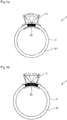
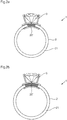
- the jewelery article according to the invention is a ring 1 comprising a closed or solid ring 2 on which can be mounted for example a decorative element 3.
- the ring 2 comprises at least a first portion 20 made of a memory alloy of form (AMF).
- the second portion 21 of the ring 2 can be made of any suitable material and is connected to the first portion 20 by any known and appropriate means to form the ring 2.
- the decorative element 3 is mounted on the ring 2 so as to cover said at least a first portion 20 of the AMF ring 2.
- the person skilled in the art can obviously place the decorative element 3 or the first portion 20 in AMF differently, depending on the aesthetic or technical constraints of the article of jewelery.
- the first portion 20 'of the ring 2 is not a solid portion of shape memory alloy but has a so-called "lattice" AMF structure or spring.
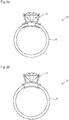
- the ring 10 comprises a ring 4, 4 'entirely made of shape memory alloy.
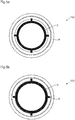
- ring 4 is open or split (and therefore has two ends) while in the variant of Figures 4a and 4b ring 4 'is closed or full.
- the ring 100 consists of a solid inner ring 5 made of alloy to shape memory and a decorative element 6 forming an outer ring and surrounding the inner ring 5.
- the decorative element 6 can also be movable with respect to the inner ring 5.
- the figures 1a , 2a , 3a , 4a and 5a illustrate the ring 1, 10, 100 in an initial size or first size A. Since this first size A, cooling the ring 1, 10, 100 at a temperature Tf less than Mf, the portion 20, 20 ', the ring 4, 4 'or the inner ring 5 changes phase to go into martensitic phase. It is then possible to deform the ring 1, 10, 100, and in particular the ring 2, 4, 4 ', or 5, by applying to it a stress at constant temperature to enlarge it and bring it to its second size. B illustrated in figures 1b , 2b , 3b , 4b and 5b .
- transition temperatures of the AMF chosen for the portion 20, 20 ', the ring 4, 4' or the inner ring 5 it is undesirable for the transition temperatures of the AMF chosen for the portion 20, 20 ', the ring 4, 4' or the inner ring 5 to be close to the temperatures encountered when the ring 1, 10, 100 is worn, and in particular body temperature. Indeed, the size of the ring 1, 10, 100 must be stable when worn, at the risk of losing (enlargement) or no longer able to remove (shrink).
- the shape-memory alloy used to produce the portion 20, 20 ', the ring 4, 4' or the inner ring 5 is thus chosen so that its temperature Af is greater than and sufficiently far from the temperatures encountered when the ring 1, 10, 100 is worn or body temperature of the wearer.
- the ring 1, 10, 100 worn in its second size B is not likely to return to its first size A simply heated by the body heat of the wearer.
- the selected shape-memory alloy therefore has a transition temperature ⁇ f greater than 80 ° C., even more preferably greater than 90 ° C.
- the shape memory alloy also has a temperature Af less than 650 ° C, more preferably less than 350 ° C. These temperatures make it possible to easily implement the change in size (basic heating system, no need for a specific oven) and to avoid deterioration of the jewelery article during the heating cycle (in particular for decorative surface coatings or the gemstones mounted on the jewelery item).
Landscapes
- Chemical & Material Sciences (AREA)
- Engineering & Computer Science (AREA)
- Materials Engineering (AREA)
- Manufacturing & Machinery (AREA)
- Mechanical Engineering (AREA)
- Metallurgy (AREA)
- Organic Chemistry (AREA)
- Physics & Mathematics (AREA)
- Thermal Sciences (AREA)
- Crystallography & Structural Chemistry (AREA)
- Adornments (AREA)
Applications Claiming Priority (1)
| Application Number | Priority Date | Filing Date | Title |
|---|---|---|---|
| CH6502018 | 2018-05-24 |
Publications (1)
| Publication Number | Publication Date |
|---|---|
| EP3572549A1 true EP3572549A1 (de) | 2019-11-27 |
Family
ID=62385951
Family Applications (1)
| Application Number | Title | Priority Date | Filing Date |
|---|---|---|---|
| EP19174829.2A Pending EP3572549A1 (de) | 2018-05-24 | 2019-05-16 | Schmuckartikel |
Country Status (1)
| Country | Link |
|---|---|
| EP (1) | EP3572549A1 (de) |
Citations (10)
| Publication number | Priority date | Publication date | Assignee | Title |
|---|---|---|---|---|
| EP0313070A2 (de) | 1987-10-23 | 1989-04-26 | The Furukawa Electric Co., Ltd. | Schmuckstück und Verfahren zu dessen Herstellung |
| GB2309372A (en) | 1996-01-26 | 1997-07-30 | Abbeycrest Plc | An automatically expandable finger ring made from a one piece stamping |
| EP1238600A1 (de) | 2001-03-08 | 2002-09-11 | Thierry Holemans | Eine Vorrichtung bestehend aus einer Gedächtnislegierung und aus einem Element, um das Hysteresis bei der Phasenumwandlung der Legierung zu reduzieren |
| EP1358814A1 (de) | 2002-05-01 | 2003-11-05 | Joel Fain | Einstückiger einstellbarer Ring |
| KR20090008240A (ko) | 2006-03-16 | 2009-01-21 | 테갈 코퍼레이션 | Mram 디바이스 구조체에서 전기적 단락을 제거하기 위한 건식 식각정지 방법 |
| KR20090008249A (ko) | 2006-04-21 | 2009-01-21 | 프리스케일 세미컨덕터, 인크. | 스트레서 통합 및 그 방법 |
| KR20090008240U (ko) * | 2008-02-13 | 2009-08-18 | (주)에스엠에이 | 장신용 반지 |
| FR2936686A1 (fr) | 2008-10-02 | 2010-04-09 | Alain Hautcoeur | Bijou sans fermoir en alliage a memoire de forme |
| EP2682017A1 (de) | 2012-07-03 | 2014-01-08 | D'Orica S.r.l. | Multizweck Montage mit variablen Konfiguration |
| EP3040790A1 (de) | 2014-12-29 | 2016-07-06 | Montres Breguet S.A. | Uhr oder Schmuckgegenstand aus einer leichten hochwertigen Legierung auf Titanbasis |
-
2019
- 2019-05-16 EP EP19174829.2A patent/EP3572549A1/de active Pending
Patent Citations (10)
| Publication number | Priority date | Publication date | Assignee | Title |
|---|---|---|---|---|
| EP0313070A2 (de) | 1987-10-23 | 1989-04-26 | The Furukawa Electric Co., Ltd. | Schmuckstück und Verfahren zu dessen Herstellung |
| GB2309372A (en) | 1996-01-26 | 1997-07-30 | Abbeycrest Plc | An automatically expandable finger ring made from a one piece stamping |
| EP1238600A1 (de) | 2001-03-08 | 2002-09-11 | Thierry Holemans | Eine Vorrichtung bestehend aus einer Gedächtnislegierung und aus einem Element, um das Hysteresis bei der Phasenumwandlung der Legierung zu reduzieren |
| EP1358814A1 (de) | 2002-05-01 | 2003-11-05 | Joel Fain | Einstückiger einstellbarer Ring |
| KR20090008240A (ko) | 2006-03-16 | 2009-01-21 | 테갈 코퍼레이션 | Mram 디바이스 구조체에서 전기적 단락을 제거하기 위한 건식 식각정지 방법 |
| KR20090008249A (ko) | 2006-04-21 | 2009-01-21 | 프리스케일 세미컨덕터, 인크. | 스트레서 통합 및 그 방법 |
| KR20090008240U (ko) * | 2008-02-13 | 2009-08-18 | (주)에스엠에이 | 장신용 반지 |
| FR2936686A1 (fr) | 2008-10-02 | 2010-04-09 | Alain Hautcoeur | Bijou sans fermoir en alliage a memoire de forme |
| EP2682017A1 (de) | 2012-07-03 | 2014-01-08 | D'Orica S.r.l. | Multizweck Montage mit variablen Konfiguration |
| EP3040790A1 (de) | 2014-12-29 | 2016-07-06 | Montres Breguet S.A. | Uhr oder Schmuckgegenstand aus einer leichten hochwertigen Legierung auf Titanbasis |
Non-Patent Citations (1)
| Title |
|---|
| BUENCONSEJO PIO JOHN S ET AL: "New Au-Cu-Al thin film shape memory alloys with tunable functional properties and high thermal s", ACTA MATERIALIA, ELSEVIER, OXFORD, GB, vol. 85, 7 January 2015 (2015-01-07), pages 378 - 386, XP029126036, ISSN: 1359-6454, DOI: 10.1016/J.ACTAMAT.2014.11.035 * |
Similar Documents
| Publication | Publication Date | Title |
|---|---|---|
| EP1286606B1 (de) | Schmuck vorrichtung | |
| CN101128133B (zh) | 可调节尺寸的珠宝 | |
| US2242544A (en) | Finger ring | |
| EP1715771B1 (de) | Armbanduhrgehäuse mit einer bandschnalle | |
| EP0807276B1 (de) | Metallisches brillengestell | |
| US8944301B2 (en) | Article carrier for supporting multiple articles around a neck of a wearer | |
| EP3675682B1 (de) | Regelungssystem für ringe | |
| CN101795595A (zh) | 可调尺寸的首饰 | |
| EP3572549A1 (de) | Schmuckartikel | |
| FR2936686A1 (fr) | Bijou sans fermoir en alliage a memoire de forme | |
| WO2021099332A1 (fr) | Article de bijouterie comprenant un fermoir | |
| CH715040B1 (fr) | Article de joaillerie, d'horlogerie ou de maroquinerie. | |
| US20110061426A1 (en) | Jewelry made out of iridium and method of making jewelry out of iridium | |
| EP1133935A1 (de) | Armbanduhr und Armband auf welches die Armbanduhr montiert werden kann | |
| CH708418A2 (fr) | Elément d'habillage pour pièce d'horlogerie comprenant une coiffe en verre métallique. | |
| EP2835698A1 (de) | Verkleidungselement mit Schutzhaube aus metallischem Glas | |
| US10912355B2 (en) | Jewelry that reversibly transitions between two different configurations | |
| FR2979199A1 (fr) | Procede pour la fabrication d'un bijou et bijou obtenu par un tel procede | |
| EP4442151B1 (de) | Schmuckstück mit schwenkbarem dekor | |
| JP3198567U (ja) | ブレスレット | |
| CH721941A1 (fr) | Piece de bijouterie ou de joaillerie avec decor interchangeable | |
| FR2947700A3 (fr) | Parure de front ou collier de tete, collier de front, bijoux de front, bijoux de tete | |
| CH716918A2 (fr) | Chaton pour le sertissage, d'un élément décoratif. | |
| WO2006085133A1 (fr) | Article de joaillerie modulable | |
| EP3387942A1 (de) | Schmuckartikel |
Legal Events
| Date | Code | Title | Description |
|---|---|---|---|
| PUAI | Public reference made under article 153(3) epc to a published international application that has entered the european phase |
Free format text: ORIGINAL CODE: 0009012 |
|
| STAA | Information on the status of an ep patent application or granted ep patent |
Free format text: STATUS: THE APPLICATION HAS BEEN PUBLISHED |
|
| AK | Designated contracting states |
Kind code of ref document: A1 Designated state(s): AL AT BE BG CH CY CZ DE DK EE ES FI FR GB GR HR HU IE IS IT LI LT LU LV MC MK MT NL NO PL PT RO RS SE SI SK SM TR |
|
| AX | Request for extension of the european patent |
Extension state: BA ME |
|
| RIN1 | Information on inventor provided before grant (corrected) |
Inventor name: COLAS, DAMIEN Inventor name: HERRERA, BRUNO |
|
| STAA | Information on the status of an ep patent application or granted ep patent |
Free format text: STATUS: REQUEST FOR EXAMINATION WAS MADE |
|
| 17P | Request for examination filed |
Effective date: 20200422 |
|
| RBV | Designated contracting states (corrected) |
Designated state(s): AL AT BE BG CH CY CZ DE DK EE ES FI FR GB GR HR HU IE IS IT LI LT LU LV MC MK MT NL NO PL PT RO RS SE SI SK SM TR |
|
| STAA | Information on the status of an ep patent application or granted ep patent |
Free format text: STATUS: EXAMINATION IS IN PROGRESS |
|
| 17Q | First examination report despatched |
Effective date: 20220804 |