EP3572983A1 - Architecture basée sur un réseau neuronal de faibles dimensions - Google Patents
Architecture basée sur un réseau neuronal de faibles dimensions Download PDFInfo
- Publication number
- EP3572983A1 EP3572983A1 EP18305625.8A EP18305625A EP3572983A1 EP 3572983 A1 EP3572983 A1 EP 3572983A1 EP 18305625 A EP18305625 A EP 18305625A EP 3572983 A1 EP3572983 A1 EP 3572983A1
- Authority
- EP
- European Patent Office
- Prior art keywords
- electronic device
- task
- perform
- low
- level feature
- Prior art date
- Legal status (The legal status is an assumption and is not a legal conclusion. Google has not performed a legal analysis and makes no representation as to the accuracy of the status listed.)
- Withdrawn
Links
Images

Classifications
-
- G—PHYSICS
- G06—COMPUTING OR CALCULATING; COUNTING
- G06N—COMPUTING ARRANGEMENTS BASED ON SPECIFIC COMPUTATIONAL MODELS
- G06N3/00—Computing arrangements based on biological models
- G06N3/02—Neural networks
- G06N3/04—Architecture, e.g. interconnection topology
- G06N3/045—Combinations of networks
-
- G—PHYSICS
- G06—COMPUTING OR CALCULATING; COUNTING
- G06N—COMPUTING ARRANGEMENTS BASED ON SPECIFIC COMPUTATIONAL MODELS
- G06N3/00—Computing arrangements based on biological models
- G06N3/02—Neural networks
- G06N3/04—Architecture, e.g. interconnection topology
- G06N3/0464—Convolutional networks [CNN, ConvNet]
-
- G—PHYSICS
- G06—COMPUTING OR CALCULATING; COUNTING
- G06N—COMPUTING ARRANGEMENTS BASED ON SPECIFIC COMPUTATIONAL MODELS
- G06N3/00—Computing arrangements based on biological models
- G06N3/02—Neural networks
- G06N3/08—Learning methods
- G06N3/09—Supervised learning
Definitions
- the present disclosure relates to the field of artificial neural networks. More particularly, the present disclosure relates to an electronic device comprising at least one neural network trained to perform a specific task.
- Deep neural networks have made significant advances in the recent past in solving a variety of difficult problems. Deep neural networks typically exhibit a standard architecture, whereby a number of layers of neurons follow each other to eventually produce an output.
- a neural network is configured to perform a specific application, such as pattern recognition or data classification, through a learning process. To this end, some weights of the neural network are adjusted during a training phase. More particularly, during this training phase, one typically uses a loss to compare a generated output with a user-supplied ground-truth (supervised learning) or an automatically generated “ground truth” (unsupervised learning). This loss is then used to update the weights associated with all nodes of the neural network, using back-propagation algorithm, so that the error between the desired output and the actual output is reduced.
- supervised learning user-supplied ground-truth
- unsupervised learning unsupervised learning
- the weights in the network are adjusted so that the generated output matches the ground-truth as well as possible in most cases.
- the neural network can be used to solve the specific task for which it was trained, i.e. it will produce outputs consistent with the training examples previously seen, even for inputs that were not part of the training.
- a disadvantage of deep learning is that a very large amount of data is necessary to train a neural network in such a way that it can satisfactorily fulfil the task it is intended to solve.
- One cause for the need of such large quantities of data is that the network is operating in a high-dimensional space. In other words, the neural network has to learn everything that is necessary to accomplish a task in one go.
- training a high-dimensional neural network and using such a network to perform a task both require substantial computational power.
- an electronic device configured to perform a specific task as a function of input data.
- Such an electronic device comprises:
- the pre-processing unit makes it possible to use a smaller neural network as a task-specific network, since some generic tasks consisting of detecting low-level features have already been performed at the pre-processing unit.
- the task-specific network may thus be considered as a low-dimensional neural network, when its dimensions are compared with those of a neural network trained to perform the same specific task within a conventional architecture comprising only a neural network processing unit and no pre-processing unit.
- the amount of data and the computational power required to train such a low-dimensional task-specific neural network may thus be reduced, as well as the computational power needed to perform the whole specific task from the input data.
- a set of low-level feature detectors is selectively parameterized in a memory of said electronic device as a function of said specific task.
- the plurality of available feature detectors forms a kind of toolbox, in which some feature detectors may be preferentially selected to provide the intermediate data, depending on the specific task to be performed.
- At least some of said at least one low-level feature detector are connected according to a connection scheme.
- low-level feature detectors can be used alone in the pre-processing unit, or they can be cascaded to form more complex feature detectors.
- connection scheme comprises connecting at least two low-level feature detectors in series, in parallel, or in a combination of series and parallel.
- connection scheme is defined as a function of said specific task.
- the feature detectors may be combined so as to perform upper-level generic tasks likely to provide intermediate data that are best adapted to feed a neural network to perform this specific task.
- said at least one low-level feature detector is defined by a rule comprising at least one predetermined weight and/or at least one trainable weight.
- a low-level feature detector may be fully determined (i.e. the associated rule comprises only the predetermined weight(s), and no trainable weights), or only partially determined (i.e. the associated rule comprises at least one trainable weight).
- said at least one low-level feature detector is a neural network.
- said at least one low-level feature detector is trained to perform said generic tasks prior to and independent of the training of said task-specific network to perform said specific task.
- the feature detectors themselves are some small neural networks that are pre-trained independently of the specific task to be performed.
- a plurality of feature detectors may thus be designed, trained and gathered so as to form a kind of toolbox, whose elements are usable and reusable to form adapted pre-processing units used to provide intermediate data to some task-specific networks.
- said specific task is a gesture recognition task.
- said generic tasks belong to the group comprising:
- the present disclosure also concerns a method for performing a specific task as a function of input data.
- a method is implemented by an electronic device, and comprises:
- providing intermediate data comprises selectively parameterizing a set of low-level feature detectors among said at least one low-level feature detector, as a function of said specific task.
- providing intermediate data comprises connecting at least some of said at least one low-level feature detector according to a connection scheme, said connection scheme being defined as a function of said specific task.
- said at least one low-level feature detector is a neural network and said method further comprises training said at least one low-level feature detector to perform said generic tasks prior to and independent of the training of said task-specific network to perform said specific task.
- the present disclosure also concerns a computer program product downloadable from a communication network and/or recorded on a medium readable by a computer and/or executable by a processor, comprising program code instructions for implementing the method as described above.
- the present disclosure also concerns a non-transitory computer-readable medium comprising a computer program product recorded thereon and capable of being run by a processor, including program code instructions for implementing the method as described above.
- Such a computer program may be stored on a computer readable storage medium.
- a computer readable storage medium as used herein is considered a non-transitory storage medium given the inherent capability to store the information therein as well as the inherent capability to provide retrieval of the information therefrom.
- a computer readable storage medium can be, for example, but is not limited to, an electronic, magnetic, optical, electromagnetic, infrared, or semiconductor system, apparatus, or device, or any suitable combination of the foregoing.
- references in the specification to "one embodiment” or “an embodiment”, indicate that the embodiment described may include a particular feature, structure, or characteristic, but every embodiment may not necessarily include the particular feature, structure, or characteristic. Moreover, such phrases are not necessarily referring to the same embodiment. Further, when a particular feature, structure, or characteristic is described in connection with an embodiment, it is submitted that it is within the knowledge of one skilled in the art to affect such feature, structure, or characteristic in connection with other embodiments whether or not explicitly described.
- the general principle of the present disclosure relies on particular neuron network based architecture, allowing an electronic device to perform a specific task.
- the electronic device comprises a neural network processing unit formed by at least one neural network, called a task-specific network, trained to perform said specific task. It is proposed, in one aspect of the present disclosure, to place a pre-processing unit in front of the neural network processing unit. As it is described hereafter with reference to the accompanying figures, this pre-processing unit is designed so as to allow, to some extent, unloading the task-specific network of at least a part of its learning load. As shown below, this offers many direct and indirect benefits.
- the task-specific network used to perform the specific task may be of lower dimensions (in terms of number of layers and/or number of neurons) than if a neural network was used within conventional neuron network based architecture, i.e. with no pre-processing unit.
- the time and/or amount of data and/or the computational power required to train the task-specific network to perform the specific task may also be reduced, as well as the computational power needed to perform the whole specific task from some input data.
- the whole specific task may also be parallelized, which also speeds up the overall process.
- the electronic device ED comprises a pre-processing unit PPU and a neural network processing unit NNU, and it is (dynamically or not) configured to perform a specific task ST as a function of input data ID. More particularly, the specific task ST is performed by the neural network processing unit NNU, as a function of intermediate data IntD provided by the pre-processing unit PPU from the input data ID.
- the neural network processing unit NNU comprises at least one neural network, called a task-specific network TSN, trained to perform said specific task ST as a function of said intermediate data IntD.
- the pre-processing unit is in charge of providing the intermediate data IntD, from input data ID of the electronic device.
- the pre-processing unit PPU comprises at least one low-level feature detector FD 1 , ..., FD n .
- a low-level feature detector may be defined as a predetermined module that is, alone or in combination with other feature detectors, configured to perform some generic tasks GT 1 , ..., GT m independent from the specific task ST to be performed by the electronic device ED.
- Such generic tasks comprise detecting given basic pattern in the input data.
- Some examples of low-level feature detectors are described later in the document, in relation with an illustrative embodiment.
- At least some of the various outputs of the low-level feature detectors - i.e. the results of the accomplishment of the various generic tasks by the low-level feature detectors - form the intermediate data IntD that are used as an input of the neural network processing unit NNU.
- the generic tasks are considered as "independent" from the specific task in the sense that they are not inextricably linked to a given specific task.
- a given feature detector configured to perform a given generic task may be used in many different settings, to provide intermediate data to various neural network processing units trained (and/or configured) to perform very different specific tasks.
- the proposed technique makes it possible to design in advance (i.e. without taking any specific task into consideration) a plurality of predefined low-level feature detectors, thus forming a kind of toolbox gathering a set of available feature detectors that may be then deployed and used within a pre-processing unit according to the disclosure.
- a set of low-level feature detectors is selectively parameterized in a memory of the electronic device, among the available low-level feature detectors FD1, ..., FDn, as a function of the specific task ST to perform.
- some feature detectors may be preferentially selected among the whole set of available feature detectors, to provide the intermediate data.
- a feature detector performing the generic task of detecting concentric circles in an image may be preferentially selected among available feature detectors, when the specific task to be performed by the task-specific network is a face recognition task.
- some studies tend to show that a visual area performing concentric circles detection would be activated in the human brain when it performs face recognition, and it is known that the way artificial neural networks process information is inspired by the way biological nervous systems, such as the brain, does: a concentric circles feature detector is thus likely to provide well-adapted intermediate data to a task-specific network implemented to perform face recognition.
- some low-level feature detectors may be connected within the pre-processing unit, so as to form more complex feature detectors. More particularly, feature detectors may be connected according to a connection scheme, comprising connecting at least two low-level feature detectors in series, in parallel, or in a combination of series and parallel. In one embodiment, this connection scheme is defined as a function of the specific task to be performed by said electronic device.
- low-level feature detectors act as elementary bricks that can be selected and then used alone or cascaded to form more complex feature detectors, thus providing great flexibility and modularity allowing designing a pre-processing unit that is particularly suitable to be placed in front of a given task-specific network.
- low-level feature detectors FD 1 to FD n form a toolbox of available feature detectors, among which feature detectors FD 1 , FD 2 , FD 3 , FD 5 have been more particularly selected and connected so as to provide intermediate data that are likely to be well-adapted to the accomplishment of specific task ST by the task-specific network TSN.
- a low-level feature detector is defined by a rule comprising at least one predetermined weight and/or at least one trainable weight.
- a low-level feature detector may thus be fully determined (i.e. the associated rule comprises only predetermined weights, and no trainable weights), or only partially determined (i.e. the associated rule comprises at least one trainable weight).
- trainable weights within the rule offers some flexibility regarding other aspects that are related to, but that do not affect, this overall framework.
- a rule implemented so as to allow performing the generic task of detecting triangle patterns within an image may include a trainable weight allowing to detect, from a training set, a particular contrast level between identified triangles and neighbouring pixels in the image.
- the low-level feature detectors are themselves neural networks.
- the proposed technique then consists of splitting a large conventional neural network into smaller neural networks, with:
- the feature detectors since the feature detectors perform some generic tasks that are independent from the specific task to be accomplished by the electronic device, they can be trained to perform said generic tasks prior to and independent of the training of said task-specific network to perform said specific task.
- some weights associated with these low-level feature detectors may be adjusted by training, before deploying the low-level feature detectors in a pre-processing unit of an electronic device, and independently of the specific task to be performed by this electronic device.
- a generic low-level feature detector may be augmented with a small number of weights that can be trained in the context of, and along with, the task specific network.
- the low-level feature detector can be partially adapted to the specific task, while requiring only very few weights to be trained, thus allowing providing an advantageous trade-off between the cost of training and adaptability to the specific task to be performed.
- a low-level feature detector may be predefined to be a line detector, but may also incorporate a single trainable weight that determines its sensitivity to contrast.
- the line detector may still be trained to be sensitive only to lines of a certain limited range of contrasts.
- the number of weights to be trained is significantly smaller than the number of weights that would have to be trained if a neural network would need to learn to detect lines, but the low-level feature detector still retains a certain degree of flexibility allowing it to better adapt to the specific task to be performed by the task-specific network.
- FIG. 2 a flow chart illustrating a method for performing a specific task is presented, according to an embodiment of the present disclosure. This method is implemented by an electronic device as described above.
- some intermediate data IntD are provided by the pre-processing unit PPU of the electronic device. More particularly, the intermediate data IntD are provided by at least one low-level feature detector FD 1 , ..., FD n of said pre-processing unit PPU configured so as to perform, from said input data ID, generic tasks GT 1 , ..., GT m independent from said specific task ST.
- step 21 for providing intermediate data may comprise selectively parameterizing a set of low-level feature detectors among the at least one low-level feature detector FD 1 , ..., FD n , as a function of said specific task ST to be performed by said electronic device.
- step 21 for providing intermediate data may also comprise connecting at least some of said at least one low-level feature detector FD 1 , ..., FD n according to a connection scheme, the connection scheme being defined as a function of said specific task ST to be performed by said electronic device.
- the specific task ST is performed at the neural processing unit NNU of the electronic device.
- the intermediate data provided by the pre-processing unit PPU are used as input of at least one neural network, called a task-specific network TSN, trained to perform said specific task ST.
- feature detectors FD 1 , ..., FD n are neural networks and the method for performing the specific task ST further comprises training the low-level feature detectors FD 1 , ..., FD n to perform generic tasks GT 1 , ..., GT m prior to and independent of the training of said task-specific network TSN to perform said specific task ST.
- the input data may be any form of data.
- deep neural networks can be trained for many different specific visual tasks, such as, for example, classification, localization, detection or segmentation tasks, or tasks that take an image as input and produce another image as output (e.g. style transfer or color transfer tasks).
- specific visual tasks such as classification, localization, detection or segmentation tasks, or tasks that take an image as input and produce another image as output (e.g. style transfer or color transfer tasks).
- features e.g., classification, localization, detection or segmentation tasks, or tasks that take an image as input and produce another image as output (e.g. style transfer or color transfer tasks).
- features that respond to very basic shapes such as lines, edge, color opponency, Gabor patterns, etc.
- Such a toolbox may comprise, but is of course not limited to, low-level feature detectors configured to perform generic tasks such as line segment detection, "T" shape detection, color-opponent detection, sine gratings detection, Gabor patches detection, etc.
- Some of these low-level feature detectors may then be deployed in a pre-processing unit, to provide intermediate data that are used afterwards to feed a task-specific network, notably for training it in a first phase.
- the task-specific network may be, to some extent, relieved of the load to learn these features from a training set.
- the amount of data needed to train the task-specific network may be reduced, as well as the size (in terms of number of layers and/or neurons) of the task-specific network.
- the low-level feature detectors may be implemented under several forms.
- Basic feature detectors can for example be obtained by simply applying a convolution between a convolution matrix, also referred to as a kernel, and an input image.
- a convolution matrix also referred to as a kernel
- the detection of various basic patterns may be performed.
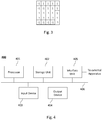
- a triangle detector may be defined by using a kernel such as the one shown in relation with figure 3 .
- the triangle detector is fully determined, since the kernel weights are set in advance and remain unchanged.
- Other applications may require combining some feature detectors to build more complex feature detectors.
- the feature detectors can themselves take the form of neural networks, with weights to update (according to a particular feature of this embodiment, a plurality of feature detectors may also be gathered within layers of a same neural network). Examples of such low-level feature detectors are given in the following.
- a feature detector is composed of n layers of k i neurons, where i is the number of the layer.
- the layers are assumed to be 'retinotopic', i.e. that spatial coordinates of neurons in a given layer correspond to pixel locations in the image.
- a given neuron is then indicated by A ( x,y,i ) , x and y being the spatial coordinates of the neuron in layer i .
- neurons take input from a subset of the neurons in the preceding layer, thereby maintaining retinotopy.
- the inputs from neuron A ( x,y,i ) come from neurons located within a radius of r of location ( x,y ) in layer i - 1.
- These inputs are normally weighted, summed and then passed into an activation function, to produce an output that can be passed to neurons in layer i + 1.
- the outputs of neurons in layer i - 1 located within a radius of r 1 of location ( x , y ) may be given positive weights, while the neurons in layer i - 1 located within a radius between r 1 and r 2 of location ( x,y ) may be given negative weights.
- Such a center-surround mechanism may serve afterwards to build many higher-level detection tasks, including edge detection, line detection, "T"-junction detection, motion detection, etc.
- a line detector may then be constructed by connecting another feature detector to the previously described center-surround feature detector.
- a line detection neuron A x,y,i
- a line detection neuron A may take as input, and sum, center-surround outputs at locations x - g to x + g.
- Such a connection allows detecting a line segment of length 2 g centered at location x .
- Other shapes such as corners, "T"-junctions and curves may be constructed by changing the connections.
- a line motion detector may be constructed by connecting the line detector previously described to a motion detector.
- a vertical motion detection neuron may take as input outputs of a horizontal line detector.
- a temporal dimension may be introduced, thus characterizing a neuron as A ( x,y,i,t ) .
- these neural network low-level feature detectors may be trained, by updating some weights of the network according to standard back-propagation methods, possibly with the aid of an Adam-like scheme to take into account previous activations.
- a complete neural learning system may be defined as a composition of a number of simple and possibly pre-trained neural networks that perform generic tasks, followed by at least one task-specific neural network that takes the output of the preceding simple networks to accomplish a given specific task.
- the proposed architecture with a pre-processing unit makes it possible to use a smaller neural network as a task-specific network.
- some generic tasks consisting of detecting low-level features have already been performed at the pre-processing unit, thus allowing, to some extent, unloading the task-specific network of at least a part of its learning load.
- the amount of data and the computational power required to train the neural network are then reduced, allowing performing the training of the task-specific network locally instead of using high computational power solutions such as architectures involving cloud-computing for example.
- the training can be performed within a consumer device having low computational power, such as a set-top box or a television.
- local learning has some advantages. For example, locally learned behaviours can be more specific to the users themselves: a voice recognition system that is trained inside a local device will be able to adapt to its users' specific accents better than a cloud-based system that gets data from all users. Local learning also makes it possible to avoid privacy issues.
- the proposed technique allows implementing an improved gesture recognition system for television remote control.
- Gesture recognition generally provides a genuinely new and useful user input mechanism, which offers a significant benefit for users of televisions. Indeed, it enables remote control of televisions as well as interaction with applications running on televisions without the use of hardware input devices such as mice, keyboards or remote control devices.
- Gesture recognition requires robust and efficient recognition and tracking of hand positions, followed by recognition of a gesture.
- the methods used to perform such hand tracking and gesture recognition have to be as efficient as possible so that the user experience is optimal.
- the proposed technique precisely makes it possible to improve hand tracking and gesture recognition efficiency since it allows, for the reasons already presented above, to perform the training locally, directly on a television or a set-top box. This enables significant progress, since it makes it possible to perform customized learning, including:
- local learning provides independence from cloud computing: the data generated by the television are processed locally, and there is no need to communicate them to online cloud servers. This makes it possible to perform any adaptability locally, in the television or the set-top box itself, which is of great interest especially at a time when online privacy is a growing concern.
- Figure 4 shows a schematic block diagram illustrating an example of an apparatus 400 for performing gesture recognition as a specific task, according to an embodiment of the present disclosure.
- Such an apparatus may be embedded in a consumer device, a television device or a set-top box for example. In another embodiment, it may be an external apparatus connected to a television device or to a set-top box.
- the apparatus 400 includes a processor 401, a storage unit 402, an input device 403, an output device 404, and an interface unit 405 which are connected by a bus 406.
- a processor 401 a storage unit 402, an input device 403, an output device 404, and an interface unit 405 which are connected by a bus 406.
- constituent elements of the computer apparatus 400 may be connected by a connection other than a bus connection using the bus 406.
- the processor 401 controls operations of the apparatus 400.
- the storage unit 402 stores at least one program to be executed by the processor 401, and various data, including for example low-level feature detectors and task-specific network settings such as weights associated with the neural networks and low-level feature detectors connection scheme, parameters used by computations performed by the processor 401, intermediate data of computations performed by the processor 401 such as intermediate data to provide to the task-specific network, and so on.
- the processor 401 is formed by any known and suitable hardware, or software, or a combination of hardware and software.
- the processor 401 is formed by dedicated hardware such as a processing circuit, or by a programmable processing unit such as a CPU (Central Processing Unit) that executes a program stored in a memory thereof.
- CPU Central Processing Unit
- the storage unit 402 is formed by any suitable storage or means capable of storing the program, data, or the like in a computer-readable manner. Examples of the storage unit 402 include non-transitory computer-readable storage media such as semiconductor memory devices, and magnetic, optical, or magneto-optical recording media loaded into a read and write unit.
- the program causes the processor 401 to perform a method for performing gesture recognition as a function of input data according to an embodiment of the present disclosure as described previously. More particularly, the program causes the processor 401 to compute, from said input data, intermediate data to provide to a task-specific network trained to perform the specific task, so that the specific task may be performed.
- the input device 403 is formed for example by an image-capturing device, such as a camera.
- the output device 404 is formed for example by a processing unit configured to make decision as a function of recognized gesture.
- the interface unit 405 provides an interface between the apparatus 400 and an external apparatus.
- the interface unit 405 may be communicable with the external apparatus via cable or wireless communication.
- an external apparatus may be such a set-top box or a television.
- processor 401 may comprise different modules and units embodying the functions carried out by apparatus 400 according to embodiments of the present disclosure, such as the unit previously described in relation with figure 1 :
- modules and units may also be embodied in several processors 401 communicating and co-operating with each other.
Landscapes
- Engineering & Computer Science (AREA)
- Theoretical Computer Science (AREA)
- Physics & Mathematics (AREA)
- Data Mining & Analysis (AREA)
- General Health & Medical Sciences (AREA)
- Biomedical Technology (AREA)
- Biophysics (AREA)
- Computational Linguistics (AREA)
- Life Sciences & Earth Sciences (AREA)
- Evolutionary Computation (AREA)
- Artificial Intelligence (AREA)
- Molecular Biology (AREA)
- Computing Systems (AREA)
- General Engineering & Computer Science (AREA)
- General Physics & Mathematics (AREA)
- Mathematical Physics (AREA)
- Software Systems (AREA)
- Health & Medical Sciences (AREA)
- Image Analysis (AREA)
Priority Applications (1)
| Application Number | Priority Date | Filing Date | Title |
|---|---|---|---|
| EP18305625.8A EP3572983A1 (fr) | 2018-05-22 | 2018-05-22 | Architecture basée sur un réseau neuronal de faibles dimensions |
Applications Claiming Priority (1)
| Application Number | Priority Date | Filing Date | Title |
|---|---|---|---|
| EP18305625.8A EP3572983A1 (fr) | 2018-05-22 | 2018-05-22 | Architecture basée sur un réseau neuronal de faibles dimensions |
Publications (1)
| Publication Number | Publication Date |
|---|---|
| EP3572983A1 true EP3572983A1 (fr) | 2019-11-27 |
Family
ID=62386324
Family Applications (1)
| Application Number | Title | Priority Date | Filing Date |
|---|---|---|---|
| EP18305625.8A Withdrawn EP3572983A1 (fr) | 2018-05-22 | 2018-05-22 | Architecture basée sur un réseau neuronal de faibles dimensions |
Country Status (1)
| Country | Link |
|---|---|
| EP (1) | EP3572983A1 (fr) |
Cited By (2)
| Publication number | Priority date | Publication date | Assignee | Title |
|---|---|---|---|---|
| US20220180744A1 (en) * | 2020-12-09 | 2022-06-09 | Beijing Didi Infinity Technology And Development Co., Ltd. | System and method for task control based on bayesian meta-reinforcement learning |
| US20240217091A1 (en) * | 2019-12-17 | 2024-07-04 | Google Llc | Shared Dense Network with Robot Task-Specific Heads |
Citations (2)
| Publication number | Priority date | Publication date | Assignee | Title |
|---|---|---|---|---|
| EP3035246A2 (fr) * | 2014-12-15 | 2016-06-22 | Samsung Electronics Co., Ltd | Procédé et appareil de reconnaissance d'image, procédé et appareil de vérification d'image, procédé et appareil d'apprentissage pour reconnaître une image et procédé et appareil d'apprentissage pour vérifier une image |
| CN107977706A (zh) * | 2017-08-09 | 2018-05-01 | 小蚁科技(香港)有限公司 | 模块化分布式人工神经网络 |
-
2018
- 2018-05-22 EP EP18305625.8A patent/EP3572983A1/fr not_active Withdrawn
Patent Citations (2)
| Publication number | Priority date | Publication date | Assignee | Title |
|---|---|---|---|---|
| EP3035246A2 (fr) * | 2014-12-15 | 2016-06-22 | Samsung Electronics Co., Ltd | Procédé et appareil de reconnaissance d'image, procédé et appareil de vérification d'image, procédé et appareil d'apprentissage pour reconnaître une image et procédé et appareil d'apprentissage pour vérifier une image |
| CN107977706A (zh) * | 2017-08-09 | 2018-05-01 | 小蚁科技(香港)有限公司 | 模块化分布式人工神经网络 |
Non-Patent Citations (3)
| Title |
|---|
| HUOGEN WANG ET AL: "Large-Scale Multimodal Gesture Segmentation and Recognition Based on Convolutional Neural Networks", 2017 IEEE INTERNATIONAL CONFERENCE ON COMPUTER VISION WORKSHOPS (ICCVW), 2017, Venice, IT, pages 3138 - 3146, XP055526173, ISBN: 978-1-5386-1034-3, DOI: 10.1109/ICCVW.2017.371 * |
| JACOB ANDREAS ET AL: "Deep Compositional Question Answering with Neural Module Networks", 24 July 2017 (2017-07-24), XP055525240, Retrieved from the Internet <URL:https://arxiv.org/pdf/1511.02799.pdf> [retrieved on 20181120] * |
| LI JIAKUN ET AL: "Using Gabor filter in 3D convolutional neural networks for human action recognition", 2017 36TH CHINESE CONTROL CONFERENCE (CCC), TECHNICAL COMMITTEE ON CONTROL THEORY, CAA, 26 July 2017 (2017-07-26), pages 11139 - 11144, XP033150515, DOI: 10.23919/CHICC.2017.8029134 * |
Cited By (2)
| Publication number | Priority date | Publication date | Assignee | Title |
|---|---|---|---|---|
| US20240217091A1 (en) * | 2019-12-17 | 2024-07-04 | Google Llc | Shared Dense Network with Robot Task-Specific Heads |
| US20220180744A1 (en) * | 2020-12-09 | 2022-06-09 | Beijing Didi Infinity Technology And Development Co., Ltd. | System and method for task control based on bayesian meta-reinforcement learning |
Similar Documents
| Publication | Publication Date | Title |
|---|---|---|
| US11593586B2 (en) | Object recognition with reduced neural network weight precision | |
| US10628705B2 (en) | Combining convolution and deconvolution for object detection | |
| EP3289529B1 (fr) | Réduction de la résolution d'image dans des réseaux à convolution profonde | |
| KR102790307B1 (ko) | 콘볼루셔널 신경 네트워크들에서의 구조 학습 | |
| Hijazi et al. | Using convolutional neural networks for image recognition | |
| JP4532915B2 (ja) | パターン認識用学習方法、パターン認識用学習装置、画像入力装置、コンピュータプログラム、及びコンピュータ読み取り可能な記録媒体 | |
| Qian et al. | Deep learning for steganalysis via convolutional neural networks | |
| US20180157892A1 (en) | Eye detection method and apparatus | |
| EP3591581B1 (fr) | Procédé et appareil de construction de modèles d'images | |
| KR20170038622A (ko) | 영상으로부터 객체를 분할하는 방법 및 장치 | |
| Yamashita et al. | Hand posture recognition based on bottom-up structured deep convolutional neural network with curriculum learning | |
| Zheng et al. | A neural autoregressive approach to attention-based recognition | |
| US20150356350A1 (en) | unsupervised non-parametric multi-component image segmentation method | |
| JP7225731B2 (ja) | 多変数データシーケンスの画像化 | |
| Bezak | Building recognition system based on deep learning | |
| US20210150238A1 (en) | Methods and systems for evaluatng a face recognition system using a face mountable device | |
| EP3572983A1 (fr) | Architecture basée sur un réseau neuronal de faibles dimensions | |
| Lutsiv | Convolutional deep-learning artificial neural networks | |
| CN115062752B (zh) | 一种模型训练方法及装置 | |
| WO2018052496A1 (fr) | Procédé de détection d'objet dans une image et une vidéo numériques à l'aide de réseaux de neurones impulsionnels | |
| Daniels et al. | Efficient model adaptation for continual learning at the edge | |
| Khan et al. | Modeling the role of contour integration in visual inference | |
| JP7178323B2 (ja) | 学習装置、学習方法、および、学習プログラム | |
| Saeed et al. | Enhancing Surveillance with Machine and Deep Learning-Based Facial Recognition Model: A Proposed Approach for Identification | |
| Vukotic et al. | Convolutional neural networks for Croatian traffic signs recognition |
Legal Events
| Date | Code | Title | Description |
|---|---|---|---|
| PUAI | Public reference made under article 153(3) epc to a published international application that has entered the european phase |
Free format text: ORIGINAL CODE: 0009012 |
|
| AK | Designated contracting states |
Kind code of ref document: A1 Designated state(s): AL AT BE BG CH CY CZ DE DK EE ES FI FR GB GR HR HU IE IS IT LI LT LU LV MC MK MT NL NO PL PT RO RS SE SI SK SM TR |
|
| AX | Request for extension of the european patent |
Extension state: BA ME |
|
| STAA | Information on the status of an ep patent application or granted ep patent |
Free format text: STATUS: THE APPLICATION IS DEEMED TO BE WITHDRAWN |
|
| 18D | Application deemed to be withdrawn |
Effective date: 20200603 |