EP3573025A1 - Procédé et système pour générer automatiquement un visuel attrayant sur la base d'un visuel original capturé par une caméra montée sur un véhicule - Google Patents
Procédé et système pour générer automatiquement un visuel attrayant sur la base d'un visuel original capturé par une caméra montée sur un véhicule Download PDFInfo
- Publication number
- EP3573025A1 EP3573025A1 EP18173982.2A EP18173982A EP3573025A1 EP 3573025 A1 EP3573025 A1 EP 3573025A1 EP 18173982 A EP18173982 A EP 18173982A EP 3573025 A1 EP3573025 A1 EP 3573025A1
- Authority
- EP
- European Patent Office
- Prior art keywords
- visual
- vehicle
- visuals
- original
- captured
- Prior art date
- Legal status (The legal status is an assumption and is not a legal conclusion. Google has not performed a legal analysis and makes no representation as to the accuracy of the status listed.)
- Withdrawn
Links
Images

Classifications
-
- G—PHYSICS
- G06—COMPUTING OR CALCULATING; COUNTING
- G06T—IMAGE DATA PROCESSING OR GENERATION, IN GENERAL
- G06T11/00—Two-dimensional [2D] image generation
-
- G—PHYSICS
- G06—COMPUTING OR CALCULATING; COUNTING
- G06T—IMAGE DATA PROCESSING OR GENERATION, IN GENERAL
- G06T11/00—Two-dimensional [2D] image generation
- G06T11/60—Creating or editing images; Combining images with text
-
- G—PHYSICS
- G06—COMPUTING OR CALCULATING; COUNTING
- G06T—IMAGE DATA PROCESSING OR GENERATION, IN GENERAL
- G06T5/00—Image enhancement or restoration
- G06T5/60—Image enhancement or restoration using machine learning, e.g. neural networks
-
- G—PHYSICS
- G06—COMPUTING OR CALCULATING; COUNTING
- G06T—IMAGE DATA PROCESSING OR GENERATION, IN GENERAL
- G06T5/00—Image enhancement or restoration
- G06T5/80—Geometric correction
-
- G—PHYSICS
- G06—COMPUTING OR CALCULATING; COUNTING
- G06T—IMAGE DATA PROCESSING OR GENERATION, IN GENERAL
- G06T5/00—Image enhancement or restoration
- G06T5/90—Dynamic range modification of images or parts thereof
-
- G—PHYSICS
- G06—COMPUTING OR CALCULATING; COUNTING
- G06V—IMAGE OR VIDEO RECOGNITION OR UNDERSTANDING
- G06V30/00—Character recognition; Recognising digital ink; Document-oriented image-based pattern recognition
- G06V30/10—Character recognition
- G06V30/26—Techniques for post-processing, e.g. correcting the recognition result
- G06V30/262—Techniques for post-processing, e.g. correcting the recognition result using context analysis, e.g. lexical, syntactic or semantic context
- G06V30/274—Syntactic or semantic context, e.g. balancing
-
- G—PHYSICS
- G06—COMPUTING OR CALCULATING; COUNTING
- G06T—IMAGE DATA PROCESSING OR GENERATION, IN GENERAL
- G06T2207/00—Indexing scheme for image analysis or image enhancement
- G06T2207/20—Special algorithmic details
- G06T2207/20081—Training; Learning
-
- H—ELECTRICITY
- H04—ELECTRIC COMMUNICATION TECHNIQUE
- H04N—PICTORIAL COMMUNICATION, e.g. TELEVISION
- H04N23/00—Cameras or camera modules comprising electronic image sensors; Control thereof
- H04N23/50—Constructional details
- H04N23/54—Mounting of pick-up tubes, electronic image sensors, deviation or focusing coils
Definitions
- the invention regards a method and a corresponding system which is capable of automatically generating an appealing visual by improving an original visual that was captured by a vehicle mounted camera.
- the invention particularly uses cameras that are mounted on vehicles and intended for capturing images on the environment in order to analyze traffic situations in assistance systems.
- a system and method for automatically generating an appealing visual based on an original visual captured by a vehicle mounted camera is provided.
- an original visual is captured and recorded by the vehicle mounted camera.
- This original image is captured with a quality that is limited by the camera which is mounted on the vehicle but also on the current traffic situation that defines a viewing angle of the visual.
- the visual is captured out of the traffic situation which is encountered by the vehicle and its driver. Therefore, no specific settings can be made on the vehicle mounted camera so that any image that will be taken by the camera will use the settings which are optimized for the assistance system which relies on the visuals taken by the vehicle mounted camera.
- a camera specific for the purpose of generating visuals can be mounted as well on the vehicle.
- vehicle as used to define and describe the invention is not limited to road vehicles but may also comprise robotic devices.
- robotic devices could be (autonomous) lawn mowers or the like
- distortion that was generated by the perspective of the camera when capturing the original visual is rectified. Additionally or alternatively distortion that was caused directly by camera parameters is rectified. These distortions may for example be the consequence of a focal length of the camera used. In many cases a short focal length is required for a vehicle mounted camera in order to have an almost panoramic view of the environment of the vehicle which allows to gather much information on the traffic situation. Of course, on the other hand for appealing images it might be preferred to have an enlarged focal length.
- the rectification which is performed on the original image allows to have a basis for further processing of the image as almost neutral perspective for seamless information fusion.
- information is added to the rectified visual so the details and objects which are not captured by the vehicle mounted camera in the original visual are added to the visual to improve the content of the visual.
- the information that is added is taken from visuals captured by other sources.
- Such other sources may be for example vehicle mounted cameras of other vehicles which captured images of the same area.
- the added information could also be taken from visuals that had been made on other occasions.
- the camera that is mounted on that vehicle takes images with different content.
- such different content could be merged in order to achieve a single enhanced visual.
- parameters of the enhanced visual are optimized according to criteria of appeal.
- Such parameters might for example be a perspective of the visual but also existence of objects in the visual.
- the parameter set that was found to be the best is applied to the enhanced visual and thereafter post-processing is performed.
- post-processing a set of templates is used. Using such templates allows to adapt brightness, color saturation and other characteristics of an image to be improved and in particular to be adapted to user preferences.
- the capturing of a visual is triggered by an event.
- the event could be reaching a local time which was set in advance, occurrence of defined sensor anomalies and occurrence of audio events. If such trigger events are defined it is a great advantage that the driver of the vehicle is not confronted with splitting his concentration on driving but also on identifying a situation where he wants to capture an image. Thus, he can for example identify in advance a situation where he wants to take a picture.
- a local time as trigger event could be used in order to take a photograph during sunset without considering the current location of the vehicle.
- occurrence of defined sensor anomalies could be used to take a video in case of strong acceleration or the like. Audio events might be spoken words by a human or radio voice in the vehicle, or even external audio events like sounds of the traffic infrastructure or other traffic participants.
- the visuals are captured and recorded continuously and the original visual used for further processing is selected based on a method for automated semantic annotation of the continuously captured and recorded visuals.
- a method for automated semantic annotation algorithm similarity towards a set of traits is calculated.
- This approach is specifically useful, since the cameras that are mounted for use in an advanced driver assistance system usually continuously observe the environment of the vehicle and thus the original visual could be a single image taken out of the video recorded by the vehicle mounted camera. This even enables a later processing of the visuals, because at first all the visuals that are automatically taken are recorded in a memory which is also mounted in the system. The processing could then be deferred to a later point in time where a higher processing capability is available.
- Preferred traits to a visual from a plurality of automatically recorded and continuously recorded visuals could be specific words, categories, prepositions, number of words or similarity of words.
- the calculation of the similarity is computed not only based on a single trait but on a sum of single traits. This allows the combination of different aspects in order to select from the entirety of available visuals the one fitting best to a defined set of criteria.
- a post-processing step at least lighting, brightness, color saturation or white balance is adjusted.
- the plurality of these parameters could also be adjusted according to a pre-set user reference.
- the information that is added to the original visual is taken from at least one visual that is stored in the Internet in a database and/or a privately hosted database, advantageously.
- the information that is intended to be added to the original visual is computed by similarity of the visuals to the rectified visual component.
- the system is advantageously configured to communicate with a public database in the Internet or any database which is privately hosted but accessible, in order to access image databases to find corresponding images which could provide information to be added.
- These databases may be established independently from the inventive system and may be databases that are used by other persons to publish their images of videos. If the system is configured to autonomously search such databases, an enormous amount of images is available for adding information to the original image.
- capturing images is triggered by capturing the original image or selecting an original image.
- this infrastructure is also triggered to capture an image, this could even involve cameras that are connected to a smart city infrastructure but which are not directly elements of the smart city infrastructure.
- cameras mounted on vehicles which are driving through such smart city and which are connected to the smart city infrastructure could be indirectly triggered to capture an image.
- the optimization of geometric parameters comprises encoding a geometric parameter set in an optimization algorithm.
- the parameter set is then iteratively adapted and each parameter set is applied to the enhanced visual.
- the application of these parameter sets results in a set of resulting enhanced visuals.
- the parameter set potentially includes parameters which specify the image specifications of the enhanced visual. This includes besides height, width and coordinates of e.g. the upper left edge of the image also parameters utilized for changing the perspective of the image, for so-called image warps.
- warps are proposed to extend the capability for achieving optimal image quality criteria, the so-called traits. Objects in an image may in this way be aligned on specified relations.
- features like e.g. straight lines and associated vanishing points are defined and algorithms are applied to warp an initial image to a new one with adapted perspective and adapted compositions.
- Further controls are e.g. planar regions, line segments, line orientation, borders and fixed points.
- a realization of the image warp may be achieved by optimizing a transformation matrix based on the energy of each control term and applying the transformation on the image.
- the parameters for vanishing points, line segments, orientation etc. are encoded in the geometric parameter set of the optimization algorithm.
- resulting enhanced visuals are automatically annotated by applying a method for automated semantic annotation. Based on the annotated resulting enhanced visuals then a calculation of similarity of the annotation towards a set of traits can be performed. It is in particular preferred to use an evolutionary optimization algorithm for the optimization of the geometric parameters. It is further to be noted that the geometric parameters might even include a decision on whether an object needs to be added to the original image or not.
- Semantic image analysis targets the extraction of image description trying to match human perception.
- the results are e.g. used for image retrieval by searching large image databases for maximum correspondence in the description words.
- a realization may utilize image segmentation algorithms to detect subregions, e.g a multi-feature active contour segmentation for providing visual information to the system.
- This step is followed by a feature extraction and analysis step to learn an instance of a mathematical model, e.g. decision trees, artificial neural networks, or support vector machines among others.
- a mathematical model e.g. decision trees, artificial neural networks, or support vector machines among others.
- Such a process is applied to learn the model on large image data sets for achieving a high model accuracy and generalization capability, which is assessed on validation image data sets.
- the computationally costly learning step is carried out offline in advance.
- a proper model is then afterwards utilized in the proposed invention potentially in the image selection process an in the parameter optimization step.
- the set of templates is defined by a set of preferences for the adaptation of visuals.
- the set of preferences are preferred user preferences for settings for brightness, contrast, color saturation and/or lighting.
- the set of preferences are provided by a machine learning algorithm trained on categories of images from databases or movies.
- said set of preferences are settings for a triangulated mesh of said vehicle which is rendered using a computational texture of the vehicle, and integrating said rendered vehicle into said optimized visual. This approach enables to generate some kind of vehicle selfie, even although the camera is firmly mounted on the vehicle.
- the vehicle can be added to the image which has already been improved.
- Such triangulated mesh which is used to insert an image of the vehicle into the enhanced visual can advantageously be provided by the vehicle maker.
- the triangulated mesh is then stored in the system and is available for integration into an enhanced visual before the visual is finalized.
- the computational texture can also be provided by the vehicle maker and be stored in the system for executing the method.
- figure 1 next to the flowchart showing the method with each process step there is shown a series of pictograms visualizing the effect on the original visual.
- an original visual needs to be determined based on which the present invention is executed.
- One easy way to determine such original visual is capturing a visual based on the user operating a pushbutton of the camera.
- the pushbutton does not need to be directly arranged on the camera itself but may be any operational element of the vehicle causing the camera to take an image.
- a trigger event is used to cause the camera to capture and record the visual.
- visuals in general may include not only still images but also video. However, from the explanation it is fully understandable that all information, which is given to the still image may in the very same way also be applied to videos.
- Recording the image may be triggered by a number of different triggers events such as the geolocation of the vehicle which might be measured by the Global Navigation Satellite System (GNSS) which is utilized to access map data for identifying spots of interest.
- GNSS Global Navigation Satellite System
- the local time may be used which could be used to take an image at time where the user expects an event to occur. The time may be set by the user in advance and when this time is reached the system will automatically capture the image for further processing.
- internal events of the vehicle may be used to trigger capturing and recording of an image, for example acceleration sensors detecting strong acceleration or breaking events.
- audio events may be mentioned which could be internal audio events, like spoken words by a human or a radio voice in the vehicle, but also external audio events like sounds of the traffic infrastructure or other traffic participants.
- the interestingness score is a value defining how far the annotated visual fulfills these criteria.
- a plurality of different criteria may be combined. It is also possible to automatically optimize over vehicle lifetime the criteria so that starting from for example an original definition of the criteria by a human user, an automatic adaptation is performed based on a feedback system. This feedback system will be described later on and requires publication of the visuals.
- the criteria defined either directly by a human user or based on a feedback system are provided to the system as so-called traits.
- Examples of such criteria are given on one hand by the occurrence of words in the annotation, for example specifying a color (e.g. "red”), a name ("Golden gate Bridge”), animals ("dog”), relations between image contents ("A is next to B"), words dominating today's news, and so on, and on the other hand by features of the annotation sentences, for example the number of words becomes larger than the specified threshold, or the number of occurrences of the same word in an annotation.
- the interestingness score can be a value which is incremented for each fulfilled single criterion. Of course, other schemes are also possible.
- the interestingness score in any case is a measure how close the visual in its current configuration is to an image considered to be most interesting. A visuals fulfilling the criterion regarding its interestingness score is then selected as original visual. This automatically selected visual, or specifically captured image, is then processed in further steps.
- the next step S2 after determining an original image to be processed is correction of the original image regarding its perspective for seamless information fusion.
- a distortion that might be present in the original image may on the one hand be caused by a perspective of the camera when capturing the image, or by physical characteristics of the capturing camera itself. Of course, even a combination of both sources of distortion may occur.
- These distortions are then rectified in the next step S2. Such kind of neutralization of the image ensures that the addition of information which will be described later on can be seamlessly performed.
- the general stages of performing the optimization shall be explained.
- the optimization of quality of a visual There are two different aspects regarding the optimization of quality of a visual.
- the interestingness of the visual is optimized and thereafter the technical quality of the visual is optimized.
- Interestingness may comprise aspects such as objects that are shown in the image, perspective, height, width, etc. All these parameters concern the composition of the visual.
- the technical quality regards aspects like color saturation, brightness, contrast and so on.
- the interestingness of the visual is optimized. It is to be noted that this interestingness is independent from the interestingness value which was already used above in order to select one particular visual from a series of continuously recorded visuals to be one original visual for further processing. Of course, specific individual criteria of the interestingness may be the same as in the process of selecting a specific visual.
- the interestingness which is now optimized using an optimization loop comprises the addition of information taken from other visuals but also modification of the perspective by angle correction as well as angle and focus adaptation.
- an enhanced visual is generated. For this enhanced visual and automatic semantic image and/or a video annotation is performed again.
- the annotations now generated correspond to the enhanced visual.
- depth information is included in the stereo image and therefore a three-dimensional model of the environment may be computed.
- a three-dimensional model of the environment may be computed.
- Such three-dimensional modeling allows to change the perspective in a wider range. Since all the relative distances between the objects in the image are known an artificial image may be generated from arbitrarily selected point of view.
- the information that is added to the original visual may be taken from any sources that are available.
- the system uses for example one or more databases which are available via the internet or any other communication channel. To make such databases available, the system is equipped with a communication unit for accessing the internet. But also privately hosted servers, in particular privately hosted servers that are owned by the vehicle owner as well can be used. Thus, if for example the vehicle owner wants to generate a high quality visual of some specific location, like for example the gate Golden Gate Bridge, he may use a plurality of images all captured by his own camera but at different points in time and maybe from slightly different locations. He collects these images on his private server and the vehicle is capable to excess his private server and search for visuals that are similar to the one just captured.
- Any of these databases may be supplied with visuals taken by other traffic participants like cars, people, etc. But also images that have been taken from stationary cameras may be used. These stationary cameras may be part of the infrastructure of a smart city and also be connected to a publicly available database or provide its own database. Of course, the vehicle owner can already make precomputations based on the image material collected from the entirety of vehicles. Furthermore, data privacy is carefully taken care according to regulations.
- a similarity search may be performed on the entirety of visuals stored in the databases. After a set of images has been found having a specific amount of similarity with the original image, the information to be added to the original visual is selected. Then, information taken from this additionally selected image may be used for fusion with the original visual.
- the similarity search starts from the neutralized original visual and selects for example a variety of visuals containing the same or at least similar content like for example the Golden gate Bridge. Instead of only carrying out a similarity search also partial search of the neutralized original image might be selected. In the present case for example that is shown in figure 3 a tree is be added which looks similar to the one already included in the original visual. The addition of information is carried out by executing a stitching algorithm. The resulting visual is called enhanced visual.
- parameters of the visual like height, width, vanishing point, perspective angle etc. are encoded and optimized.
- the addition of objects, like the tree in the example may be encoded.
- the parameters are varied according to the chosen optimization algorithm. Examples for preferred optimization algorithms are deterministic or stochastic optimization algorithms.
- the artistic representation parameters or composition parameters may comprise also the objects that are included in the visual. Three examples denoted as visual A, visual B and visual C are illustrated in figure 1 .
- the optimization of the parameters of the enhanced image is performed in accordance with traits that might for example define the presence of two trees and one house along a road having an inclination of 10°. As it can easily be seen from visual C, here all these criteria are fulfilled.
- visual C has the highest degree of accordance with the traits.
- the visual C may be given a score of for example 10.
- visual B has the lowest degree of accordance with the traits and thus the score is only 3.
- visual B the annotation that is automatically performed says two trees and a house along the road.
- visual A has an annotation that says two trees and a house along a 20°-inclined road. Since here the road is also inclined the score is higher than for visual B but nevertheless it does not meet perfectly the requirements defined in the traits.
- a counter could be incremented. Different traits might have different importance and thus a plurality of separate counters using different increments could be used. In the end, all counter values are added to give an overall interestingness value. Alternatively, a single counter with adapted increments depending on the specific trait could be used.
- a parameter set is determined that results in a visual C having a composition which thus is the best result regarding geometric parameters and content of the visual.
- This visual is then selected and in a further method step S5 post-processing is performed on this selected enhanced image with applied selected parameters.
- the optimal parameter set is applied on the corrected enhanced visual and an improvement is performed using predefined templates.
- the post-processing may either use specified values for brightness, contrast, color saturation, focus effects, filter effects etc. but also the image parameters may be defined using machine learning algorithms which have been trained on image or video categories, e.g. all images of Disney movies, animal movies etc.
- Post-processing is directed to the technical quality of the resulting visuals but another aspect can be the addition of a virtual object (or a plurality of virtual objects) into the visual.
- an alternative template utilizes the shape of the car which initiated the recording of the visual.
- Such car may be positioned on the optimized visual achieved up to this stage. This is achieved by using a computational triangular mesh, e.g. stereolithography (STL) file representing the shape of the vehicle which recorded the original visual, which is textured using either an existing texture which is as close as possible to the appearance of the vehicle which recorded the initial visual, or texture extracted from visuals taken by the traffic infrastructure or other traffic participants connected to the infrastructure of the Smart city environment at a time close to the time when the original visual has been recorded.
- STL stereolithography
- the vehicle By rendering an image section using the triangular mesh but also one of the textures utilizing the optimal parameter set the vehicle can be included in the final image.
- This image section may be modified in the very same way as explained above and improved with pre-specified settings, e.g. specified values for brightness, contrast, saturation, focus effects, filter effects, etc.
- pre-specified settings e.g. specified values for brightness, contrast, saturation, focus effects, filter effects, etc.
- visual C A is only improved by applying specified values for brightness, contrast and so on whereas visual C B also includes the vehicle itself to generate some kind of selfie of the vehicle in front of objects that are actually the sum of objects captured by taking an image but also extracted objects from other visuals.
- the traits of the system are adapted by e.g. removing traits with low likeness scores and adding of new traits randomly, based on machine learning algorithms for user preference.
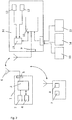
- FIG. 2 there is shown a simplified schematic of the entire system used for carrying out the method steps according to the present invention.
- the system comprises in particular one vehicle 1 including the camera 2 which is connected to the processor 3.
- the processor 3 is connected to a memory 4 so that images that are taken by the camera 2 can be stored in the memory 4.
- the processor 3 is further capable of communicating with communication counterparts by means of communication modules 5 such as an LTE interface connected to an external antenna 6.
- the communication counterpart may on the one side be the Internet in general which is exemplary illustrated having two databases 7 and 8, one of them being a public database and the other one a privately hosted database.
- the communication counterpart may also be an infrastructure 16 of a so-called smart city.
- Such infrastructure 8 may comprise also the communication unit 9 so that data can be exchanged between the vehicle 1 and the infrastructure 16 of the smart city.
- the communication interface 9 is connected to a processor 10 which in turn is connected to a memory 11.
- the infrastructure 16 may also be may also comprise one or more stationary cameras 12 which might either at regular intervals or upon being triggered take visuals from the environment and store the visuals in the memory 11. These visuals may then be used for addition of information to the original image captured by the camera 2 of the vehicle 1.
- the infrastructure 16 may be connected to other vehicles 14, 15 and 16 which are themselves equipped with further cameras and which can transmit their image data also to the memory 11 of the infrastructure 16.
- the processor 3 that performs all the optimization and improvement of the original visual is arranged in the vehicle 1. But it is of course also possible to use an off-line processing so that another processor may be used having even better performance than the one included in the vehicle 1.
- the vehicle communicates not only with the infrastructure 16 and the databases of the internet but also, preferably via the internet, with a PC for example of the vehicle owner.
Landscapes
- Engineering & Computer Science (AREA)
- Physics & Mathematics (AREA)
- General Physics & Mathematics (AREA)
- Theoretical Computer Science (AREA)
- Computational Linguistics (AREA)
- Computer Vision & Pattern Recognition (AREA)
- Multimedia (AREA)
- Image Analysis (AREA)
- Image Processing (AREA)
- Geometry (AREA)
- Studio Devices (AREA)
- Traffic Control Systems (AREA)
Priority Applications (4)
| Application Number | Priority Date | Filing Date | Title |
|---|---|---|---|
| EP18173982.2A EP3573025A1 (fr) | 2018-05-24 | 2018-05-24 | Procédé et système pour générer automatiquement un visuel attrayant sur la base d'un visuel original capturé par une caméra montée sur un véhicule |
| EP19175877.0A EP3582185A3 (fr) | 2018-05-24 | 2019-05-22 | Procédé et système pour générer automatiquement un visuel attrayant sur la base d'un visuel original capturé par une caméra montée sur un véhicule |
| JP2019096811A JP6997134B2 (ja) | 2018-05-24 | 2019-05-23 | 車載カメラにより取り込まれた原映像に基づいてアピーリング映像を自動的に生成するための方法およびシステム |
| US16/422,139 US11049301B2 (en) | 2018-05-24 | 2019-05-24 | Method and system for automatically generating an appealing visual based on an original visual captured by the vehicle mounted camera |
Applications Claiming Priority (1)
| Application Number | Priority Date | Filing Date | Title |
|---|---|---|---|
| EP18173982.2A EP3573025A1 (fr) | 2018-05-24 | 2018-05-24 | Procédé et système pour générer automatiquement un visuel attrayant sur la base d'un visuel original capturé par une caméra montée sur un véhicule |
Publications (1)
| Publication Number | Publication Date |
|---|---|
| EP3573025A1 true EP3573025A1 (fr) | 2019-11-27 |
Family
ID=62528246
Family Applications (2)
| Application Number | Title | Priority Date | Filing Date |
|---|---|---|---|
| EP18173982.2A Withdrawn EP3573025A1 (fr) | 2018-05-24 | 2018-05-24 | Procédé et système pour générer automatiquement un visuel attrayant sur la base d'un visuel original capturé par une caméra montée sur un véhicule |
| EP19175877.0A Withdrawn EP3582185A3 (fr) | 2018-05-24 | 2019-05-22 | Procédé et système pour générer automatiquement un visuel attrayant sur la base d'un visuel original capturé par une caméra montée sur un véhicule |
Family Applications After (1)
| Application Number | Title | Priority Date | Filing Date |
|---|---|---|---|
| EP19175877.0A Withdrawn EP3582185A3 (fr) | 2018-05-24 | 2019-05-22 | Procédé et système pour générer automatiquement un visuel attrayant sur la base d'un visuel original capturé par une caméra montée sur un véhicule |
Country Status (3)
| Country | Link |
|---|---|
| US (1) | US11049301B2 (fr) |
| EP (2) | EP3573025A1 (fr) |
| JP (1) | JP6997134B2 (fr) |
Families Citing this family (1)
| Publication number | Priority date | Publication date | Assignee | Title |
|---|---|---|---|---|
| KR102771825B1 (ko) * | 2021-10-14 | 2025-02-26 | 서울과학기술대학교 산학협력단 | 자동 영상 생성 방법 및 장치 |
Citations (5)
| Publication number | Priority date | Publication date | Assignee | Title |
|---|---|---|---|---|
| EP1975673A2 (fr) * | 2007-03-30 | 2008-10-01 | Ford Global Technologies, LLC | Affichage pour système de vision nocturne automobile |
| EP2410740A1 (fr) * | 2009-07-29 | 2012-01-25 | Clarion Co., Ltd. | Dispositif de surveillance de zone environnante pour des véhicules et procédé d affichage d image de zone environnante pour des véhicules |
| US20140104424A1 (en) * | 2012-10-11 | 2014-04-17 | GM Global Technology Operations LLC | Imaging surface modeling for camera modeling and virtual view synthesis |
| US20160044284A1 (en) * | 2014-06-13 | 2016-02-11 | Magna Electronics Inc. | Vehicle vision system with panoramic view |
| US20160311374A1 (en) * | 2015-04-21 | 2016-10-27 | Magna Electronics Inc. | Vehicle vision system with overlay calibration |
Family Cites Families (5)
| Publication number | Priority date | Publication date | Assignee | Title |
|---|---|---|---|---|
| US7349020B2 (en) * | 2003-10-27 | 2008-03-25 | Hewlett-Packard Development Company, L.P. | System and method for displaying an image composition template |
| JP4328692B2 (ja) * | 2004-08-11 | 2009-09-09 | 国立大学法人東京工業大学 | 物体検出装置 |
| DE102012200133A1 (de) | 2012-01-05 | 2013-07-11 | Robert Bosch Gmbh | Verfahren und Vorrichtung zur Fahrerinformation |
| US10366290B2 (en) | 2016-05-11 | 2019-07-30 | Baidu Usa Llc | System and method for providing augmented virtual reality content in autonomous vehicles |
| JP6855350B2 (ja) * | 2017-08-08 | 2021-04-07 | アルパイン株式会社 | ヘッドアップディスプレイ装置、ナビゲーション装置、表示方法 |
-
2018
- 2018-05-24 EP EP18173982.2A patent/EP3573025A1/fr not_active Withdrawn
-
2019
- 2019-05-22 EP EP19175877.0A patent/EP3582185A3/fr not_active Withdrawn
- 2019-05-23 JP JP2019096811A patent/JP6997134B2/ja active Active
- 2019-05-24 US US16/422,139 patent/US11049301B2/en active Active
Patent Citations (5)
| Publication number | Priority date | Publication date | Assignee | Title |
|---|---|---|---|---|
| EP1975673A2 (fr) * | 2007-03-30 | 2008-10-01 | Ford Global Technologies, LLC | Affichage pour système de vision nocturne automobile |
| EP2410740A1 (fr) * | 2009-07-29 | 2012-01-25 | Clarion Co., Ltd. | Dispositif de surveillance de zone environnante pour des véhicules et procédé d affichage d image de zone environnante pour des véhicules |
| US20140104424A1 (en) * | 2012-10-11 | 2014-04-17 | GM Global Technology Operations LLC | Imaging surface modeling for camera modeling and virtual view synthesis |
| US20160044284A1 (en) * | 2014-06-13 | 2016-02-11 | Magna Electronics Inc. | Vehicle vision system with panoramic view |
| US20160311374A1 (en) * | 2015-04-21 | 2016-10-27 | Magna Electronics Inc. | Vehicle vision system with overlay calibration |
Non-Patent Citations (1)
| Title |
|---|
| "Serious Games", vol. 8638, January 2014, SPRINGER INTERNATIONAL PUBLISHING, Cham, ISBN: 978-3-642-15171-2, ISSN: 0302-9743, article ALEXEY MEDVEDEV ET AL: "Citywatcher: Annotating and Searching Video Data Streams for Smart Cities Applications", pages: 144 - 155, XP055527556, DOI: 10.1007/978-3-319-10353-2_13 * |
Also Published As
| Publication number | Publication date |
|---|---|
| JP2019215859A (ja) | 2019-12-19 |
| JP6997134B2 (ja) | 2022-01-17 |
| US11049301B2 (en) | 2021-06-29 |
| US20190362527A1 (en) | 2019-11-28 |
| EP3582185A2 (fr) | 2019-12-18 |
| EP3582185A3 (fr) | 2020-03-04 |
Similar Documents
| Publication | Publication Date | Title |
|---|---|---|
| US20220012495A1 (en) | Visual feature tagging in multi-view interactive digital media representations | |
| KR101289085B1 (ko) | 객체 기반 영상 검색시스템 및 검색방법 | |
| CN109447169B (zh) | 图像处理方法及其模型的训练方法、装置和电子系统 | |
| KR102033262B1 (ko) | 정경 재구성 방법, 장치, 단말기 장치 및 저장 매체 | |
| KR101854554B1 (ko) | 건축물 높이 산출 방법, 장치 및 저장 매체 | |
| US20180374199A1 (en) | Sky Editing Based On Image Composition | |
| US20230334890A1 (en) | Pedestrian re-identification method and device | |
| US20130215239A1 (en) | 3d scene model from video | |
| CN111507210A (zh) | 交通信号灯的识别方法、系统、计算设备和智能车 | |
| US20130215233A1 (en) | 3d scene model from collection of images | |
| JP6719497B2 (ja) | 画像生成方法、画像生成装置及び画像生成システム | |
| CN105608417A (zh) | 交通信号灯检测方法及装置 | |
| CN103617432A (zh) | 一种场景识别方法及装置 | |
| CN117974846A (zh) | 可控图像描述的生成方法、装置及电子设备 | |
| CN112926461B (zh) | 神经网络训练、行驶控制方法及装置 | |
| US20210326376A1 (en) | Navigating through a set of images | |
| CN120012858A (zh) | 模型压缩与环境感知方法及装置、设备、介质、产品 | |
| CN114155273B (zh) | 一种结合历史轨迹信息的视频图像单目标跟踪方法 | |
| US11049301B2 (en) | Method and system for automatically generating an appealing visual based on an original visual captured by the vehicle mounted camera | |
| CN121716743A (zh) | 一种自动驾驶汽车动态避障路径规划方法及系统 | |
| US9286707B1 (en) | Removing transient objects to synthesize an unobstructed image | |
| CN120011591A (zh) | 视频检索方法、装置、电子设备及存储介质 | |
| US20240104696A1 (en) | Image processing method and apparatus, storage medium, electronic device, and product | |
| KR101305732B1 (ko) | 비디오 검색을 위한 블록 생성 방법 및 이를 통해 생성된 블록을 기초로 한 질의 처리 방법 | |
| CN116612190A (zh) | 车辆的定位方法、装置、车辆及存储介质 |
Legal Events
| Date | Code | Title | Description |
|---|---|---|---|
| PUAI | Public reference made under article 153(3) epc to a published international application that has entered the european phase |
Free format text: ORIGINAL CODE: 0009012 |
|
| STAA | Information on the status of an ep patent application or granted ep patent |
Free format text: STATUS: THE APPLICATION HAS BEEN PUBLISHED |
|
| AK | Designated contracting states |
Kind code of ref document: A1 Designated state(s): AL AT BE BG CH CY CZ DE DK EE ES FI FR GB GR HR HU IE IS IT LI LT LU LV MC MK MT NL NO PL PT RO RS SE SI SK SM TR |
|
| AX | Request for extension of the european patent |
Extension state: BA ME |
|
| STAA | Information on the status of an ep patent application or granted ep patent |
Free format text: STATUS: THE APPLICATION IS DEEMED TO BE WITHDRAWN |
|
| 18D | Application deemed to be withdrawn |
Effective date: 20200603 |