EP3573054B1 - Elektronische vorrichtung, steuerungsverfahren und computerlesbares medium - Google Patents
Elektronische vorrichtung, steuerungsverfahren und computerlesbares medium Download PDFInfo
- Publication number
- EP3573054B1 EP3573054B1 EP19174786.4A EP19174786A EP3573054B1 EP 3573054 B1 EP3573054 B1 EP 3573054B1 EP 19174786 A EP19174786 A EP 19174786A EP 3573054 B1 EP3573054 B1 EP 3573054B1
- Authority
- EP
- European Patent Office
- Prior art keywords
- user
- recognition model
- voice
- speaker recognition
- received
- Prior art date
- Legal status (The legal status is an assumption and is not a legal conclusion. Google has not performed a legal analysis and makes no representation as to the accuracy of the status listed.)
- Active
Links
Images




Classifications
-
- G—PHYSICS
- G10—MUSICAL INSTRUMENTS; ACOUSTICS
- G10L—SPEECH ANALYSIS TECHNIQUES OR SPEECH SYNTHESIS; SPEECH RECOGNITION; SPEECH OR VOICE PROCESSING TECHNIQUES; SPEECH OR AUDIO CODING OR DECODING
- G10L17/00—Speaker identification or verification techniques
- G10L17/22—Interactive procedures; Man-machine interfaces
-
- G—PHYSICS
- G10—MUSICAL INSTRUMENTS; ACOUSTICS
- G10L—SPEECH ANALYSIS TECHNIQUES OR SPEECH SYNTHESIS; SPEECH RECOGNITION; SPEECH OR VOICE PROCESSING TECHNIQUES; SPEECH OR AUDIO CODING OR DECODING
- G10L17/00—Speaker identification or verification techniques
- G10L17/04—Training, enrolment or model building
-
- G—PHYSICS
- G06—COMPUTING OR CALCULATING; COUNTING
- G06F—ELECTRIC DIGITAL DATA PROCESSING
- G06F21/00—Security arrangements for protecting computers, components thereof, programs or data against unauthorised activity
- G06F21/30—Authentication, i.e. establishing the identity or authorisation of security principals
- G06F21/31—User authentication
- G06F21/32—User authentication using biometric data, e.g. fingerprints, iris scans or voiceprints
-
- G—PHYSICS
- G10—MUSICAL INSTRUMENTS; ACOUSTICS
- G10L—SPEECH ANALYSIS TECHNIQUES OR SPEECH SYNTHESIS; SPEECH RECOGNITION; SPEECH OR VOICE PROCESSING TECHNIQUES; SPEECH OR AUDIO CODING OR DECODING
- G10L15/00—Speech recognition
- G10L15/04—Segmentation; Word boundary detection
-
- G—PHYSICS
- G10—MUSICAL INSTRUMENTS; ACOUSTICS
- G10L—SPEECH ANALYSIS TECHNIQUES OR SPEECH SYNTHESIS; SPEECH RECOGNITION; SPEECH OR VOICE PROCESSING TECHNIQUES; SPEECH OR AUDIO CODING OR DECODING
- G10L17/00—Speaker identification or verification techniques
- G10L17/02—Preprocessing operations, e.g. segment selection; Pattern representation or modelling, e.g. based on linear discriminant analysis [LDA] or principal components; Feature selection or extraction
-
- G—PHYSICS
- G10—MUSICAL INSTRUMENTS; ACOUSTICS
- G10L—SPEECH ANALYSIS TECHNIQUES OR SPEECH SYNTHESIS; SPEECH RECOGNITION; SPEECH OR VOICE PROCESSING TECHNIQUES; SPEECH OR AUDIO CODING OR DECODING
- G10L17/00—Speaker identification or verification techniques
- G10L17/06—Decision making techniques; Pattern matching strategies
- G10L17/08—Use of distortion metrics or a particular distance between probe pattern and reference templates
Definitions
- the present disclosure relates to an electronic apparatus, a controlling method thereof and a computer readable medium, and, for example, to a technique for building a system for recognizing a speaker in a sentence-independent manner.
- US 2015/0301796 A1 describes a system for speaker verification.
- Sanchez Avila et al. “State of the Art of Mobile Biometrics, Liveness and Non-Coercion Detection", PCAS Project, 4 March 2014 , describes an overview of biometrics in mobile phones.
- Speaker recognition refers to a technique of comparing input voice data with pre-stored data and identifying a speaker.
- a process of registering a speaker recognition model for a user is necessary for speaker recognition.
- the process includes notifying the system of the speaker who uttered the currently input voice and registers the speaker recognition model for the user who uttered the input voice based on the feature extracted from the input voice.
- the process of registering a speaker recognition model may be categorized by two types according to the speaker recognition method.
- the two types includes a sentence-dependent method in which only the designated sentence or word is uttered, and the speaker recognition model is registered by extracting the voice characteristic of the user based on the utterance, and a sentence-independent model in which a sufficient number of sentences and words are made to be uttered in order to allow the speaker to recognize the free speech of the user, and then a speaker recognition model is registered by extracting the voice characteristic of a user based on the utterance.
- the sentence-independent method is advantageous in that it can recognize the speaker of a voice regardless of the voice of the user based on a large amount of data than the sentence-dependent method.
- the conventional sentence-independent method has caused the inconvenience for a user because the amount of words and sentences to be uttered by the in registering the speaker recognition model is too large.
- the parameters based on the user's fatigue, the accuracy of the utterance recognition, the ambient noise, etc. increase and the quality of the registered speaker recognition model deteriorates.
- FIG. 1 is a diagram illustrating part of a conventional technique in registering a speaker recognition model for speaker recognition in a sentence-independent manner.
- FIG. 1 sequentially shows images displayed in the process of registering a speaker recognition model, and each image requests a user to utter a specific sentence.
- a user may be requested to utter a large number of sentences sequentially. For example, as shown in FIG. 1 , if a user utters a voice according to a sequential utterance request for 30 types of texts, and receives the uttered voice, a user may feel inconvenience in a continuous job.
- the accuracy of the speaker recognition model that is finally registered due to the inaccuracy of the voice uttered by the weary user may be deteriorated.
- An electronic apparatus, a controlling method thereof, and a computer-readable medium according to the disclosure is advantageous in alleviating user's inconvenience that a user has to speak a large amount of utterances for registering a speaker recognition model for speaker recognition in a sentence-independent manner, and providing a more accurate speaker recognition model.
- 'a module', 'a unit', or ⁇ a part' perform at least one function or operation, and may be realized as hardware, such as, for example, and without limitation, a processor, integrated circuit, or the like, software that is executed by a processor, or any combination thereof.
- a plurality of 'modules', a plurality of 'units', or a plurality of 'parts' may be integrated into at least one module or chip and may be realized as at least one processor except for 'modules', 'units' or 'parts' that should be realized in a specific hardware.
- an element When an element is referred to as being “connected” or “coupled” to another element, it can be directly connected or coupled to the another element or be indirectly connected or coupled to the another element with one or more intervening elements interposed therebetween.
- an element when an element is referred to as "including” a component, this indicates that the element may further include another component instead of excluding another component unless there is different disclosure.
- 'at least one of a, b or c' means 'only a, only b, only c, both a and b, both a and c, both b and c, all of a, b, and c, or variations thereof.
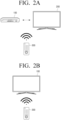
- FIG. 2A and 2B are diagrams illustrating an example electronic apparatus 100, an external device 200 including a display, and a remote control device 300.
- the electronic apparatus 100 may be embodied, for example, and without limitation, as TVs, smart TVs, set-top boxes, PCs, servers, terminal devices, mobile phones, table PCs, or the like.
- the external device 200 may be embodied, for example, and without limitation, as TVs, smart TVs, PCs, or the like, including a display
- the remote control device 300 may be embodied, for example, and without limitation, as a TV remote controller, a terminal device storing an application for controlling a TV, or the like.
- FIG. 2A is a diagram illustrating a non-limiting example in which the electronic apparatus 100 is embodied as a set-top box without a display.
- the electronic apparatus 100 and the external device 200 may exchange signals each other.
- the electronic apparatus 100 may transmit image signals to the external device 200 to display images.
- the electronic apparatus 100 may transmit signals regarding voices to the external device 200 to output voices.
- the remote control device 300 may output a signal for controlling at least one of the electronic apparatus 100 and/or the external device 200 based, for example, on a user command.
- the remote control device 300 may transmit a signal including user information to at least one of the electronic apparatus 100 and/or the external device 200.
- FIG. 2B is a diagram illustrating a non-limiting example in which the electronic apparatus 100 is embodied as a TV or a smart TV with a display.
- the electronic apparatus 100 may display images and/or output voices based on the control signals received, for example, from the remote control device 300.
- the electronic apparatus 100 may receive signals including, for example, user information from the remote control device 300.
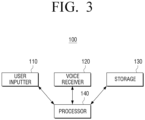
- FIG. 3 is a block diagram illustrating an example configuration of an electronic apparatus and an external device.
- an electronic apparatus 100 includes a user inputter (e.g., including input circuitry) 110, a voice receiver (e.g., including voice receiving circuitry) 120, a storage 130 and a processor (e.g., including processing circuitry) 140.
- the user inputter 110 includes various input circuitry and may be a configuration that enables the electronic apparatus 100 to receive commands or information from a user.
- the user inputter 110 may include various input circuitry, such as, for example, and without limitation, a microphone (not shown), or the like, and receive a user voice uttered by a user using the microphone.
- the user inputter 110 may include circuitry to convert a user voice in an analog form into a digital form, and transmit the user voice in the digital form to at least one of the voice receiver 120 and/or the processor 140.
- the user inputter 110 may include, for example, and without limitation, a touch panel (not shown) with a display (not shown) or an additional touch pad (not shown) to receive user commands or information by touch.
- the user inputter 110 may receive information on the texts input by a user.
- the user inputter 110 may include, for example, and without limitation, a keyboard or a mouse (not shown) and receive specific texts from the user using the keyboard and/or the mouse.
- the user inputter 110 may receive user's biometric information in addition to user voices.
- the user inputter 110 may include, for example, and without limitation, a sensor for recognizing fingerprints of a user, a camera for recognizing a user face, a sensor for recognizing user's iris, or the like.
- the user inputter 110 may receive the signal including the user command and the information from the communicator (not shown).
- the remote control device 300 may receive a command for text input from a user and transmit the received signal to the communicator (not shown) of the electronic apparatus 100.
- the user inputter 110 may receive a user command for text input in the form of receiving a signal including a user command from the communicator (not shown).
- the remote control device 300 may receive fingerprint information from a user using a sensor for fingerprint recognition (not shown), and transmit a signal including the input fingerprint information to the user in putter 110 through the communicator (not shown) of the electronic apparatus 100.
- the remote control device 300 may receive iris information from a user using a sensor for iris recognition (not shown), and transmit the signal including the input iris information to the user inputter 110 through the communicator (not shown).
- the remote control device 300 may capture a user face using a camera for face recognition (not shown), and transmit a signal including the captured face image to the user inputter 110 through the communicator (not shown) of the electronic apparatus 100.
- the voice receiver 120 may include various voice receiving circuitry and be configured to receive user voices.
- the voice receiver 120 may receive a user voice input through circuitry including, for example, and without limitation, a microphone (not shown), provided in the user inputter 110.
- the voice receiver 120 may receive a user voice signal received in an analog form and converted into a digital form through the microphone (not shown) provided in the user inputter 110.
- the voice receiver 120 may receive a voice signal input through the microphone (not shown) included in the remote control device 300 or other external devices (not shown) from the remote control device 300 or other external devices (not shown)
- the storage 130 may be configured to store an operating system (OS) for controlling the overall operations of the elements of the electronic apparatus 100 and commands or data related to the elements of the electronic apparatus 100.
- OS operating system
- the storage 130 may be embodied, for example, and without limitation, as a non-volatile memory (e.g., hard disk, solid state drive (SSD), flash memory, etc.), a volatile memory, or the like.
- a non-volatile memory e.g., hard disk, solid state drive (SSD), flash memory, etc.
- volatile memory e.g., hard disk, solid state drive (SSD), flash memory, etc.
- the storage 130 may store data on a user-specific speaker recognition model.
- the user-specific speaker recognition model may be defined by a model of one or more parameters representing the characteristic of a voice uttered by each user on a user-by-user basis.
- the characteristic of a voice may be based, for example, and without limitation, on Pitch, Formant, Linear Predictive Cepstral Coefficient (LPCC), Mel-Frequency Cepstral Coefficient (MFCC), Perceptual Linear Predictive (PLP), and the like.
- LPCC Linear Predictive Cepstral Coefficient
- MFCC Mel-Frequency Cepstral Coefficient
- PPP Perceptual Linear Predictive
- the storage 130 may store information on voices to be received from a user to generate, update and complete a speaker recognition model for a user.
- the storage 130 may store information on a time length of a voice to be received for each user to generate and/or update a speaker recognition model for each user and the amount of texts corresponding to voices to be received.
- the storage 130 stores information on a plurality of texts corresponding to the voice to be received for each user to generate and/or update a user-specific speaker recognition model.
- the storage 130 may store information on voices corresponding to which texts are to be received to generate and/or update a speaker recognition model.
- the storage 130 may store information on basic texts corresponding to voices to be received for each user to generate a user-specific speaker recognition model, and information on a plurality of texts corresponding to voices to be received for each user to update or compete a user-specific speaker recognition model.
- the plurality of texts corresponding to voices to be received for each user to generate and/or update a user-specific speaker recognition model will be described with reference to FIG. 6 .
- the processor 140 may include various processing circuitry and control the operations of the electronic apparatus 100.
- the processor 140 may include a random access memory (RAM) (not shown), a read only memory (ROM) (not shown), a central processing unit (CPU), a graphic processing unit (not shown), and a system bus (not shown), and may perform operations and data processing related to control of other components included in the electronic apparatus 100.
- RAM random access memory
- ROM read only memory
- CPU central processing unit
- graphic processing unit not shown
- system bus not shown
- the processor 140 provides a text of the plurality of texts to prompt a user to speak when user authentication is performed based on user information input through the user inputter 110.
- the user information input through the user inputter 110 may include, for example, and without limitation, a user's id and/or password, user's fingerprint information, user's face recognition information, user's iris information, user's touch information on a pattern image displayed through a display (not shown) of the electronic apparatus 100, or the like.
- the user authentication may be performed based on a result of comparison between user information pre-stored in the storage 130 and user information input through the user inputter 110. For example, user' access or log-in to the electronic apparatus 100, or user's access or log-in to an application or a service provided through the electronic apparatus 100 may be included in the user authentication.
- the processor 140 may identify (determine) whether the speaker recognition model corresponding to the user information is stored. As a result of identification, if the speaker recognition model corresponding to the input user information has not yet been stored, the guide for prompting a user utterance may include a user interface to allow a user to select whether a speaker recognition model corresponding to user information is generated.
- the user interface that allows a user to select whether to generate the speaker recognition model corresponding to the user information may include images displayed through the electronic apparatus 100, voices output through the electronic apparatus 100, and user's selection commands for the user inputter 110 of the electronic apparatus 100.
- the processor 120 may provide a guide for prompting user' utterance, including some of a plurality of texts stored in the storage 130.
- the plurality of texts stored in the storage 130 may be a plurality of texts corresponding to voices to be received for each user to generate and update a user-specific speaker recognition model.
- Some of the plurality of texts may be texts to correspond to voices to be received for each user to generate a user-specific speaker recognition model.
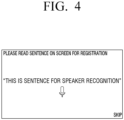
- FIG. 4 is a diagram illustrating an example of a part of a guide that prompts an utterance of a user.
- FIG. 4 illustrates an example part of an example guide for prompting user's utterance displayed through an electronic apparatus 100 or displayed through an external device 200 that receives an image signal from the electronic apparatus 100.
- the text "this is a sentence for speaker recognition" may be a text that a user who has completed the user authentication should utter to generate an initial speaker recognition model corresponding to user's own information.
- the processor 140 may generate a speaker recognition model corresponding to user information based on the received voice and store the speaker recognition model in the storage 130.
- the processor 140 may generate a speaker recognition model based on the feature value of the received voice.
- the generated speaker recognition model may correspond to the input user information and may be stored in the storage 130.
- the processor 140 may provide a guide for prompting user's utterance.
- the specific user's log-in may, for example, be a log-in to the electronic apparatus 100 or an application that operates through the electronic apparatus 100.
- the processor 140 generates and stores a speaker recognition model corresponding to the user information based on the voice that is received through the voice receiver 120 and corresponds to the text being received.
- the processor 140 may generate the speaker recognition model corresponding to the specific user based on the received voice and store the speaker recognition model in the storage 130.
- the processor 140 may provide a user interface providing a notification as to what extent a speaker recognition model has been completed.
- the user interface may be provided such that the electronic apparatus 100 or the external device 200 that receives a signal from the electronic apparatus 100 displays a guide image or outputs a guide voice.
- the processor 140 may compare the voice received through the voice receiver 120 with a speaker recognition model stored in the storage 130 and update the speaker recognition model stored in the storage 130.
- the processor 140 may compare the voice received through the voice receiver 120 during the voice recognition service with the speaker recognition model stored in the storage 130, and update the speaker recognition model.
- the voice recognition service may include a service provided through an application including a voice recognition function of applications performed through the electronic apparatus 100.
- the voice recognition service may be a service provided by an application performing a voice recognition function of the applications stored in the storage 130 when the user authentication based on user information corresponding to the speaker recognition model stored in the storage 130 is performed.
- the processor 140 may identify (determine) whether the speaker recognition model stored in the storage 130 and the feature value of the received voice have a similarity equal to or greater than a predetermined threshold value.
- the processor 140 may update the speaker recognition model stored in the storage 130 based on the feature value of the received voice.
- the processor 140 may update a speaker recognition model stored in the storage 130 based on the feature value of the received voice.
- the plurality of texts stored in the storage 130 may be the texts corresponding to the voices to be received to update the speaker recognition model.
- the processor 140 may update the speaker recognition model stored in the storage 130 based on the feature value of the received voice when the text corresponding to the voice to be received is included in the plurality of texts stored in the storage 130, in addition to the case where the feature value of the voice received through the voice receiver 120 while a voice recognition service is provided has a similarity equal to or greater than a predetermined threshold value to the speaker recognition model stored in the storage 130.
- FIG. 5A and 5B are diagrams illustrating an example operation of the electronic apparatus 100 when a plurality of texts to be received in the form of a voice is predetermined to complete a speaker recognition model.
- the plurality of texts may be stored in the storage 130.
- FIG. 5A and 5B illustrate a plurality of texts corresponding to voices to be received to generate and update a speaker recognition model in a partial block form.
- black blocks may be registered texts 510 which have already received user utterance voices among a plurality of texts.
- the voices corresponding to the registered texts 510 may be received through the voice receiver 120 and used for generating or updating a speaker recognition model.
- white blocks may be non-registered texts 520 which have not yet been received user utterance voices among the plurality of texts.
- the voices corresponding to the non-registered texts 520 have not yet been received through the voice receiver 120, or have not been used for generating or updating a speaker recognition model.
- the processor 140 may compare the speaker recognition model stored in the storage 130 with the received voice and measure the similarity, and identify (determine) whether the texts recognized as corresponding to the received voice match at least part of the non-registered texts 520.
- FIG. 5B assumes that the similarity is measured to be equal to or greater than a predetermined threshold value, and the text recognized as corresponding to the received voice matches a text 500-4 of the non-registered texts 520.
- FIG. 5B shows that the text 500-4 included in the non-registered texts 520 in FIG. 5A is included in the registered texts 510.
- the voice corresponding to the text 500-4 may be received through the voice receiver 120 and used for updating the speaker recognition model.
- the processor 140 identifies whether the speaker recognition model corresponding to the user information has been updated. For example, when the user authentication is performed again based on the same user information as the user information as described above, the processor 140 identifies whether the updating of the speaker recognition model corresponding to the user information has been completed.
- the processor 140 may identify (determine) the updating progress or completeness of the speaker recognition model corresponding to the user information as a ratio.
- the processor 140 may provide a user interface indicating (e.g., providing a notification of) the update progress of the speaker recognition model.
- the user interface may be provided such that the electronic apparatus 100 and the external device 200 that receives a signal from the electronic apparatus 100 displays a guide image or outputs a guide voice.
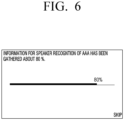
- FIG. 6 is a diagram illustrating an example of a user interface displaying an update progress of a speaker recognition model.
- FIG. 6 may, for example, be a guide image displayed for indicating the updating progress of a speaker recognition model.
- FIG. 6 assumes a situation where user authentication for user "AAA” is performed as a result of inputting user information for user "AAA”.
- the speaker recognition model of the user "AAA" confirms that the update has been completed by 80%.
- the processor 140 may compare a voice received through the voice receiver 120 in providing a voice recognition service while a specific user is logged in with the speaker recognition model stored in the storage 130 and update a speaker recognition model.
- the electronic apparatus 100 may efficiently complete a user-specific speaker recognition model using a user voice that is naturally received while a voice recognition service is provided without requiring a user to speaker utterance corresponding all the texts necessary for generating and updating a speaker recognition model.
- the electronic apparatus 100 may provide the update progress of the user-specific speaker recognition model in the form of a user interface after performing user authentication on a user-by-user basis. Therefore, a user may clearly recognize a progress of registering a speaker recognition model without repeating tedious operations.
- the processor 140 may recognize a user corresponding to the voice received through the voice receiver 120 based on the updated speaker recognition model.
- the processor 140 identifies (determines) whether the voice received through the voice receiver 120 is the specific user's voice.
- the processor 140 identifies (determines) whether the speaker recognition model corresponding to the user information has been updated when user authentication is performed again based on user information, and if it is identified (determined)_that the update of the speaker recognition model has not been completed, a guide for prompting the utterance of a text that is not uttered by a user among the plurality of texts stored in the storage 130 is provided.
- the text that has not been uttered by the user may indicate that the voice corresponding to the text has not yet been received through the voice receiver 120 and has not yet been recognized as the corresponding text. For example, it may be the case that the voice corresponding to the text has not yet been received through the voice receiver 120 to be recognized as the text when the user performs user authentication.
- the plurality of texts stored in the storage 130 may be texts corresponding to the voices to be received to generate or update a speaker recognition model.
- a guide for prompting an utterance of the text that has not been uttered by a user may be provided by displaying an image including the text that has not been uttered, or outputting a voice for the text that has not been uttered.
- the processor 140 may provide a guide for prompting the utterance of the texts necessary for updating the remaining 10 percentage, for example, the text that has not yet been uttered by a user among the plurality of texts stored in the storage 130,
- the processor 140 may update the speaker recognition model based on the feature value of the received voice and generate a final speaker recognition model corresponding to the user information.
- the processor 140 may update the speaker recognition model stored in the storage 130 based on the received feature value of the received voice and generate a final speaker recognition model corresponding to the user information.
- the processor 140 identifies (determines) whose utterance the voice received through the voice receiver 120 is based thereon.
- the processor 140 performs user authentication based on the identification result.
- the processor 140 may recognize a user based on the final speaker recognition model, and it is possible to perform user authentication based thereon.
- the processor 140 may identify (determine) whose voice each of the plurality of voices received through the voice receiver 120 is, and perform user authentication for the identified user.
- the processor 140 may identify whose voice the randomly uttered voice is and perform user authentication for the identified user, and start voice recognition for the voice which is freely uttered by the authenticated user.
- the electronic apparatus 100 may receive a signal including a request to start voice recognition from the remote control device 300, then recognize a user based on the updated speaker recognition model and the voice freely uttered by the user, and start recognition of a voice freely uttered by the user.
- the processor 140 may perform user authentication using a method for verifying whether the voice received through the voice receiver 120 is a user's voice based on the final speaker recognition model corresponding to the user information including, for example, and without limitation, at least one of user's id/password information, touch information, fingerprint information, face information, iris information, or the like, received through the user inputter 110.
- the voice corresponding to the random sentence uttered by user A may be transmitted to the voice receiver 120 through the remote control device 300 or a microphone (not shown) included in or the electronic apparatus 100.
- the processor 120 may compare user information corresponding to the final speaker recognition model in which the feature values of the received voice and signal match each other by a predetermined threshold value or more, among the final recognition models stored in the storage 130, with user information corresponding to the fingerprint recognized through a fingerprint sensor (not shown), and when the two user information is determined to be the same as the information on user A, may perform user authentication on user A.
- the processor 140 may provide a user customized service based on the identification of whose voice the voice received through the voice receiver 120 is without performing additional user authentication.
- the user customized service may include, for example, and without limitation, allowing or blocking a content with age restriction, providing a customized advertisement in consideration of the history of user specific content usage, providing customized user interface considering the user-specific user interface usage history, or the like.
- FIG. 7 is a block diagram illustrating an example configuration of an electronic apparatus according to various example embodiments of the disclosure.
- an electronic apparatus 100 may further include at least one of an input/output port 150, a communicator (e.g., including communication circuitry) 160, a display 170, an audio outputter (e.g., including audio output circuitry) 180, and a broadcasting receiver (e.g., including broadcast receiving circuitry) 190, including a user inputter (e.g., including input circuitry) 110, a voice receiver (e.g., including voice receiving circuitry) 120, a storage 130, and a processor (e.g., including processing circuitry) 140.
- a communicator e.g., including communication circuitry
- a display 170 e.g., an audio outputter (e.g., including audio output circuitry) 180
- a broadcasting receiver e.g., including broadcast receiving circuitry
- a user inputter e.g., including input circuitry
- a voice receiver e.g., including voice receiving circuitry
- storage 130 e.g., including storage 130
- the electronic apparatus 100 may receive signals for images and/or voices from an external source, or transmit images and/or voice signals to an external source through the input/output port 150.
- the input/output port 150 may be implemented, for example, and without limitation, as a wired port such as an HDMI port, a display port, an RGB port, a Digital Visual Interface (DVI) port, a Thunderbolt, a component port, or the like.
- the input/output port 150 may be implemented as a port for wireless communication such as, for example, and without limitation, Wi-Fi, Bluetooth communication, or the like.
- the input/output port 150 may be implemented as an HDMI port or a Thunderbolt, and may be configured to transmit images and audio signals together. However, a first port for transmitting an image signal and a second port for transmitting a voice signal may be implemented separately.
- the electronic apparatus 100 may receive signals for images and/or voices including a specific user interface from an external device (not shown) such as a set-top box through the input/output port 150.
- an external device not shown
- the electronic apparatus 100 may receive signals for images and/or voices including a specific user interface from an external device (not shown) such as a set-top box through the input/output port 150.
- the electronic apparatus 100 may transmit the images and/or voices including a specific user interface to the external device 200 through the input/output port 150 so that the images and/or voices including the specific user interface may be output through the external device 200.
- the communicator 160 may include various communication circuitry and be configured to perform communication with various types of external devices according to various types of communication methods.
- the communicator 160 may include various chips, each including various processing circuitry, such as, for example, and without limitation, a Wi-Fi chip (not shown), a Bluetooth chip (not shown), or the like.
- the processor 140 may include various processing circuitry and perform communication with various external devices using the communicator 160.
- the communicator 160 may perform data communication with various external devices wiry or wirelessly.
- the communicator 160 may include, for example, and without limitation, at least one of a WIFI DIRECT communication module, a Bluetooth module, an infrared data association (IrDA) Module, a Near Field Communication (NFC) module, a Zigbee module, a cellular communication module, a third generation (3G) mobile communication module, a fourth generation (4G) mobile communication module, a fourth generation Long Term Evolution (LTE), a fifth generation Long Term Evolution (5GLTE), or the like.
- a WIFI DIRECT communication module a Bluetooth module, an infrared data association (IrDA) Module, a Near Field Communication (NFC) module, a Zigbee module, a cellular communication module, a third generation (3G) mobile communication module, a fourth generation (4G) mobile communication module, a fourth generation Long Term Evolution (LTE), a fifth generation Long Term Evolution (5GLTE), or the like.
- the electronic apparatus 100 including the display 170 may receive data from the remote control device 300 through the communicator 160.
- the communicator 160 may receive data and/or signals for user information input to the remote control device 300, data and/or signals for user voices input to a microphone (not shown) of the remote control device 300, and data and/or signals for user commands input to the remote control device 300 from the remote control device 300 using, for example, a Bluetooth or Wi-Fi communication method.
- the communicator 160 that receives data and/or digital signals for user voices input to a microphone (not shown) of the microphone 300 may transmit the received data and/or digital signals to the voice receiver 120.
- the communicator 160 that receives user information data such as iris recognition data, face capturing data, fingerprint data, or the like, received through various sensors (not shown) or a camera, may transmit the received user information data to at least one of the user inputter 110 or the processor 140.
- user information data such as iris recognition data, face capturing data, fingerprint data, or the like
- various sensors not shown
- a camera may transmit the received user information data to at least one of the user inputter 110 or the processor 140.
- the communicator 160 may transmit and receive data related to the function performed by the electronic apparatus 100 to or to from an external server (not shown).
- the communicator 160 may separately include a first communicator (not shown) for transmitting or receiving data to or from the external device 200 or the remote control device 300, and a second communicator (not shown) for transmitting or receiving data to or from the external server (not shown).
- the first communicator (not shown) may be embodied, for example, and without limitation, as an Ethernet modem, a Wi-Fi module, a Bluetooth module, or the like, and the second communicator may be embodied, for example, and without limitation, as an additional Wi-Fi module.
- the display 170 may display an image under the control of the processor 140.
- the display 170 may be implemented, for example, and without limitation, as a liquid crystal display (LCD), a plasma display panel (PDP), an organic light emitting diode (OLED), a transparent OLED (TOLED), or the like.
- the display 170 may include a driving circuit (not shown) that can be embodied in the form of an a-Si TFT, a low temperature poly silicon (LTPS) TFT, an organic TFT (OTFT0, etc. and a backlight unit (not shown).
- the display 170 may be embodied as a touch screen type including a touch panel for sensing a user's touch and it may be included in the user inputter 110 in this case.
- the display 170 may output an image included in a broadcasting signal received through the broadcasting receiver 190, an image included in a signal received through the communicator 160, an image input through the user inputter 110, an image included in an image file stored in the storage 130, and an image included in a signal received from an external source through the input/output port 150.
- the audio outputter 180 may include various audio output circuitry and be configured to output a specific voice under the control of the processor 140.
- the audio outputter 180 may include various audio output circuitry, such as, for example, and without limitation, a speaker (not shown), a headphone/earphone output terminal (not shown), or the like.
- the audio outputter 180 may output a voice included in a broadcasting signal received through the broadcasting receiver 190, a voice included in a signal received through the communicator 160, a voice input through a microphone (not shown) included in the user inputter 110, a voice included in an audio file stored in the storage 130, and a voice included in a signal received from an external source through the input output/port 150.
- the broadcast receiver 190 may include various broadcast receiving circuitry and receive a signal for a broadcasting content.
- the broadcasting content may include, for example, and without limitation, images, audio and additional data (e.g., EPG), or the like, and the broadcast receiver 190 may receive broadcast content signals from various sources such as, for example, and without limitation, terrestrial broadcast, cable broadcast, satellite broadcast, Internet broadcast, or the like.
- the broadcast receiver 190 may include various broadcast receiving circuitry, such as, for example, and without limitation, a tuner (not shown), a demodulator (not shown), an equalizer (not shown), and the like, in order to receive broadcast contents transmitted from a broadcasting station.
- various broadcast receiving circuitry such as, for example, and without limitation, a tuner (not shown), a demodulator (not shown), an equalizer (not shown), and the like, in order to receive broadcast contents transmitted from a broadcasting station.
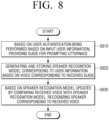
- FIG. 8 is a flowchart illustrating an example method of controlling an electronic apparatus according to an example.
- a controlling method may include providing a guide for prompting user utterance when user authentication is performed based on user information input through a user inputter at step S810.
- the guide for prompting user utterance may include at least one of a process of displaying an image including a text to be uttered by a user, or a process of outputting a voice corresponding to the text to be uttered by the user.
- a guide for prompting user utterance may guide a user to utter a voice corresponding to some of a plurality of texts corresponding to the voices to be received for generating and updating a user-specific speaker recognition model.
- the guide for prompting user utterance may include a user interface for asking the user whether or not to perform utterance to generate a speaker generation model corresponding to the user information and for allowing the user to select the utterance.
- a guide for prompting user utterance may be provided.
- a controlling method may include generating and storing a speaker recognition model corresponding user information based on the voice corresponding to the received guide at step S820.
- the speaker recognition model may be generated based on the feature of the received voice.
- a speaker recognition model corresponding to a specific user may be generated and stored based on the received voice.
- Steps S810 and S820 as described above may be included in an initial speaker recognition generation process 900 (see, e.g., FIG. 9 ).
- a controlling method may include comparing the voice received through the voice receiver with the speaker recognition model and recognizing a speaker corresponding to the received voice based on the updated speaker recognition model at step S830.
- the stored speaker recognition model may be updated by comparing the voice received through a voice receiver in providing a voice recognition service for the user with the stored speaker recognition model.
- the stored speaker recognition model and the feature value of the received voice may be identified whether the stored speaker recognition model and the feature value of the received voice have a similarity equal to or greater than a predetermined threshold value, and as a result of identification, if the similarity is equal to or greater than the predetermined threshold value, the stored speaker recognition model may be updated based on the feature value of the received voice.
- the stored speaker recognition model may be updated based on the feature value of the received voice.
- the plurality of pre-stored texts may be texts corresponding to the voices to be received through the voice receiver for generating or updating a user-specific speaker recognition model.
- a speaker recognition model may be updated by comparing the voice received through the voice receiver while the voice recognition service is provided with the stored speaker recognition model when a specific user is logged in.
- a user interface indicating the update progress of a speaker recognition model may be provided.
- a speaker recognition model corresponding to user information When user authentication is performed again based on user information, it may be identified whether a speaker recognition model corresponding to user information has been updated, and if it is identified that the updating of a speaker recognition model has not been completed, a guide for prompting user utterance of a text that has not yet been uttered by a user among the plurality of pre-stored texts may be provided.
- a speaker recognition model may be updated based on the feature value of the received voice, and a final speaker recognition model corresponding to user information may be generated.
- the updating of the speaker recognition model may include not only a process of updating a speaker recognition model without an utterance request for a user 1000 (see, e.g., FIG. 10 ), but also a process of updating a speaker recognition model through an utterance request for a user 1100 (see, e.g., FIG. 11 ).
- a controlling method may include recognizing a user corresponding to the voice received through the voice receiver based on the updated speaker recognition model.
- a user corresponding to the voice received through the voice receiver may be recognized based on the final user-specific speaker recognition model generated upon the completion of update.
- FIG. 9 is flowchart illustrating an example process of generating an initial speaker recognition model according to an example.
- user authentication may be performed by comparing the pre-stored information with the input user information. If the input user information does not match the user information to be authenticated at step S920-N, user information may be input again.
- step S920-Y When user authentication is completed based on the input user information at step S920-Y, it may be identified (determined) whether a speaker recognition model corresponding to the input user information is stored at step S930. If the speaker recognition model corresponding to the input user information is stored at step S930-Y, a user may immediately enter a service at step S990.
- a user may select whether to generate the speaker recognition model corresponding to the input user information at step S940. For example, a user may select whether to perform utterance for generating a speaker recognition model necessary for recognizing a user's own voice.
- a process of asking a user whether to generate a speaker recognition model corresponding to the input user information and a process of allowing a user to select may be processed by a user interface.
- the user interface may include a process of displaying an image that displays information, a process of outputting voices on information and a process of receiving user's selection.
- a user selects not to generate a speaker recognition model at step S940N, the user may enter a service as step S990.
- a guide for prompting user utterance may be provided and a voice uttered by a user may be received at step S950.
- a guide for prompting user utterance may include a process of displaying an image including a text to be uttered by a user, and a process of outputting a voice corresponding to text to be uttered by a user.
- the text to be uttered by a user may be a text corresponding to the user voice to be received to generate an initial speaker recognition model.
- the voice uttered by a user When the voice uttered by a user is received, it may be identified (determined) whether the utterance is accurate (correct) at step S960.
- the identification as to whether or not the utterance is accurate (correct) may refer, for example, to whether the user correctly utters a voice to be received in order to generate an initial speaker recognition model.
- the identification as to whether or not the utterance is accurate may be based on whether or not the result (text) of recognizing the voice uttered by the user coincides with the text to be uttered by the user by a threshold value or more.
- the above-described identification (determination) process may include identifying whether a voice uttered by a user exactly corresponds to the sentence, for example, when a guide for prompting a user's utterance requests a user to utter a phrase "Hello, I am so pleased to meet you ".
- the feature of the received voice may be extracted at step S970.
- the feature of the voice may be based, for example, and without limitation, on Pitch, Formant, Linear Predictive Cepstral Coefficient (LPCC), Mel-Frequency Cepstral Coefficient (MFCC), Perceptual Linear Predictive (PLP), or the like.
- the initial speaker recognition model corresponding to the input user information may be generated and stored based on the extracted feature at step S980.
- the above-described processes may not require the user to speak a large amount of utterances enough to complete the speaker recognition model. Instead, a user may enter the service with only being request to speaker utterances sufficient to generate an initial speaker recognition model at step S990. Therefore, the convenience of the user can be increased.
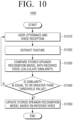
- FIG. 10 is a flowchart illustrating an example process of updating a speaker recognition model without requesting a user to speak 1000.
- the process 1000 may be continuously performed while the same user is using the voice recognition service as a result of performing the same user authentication by inputting the same user information as that in a process of generating the initial speaker recognition model 900.
- the process 1000 may include receiving a voice uttered by a user when user authentication on a specific user is performed again after user information corresponding to the generated speaker recognition model is input at step S1010. This might be the situation where a user who finished authentication utters various texts in the use of a voice recognition service through an electronic apparatus.
- the feature on the received voice may be extracted at step S1020.
- a similarity may be calculated (determined) by comparing the extracted feature value with the stored speaker recognition model at step S1030. In other words, it may be identified (determined) whether the pre-stored feature of the speaker recognition model corresponding to the input user information matches the feature of the newly received voice by a threshold value or more. In addition, it may be identified (determined) whether the similarity is equal to or greater than a threshold value at step S1040.
- the pre-stored speaker recognition model may not be updated based on the received voice.
- the pre-stored speaker recognition model may be updated based on the received voice at step S1050.
- a speaker recognition model may be updated by adding the feature of the received voice to the feature of the pre-stored speaker recognition model and the updated speaker recognition model may be stored again.
- the pre-stored text may be a text corresponding to a voice to be received for updating a user-specific speaker recognition model.
- the pre-stored speaker recognition model may be updated based on the received voice.
- a process of updating a speaker recognition model through an utterance request for a user 1100 may be additionally needed other than the process of updating a speaker recognition model without an utterance request for a user 1000.
- the process of updating a speaker recognition model through an utterance request for a user 1100 may be performed at a time when the updating of the speaker recognition model is almost completed to generate a 100 percentage completed final speaker recognition model.
- the process of updating a speaker recognition model through an utterance request for a user 1100 may be useful if a voice corresponding to a specific text among a plurality of texts has not yet been received, or has not been received for a long time although all the voices corresponding to the plurality of pre-stored texts should be received to complete a final speaker recognition model.
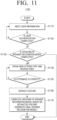
- FIG. 11 is a flowchart illustrating an example process of updating a speaker recognition model through a request for a user to speak 1100.
- step S1110 if user information is input at step S1110, and user authentication is completed again at step S1120-Y, it is identified (determined) whether the updating of a speaker recognition model corresponding to the input user information has been completed at step S1130.
- step S1130-N if the updating of the speaker recognition model has not been completed at step S1130-N, the user is requested to speak unuttered texts, and the voices uttered by a user are received at step S1140.
- the unuttered texts are the remaining texts which do not correspond to the already received voice among a plurality of texts when only voices corresponding to a part of texts are received and used for updating a speaker recognition model although voices corresponding to a plurality of texts need to be received to complete a speaker recognition model.
- a user may be requested to utter a voice, and then the voice may be received.
- the user may be burdened with a large amount of utterances to speak for completion of the speaker recognition model of the user, so that only when the update of the speaker recognition model is completed over 90 percent, a user may be requested to utter and then the voice may be received.
- a user is requested to utter using a guide for prompting user's utterance.
- a voice is received as a result of an utterance request, it may be identified (determined) whether the utterance is correct at step S1150. For example, it may be identified (determined) whether a user correctly utters a voice corresponding to a text that has not been uttered. In other words, it may be identified (determined) whether the result of recognizing the received voice corresponds to the text that has not been uttered.
- the feature of the received voice may be extracted at step S1160.
- the feature of the received voice may be extracted only when the utterance is correct and the feature of the received voice is similar to the feature of the conventional speaker recognition model by a predetermined value or more.
- the updating of the speaker recognition model is completed based on the extracted feature and the final speaker recognition model is generated at step S1170.
- the controlling method for the electronic apparatus in FIGS. 8 to 11 may be performed by the electronic apparatus 100 illustrated and described in FIGS. 3 and 7 , and/or may be performed by a system including the remote control device 300.
- the above-described controlling method may be performed by the electronic apparatus 100 without a display, the external device 200 with a display, and/or the remote control device 300.
- the above-described controlling method may be performed by the electronic apparatus 100 and/or a server (not shown) for transmitting or receiving data to or from the electronic apparatus 100.
- the process of receiving user information from a user and receiving a user voice may be performed by the electronic apparatus 100, and the process of performing user authentication based on the input user information and generating and updating a speaker recognition model based on the received voice may be performed by a server (not shown).
- the server (not shown) may transmit a command signal to provide a guide for prompting user's utterance to the electronic apparatus 100.
- the electronic apparatus 100 may transmit data on the received voice to the server, and the server may identify whose voice the received voice is and transmit the data on the identification result to the electronic apparatus 100.
- not only the process of receiving user information and user voices, but also the process of performing user authentication and providing a guide for prompting a user utterance may be performed by the electronic apparatus 100.
- a guide may be provided to a user after the electronic apparatus 100 performs user authentication, and at the same time, the received voice may be transmitted to a server (not shown) and a speaker recognition model may be generated and updated through the server (not shown).
- a calculation speed and a memory capacity at a predetermined level or more may be necessary for generating and updating a speaker recognition model by analyzing the feature of the received voice and storing the result, and this embodiment uses the server (not shown) in which a calculation speed is relatively outperforming, and data storage capacity is quite available compared to the electronic apparatus 100.
- the embodiments described in this disclosure may be implemented, for example, and without limitation, as application specific integrated circuits (ASICs), digital signal processors (DSPs), digital signal processing devices (DSPDs), programmable logic devices (PLDs) programmable gate arrays, a processor, a controller, a micro-controller, a microprocessor, an electrical unit for performing other functions, or the like.
- ASICs application specific integrated circuits
- DSPs digital signal processors
- DSPDs digital signal processing devices
- PLDs programmable logic devices programmable gate arrays
- processor a controller
- micro-controller a microcontroller
- microprocessor an electrical unit for performing other functions, or the like.
- embodiments described herein may be implemented by a processor 140 itself. According to software implementation, embodiments such as the procedures and functions described herein may be implemented in separate software modules. Each of the software modules may perform one or more of the functions and operations described herein.
- the non-transitory computer readable medium refers to a medium that stores data semi-permanently, and is readable by an apparatus.
- a non-transitory computer readable medium such as a compact disc (CD), a digital versatile disk (DVD), a hard disk, a Blu-ray disk, a universal serial bus (USB) memory stick, a memory card, and a read only memory (ROM).
- the pre-stored text may be a text corresponding to a voice to be received for updating a user-specific speaker recognition model.
- the pre-stored speaker recognition model may be updated based on the received voice.
- a process of updating a speaker recognition model through an utterance request for a user 1100 may be additionally needed other than the process of updating a speaker recognition model without an utterance request for a user 1000.
- the process of updating a speaker recognition model through an utterance request for a user 1100 may be performed at a time when the updating of the speaker recognition model is almost completed to generate a 100 percentage completed final speaker recognition model.
- the process of updating a speaker recognition model through an utterance request for a user 1100 may be useful if a voice corresponding to a specific text among a plurality of texts has not yet been received, or has not been received for a long time although all the voices corresponding to the plurality of pre-stored texts should be received to complete a final speaker recognition model.
- the process of updating a speaker recognition model through an utterance request for a user 1100 may also be useful when a voice having a predetermined time or capacity should be received to complete the final speaker recognition model, but it has not yet been received, and a final speaker recognition model needs to be completed quickly.
- FIG. 11 is a flowchart illustrating an example process of updating a speaker recognition model through a request for a user to speak 1100.
- step S1110 if user information is input at step S1110, and user authentication is completed again at step S1120-Y, it may be identified (determined) whether the updating of a speaker recognition model corresponding to the input user information has been completed at step S1130.
- the user may be requested to speak unuttered texts, and the voices uttered by a user may be received at step S1140.
- the unuttered texts may be the remaining texts which do not correspond to the already received voice among a plurality of texts when only voices corresponding to a part of texts are received and used for updating a speaker recognition model although voices corresponding to a plurality of texts need to be received to complete a speaker recognition model.
- the user may also be asked to utter a voice matching a specific time or an amount needed to complete the speaker recognition model.
- a user may be requested to utter a voice, and then the voice may be received.
- the user may be burdened with a large amount of utterances to speak for completion of the speaker recognition model of the user, so that only when the update of the speaker recognition model is completed over 90 percent, a user may be requested to utter and then the voice may be received.
- a user may be requested to utter using a guide for prompting user's utterance.
- a voice is received as a result of an utterance request, it may be identified (determined) whether the utterance is correct at step S1150. For example, it may be identified (determined) whether a user correctly utters a voice corresponding to a text that has not been uttered. In other words, it may be identified (determined) whether the result of recognizing the received voice corresponds to the text that has not been uttered.
- the feature of the received voice may be extracted at step S1160.
- the feature of the received voice may be extracted only when the utterance is correct and the feature of the received voice is similar to the feature of the conventional speaker recognition model by a predetermined value or more.
- the updating of the speaker recognition model may be completed based on the extracted feature and the final speaker recognition model may be generated at step S1170.
- the controlling method for the electronic apparatus in FIGS. 8 to 11 may be performed by the electronic apparatus 100 illustrated and described in FIGS. 3 and 7 , and/or may be performed by a system including the remote control device 300.
- the above-described controlling method may be performed by the electronic apparatus 100 without a display, the external device 200 with a display, and/or the remote control device 300.
- the above-described controlling method may be performed by the electronic apparatus 100 and/or a server (not shown) for transmitting or receiving data to or from the electronic apparatus 100.
- the process of receiving user information from a user and receiving a user voice may be performed by the electronic apparatus 100, and the process of performing user authentication based on the input user information and generating and updating a speaker recognition model based on the received voice may be performed by a server (not shown).
- the server (not shown) may transmit a command signal to provide a guide for prompting user's utterance to the electronic apparatus 100.
- the electronic apparatus 100 may transmit data on the received voice to the server, and the server may identify whose voice the received voice is and transmit the data on the identification result to the electronic apparatus 100.
- not only the process of receiving user information and user voices, but also the process of performing user authentication and providing a guide for prompting a user utterance may be performed by the electronic apparatus 100.
- a guide may be provided to a user after the electronic apparatus 100 performs user authentication, and at the same time, the received voice may be transmitted to a server (not shown) and a speaker recognition model may be generated and updated through the server (not shown).
- a calculation speed and a memory capacity at a predetermined level or more may be necessary for generating and updating a speaker recognition model by analyzing the feature of the received voice and storing the result, and this embodiment uses the server (not shown) in which a calculation speed is relatively outperforming, and data storage capacity is quite available compared to the electronic apparatus 100.
- the embodiments described in this disclosure may be implemented, for example, and without limitation, as application specific integrated circuits (ASICs), digital signal processors (DSPs), digital signal processing devices (DSPDs), programmable logic devices (PLDs) programmable gate arrays, a processor, a controller, a micro-controller, a microprocessor, an electrical unit for performing other functions, or the like.
- ASICs application specific integrated circuits
- DSPs digital signal processors
- DSPDs digital signal processing devices
- PLDs programmable logic devices programmable gate arrays
- processor a controller
- micro-controller a microcontroller
- microprocessor an electrical unit for performing other functions, or the like.
- embodiments described herein may be implemented by a processor 140 itself. According to software implementation, embodiments such as the procedures and functions described herein may be implemented in separate software modules. Each of the software modules may perform one or more of the functions and operations described herein.
- the non-transitory computer readable medium refers to a medium that stores data semi-permanently, and is readable by an apparatus.
- a non-transitory computer readable medium such as a compact disc (CD), a digital versatile disk (DVD), a hard disk, a Blu-ray disk, a universal serial bus (USB) memory stick, a memory card, and a read only memory (ROM).
Landscapes
- Engineering & Computer Science (AREA)
- Physics & Mathematics (AREA)
- Audiology, Speech & Language Pathology (AREA)
- Human Computer Interaction (AREA)
- Acoustics & Sound (AREA)
- Multimedia (AREA)
- Health & Medical Sciences (AREA)
- Computer Security & Cryptography (AREA)
- Theoretical Computer Science (AREA)
- Computer Vision & Pattern Recognition (AREA)
- Computer Hardware Design (AREA)
- Software Systems (AREA)
- General Engineering & Computer Science (AREA)
- General Physics & Mathematics (AREA)
- Computational Linguistics (AREA)
- Game Theory and Decision Science (AREA)
- Business, Economics & Management (AREA)
- User Interface Of Digital Computer (AREA)
Claims (9)
- Elektronische Vorrichtung (100), umfassend:ein Eingabegerät, das eine Eingangsschaltung umfasst;einen Sprachempfänger (120), der eine Sprachempfangsschaltung umfasst;einen Speicher (130), der so konfiguriert ist, dass er eine Vielzahl von Texten speichert, die zur Vervollständigung eines Sprechererkennungsmodells vorgegeben sind; undeinen Prozessor (140), der dazu konfiguriert ist:basierend auf der Benutzerauthentifizierung bezüglich eines Benutzers, die gemäß den über das Eingabegerät eingegebenen Benutzerinformationen durchgeführt wird,einen Text aus der Vielzahl von Texten bereitzustellen, um einen Benutzer zur Äußerung eines Textes aufzufordern,das dem Benutzer entsprechende Sprechererkennungsmodell auf der Grundlage einer Stimme zu erzeugen, die dem bereitgestellten Text entspricht, der über den Sprachempfänger (120) empfangen wird, und um das Sprechererkennungsmodell im Speicher (130) zu speichern,basierend auf der erneuten Durchführung einer Benutzerauthentifizierung bezüglich des Benutzers entsprechend den über das Eingabegerät neu eingegebenen Benutzerinformationen, zu identifizieren, ob die Aktualisierung des Sprechererkennungsmodells, das den Benutzerinformationen entspricht, abgeschlossen wurde, basierend darauf, ob Stimmen empfangen wurden, die allen Texten aus der Vielzahl von Texten entsprechen, die zum Vervollständigen eines Sprechererkennungsmodells vorgegeben sind;basierend darauf, dass die Aktualisierung des Sprechererkennungsmodells noch nicht abgeschlossen ist, aus der Vielzahl von Texten einen Text bereitzustellen, der vom Benutzer nicht geäußert wurde, um eine Äußerung eines Textes durch den Benutzer zu veranlassen, und das Sprechererkennungsmodell zu aktualisieren;wobei das Sprechererkennungsmodell basierend auf einem Merkmalswert einer über den Sprachempfänger (120) empfangenen Stimme aktualisiert wird, der dem Sprechererkennungsmodell um einen vorbestimmten Schwellenwert ähnelt;basierend auf dem Abschluss der Aktualisierung des Sprechererkennungsmodells, ein endgültiges Sprechererkennungsmodell bereitzustellen, das den Benutzerinformationen entspricht, undeinen Benutzer, der einer über den Sprachempfänger (120) empfangenen Stimme entspricht, basierend auf dem endgültigen Sprechererkennungsmodell zu identifizieren.
- Elektronische Vorrichtung (100) nach Anspruch 1, wobei der Prozessor (140) ferner dazu konfiguriert ist:basierend auf einer Stimme, die über den Sprachempfänger (120) empfangen wird, während ein Spracherkennungsdienst bereitgestellt wird, zu bestimmen, ob das im Speicher (130) gespeicherte Sprechererkennungsmodell und der Merkmalswert der empfangenen Stimme eine Ähnlichkeit aufweisen, die gleich oder größer als ein vorgegebener Schwellenwert ist, undbasierend darauf, dass die Ähnlichkeit größer als der vorgegebene Schwellenwert ist, das im Speicher (130) gespeicherte Sprechererkennungsmodell basierend auf dem Merkmalswert der empfangenen Stimme zu aktualisieren.
- Elektronische Vorrichtung (100) nach Anspruch 3, wobei der Prozessor (140) weiterhin dazu konfiguriert ist, das im Speicher (130) gespeicherte Sprechererkennungsmodell basierend auf dem Merkmalswert der empfangenen Stimme basierend darauf, dass ein Text, der der über den Sprachempfänger (120) empfangenen Stimme entspricht, in die Vielzahl von im Speicher (130) gespeicherten Texten aufgenommen wird, zu aktualisieren, während der Spracherkennungsdienst bereitgestellt wird.
- Elektronische Vorrichtung (100) nach Anspruch 1, wobei der Prozessor (140) weiterhin dazu konfiguriert ist, eine Benutzerschnittstelle, die einen Aktualisierungsfortschritt des Sprechererkennungsmodells anzeigt, basierend auf der Benutzerauthentifizierung bereitzustellen, die auf der Grundlage der Benutzerinformationen durchgeführt wird.
- Elektronische Vorrichtung (100) nach Anspruch 1, wobei der Prozessor (140) weiterhin dazu konfiguriert ist, basierend auf der Durchführung der Benutzerauthentifizierung basierend auf den Benutzerinformationen, die über das Eingabegerät eingegeben werden, zu identifizieren, ob ein den Benutzerinformationen entsprechendes Sprechererkennungsmodell im Speicher (130) gespeichert ist, und
einen Leitfaden bereitzustellen, der eine Benutzeroberfläche zum Auswählen enthält, ob das den Benutzerinformationen entsprechende Sprechererkennungsmodell bereitgestellt werden soll, basierend darauf, dass das den Benutzerinformationen entsprechende Sprechererkennungsmodell nicht im Speicher (130) gespeichert ist. - Elektronische Vorrichtung (100) nach Anspruch 1, wobei der Prozessor (140) weiterhin dazu konfiguriert ist:einen Text aus der Vielzahl von Texten bereitzustellen, um einen bestimmten Benutzer zu einer Äußerung anzuregen, basierend auf der anfänglichen Anmeldung des bestimmten Benutzers, basierend auf den Benutzerinformationen, die über das Eingabegerät eingegeben wurden,ein Sprechererkennungsmodell, das dem spezifischen Benutzer entspricht, basierend auf einer Stimme zu erzeugen, die durch den Sprachempfänger (120) entsprechend dem bereitgestellten Text empfangen wird, und um das Sprechererkennungsmodell im Speicher (130) zu speichern, unddas Sprechererkennungsmodell zu aktualisieren, indem das im Speicher (130) gespeicherte Sprechererkennungsmodell mit einer über den Sprachempfänger (120) empfangenen Stimme verglichen wird, während ein Spracherkennungsdienst bereitgestellt wird, wenn der bestimmte Benutzer angemeldet ist.
- Verfahren zum Steuern einer elektronischen Vorrichtung (100), wobei das Verfahren Folgendes umfasst:Speichern einer Vielzahl von vorab festgelegten Texten, um ein Sprechererkennungsmodell zu vervollständigen;basierend auf der Benutzerauthentifizierung bezüglich eines Benutzers, die gemäß der Benutzerinformationseingabe durchgeführt wird, Bereitstellen eines Textes aus der Vielzahl von Texten, der einen Benutzer zur Äußerung eines Textes auffordert; Erzeugen und Speichern des Sprechererkennungsmodells, das dem Benutzer entspricht, basierend auf einer Stimme, die dem bereitgestellten Text entspricht, der über einen Sprachempfänger (120) empfangen wird; und Aktualisieren des Sprechererkennungsmodells durch:basierend auf einer erneuten Benutzerauthentifizierung bezüglich des Benutzers entsprechend den neu eingegebenen Benutzerinformationen, Identifizieren, ob die Aktualisierung des Sprechererkennungsmodells, das den Benutzerinformationen entspricht, abgeschlossen wurde, basierend darauf, ob Stimmen empfangen wurden, die allen Texten der Vielzahl von Texten entsprechen, die zur Vervollständigung eines Sprechererkennungsmodells vorgegeben sind, basierend darauf, dass die Aktualisierung des Sprechererkennungsmodells noch nicht abgeschlossen ist, Bereitstellen eines vom Benutzer nicht geäußerten Textes aus der Vielzahl von Texten, um den Benutzer zur Äußerung eines Textes zu veranlassen, und Aktualisieren des Sprechererkennungsmodells,wobei das Aktualisieren des Sprechererkennungsmodells das Vergleichen einer über den Sprachempfänger (120) empfangenen Stimme mit dem Sprechererkennungsmodell und Aktualisieren des Sprechererkennungsmodells basierend auf einem Merkmalswert einer über den Sprachempfänger (120) empfangenen Stimme umfasst, der dem Sprechererkennungsmodell um einen vorbestimmten Schwellenwert ähnelt;basierend auf dem Abschluss der Aktualisierung des Sprechererkennungsmodells, Bereitstellen eines endgültigen Sprechererkennungsmodells, das den Benutzerinformationen entspricht, undIdentifizieren eines Benutzers, der einer über den Sprachempfänger (120) empfangenen Stimme entspricht, basierend auf dem endgültigen Sprechererkennungsmodell.
- Verfahren nach Anspruch 7,
wobei das Aktualisieren des Sprechererkennungsmodells Folgendes umfasst:Bestimmen, ob das gespeicherte Sprechererkennungsmodell und ein Merkmalswert einer über den Sprachempfänger (120) empfangenen Stimme eine Ähnlichkeit aufweisen, die gleich oder größer als ein vorgegebener Schwellenwert ist, basierend auf der Stimme, die während einer Stimme über den Sprachempfänger (120) empfangen wird Anerkennungsdienst bereitgestellt wird, undAktualisieren des gespeicherten Sprechererkennungsmodells basierend auf dem Merkmalswert der empfangenen Stimme basierend darauf, dass die Ähnlichkeit gleich oder größer als der vorgegebene Schwellenwert ist. - Verfahren nach Anspruch 8,
wobei das Aktualisieren des Sprechererkennungsmodells Folgendes umfasst:
Aktualisieren des gespeicherten Sprechererkennungsmodells basierend auf dem Merkmalswert der empfangenen Stimme basierend auf einem Text, der der über den Sprachempfänger (120) empfangenen Stimme entspricht und in der Vielzahl von Texten enthalten ist, während der Spracherkennungsdienst bereitgestellt wird.
Applications Claiming Priority (1)
| Application Number | Priority Date | Filing Date | Title |
|---|---|---|---|
| KR1020180059901A KR102595184B1 (ko) | 2018-05-25 | 2018-05-25 | 전자 장치, 전자 장치의 제어 방법 및 컴퓨터 판독 가능 매체 |
Publications (3)
| Publication Number | Publication Date |
|---|---|
| EP3573054A1 EP3573054A1 (de) | 2019-11-27 |
| EP3573054B1 true EP3573054B1 (de) | 2023-12-13 |
| EP3573054C0 EP3573054C0 (de) | 2023-12-13 |
Family
ID=66589256
Family Applications (1)
| Application Number | Title | Priority Date | Filing Date |
|---|---|---|---|
| EP19174786.4A Active EP3573054B1 (de) | 2018-05-25 | 2019-05-16 | Elektronische vorrichtung, steuerungsverfahren und computerlesbares medium |
Country Status (4)
| Country | Link |
|---|---|
| US (1) | US11200904B2 (de) |
| EP (1) | EP3573054B1 (de) |
| KR (1) | KR102595184B1 (de) |
| WO (1) | WO2019225892A1 (de) |
Families Citing this family (6)
| Publication number | Priority date | Publication date | Assignee | Title |
|---|---|---|---|---|
| CN110858479B (zh) * | 2018-08-08 | 2022-04-22 | Oppo广东移动通信有限公司 | 语音识别模型更新方法、装置、存储介质及电子设备 |
| KR20220040875A (ko) * | 2020-09-24 | 2022-03-31 | 삼성전자주식회사 | 음성 인식 서비스를 위한 등록 사용자에 대한 화자 인증 학습 장치 및 그 동작 방법 |
| WO2023101000A1 (ja) * | 2021-12-03 | 2023-06-08 | パナソニックIpマネジメント株式会社 | 音声登録装置および音声登録方法 |
| EP4443429A4 (de) * | 2021-12-03 | 2025-02-26 | Panasonic Intellectual Property Management Co., Ltd. | Sprachregistrierungsvorrichtung und sprachregistrierungsverfahren |
| CN114648978B (zh) * | 2022-04-27 | 2024-08-16 | 腾讯科技(深圳)有限公司 | 一种语音验证处理的方法以及相关装置 |
| KR102626108B1 (ko) * | 2023-07-24 | 2024-01-17 | 주식회사 마키나락스 | 인공지능 플랫폼에서 사용자를 인증하는 방법 |
Family Cites Families (32)
| Publication number | Priority date | Publication date | Assignee | Title |
|---|---|---|---|---|
| US6766295B1 (en) * | 1999-05-10 | 2004-07-20 | Nuance Communications | Adaptation of a speech recognition system across multiple remote sessions with a speaker |
| US6356868B1 (en) * | 1999-10-25 | 2002-03-12 | Comverse Network Systems, Inc. | Voiceprint identification system |
| US6751590B1 (en) * | 2000-06-13 | 2004-06-15 | International Business Machines Corporation | Method and apparatus for performing pattern-specific maximum likelihood transformations for speaker recognition |
| US6941264B2 (en) * | 2001-08-16 | 2005-09-06 | Sony Electronics Inc. | Retraining and updating speech models for speech recognition |
| JP4440502B2 (ja) | 2001-08-31 | 2010-03-24 | 富士通株式会社 | 話者認証システム及び方法 |
| KR100641013B1 (ko) | 2005-10-04 | 2006-11-02 | 삼성전자주식회사 | 이동통신 단말기에서 사용자 인증을 위한 화자음성정보갱신방법 |
| US7761384B2 (en) * | 2006-03-16 | 2010-07-20 | Sushil Madhogarhia | Strategy-driven methodology for reducing identity theft |
| JP2008058452A (ja) | 2006-08-30 | 2008-03-13 | Pioneer Electronic Corp | 音声情報認証装置及び音声情報認証方法 |
| US8099288B2 (en) * | 2007-02-12 | 2012-01-17 | Microsoft Corp. | Text-dependent speaker verification |
| JP4897040B2 (ja) * | 2007-03-14 | 2012-03-14 | パイオニア株式会社 | 音響モデル登録装置、話者認識装置、音響モデル登録方法及び音響モデル登録処理プログラム |
| US8332223B2 (en) * | 2008-10-24 | 2012-12-11 | Nuance Communications, Inc. | Speaker verification methods and apparatus |
| US8190437B2 (en) * | 2008-10-24 | 2012-05-29 | Nuance Communications, Inc. | Speaker verification methods and apparatus |
| US8209174B2 (en) * | 2009-04-17 | 2012-06-26 | Saudi Arabian Oil Company | Speaker verification system |
| JP2011064913A (ja) | 2009-09-16 | 2011-03-31 | Ntt Docomo Inc | 電話システム、端末装置、音声モデル更新装置、および音声モデル更新方法 |
| US9257121B2 (en) * | 2010-12-10 | 2016-02-09 | Panasonic Intellectual Property Corporation Of America | Device and method for pass-phrase modeling for speaker verification, and verification system |
| KR20140086853A (ko) | 2012-12-27 | 2014-07-08 | 전자부품연구원 | 음성 데이터 분석을 통한 화자기반 콘텐츠 관리 장치 및 방법 |
| US9343068B2 (en) | 2013-09-16 | 2016-05-17 | Qualcomm Incorporated | Method and apparatus for controlling access to applications having different security levels |
| US8812320B1 (en) * | 2014-04-01 | 2014-08-19 | Google Inc. | Segment-based speaker verification using dynamically generated phrases |
| US10540979B2 (en) * | 2014-04-17 | 2020-01-21 | Qualcomm Incorporated | User interface for secure access to a device using speaker verification |
| US10296733B2 (en) * | 2014-07-14 | 2019-05-21 | Friday Harbor Llc | Access code obfuscation using speech input |
| KR102246900B1 (ko) | 2014-07-29 | 2021-04-30 | 삼성전자주식회사 | 전자 장치 및 이의 음성 인식 방법 |
| KR102287739B1 (ko) | 2014-10-23 | 2021-08-09 | 주식회사 케이티 | 음성 검색 시 입력된 음성 데이터를 누적하여 화자를 인식하는 시스템, 방법 및 컴퓨팅 장치 |
| KR102371697B1 (ko) | 2015-02-11 | 2022-03-08 | 삼성전자주식회사 | 음성 기능 운용 방법 및 이를 지원하는 전자 장치 |
| KR101618512B1 (ko) | 2015-05-06 | 2016-05-09 | 서울시립대학교 산학협력단 | 가우시안 혼합모델을 이용한 화자 인식 시스템 및 추가 학습 발화 선택 방법 |
| US10008199B2 (en) * | 2015-08-22 | 2018-06-26 | Toyota Motor Engineering & Manufacturing North America, Inc. | Speech recognition system with abbreviated training |
| KR102443087B1 (ko) * | 2015-09-23 | 2022-09-14 | 삼성전자주식회사 | 전자 기기 및 그의 음성 인식 방법 |
| KR102596430B1 (ko) * | 2016-08-31 | 2023-10-31 | 삼성전자주식회사 | 화자 인식에 기초한 음성 인식 방법 및 장치 |
| US9786271B1 (en) * | 2016-09-28 | 2017-10-10 | International Business Machines Corporation | Voice pattern coding sequence and cataloging voice matching system |
| KR102604319B1 (ko) * | 2016-11-01 | 2023-11-24 | 한국전자통신연구원 | 화자 인증 시스템 및 그 방법 |
| US10878825B2 (en) * | 2018-03-21 | 2020-12-29 | Cirrus Logic, Inc. | Biometric processes |
| US10720166B2 (en) * | 2018-04-09 | 2020-07-21 | Synaptics Incorporated | Voice biometrics systems and methods |
| US10909991B2 (en) * | 2018-04-24 | 2021-02-02 | ID R&D, Inc. | System for text-dependent speaker recognition and method thereof |
-
2018
- 2018-05-25 KR KR1020180059901A patent/KR102595184B1/ko active Active
-
2019
- 2019-05-10 WO PCT/KR2019/005661 patent/WO2019225892A1/en not_active Ceased
- 2019-05-10 US US16/409,008 patent/US11200904B2/en active Active
- 2019-05-16 EP EP19174786.4A patent/EP3573054B1/de active Active
Also Published As
| Publication number | Publication date |
|---|---|
| US20190362726A1 (en) | 2019-11-28 |
| EP3573054C0 (de) | 2023-12-13 |
| EP3573054A1 (de) | 2019-11-27 |
| KR102595184B1 (ko) | 2023-10-30 |
| KR20190134366A (ko) | 2019-12-04 |
| US11200904B2 (en) | 2021-12-14 |
| WO2019225892A1 (en) | 2019-11-28 |
Similar Documents
| Publication | Publication Date | Title |
|---|---|---|
| EP3573054B1 (de) | Elektronische vorrichtung, steuerungsverfahren und computerlesbares medium | |
| KR102483834B1 (ko) | 음성 명령을 이용한 사용자 인증 방법 및 전자 장치 | |
| US12080280B2 (en) | Systems and methods for determining whether to trigger a voice capable device based on speaking cadence | |
| KR102245747B1 (ko) | 사용자 명령어 등록을 위한 디스플레이 장치 및 방법 | |
| EP2674941B1 (de) | Endgerätevorrichtung und Steuerverfahren dafür | |
| US9245521B2 (en) | Method for correcting voice recognition error and broadcast receiving apparatus applying the same | |
| US20150279369A1 (en) | Display apparatus and user interaction method thereof | |
| US20150194167A1 (en) | Display apparatus which operates in response to voice commands and control method thereof | |
| US9653073B2 (en) | Voice input correction | |
| US10276151B2 (en) | Electronic apparatus and method for controlling the electronic apparatus | |
| US20160182950A1 (en) | Identification of a user for personalized media content presentation | |
| US11437046B2 (en) | Electronic apparatus, controlling method of electronic apparatus and computer readable medium | |
| US20240404523A1 (en) | Electronic device and voice recognition method thereof | |
| EP2916283A2 (de) | Anzeigevorrichtung und Steuerungsverfahren dafür | |
| CN111225284A (zh) | 电视系统及控制电视系统的方法 | |
| US20170287479A1 (en) | Control device, control method, program and information storage medium | |
| US11942089B2 (en) | Electronic apparatus for recognizing voice and method of controlling the same | |
| KR102662571B1 (ko) | 전자 장치, 제어 방법 및 컴퓨터 판독 가능 매체 | |
| US20250260686A1 (en) | Electronic device and system including same | |
| KR20140026220A (ko) | 단말 장치 및 단말 장치의 제어 방법 | |
| US20250227328A1 (en) | Television Use Assessment System | |
| CN113038212B (zh) | 一种电视控制方法、电视以及存储介质 | |
| JP2005004032A (ja) | 音声認識装置及び音声認識方法 | |
| KR20220143801A (ko) | 사용자 명령어 등록을 위한 디스플레이 장치 및 방법 | |
| US20140085187A1 (en) | Display apparatus and control method thereof |
Legal Events
| Date | Code | Title | Description |
|---|---|---|---|
| PUAI | Public reference made under article 153(3) epc to a published international application that has entered the european phase |
Free format text: ORIGINAL CODE: 0009012 |
|
| STAA | Information on the status of an ep patent application or granted ep patent |
Free format text: STATUS: THE APPLICATION HAS BEEN PUBLISHED |
|
| AK | Designated contracting states |
Kind code of ref document: A1 Designated state(s): AL AT BE BG CH CY CZ DE DK EE ES FI FR GB GR HR HU IE IS IT LI LT LU LV MC MK MT NL NO PL PT RO RS SE SI SK SM TR |
|
| AX | Request for extension of the european patent |
Extension state: BA ME |
|
| STAA | Information on the status of an ep patent application or granted ep patent |
Free format text: STATUS: REQUEST FOR EXAMINATION WAS MADE |
|
| 17P | Request for examination filed |
Effective date: 20200210 |
|
| RBV | Designated contracting states (corrected) |
Designated state(s): AL AT BE BG CH CY CZ DE DK EE ES FI FR GB GR HR HU IE IS IT LI LT LU LV MC MK MT NL NO PL PT RO RS SE SI SK SM TR |
|
| STAA | Information on the status of an ep patent application or granted ep patent |
Free format text: STATUS: EXAMINATION IS IN PROGRESS |
|
| 17Q | First examination report despatched |
Effective date: 20210413 |
|
| GRAP | Despatch of communication of intention to grant a patent |
Free format text: ORIGINAL CODE: EPIDOSNIGR1 |
|
| STAA | Information on the status of an ep patent application or granted ep patent |
Free format text: STATUS: GRANT OF PATENT IS INTENDED |
|
| INTG | Intention to grant announced |
Effective date: 20230713 |
|
| GRAS | Grant fee paid |
Free format text: ORIGINAL CODE: EPIDOSNIGR3 |
|
| GRAA | (expected) grant |
Free format text: ORIGINAL CODE: 0009210 |
|
| STAA | Information on the status of an ep patent application or granted ep patent |
Free format text: STATUS: THE PATENT HAS BEEN GRANTED |
|
| AK | Designated contracting states |
Kind code of ref document: B1 Designated state(s): AL AT BE BG CH CY CZ DE DK EE ES FI FR GB GR HR HU IE IS IT LI LT LU LV MC MK MT NL NO PL PT RO RS SE SI SK SM TR |
|
| REG | Reference to a national code |
Ref country code: GB Ref legal event code: FG4D |
|
| REG | Reference to a national code |
Ref country code: CH Ref legal event code: EP |
|
| REG | Reference to a national code |
Ref country code: DE Ref legal event code: R096 Ref document number: 602019043106 Country of ref document: DE |
|
| REG | Reference to a national code |
Ref country code: IE Ref legal event code: FG4D |
|
| U01 | Request for unitary effect filed |
Effective date: 20231214 |
|
| U07 | Unitary effect registered |
Designated state(s): AT BE BG DE DK EE FI FR IT LT LU LV MT NL PT SE SI Effective date: 20231221 |
|
| PG25 | Lapsed in a contracting state [announced via postgrant information from national office to epo] |
Ref country code: GR Free format text: LAPSE BECAUSE OF FAILURE TO SUBMIT A TRANSLATION OF THE DESCRIPTION OR TO PAY THE FEE WITHIN THE PRESCRIBED TIME-LIMIT Effective date: 20240314 |
|
| PG25 | Lapsed in a contracting state [announced via postgrant information from national office to epo] |
Ref country code: ES Free format text: LAPSE BECAUSE OF FAILURE TO SUBMIT A TRANSLATION OF THE DESCRIPTION OR TO PAY THE FEE WITHIN THE PRESCRIBED TIME-LIMIT Effective date: 20231213 |
|
| PG25 | Lapsed in a contracting state [announced via postgrant information from national office to epo] |
Ref country code: GR Free format text: LAPSE BECAUSE OF FAILURE TO SUBMIT A TRANSLATION OF THE DESCRIPTION OR TO PAY THE FEE WITHIN THE PRESCRIBED TIME-LIMIT Effective date: 20240314 Ref country code: ES Free format text: LAPSE BECAUSE OF FAILURE TO SUBMIT A TRANSLATION OF THE DESCRIPTION OR TO PAY THE FEE WITHIN THE PRESCRIBED TIME-LIMIT Effective date: 20231213 |
|
| U20 | Renewal fee for the european patent with unitary effect paid |
Year of fee payment: 6 Effective date: 20240423 |
|
| PG25 | Lapsed in a contracting state [announced via postgrant information from national office to epo] |
Ref country code: RS Free format text: LAPSE BECAUSE OF FAILURE TO SUBMIT A TRANSLATION OF THE DESCRIPTION OR TO PAY THE FEE WITHIN THE PRESCRIBED TIME-LIMIT Effective date: 20231213 Ref country code: NO Free format text: LAPSE BECAUSE OF FAILURE TO SUBMIT A TRANSLATION OF THE DESCRIPTION OR TO PAY THE FEE WITHIN THE PRESCRIBED TIME-LIMIT Effective date: 20240313 Ref country code: HR Free format text: LAPSE BECAUSE OF FAILURE TO SUBMIT A TRANSLATION OF THE DESCRIPTION OR TO PAY THE FEE WITHIN THE PRESCRIBED TIME-LIMIT Effective date: 20231213 |
|
| PG25 | Lapsed in a contracting state [announced via postgrant information from national office to epo] |
Ref country code: IS Free format text: LAPSE BECAUSE OF FAILURE TO SUBMIT A TRANSLATION OF THE DESCRIPTION OR TO PAY THE FEE WITHIN THE PRESCRIBED TIME-LIMIT Effective date: 20240413 |
|
| PG25 | Lapsed in a contracting state [announced via postgrant information from national office to epo] |
Ref country code: CZ Free format text: LAPSE BECAUSE OF FAILURE TO SUBMIT A TRANSLATION OF THE DESCRIPTION OR TO PAY THE FEE WITHIN THE PRESCRIBED TIME-LIMIT Effective date: 20231213 |
|
| PG25 | Lapsed in a contracting state [announced via postgrant information from national office to epo] |
Ref country code: SK Free format text: LAPSE BECAUSE OF FAILURE TO SUBMIT A TRANSLATION OF THE DESCRIPTION OR TO PAY THE FEE WITHIN THE PRESCRIBED TIME-LIMIT Effective date: 20231213 |
|
| PG25 | Lapsed in a contracting state [announced via postgrant information from national office to epo] |
Ref country code: SM Free format text: LAPSE BECAUSE OF FAILURE TO SUBMIT A TRANSLATION OF THE DESCRIPTION OR TO PAY THE FEE WITHIN THE PRESCRIBED TIME-LIMIT Effective date: 20231213 Ref country code: SK Free format text: LAPSE BECAUSE OF FAILURE TO SUBMIT A TRANSLATION OF THE DESCRIPTION OR TO PAY THE FEE WITHIN THE PRESCRIBED TIME-LIMIT Effective date: 20231213 Ref country code: RO Free format text: LAPSE BECAUSE OF FAILURE TO SUBMIT A TRANSLATION OF THE DESCRIPTION OR TO PAY THE FEE WITHIN THE PRESCRIBED TIME-LIMIT Effective date: 20231213 Ref country code: IS Free format text: LAPSE BECAUSE OF FAILURE TO SUBMIT A TRANSLATION OF THE DESCRIPTION OR TO PAY THE FEE WITHIN THE PRESCRIBED TIME-LIMIT Effective date: 20240413 Ref country code: CZ Free format text: LAPSE BECAUSE OF FAILURE TO SUBMIT A TRANSLATION OF THE DESCRIPTION OR TO PAY THE FEE WITHIN THE PRESCRIBED TIME-LIMIT Effective date: 20231213 |
|
| PG25 | Lapsed in a contracting state [announced via postgrant information from national office to epo] |
Ref country code: PL Free format text: LAPSE BECAUSE OF FAILURE TO SUBMIT A TRANSLATION OF THE DESCRIPTION OR TO PAY THE FEE WITHIN THE PRESCRIBED TIME-LIMIT Effective date: 20231213 |
|
| PG25 | Lapsed in a contracting state [announced via postgrant information from national office to epo] |
Ref country code: PL Free format text: LAPSE BECAUSE OF FAILURE TO SUBMIT A TRANSLATION OF THE DESCRIPTION OR TO PAY THE FEE WITHIN THE PRESCRIBED TIME-LIMIT Effective date: 20231213 |
|
| REG | Reference to a national code |
Ref country code: DE Ref legal event code: R097 Ref document number: 602019043106 Country of ref document: DE |
|
| PLBE | No opposition filed within time limit |
Free format text: ORIGINAL CODE: 0009261 |
|
| STAA | Information on the status of an ep patent application or granted ep patent |
Free format text: STATUS: NO OPPOSITION FILED WITHIN TIME LIMIT |
|
| 26N | No opposition filed |
Effective date: 20240916 |
|
| REG | Reference to a national code |
Ref country code: CH Ref legal event code: PL |
|
| PG25 | Lapsed in a contracting state [announced via postgrant information from national office to epo] |
Ref country code: MC Free format text: LAPSE BECAUSE OF FAILURE TO SUBMIT A TRANSLATION OF THE DESCRIPTION OR TO PAY THE FEE WITHIN THE PRESCRIBED TIME-LIMIT Effective date: 20231213 |
|
| PG25 | Lapsed in a contracting state [announced via postgrant information from national office to epo] |
Ref country code: MC Free format text: LAPSE BECAUSE OF FAILURE TO SUBMIT A TRANSLATION OF THE DESCRIPTION OR TO PAY THE FEE WITHIN THE PRESCRIBED TIME-LIMIT Effective date: 20231213 Ref country code: CH Free format text: LAPSE BECAUSE OF NON-PAYMENT OF DUE FEES Effective date: 20240531 |
|
| PG25 | Lapsed in a contracting state [announced via postgrant information from national office to epo] |
Ref country code: IE Free format text: LAPSE BECAUSE OF NON-PAYMENT OF DUE FEES Effective date: 20240516 |
|
| U20 | Renewal fee for the european patent with unitary effect paid |
Year of fee payment: 7 Effective date: 20250523 |
|
| PG25 | Lapsed in a contracting state [announced via postgrant information from national office to epo] |
Ref country code: CY Free format text: LAPSE BECAUSE OF FAILURE TO SUBMIT A TRANSLATION OF THE DESCRIPTION OR TO PAY THE FEE WITHIN THE PRESCRIBED TIME-LIMIT; INVALID AB INITIO Effective date: 20190516 |
|
| PG25 | Lapsed in a contracting state [announced via postgrant information from national office to epo] |
Ref country code: HU Free format text: LAPSE BECAUSE OF FAILURE TO SUBMIT A TRANSLATION OF THE DESCRIPTION OR TO PAY THE FEE WITHIN THE PRESCRIBED TIME-LIMIT; INVALID AB INITIO Effective date: 20190516 |
|
| PGFP | Annual fee paid to national office [announced via postgrant information from national office to epo] |
Ref country code: GB Payment date: 20260324 Year of fee payment: 8 |