EP3573258B1 - Système de réseau optique passif, et composant optique et son procédé de réglage d'impédance d'adaptation - Google Patents
Système de réseau optique passif, et composant optique et son procédé de réglage d'impédance d'adaptation Download PDFInfo
- Publication number
- EP3573258B1 EP3573258B1 EP17899120.4A EP17899120A EP3573258B1 EP 3573258 B1 EP3573258 B1 EP 3573258B1 EP 17899120 A EP17899120 A EP 17899120A EP 3573258 B1 EP3573258 B1 EP 3573258B1
- Authority
- EP
- European Patent Office
- Prior art keywords
- optical
- parameter
- scattering
- optical component
- scattering parameter
- Prior art date
- Legal status (The legal status is an assumption and is not a legal conclusion. Google has not performed a legal analysis and makes no representation as to the accuracy of the status listed.)
- Active
Links
Images


Classifications
-
- H—ELECTRICITY
- H04—ELECTRIC COMMUNICATION TECHNIQUE
- H04B—TRANSMISSION
- H04B10/00—Transmission systems employing electromagnetic waves other than radio-waves, e.g. infrared, visible or ultraviolet light, or employing corpuscular radiation, e.g. quantum communication
- H04B10/40—Transceivers
Definitions
- the present invention relates to the field of optical communications technologies, and in particular, to a passive optical network system, an optical assembly, and a method for adjusting matched impedance of the optical assembly.
- a pluggable connection is formed between an optical module and a connector on a communications board by using an edge connector.
- the optical module includes optical components and electronic chips such as a bidirectional optical subassembly (Bidirectional Optical Sub Assembly, BOSA), a laser diode driver (Laser Diode Driver, LDD), a limiting amplifier (Limiting Amplifier, LA), a micro controller (Micro Control Unit, MCU), an avalanche photodiode (Avalanche Photodiode, APD) bias chip, and a thermoelectric cooler (Thermoelectric Cooler, TEC) controller, as shown in FIG. 1 .
- BOSA bidirectional optical subassembly
- LDD Laser Diode Driver
- LA Limit Amplifier
- MCU Micro Control Unit
- APD avalanche photodiode
- APD avalanche Photodiode
- TEC thermoelectric Cooler
- optical module As a rate of the optical module increases, new functions are implemented, and a quantity of channels increases, power consumption of the optical module continuously increases.
- power consumption supported by conventional optical modules such as a small form-factor pluggable (Small Form Factor Pluggable, SFP) transceiver and a 10 Gigabit small form-factor pluggable (10 Gigabit Small Form Factor Pluggable, XFP) transceiver is limited.
- SFP Small Form Factor Pluggable
- XFP 10 Gigabit Small Form Factor Pluggable
- optical module manufacturers have to bear higher costs.
- manufacturers of devices that use the optical modules cannot design communications boards based on optimal performance of the devices. Consequently, optimal capabilities of the communications boards cannot be fully exerted, increasing costs for the device manufacturers
- An optical assembly according to the state of the art is known from CN-A-106059673 .
- Embodiments of the present invention provide a passive optical network system, an optical assembly, and a method for adjusting matched impedance of the optical assembly, to reduce power consumption of an optical module in the optical assembly and improve a port density of a communications board in the optical assembly, thereby improving resource utilization of the passive optical network system.
- a first aspect of the embodiments of the present invention provides an optical assembly, including an optical module and a communications board.
- An optical component, a first memory, and an edge connector connected to the optical component and the first memory are disposed on the optical module, and the first memory is configured to store a first scattering parameter of the optical module and an operating parameter of the optical component.
- a connector, and an electronic chip and a matching network that correspond to the optical component are disposed on the communications board, and the optical module is connected to the connector by using the edge connector.
- the electronic chip includes a micro controller and a laser diode driver.
- the micro controller is electrically connected to the laser diode driver and the matching network, the laser diode driver is connected to the connector via the matching network, and the communications board stores a second scattering parameter that is between the laser diode driver and the connector.
- the micro controller is configured to: read the first scattering parameter from the first memory, calculate a third scattering parameter that is between the laser diode driver and the optical module based on the first scattering parameter and the second scattering parameter, and further adjust matched impedance of the matching network based on the third scattering parameter.
- the electronic chip corresponding to the optical component is disposed on the communications board. This helps reduce power consumption of the optical module and improve port density of the communications board, thereby improving resource utilization.
- the operating parameter of the optical component and the first scattering parameter of the optical module are stored in the first memory of the optical module.
- the third scattering parameter that is between the laser diode driver and the optical module is calculated by reading the first scattering parameter stored in the first memory and the second scattering parameter that is between the laser diode driver and the connector and that is stored on the communications board, and then the matched impedance of the matching network is adjusted based on the third scattering parameter. Therefore, the matched impedance of the matching network can be adjusted based on different optical modules, to enable matched impedance between the laser diode driver and the optical module to meet an impedance matching requirement, thereby improving signal quality of the optical assembly.
- the electronic chip further includes: an avalanche photodiode bias chip, configured to provide a bias voltage for the optical component; a limiting amplifier, configured to amplify a signal received by the optical component; and a thermoelectric cooler control chip, configured to provide a cooling current or a heating current for the optical module.
- an avalanche photodiode bias chip configured to provide a bias voltage for the optical component
- a limiting amplifier configured to amplify a signal received by the optical component
- a thermoelectric cooler control chip configured to provide a cooling current or a heating current for the optical module.
- the operating parameter of the optical component includes a bias current, a modulated current, a modulated voltage, an operating temperature, and a backlight diode current; the micro controller is further configured to: read the operating parameter from the first memory and configure the laser diode driver and the limiting amplifier based on the operating parameter; and the laser diode driver is configured to drive the optical component to transmit an optical signal.
- the calculating a third scattering parameter that is between the laser diode driver and the optical module based on the first scattering parameter and the second scattering parameter includes: converting the first scattering parameter into a corresponding first scattering transmission parameter, and converting the second scattering parameter into a second scattering transmission parameter; multiplying the first scattering transmission parameter by the second scattering transmission parameter, to obtain a third scattering transmission parameter; and converting the third scattering transmission parameter into the corresponding third scattering parameter.
- both the first scattering parameter and the second scattering parameter are known.
- the first scattering parameter and the second scattering parameter are respectively converted into the corresponding first scattering transmission parameter and second scattering transmission parameter, and then the two scattering transmission parameters are multiplied to obtain the third scattering transmission parameter that is between the laser diode driver and the optical module.
- the third scattering transmission parameter is converted into the third scattering parameter that is between the laser diode driver and the optical module.
- a scattering parameter that is between the laser diode driver and the optical module can be easily obtained for different impedance matching conditions, so that it is convenient to determine, based on the scattering parameter, whether the matched impedance of the matching network meets a requirement, and when the matched impedance does not meet the requirement, control the matching network to adjust the matched impedance.
- the matching network includes one or a combination of more of a resistor, an inductor, and a capacitor connected in series and/or connected in parallel, and the adjusting matched impedance of the matching network is adjusting a value of the resistor, the inductor, or the capacitor.
- the optical component includes a bidirectional optical subassembly BOSA, or the optical component includes a transmitter optical subassembly TOSA and a receiver optical subassembly ROSA.
- a second aspect of the embodiments of the present invention provides an optical assembly, including an optical module and a communications board.
- An optical component, a first memory, and an edge connector connected to the optical component and the first memory are disposed on the optical module, the first memory is configured to store an operating parameter of the optical component, and the operating parameter includes a preset eye mask margin.
- a connector, and an electronic chip and a matching network that correspond to the optical component are disposed on the communications board, and the optical module is connected to the connector by using the edge connector.
- the electronic chip includes a micro controller, a laser diode driver, and an eye opening monitoring module; the micro controller is electrically connected to the laser diode driver, the eye opening monitoring module, and the matching network; and the laser diode driver is connected to the connector via the matching network.
- the eye opening monitoring module is configured to: read an electrical signal output by a monitor photodiode in the optical component, and measure, based on the electrical signal, an eye opening of a signal transmitted by the optical component.
- the micro controller is configured to: read the eye opening and the preset eye mask margin, and adjust matched impedance of the matching network based on the eye opening and the preset eye mask margin.
- the eye opening of the signal transmitted by the optical component is measured, and an eye mask margin of the signal transmitted by the optical component is calculated based on the eye opening and a preset eye pattern mask. Further, whether the eye mask margin of the signal transmitted by the optical component falls within a preset eye mask margin range is determined. If the eye mask margin of the signal transmitted by the optical component falls within the preset eye mask margin range, it indicates that quality of the signal transmitted by the optical component meets a requirement. In other words, current matched impedance of the matching network already meets an impedance matching requirement, so that no adjustment is needed.
- the eye mask margin of the signal transmitted by the optical component falls outside the preset eye mask margin range, it indicates that quality of the signal transmitted by the optical component does not meet a requirement, so that the matched impedance of the matching network needs to be adjusted, to improve the quality of the transmitted signal.
- the electronic chip further includes: an avalanche photodiode bias chip, configured to provide a bias voltage for the optical component; a limiting amplifier, configured to amplify a signal received by the optical component; and a thermoelectric cooler control chip, configured to provide a cooling current or a heating current for the optical module.
- an avalanche photodiode bias chip configured to provide a bias voltage for the optical component
- a limiting amplifier configured to amplify a signal received by the optical component
- a thermoelectric cooler control chip configured to provide a cooling current or a heating current for the optical module.
- the operating parameter of the optical component further includes a bias current, a modulated current, a modulated voltage, an operating temperature, a backlight diode current, and a monitor photodiode current;
- the micro controller is further configured to configure the laser diode driver and the limiting amplifier based on the operating parameter; and the laser diode driver is configured to drive the optical component to transmit an optical signal.
- the matching network includes one or a combination of more of a resistor, an inductor, and a capacitor connected in series and/or connected in parallel, and the adjusting matched impedance of the matching network is adjusting a value of the resistor, the inductor, or the capacitor.
- the optical component includes a bidirectional optical subassembly BOSA, or the optical component includes a transmitter optical subassembly TOSA and a receiver optical subassembly ROSA.
- a third aspect of the embodiments of the present invention provides a passive optical network system, including an optical line terminal, an optical distribution network, and an optical network unit.
- the optical line terminal is connected to the optical network unit via the optical distribution network, and the optical line terminal includes the optical assembly according to any one of the first aspect or the implementations of the first aspect of the embodiments of the present invention, and/or the optical network unit includes the optical assembly according to any one of the second aspect or the implementations of the second aspect of the embodiments of the present invention.
- a fourth aspect of the embodiments of the present invention provides a method for adjusting matched impedance of the optical assembly according to any one of the first aspect or the implementations of the first aspect of the embodiments of the present invention, including:
- the calculating a third scattering parameter that is between the laser diode driver and the optical module based on the first scattering parameter and the second scattering parameter includes:
- the adjusting matched impedance of a matching network of the optical assembly based on the third scattering parameter includes:
- a fifth aspect of the embodiments of the present invention provides a method for adjusting matched impedance of the optical assembly according to any one of the second aspect or the implementations of the second aspect of the embodiments of the present invention, including:
- the adjusting matched impedance of the matching network based on the eye opening and the preset eye mask margin includes:
- a sixth aspect of the embodiments of the present invention provides an apparatus for adjusting matched impedance of the optical assembly according to any one of the first aspect or the implementations of the first aspect of the embodiments of the present invention, including:
- the third-scattering-parameter calculation unit is specifically configured to:
- the matched impedance adjustment unit is specifically configured to:
- a seventh aspect of the embodiments of the present invention provides an apparatus for adjusting matched impedance of the optical assembly according to any one of the second aspect or the implementations of the second aspect of the embodiments of the present invention, including:
- the matched impedance adjustment unit is specifically configured to:
- an embodiment of the present invention provides a passive optical network (Passive Optical Network, PON) system 100, including at least one optical line terminal (Optical Line Terminal, OLT) 110, one optical distribution network (Optical Distribution Network, ODN) 120, and a plurality of optical network units (Optical Network Unit, ONU) 130.
- the optical line terminal OLT is connected to the optical network units ONUs via the optical distribution network ODN.
- the optical line terminal OLT includes an optical assembly 30 described in an embodiment of FIG. 3 or an optical assembly 40 described in an embodiment of FIG. 4 , and/or the optical network units ONUs each include the optical assembly 30 described in the embodiment of FIG. 3 or the optical assembly 40 described in the embodiment of FIG. 4 .
- For a specific structure of the optical assembly 40 refer to related descriptions in the embodiment shown in FIG. 4 .
- a direction from the optical line terminal OLT to the optical network unit ONU is defined as a downstream direction, and a direction from the optical network unit ONU to the optical line terminal OLT is defined as an upstream direction.
- the optical line terminal OLT broadcasts downstream data to the plurality of optical network units ONUs in a time division multiplexing (Time Division Multiplexing, TDM) manner, and each optical network unit ONU receives only data that carries an identifier of the optical network unit ONU.
- TDM Time Division Multiplexing
- the plurality of optical network units ONUs communicate with the optical line terminal OLT in a time division multiple access TDMA manner, and each optical network unit ONU sends upstream data in strict accordance with a slot allocated by the optical line terminal OLT.
- the passive optical network system 100 may be a communications network for distributing data between the optical line terminal OLT and the optical network units ONUs without requiring any active component.
- data between the optical line terminal OLT and the optical network units ONUs may be distributed by using a passive optical component (for example, an optical splitter) in the ODN.
- a passive optical component for example, an optical splitter
- the passive optical network system 100 may be an asynchronous transfer mode passive optical network (ATM PON) system or a broadband passive optical network (BPON) system defined in the ITU-T G.983 standard, a gigabit-capable passive optical network (GPON) system defined in the ITU-T G.984 standard, an Ethernet passive optical network (EPON) defined in the IEEE 802.3ah standard, or a next-generation passive optical network (NG PON, for example, an XGPON or a 10G EPON). All content of the various passive optical network systems defined in the foregoing standards is incorporated in this application document by reference.
- ATM PON asynchronous transfer mode passive optical network
- BPON broadband passive optical network
- GPON gigabit-capable passive optical network
- EPON Ethernet passive optical network
- NG PON next-generation passive optical network
- the optical line terminal OLT is usually located in a central office (Central Office, CO).
- the optical line terminal OLT can manage the plurality of optical network units ONUs together, and transmit data between the optical network units ONUs and an upper-layer network.
- the optical line terminal OLT may serve as a medium between the optical network units ONUs and the upper-layer network (for example, the Internet and a public switched telephone network (Public Switched Telephone Network, PSTN)), to forward data received from the upper-layer network to the optical network units ONUs and forward data received from the optical network units ONUs to the upper-layer network.
- PSTN Public Switched Telephone Network
- a specific structural configuration of the optical line terminal OLT may vary with a specific type of the passive optical network 100.
- the optical line terminal OLT may include a transmitter and a receiver.
- the transmitter is configured to send continuous downstream optical signals to the optical network units ONUs
- the receiver is configured to receive burst upstream optical signals from the optical network units ONUs.
- the downstream optical signals and the upstream optical signal may be transmitted over the optical distribution network.
- the optical network units ONUs may be disposed at user-side locations (for example, customer premises) in a distributed manner.
- the optical network units ONUs may be network devices used for communication between the optical line terminal OLT and a user.
- the optical network units ONUs may serve as media between the optical line terminal OLT and the user.
- the optical network units ONUs may forward data received from the optical line terminal OLT to the user, and forward data received from the user to the optical line terminal OLT.
- a structure of the optical network unit ONU is similar to that of an optical network terminal (Optical Network Terminal, ONT). Therefore, in the solutions provided in this application document, the optical network unit and the optical network terminal are interchangeable.
- the ODN may be a data distribution system, and may include an optical fiber, an optical coupler, an optical splitter, and/or another device.
- the optical fiber, the optical coupler, the optical splitter, and/or the another device each may be a passive optical component.
- the optical fiber, the optical coupler, the optical splitter, and/or the another device each may be a component that distributes a data signal between the optical line terminal OLT and the optical network units ONUs without support of a power supply.
- an optical splitter Optical Splitter
- the optical splitter may be connected to the optical line terminal OLT by using a feeder optical fiber, and connected to the plurality of optical network units ONUs respectively by using a plurality of distribution fibers, to implement a point-to-multipoint connection between the optical line terminal OLT and the optical network units ONUs.
- the ODN may further include one or more processing devices, for example, an optical amplifier or a relay device (Relay device).
- the ODN may specifically extend from the optical line terminal OLT to the plurality of optical network units ONUs, or may be configured as any other point-to-multipoint structure.
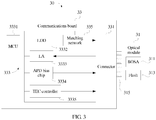
- an embodiment of the present invention provides an optical assembly 30, including an optical module 31 and a communications board 33.
- An optical component 311, a first memory 313, and an edge connector 315 connected to the optical component 311 and the first memory 313 are disposed on the optical module 31, and the first memory 313 is configured to store a first scattering parameter S1 of the optical module 31 and an operating parameter of the optical component 311.
- the first scattering parameter S1 is a scattering parameter (S parameter) of the optical module 31, including a backward transmission (isolation) coefficient S1 12 , a forward transmission (gain) coefficient S1 21 , an input reflection (input return loss) coefficient S1 11 , and an output reflection (output return loss) coefficient S1 22 .
- the operating parameter of the optical component 311 includes a bias current, a modulated current, a modulated voltage, an operating temperature, and a backlight diode current.
- the optical component 311 includes a bidirectional optical subassembly BOSA, or the optical component 311 may include a transmitter optical subassembly TOSA and a receiver optical subassembly ROSA.
- a connector 331, and an electronic chip 333 and a matching network 335 that correspond to the optical component are disposed on the communications board 33.
- the optical module 31 is connected to the connector 331 by using the edge connector 315.
- a pluggable connection is formed between the optical module 31 and the communications board 33 by using the edge connector 315.
- the electronic chip 333 includes a micro controller (Micro Control Unit, MCU) 3331, a laser diode driver (Laser Diode Driver, LDD) 3332, a limiting amplifier (Limiting Amplifier, LA) 3333, an avalanche photodiode (Avalanche Photodiode, APD) bias chip 3334, and a thermoelectric cooler (Thermoelectric Cooler, TEC) control chip 3335.
- MCU Micro Control Unit
- LDD Laser Diode Driver
- LA Limit Amplifier
- LA avalanche photodiode
- APD avalanche Photodiode
- TEC thermoelectric cooler
- the micro controller 3331 is electrically connected to the laser diode driver 3332, the limiting amplifier 3333, the avalanche photodiode bias chip 3334, the thermoelectric cooler control chip 3335, and the matching network 335, and is electrically connected to the first memory 313 by using the connector 331 and the edge connector 315.
- the laser diode driver 3332 is connected to the connector 331 via the matching network 335.
- the micro controller 3331 is electrically connected to another chip on the communications board 33 and the first memory 313 on the optical module 31 by using a control bus (for example, an I 2 C bus).
- the micro controller 3331 is configured to: read the operating parameter from the first memory 313, and configure the laser diode driver 3332 and the limiting amplifier 3333 based on the operating parameter.
- the laser diode driver 3332 is configured to drive the optical component 311 to transmit an optical signal.
- the limiting amplifier 3333 is configured to amplify a signal received by the optical component 311.
- the avalanche photodiode bias chip 3334 is configured to provide a bias voltage for the optical component 311.
- the thermoelectric cooler control chip 3335 is configured to provide a cooling current or a heating current for the optical module.
- the communications board 33 stores a second scattering parameter S2 that is between the laser diode driver 3332 and the connector 331.
- the second scattering parameter S2 may be stored in built-in storage space of the micro controller 3331 or in a second memory (not shown in the figure) disposed on the communications board 33.
- the second scattering parameter S2 is a scattering parameter (S parameter) between an output end of the laser diode driver 3332 and an end that is of the connector 331 and that is connected to the edge connector 315.
- the second scattering parameter includes a scattering parameter of the connector 331.
- the second scattering parameter also includes a backward transmission coefficient S2 12 , a forward transmission coefficient S2 21 , an input reflection coefficient S2 11 , and an output reflection coefficient S2 22 .
- the micro controller 3331 is further configured to: read the first scattering parameter from the first memory 313, calculate a third scattering parameter S3 that is between the laser diode driver 3332 and the optical module 31 based on the first scattering parameter and the second scattering parameter, and further adjust matched impedance of the matching network 335 based on the third scattering parameter S3.
- the third scattering parameter S3 is a scattering parameter (S parameter) between the output end of the laser diode driver 3332 and an output end of the optical module 31.
- the third scattering parameter includes a scattering parameter of the optical module 31.
- the third scattering parameter also includes a backward transmission coefficient S3 12 , a forward transmission coefficient S3 21 , an input reflection coefficient S3 11 , and an output reflection coefficient S3 22 .
- the calculating a third scattering parameter that is between the laser diode driver and the optical module based on the first scattering parameter and the second scattering parameter includes:
- the first scattering parameter is used as an example.
- the first scattering transmission parameter is T1.
- the second scattering transmission parameter T2 corresponding to the second scattering parameter may be calculated according to the foregoing formulas.
- the matching network 335 may include one or a combination of more of a resistor, an inductor, and a capacitor connected in series and/or connected in parallel, and the adjusting matched impedance of the matching network 335 is adjusting a value of the resistor, the inductor, or the capacitor.
- a value of at least one resistor, at least one inductor, or at least one capacitor in the matching network 335 is electrically adjustable.
- the adjusting matched impedance of the matching network of the optical assembly based on the third scattering parameter includes:
- a curve of the input reflection coefficient S3 11 of the third scattering parameter namely, an input return loss curve between the output end of the laser diode driver and the output end of the optical module, is generated. Then, a 3-dB bandwidth of the input return loss curve is calculated, and the 3-dB bandwidth of the input return loss curve is compared with the preset 3-dB bandwidth range. If the 3-dB bandwidth of the input return loss curve falls outside the preset 3-dB bandwidth range, it indicates that current matched impedance of the matching network needs to be adjusted. The micro controller may then control the electrically adjustable resistor, inductor, or capacitor in the matching network to change the value, thereby adjusting the matched impedance of the matching network.
- the third scattering parameter between the laser diode driver and the optical module is calculated by reading the first scattering parameter stored in the first memory and the second scattering parameter that is between the laser diode driver and the connector and that is stored on the communications board, and then the matched impedance of the matching network 335 between the laser diode driver and the connector is adjusted based on whether the 3-dB bandwidth of the curve corresponding to the third scattering parameter falls within the preset range, thereby implementing impedance matching between the laser diode driver and the optical module. This helps improve communication performance of the optical assembly.
- an embodiment of the present invention provides an optical assembly 30', including an optical module 31' and a communications board 33'.
- the optical module 31' differs from the optical module 31 in the embodiment shown in FIG. 3 in that the first memory 313 is configured to store an operating parameter of the optical component 311.
- the operating parameter includes a preset eye mask margin, a bias current, a modulated current, a modulated voltage, an operating temperature, a backlight diode current, and a monitor photodiode current.
- the communications board 33' differs from the communications board 33 in the embodiment shown in FIG. 3 in that an electronic chip 333' that is on the communications board 33' and that corresponds to the optical component 311 further includes an eye opening monitoring module 3336.
- the eye opening monitoring module 3336 is connected to the micro controller 3331, and is electrically connected to the optical module 31' by using the connector.
- the eye opening monitoring module 3336 is configured to: read an electrical signal output by a monitor photodiode (not shown in the figure) in the optical component 311, and measure, based on the electrical signal, an eye opening of a signal transmitted by the optical component 311.
- the micro controller 3331 is configured to: read the operating parameter from the first memory 313, and configure the laser diode driver 3332 and the limiting amplifier 3333 based on the operating parameter.
- the micro controller 3331 is further configured to: read the eye opening, and adjust matched impedance of the matching network 335 based on the eye opening and the preset eye mask margin in the operating parameter.
- the adjusting matched impedance of the matching network based on the eye opening and the preset eye mask margin includes:
- the eye opening of the signal transmitted by the optical component is measured, and the eye mask margin of the signal transmitted by the optical component is calculated based on the eye opening and a preset eye pattern mask. Further, whether the eye mask margin of the signal transmitted by the optical component falls within the preset eye mask margin range is determined. If the eye mask margin of the signal transmitted by the optical component falls within the preset eye mask margin range, it indicates that quality of the signal transmitted by the optical component meets a requirement. In other words, current matched impedance of the matching network already meets an impedance matching requirement, so that no adjustment is needed.
- the eye mask margin of the signal transmitted by the optical component falls outside the preset eye mask margin range, it indicates that quality of the signal transmitted by the optical component does not meet a requirement, so that the matched impedance of the matching network needs to be adjusted, to improve the quality of the transmitted signal.
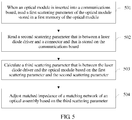
- an embodiment of the present invention provides a method for adjusting matched impedance of the optical assembly 30 in the embodiment shown in FIG. 3 .
- the method includes the following steps:
- the calculating a third scattering parameter that is between the laser diode driver and the optical module based on the first scattering parameter and the second scattering parameter includes:
- the adjusting matched impedance of a matching network of the optical assembly based on the third scattering parameter includes:
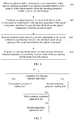
- an embodiment of the present invention provides a method for adjusting matched impedance of the optical assembly 30' in the embodiment shown in FIG. 4 .
- the method includes the following steps:
- Step 601 When an optical module is inserted into a communications board, read an operating parameter of an optical component stored in a first memory of the optical module, where the operating parameter includes a preset eye mask margin.
- Step 602 Configure an output parameter of a laser diode driver on the communications board based on the operating parameter of the optical component, and drive, by using the laser diode driver, the optical component to transmit an optical signal.
- Step 603 Read an electrical signal output by a monitor photodiode in the optical component, and measure, based on the electrical signal, an eye opening of the signal transmitted by the optical component.
- Step 604 Read the eye opening and the preset eye mask margin, and adjust matched impedance of the matching network based on the eye opening and the preset eye mask margin.
- the adjusting matched impedance of the matching network based on the eye opening and the preset eye mask margin includes:
- an embodiment of the present invention provides an apparatus 70 for adjusting matched impedance of the optical assembly 30 in the embodiment shown in FIG. 3 .
- the apparatus includes:
- the third-scattering-parameter calculation unit 703 is specifically configured to:
- the matched impedance adjustment unit 704 is specifically configured to:
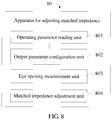
- an embodiment of the present invention provides an apparatus 80 for adjusting matched impedance of the optical assembly 30' in the embodiment shown in FIG. 4 .
- the apparatus includes:
- the matched impedance adjustment unit 804 is specifically configured to:
Landscapes
- Physics & Mathematics (AREA)
- Electromagnetism (AREA)
- Engineering & Computer Science (AREA)
- Computer Networks & Wireless Communication (AREA)
- Signal Processing (AREA)
- Optical Communication System (AREA)
- Optical Couplings Of Light Guides (AREA)
- Semiconductor Lasers (AREA)
Claims (15)
- Ensemble optique (30, 40), comprenant un module optique (31) et une carte de communications (33), dans lequel un composant optique (311), une première mémoire (313) et un connecteur plat (315) connectés au composant optique et à la première mémoire sont disposés sur le module optique, et la première mémoire est configurée pour stocker un premier paramètre de diffusion du module optique et un paramètre de fonctionnement du composant optique ;un connecteur, et une puce électronique (333) et un réseau d'adaptation (335) qui correspondent au composant optique sont disposés sur la carte de communication, et le module optique est connecté au connecteur en utilisant le connecteur plat ;la puce électronique comprend un microcontrôleur (3331) et un circuit d'attaque de diode laser (3332), le circuit d'attaque de diode laser est connecté au connecteur par l'intermédiaire du réseau d'adaptation, et la carte de communications stocke un deuxième paramètre de diffusion qui se trouve entre le circuit d'attaque de diode laser et le connecteur ; etle microcontrôleur est configuré pour :
lire le premier paramètre de diffusion dans la première mémoire, calculer un troisième paramètre de diffusion qui se trouve entre le circuit d'attaque de diode laser et le module optique en fonction du premier paramètre de diffusion et du deuxième paramètre de diffusion, et ajuster en outre l'impédance adaptée du réseau correspondant en fonction du troisième paramètre de diffusion. - Ensemble optique selon la revendication 1, dans lequel la puce électronique comprend en outre :une puce de polarisation de photodiode à avalanche, configurée pour fournir une tension de polarisation au composant optique ;un amplificateur de limitation, configuré pour amplifier un signal reçu par le composant optique ; etune puce de commande de refroidisseur thermoélectrique, configurée pour fournir un courant de refroidissement ou un courant de chauffage au module optique.
- Ensemble optique selon la revendication 2, dans lequel le paramètre de fonctionnement du composant optique comprend un courant de polarisation, un courant modulé, une tension modulée, une température de fonctionnement et un courant de diode de rétroéclairage ;
le microcontrôleur est en outre configuré pour :lire le paramètre de fonctionnement dans la première mémoire et configurer le circuit d'attaque de diode laser et l'amplificateur de limitation en fonction du paramètre de fonctionnement ; etle circuit d'attaque de diode laser est configuré pour attaquer le composant optique afin d'émettre un signal optique. - Ensemble optique selon l'une quelconque des revendications 1 à 3, dans lequel le calcul d'un troisième paramètre de diffusion, qui se trouve entre le circuit d'attaque de diode laser et le module optique, en fonction du premier paramètre de diffusion et du deuxième paramètre de diffusion comprend :la conversion du premier paramètre de diffusion en un premier paramètre d'émission de diffusion correspondant, et la conversion du deuxième paramètre de diffusion en un deuxième paramètre d'émission de diffusion ;la multiplication du premier paramètre d'émission de diffusion par le troisième paramètre d'émission de diffusion, pour obtenir un troisième paramètre d'émission de diffusion ; etla conversion du troisième paramètre d'émission de diffusion en troisième paramètre de diffusion correspondant.
- Ensemble optique selon l'une quelconque des revendications 1 à 3, dans lequel le réseau d'adaptation comprend un élément ou une combinaison de plusieurs éléments parmi une résistance, un inducteur et un condensateur connectés en série et/ou connectés en parallèle, et l'impédance d'ajustement adaptée du réseau correspondant ajuste une valeur de la résistance, de l'inducteur ou du condensateur.
- Ensemble optique selon l'une quelconque des revendications 1 à 3, dans lequel le composant optique comprend un sous-ensemble optique bidirectionnel, BOSA, ou le composant optique comprend un sous-ensemble optique émetteur, TOSA, et un sous-ensemble optique récepteur, ROSA.
- Ensemble optique, comprenant un module optique et une carte de communication, dans lequel un composant optique, une première mémoire et un connecteur plat connecté au composant optique et à la première mémoire sont disposés sur le module optique, la première mémoire étant configurée pour stocker un paramètre de fonctionnement du composant optique, et le paramètre de fonctionnement comprend une marge de masque oculaire prédéfinie ;un connecteur, et une puce électronique et un réseau d'adaptation qui correspondent au composant optique sont disposés sur la carte de communication, et le module optique est connecté au connecteur en utilisant le connecteur plat ;la puce électronique comprend un microcontrôleur, un circuit d'attaque de diode laser et un module de surveillance d'ouverture des yeux ;le microcontrôleur est connecté électriquement au circuit d'attaque de diode laser, au module de surveillance d'ouverture des yeux et au réseau d'adaptation ; etle circuit d'attaque de diode laser est connecté au connecteur par l'intermédiaire du réseau correspondant ;le module de surveillance de l'ouverture des yeux est configuré pour :lire un signal électrique délivré par une photodiode de surveillance dans le composant optique, et mesurer, sen fonction du signal électrique, une ouverture oculaire d'un signal émis par le composant optique ; etle microcontrôleur est configuré pour :
lire l'ouverture des yeux et la marge du masque oculaire prédéfinie, et ajuster l'impédance adaptée du réseau correspondant en fonction de l'ouverture des yeux et de la marge du masque oculaire prédéfinie. - Ensemble optique selon la revendication 7, dans lequel la puce électronique comprend en outre :une puce de polarisation de photodiode à avalanche, configurée pour fournir une tension de polarisation au composant optique ;un amplificateur de limitation, configuré pour amplifier un signal reçu par le composant optique ; etune puce de commande de refroidisseur thermoélectrique, configurée pour fournir un courant de refroidissement ou un courant de chauffage au module optique.
- Ensemble optique selon la revendication 8, dans lequel le paramètre de fonctionnement du composant optique comprend en outre un courant de polarisation, un courant modulé, une tension modulée, une température de fonctionnement, un courant de diode de rétroéclairage et un courant de photodiode de surveillance ;le microcontrôleur est en outre configuré pour configurer le circuit d'attaque de diode laser et l'amplificateur de limitation en fonction du paramètre de fonctionnement ; etle circuit d'attaque de diode laser est configuré pour attaquer le composant optique afin d'émettre un signal optique.
- Ensemble optique selon l'une quelconque des revendications 7 à 9, dans lequel le réseau d'adaptation comprend un élément ou une combinaison de plusieurs éléments parmi une résistance, un inducteur et un condensateur connectés en série et/ou connectés en parallèle, et l'impédance d'ajustement adaptée du réseau correspondant ajuste une valeur de la résistance, de l'inducteur ou du condensateur.
- Ensemble optique selon l'une quelconque des revendications 7 à 9, dans lequel le composant optique comprend un sous-ensemble optique bidirectionnel, BOSA, ou le composant optique comprend un sous-ensemble optique émetteur, TOSA, et un sous-ensemble optique récepteur, ROSA.
- Système de réseau optique passif, comprenant un terminal de ligne optique, un réseau de distribution optique et une unité de réseau optique, dans lequel le terminal de ligne optique est connecté à l'unité de réseau optique par l'intermédiaire du réseau de distribution optique, et le terminal de ligne optique comprend l'ensemble optique selon l'une quelconque des revendications 1 à 6, et/ou l'unité de réseau optique comprend l'ensemble optique selon l'une quelconque des revendications 7 à 11.
- Procédé pour ajuster l'impédance adaptée de l'ensemble optique selon l'une quelconque des revendications 1 à 6, comprenant :lorsqu'un module optique est inséré dans une carte de communication, la lecture d'un premier paramètre de diffusion du module optique stocké dans une première mémoire du module optique ;la lecture d'un deuxième paramètre de diffusion qui se trouve entre un circuit d'attaque de diode laser et un connecteur, et qui est stocké sur la carte de communication ;le calcul d'un troisième paramètre de diffusion, qui se trouve entre le circuit d'attaque de diode laser et le module optique, en fonction du premier paramètre de diffusion et du deuxième paramètre de diffusion ; etl'ajustement de l'impédance adaptée d'un réseau correspondant de l'ensemble optique en fonction du troisième paramètre de diffusion.
- Procédé selon la revendication 13, dans lequel le calcul d'un troisième paramètre de diffusion, qui se trouve entre le circuit d'attaque de diode laser et le module optique, en fonction du premier paramètre de diffusion et du deuxième paramètre de diffusion comprend :la conversion du premier paramètre de diffusion en un premier paramètre d'émission de diffusion correspondant, et la conversion du deuxième paramètre de diffusion en un deuxième paramètre d'émission de diffusion ;la multiplication du premier paramètre d'émission de diffusion par le troisième paramètre d'émission de diffusion, pour obtenir un troisième paramètre d'émission de diffusion ; etla conversion du troisième paramètre d'émission de diffusion en troisième paramètre de diffusion correspondant.
- Procédé selon la revendication 13, dans lequel l'ajustement de l'impédance adaptée d'un réseau correspondant de l'ensemble optique en fonction du troisième paramètre de diffusion comprend :le calcul d'une largeur de bande de 3 dB d'une courbe correspondant au troisième paramètre de diffusion ;la détermination du fait de savoir si la largeur de bande de 3 dB de la courbe correspondant au troisième paramètre de diffusion se situe dans une plage de largeur de bande prédéfinie de 3 dB ; etsi la largeur de bande de 3 dB de la courbe correspondant au troisième paramètre de diffusion se situe en dehors de la plage de largeur de bande prédéfinie de 3 dB, l'ajustement de l'impédance adaptée de l'ensemble optique en ajustant une valeur d'une résistance, d'un inducteur ou d'un condensateur dans le réseau correspondant sur la carte de communication.
Applications Claiming Priority (1)
| Application Number | Priority Date | Filing Date | Title |
|---|---|---|---|
| PCT/CN2017/075273 WO2018157317A1 (fr) | 2017-02-28 | 2017-02-28 | Système de réseau optique passif, et composant optique et son procédé de réglage d'impédance d'adaptation |
Publications (3)
| Publication Number | Publication Date |
|---|---|
| EP3573258A1 EP3573258A1 (fr) | 2019-11-27 |
| EP3573258A4 EP3573258A4 (fr) | 2020-04-08 |
| EP3573258B1 true EP3573258B1 (fr) | 2021-03-17 |
Family
ID=63369615
Family Applications (1)
| Application Number | Title | Priority Date | Filing Date |
|---|---|---|---|
| EP17899120.4A Active EP3573258B1 (fr) | 2017-02-28 | 2017-02-28 | Système de réseau optique passif, et composant optique et son procédé de réglage d'impédance d'adaptation |
Country Status (3)
| Country | Link |
|---|---|
| EP (1) | EP3573258B1 (fr) |
| CN (1) | CN110192358B (fr) |
| WO (1) | WO2018157317A1 (fr) |
Families Citing this family (8)
| Publication number | Priority date | Publication date | Assignee | Title |
|---|---|---|---|---|
| CN112925068B (zh) * | 2019-12-06 | 2023-05-05 | 青岛海信宽带多媒体技术有限公司 | 一种光模块 |
| CN112398541B (zh) * | 2020-11-05 | 2022-05-17 | 青岛海信宽带多媒体技术有限公司 | 一种光模块 |
| WO2022057866A1 (fr) * | 2020-09-17 | 2022-03-24 | 青岛海信宽带多媒体技术有限公司 | Module optique |
| CN113092867A (zh) * | 2021-03-29 | 2021-07-09 | 上海橙科微电子科技有限公司 | 通过方波测试光模块发送系统阻抗的连续性的方法、系统及介质 |
| CN115314105B (zh) * | 2022-07-06 | 2023-07-21 | 江苏信而泰智能装备有限公司 | Bob测试系统 |
| CN118368546A (zh) * | 2023-01-18 | 2024-07-19 | 华为技术有限公司 | 信号传输装置、信号传输装置的调测方法及设备 |
| CN118827249A (zh) * | 2023-04-20 | 2024-10-22 | 华为技术有限公司 | 通信方法、通信设备、直驱模块和通信系统 |
| CN118367436B (zh) * | 2024-06-19 | 2024-10-01 | 四川泰瑞创通讯技术股份有限公司 | 优化激光器打线阻抗匹配的光模块 |
Family Cites Families (7)
| Publication number | Priority date | Publication date | Assignee | Title |
|---|---|---|---|---|
| US7486894B2 (en) * | 2002-06-25 | 2009-02-03 | Finisar Corporation | Transceiver module and integrated circuit with dual eye openers |
| US7526207B2 (en) * | 2002-10-18 | 2009-04-28 | Finisar Corporation | Flexible circuit design for improved laser bias connections to optical subassemblies |
| US8422891B2 (en) * | 2010-09-24 | 2013-04-16 | Intel Corporation | Jitter reduction of electrical signals from limiting optical modules |
| CN102299746B (zh) * | 2011-07-08 | 2014-06-25 | 成都新易盛通信技术股份有限公司 | 一种低成本带高精度数字诊断功能的sfp模块 |
| CN203632683U (zh) * | 2013-11-27 | 2014-06-04 | 青岛海信宽带多媒体技术有限公司 | 光信号接收丢失迟滞参数调整电路及光模块 |
| CN106059673A (zh) * | 2016-05-18 | 2016-10-26 | 青岛海信宽带多媒体技术有限公司 | 一种光模块及光线路终端设备 |
| CN106125213B (zh) * | 2016-08-26 | 2018-08-17 | 青岛海信宽带多媒体技术有限公司 | 一种光模块 |
-
2017
- 2017-02-28 CN CN201780084156.4A patent/CN110192358B/zh active Active
- 2017-02-28 WO PCT/CN2017/075273 patent/WO2018157317A1/fr not_active Ceased
- 2017-02-28 EP EP17899120.4A patent/EP3573258B1/fr active Active
Non-Patent Citations (1)
| Title |
|---|
| None * |
Also Published As
| Publication number | Publication date |
|---|---|
| EP3573258A1 (fr) | 2019-11-27 |
| CN110192358B (zh) | 2020-12-15 |
| EP3573258A4 (fr) | 2020-04-08 |
| WO2018157317A1 (fr) | 2018-09-07 |
| CN110192358A (zh) | 2019-08-30 |
Similar Documents
| Publication | Publication Date | Title |
|---|---|---|
| EP3573258B1 (fr) | Système de réseau optique passif, et composant optique et son procédé de réglage d'impédance d'adaptation | |
| EP2602946B1 (fr) | Module optique bidirectionnel à fibre unique et système de réseau optique passif | |
| CN105144508B (zh) | 温控多信道光发射次模块以及具有此温控多信道光发射次模块的光收发器模块 | |
| CA2722400C (fr) | Procede et appareil de regulation de la puissance optique de sortie d'un laser en mode rafale | |
| US7751712B2 (en) | Passive optical network and data communication method thereof | |
| US9964720B2 (en) | Monitoring and controlling temperature across a laser array in a transmitter optical subassembly (TOSA) package | |
| CN105247400B (zh) | 紧凑型多信道光收发器模块 | |
| CN107710648B (zh) | 具有热阵列波导光栅多路复用器和无热阵列波导光栅解复用器的多通道光收发器模块 | |
| US20090169209A1 (en) | Network system, optical line terminating apparatus, and optical network apparatus | |
| US20130202300A1 (en) | Optical line terminal (olt) optical module adapted to perform optical unit network (onu) functionality | |
| CN105518949A (zh) | 用于光发射器系统的提高效率的加热激光器封装 | |
| CN102523540B (zh) | 光模块及具有该光模块的无源光网络 | |
| CN102511138B (zh) | 可调光收发器、无源光网络系统及设备 | |
| US9106050B2 (en) | Self-characterization tunable optical network unit | |
| JP2010166279A (ja) | 光通信システムおよび光集線装置 | |
| US9287989B2 (en) | Optical data transmission device | |
| US8340519B2 (en) | Passive optical network comprising an optical burst mode receiver | |
| CN211127812U (zh) | 一种自带mac的sfp+光模块 | |
| WO2015042842A1 (fr) | Système d'émission optique | |
| US12382203B2 (en) | Optical communication apparatus and optical communication method | |
| WO2017173619A1 (fr) | Procédé de compensation de courant de commande commandant un dispositif laser, ainsi que dispositif, ensemble et système associés | |
| CN201315587Y (zh) | 一种单纤三向模块 | |
| CN223024424U (zh) | 光组件在板装置、主网关和fttr系统 | |
| WO2020238279A1 (fr) | Puce plc, tosa, bosa, module optique et dispositif de réseau optique |
Legal Events
| Date | Code | Title | Description |
|---|---|---|---|
| STAA | Information on the status of an ep patent application or granted ep patent |
Free format text: STATUS: THE INTERNATIONAL PUBLICATION HAS BEEN MADE |
|
| PUAI | Public reference made under article 153(3) epc to a published international application that has entered the european phase |
Free format text: ORIGINAL CODE: 0009012 |
|
| STAA | Information on the status of an ep patent application or granted ep patent |
Free format text: STATUS: REQUEST FOR EXAMINATION WAS MADE |
|
| 17P | Request for examination filed |
Effective date: 20190821 |
|
| AK | Designated contracting states |
Kind code of ref document: A1 Designated state(s): AL AT BE BG CH CY CZ DE DK EE ES FI FR GB GR HR HU IE IS IT LI LT LU LV MC MK MT NL NO PL PT RO RS SE SI SK SM TR |
|
| AX | Request for extension of the european patent |
Extension state: BA ME |
|
| A4 | Supplementary search report drawn up and despatched |
Effective date: 20200305 |
|
| RIC1 | Information provided on ipc code assigned before grant |
Ipc: H04B 10/40 20130101AFI20200228BHEP Ipc: G02B 6/42 20060101ALI20200228BHEP |
|
| DAV | Request for validation of the european patent (deleted) | ||
| DAX | Request for extension of the european patent (deleted) | ||
| GRAP | Despatch of communication of intention to grant a patent |
Free format text: ORIGINAL CODE: EPIDOSNIGR1 |
|
| STAA | Information on the status of an ep patent application or granted ep patent |
Free format text: STATUS: GRANT OF PATENT IS INTENDED |
|
| INTG | Intention to grant announced |
Effective date: 20201016 |
|
| GRAS | Grant fee paid |
Free format text: ORIGINAL CODE: EPIDOSNIGR3 |
|
| GRAA | (expected) grant |
Free format text: ORIGINAL CODE: 0009210 |
|
| STAA | Information on the status of an ep patent application or granted ep patent |
Free format text: STATUS: THE PATENT HAS BEEN GRANTED |
|
| AK | Designated contracting states |
Kind code of ref document: B1 Designated state(s): AL AT BE BG CH CY CZ DE DK EE ES FI FR GB GR HR HU IE IS IT LI LT LU LV MC MK MT NL NO PL PT RO RS SE SI SK SM TR |
|
| REG | Reference to a national code |
Ref country code: GB Ref legal event code: FG4D |
|
| REG | Reference to a national code |
Ref country code: CH Ref legal event code: EP |
|
| REG | Reference to a national code |
Ref country code: DE Ref legal event code: R096 Ref document number: 602017035024 Country of ref document: DE |
|
| REG | Reference to a national code |
Ref country code: IE Ref legal event code: FG4D |
|
| REG | Reference to a national code |
Ref country code: AT Ref legal event code: REF Ref document number: 1373232 Country of ref document: AT Kind code of ref document: T Effective date: 20210415 |
|
| REG | Reference to a national code |
Ref country code: LT Ref legal event code: MG9D |
|
| PG25 | Lapsed in a contracting state [announced via postgrant information from national office to epo] |
Ref country code: BG Free format text: LAPSE BECAUSE OF FAILURE TO SUBMIT A TRANSLATION OF THE DESCRIPTION OR TO PAY THE FEE WITHIN THE PRESCRIBED TIME-LIMIT Effective date: 20210617 Ref country code: FI Free format text: LAPSE BECAUSE OF FAILURE TO SUBMIT A TRANSLATION OF THE DESCRIPTION OR TO PAY THE FEE WITHIN THE PRESCRIBED TIME-LIMIT Effective date: 20210317 Ref country code: HR Free format text: LAPSE BECAUSE OF FAILURE TO SUBMIT A TRANSLATION OF THE DESCRIPTION OR TO PAY THE FEE WITHIN THE PRESCRIBED TIME-LIMIT Effective date: 20210317 Ref country code: GR Free format text: LAPSE BECAUSE OF FAILURE TO SUBMIT A TRANSLATION OF THE DESCRIPTION OR TO PAY THE FEE WITHIN THE PRESCRIBED TIME-LIMIT Effective date: 20210618 Ref country code: NO Free format text: LAPSE BECAUSE OF FAILURE TO SUBMIT A TRANSLATION OF THE DESCRIPTION OR TO PAY THE FEE WITHIN THE PRESCRIBED TIME-LIMIT Effective date: 20210617 |
|
| REG | Reference to a national code |
Ref country code: AT Ref legal event code: MK05 Ref document number: 1373232 Country of ref document: AT Kind code of ref document: T Effective date: 20210317 |
|
| REG | Reference to a national code |
Ref country code: NL Ref legal event code: MP Effective date: 20210317 |
|
| PG25 | Lapsed in a contracting state [announced via postgrant information from national office to epo] |
Ref country code: RS Free format text: LAPSE BECAUSE OF FAILURE TO SUBMIT A TRANSLATION OF THE DESCRIPTION OR TO PAY THE FEE WITHIN THE PRESCRIBED TIME-LIMIT Effective date: 20210317 Ref country code: LV Free format text: LAPSE BECAUSE OF FAILURE TO SUBMIT A TRANSLATION OF THE DESCRIPTION OR TO PAY THE FEE WITHIN THE PRESCRIBED TIME-LIMIT Effective date: 20210317 Ref country code: SE Free format text: LAPSE BECAUSE OF FAILURE TO SUBMIT A TRANSLATION OF THE DESCRIPTION OR TO PAY THE FEE WITHIN THE PRESCRIBED TIME-LIMIT Effective date: 20210317 |
|
| PG25 | Lapsed in a contracting state [announced via postgrant information from national office to epo] |
Ref country code: NL Free format text: LAPSE BECAUSE OF FAILURE TO SUBMIT A TRANSLATION OF THE DESCRIPTION OR TO PAY THE FEE WITHIN THE PRESCRIBED TIME-LIMIT Effective date: 20210317 |
|
| PG25 | Lapsed in a contracting state [announced via postgrant information from national office to epo] |
Ref country code: CZ Free format text: LAPSE BECAUSE OF FAILURE TO SUBMIT A TRANSLATION OF THE DESCRIPTION OR TO PAY THE FEE WITHIN THE PRESCRIBED TIME-LIMIT Effective date: 20210317 Ref country code: EE Free format text: LAPSE BECAUSE OF FAILURE TO SUBMIT A TRANSLATION OF THE DESCRIPTION OR TO PAY THE FEE WITHIN THE PRESCRIBED TIME-LIMIT Effective date: 20210317 Ref country code: LT Free format text: LAPSE BECAUSE OF FAILURE TO SUBMIT A TRANSLATION OF THE DESCRIPTION OR TO PAY THE FEE WITHIN THE PRESCRIBED TIME-LIMIT Effective date: 20210317 Ref country code: SM Free format text: LAPSE BECAUSE OF FAILURE TO SUBMIT A TRANSLATION OF THE DESCRIPTION OR TO PAY THE FEE WITHIN THE PRESCRIBED TIME-LIMIT Effective date: 20210317 Ref country code: AT Free format text: LAPSE BECAUSE OF FAILURE TO SUBMIT A TRANSLATION OF THE DESCRIPTION OR TO PAY THE FEE WITHIN THE PRESCRIBED TIME-LIMIT Effective date: 20210317 |
|
| PG25 | Lapsed in a contracting state [announced via postgrant information from national office to epo] |
Ref country code: PT Free format text: LAPSE BECAUSE OF FAILURE TO SUBMIT A TRANSLATION OF THE DESCRIPTION OR TO PAY THE FEE WITHIN THE PRESCRIBED TIME-LIMIT Effective date: 20210719 Ref country code: PL Free format text: LAPSE BECAUSE OF FAILURE TO SUBMIT A TRANSLATION OF THE DESCRIPTION OR TO PAY THE FEE WITHIN THE PRESCRIBED TIME-LIMIT Effective date: 20210317 Ref country code: SK Free format text: LAPSE BECAUSE OF FAILURE TO SUBMIT A TRANSLATION OF THE DESCRIPTION OR TO PAY THE FEE WITHIN THE PRESCRIBED TIME-LIMIT Effective date: 20210317 Ref country code: RO Free format text: LAPSE BECAUSE OF FAILURE TO SUBMIT A TRANSLATION OF THE DESCRIPTION OR TO PAY THE FEE WITHIN THE PRESCRIBED TIME-LIMIT Effective date: 20210317 Ref country code: IS Free format text: LAPSE BECAUSE OF FAILURE TO SUBMIT A TRANSLATION OF THE DESCRIPTION OR TO PAY THE FEE WITHIN THE PRESCRIBED TIME-LIMIT Effective date: 20210717 |
|
| REG | Reference to a national code |
Ref country code: DE Ref legal event code: R097 Ref document number: 602017035024 Country of ref document: DE |
|
| PLBE | No opposition filed within time limit |
Free format text: ORIGINAL CODE: 0009261 |
|
| STAA | Information on the status of an ep patent application or granted ep patent |
Free format text: STATUS: NO OPPOSITION FILED WITHIN TIME LIMIT |
|
| PG25 | Lapsed in a contracting state [announced via postgrant information from national office to epo] |
Ref country code: AL Free format text: LAPSE BECAUSE OF FAILURE TO SUBMIT A TRANSLATION OF THE DESCRIPTION OR TO PAY THE FEE WITHIN THE PRESCRIBED TIME-LIMIT Effective date: 20210317 Ref country code: DK Free format text: LAPSE BECAUSE OF FAILURE TO SUBMIT A TRANSLATION OF THE DESCRIPTION OR TO PAY THE FEE WITHIN THE PRESCRIBED TIME-LIMIT Effective date: 20210317 Ref country code: ES Free format text: LAPSE BECAUSE OF FAILURE TO SUBMIT A TRANSLATION OF THE DESCRIPTION OR TO PAY THE FEE WITHIN THE PRESCRIBED TIME-LIMIT Effective date: 20210317 |
|
| 26N | No opposition filed |
Effective date: 20211220 |
|
| PG25 | Lapsed in a contracting state [announced via postgrant information from national office to epo] |
Ref country code: SI Free format text: LAPSE BECAUSE OF FAILURE TO SUBMIT A TRANSLATION OF THE DESCRIPTION OR TO PAY THE FEE WITHIN THE PRESCRIBED TIME-LIMIT Effective date: 20210317 |
|
| PG25 | Lapsed in a contracting state [announced via postgrant information from national office to epo] |
Ref country code: IT Free format text: LAPSE BECAUSE OF FAILURE TO SUBMIT A TRANSLATION OF THE DESCRIPTION OR TO PAY THE FEE WITHIN THE PRESCRIBED TIME-LIMIT Effective date: 20210317 |
|
| PG25 | Lapsed in a contracting state [announced via postgrant information from national office to epo] |
Ref country code: IS Free format text: LAPSE BECAUSE OF FAILURE TO SUBMIT A TRANSLATION OF THE DESCRIPTION OR TO PAY THE FEE WITHIN THE PRESCRIBED TIME-LIMIT Effective date: 20210717 |
|
| REG | Reference to a national code |
Ref country code: DE Ref legal event code: R119 Ref document number: 602017035024 Country of ref document: DE |
|
| PG25 | Lapsed in a contracting state [announced via postgrant information from national office to epo] |
Ref country code: MC Free format text: LAPSE BECAUSE OF FAILURE TO SUBMIT A TRANSLATION OF THE DESCRIPTION OR TO PAY THE FEE WITHIN THE PRESCRIBED TIME-LIMIT Effective date: 20210317 |
|
| REG | Reference to a national code |
Ref country code: CH Ref legal event code: PL |
|
| REG | Reference to a national code |
Ref country code: BE Ref legal event code: MM Effective date: 20220228 |
|
| PG25 | Lapsed in a contracting state [announced via postgrant information from national office to epo] |
Ref country code: LU Free format text: LAPSE BECAUSE OF NON-PAYMENT OF DUE FEES Effective date: 20220228 |
|
| PG25 | Lapsed in a contracting state [announced via postgrant information from national office to epo] |
Ref country code: FR Free format text: LAPSE BECAUSE OF NON-PAYMENT OF DUE FEES Effective date: 20220228 |
|
| PG25 | Lapsed in a contracting state [announced via postgrant information from national office to epo] |
Ref country code: LI Free format text: LAPSE BECAUSE OF NON-PAYMENT OF DUE FEES Effective date: 20220228 Ref country code: IE Free format text: LAPSE BECAUSE OF NON-PAYMENT OF DUE FEES Effective date: 20220228 Ref country code: DE Free format text: LAPSE BECAUSE OF NON-PAYMENT OF DUE FEES Effective date: 20220901 Ref country code: CH Free format text: LAPSE BECAUSE OF NON-PAYMENT OF DUE FEES Effective date: 20220228 |
|
| PG25 | Lapsed in a contracting state [announced via postgrant information from national office to epo] |
Ref country code: BE Free format text: LAPSE BECAUSE OF NON-PAYMENT OF DUE FEES Effective date: 20220228 |
|
| PG25 | Lapsed in a contracting state [announced via postgrant information from national office to epo] |
Ref country code: MK Free format text: LAPSE BECAUSE OF FAILURE TO SUBMIT A TRANSLATION OF THE DESCRIPTION OR TO PAY THE FEE WITHIN THE PRESCRIBED TIME-LIMIT Effective date: 20210317 Ref country code: CY Free format text: LAPSE BECAUSE OF FAILURE TO SUBMIT A TRANSLATION OF THE DESCRIPTION OR TO PAY THE FEE WITHIN THE PRESCRIBED TIME-LIMIT Effective date: 20210317 |
|
| PG25 | Lapsed in a contracting state [announced via postgrant information from national office to epo] |
Ref country code: HU Free format text: LAPSE BECAUSE OF FAILURE TO SUBMIT A TRANSLATION OF THE DESCRIPTION OR TO PAY THE FEE WITHIN THE PRESCRIBED TIME-LIMIT; INVALID AB INITIO Effective date: 20170228 |
|
| PG25 | Lapsed in a contracting state [announced via postgrant information from national office to epo] |
Ref country code: MT Free format text: LAPSE BECAUSE OF FAILURE TO SUBMIT A TRANSLATION OF THE DESCRIPTION OR TO PAY THE FEE WITHIN THE PRESCRIBED TIME-LIMIT Effective date: 20210317 |
|
| PG25 | Lapsed in a contracting state [announced via postgrant information from national office to epo] |
Ref country code: TR Free format text: LAPSE BECAUSE OF FAILURE TO SUBMIT A TRANSLATION OF THE DESCRIPTION OR TO PAY THE FEE WITHIN THE PRESCRIBED TIME-LIMIT Effective date: 20210317 |
|
| PGFP | Annual fee paid to national office [announced via postgrant information from national office to epo] |
Ref country code: GB Payment date: 20260106 Year of fee payment: 10 |