EP3573389A1 - Kommunikationsverfahren und -vorrichtung im kontext einer ruheprozedur und computerprogramm und computerlesbares speichermedium - Google Patents
Kommunikationsverfahren und -vorrichtung im kontext einer ruheprozedur und computerprogramm und computerlesbares speichermedium Download PDFInfo
- Publication number
- EP3573389A1 EP3573389A1 EP19179237.3A EP19179237A EP3573389A1 EP 3573389 A1 EP3573389 A1 EP 3573389A1 EP 19179237 A EP19179237 A EP 19179237A EP 3573389 A1 EP3573389 A1 EP 3573389A1
- Authority
- EP
- European Patent Office
- Prior art keywords
- node
- idle
- procedure
- request
- post
- Prior art date
- Legal status (The legal status is an assumption and is not a legal conclusion. Google has not performed a legal analysis and makes no representation as to the accuracy of the status listed.)
- Withdrawn
Links
- 238000000034 method Methods 0.000 title claims abstract description 129
- 238000004891 communication Methods 0.000 title claims description 17
- 238000004590 computer program Methods 0.000 title claims description 3
- 230000011664 signaling Effects 0.000 claims abstract description 17
- 238000005516 engineering process Methods 0.000 claims abstract description 14
- 230000009467 reduction Effects 0.000 claims abstract description 7
- 238000007726 management method Methods 0.000 description 27
- 230000006870 function Effects 0.000 description 12
- 230000001413 cellular effect Effects 0.000 description 8
- 230000004044 response Effects 0.000 description 6
- 230000008859 change Effects 0.000 description 4
- 238000010295 mobile communication Methods 0.000 description 4
- 101150114331 MME1 gene Proteins 0.000 description 3
- 230000008901 benefit Effects 0.000 description 3
- 238000010586 diagram Methods 0.000 description 3
- 230000008569 process Effects 0.000 description 3
- 230000000694 effects Effects 0.000 description 2
- 230000007774 longterm Effects 0.000 description 2
- 102000006479 Heterogeneous-Nuclear Ribonucleoproteins Human genes 0.000 description 1
- 108010019372 Heterogeneous-Nuclear Ribonucleoproteins Proteins 0.000 description 1
- 230000004913 activation Effects 0.000 description 1
- 230000009849 deactivation Effects 0.000 description 1
- 230000000763 evoking effect Effects 0.000 description 1
- 230000004048 modification Effects 0.000 description 1
- 238000012986 modification Methods 0.000 description 1
Images



Classifications
-
- H—ELECTRICITY
- H04—ELECTRIC COMMUNICATION TECHNIQUE
- H04W—WIRELESS COMMUNICATION NETWORKS
- H04W60/00—Affiliation to network, e.g. registration; Terminating affiliation with the network, e.g. de-registration
- H04W60/04—Affiliation to network, e.g. registration; Terminating affiliation with the network, e.g. de-registration using triggered events
-
- H—ELECTRICITY
- H04—ELECTRIC COMMUNICATION TECHNIQUE
- H04W—WIRELESS COMMUNICATION NETWORKS
- H04W8/00—Network data management
- H04W8/02—Processing of mobility data, e.g. registration information at HLR [Home Location Register] or VLR [Visitor Location Register]; Transfer of mobility data, e.g. between HLR, VLR or external networks
- H04W8/06—Registration at serving network Location Register, VLR or user mobility server
Definitions
- Example embodiments presented herein relate to providing an indication of the use of a Radio Access Technology (RAT) type after an idle procedure.
- RAT Radio Access Technology
- wireless terminals also known as mobile stations and/or User Equipment units (UEs) communicate via a Radio Access Network (RAN) to one or more core networks.
- the wireless terminals can be mobile stations or user equipment units such as mobile telephones also known as "cellular" telephones, and laptops with wireless capability, e.g., mobile termination, and thus can be, for example, portable, pocket, hand-held, computer-included, or car-mounted mobile devices which communicate voice and/or data with radio access network.
- the radio access network covers a geographical area which is divided into cell areas, with each cell area being served by a base station, e.g., a Radio Base Station (RBS), which in some networks is also called “NodeB” or “B node” and which in this document also is referred to as a base station.
- a cell is a geographical area where radio coverage is provided by the radio base station equipment at a base station site. Each cell is identified by an identity within the local radio area, which is broadcast in the cell.
- the base stations communicate over the air interface operating on radio frequencies with the user equipment units within range of the base stations.
- radio network controller In some versions of the radio access network, several base stations are typically connected, e.g., by landlines or microwave, to a Radio Network Controller (RNC).
- RNC Radio Network Controller
- the radio network controller also sometimes termed a Base Station Controller (BSC), supervises and coordinates various activities of the plural base stations connected thereto.
- BSC Base Station Controller
- the radio network controllers are typically connected to one or more core networks.
- the Universal Mobile Telecommunications System is a third generation mobile communication system, which evolved from the Global System for Mobile Communications (GSM), and is intended to provide improved mobile communication services based on Wideband Code Division Multiple Access (WCDMA) technology.
- GSM Global System for Mobile Communications
- WCDMA Wideband Code Division Multiple Access
- UTRAN UMTS Terrestrial Radio Access Network
- UEs user equipment units
- 3GPP Third Generation Partnership Project
- 3GPP has undertaken to further evolve the UTRAN and GSM based radio access network technologies.
- 3GPP work regarding 3G Long Term Evolution (LTE) systems is ongoing.
- Mobility management is an important function in maintaining cellular networks.
- the goal of mobility management is to track where cellular phones, or User Equipments (UEs), are located in order for mobile phone services to be provided to the various UEs included in any given network.
- UEs User Equipments
- Each base station of a cellular network covers a limited geographical area, which may be referred to as a cell. Integrating the coverage of a number of base stations, or cells, provides a cellular network with radio coverage over a much wider area.
- an eNodeB or a group of these base stations may be referred to as covering a Tracking Area (TA).
- TA Tracking Area
- a Routing Area (RA) may be formed from one or more of these cells as well.
- a Tracking Area Update (TAU) and/or a Routing Area Update (RAU) procedure allows a UE to inform the cellular network when the UE moves from one TA and/or RA to another.
- TAU Tracking Area Update
- RAU Routing Area Update
- the network node typically responsible for mobility management is the Mobility Management Entity (MME) in LTE systems and the Serving General Packet Radio Service Support Node (SGSN) in 2G/3G systems.
- MME Mobility Management Entity
- SGSN Serving General Packet Radio Service Support Node
- the MME and SGSN are key control nodes typically responsible for idle mode UE tracking, paging procedures, bearer activation/deactivation processes, and the MME and SGSN are also responsible for choosing a Serving Gateway (SGW) for a particular UE.
- SGW Serving Gateway
- ISR Idle Mode Signaling Reduction
- the new SGSN or MME may chose to activate ISR, and indicate to the old SGSN/MME to keep records and association to the SGW for the UE. Also the SGW may be notified to keep the association to the old SGSN/MME. In case of downlink data the SGW may send Downlink Data Notification to both the SGSN over S4 interface and to the MME over S11 interface.
- the new RAT shall be reported to the SGW and then forwarded over a S5/S8 interface to the PDN-GW in the Modify Bearer Request message (MBR).
- MLR Modify Bearer Request message
- the SGW needs to get the new RAT from new MME/SGSN if RAT has changed.
- the new MME/SGSN does not know if RAT has changed and if RAT shall be included in MBR to the SGW, due to the reduced signaling from the UE in Idle mode.
- the new MME/SGSN does not even know if ISR was activated.
- Numerous problems may arise from failing to indicate whether or not a new RAT has been utilized. For example, different charging rates may be applied to different RAT types. Therefore, without accurate knowledge of which RAT a particular UE is utilizing, an operator may not be able to provide the correct charging information.
- An example object of at least one of the example embodiments presented herein is to provide accurate network information during post idle mobility procedures (e.g., TAU and/or RAU procedures).
- the technical effect of this solution may therefore be providing an indication as to whether or not a new RAT has been utilized, while minimizing signaling.
- a post idle mobility procedure may be any mobility procedure concerning the mobility of a UE upon exiting an idle procedure.
- the procedure may take place immediately upon exiting the idle procedure or it may take place when a first mobility procedure is initiated upon exiting the idle procedure.
- Examples of a post idle mobility procedure may be a TAU or a RAU.
- An example of an idle procedure may be ISR. It should be appreciated that the example embodiments presented may be directed towards any idle procedure or post idle mobility procedure known in the art. It should further be appreciated that the post mobility procedure may take place at any time upon exiting the idle procedure.
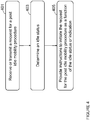
- the method may comprise receiving or transmitting a request for the post idle mobility procedure, determining an idle status or indication of an idle procedure, and providing instructions to initiate the request for the post idle mobility procedure, which may be a function of the idle status or indication.
- the idle status or indication may be provided by an information element which may be in the form of a signal or flag setting. For example, if the idle status or indication is positive, an Idle Mode Signaling Reduction (ISR) may have been initiated.
- ISR Idle Mode Signaling Reduction
- providing instructions to initiate the request for the post idle mobility procedure may further comprise providing a network node with a last Radio Access Technology (RAT) type if the idle status or indication is positive.
- RAT Radio Access Technology
- the idle status or indication may further provide an identification of a last mobility management node in an ISR set-up procedure.
- providing instructions to initiate the request for the post idle mobility procedure may further comprise providing a network node with a last Radio Access Technology (RAT) type if the idle status or indication is positive and the identification of a last mobility management node is of a different node type as a current mobility management node.
- RAT Radio Access Technology
- a mobility management node type may be a Mobility Management Entity (MME) node or a Serving General Packet Radio Service Support Node (SGSN) node.
- MME Mobility Management Entity
- SGSN Serving General Packet Radio Service Support Node
- the transmitting of the request for the post idle mobility procedure may be provided by a User Equipment (UE) node.
- UE User Equipment
- the receiving of the request for the post idle mobility procedure may be provided by a current MME or SGSN node.
- Some example embodiments may be directed towards a method of providing a post idle mobility procedure comprising receiving or transmitting a request for the post idle mobility procedure in a communications network, and providing instructions to initiate the request for the post idle mobility procedure, wherein the instructions may comprise a current RAT type.
- Some example embodiments may be directed towards an indication unit for providing a post idle mobility procedure.
- the unit may comprise a communications port that may be configured to receive or transmit a request for the post idle mobility procedure.
- the unit may also include a processor that may be configured to determine an idle status or indication.
- the processor may be further configured to provide instructions to initiate the request for the post idle mobility procedure as a function of the idle status or indication.
- the unit may be further configured to perform at least one of the method steps described above.
- the unit may be located in a User Equipment, Mobility Management Entity (MME) node, a Serving General Packet Radio Service Support Node (SGSN) node, or in a stand alone node.
- MME Mobility Management Entity
- SGSN Serving General Packet Radio Service Support Node
- Some example embodiments may be directed towards an indication unit for providing a post idle mobility procedure.
- the unit may comprise a communications port that may be configured to receive or transmit a request for the post idle mobility procedure, and a processor that may be configured to initiate the request for the post idle mobility procedure, wherein the instructions comprise a current Radio Access Technology (RAT) type.
- RAT Radio Access Technology
- Some example embodiments may be directed towards a computer readable storage medium encoded with computer executable instructions, wherein the instructions, when executed by an indication unit, may perform any one of the method steps described above.
- Figure 1 illustrates a block schematic of a mobile network 100 and Figure 2 illustrates a sequence messaging diagram 200 depicting messages among the nodes of Figure 1 which may be employed during a post idle mobility operation, specifically, a TAU procedure. It should be appreciated that similar messages may be employed in an RAU procedure or other post idle mobility procedures.
- the UE may initiate a TAU procedure (message 1).
- the TAU may be initiated when the UE 101 sends a request to an eNodeB 102 within an Evolved Universal Mobile Telecommunications System Terrestrial Radio Access Network (E-UTRAN) 103 (message 2).
- the eNodeB 102 may be a Base Transceiver Station (BTS) configured to communicate directed with the UEs.
- BTS Base Transceiver Station
- the eNodeB 102 may forward the TAU request to a MME 104 within the new TA the UE 101 has entered (message 3).
- the TAU request may comprise information relating to the UE 101.
- the MME 104 associated with the new TA may send a context request to the MME associated with the TA which the UE 101 utilized prior to entering the new and current TA which may be used to inquire as to the UE's authenticity (message 4).
- the old MME, or core node, 105 may in return supply a context response which may be used to verify authenticity (message 5).
- an authentication or security connection may be established between the UE 101 and the new MME 104.
- an authentication or security connection may also be established between the new MME 104 and a High Speed Serial (HSS) interface 109 (message 6).
- HSS High Speed Serial
- the HSS 109 may be employed to create a communication link over Wide Area Networks (WANs) links.
- WANs Wide Area Networks
- the new MME 104 may thereafter send a bearer request to a new Serving Gateway (SGW) 106 associated with the new MME 104 and TA the UE 101 is currently in (message 8).
- SGW Serving Gateway
- the SGW may be responsible for the delivery of data packets from and on the mobile stations within an associated geographical service area.
- the new SGW 106 may in return send an update bearer request message to the Public data network Gateway (PGW) 108 (message 9).
- PGW Public data network Gateway
- the PGW may provide connectivity from the UE to external packet data networks.
- a Policy and Charging Enforcement Function may initiate an Internet Protocol Connectivity Access Network (IP-CAN) session modification (message 9a).
- the PGW 108 may then send an update bearer response to the new SGW 107, which may in turn send a create bearer response to the new MME 104 (messages 10-11).
- the new MME 104 may send and update location message to the HHS 109 which may in turn send a cancel location request to the old core node 105 (messages 12-13).
- the old core node 105 may send a cancel location acknowledgement to the HSS 109 (message 14).
- the old core node 105 may send an lu Release Command to the Radio Network Controller (RNC) 103 (message 15A), while in a scenario where the old core node 105 is an MME, the old core node 105 may also send an S1AP UE Context Release Command to the old eNodeB 10x (message 15B).
- RNC Radio Network Controller
- the old RNC 103 or the old eNodeB may in turn send an lu Release Complete message (message 16A) or an S1AP UE Context Release Complete message (message 16B), respectively, to the old core node 105 and the HSS 109 may send an update location acknowledgement to the new MME 104 (message 17).
- the old core node 105 may send a delete bearer request to the old SGW 107 and the old SGW 107 may in turn send a delete bearer response back to the old core node 105 (messages 18-19).
- the new MME 104 may send a TAU accept message forwarding the new TAI list and the UE 101 may send a TAU complete message acknowledging receipt of the 'TAI list (messages 20-21).
- ISR Idle Mode Signaling Reduction
- ISR is a feature that reduces the mobility signaling.
- an UE may be registered in an UTRAN/GERAN RA at the same time it is registered in an E-UTRAN TA or list of TAs. Therefore, the UE may be free to switch from a 2G/3G to a LTE system without additional network signaling.
- the reduced network signaling during ISR also means that the SGW will not be notified of any changes in RAT type.
- an indication of whether or not a UE is utilizing a different RAT type in a post idle mode may be provided.
- Figure 3 is an illustrative example of an indication unit 300 which may provide a RAT indication
- Figure 4 is a flow diagram depicting example operational steps which may be taken by the indication unit of Figure 3 .
- the indication unit 300 may be located in a UE, MME, SGSN, HSS, or any other node in a wireless network. It should further be appreciated that the indication unit 300 may also be configured as a stand alone node.
- the indication unit 300 may comprise at least one communications port 303 which may be configured to receive and transmit various forms of network communications 301.
- the network node 300 may also comprise at least one processor 307.
- the processor 307 may be any suitable type of computation unit arranged to operate software or hardware instruction sets known in the art, e.g. a microprocessor, digital signal processor (DSP), field programmable gate array (FPGA), or application specific integrated circuit (ASIC).
- the network node 300 may also comprise at least one storage unit 305 which may be any suitable type of computer readable memory and may be of volatile and/or non-volatile type known in the art.
- the storage unit 305 may be configured to store received, transmitted, and/or measured data and/or executable program instructions.
- the indication unit 300 may be configured to receive or transmit a request 301 for a post idle mobility procedure (401). In an example embodiment where the indication unit is located in the UE 101, the indication unit may be configured to transmit the request for the post idle mobility procedure. In an example embodiment where the indication unit is located in the MME or SGSN, the indication unit 300 may be configured to receive the request for the post idle mobility procedure. It should be appreciated that the post idle mobility procedure may be a RAU or a TAU, or any other post idle mobility procedure known in the art.
- the idle status or indication may be in the form of an information element such as, for example, a signal or flag setting (e.g., an ISR flag setting) indicative of whether or not the UE 101 has undergone an idle procedure.
- a signal or flag setting e.g., an ISR flag setting
- the information element may be in the form of a flag, a one bit signal, two bit signal, or a signal of any number of bits.
- the idle procedure may be, for example, ISR. Therefore, if the information element is positive, the UE 101 has undergone an idle procedure.
- the indication unit 300 may then provide instructions to initiate the request for the post idle mobility procedure as a function of the status or indication (405). It should be appreciated that the example embodiments may provide for the instructions to be given in a number of ways. Below three cases are provided as illustrative examples. It should be appreciated that the example embodiments presented herein may be practiced in other manners and the cases provided below are presented merely as examples.
- the information element may be provided as a 1 bit indicator.
- the information element may provide a positive indication or status if an ISR procedure was initiated. Therefore, the indication unit may be configured to provide instructions that the SGW should be provided with a current RAT type. In the scenario described by case one, the additional signaling provided by the indication unit sending instructions to the SGW need only take place if the information element is positive (i.e., if an ISR procedure occurred).
- the decision of whether or not to send a current RAT type may be based solely on whether or not a last mobility management node type is the same as a current mobility management node type (i.e., without an indication of if an ISR occurred or not). Using an indication of whether or not a last mobility management node is of the same type as a current mobility management node will be explained in greater detail in relation to case two.
- the SGW may be informed of the RAT change with reduced signaling.
- the SGW is not always updated with a current RAT type, an update only occurs when the information element provides a positive result.
- INFORMATIN ELEMENT MULTIPLE VALUE FLAG OR BIT INDICATOR
- the information element may be provided as a multiple value flag or bit indicator.
- the information element may provide, for example, a positive indication or status if an ISR procedure was initiated.
- the information element may also provide, for example, an identification of a last mobility management node utilized in evoking the idle procedure. It should be appreciated that it is the last mobility management node (e.g., an SGSN, or MME) which may update the SGW prior to the start of the ISR mode. Therefore, if the node type of the last mobility management node is not the same as a node type of a current mobility management node, the current RAT type may not be the same as the RAT type stored in the SGW prior to ISR. Thus, by having knowledge of a last mobility management node, a more precise indication of whether or not a new RAT type needs to be provided may be obtained.
- a UE is registered with an MME (e.g., MME1), then beings to utilize a UTRAN system and sends a RAU to a SGSN (e.g., SGSN1), which decides to start ISR, the SGSN1 may signal to the MME1 to keep the UE record or information associated with the UE.
- the UE 101 may be free to interact back and forth between an E-UTRAN subsystem and a UTRAN subsystem. Therefore, a UE 101 may switch back and froth from communicating between the SGSN1 and the MME1. However, the SGW may not be notified of the RAT change.
- the current node will not inform the SGW of the RAT type since the correct RAT type is already stored in the SGW. Thereafter, the correct RAT type will be stored in the SGW upon the execution of the post idle mobility procedure.
- An example of a benefit provided from this embodiment is that the SGW may be informed of the RAT change with reduced signaling.
- signaling will be used to provide an indication for a RAT change only when such an indication is needed.
- an information element may be not be necessary.
- the current mobility node may be configured to always send the current RAT type, without the use of an information element and regardless of whether or not an update is needed.
- An example of a benefit provided from this embodiment is the low level of complexity of the system by removing the step of determining a status or indication of a post mobility procedure.
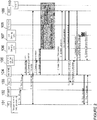
- FIG. 5 is a message sequence diagram of a TAU employing some of the example embodiments presented herein.
- the UE 101 may send the TAU request featuring the information element.
- the new MME 104 may provide an indication or status update that the RAT type needs to be updated in message 8 (highlighted by circle 505).
- the new SGW may make any necessary adjustments in an update bearer request as shown in message 9 (highlighted by circle 507).
- the indication unit may be located in the MME, thus in this scenario, the idle status or indication would be provided in message 503.
- a computer-readable medium may comprise removable and non-removable storage devices comprising, but not limited to, Read Only Memory (ROM), Random Access Memory (RAM), compact discs (CDs), digital versatile discs (DVD), etc.
- program modules may comprise routines, programs, objects, components, data structures, etc. that perform particular tasks or implement particular abstract data types.
- Computer-executable instructions, associated data structures, and program modules represent examples of program code for executing steps of the methods disclosed herein. The particular sequence of such executable instructions or associated data structures represents examples of corresponding acts for implementing the functions described in such steps or processes.
Landscapes
- Engineering & Computer Science (AREA)
- Computer Networks & Wireless Communication (AREA)
- Signal Processing (AREA)
- Mobile Radio Communication Systems (AREA)
Applications Claiming Priority (3)
| Application Number | Priority Date | Filing Date | Title |
|---|---|---|---|
| US41037310P | 2010-11-05 | 2010-11-05 | |
| PCT/EP2010/070425 WO2012059141A1 (en) | 2010-11-05 | 2010-12-21 | A method and device for communication |
| EP10795391.1A EP2636230B1 (de) | 2010-11-05 | 2010-12-21 | Kommunikationsverfahren und -vorrichtungen im kontext einer ruheprozedur und computerlesbares speichermedium und computerprogramm |
Related Parent Applications (1)
| Application Number | Title | Priority Date | Filing Date |
|---|---|---|---|
| EP10795391.1A Division EP2636230B1 (de) | 2010-11-05 | 2010-12-21 | Kommunikationsverfahren und -vorrichtungen im kontext einer ruheprozedur und computerlesbares speichermedium und computerprogramm |
Publications (1)
| Publication Number | Publication Date |
|---|---|
| EP3573389A1 true EP3573389A1 (de) | 2019-11-27 |
Family
ID=44224568
Family Applications (2)
| Application Number | Title | Priority Date | Filing Date |
|---|---|---|---|
| EP19179237.3A Withdrawn EP3573389A1 (de) | 2010-11-05 | 2010-12-21 | Kommunikationsverfahren und -vorrichtung im kontext einer ruheprozedur und computerprogramm und computerlesbares speichermedium |
| EP10795391.1A Active EP2636230B1 (de) | 2010-11-05 | 2010-12-21 | Kommunikationsverfahren und -vorrichtungen im kontext einer ruheprozedur und computerlesbares speichermedium und computerprogramm |
Family Applications After (1)
| Application Number | Title | Priority Date | Filing Date |
|---|---|---|---|
| EP10795391.1A Active EP2636230B1 (de) | 2010-11-05 | 2010-12-21 | Kommunikationsverfahren und -vorrichtungen im kontext einer ruheprozedur und computerlesbares speichermedium und computerprogramm |
Country Status (6)
| Country | Link |
|---|---|
| US (1) | US8861435B2 (de) |
| EP (2) | EP3573389A1 (de) |
| JP (1) | JP5746358B2 (de) |
| CN (1) | CN103329580B (de) |
| RU (1) | RU2551121C2 (de) |
| WO (1) | WO2012059141A1 (de) |
Families Citing this family (9)
| Publication number | Priority date | Publication date | Assignee | Title |
|---|---|---|---|---|
| US8477730B2 (en) * | 2011-01-04 | 2013-07-02 | Cisco Technology, Inc. | Distributed load management on network devices |
| JP5011439B2 (ja) * | 2011-01-07 | 2012-08-29 | 株式会社エヌ・ティ・ティ・ドコモ | 移動通信方法、移動管理ノード及びサービングゲートウェイ装置 |
| US8724467B2 (en) | 2011-02-04 | 2014-05-13 | Cisco Technology, Inc. | System and method for managing congestion in a network environment |
| US8630247B2 (en) * | 2011-02-15 | 2014-01-14 | Cisco Technology, Inc. | System and method for managing tracking area identity lists in a mobile network environment |
| US9397879B2 (en) * | 2011-06-08 | 2016-07-19 | Alcatel Lucent | System, apparatus and method for address management in a distributed mobile core network |
| US9198209B2 (en) | 2012-08-21 | 2015-11-24 | Cisco Technology, Inc. | Providing integrated end-to-end architecture that includes quality of service transport for tunneled traffic |
| CN104640064A (zh) * | 2013-11-08 | 2015-05-20 | 中兴通讯股份有限公司 | 身份位置分离数据处理方法及装置 |
| RU2638036C2 (ru) * | 2014-12-22 | 2017-12-11 | Нек Корпорейшн | Система мобильной связи, sgw, терминал, способ приема системы мобильной связи, способ приема sgw и способ приема терминала |
| US12143836B2 (en) * | 2022-05-10 | 2024-11-12 | T-Mobile Innovations Llc | Optimization of device configuration relating to wireless access technologies |
Citations (4)
| Publication number | Priority date | Publication date | Assignee | Title |
|---|---|---|---|---|
| EP2159972A1 (de) * | 2007-11-01 | 2010-03-03 | Huawei Technologies Co., Ltd. | Verfahren und gerät zum zugang zum ursprungsnetzwerk unter nutzung einer temporären kennung eines entwicklungsnetzwerks |
| US20100056146A1 (en) * | 2008-06-18 | 2010-03-04 | Huawei Technologies Co., Ltd. | Method and device for processing information given idle-mode signaling reduction |
| EP2187681A1 (de) * | 2007-10-16 | 2010-05-19 | Huawei Technologies Co., Ltd. | Verfahren und system zur verwaltung von doppelregistrierungen |
| EP2214444A1 (de) * | 2009-01-30 | 2010-08-04 | Nec Corporation | Verfahren zur Optimierung der Reduzierung von Mobilitätssignalisierung bei Inter-RAT-Wechsel |
Family Cites Families (5)
| Publication number | Priority date | Publication date | Assignee | Title |
|---|---|---|---|---|
| US7876729B1 (en) * | 1998-07-20 | 2011-01-25 | Qualcomm Incorporated | Intersystem base station handover |
| CN101610504B (zh) * | 2008-06-18 | 2012-08-08 | 上海华为技术有限公司 | 接入、获取用户设备上下文及用户设备标识的方法和装置 |
| WO2010057200A1 (en) * | 2008-11-17 | 2010-05-20 | Starent Networks, Corp | Location reporting in wireless networks |
| EP2214440B1 (de) * | 2009-01-30 | 2012-03-28 | Vodafone Holding GmbH | Reduzierung der Signalisierungslast von einer mobilen Vorrichtung zu einem mobilen Netzwerk |
| US20120329440A1 (en) * | 2010-02-09 | 2012-12-27 | Research In Motion Limited | RFSP Selective Camping |
-
2010
- 2010-12-21 CN CN201080069959.0A patent/CN103329580B/zh active Active
- 2010-12-21 RU RU2013125759/07A patent/RU2551121C2/ru active
- 2010-12-21 JP JP2013537011A patent/JP5746358B2/ja active Active
- 2010-12-21 WO PCT/EP2010/070425 patent/WO2012059141A1/en not_active Ceased
- 2010-12-21 EP EP19179237.3A patent/EP3573389A1/de not_active Withdrawn
- 2010-12-21 EP EP10795391.1A patent/EP2636230B1/de active Active
- 2010-12-28 US US12/979,612 patent/US8861435B2/en active Active
Patent Citations (4)
| Publication number | Priority date | Publication date | Assignee | Title |
|---|---|---|---|---|
| EP2187681A1 (de) * | 2007-10-16 | 2010-05-19 | Huawei Technologies Co., Ltd. | Verfahren und system zur verwaltung von doppelregistrierungen |
| EP2159972A1 (de) * | 2007-11-01 | 2010-03-03 | Huawei Technologies Co., Ltd. | Verfahren und gerät zum zugang zum ursprungsnetzwerk unter nutzung einer temporären kennung eines entwicklungsnetzwerks |
| US20100056146A1 (en) * | 2008-06-18 | 2010-03-04 | Huawei Technologies Co., Ltd. | Method and device for processing information given idle-mode signaling reduction |
| EP2214444A1 (de) * | 2009-01-30 | 2010-08-04 | Nec Corporation | Verfahren zur Optimierung der Reduzierung von Mobilitätssignalisierung bei Inter-RAT-Wechsel |
Non-Patent Citations (3)
| Title |
|---|
| "3rd Generation Partnership Project; Technical Specification Group Services and System Aspects; General Packet Radio Service (GPRS) enhancements for Evolved Universal Terrestrial Radio Access Network (E-UTRAN) access (Release 8)", 3GPP STANDARD; 3GPP TS 23.401, 3RD GENERATION PARTNERSHIP PROJECT (3GPP), MOBILE COMPETENCE CENTRE ; 650, ROUTE DES LUCIOLES ; F-06921 SOPHIA-ANTIPOLIS CEDEX ; FRANCE, no. V8.11.0, 29 September 2010 (2010-09-29), pages 1 - 242, XP050442331 * |
| NORTEL, 3GPP TSG SA WG2 ARCHITECTURE - S2#60: "Generic impact on TAU identifiers when ISR is used", October 2007 (2007-10-01), XP002649217, Retrieved from the Internet <URL:http://www.3gpp.org/ftp/specs/html-info/TDocExMtg--S2-60--26047.htm> [retrieved on 20110708] * |
| NORTEL, 3GPP TSG SA WG2 ARCHITECTURE - S2#60: "TAU Procedure with ISR", October 2007 (2007-10-01), XP002649216, Retrieved from the Internet <URL:http://www.3gpp.org/ftp/specs/html-info/TDocExMtg--S2-60--26047.htm> [retrieved on 20110708] * |
Also Published As
| Publication number | Publication date |
|---|---|
| EP2636230B1 (de) | 2019-06-19 |
| RU2013125759A (ru) | 2014-12-10 |
| CN103329580A (zh) | 2013-09-25 |
| US20120113894A1 (en) | 2012-05-10 |
| US8861435B2 (en) | 2014-10-14 |
| CN103329580B (zh) | 2016-12-28 |
| RU2551121C2 (ru) | 2015-05-20 |
| JP5746358B2 (ja) | 2015-07-08 |
| EP2636230A1 (de) | 2013-09-11 |
| JP2014502078A (ja) | 2014-01-23 |
| WO2012059141A1 (en) | 2012-05-10 |
Similar Documents
| Publication | Publication Date | Title |
|---|---|---|
| US8861435B2 (en) | Method and device for communication | |
| US9219643B2 (en) | Node and method for the handling of serving gateway partial failure | |
| KR101778705B1 (ko) | 이동통신 시스템에서 위치 기반 pcc 제어 방법 및 시스템, 위치 기반 pcc 제어를 위한 패킷 데이터 네트워크 게이트웨이 장치 | |
| EP3216244B1 (de) | Knoten und verfahren zur überwachung der registrierung eines besucherstandortregisters einer drahtlosen vorrichtung | |
| EP3192305B1 (de) | Schnelles wifi-zu-lte-handover | |
| US9392566B2 (en) | Avoiding unlimited number of unsuccessful location update or packet data connection establishment attempts | |
| US9374691B2 (en) | Mobile station and information delivery server | |
| EP3008864B1 (de) | Knoten und verfahren zur handhabung von ran-überlastungsstatus | |
| US10149186B2 (en) | Node and method for monitoring an ability of a wireless device to receive downlink data | |
| EP3108690B1 (de) | Verfahren und vorrichtung zur videotelefoniedienstqualitätsverbesserung | |
| US9591689B2 (en) | System and method for detachment in wireless communication system | |
| KR20140019548A (ko) | 이종망간의 통신 서비스 제공 방법 | |
| EP3529954B1 (de) | Verfahren und vorrichtungen zur anbindung einer basisstation an ein kernnetzwerk | |
| US9986467B2 (en) | Node and method for a combined single radio voice call continuity and a packet switched handover | |
| US20180332474A1 (en) | Increased security for multilateration timing advance | |
| EP2643991B1 (de) | -handhabung von qos in s4-sgsn |
Legal Events
| Date | Code | Title | Description |
|---|---|---|---|
| PUAI | Public reference made under article 153(3) epc to a published international application that has entered the european phase |
Free format text: ORIGINAL CODE: 0009012 |
|
| AC | Divisional application: reference to earlier application |
Ref document number: 2636230 Country of ref document: EP Kind code of ref document: P |
|
| AK | Designated contracting states |
Kind code of ref document: A1 Designated state(s): AL AT BE BG CH CY CZ DE DK EE ES FI FR GB GR HR HU IE IS IT LI LT LU LV MC MK MT NL NO PL PT RO RS SE SI SK SM TR |
|
| STAA | Information on the status of an ep patent application or granted ep patent |
Free format text: STATUS: THE APPLICATION IS DEEMED TO BE WITHDRAWN |
|
| 18D | Application deemed to be withdrawn |
Effective date: 20200603 |