EP3573422B1 - Paarung drahtloser knoten - Google Patents
Paarung drahtloser knoten Download PDFInfo
- Publication number
- EP3573422B1 EP3573422B1 EP17892200.1A EP17892200A EP3573422B1 EP 3573422 B1 EP3573422 B1 EP 3573422B1 EP 17892200 A EP17892200 A EP 17892200A EP 3573422 B1 EP3573422 B1 EP 3573422B1
- Authority
- EP
- European Patent Office
- Prior art keywords
- communication device
- pairing
- devices
- group list
- communication
- Prior art date
- Legal status (The legal status is an assumption and is not a legal conclusion. Google has not performed a legal analysis and makes no representation as to the accuracy of the status listed.)
- Active
Links
Images






Classifications
-
- H—ELECTRICITY
- H04—ELECTRIC COMMUNICATION TECHNIQUE
- H04W—WIRELESS COMMUNICATION NETWORKS
- H04W8/00—Network data management
- H04W8/22—Processing or transfer of terminal data, e.g. status or physical capabilities
- H04W8/24—Transfer of terminal data
-
- H—ELECTRICITY
- H04—ELECTRIC COMMUNICATION TECHNIQUE
- H04W—WIRELESS COMMUNICATION NETWORKS
- H04W4/00—Services specially adapted for wireless communication networks; Facilities therefor
- H04W4/06—Selective distribution of broadcast services, e.g. multimedia broadcast multicast service [MBMS]; Services to user groups; One-way selective calling services
- H04W4/08—User group management
-
- H—ELECTRICITY
- H04—ELECTRIC COMMUNICATION TECHNIQUE
- H04W—WIRELESS COMMUNICATION NETWORKS
- H04W8/00—Network data management
- H04W8/005—Discovery of network devices, e.g. terminals
-
- H—ELECTRICITY
- H04—ELECTRIC COMMUNICATION TECHNIQUE
- H04W—WIRELESS COMMUNICATION NETWORKS
- H04W84/00—Network topologies
- H04W84/02—Hierarchically pre-organised networks, e.g. paging networks, cellular networks, WLAN [Wireless Local Area Network] or WLL [Wireless Local Loop]
- H04W84/10—Small scale networks; Flat hierarchical networks
-
- H—ELECTRICITY
- H04—ELECTRIC COMMUNICATION TECHNIQUE
- H04W—WIRELESS COMMUNICATION NETWORKS
- H04W84/00—Network topologies
- H04W84/18—Self-organising networks, e.g. ad-hoc networks or sensor networks
- H04W84/20—Leader-follower arrangements
-
- H—ELECTRICITY
- H04—ELECTRIC COMMUNICATION TECHNIQUE
- H04W—WIRELESS COMMUNICATION NETWORKS
- H04W4/00—Services specially adapted for wireless communication networks; Facilities therefor
- H04W4/02—Services making use of location information
- H04W4/023—Services making use of location information using mutual or relative location information between multiple location based services [LBS] targets or of distance thresholds
-
- H—ELECTRICITY
- H04—ELECTRIC COMMUNICATION TECHNIQUE
- H04W—WIRELESS COMMUNICATION NETWORKS
- H04W4/00—Services specially adapted for wireless communication networks; Facilities therefor
- H04W4/80—Services using short range communication, e.g. near-field communication [NFC], radio-frequency identification [RFID] or low energy communication
-
- H—ELECTRICITY
- H04—ELECTRIC COMMUNICATION TECHNIQUE
- H04W—WIRELESS COMMUNICATION NETWORKS
- H04W76/00—Connection management
- H04W76/10—Connection setup
-
- H—ELECTRICITY
- H04—ELECTRIC COMMUNICATION TECHNIQUE
- H04W—WIRELESS COMMUNICATION NETWORKS
- H04W84/00—Network topologies
- H04W84/18—Self-organising networks, e.g. ad-hoc networks or sensor networks
Definitions
- the present technology relates to a master communication device, a slave communication device, pairing methods, and programs, and particularly relates to a pairing technology in communication among a large number of such as three or more devices.
- Bluetooth (registered trademark) wireless technology is peer to peer (P2P) communication and requires pairing between devices in advance to perform communication between the devices. Because of the P2P communication, normally, one-to-one pairing is performed in one operation.
- pairing is performed in a desired combination.
- Patent Document 1 describes a technology regarding pairing.
- a user procedure for pairing is, for example, as follows.
- the user in a case where the user wants to listen to music played on a smartphone using a wireless headset, the user performs an operation to turn on Bluetooth communication on the smartphone. Then, the smartphone searches for nearby communicable devices and displays the discovered communicable devices.
- the user performs an operation to specify a headset to be used among the displayed communicable devices. Then, the smartphone performs pairing with the headset.
- the smartphone and the headset are set to be communication targets with each other, and the user becomes able to listen to the music played on the smartphone using the wirelessly connected headset thereafter.
- Patent Document 2 relates to a system and method for connecting computing devices together. It proposes an authentication protocol that enables one device to securely and encryptedly access the network of another device.
- Patent Document 3 relates to methods and devices for establishing communication between multiple devices in a group.
- the method involves receiving a communication request from a main device in the group to establish communication with the first client device. It also involves checking the communication status of the first client device to decide whether to establish communication with the main device. Additionally, the method includes receiving a communication extension request from a second client device to establish communication with the first client device, checking if the second client device is part of the group, and then deciding whether to establish communication with the second client device based on whether communication with the main device and the first client device have already been set up.
- communication devices that enable a talk in a group of a plurality of people who are in a short distance are useful. For example, nearby friends can talk with one another by using Bluetooth communication devices mounted on helmets used for motorcycles, skiing, or the like.
- a plurality of friends such as three or four people, for example, is only required to pair their communication devices with communication devices of other people in advance.
- N*(N - 1)/2 times of pairing is required.
- four friends respectively carry out devices A, B, C, and D, and perform communication
- six times of pairing operations between A and B, A and C, A and D, B and C, B and D, and C and D are required.
- the users need to perform the pairing operations while grasping which devices are paired and which devices are unpaired.
- an object of the present technology is to facilitate a pairing operation in a case where, for example, pairing is performed among three or more devices to create a communicable group.
- pairing is automatically executed on the basis of group list information. Therefore, pairing among three or more devices can be quickly and efficiently executed, and the burden of operation on users is eliminated.
- a communication device 1 as a Bluetooth communication device is cited as an example.
- the communication device 1 is assumed to be a device capable of performing voice communication (call) with another paired communication device 1 in a state of being worn or carried by a user.
- Fig. 1A illustrates a configuration of the communication device 1 according to the embodiment.
- the communication device 1 includes a system-on-a-chip (SoC) 10, an antenna 11, a speaker 12, and a microphone 13.
- SoC system-on-a-chip
- the SoC 10 is a Bluetooth SoC generated as a device for performing Bluetooth communication control.
- Fig. 1B illustrates an internal configuration example of the SoC 10. Note that, here, an example using an SoC is illustrated. However, the present embodiment is not limited to an SoC form, and it is sufficient that the communication device 1 has the configuration for performing Bluetooth communication control as illustrated in Fig. 1B .
- the SoC 10 includes a control unit 21, a memory unit 22, a wireless communication unit 23, an audio codec 24, an audio interface 25, an input amplifier 26, and an output amplifier 27.
- the control unit 21 is configured by a micro control unit (MCU), a digital signal processor (DSP), and the like, and controls an overall operation of the communication device 1.
- MCU micro control unit
- DSP digital signal processor
- control unit 21 is provided with functions as a communication control unit 21a, a list information processing unit 21b, and a pairing processing unit 21c illustrated in Fig. 2 according to an operation program.
- the communication control unit 21a is illustrated as a function to control an overall voice communication operation with another communication device 1 via the wireless communication unit 23.
- the list information processing unit 21b and the pairing processing unit 21c are provided as functions to efficiently execute a grouping operation to perform pairing among three or more communication devices 1.
- the list information processing unit 21b is a function to generate or acquire a group list indicating a device selected as a device capable of wireless communication and as a device capable of corresponding to a group that performs communication.
- the group list is information in which a own device, and devices selected as devices to be connected for a group call, among communicable devices existing in the neighborhood of the own device, are listed.
- a certain communication device 1 serves as a master device in making a group capable of voice communication by pairing each two of three or more communication devices 1 each other, the certain communication device 1 performs processing of generating a group list by the function of the list information processing unit 21b.
- the slave communication device 1 performs processing of receiving and acquiring a group list transmitted by another communication device 1 by the function of the list information processing unit 21b.
- the pairing processing unit 21c is a function to perform pairing processing of setting a own device and a communication device indicated in the group list to be wireless communication targets to each other by reference to the group list information.
- the necessary pairing processing is performed such that each communication device 1 in the group is paired with each of the other communication device 1.
- the memory unit 22 in Fig. 1B generally indicates a read only memory (ROM), a random access memory (RAM), a flash ROM, and the like.
- the ROM or the flash ROM in the memory unit 22 stores programs for realizing the functions illustrated in Fig. 2 and constants necessary for various types of processing, and the like.
- the RAM in the memory unit 22 is used as an arithmetic area of various types of processing such as communication control, pairing processing, and group list generation and is also used for temporary data storage.
- the wireless communication unit 23 is illustrated as a unit that performs voice data communication according to a Bluetooth communication method via the antenna 11 on the basis of the control of the control unit 21.
- the audio codec 24 performs encoding and decoding for the voice data communication.
- the audio codec 24 encodes voice data of a transmission voice obtained by the microphone 13 and supplies the voice data to the wireless communication unit 23. Furthermore, the audio codec 24 decodes voice data received by the wireless communication unit 23.
- the microphone 13 collects the user's transmission voice.
- An analog voice signal collected by the microphone 13 is supplied to the input amplifier 26.
- the input amplifier 26 applies automatic gain control (AGC) processing, limiter processing, filter processing, conversion processing into a digital signal (A/D conversion), equalization, and the like to the analog voice signal, and supplies the voice signal to the audio interface 25 as digital data of the transmission voice.
- AGC automatic gain control
- the digital data is transferred to the audio codec 24.
- the digital data is encoded and transmitted from the wireless communication unit 23.
- Voice data of reception voice received by the wireless communication unit 23 and decoded by the audio codec 24 is supplied to the output amplifier 27 via the audio interface 25.
- the output amplifier 27 supplies a voice signal, to which equalization, conversion processing into an analog signal (D/A conversion), level adjustment, power amplifier amplification, and the like has been applied, to the speaker 12 and causes the speaker 12 to execute a voice output.
- Fig. 3 illustrates four communication devices 1A, 1B, 1C, and 1D as the communication devices 1 having such a configuration.
- the communication devices 1A, 1B, 1C, and 1D are connected by a Bluetooth wireless method, users can have a voice conversation with each other, and moreover, all the users can have a conversation, even if the users are far away from one another, as long as wireless signals can reach.
- the present embodiment can facilitate such pairing among the communication devices 1A, 1B, 1C, and 1D, for example.
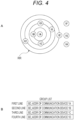
- Fig. 4A illustrates devices capable of Bluetooth communication existing in the neighborhood around the communication device 1A. Note that it is assumed that a circular range RR is a range in which an ID packet transmitted from the communication device 1A can reach.
- communication devices 1E, 1F, 1G, and 1H are also assumed to be similar communication devices 1 but are assumed to exist at relatively distant positions.
- Devices X1 and X2 are also devices capable of Bluetooth communication but are not devices for voice communication with the communication devices 1.
- the devices X1 and X2 are assumed to be devices such as music players or game devices.
- the devices X1 and X2 exist at positions where the devices X1 and X2 can communicate with the communication device 1A.
- the communication devices 1E, 1F, 1G, and 1H are assumed to be the communication devices 1 carried by unrelated persons.
- the communication device 1A searches for devices capable of Bluetooth communication, thereby detecting the communication devices 1B, 1C, and 1D, and the devices X1 and X2.
- the communication device 1E may be detected.
- the communication device 1A selects a device to belong to the group from among the devices detected as communicable devices.
- the communication device 1A can eliminate the devices X1 and X2 from the devices to be connected by confirming device type information of each of the detected devices.
- the communication device 1E can be eliminated from the device to be connected by lowering priority of selection of the communication device 1E according to the above characteristic.
- the communication device 1E is eliminated from the device to be connected due to number limitation.
- whether or not the communication device 1E is the device to be connected may be determined according to the level of the received signal strength indicator.
- the communication device 1A selects devices in a group and generates a group list listing the devices to belong to the group.
- FIG. 4B An example of the group list is illustrated in Fig. 4B .
- the own device (communication device 1A) is described.
- the communication device 1B, the communication device 1C, and the communication device 1D selected as the devices in the group are described.
- Each of the communication devices 1A, 1B, 1C, and 1D is indicated by a Bluetooth device address (BD_ADDR).
- the group list is generated at the time of grouping as indicating all the devices in the group.
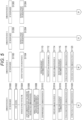
- FIG. 5 to 7 illustrate a flow of control processing by the control units 21 of the respective communication devices 1 (1A, 1B, 1C, and 1D), assuming that the communication devices 1A, 1B, 1C, and 1D in Fig. 4A are grouped.
- the four users respectively carrying the communication devices 1A, 1B, 1C, and 1D in a positional relationship as illustrated in Fig. 4A respectively operate their own communication devices 1 (1A, 1B, 1C, and 1D) to set the communication devices 1 to be in a grouping mode.
- each communication device 1 enters a standby state for processing for grouping to be described below as steps S1000, S1100, S1200, and S1300 in Fig. 5 in response to the operation to set the grouping mode.
- the communication devices 1A, 1B, 1C, and 1D become discoverable and become searchable by inquiry search (inquiry described below).
- One of the plurality of communication devices 1 in the grouping mode functions as a master and grouping processing proceeds. Any of the communication devices 1A, 1B, 1C, and 1D may become the master. When a certain user starts grouping, the communication device 1 that has performed the grouping start operation becomes the master.
- step S1002 the communication device 1A starts the grouping processing as the master in response to the grouping start operation.
- step S1004 the communication device 1A broadcasts an ID packet for a fixed time for query search.
- the communication devices 1B, 1C, and 1D respectively execute responses to the ID packet (for example, transmission of frequency hop synchronization (FHS) packets and extended inquiry response (EIR) packets) (steps S1104, S1204, and S1304).
- FHS frequency hop synchronization
- EIR extended inquiry response
- step S1006 the communication device 1A executes processing of extracting a communication device to be connected from class of device (CoD) or manufacturer specific data obtained from the responses of the peripheral devices (devices capable of Bluetooth communication).
- class of device CoD
- manufacturer specific data obtained from the responses of the peripheral devices (devices capable of Bluetooth communication).
- Bluetooth compatible devices X1 and X2 there are cases where other Bluetooth compatible devices X1 and X2 exist around the communication device 1A, as illustrated in Fig. 4A , and these devices may return responses to the ID packet from the communication device 1A.
- the communication device 1A determines whether or not the devices X1 and X2 are the devices to be connected by determining the types of the devices according to the CoD included in the responses.
- the communication device 1A can determine whether or not the devices X1 and X2 are the devices to be connected in more detail by setting the manufacturer specific data in the EIR.
- the communication device 1A can exclude the devices X1 and X2 and extract the communication devices 1B, 1C, and 1D.
- step S1008 the communication device 1A executes group list creation.
- the communication device 1A creates a group list by arranging the communication devices extracted as the devices to be connected in descending order of values of received signal strength indicator (RSSI).
- RSSI received signal strength indicator
- the communication device 1A stores the RSSI values at the time of receiving the responses from the communication devices (1B, 1C, and 1D).
- the communication device with a large RSSI value is located near the communication device 1A, and the communication device with a small RSSI value is located at a distant place from the communication device 1A. That is, the communication device 1A creates the group list by arranging the communication devices 1B, 1C, and 1D selected as the devices to be connected in order of proximity to the own device.
- the communication devices 1E, 1F, 1G, and 1H in Fig. 4A are not included in the group list.
- the communication devices 1E, 1F, 1G, and 1H are devices of the same model or the same type capable of voice communication of the present embodiment, no response to the ID packet is returned to the communication device 1A because the communication devices 1F, 1G, and 1H do not exist near the communication device 1A at the start of grouping. That is, the communication devices 1F, 1G, and 1H do not exist as viewed from the communication device 1A.
- the communication device 1E there is usually no problem because the communication device 1E is usually assumed not to be in the grouping mode at the same time. However, it is conceivable that the communication device 1E becomes in the grouping mode at the same time and is located relatively close to the communication device 1A. In that case, the communication device 1E may return a response to the ID packet of the communication device 1A.
- the communication device 1E is prevented from being grouped by arranging the communication devices 1 in descending order of the RSSI values and limiting the number of devices in the group.
- the communication device 1A sets the number of communication devices in the group to "4" including the own device and arranging the communication devices in descending order of the RSSI values, thereby excluding the communication device with a small RSSI value, that is, the communication device 1E located at a distant place from the communication device 1A from the device to be connected.
- the first line of the group list is the communication device 1A that has started the grouping in step S1002.
- BD_ADDRs of the communication devices 1B, 1C, and 1D are listed in descending order of the RSSI values. That is, because of the positional relationship in Fig. 4A , the communication devices 1B, 1C, and 1D are illustrated in order of proximity to the communication device 1A.
- step S1010 the communication device 1A transmits a pairing request to the communication device 1B according to the group list.
- step S1110 the communication device 1B receives the pairing request from the communication device 1A.
- step S1112 the communication device 1B transfers a response mode to a non-discoverable mode so as not to respond to the query search from other Bluetooth devices. Note that, during the grouping processing, the communication device 1B does not return to be discoverable to make a discoverable period as short as possible after entering the grouping mode.
- step S1014 the communication device 1A executes the pairing processing with the communication device 1B.
- step S1114 the communication device 1B executes the pairing processing with the communication device 1A.
- step S1016 the communication device 1A transmits a connection request to the communication device 1B.
- step S1116 the communication device 1B receives the connection request from the communication device 1A.
- step S1018 the communication device 1A establishes connection with the communication device 1B.
- step S1118 the communication device 1B establishes connection with the communication device 1A.
- step S1020 the communication device 1A executes group list distribution to the communication device 1B.
- step S1120 the communication device 1B executes group list reception from the communication device 1A. Thereby, the communication device 1B has acquired the group list as illustrated in Fig. 4B .
- the communication device 1A executes, between the communication device 1A and the communication device 1C and between the communication device 1A and the communication device 1D in the order of the group list, each processing according to the same procedure as the "pairing, connection, and group list distribution" between the communication device 1A and the communication device 1B.
- step S1022 in Fig. 6 the communication device 1A transmits the pairing request to the communication device 1C.
- step S1222 the communication device 1C receives the pairing request from the communication device 1A, and in step S1224, the communication device 1C transitions to the non-discoverable mode.
- step S1026 the communication device 1A executes the pairing processing with the communication device 1C.
- step S1226 the communication device 1C executes the pairing processing with the communication device 1A.
- step S1028 the communication device 1A transmits the connection request to the communication device 1C.
- step S1228 the communication device 1C receives the connection request from the communication device 1A.
- step S1030 the communication device 1A establishes connection with the communication device 1C.
- step S1230 the communication device 1C establishes connection with the communication device 1A.
- step S1032 the communication device 1A executes the group list distribution to the communication device 1C.
- step S1232 the communication device 1C executes the group list reception from the communication device 1A. Thereby, the communication device 1C has acquired the group list.
- step S1034 the communication device 1A transmits the pairing request to the communication device 1D.
- step S1334 the communication device 1D receives the pairing request from the communication device 1A, and in step S1336, the communication device 1D transitions to the non-discoverable mode.
- step S1038 the communication device 1A executes the pairing processing with the communication device 1D.
- step S1040 the communication device 1A transmits the connection request to the communication device 1D.
- step S1340 the communication device 1D receives the connection request from the communication device 1A.
- step S1042 the communication device 1A establishes connection with the communication device 1D.
- step S1342 the communication device 1D establishes connection with the communication device 1A.
- step S1044 the communication device 1A executes the group list distribution to the communication device 1D.
- step S1344 the communication device 1D executes the group list reception from the communication device 1A. Thereby, the communication device 1D has acquired the group list.
- the communication device 1A which is the master device, causes slave devices to perform pairing between the slave devices.
- step S1046 in Fig. 7 the communication device 1A transmits a pairing instruction (slave-slave pairing instruction) with another communication device to the communication device 1B according to the group list.
- step S1146 the communication device 1B receives the pairing instruction from the communication device 1A.
- step S1148 the communication device 1B transmits the pairing request to the communication device 1C lower than the communication device 1B in the group list.
- step S1248 the communication device 1C receives the pairing request from the communication device 1B.
- step S1150 the communication device 1B executes the pairing processing with the communication device 1C.
- step S1250 the communication device 1C executes the pairing processing with the communication device 1B. Thereby, the communication device 1B is paired with the communication device 1C.
- step S1152 the communication device 1B transmits the pairing request to the communication device 1D lower than the communication device 1C in the group list.
- step S1352 the communication device 1D receives the pairing request from the communication device 1B.
- step S1154 the communication device 1B executes the pairing processing with the communication device 1D.
- step S1354 the communication device 1D executes the pairing processing with the communication device 1B. Thereby, the communication device 1B is paired with the communication device 1D.
- step S1156 the communication device 1B transmits a pairing completion notification to the communication device 1A as the master device.
- step S1056 the communication device 1A receives a pairing completion notification from the communication device 1B.
- the communication device 1A transmits the pairing instruction with another communication device to the communication device 1C lower than the communication device 1B in the group list.
- the communication device 1C By receiving the pairing instruction from the communication device 1A in step S1258, the communication device 1C performs pairing with a communication device lower than the communication device 1C in the group list in a similar manner to the communication device 1B.
- step S1260 the communication device 1C transmits the pairing request to the communication device 1D.
- step S1360 the communication device 1D receives the pairing request from the communication device 1C.
- step S1262 the communication device 1C executes the pairing processing with the communication device 1D.
- step S1362 the communication device 1D executes the pairing processing with the communication device 1C. Thereby, the communication device 1C is paired with the communication device 1D.
- step S1264 the communication device 1C transmits a pairing completion notification to the communication device 1A as the master device.
- step S1064 the communication device 1A receives the pairing completion notification from the communication device 1C.
- the communication device 1A executes the pairing instruction (slave-slave pairing instruction) with another communication device up to the one higher communication device (the communication device 1C in this example) than the lowest communication device in the group list.
- the communication device 1A when the communication device 1A receives the pairing completion notification from the communication device 1C, it can be determined that the pairing in all the combinations of the communication devices has been completed.
- step S1068 the communication device 1A transmits a grouping completion notification to each of the communication devices 1B, 1C, and 1D. Then, in step S1070, the communication device 1A terminates the grouping processing as grouping completion.
- step S1168 the communication device 1B receives the grouping completion notification from the communication device 1A, and in step S1170, the communication device 1B terminates the grouping processing in response to the notification.
- step S1268 the communication device 1C receives the grouping completion notification from the communication device 1A, and in step S1270, the communication device 1C terminates the grouping processing in response to the notification.
- step S1368 the communication device 1D receives the grouping completion notification from the communication device 1A, and in step S1370, the communication device 1D terminates the grouping processing in response to the notification.
- the pairing has been completed in all the combinations among the communication devices 1A, 1B, 1C, and 1D.
- the master device (the device that has started grouping) can transmit the ID packet and can determine whether or not the slave device that has received the ID packet is a device to be grouped according to the information included in the FHS packet and the EIR packet from the slave device.
- the master device can set the device having a high received signal strength indicator to be the device to be grouped and can exclude the device having a low received signal strength indicator from the device to be grouped according to the received signal strength indicator (RSSI) in the received FHS packet.
- RSSI received signal strength indicator
- the master device can perform grouping of the devices that perform voice communication by creating the group list using the information and the RSSI values included in the FHS packets and the EIR packet.
- the group list indicates each device by including the Bluetooth device address BD_ADDR of each communication device 1.
- the master device executes pairing with each device included in the group list.
- the master device distributes the created group list to each slave device included in the group list.
- the pairing between the slave devices included in the group list excluding the master device is performed in accordance with the group list according to the instruction from the master device.
- a processing algorithm of the communication device 1 that enables the above-described grouping processing in other words, a processing algorithm as the list information processing unit 21b and the pairing processing unit 21c will be mainly described.
- the following is an example of processing performed by the control unit 21 on the basis of a program.
- Each communication device 1 can perform the grouping processing as the master device or the slave device, as the control unit 21 of the each communication device 1 performs the processing in Figs. 8 to 12 below.
- Fig. 8 illustrates processing of transition to the grouping mode by the communication device 1.
- step S101 When detecting a grouping mode operation by the user, the control unit 21 proceeds from step S101 to step S103 and transitions to the grouping mode. In this state, the communication device 1 transitions to the grouping mode as the slave device.
- This process corresponds to the processes in steps S1000, S1100, S1200, and S1300 in the communication devices 1A, 1B, 1C, and 1D in Fig. 5 .
- control unit 21 proceeds from step S102 to step S104, and transitions to the grouping mode as the master device in step S105 when the communication device 1 is already in the grouping mode state.
- This process corresponds to the process in step S1002 in the communication device 1A in Fig. 5 .
- control unit 21 also accepts operations other than the grouping mode operation and the grouping start operation, but the processing in those cases are not illustrated and described.
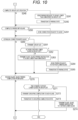
- Fig. 9 and Fig. 10 illustrate processing executed in a case where the communication device 1 transitions to the grouping mode as the master device. That is, the processing corresponds to the processing in the case of the communication device 1A in Fig. 5 . Note that the processing in Fig. 9 is illustrated to continue to Fig. 10 .
- the control unit 21 of the communication device 1 as the master device repeats the processing of the check loop of steps S200, S210, S220, S230, S240, S250, S260, and S270 illustrated in Figs. 9 and 10 .
- step S200 in Fig. 9 the control unit 21 determines whether or not it is start timing of an inquiry.
- the inquiry is processing of inquiring peripheral devices and obtaining a list of the peripheral devices.
- the timing when the communication device 1 becomes the master device is the start timing of the inquiry.
- the control unit 21 starts an inquiry timer
- the control unit 21 starts transmission of the ID packet.
- the inquiry timer is a timer that counts a period of the inquiry (transmission of the ID packet).
- the period of one inquiry is defined by a set time Tinquiry.
- the set time Tinquiry is, for example, 10 seconds, or the like.
- step S210 the control unit 21 confirms whether or not a grouping timer has reached a certain set time Tiquiryscan.
- the grouping timer is a timer that counts a period of the grouping mode, and starts counting in step S301 in Fig. 11 described below when the communication device 1 is set to in the grouping mode as the slave device.
- the communication device 1 which has transitioned to the grouping mode as the master device, had temporarily transitioned to the grouping mode as the slave device when the grouping mode operation was first performed, so the counting of the grouping timer has started and still being executed after transitioning to the master state.
- the set time Tiquiryscan indicates a time limit of the period of the grouping mode, and is, for example, 30 seconds, or the like.
- the communication device can leave the grouping mode by timeout of the grouping timer.
- step S210 the control unit 21 proceeds from step S210 to step S211, stops the grouping timer, stops the inquiry timer in step S212, and terminates the inquiry in step S213. Then, in step S214, the control unit 21 transitions to a connection waiting state. That is, the grouping mode is terminated.
- step S220 the control unit 21 confirms reception of the FHS packet.
- the control unit 21 confirms whether or not the FHS packet is from the device to be grouped. For example, the control unit 21 determines whether or not the transmission source of the FHS packet is the communication device to be connected from the CoD or the manufacturer specific data, as described above.
- the control unit 21 performs no particular processing (S221 ⁇ NO). In a case where the transmission source of the FHS packet is the device to be grouped, the control unit 21 proceeds to step S222 and acquires the RSSI value. Then, in step S223, the processing branches depending on whether or not the device has been already registered in an inquiry list.
- the inquiry list is a list of the peripheral devices detected by the inquiry.
- control unit 21 proceeds to step S224 and adds the BD_ADDR and the RSSI of the device detected this time to the inquiry list.
- control unit 21 proceeds to step S225 and updates the RSSI corresponding to the BD_ADDR of the device detected this time in the inquiry list.
- step S226 the control unit 21 sorts the inquiry list in order of RSSI.
- step S230 the control unit 21 confirms whether or not the inquiry timer has reached a certain set time Tinquiry.
- control unit 21 proceeds to step S231 and confirms whether or not there is a device in the inquiry list.
- control unit 21 continues to execute the inquiry. That is, the control unit 21 proceeds to step S232, resets the inquiry timer, and starts the inquiry timer in step S233.
- step S231 the control unit 21 stops the inquiry timer in step S234 and terminates the inquiry in step S235.
- step S236 the control unit 21 creates the group list as described above from the inquiry list at that time.
- step S240 in Fig. 10 the control unit 21 confirms completion of group list creation. That is, when the group list creation is completed, the control unit 21 proceeds from step S240 to S241 and sends the pairing request to the slave device lower than the own device in the group list. Then, in step S242, the control unit 21 transitions to a pairing state.
- step S250 the control unit 21 confirms completion of the pairing with the slave device. That is, when the pairing with the slave device is completed, the control unit 21 proceeds from step S250 to S251 and sends the connection request to the paired slave device.
- step S260 the control unit 21 confirms establishment of connection with the slave device. That is, when the connection establishment with the slave device is completed, the control unit 21 proceeds from step S260 to S261 and transmits the group list to the connected slave device.
- step S262 the control unit 21 confirms whether or not there is a further lower slave device in the group list.
- step S263 the control unit 21 transmits the slave-slave pairing instruction to the slave device immediately below the own device.
- control unit 21 requests the further lower slave device of pairing in step S264 and transitions to the pairing state in step S265.
- step S270 the control unit 21 confirms reception of slave-slave pairing completion.
- the control unit 21 confirms a notification of the slave-slave pairing completion
- the control unit 21 proceeds to step S271.
- the control unit 21 confirms whether or not there are two or more further lower slave devices (than the slave device that has transmitted the pairing completion) in the group list.
- step S274 the control unit 21 transmits the slave-slave pairing instruction to the slave device next lower than the slave device that has transmitted the pairing completion.
- step S272 the control unit 21 transmits the grouping completion notification to each slave device. Then, in step S273, the control unit 21 transitions to a grouping completion state. That is, the grouping mode is terminated.
- the control unit 21 of the communication device 1 as the slave device repeats the processing of the check loop of steps S300, S310, S320, S330, S340, S350, S360, S370, S380, and S390 illustrated in Figs. 11 and 12 .
- step S300 in Fig. 11 the control unit 21 determines whether or not it is start timing of inquiry scan corresponding to the inquiry. This timing is the timing when the communication device 1 has transitioned to the grouping mode. In this case, in step S301, the control unit 21 starts the grouping timer.
- step S310 the control unit 21 confirms whether or not the grouping timer has reached the set time Tiquiryscan.
- control unit 21 stops the grouping timer in step S311 and terminates the inquiry scan in step S312. Then, in step S313, the control unit 21 transitions to the connection waiting state. That is, the grouping mode is terminated.
- step S320 the control unit 21 confirms reception of the ID packet from the master device. In a case where the ID packet has been received, in step S321, the control unit 21 responds with the FHS packet.
- step S330 the control unit 21 confirms reception of the pairing request. In a case where the pairing request has been received, in step S331, the control unit 21 transitions to the pairing state.
- the pairing request is transmitted not only from the master device but also from other slave devices.
- step S332 the control unit 21 terminates the inquiry scan, and in step S333, the control unit 21 transitions to a page scan state. That is, the discoverable state responding to the inquiry is terminated, and the non-discoverable state corresponding to a call by an address is set.
- step S340 the control unit 21 confirms the end of pairing with the master device.
- control unit 21 resets the grouping timer in step S341, and starts the grouping timer in step S342.
- step S350 the control unit 21 confirms reception of the connection request from the master device. In a case where the connection request has been received, in step S351, the control unit 21 transitions to the connection state.
- step S360 the control unit 21 confirms reception of the group list. In a case where the group list has been received, in step S361, the control unit 21 performs processing of storing the group list.
- step S370 the control unit 21 confirms reception of the slave-slave pairing instruction from the master device. In a case where the instruction has been received, in step S371, the control unit 21 confirms whether or not there is a device lower than the own device in the group list. If there is no lower device, the control unit 21 performs no particular processing.
- step S372 the control unit 21 sends the pairing request to the lower slave device. Then, in step S373, the control unit 21 transitions to the pairing state.
- step S380 the control unit 21 confirms the end of the pairing with the slave device.
- step S381 the control unit 21 confirms whether or not there is a lower slave device (lower than the paired slave device) in the group list.
- step S383 the control unit 21 sends the pairing request to the lower slave device. Then, in step S384, the control unit 21 transitions to the pairing state.
- step S382 the control unit 21 transmits a slave-slave pairing completion notification to the master device.
- step S390 the control unit 21 confirms reception of the grouping completion notification.
- the control unit 21 transitions to the grouping completed state. That is, the grouping mode is terminated.
- each communication device 1 Since each communication device 1 is capable of executing the processing in Fig. 8 to Fig. 12 described above, each communication device 1 behaves as one of the communication devices 1A to 1D in Figs. 5 to 7 , and automatic grouping is executed.
- the communication device 1 of the above-described embodiment includes the list information processing unit 21b that generates or acquires the group list indicating a device selected as a device capable of wireless communication and as a device capable of corresponding to a group that performs communication, and the pairing processing unit 21c that performs the pairing processing of setting the own device and the communication device 1 indicated in the group list to be wireless communication targets to each other by reference to the group list.
- each communication device 1 does not perform an operation to give an instruction on pairing with each of the other communication devices 1, pairing can be automatically performed among the plurality of grouped communication devices 1.
- the present embodiment all the pairings are automatically and efficiently performed. Therefore, the operation burden on the user is significantly reduced. For example, it is sufficient that each user performs the operation to set the grouping mode, and one user (the user who carries the communication device 1A, for example) performs the grouping start operation.
- unpaired devices may occur but such unpaired devices do not occur.
- two or more devices to be connected capable of corresponding to a group that performs communication are selected from among the devices capable of wireless communication on the basis of predetermined information in response to the grouping start trigger (for example, the grouping start operation), and the group list indicating the own device and the two or more devices to be connected is generated.
- the grouping start trigger for example, the grouping start operation
- the group list is created as an operation of the communication device 1 that serves as the master in grouping.
- the group list To create the group list, other devices capable of wireless communication existing in the periphery are searched for, and the devices to be grouped among the searched devices are set as the devices to be connected. Then, the own device and the devices to be connected are listed, and the group list that specifies the devices to be grouped is created. Thereby, the group list that can be appropriately used for pairing between devices that the users want to form a group can be created.
- pairing is performed on the basis of the group list. In doing so, the inquiry response is performed only once before creating the group list. Therefore, pairing is not accidentally or intentionally performed by the third party, and an advantage of high security can also be obtained.
- the inquiry response can be performed with limited inquiry access code (LIAC) as a modification.
- LIAC limited inquiry access code
- GIAC general inquiry access code
- the device type information received from another device capable of wireless communication for example, the CoD or the manufacturer specific data is used as the predetermined information for selecting the device to be connected for generating the group list.
- the communication device that becomes the master in grouping selects the device to be connected from among peripheral devices capable of wireless communication according to the device type.
- the device of the type suitable for grouping as viewed from the master device, for example, the device suitable for voice communication for conversation in the group, as in the present embodiment, is automatically selected as the device to be connected, and the group list is generated. Therefore, even if there are devices capable of Bluetooth communication such as a smartphone, a music player, a speaker, a communication device incompatible with voice communication, and a communication device for different purposes, for example, the group list can be created excluding such devices.
- the slave device since whether or not the slave device is the device to be paired is selected according to the RSSI of the slave device at the time of inquiry response, the possibility of erroneous pairing is low even if a third party who purchased the same device performs grouping at the same timing.
- the communication device 1 serving as the master in grouping creates the group list limiting the number of devices to within the upper limit number.
- the processing according to the embodiment is suitable for grouping of the number of devices suitable for the processing capacity of the communication system and the devices, the amount of communication, a use band, a use form, or the circumstances according to the purpose of use. For example, in a case of a communication system in which the voice communication performance is degraded when the number of devices increases, the processing according to the embodiment is effective in a case of limiting the number of devices to the number that can maintain good voice communication performance, for example.
- devices with low received signal strength can be excluded from the devices to be grouped by limiting the number of devices. Thereby, only devices that can perform good communication can be set to the devices to be grouped.
- RSSI received signal strength indicator
- the upper limit number may be able to be set by the user before grouping. For example, in the case of a group of four, the upper limit number is four, and in the case of a group of five, the upper limit number is five. In doing so, the communication device 1E of the unrelated person illustrated in Fig. 4 can be more effectively prevented from being paired.
- the pairing processing is sequentially performed with each of the devices to be connected (slave devices) indicated in the group list (S241 and S264).
- an unnecessary pairing operation is not performed. That is, pairing with the device capable of wireless communication but not the device to be connected is not performed. Therefore, appropriate grouping according to the purpose of use of the communication devices can be performed and grouping can be made efficient.
- transmission control of the group list is performed for all or part of the devices to be connected (slave devices) indicated in the group list (S261).
- the slave devices can receive and acquire the group list generated by the master device. With the acquisition, the devices in the group can share the group list.
- the master device may transmit the group list to part of the slave devices, and the received slave device may transmit the group list to the other slave devices. In any case, it is sufficient that all the devices listed in the group list can share the group list created by the master device.
- transmission control of a pairing execution instruction using the group list is performed on the slave device as the transmission destination of the group list (S263 and S274).
- the slave device is paired with another slave device. This allows each device in the group to form a paired state with all the other devices.
- the group list information is acquired by receiving the group list information transmitted from the paired device, from the master device, for example (S361).
- the slave device can refer to the group list, and can perform pairing using the group list.
- transition is made to a state of not responding to any pairing request other than a pairing request specifying the own device in response to reception of the first pairing request after the start of grouping.
- the slave device executes the pairing processing in response to the request from another device but transitions to be in the non-discoverable state of not responding to an inquiry not specifying the own device (for example, an inquiry from a third device), thereby accurately executing the pairing processing without responding to the inquiry from another Bluetooth device.
- the communication devices 1B, 1C, and 1D transition to the non-discoverable state when the pairing request is first sent from the communication device 1A. Furthermore, since the BD_ADDR (Bluetooth device address) is clear by receiving the group list, the slave devices can be kept non-discoverable in pairing between the slave devices.
- BD_ADDR Bluetooth device address
- each slave device After receiving the pairing request, each slave device becomes non-discoverable, so the each slave device is not paired with a third party accidentally or intentionally, and high security can be secured.
- timing of transition to non-discoverable is not limited to immediately after receiving the pairing request and may be another timing, for example, after pairing completion with the master device, connection completion with the master device, or the like. In other words, various timings can be considered as the timing to reduce the time of being discoverable.
- the pairing processing is performed with an unpaired device among the devices indicated in the group list in response to reception of the pairing execution instruction (S372).
- the communication device 1 serving as the slave device in grouping confirms another slave device on the basis of the group list, and is paired with the another slave device in response to the pairing execution instruction from the master device.
- each of the devices in the group list can form a paired state with each of the other devices.
- the pairing completion notification is sent to the transmission source device of the pairing execution instruction when the pairing processing with all of the unpaired devices among the devices indicated in the group list has been completed (S382).
- the master device can recognize the pairing between the slave devices. Therefore, the series of grouping processing can be smoothly performed while grasping the pairing between the slave devices.
- the communication device 1 includes a voice input unit (microphone 13 and input amplifier 26), a voice output unit (speaker 12 and output amplifier 27), and a codec unit (audio codec 24) for encoding and decoding a voice signal and performs communication of a call voice.
- a voice input unit microphone 13 and input amplifier 26
- a voice output unit microphone 12 and output amplifier 27
- a codec unit audio codec 24
- a system with automatically optimized grouping can be realized as a communication device for conversational communication or the like.
- the users it is not necessary for the users to perform complicated operations such as the pairing operations between the communication devices used by the users, and an environment where a group call can be very easily performed can be realized for the users.
- the SoC 10 illustrated in Fig. 1 is configured by, for example, a Bluetooth wireless unit, an MCU, a DSP, a ROM, an I/O, a flash ROM, a RAM, an audio codec, an audio amplifier, or the like, but the aforementioned elements may be able to be used in combination as components.
- the present technology is useful for a configuration including three or more communication devices 1.
- the communication device 1 using Bluetooth communication
- the communication device 1 can be implemented in three to eight devices, and the above-described effects can be obtained. Note that it goes without saying that the communication operation can be performed even in a case of using two communication devices 1 to which the present technology is applied.
- the present technology supports inquiry response by general inquiry access code (GIAC), and also supports inquiry response by limited inquiry access code (LIAC).
- GIAC general inquiry access code
- LIAC limited inquiry access code
- a Bluetooth headset As specific product examples to which the present technology can be applied, a Bluetooth headset, a Bluetooth headphone, a Bluetooth speaker, an intercom device for motorcycles and bicycles, and the like are assumed.
- a program of the embodiment is a program for causing an arithmetic processing unit to execute a list information processing step of generating or acquire group list indicating a device selected as a device capable of wireless communication and as a device capable of corresponding to a group that performs communication, and a pairing processing step of performing pairing processing of setting the own device and a communication device indicated in the group list to be wireless communication targets to each other by reference to the group list information.
- the program causes an arithmetic processing unit to execute the processing in Figs. 8 , 9 , 10 , 11 , and 12 .
- Such a program facilitates the implementation of the communication device 1 of the present embodiment.
- Such a program can be stored in advance in a recording medium incorporated in a device such as a computer device, a ROM in a microcomputer having a CPU, or the like.
- a program can be temporarily or permanently stored in a removable recording medium such as a semiconductor memory, a memory card, an optical disk, a magneto-optical disk, or a magnetic disk.
- a removable recording medium can be provided as so-called package software.
- Such a program can be installed from a removable recording medium to a personal computer or the like, and can also be downloaded from a download site via a network such as a LAN or the Internet.
Landscapes
- Engineering & Computer Science (AREA)
- Computer Networks & Wireless Communication (AREA)
- Signal Processing (AREA)
- Databases & Information Systems (AREA)
- Multimedia (AREA)
- Mobile Radio Communication Systems (AREA)
Claims (11)
- Master-Kommunikationsvorrichtung (1A), umfassend eine Schaltlogik (21, 23), die konfiguriert ist zum:Broadcasten eines ID-Pakets für eine festgelegte Zeit für eine Abfragesuche:Ausführen einer Verarbeitung eines Extrahierens von Kommunikationsvorrichtungen (1B, 1C, 1D), die von einer Klasse von Vorrichtungs- oder herstellerspezifischen Daten verbunden werden sollen, die von Antworten von Peripherievorrichtungen (1B, 1C, 1D, 1E, X1, X2) in der Nachbarschaft der Master-Kommunikationsvorrichtung (1A) erhalten werden;Ausführen einer Erstellung einer Gruppenliste durch Anordnen der Kommunikationsvorrichtungen, die als die Kommunikationsvorrichtungen (1B, 1C, 1D) extrahiert werden, die in absteigender Reihenfolge von Werten des Signalstärkeanzeigers verbunden werden sollen;sequenzielles Durchführen für jede Kommunikationsvorrichtung (1B, 1C, 1D) in der Gruppenliste:Übertragen einer Paarungsanforderung an die Kommunikationsvorrichtung (1B, 1C, 1D);Ausführen einer Paarungsverarbeitung mit der Kommunikationsvorrichtung (1B, 1C, 1D);Übertragen einer Verbindungsanforderung an die Kommunikationsvorrichtung (1B, 1C, 1D);Herstellen einer Verbindung mit der Kommunikationsvorrichtung (1B, 1C, 1D); undÜbertragen der Gruppenliste an die Kommunikationsvorrichtung (1B, 1C, 1D); undnachdem die Gruppenliste an jede Kommunikationsvorrichtung (1B, 1C, 1D) in der Gruppenliste übertragen wird, Übertragen einer Paarungsanweisung an jede Kommunikationsvorrichtung in der Gruppenliste mit Ausnahme der am niedrigsten eingestuften Kommunikationsvorrichtung (1D) in der Gruppenliste, um jeweils die Kommunikationsvorrichtungen zu veranlassen zum:Übertragen einer Paarungsanforderung und Ausführen einer Paarungsverarbeitung mit den Kommunikationsvorrichtungen, die in der Gruppenliste niedriger eingestuft werden; undÜbertragen einer Paarungsabschlussbenachrichtigung an die Master-Kommunikationsvorrichtung (1A), wenn die jeweilige Kommunikationsvorrichtung mit allen Kommunikationsvorrichtungen gepaart wurde, die in der Gruppenliste niedriger eingestuft werden.
- Kommunikationsvorrichtung (1A) nach Anspruch 1, wobei
die Schaltlogik (21, 23) ferner konfiguriert ist, um die Gruppenliste innerhalb einer Obergrenzenanzahl von Kommunikationsvorrichtungen, einschließlich der Master-Kommunikationsvorrichtung (1A), zu erzeugen. - Master-Kommunikationsvorrichtung (1A) nach Anspruch 1 oder 2, wobei
die Schaltlogik (21, 23) ferner konfiguriert ist, um mit den Peripherievorrichtungen (1B, 1C, 1D, 1E, X1, X2) durch Bluetooth zu kommunizieren. - Master-Kommunikationsvorrichtung (1A) nach einem der Ansprüche 1 bis 3, ferner umfassend:eine Spracheingabeeinheit (13), eine Sprachausgabeeinheit (12) und eine Codec-Einheit (24), die konfiguriert ist, um ein Sprachsignal zu codieren und zu decodieren, wobeidie Master-Kommunikationsvorrichtung (1A) konfiguriert ist, um eine Kommunikation einer Anrufsprache durchzuführen.
- Paarungsverfahren für eine Master-Kommunikationsvorrichtung (1A), das Verfahren umfassend:
Broadcasten eines ID-Pakets für eine festgelegte Zeit für die Abfragesuche:Ausführen der Verarbeitung des Extrahierens von Kommunikationsvorrichtungen (1B, 1C, 1D), die von der Klasse von Vorrichtungs- oder herstellerspezifischen Daten verbunden werden sollen, die von Antworten von Peripherievorrichtungen (1B, 1C, 1D, 1E, X1, X2) in der Nachbarschaft der Master-Kommunikationsvorrichtung (1A) erhalten werden;Ausführen der Erstellung einer Gruppenliste durch Anordnen der Kommunikationsvorrichtungen, die als die Kommunikationsvorrichtungen (1B, 1C, 1D) extrahiert werden, die in absteigender Reihenfolge von Werten des Signalstärkeanzeigers verbunden werden sollen;sequenzielles Durchführen für jede Kommunikationsvorrichtung (1B, 1C, 1D) in der Gruppenliste:Übertragen einer Paarungsanforderung an die Kommunikationsvorrichtung (1B, 1C, 1D);Ausführen der Paarungsverarbeitung mit der Kommunikationsvorrichtung (1B, 1C, 1D);Übertragen einer Verbindungsanforderung an die Kommunikationsvorrichtung (1B, 1C, 1D);Herstellen der Verbindung mit der Kommunikationsvorrichtung (1B, 1C, 1D); undÜbertragen der Gruppenliste an die Kommunikationsvorrichtung (1B, 1C, 1D); undnachdem die Gruppenliste an jede Kommunikationsvorrichtung (1B, 1C, 1D) in der Gruppenliste übertragen wird, Übertragen einer Paarungsanweisung an jede Kommunikationsvorrichtung in der Gruppenliste mit Ausnahme der am niedrigsten eingestuften Kommunikationsvorrichtung (ID) in der Gruppenliste, um jeweils die Kommunikationsvorrichtungen zu veranlassen zum:Übertragen einer Paarungsanforderung und Ausführen einer Paarungsverarbeitung mit den Kommunikationsvorrichtungen, die in der Gruppenliste niedriger eingestuft werden; undÜbertragen einer Paarungsabschlussbenachrichtigung an die Master-Kommunikationsvorrichtung (1A), wenn die jeweilige Kommunikationsvorrichtung mit allen Kommunikationsvorrichtungen gepaart wurde, die in der Gruppenliste niedriger eingestuft werden. - Computerprogramm, umfassend Anweisungen, die, wenn sie durch eine Master-Kommunikationsvorrichtung (1A) nach einem der Ansprüche 1 bis 4 ausgeführt werden, die Master-Kommunikationsvorrichtung (1A) veranlassen, das Verfahren nach Anspruch 5 vorzunehmen.
- Slave-Kommunikationsvorrichtung (1B, 1C, 1D), umfassend eine Schaltlogik (21, 23), die konfiguriert ist zum:Empfangen eines ID-Pakets für die Abfragesuche von einer Master-Kommunikationsvorrichtung (1A);Übertragen einer Antwort an die Master-Kommunikationsvorrichtung (1A), einschließlich einer Klasse von Vorrichtungs- oder herstellerspezifischen Daten der Slave-Kommunikationsvorrichtung (1B, 1C, 1D);Empfangen einer Paarungsanforderung von der Master-Kommunikationsvorrichtung (1A);als Reaktion auf das Empfangen der Paarungsanforderung von der Master-Kommunikationsvorrichtung (1A), Übergang in einen Zustand des Nicht-Antwortens auf Abfragesuchen von anderen Vorrichtungen;Ausführen der Paarungsverarbeitung mit der Master-Kommunikationsvorrichtung (1A);Empfangen einer Verbindungsanforderung von der Master-Kommunikationsvorrichtung (1A);Herstellen der Verbindung mit der Master-Kommunikationsvorrichtung (1A);Empfangen einer Gruppenliste von der Master-Kommunikationsvorrichtung (1A);Empfangen einer Paarungsanweisung von der Master-Kommunikationsvorrichtung (1A); undals Reaktion auf das Empfangen der Paarungsanweisung:Übertragen einer Paarungsanforderung und Ausführen einer Paarungsverarbeitung mit Kommunikationsvorrichtungen, die in der Gruppenliste niedriger eingestuft werden; undÜbertragen einer Paarungsabschlussbenachrichtigung an die Master-Kommunikationsvorrichtung (1A), wenn die Slave-Kommunikationsvorrichtung mit allen Kommunikationsvorrichtungen gepaart wurde, die in der Gruppenliste niedriger eingestuft werden.
- Slave-Kommunikationsvorrichtung (1B, 1C, 1D) nach Anspruch 7, wobei
die Schaltlogik (21, 23) ferner konfiguriert ist, um mit der Master-Kommunikationsvorrichtung (1A) durch Bluetooth zu kommunizieren. - Slave-Kommunikationsvorrichtung (1B, 1C, 1D) nach Anspruch 7 oder 8, ferner umfassend:eine Spracheingabeeinheit (13), eine Sprachausgabeeinheit (12) und eine Codec-Einheit (24), die konfiguriert ist, um ein Sprachsignal zu codieren und zu decodieren, wobeidie Slave-Kommunikationsvorrichtung (1B, 1C, 1D) konfiguriert ist, um eine Kommunikation einer Anrufsprache durchzuführen.
- Paarungsverfahren für eine Slave-Kommunikationsvorrichtung (1B, 1C, 1D), das Verfahren umfassend:Empfangen eines ID-Pakets für die Abfragesuche von einer Master-Kommunikationsvorrichtung (1A);Übertragen einer Antwort an die Master-Kommunikationsvorrichtung (1A), einschließlich einer Klasse von Vorrichtungs- oder herstellerspezifischen Daten der Slave-Kommunikationsvorrichtung (1B, 1C, 1D);Empfangen einer Paarungsanforderung von der Master-Kommunikationsvorrichtung (1A);als Reaktion auf das Empfangen der Paarungsanforderung von der Master-Kommunikationsvorrichtung (1A), Überführen in einen Zustand des Nicht-Antwortens auf Anfragesuchen von anderen Vorrichtungen;Ausführen der Paarungsverarbeitung mit der Master-Kommunikationsvorrichtung (1A);Empfangen einer Verbindungsanforderung von der Master-Kommunikationsvorrichtung (1A);Herstellen der Verbindung mit der Master-Kommunikationsvorrichtung (1A);Empfangen einer Gruppenliste von der Master-Kommunikationsvorrichtung (1A);Empfangen einer Paarungsanweisung von der Master-Kommunikationsvorrichtung (1A); undals Reaktion auf das Empfangen der Paarungsanweisung:Übertragen einer Paarungsanforderung und Ausführen einer Paarungsverarbeitung mit Kommunikationsvorrichtungen, die in der Gruppenliste niedriger eingestuft werden; undÜbertragen einer Paarungsabschlussbenachrichtigung an die Master-Kommunikationsvorrichtung (1A), wenn die Slave-Kommunikationsvorrichtung mit allen Kommunikationsvorrichtungen gepaart wurde, die in der Gruppenliste niedriger eingestuft werden.
- Computerprogramm, umfassend Anweisungen, die, wenn sie durch eine Slave-Kommunikationsvorrichtung (1B, 1C, 1D) nach einem der Ansprüche 7 bis 9 ausgeführt werden, die Slave-Kommunikationsvorrichtung (1B, 1C, 1D) veranlassen, das Verfahren nach Anspruch 10 vorzunehmen.
Applications Claiming Priority (2)
| Application Number | Priority Date | Filing Date | Title |
|---|---|---|---|
| JP2017005622 | 2017-01-17 | ||
| PCT/JP2017/043820 WO2018135165A1 (ja) | 2017-01-17 | 2017-12-06 | 通信装置、ペアリング方法、プログラム |
Publications (3)
| Publication Number | Publication Date |
|---|---|
| EP3573422A1 EP3573422A1 (de) | 2019-11-27 |
| EP3573422A4 EP3573422A4 (de) | 2019-12-25 |
| EP3573422B1 true EP3573422B1 (de) | 2024-02-21 |
Family
ID=62908985
Family Applications (1)
| Application Number | Title | Priority Date | Filing Date |
|---|---|---|---|
| EP17892200.1A Active EP3573422B1 (de) | 2017-01-17 | 2017-12-06 | Paarung drahtloser knoten |
Country Status (5)
| Country | Link |
|---|---|
| US (1) | US11206530B2 (de) |
| EP (1) | EP3573422B1 (de) |
| JP (1) | JP7044074B2 (de) |
| CN (1) | CN110178390B (de) |
| WO (1) | WO2018135165A1 (de) |
Families Citing this family (13)
| Publication number | Priority date | Publication date | Assignee | Title |
|---|---|---|---|---|
| CN110311800B (zh) * | 2018-03-27 | 2022-10-11 | 中兴通讯股份有限公司 | 通信设备、节点的连接方法、存储介质、电子装置 |
| EP3868145B1 (de) * | 2018-10-16 | 2024-05-08 | British Telecommunications public limited company | Messung der kanalleistung in drahtlosen lokalen netzwerken |
| WO2020078730A1 (en) | 2018-10-16 | 2020-04-23 | British Telecommunications Public Limited Company | Measuring channel performance in wireless local area networks |
| KR102083564B1 (ko) * | 2019-01-04 | 2020-04-23 | 주식회사 세나테크놀로지 | 무선 인터컴 시스템 및 무선 인터컴 시스템의 그룹 페어링 방법 |
| CN109831763B (zh) * | 2019-01-24 | 2024-08-23 | 北京穆奇科技有限公司 | 快速zigbee组网装置 |
| CN109743782B (zh) * | 2019-03-29 | 2019-07-23 | 展讯通信(上海)有限公司 | 通信方法、装置及设备 |
| CN111800695B (zh) * | 2020-06-30 | 2021-07-30 | 深圳市中科蓝讯科技股份有限公司 | Tws耳机及其连接组队方法、计算机可读存储介质 |
| KR102530814B1 (ko) | 2020-06-30 | 2023-05-10 | 주식회사 이지티엠 | 박막 증착을 위한 5족 금속 화합물 및 이를 이용한 5족 금속 함유 박막의 형성 방법 |
| TWI789038B (zh) * | 2020-11-23 | 2023-01-01 | 瑞昱半導體股份有限公司 | 不支援藍牙低功耗技術也能實現自動配對功能的藍牙通信系統及相關的藍牙裝置 |
| CN114765765B (zh) * | 2021-01-10 | 2025-07-08 | 瑞昱半导体股份有限公司 | 蓝牙通信系统及相关的蓝牙设备群 |
| KR20220106531A (ko) * | 2021-01-22 | 2022-07-29 | 삼성전자주식회사 | 외부 전자 장치와의 통신 연결을 수립하는 전자 장치 및 이의 동작 방법 |
| JP7740074B2 (ja) * | 2022-03-14 | 2025-09-17 | 株式会社Jvcケンウッド | 無線通信装置、および無線通信方法 |
| CN116133160A (zh) * | 2023-02-22 | 2023-05-16 | 珠海格力电器股份有限公司 | 智能设备的自动配对方法、装置、处理器和电子设备 |
Family Cites Families (39)
| Publication number | Priority date | Publication date | Assignee | Title |
|---|---|---|---|---|
| US7995489B2 (en) | 2004-06-14 | 2011-08-09 | The Boeing Company | Topology and quality of service management apparatus and methods for communication networks |
| EP1646205A1 (de) * | 2004-10-08 | 2006-04-12 | Deutsche Thomson-Brandt Gmbh | Eine Methode zur aufbauen einer Kommunikation zwischen Peer-Gruppen |
| JP4659480B2 (ja) | 2005-02-15 | 2011-03-30 | キヤノン株式会社 | 無線通信装置及び無線通信、プログラム、記憶媒体 |
| US7844295B1 (en) * | 2005-05-17 | 2010-11-30 | Sprint Spectrum L.P. | Using a wireless intercom to talk-around a cellular wireless network |
| AR060699A1 (es) * | 2006-04-26 | 2008-07-10 | Qualcomm Inc | Esquema de energia del ciclo de trabajo |
| US20070274270A1 (en) * | 2006-05-25 | 2007-11-29 | Motorola, Inc. | Network pairing of wireless communication devices through one or more intermediate devices |
| JP2010515893A (ja) * | 2007-01-10 | 2010-05-13 | トムトム インターナショナル ベスローテン フエンノートシャップ | ナビゲーション装置及び運転の休息警告方法 |
| KR100834816B1 (ko) * | 2007-01-23 | 2008-06-05 | 삼성전자주식회사 | 휴대용 단말기에서 블루투스 신호의 세기를 이용하여데이터를 전송하기 위한 장치 및 방법 |
| JP4618279B2 (ja) | 2007-08-16 | 2011-01-26 | ソニー株式会社 | リモートコントロールシステム、受信装置および電子機器 |
| WO2009060863A1 (ja) * | 2007-11-07 | 2009-05-14 | Nec Corporation | ペアリングシステム、ペアリング管理装置、ペアリング方法およびプログラム |
| CN101252376B (zh) * | 2008-03-27 | 2013-06-12 | 宇龙计算机通信科技(深圳)有限公司 | 一种连接蓝牙设备的方法、系统及移动通信终端 |
| US10104183B2 (en) | 2010-06-22 | 2018-10-16 | Microsoft Technology Licensing, Llc | Networked device authentication, pairing and resource sharing |
| CN102130773B (zh) * | 2011-02-25 | 2012-12-19 | 华为技术有限公司 | 群组通信的方法和用于群组通信的装置 |
| CN103118337B (zh) * | 2011-11-17 | 2015-08-12 | 中兴通讯股份有限公司 | 用于蓝牙设备的信息处理方法、装置及其蓝牙设备 |
| KR20130079839A (ko) * | 2012-01-03 | 2013-07-11 | 삼성전자주식회사 | 와이파이 다이렉트 연결 방법 |
| US8947239B1 (en) * | 2012-03-05 | 2015-02-03 | Fitbit, Inc. | Near field communication system, and method of operating same |
| US10057370B2 (en) * | 2012-09-06 | 2018-08-21 | Unisys Corporation | Team processing using dynamic licenses |
| US9100828B2 (en) * | 2012-09-30 | 2015-08-04 | Apple Inc. | Transferring data over Bluetooth using intermediary bridge |
| EP2936858B1 (de) * | 2012-12-21 | 2018-10-10 | Sonova AG | Kopplungsverfahren zum einrichten eines drahtlosen audionetzwerks |
| JP5943860B2 (ja) * | 2013-02-28 | 2016-07-05 | 株式会社Kddi研究所 | ゲートウェイ装置におけるデバイス装置の設定方法、デバイス装置設定システム及びデバイス装置設定プログラム |
| US9131478B2 (en) | 2013-03-13 | 2015-09-08 | Google Technology Holdings LLC | Method and system for improved communication among paired electronic devices |
| KR101885776B1 (ko) * | 2013-09-12 | 2018-08-06 | 삼성전자주식회사 | 통신을 수립하는 방법, 장치 및 기록매체 |
| US20150082167A1 (en) * | 2013-09-17 | 2015-03-19 | Sony Corporation | Intelligent device mode shifting based on activity |
| JP5852620B2 (ja) * | 2013-09-26 | 2016-02-03 | 有限会社Gh9 | 低消費電力近距離無線通信システム |
| ES2717506T3 (es) | 2013-11-03 | 2019-06-21 | Cardo Systems Ltd | Método de extensión de un alcance de comunicación de intercomunicador y dispositivo para el mismo |
| WO2015088377A1 (en) * | 2013-12-13 | 2015-06-18 | Symbol Technologies, Llc | Method of and system for pairing a bluetooth master device with a bluetooth slave device that is selected from a group of bluetooth slave devices that are in bluetooth-discoverable range with the bluetooth master device |
| JP2015149596A (ja) | 2014-02-06 | 2015-08-20 | Kddi株式会社 | グルーピング装置、方法及びプログラム |
| CN104104414A (zh) * | 2014-06-18 | 2014-10-15 | 深圳市警豹电子科技有限公司 | 多台蓝牙设备通讯及蓝牙设备配对信息的转送方法 |
| CN104104413A (zh) * | 2014-06-18 | 2014-10-15 | 杨尧任 | 多个蓝牙设备的通讯方法 |
| US9392398B2 (en) * | 2014-09-30 | 2016-07-12 | Apple Inc. | Wireless proximity pairing of user-interface devices |
| US9906924B2 (en) * | 2014-10-09 | 2018-02-27 | General Motors Llc | Establishing a local vehicle communication group |
| CN105703807B (zh) * | 2014-11-28 | 2019-02-12 | 华为技术有限公司 | 一种蓝牙配对方法、装置及系统 |
| EP3257319B1 (de) * | 2015-02-12 | 2019-05-08 | Nec Corporation | Verfahren und system zur kommunikation von vorrichtung zu vorrichtung |
| KR102352870B1 (ko) * | 2015-03-09 | 2022-01-18 | 삼성전자 주식회사 | 통신 시스템에서 전자장치 제어 방법 및 장치 |
| US20180049013A1 (en) * | 2015-03-18 | 2018-02-15 | Lg Electronics Inc. | Method and device for executing service discovery in wireless communication system |
| JP2016178357A (ja) | 2015-03-18 | 2016-10-06 | 富士通株式会社 | 無線通信装置 |
| EP3304953B1 (de) * | 2015-05-29 | 2021-05-12 | Nike Innovate C.V. | Übertragung von sportdaten mit einem nicht verbundenen zustand des entdeckungssignals |
| EP3317678B1 (de) * | 2015-07-02 | 2021-01-13 | Hubbell Incorporated | Spannungsmessung und drahtloskommunikationssystem |
| US9967648B2 (en) | 2015-09-30 | 2018-05-08 | Apple Inc. | Case with magnetic over-center mechanism |
-
2017
- 2017-12-06 EP EP17892200.1A patent/EP3573422B1/de active Active
- 2017-12-06 WO PCT/JP2017/043820 patent/WO2018135165A1/ja not_active Ceased
- 2017-12-06 US US16/476,352 patent/US11206530B2/en not_active Expired - Fee Related
- 2017-12-06 JP JP2018563202A patent/JP7044074B2/ja active Active
- 2017-12-06 CN CN201780082889.4A patent/CN110178390B/zh active Active
Also Published As
| Publication number | Publication date |
|---|---|
| WO2018135165A1 (ja) | 2018-07-26 |
| JPWO2018135165A1 (ja) | 2019-11-07 |
| EP3573422A4 (de) | 2019-12-25 |
| CN110178390A (zh) | 2019-08-27 |
| JP7044074B2 (ja) | 2022-03-30 |
| CN110178390B (zh) | 2024-01-12 |
| US11206530B2 (en) | 2021-12-21 |
| US20200008048A1 (en) | 2020-01-02 |
| EP3573422A1 (de) | 2019-11-27 |
Similar Documents
| Publication | Publication Date | Title |
|---|---|---|
| EP3573422A1 (de) | Kommunikationsvorrichtung, paarungsverfahren und programm | |
| CN109445741B (zh) | 数据传输方法、装置、电子设备及存储介质 | |
| CN104969649B (zh) | Wifi实时流和蓝牙共存 | |
| US20130166759A1 (en) | Apparatus, systems, and methods of ip address discovery for tunneled direct link setup | |
| US20120106449A1 (en) | Wireless communication terminal | |
| TW201639408A (zh) | 參與nan資料連結的設備之間的排程選擇和連接設立(二) | |
| TWI539846B (zh) | 支援透過網狀網路之緊急呼叫的方法 | |
| CN115442778B (zh) | 建立蓝牙链路的方法、装置、蓝牙芯片及设备 | |
| CN111629366A (zh) | 蓝牙设备间的交互方法及装置、存储介质和电子设备 | |
| CN114430930B (zh) | 信息传输方法、装置及通信设备 | |
| US9866975B2 (en) | Hearing assistance system and method | |
| CN111491278B (zh) | 一种通过蓝牙设备播放音频的方法及终端 | |
| CN116406027A (zh) | 音频共享方法、蓝牙设备、终端设备和存储介质 | |
| WO2006001640A1 (en) | Method of connecting mobile comunication terminals having bluetooth module | |
| CN117479131A (zh) | 蓝牙连接方法、装置、电子设备及计算机可读存储介质 | |
| JP7238406B2 (ja) | 通信装置、通信方法、プログラム | |
| CN113519176B (zh) | 一种通信方法、通信装置及终端 | |
| WO2018058875A1 (zh) | 一种终端的通话切换方法、系统及终端、计算机存储介质 | |
| CN116801155A (zh) | 一种无线对耳耳机、无线通信系统和存储介质 | |
| CN109819360A (zh) | 多无线麦克风的音频采集方法及系统 | |
| EP3393195B1 (de) | Informationsverarbeitungsvorrichtung, netzwerkverbindungssystem und netzwerkverbindungsverfahren | |
| CN112822665A (zh) | 音频播放方法、装置、设备和系统 | |
| US20240292491A1 (en) | Electronic device providing walkie-talkie service using short-range wireless communication network | |
| US20260019776A1 (en) | Audio output method and electronic device performing same | |
| JP7140391B2 (ja) | 無線接続システム及び無線接続方法 |
Legal Events
| Date | Code | Title | Description |
|---|---|---|---|
| STAA | Information on the status of an ep patent application or granted ep patent |
Free format text: STATUS: THE INTERNATIONAL PUBLICATION HAS BEEN MADE |
|
| PUAI | Public reference made under article 153(3) epc to a published international application that has entered the european phase |
Free format text: ORIGINAL CODE: 0009012 |
|
| STAA | Information on the status of an ep patent application or granted ep patent |
Free format text: STATUS: REQUEST FOR EXAMINATION WAS MADE |
|
| 17P | Request for examination filed |
Effective date: 20190819 |
|
| AK | Designated contracting states |
Kind code of ref document: A1 Designated state(s): AL AT BE BG CH CY CZ DE DK EE ES FI FR GB GR HR HU IE IS IT LI LT LU LV MC MK MT NL NO PL PT RO RS SE SI SK SM TR |
|
| AX | Request for extension of the european patent |
Extension state: BA ME |
|
| A4 | Supplementary search report drawn up and despatched |
Effective date: 20191127 |
|
| RIC1 | Information provided on ipc code assigned before grant |
Ipc: H04W 76/14 20180101ALI20191121BHEP Ipc: H04W 84/18 20090101ALI20191121BHEP Ipc: H04W 84/20 20090101ALI20191121BHEP Ipc: H04W 8/00 20090101ALI20191121BHEP Ipc: H04W 76/10 20180101ALI20191121BHEP Ipc: H04W 84/10 20090101AFI20191121BHEP Ipc: H04W 4/08 20090101ALI20191121BHEP |
|
| DAV | Request for validation of the european patent (deleted) | ||
| DAX | Request for extension of the european patent (deleted) | ||
| STAA | Information on the status of an ep patent application or granted ep patent |
Free format text: STATUS: EXAMINATION IS IN PROGRESS |
|
| 17Q | First examination report despatched |
Effective date: 20210512 |
|
| RAP3 | Party data changed (applicant data changed or rights of an application transferred) |
Owner name: SONY GROUP CORPORATION |
|
| REG | Reference to a national code |
Ref country code: DE Ref legal event code: R079 Free format text: PREVIOUS MAIN CLASS: H04W0084100000 Ipc: H04W0004080000 Ref country code: DE Ref legal event code: R079 Ref document number: 602017079440 Country of ref document: DE Free format text: PREVIOUS MAIN CLASS: H04W0084100000 Ipc: H04W0004080000 |
|
| GRAP | Despatch of communication of intention to grant a patent |
Free format text: ORIGINAL CODE: EPIDOSNIGR1 |
|
| STAA | Information on the status of an ep patent application or granted ep patent |
Free format text: STATUS: GRANT OF PATENT IS INTENDED |
|
| RIC1 | Information provided on ipc code assigned before grant |
Ipc: H04W 84/18 20090101ALI20230908BHEP Ipc: H04W 76/10 20180101ALI20230908BHEP Ipc: H04W 4/80 20180101ALI20230908BHEP Ipc: H04W 4/02 20180101ALI20230908BHEP Ipc: H04W 8/00 20090101ALI20230908BHEP Ipc: H04W 4/08 20090101AFI20230908BHEP |
|
| INTG | Intention to grant announced |
Effective date: 20230927 |
|
| GRAS | Grant fee paid |
Free format text: ORIGINAL CODE: EPIDOSNIGR3 |
|
| GRAA | (expected) grant |
Free format text: ORIGINAL CODE: 0009210 |
|
| STAA | Information on the status of an ep patent application or granted ep patent |
Free format text: STATUS: THE PATENT HAS BEEN GRANTED |
|
| P01 | Opt-out of the competence of the unified patent court (upc) registered |
Effective date: 20231228 |
|
| AK | Designated contracting states |
Kind code of ref document: B1 Designated state(s): AL AT BE BG CH CY CZ DE DK EE ES FI FR GB GR HR HU IE IS IT LI LT LU LV MC MK MT NL NO PL PT RO RS SE SI SK SM TR |
|
| REG | Reference to a national code |
Ref country code: GB Ref legal event code: FG4D |
|
| REG | Reference to a national code |
Ref country code: CH Ref legal event code: EP |
|
| REG | Reference to a national code |
Ref country code: DE Ref legal event code: R096 Ref document number: 602017079440 Country of ref document: DE |
|
| REG | Reference to a national code |
Ref country code: IE Ref legal event code: FG4D |
|
| REG | Reference to a national code |
Ref country code: LT Ref legal event code: MG9D |
|
| REG | Reference to a national code |
Ref country code: NL Ref legal event code: MP Effective date: 20240221 |
|
| PG25 | Lapsed in a contracting state [announced via postgrant information from national office to epo] |
Ref country code: IS Free format text: LAPSE BECAUSE OF FAILURE TO SUBMIT A TRANSLATION OF THE DESCRIPTION OR TO PAY THE FEE WITHIN THE PRESCRIBED TIME-LIMIT Effective date: 20240621 |
|
| PG25 | Lapsed in a contracting state [announced via postgrant information from national office to epo] |
Ref country code: LT Free format text: LAPSE BECAUSE OF FAILURE TO SUBMIT A TRANSLATION OF THE DESCRIPTION OR TO PAY THE FEE WITHIN THE PRESCRIBED TIME-LIMIT Effective date: 20240221 |
|
| PG25 | Lapsed in a contracting state [announced via postgrant information from national office to epo] |
Ref country code: GR Free format text: LAPSE BECAUSE OF FAILURE TO SUBMIT A TRANSLATION OF THE DESCRIPTION OR TO PAY THE FEE WITHIN THE PRESCRIBED TIME-LIMIT Effective date: 20240522 |
|
| REG | Reference to a national code |
Ref country code: AT Ref legal event code: MK05 Ref document number: 1660168 Country of ref document: AT Kind code of ref document: T Effective date: 20240221 |
|
| PG25 | Lapsed in a contracting state [announced via postgrant information from national office to epo] |
Ref country code: NL Free format text: LAPSE BECAUSE OF FAILURE TO SUBMIT A TRANSLATION OF THE DESCRIPTION OR TO PAY THE FEE WITHIN THE PRESCRIBED TIME-LIMIT Effective date: 20240221 Ref country code: HR Free format text: LAPSE BECAUSE OF FAILURE TO SUBMIT A TRANSLATION OF THE DESCRIPTION OR TO PAY THE FEE WITHIN THE PRESCRIBED TIME-LIMIT Effective date: 20240221 Ref country code: RS Free format text: LAPSE BECAUSE OF FAILURE TO SUBMIT A TRANSLATION OF THE DESCRIPTION OR TO PAY THE FEE WITHIN THE PRESCRIBED TIME-LIMIT Effective date: 20240521 |
|
| PG25 | Lapsed in a contracting state [announced via postgrant information from national office to epo] |
Ref country code: ES Free format text: LAPSE BECAUSE OF FAILURE TO SUBMIT A TRANSLATION OF THE DESCRIPTION OR TO PAY THE FEE WITHIN THE PRESCRIBED TIME-LIMIT Effective date: 20240221 |
|
| PG25 | Lapsed in a contracting state [announced via postgrant information from national office to epo] |
Ref country code: AT Free format text: LAPSE BECAUSE OF FAILURE TO SUBMIT A TRANSLATION OF THE DESCRIPTION OR TO PAY THE FEE WITHIN THE PRESCRIBED TIME-LIMIT Effective date: 20240221 |
|
| PG25 | Lapsed in a contracting state [announced via postgrant information from national office to epo] |
Ref country code: RS Free format text: LAPSE BECAUSE OF FAILURE TO SUBMIT A TRANSLATION OF THE DESCRIPTION OR TO PAY THE FEE WITHIN THE PRESCRIBED TIME-LIMIT Effective date: 20240521 Ref country code: NO Free format text: LAPSE BECAUSE OF FAILURE TO SUBMIT A TRANSLATION OF THE DESCRIPTION OR TO PAY THE FEE WITHIN THE PRESCRIBED TIME-LIMIT Effective date: 20240521 Ref country code: NL Free format text: LAPSE BECAUSE OF FAILURE TO SUBMIT A TRANSLATION OF THE DESCRIPTION OR TO PAY THE FEE WITHIN THE PRESCRIBED TIME-LIMIT Effective date: 20240221 Ref country code: LT Free format text: LAPSE BECAUSE OF FAILURE TO SUBMIT A TRANSLATION OF THE DESCRIPTION OR TO PAY THE FEE WITHIN THE PRESCRIBED TIME-LIMIT Effective date: 20240221 Ref country code: IS Free format text: LAPSE BECAUSE OF FAILURE TO SUBMIT A TRANSLATION OF THE DESCRIPTION OR TO PAY THE FEE WITHIN THE PRESCRIBED TIME-LIMIT Effective date: 20240621 Ref country code: HR Free format text: LAPSE BECAUSE OF FAILURE TO SUBMIT A TRANSLATION OF THE DESCRIPTION OR TO PAY THE FEE WITHIN THE PRESCRIBED TIME-LIMIT Effective date: 20240221 Ref country code: GR Free format text: LAPSE BECAUSE OF FAILURE TO SUBMIT A TRANSLATION OF THE DESCRIPTION OR TO PAY THE FEE WITHIN THE PRESCRIBED TIME-LIMIT Effective date: 20240522 Ref country code: FI Free format text: LAPSE BECAUSE OF FAILURE TO SUBMIT A TRANSLATION OF THE DESCRIPTION OR TO PAY THE FEE WITHIN THE PRESCRIBED TIME-LIMIT Effective date: 20240221 Ref country code: ES Free format text: LAPSE BECAUSE OF FAILURE TO SUBMIT A TRANSLATION OF THE DESCRIPTION OR TO PAY THE FEE WITHIN THE PRESCRIBED TIME-LIMIT Effective date: 20240221 Ref country code: BG Free format text: LAPSE BECAUSE OF FAILURE TO SUBMIT A TRANSLATION OF THE DESCRIPTION OR TO PAY THE FEE WITHIN THE PRESCRIBED TIME-LIMIT Effective date: 20240221 Ref country code: AT Free format text: LAPSE BECAUSE OF FAILURE TO SUBMIT A TRANSLATION OF THE DESCRIPTION OR TO PAY THE FEE WITHIN THE PRESCRIBED TIME-LIMIT Effective date: 20240221 |
|
| PG25 | Lapsed in a contracting state [announced via postgrant information from national office to epo] |
Ref country code: PL Free format text: LAPSE BECAUSE OF FAILURE TO SUBMIT A TRANSLATION OF THE DESCRIPTION OR TO PAY THE FEE WITHIN THE PRESCRIBED TIME-LIMIT Effective date: 20240221 Ref country code: PT Free format text: LAPSE BECAUSE OF FAILURE TO SUBMIT A TRANSLATION OF THE DESCRIPTION OR TO PAY THE FEE WITHIN THE PRESCRIBED TIME-LIMIT Effective date: 20240621 |
|
| PG25 | Lapsed in a contracting state [announced via postgrant information from national office to epo] |
Ref country code: SE Free format text: LAPSE BECAUSE OF FAILURE TO SUBMIT A TRANSLATION OF THE DESCRIPTION OR TO PAY THE FEE WITHIN THE PRESCRIBED TIME-LIMIT Effective date: 20240221 Ref country code: PT Free format text: LAPSE BECAUSE OF FAILURE TO SUBMIT A TRANSLATION OF THE DESCRIPTION OR TO PAY THE FEE WITHIN THE PRESCRIBED TIME-LIMIT Effective date: 20240621 Ref country code: PL Free format text: LAPSE BECAUSE OF FAILURE TO SUBMIT A TRANSLATION OF THE DESCRIPTION OR TO PAY THE FEE WITHIN THE PRESCRIBED TIME-LIMIT Effective date: 20240221 Ref country code: LV Free format text: LAPSE BECAUSE OF FAILURE TO SUBMIT A TRANSLATION OF THE DESCRIPTION OR TO PAY THE FEE WITHIN THE PRESCRIBED TIME-LIMIT Effective date: 20240221 |
|
| PG25 | Lapsed in a contracting state [announced via postgrant information from national office to epo] |
Ref country code: DK Free format text: LAPSE BECAUSE OF FAILURE TO SUBMIT A TRANSLATION OF THE DESCRIPTION OR TO PAY THE FEE WITHIN THE PRESCRIBED TIME-LIMIT Effective date: 20240221 |
|
| PG25 | Lapsed in a contracting state [announced via postgrant information from national office to epo] |
Ref country code: SM Free format text: LAPSE BECAUSE OF FAILURE TO SUBMIT A TRANSLATION OF THE DESCRIPTION OR TO PAY THE FEE WITHIN THE PRESCRIBED TIME-LIMIT Effective date: 20240221 |
|
| PG25 | Lapsed in a contracting state [announced via postgrant information from national office to epo] |
Ref country code: EE Free format text: LAPSE BECAUSE OF FAILURE TO SUBMIT A TRANSLATION OF THE DESCRIPTION OR TO PAY THE FEE WITHIN THE PRESCRIBED TIME-LIMIT Effective date: 20240221 Ref country code: CZ Free format text: LAPSE BECAUSE OF FAILURE TO SUBMIT A TRANSLATION OF THE DESCRIPTION OR TO PAY THE FEE WITHIN THE PRESCRIBED TIME-LIMIT Effective date: 20240221 |
|
| PG25 | Lapsed in a contracting state [announced via postgrant information from national office to epo] |
Ref country code: SK Free format text: LAPSE BECAUSE OF FAILURE TO SUBMIT A TRANSLATION OF THE DESCRIPTION OR TO PAY THE FEE WITHIN THE PRESCRIBED TIME-LIMIT Effective date: 20240221 |
|
| PG25 | Lapsed in a contracting state [announced via postgrant information from national office to epo] |
Ref country code: SM Free format text: LAPSE BECAUSE OF FAILURE TO SUBMIT A TRANSLATION OF THE DESCRIPTION OR TO PAY THE FEE WITHIN THE PRESCRIBED TIME-LIMIT Effective date: 20240221 Ref country code: SK Free format text: LAPSE BECAUSE OF FAILURE TO SUBMIT A TRANSLATION OF THE DESCRIPTION OR TO PAY THE FEE WITHIN THE PRESCRIBED TIME-LIMIT Effective date: 20240221 Ref country code: RO Free format text: LAPSE BECAUSE OF FAILURE TO SUBMIT A TRANSLATION OF THE DESCRIPTION OR TO PAY THE FEE WITHIN THE PRESCRIBED TIME-LIMIT Effective date: 20240221 Ref country code: EE Free format text: LAPSE BECAUSE OF FAILURE TO SUBMIT A TRANSLATION OF THE DESCRIPTION OR TO PAY THE FEE WITHIN THE PRESCRIBED TIME-LIMIT Effective date: 20240221 Ref country code: DK Free format text: LAPSE BECAUSE OF FAILURE TO SUBMIT A TRANSLATION OF THE DESCRIPTION OR TO PAY THE FEE WITHIN THE PRESCRIBED TIME-LIMIT Effective date: 20240221 Ref country code: CZ Free format text: LAPSE BECAUSE OF FAILURE TO SUBMIT A TRANSLATION OF THE DESCRIPTION OR TO PAY THE FEE WITHIN THE PRESCRIBED TIME-LIMIT Effective date: 20240221 |
|
| REG | Reference to a national code |
Ref country code: DE Ref legal event code: R097 Ref document number: 602017079440 Country of ref document: DE |
|
| PG25 | Lapsed in a contracting state [announced via postgrant information from national office to epo] |
Ref country code: IT Free format text: LAPSE BECAUSE OF FAILURE TO SUBMIT A TRANSLATION OF THE DESCRIPTION OR TO PAY THE FEE WITHIN THE PRESCRIBED TIME-LIMIT Effective date: 20240221 |
|
| PLBE | No opposition filed within time limit |
Free format text: ORIGINAL CODE: 0009261 |
|
| STAA | Information on the status of an ep patent application or granted ep patent |
Free format text: STATUS: NO OPPOSITION FILED WITHIN TIME LIMIT |
|
| PG25 | Lapsed in a contracting state [announced via postgrant information from national office to epo] |
Ref country code: IT Free format text: LAPSE BECAUSE OF FAILURE TO SUBMIT A TRANSLATION OF THE DESCRIPTION OR TO PAY THE FEE WITHIN THE PRESCRIBED TIME-LIMIT Effective date: 20240221 |
|
| PGFP | Annual fee paid to national office [announced via postgrant information from national office to epo] |
Ref country code: DE Payment date: 20241121 Year of fee payment: 8 |
|
| 26N | No opposition filed |
Effective date: 20241122 |
|
| PG25 | Lapsed in a contracting state [announced via postgrant information from national office to epo] |
Ref country code: SI Free format text: LAPSE BECAUSE OF FAILURE TO SUBMIT A TRANSLATION OF THE DESCRIPTION OR TO PAY THE FEE WITHIN THE PRESCRIBED TIME-LIMIT Effective date: 20240221 |
|
| PG25 | Lapsed in a contracting state [announced via postgrant information from national office to epo] |
Ref country code: MC Free format text: LAPSE BECAUSE OF FAILURE TO SUBMIT A TRANSLATION OF THE DESCRIPTION OR TO PAY THE FEE WITHIN THE PRESCRIBED TIME-LIMIT Effective date: 20240221 |
|
| REG | Reference to a national code |
Ref country code: CH Ref legal event code: PL |
|
| PG25 | Lapsed in a contracting state [announced via postgrant information from national office to epo] |
Ref country code: LU Free format text: LAPSE BECAUSE OF NON-PAYMENT OF DUE FEES Effective date: 20241206 |
|
| GBPC | Gb: european patent ceased through non-payment of renewal fee |
Effective date: 20241206 |
|
| REG | Reference to a national code |
Ref country code: BE Ref legal event code: MM Effective date: 20241231 |
|
| PG25 | Lapsed in a contracting state [announced via postgrant information from national office to epo] |
Ref country code: GB Free format text: LAPSE BECAUSE OF NON-PAYMENT OF DUE FEES Effective date: 20241206 Ref country code: BE Free format text: LAPSE BECAUSE OF NON-PAYMENT OF DUE FEES Effective date: 20241231 |
|
| PG25 | Lapsed in a contracting state [announced via postgrant information from national office to epo] |
Ref country code: FR Free format text: LAPSE BECAUSE OF NON-PAYMENT OF DUE FEES Effective date: 20241231 |
|
| PG25 | Lapsed in a contracting state [announced via postgrant information from national office to epo] |
Ref country code: CH Free format text: LAPSE BECAUSE OF NON-PAYMENT OF DUE FEES Effective date: 20241231 |
|
| PG25 | Lapsed in a contracting state [announced via postgrant information from national office to epo] |
Ref country code: IE Free format text: LAPSE BECAUSE OF NON-PAYMENT OF DUE FEES Effective date: 20241206 |
|
| PG25 | Lapsed in a contracting state [announced via postgrant information from national office to epo] |
Ref country code: CY Free format text: LAPSE BECAUSE OF FAILURE TO SUBMIT A TRANSLATION OF THE DESCRIPTION OR TO PAY THE FEE WITHIN THE PRESCRIBED TIME-LIMIT; INVALID AB INITIO Effective date: 20171206 |