EP3574482B1 - Abstimmungssysteme und -verfahren - Google Patents
Abstimmungssysteme und -verfahren Download PDFInfo
- Publication number
- EP3574482B1 EP3574482B1 EP17894569.7A EP17894569A EP3574482B1 EP 3574482 B1 EP3574482 B1 EP 3574482B1 EP 17894569 A EP17894569 A EP 17894569A EP 3574482 B1 EP3574482 B1 EP 3574482B1
- Authority
- EP
- European Patent Office
- Prior art keywords
- public keys
- voting
- node computer
- votes
- computer devices
- Prior art date
- Legal status (The legal status is an assumption and is not a legal conclusion. Google has not performed a legal analysis and makes no representation as to the accuracy of the status listed.)
- Active
Links
Images


Classifications
-
- H—ELECTRICITY
- H04—ELECTRIC COMMUNICATION TECHNIQUE
- H04L—TRANSMISSION OF DIGITAL INFORMATION, e.g. TELEGRAPHIC COMMUNICATION
- H04L9/00—Cryptographic mechanisms or cryptographic arrangements for secret or secure communications; Network security protocols
- H04L9/32—Cryptographic mechanisms or cryptographic arrangements for secret or secure communications; Network security protocols including means for verifying the identity or authority of a user of the system or for message authentication, e.g. authorization, entity authentication, data integrity or data verification, non-repudiation, key authentication or verification of credentials
- H04L9/321—Cryptographic mechanisms or cryptographic arrangements for secret or secure communications; Network security protocols including means for verifying the identity or authority of a user of the system or for message authentication, e.g. authorization, entity authentication, data integrity or data verification, non-repudiation, key authentication or verification of credentials involving a third party or a trusted authority
-
- G—PHYSICS
- G07—CHECKING-DEVICES
- G07C—TIME OR ATTENDANCE REGISTERS; REGISTERING OR INDICATING THE WORKING OF MACHINES; GENERATING RANDOM NUMBERS; VOTING OR LOTTERY APPARATUS; ARRANGEMENTS, SYSTEMS OR APPARATUS FOR CHECKING NOT PROVIDED FOR ELSEWHERE
- G07C13/00—Voting apparatus
-
- H—ELECTRICITY
- H04—ELECTRIC COMMUNICATION TECHNIQUE
- H04L—TRANSMISSION OF DIGITAL INFORMATION, e.g. TELEGRAPHIC COMMUNICATION
- H04L63/00—Network architectures or network communication protocols for network security
- H04L63/04—Network architectures or network communication protocols for network security for providing a confidential data exchange among entities communicating through data packet networks
- H04L63/0407—Network architectures or network communication protocols for network security for providing a confidential data exchange among entities communicating through data packet networks wherein the identity of one or more communicating identities is hidden
- H04L63/0421—Anonymous communication, i.e. the party's identifiers are hidden from the other party or parties, e.g. using an anonymizer
-
- H—ELECTRICITY
- H04—ELECTRIC COMMUNICATION TECHNIQUE
- H04L—TRANSMISSION OF DIGITAL INFORMATION, e.g. TELEGRAPHIC COMMUNICATION
- H04L63/00—Network architectures or network communication protocols for network security
- H04L63/04—Network architectures or network communication protocols for network security for providing a confidential data exchange among entities communicating through data packet networks
- H04L63/0428—Network architectures or network communication protocols for network security for providing a confidential data exchange among entities communicating through data packet networks wherein the data content is protected, e.g. by encrypting or encapsulating the payload
- H04L63/0442—Network architectures or network communication protocols for network security for providing a confidential data exchange among entities communicating through data packet networks wherein the data content is protected, e.g. by encrypting or encapsulating the payload wherein the sending and receiving network entities apply asymmetric encryption, i.e. different keys for encryption and decryption
-
- H—ELECTRICITY
- H04—ELECTRIC COMMUNICATION TECHNIQUE
- H04L—TRANSMISSION OF DIGITAL INFORMATION, e.g. TELEGRAPHIC COMMUNICATION
- H04L63/00—Network architectures or network communication protocols for network security
- H04L63/12—Applying verification of the received information
- H04L63/126—Applying verification of the received information the source of the received data
-
- H—ELECTRICITY
- H04—ELECTRIC COMMUNICATION TECHNIQUE
- H04L—TRANSMISSION OF DIGITAL INFORMATION, e.g. TELEGRAPHIC COMMUNICATION
- H04L9/00—Cryptographic mechanisms or cryptographic arrangements for secret or secure communications; Network security protocols
- H04L9/08—Key distribution or management, e.g. generation, sharing or updating, of cryptographic keys or passwords
- H04L9/0816—Key establishment, i.e. cryptographic processes or cryptographic protocols whereby a shared secret becomes available to two or more parties, for subsequent use
- H04L9/0819—Key transport or distribution, i.e. key establishment techniques where one party creates or otherwise obtains a secret value, and securely transfers it to the other(s)
- H04L9/0825—Key transport or distribution, i.e. key establishment techniques where one party creates or otherwise obtains a secret value, and securely transfers it to the other(s) using asymmetric-key encryption or public key infrastructure [PKI], e.g. key signature or public key certificates
-
- H—ELECTRICITY
- H04—ELECTRIC COMMUNICATION TECHNIQUE
- H04L—TRANSMISSION OF DIGITAL INFORMATION, e.g. TELEGRAPHIC COMMUNICATION
- H04L9/00—Cryptographic mechanisms or cryptographic arrangements for secret or secure communications; Network security protocols
- H04L9/08—Key distribution or management, e.g. generation, sharing or updating, of cryptographic keys or passwords
- H04L9/0816—Key establishment, i.e. cryptographic processes or cryptographic protocols whereby a shared secret becomes available to two or more parties, for subsequent use
- H04L9/0819—Key transport or distribution, i.e. key establishment techniques where one party creates or otherwise obtains a secret value, and securely transfers it to the other(s)
- H04L9/083—Key transport or distribution, i.e. key establishment techniques where one party creates or otherwise obtains a secret value, and securely transfers it to the other(s) involving central third party, e.g. key distribution center [KDC] or trusted third party [TTP]
- H04L9/0833—Key transport or distribution, i.e. key establishment techniques where one party creates or otherwise obtains a secret value, and securely transfers it to the other(s) involving central third party, e.g. key distribution center [KDC] or trusted third party [TTP] involving conference or group key
-
- H—ELECTRICITY
- H04—ELECTRIC COMMUNICATION TECHNIQUE
- H04L—TRANSMISSION OF DIGITAL INFORMATION, e.g. TELEGRAPHIC COMMUNICATION
- H04L9/00—Cryptographic mechanisms or cryptographic arrangements for secret or secure communications; Network security protocols
- H04L9/14—Cryptographic mechanisms or cryptographic arrangements for secret or secure communications; Network security protocols using a plurality of keys or algorithms
-
- H—ELECTRICITY
- H04—ELECTRIC COMMUNICATION TECHNIQUE
- H04L—TRANSMISSION OF DIGITAL INFORMATION, e.g. TELEGRAPHIC COMMUNICATION
- H04L9/00—Cryptographic mechanisms or cryptographic arrangements for secret or secure communications; Network security protocols
- H04L9/30—Public key, i.e. encryption algorithm being computationally infeasible to invert or user's encryption keys not requiring secrecy
-
- H—ELECTRICITY
- H04—ELECTRIC COMMUNICATION TECHNIQUE
- H04L—TRANSMISSION OF DIGITAL INFORMATION, e.g. TELEGRAPHIC COMMUNICATION
- H04L9/00—Cryptographic mechanisms or cryptographic arrangements for secret or secure communications; Network security protocols
- H04L9/32—Cryptographic mechanisms or cryptographic arrangements for secret or secure communications; Network security protocols including means for verifying the identity or authority of a user of the system or for message authentication, e.g. authorization, entity authentication, data integrity or data verification, non-repudiation, key authentication or verification of credentials
- H04L9/3247—Cryptographic mechanisms or cryptographic arrangements for secret or secure communications; Network security protocols including means for verifying the identity or authority of a user of the system or for message authentication, e.g. authorization, entity authentication, data integrity or data verification, non-repudiation, key authentication or verification of credentials involving digital signatures
-
- H—ELECTRICITY
- H04—ELECTRIC COMMUNICATION TECHNIQUE
- H04L—TRANSMISSION OF DIGITAL INFORMATION, e.g. TELEGRAPHIC COMMUNICATION
- H04L2209/00—Additional information or applications relating to cryptographic mechanisms or cryptographic arrangements for secret or secure communication H04L9/00
- H04L2209/42—Anonymization, e.g. involving pseudonyms
-
- H—ELECTRICITY
- H04—ELECTRIC COMMUNICATION TECHNIQUE
- H04L—TRANSMISSION OF DIGITAL INFORMATION, e.g. TELEGRAPHIC COMMUNICATION
- H04L2209/00—Additional information or applications relating to cryptographic mechanisms or cryptographic arrangements for secret or secure communication H04L9/00
- H04L2209/46—Secure multiparty computation, e.g. millionaire problem
- H04L2209/463—Electronic voting
Definitions
- This disclosure relates to voting systems and methods for collecting votes from multiple voters.
- US 2008/0110985 A1 discloses a method that involves creating a private key and a public key cryptographic key pair, generating a unique and random identifier for a voter's vote and accepting an election vote from said voter.
- WO 02/077929 A2 discloses a mathematical construct which provides a cryptographic protocol to (verifiably shuffle) a sequence of (k) modular integers, and its application to secure, universally verifiable, multi-authority election schemes.
- WO 01/73694 A2 discloses a cryptographic process that permits one to verifiably shuffle a series of input data elements (e.g. public keys in discrete log form or ElGamal encrypted ballot data).
- US 2012/0095811 A1 discloses is an electronic voting system in which a polling administration unit, upon receiving encoded vote content data encoded by a temporary key from a voting unit, generates a reference value capable of identifying sameness of the encoded vote content data and sends it to a voter list administration unit.
- Tarasov: "Internet Voting Using Zcash" IACR Cryptology ePrint Archive, 1 January 2017 discloses a protocol that offers anonymity of voter transactions, while keeping the transactions private, and the election transparent and secure.
- Untrusted means that the peer can verified using data from other peers and independent from data provided by the peer to be verified.
- voting system for collecting votes from multiple voters.
- the voters are associated with multiple identity public keys that each identify one voter.
- the voting system comprises:
- Each of the multiple node computer devices may be further configured to store an identity key pair including the identity public key and an identity private key and to sign the voting public key using the identity private key of that node computer device.
- the voting public keys may be ephemeral.
- Using cryptography to remove the association between the voting public keys and the identity public keys may comprise encrypting multiple voting public keys according to a random order and sending the randomly sorted voting public keys to the other node computer devices.
- Using cryptography to remove the association between the voting public keys and the identity public keys may comprise receiving a first data packet that is encrypted multiple times with different voting public keys, decrypting the first data packet once and sending the decrypted first data packet to a next node computing device.
- Using cryptography to remove the association between the voting public keys and the identity public keys may further comprise:
- Using cryptography to remove the association between the voting public keys and the identity public keys may further comprise, before the step of randomly ordering the multiple data packets, creating a new data packet, encrypting the new data packet multiple times with different voting public keys and adding the encrypted new data packet to the multiple data packets.
- Using cryptography to remove the association between the voting public keys and the identity public keys may further comprise:
- Using cryptography to remove the association between the voting public keys and the identity public keys may further comprise:
- Storing the vote container on a public data store may comprise storing the vote container on a distributed ledger of transactions.
- the multiple node computer devices may be further configured to store the list of anonymised voting public keys on a distributed ledger.
- the multiple node computer devices may be further configured to determine whether their associated public key is included in the list of anonymised voting public keys and upon determining that their associated public key is included, calculating a cryptographic signature of the list of anonymised voting public keys.
- Each of the votes may include a vote identifier and the multiple node computer devices may be further configured to determine whether their vote identifier is included in the collected votes and upon determining that their vote identifier is included, calculating a cryptographic signature of the collected votes.
- the multiple node computer devices may be further configured to monitor communications and in response to detecting an anomaly, entering a blame game stage to identify a non-compliant node computer device.
- the multiple node computer devices may be further configured to remove the association between the voting public keys and the identity public keys selectively by using a first protocol according or by using a second protocol.
- the multiple node computer devices may be further configured to select between the first protocol and the second protocol based on the number of node computer devices.
- a method comprising: collecting votes from multiple voters.
- the voters are associated with multiple identity public keys that each identify one voter.
- the method further comprises:
- This disclosure provides a two-phase, multi-step process to deliver fully anonymized votes from a population of voters. It is a process by which 3 or more distinct voters can combine their votes to produce an outcome where each vote cannot be tied to an identity, and any attempt to compromise either phase of the process reveals no information about who attempted to vote what. It also allows for a ⁇ blame game' to be played, revealing which actor attempted to compromise the process in the case that either phase does not resolve.
- This disclosure further provides an algorithm that can efficiently produce anonymized votes.
- 'efficiently' means ⁇ generating a vote with comparable computational effort to a plaintext vote signed by a single identity (either RSA or ECC keypair)'.
- the proposed solution is able to produce anonymised votes with only twice the verification burden (per vote) of a single, anonymous vote. No precomputation is required, and the algorithm is also simple enough for most people to understand, which increases transparency.
- a verifier is able to take a whitelist of all voters' identities, a list of phase 1 actions (anonymization of identity), and list of phase 2 actions (the anonymized votes), and from that can verify:
- the disclosed solution does not involve any special authorities, which makes it (with the exclusion of users' devices) the basis for a secure voting system, as there is no central point of failure in this solution.
- the whitelist of identities is public but never connected to a vote, they can safely be publicly associated with a UUID corresponding uniquely to an elector. This ensures that multiple independent audits (carried out in private where necessary) can guarantee the integrity of the list of electors.
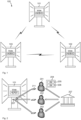
- Fig. 1 illustrates a voting system 100 for collecting votes from multiple voters (not shown).
- the voters are associated with multiple identity public keys that each identify one voter.
- Voting system 100 comprises first node computer device 101, second node computer device 102 and third node computer device 103.
- the node computer devices my simply be referred to as nodes.
- the nodes may be voting booths as shown in Fig. 1 , voters' own mobile devices, such as smartphones or computers using web application or other technologies.
- Three nodes are shown in Fig. 1 for clarity but more nodes, such as ten nodes, may be present in the system.
- Nodes 101, 102 and 103 collect the votes, combine the votes into a vote container and store the vote container including the votes on a public data store as will be described in detail below.
- the voters are associated with identity public keys that each identify one voter.
- Fig. 2 illustrates this in more detail using the example of three voters 201, 202 and 203 using voting booth 101.
- Voter 201 for example, generates a key pair 204 including an identity public key 205 and an identity secret key 206.
- the terms secret key and private key are used herein interchangeably.
- the aim here is to enable other parties to authenticate messages from voter 201. That is, other parties should be able to check that a message received from voter 201 was not in fact transmitted by an attacker.
- a central trusted authority 207 or other public key infrastructure (KPI) can be used.
- This trusted authority 207 can be a government body or private company authorised by the government.
- Trusted authority 207 can provide a public key to all parties in a secure way. Trusted authority 207 can then use its secret key to sign voter's 201 public key 205. When voter 201 broadcasts public key 205, all receivers can verify, using the public key from trusted authority 207, that the public key is valid. In fact, voter 201 can sign any message or payload data using the secret key 206 and all receivers can verify that the message or payload came from voter 201 and nobody else because nobody else has access to the secret key 206. In one example, each voter has exactly one key pair 204 that is signed by trusted authority 207.
- Voter 201 could now generate a vote and sign the vote with public key 205. This would guarantee that the vote has been generated by voter 201 and by checking all votes, it can be verified that each voter 201, or more precisely each person with access to a secret key corresponding to a signed public key has voted once. The problem, however, would be that the vote is not anonymous, which is important in most elections or ballots.
- the following disclosure provides a solution based on a voting public key where the association between the voting public key and the identity public key 206 is removed while still allowing for transparent verification of all votes by the public.
- the key pair 204 is stored on a data store, such as a memory stick.
- the key pair 204 is stored on a smart card.
- the smart card may also comprise an integrated cryptographic chip, such that a reader can send the data to the card, the card encrypts the data or signs the data and sends the encrypted data or the signature back to the reader. This way, the keys are not accessible to the reader.
- the voting booth 101 has a slot 207 as a card reader.
- Voter 201 inserts the smart card 211 into slot 207 of the voting booth 101 to enable the voting booth 101 to access identity public key 205 and to request encryption and signatures based on the identity secret key 206.
- node 101 Once voter 201 initiates the voting process with node 101, node 101 generates a new pair of voting public key and voting secret key.
- the smart card or another device generates the pair.
- the voting public key and voting secret key may be generated the same way or in a different way to identity key pair 204. It is noted that the terms voting public key and identity public key are merely used to indicate the function of these keys but do not indicate a technical difference between these two keys. The actual value of the keys, however, is different.
- nodes 101, 102 and 103 As voters interact with the three nodes 101, 102 and 103 there is a voting public key available at each node. Nodes 101, 102 and 103 now communicate the voting public keys between them. In particular, nodes 101, 102 103 calculate signatures of their voting public keys using their identity secret keys. Nodes 101, 102 and 103 further encrypt the data using the identity public keys of the other voters. The nodes continue this use of cryptography as described below to remove the association between the voting public keys and the identity public keys. The nodes 101, 102 and 103 thereby create a list of anonymised voting public keys. It is noted that throughout this disclosure, unless stated otherwise, a list is not meant to be an ordered list or a data structure with a relationship between neighbouring list items. More broadly, a list is a collection of items and could, in programmers' terms, equally be referred to as a set, bag, collection, hash table, heap, stack or other terms.
- Removing the association between the voting public keys and the identity public keys means that it is not possible to determine the identity of a holder of an identity secret key from the voting public key that was generated for that holder.
- the voting public keys are communicated in a way that ensures that each voting public key that is communicated belongs to a verified voter, that is, a voter with a valid identity secret key. However, it is not possible to identify that voter.
- the result is a list of public keys but there is no further information that could identify the identity secret key. This can be achieved by the nodes randomising an order of encrypted voting public keys such that any receiving node cannot determine the origin of each encrypted voting public key.
- the nodes 101, 102 and 103 communicate votes, which are now authenticated by the anonymised voting public keys.
- the nodes 101, 102 and 103 again use cryptography to remove the association between the votes and the voting public keys. This way, the nodes 101, 102 and 103 create anonymised votes and combine the anonymised votes into the vote container.
- a 'vote' herein refers to any data structure that can be indicative of a vote.
- a vote could be a string comprising the selected option, such as "A", "B” or "C".
- the vote is more complex and may be in JSON or XML format.
- the vote may also include a vote identifier, such as a random number generated by nodes 101, 102 and 103.
- the vote identifier may be a 128 bit number. This way, each node 101, 102 and 103 can store the vote identifier temporarily and analyse the complete set of votes in the vote container and verify that the vote with their chosen stored vote identifier is included in the vote container. Storing a vote as bytes on a data store is referred to as 'serialisation'.
- one aim is to provide a voting system where the votes can be authenticated but the origin of each node is hidden.
- the solution involves the removal of associations of keys/votes to the identity public keys of the participants.
- the removal is achieved by communicating the keys/votes between nodes using cryptography to remove the associations.
- the nodes generate public keys and communicate these keys to remove the association to the respective identity public key.
- the generated public keys may be ephemeral, which means that they are used for only a single vote and then disregarded.
- each node there is a software application that is installed on each node.
- This software application is identical for each node or at least, follows the same protocol for each node.
- the application may be implemented in different languages or for different platforms but offers the same functionality in the sense that the communication between the nodes using cryptography to remove the association is compatible between the nodes.
- the proposed methods may also be referred to as ⁇ peer to peer' since the nodes are self-reliant without the need for a central authority other than for providing the identity keys.
- the nodes perform the following algorithm comprising two rounds, where the first round is for creating the list of anonymised public keys and the second round is for creating the anonymised votes.
- the identity public key is referred to as the main public key (MPK).
- the identity secret key is referred to as the main secret key (MSK).
- a 'voter' such as "selecting voters”. It is to be understood that this refers to a selection that is performed by the node devices.
- Each 'voter' may be represented by a voter identifier or directly by the main public key (MPK). That is, selecting a voter in this case means selecting one of the available MPKs.
- MPK main public key
- Fig. 3 illustrates an example where the only messages from the first node 101 are shown for clarity.
- the ⁇ blame game' involves every node publishing the complete collection of messages they have sent and received, as well as their ERSK, which allows the location of the mistake to be deduced.
- the blame game either some voter refused to publish their messages and ERSK (and thus they were probably the attacker) or the point of attack can be found. Either way, a member of the group can be identified and excluded. More information can be found in CoinShuffle: https://crypsys.mmci.uni-saarland.de/projects/CoinShuffle/coinshuffle.pdf.
- the nodes perform another method using a MixNet or onion routing. That is, the nodes anonymise packets by wrapping them in encryption layers (e.g. A(B(C(msg))) where A, B, and C are public keys).
- encryption layers e.g. A(B(C(msg)) where A, B, and C are public keys).
- the shuffle algorithm proceeds as follows:
- the nodes can again create an anonymized list.
- the current disclosure refers to this method as the mix shuffle.
- the methods described above can be used to remove associations between arbitrary data packets and the MKPs. As such, the methods described above can be used for exchanging public keys as well as for exchanging votes. In particular, the above methods can be used in a first round to exchange public keys anonymously (i.e. association with the MPK removed) and then in a second round to exchange votes anonymously (i.e. association with the MPK removed).
- Votes can be serialized in any format, and this algorithm is agnostic to the particular type of vote or method of serialization as it operates on raw bytes. Serialization is the process of taking structured data and storing it in bytes. The methods disclosed herein are agnostic to the method of serialization.
- the pool of N voters in round 1 can be identical to the pool of M voters for round 1, but is not required to be. Using different sets makes it even more difficult for an attacker to recreate the removed associations using traffic analysis, for example.
- the Voting Shuffle is a fast, efficient, and highly scalable algorithm to produce anonymised votes. This means that it can - for example - be used in developing democracies as part of a full voting solution to guarantee the integrity of an election for an order of magnitude or greater reduction in cost compared to paper voting. This significantly lowers the barriers to democratic integrity.
- the peer-to-peer architecture has the advantage that there is no central authority that can be attacked to compromise a ballot or election. Significant effort can be invested into the distribution and protection of the identity keys, such as smart cards, personal pick-up, identity checks. Based on this infrastructure, the proposed voting solution is relatively light weight and accessible.
- the nodes may use the above methods selectively. That is, the nodes may automatically select between oblivious shuffle and mixnet. For example, the nodes may switch between the two protocols based on the number of nodes, such as below 10 nodes use oblivious shuffle and for 10 or above use mixnet.
- the votes can be counted for each group of nodes. For example, for a population of 300 million, there may be 3 million groups of nodes with 100 nodes in each group. As a result, there are 3 million transactions on the distributed ledger, such as Bitcoin and every voter can verify that their vote is included. Further, the votes can be counted by any computer of the public. Each group of nodes may be spread across the country or across an electorate. As soon as a further group of nodes has finished the process, the count of votes can be updated to generate a real-time counting of cast votes.
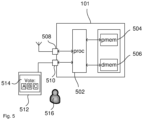
- Fig. 5 illustrates a node computer device 101 in more detail.
- the computer device 101 comprises a processor 502 connected to a program memory 504, a data memory 506, a communication port 508 and a user port 510.
- the program memory 504 is a non-transitory computer readable medium, such as a hard drive, a solid state disk or CD-ROM.
- Software that is, an executable program stored on program memory 504 causes the processor 502 to perform the method in Fig. 6 , that is, processor 502 communicates voting public keys between the other nodes by using cryptography to remove an association between the voting public keys and the identity public keys to create a list of anonymised voting public keys. After the association between the voting public keys and the identity public keys is removed, processor 502 communicates votes, authenticated by the anonymised voting public keys to create anonymised votes as described above and combines the anonymised votes into a vote container.
- the processor 502 may store the votes and keys on data store 506, such as on RAM or a processor register. Processor 502 may also send the votes and keys via communication port 508 to a server, or to the blockchain as transactions.
- the processor 502 may receive data, such as votes or keys, from data memory 506 as well as from the communications port 508 and the user port 510, which is connected to a display 512 that shows a visual representation 514 of a voting interface to a voter 516.
- the processor 502 receives votes or keys from other nodes via communications port 508, such as by using a Wi-Fi network according to IEEE 802.11.
- the Wi-Fi network may be a decentralised ad-hoc network, such that no dedicated management infrastructure, such as a router, is required or a centralised network with a router or access point managing the network.
- communications port 508 and user port 510 are shown as distinct entities, it is to be understood that any kind of data port may be used to receive data, such as a network connection, a memory interface, a pin of the chip package of processor 502, or logical ports, such as IP sockets or parameters of functions stored on program memory 504 and executed by processor 502. These parameters may be stored on data memory 506 and may be handled by-value or by-reference, that is, as a pointer, in the source code.
- the processor 502 may receive data through all these interfaces, which includes memory access of volatile memory, such as cache or RAM, or non-volatile memory, such as an optical disk drive, hard disk drive, storage server or cloud storage.
- volatile memory such as cache or RAM
- non-volatile memory such as an optical disk drive, hard disk drive, storage server or cloud storage.
- the computer system 500 may further be implemented within a cloud computing environment, such as a managed group of interconnected servers hosting a dynamic number of virtual machines.
- any receiving step may be preceded by the processor 502 determining or computing the data that is later received.
- the processor 502 decrypts a vote or key and stores the decrypted vote or key in data memory 506, such as RAM or a processor register.
- the processor 502 requests the data from the data memory 506, such as by providing a read signal together with a memory address.
- the data memory 506 provides the data as a voltage signal on a physical bit line and the processor 502 receives the decrypted vote or key via a memory interface.
- nodes, edges, graphs, solutions, variables, votes, keys, blobs and the like refer to data structures, which are physically stored on data memory 506 or processed by processor 502. Further, for the sake of brevity when reference is made to particular variable names, such as "period of time” or “identifier” this is to be understood to refer to values of variables stored as physical data in computer system 500.
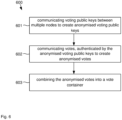
- Fig. 6 illustrates a method 600 as performed by processor 502 for collecting votes.
- Fig. 6 is to be understood as a blueprint for the software program and may be implemented step-by-step, such that each step in Fig. 6 is represented by a function in a programming language, such as C++ or Java.
- the resulting source code is then compiled and stored as computer executable instructions on program memory 504.
- the voters are associated with multiple identity public keys that each identify one voter.
- the method commences by communicating 601 voting public keys between multiple nodes. Each node uses cryptography to remove an association between the voting public keys and the identity public keys to create a list of anonymised voting public keys. After the association between the voting public keys and the identity public keys is removed, each node communicates 602 votes, authenticated by the anonymised voting public keys to create anonymised votes. Finally, each node combines 603 the anonymised votes into a vote container.
- Suitable computer readable media may include volatile (e.g. RAM) and/or non-volatile (e.g. ROM, disk) memory, carrier waves and transmission media.
- Exemplary carrier waves may take the form of electrical, electromagnetic or optical signals conveying digital data steams along a local network or a publically accessible network such as the internet.
Landscapes
- Engineering & Computer Science (AREA)
- Computer Security & Cryptography (AREA)
- Computer Networks & Wireless Communication (AREA)
- Signal Processing (AREA)
- Computing Systems (AREA)
- Computer Hardware Design (AREA)
- General Engineering & Computer Science (AREA)
- Theoretical Computer Science (AREA)
- Physics & Mathematics (AREA)
- General Physics & Mathematics (AREA)
- Management, Administration, Business Operations System, And Electronic Commerce (AREA)
Claims (15)
- Abstimmungssystem (100) zum Sammeln von Stimmen von mehreren Wählern (201, 202, 203), wobei die Wähler mehreren öffentlichen Identitätsschlüsseln (205) zugeordnet sind, die jeweils einen Wähler identifizieren, mit:mehrere Knotencomputervorrichtungen (101, 102, 103), die zum Sammeln der Stimmen und zum Kombinieren der Stimmen in einen Stimmencontainer (423) und zum Speichern des Stimmencontainers mit den Stimmen auf einem öffentlichen Datenspeicher ausgebildet sind, dadurch gekennzeichnet, dassdie mehreren Knotencomputervorrichtungen ferner zum Erzeugen von öffentlichen Abstimmungsschlüsseln ausgebildet sind, wobei eine Zuordnung zwischen den öffentlichen Abstimmungsschlüsseln (311) und den öffentlichen Identitätsschlüsseln über entsprechende Signaturen vorhanden ist,jede der mehreren Knotencomputervorrichtungen ferner zum Kommunizieren der öffentlichen Abstimmungsschlüssel zwischen den Knotencomputervorrichtungen unter Verwendung von Kryptographie zum Entfernen der Zuordnung zwischen den öffentlichen Abstimmungsschlüsseln und den öffentlichen Identitätsschlüsseln zum Erzeugen einer Liste von anonymisierten öffentlichen Abstimmungsschlüsseln ausgebildet ist,jede der mehreren Knotencomputervorrichtungen ferner dazu ausgebildet ist, nach Entfernen der Zuordnung zwischen den öffentlichen Abstimmungsschlüsseln und den öffentlichen Identitätsschlüsseln, Stimmen, die durch die anonymisierten öffentlichen Abstimmungsschlüssel authentifiziert sind, unter Verwendung von Kryptographie zum Entfernen einer Zuordnung zwischen den Stimmen und den öffentlichen Abstimmungsschlüsseln zum Erzeugen von anonymisierten Stimmen zu kommunizieren und die anonymisierten Stimmen in den Stimmencontainer zu kombinieren.
- Abstimmungssystem nach Anspruch 1, bei dem jede der mehreren Knotencomputervorrichtungen ferner zum Speichern eines Identitätsschlüsselpaars mit dem öffentlichen Identitätsschlüssel und einem privaten Identitätsschlüssel (206) und zum Signieren des öffentlichen Abstimmungsschlüssels unter Verwendung des privaten Identitätsschlüssels dieser Knotencomputervorrichtung ausgebildet ist.
- Abstimmungssystem nach einem der vorhergehenden Ansprüche, bei dem die öffentlichen Abstimmungsschlüssel ephemerisch sind.
- Abstimmungssystem nach einem der vorhergehenden Ansprüche, bei dem die Verwendung von Kryptographie zum Entfernen der Zuordnung zwischen den öffentlichen Abstimmungsschlüsseln und den öffentlichen Identitätsschlüsseln Verschlüsseln mehrerer öffentlicher Abstimmungsschlüssel gemäß einer zufälligen Reihenfolge und Senden der zufällig sortierten öffentlichen Abstimmungsschlüssel zu den anderen Knotencomputervorrichtungen beinhaltet.
- Abstimmungssystem nach einem der vorhergehenden Ansprüche, bei dem die Verwendung von Kryptographie zum Entfernen der Zuordnung zwischen den öffentlichen Abstimmungsschlüsseln und den öffentlichen Identitätsschlüsseln Empfangen eines ersten Datenpakets, das mehrere Male mit unterschiedlichen öffentlichen Abstimmungsschlüsseln verschlüsselt ist, einmaliges Entschlüsseln des ersten Datenpakets und Senden des entschlüsselten ersten Datenpakets zu einer nächsten Knotencomputervorrichtung beinhaltet.
- Abstimmungssystem nach Anspruch 5, bei dem die Verwendung von Kryptographie zum Entfernen der Zuordnung zwischen den öffentlichen Abstimmungsschlüsseln und den öffentlichen Identitätsschlüsseln ferner beinhaltet:Empfangen von mehreren Datenpaketen, die mehrere Male mit unterschiedlichen öffentlichen Abstimmungsschlüsseln verschlüsselt sind;einmaliges Entschlüsseln der mehreren Datenpakete;zufällig Ordnen der mehreren Datenpakete; undSenden der entschlüsselten zufällig geordneten mehreren Datenpakete zu einer nächsten Knotencomputervorrichtung.
- Abstimmungssystem nach Anspruch 6, bei dem die Verwendung von Kryptographie zum Entfernen der Zuordnung zwischen den öffentlichen Abstimmungsschlüsseln und den öffentlichen Identitätsschlüsseln ferner, vor dem Schritt zum zufällig Ordnen der mehreren Datenpakete, Erzeugen eines neuen Datenpakets, mehrmaliges Verschlüsseln des neuen Datenpakets mit unterschiedlichen öffentlichen Abstimmungsschlüsseln und Hinzufügen des verschlüsselten neuen Datenpakets zu den mehreren Datenpaketen beinhaltet.
- Abstimmungssystem nach einem der vorhergehenden Ansprüche, bei dem die Verwendung von Kryptographie zum Entfernen der Zuordnung zwischen den öffentlichen Abstimmungsschlüsseln und den öffentlichen Identitätsschlüsseln ferner beinhaltet:Erzeugen einer zufälligen Reihenfolge von Knotencomputervorrichtungen;mehrmaliges Verschlüsseln eines Datenpakets unter Verwendung von öffentlichen Abstimmungsschlüsseln in der Reihenfolge der Knotencomputervorrichtungen; undSenden des verschlüsselten Datenpakets zusammen mit einer Angabe der Reihenfolge der Knotencomputervorrichtungen zu einer nächsten Knotencomputervorrichtung wie durch die Reihenfolge der Knotencomputervorrichtungen angegeben.
- Abstimmungssystem nach Anspruch 8, bei dem die Verwendung von Kryptographie zum Entfernen der Zuordnung zwischen den öffentlichen Abstimmungsschlüsseln und den öffentlichen Identitätsschlüsseln ferner beinhaltet:Erzeugen mehrerer zufälliger Reihenfolgen von Knotencomputervorrichtungen durch Erzeugen einer zufälligen Reihenfolge für jede der mehreren Knotencomputervorrichtungen derart, dass die zufällige Reihenfolge bei dieser Knotencomputervorrichtung endet;für jede der mehreren zufälligen Reihenfolgen, mehrmaliges Verschlüsseln eines Datenpakets unter Verwendung von öffentlichen Abstimmungsschlüsseln in dieser Reihenfolge der Knotencomputervorrichtungen; undSenden jedes der verschlüsselten Datenpakete zusammen mit einer Angabe dieser Reihenfolgen von Knotencomputervorrichtungen zu einer nächsten Knotencomputervorrichtung wie durch diese Reihenfolge von Knotencomputervorrichtungen angegeben.
- Abstimmungssystem nach einem der vorhergehenden Ansprüche, bei dem das Speichern des Stimmencontainers auf einem öffentlichen Datenspeicher Speichern des Stimmencontainers auf einem verteilten Verzeichnis von Transaktionen beinhaltet.
- Abstimmungssystem nach einem der vorhergehenden Ansprüche, bei dem die mehreren Knotencomputervorrichtungen ferner zum Speichern der Liste von anonymisierten öffentlichen Abstimmungsschlüsseln auf einem verteilten Verzeichnis ausgebildet sind.
- Abstimmungssystem nach einem der vorhergehenden Ansprüche, bei dem die mehreren Knotencomputervorrichtungen ferner dazu ausgebildet sind, zu bestimmen, ob ihr zugeordneter öffentlicher Schlüssel in der Liste von anonymisierten öffentlichen Abstimmungsschlüsseln enthalten ist, und bei einer Bestimmung, dass ihr zugeordneter öffentlicher Schlüssel enthalten ist, eine kryptographische Signatur der Listen von anonymisierten öffentlichen Abstimmungsschlüsseln zu berechnen.
- Abstimmungssystem nach einem der vorhergehenden Ansprüche, bei dem jede der Stimmen einen Stimmenidentifizierer aufweist und die mehreren Knotencomputervorrichtungen ferner dazu ausgebildet sind, zu bestimmen, ob ihr Stimmenidentifizierer in den gesammelten Stimmen enthalten ist, und bei einer Bestimmung, dass ihr Stimmenidentifizierer enthalten ist, eine kryptographische Signatur der gesammelten Stimmen zu berechnen.
- Abstimmungssystem nach einem der vorhergehenden Ansprüche, bei dem die mehreren Knotencomputervorrichtungen ferner dazu ausgebildet sind, die Zuordnung zwischen den öffentlichen Abstimmungsschlüsseln und den öffentlichen Identitätsschlüsseln selektiv zu entfernen, unter Verwendung eines ersten Protokolls nach einem der Ansprüche 6 und 7 oder unter Verwendung eines zweiten Protokolls nach einem der Ansprüche 8 und 9, wobei optional die mehreren Knotencomputervorrichtungen ferner dazu ausgebildet sind, basierend auf der Anzahl von Knotencomputervorrichtungen zwischen dem ersten Protokoll und dem zweiten Protokoll auszuwählen.
- Verfahren (600) mit den folgenden Schritten, die durch mehrere Knotencomputervorrichtungen (101, 102, 103) eines Abstimmungssystems durchgeführt werden:
Sammeln von Stimmen von mehreren Wählern (201, 202, 203), wobei die Wähler mehreren öffentlichen Identitätsschlüsseln (205) zugeordnet sind, die jeweils einen Wähler identifizieren, dadurch gekennzeichnet, dass das Verfahren ferner aufweist:Erzeugen von öffentlichen Abstimmungsschlüsseln, wobei eine Zuordnung zwischen den öffentlichen Abstimmungsschlüsseln (311) und den öffentlichen Identitätsschlüsseln über entsprechende Signaturen vorhanden ist,Kommunizieren von öffentlichen Abstimmungsschlüsseln (311) zwischen den mehreren Knotencomputervorrichtungen (101, 102, 103) unter Verwendung von Kryptographie zum Entfernen der Zuordnung zwischen den öffentlichen Abstimmungsschlüsseln und den öffentlichen Identitätsschlüsseln zum Erzeugen einer Liste von anonymisierten öffentlichen Abstimmungsschlüsseln,nach Entfernen der Zuordnung zwischen den öffentlichen Abstimmungsschlüsseln und den öffentlichen Identitätsschlüsseln, Kommunizieren von Stimmen, authentifiziert durch die anonymisierten öffentlichen Abstimmungsschlüssel, unter Verwendung von Kryptographie zum Entfernen einer Zuordnung zwischen den Stimmen und den öffentlichen Abstimmungsschlüsseln zum Erzeugen von anonymisierten Stimmen; undKombinieren der anonymisierten Stimmen in einen Stimmencontainer.
Applications Claiming Priority (2)
| Application Number | Priority Date | Filing Date | Title |
|---|---|---|---|
| AU2017900257A AU2017900257A0 (en) | 2017-01-30 | Voting system and method | |
| PCT/AU2017/051446 WO2018136991A1 (en) | 2017-01-30 | 2017-12-22 | Voting system and method |
Publications (5)
| Publication Number | Publication Date |
|---|---|
| EP3574482A1 EP3574482A1 (de) | 2019-12-04 |
| EP3574482A4 EP3574482A4 (de) | 2020-05-20 |
| EP3574482C0 EP3574482C0 (de) | 2023-06-28 |
| EP3574482B1 true EP3574482B1 (de) | 2023-06-28 |
| EP3574482B8 EP3574482B8 (de) | 2023-08-02 |
Family
ID=62977830
Family Applications (1)
| Application Number | Title | Priority Date | Filing Date |
|---|---|---|---|
| EP17894569.7A Active EP3574482B8 (de) | 2017-01-30 | 2017-12-22 | Abstimmungssysteme und -verfahren |
Country Status (4)
| Country | Link |
|---|---|
| US (1) | US20190371106A1 (de) |
| EP (1) | EP3574482B8 (de) |
| AU (1) | AU2017395785B2 (de) |
| WO (1) | WO2018136991A1 (de) |
Families Citing this family (30)
| Publication number | Priority date | Publication date | Assignee | Title |
|---|---|---|---|---|
| US11777729B2 (en) | 2017-01-20 | 2023-10-03 | Enveil, Inc. | Secure analytics using term generation and homomorphic encryption |
| US11507683B2 (en) | 2017-01-20 | 2022-11-22 | Enveil, Inc. | Query processing with adaptive risk decisioning |
| US11196541B2 (en) | 2017-01-20 | 2021-12-07 | Enveil, Inc. | Secure machine learning analytics using homomorphic encryption |
| US10873568B2 (en) | 2017-01-20 | 2020-12-22 | Enveil, Inc. | Secure analytics using homomorphic and injective format-preserving encryption and an encrypted analytics matrix |
| US10972251B2 (en) | 2017-01-20 | 2021-04-06 | Enveil, Inc. | Secure web browsing via homomorphic encryption |
| US10903976B2 (en) | 2017-01-20 | 2021-01-26 | Enveil, Inc. | End-to-end secure operations using a query matrix |
| GB201800818D0 (en) | 2018-01-18 | 2018-03-07 | Nchain Holdings Ltd | Computer-implemented system and method |
| US20190306129A1 (en) * | 2018-03-27 | 2019-10-03 | Lenovo (Singapore) Pte. Ltd. | Secure communication in a nondeterministic network |
| US10902133B2 (en) | 2018-10-25 | 2021-01-26 | Enveil, Inc. | Computational operations in enclave computing environments |
| US10817262B2 (en) | 2018-11-08 | 2020-10-27 | Enveil, Inc. | Reduced and pipelined hardware architecture for Montgomery Modular Multiplication |
| US10979225B1 (en) * | 2018-11-15 | 2021-04-13 | Amazon Technologies, Inc. | Secure and anonymous electronic polling |
| US11087578B2 (en) | 2018-11-15 | 2021-08-10 | Daniel Bernard Ruskin | Voting booth, system, and methods of making and using same |
| TWI714997B (zh) * | 2019-03-28 | 2021-01-01 | 王任昌 | 投票防弊裝置及使用其進行投票之方法 |
| CN110110555B (zh) * | 2019-04-24 | 2023-05-12 | 深圳前海微众银行股份有限公司 | 一种区块链中的投票方法及装置 |
| CN110995711A (zh) * | 2019-12-05 | 2020-04-10 | 全链通有限公司 | 基于区块链的电子投票方法、设备及存储介质 |
| CN110958253A (zh) * | 2019-12-05 | 2020-04-03 | 全链通有限公司 | 基于区块链的电子投票方法、设备及存储介质 |
| US12099997B1 (en) | 2020-01-31 | 2024-09-24 | Steven Mark Hoffberg | Tokenized fungible liabilities |
| PL434378A1 (pl) * | 2020-06-19 | 2021-05-17 | Damian Babula | Wspomagany komputerowo sposób przeprowadzania anonimowych głosowań i urządzenie do głosowania anonimowego |
| CN114299656B (zh) * | 2020-09-23 | 2023-08-01 | 成都中科信息技术有限公司 | 一种投票方法 |
| US11601258B2 (en) | 2020-10-08 | 2023-03-07 | Enveil, Inc. | Selector derived encryption systems and methods |
| CN113765666B (zh) * | 2020-10-20 | 2025-01-14 | 北京沃东天骏信息技术有限公司 | 信息加密方法及装置 |
| US12244718B2 (en) * | 2020-11-04 | 2025-03-04 | Gwangju Institute Of Science And Technology | Blockchain e-voting system and operating method thereof |
| US11361606B1 (en) * | 2020-11-29 | 2022-06-14 | Oren Zbeda | Tamper resistant public ledger voting system |
| US11743039B2 (en) * | 2021-04-20 | 2023-08-29 | Coinbase Il Rd Ltd. | System and method for data encryption using key derivation |
| CN113268750B (zh) * | 2021-05-21 | 2023-05-12 | 中国联合网络通信集团有限公司 | 数据处理方法、竞投节点设备和计算机可读介质 |
| CN114095246B (zh) * | 2021-11-18 | 2024-01-23 | 国网河北省电力有限公司电力科学研究院 | 配电终端的入网身份认证方法 |
| US12225111B2 (en) * | 2022-03-08 | 2025-02-11 | SanDisk Technologies, Inc. | Authorization requests from a data storage device to multiple manager devices |
| CN114866244B (zh) * | 2022-03-14 | 2024-02-23 | 杭州云象网络技术有限公司 | 基于密文分组链接加密的可控匿名认证方法、系统及装置 |
| CN115632777B (zh) * | 2022-12-12 | 2023-03-31 | 中电长城网际系统应用有限公司 | 数据处理方法及电子设备 |
| CN117040928B (zh) * | 2023-10-08 | 2024-02-09 | 广州市悦智计算机有限公司 | 一种基于区块链智能合约实现投票权隐私发放方法 |
Family Cites Families (6)
| Publication number | Priority date | Publication date | Assignee | Title |
|---|---|---|---|---|
| DK1302020T3 (da) * | 2000-03-24 | 2006-03-20 | Dategrity Corp | Verificerbar, hemmelig blanding af krypterede data, såsom ElGamal krypterede data, for sikre multimyndighedsvalg |
| JP4235453B2 (ja) * | 2001-03-24 | 2009-03-11 | ヴォートヒア インコーポレイテッド | 検証可能な秘密のシャッフルおよびそれらの電子投票への応用 |
| WO2005093671A2 (en) * | 2004-03-25 | 2005-10-06 | Cryptomathic A/S | Electronic voting systems |
| US7657456B2 (en) | 2005-03-18 | 2010-02-02 | Pitney Bowes Inc. | Method and system for electronic voting using identity based encryption |
| US8061589B2 (en) | 2006-10-20 | 2011-11-22 | Barry Cohen | Electronic voting system |
| JP4835886B2 (ja) * | 2009-12-22 | 2011-12-14 | クオード株式会社 | 電子投票システム |
-
2017
- 2017-12-22 WO PCT/AU2017/051446 patent/WO2018136991A1/en not_active Ceased
- 2017-12-22 US US16/481,730 patent/US20190371106A1/en not_active Abandoned
- 2017-12-22 EP EP17894569.7A patent/EP3574482B8/de active Active
- 2017-12-22 AU AU2017395785A patent/AU2017395785B2/en not_active Ceased
Also Published As
| Publication number | Publication date |
|---|---|
| AU2017395785B2 (en) | 2023-12-21 |
| EP3574482B8 (de) | 2023-08-02 |
| EP3574482C0 (de) | 2023-06-28 |
| EP3574482A4 (de) | 2020-05-20 |
| EP3574482A1 (de) | 2019-12-04 |
| US20190371106A1 (en) | 2019-12-05 |
| AU2017395785A1 (en) | 2019-08-22 |
| WO2018136991A1 (en) | 2018-08-02 |
Similar Documents
| Publication | Publication Date | Title |
|---|---|---|
| AU2017395785B2 (en) | Voting system and method | |
| US12278898B2 (en) | Blockchain-implemented control method and system | |
| Ziegeldorf et al. | Coinparty: Secure multi-party mixing of bitcoins | |
| Chaieb et al. | Verify-your-vote: A verifiable blockchain-based online voting protocol | |
| EP3676988A1 (de) | Systeme und verfahren zur kommunikation, speicherung und verarbeitung von daten, die von einer einheit über ein blockchain-netzwerk bereitgestellt werden | |
| EP3419210A1 (de) | Verfahren zur erzeugung einer transaktion einer blockchain und verfahren zum validieren eines blocks einer blockchain | |
| EP3873055A1 (de) | Verfahren, systeme, und vorrichtungen zur verwaltung von digitalen assets | |
| CN110867012A (zh) | 一种基于智能合约的去中心电子投票方法、装置、系统及存储介质 | |
| Wei et al. | Blockchain-based electronic voting protocol | |
| US20230237437A1 (en) | Apparatuses and methods for determining and processing dormant user data in a job resume immutable sequential listing | |
| Salvakkam et al. | Design of fully homomorphic multikey encryption scheme for secured cloud access and storage environment | |
| CN111783136A (zh) | 一种数据保护方法、装置、设备和存储介质 | |
| Lee et al. | Security analysis and modification of ID-based encryption with equality test from ACISP 2017 | |
| Gjøsteen et al. | Efficient mixing of arbitrary ballots with everlasting privacy: How to verifiably mix the PPATC scheme | |
| Sangroula et al. | Blockchain based anonymous voting system using ring-signature | |
| Ghosh | Blockchain Based Election Architecture using XRPL | |
| Malathi et al. | Elliptic curve Menezes–Qu–Vanstone-based message authentication code (ECMQV-MAC) with blockchain technology for e-voting systems | |
| Kumar et al. | Secure Online Polling: Based on Homomorphic Encryption Using (n, n) Secret Sharing Scheme | |
| HK40087696A (en) | Blockchain-implemented method and system | |
| HK40090926A (en) | Blockchain-implemented method and system | |
| HK40001617A (en) | Blockchain-implemented method and system | |
| HK40001617B (en) | Blockchain-implemented method and system | |
| HK40001616A (en) | Blockchain-implemented method and system | |
| HK40001616B (en) | Blockchain-implemented method and system | |
| Mohanty et al. | Implementation of a Secure Internet Voting Protocol |
Legal Events
| Date | Code | Title | Description |
|---|---|---|---|
| STAA | Information on the status of an ep patent application or granted ep patent |
Free format text: STATUS: THE INTERNATIONAL PUBLICATION HAS BEEN MADE |
|
| PUAI | Public reference made under article 153(3) epc to a published international application that has entered the european phase |
Free format text: ORIGINAL CODE: 0009012 |
|
| STAA | Information on the status of an ep patent application or granted ep patent |
Free format text: STATUS: REQUEST FOR EXAMINATION WAS MADE |
|
| 17P | Request for examination filed |
Effective date: 20190809 |
|
| AK | Designated contracting states |
Kind code of ref document: A1 Designated state(s): AL AT BE BG CH CY CZ DE DK EE ES FI FR GB GR HR HU IE IS IT LI LT LU LV MC MK MT NL NO PL PT RO RS SE SI SK SM TR |
|
| AX | Request for extension of the european patent |
Extension state: BA ME |
|
| DAV | Request for validation of the european patent (deleted) | ||
| DAX | Request for extension of the european patent (deleted) | ||
| A4 | Supplementary search report drawn up and despatched |
Effective date: 20200421 |
|
| RIC1 | Information provided on ipc code assigned before grant |
Ipc: G07C 13/00 20060101ALI20200415BHEP Ipc: H04L 29/06 20060101AFI20200415BHEP Ipc: H04L 9/00 20060101ALI20200415BHEP |
|
| REG | Reference to a national code |
Ref country code: DE Ref legal event code: R079 Ref document number: 602017070818 Country of ref document: DE Free format text: PREVIOUS MAIN CLASS: G07C0013000000 Ipc: H04L0009400000 |
|
| GRAP | Despatch of communication of intention to grant a patent |
Free format text: ORIGINAL CODE: EPIDOSNIGR1 |
|
| STAA | Information on the status of an ep patent application or granted ep patent |
Free format text: STATUS: GRANT OF PATENT IS INTENDED |
|
| RIC1 | Information provided on ipc code assigned before grant |
Ipc: H04L 9/32 20060101ALI20221216BHEP Ipc: H04L 9/14 20060101ALI20221216BHEP Ipc: G07C 13/00 20060101ALI20221216BHEP Ipc: H04L 9/08 20060101ALI20221216BHEP Ipc: H04L 9/40 20220101AFI20221216BHEP |
|
| INTG | Intention to grant announced |
Effective date: 20230110 |
|
| GRAS | Grant fee paid |
Free format text: ORIGINAL CODE: EPIDOSNIGR3 |
|
| GRAA | (expected) grant |
Free format text: ORIGINAL CODE: 0009210 |
|
| STAA | Information on the status of an ep patent application or granted ep patent |
Free format text: STATUS: THE PATENT HAS BEEN GRANTED |
|
| AK | Designated contracting states |
Kind code of ref document: B1 Designated state(s): AL AT BE BG CH CY CZ DE DK EE ES FI FR GB GR HR HU IE IS IT LI LT LU LV MC MK MT NL NO PL PT RO RS SE SI SK SM TR |
|
| REG | Reference to a national code |
Ref country code: CH Ref legal event code: EP |
|
| REG | Reference to a national code |
Ref country code: CH Ref legal event code: PK Free format text: BERICHTIGUNG B8 |
|
| REG | Reference to a national code |
Ref country code: AT Ref legal event code: REF Ref document number: 1583708 Country of ref document: AT Kind code of ref document: T Effective date: 20230715 |
|
| REG | Reference to a national code |
Ref country code: IE Ref legal event code: FG4D |
|
| REG | Reference to a national code |
Ref country code: DE Ref legal event code: R096 Ref document number: 602017070818 Country of ref document: DE |
|
| RAP4 | Party data changed (patent owner data changed or rights of a patent transferred) |
Owner name: EXO ONE PTY LTD |
|
| U01 | Request for unitary effect filed |
Effective date: 20230725 |
|
| U07 | Unitary effect registered |
Designated state(s): AT BE BG DE DK EE FI FR IT LT LU LV MT NL PT SE SI Effective date: 20230731 |
|
| REG | Reference to a national code |
Ref country code: LT Ref legal event code: MG9D |
|
| PG25 | Lapsed in a contracting state [announced via postgrant information from national office to epo] |
Ref country code: NO Free format text: LAPSE BECAUSE OF FAILURE TO SUBMIT A TRANSLATION OF THE DESCRIPTION OR TO PAY THE FEE WITHIN THE PRESCRIBED TIME-LIMIT Effective date: 20230928 |
|
| PG25 | Lapsed in a contracting state [announced via postgrant information from national office to epo] |
Ref country code: RS Free format text: LAPSE BECAUSE OF FAILURE TO SUBMIT A TRANSLATION OF THE DESCRIPTION OR TO PAY THE FEE WITHIN THE PRESCRIBED TIME-LIMIT Effective date: 20230628 Ref country code: HR Free format text: LAPSE BECAUSE OF FAILURE TO SUBMIT A TRANSLATION OF THE DESCRIPTION OR TO PAY THE FEE WITHIN THE PRESCRIBED TIME-LIMIT Effective date: 20230628 Ref country code: GR Free format text: LAPSE BECAUSE OF FAILURE TO SUBMIT A TRANSLATION OF THE DESCRIPTION OR TO PAY THE FEE WITHIN THE PRESCRIBED TIME-LIMIT Effective date: 20230929 |
|
| PG25 | Lapsed in a contracting state [announced via postgrant information from national office to epo] |
Ref country code: SK Free format text: LAPSE BECAUSE OF FAILURE TO SUBMIT A TRANSLATION OF THE DESCRIPTION OR TO PAY THE FEE WITHIN THE PRESCRIBED TIME-LIMIT Effective date: 20230628 |
|
| PG25 | Lapsed in a contracting state [announced via postgrant information from national office to epo] |
Ref country code: ES Free format text: LAPSE BECAUSE OF FAILURE TO SUBMIT A TRANSLATION OF THE DESCRIPTION OR TO PAY THE FEE WITHIN THE PRESCRIBED TIME-LIMIT Effective date: 20230628 |
|
| PG25 | Lapsed in a contracting state [announced via postgrant information from national office to epo] |
Ref country code: IS Free format text: LAPSE BECAUSE OF FAILURE TO SUBMIT A TRANSLATION OF THE DESCRIPTION OR TO PAY THE FEE WITHIN THE PRESCRIBED TIME-LIMIT Effective date: 20231028 |
|
| U20 | Renewal fee for the european patent with unitary effect paid |
Year of fee payment: 7 Effective date: 20231220 |
|
| PG25 | Lapsed in a contracting state [announced via postgrant information from national office to epo] |
Ref country code: SM Free format text: LAPSE BECAUSE OF FAILURE TO SUBMIT A TRANSLATION OF THE DESCRIPTION OR TO PAY THE FEE WITHIN THE PRESCRIBED TIME-LIMIT Effective date: 20230628 Ref country code: SK Free format text: LAPSE BECAUSE OF FAILURE TO SUBMIT A TRANSLATION OF THE DESCRIPTION OR TO PAY THE FEE WITHIN THE PRESCRIBED TIME-LIMIT Effective date: 20230628 Ref country code: RO Free format text: LAPSE BECAUSE OF FAILURE TO SUBMIT A TRANSLATION OF THE DESCRIPTION OR TO PAY THE FEE WITHIN THE PRESCRIBED TIME-LIMIT Effective date: 20230628 Ref country code: IS Free format text: LAPSE BECAUSE OF FAILURE TO SUBMIT A TRANSLATION OF THE DESCRIPTION OR TO PAY THE FEE WITHIN THE PRESCRIBED TIME-LIMIT Effective date: 20231028 Ref country code: ES Free format text: LAPSE BECAUSE OF FAILURE TO SUBMIT A TRANSLATION OF THE DESCRIPTION OR TO PAY THE FEE WITHIN THE PRESCRIBED TIME-LIMIT Effective date: 20230628 Ref country code: CZ Free format text: LAPSE BECAUSE OF FAILURE TO SUBMIT A TRANSLATION OF THE DESCRIPTION OR TO PAY THE FEE WITHIN THE PRESCRIBED TIME-LIMIT Effective date: 20230628 |
|
| PG25 | Lapsed in a contracting state [announced via postgrant information from national office to epo] |
Ref country code: PL Free format text: LAPSE BECAUSE OF FAILURE TO SUBMIT A TRANSLATION OF THE DESCRIPTION OR TO PAY THE FEE WITHIN THE PRESCRIBED TIME-LIMIT Effective date: 20230628 |
|
| REG | Reference to a national code |
Ref country code: DE Ref legal event code: R097 Ref document number: 602017070818 Country of ref document: DE |
|
| PLBE | No opposition filed within time limit |
Free format text: ORIGINAL CODE: 0009261 |
|
| STAA | Information on the status of an ep patent application or granted ep patent |
Free format text: STATUS: NO OPPOSITION FILED WITHIN TIME LIMIT |
|
| 26N | No opposition filed |
Effective date: 20240402 |
|
| REG | Reference to a national code |
Ref country code: CH Ref legal event code: PL |
|
| PG25 | Lapsed in a contracting state [announced via postgrant information from national office to epo] |
Ref country code: MC Free format text: LAPSE BECAUSE OF FAILURE TO SUBMIT A TRANSLATION OF THE DESCRIPTION OR TO PAY THE FEE WITHIN THE PRESCRIBED TIME-LIMIT Effective date: 20230628 |
|
| GBPC | Gb: european patent ceased through non-payment of renewal fee |
Effective date: 20231222 |
|
| PG25 | Lapsed in a contracting state [announced via postgrant information from national office to epo] |
Ref country code: MC Free format text: LAPSE BECAUSE OF FAILURE TO SUBMIT A TRANSLATION OF THE DESCRIPTION OR TO PAY THE FEE WITHIN THE PRESCRIBED TIME-LIMIT Effective date: 20230628 |
|
| REG | Reference to a national code |
Ref country code: IE Ref legal event code: MM4A |
|
| PG25 | Lapsed in a contracting state [announced via postgrant information from national office to epo] |
Ref country code: IE Free format text: LAPSE BECAUSE OF NON-PAYMENT OF DUE FEES Effective date: 20231222 |
|
| PG25 | Lapsed in a contracting state [announced via postgrant information from national office to epo] |
Ref country code: GB Free format text: LAPSE BECAUSE OF NON-PAYMENT OF DUE FEES Effective date: 20231222 |
|
| PG25 | Lapsed in a contracting state [announced via postgrant information from national office to epo] |
Ref country code: CH Free format text: LAPSE BECAUSE OF NON-PAYMENT OF DUE FEES Effective date: 20231231 |
|
| PG25 | Lapsed in a contracting state [announced via postgrant information from national office to epo] |
Ref country code: IE Free format text: LAPSE BECAUSE OF NON-PAYMENT OF DUE FEES Effective date: 20231222 Ref country code: GB Free format text: LAPSE BECAUSE OF NON-PAYMENT OF DUE FEES Effective date: 20231222 Ref country code: CH Free format text: LAPSE BECAUSE OF NON-PAYMENT OF DUE FEES Effective date: 20231231 |
|
| PG25 | Lapsed in a contracting state [announced via postgrant information from national office to epo] |
Ref country code: CY Free format text: LAPSE BECAUSE OF FAILURE TO SUBMIT A TRANSLATION OF THE DESCRIPTION OR TO PAY THE FEE WITHIN THE PRESCRIBED TIME-LIMIT; INVALID AB INITIO Effective date: 20171222 |
|
| U90 | Renewal fees not paid: noting of loss of rights |
Free format text: RENEWAL FEE NOT PAID FOR YEAR 08 Effective date: 20250711 |
|
| PG25 | Lapsed in a contracting state [announced via postgrant information from national office to epo] |
Ref country code: HU Free format text: LAPSE BECAUSE OF FAILURE TO SUBMIT A TRANSLATION OF THE DESCRIPTION OR TO PAY THE FEE WITHIN THE PRESCRIBED TIME-LIMIT; INVALID AB INITIO Effective date: 20171222 |
|
| U93 | Unitary patent lapsed |
Free format text: RENEWAL FEE NOT PAID Effective date: 20241231 |
|
| PG25 | Lapsed in a contracting state [announced via postgrant information from national office to epo] |
Ref country code: TR Free format text: LAPSE BECAUSE OF FAILURE TO SUBMIT A TRANSLATION OF THE DESCRIPTION OR TO PAY THE FEE WITHIN THE PRESCRIBED TIME-LIMIT Effective date: 20230628 |