EP3575174B1 - Objektpositionshistorienwiedergabe für übergang eines automatisierten fahrzeugs vom autonomen modus zum manuellen modus - Google Patents
Objektpositionshistorienwiedergabe für übergang eines automatisierten fahrzeugs vom autonomen modus zum manuellen modus Download PDFInfo
- Publication number
- EP3575174B1 EP3575174B1 EP19173297.3A EP19173297A EP3575174B1 EP 3575174 B1 EP3575174 B1 EP 3575174B1 EP 19173297 A EP19173297 A EP 19173297A EP 3575174 B1 EP3575174 B1 EP 3575174B1
- Authority
- EP
- European Patent Office
- Prior art keywords
- vehicle
- host
- history
- objects
- mode
- Prior art date
- Legal status (The legal status is an assumption and is not a legal conclusion. Google has not performed a legal analysis and makes no representation as to the accuracy of the status listed.)
- Not-in-force
Links
Images


Classifications
-
- B—PERFORMING OPERATIONS; TRANSPORTING
- B60—VEHICLES IN GENERAL
- B60W—CONJOINT CONTROL OF VEHICLE SUB-UNITS OF DIFFERENT TYPE OR DIFFERENT FUNCTION; CONTROL SYSTEMS SPECIALLY ADAPTED FOR HYBRID VEHICLES; ROAD VEHICLE DRIVE CONTROL SYSTEMS FOR PURPOSES NOT RELATED TO THE CONTROL OF A PARTICULAR SUB-UNIT
- B60W50/00—Details of control systems for road vehicle drive control not related to the control of a particular sub-unit, e.g. process diagnostic or vehicle driver interfaces
-
- B—PERFORMING OPERATIONS; TRANSPORTING
- B60—VEHICLES IN GENERAL
- B60W—CONJOINT CONTROL OF VEHICLE SUB-UNITS OF DIFFERENT TYPE OR DIFFERENT FUNCTION; CONTROL SYSTEMS SPECIALLY ADAPTED FOR HYBRID VEHICLES; ROAD VEHICLE DRIVE CONTROL SYSTEMS FOR PURPOSES NOT RELATED TO THE CONTROL OF A PARTICULAR SUB-UNIT
- B60W50/00—Details of control systems for road vehicle drive control not related to the control of a particular sub-unit, e.g. process diagnostic or vehicle driver interfaces
- B60W50/08—Interaction between the driver and the control system
- B60W50/14—Means for informing the driver, warning the driver or prompting a driver intervention
-
- B—PERFORMING OPERATIONS; TRANSPORTING
- B60—VEHICLES IN GENERAL
- B60W—CONJOINT CONTROL OF VEHICLE SUB-UNITS OF DIFFERENT TYPE OR DIFFERENT FUNCTION; CONTROL SYSTEMS SPECIALLY ADAPTED FOR HYBRID VEHICLES; ROAD VEHICLE DRIVE CONTROL SYSTEMS FOR PURPOSES NOT RELATED TO THE CONTROL OF A PARTICULAR SUB-UNIT
- B60W30/00—Purposes of road vehicle drive control systems not related to the control of a particular sub-unit, e.g. of systems using conjoint control of vehicle sub-units
- B60W30/18—Propelling the vehicle
- B60W30/182—Selecting between different operative modes, e.g. comfort and performance modes
-
- B—PERFORMING OPERATIONS; TRANSPORTING
- B60—VEHICLES IN GENERAL
- B60K—ARRANGEMENT OR MOUNTING OF PROPULSION UNITS OR OF TRANSMISSIONS IN VEHICLES; ARRANGEMENT OR MOUNTING OF PLURAL DIVERSE PRIME-MOVERS IN VEHICLES; AUXILIARY DRIVES FOR VEHICLES; INSTRUMENTATION OR DASHBOARDS FOR VEHICLES; ARRANGEMENTS IN CONNECTION WITH COOLING, AIR INTAKE, GAS EXHAUST OR FUEL SUPPLY OF PROPULSION UNITS IN VEHICLES
- B60K35/00—Instruments specially adapted for vehicles; Arrangement of instruments in or on vehicles
- B60K35/10—Input arrangements, i.e. from user to vehicle, associated with vehicle functions or specially adapted therefor
-
- B—PERFORMING OPERATIONS; TRANSPORTING
- B60—VEHICLES IN GENERAL
- B60K—ARRANGEMENT OR MOUNTING OF PROPULSION UNITS OR OF TRANSMISSIONS IN VEHICLES; ARRANGEMENT OR MOUNTING OF PLURAL DIVERSE PRIME-MOVERS IN VEHICLES; AUXILIARY DRIVES FOR VEHICLES; INSTRUMENTATION OR DASHBOARDS FOR VEHICLES; ARRANGEMENTS IN CONNECTION WITH COOLING, AIR INTAKE, GAS EXHAUST OR FUEL SUPPLY OF PROPULSION UNITS IN VEHICLES
- B60K35/00—Instruments specially adapted for vehicles; Arrangement of instruments in or on vehicles
- B60K35/20—Output arrangements, i.e. from vehicle to user, associated with vehicle functions or specially adapted therefor
- B60K35/28—Output arrangements, i.e. from vehicle to user, associated with vehicle functions or specially adapted therefor characterised by the type of the output information, e.g. video entertainment or vehicle dynamics information; characterised by the purpose of the output information, e.g. for attracting the attention of the driver
-
- B—PERFORMING OPERATIONS; TRANSPORTING
- B60—VEHICLES IN GENERAL
- B60W—CONJOINT CONTROL OF VEHICLE SUB-UNITS OF DIFFERENT TYPE OR DIFFERENT FUNCTION; CONTROL SYSTEMS SPECIALLY ADAPTED FOR HYBRID VEHICLES; ROAD VEHICLE DRIVE CONTROL SYSTEMS FOR PURPOSES NOT RELATED TO THE CONTROL OF A PARTICULAR SUB-UNIT
- B60W60/00—Drive control systems specially adapted for autonomous road vehicles
- B60W60/005—Handover processes
- B60W60/0053—Handover processes from vehicle to occupant
-
- B—PERFORMING OPERATIONS; TRANSPORTING
- B60—VEHICLES IN GENERAL
- B60W—CONJOINT CONTROL OF VEHICLE SUB-UNITS OF DIFFERENT TYPE OR DIFFERENT FUNCTION; CONTROL SYSTEMS SPECIALLY ADAPTED FOR HYBRID VEHICLES; ROAD VEHICLE DRIVE CONTROL SYSTEMS FOR PURPOSES NOT RELATED TO THE CONTROL OF A PARTICULAR SUB-UNIT
- B60W60/00—Drive control systems specially adapted for autonomous road vehicles
- B60W60/005—Handover processes
- B60W60/0057—Estimation of the time available or required for the handover
-
- G—PHYSICS
- G06—COMPUTING OR CALCULATING; COUNTING
- G06F—ELECTRIC DIGITAL DATA PROCESSING
- G06F16/00—Information retrieval; Database structures therefor; File system structures therefor
- G06F16/70—Information retrieval; Database structures therefor; File system structures therefor of video data
- G06F16/73—Querying
- G06F16/738—Presentation of query results
- G06F16/739—Presentation of query results in form of a video summary, e.g. the video summary being a video sequence, a composite still image or having synthesized frames
-
- G—PHYSICS
- G06—COMPUTING OR CALCULATING; COUNTING
- G06F—ELECTRIC DIGITAL DATA PROCESSING
- G06F16/00—Information retrieval; Database structures therefor; File system structures therefor
- G06F16/70—Information retrieval; Database structures therefor; File system structures therefor of video data
- G06F16/78—Retrieval characterised by using metadata, e.g. metadata not derived from the content or metadata generated manually
- G06F16/7867—Retrieval characterised by using metadata, e.g. metadata not derived from the content or metadata generated manually using information manually generated, e.g. tags, keywords, comments, title and artist information, manually generated time, location and usage information, user ratings
-
- B—PERFORMING OPERATIONS; TRANSPORTING
- B60—VEHICLES IN GENERAL
- B60K—ARRANGEMENT OR MOUNTING OF PROPULSION UNITS OR OF TRANSMISSIONS IN VEHICLES; ARRANGEMENT OR MOUNTING OF PLURAL DIVERSE PRIME-MOVERS IN VEHICLES; AUXILIARY DRIVES FOR VEHICLES; INSTRUMENTATION OR DASHBOARDS FOR VEHICLES; ARRANGEMENTS IN CONNECTION WITH COOLING, AIR INTAKE, GAS EXHAUST OR FUEL SUPPLY OF PROPULSION UNITS IN VEHICLES
- B60K2360/00—Indexing scheme associated with groups B60K35/00 or B60K37/00 relating to details of instruments or dashboards
- B60K2360/16—Type of output information
- B60K2360/175—Autonomous driving
-
- B—PERFORMING OPERATIONS; TRANSPORTING
- B60—VEHICLES IN GENERAL
- B60W—CONJOINT CONTROL OF VEHICLE SUB-UNITS OF DIFFERENT TYPE OR DIFFERENT FUNCTION; CONTROL SYSTEMS SPECIALLY ADAPTED FOR HYBRID VEHICLES; ROAD VEHICLE DRIVE CONTROL SYSTEMS FOR PURPOSES NOT RELATED TO THE CONTROL OF A PARTICULAR SUB-UNIT
- B60W50/00—Details of control systems for road vehicle drive control not related to the control of a particular sub-unit, e.g. process diagnostic or vehicle driver interfaces
- B60W2050/0062—Adapting control system settings
- B60W2050/007—Switching between manual and automatic parameter input, and vice versa
-
- B—PERFORMING OPERATIONS; TRANSPORTING
- B60—VEHICLES IN GENERAL
- B60W—CONJOINT CONTROL OF VEHICLE SUB-UNITS OF DIFFERENT TYPE OR DIFFERENT FUNCTION; CONTROL SYSTEMS SPECIALLY ADAPTED FOR HYBRID VEHICLES; ROAD VEHICLE DRIVE CONTROL SYSTEMS FOR PURPOSES NOT RELATED TO THE CONTROL OF A PARTICULAR SUB-UNIT
- B60W50/00—Details of control systems for road vehicle drive control not related to the control of a particular sub-unit, e.g. process diagnostic or vehicle driver interfaces
- B60W2050/0062—Adapting control system settings
- B60W2050/0075—Automatic parameter input, automatic initialising or calibrating means
-
- B—PERFORMING OPERATIONS; TRANSPORTING
- B60—VEHICLES IN GENERAL
- B60W—CONJOINT CONTROL OF VEHICLE SUB-UNITS OF DIFFERENT TYPE OR DIFFERENT FUNCTION; CONTROL SYSTEMS SPECIALLY ADAPTED FOR HYBRID VEHICLES; ROAD VEHICLE DRIVE CONTROL SYSTEMS FOR PURPOSES NOT RELATED TO THE CONTROL OF A PARTICULAR SUB-UNIT
- B60W50/00—Details of control systems for road vehicle drive control not related to the control of a particular sub-unit, e.g. process diagnostic or vehicle driver interfaces
- B60W2050/0062—Adapting control system settings
- B60W2050/0075—Automatic parameter input, automatic initialising or calibrating means
- B60W2050/0095—Automatic control mode change
-
- B—PERFORMING OPERATIONS; TRANSPORTING
- B60—VEHICLES IN GENERAL
- B60W—CONJOINT CONTROL OF VEHICLE SUB-UNITS OF DIFFERENT TYPE OR DIFFERENT FUNCTION; CONTROL SYSTEMS SPECIALLY ADAPTED FOR HYBRID VEHICLES; ROAD VEHICLE DRIVE CONTROL SYSTEMS FOR PURPOSES NOT RELATED TO THE CONTROL OF A PARTICULAR SUB-UNIT
- B60W50/00—Details of control systems for road vehicle drive control not related to the control of a particular sub-unit, e.g. process diagnostic or vehicle driver interfaces
- B60W50/08—Interaction between the driver and the control system
- B60W50/14—Means for informing the driver, warning the driver or prompting a driver intervention
- B60W2050/146—Display means
-
- B—PERFORMING OPERATIONS; TRANSPORTING
- B60—VEHICLES IN GENERAL
- B60W—CONJOINT CONTROL OF VEHICLE SUB-UNITS OF DIFFERENT TYPE OR DIFFERENT FUNCTION; CONTROL SYSTEMS SPECIALLY ADAPTED FOR HYBRID VEHICLES; ROAD VEHICLE DRIVE CONTROL SYSTEMS FOR PURPOSES NOT RELATED TO THE CONTROL OF A PARTICULAR SUB-UNIT
- B60W2420/00—Indexing codes relating to the type of sensors based on the principle of their operation
- B60W2420/40—Photo, light or radio wave sensitive means, e.g. infrared sensors
- B60W2420/403—Image sensing, e.g. optical camera
-
- B—PERFORMING OPERATIONS; TRANSPORTING
- B60—VEHICLES IN GENERAL
- B60W—CONJOINT CONTROL OF VEHICLE SUB-UNITS OF DIFFERENT TYPE OR DIFFERENT FUNCTION; CONTROL SYSTEMS SPECIALLY ADAPTED FOR HYBRID VEHICLES; ROAD VEHICLE DRIVE CONTROL SYSTEMS FOR PURPOSES NOT RELATED TO THE CONTROL OF A PARTICULAR SUB-UNIT
- B60W2420/00—Indexing codes relating to the type of sensors based on the principle of their operation
- B60W2420/40—Photo, light or radio wave sensitive means, e.g. infrared sensors
- B60W2420/408—Radar; Laser, e.g. lidar
-
- B—PERFORMING OPERATIONS; TRANSPORTING
- B60—VEHICLES IN GENERAL
- B60W—CONJOINT CONTROL OF VEHICLE SUB-UNITS OF DIFFERENT TYPE OR DIFFERENT FUNCTION; CONTROL SYSTEMS SPECIALLY ADAPTED FOR HYBRID VEHICLES; ROAD VEHICLE DRIVE CONTROL SYSTEMS FOR PURPOSES NOT RELATED TO THE CONTROL OF A PARTICULAR SUB-UNIT
- B60W2420/00—Indexing codes relating to the type of sensors based on the principle of their operation
- B60W2420/54—Audio sensitive means, e.g. ultrasound
-
- B—PERFORMING OPERATIONS; TRANSPORTING
- B60—VEHICLES IN GENERAL
- B60W—CONJOINT CONTROL OF VEHICLE SUB-UNITS OF DIFFERENT TYPE OR DIFFERENT FUNCTION; CONTROL SYSTEMS SPECIALLY ADAPTED FOR HYBRID VEHICLES; ROAD VEHICLE DRIVE CONTROL SYSTEMS FOR PURPOSES NOT RELATED TO THE CONTROL OF A PARTICULAR SUB-UNIT
- B60W2554/00—Input parameters relating to objects
-
- B—PERFORMING OPERATIONS; TRANSPORTING
- B60—VEHICLES IN GENERAL
- B60W—CONJOINT CONTROL OF VEHICLE SUB-UNITS OF DIFFERENT TYPE OR DIFFERENT FUNCTION; CONTROL SYSTEMS SPECIALLY ADAPTED FOR HYBRID VEHICLES; ROAD VEHICLE DRIVE CONTROL SYSTEMS FOR PURPOSES NOT RELATED TO THE CONTROL OF A PARTICULAR SUB-UNIT
- B60W2554/00—Input parameters relating to objects
- B60W2554/40—Dynamic objects, e.g. animals, windblown objects
- B60W2554/404—Characteristics
- B60W2554/4046—Behavior, e.g. aggressive or erratic
-
- B—PERFORMING OPERATIONS; TRANSPORTING
- B60—VEHICLES IN GENERAL
- B60W—CONJOINT CONTROL OF VEHICLE SUB-UNITS OF DIFFERENT TYPE OR DIFFERENT FUNCTION; CONTROL SYSTEMS SPECIALLY ADAPTED FOR HYBRID VEHICLES; ROAD VEHICLE DRIVE CONTROL SYSTEMS FOR PURPOSES NOT RELATED TO THE CONTROL OF A PARTICULAR SUB-UNIT
- B60W2556/00—Input parameters relating to data
- B60W2556/10—Historical data
-
- B—PERFORMING OPERATIONS; TRANSPORTING
- B60—VEHICLES IN GENERAL
- B60W—CONJOINT CONTROL OF VEHICLE SUB-UNITS OF DIFFERENT TYPE OR DIFFERENT FUNCTION; CONTROL SYSTEMS SPECIALLY ADAPTED FOR HYBRID VEHICLES; ROAD VEHICLE DRIVE CONTROL SYSTEMS FOR PURPOSES NOT RELATED TO THE CONTROL OF A PARTICULAR SUB-UNIT
- B60W2556/00—Input parameters relating to data
- B60W2556/45—External transmission of data to or from the vehicle
Definitions
- This invention generally relates to a system for operating an automated vehicle, and more particularly relates to a system that operates a display to playback or convey to an operator a history of the position of an object when a transition is initiated to change operation of the host-vehicle from an autonomous-mode to a manual-mode.
- 'One or more' includes a function being performed by one element, a function being performed by more than one element, e.g., in a distributed fashion, several functions being performed by one element, several functions being performed by several elements, or any combination of the above.
- first, second, etc. are, in some instances, used herein to describe various elements, these elements should not be limited by these terms. These terms are only used to distinguish one element from another.
- a first contact could be termed a second contact, and, similarly, a second contact could be termed a first contact, without departing from the scope of the various described embodiments.
- the first contact and the second contact are both contacts, but they are not the same contact.
- the term “if' is, optionally, construed to mean “when” or “upon” or “in response to determining” or “in response to detecting,” depending on the context.
- the phrase “if it is determined” or “if [a stated condition or event] is detected” is, optionally, construed to mean “upon determining” or “in response to determining” or “upon detecting [the stated condition or event]” or “in response to detecting [the stated condition or event],” depending on the context.
- Fig. 1 illustrates a non-limiting example of a system 10 for operating an automated vehicle, e.g. a host-vehicle 12.
- the host-vehicle 12 may be characterized as an automated vehicle.
- the term automated vehicle may apply to instances when the host-vehicle 12 is being operated in an autonomous-mode 14, i.e. a fully automated or driverless mode, where an operator 18 of the host-vehicle 12 may do little more than designate a destination to operate the host-vehicle 12.
- full automation is not a full-time requirement.
- the teachings presented herein are useful when the host-vehicle 12 is operated in a manual-mode 16 where the degree or level of automation may include, for example, manual steering, but all other aspects of operating the host-vehicle 12, e.g. braking/accelerating, maybe automated. Alternatively, the level of automation may be little more than providing an audible or visual warning to the human-operator who is generally in control of the steering, accelerator, and brakes of the host-vehicle 12.
- a feature of the system 10 is to playback to the operator 18 a history 20 of information regarding various instances of objects 22 (e.g. other vehicles, pedestrians, bicyclists, traffic-signals) around or proximate to the host-vehicle 12 when a transition 24 is initiated by way of a handover (the system 10 requests or requires that the operator 18 take control of the host-vehicle 12) or a takeover (the operator 18 performs some action to take control of one or more aspects of operating the host-vehicle 12) to change operation of the host-vehicle 12 from the autonomous-mode 14 to the manual-mode 16 described above.
- objects 22 e.g. other vehicles, pedestrians, bicyclists, traffic-signals
- the history 20 is useful to the operator 18 around the time of the transition 24 as the operator 18 may not have been paying attention to traffic prior to the initiation of the transition.
- the history 20 may show prior movement of an object 22 such as an other-vehicle 26 proximate to, e.g. behind, the host-vehicle 12. If the other-vehicle 26 is rapidly approaching the host-vehicle 12 from behind and/or swerving to make frequent lane changes, the operator 18 is better aware of the situation as the history 20 conveys this prior behavior. By being better informed about nearby objects, the operator 18 may, for example, advantageously decide to change lanes or remain in a present lane to avoid interfering or a collision with the other-vehicle 26.
- the system 10 includes a perception-sensor 28 that is used by the system 10 to determine a rendering 30 of an area 32 proximate to (e.g. within 200 meters of) the host-vehicle 12.
- the perception-sensor 28 may include, but is not limited to, a camera, a radar, a lidar, an ultrasonic transducer, or any combination thereof mounted on-board the host-vehicle 12.
- the perception-sensor 28 may include, but is not limited to, any combination of those devices located off-board the host-vehicle, e.g. one or more devices mounted on the other-vehicle 26 and/or associated with infrastructure such as a traffic-camera located above a roadway 50 ( Fig. 2 ) traveled by the host-vehicle 12.
- an infrastructure aspect of the perception-sensor 28 may include a means to indicate the status of, for example, a traffic-signal or a cross-walk signal. That is, the traffic-signal may be equipped to broadcast a status, for example that the red, yellow, or green signal light is illuminated. Any instance of a camera may be configured to output a still-image or a video-stream. Likewise, a radar may output a radar-map, and a lidar may output a point-cloud.
- the rendering 30 of the area 32 may be as simple as a copy of a video feed from single a camera (on-board or off-board), or as sophisticated as a 'birds-eye' view of the area 32 which may be synthesized from multiple video feeds from multiple cameras, on-board and/or off-board the host-vehicle 12.
- the rendering 30 may include further enhancements of video information by using a radar-map from a radar and/or a point-cloud from a lidar to emphasize selected instances of the objects 22 that appear or are otherwise indicated in the rendering 30.
- the system 10 includes a display 34 such as a reconfigurable computer monitor or a general-purpose graphics type of display that is operable to convey to the operator 18 of the host-vehicle 12 a position 36, e.g. a relative-position relative to the host-vehicle 12, of one or more instances of objects 22 present in the area 32 and in accordance with the rendering 30.
- the display 34 may be part of the host-vehicle 12, i.e. permanently attached to the host-vehicle 12, or the display 34 may be a smart-phone or tablet that is provided by the operator 18 and can be taken away from the host-vehicle 12 for other uses when not being used as, for example, a general-purpose display that may be generally used for operating the host-vehicle 12.
- the system 10 includes a controller-circuit 40 in communication with the perception-sensor 28 and the display 34.
- the communication may be by way of wires, optical-cable, or wireless communications as will be recognized by those in the art. Wireless communications would most likely be used for any off-board sensors, and there are known protocols for such communication such as BLUETOOTH®, Wi-Fi, dedicated-short-range-communications (DSRC), or cellular phone networks.
- the controller-circuit 40 hereafter sometimes referred to as the controller 40, may include one or more instances of a processor 42 such as one or more instances of a microprocessor or other control circuitry such as analog and/or digital control circuitry including an application specific integrated circuit (ASIC) for processing data as should be evident to those in the art.
- ASIC application specific integrated circuit
- the controller 40 may include memory 44, i.e. non-transitory computer-readable storage-medium, including non-volatile memory, such as electrically erasable programmable read-only memory (EEPROM) for storing one or more routines, thresholds, and captured data.
- memory 44 i.e. non-transitory computer-readable storage-medium, including non-volatile memory, such as electrically erasable programmable read-only memory (EEPROM) for storing one or more routines, thresholds, and captured data.
- EEPROM electrically erasable programmable read-only memory
- the memory 44 may be part of the processor 42, or part of the controller 40, or separate from the controller 40 such as remote memory stored in the cloud.
- the one or more routines may be executed by the controller 40 or the processor 42 to perform steps for determining the rendering 30 and the history 20 based on signals received by the controller 40 from, but not limited to, the perception-sensor 28 as described herein.
- the system 10 conveys to the operator 18 a history 20 of information regarding various instances of objects 22 around or proximate to the host-vehicle 12 when the transition 24 is initiated to change operation of the host-vehicle 12 from the autonomous-mode 14 to the manual-mode 16. That is, the history 20 is conveyed in response to initiating the transition 24 of operation of the host-vehicle 12 from the autonomous-mode 14 to a manual-mode 16.
- the controller-circuit 40 is configured (i.e. programmed) to operate the host-vehicle 12 in the autonomous-mode 14, i.e. operate the vehicle-controls 46 of the host-vehicle 12 to control, for example, the steering, brakes, and accelerator of the host-vehicle 12.
- the controller 40 then operates the display 34 to convey to the operator 18 the history 20 of the position of one or more instances of the objects 22 in accordance with the rendering 30.
- the history 20 may be comparable to, but not limited to, an overhead (i.e. birds-eye) or perspective view (e.g. elevated) of the area 32, or an elevated perspective view of a selected portion of the area 32.
- an overhead i.e. birds-eye
- perspective view e.g. elevated
- the image-processing techniques and algorithms necessary to synthesize images with various perspectives from one or more cameras that have different perspectives that what is shown are known.
- a playback-speed 48 of the history 20 may be faster than the speed at which the events depicted in the history 20 actually occurred. That is, if the events depicted in the history 20 are characterized as having previously occurred or been previously recorded in real-time, and the history 20 when conveyed to the operator 18 is characterized by the playback-speed 48, then the playback-speed 48 may be advantageously faster than real-time.
- the playback-speed 48 is three times (3x) real-time, and the desire is for the history 20 to start three seconds before the transition 24 was initiated, and the history 20 continues at 3x until the history 20 catches up to the present time thereby showing any subsequent events after starting to convey the history 20, the total time need to convey the history is 4.5 seconds.
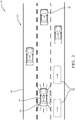
- Fig. 2 illustrates one frame of video that is a non-limiting example of the history 20.
- the perspective suggests that a camera was positioned well above the roadway 50 traveled by the host-vehicle 12 and the various vehicles that are in this example indicated as the objects 22.
- This perspective could come from an infrastructure camera located above the roadway 50, or could be synthesized from images provided by one or more cameras on the host-vehicle 12 and/or the other various vehicles and/or other infrastructure cameras at locations that don't correspond to the perspective suggested by Fig. 2 , as will be recognized by those in the art.
- the history 20 may only show or depict selected instances of the objects 22 around the host-vehicle 12 rather than clearly or explicitly show every instance of the objects 22.
- the two vehicles in the right-hand lane well behind the host-vehicle 12 are examples of how the depiction of unimportant instances of the objects 22 may be blurred or ghosted. This is done so that the history 20 does not convey so much information that the operator 18 is confused with irrelevant information.
- the controller 40 may also be configured to determine a threat-level 52 of the object 22, i.e. the threat-level 52 of one or more instances of the objects 22.
- a threat-level 52 of the object 22 i.e. the threat-level 52 of one or more instances of the objects 22.
- one instance of the objects 22 in Fig. 2 is the other-vehicle 26 which at the time the transition 24 is initiated is deemed operating in an erratic manner or traveling at a speed substantially greater than all the other vehicles on the roadway 50.
- Algorithms for tracking objects and identifying which objects may pose a threat to a vehicle, e.g. the host-vehicle 12 are known.
- Each of the objects 22 may be tracked and the threat-level 52 of each of the objects 22 may be updated on a periodic basis so that when the transition 24 is initiated, the controller 40 or the processor 42 can quickly determine the history 20 to be shown to the operator 18.
- the history 20 shown on the display 34 may highlight a selected instance of the objects 22, e.g. the other-vehicle 26.
- the history 20 may alter the rendering 30 used for the history 20 by, but not limited to, altering the general color of the depiction of the other-vehicle 26, superimposing a shaded box around the depiction of the other-vehicle 26 shown in the history 20, flashing the depiction of the other-vehicle 26, or any combination thereof.
- the degree which an object is highlighted may be characterized by an intensity 54, i.e. a highlight-intensity 54.
- the depiction of an instance of the object 22 may be de-emphasized, e.g. blurred or erased if the threat-level 52 is deemed to be relatively low, e.g. less than a threat-threshold, see for example the low-threat-objects 56.
- FIG. 2 Other examples of objects that may be highlighted in the history 20 that are not depicted in Fig. 2 include, but are not limited to, objects moving in a direction that intersects a forward-path of the host-vehicle 12, objects that are characterized by a time to potential impact less than a time-threshold, objects that are characterized by a probability of impact greater than a probability threshold, and/or a relative-speed, actual-speed, or over-speed (speed over posted speed-limit) greater than a speed-threshold.
- objects that may be highlighted in the history 20 include, but are not limited to, a vehicle pulled up into a position to enter the roadway from a driveway, intersecting road, or parking lot; or objects that are classified as likely to be periodically moving in and out of traffic flow, e.g. a mail truck, a garbage truck, etc.; and/or a recently change traffic signal or cross-walk signal and/or static obstructing objects on the road, e.g. fallen equipment from maintenance truck, boxes etc.
- the controller-circuit 40 may be configured to operate the display 34 to convey the positions 36 of a plurality of objects 22.
- the plurality of objects 22 may be characterized by a number-of-objects 58, and how many of the number-of-objects 58 that are to be highlighted may be determined in accordance with or based on a time-interval 60 from initiating the transition 24 and to when the manual-mode 16 is required. For example, if the time-interval is relatively short, e.g. three seconds, then only one or two objects with the highest threat-level may be highlighted. By contrast, if the time-interval is relatively long, e.g.
- the intent is to decrease the complexity of the history 20 as the time-interval 60 to full manual is shortened so operator 18 is not overwhelmed with information.
- Fig. 3 is a non-limiting example of a method 100 of operating the system 10.
- Step 105 OPERATE HOST-VEHICLE IN AUTONOMOUS-MODE, may include operating the host-vehicle 12 in the autonomous-mode 14 by the operator 18 entering a destination, and the controller 40 or processor 42 performing all operations to control the host-vehicle 12.
- the operations may include, but are not limited to, the identification and tracking of the objects 22 (other-vehicles, lane-markings, stationary-objects, etc.) proximate to the host-vehicle 12, determining a location of the host-vehicle 12 on a digital-map based on signals received from global-positioning-system (GPS) satellites that were processed by a location-device, e.g. a GPS receiver, and operating the steering, brakes, and accelerator of the vehicle-controls 46 to control the speed and heading of the host-vehicle 12.
- GPS global-positioning-system
- Step 110 RECEIVE/STORE RENDERING, may include receiving from a perception-sensor 28 a rendering (e.g. video from a camera, radar-map from a radar, point-cloud from a lidar, or any combination thereof) of an area 32 proximate to the host-vehicle 12.
- the rendering 30 may be stored in the memory 44, and the storing of the most recent information from the rendering 30 may displace relatively old information, e.g. information from greater than twenty-five seconds prior to the present time.
- Step 115, DETECT OBJECT(S) may include noting which of the objects 22 in the rendering 30 is closer than a distance-threshold, and adding to the record stored in the memory 44 distance to target information for each instance of the objects 22 is closer than the distance-threshold.
- Step 120 DETERMINE THREAT-LEVEL(S) , may include determining a threat-level 52 of various instance of the objects 22 based on, but not limited to, a closing-rate (e.g. how fast the other-vehicle 26 is approaching the host-vehicle), a time-to-collision (e.g. how much time until the host-vehicle 12 and an instance of the objects 22 collides if no remedial action is taken), or travel-path-proximity (how close is an instance of the objects 22 to the predicted travel-path of the host-vehicle 12).
- a closing-rate e.g. how fast the other-vehicle 26 is approaching the host-vehicle
- a time-to-collision e.g. how much time until the host-vehicle 12 and an instance of the objects 22 collides if no remedial action is taken
- travel-path-proximity how close is an instance of the objects 22 to the predicted travel-path of the host
- a threat-level 52 of zero or less than 0.1 indicates that an instance of the objects 22 presents little or no threat to the host-vehicle 12, while a threat-level of 0.9 or 1 indicates that an instance of the objects 22 presents a substantial threat and/or that a collision is almost certain.
- Step 125, DETERMINE HISTORY may include determining the history 20 of a position 36 of an object 22 present in the area 32, which may include tracking a vehicle that may not register with a high value of the threat-level 52, but is behaving in an erratic manner (e.g. frequent/rapid lane changes) so that vehicle may become a substantial threat at some time in the future. Determining the history 20 may also include determining how far back in time it is desirable that the history 20 of the rendering should be stored.
- Step 130, TRANSITION INITIATED? may include initiating a transition 24 of operation of the host-vehicle 12 from the autonomous-mode 14 to a manual-mode 16 by the operator 18 or the controller 40.
- the operator 18 may suddenly decide, for example, to exit an expressway to stop at a rest-area (not shown). Rather than taking the time to enter the rest-area as a new destination or a way-point, the operator 18 may physically override the automated steering of the host-vehicle 12 by turning a hand-wheel of the host-vehicle 12 to steer the host-vehicle 12 toward the rest-area.
- the controller 40 may decide that manual control of the host-vehicle 12 is necessary because, for example, the perception-sensor 28 is not operating properly, or there is an accident-site ahead and the controller 40 does not have high confidence about navigating around the accident-site.
- Step 135, DETERMINE TIME-INTERVAL may include the controller 40 determining how much time is available from the instant the transition 24 is initiated until the operator 18 must be fully prepared to take control of the host-vehicle 12 in the manual-mode 16.
- the time-interval 60 may generally corresponds to how much time there is to convey the history 20.
- Step 140 DETERMINE NUMBER-OF-OBJECTS, may include detecting and/or determining positions of a plurality of objects that are to be displayed in the history 20.
- the plurality of objects may be characterized by a number-of-objects 58, where the number-of-objects 58 indicates how many of the objects 22 are to be highlighted or otherwise emphasized to attract the attention of the operator 18.
- the number-of-objects 58 may also be determined in accordance with the time-interval 60. If the time-interval 60 is relatively short, e.g. three seconds, the number-of-objects 58 that are highlighted may be only one or two so the operator 18 is not overwhelmed with information. However, if the time-interval 60 is relatively large, fifteen seconds for example, then more of the objects 22 may be highlighted in the history as the operator 18 has more time to contemplate the history 20.
- Step 145, DETERMINE HIGHLIGHT-INTENSITY may include highlighting the object in the history 20.
- the highlighting of the object may be characterized by an intensity 54 or a highlight-intensity 54.
- the intensity 54 may be determined in accordance with the threat-level 52 of the object 22. For example, if the threat-level 52 is relatively high, the highlighting may include coloring the object bright red, or adding a bounding box around the object in the history 20 shown on the display 34.
- the bounding box may be colored based on the threat level where, for example, red is a high-threat, orange is a medium threat, yellow is a low-threat, and no boarder means the object is little or no threat.
- Step 150 DETERMINE PLAYBACK-SPEED, may include increasing the speed at which the history conveys events depicted in the history relative to normal-time or real-time. That is, the events are characterized as having occurred in real-time, and the history 20 may be characterized by a playback-speed 48 that is faster than real-time, e.g. two or three times real time.
- Step 155, CONVEY HISTORY may include, in response to detecting the initiating of the transition 24, conveying to the operator 18 of the host-vehicle 12 the history of the position of the object 22 in accordance with the rendering 30.
- Step 160 OPERATE HOST-VEHICLE IN MANUAL-MODE, may include the controller 40 releasing control to the operator 18 all of some of the vehicle-controls 46.
- a first device 40 that includes one or more processors 42; memory 44; and one or more programs 105-160 stored in memory 44, the one or more programs 105-160 including instructions for performing all or part of the method 100.
- a non-transitory computer-readable storage-medium 44 comprising one or more programs 105-160 for execution by one or more processors 42 of a first device 40, the one or more programs 105-160 including instructions which, when executed by the one or more processors 42, cause the first device to perform all or part of the method 100.
- a system 10 a controller 40 for the system 10, and a method 100 of operating the system 10 are provided.
- a history 20 is provided so an operator can quickly learn about prior activity about the host-vehicle 12 that the operator 18 is about to operate in the manual-mode 16
Landscapes
- Engineering & Computer Science (AREA)
- Transportation (AREA)
- Mechanical Engineering (AREA)
- Automation & Control Theory (AREA)
- Combustion & Propulsion (AREA)
- Chemical & Material Sciences (AREA)
- Human Computer Interaction (AREA)
- Theoretical Computer Science (AREA)
- Multimedia (AREA)
- Databases & Information Systems (AREA)
- Physics & Mathematics (AREA)
- General Engineering & Computer Science (AREA)
- General Physics & Mathematics (AREA)
- Data Mining & Analysis (AREA)
- Library & Information Science (AREA)
- Computational Linguistics (AREA)
- Traffic Control Systems (AREA)
- Control Of Position, Course, Altitude, Or Attitude Of Moving Bodies (AREA)
Claims (10)
- Steuerschaltung (40) zum Betreiben eines automatisierten Fahrzeugs, wobei das System (10) umfasst:einen Eingang, der so konfiguriert ist, dass er mit einem Wahrnehmungssensor (28) kommuniziert, der verwendet wird, um eine Darstellung eines Bereichs (32) in der Nähe eines Host-Fahrzeugs (12) zu bestimmen;einen Ausgang, der so konfiguriert ist, dass er mit einer Anzeige (34) kommuniziert, die so betrieben werden kann, dass sie einem Bediener (18) des Host-Fahrzeugs (12) eine Position (36) eines Objekts (22), das sich in dem Bereich (32) befindet, entsprechend der Darstellung übermittelt; undeinen Prozessor (42) in Kommunikation mit dem Wahrnehmungssensor (28) und der Anzeige (34), wobei der Prozessor (42) so konfiguriert ist, dass er das Host-Fahrzeug (12) in einem autonomen Modus (14) betreibt, und die Anzeige (34) betreibt, um dem Bediener (18) einen Verlauf (20) der Position (36) des Objekts (22) in Übereinstimmung mit der Darstellung zu übermitteln, wobei der Verlauf (20) in Reaktion auf das Einleiten eines Übergangs (24) des Betriebs des Host-Fahrzeugs (12) von dem autonomen Modus (14) in einen manuellen Modus (16) übermittelt wird.
- Steuerschaltung (40) nach Anspruch 1, wobei in dem Verlauf (20) dargestellte Ereignisse so gekennzeichnet sind, dass sie in Echtzeit aufgetreten sind, und der Verlauf (20) durch eine Wiedergabegeschwindigkeit (48) gekennzeichnet ist, wobei die Wiedergabegeschwindigkeit (48) schneller als Echtzeit ist.
- Steuerschaltung (40) nach einem der vorhergehenden Ansprüche, wobei der Prozessor (42) so konfiguriert ist, dass er einen Bedrohungsgrad (52) des Objekts (22) bestimmt und das Objekt (22) in dem Verlauf (20) hervorhebt, wobei das Hervorheben des Objekts (22) durch eine Intensität (54) gekennzeichnet ist, wobei die Intensität (54) in Übereinstimmung mit dem Bedrohungsgrad (52) des Objekts (22) bestimmt wird.
- Steuerschaltung (40) nach Anspruch 3, wobei der Prozessor (42) so konfiguriert ist, dass er die Anzeige (34) betreibt, um Positionen (36) einer Vielzahl von Objekten (22) zu übermitteln, wobei die Vielzahl von Objekten (22) durch eine Anzahl (58) der Objekte gekennzeichnet ist, wobei die Anzahl (58) der hervorgehobenen Objekte in Übereinstimmung mit einem Zeitintervall (60) vom Einleiten des Übergangs (24) und bis zu einem Zeitpunkt, an dem der manuelle Modus (16) benötigt wird, bestimmt wird.
- System (10) zum Betreiben eines automatisierten Fahrzeugs, wobei das System (10) eine Steuerschaltung (40) nach Anspruch 1, einen Wahrnehmungssensor (28) und eine Anzeige (34) umfasst.
- Verfahren (100) zum Betreiben eines automatisierten Fahrzeugs, wobei das Verfahren (100) umfasst:Empfangen (110) einer Darstellung eines Bereichs (32) in der Nähe eines Host-Fahrzeugs (12) von einem Wahrnehmungssensor (28);Betreiben (105) des Host-Fahrzeugs (12) in einem autonomen Modus (14);Bestimmen (125) eines Verlaufs (20) einer Position (36) eines Objekts (22), das sich in dem Bereich (32) befindet;Einleiten (130) eines Übergangs (24) des Betriebs des Host-Fahrzeugs (12) von dem autonomen Modus (14) in einen manuellen Modus (16); undals Reaktion auf das Einleiten des Übergangs (24), Übermitteln (150) des Verlaufs (20) der Position (36) des Objekts (22) an einen Bediener (18) des Host-Fahrzeugs (12) in Übereinstimmung mit der Darstellung.
- Verfahren (100) nach Anspruch 6, wobei in dem Verlauf (20) dargestellte Ereignisse so gekennzeichnet sind, dass sie in Echtzeit aufgetreten sind, und der Verlauf (20) durch eine Wiedergabegeschwindigkeit (48) gekennzeichnet ist, wobei die Wiedergabegeschwindigkeit (48) schneller als Echtzeit ist.
- Verfahren (100) nach einem der Ansprüche 6 und 7, wobei das Verfahren (100) umfasst:Bestimmen (120) eines Bedrohungsgrads (52) des Objekts (22); undHervorheben (145) des Objekts (22) in dem Verlauf (20), wobei das Hervorheben des Objekts (22) durch eine Intensität (54) gekennzeichnet ist, wobei die Intensität (54) in Übereinstimmung mit dem Bedrohungsgrad (52) des Objekts (22) bestimmt wird.
- Verfahren (100) nach Anspruch 8, wobei das Verfahren (100) umfasst
Bestimmen (115) von Positionen (36) einer Vielzahl von Objekten (22), wobei die Vielzahl von Objekten (22) durch eine Anzahl (58) der Objekte (58) gekennzeichnet ist, wobei die Anzahl (58) der hervorgehobenen Objekte in Übereinstimmung mit einem Zeitintervall (60) vom Einleiten des Übergangs (24) bis zu einem Zeitpunkt, an dem der manuelle Modus (16) benötigt wird, bestimmt wird. - Nichtflüchtiges computerlesbares Speichermedium (44), das ein oder mehrere Programme (105-155) zur Ausführung durch einen oder mehrere Prozessoren (42) einer ersten Vorrichtung (40) umfasst, wobei das eine oder die mehreren Programme (105-155) Befehle enthalten, die, wenn sie von dem einen oder den mehreren Prozessoren (42) ausgeführt werden, die erste Vorrichtung (40) dazu veranlassen, das Verfahren (100) nach einem der Ansprüche 6-9 durchzuführen.
Priority Applications (1)
| Application Number | Priority Date | Filing Date | Title |
|---|---|---|---|
| EP21193280.1A EP3936401A3 (de) | 2018-05-17 | 2019-05-08 | Objektpositionshistorienwiedergabe für übergang eines automatisierten fahrzeugs vom autonomen modus zum manuellen modus |
Applications Claiming Priority (2)
| Application Number | Priority Date | Filing Date | Title |
|---|---|---|---|
| US201862672815P | 2018-05-17 | 2018-05-17 | |
| US16/030,278 US10676103B2 (en) | 2018-05-17 | 2018-07-09 | Object position history playback for automated vehicle transition from autonomous-mode to manual-mode |
Related Child Applications (2)
| Application Number | Title | Priority Date | Filing Date |
|---|---|---|---|
| EP21193280.1A Division EP3936401A3 (de) | 2018-05-17 | 2019-05-08 | Objektpositionshistorienwiedergabe für übergang eines automatisierten fahrzeugs vom autonomen modus zum manuellen modus |
| EP21193280.1A Division-Into EP3936401A3 (de) | 2018-05-17 | 2019-05-08 | Objektpositionshistorienwiedergabe für übergang eines automatisierten fahrzeugs vom autonomen modus zum manuellen modus |
Publications (2)
| Publication Number | Publication Date |
|---|---|
| EP3575174A1 EP3575174A1 (de) | 2019-12-04 |
| EP3575174B1 true EP3575174B1 (de) | 2021-10-06 |
Family
ID=66625750
Family Applications (2)
| Application Number | Title | Priority Date | Filing Date |
|---|---|---|---|
| EP21193280.1A Pending EP3936401A3 (de) | 2018-05-17 | 2019-05-08 | Objektpositionshistorienwiedergabe für übergang eines automatisierten fahrzeugs vom autonomen modus zum manuellen modus |
| EP19173297.3A Not-in-force EP3575174B1 (de) | 2018-05-17 | 2019-05-08 | Objektpositionshistorienwiedergabe für übergang eines automatisierten fahrzeugs vom autonomen modus zum manuellen modus |
Family Applications Before (1)
| Application Number | Title | Priority Date | Filing Date |
|---|---|---|---|
| EP21193280.1A Pending EP3936401A3 (de) | 2018-05-17 | 2019-05-08 | Objektpositionshistorienwiedergabe für übergang eines automatisierten fahrzeugs vom autonomen modus zum manuellen modus |
Country Status (3)
| Country | Link |
|---|---|
| US (1) | US10676103B2 (de) |
| EP (2) | EP3936401A3 (de) |
| CN (1) | CN110497919B (de) |
Families Citing this family (8)
| Publication number | Priority date | Publication date | Assignee | Title |
|---|---|---|---|---|
| KR102637599B1 (ko) * | 2018-10-08 | 2024-02-19 | 주식회사 에이치엘클레무브 | 차량간 통신 정보를 이용한 차선변경 제어장치 및 방법과, 그를 위한 성향 정보 산출 장치 |
| WO2021005632A1 (ja) * | 2019-07-05 | 2021-01-14 | 三菱電機株式会社 | 車載情報機器及び車載情報機器制御方法 |
| US11511760B2 (en) * | 2020-01-23 | 2022-11-29 | Baidu Usa Llc | Cross-platform control profiling tool for autonomous vehicle control |
| US11312298B2 (en) * | 2020-01-30 | 2022-04-26 | International Business Machines Corporation | Modulating attention of responsible parties to predicted dangers of self-driving cars |
| CN114450720A (zh) * | 2020-08-18 | 2022-05-06 | 深圳市大疆创新科技有限公司 | 一种目标检测的方法、装置和车载雷达 |
| JP7579724B2 (ja) * | 2021-03-11 | 2024-11-08 | 本田技研工業株式会社 | 情報処理装置及びプログラム |
| US12325453B2 (en) * | 2021-08-23 | 2025-06-10 | Intel Corporation | Handover assistant for machine to driver transitions |
| US12322289B2 (en) * | 2022-12-22 | 2025-06-03 | Here Global B.V. | Method and system of special vehicle notification in HD map to improve AV driving safety |
Family Cites Families (16)
| Publication number | Priority date | Publication date | Assignee | Title |
|---|---|---|---|---|
| DE102006008981A1 (de) * | 2006-02-23 | 2007-08-30 | Siemens Ag | Assistenzsystem zur Unterstützung eines Fahrers |
| US8126642B2 (en) * | 2008-10-24 | 2012-02-28 | Gray & Company, Inc. | Control and systems for autonomously driven vehicles |
| JP5483535B2 (ja) * | 2009-08-04 | 2014-05-07 | アイシン精機株式会社 | 車両周辺認知支援装置 |
| US20130116887A1 (en) * | 2011-11-08 | 2013-05-09 | Delphi Technologies, Inc. | Vehicle camera system with replay |
| US9728228B2 (en) * | 2012-08-10 | 2017-08-08 | Smartdrive Systems, Inc. | Vehicle event playback apparatus and methods |
| US8676431B1 (en) * | 2013-03-12 | 2014-03-18 | Google Inc. | User interface for displaying object-based indications in an autonomous driving system |
| US9522676B2 (en) * | 2014-04-30 | 2016-12-20 | Denso International America, Inc. | Situation awareness assistant for vehicle control |
| US9365213B2 (en) * | 2014-04-30 | 2016-06-14 | Here Global B.V. | Mode transition for an autonomous vehicle |
| JP6447011B2 (ja) * | 2014-10-29 | 2019-01-09 | 株式会社デンソー | 運転情報表示装置および運転情報表示方法 |
| EP3230142B1 (de) * | 2014-12-12 | 2022-03-16 | Sony Group Corporation | Verfahren zum wechseln der betriebsmodi eines fahrzeugs |
| JP6520668B2 (ja) * | 2015-02-09 | 2019-05-29 | 株式会社デンソー | 車両用表示制御装置及び車両用表示ユニット |
| CN107531245B (zh) * | 2015-04-21 | 2020-01-24 | 松下知识产权经营株式会社 | 信息处理系统、信息处理方法、以及程序 |
| EP3109115B1 (de) * | 2015-06-23 | 2018-01-31 | Volvo Car Corporation | Anordnung und verfahren zur ermöglichung der übergabe zu und von einem automatisierten autonomen antriebsunterstützungssystem |
| KR101730321B1 (ko) * | 2015-08-03 | 2017-04-27 | 엘지전자 주식회사 | 운전자 보조 장치 및 그 제어방법 |
| US9823657B1 (en) * | 2016-11-02 | 2017-11-21 | Smartdrive Systems, Inc. | Measuring operator readiness and readiness testing triggering in an autonomous vehicle |
| US9925872B1 (en) * | 2016-11-14 | 2018-03-27 | Denso International America, Inc. | System for monitoring driver alertness and adapting vehicle settings thereto |
-
2018
- 2018-07-09 US US16/030,278 patent/US10676103B2/en active Active
-
2019
- 2019-05-08 EP EP21193280.1A patent/EP3936401A3/de active Pending
- 2019-05-08 EP EP19173297.3A patent/EP3575174B1/de not_active Not-in-force
- 2019-05-15 CN CN201910406640.5A patent/CN110497919B/zh active Active
Also Published As
| Publication number | Publication date |
|---|---|
| EP3936401A2 (de) | 2022-01-12 |
| EP3575174A1 (de) | 2019-12-04 |
| CN110497919B (zh) | 2023-06-06 |
| CN110497919A (zh) | 2019-11-26 |
| US20190351916A1 (en) | 2019-11-21 |
| US10676103B2 (en) | 2020-06-09 |
| EP3936401A3 (de) | 2022-05-04 |
Similar Documents
| Publication | Publication Date | Title |
|---|---|---|
| EP3575174B1 (de) | Objektpositionshistorienwiedergabe für übergang eines automatisierten fahrzeugs vom autonomen modus zum manuellen modus | |
| EP4018427B1 (de) | Verfahren zur handhabung von staus an kreuzungen im betrieb eines autonomen fahrzeugs und korrespondierendes system und computerprogrammprodukt | |
| CN109844843B (zh) | 用于检查超车可能性条件的方法 | |
| CN107792068B (zh) | 自动化车辆车道变换控制系统 | |
| US12423989B2 (en) | Method for capturing the surroundings using at least two independent imaging surroundings capture sensors, apparatus for performing the method, vehicle and appropriately designed computer program | |
| EP3524935B1 (de) | Fahrzeugwahrnehmungsdatenerfassungssystem und -verfahren | |
| US10160459B2 (en) | Vehicle lane direction detection | |
| CN113727899B (zh) | 至少部分地自动化引导机动车辆的方法 | |
| US20090034798A1 (en) | Method for recognition of an object | |
| EP3407249A2 (de) | Verfahren und system zur erzeugung und verwendung eines wahrnehmungsszenengraphen in kraftfahrzeuganwendungen | |
| US12002353B2 (en) | Method and system for providing environmental data | |
| US10848718B2 (en) | Vehicle sensor configuration based on map data | |
| CN114274978B (zh) | 一种无人驾驶物流车的避障方法 | |
| US9939523B2 (en) | Vehicle type radar system, and method for removing an uninterested target | |
| EP3460778B1 (de) | Automatisiertes fahrzeugsimuliertes fahrspurführungssystem | |
| EP3211618A1 (de) | Verifizierung benachbarter spuren für ein automatisiertes fahrzeug | |
| US20230192081A1 (en) | Method for controlling a distance-dependent cruise control system | |
| CN112970052A (zh) | 车辆控制系统 | |
| CN111137286A (zh) | 车辆车道偏离系统以及方法 | |
| CN110606091B (zh) | 在物体离开主车辆的道路之后的物体跟踪 | |
| US12444300B2 (en) | Preemptive maneuvering system for viewing a traffic control device | |
| CN112639808A (zh) | 用于机动车辆的纵向和/或横向控制的驾驶辅助 | |
| US20260073794A1 (en) | Systems and methods for preventing unsafe driving behavior | |
| CN110015302A (zh) | 用于在施工区域附近从自动模式改变为手动模式的自动车辆系统和方法 |
Legal Events
| Date | Code | Title | Description |
|---|---|---|---|
| PUAI | Public reference made under article 153(3) epc to a published international application that has entered the european phase |
Free format text: ORIGINAL CODE: 0009012 |
|
| STAA | Information on the status of an ep patent application or granted ep patent |
Free format text: STATUS: THE APPLICATION HAS BEEN PUBLISHED |
|
| AK | Designated contracting states |
Kind code of ref document: A1 Designated state(s): AL AT BE BG CH CY CZ DE DK EE ES FI FR GB GR HR HU IE IS IT LI LT LU LV MC MK MT NL NO PL PT RO RS SE SI SK SM TR |
|
| AX | Request for extension of the european patent |
Extension state: BA ME |
|
| STAA | Information on the status of an ep patent application or granted ep patent |
Free format text: STATUS: REQUEST FOR EXAMINATION WAS MADE |
|
| 17P | Request for examination filed |
Effective date: 20200528 |
|
| RBV | Designated contracting states (corrected) |
Designated state(s): AL AT BE BG CH CY CZ DE DK EE ES FI FR GB GR HR HU IE IS IT LI LT LU LV MC MK MT NL NO PL PT RO RS SE SI SK SM TR |
|
| GRAP | Despatch of communication of intention to grant a patent |
Free format text: ORIGINAL CODE: EPIDOSNIGR1 |
|
| STAA | Information on the status of an ep patent application or granted ep patent |
Free format text: STATUS: GRANT OF PATENT IS INTENDED |
|
| INTG | Intention to grant announced |
Effective date: 20210420 |
|
| GRAS | Grant fee paid |
Free format text: ORIGINAL CODE: EPIDOSNIGR3 |
|
| GRAA | (expected) grant |
Free format text: ORIGINAL CODE: 0009210 |
|
| STAA | Information on the status of an ep patent application or granted ep patent |
Free format text: STATUS: THE PATENT HAS BEEN GRANTED |
|
| AK | Designated contracting states |
Kind code of ref document: B1 Designated state(s): AL AT BE BG CH CY CZ DE DK EE ES FI FR GB GR HR HU IE IS IT LI LT LU LV MC MK MT NL NO PL PT RO RS SE SI SK SM TR |
|
| REG | Reference to a national code |
Ref country code: GB Ref legal event code: FG4D |
|
| REG | Reference to a national code |
Ref country code: CH Ref legal event code: EP Ref country code: AT Ref legal event code: REF Ref document number: 1435971 Country of ref document: AT Kind code of ref document: T Effective date: 20211015 |
|
| REG | Reference to a national code |
Ref country code: IE Ref legal event code: FG4D |
|
| REG | Reference to a national code |
Ref country code: DE Ref legal event code: R096 Ref document number: 602019008089 Country of ref document: DE |
|
| REG | Reference to a national code |
Ref country code: LT Ref legal event code: MG9D |
|
| REG | Reference to a national code |
Ref country code: NL Ref legal event code: MP Effective date: 20211006 |
|
| REG | Reference to a national code |
Ref country code: AT Ref legal event code: MK05 Ref document number: 1435971 Country of ref document: AT Kind code of ref document: T Effective date: 20211006 |
|
| PG25 | Lapsed in a contracting state [announced via postgrant information from national office to epo] |
Ref country code: RS Free format text: LAPSE BECAUSE OF FAILURE TO SUBMIT A TRANSLATION OF THE DESCRIPTION OR TO PAY THE FEE WITHIN THE PRESCRIBED TIME-LIMIT Effective date: 20211006 Ref country code: LT Free format text: LAPSE BECAUSE OF FAILURE TO SUBMIT A TRANSLATION OF THE DESCRIPTION OR TO PAY THE FEE WITHIN THE PRESCRIBED TIME-LIMIT Effective date: 20211006 Ref country code: FI Free format text: LAPSE BECAUSE OF FAILURE TO SUBMIT A TRANSLATION OF THE DESCRIPTION OR TO PAY THE FEE WITHIN THE PRESCRIBED TIME-LIMIT Effective date: 20211006 Ref country code: BG Free format text: LAPSE BECAUSE OF FAILURE TO SUBMIT A TRANSLATION OF THE DESCRIPTION OR TO PAY THE FEE WITHIN THE PRESCRIBED TIME-LIMIT Effective date: 20220106 Ref country code: AT Free format text: LAPSE BECAUSE OF FAILURE TO SUBMIT A TRANSLATION OF THE DESCRIPTION OR TO PAY THE FEE WITHIN THE PRESCRIBED TIME-LIMIT Effective date: 20211006 |
|
| PG25 | Lapsed in a contracting state [announced via postgrant information from national office to epo] |
Ref country code: IS Free format text: LAPSE BECAUSE OF FAILURE TO SUBMIT A TRANSLATION OF THE DESCRIPTION OR TO PAY THE FEE WITHIN THE PRESCRIBED TIME-LIMIT Effective date: 20220206 Ref country code: SE Free format text: LAPSE BECAUSE OF FAILURE TO SUBMIT A TRANSLATION OF THE DESCRIPTION OR TO PAY THE FEE WITHIN THE PRESCRIBED TIME-LIMIT Effective date: 20211006 Ref country code: PT Free format text: LAPSE BECAUSE OF FAILURE TO SUBMIT A TRANSLATION OF THE DESCRIPTION OR TO PAY THE FEE WITHIN THE PRESCRIBED TIME-LIMIT Effective date: 20220207 Ref country code: PL Free format text: LAPSE BECAUSE OF FAILURE TO SUBMIT A TRANSLATION OF THE DESCRIPTION OR TO PAY THE FEE WITHIN THE PRESCRIBED TIME-LIMIT Effective date: 20211006 Ref country code: NO Free format text: LAPSE BECAUSE OF FAILURE TO SUBMIT A TRANSLATION OF THE DESCRIPTION OR TO PAY THE FEE WITHIN THE PRESCRIBED TIME-LIMIT Effective date: 20220106 Ref country code: NL Free format text: LAPSE BECAUSE OF FAILURE TO SUBMIT A TRANSLATION OF THE DESCRIPTION OR TO PAY THE FEE WITHIN THE PRESCRIBED TIME-LIMIT Effective date: 20211006 Ref country code: LV Free format text: LAPSE BECAUSE OF FAILURE TO SUBMIT A TRANSLATION OF THE DESCRIPTION OR TO PAY THE FEE WITHIN THE PRESCRIBED TIME-LIMIT Effective date: 20211006 Ref country code: HR Free format text: LAPSE BECAUSE OF FAILURE TO SUBMIT A TRANSLATION OF THE DESCRIPTION OR TO PAY THE FEE WITHIN THE PRESCRIBED TIME-LIMIT Effective date: 20211006 Ref country code: GR Free format text: LAPSE BECAUSE OF FAILURE TO SUBMIT A TRANSLATION OF THE DESCRIPTION OR TO PAY THE FEE WITHIN THE PRESCRIBED TIME-LIMIT Effective date: 20220107 Ref country code: ES Free format text: LAPSE BECAUSE OF FAILURE TO SUBMIT A TRANSLATION OF THE DESCRIPTION OR TO PAY THE FEE WITHIN THE PRESCRIBED TIME-LIMIT Effective date: 20211006 |
|
| REG | Reference to a national code |
Ref country code: DE Ref legal event code: R097 Ref document number: 602019008089 Country of ref document: DE |
|
| PG25 | Lapsed in a contracting state [announced via postgrant information from national office to epo] |
Ref country code: SM Free format text: LAPSE BECAUSE OF FAILURE TO SUBMIT A TRANSLATION OF THE DESCRIPTION OR TO PAY THE FEE WITHIN THE PRESCRIBED TIME-LIMIT Effective date: 20211006 Ref country code: SK Free format text: LAPSE BECAUSE OF FAILURE TO SUBMIT A TRANSLATION OF THE DESCRIPTION OR TO PAY THE FEE WITHIN THE PRESCRIBED TIME-LIMIT Effective date: 20211006 Ref country code: RO Free format text: LAPSE BECAUSE OF FAILURE TO SUBMIT A TRANSLATION OF THE DESCRIPTION OR TO PAY THE FEE WITHIN THE PRESCRIBED TIME-LIMIT Effective date: 20211006 Ref country code: EE Free format text: LAPSE BECAUSE OF FAILURE TO SUBMIT A TRANSLATION OF THE DESCRIPTION OR TO PAY THE FEE WITHIN THE PRESCRIBED TIME-LIMIT Effective date: 20211006 Ref country code: DK Free format text: LAPSE BECAUSE OF FAILURE TO SUBMIT A TRANSLATION OF THE DESCRIPTION OR TO PAY THE FEE WITHIN THE PRESCRIBED TIME-LIMIT Effective date: 20211006 Ref country code: CZ Free format text: LAPSE BECAUSE OF FAILURE TO SUBMIT A TRANSLATION OF THE DESCRIPTION OR TO PAY THE FEE WITHIN THE PRESCRIBED TIME-LIMIT Effective date: 20211006 |
|
| PLBE | No opposition filed within time limit |
Free format text: ORIGINAL CODE: 0009261 |
|
| STAA | Information on the status of an ep patent application or granted ep patent |
Free format text: STATUS: NO OPPOSITION FILED WITHIN TIME LIMIT |
|
| 26N | No opposition filed |
Effective date: 20220707 |
|
| PG25 | Lapsed in a contracting state [announced via postgrant information from national office to epo] |
Ref country code: AL Free format text: LAPSE BECAUSE OF FAILURE TO SUBMIT A TRANSLATION OF THE DESCRIPTION OR TO PAY THE FEE WITHIN THE PRESCRIBED TIME-LIMIT Effective date: 20211006 |
|
| PG25 | Lapsed in a contracting state [announced via postgrant information from national office to epo] |
Ref country code: SI Free format text: LAPSE BECAUSE OF FAILURE TO SUBMIT A TRANSLATION OF THE DESCRIPTION OR TO PAY THE FEE WITHIN THE PRESCRIBED TIME-LIMIT Effective date: 20211006 |
|
| REG | Reference to a national code |
Ref country code: CH Ref legal event code: PL |
|
| REG | Reference to a national code |
Ref country code: BE Ref legal event code: MM Effective date: 20220531 |
|
| PG25 | Lapsed in a contracting state [announced via postgrant information from national office to epo] |
Ref country code: MC Free format text: LAPSE BECAUSE OF FAILURE TO SUBMIT A TRANSLATION OF THE DESCRIPTION OR TO PAY THE FEE WITHIN THE PRESCRIBED TIME-LIMIT Effective date: 20211006 Ref country code: LU Free format text: LAPSE BECAUSE OF NON-PAYMENT OF DUE FEES Effective date: 20220508 Ref country code: LI Free format text: LAPSE BECAUSE OF NON-PAYMENT OF DUE FEES Effective date: 20220531 Ref country code: CH Free format text: LAPSE BECAUSE OF NON-PAYMENT OF DUE FEES Effective date: 20220531 |
|
| PG25 | Lapsed in a contracting state [announced via postgrant information from national office to epo] |
Ref country code: IE Free format text: LAPSE BECAUSE OF NON-PAYMENT OF DUE FEES Effective date: 20220508 |
|
| PG25 | Lapsed in a contracting state [announced via postgrant information from national office to epo] |
Ref country code: IT Free format text: LAPSE BECAUSE OF FAILURE TO SUBMIT A TRANSLATION OF THE DESCRIPTION OR TO PAY THE FEE WITHIN THE PRESCRIBED TIME-LIMIT Effective date: 20211006 Ref country code: BE Free format text: LAPSE BECAUSE OF NON-PAYMENT OF DUE FEES Effective date: 20220531 |
|
| P01 | Opt-out of the competence of the unified patent court (upc) registered |
Effective date: 20230424 |
|
| PG25 | Lapsed in a contracting state [announced via postgrant information from national office to epo] |
Ref country code: HU Free format text: LAPSE BECAUSE OF FAILURE TO SUBMIT A TRANSLATION OF THE DESCRIPTION OR TO PAY THE FEE WITHIN THE PRESCRIBED TIME-LIMIT; INVALID AB INITIO Effective date: 20190508 |
|
| PG25 | Lapsed in a contracting state [announced via postgrant information from national office to epo] |
Ref country code: MK Free format text: LAPSE BECAUSE OF FAILURE TO SUBMIT A TRANSLATION OF THE DESCRIPTION OR TO PAY THE FEE WITHIN THE PRESCRIBED TIME-LIMIT Effective date: 20211006 Ref country code: CY Free format text: LAPSE BECAUSE OF FAILURE TO SUBMIT A TRANSLATION OF THE DESCRIPTION OR TO PAY THE FEE WITHIN THE PRESCRIBED TIME-LIMIT Effective date: 20211006 |
|
| PG25 | Lapsed in a contracting state [announced via postgrant information from national office to epo] |
Ref country code: TR Free format text: LAPSE BECAUSE OF FAILURE TO SUBMIT A TRANSLATION OF THE DESCRIPTION OR TO PAY THE FEE WITHIN THE PRESCRIBED TIME-LIMIT Effective date: 20211006 |
|
| PGFP | Annual fee paid to national office [announced via postgrant information from national office to epo] |
Ref country code: GB Payment date: 20240527 Year of fee payment: 6 |
|
| PGFP | Annual fee paid to national office [announced via postgrant information from national office to epo] |
Ref country code: DE Payment date: 20240516 Year of fee payment: 6 |
|
| PGFP | Annual fee paid to national office [announced via postgrant information from national office to epo] |
Ref country code: FR Payment date: 20240524 Year of fee payment: 6 |
|
| PG25 | Lapsed in a contracting state [announced via postgrant information from national office to epo] |
Ref country code: MT Free format text: LAPSE BECAUSE OF FAILURE TO SUBMIT A TRANSLATION OF THE DESCRIPTION OR TO PAY THE FEE WITHIN THE PRESCRIBED TIME-LIMIT Effective date: 20211006 |
|
| REG | Reference to a national code |
Ref country code: DE Ref legal event code: R081 Ref document number: 602019008089 Country of ref document: DE Owner name: APTIV TECHNOLOGIES AG, CH Free format text: FORMER OWNER: APTIV TECHNOLOGIES LIMITED, ST. MICHAEL, BB |
|
| REG | Reference to a national code |
Ref country code: DE Ref legal event code: R119 Ref document number: 602019008089 Country of ref document: DE |
|
| GBPC | Gb: european patent ceased through non-payment of renewal fee |
Effective date: 20250508 |
|
| PG25 | Lapsed in a contracting state [announced via postgrant information from national office to epo] |
Ref country code: GB Free format text: LAPSE BECAUSE OF NON-PAYMENT OF DUE FEES Effective date: 20250508 |
|
| PG25 | Lapsed in a contracting state [announced via postgrant information from national office to epo] |
Ref country code: DE Free format text: LAPSE BECAUSE OF NON-PAYMENT OF DUE FEES Effective date: 20251202 |
|
| PG25 | Lapsed in a contracting state [announced via postgrant information from national office to epo] |
Ref country code: FR Free format text: LAPSE BECAUSE OF NON-PAYMENT OF DUE FEES Effective date: 20250531 |