EP3575504A1 - Strömungskanal für eine inspektionskammer oder ein mannloch - Google Patents
Strömungskanal für eine inspektionskammer oder ein mannloch Download PDFInfo
- Publication number
- EP3575504A1 EP3575504A1 EP19176998.3A EP19176998A EP3575504A1 EP 3575504 A1 EP3575504 A1 EP 3575504A1 EP 19176998 A EP19176998 A EP 19176998A EP 3575504 A1 EP3575504 A1 EP 3575504A1
- Authority
- EP
- European Patent Office
- Prior art keywords
- flow channel
- inlet
- outlet
- man
- plates
- Prior art date
- Legal status (The legal status is an assumption and is not a legal conclusion. Google has not performed a legal analysis and makes no representation as to the accuracy of the status listed.)
- Granted
Links
Images





Classifications
-
- E—FIXED CONSTRUCTIONS
- E03—WATER SUPPLY; SEWERAGE
- E03F—SEWERS; CESSPOOLS
- E03F5/00—Sewerage structures
- E03F5/02—Manhole shafts or other inspection chambers; Snow-filling openings; accessories
- E03F5/021—Connection of sewer pipes to manhole shaft
-
- E—FIXED CONSTRUCTIONS
- E03—WATER SUPPLY; SEWERAGE
- E03F—SEWERS; CESSPOOLS
- E03F5/00—Sewerage structures
- E03F5/02—Manhole shafts or other inspection chambers; Snow-filling openings; accessories
-
- B—PERFORMING OPERATIONS; TRANSPORTING
- B29—WORKING OF PLASTICS; WORKING OF SUBSTANCES IN A PLASTIC STATE IN GENERAL
- B29C—SHAPING OR JOINING OF PLASTICS; SHAPING OF MATERIAL IN A PLASTIC STATE, NOT OTHERWISE PROVIDED FOR; AFTER-TREATMENT OF THE SHAPED PRODUCTS, e.g. REPAIRING
- B29C53/00—Shaping by bending, folding, twisting, straightening or flattening; Apparatus therefor
- B29C53/02—Bending or folding
- B29C53/04—Bending or folding of plates or sheets
-
- E—FIXED CONSTRUCTIONS
- E02—HYDRAULIC ENGINEERING; FOUNDATIONS; SOIL SHIFTING
- E02D—FOUNDATIONS; EXCAVATIONS; EMBANKMENTS; UNDERGROUND OR UNDERWATER STRUCTURES
- E02D29/00—Independent underground or underwater structures; Retaining walls
- E02D29/12—Manhole shafts; Other inspection or access chambers; Accessories therefor
-
- E—FIXED CONSTRUCTIONS
- E02—HYDRAULIC ENGINEERING; FOUNDATIONS; SOIL SHIFTING
- E02D—FOUNDATIONS; EXCAVATIONS; EMBANKMENTS; UNDERGROUND OR UNDERWATER STRUCTURES
- E02D29/00—Independent underground or underwater structures; Retaining walls
- E02D29/12—Manhole shafts; Other inspection or access chambers; Accessories therefor
- E02D29/124—Shaft entirely made of synthetic material
-
- E—FIXED CONSTRUCTIONS
- E03—WATER SUPPLY; SEWERAGE
- E03F—SEWERS; CESSPOOLS
- E03F5/00—Sewerage structures
- E03F5/02—Manhole shafts or other inspection chambers; Snow-filling openings; accessories
- E03F5/024—Manhole shafts or other inspection chambers; Snow-filling openings; accessories made of plastic material
-
- E—FIXED CONSTRUCTIONS
- E03—WATER SUPPLY; SEWERAGE
- E03F—SEWERS; CESSPOOLS
- E03F5/00—Sewerage structures
- E03F5/02—Manhole shafts or other inspection chambers; Snow-filling openings; accessories
- E03F5/027—The bottom made of prefabricated segments
Definitions
- the present invention relates to a flow channel for an inspection chamber or man-hole.
- the present invention relates to a use of a flow channel.
- the present invention relates to an inspection chamber or man-hole.
- the present invention relates to a method of manufacturing a flow channel for an inspection chamber or man-hole.
- the present invention relates to a computer readable memory.
- Inspection chambers or man-holes are known by means of which a person can have access to a sewer system, a storm water removal system, a system for processing or transporting liquids, and the like.
- the inspection chambers or man-holes are normally used for providing access to a flow channel for reasons of inspection, maintenance, cleaning, de-clogging, and the like.
- Said inspection chambers or man-holes are typically buried into the ground, for example below the tarmac of a street or below a walkway.
- Conventional systems employed for handling sewage, storm drainage and the like employ vertically oriented inspection chambers or manholes of generally cylindrical shape which are positioned at juncture locations of diverse flow pipes or at positions where flow pipes change their orientation.
- the inspection chambers or man-holes typically include a cover which can be manually removed in order to provide access to a respective inspection chamber or man-hole.
- Each inspection chamber or man-hole comprises at least two flow openings or sewage water openings, i.e. at least one inlet opening for inwardly flowing material and at least one outlet opening for outwardly flowing material.
- An inflow pipe is connected to each inlet opening and an outflow pipe is connected to each outlet opening.
- sewer pipes may be connected to the inspection chamber or man-hole.
- Inflow pipes frequently arrive at different elevations and are frequently of different sizes.
- outflow pipes frequently depart at different elevations and are frequently of different sizes.
- Document US 4867411 A discloses a plurality of invert forming mold members which are bolted together and have their ends received in internal frames provided at adjacent pipe openings in a manhole.
- the mold members are formed of relatively thick and heavy polyurethane and are of U-shaped cross-section.
- a mold supporting plate is provided in each of the internal mounting frames and has an opening configured to matingly receive the endmost mold component.
- the mold components are provided in a variety of linear lengths, angular curved configurations and elevation changing members so that they can be associated to form inverts required for any particular manhole configuration.
- the assembly of mold members is strong and rigid and does not require any additional internal bracing.
- document US 2008/141445 A describes an inspection chamber having a plastic sleeve as well as a plastic base attached to the sleeve and provided with at least two openings to which a pipe can in each case be attached.
- the plastic base has a flow profile which extends between the openings, and is made up of at least two separate base parts which, at the edges thereof facing towards each other, are fixedly attached to one another by means of a joining technique, such as gluing, welding and/or pop rivets.
- document US 2005/161088 A teaches a manhole base or liner for directing the flow of liquid from a manhole inlet opening positioned in one of a plurality of possible locations in a manhole side wall to a manhole outlet opening in the manhole side wall, and a manhole having the base or liner.
- the base or liner includes a perimeter, an upper surface extending to the perimeter, and a liquid flow path formed in the upper surface.
- the liquid flow path has, in series, first and second flow path portions, the first flow path portion defined by a first bottom wall and a pair of spaced apart side by side guide walls extending upwardly from the bottom wall, the guide walls each having a guide wall inner end and a guide wall outer end, the outer ends being located at the perimeter and being spaced apart a greater distance than the distance between the inner ends, the second flow path portion being defined by a second bottom wall, contiguous with the first bottom wall, and a pair of spaced apart side by side channel walls extending upwardly from the second bottom wall, each channel wall having an inner channel wall end and an outer channel wall end, the inner channel wall ends meeting the respective guide wall inner ends, and the outer channel wall ends being located at the perimeter.
- Document EP 1174550 A2 discloses a base element for a manhole shaft.
- the lower section of a shaft using prefabricated parts, has at least two channel segments assembled into an inner body with an outflow connection and at least one inflow connection.
- the inner body, with the component parts fitted together, is embedded into a lower part body with its base and mantle, so that the inflow and outflow connections match up with the inflows and outflows at the lower body.
- a modular system forming an inspection chamber or manhole for a drainage system comprises a base portion, an insert portion adapted to lie at least partly upon said base and having one or more drainage channels fabricated within it, a plurality of support segments of desired arc lengths, the insert portion being supported at its edges between the top of the support segments and a stack of shaft rings, wherein each piece is preformed and the structure is adapted to be assembled in situ and to be connected to the ends of drainage pipes.
- a manhole comprises an access chamber of moulded plastics material with a closed bottom and inlet forming portions spaced around the lower end of the sides of the chamber and an invert-forming insert of moulded plastics material fitting in the bottom of the chamber and having at least one upwardly facing channel forming an invert between two of the inlet forming portions.
- the insert is a tight fit in the chamber bottom with its sides blocking off the unused inlets and is snapped past an inward projection just above the inlets.
- the insert may be either a closed body with a bottom or it may be an open shell reinforced by ribs at locations not bearing invert channels.
- the inlet forming portions may be knock outs in the chamber wall, sealing being effected round a pipe-end inserted in a knocked out hole by means of a grommet or the ends of the outwardly projecting blind spigots may be pierced or cut off to provide access.
- the upper end of the chamber is formed as a socket to receive an extension piece with an outward flange for contacting a manhole cover. Additional socketing extension pieces may be provided between the chamber and extension piece.
- the chamber, extensions and insert may be of octagonal or circular cross-section and the chamber may serve simply as a former surrounded in use by low grade concrete or other settable filler or by a built-up structure.
- Document US 2007/053750 A describes an inspection chamber having a plastic sleeve, a plastic base accommodated in the sleeve and at least two branches connected to the sleeve, which base has a flow profile that extends between the two branches.
- the base is made up of at least two separate base parts that are permanently fixed to one another at their edges facing one another, such as by welding, fusing, gluing and the like.
- JP 6026065 A discloses an invert block structure for a manhole.
- JP 6146313 A teaches an invert block for a man-hole and a driving channel formation method.
- JP 5287766 A describes further an invert manufacturing method of a sewage man-hole. According to the method, concrete is poured into a form consisting of male and female types to form an invert, and precasting the invert takes place at a plant other than a man-hole construction site.
- a flow channel for an inspection chamber or man-hole comprising at least one inlet configured to be coupled to at least one inlet pipe, at least one outlet configured to be coupled to at least one outlet pipe, and wherein the flow channel between the at least one inlet and the at least one outlet is formed by at least one bent plate.
- the plate preferably comprises a weldable material, such as a metal or, in particular, a thermoplastic material. By welding, two or more bent and/or planar plates can be joined to form even complex surface profiles.
- an inspection chamber or man-hole comprising a base, a perimeter wall protruding from the base, a flow channel comprising at least one inlet configured to be coupled to at least one inlet pipe, at least one outlet configured to be coupled to at least one outlet pipe, and wherein the flow channel between the at least one inlet and the at least one outlet is formed by at least one bent plate, and a frame positioned on the base and configured to support the bent plate.
- a method of manufacturing a flow channel for an inspection chamber or man-hole comprising measuring or determining information including at least diameters, orientations and depths of at least two pipes in the ground, cutting of at least one flat plate into a defined shape based on the measured or determined information, and bending the at least one cut plate into a predefined form.
- a non-transitory computer readable memory medium having stored thereon a set of computer readable instructions that, when executed by at least one processor, cause a system to at least receive measured or determined information including diameters, orientations and depths of at least two pipes in the ground, calculate a defined shape for at least one flat plate based on the received information, wherein the flat plate is configured to be bent into a predefined form in order to form a flow channel for an inspection chamber or man-hole, transmit calculated shape data for the at least one flat plate to a CNC machine, and cause the CNC machine to cut the at least one flat plate into the defined shape.
- a flow channel for an inspection chamber or man-hole a use of a flow channel in connection with an inspection chamber or man-hole, an inspection chamber or man-hole, a method of manufacturing a flow channel for an inspection chamber or man-hole, and a computer readable memory are provided.
- Flow channels of different inspection chambers or man-holes are typically not identical, because of varying parameters such as number of inlet pipes, number of outlet pipes, diameter of inlet pipes, diameter of outlet pipes, orientation of inlet pipes, orientation of outlet pipes, depth in the ground of inlet pipes, depth in the ground of outlet pipes, distance between inlet and outlet pipes, depth difference between inlet and outlet pipes, and the like.
- flow channels are provided for different inspection chambers or man-holes having various parameters. Forming of each flow channel can be carried out quickly and easily, for example when building a sewer system or replacing an existing inspection chamber or man-hole by a new one and connecting it with existing pipes in the ground.
- complex flow channels can be formed by a low number of bent plates. For example, only two plates are required to connect two inlet pipes with a single outlet pipe. Even more complex flow channels can be formed with a very low number of plates.
- the flow channels are lightweight and the dimensions can be freely selected. Non-standardized flow channels can be provided. Flow channels for any dimensions of pipes and material of the respective pipes can be provided.
- flat or planar plates can be cut into a defined shape in a plant based on measured or determined information and/or parameters.
- the plates are typically cut into the defined shape based on a computer calculation.
- the shape of the plates is typically calculated based on the measured or determined input data.
- the defined shape of the plates can be automatically calculated by at least one processing core.
- the defined shape of the plates may be provided as CAD data.
- the plate's mechanical dimensions may be defined using CAD software, and then translated into manufacturing directives by CAM software.
- the resulting directives may be transformed into commands necessary for a CNC machine to cut the plates.
- the CNC machine may cut the plates into the defined shape according to the calculated CAD data.
- the flow channels can be formed at the construction site by manually bending the pre-cut plates into a predefined form and welding them together or connecting the bent plates otherwise.
- the plates may also be cut into the defined shape by another device or even manually.
- flow channel means a flow system through which material such as sewage water and storm drainage can flow.
- the channel is configured to be connected to at least one inlet pipe and at least one outlet pipe.
- the channel is configured to be arranged within an inspection chamber or man-hole.
- the channel is open on one side to provide access to the channel.
- the term "inspection chamber” means a structure by means of which a person can have access to a flow channel positioned within said structure.
- the structure comprises a base, a perimeter wall, at least one inlet opening, at least one outlet opening and an access opening.
- a flow channel is further arranged within the structure.
- the structure is dimensioned such that a person cannot completely enter the structure.
- the term "man-hole” means a structure by means of which a person can have access to a flow channel positioned within said structure.
- the structure comprises a base, a perimeter wall, at least one inlet opening, at least one outlet opening and an access opening.
- a flow channel is further arranged within the structure.
- the structure is dimensioned such that a person can completely enter the structure via the access opening. Entering through the access opening may, for example, take place using a ladder.
- FIGURE 1 a schematic perspective view of a flow channel 1 in accordance with at least some embodiments of the present invention is illustrated.
- the flow channel 1 is shown within an inspection chamber 2.
- Such inspection chambers 2 of a sewage system are, for example, located at a distance of about 40 m - 50 m to each other.
- the inspection chambers 2 are typically connected to each other by sewage pipes.
- an inspection chamber 2 comprising a base 8 and a perimeter wall 9 is shown.
- the inspection chamber 2 further includes an inlet opening and an outlet opening in the perimeter wall 9.
- An inlet pipe 5 is coupled to the inspection chamber 2 on one side and an outlet pipe 7 is coupled to the inspection chamber 2 on an opposite side.
- the flow channel 1 comprises an inlet 4 configured to be coupled to the inlet pipe 5.
- the flow channel further comprises an outlet 6 configured to be coupled to the outlet pipe 7.
- the flow channel 1 between the inlet 4 and the outlet 6 is formed by at least one bent plate 3. In FIGURE 1 , the shown flow channel 1 is straight.
- a support frame 10 is arranged on the base 8 of the inspection chamber 2.
- the frame 10 is configured to support the at least one bent plate 3 forming the flow channel 1.
- the plate 3 is bent into a form corresponding to the form of a part of the frame 10.
- the predefined form of the flow channel 1 is achieved by pressing the plate 3 against parts of the frame 10.
- the bent plate 3 may be at least temporarily attached to the frame using attachment means, for example clips, in order to align the at least one plate 3 and the frame 10 for welding the plate 3 and the frame 10 together.
- the thickness of the at least one bent plate 3 is typically in the range between 3 mm and 30 mm, and thus it is possible to bend the at least one plate 3 manually.
- heating of the at least one plate 3 is not required in order to bend the plate into a predefined form.
- the surface of the plate 3 forming the flow channel 1 is smooth, i.e. there are typically no corners, steps, bumps, and the like.
- the flow channel 1 is normally U-shaped.
- Extension plates 11 are further connected to the at least one bent plate 3.
- the extension plates 11 cover the frame 10 and prevent overflowing of material from the flow channel 1.
- the extension plates and the at least one bent plate 3 are welded together or the extension plates 11 are an integral part of the bent plate 3.
- the at least one bent plate 3 and the extension plates 11 are of the same material, for example thermoplastic material, in particular a polyolefin material, such as polyethylene (PE) or polypropylene (PP).
- suitable thermoplastic materials include weldable thermoplastic materials, such as polystyrene (PS), acrylonitrile butadiene styrene (ABS), polyimide (PI) and polyamide (PA) or a thermoset material.
- the extension plates 11 are further fixedly attached to the frame 10.
- the frame 10 may be of the same material as the at least one plate 3 and the extension plates 11. Thus, all parts forming the flow channel 1 can be welded together.
- the flow channel 1 may also be located within a man-hole instead of the inspection chamber 2.
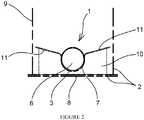
- FIGURE 2 a schematic front view of a flow channel 1 in accordance with at least some embodiments of the present invention is illustrated.
- the flow channel 1 comprises an inlet configured to be coupled to an inlet pipe.
- the flow channel further comprises an outlet 6 configured to be coupled to an outlet pipe 7.
- the flow channel 1 between the inlet 4 and the outlet 6 is formed by a bent plate 3.
- the shown flow channel 1 is straight.
- Extension plates 11 are connected to the bent plate 3.
- the angle between the extension plates 11 and the basis 8 may vary depending on in which country the flow channel 1 is to be installed. Also the distance between the extension plates 11 and the baseline of the bent plate 3 or the lowest point of the plate 3, may vary depending on in which country the flow channel 1 is to be installed. The distance between the extension plates 11 and the baseline of the bent plate 3 or the lowest point of the plate 3 may be, for example, greater than 1/2 of the diameter of the pipe 7.
- FIGURE 3 a schematic side view of a flow channel 1 in accordance with at least some embodiments of the present invention is illustrated.
- the flow channel 1 comprises an inlet 4 configured to be coupled to an inlet pipe 5.
- the flow channel further comprises an outlet 6 configured to be coupled to an outlet pipe 7.
- the flow channel 1 between the inlet 4 and the outlet 6 is formed by a bent plate 3.
- the shown flow channel 1 is straight.
- the inlet 4 and the outlet 6 may be configured to be coupled to pipes 5, 7 having a diameter of 110 mm or greater than 110 mm, for example to pipes 5, 7 having a diameter in the range between 110 mm and 3000 mm.
- FIGURE 4 a schematic perspective view of another flow channel 1 in accordance with at least some embodiments of the present invention is illustrated.
- the flow channel 1 comprises an inlet 4 configured to be coupled to an inlet pipe 5.
- the flow channel further comprises an outlet 6 configured to be coupled to an outlet pipe 7.
- the flow channel 1 between the inlet 4 and the outlet 6 is formed by a plurality of bent plates 3.
- the shown flow channel 1 is not straight.
- the flow channel 1 changes its orientation by about 30 degrees.
- the bent plates 3 are welded together along a welding line 12. Extension plates 11 are further welded to the bent plates 3 as well as to each other on each side of the flow channel 1.
- the orientation of the flow channel 1 changes at the welding line 12. Typically, the orientation changes by 30 degrees or less. Thus, material cannot get stuck and clogging of the flow channel 1 can be avoided.
- the orientation of the first part of the flow channel 1 is identical with the orientation of the inlet pipe 5 and the orientation of the second part of the flow channel 1 is identical with the orientation of the outlet pipe 7.
- the orientation of the flow channel only changes once.
- the orientation of the flow channel can change several times, for instance.
- the orientation of the first part of the flow channel 1 is not identical with the orientation of the inlet pipe 5 and/or the orientation of the second part of the flow channel 1 is not identical with the orientation of the outlet pipe 7.
- adjacent plates 3 may be fixedly attached to each other using adhesive.
- adhesive refers to a material, by means of which plates 3, extension plates 11 and/or the frame 10 can be attached to each other.
- the adhesive used in the embodiments may be, for example, an epoxy.
- the adhesive used is selected in such a way that the adhesive used will have sufficient adhesion to the plates 3, extension plates 11 and/or the frame 10. According to certain embodiments, the adhesive selected has a short hardening time, such as a few seconds or less than a minute at most.
- the adhesive hardens at least partly within this time so that the adhesive will be able to hold the plates 3, extension plates 11 and/or the frame 10 in place.
- the final hardening can take clearly more time and the final hardening can even be planned to take place in connection with later process stages.
- adjacent plates 3, extension plates 11 and/or the frame 10 may be attached to each other by mechanical joints. Adjacent plates may, for example, include tongue and groove joints or other mechanical connections. Adhesive may be additionally used in order to seal the joint to avoid leaking of the flow channel 1.
- the flow channel 1 may also be located within a man-hole instead of the inspection chamber 2.
- FIGURE 5 a schematic front view of another flow channel 1 in accordance with at least some embodiments of the present invention is illustrated.
- the flow channel 1 comprises an inlet 4 configured to be coupled to an inlet pipe 5.
- the flow channel further comprises an outlet 6 configured to be coupled to an outlet pipe 7.
- the flow channel 1 between the inlet 4 and the outlet 6 is formed by bent plates 3.
- the shown flow channel 1 is not straight.
- the flow channel 1 changes its orientation by about 30 degrees.
- FIGURE 6 a schematic side view of another flow channel 1 in accordance with at least some embodiments of the present invention is illustrated.
- the flow channel 1 comprises an inlet 4 configured to be coupled to an inlet pipe 5.
- the flow channel further comprises an outlet 6 configured to be coupled to an outlet pipe 7.
- the flow channel 1 between the inlet 4 and the outlet 6 is formed by bent plates 3.
- the shown flow channel 1 is not straight.
- the flow channel 1 changes its orientation by about 30 degrees at the welding line 12.
- FIGURE 7 a schematic top view of another flow channel 1 in accordance with at least some embodiments of the present invention is illustrated.
- the flow channel 1 comprises an inlet 4 configured to be coupled to an inlet pipe 5.
- the flow channel further comprises an outlet 6 configured to be coupled to an outlet pipe 7.
- the flow channel 1 between the inlet 4 and the outlet 6 is formed by bent plates 3.
- the shown flow channel 1 is not straight.
- the flow channel 1 changes its orientation by about 30 degrees as shown by the angle ⁇ .
- the inlet pipe 5 has a first diameter d 1 and the outlet pipe has a second diameter d 2 .
- the first diameter d 1 and the second diameter d 2 may be identical or different.
- the diameters d 1 , d 2 are identical.
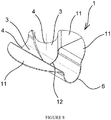
- FIGURE 8 a schematic perspective view of a further flow channel 1 in accordance with at least some embodiments of the present invention is illustrated.
- the flow channel 1 comprises two inlets 4, wherein each inlet 4 is configured to be coupled to a respective inlet pipe 5.
- the flow channel 1 is configured to be coupled to inlet pipes 5 having different orientation.
- the diameters of the inlet pipes 5 may be identical or different according to certain embodiments.
- the flow channel 1 further comprises a single outlet 6 configured to be coupled to an outlet pipe 7, wherein the orientation of the outlet pipe coincides with one of the inlet pipes.
- all pipes 5, 7 may have a different orientation and/or diameter. Additionally, the pipes may arrive and/or depart at different depths in the ground. There is a depth difference between an inlet 4 and an outlet 6 of 1 cm - 2 cm per m length of the flow channel 1, for instance.
- the flow channel 1 between the inlets 4 and the outlet 6 is formed by only two bent plates 3. Within the flow channel 1, a junction is located. Material flowing through the flow channel 1 from the first inlet 4 and from the second inlet 4 can flow towards the outlet 6 from the junction at the welding line 12. In other words, the flows from the first inlet 4 and from the second inlet 4 are combined to be one flow after the junction.
- the flow channel 1 is made by only two bent plates 3.
- the pre-cut plates 3 can be manually bent at the construction site and welded together along welding line 12.
- Extension plates 11 may be additionally welded to the bent plates 3 or be an integral part of the bent plates 3.
- the installation of the flow channel 1 is less time consuming and less labour intensive than e.g. bolting a plurality of U-shaped profiles together.
- FIGURE 9 a schematic front view of a further flow channel 1 in accordance with at least some embodiments of the present invention is illustrated.
- the flow channel 1 comprises two inlets and one outlet 6.
- the flow channel 1 is made by only two bent plates 3.
- FIGURE 10 a schematic top view of two cut plates 3 of a yet further flow channel 1 in accordance with at least some embodiments of the present invention is illustrated.
- Flat plates 3 are cut based on measured or determined information including orientations, diameters and depths in the ground of different pipes.
- the shape of the plates 3 may be defined by a computer calculation based on the measured or determined information. Defined shape data of the plates 3 may then be provided as CAD data.
- the plates 3 may then be cut by a CNC machine into the defined shape.
- a flow channel 1 having two inlets and one outlet can be formed by bending the plates 3 shown in FIGURE 10 against a frame and welding the bent plates 3 together.
- the plates 3 may also be cut by another device, for example a plasma burner, or even manually using a saw.
- the plates 3 may comprise a plurality of grooves in the rear side of the plates 3, i.e. in the side opposite to the side forming the flow channel 1.
- the grooves improve bending of the plates 3 due to locally decreasing the thickness of the plates 3, thus providing some sort of flexibility.
- the grooves may be arranged locally in the rear side, for example only where a small bending radius is required.
- the grooves may also be arranged over the entire rear surface of the plates.
- the grooves may be arranged at identical or varying distances to each other.
- the grooves do not extend to one edge or to the edges of a respective plate 3. Instead, an end of a respective groove is located at a distance of a few millimetres, for example at a distance in the range between 5 mm to 30 mm, from the respective edge of the plate 3.
- welding of two adjacent plates 3 to each other is enhanced, while a sufficient flexibility for bending the plates 3 is still provided.
- the grooves may have identical or different depth, length and/or shape.
- the depth of a groove may be in the range between 10 % and 70 % of the thickness of a respective plate 3, for instance.
- the grooves may have, for example, a depth of 5 mm and the thickness of the plate may be, for example, 10 mm.
- the grooves may be arranged parallel or at an angle to each other.
- the side forming the flow channel is typically smooth.
- At least some embodiments of the present invention find industrial application in forming of a flow channel for an inspection chamber or man-hole as well as in inspection chambers and other subterranean chambers and wells.
Landscapes
- Engineering & Computer Science (AREA)
- Life Sciences & Earth Sciences (AREA)
- Health & Medical Sciences (AREA)
- Hydrology & Water Resources (AREA)
- Public Health (AREA)
- Water Supply & Treatment (AREA)
- Mining & Mineral Resources (AREA)
- General Life Sciences & Earth Sciences (AREA)
- Environmental & Geological Engineering (AREA)
- Paleontology (AREA)
- Civil Engineering (AREA)
- General Engineering & Computer Science (AREA)
- Structural Engineering (AREA)
- Mechanical Engineering (AREA)
- Sewage (AREA)
- Measuring Volume Flow (AREA)
Applications Claiming Priority (1)
| Application Number | Priority Date | Filing Date | Title |
|---|---|---|---|
| FI20185502A FI129253B (en) | 2018-06-01 | 2018-06-01 | Flow channel for an inspection chamber or man-hole |
Publications (3)
| Publication Number | Publication Date |
|---|---|
| EP3575504A1 true EP3575504A1 (de) | 2019-12-04 |
| EP3575504B1 EP3575504B1 (de) | 2025-12-24 |
| EP3575504C0 EP3575504C0 (de) | 2025-12-24 |
Family
ID=66668828
Family Applications (1)
| Application Number | Title | Priority Date | Filing Date |
|---|---|---|---|
| EP19176998.3A Active EP3575504B1 (de) | 2018-06-01 | 2019-05-28 | Strömungskanal für eine inspektionskammer oder ein mannloch |
Country Status (3)
| Country | Link |
|---|---|
| EP (1) | EP3575504B1 (de) |
| FI (1) | FI129253B (de) |
| PL (1) | PL3575504T3 (de) |
Citations (16)
| Publication number | Priority date | Publication date | Assignee | Title |
|---|---|---|---|---|
| GB1363302A (en) | 1972-10-13 | 1974-08-14 | Hepworth Iron Co Ltd | Manholes |
| DE2509909A1 (de) * | 1975-03-07 | 1976-09-16 | Andreas Weiss | Verfahren zum erstellen einer rinnensohle in einem revisionsschacht und platte zur durchfuehrung des verfahrens |
| JPS5287766A (en) | 1975-11-29 | 1977-07-22 | Koehring Gmbh Bomag Division | Unbalance driving system |
| JPS57151452U (de) * | 1981-03-18 | 1982-09-22 | ||
| JPS6026065A (ja) | 1983-07-22 | 1985-02-08 | Yokohama Rubber Co Ltd:The | シリコ−ン変性アクリルワニス |
| JPS6026065B2 (ja) | 1978-06-13 | 1985-06-21 | 黒崎窯業株式会社 | 塩基性耐火物の製造法 |
| JPS6146313A (ja) | 1984-08-08 | 1986-03-06 | Sumitomo Metal Ind Ltd | 厚鋼板の冷却装置 |
| JPS6146313B2 (de) | 1982-08-30 | 1986-10-13 | Matsushita Electric Works Ltd | |
| US4867411A (en) | 1987-08-28 | 1989-09-19 | Valley Blox, Inc. | Manhole invert casting system |
| WO1993019258A1 (en) | 1992-03-19 | 1993-09-30 | Caswick Limited | Manholes and inspection chambers |
| EP1174550A2 (de) | 2000-07-21 | 2002-01-23 | Funke Kunststoffe GmbH | Schachtunterteil |
| US20050161088A1 (en) | 2003-08-13 | 2005-07-28 | John Mokrzycki | Manhole base |
| US20070053750A1 (en) | 2003-09-11 | 2007-03-08 | Pipelife Nederland B.V. | Inspection chamber, as well as set of base parts therefor |
| US20080141445A1 (en) | 2006-12-18 | 2008-06-19 | Pipelife Nederland B.V. | Inspection chamber and method for producing an inspection chamber with base segments |
| EP2295655A2 (de) * | 2009-08-13 | 2011-03-16 | Hegler Plastik GmbH | Schacht, insbesondere Kontroll- und Spül-Schacht für Abwasser mit einem Fließ-Gerinne und Platte für ein Fließ-Gerinne |
| CN202577351U (zh) * | 2012-03-21 | 2012-12-05 | 常州市河马塑胶有限公司 | 多用途组合式塑料检查井 |
-
2018
- 2018-06-01 FI FI20185502A patent/FI129253B/en active IP Right Grant
-
2019
- 2019-05-28 PL PL19176998.3T patent/PL3575504T3/pl unknown
- 2019-05-28 EP EP19176998.3A patent/EP3575504B1/de active Active
Patent Citations (16)
| Publication number | Priority date | Publication date | Assignee | Title |
|---|---|---|---|---|
| GB1363302A (en) | 1972-10-13 | 1974-08-14 | Hepworth Iron Co Ltd | Manholes |
| DE2509909A1 (de) * | 1975-03-07 | 1976-09-16 | Andreas Weiss | Verfahren zum erstellen einer rinnensohle in einem revisionsschacht und platte zur durchfuehrung des verfahrens |
| JPS5287766A (en) | 1975-11-29 | 1977-07-22 | Koehring Gmbh Bomag Division | Unbalance driving system |
| JPS6026065B2 (ja) | 1978-06-13 | 1985-06-21 | 黒崎窯業株式会社 | 塩基性耐火物の製造法 |
| JPS57151452U (de) * | 1981-03-18 | 1982-09-22 | ||
| JPS6146313B2 (de) | 1982-08-30 | 1986-10-13 | Matsushita Electric Works Ltd | |
| JPS6026065A (ja) | 1983-07-22 | 1985-02-08 | Yokohama Rubber Co Ltd:The | シリコ−ン変性アクリルワニス |
| JPS6146313A (ja) | 1984-08-08 | 1986-03-06 | Sumitomo Metal Ind Ltd | 厚鋼板の冷却装置 |
| US4867411A (en) | 1987-08-28 | 1989-09-19 | Valley Blox, Inc. | Manhole invert casting system |
| WO1993019258A1 (en) | 1992-03-19 | 1993-09-30 | Caswick Limited | Manholes and inspection chambers |
| EP1174550A2 (de) | 2000-07-21 | 2002-01-23 | Funke Kunststoffe GmbH | Schachtunterteil |
| US20050161088A1 (en) | 2003-08-13 | 2005-07-28 | John Mokrzycki | Manhole base |
| US20070053750A1 (en) | 2003-09-11 | 2007-03-08 | Pipelife Nederland B.V. | Inspection chamber, as well as set of base parts therefor |
| US20080141445A1 (en) | 2006-12-18 | 2008-06-19 | Pipelife Nederland B.V. | Inspection chamber and method for producing an inspection chamber with base segments |
| EP2295655A2 (de) * | 2009-08-13 | 2011-03-16 | Hegler Plastik GmbH | Schacht, insbesondere Kontroll- und Spül-Schacht für Abwasser mit einem Fließ-Gerinne und Platte für ein Fließ-Gerinne |
| CN202577351U (zh) * | 2012-03-21 | 2012-12-05 | 常州市河马塑胶有限公司 | 多用途组合式塑料检查井 |
Also Published As
| Publication number | Publication date |
|---|---|
| FI129253B (en) | 2021-10-15 |
| EP3575504B1 (de) | 2025-12-24 |
| FI20185502A1 (en) | 2019-12-02 |
| PL3575504T3 (pl) | 2026-04-20 |
| EP3575504C0 (de) | 2025-12-24 |
Similar Documents
| Publication | Publication Date | Title |
|---|---|---|
| US6027283A (en) | End caps for drainage system | |
| EP1499779B1 (de) | Schlitzrinne | |
| US20050025572A1 (en) | Modular trench drain | |
| EP2931631B1 (de) | Modulare tanks, verfahren zur herstellung eines modularen tanks und bausatz zur herstellung eines modularen tanks | |
| US11987938B2 (en) | Drainage device and methods for constructing and use | |
| CN100447350C (zh) | Grp检修孔结构及grp检修孔的主体和连接管的制造方法 | |
| KR200436633Y1 (ko) | 조립식 맨홀장치 | |
| JP6062386B2 (ja) | 垂直導水管 | |
| EP3575504B1 (de) | Strömungskanal für eine inspektionskammer oder ein mannloch | |
| EP3088617B1 (de) | Wand mit einem durchgang und verfahren zu dessen herstellung | |
| EP3550088B1 (de) | Abflusselement | |
| KR101626775B1 (ko) | 배수관로용 복합재료 고정장치 | |
| JP7535154B2 (ja) | 偏心インクリーザー及び配管構造 | |
| KR101521419B1 (ko) | 집 배수로의 가변 집 배수관 및 그 집 배수관의 연결방법 | |
| KR101796825B1 (ko) | 콘크리트 블럭을 이용한 벽체플레이트 조립체 | |
| JP2005155122A (ja) | マンホール補修体およびマンホールの補修方法 | |
| KR101496635B1 (ko) | 소켓 및 커넥터 일체형 조립식 pc맨홀의 제작방법 | |
| KR101304987B1 (ko) | 소켓 및 커넥터 일체형 조립식 pc맨홀 | |
| US20210140164A1 (en) | Form for a Plastic Lined Concrete Septic System Distribution Box | |
| KR200362348Y1 (ko) | 조립형 이음관 | |
| JP6921371B2 (ja) | 勾配付き排水溝 | |
| GB2629754A (en) | Access chambers | |
| KR100546951B1 (ko) | 흄관과 맨홀 및 인버터의 기초 타설 일체형 거푸집 및 이의시공공법 | |
| KR200416955Y1 (ko) | 관접속장치 | |
| KR101682393B1 (ko) | 배수관의 연결구 |
Legal Events
| Date | Code | Title | Description |
|---|---|---|---|
| PUAI | Public reference made under article 153(3) epc to a published international application that has entered the european phase |
Free format text: ORIGINAL CODE: 0009012 |
|
| STAA | Information on the status of an ep patent application or granted ep patent |
Free format text: STATUS: THE APPLICATION HAS BEEN PUBLISHED |
|
| AK | Designated contracting states |
Kind code of ref document: A1 Designated state(s): AL AT BE BG CH CY CZ DE DK EE ES FI FR GB GR HR HU IE IS IT LI LT LU LV MC MK MT NL NO PL PT RO RS SE SI SK SM TR |
|
| AX | Request for extension of the european patent |
Extension state: BA ME |
|
| STAA | Information on the status of an ep patent application or granted ep patent |
Free format text: STATUS: REQUEST FOR EXAMINATION WAS MADE |
|
| 17P | Request for examination filed |
Effective date: 20200527 |
|
| RBV | Designated contracting states (corrected) |
Designated state(s): AL AT BE BG CH CY CZ DE DK EE ES FI FR GB GR HR HU IE IS IT LI LT LU LV MC MK MT NL NO PL PT RO RS SE SI SK SM TR |
|
| STAA | Information on the status of an ep patent application or granted ep patent |
Free format text: STATUS: EXAMINATION IS IN PROGRESS |
|
| 17Q | First examination report despatched |
Effective date: 20211013 |
|
| P01 | Opt-out of the competence of the unified patent court (upc) registered |
Effective date: 20230602 |
|
| GRAP | Despatch of communication of intention to grant a patent |
Free format text: ORIGINAL CODE: EPIDOSNIGR1 |
|
| STAA | Information on the status of an ep patent application or granted ep patent |
Free format text: STATUS: GRANT OF PATENT IS INTENDED |
|
| INTG | Intention to grant announced |
Effective date: 20250917 |
|
| GRAS | Grant fee paid |
Free format text: ORIGINAL CODE: EPIDOSNIGR3 |
|
| GRAA | (expected) grant |
Free format text: ORIGINAL CODE: 0009210 |
|
| STAA | Information on the status of an ep patent application or granted ep patent |
Free format text: STATUS: THE PATENT HAS BEEN GRANTED |
|
| P04 | Withdrawal of opt-out of the competence of the unified patent court (upc) registered |
Free format text: CASE NUMBER: UPC_APP_0010088_3575504/2025 Effective date: 20251017 |
|
| AK | Designated contracting states |
Kind code of ref document: B1 Designated state(s): AL AT BE BG CH CY CZ DE DK EE ES FI FR GB GR HR HU IE IS IT LI LT LU LV MC MK MT NL NO PL PT RO RS SE SI SK SM TR |
|
| REG | Reference to a national code |
Ref country code: CH Ref legal event code: F10 Free format text: ST27 STATUS EVENT CODE: U-0-0-F10-F00 (AS PROVIDED BY THE NATIONAL OFFICE) Effective date: 20251224 Ref country code: GB Ref legal event code: FG4D |
|
| REG | Reference to a national code |
Ref country code: DE Ref legal event code: R096 Ref document number: 602019079491 Country of ref document: DE |
|
| U01 | Request for unitary effect filed |
Effective date: 20260105 |
|
| U07 | Unitary effect registered |
Designated state(s): AT BE BG DE DK EE FI FR IT LT LU LV MT NL PT RO SE SI Effective date: 20260112 |
|
| PG25 | Lapsed in a contracting state [announced via postgrant information from national office to epo] |
Ref country code: HR Free format text: LAPSE BECAUSE OF FAILURE TO SUBMIT A TRANSLATION OF THE DESCRIPTION OR TO PAY THE FEE WITHIN THE PRESCRIBED TIME-LIMIT Effective date: 20251224 |
|
| PG25 | Lapsed in a contracting state [announced via postgrant information from national office to epo] |
Ref country code: RS Free format text: LAPSE BECAUSE OF FAILURE TO SUBMIT A TRANSLATION OF THE DESCRIPTION OR TO PAY THE FEE WITHIN THE PRESCRIBED TIME-LIMIT Effective date: 20260324 |