EP3575986A1 - Verlustbehafteter datenkompressor für fahrzeugsteuerungssysteme - Google Patents
Verlustbehafteter datenkompressor für fahrzeugsteuerungssysteme Download PDFInfo
- Publication number
- EP3575986A1 EP3575986A1 EP18175062.1A EP18175062A EP3575986A1 EP 3575986 A1 EP3575986 A1 EP 3575986A1 EP 18175062 A EP18175062 A EP 18175062A EP 3575986 A1 EP3575986 A1 EP 3575986A1
- Authority
- EP
- European Patent Office
- Prior art keywords
- manifold
- vehicle
- data
- data compressor
- mapping
- Prior art date
- Legal status (The legal status is an assumption and is not a legal conclusion. Google has not performed a legal analysis and makes no representation as to the accuracy of the status listed.)
- Granted
Links
Images



Classifications
-
- H—ELECTRICITY
- H03—ELECTRONIC CIRCUITRY
- H03M—CODING; DECODING; CODE CONVERSION IN GENERAL
- H03M7/00—Conversion of a code where information is represented by a given sequence or number of digits to a code where the same, similar or subset of information is represented by a different sequence or number of digits
- H03M7/30—Compression; Expansion; Suppression of unnecessary data, e.g. redundancy reduction
- H03M7/3059—Digital compression and data reduction techniques where the original information is represented by a subset or similar information, e.g. lossy compression
-
- G—PHYSICS
- G06—COMPUTING OR CALCULATING; COUNTING
- G06F—ELECTRIC DIGITAL DATA PROCESSING
- G06F8/00—Arrangements for software engineering
- G06F8/60—Software deployment
- G06F8/65—Updates
-
- G—PHYSICS
- G06—COMPUTING OR CALCULATING; COUNTING
- G06F—ELECTRIC DIGITAL DATA PROCESSING
- G06F17/00—Digital computing or data processing equipment or methods, specially adapted for specific functions
- G06F17/10—Complex mathematical operations
- G06F17/11—Complex mathematical operations for solving equations, e.g. nonlinear equations, general mathematical optimization problems
-
- B—PERFORMING OPERATIONS; TRANSPORTING
- B60—VEHICLES IN GENERAL
- B60W—CONJOINT CONTROL OF VEHICLE SUB-UNITS OF DIFFERENT TYPE OR DIFFERENT FUNCTION; CONTROL SYSTEMS SPECIALLY ADAPTED FOR HYBRID VEHICLES; ROAD VEHICLE DRIVE CONTROL SYSTEMS FOR PURPOSES NOT RELATED TO THE CONTROL OF A PARTICULAR SUB-UNIT
- B60W10/00—Conjoint control of vehicle sub-units of different type or different function
- B60W10/04—Conjoint control of vehicle sub-units of different type or different function including control of propulsion units
-
- B—PERFORMING OPERATIONS; TRANSPORTING
- B60—VEHICLES IN GENERAL
- B60W—CONJOINT CONTROL OF VEHICLE SUB-UNITS OF DIFFERENT TYPE OR DIFFERENT FUNCTION; CONTROL SYSTEMS SPECIALLY ADAPTED FOR HYBRID VEHICLES; ROAD VEHICLE DRIVE CONTROL SYSTEMS FOR PURPOSES NOT RELATED TO THE CONTROL OF A PARTICULAR SUB-UNIT
- B60W10/00—Conjoint control of vehicle sub-units of different type or different function
- B60W10/18—Conjoint control of vehicle sub-units of different type or different function including control of braking systems
-
- B—PERFORMING OPERATIONS; TRANSPORTING
- B60—VEHICLES IN GENERAL
- B60W—CONJOINT CONTROL OF VEHICLE SUB-UNITS OF DIFFERENT TYPE OR DIFFERENT FUNCTION; CONTROL SYSTEMS SPECIALLY ADAPTED FOR HYBRID VEHICLES; ROAD VEHICLE DRIVE CONTROL SYSTEMS FOR PURPOSES NOT RELATED TO THE CONTROL OF A PARTICULAR SUB-UNIT
- B60W10/00—Conjoint control of vehicle sub-units of different type or different function
- B60W10/20—Conjoint control of vehicle sub-units of different type or different function including control of steering systems
-
- B—PERFORMING OPERATIONS; TRANSPORTING
- B60—VEHICLES IN GENERAL
- B60W—CONJOINT CONTROL OF VEHICLE SUB-UNITS OF DIFFERENT TYPE OR DIFFERENT FUNCTION; CONTROL SYSTEMS SPECIALLY ADAPTED FOR HYBRID VEHICLES; ROAD VEHICLE DRIVE CONTROL SYSTEMS FOR PURPOSES NOT RELATED TO THE CONTROL OF A PARTICULAR SUB-UNIT
- B60W30/00—Purposes of road vehicle drive control systems not related to the control of a particular sub-unit, e.g. of systems using conjoint control of vehicle sub-units
- B60W30/08—Active safety systems predicting or avoiding probable or impending collision or attempting to minimise its consequences
- B60W30/09—Taking automatic action to avoid collision, e.g. braking and steering
-
- B—PERFORMING OPERATIONS; TRANSPORTING
- B60—VEHICLES IN GENERAL
- B60W—CONJOINT CONTROL OF VEHICLE SUB-UNITS OF DIFFERENT TYPE OR DIFFERENT FUNCTION; CONTROL SYSTEMS SPECIALLY ADAPTED FOR HYBRID VEHICLES; ROAD VEHICLE DRIVE CONTROL SYSTEMS FOR PURPOSES NOT RELATED TO THE CONTROL OF A PARTICULAR SUB-UNIT
- B60W40/00—Estimation or calculation of non-directly measurable driving parameters for road vehicle drive control systems not related to the control of a particular sub unit, e.g. by using mathematical models
- B60W40/02—Estimation or calculation of non-directly measurable driving parameters for road vehicle drive control systems not related to the control of a particular sub unit, e.g. by using mathematical models related to ambient conditions
-
- B—PERFORMING OPERATIONS; TRANSPORTING
- B60—VEHICLES IN GENERAL
- B60W—CONJOINT CONTROL OF VEHICLE SUB-UNITS OF DIFFERENT TYPE OR DIFFERENT FUNCTION; CONTROL SYSTEMS SPECIALLY ADAPTED FOR HYBRID VEHICLES; ROAD VEHICLE DRIVE CONTROL SYSTEMS FOR PURPOSES NOT RELATED TO THE CONTROL OF A PARTICULAR SUB-UNIT
- B60W50/00—Details of control systems for road vehicle drive control not related to the control of a particular sub-unit, e.g. process diagnostic or vehicle driver interfaces
- B60W50/0098—Details of control systems ensuring comfort, safety or stability not otherwise provided for
-
- B—PERFORMING OPERATIONS; TRANSPORTING
- B60—VEHICLES IN GENERAL
- B60W—CONJOINT CONTROL OF VEHICLE SUB-UNITS OF DIFFERENT TYPE OR DIFFERENT FUNCTION; CONTROL SYSTEMS SPECIALLY ADAPTED FOR HYBRID VEHICLES; ROAD VEHICLE DRIVE CONTROL SYSTEMS FOR PURPOSES NOT RELATED TO THE CONTROL OF A PARTICULAR SUB-UNIT
- B60W50/00—Details of control systems for road vehicle drive control not related to the control of a particular sub-unit, e.g. process diagnostic or vehicle driver interfaces
- B60W50/08—Interaction between the driver and the control system
- B60W50/14—Means for informing the driver, warning the driver or prompting a driver intervention
-
- G—PHYSICS
- G06—COMPUTING OR CALCULATING; COUNTING
- G06F—ELECTRIC DIGITAL DATA PROCESSING
- G06F18/00—Pattern recognition
- G06F18/20—Analysing
- G06F18/21—Design or setup of recognition systems or techniques; Extraction of features in feature space; Blind source separation
- G06F18/213—Feature extraction, e.g. by transforming the feature space; Summarisation; Mappings, e.g. subspace methods
- G06F18/2137—Feature extraction, e.g. by transforming the feature space; Summarisation; Mappings, e.g. subspace methods based on criteria of topology preservation, e.g. multidimensional scaling or self-organising maps
- G06F18/21375—Feature extraction, e.g. by transforming the feature space; Summarisation; Mappings, e.g. subspace methods based on criteria of topology preservation, e.g. multidimensional scaling or self-organising maps involving differential geometry, e.g. embedding of pattern manifold
-
- G—PHYSICS
- G06—COMPUTING OR CALCULATING; COUNTING
- G06N—COMPUTING ARRANGEMENTS BASED ON SPECIFIC COMPUTATIONAL MODELS
- G06N20/00—Machine learning
-
- G—PHYSICS
- G06—COMPUTING OR CALCULATING; COUNTING
- G06N—COMPUTING ARRANGEMENTS BASED ON SPECIFIC COMPUTATIONAL MODELS
- G06N3/00—Computing arrangements based on biological models
- G06N3/02—Neural networks
- G06N3/04—Architecture, e.g. interconnection topology
- G06N3/045—Combinations of networks
-
- G—PHYSICS
- G06—COMPUTING OR CALCULATING; COUNTING
- G06N—COMPUTING ARRANGEMENTS BASED ON SPECIFIC COMPUTATIONAL MODELS
- G06N3/00—Computing arrangements based on biological models
- G06N3/02—Neural networks
- G06N3/04—Architecture, e.g. interconnection topology
- G06N3/045—Combinations of networks
- G06N3/0455—Auto-encoder networks; Encoder-decoder networks
-
- G—PHYSICS
- G06—COMPUTING OR CALCULATING; COUNTING
- G06N—COMPUTING ARRANGEMENTS BASED ON SPECIFIC COMPUTATIONAL MODELS
- G06N3/00—Computing arrangements based on biological models
- G06N3/02—Neural networks
- G06N3/04—Architecture, e.g. interconnection topology
- G06N3/0495—Quantised networks; Sparse networks; Compressed networks
-
- G—PHYSICS
- G06—COMPUTING OR CALCULATING; COUNTING
- G06N—COMPUTING ARRANGEMENTS BASED ON SPECIFIC COMPUTATIONAL MODELS
- G06N3/00—Computing arrangements based on biological models
- G06N3/02—Neural networks
- G06N3/04—Architecture, e.g. interconnection topology
- G06N3/0499—Feedforward networks
-
- G—PHYSICS
- G06—COMPUTING OR CALCULATING; COUNTING
- G06V—IMAGE OR VIDEO RECOGNITION OR UNDERSTANDING
- G06V10/00—Arrangements for image or video recognition or understanding
- G06V10/70—Arrangements for image or video recognition or understanding using pattern recognition or machine learning
- G06V10/77—Processing image or video features in feature spaces; using data integration or data reduction, e.g. principal component analysis [PCA] or independent component analysis [ICA] or self-organising maps [SOM]; Blind source separation
- G06V10/7715—Feature extraction, e.g. by transforming the feature space, e.g. multi-dimensional scaling [MDS]; Mappings, e.g. subspace methods
-
- H—ELECTRICITY
- H03—ELECTRONIC CIRCUITRY
- H03M—CODING; DECODING; CODE CONVERSION IN GENERAL
- H03M7/00—Conversion of a code where information is represented by a given sequence or number of digits to a code where the same, similar or subset of information is represented by a different sequence or number of digits
- H03M7/30—Compression; Expansion; Suppression of unnecessary data, e.g. redundancy reduction
- H03M7/3082—Vector coding
-
- H—ELECTRICITY
- H03—ELECTRONIC CIRCUITRY
- H03M—CODING; DECODING; CODE CONVERSION IN GENERAL
- H03M7/00—Conversion of a code where information is represented by a given sequence or number of digits to a code where the same, similar or subset of information is represented by a different sequence or number of digits
- H03M7/30—Compression; Expansion; Suppression of unnecessary data, e.g. redundancy reduction
- H03M7/60—General implementation details not specific to a particular type of compression
- H03M7/6017—Methods or arrangements to increase the throughput
-
- H—ELECTRICITY
- H03—ELECTRONIC CIRCUITRY
- H03M—CODING; DECODING; CODE CONVERSION IN GENERAL
- H03M7/00—Conversion of a code where information is represented by a given sequence or number of digits to a code where the same, similar or subset of information is represented by a different sequence or number of digits
- H03M7/30—Compression; Expansion; Suppression of unnecessary data, e.g. redundancy reduction
- H03M7/70—Type of the data to be coded, other than image and sound
-
- H—ELECTRICITY
- H04—ELECTRIC COMMUNICATION TECHNIQUE
- H04N—PICTORIAL COMMUNICATION, e.g. TELEVISION
- H04N19/00—Methods or arrangements for coding, decoding, compressing or decompressing digital video signals
- H04N19/10—Methods or arrangements for coding, decoding, compressing or decompressing digital video signals using adaptive coding
- H04N19/169—Methods or arrangements for coding, decoding, compressing or decompressing digital video signals using adaptive coding characterised by the coding unit, i.e. the structural portion or semantic portion of the video signal being the object or the subject of the adaptive coding
- H04N19/182—Methods or arrangements for coding, decoding, compressing or decompressing digital video signals using adaptive coding characterised by the coding unit, i.e. the structural portion or semantic portion of the video signal being the object or the subject of the adaptive coding the unit being a pixel
-
- H—ELECTRICITY
- H04—ELECTRIC COMMUNICATION TECHNIQUE
- H04N—PICTORIAL COMMUNICATION, e.g. TELEVISION
- H04N19/00—Methods or arrangements for coding, decoding, compressing or decompressing digital video signals
- H04N19/10—Methods or arrangements for coding, decoding, compressing or decompressing digital video signals using adaptive coding
- H04N19/169—Methods or arrangements for coding, decoding, compressing or decompressing digital video signals using adaptive coding characterised by the coding unit, i.e. the structural portion or semantic portion of the video signal being the object or the subject of the adaptive coding
- H04N19/186—Methods or arrangements for coding, decoding, compressing or decompressing digital video signals using adaptive coding characterised by the coding unit, i.e. the structural portion or semantic portion of the video signal being the object or the subject of the adaptive coding the unit being a colour or a chrominance component
-
- H—ELECTRICITY
- H04—ELECTRIC COMMUNICATION TECHNIQUE
- H04N—PICTORIAL COMMUNICATION, e.g. TELEVISION
- H04N19/00—Methods or arrangements for coding, decoding, compressing or decompressing digital video signals
- H04N19/42—Methods or arrangements for coding, decoding, compressing or decompressing digital video signals characterised by implementation details or hardware specially adapted for video compression or decompression, e.g. dedicated software implementation
-
- H—ELECTRICITY
- H04—ELECTRIC COMMUNICATION TECHNIQUE
- H04N—PICTORIAL COMMUNICATION, e.g. TELEVISION
- H04N19/00—Methods or arrangements for coding, decoding, compressing or decompressing digital video signals
- H04N19/85—Methods or arrangements for coding, decoding, compressing or decompressing digital video signals using pre-processing or post-processing specially adapted for video compression
-
- H—ELECTRICITY
- H04—ELECTRIC COMMUNICATION TECHNIQUE
- H04N—PICTORIAL COMMUNICATION, e.g. TELEVISION
- H04N19/00—Methods or arrangements for coding, decoding, compressing or decompressing digital video signals
- H04N19/90—Methods or arrangements for coding, decoding, compressing or decompressing digital video signals using coding techniques not provided for in groups H04N19/10-H04N19/85, e.g. fractals
- H04N19/91—Entropy coding, e.g. variable length coding [VLC] or arithmetic coding
-
- B—PERFORMING OPERATIONS; TRANSPORTING
- B60—VEHICLES IN GENERAL
- B60W—CONJOINT CONTROL OF VEHICLE SUB-UNITS OF DIFFERENT TYPE OR DIFFERENT FUNCTION; CONTROL SYSTEMS SPECIALLY ADAPTED FOR HYBRID VEHICLES; ROAD VEHICLE DRIVE CONTROL SYSTEMS FOR PURPOSES NOT RELATED TO THE CONTROL OF A PARTICULAR SUB-UNIT
- B60W50/00—Details of control systems for road vehicle drive control not related to the control of a particular sub-unit, e.g. process diagnostic or vehicle driver interfaces
- B60W50/08—Interaction between the driver and the control system
- B60W50/14—Means for informing the driver, warning the driver or prompting a driver intervention
- B60W2050/143—Alarm means
-
- B—PERFORMING OPERATIONS; TRANSPORTING
- B60—VEHICLES IN GENERAL
- B60W—CONJOINT CONTROL OF VEHICLE SUB-UNITS OF DIFFERENT TYPE OR DIFFERENT FUNCTION; CONTROL SYSTEMS SPECIALLY ADAPTED FOR HYBRID VEHICLES; ROAD VEHICLE DRIVE CONTROL SYSTEMS FOR PURPOSES NOT RELATED TO THE CONTROL OF A PARTICULAR SUB-UNIT
- B60W2420/00—Indexing codes relating to the type of sensors based on the principle of their operation
- B60W2420/40—Photo, light or radio wave sensitive means, e.g. infrared sensors
- B60W2420/403—Image sensing, e.g. optical camera
-
- B—PERFORMING OPERATIONS; TRANSPORTING
- B60—VEHICLES IN GENERAL
- B60Y—INDEXING SCHEME RELATING TO ASPECTS CROSS-CUTTING VEHICLE TECHNOLOGY
- B60Y2400/00—Special features of vehicle units
- B60Y2400/81—Braking systems
-
- G—PHYSICS
- G08—SIGNALLING
- G08G—TRAFFIC CONTROL SYSTEMS
- G08G1/00—Traffic control systems for road vehicles
- G08G1/16—Anti-collision systems
- G08G1/165—Anti-collision systems for passive traffic, e.g. including static obstacles, trees
-
- G—PHYSICS
- G08—SIGNALLING
- G08G—TRAFFIC CONTROL SYSTEMS
- G08G1/00—Traffic control systems for road vehicles
- G08G1/16—Anti-collision systems
- G08G1/166—Anti-collision systems for active traffic, e.g. moving vehicles, pedestrians, bikes
Definitions
- the invention relates to a lossy data compressor that is particularly suitable for physical measurement data that is to be evaluated for the presence of objects or situations by an at least partially automated vehicle.
- a human driver When driving a vehicle, a human driver captures a plethora of information using his eyes and classifies the visible objects. For example, the driver recognizes lane boundaries, traffic signs, other vehicles and pedestrians and initiates appropriate actions on the manual controls of the vehicle.
- a functionality is needed to classify objects and situations from physical measurement data that has been captured by sensors from the environment of the vehicle.
- EP 1 752 362 B1 discloses a lane keeping assistance system for vehicles that classifies lane boundaries according to tapes and rates the possibility that the boundary will be crossed, as well as the potential dangers associated with such crossing.
- US 8,682,821 B2 discloses a method to evaluate radar data from the environment of the vehicle in order to classify whether certain types of objects or non-human animals are moving in the environment. For this classification, machine learning is used.
- the invention provides a lossy data compressor for physical measurement data.
- the lossy data compressor comprises a parametrized mapping network that, when applied to a data point x of the physical measurement data that lives in a space X, produces a point z in a Riemannian manifold Z that has a lower dimensionality than the space X, and configured to provide a point z on Z as output in response to receiving a data point x as input.
- the physical training data consists of images from a camera that have a given width and height in pixels and a color depth of a given number of bits per pixel, then these images live in the space X of all possible images having this width, height and color depth.
- a data point in x thus corresponds to one such image.
- the manifold Z is a continuous hypersurface that only admits fully continuous paths between any two points on the hypersurface.
- the surface of a conventional sphere in three-dimensional space is two-dimensional, with a polar angle and an azimuthal angle as degrees of freedom.
- the parameters ⁇ of the mapping network are trainable or trained towards an objective that comprises minimizing, on the manifold Z, a distance between a given prior distribution Pz and a distribution P Q induced on manifold Z by mapping a given set P D of physical measurement data from space X onto manifold Z using the mapping network, according to a given distance measure.
- the distance measure is well-defined both for distances between distributions and for distance between individual points.
- the classification problems that are relevant for at least partially automatic vehicles are supervised learning problems, i.e., the learning process has to be anchored to "ground truth”: it has to be made known to a classification system, e.g., which traffic signs are to be recognized and what they mean, or which different types of lane markings have which consequences.
- training data (such as images) is manually labelled with, e.g., the objects that are actually visible in the image.
- a machine-learning classification system is then trained so that over a whole set of training images, the truly present objects are correctly recognized.
- labelled training data is a scarce and expensive resource.
- the inventors have found that by compressing the physical measurement data with the provided lossy data compressor, they can be brought into a form that is more tractable for subsequent supervised training. Specifically, the dimensionality of the data is reduced by a large amount, so that the supervised training may be performed with less manually labelled training data than a training that is directly performed on the physical measurement data.
- the combination of the continuous hypersurface with the training objective for the parameters ⁇ of the mapping network ensures that despite the compression to a much lower dimensionality, a semantic similarity that exists between data points x in the high-dimensional space X is preserved when mapping to the lower-dimensional manifold Z. For example, if several images in X show a similar object, then they are mapped to similar locations on the manifold Z. Lossy compression inevitably entails discarding some information, but for the ultimate purpose of controlling the vehicle in traffic, the semantic meaning of objects and situations is important. It is therefore advantageous to preserve semantic similarity, so that the lossy data compression is not a mere culling of information to reduce its volume and make the subsequent classification more tractable solely by virtue of the reduced volume. Rather, the data compression already enhances the data by highlighting regularities in them, so it is actually a pre-processing that does part of the work that otherwise would be performed by the classification alone.
- mapping network itself may be performed in an unsupervised manner, i.e., it may be performed on unlabeled training data.
- a large body of unlabeled data may be used to train the lossy data compressor.
- the compressed data is of a much lower dimensionality on the one hand and also pre-processed with respect to regularities and similarities on the other hand, a classifier for recognizing objects and situations will require fewer labeled data for training.
- Z being a continuous hypersurface and the distance measure being well-defined both for distances between distributions and for distances between individual points facilitates the training of the mapping network.
- gradient descent methods or other methods that require the objective function to be differentiable may be used.
- the robustness of the training is improved because the compression may suppress irrelevant alterations of the data, such as noise.
- the parameters ⁇ of the mapping network per se are, on the face of it, just a set of numbers that show no signs of how they have been obtained, on the date of filing of the present application, statistical methods are available with which it can be verified whether a given mapping network has been trained towards the mentioned objective. In other words, training towards this objective leaves a unique "fingerprint" in the parameters ⁇ of the mapping network. Therefore, the feature "trainable or trained towards the objective” can be regarded as a feature of the finished lossy data compressor, rather than a mere feature of a method for obtaining this compressor.
- the manifold Z is a hypersphere or a hyperellipsoid.
- These hypersurfaces are relatively simple, so it is easy to preserve semantic similarity by mapping onto them.
- the equations that define those hypersurfaces also fix the paths between points on these hypersurfaces that are permitted in the first place. I.e., these equations forbid the paths from leaving or puncturing the hypersurface.
- the distance measure in the objective of the training of the mapping network comprises the Wasserstein distance.
- the mapping network solves the "optimal transport problem" of converting, on the manifold Z, the induced distribution P Q into the given prior distribution P Z (or vice versa) at minimum cost.
- the distribution P Q is supported by only those values that have been generated from the physical measurement data P D , it is not limited to these values. Rather, the distribution P Q comprises an infinite number of points in Z that preserves the main features evident from the set P D of physical measurement data.
- the original set P D of physical measurement data can also be construed to represent a distribution that extends far beyond this actual set P D .
- the preservation of semantic similarity and of relative distances between points x in space X after mapping into Z is valid for the whole distribution, not just for the supporting set P D .
- the mapping network comprises at least one neural network.
- Such networks are very good tools to drastically reduce the dimensionality of a data set.
- a neural network as part of the mapping network can also serve another purpose: It can be extended with fixed layers that can be used as a hardware acceleration for the training of the mapping network.
- this method uses the Sinkhorn algorithm that relies on an iterative calculation involving calculation of an exponential function, matrix multiplication, element-wise division of matrices, and computation of a Frobenius product.
- Each of these operations can be implemented as a layer of the neural network, so that the massive parallelism of the neural network can be exploited to increase the speed of the computation.
- a loop that iterates over a sequence of computations for a fixed number of times thus may be implemented in the neural network as repetitions of a sandwich structure in which the individual computations are stacked.
- the neural network comprises at least two instances of one and the same sandwich structure, wherein this sandwich structure comprises a plurality of different layers and wherein each of these layers is configured to perform at least one of calculation of an exponential function, matrix multiplication, element-wise division of matrices, or computation of a Frobenius product.
- the training of the lossy data compressor may be performed on unlabeled data, this does not mean that available a priori information about the physical measurement data and the features to be extracted from these data cannot be exploited by the mapping network. Rather, such a priori information can go into the given prior Pz. For example, if a fixed set of objects is to be recognized in the end, then the prior P Z may be chosen to contain a number of distinct clusters corresponding to the number of distinct objects in the fixed set. In this manner, the lossy compression will pre-discretize the physical measurement data to some degree for the subsequent classification. Also, physical limits of the measurement range may be reflected in the choice of the prior P Z .
- the given prior P Z comprises at least two distinct clusters on the manifold Z.
- the present invention also provides a system for classifying objects or situations in the environment of a vehicle.
- This system comprises at least one lossy data compressor described above.
- This lossy data compressor is communicatively coupled to at least one sensor that is configured to obtain physical measurement data from at least part of the environment of the vehicle.
- the system further comprises a classifier module that is communicatively coupled to the lossy data compressor and configured to classify whether the output of the lossy data compressor indicates the presence of at least one object or at least one situation in the environment of the vehicle.
- the lossy data compressor and the classifier module work hand in hand in that the compression provides a pre-processing and enhancing of the raw data, so that the classification is facilitated beyond the mere effect of the manifold Z having a lower dimensionality than the space X.
- the lossy data compressor is obtainable using a large body of unlabeled training data, with little or no labeled data. Training of the classifier module can be accomplished with a far smaller set of labeled training data than would be required if the classification were to be directly performed on the physical measurement data.
- the classifier module is communicatively coupled to the lossy data compressor via a shared-medium bus network to which further systems of the vehicle are coupled, whereas the lossy data compressor is communicatively coupled to a sensor via a dedicated broadband connection.
- the collection of physical measurement data from different areas within the vehicle is facilitated without hogging an overly high amount of available transmission bandwidth.
- the lossy data compressor may be part of a sensor module for collecting physical measurement data.
- system further comprises a decision module that is communicatively coupled with the classifier module and configured to determine, based on the output of the classifier module, whether it is necessary to change the trajectory of the vehicle, or to at least partially deactivate automated driving functionality, to avoid adverse consequences for the vehicle, the driver of the vehicle, or another entity.
- a decision module that is communicatively coupled with the classifier module and configured to determine, based on the output of the classifier module, whether it is necessary to change the trajectory of the vehicle, or to at least partially deactivate automated driving functionality, to avoid adverse consequences for the vehicle, the driver of the vehicle, or another entity.
- the system further comprises an actuation module that is communicatively coupled with the decision module and configured to, in response to said determination being positive, actuate a power train, a braking system, and/or a steering system, of the vehicle, and/or actuate a warning device of the vehicle to emit a warning that is physically perceptible by the driver of the vehicle, and/or cause at least partial deactivation of automated driving functionality of the vehicle.
- an actuation module that is communicatively coupled with the decision module and configured to, in response to said determination being positive, actuate a power train, a braking system, and/or a steering system, of the vehicle, and/or actuate a warning device of the vehicle to emit a warning that is physically perceptible by the driver of the vehicle, and/or cause at least partial deactivation of automated driving functionality of the vehicle.
- the overall operating safety of the vehicle may be increased, or, if a given level of overall operating safety is to be provided, this may be achieved with fewer labeled training data.
- one further important use case is the classification of small objects on the road-surface as harmless or dangerous for a car. For instance, a brick would be dangerous to run over, whereas a pieces of paper is harmless. This can lead to the triggering of an emergency braking system in case a dangerous object is detected.
- the lossy data compressor Although the use in vehicle systems is the primary use case of the lossy data compressor, the lossy data compressor, and particularly its combination with a further classifier, has a multitude of other applications. Some examples are:
- the invention also provides a method for manufacturing the lossy data compressor.
- This method comprises, in a first step, setting up an objective function for the minimizing of the distance between the prior distribution P Z and the distribution P Q induced on manifold Z by the mapping of the physical measurement data set P D .
- the objective function is a weighted sum of said distance and the entropy of a doubly stochastic matrix P specifying the probability that a randomly generated label belongs to a data point x in P D .
- the objective function is minimized with respect to the doubly stochastic matrix P to find an optimal matrix P.
- the objective function is minimized with respect to the parameters ⁇ of the mapping network to find optimal parameters ⁇ of the mapping network.
- the effect of the entropy in the weighted sum is that the problem is relaxed somehow to make its solution more tractable. For example, if the Wasserstein distance is used as a distance measure, then finding the optimal parameters ⁇ of the mapping network that minimize the objective function becomes difficult and computationally expensive. Specifically, said relaxation regularizes the problem.
- the objective function comprises a Frobenius dot product of the doubly stochastic matrix P and a cost matrix C that assigns a cost value to every combination of a data point X i in P D and a corresponding feature z j on manifold Z.
- This Frobenius dot product is particularly suited to be solved using the nearly linear-time Sinkhorn algorithm. Therefore, advantageously, minimizing with respect to P is performed by means of the Sinkhorn algorithm.
- the cost value corresponds to a Euclidean or geodesic absolute distance between the point on manifold Z that the data point X i is mapped to and the feature z i .
- the distance may be organically adapted to the chosen manifold Z and to the chosen prior distribution P Z on Z.
- ⁇ > is the Frobenius dot product
- H is the entropy
- P is a matrix that specifies the probability that a (randomly generated) label belongs to a data-point (that is, entries in P must be positive and rows and columns must sum up to one, or in other words P must be in the set of doubly stochastic matrices).
- the minimizing with respect to the parameters ⁇ of the mapping network is performed by stochastic gradient descent on the parameters ⁇ of the mapping network.
- the lossy data compressor and the system may be at least partially computer-implemented.
- Such software is therefore a marketable product of its own.
- the invention therefore also relates to a computer program with machine readable instructions, which, when executed by a computer, and/or by a control unit, upgrade the computer, and/or the control unit, to the lossy data compressor, and/or to the system, provided by the invention.
- the invention also relates to a non-transitory machine-readable storage medium or a download product with the computer program.
- Figure 1 illustrates an exemplary embodiment of the lossy data compressor 1.
- a mapping module 2 parametrized by a tuple of parameters ⁇ , maps data points x from a training set P D , which is a subset of the space X, to points z on lower-dimensional manifold Z. All physical measurement data 3 live in the space X.
- the manifold Z is defined by a given prior P Z . In the example illustrated in Figure 1 , the manifold Z is a sphere, and the prior P Z is a random distribution of points scattered across the surface of this sphere.
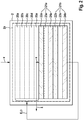
- Figure 2 shows an exemplary neural network 2a in a mapping network 2.
- the actual mapping of a data point x to a data point z is performed by layers 20a-20e drawn in dashed contours. These layers 20a-20e are parametrized by the tuple of parameters ⁇ .
- the neural network 2a comprises two instances 21a and 21b of layer sandwiches.
- the layers in these sandwiches are fixed (i.e., they do not depend on the parameters ⁇ ) and are therefore drawn in solid contours.
- the first sandwich 21a comprises layers 22a, 23a and 24a.
- the second sandwich 21b comprises layers 22b, 23b and 24b.
- layer 22b performs the same functionality as layer 22a
- layer 23b performs the same functionality as layer 23a
- layer 24b performs the same functionality as layer 24a.
- the combination of the layer sandwiches 21a and 21b is used to compute the error signal E that is a measure for the entropy-relaxed Wasserstein distance between the distribution P Q induced on Z and the prior distribution P Z .
- the parameters ⁇ are adjusted to minimize the error signal E.
- Figure 3a shows an exemplary set P D of physical measurement data 3 in the form of handwritten numbers x.
- Figures 3b to 3d show different mappings of the data points x to lower-dimensional manifold.
- Figure 3b shows a first mapping onto a band-shaped lower-dimensional manifold Y.
- the manifold has been assigned reference sign Y instead of Z because it does not fulfill the condition that it only admits fully continuous paths between any two points on this manifold Y. Rather, a path from one point to another point may lead to areas that are off the band.
- the mapping to this manifold Y is not well-behaved because points relating to different numbers appear in a wild mixture.
- Figure 3c shows a second mapping onto a spherical lower-dimensional manifold Z.
- FIG 4 shows an exemplary vehicle 50 that is fitted with a system 51 for classifying objects or situations in its environment.
- the vehicle 50 is fitted with four camera sensors 52a-52d that monitor different parts 53a-53d of the environment of the vehicle 50.
- Each sensor 52a-52d is connected to a corresponding lossy data compressor 1a-1d via a respective dedicated broadband connection 56a-56d and receives physical measurement data 3 over this connection 56a-56d.
- the vehicle 50 is equipped with a CAN bus as a shared medium bus network 55.
- the lossy data compressors 1a-1d are connected to this network 55 and use it to forward the compressed data to the classifier module 54.
- the classifier module 54 forwards the result of the classification to the decision module 57 via the network 55. If the decision module 57 finds that there is a need to change the trajectory 50a of the vehicle 50, or to at least partially disable automated driving functionality, the actuation module 58 is notified.
- the actuation module 58 then actuates the power train 59a, the braking system 59b, and/or the steering system 59c, to this effect.
- the actuation module 58 may also actuate a warning device 59d of the vehicle 50 to emit a warning 59e that is physically perceptible by the driver of the vehicle 50.
- the drawing of the classifier module 54, the decision module 57 and the actuation module 58 in distinct places within the vehicle 50 is not limiting in the sense that such placing is required. Rather, these modules may also be combined, e.g., into one single control unit.
- the exemplary placing in Figure 4 is illustrative to show that the presence of the shared-medium bus network 55 in the vehicle 50 provides a high degree of freedom as to the placement of components.
- Figure 5 shows an exemplary embodiment of the method 100 for manufacturing the lossy data compressor 1.
- the main aspect of this manufacturing is the training of the mapping network 2 within the lossy data compressor 1.
- a first step 110 an objective function is set up for the minimizing of the distance between the prior distribution Pz and the distribution P Q induced on manifold Z by the mapping of the physical measurement data set P D .
- This objective function is minimized in the following in an alternating manner.
- step 120 the objective function is minimized with respect to the doubly stochastic matrix P to find an optimal matrix P.
- step 130 the objective function is minimized with respect to the parameters ⁇ of the mapping network to find optimal parameters ⁇ of the mapping network.
- a predetermined termination criterion is satisfied.
- a termination criterion may, for example, be formulated in terms of a threshold for the absolute value of the objective function, or for the relative change of the value of the objective function from one iteration to the next. If the termination criterion is met (logical value 1), the method 100 terminates. If the termination criterion is not met (logical value 0), then, in step 140, the method 100 branches back to the minimizing with respect to P according to step 120.
Landscapes
- Engineering & Computer Science (AREA)
- Theoretical Computer Science (AREA)
- Physics & Mathematics (AREA)
- General Physics & Mathematics (AREA)
- Software Systems (AREA)
- Mathematical Physics (AREA)
- Data Mining & Analysis (AREA)
- General Engineering & Computer Science (AREA)
- Automation & Control Theory (AREA)
- Transportation (AREA)
- Mechanical Engineering (AREA)
- Evolutionary Computation (AREA)
- Artificial Intelligence (AREA)
- Computing Systems (AREA)
- Computer Vision & Pattern Recognition (AREA)
- Multimedia (AREA)
- Health & Medical Sciences (AREA)
- General Health & Medical Sciences (AREA)
- Life Sciences & Earth Sciences (AREA)
- Signal Processing (AREA)
- Chemical & Material Sciences (AREA)
- Combustion & Propulsion (AREA)
- Mathematical Optimization (AREA)
- Molecular Biology (AREA)
- Biophysics (AREA)
- Computational Mathematics (AREA)
- Mathematical Analysis (AREA)
- Biomedical Technology (AREA)
- Computational Linguistics (AREA)
- Pure & Applied Mathematics (AREA)
- Databases & Information Systems (AREA)
- Human Computer Interaction (AREA)
- Medical Informatics (AREA)
- Algebra (AREA)
- Operations Research (AREA)
- Evolutionary Biology (AREA)
- Bioinformatics & Cheminformatics (AREA)
- Bioinformatics & Computational Biology (AREA)
- Computer Security & Cryptography (AREA)
- Image Analysis (AREA)
Priority Applications (5)
| Application Number | Priority Date | Filing Date | Title |
|---|---|---|---|
| EP18175062.1A EP3575986B1 (de) | 2018-05-30 | 2018-05-30 | Verlustbehafteter datenkompressor für fahrzeugsteuerungssysteme |
| US16/420,440 US11150657B2 (en) | 2018-05-30 | 2019-05-23 | Lossy data compressor for vehicle control systems |
| KR1020190061912A KR102659923B1 (ko) | 2018-05-30 | 2019-05-27 | 차량 제어 시스템용 손실성 데이터 압축기 |
| JP2019100303A JP7326028B2 (ja) | 2018-05-30 | 2019-05-29 | 車両制御システム用非可逆データ圧縮器 |
| CN201910456819.1A CN110557636B (zh) | 2018-05-30 | 2019-05-29 | 用于车辆控制系统的有损数据压缩器 |
Applications Claiming Priority (1)
| Application Number | Priority Date | Filing Date | Title |
|---|---|---|---|
| EP18175062.1A EP3575986B1 (de) | 2018-05-30 | 2018-05-30 | Verlustbehafteter datenkompressor für fahrzeugsteuerungssysteme |
Publications (2)
| Publication Number | Publication Date |
|---|---|
| EP3575986A1 true EP3575986A1 (de) | 2019-12-04 |
| EP3575986B1 EP3575986B1 (de) | 2024-07-10 |
Family
ID=62683086
Family Applications (1)
| Application Number | Title | Priority Date | Filing Date |
|---|---|---|---|
| EP18175062.1A Active EP3575986B1 (de) | 2018-05-30 | 2018-05-30 | Verlustbehafteter datenkompressor für fahrzeugsteuerungssysteme |
Country Status (5)
| Country | Link |
|---|---|
| US (1) | US11150657B2 (de) |
| EP (1) | EP3575986B1 (de) |
| JP (1) | JP7326028B2 (de) |
| KR (1) | KR102659923B1 (de) |
| CN (1) | CN110557636B (de) |
Cited By (3)
| Publication number | Priority date | Publication date | Assignee | Title |
|---|---|---|---|---|
| DE102021204790A1 (de) | 2021-05-11 | 2022-11-17 | Robert Bosch Gesellschaft mit beschränkter Haftung | Quantitative Bewertung von Modellen zur Beschreibung realer Szenerien |
| EP4125005A1 (de) | 2021-07-26 | 2023-02-01 | Robert Bosch GmbH | Kontrastives representation learning für messdaten |
| CN116934431A (zh) * | 2023-09-19 | 2023-10-24 | 贵昌集团有限公司 | 一种电子商务数据智能管理系统 |
Families Citing this family (2)
| Publication number | Priority date | Publication date | Assignee | Title |
|---|---|---|---|---|
| CN116486185A (zh) * | 2022-01-11 | 2023-07-25 | 中国石油化工股份有限公司 | 油井工况识别方法、装置、设备和存储介质 |
| US20250053698A1 (en) * | 2023-08-08 | 2025-02-13 | International Business Machines Corporation | Optimal qubit routing using double stochastic matrices |
Citations (3)
| Publication number | Priority date | Publication date | Assignee | Title |
|---|---|---|---|---|
| EP1752362B1 (de) | 2005-08-08 | 2008-10-08 | Robert Bosch Gmbh | Spurassistenzsystem für Fahrzeuge |
| US7724961B2 (en) * | 2006-09-08 | 2010-05-25 | Mitsubishi Electric Research Laboratories, Inc. | Method for classifying data using an analytic manifold |
| US20130041856A1 (en) * | 2011-08-08 | 2013-02-14 | Robert Bosch Gmbh | Method for detection of movement of a specific type of object or animal based on radar signals |
Family Cites Families (17)
| Publication number | Priority date | Publication date | Assignee | Title |
|---|---|---|---|---|
| US8024084B2 (en) * | 1995-06-07 | 2011-09-20 | Automotive Technologies International, Inc. | Vehicle diagnostic techniques |
| US6167155A (en) * | 1997-07-28 | 2000-12-26 | Physical Optics Corporation | Method of isomorphic singular manifold projection and still/video imagery compression |
| US6615158B2 (en) * | 2001-06-25 | 2003-09-02 | National Instruments Corporation | System and method for analyzing a surface by mapping sample points onto the surface and sampling the surface at the mapped points |
| AU2003303499A1 (en) * | 2002-12-26 | 2004-07-29 | The Trustees Of Columbia University In The City Of New York | Ordered data compression system and methods |
| US7899253B2 (en) * | 2006-09-08 | 2011-03-01 | Mitsubishi Electric Research Laboratories, Inc. | Detecting moving objects in video by classifying on riemannian manifolds |
| US7907784B2 (en) * | 2007-07-09 | 2011-03-15 | The United States Of America As Represented By The Secretary Of The Commerce | Selectively lossy, lossless, and/or error robust data compression method |
| US9202140B2 (en) * | 2008-09-05 | 2015-12-01 | Siemens Medical Solutions Usa, Inc. | Quotient appearance manifold mapping for image classification |
| US9014876B2 (en) * | 2012-06-19 | 2015-04-21 | Telogis, Inc. | System for processing fleet vehicle operation information |
| US8837867B2 (en) * | 2012-12-07 | 2014-09-16 | Realnetworks, Inc. | Method and system to detect and select best photographs |
| JP6282193B2 (ja) * | 2014-07-28 | 2018-02-21 | クラリオン株式会社 | 物体検出装置 |
| US9510787B2 (en) * | 2014-12-11 | 2016-12-06 | Mitsubishi Electric Research Laboratories, Inc. | Method and system for reconstructing sampled signals |
| JP6488380B2 (ja) * | 2014-12-17 | 2019-03-20 | ノキア テクノロジーズ オーユー | ニューラルネットワークによるオブジェクト検出 |
| EP3159853B1 (de) * | 2015-10-23 | 2019-03-27 | Harman International Industries, Incorporated | Systeme und verfahren zur fortschrittlichen fahrerassistenzanalytik |
| US11237546B2 (en) * | 2016-06-15 | 2022-02-01 | Strong Force loT Portfolio 2016, LLC | Method and system of modifying a data collection trajectory for vehicles |
| CN107622272A (zh) * | 2016-07-13 | 2018-01-23 | 华为技术有限公司 | 一种图像分类方法及装置 |
| US10776659B2 (en) * | 2016-08-26 | 2020-09-15 | Goodrich Corporation | Systems and methods for compressing data |
| US10650621B1 (en) * | 2016-09-13 | 2020-05-12 | Iocurrents, Inc. | Interfacing with a vehicular controller area network |
-
2018
- 2018-05-30 EP EP18175062.1A patent/EP3575986B1/de active Active
-
2019
- 2019-05-23 US US16/420,440 patent/US11150657B2/en active Active
- 2019-05-27 KR KR1020190061912A patent/KR102659923B1/ko active Active
- 2019-05-29 JP JP2019100303A patent/JP7326028B2/ja active Active
- 2019-05-29 CN CN201910456819.1A patent/CN110557636B/zh active Active
Patent Citations (4)
| Publication number | Priority date | Publication date | Assignee | Title |
|---|---|---|---|---|
| EP1752362B1 (de) | 2005-08-08 | 2008-10-08 | Robert Bosch Gmbh | Spurassistenzsystem für Fahrzeuge |
| US7724961B2 (en) * | 2006-09-08 | 2010-05-25 | Mitsubishi Electric Research Laboratories, Inc. | Method for classifying data using an analytic manifold |
| US20130041856A1 (en) * | 2011-08-08 | 2013-02-14 | Robert Bosch Gmbh | Method for detection of movement of a specific type of object or animal based on radar signals |
| US8682821B2 (en) | 2011-08-08 | 2014-03-25 | Robert Bosch Gmbh | Method for detection of movement of a specific type of object or animal based on radar signals |
Non-Patent Citations (1)
| Title |
|---|
| GUILLERMO D CANAS ET AL: "Learning Probability Measures with respect to Optimal Transport Metrics", PREPRINT, 5 September 2012 (2012-09-05), pages 1 - 13, XP055531324, Retrieved from the Internet <URL:https://arxiv.org/pdf/1209.1077.pdf> [retrieved on 20181206] * |
Cited By (4)
| Publication number | Priority date | Publication date | Assignee | Title |
|---|---|---|---|---|
| DE102021204790A1 (de) | 2021-05-11 | 2022-11-17 | Robert Bosch Gesellschaft mit beschränkter Haftung | Quantitative Bewertung von Modellen zur Beschreibung realer Szenerien |
| EP4125005A1 (de) | 2021-07-26 | 2023-02-01 | Robert Bosch GmbH | Kontrastives representation learning für messdaten |
| CN116934431A (zh) * | 2023-09-19 | 2023-10-24 | 贵昌集团有限公司 | 一种电子商务数据智能管理系统 |
| CN116934431B (zh) * | 2023-09-19 | 2023-12-05 | 贵昌集团有限公司 | 一种电子商务数据智能管理系统 |
Also Published As
| Publication number | Publication date |
|---|---|
| JP2020010319A (ja) | 2020-01-16 |
| EP3575986B1 (de) | 2024-07-10 |
| JP7326028B2 (ja) | 2023-08-15 |
| US20190369619A1 (en) | 2019-12-05 |
| KR20190136955A (ko) | 2019-12-10 |
| US11150657B2 (en) | 2021-10-19 |
| CN110557636B (zh) | 2024-07-23 |
| KR102659923B1 (ko) | 2024-04-24 |
| CN110557636A (zh) | 2019-12-10 |
Similar Documents
| Publication | Publication Date | Title |
|---|---|---|
| US11150657B2 (en) | Lossy data compressor for vehicle control systems | |
| Roychowdhury et al. | Machine learning models for road surface and friction estimation using front-camera images | |
| CN112446476B (zh) | 神经网络模型压缩的方法、装置、存储介质和芯片 | |
| US10282589B2 (en) | Method and system for detection and classification of cells using convolutional neural networks | |
| CA3068258C (en) | Rare instance classifiers | |
| US10867167B2 (en) | Collaborative deep network model method for pedestrian detection | |
| US10713563B2 (en) | Object recognition using a convolutional neural network trained by principal component analysis and repeated spectral clustering | |
| US12217395B2 (en) | Exemplar-based object appearance transfer driven by correspondence | |
| WO2019101720A1 (en) | Methods for scene classification of an image in a driving support system | |
| IL281302B1 (en) | Method and device for classifying objects | |
| CN107239514A (zh) | 一种基于卷积神经网络的植物识别方法及系统 | |
| RU2018142757A (ru) | Система и способ обнаружения болезней растений | |
| CN110689043A (zh) | 一种基于多重注意力机制的车辆细粒度识别方法及装置 | |
| US12430899B2 (en) | De-biasing datasets for machine learning | |
| Barodi et al. | An enhanced artificial intelligence-based approach applied to vehicular traffic signs detection and road safety enhancement | |
| CN109165698A (zh) | 一种面向智慧交通的图像分类识别方法及其存储介质 | |
| CN113283404A (zh) | 行人属性识别方法、装置、电子设备及存储介质 | |
| CN103366184A (zh) | 基于混合分类器的极化sar数据分类方法及系统 | |
| CN114387505A (zh) | 一种高光谱与激光雷达多模态遥感数据分类方法及系统 | |
| CN112052829B (zh) | 一种基于深度学习的飞行员行为监控方法 | |
| Landry et al. | Deep learning and computer vision techniques for estimating snow coverage on roads using surveillance cameras | |
| CN120635468B (zh) | 一种机坪动态场景目标无监督分割方法及系统 | |
| Sarkar et al. | Universal skin detection without color information | |
| CN120689592A (zh) | 基于无人机航拍的多目标交通感知与智能检测方法 | |
| CN112464716A (zh) | 基于afn网络的驾驶员疲劳状态检测方法 |
Legal Events
| Date | Code | Title | Description |
|---|---|---|---|
| PUAI | Public reference made under article 153(3) epc to a published international application that has entered the european phase |
Free format text: ORIGINAL CODE: 0009012 |
|
| STAA | Information on the status of an ep patent application or granted ep patent |
Free format text: STATUS: THE APPLICATION HAS BEEN PUBLISHED |
|
| AK | Designated contracting states |
Kind code of ref document: A1 Designated state(s): AL AT BE BG CH CY CZ DE DK EE ES FI FR GB GR HR HU IE IS IT LI LT LU LV MC MK MT NL NO PL PT RO RS SE SI SK SM TR |
|
| AX | Request for extension of the european patent |
Extension state: BA ME |
|
| RAP1 | Party data changed (applicant data changed or rights of an application transferred) |
Owner name: ROBERT BOSCH GMBH |
|
| RAP1 | Party data changed (applicant data changed or rights of an application transferred) |
Owner name: ROBERT BOSCH GMBH |
|
| STAA | Information on the status of an ep patent application or granted ep patent |
Free format text: STATUS: REQUEST FOR EXAMINATION WAS MADE |
|
| 17P | Request for examination filed |
Effective date: 20200604 |
|
| RBV | Designated contracting states (corrected) |
Designated state(s): AL AT BE BG CH CY CZ DE DK EE ES FI FR GB GR HR HU IE IS IT LI LT LU LV MC MK MT NL NO PL PT RO RS SE SI SK SM TR |
|
| STAA | Information on the status of an ep patent application or granted ep patent |
Free format text: STATUS: EXAMINATION IS IN PROGRESS |
|
| 17Q | First examination report despatched |
Effective date: 20211201 |
|
| GRAP | Despatch of communication of intention to grant a patent |
Free format text: ORIGINAL CODE: EPIDOSNIGR1 |
|
| STAA | Information on the status of an ep patent application or granted ep patent |
Free format text: STATUS: GRANT OF PATENT IS INTENDED |
|
| RIC1 | Information provided on ipc code assigned before grant |
Ipc: G06V 10/77 20220101ALI20240203BHEP Ipc: G06F 18/2137 20230101ALI20240203BHEP Ipc: G06F 18/213 20230101ALI20240203BHEP Ipc: G08G 1/16 20060101ALI20240203BHEP Ipc: G06F 17/11 20060101AFI20240203BHEP |
|
| INTG | Intention to grant announced |
Effective date: 20240226 |
|
| GRAS | Grant fee paid |
Free format text: ORIGINAL CODE: EPIDOSNIGR3 |
|
| GRAA | (expected) grant |
Free format text: ORIGINAL CODE: 0009210 |
|
| STAA | Information on the status of an ep patent application or granted ep patent |
Free format text: STATUS: THE PATENT HAS BEEN GRANTED |
|
| AK | Designated contracting states |
Kind code of ref document: B1 Designated state(s): AL AT BE BG CH CY CZ DE DK EE ES FI FR GB GR HR HU IE IS IT LI LT LU LV MC MK MT NL NO PL PT RO RS SE SI SK SM TR |
|
| REG | Reference to a national code |
Ref country code: CH Ref legal event code: EP |
|
| REG | Reference to a national code |
Ref country code: DE Ref legal event code: R096 Ref document number: 602018071504 Country of ref document: DE |
|
| REG | Reference to a national code |
Ref country code: LT Ref legal event code: MG9D |
|
| REG | Reference to a national code |
Ref country code: NL Ref legal event code: MP Effective date: 20240710 |
|
| PG25 | Lapsed in a contracting state [announced via postgrant information from national office to epo] |
Ref country code: PT Free format text: LAPSE BECAUSE OF FAILURE TO SUBMIT A TRANSLATION OF THE DESCRIPTION OR TO PAY THE FEE WITHIN THE PRESCRIBED TIME-LIMIT Effective date: 20241111 |
|
| REG | Reference to a national code |
Ref country code: AT Ref legal event code: MK05 Ref document number: 1702656 Country of ref document: AT Kind code of ref document: T Effective date: 20240710 |
|
| PG25 | Lapsed in a contracting state [announced via postgrant information from national office to epo] |
Ref country code: NL Free format text: LAPSE BECAUSE OF FAILURE TO SUBMIT A TRANSLATION OF THE DESCRIPTION OR TO PAY THE FEE WITHIN THE PRESCRIBED TIME-LIMIT Effective date: 20240710 |
|
| PG25 | Lapsed in a contracting state [announced via postgrant information from national office to epo] |
Ref country code: PT Free format text: LAPSE BECAUSE OF FAILURE TO SUBMIT A TRANSLATION OF THE DESCRIPTION OR TO PAY THE FEE WITHIN THE PRESCRIBED TIME-LIMIT Effective date: 20241111 Ref country code: NL Free format text: LAPSE BECAUSE OF FAILURE TO SUBMIT A TRANSLATION OF THE DESCRIPTION OR TO PAY THE FEE WITHIN THE PRESCRIBED TIME-LIMIT Effective date: 20240710 |
|
| PG25 | Lapsed in a contracting state [announced via postgrant information from national office to epo] |
Ref country code: NO Free format text: LAPSE BECAUSE OF FAILURE TO SUBMIT A TRANSLATION OF THE DESCRIPTION OR TO PAY THE FEE WITHIN THE PRESCRIBED TIME-LIMIT Effective date: 20241010 |
|
| PG25 | Lapsed in a contracting state [announced via postgrant information from national office to epo] |
Ref country code: FI Free format text: LAPSE BECAUSE OF FAILURE TO SUBMIT A TRANSLATION OF THE DESCRIPTION OR TO PAY THE FEE WITHIN THE PRESCRIBED TIME-LIMIT Effective date: 20240710 Ref country code: GR Free format text: LAPSE BECAUSE OF FAILURE TO SUBMIT A TRANSLATION OF THE DESCRIPTION OR TO PAY THE FEE WITHIN THE PRESCRIBED TIME-LIMIT Effective date: 20241011 Ref country code: PL Free format text: LAPSE BECAUSE OF FAILURE TO SUBMIT A TRANSLATION OF THE DESCRIPTION OR TO PAY THE FEE WITHIN THE PRESCRIBED TIME-LIMIT Effective date: 20240710 |
|
| PG25 | Lapsed in a contracting state [announced via postgrant information from national office to epo] |
Ref country code: BG Free format text: LAPSE BECAUSE OF FAILURE TO SUBMIT A TRANSLATION OF THE DESCRIPTION OR TO PAY THE FEE WITHIN THE PRESCRIBED TIME-LIMIT Effective date: 20240710 |
|
| PG25 | Lapsed in a contracting state [announced via postgrant information from national office to epo] |
Ref country code: LV Free format text: LAPSE BECAUSE OF FAILURE TO SUBMIT A TRANSLATION OF THE DESCRIPTION OR TO PAY THE FEE WITHIN THE PRESCRIBED TIME-LIMIT Effective date: 20240710 |
|
| PG25 | Lapsed in a contracting state [announced via postgrant information from national office to epo] |
Ref country code: IS Free format text: LAPSE BECAUSE OF FAILURE TO SUBMIT A TRANSLATION OF THE DESCRIPTION OR TO PAY THE FEE WITHIN THE PRESCRIBED TIME-LIMIT Effective date: 20241110 Ref country code: AT Free format text: LAPSE BECAUSE OF FAILURE TO SUBMIT A TRANSLATION OF THE DESCRIPTION OR TO PAY THE FEE WITHIN THE PRESCRIBED TIME-LIMIT Effective date: 20240710 |
|
| PG25 | Lapsed in a contracting state [announced via postgrant information from national office to epo] |
Ref country code: HR Free format text: LAPSE BECAUSE OF FAILURE TO SUBMIT A TRANSLATION OF THE DESCRIPTION OR TO PAY THE FEE WITHIN THE PRESCRIBED TIME-LIMIT Effective date: 20240710 |
|
| PG25 | Lapsed in a contracting state [announced via postgrant information from national office to epo] |
Ref country code: ES Free format text: LAPSE BECAUSE OF FAILURE TO SUBMIT A TRANSLATION OF THE DESCRIPTION OR TO PAY THE FEE WITHIN THE PRESCRIBED TIME-LIMIT Effective date: 20240710 Ref country code: RS Free format text: LAPSE BECAUSE OF FAILURE TO SUBMIT A TRANSLATION OF THE DESCRIPTION OR TO PAY THE FEE WITHIN THE PRESCRIBED TIME-LIMIT Effective date: 20241010 |
|
| PG25 | Lapsed in a contracting state [announced via postgrant information from national office to epo] |
Ref country code: RS Free format text: LAPSE BECAUSE OF FAILURE TO SUBMIT A TRANSLATION OF THE DESCRIPTION OR TO PAY THE FEE WITHIN THE PRESCRIBED TIME-LIMIT Effective date: 20241010 Ref country code: PL Free format text: LAPSE BECAUSE OF FAILURE TO SUBMIT A TRANSLATION OF THE DESCRIPTION OR TO PAY THE FEE WITHIN THE PRESCRIBED TIME-LIMIT Effective date: 20240710 Ref country code: NO Free format text: LAPSE BECAUSE OF FAILURE TO SUBMIT A TRANSLATION OF THE DESCRIPTION OR TO PAY THE FEE WITHIN THE PRESCRIBED TIME-LIMIT Effective date: 20241010 Ref country code: LV Free format text: LAPSE BECAUSE OF FAILURE TO SUBMIT A TRANSLATION OF THE DESCRIPTION OR TO PAY THE FEE WITHIN THE PRESCRIBED TIME-LIMIT Effective date: 20240710 Ref country code: IS Free format text: LAPSE BECAUSE OF FAILURE TO SUBMIT A TRANSLATION OF THE DESCRIPTION OR TO PAY THE FEE WITHIN THE PRESCRIBED TIME-LIMIT Effective date: 20241110 Ref country code: HR Free format text: LAPSE BECAUSE OF FAILURE TO SUBMIT A TRANSLATION OF THE DESCRIPTION OR TO PAY THE FEE WITHIN THE PRESCRIBED TIME-LIMIT Effective date: 20240710 Ref country code: GR Free format text: LAPSE BECAUSE OF FAILURE TO SUBMIT A TRANSLATION OF THE DESCRIPTION OR TO PAY THE FEE WITHIN THE PRESCRIBED TIME-LIMIT Effective date: 20241011 Ref country code: FI Free format text: LAPSE BECAUSE OF FAILURE TO SUBMIT A TRANSLATION OF THE DESCRIPTION OR TO PAY THE FEE WITHIN THE PRESCRIBED TIME-LIMIT Effective date: 20240710 Ref country code: ES Free format text: LAPSE BECAUSE OF FAILURE TO SUBMIT A TRANSLATION OF THE DESCRIPTION OR TO PAY THE FEE WITHIN THE PRESCRIBED TIME-LIMIT Effective date: 20240710 Ref country code: BG Free format text: LAPSE BECAUSE OF FAILURE TO SUBMIT A TRANSLATION OF THE DESCRIPTION OR TO PAY THE FEE WITHIN THE PRESCRIBED TIME-LIMIT Effective date: 20240710 Ref country code: AT Free format text: LAPSE BECAUSE OF FAILURE TO SUBMIT A TRANSLATION OF THE DESCRIPTION OR TO PAY THE FEE WITHIN THE PRESCRIBED TIME-LIMIT Effective date: 20240710 |
|
| REG | Reference to a national code |
Ref country code: DE Ref legal event code: R097 Ref document number: 602018071504 Country of ref document: DE |
|
| PG25 | Lapsed in a contracting state [announced via postgrant information from national office to epo] |
Ref country code: RO Free format text: LAPSE BECAUSE OF FAILURE TO SUBMIT A TRANSLATION OF THE DESCRIPTION OR TO PAY THE FEE WITHIN THE PRESCRIBED TIME-LIMIT Effective date: 20240710 Ref country code: SM Free format text: LAPSE BECAUSE OF FAILURE TO SUBMIT A TRANSLATION OF THE DESCRIPTION OR TO PAY THE FEE WITHIN THE PRESCRIBED TIME-LIMIT Effective date: 20240710 Ref country code: DK Free format text: LAPSE BECAUSE OF FAILURE TO SUBMIT A TRANSLATION OF THE DESCRIPTION OR TO PAY THE FEE WITHIN THE PRESCRIBED TIME-LIMIT Effective date: 20240710 |
|
| PG25 | Lapsed in a contracting state [announced via postgrant information from national office to epo] |
Ref country code: EE Free format text: LAPSE BECAUSE OF FAILURE TO SUBMIT A TRANSLATION OF THE DESCRIPTION OR TO PAY THE FEE WITHIN THE PRESCRIBED TIME-LIMIT Effective date: 20240710 |
|
| PG25 | Lapsed in a contracting state [announced via postgrant information from national office to epo] |
Ref country code: CZ Free format text: LAPSE BECAUSE OF FAILURE TO SUBMIT A TRANSLATION OF THE DESCRIPTION OR TO PAY THE FEE WITHIN THE PRESCRIBED TIME-LIMIT Effective date: 20240710 |
|
| PG25 | Lapsed in a contracting state [announced via postgrant information from national office to epo] |
Ref country code: IT Free format text: LAPSE BECAUSE OF FAILURE TO SUBMIT A TRANSLATION OF THE DESCRIPTION OR TO PAY THE FEE WITHIN THE PRESCRIBED TIME-LIMIT Effective date: 20240710 Ref country code: SK Free format text: LAPSE BECAUSE OF FAILURE TO SUBMIT A TRANSLATION OF THE DESCRIPTION OR TO PAY THE FEE WITHIN THE PRESCRIBED TIME-LIMIT Effective date: 20240710 |
|
| PLBE | No opposition filed within time limit |
Free format text: ORIGINAL CODE: 0009261 |
|
| STAA | Information on the status of an ep patent application or granted ep patent |
Free format text: STATUS: NO OPPOSITION FILED WITHIN TIME LIMIT |
|
| 26N | No opposition filed |
Effective date: 20250411 |
|
| PG25 | Lapsed in a contracting state [announced via postgrant information from national office to epo] |
Ref country code: SE Free format text: LAPSE BECAUSE OF FAILURE TO SUBMIT A TRANSLATION OF THE DESCRIPTION OR TO PAY THE FEE WITHIN THE PRESCRIBED TIME-LIMIT Effective date: 20240710 |
|
| PGFP | Annual fee paid to national office [announced via postgrant information from national office to epo] |
Ref country code: DE Payment date: 20250716 Year of fee payment: 8 |
|
| REG | Reference to a national code |
Ref country code: CH Ref legal event code: H13 Free format text: ST27 STATUS EVENT CODE: U-0-0-H10-H13 (AS PROVIDED BY THE NATIONAL OFFICE) Effective date: 20251223 |
|
| PG25 | Lapsed in a contracting state [announced via postgrant information from national office to epo] |
Ref country code: LU Free format text: LAPSE BECAUSE OF NON-PAYMENT OF DUE FEES Effective date: 20250530 |
|
| PG25 | Lapsed in a contracting state [announced via postgrant information from national office to epo] |
Ref country code: CH Free format text: LAPSE BECAUSE OF NON-PAYMENT OF DUE FEES Effective date: 20250531 |
|
| GBPC | Gb: european patent ceased through non-payment of renewal fee |
Effective date: 20250530 |
|
| REG | Reference to a national code |
Ref country code: BE Ref legal event code: MM Effective date: 20250531 |
|
| PG25 | Lapsed in a contracting state [announced via postgrant information from national office to epo] |
Ref country code: MC Free format text: LAPSE BECAUSE OF FAILURE TO SUBMIT A TRANSLATION OF THE DESCRIPTION OR TO PAY THE FEE WITHIN THE PRESCRIBED TIME-LIMIT Effective date: 20240710 |
|
| PG25 | Lapsed in a contracting state [announced via postgrant information from national office to epo] |
Ref country code: GB Free format text: LAPSE BECAUSE OF NON-PAYMENT OF DUE FEES Effective date: 20250530 |
|
| PG25 | Lapsed in a contracting state [announced via postgrant information from national office to epo] |
Ref country code: IE Free format text: LAPSE BECAUSE OF NON-PAYMENT OF DUE FEES Effective date: 20250530 |
|
| PG25 | Lapsed in a contracting state [announced via postgrant information from national office to epo] |
Ref country code: BE Free format text: LAPSE BECAUSE OF NON-PAYMENT OF DUE FEES Effective date: 20250531 |
|
| PG25 | Lapsed in a contracting state [announced via postgrant information from national office to epo] |
Ref country code: FR Free format text: LAPSE BECAUSE OF NON-PAYMENT OF DUE FEES Effective date: 20250531 |