EP3576079A1 - Procédé de conversion d'historique de déplacement, dispositif de traitement d'informations et système d'informations - Google Patents
Procédé de conversion d'historique de déplacement, dispositif de traitement d'informations et système d'informations Download PDFInfo
- Publication number
- EP3576079A1 EP3576079A1 EP17893835.3A EP17893835A EP3576079A1 EP 3576079 A1 EP3576079 A1 EP 3576079A1 EP 17893835 A EP17893835 A EP 17893835A EP 3576079 A1 EP3576079 A1 EP 3576079A1
- Authority
- EP
- European Patent Office
- Prior art keywords
- information
- travel history
- intersection
- history
- travel
- Prior art date
- Legal status (The legal status is an assumption and is not a legal conclusion. Google has not performed a legal analysis and makes no representation as to the accuracy of the status listed.)
- Withdrawn
Links
- 238000006243 chemical reaction Methods 0.000 title claims abstract description 155
- 238000000034 method Methods 0.000 title claims abstract description 137
- 230000010365 information processing Effects 0.000 title claims description 11
- 230000008569 process Effects 0.000 claims abstract description 119
- 230000006978 adaptation Effects 0.000 claims description 94
- 230000008859 change Effects 0.000 description 52
- 238000004891 communication Methods 0.000 description 16
- 238000012545 processing Methods 0.000 description 14
- 238000012790 confirmation Methods 0.000 description 8
- 238000012546 transfer Methods 0.000 description 4
- 230000008901 benefit Effects 0.000 description 3
- 238000007726 management method Methods 0.000 description 2
- 244000298715 Actinidia chinensis Species 0.000 description 1
- 235000009434 Actinidia chinensis Nutrition 0.000 description 1
- 235000009436 Actinidia deliciosa Nutrition 0.000 description 1
- 230000000694 effects Effects 0.000 description 1
- 238000005516 engineering process Methods 0.000 description 1
- 239000004973 liquid crystal related substance Substances 0.000 description 1
- 230000009467 reduction Effects 0.000 description 1
Images






Classifications
-
- G—PHYSICS
- G09—EDUCATION; CRYPTOGRAPHY; DISPLAY; ADVERTISING; SEALS
- G09B—EDUCATIONAL OR DEMONSTRATION APPLIANCES; APPLIANCES FOR TEACHING, OR COMMUNICATING WITH, THE BLIND, DEAF OR MUTE; MODELS; PLANETARIA; GLOBES; MAPS; DIAGRAMS
- G09B29/00—Maps; Plans; Charts; Diagrams, e.g. route diagram
- G09B29/10—Map spot or coordinate position indicators; Map reading aids
-
- G—PHYSICS
- G01—MEASURING; TESTING
- G01C—MEASURING DISTANCES, LEVELS OR BEARINGS; SURVEYING; NAVIGATION; GYROSCOPIC INSTRUMENTS; PHOTOGRAMMETRY OR VIDEOGRAMMETRY
- G01C21/00—Navigation; Navigational instruments not provided for in groups G01C1/00 - G01C19/00
- G01C21/26—Navigation; Navigational instruments not provided for in groups G01C1/00 - G01C19/00 specially adapted for navigation in a road network
- G01C21/34—Route searching; Route guidance
- G01C21/36—Input/output arrangements for on-board computers
- G01C21/3605—Destination input or retrieval
- G01C21/3617—Destination input or retrieval using user history, behaviour, conditions or preferences, e.g. predicted or inferred from previous use or current movement
-
- G—PHYSICS
- G01—MEASURING; TESTING
- G01C—MEASURING DISTANCES, LEVELS OR BEARINGS; SURVEYING; NAVIGATION; GYROSCOPIC INSTRUMENTS; PHOTOGRAMMETRY OR VIDEOGRAMMETRY
- G01C21/00—Navigation; Navigational instruments not provided for in groups G01C1/00 - G01C19/00
- G01C21/26—Navigation; Navigational instruments not provided for in groups G01C1/00 - G01C19/00 specially adapted for navigation in a road network
-
- G—PHYSICS
- G01—MEASURING; TESTING
- G01C—MEASURING DISTANCES, LEVELS OR BEARINGS; SURVEYING; NAVIGATION; GYROSCOPIC INSTRUMENTS; PHOTOGRAMMETRY OR VIDEOGRAMMETRY
- G01C21/00—Navigation; Navigational instruments not provided for in groups G01C1/00 - G01C19/00
- G01C21/26—Navigation; Navigational instruments not provided for in groups G01C1/00 - G01C19/00 specially adapted for navigation in a road network
- G01C21/34—Route searching; Route guidance
- G01C21/3453—Special cost functions, i.e. other than distance or default speed limit of road segments
- G01C21/3484—Personalized, e.g. from learned user behaviour or user-defined profiles
-
- G—PHYSICS
- G01—MEASURING; TESTING
- G01C—MEASURING DISTANCES, LEVELS OR BEARINGS; SURVEYING; NAVIGATION; GYROSCOPIC INSTRUMENTS; PHOTOGRAMMETRY OR VIDEOGRAMMETRY
- G01C21/00—Navigation; Navigational instruments not provided for in groups G01C1/00 - G01C19/00
- G01C21/38—Electronic maps specially adapted for navigation; Updating thereof
- G01C21/3804—Creation or updating of map data
- G01C21/3807—Creation or updating of map data characterised by the type of data
- G01C21/3815—Road data
-
- G—PHYSICS
- G05—CONTROLLING; REGULATING
- G05D—SYSTEMS FOR CONTROLLING OR REGULATING NON-ELECTRIC VARIABLES
- G05D1/00—Control of position, course, altitude or attitude of land, water, air or space vehicles, e.g. using automatic pilots
- G05D1/02—Control of position or course in two dimensions
- G05D1/021—Control of position or course in two dimensions specially adapted to land vehicles
- G05D1/0268—Control of position or course in two dimensions specially adapted to land vehicles using internal positioning means
- G05D1/0274—Control of position or course in two dimensions specially adapted to land vehicles using internal positioning means using mapping information stored in a memory device
-
- G—PHYSICS
- G08—SIGNALLING
- G08G—TRAFFIC CONTROL SYSTEMS
- G08G1/00—Traffic control systems for road vehicles
- G08G1/09—Arrangements for giving variable traffic instructions
- G08G1/0962—Arrangements for giving variable traffic instructions having an indicator mounted inside the vehicle, e.g. giving voice messages
- G08G1/0968—Systems involving transmission of navigation instructions to the vehicle
- G08G1/0969—Systems involving transmission of navigation instructions to the vehicle having a display in the form of a map
-
- H—ELECTRICITY
- H04—ELECTRIC COMMUNICATION TECHNIQUE
- H04W—WIRELESS COMMUNICATION NETWORKS
- H04W4/00—Services specially adapted for wireless communication networks; Facilities therefor
- H04W4/30—Services specially adapted for particular environments, situations or purposes
- H04W4/40—Services specially adapted for particular environments, situations or purposes for vehicles, e.g. vehicle-to-pedestrians [V2P]
- H04W4/48—Services specially adapted for particular environments, situations or purposes for vehicles, e.g. vehicle-to-pedestrians [V2P] for in-vehicle communication
Definitions
- the present invention relates to a travel history conversion method, an information processing device that uses this travel history conversion method to convert travel history information, and an information system.
- Patent literature 1 discloses a route prediction system that accumulates travel history data of the vehicle in an in-vehicle terminal mounted to the vehicle to obtain a predicted route of the vehicle using this travel history data.
- Patent literature 1 Japanese Unexamined Patent Application Publication No. 2013-148387
- Figs. 3 include drawings illustrating the exemplary travel history information 123.
- Fig. 3(a) illustrates the exemplary intersection and road links constituting the road.
- Fig. 3(b) illustrates the exemplary intersection history information 130 corresponding to the intersection of Fig. 3(a) in the travel history information 123.
- Fig. 3(c) illustrates the exemplary road history information 131 corresponding to each road link of Fig. 3(a) in the travel history information 123.
- the intersection history information 130 stores the history tables as illustrated in Fig. 3(b) by the intersections as the travel histories of the own vehicle at the respective intersections. While Fig. 3(b) illustrates the example of the intersection history information 130 indicating the passing frequencies by the combinations of the entry link and the exit link, the travel history may be indicated in another format. For example, the intersection history information 130 may be indicated using a proportion of the passing frequency of each exit link for each entry link, or a proportion of each combination of the entry link and the exit link when a sum of the passing frequencies at this intersection is assumed to be 100%.
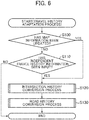
- Fig. 6 is a flowchart illustrating a flow of the travel history adaptation process executed by the travel history adaptation unit 121.
- the travel history adaptation unit 121 executes the travel history adaptation process in accordance with a processing flow illustrated in Fig. 6 , for example, every predetermined time.
- the travel history adaptation unit 121 determines whether the independent travel history information 124 has been input to the in-vehicle terminal 100 from outside or not. For example, when the in-vehicle terminal 100 has been replaced in the own vehicle, and the independent travel history information 124 generated in the in-vehicle terminal 100 before the replacement has been input to the in-vehicle terminal 100 after the replacement, the process proceeds to Step S120. In this case, the input independent travel history information 124 is stored in the in-vehicle storage 113. Meanwhile, when the independent travel history information 124 is not input, the processing flow of Fig. 6 is terminated.
- Step S201 the travel history adaptation unit 121 determines whether the independent intersection history information 132 includes an unconverted intersection or not.
- the unconverted intersection that is, the intersection not adapted to the map information 122 after the change of contents is included
- the process proceeds to Step S202.
- the unconverted intersection is not included, that is, when every intersection in the independent intersection history information 132 has been adapted to the map information 122 after the change of contents
- the processing flow of Fig. 7 is terminated and the intersection history conversion process is completed.
- the travel history adaptation unit 121 advances the process to Step S206.
- the travel history adaptation unit 121 determines that the travel history of this intersection indicated by the independent intersection history information 132 cannot be directly converted because the count of the road links connected to this intersection is different between before and after the change of the map information 122. Therefore, in order to adjust the information on the travel history of this intersection in the changed intersection history information in accordance with the changed map information 122, the process of Step S206 and the process of Step S207 or S208 described below are executed.
- intersection history conversion process the above-described processes are repeatedly executed for each intersection, thus ensuring the conversion of the independent intersection history information 132 into the intersection history information adapted to the map information 122 after the change of contents.
- Fig. 8 is a flowchart illustrating a flow of a road history conversion process executed at Step S130 of Fig. 6 .
- the travel history adaptation unit 121 determines whether the independent road history information 133 includes an unconverted road link or not.
- the unconverted road link that is, the road link not adapted to the map information 122 after the change of contents
- the process proceeds to Step S302.
- the unconverted road link is not included, that is, when every road link in the independent road history information 133 has been adapted to the map information 122 after the change of contents
- the processing flow of Fig. 8 is terminated and the road history conversion process is completed.
- the travel history adaptation unit 121 performs a conversion target link determination process.
- the conversion target link determination process is a process to determine a conversion target link corresponding to the unconverted road link in the map information 122 after the change of contents. The specific contents of the conversion target link determination process will be described later with reference to a flowchart of Fig. 9 .
- Step S303 the travel history adaptation unit 121 performs an establishment confirmation process.
- the establishment confirmation process is a process to confirm whether the conversion target link determined at Step S302 establishes the converted road history information. The specific contents of the establishment confirmation process will be described later with reference to a flowchart of Fig. 10 .
- the travel history adaptation unit 121 After the execution of Step S303, the travel history adaptation unit 121 returns the process to Step S301.
- Fig. 9 is a flowchart illustrating a flow of the conversion target link determination process executed at Step S302 of Fig. 8 .
- the travel history adaptation unit 121 selects one of the unconverted road links in the independent road history information 133, and identifies a road link corresponding to this road link as a conversion candidate.
- the road link as the conversion candidate is identified by identifying which road link corresponds to this road link in the map information 122 after the change of contents as a conversion target based on the position information of this road link, the road information, and similar information included in the independent road history information 133.
- a road link included in a predetermined range from a position of this road link indicated by the position information and a road link having a feature identical to or close to the feature of this road link indicated by the road information are identified as conversion candidate road links from the map information 122 after the change of contents.
- the plurality of road links are identified as the conversion candidates.
- the travel history adaptation unit 121 determines whether a plurality of road links are identified as the conversion candidates for the road links selected at Step S401 or not. When a plurality of road links are not identified as the conversion candidates, that is, when only one road link is identified as the conversion candidate, the process proceeds to Step S403, and when a plurality of road links are identified as the conversion candidates, the process proceeds to Step S404.
- Step S405 the travel history adaptation unit 121 provisionally determines the road link as the conversion candidate at the top of the stack generated at Step S404 as a provisional conversion target link corresponding to this road link.
- Step S405 the processing flow of Fig. 9 is terminated and the conversion target link determination process is completed.
- the travel history adaptation unit 121 performs the conversion of the independent road history information 133 for the road link selected at Step S401 in the conversion target link determination process of Fig. 9 .
- this provisional conversion target link is determined as the conversion target link.
- this conversion target link is directly used.
- the travel history adaptation unit 121 determines whether the determination that the condition of the relative position information is not satisfied at Step S501 is made to the conversion target link or not. When it is the conversion target link, the process proceeds to Step S507, and when it is not the conversion target link, that is, when it is the provisional conversion target link, the process proceeds to Step S504.
- the travel history adaptation unit 121 pops the provisional conversion target link at the top of the stack and determined not to satisfy the condition of the relative position information at Step S501 from the stack. This releases the provisional determination of the provisional conversion target link and removes the provisional conversion target link from the target of the following processes.
- Step S505 the travel history adaptation unit 121 determines whether a conversion candidate link still remains in the stack from which the provisional conversion target link has been popped at Step S504 or not.
- the process proceeds to Step S506, and when the conversion candidate link does not remain, that is, when every conversion candidate link in the stack has been popped, the process proceeds to Step S507.
- the travel history adaptation unit 121 removes the road link selected at Step S401 from the conversion target in the independent road history information 133. That is, in this case, since the conversion candidate link does not remain in the stack, the conversion of the independent road history information 133 cannot be performed on this road link. Accordingly, the travel history of this road link is treated as a conversion error and not included in the converted road history information.
- the processing flow of Fig. 10 is terminated, and the establishment confirmation process is completed.
- the above-described processes are repeatedly executed for each road link, thus ensuring the conversion of the independent road history information 133 into the road history information adapted to the map information 122 after the change of contents based on the relative position information included in the independent travel history information 124.
- the in-vehicle terminal 100 may directly convert the travel history information 123 into the travel history information adapted to the map information 122 after the change of contents without generating the independent travel history information 124.
- the travel history conversion unit 112 since it is not necessary to execute the travel history independence process, it is only necessary that the travel history conversion unit 112 has only the function corresponding to the travel history adaptation unit 121 without the travel history independence unit 120.
- the travel history adaptation process instead of the independent travel history information 124, it is only necessary to obtain the information on the intersections and the road links from the map information 122 before the change of contents and convert the travel history information 123 based on this information.
- the in-vehicle storage 113 needs to store both the map information 122 before the change of contents and the map information 122 after the change of contents.
- the map information 122 before the change of contents only the information necessary for the conversion of the travel history information 123 is left and other information may be deleted.
- Fig. 11 is a drawing illustrating a hardware configuration of an information system according to the second embodiment of the present invention.
- the information system illustrated in Fig. 11 includes an in-vehicle terminal 100a and a server 300 connected via a communication line 400.
- the in-vehicle terminal 100a includes the display device 101, the operating device 102, the positioning sensor 103, the communication unit 104, the ROM 105, the RAM 106, the auxiliary storage device 107, and the CPU 108.
- the server 300 includes an output unit 301, an input unit 302, an auxiliary storage device 303, a communication unit 304, a CPU 305, and a RAM 306. While multiple in-vehicle terminals are connectable to the server 300, Fig. 11 illustrates one in-vehicle terminal 100a on behalf of them.
- the communication unit 104 is connected to the communication line 400 and communicates with the server 300.
- the communication line 400 includes, for example, Internet and a mobile phone line. Other configurations are as described in the first embodiment.
- the output unit 301 is connected to a display (not illustrated) and the like, and outputs information for displaying, for example, a process result by the CPU 305.
- the input unit 302 is connected to a touchscreen, a keyboard, a computer mouse, and the like, and used to input a command from an operator to the server 300.
- the auxiliary storage device 303 is a storage device that stores a program and various kinds of data, and includes a HDD and a SSD.
- the communication unit 304 is connected to the communication line 400, and communicates various kinds of data with the in-vehicle terminal 100a.
- the CPU 305 is a processing unit that executes programs loaded from the auxiliary storage device 303 to the RAM 306.
- the RAM 306 is a storage device that temporarily stores information used for the process by the CPU 305.
- the RAM 306 is used for, for example, loading a program stored in the auxiliary storage device 303 at the execution of this program by the CPU 305, and temporarily storing information generated by the program during the execution by the CPU 305.
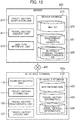
- Fig. 12 is a drawing illustrating a system configuration of the information system according to the second embodiment of the present invention.
- the in-vehicle terminal 100a includes, as its functions, a route estimation unit 110, a travel history storing unit 111, a travel history independence unit 120, a travel history upload unit 125, and an in-vehicle storage 113.
- the in-vehicle storage 113 stores, similarly to the in-vehicle terminal 100 according to the first embodiment illustrated in Fig. 2 , map information 122, travel history information 123, and independent travel history information 124.
- the travel history information 123 includes the intersection history information 130 and the road history information 131
- the independent travel history information 124 includes the independent intersection history information 132 and the independent road history information 133, while the illustrations of them are omitted in Fig. 12 .
- the route estimation unit 110, the travel history storing unit 111, the travel history independence unit 120, and the travel history upload unit 125 are functions achieved by the CPU 108 executing predetermined programs stored in the ROM 105 and the auxiliary storage device 107.
- the server 300 includes, as its functions, a travel history adaptation unit 310, a travel history delivery unit 311, a map type retrieval unit 312, and a server storage 313.
- the server storage 313 stores a map DB 320, an independent travel history DB 321, and an in-vehicle terminal-to-map correspondence DB 322.
- the travel history adaptation unit 310, the travel history delivery unit 311, and the map type retrieval unit 312 are functions achieved by the CPU 305 executing predetermined programs stored in the auxiliary storage device 303. Meanwhile, the server storage 313 is a function achieved by the auxiliary storage device 303.
- the travel history upload unit 125 uses the communication unit 104 to upload the independent travel history information 124, which is converted from the travel history information 123 by the travel history independence unit 120 and stored in the in-vehicle storage 113, on the server 300.
- the travel history adaptation unit 310 converts the independent travel history information 124 uploaded from the in-vehicle terminal 100a and stored in the independent travel history DB 321 into the converted travel history information corresponding to the in-vehicle terminal 100a.
- the converted travel history information corresponding to the in-vehicle terminal 100a is information adapted to the map information 122 after the change of contents when the contents of the map information 122 are changed in the in-vehicle terminal 100a.
- the travel history adaptation unit 310 converts the independent travel history information 124 into the converted travel history information corresponding to the in-vehicle terminal 100a with a method similar to that in the travel history adaptation unit 121 of the in-vehicle terminal 100 described in the first embodiment.
- the travel history delivery unit 311 uses the communication unit 304 to deliver the converted travel history information, which is generated by the travel history adaptation unit 310 and corresponds to the in-vehicle terminal 100a, to the in-vehicle terminal 100a.
- the map type retrieval unit 312 retrieves and obtains map information identical to the map information 122 stored in the in-vehicle storage 113 mounted to the in-vehicle terminal 100a from the map DB 320.
- the map type retrieval unit 312 retrieves map type information corresponding to the in-vehicle terminal 100a from map type information stored in the in-vehicle terminal-to-map correspondence DB 322. Then, the map type retrieval unit 312 retrieves the map information that matches the map information 122 in the in-vehicle terminal 100a from the map DB 320 based on the retrieved map type information.
- the map type retrieval unit 312 can retrieve the information, such as an ID and a model of the in-vehicle terminal to which the map information 122 is provided, a target area of the map included in the map information 122, a format of the map information 122, and a delivery year of the map information 122, as the map type information corresponding to the map information 122 from the in-vehicle terminal-to-map correspondence DB 322.
- the map DB 320 stores the map information identical to the map information 122 stored in the in-vehicle storage 113 in the in-vehicle terminal 100a. Furthermore, for the in-vehicle terminals connected to the server 300 other than the in-vehicle terminal 100a, map information identical to that stored in each in-vehicle terminal is stored in the map DB 320. That is, the map DB 320 is a database that includes various kinds of map information corresponding to all of the in-vehicle terminals connected to the server 300. Only map information of the latest version corresponding to each in-vehicle terminal may be stored in the map DB 320, or map information of past version also may be included and stored in the map DB 320.
- the independent travel history DB 321 stores the independent travel history information 124 uploaded from the in-vehicle terminal 100a. Furthermore, for the in-vehicle terminals connected to the server 300 other than the in-vehicle terminal 100a, the independent travel history information uploaded from each of the in-vehicle terminals is stored in the independent travel history DB 321.
- the independent travel history information of each of the in-vehicle terminals in the independent travel history DB 321 may be managed for each in-vehicle terminal, or may be managed for each user that uses the in-vehicle terminal or for each vehicle that includes the in-vehicle terminal.
- the in-vehicle terminal-to-map correspondence DB 322 stores the map type information corresponding to the map information of each of the in-vehicle terminals including the in-vehicle terminal 100a.
- the information such as an ID and a model of the in-vehicle terminal to which the map information is provided, a target area of the map included in the map information, a format of the map information, and a delivery year of the map information, is stored as the map type information in the in-vehicle terminal-to-map correspondence DB 322.
- the map type information in the in-vehicle terminal-to-map correspondence DB 322 may be managed for each in-vehicle terminal, or may be managed for each model by grouping the in-vehicle terminals for each of the identical models. Alternatively, the management may be performed for each user that uses the in-vehicle terminal or for each vehicle that includes the in-vehicle terminal.
- Fig. 13 is a drawing illustrating a process sequence when the independent travel history information 124 is uploaded from the in-vehicle terminal 100a to the server 300 in the information system according to the second embodiment of the present invention. This process sequence is executed when the in-vehicle terminal 100a determines to start transferring the travel history. The determination whether to start transferring the travel history or not is performable with a method similar to that of Step S10 of Fig. 4 described in the first embodiment.
- the in-vehicle terminal 100a transmits authentication information to the server 300.
- This authentication information is information to authenticate the in-vehicle terminal 100a as a service provision target in the server 300, and, for example, an ID of the in-vehicle terminal 100a.
- the server 300 that has received the authentication information from the in-vehicle terminal 100a authenticates the in-vehicle terminal 100a based on this authentication information at Step S601.
- the in-vehicle terminal 100a may be authenticated by the authentication of the vehicle that includes the in-vehicle terminal 100a or the user that uses the in-vehicle terminal 100a instead of the direct authentication of the in-vehicle terminal 100a.
- Which authentication method is to be used is simply distinguished depending on the management unit of the independent travel history information of each in-vehicle terminal in the independent travel history DB 321.
- an authentication result is replied to the in-vehicle terminal 100a from the server 300.
- the server 300 obtains the independent travel history information 124 of the in-vehicle terminal 100a stored in the independent travel history DB 321 at Step S702.
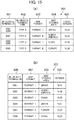
- Figs. 15 include drawings illustrating exemplary map type information stored in the in-vehicle terminal-to-map correspondence DB 322.
- the in-vehicle terminal-to-map correspondence DB 322 stores, for example, the information as illustrated in tables of Figs. 15 as the map type information.
- the table of Fig. 15(b) is the exemplary map type information managed for each terminal.
- a column 606 has cells that store IDs of the respective in-vehicle terminals for each terminal.
- a column 607 has cells that store information indicating formats of the map information of the respective in-vehicle terminals.
- a column 608 has cells that store information on regions indicated by the map information of the respective in-vehicle terminals.
- a column 609 has cells that store information indicating versions of the map information of the respective in-vehicle terminals.
- map type information as Fig. 15(b) allows the travel history adaptation unit 310 to convert the independent travel history information 124 so as to make the travel history information adapted to the map information of any version not limited to the latest version. Accordingly, in this case, the map information 122 can be updated to any version in the in-vehicle terminal 100a.
- the information system includes the in-vehicle terminal 100a mounted to the own vehicle and the server 300 connected to the in-vehicle terminal 100a.
- the in-vehicle terminal 100a includes the in-vehicle storage 113, the travel history storing unit 111, the travel history independence unit 120, and the travel history upload unit 125.
- the in-vehicle storage 113 stores the travel history information 123 that indicates the travel history of the own vehicle based on the map information 122 before the change of contents.
- the travel history storing unit 111 causes the in-vehicle storage 113 to store the travel history information 123.
- the travel history delivery unit 311 delivers the converted travel history information converted from the independent travel history information 124 by the travel history adaptation unit 310 to the in-vehicle terminal 100a.
- This configuration ensures, similarly to first embodiment, the accumulated travel history information to be transferred and used when the in-vehicle terminal mounted to the vehicle is replaced with another in-vehicle terminal, and when the map data in the in-vehicle terminal is updated.
- the example where the travel history information 123 includes the intersection history information 130 and the road history information 131, and the independent travel history information 124 includes the independent intersection history information 132 and the independent road history information 133 has been described.
- a configuration may be employed such that the travel history information 123 does not include the road history information 131, and the independent travel history information 124 does not include the independent road history information 133. That is, only the history of the entry link and the exit link of the own vehicle at each intersection may be recorded as the travel history information 123, this travel history information 123 may be converted into the independent travel history information 124, and thus obtained independent travel history information 124 may be adapted to the map information 122 after the change of contents.
- the travel history independence unit 120 can omit the process of Step S40 in the travel history independence process illustrated in Fig. 4 . Furthermore, in this case, the process of Step S30 may be omitted so as not to generate the relative position information.
- the travel history adaptation units 121 and 310 may omit the process of Step S130 in the travel history adaptation process illustrated in Fig. 6 . Even this configuration can provide the operational advantages similar to those described in the first and second embodiments.
Landscapes
- Engineering & Computer Science (AREA)
- Radar, Positioning & Navigation (AREA)
- Remote Sensing (AREA)
- Physics & Mathematics (AREA)
- General Physics & Mathematics (AREA)
- Automation & Control Theory (AREA)
- Health & Medical Sciences (AREA)
- General Health & Medical Sciences (AREA)
- Social Psychology (AREA)
- Theoretical Computer Science (AREA)
- Signal Processing (AREA)
- Aviation & Aerospace Engineering (AREA)
- Computer Networks & Wireless Communication (AREA)
- Mathematical Physics (AREA)
- Business, Economics & Management (AREA)
- Educational Administration (AREA)
- Educational Technology (AREA)
- Navigation (AREA)
- Traffic Control Systems (AREA)
- Instructional Devices (AREA)
Applications Claiming Priority (2)
| Application Number | Priority Date | Filing Date | Title |
|---|---|---|---|
| JP2017012250A JP6796500B2 (ja) | 2017-01-26 | 2017-01-26 | 走行履歴変換方法、情報処理装置、情報システム |
| PCT/JP2017/044794 WO2018139093A1 (fr) | 2017-01-26 | 2017-12-13 | Procédé de conversion d'historique de déplacement, dispositif de traitement d'informations et système d'informations |
Publications (2)
| Publication Number | Publication Date |
|---|---|
| EP3576079A1 true EP3576079A1 (fr) | 2019-12-04 |
| EP3576079A4 EP3576079A4 (fr) | 2020-08-05 |
Family
ID=62978966
Family Applications (1)
| Application Number | Title | Priority Date | Filing Date |
|---|---|---|---|
| EP17893835.3A Withdrawn EP3576079A4 (fr) | 2017-01-26 | 2017-12-13 | Procédé de conversion d'historique de déplacement, dispositif de traitement d'informations et système d'informations |
Country Status (5)
| Country | Link |
|---|---|
| US (1) | US20190390973A1 (fr) |
| EP (1) | EP3576079A4 (fr) |
| JP (1) | JP6796500B2 (fr) |
| CN (1) | CN110226189A (fr) |
| WO (1) | WO2018139093A1 (fr) |
Families Citing this family (1)
| Publication number | Priority date | Publication date | Assignee | Title |
|---|---|---|---|---|
| DE102017217747A1 (de) * | 2017-10-05 | 2019-04-11 | Volkswagen Aktiengesellschaft | Verfahren zum Betrieb eines Navigationssystems |
Family Cites Families (11)
| Publication number | Priority date | Publication date | Assignee | Title |
|---|---|---|---|---|
| JP4034113B2 (ja) * | 2002-05-10 | 2008-01-16 | 三菱電機株式会社 | 地図データ更新システム及び地図データ更新プログラム |
| JP2005037275A (ja) * | 2003-07-16 | 2005-02-10 | Denso Corp | ナビゲーション装置 |
| JP2005077642A (ja) * | 2003-08-29 | 2005-03-24 | Mitsubishi Electric Corp | 地図情報処理装置、地図修正情報記憶媒体、地図修正情報データ構造、地図修正情報作成システム及び地図情報更新システム |
| CN101666655B (zh) * | 2005-02-17 | 2012-02-29 | 松下电器产业株式会社 | 移动履历转换装置及移动履历转换方法 |
| US7349800B2 (en) * | 2005-04-12 | 2008-03-25 | International Business Machines Corporation | Adaptable navigation system |
| JP2008082863A (ja) * | 2006-09-27 | 2008-04-10 | Denso Corp | 車両用ナビゲーション装置 |
| JP4539722B2 (ja) * | 2008-01-14 | 2010-09-08 | 株式会社デンソー | 地図配信サーバおよび地図配信システム |
| JP5979885B2 (ja) | 2012-01-17 | 2016-08-31 | 株式会社デンソーアイティーラボラトリ | 経路予測システム、経路予測方法およびプログラム |
| JP5860836B2 (ja) * | 2013-05-10 | 2016-02-16 | アイシン・エィ・ダブリュ株式会社 | 地図データ記憶装置、地図データ更新方法及びコンピュータプログラム |
| JP6507717B2 (ja) * | 2015-03-02 | 2019-05-08 | 株式会社デンソー | 遭遇車両判定装置 |
| JP5814485B1 (ja) | 2015-06-26 | 2015-11-17 | ユニ・チャーム株式会社 | 使い捨て着用物品 |
-
2017
- 2017-01-26 JP JP2017012250A patent/JP6796500B2/ja not_active Expired - Fee Related
- 2017-12-13 WO PCT/JP2017/044794 patent/WO2018139093A1/fr not_active Ceased
- 2017-12-13 US US16/480,961 patent/US20190390973A1/en not_active Abandoned
- 2017-12-13 CN CN201780084816.9A patent/CN110226189A/zh active Pending
- 2017-12-13 EP EP17893835.3A patent/EP3576079A4/fr not_active Withdrawn
Also Published As
| Publication number | Publication date |
|---|---|
| JP6796500B2 (ja) | 2020-12-09 |
| JP2018120127A (ja) | 2018-08-02 |
| US20190390973A1 (en) | 2019-12-26 |
| WO2018139093A1 (fr) | 2018-08-02 |
| EP3576079A4 (fr) | 2020-08-05 |
| CN110226189A (zh) | 2019-09-10 |
Similar Documents
| Publication | Publication Date | Title |
|---|---|---|
| US20130345977A1 (en) | Map updating system | |
| EP2936472B1 (fr) | Application de système de navigation pour un dispositif mobile | |
| US20210191707A1 (en) | Vehicle Software Deployment System | |
| US20180376309A1 (en) | Information Transfer System, Vehicle-Mounted Terminal, and Information Transfer Method | |
| US9869558B2 (en) | Map data storage device, map data updating method, and computer program | |
| WO2015115711A1 (fr) | Dispositif, procédé et serveur de mise à jour automatique de navigation | |
| US20060195256A1 (en) | Systems, methods, and programs for updating map data | |
| CN101506857B (zh) | 接收交通状况报告并生成方向信息的方法 | |
| WO2020054537A1 (fr) | Système de mise à jour de carte, serveur de mise à jour de carte et terminal monté sur véhicule | |
| JP4825064B2 (ja) | 位置測定システム及び位置測定方法 | |
| JP6489993B2 (ja) | ナビゲーション支援装置、サーバ装置およびナビゲーション支援方法 | |
| CN102087111A (zh) | 一种车辆导航方法 | |
| US20150247732A1 (en) | Center device, program, map information transmission method, and navigation device | |
| EP3576079A1 (fr) | Procédé de conversion d'historique de déplacement, dispositif de traitement d'informations et système d'informations | |
| US11217089B2 (en) | Vehicle control device, vehicle control method and program | |
| JP2016197842A (ja) | 情報処理装置及び情報処理方法及び情報処理プログラム | |
| JP2010223648A (ja) | ナビゲーションシステム、ナビゲーション装置、センター装置、ナビゲーション方法およびプログラム | |
| JP2016212535A (ja) | 情報処理装置、交通情報データ、および、コンピュータプログラム | |
| US12061095B2 (en) | Information processing system, processing device, and information processing method | |
| US12546613B2 (en) | Information processing device and information processing method | |
| KR102599264B1 (ko) | 지도 업데이트 방법 | |
| JP6151095B2 (ja) | 地図データを更新する情報処理装置及びそれを用いたシステム | |
| CN111818116B (zh) | 用于校正车辆位置的方法、设备、车辆和计算机可读介质 | |
| US20210156701A1 (en) | Information processing apparatus, information processing method and system | |
| CN113709673A (zh) | 一种呼车方法、装置、设备及存储介质 |
Legal Events
| Date | Code | Title | Description |
|---|---|---|---|
| STAA | Information on the status of an ep patent application or granted ep patent |
Free format text: STATUS: THE INTERNATIONAL PUBLICATION HAS BEEN MADE |
|
| PUAI | Public reference made under article 153(3) epc to a published international application that has entered the european phase |
Free format text: ORIGINAL CODE: 0009012 |
|
| STAA | Information on the status of an ep patent application or granted ep patent |
Free format text: STATUS: REQUEST FOR EXAMINATION WAS MADE |
|
| 17P | Request for examination filed |
Effective date: 20190725 |
|
| AK | Designated contracting states |
Kind code of ref document: A1 Designated state(s): AL AT BE BG CH CY CZ DE DK EE ES FI FR GB GR HR HU IE IS IT LI LT LU LV MC MK MT NL NO PL PT RO RS SE SI SK SM TR |
|
| AX | Request for extension of the european patent |
Extension state: BA ME |
|
| DAV | Request for validation of the european patent (deleted) | ||
| DAX | Request for extension of the european patent (deleted) | ||
| A4 | Supplementary search report drawn up and despatched |
Effective date: 20200707 |
|
| RIC1 | Information provided on ipc code assigned before grant |
Ipc: G09B 29/00 20060101AFI20200701BHEP Ipc: G01C 21/26 20060101ALI20200701BHEP Ipc: G09B 29/10 20060101ALI20200701BHEP |
|
| STAA | Information on the status of an ep patent application or granted ep patent |
Free format text: STATUS: EXAMINATION IS IN PROGRESS |
|
| 17Q | First examination report despatched |
Effective date: 20210421 |
|
| STAA | Information on the status of an ep patent application or granted ep patent |
Free format text: STATUS: THE APPLICATION HAS BEEN WITHDRAWN |
|
| 18W | Application withdrawn |
Effective date: 20210826 |