EP3576100B1 - Système d'aide à la décision pour la planification de thérapies médicales - Google Patents
Système d'aide à la décision pour la planification de thérapies médicales Download PDFInfo
- Publication number
- EP3576100B1 EP3576100B1 EP19177161.7A EP19177161A EP3576100B1 EP 3576100 B1 EP3576100 B1 EP 3576100B1 EP 19177161 A EP19177161 A EP 19177161A EP 3576100 B1 EP3576100 B1 EP 3576100B1
- Authority
- EP
- European Patent Office
- Prior art keywords
- outcome
- network
- machine
- image
- therapy
- Prior art date
- Legal status (The legal status is an assumption and is not a legal conclusion. Google has not performed a legal analysis and makes no representation as to the accuracy of the status listed.)
- Active
Links
Images



Classifications
-
- G—PHYSICS
- G16—INFORMATION AND COMMUNICATION TECHNOLOGY [ICT] SPECIALLY ADAPTED FOR SPECIFIC APPLICATION FIELDS
- G16H—HEALTHCARE INFORMATICS, i.e. INFORMATION AND COMMUNICATION TECHNOLOGY [ICT] SPECIALLY ADAPTED FOR THE HANDLING OR PROCESSING OF MEDICAL OR HEALTHCARE DATA
- G16H30/00—ICT specially adapted for the handling or processing of medical images
- G16H30/20—ICT specially adapted for the handling or processing of medical images for handling medical images, e.g. DICOM, HL7 or PACS
-
- G—PHYSICS
- G16—INFORMATION AND COMMUNICATION TECHNOLOGY [ICT] SPECIALLY ADAPTED FOR SPECIFIC APPLICATION FIELDS
- G16H—HEALTHCARE INFORMATICS, i.e. INFORMATION AND COMMUNICATION TECHNOLOGY [ICT] SPECIALLY ADAPTED FOR THE HANDLING OR PROCESSING OF MEDICAL OR HEALTHCARE DATA
- G16H50/00—ICT specially adapted for medical diagnosis, medical simulation or medical data mining; ICT specially adapted for detecting, monitoring or modelling epidemics or pandemics
- G16H50/70—ICT specially adapted for medical diagnosis, medical simulation or medical data mining; ICT specially adapted for detecting, monitoring or modelling epidemics or pandemics for mining of medical data, e.g. analysing previous cases of other patients
-
- G—PHYSICS
- G16—INFORMATION AND COMMUNICATION TECHNOLOGY [ICT] SPECIALLY ADAPTED FOR SPECIFIC APPLICATION FIELDS
- G16H—HEALTHCARE INFORMATICS, i.e. INFORMATION AND COMMUNICATION TECHNOLOGY [ICT] SPECIALLY ADAPTED FOR THE HANDLING OR PROCESSING OF MEDICAL OR HEALTHCARE DATA
- G16H20/00—ICT specially adapted for therapies or health-improving plans, e.g. for handling prescriptions, for steering therapy or for monitoring patient compliance
- G16H20/40—ICT specially adapted for therapies or health-improving plans, e.g. for handling prescriptions, for steering therapy or for monitoring patient compliance relating to mechanical, radiation or invasive therapies, e.g. surgery, laser therapy, dialysis or acupuncture
-
- A—HUMAN NECESSITIES
- A61—MEDICAL OR VETERINARY SCIENCE; HYGIENE
- A61B—DIAGNOSIS; SURGERY; IDENTIFICATION
- A61B5/00—Measuring for diagnostic purposes; Identification of persons
- A61B5/72—Signal processing specially adapted for physiological signals or for diagnostic purposes
- A61B5/7235—Details of waveform analysis
- A61B5/7264—Classification of physiological signals or data, e.g. using neural networks, statistical classifiers, expert systems or fuzzy systems
- A61B5/7267—Classification of physiological signals or data, e.g. using neural networks, statistical classifiers, expert systems or fuzzy systems involving training the classification device
-
- A—HUMAN NECESSITIES
- A61—MEDICAL OR VETERINARY SCIENCE; HYGIENE
- A61N—ELECTROTHERAPY; MAGNETOTHERAPY; RADIATION THERAPY; ULTRASOUND THERAPY
- A61N5/00—Radiation therapy
- A61N5/10—X-ray therapy; Gamma-ray therapy; Particle-irradiation therapy
- A61N5/103—Treatment planning systems
-
- G—PHYSICS
- G06—COMPUTING OR CALCULATING; COUNTING
- G06N—COMPUTING ARRANGEMENTS BASED ON SPECIFIC COMPUTATIONAL MODELS
- G06N3/00—Computing arrangements based on biological models
- G06N3/02—Neural networks
- G06N3/04—Architecture, e.g. interconnection topology
-
- G—PHYSICS
- G06—COMPUTING OR CALCULATING; COUNTING
- G06N—COMPUTING ARRANGEMENTS BASED ON SPECIFIC COMPUTATIONAL MODELS
- G06N3/00—Computing arrangements based on biological models
- G06N3/02—Neural networks
- G06N3/04—Architecture, e.g. interconnection topology
- G06N3/045—Combinations of networks
- G06N3/0455—Auto-encoder networks; Encoder-decoder networks
-
- G—PHYSICS
- G06—COMPUTING OR CALCULATING; COUNTING
- G06N—COMPUTING ARRANGEMENTS BASED ON SPECIFIC COMPUTATIONAL MODELS
- G06N3/00—Computing arrangements based on biological models
- G06N3/02—Neural networks
- G06N3/04—Architecture, e.g. interconnection topology
- G06N3/0464—Convolutional networks [CNN, ConvNet]
-
- G—PHYSICS
- G06—COMPUTING OR CALCULATING; COUNTING
- G06N—COMPUTING ARRANGEMENTS BASED ON SPECIFIC COMPUTATIONAL MODELS
- G06N3/00—Computing arrangements based on biological models
- G06N3/02—Neural networks
- G06N3/04—Architecture, e.g. interconnection topology
- G06N3/0475—Generative networks
-
- G—PHYSICS
- G06—COMPUTING OR CALCULATING; COUNTING
- G06N—COMPUTING ARRANGEMENTS BASED ON SPECIFIC COMPUTATIONAL MODELS
- G06N3/00—Computing arrangements based on biological models
- G06N3/02—Neural networks
- G06N3/08—Learning methods
- G06N3/0895—Weakly supervised learning, e.g. semi-supervised or self-supervised learning
-
- G—PHYSICS
- G06—COMPUTING OR CALCULATING; COUNTING
- G06N—COMPUTING ARRANGEMENTS BASED ON SPECIFIC COMPUTATIONAL MODELS
- G06N3/00—Computing arrangements based on biological models
- G06N3/02—Neural networks
- G06N3/08—Learning methods
- G06N3/09—Supervised learning
-
- G—PHYSICS
- G06—COMPUTING OR CALCULATING; COUNTING
- G06N—COMPUTING ARRANGEMENTS BASED ON SPECIFIC COMPUTATIONAL MODELS
- G06N3/00—Computing arrangements based on biological models
- G06N3/02—Neural networks
- G06N3/08—Learning methods
- G06N3/094—Adversarial learning
-
- G—PHYSICS
- G06—COMPUTING OR CALCULATING; COUNTING
- G06N—COMPUTING ARRANGEMENTS BASED ON SPECIFIC COMPUTATIONAL MODELS
- G06N3/00—Computing arrangements based on biological models
- G06N3/02—Neural networks
- G06N3/08—Learning methods
- G06N3/096—Transfer learning
-
- G—PHYSICS
- G06—COMPUTING OR CALCULATING; COUNTING
- G06T—IMAGE DATA PROCESSING OR GENERATION, IN GENERAL
- G06T7/00—Image analysis
- G06T7/0002—Inspection of images, e.g. flaw detection
- G06T7/0012—Biomedical image inspection
-
- G—PHYSICS
- G16—INFORMATION AND COMMUNICATION TECHNOLOGY [ICT] SPECIALLY ADAPTED FOR SPECIFIC APPLICATION FIELDS
- G16H—HEALTHCARE INFORMATICS, i.e. INFORMATION AND COMMUNICATION TECHNOLOGY [ICT] SPECIALLY ADAPTED FOR THE HANDLING OR PROCESSING OF MEDICAL OR HEALTHCARE DATA
- G16H50/00—ICT specially adapted for medical diagnosis, medical simulation or medical data mining; ICT specially adapted for detecting, monitoring or modelling epidemics or pandemics
- G16H50/20—ICT specially adapted for medical diagnosis, medical simulation or medical data mining; ICT specially adapted for detecting, monitoring or modelling epidemics or pandemics for computer-aided diagnosis, e.g. based on medical expert systems
-
- G—PHYSICS
- G16—INFORMATION AND COMMUNICATION TECHNOLOGY [ICT] SPECIALLY ADAPTED FOR SPECIFIC APPLICATION FIELDS
- G16H—HEALTHCARE INFORMATICS, i.e. INFORMATION AND COMMUNICATION TECHNOLOGY [ICT] SPECIALLY ADAPTED FOR THE HANDLING OR PROCESSING OF MEDICAL OR HEALTHCARE DATA
- G16H50/00—ICT specially adapted for medical diagnosis, medical simulation or medical data mining; ICT specially adapted for detecting, monitoring or modelling epidemics or pandemics
- G16H50/30—ICT specially adapted for medical diagnosis, medical simulation or medical data mining; ICT specially adapted for detecting, monitoring or modelling epidemics or pandemics for calculating health indices; for individual health risk assessment
-
- A—HUMAN NECESSITIES
- A61—MEDICAL OR VETERINARY SCIENCE; HYGIENE
- A61B—DIAGNOSIS; SURGERY; IDENTIFICATION
- A61B6/00—Apparatus or devices for radiation diagnosis; Apparatus or devices for radiation diagnosis combined with radiation therapy equipment
- A61B6/02—Arrangements for diagnosis sequentially in different planes; Stereoscopic radiation diagnosis
- A61B6/03—Computed tomography [CT]
- A61B6/032—Transmission computed tomography [CT]
-
- G—PHYSICS
- G06—COMPUTING OR CALCULATING; COUNTING
- G06T—IMAGE DATA PROCESSING OR GENERATION, IN GENERAL
- G06T2207/00—Indexing scheme for image analysis or image enhancement
- G06T2207/10—Image acquisition modality
- G06T2207/10072—Tomographic images
- G06T2207/10081—Computed x-ray tomography [CT]
-
- G—PHYSICS
- G06—COMPUTING OR CALCULATING; COUNTING
- G06T—IMAGE DATA PROCESSING OR GENERATION, IN GENERAL
- G06T2207/00—Indexing scheme for image analysis or image enhancement
- G06T2207/20—Special algorithmic details
- G06T2207/20081—Training; Learning
-
- G—PHYSICS
- G06—COMPUTING OR CALCULATING; COUNTING
- G06T—IMAGE DATA PROCESSING OR GENERATION, IN GENERAL
- G06T2207/00—Indexing scheme for image analysis or image enhancement
- G06T2207/20—Special algorithmic details
- G06T2207/20084—Artificial neural networks [ANN]
Definitions
- Radiotherapy is a useful and cost-effective treatment strategy for many types of cancer. Although radiotherapy is an effective cancer treatment, a large portion of patients subsequently experience radio-resistance and recurrence of their cancers. Doctors seek to select treatments based on specific characteristics of the patient and their disease to avoid treatment resistance and recurrence.
- the machine-learned multi-task generator includes an encoder for image features and a classifier for the outcome.
- the acquired images and outcome generation may be for a first clinical problem, such as for a first organ, first tumor, and/or first diagnosis. Images may be acquired, and outcome generated for a different clinical problem, such as a different organ, using the same machine-learned multi-task generator. For any clinical problem, the patient is treated based on the generated outcome. Which therapy or the settings for therapy are selected using the predicted outcome, such as using an alternative where the outcome for a particular therapy to a particular patient is predicted to be poor.
- a method for machine training decision support in a medical therapy system.
- a multi-task network is defined with an output layer for outcome estimation and an output layer for image feature estimation.
- a machine trains the multi-task network to estimate image features and to estimate outcome from input medical imaging volumes. The training is based on ground truth outcomes and ground truth (e.g., handcrafted) image features.
- the machine-trained multi-task network is stored.
- the medical scan may be of any modality, such as scanning the patient with a computed tomography scanner.
- the scan comprises acquiring voxel data representing a three-dimensional distribution of locations in a volume of the patient.
- the survival is generated based on input of the voxel data for a segmented three-dimensional region of the volume.
- the machine-learned multi-task generator may be a convolutional neural network, such as an encoder network trained as part of an encoder and decoder network and a neural network configured to receive bottleneck features of the encoder network.
- the neural network generates the survival.
- the other loss may be one of various losses, such as an image feature loss.
- an image feature loss the machine-learned multi-task generator was been trained with deep learning to create features compared to handcrafted radiomics features for the image feature loss.
- the machine-learned multi-task generator was trained with deep learning to create segmentations compared to ground truth segmentation for the segmentation loss and to compare prediction results to ground truth results for the outcome loss.
- the machine-learned multi-task generator may have been trained with a greater number of training data samples for an image feature loss of the at least two losses than for the survival loss.
- a method for decision support in a medical therapy system.
- First non-image data representing characteristics of a patient is acquired.
- a prediction of outcome of therapy for the patient is generated by a machine-learned network having been trained as an autoencoder for generating second non-image data representing patients from third non-image data representing other patients.
- the second non-image data is of a same type as the third non-image data.
- An image of the outcome is displayed.
- a method for decision support in a medical therapy system is provided.
- a medical scan of a patient is acquired.
- a prediction of outcome of therapy for the patient from scan data of the medical scan is generated by a machine-learned multi-task generator having been trained with unsupervised learning from training data unlabeled for the outcome and having been trained from labeled training data for the outcome.
- An image of the outcome is displayed.
- An imaging-based artificial intelligence provides for patient stratification and/or radiotherapy response prediction.
- This radiotherapy decision support may be based on pre-treatment CT or other modality scans.
- the therapy outcome may be predicted based on imaging and/or non-imaging data, providing physician decision assistance.
- Figure 1 shows one embodiment of a decision support system for producing prognostic signatures of the therapy from radiological imaging data.
- the signature is patient information or features from imaging data of the medical image.
- the medical image is preprocessed, such as scaled, normalized, and/or segmented for tumors or regions including tumors. Different from traditional radiomic features that are usually handcrafted, deep-learning-based radiomic features that are completely data-driven are to be used.
- the handcrafted radiomics are used as ground truth as these features may be created from any image, allowing for unsupervised learning or ground truth unlabeled for the outcome.
- a neural network is pre-trained to generate features based on the handcrafted radiomics as the ground truth for each image.
- Outliers in the dataset may be identified using the pre-trained network and verified as accurate, corrected, or discarded.
- the network is then fine-tuned using the training data with known outcomes as the ground truth.
- the network trained to generate features that lead to handcrafted radiomics is used to initialize or used with a network for predicting outcome.
- This decision support system may be used to stratify patients (e.g., predict outcomes of different therapies using the same or different trained networks) based on likelihood of therapy failure or likelihood of tumor recurrence post-treatment, and redirect the patients that have high risk of failure to an alternate or modified therapy regimen.
- a unified processing pipeline for various problems makes the system more efficient.
- the decision support model is able to utilize the information in the vast amount of unlabeled data.
- an auto-encoder is trained from unlabeled images in an unsupervised fashion. This is particularly useful when labeled data is scarce, a problem very common in the medical data domain due to high labor and financial cost in acquiring both the data and the labels.
- An initially trained network may be used to automatically identify outliers from a large training database, effectively reducing labor cost in training.
- the same neural network architecture may be used for different problems (e.g., tumors in different organs) without changes. For new clinical problems, if the imaging modality is the same, the network does not need to be pre-trained, which saves more time for developing and deploying.
- the machine-learned generator of the decision support system projects the original high dimension image data into a low dimension space (e.g., bottleneck of an autoencoder, image-to-image network, or encoder-decoder network).
- the values of the features in the low dimensional space may be used as input to a fully connected or another network to predict the outcome.
- the values of the low dimensional space may be used to group patients in terms of predicted therapy outcome. An unsupervised clustering may be performed in this low dimension space to identify similar cases when an unseen case is presented. The prognosis of the patient may be more reliable when provided empirical cases of a similar nature.
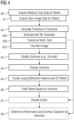
- Figure 3 shows an example method for machine training decision support in a medical therapy system.
- the method is implemented by a machine (e.g., computer, processor, workstation, or server) using training data (e.g., samples and ground truths for the samples) in a memory.
- a machine e.g., computer, processor, workstation, or server
- training data e.g., samples and ground truths for the samples
- the generator includes outputs for one or more tasks.
- an autoencoder, image-to-image network, U-net, or convolutional neural network is used to output an estimation for one task.
- the generator may be a multi-task generator.
- a neural network is defined with an architecture having two or more outputs.
- a multi-task generator is used so that the generator is trained to optimize for the multiple tasks, such as including a loss function based on multiple losses (i.e., a loss for each of the tasks).
- the task having fewer samples in the training data may benefit (become more accurate while limiting overfitting) from the learning for the task with more samples.
- the multi-task network is defined to include an encoder and decoder as an image-to-image network for generating a segmentation or image features from an input image for one task.
- the multi-task network is defined to also include a neural network for the outcome prediction, such as a neural network receiving as input bottleneck features output by the encoder to the decoder.
- a neural network for the outcome prediction such as a neural network receiving as input bottleneck features output by the encoder to the decoder.
- ground truth e.g., already known ground truth or later determined ground truth
- the training for outcome or survival which has fewer samples with ground truth, benefits from the training for segmentation or image features, resulting in a more accurate prediction of outcome or survival.
- Other network architectures may be used, such as the classifier architecture for the outcome using the output of the decoder and/or receiving learned features from in the encoder or decoder (e.g., skip connections) as inputs.
- the machine e.g., processor, computer, workstation, or server
- the defined network e.g., the defined multi-task generator.
- the network is trained to generate outputs for one or more tasks, such as multiple tasks.
- the generator and any discriminators are trained by machine learning. Based on the architecture, the generator is trained to generate output.
- the training data includes many samples (e.g., hundreds or thousands) of input images (e.g., scan data to be used for imaging or images formatted for display) and ground truths.
- the ground truths may be annotations from experts or data mined from patient records, such as outcomes or segmentations for the samples.
- the ground truths may be automatically determined from the input, such as segmentation or radiomic features.
- the network is trained to output based on the assigned ground truths for the input samples.
- the method is performed by a medical diagnostic scanner, a workstation, a server, or a computer.
- the scanner or memory are used to acquire data for a patient.
- An image processor such as an image processor of the scanner or a separate computer, predicts the outcome, stratifies, and/or clusters.
- the image processor displays using a display screen or printer.
- a physician may use the output information to make a treatment decision for the patient.
- the image processor acquires non-image data.
- the non-image data is from sensors, the computerized patient medical record, manual input, pathology database, laboratory database, and/or other source.
- the non-image data represents one or more characteristics of the patient, such as family history, medications taken, temperature, body-mass index, and/or other information.
- genomic, clinical, measurement, molecular, and/or family history data of the patient are acquired from memory, transform, data mining, and/or manual input.
- proposed therapy settings are acquired, such as a course of therapy including a sequence of therapy events, the power for each event, the duration of each event, and/or the region of application for each event.
- the image processor generates a prediction of outcome from therapy for the patient.
- the prediction is based on input of the scan data (e.g., voxel data) and/or non-image data. For example, voxel data for a segmented three-dimensional region of a tumor and surrounding tissue is input.
- Any machine-learned generator may be used.
- a support vector machine, clustering, or other generator is provided for generating an estimate of the outcome based on the input.
- a machine-learned classifier may be used.
- a neural network is trained as the generator, such as a trained convolutional neural network (CNN).
- the network is a deep architecture, which may include CNN or deep belief nets (DBN). Other deep networks may be used.
- CNN learns feed-forward mapping functions while DBN learns a generative model of data.
- CNN uses shared weights for all local regions while DBN is a fully connected network (i.e., having different weights for all regions of an image).
- the training of CNN is entirely discriminative through back-propagation.
- DBN employs the layer-wise unsupervised training (e.g., pre-training) followed by the discriminative refinement with back-propagation if necessary.
- the network is defined as a plurality of sequential feature units or layers. Sequential is used to indicate the general flow of output feature values from one layer to input to a next layer. The information from the next layer is fed to a next layer, and so on until the final output.
- the layers may only feed forward or may be bi-directional, including some feedback to a previous layer.
- the nodes of each layer or unit may connect with all or only a sub-set of nodes of a previous or subsequent layer or unit. Skip connections, feeding values for features directly to layers in addition to or as well as a next layer, such as for a dense network.
- any number of nodes is provided. For example, 100 nodes are provided. Later or subsequent units may have more, fewer, or the same number of nodes.
- the features of the nodes are learned by the machine using any building blocks. For example, auto-encoder (AE) or restricted Boltzmann machine (RBM) approaches are used. AE transforms data linearly, and then applies a non-linear rectification, like a sigmoid function.
- the objective function of AE is the expected mean square error between the input image and reconstructed images using the learned features. AE may be trained using stochastic gradient descent or other approach to learn, by the machine, the features leading to the best reconstruction.
- the objective function of RBM is an energy function. Exact computation of the likelihood term associated with RBM is intractable. Therefore, an approximate algorithm, such as contrastive-divergence based on k-step Gibb sampling or other, is used to train the RBM to reconstruct the image from features.
- the architecture provides a multi-task generator or was trained as a multi-task generator (act 42B). Multiple outputs may be generated in response to the input. For application, less than all the trained network may be used, such as training as a multi-task generator but only using the parts of the multi-task network that output the outcome. Alternatively, the entire network or the parts that output the estimates for the different tasks are used.
- the output or final layer of the architecture may form both outputs.
- One network may be used for both tasks. There are multiple outputs from the one network. There is one output for the segmentation or radiomic feature generation task and another output for the outcome estimation.
- One or more additional layers may be added in this framework to further process an output for one task to generate an output for another task.
- the machine-learned, multi-task generator predicts outcome in response to input of the scan data. For example, personalized radiotherapy outcome is predicted from CT images of a tumor of a patient in a therapy planning phase. Unlike current radiomics methods that use pre-defined features for all tasks, the deep learning trains the generator to directly extract high-throughput image features. Since the features are created based on the specific task, the features may be more accurate and informative than general quantitative image measurements for therapy outcome prediction.
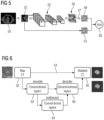
- the network 54 is a CNN arranged as an encoder network 62 to build the sought-after task-specific fingerprint (features). The fingerprint in this case is based on a set of latent variables at the bottleneck 64 of the overall encoder and decoder network 54.
- a segmentation model is built using planning computed tomography images and different radiotherapy contours (i.e., ground truth segmentation).
- the input of the network is a computed tomography image (e.g., 3D scan data) that includes gross tumor volume (GTV) and neighboring tissues.
- the ground truth target image is a mask of a selected ROI, so the output of the network is a GTV heatmap.
- the architecture is an U-Net convolutional network architecture to achieve a fast segmentation of images. Other kinds of fully convolutional networks may be used for segmentation.
- Semi-supervised convolutional neural networks, recurrent neural networks, unsupervised clustering, or reinforcement learning may be adopted for further refining the segmentation.
- the machine-learned multi-task generator may have been trained with a greater number of training data samples for the image feature or segmentation error than for the outcome error due to the availability of data. Alternatively, there are an equal number of samples or more samples for outcome than for image features or segmentation.
- Figure 5 illustrates one instance of this process, applied to planning computed tomography scans of stereotactic body radiation therapy (SBRT) for non-small cell lung cancer (NSCLC) patients.
- SBRT stereotactic body radiation therapy
- NSCLC non-small cell lung cancer
- the network takes the preprocessed computed tomography image, with gross tumor volume (GTV) annotated, as input and generates a set of image features 56.
- GTV gross tumor volume
- the fully connected layer 57 is used to connect the image layer 56 and the regression layer 58, which is the output of the network.
- the output 58 is an estimation of the radiomic features and is compared with handcrafted radiomics 53.
- the error between the estimated radiomics and handcrafted radiomics is used as the loss for training the network. Since radiomic features have different physical meanings and units, the radiomic features are normalized or different weights are set for induvial features in determining the loss.
- the decoder network 66 of the network 54 reconstructs radiomic features from latent fingerprint variables.
- the fingerprint in this case is going to be able to reconstruct a full set of radiomics features, and thereby the entire network 54, 72 is more constrained and regularized and as the results is less susceptible to overfitting.
- Traditional radiomics or segmentation constrain the network 54, 72 to alleviate overfitting.
- the multi-task learning framework adds constrains on the neural network image features, so that image features keep the physical properties of the tumor volume.
- the machine-learned multi-task generator was trained with a combination of losses. For example, a weighted combination of the image feature error and outcome error is used as a loss function for training. Any combination may be used for the joint learning or losses for the different tasks. The resulting machine-learned multi-task generator may better predict outcome due to the use of multiple losses in training.
- the main task is the outcome prediction.
- Any loss function may be used for outcome loss or error.
- Other loss functions such as a partial likelihood loss or another function for a continuous output variable rather than binary class membership, may be used.
- the medical imager 136 is a computed tomography, magnetic resonance, ultrasound, positron emission tomography, or single photon emission computed tomography scanner.
- the medical imager 136 is a computed tomography system having an x-ray source and detector connected to a moveable gantry on opposite sides of a patient bed.
- the display 130 is a CRT, LCD, projector, plasma, printer, tablet, smart phone or other now known or later developed display device for displaying the output, such as an image with an outcome prediction.
Landscapes
- Engineering & Computer Science (AREA)
- Health & Medical Sciences (AREA)
- Physics & Mathematics (AREA)
- General Health & Medical Sciences (AREA)
- Biomedical Technology (AREA)
- Theoretical Computer Science (AREA)
- Medical Informatics (AREA)
- Public Health (AREA)
- Life Sciences & Earth Sciences (AREA)
- Data Mining & Analysis (AREA)
- Artificial Intelligence (AREA)
- Mathematical Physics (AREA)
- Evolutionary Computation (AREA)
- Molecular Biology (AREA)
- General Physics & Mathematics (AREA)
- Biophysics (AREA)
- Software Systems (AREA)
- General Engineering & Computer Science (AREA)
- Computing Systems (AREA)
- Computational Linguistics (AREA)
- Pathology (AREA)
- Primary Health Care (AREA)
- Epidemiology (AREA)
- Nuclear Medicine, Radiotherapy & Molecular Imaging (AREA)
- Databases & Information Systems (AREA)
- Radiology & Medical Imaging (AREA)
- Surgery (AREA)
- Computer Vision & Pattern Recognition (AREA)
- Veterinary Medicine (AREA)
- Animal Behavior & Ethology (AREA)
- Psychiatry (AREA)
- Heart & Thoracic Surgery (AREA)
- Signal Processing (AREA)
- Physiology (AREA)
- Fuzzy Systems (AREA)
- Urology & Nephrology (AREA)
- Quality & Reliability (AREA)
- Image Analysis (AREA)
- Apparatus For Radiation Diagnosis (AREA)
Claims (11)
- Méthode d'aide à la décision dans un système de thérapie médicale, comprenant les éléments suivants ;acquérir (40) un scan médical d'un patient à partir d'une mémoire, l'acquisition (40) comprenant l'acquisition (40) de données de voxels représentant une distribution tridimensionnelle d'emplacements dans un volume du patient ;générer (42) une prédiction de l'issue de la thérapie pour le patient, l'issue de la thérapie étant générée par un générateur multitâche à apprentissage automatique ayant été entraîné sur la base de l'erreur de caractéristique de l'image et de l'erreur d'issue,le générateur multitâche à apprentissage automatique comprend une couche de sortie pour l'estimation des résultats et une couche de sortie pour l'estimation des caractéristiques de l'image,dans lequel la génération (42) comprend la génération (42) basée sur l'entrée des données de voxels pour une région tridimensionnelle segmentée ; etafficher (44) une image du résultat de la thérapie.
- La méthode selon la revendication 1, dans laquelle la génération (42) comprend la génération (42) avec le générateur multitâche à apprentissage automatique étant un réseau neuronal convolutif ou dans laquelle la génération (42) comprend la génération (42) avec le générateur multitâche à apprentissage automatique ayant été formé avec l'apprentissage profond pour créer des caractéristiques comparées aux caractéristiques radiomiques créées à la main pour l'erreur de caractéristique d'image,
ou
dans lequel la génération (42) comprend la génération (42) avec le générateur multitâche à apprentissage automatique ayant été entraîné avec un plus grand nombre d'échantillons de données d'entraînement (34) pour l'erreur de caractéristique d'image que pour l'erreur de résultat. - La méthode selon l'une des revendications précédentes, dans laquelle la génération (42) comprend la génération (42) du résultat de la thérapie en tant que probabilité de récurrence de la tumeur.
- La méthode selon l'une des revendications précédentes, dans laquelle la génération (42) comprend la génération (42) avec le générateur multitâche à apprentissage automatique ayant été formé avec une combinaison pondérée de l'erreur de caractéristique d'image et de l'erreur de résultat comme fonction de perte, en particulier, dans laquelle la génération (42) comprend la génération (42) avec le générateur multitâche à apprentissage automatique ayant été formé avec l'erreur de caractéristique d'image comprenant une fonction de perte quadratique moyenne et l'erreur de résultat comprenant une fonction de perte d'entropie croisée ou une fonction de perte de vraisemblance partielle.
- La méthode selon l'une des revendications précédentes, dans laquelle la génération (42) comprend la génération (42) avec le générateur multitâche à apprentissage automatique comprenant un codeur (62) pour les caractéristiques de l'image et un classificateur pour le résultat de la thérapie.
- La méthode d'aide à la décision par apprentissage automatique (34) dans un système de thérapie médicale, comprenant les éléments suivantsdéfinir (32) un réseau multitâche avec une couche de sortie pour l'estimation du résultat de la thérapie et une couche de sortie pour l'estimation des caractéristiques de l'image ;l'apprentissage automatique (34) du réseau multitâche pour estimer les caractéristiques de l'image et pour estimer le résultat de la thérapie à partir des volumes d'imagerie médicale d'entrée, l'apprentissage automatique (34) étant basé sur les résultats de la thérapie et les caractéristiques de l'image de la vérité de terrain ; etstocker (36) le réseau multitâche entraîné par la machine.
- La méthode selon la revendication 6, dans laquelle l'apprentissage automatique (34) comprend l'apprentissage automatique (34) avec une fonction de perte comprenant une combinaison pondérée d'une perte de caractéristique d'image et d'une perte de résultat.
- La méthode selon l'une des revendications 6 ou 7, dans laquelle l'apprentissage automatique (34) comprend l'apprentissage (34) avec des échantillons de données d'apprentissage (34) pour les résultats de la vérité terrain et des échantillons de données d'apprentissage (34) pour les caractéristiques de l'image de la vérité terrain, les échantillons de données d'apprentissage (34) pour les résultats de la vérité terrain étant moins nombreux que les échantillons de données d'apprentissage (34) pour les caractéristiques de l'image de la vérité terrain, d'un ordre de grandeur.
- Système d'imagerie médicale pour l'aide à la décision thérapeutique, le système d'imagerie médicale comprenant :un imageur médical (136) configuré pour scanner un patient ;un processeur d'images (132) configuré pour prédire un résultat de thérapie pour le patient en réponse à l'entrée des données du scanner dans un réseau entraîné multitâche ; etun écran (130) configuré pour afficher le résultat prévu de la thérapie, dans lequel le système met en œuvre la méthode selon l'une des revendications 1 à 5.
- Le système d'imagerie médicale selon la revendication 9, dans lequel l'imageur médical (136) comprend un imageur de tomographie assistée par ordinateur (136), et dans lequel le réseau entraîné multitâche a été entraîné en utilisant une première perte pour les caractéristiques d'image basées sur la radiomique créée à la main et en utilisant une deuxième perte pour le résultat, et/ou
dans lequel le réseau entraîné multitâche comprend un codeur à apprentissage automatique (62) pour les caractéristiques de l'image et un réseau entièrement connecté pour la prédiction de l'issue de la thérapie. - Support de stockage non transitoire lisible par ordinateur, comprenant des instructions qui, lorsqu'elles sont exécutées par un processeur, amènent le processeur à mettre en œuvre la méthode selon l'une des revendications 1 à 8.
Applications Claiming Priority (3)
| Application Number | Priority Date | Filing Date | Title |
|---|---|---|---|
| US201862677716P | 2018-05-30 | 2018-05-30 | |
| US201862745712P | 2018-10-15 | 2018-10-15 | |
| US16/270,743 US11756667B2 (en) | 2018-05-30 | 2019-02-08 | Decision support system for medical therapy planning |
Publications (3)
| Publication Number | Publication Date |
|---|---|
| EP3576100A1 EP3576100A1 (fr) | 2019-12-04 |
| EP3576100C0 EP3576100C0 (fr) | 2025-04-16 |
| EP3576100B1 true EP3576100B1 (fr) | 2025-04-16 |
Family
ID=66685369
Family Applications (1)
| Application Number | Title | Priority Date | Filing Date |
|---|---|---|---|
| EP19177161.7A Active EP3576100B1 (fr) | 2018-05-30 | 2019-05-29 | Système d'aide à la décision pour la planification de thérapies médicales |
Country Status (3)
| Country | Link |
|---|---|
| US (4) | US11756667B2 (fr) |
| EP (1) | EP3576100B1 (fr) |
| CN (1) | CN110556178A (fr) |
Families Citing this family (83)
| Publication number | Priority date | Publication date | Assignee | Title |
|---|---|---|---|---|
| US11568982B1 (en) | 2014-02-17 | 2023-01-31 | Health at Scale Corporation | System to improve the logistics of clinical care by selectively matching patients to providers |
| US10997724B2 (en) * | 2016-12-15 | 2021-05-04 | General Electric Company | System and method for image segmentation using a joint deep learning model |
| WO2020010163A1 (fr) * | 2018-07-02 | 2020-01-09 | Tempus Labs, Inc. | Plate-forme radiomique 3d destinée au développement de biomarqueurs d'imagerie |
| US12254976B2 (en) | 2018-07-10 | 2025-03-18 | Integer Health Technologies, LLC | Healthcare clinical efficiency claims per healthy day navigation engine |
| GB201820004D0 (en) * | 2018-12-07 | 2019-01-23 | Univ Oxford Innovation Ltd | Method and data processing apparatus for generating real-time alerts about a patient |
| AU2019418813A1 (en) | 2018-12-31 | 2021-07-22 | Tempus Ai, Inc. | A method and process for predicting and analyzing patient cohort response, progression, and survival |
| US11875903B2 (en) | 2018-12-31 | 2024-01-16 | Tempus Labs, Inc. | Method and process for predicting and analyzing patient cohort response, progression, and survival |
| US10997475B2 (en) * | 2019-02-14 | 2021-05-04 | Siemens Healthcare Gmbh | COPD classification with machine-trained abnormality detection |
| US11182929B2 (en) * | 2019-02-25 | 2021-11-23 | Center For Deep Learning In Electronics Manufacturing, Inc. | Methods and systems for compressing shape data for electronic designs |
| US11210790B1 (en) * | 2019-03-05 | 2021-12-28 | 4Qimaging, Llc | System and method for outcome-specific image enhancement |
| WO2020181098A1 (fr) * | 2019-03-05 | 2020-09-10 | Memorial Sloan Kettering Cancer Center | Systèmes et procédés de classification d'images à l'aide de dictionnaires visuels |
| US20200297287A1 (en) * | 2019-03-20 | 2020-09-24 | The Board Of Regents Of The University Of Texas System | System and method for automated rules based assessment of aneurysm coil stability |
| US11410766B2 (en) * | 2019-06-06 | 2022-08-09 | Varian Medical Systems International Ag | Methods and systems for radiotherapy treatment planning based on continuous deep learning |
| US11676703B2 (en) * | 2019-10-11 | 2023-06-13 | Case Western Reserve University | Combination of radiomic and pathomic features in the prediction of prognoses for tumors |
| US11170315B2 (en) * | 2019-10-30 | 2021-11-09 | Kpn Innovations, Llc | Methods and systems for providing dynamic constitutional guidance |
| US20220028511A1 (en) * | 2019-10-30 | 2022-01-27 | Kpn Innovations, Llc. | Systems and methods for initiating an updated user ameliorative plan |
| WO2021127416A1 (fr) * | 2019-12-20 | 2021-06-24 | Convergascent Llc. | Planification et navigation dans l'administration de médicament super-sélective par l'intermédiaire des voies respiratoires trachéobronchiques |
| US20210192291A1 (en) * | 2019-12-20 | 2021-06-24 | GE Precision Healthcare LLC | Continuous training for ai networks in ultrasound scanners |
| CN111128340A (zh) * | 2019-12-25 | 2020-05-08 | 上海联影医疗科技有限公司 | 放射治疗计划生成设备、装置和存储介质 |
| US11562828B2 (en) | 2019-12-26 | 2023-01-24 | Kpn Innovations, Llc. | Methods and systems for customizing treatments |
| CN111128382B (zh) * | 2019-12-30 | 2022-06-28 | 清华大学 | 一种人工智能多模成像分析装置 |
| CN111184948B (zh) * | 2020-01-09 | 2020-12-25 | 北京理工大学 | 基于血管靶向光动力疗法的鲜红斑痣处理方法及系统 |
| CN111312401B (zh) * | 2020-01-14 | 2021-12-17 | 之江实验室 | 一种基于多标签学习的体检后慢性疾病预后系统 |
| EP4097636A1 (fr) * | 2020-01-28 | 2022-12-07 | PAIGE.AI, Inc. | Systèmes et procédés de traitement d'images électroniques pour procédés de détection de calcul |
| WO2021163022A1 (fr) * | 2020-02-11 | 2021-08-19 | Subtle Medical, Inc. | Systèmes et procédés d'amélioration vidéo en temps réel |
| CN111640510A (zh) * | 2020-04-09 | 2020-09-08 | 之江实验室 | 一种基于深度半监督多任务学习生存分析的疾病预后预测系统 |
| US11610679B1 (en) | 2020-04-20 | 2023-03-21 | Health at Scale Corporation | Prediction and prevention of medical events using machine-learning algorithms |
| US11830606B2 (en) * | 2020-04-28 | 2023-11-28 | Siemens Healthcare Gmbh | Risk prediction for COVID-19 patient management |
| CN111528918B (zh) * | 2020-04-30 | 2023-02-21 | 深圳开立生物医疗科技股份有限公司 | 消融术后肿瘤体积变化趋势图生成装置、设备及存储介质 |
| CN111528800A (zh) * | 2020-04-30 | 2020-08-14 | 深圳开立生物医疗科技股份有限公司 | 一种肿瘤消融疗效预测方法、装置、设备及计算机介质 |
| CN111583217A (zh) * | 2020-04-30 | 2020-08-25 | 深圳开立生物医疗科技股份有限公司 | 一种肿瘤消融疗效预测方法、装置、设备及计算机介质 |
| CN111666994A (zh) * | 2020-05-28 | 2020-09-15 | 平安科技(深圳)有限公司 | 样本图像数据增强方法、装置、电子设备及存储介质 |
| CN111784637B (zh) * | 2020-06-04 | 2024-06-14 | 复旦大学附属中山医院 | 一种预后特征可视化方法、系统、设备和存储介质 |
| CN115104131B (zh) * | 2020-06-16 | 2026-04-21 | 华为技术有限公司 | 用于小样本分类的混合学习代理 |
| US12580081B2 (en) | 2020-06-16 | 2026-03-17 | Verily Life Sciences Llc | Systems and methods for directly predicting cancer patient survival based on histopathology images |
| WO2022000159A1 (fr) * | 2020-06-29 | 2022-01-06 | Shanghai United Imaging Healthcare Co., Ltd. | Systèmes et procédés de planification de radiothérapie |
| EP3936187A1 (fr) * | 2020-07-09 | 2022-01-12 | Koninklijke Philips N.V. | Système d'intelligence artificielle pour la prise en charge de radiothérapie adaptative |
| US12536652B2 (en) * | 2020-07-15 | 2026-01-27 | Takeda Pharmeceutical Company Limited | Image scoring using error prediction |
| US12004860B2 (en) | 2020-07-31 | 2024-06-11 | Siemens Healthineers Ag | Cardiac function assessment using machine-learning algorithms |
| US12094582B1 (en) | 2020-08-11 | 2024-09-17 | Health at Scale Corporation | Intelligent healthcare data fabric system |
| US20230253117A1 (en) * | 2020-08-14 | 2023-08-10 | Siemens Healthcare Diagnostics Inc. | Estimating patient risk of cytokine storm using knowledge graphs |
| DE102021120603A1 (de) * | 2020-08-24 | 2022-02-24 | Nvidia Corporation | Techniken des maschinellen lernens zur sauerstofftherapievorhersage unter verwendung von medizinischen bildgebungsdaten und klinischen metadaten |
| US12080428B1 (en) | 2020-09-10 | 2024-09-03 | Health at Scale Corporation | Machine intelligence-based prioritization of non-emergent procedures and visits |
| WO2022064763A1 (fr) * | 2020-09-28 | 2022-03-31 | 富士フイルム株式会社 | Dispositif, procédé et programme d'apprentissage, dispositif, procédé et programme de génération d'images, modèle entraîné, image virtuelle et support d'enregistrement |
| US11080484B1 (en) * | 2020-10-08 | 2021-08-03 | Omniscient Neurotechnology Pty Limited | Natural language processing of electronic records |
| US11830586B2 (en) * | 2020-12-08 | 2023-11-28 | Kyndryl, Inc. | Enhancement of patient outcome forecasting |
| WO2022120737A1 (fr) * | 2020-12-10 | 2022-06-16 | 深圳先进技术研究院 | Procédé et système de génération de réseau antagoniste génératif de type à apprentissage multitâche pour la reconstruction de tep à faible dose |
| US11848097B2 (en) | 2020-12-17 | 2023-12-19 | Evicore Healthcare MSI, LLC | Machine learning models for automated request processing |
| US11152123B1 (en) * | 2021-01-08 | 2021-10-19 | Omniscient Neurotechnology Pty Limited | Processing brain data using autoencoder neural networks |
| CN112767355A (zh) * | 2021-01-20 | 2021-05-07 | 北京小白世纪网络科技有限公司 | 一种甲状腺结节Tirads分级自动识别模型构建方法及装置 |
| EP4043072B1 (fr) | 2021-02-16 | 2025-04-30 | Siemens Healthineers AG | Toxicité induite par les rayonnements et apprentissage automatique |
| CN117136376A (zh) * | 2021-03-02 | 2023-11-28 | 拜耳公司 | 使用机器学习的造影剂增强的放射学系统、方法和计算机程序产品 |
| CN113724185B (zh) * | 2021-03-08 | 2024-07-09 | 腾讯科技(深圳)有限公司 | 用于图像分类的模型处理方法、装置及存储介质 |
| US11893086B2 (en) * | 2021-03-10 | 2024-02-06 | GM Global Technology Operations LLC | Shape-biased image classification using deep convolutional networks |
| US20220319709A1 (en) * | 2021-04-05 | 2022-10-06 | Nec Laboratories America, Inc. | Medical event prediction using a personalized dual-channel combiner network |
| CN112927799B (zh) * | 2021-04-13 | 2023-06-27 | 中国科学院自动化研究所 | 融合多示例学习和多任务深度影像组学的生存期分析系统 |
| CN113269843A (zh) * | 2021-04-16 | 2021-08-17 | 西安数合信息科技有限公司 | 一种基于基础稠密连接块的数字射线图像重建算法 |
| CN113171059B (zh) * | 2021-04-25 | 2022-03-01 | 首都医科大学附属北京天坛医院 | 多模态监测信息的术后end风险预警及相关设备 |
| WO2022256782A1 (fr) * | 2021-06-02 | 2022-12-08 | Elekta, Inc. | Planification automatisée de paramètres discrets |
| EP4145463A1 (fr) * | 2021-09-03 | 2023-03-08 | Siemens Healthcare GmbH | Procédé de fourniture de données de support de décision d'imagerie médicale et procédé de fourniture de réalité de terrain dans un espace d'image 2d |
| US12450730B2 (en) * | 2021-09-30 | 2025-10-21 | Siemens Healthineers Ag | Multimodal analysis of imaging and clinical data for personalized therapy |
| CN115985492A (zh) * | 2021-10-14 | 2023-04-18 | 深圳科亚医疗科技有限公司 | 一种基于患者的医学信息进行预后管理的系统和方法 |
| CN114036755B (zh) * | 2021-11-10 | 2025-09-30 | 深圳市联影高端医疗装备创新研究院 | 一种效果预测方法、装置、存储介质及电子设备 |
| US12393827B2 (en) | 2021-12-22 | 2025-08-19 | Siemens Healthineers Ag | Late gadolinium enhancement analysis for magnetic resonance imaging |
| US12198337B2 (en) * | 2022-01-17 | 2025-01-14 | Siemens Healthineers Ag | Out-of-distribution detection for artificial intelligence systems for prostate cancer detection |
| CN114565014B (zh) * | 2022-01-21 | 2025-05-02 | 西安理工大学 | 一种细粒度图像分类方法及系统、终端设备及存储介质 |
| CN114283916A (zh) * | 2022-01-26 | 2022-04-05 | 清华珠三角研究院 | 肺癌治疗方案的推荐方法、系统、装置及存储介质 |
| US12456196B2 (en) | 2022-04-22 | 2025-10-28 | Siemens Healthineers Ag | Representation learning for organs at risk and gross tumor volumes for treatment response prediction |
| US20230414189A1 (en) * | 2022-06-27 | 2023-12-28 | Mohamed bin Zayed University of Artificial Intelligence | Deep learning apparatus and method for segmentation and survival prediction for head and neck tumors |
| CN115457380B (zh) * | 2022-08-17 | 2026-01-06 | 中国科学院空天信息创新研究院 | 地块分割方法、装置、设备及介质 |
| CN115359878A (zh) * | 2022-08-30 | 2022-11-18 | 北京赛迈特锐医疗科技有限公司 | Icu床旁胸部x线片自动对比诊断智能报告系统及方法 |
| CN115409804A (zh) * | 2022-08-31 | 2022-11-29 | 杭州电子科技大学 | 一种乳腺磁共振影像的病灶区域识别标注及疗效预测方法 |
| EP4335401A1 (fr) | 2022-09-07 | 2024-03-13 | Erbe Elektromedizin GmbH | Dispositif de traitement pour la création d'une carte de planification de traitement |
| EP4358034A1 (fr) * | 2022-10-18 | 2024-04-24 | F. Hoffmann-La Roche AG | Système d'assistance clinique et procédés associés mis en uvre par ordinateur |
| US20240170151A1 (en) * | 2022-11-17 | 2024-05-23 | Amrit.ai Inc. d/b/a Picture Health | Interface and deep learning model for lesion annotation, measurement, and phenotype-driven early diagnosis (ampd) |
| US12249023B2 (en) * | 2022-12-14 | 2025-03-11 | GE Precision Healthcare LLC | Interpretable task-specific dimensionality reduction |
| CN116797612B (zh) * | 2023-08-24 | 2024-03-29 | 天津医科大学第二医院 | 基于弱监督深度活动轮廓模型的超声图像分割方法及装置 |
| WO2025146414A1 (fr) * | 2024-01-04 | 2025-07-10 | Koninklijke Philips N.V. | Images médicales pour évaluation physiologique et sélection de modèle pour analyse d'images médicales |
| KR102804413B1 (ko) * | 2024-05-09 | 2025-05-13 | 주식회사 아이브 | 경계 부분의 시맨틱 세그맨테이션 정확성을 높이는 방법 |
| WO2025255036A1 (fr) * | 2024-06-05 | 2025-12-11 | New York University | Systèmes et procédés de génération de contrastes d'image synthétiques |
| CN118315004B (zh) * | 2024-06-07 | 2024-08-13 | 成都信息工程大学 | 一种基于三维子轨迹聚类算法的临床路径挖掘方法 |
| CN119495438B (zh) * | 2025-01-20 | 2025-04-22 | 吉林大学第一医院 | 一种基于神经内科护理领域数据模型的分析系统 |
| CN120932900B (zh) * | 2025-10-13 | 2026-02-13 | 之江实验室 | 基于多模态医学影像的腰椎间盘突出术后复发预测系统 |
Family Cites Families (13)
| Publication number | Priority date | Publication date | Assignee | Title |
|---|---|---|---|---|
| US7620444B2 (en) | 2002-10-05 | 2009-11-17 | General Electric Company | Systems and methods for improving usability of images for medical applications |
| US9655563B2 (en) * | 2013-09-25 | 2017-05-23 | Siemens Healthcare Gmbh | Early therapy response assessment of lesions |
| US10282588B2 (en) | 2016-06-09 | 2019-05-07 | Siemens Healthcare Gmbh | Image-based tumor phenotyping with machine learning from synthetic data |
| JP6688536B2 (ja) | 2016-09-07 | 2020-04-28 | エレクタ、インク.Elekta, Inc. | 放射線療法治療計画のモデルを学習して放射線療法の線量分布を予測するためのシステムおよび方法 |
| KR101879207B1 (ko) | 2016-11-22 | 2018-07-17 | 주식회사 루닛 | 약한 지도 학습 방식의 객체 인식 방법 및 장치 |
| US10395141B2 (en) | 2017-03-20 | 2019-08-27 | Sap Se | Weight initialization for machine learning models |
| CN107545263B (zh) * | 2017-08-02 | 2020-12-15 | 清华大学 | 一种物体检测方法及装置 |
| CN107451620A (zh) | 2017-08-11 | 2017-12-08 | 深圳市唯特视科技有限公司 | 一种基于多任务学习的场景理解方法 |
| CN108053025B (zh) | 2017-12-08 | 2020-01-24 | 合肥工业大学 | 多柱神经网络医学影像分析方法及装置 |
| US11132797B2 (en) | 2017-12-28 | 2021-09-28 | Topcon Corporation | Automatically identifying regions of interest of an object from horizontal images using a machine learning guided imaging system |
| CN112640000A (zh) * | 2018-08-22 | 2021-04-09 | 西门子医疗有限公司 | 根据医学数据对预测性数字孪生体模型的数据驱动的估计 |
| US11996178B2 (en) * | 2019-07-16 | 2024-05-28 | Elekta Ab (Publ) | Parameter search in radiotherapy treatment plan optimization |
| US11077320B1 (en) * | 2020-02-07 | 2021-08-03 | Elekta, Inc. | Adversarial prediction of radiotherapy treatment plans |
-
2019
- 2019-02-08 US US16/270,743 patent/US11756667B2/en active Active
- 2019-05-29 EP EP19177161.7A patent/EP3576100B1/fr active Active
- 2019-05-30 CN CN201910463114.2A patent/CN110556178A/zh active Pending
-
2023
- 2023-07-27 US US18/360,348 patent/US11961604B2/en active Active
-
2024
- 2024-03-01 US US18/592,972 patent/US12266442B2/en active Active
-
2025
- 2025-02-20 US US19/058,417 patent/US20250191728A1/en active Pending
Also Published As
| Publication number | Publication date |
|---|---|
| EP3576100A1 (fr) | 2019-12-04 |
| CN110556178A (zh) | 2019-12-10 |
| US12266442B2 (en) | 2025-04-01 |
| US11961604B2 (en) | 2024-04-16 |
| US11756667B2 (en) | 2023-09-12 |
| EP3576100C0 (fr) | 2025-04-16 |
| US20240203564A1 (en) | 2024-06-20 |
| US20230368888A1 (en) | 2023-11-16 |
| US20250191728A1 (en) | 2025-06-12 |
| US20190371450A1 (en) | 2019-12-05 |
Similar Documents
| Publication | Publication Date | Title |
|---|---|---|
| US11961604B2 (en) | Decision support system for medical therapy planning | |
| US11491350B2 (en) | Decision support system for individualizing radiotherapy dose | |
| Wankhade et al. | A novel hybrid deep learning method for early detection of lung cancer using neural networks | |
| US10496884B1 (en) | Transformation of textbook information | |
| US10499857B1 (en) | Medical protocol change in real-time imaging | |
| US10347010B2 (en) | Anomaly detection in volumetric images using sequential convolutional and recurrent neural networks | |
| US10853449B1 (en) | Report formatting for automated or assisted analysis of medical imaging data and medical diagnosis | |
| US12450730B2 (en) | Multimodal analysis of imaging and clinical data for personalized therapy | |
| Ypsilantis et al. | Recurrent convolutional networks for pulmonary nodule detection in CT imaging | |
| EP4266251A1 (fr) | Apprentissage de représentation d'organes à risque et volumes de tumeur globale pour la prédiction de réponse à un traitement | |
| US12106549B2 (en) | Self-supervised learning for artificial intelligence-based systems for medical imaging analysis | |
| Sahoo et al. | A comparative analysis of PGGAN with other data augmentation technique for brain tumor classification | |
| UN et al. | BCDU-Net and chronological-AVO based ensemble learning for lung nodule segmentation and classification | |
| Devi et al. | MRI brain image-based segmentation and classification with optimization using metaheuristic deep learning model in Detection of Alzheimer's disease. | |
| US20250149177A1 (en) | Deep learning based unsupervised domain adaptation via a unified model for multi-site prostate lesion detection | |
| CN119694504A (zh) | 用于基于全玻片图像来提供治疗反应预测的方法和系统 | |
| EP4398132A1 (fr) | Procédé mis en uvre par ordinateur, système et programmes informatiques pour la caractérisation de pathologies | |
| US20230260106A1 (en) | Detecting robustness of machine learning models in clinical workflows | |
| Thushara | An efficient Alzheimer's disease prediction based on MEPC-SSC segmentation and momentum geo-transient MLPs | |
| Maloji | Optimised ResNet50 for Multi-Class Classification of Brain Tumors | |
| US20250078258A1 (en) | Disease-specific longitudinal change analysis in medical imaging | |
| Altaf | Deep learning augmentation for medical image analysis | |
| US20260087615A1 (en) | Advanced pulmonary nodule analysis system with malignancy-weighted detection and customized visualization | |
| Kulkarni et al. | Enhanced Pancreatic Cancer Detection through Deep Learning Based Hybrid Feature Fusion and LSTM Classifier. | |
| US20250315943A1 (en) | Generating synthetic healthy-for-age brain images |
Legal Events
| Date | Code | Title | Description |
|---|---|---|---|
| PUAI | Public reference made under article 153(3) epc to a published international application that has entered the european phase |
Free format text: ORIGINAL CODE: 0009012 |
|
| STAA | Information on the status of an ep patent application or granted ep patent |
Free format text: STATUS: REQUEST FOR EXAMINATION WAS MADE |
|
| 17P | Request for examination filed |
Effective date: 20190529 |
|
| AK | Designated contracting states |
Kind code of ref document: A1 Designated state(s): AL AT BE BG CH CY CZ DE DK EE ES FI FR GB GR HR HU IE IS IT LI LT LU LV MC MK MT NL NO PL PT RO RS SE SI SK SM TR |
|
| AX | Request for extension of the european patent |
Extension state: BA ME |
|
| STAA | Information on the status of an ep patent application or granted ep patent |
Free format text: STATUS: EXAMINATION IS IN PROGRESS |
|
| RBV | Designated contracting states (corrected) |
Designated state(s): AL AT BE BG CH CY CZ DE DK EE ES FI FR GB GR HR HU IE IS IT LI LT LU LV MC MK MT NL NO PL PT RO RS SE SI SK SM TR |
|
| 17Q | First examination report despatched |
Effective date: 20200710 |
|
| APBK | Appeal reference recorded |
Free format text: ORIGINAL CODE: EPIDOSNREFNE |
|
| APBN | Date of receipt of notice of appeal recorded |
Free format text: ORIGINAL CODE: EPIDOSNNOA2E |
|
| APBR | Date of receipt of statement of grounds of appeal recorded |
Free format text: ORIGINAL CODE: EPIDOSNNOA3E |
|
| APBV | Interlocutory revision of appeal recorded |
Free format text: ORIGINAL CODE: EPIDOSNIRAPE |
|
| RAP1 | Party data changed (applicant data changed or rights of an application transferred) |
Owner name: SIEMENS HEALTHINEERS AG |
|
| GRAP | Despatch of communication of intention to grant a patent |
Free format text: ORIGINAL CODE: EPIDOSNIGR1 |
|
| STAA | Information on the status of an ep patent application or granted ep patent |
Free format text: STATUS: GRANT OF PATENT IS INTENDED |
|
| RIC1 | Information provided on ipc code assigned before grant |
Ipc: G16H 50/70 20180101AFI20250110BHEP |
|
| INTG | Intention to grant announced |
Effective date: 20250124 |
|
| RIN1 | Information on inventor provided before grant (corrected) |
Inventor name: LOU, BIN Inventor name: KAMEN, ALI |
|
| GRAS | Grant fee paid |
Free format text: ORIGINAL CODE: EPIDOSNIGR3 |
|
| GRAA | (expected) grant |
Free format text: ORIGINAL CODE: 0009210 |
|
| STAA | Information on the status of an ep patent application or granted ep patent |
Free format text: STATUS: THE PATENT HAS BEEN GRANTED |
|
| AK | Designated contracting states |
Kind code of ref document: B1 Designated state(s): AL AT BE BG CH CY CZ DE DK EE ES FI FR GB GR HR HU IE IS IT LI LT LU LV MC MK MT NL NO PL PT RO RS SE SI SK SM TR |
|
| REG | Reference to a national code |
Ref country code: GB Ref legal event code: FG4D |
|
| REG | Reference to a national code |
Ref country code: CH Ref legal event code: EP Ref country code: DE Ref legal event code: R096 Ref document number: 602019068613 Country of ref document: DE |
|
| REG | Reference to a national code |
Ref country code: IE Ref legal event code: FG4D |
|
| U01 | Request for unitary effect filed |
Effective date: 20250416 |
|
| U07 | Unitary effect registered |
Designated state(s): AT BE BG DE DK EE FI FR IT LT LU LV MT NL PT RO SE SI Effective date: 20250424 |
|
| U20 | Renewal fee for the european patent with unitary effect paid |
Year of fee payment: 7 Effective date: 20250520 |
|
| PGFP | Annual fee paid to national office [announced via postgrant information from national office to epo] |
Ref country code: GB Payment date: 20250610 Year of fee payment: 7 |
|
| PG25 | Lapsed in a contracting state [announced via postgrant information from national office to epo] |
Ref country code: ES Free format text: LAPSE BECAUSE OF FAILURE TO SUBMIT A TRANSLATION OF THE DESCRIPTION OR TO PAY THE FEE WITHIN THE PRESCRIBED TIME-LIMIT Effective date: 20250416 |
|
| PG25 | Lapsed in a contracting state [announced via postgrant information from national office to epo] |
Ref country code: NO Free format text: LAPSE BECAUSE OF FAILURE TO SUBMIT A TRANSLATION OF THE DESCRIPTION OR TO PAY THE FEE WITHIN THE PRESCRIBED TIME-LIMIT Effective date: 20250716 Ref country code: GR Free format text: LAPSE BECAUSE OF FAILURE TO SUBMIT A TRANSLATION OF THE DESCRIPTION OR TO PAY THE FEE WITHIN THE PRESCRIBED TIME-LIMIT Effective date: 20250717 |
|
| PG25 | Lapsed in a contracting state [announced via postgrant information from national office to epo] |
Ref country code: PL Free format text: LAPSE BECAUSE OF FAILURE TO SUBMIT A TRANSLATION OF THE DESCRIPTION OR TO PAY THE FEE WITHIN THE PRESCRIBED TIME-LIMIT Effective date: 20250416 |
|
| PG25 | Lapsed in a contracting state [announced via postgrant information from national office to epo] |
Ref country code: HR Free format text: LAPSE BECAUSE OF FAILURE TO SUBMIT A TRANSLATION OF THE DESCRIPTION OR TO PAY THE FEE WITHIN THE PRESCRIBED TIME-LIMIT Effective date: 20250416 |
|
| PG25 | Lapsed in a contracting state [announced via postgrant information from national office to epo] |
Ref country code: RS Free format text: LAPSE BECAUSE OF FAILURE TO SUBMIT A TRANSLATION OF THE DESCRIPTION OR TO PAY THE FEE WITHIN THE PRESCRIBED TIME-LIMIT Effective date: 20250716 |
|
| PG25 | Lapsed in a contracting state [announced via postgrant information from national office to epo] |
Ref country code: IS Free format text: LAPSE BECAUSE OF FAILURE TO SUBMIT A TRANSLATION OF THE DESCRIPTION OR TO PAY THE FEE WITHIN THE PRESCRIBED TIME-LIMIT Effective date: 20250816 |
|
| REG | Reference to a national code |
Ref country code: CH Ref legal event code: H13 Free format text: ST27 STATUS EVENT CODE: U-0-0-H10-H13 (AS PROVIDED BY THE NATIONAL OFFICE) Effective date: 20251223 |
|
| PG25 | Lapsed in a contracting state [announced via postgrant information from national office to epo] |
Ref country code: SM Free format text: LAPSE BECAUSE OF FAILURE TO SUBMIT A TRANSLATION OF THE DESCRIPTION OR TO PAY THE FEE WITHIN THE PRESCRIBED TIME-LIMIT Effective date: 20250416 |
|
| PG25 | Lapsed in a contracting state [announced via postgrant information from national office to epo] |
Ref country code: CH Free format text: LAPSE BECAUSE OF NON-PAYMENT OF DUE FEES Effective date: 20250531 |
|
| PG25 | Lapsed in a contracting state [announced via postgrant information from national office to epo] |
Ref country code: CZ Free format text: LAPSE BECAUSE OF FAILURE TO SUBMIT A TRANSLATION OF THE DESCRIPTION OR TO PAY THE FEE WITHIN THE PRESCRIBED TIME-LIMIT Effective date: 20250416 |
|
| PG25 | Lapsed in a contracting state [announced via postgrant information from national office to epo] |
Ref country code: SK Free format text: LAPSE BECAUSE OF FAILURE TO SUBMIT A TRANSLATION OF THE DESCRIPTION OR TO PAY THE FEE WITHIN THE PRESCRIBED TIME-LIMIT Effective date: 20250416 |
|
| PG25 | Lapsed in a contracting state [announced via postgrant information from national office to epo] |
Ref country code: MC Free format text: LAPSE BECAUSE OF FAILURE TO SUBMIT A TRANSLATION OF THE DESCRIPTION OR TO PAY THE FEE WITHIN THE PRESCRIBED TIME-LIMIT Effective date: 20250416 |
|
| PLBE | No opposition filed within time limit |
Free format text: ORIGINAL CODE: 0009261 |
|
| STAA | Information on the status of an ep patent application or granted ep patent |
Free format text: STATUS: NO OPPOSITION FILED WITHIN TIME LIMIT |
|
| REG | Reference to a national code |
Ref country code: CH Ref legal event code: L10 Free format text: ST27 STATUS EVENT CODE: U-0-0-L10-L00 (AS PROVIDED BY THE NATIONAL OFFICE) Effective date: 20260225 |
|
| 26N | No opposition filed |
Effective date: 20260119 |
|
| PG25 | Lapsed in a contracting state [announced via postgrant information from national office to epo] |
Ref country code: IE Free format text: LAPSE BECAUSE OF NON-PAYMENT OF DUE FEES Effective date: 20250529 |