EP3576201A1 - Membrane électrolytique amphotère et batterie à flux redox comprenant une membrane électrolytique - Google Patents
Membrane électrolytique amphotère et batterie à flux redox comprenant une membrane électrolytique Download PDFInfo
- Publication number
- EP3576201A1 EP3576201A1 EP18175340.1A EP18175340A EP3576201A1 EP 3576201 A1 EP3576201 A1 EP 3576201A1 EP 18175340 A EP18175340 A EP 18175340A EP 3576201 A1 EP3576201 A1 EP 3576201A1
- Authority
- EP
- European Patent Office
- Prior art keywords
- ion exchange
- exchange groups
- membrane
- redox
- ion
- Prior art date
- Legal status (The legal status is an assumption and is not a legal conclusion. Google has not performed a legal analysis and makes no representation as to the accuracy of the status listed.)
- Withdrawn
Links
- 239000012528 membrane Substances 0.000 title claims abstract description 76
- 239000003792 electrolyte Substances 0.000 title claims description 48
- 238000005341 cation exchange Methods 0.000 claims abstract description 40
- 238000005349 anion exchange Methods 0.000 claims abstract description 39
- 229920005601 base polymer Polymers 0.000 claims abstract description 25
- 150000002500 ions Chemical class 0.000 claims abstract description 21
- 239000003014 ion exchange membrane Substances 0.000 claims abstract description 19
- 230000032258 transport Effects 0.000 claims abstract description 14
- 239000000470 constituent Substances 0.000 claims abstract description 12
- 238000005342 ion exchange Methods 0.000 claims abstract description 12
- 239000000203 mixture Substances 0.000 claims abstract description 12
- 229920000642 polymer Polymers 0.000 claims abstract description 12
- 239000003963 antioxidant agent Substances 0.000 claims abstract description 7
- 239000004971 Cross linker Substances 0.000 claims abstract description 6
- 230000037427 ion transport Effects 0.000 claims abstract description 5
- 238000002144 chemical decomposition reaction Methods 0.000 claims abstract description 3
- 239000000178 monomer Substances 0.000 claims description 62
- 239000002243 precursor Substances 0.000 claims description 20
- QAOWNCQODCNURD-UHFFFAOYSA-N Sulfuric acid Chemical compound OS(O)(=O)=O QAOWNCQODCNURD-UHFFFAOYSA-N 0.000 claims description 18
- 238000006243 chemical reaction Methods 0.000 claims description 13
- 239000008151 electrolyte solution Substances 0.000 claims description 12
- NGCJVMZXRCLPRQ-UHFFFAOYSA-N 2-methylidenepentanedinitrile Chemical compound N#CC(=C)CCC#N NGCJVMZXRCLPRQ-UHFFFAOYSA-N 0.000 claims description 11
- 150000003839 salts Chemical class 0.000 claims description 8
- XYLMUPLGERFSHI-UHFFFAOYSA-N alpha-Methylstyrene Chemical compound CC(=C)C1=CC=CC=C1 XYLMUPLGERFSHI-UHFFFAOYSA-N 0.000 claims description 7
- VEXZGXHMUGYJMC-UHFFFAOYSA-N Hydrochloric acid Chemical compound Cl VEXZGXHMUGYJMC-UHFFFAOYSA-N 0.000 claims description 6
- 239000007864 aqueous solution Substances 0.000 claims description 6
- 230000005865 ionizing radiation Effects 0.000 claims description 6
- GYCMBHHDWRMZGG-UHFFFAOYSA-N Methylacrylonitrile Chemical compound CC(=C)C#N GYCMBHHDWRMZGG-UHFFFAOYSA-N 0.000 claims description 5
- 238000010894 electron beam technology Methods 0.000 claims description 5
- VOZRXNHHFUQHIL-UHFFFAOYSA-N glycidyl methacrylate Chemical compound CC(=C)C(=O)OCC1CO1 VOZRXNHHFUQHIL-UHFFFAOYSA-N 0.000 claims description 5
- 230000005855 radiation Effects 0.000 claims description 5
- RXYPXQSKLGGKOL-UHFFFAOYSA-N 1,4-dimethylpiperazine Chemical compound CN1CCN(C)CC1 RXYPXQSKLGGKOL-UHFFFAOYSA-N 0.000 claims description 4
- MFLVBJSBJSDKOG-UHFFFAOYSA-N 1-(chloromethyl)-3-prop-1-en-2-ylbenzene Chemical compound CC(=C)C1=CC=CC(CCl)=C1 MFLVBJSBJSDKOG-UHFFFAOYSA-N 0.000 claims description 4
- DAEXAGHVEUWODX-UHFFFAOYSA-N 1-fluoroethenylbenzene Chemical compound FC(=C)C1=CC=CC=C1 DAEXAGHVEUWODX-UHFFFAOYSA-N 0.000 claims description 4
- PAMIQIKDUOTOBW-UHFFFAOYSA-N 1-methylpiperidine Chemical compound CN1CCCCC1 PAMIQIKDUOTOBW-UHFFFAOYSA-N 0.000 claims description 4
- 229920002313 fluoropolymer Polymers 0.000 claims description 4
- 229920002480 polybenzimidazole Polymers 0.000 claims description 4
- 238000006277 sulfonation reaction Methods 0.000 claims description 4
- 238000011282 treatment Methods 0.000 claims description 4
- GETQZCLCWQTVFV-UHFFFAOYSA-N trimethylamine Chemical compound CN(C)C GETQZCLCWQTVFV-UHFFFAOYSA-N 0.000 claims description 4
- SUTQSIHGGHVXFK-UHFFFAOYSA-N 1,2,2-trifluoroethenylbenzene Chemical compound FC(F)=C(F)C1=CC=CC=C1 SUTQSIHGGHVXFK-UHFFFAOYSA-N 0.000 claims description 3
- SRXJYTZCORKVNA-UHFFFAOYSA-N 1-bromoethenylbenzene Chemical compound BrC(=C)C1=CC=CC=C1 SRXJYTZCORKVNA-UHFFFAOYSA-N 0.000 claims description 3
- XHZPRMZZQOIPDS-UHFFFAOYSA-N 2-Methyl-2-[(1-oxo-2-propenyl)amino]-1-propanesulfonic acid Chemical compound OS(=O)(=O)CC(C)(C)NC(=O)C=C XHZPRMZZQOIPDS-UHFFFAOYSA-N 0.000 claims description 3
- OBNZQBVPDZWAEB-UHFFFAOYSA-N 2-phenylprop-1-ene-1-sulfonic acid Chemical compound OS(=O)(=O)C=C(C)C1=CC=CC=C1 OBNZQBVPDZWAEB-UHFFFAOYSA-N 0.000 claims description 3
- 239000004693 Polybenzimidazole Substances 0.000 claims description 3
- 239000004811 fluoropolymer Substances 0.000 claims description 3
- 229920000098 polyolefin Polymers 0.000 claims description 3
- PVOAHINGSUIXLS-UHFFFAOYSA-N 1-Methylpiperazine Chemical compound CN1CCNCC1 PVOAHINGSUIXLS-UHFFFAOYSA-N 0.000 claims description 2
- SIZDIMDMQQFWLM-UHFFFAOYSA-N 1-methoxyethenylbenzene Chemical compound COC(=C)C1=CC=CC=C1 SIZDIMDMQQFWLM-UHFFFAOYSA-N 0.000 claims description 2
- AVFZOVWCLRSYKC-UHFFFAOYSA-N 1-methylpyrrolidine Chemical compound CN1CCCC1 AVFZOVWCLRSYKC-UHFFFAOYSA-N 0.000 claims description 2
- SBAJRGRUGUQKAF-UHFFFAOYSA-N 3-(2-cyanoethylamino)propanenitrile Chemical compound N#CCCNCCC#N SBAJRGRUGUQKAF-UHFFFAOYSA-N 0.000 claims description 2
- 150000008575 L-amino acids Chemical class 0.000 claims description 2
- AHVYPIQETPWLSZ-UHFFFAOYSA-N N-methyl-pyrrolidine Natural products CN1CC=CC1 AHVYPIQETPWLSZ-UHFFFAOYSA-N 0.000 claims description 2
- 230000003078 antioxidant effect Effects 0.000 claims description 2
- 230000007062 hydrolysis Effects 0.000 claims description 2
- 238000006460 hydrolysis reaction Methods 0.000 claims description 2
- 125000001453 quaternary ammonium group Chemical group 0.000 claims description 2
- 125000000542 sulfonic acid group Chemical group 0.000 claims description 2
- 150000003512 tertiary amines Chemical class 0.000 claims description 2
- 125000005270 trialkylamine group Chemical group 0.000 claims description 2
- CERQOIWHTDAKMF-UHFFFAOYSA-M methacrylate group Chemical group C(C(=C)C)(=O)[O-] CERQOIWHTDAKMF-UHFFFAOYSA-M 0.000 claims 1
- 238000005956 quaternization reaction Methods 0.000 claims 1
- 229910052720 vanadium Inorganic materials 0.000 abstract description 20
- LEONUFNNVUYDNQ-UHFFFAOYSA-N vanadium atom Chemical compound [V] LEONUFNNVUYDNQ-UHFFFAOYSA-N 0.000 abstract description 17
- 150000001450 anions Chemical class 0.000 abstract description 7
- 239000000243 solution Substances 0.000 description 14
- 230000000052 comparative effect Effects 0.000 description 12
- 229910001456 vanadium ion Inorganic materials 0.000 description 11
- 229940021013 electrolyte solution Drugs 0.000 description 10
- 238000005562 fading Methods 0.000 description 10
- 229910001868 water Inorganic materials 0.000 description 10
- XLYOFNOQVPJJNP-UHFFFAOYSA-N water Substances O XLYOFNOQVPJJNP-UHFFFAOYSA-N 0.000 description 9
- 229920000557 Nafion® Polymers 0.000 description 8
- 239000003011 anion exchange membrane Substances 0.000 description 8
- 230000004907 flux Effects 0.000 description 8
- 239000000463 material Substances 0.000 description 8
- 150000001768 cations Chemical class 0.000 description 7
- -1 sulfate anions Chemical class 0.000 description 7
- AKEJUJNQAAGONA-UHFFFAOYSA-N sulfur trioxide Chemical compound O=S(=O)=O AKEJUJNQAAGONA-UHFFFAOYSA-N 0.000 description 7
- YMWUJEATGCHHMB-UHFFFAOYSA-N Dichloromethane Chemical compound ClCCl YMWUJEATGCHHMB-UHFFFAOYSA-N 0.000 description 6
- 230000006870 function Effects 0.000 description 6
- 229920000840 ethylene tetrafluoroethylene copolymer Polymers 0.000 description 5
- 238000007306 functionalization reaction Methods 0.000 description 5
- 239000011521 glass Substances 0.000 description 5
- 229920000554 ionomer Polymers 0.000 description 5
- 238000000034 method Methods 0.000 description 5
- 239000002033 PVDF binder Substances 0.000 description 4
- 230000002378 acidificating effect Effects 0.000 description 4
- 238000004146 energy storage Methods 0.000 description 4
- 239000007789 gas Substances 0.000 description 4
- 229920000578 graft copolymer Polymers 0.000 description 4
- 230000003647 oxidation Effects 0.000 description 4
- 238000007254 oxidation reaction Methods 0.000 description 4
- 229920002981 polyvinylidene fluoride Polymers 0.000 description 4
- 239000002904 solvent Substances 0.000 description 4
- KEQGZUUPPQEDPF-UHFFFAOYSA-N 1,3-dichloro-5,5-dimethylimidazolidine-2,4-dione Chemical compound CC1(C)N(Cl)C(=O)N(Cl)C1=O KEQGZUUPPQEDPF-UHFFFAOYSA-N 0.000 description 3
- OKTJSMMVPCPJKN-UHFFFAOYSA-N Carbon Chemical compound [C] OKTJSMMVPCPJKN-UHFFFAOYSA-N 0.000 description 3
- 206010014418 Electrolyte imbalance Diseases 0.000 description 3
- 239000004812 Fluorinated ethylene propylene Substances 0.000 description 3
- 239000004698 Polyethylene Substances 0.000 description 3
- 239000004743 Polypropylene Substances 0.000 description 3
- 239000002253 acid Substances 0.000 description 3
- 238000004458 analytical method Methods 0.000 description 3
- 230000015572 biosynthetic process Effects 0.000 description 3
- 229910052799 carbon Inorganic materials 0.000 description 3
- XTHPWXDJESJLNJ-UHFFFAOYSA-N chlorosulfonic acid Substances OS(Cl)(=O)=O XTHPWXDJESJLNJ-UHFFFAOYSA-N 0.000 description 3
- 230000007423 decrease Effects 0.000 description 3
- 238000009792 diffusion process Methods 0.000 description 3
- 229920009441 perflouroethylene propylene Polymers 0.000 description 3
- 229920000573 polyethylene Polymers 0.000 description 3
- 229920001155 polypropylene Polymers 0.000 description 3
- 239000011541 reaction mixture Substances 0.000 description 3
- 239000000126 substance Substances 0.000 description 3
- 238000003786 synthesis reaction Methods 0.000 description 3
- 229910001428 transition metal ion Inorganic materials 0.000 description 3
- MIZLGWKEZAPEFJ-UHFFFAOYSA-N 1,1,2-trifluoroethene Chemical group FC=C(F)F MIZLGWKEZAPEFJ-UHFFFAOYSA-N 0.000 description 2
- BQCIDUSAKPWEOX-UHFFFAOYSA-N 1,1-Difluoroethene Chemical compound FC(F)=C BQCIDUSAKPWEOX-UHFFFAOYSA-N 0.000 description 2
- MYRTYDVEIRVNKP-UHFFFAOYSA-N 1,2-Divinylbenzene Chemical compound C=CC1=CC=CC=C1C=C MYRTYDVEIRVNKP-UHFFFAOYSA-N 0.000 description 2
- CSCPPACGZOOCGX-UHFFFAOYSA-N Acetone Chemical compound CC(C)=O CSCPPACGZOOCGX-UHFFFAOYSA-N 0.000 description 2
- 229920001780 ECTFE Polymers 0.000 description 2
- AVXURJPOCDRRFD-UHFFFAOYSA-N Hydroxylamine Chemical compound ON AVXURJPOCDRRFD-UHFFFAOYSA-N 0.000 description 2
- WTDHULULXKLSOZ-UHFFFAOYSA-N Hydroxylamine hydrochloride Chemical compound Cl.ON WTDHULULXKLSOZ-UHFFFAOYSA-N 0.000 description 2
- XEEYBQQBJWHFJM-UHFFFAOYSA-N Iron Chemical compound [Fe] XEEYBQQBJWHFJM-UHFFFAOYSA-N 0.000 description 2
- CSNNHWWHGAXBCP-UHFFFAOYSA-L Magnesium sulfate Chemical compound [Mg+2].[O-][S+2]([O-])([O-])[O-] CSNNHWWHGAXBCP-UHFFFAOYSA-L 0.000 description 2
- AFVFQIVMOAPDHO-UHFFFAOYSA-N Methanesulfonic acid Chemical compound CS(O)(=O)=O AFVFQIVMOAPDHO-UHFFFAOYSA-N 0.000 description 2
- PPBRXRYQALVLMV-UHFFFAOYSA-N Styrene Chemical compound C=CC1=CC=CC=C1 PPBRXRYQALVLMV-UHFFFAOYSA-N 0.000 description 2
- 238000009825 accumulation Methods 0.000 description 2
- 238000005576 amination reaction Methods 0.000 description 2
- 230000000903 blocking effect Effects 0.000 description 2
- 239000003010 cation ion exchange membrane Substances 0.000 description 2
- 230000008859 change Effects 0.000 description 2
- SFZULDYEOVSIKM-UHFFFAOYSA-N chembl321317 Chemical compound C1=CC(C(=N)NO)=CC=C1C1=CC=C(C=2C=CC(=CC=2)C(=N)NO)O1 SFZULDYEOVSIKM-UHFFFAOYSA-N 0.000 description 2
- UUAGAQFQZIEFAH-UHFFFAOYSA-N chlorotrifluoroethylene Chemical group FC(F)=C(F)Cl UUAGAQFQZIEFAH-UHFFFAOYSA-N 0.000 description 2
- 238000007334 copolymerization reaction Methods 0.000 description 2
- 230000001351 cycling effect Effects 0.000 description 2
- 229920001038 ethylene copolymer Polymers 0.000 description 2
- HCDGVLDPFQMKDK-UHFFFAOYSA-N hexafluoropropylene Chemical group FC(F)=C(F)C(F)(F)F HCDGVLDPFQMKDK-UHFFFAOYSA-N 0.000 description 2
- 238000007654 immersion Methods 0.000 description 2
- 229920003303 ion-exchange polymer Polymers 0.000 description 2
- 239000007788 liquid Substances 0.000 description 2
- 238000012423 maintenance Methods 0.000 description 2
- 230000014759 maintenance of location Effects 0.000 description 2
- 125000002560 nitrile group Chemical group 0.000 description 2
- 230000035699 permeability Effects 0.000 description 2
- 239000005518 polymer electrolyte Substances 0.000 description 2
- 150000003254 radicals Chemical class 0.000 description 2
- 239000012925 reference material Substances 0.000 description 2
- 230000008961 swelling Effects 0.000 description 2
- BFKJFAAPBSQJPD-UHFFFAOYSA-N tetrafluoroethene Chemical group FC(F)=C(F)F BFKJFAAPBSQJPD-UHFFFAOYSA-N 0.000 description 2
- 238000012546 transfer Methods 0.000 description 2
- HIACAHMKXQESOV-UHFFFAOYSA-N 1,2-bis(prop-1-en-2-yl)benzene Chemical compound CC(=C)C1=CC=CC=C1C(C)=C HIACAHMKXQESOV-UHFFFAOYSA-N 0.000 description 1
- FAPKAHJYPAALBJ-UHFFFAOYSA-N 1-ethenyl-2-[1-(2-ethenylphenyl)ethyl]benzene Chemical compound C=1C=CC=C(C=C)C=1C(C)C1=CC=CC=C1C=C FAPKAHJYPAALBJ-UHFFFAOYSA-N 0.000 description 1
- QGZKDVFQNNGYKY-UHFFFAOYSA-O Ammonium Chemical compound [NH4+] QGZKDVFQNNGYKY-UHFFFAOYSA-O 0.000 description 1
- LSNNMFCWUKXFEE-UHFFFAOYSA-M Bisulfite Chemical compound OS([O-])=O LSNNMFCWUKXFEE-UHFFFAOYSA-M 0.000 description 1
- WKBOTKDWSSQWDR-UHFFFAOYSA-N Bromine atom Chemical compound [Br] WKBOTKDWSSQWDR-UHFFFAOYSA-N 0.000 description 1
- 229920007925 Ethylene chlorotrifluoroethylene (ECTFE) Polymers 0.000 description 1
- 238000005033 Fourier transform infrared spectroscopy Methods 0.000 description 1
- 229920001774 Perfluoroether Polymers 0.000 description 1
- NBIIXXVUZAFLBC-UHFFFAOYSA-N Phosphoric acid Chemical compound OP(O)(O)=O NBIIXXVUZAFLBC-UHFFFAOYSA-N 0.000 description 1
- 239000004952 Polyamide Substances 0.000 description 1
- 229920006355 Tefzel Polymers 0.000 description 1
- ZMFKXOMVFFKPEC-UHFFFAOYSA-D [V+5].[V+5].[O-]S([O-])(=O)=O.[O-]S([O-])(=O)=O.[O-]S([O-])(=O)=O.[O-]S([O-])(=O)=O.[O-]S([O-])(=O)=O Chemical compound [V+5].[V+5].[O-]S([O-])(=O)=O.[O-]S([O-])(=O)=O.[O-]S([O-])(=O)=O.[O-]S([O-])(=O)=O.[O-]S([O-])(=O)=O ZMFKXOMVFFKPEC-UHFFFAOYSA-D 0.000 description 1
- 150000007513 acids Chemical class 0.000 description 1
- NIXOWILDQLNWCW-UHFFFAOYSA-N acrylic acid group Chemical group C(C=C)(=O)O NIXOWILDQLNWCW-UHFFFAOYSA-N 0.000 description 1
- 230000004913 activation Effects 0.000 description 1
- 239000012670 alkaline solution Substances 0.000 description 1
- 125000000217 alkyl group Chemical group 0.000 description 1
- 150000001412 amines Chemical class 0.000 description 1
- 125000003118 aryl group Chemical group 0.000 description 1
- 239000012298 atmosphere Substances 0.000 description 1
- 230000008901 benefit Effects 0.000 description 1
- 230000033228 biological regulation Effects 0.000 description 1
- GDTBXPJZTBHREO-UHFFFAOYSA-N bromine Substances BrBr GDTBXPJZTBHREO-UHFFFAOYSA-N 0.000 description 1
- 229910052794 bromium Inorganic materials 0.000 description 1
- 230000015556 catabolic process Effects 0.000 description 1
- 125000002091 cationic group Chemical group 0.000 description 1
- 238000012512 characterization method Methods 0.000 description 1
- 239000013626 chemical specie Substances 0.000 description 1
- 229910052804 chromium Inorganic materials 0.000 description 1
- 239000011651 chromium Substances 0.000 description 1
- 229920001577 copolymer Polymers 0.000 description 1
- 238000012864 cross contamination Methods 0.000 description 1
- 238000004132 cross linking Methods 0.000 description 1
- 230000003247 decreasing effect Effects 0.000 description 1
- 230000007812 deficiency Effects 0.000 description 1
- 238000006731 degradation reaction Methods 0.000 description 1
- 238000013461 design Methods 0.000 description 1
- 125000004386 diacrylate group Chemical group 0.000 description 1
- 239000003085 diluting agent Substances 0.000 description 1
- 230000000694 effects Effects 0.000 description 1
- 239000011263 electroactive material Substances 0.000 description 1
- 238000005516 engineering process Methods 0.000 description 1
- QHSJIZLJUFMIFP-UHFFFAOYSA-N ethene;1,1,2,2-tetrafluoroethene Chemical compound C=C.FC(F)=C(F)F QHSJIZLJUFMIFP-UHFFFAOYSA-N 0.000 description 1
- HQQADJVZYDDRJT-UHFFFAOYSA-N ethene;prop-1-ene Chemical group C=C.CC=C HQQADJVZYDDRJT-UHFFFAOYSA-N 0.000 description 1
- 230000007717 exclusion Effects 0.000 description 1
- 238000002474 experimental method Methods 0.000 description 1
- 239000000835 fiber Substances 0.000 description 1
- 125000000524 functional group Chemical group 0.000 description 1
- 239000008246 gaseous mixture Substances 0.000 description 1
- 238000009499 grossing Methods 0.000 description 1
- 238000001453 impedance spectrum Methods 0.000 description 1
- 230000006872 improvement Effects 0.000 description 1
- 125000003010 ionic group Chemical group 0.000 description 1
- 229910052742 iron Inorganic materials 0.000 description 1
- 239000011244 liquid electrolyte Substances 0.000 description 1
- 239000006193 liquid solution Substances 0.000 description 1
- 229910052943 magnesium sulfate Inorganic materials 0.000 description 1
- 238000004519 manufacturing process Methods 0.000 description 1
- 238000005259 measurement Methods 0.000 description 1
- 229910021645 metal ion Inorganic materials 0.000 description 1
- 229940098779 methanesulfonic acid Drugs 0.000 description 1
- VAOCPAMSLUNLGC-UHFFFAOYSA-N metronidazole Chemical compound CC1=NC=C([N+]([O-])=O)N1CCO VAOCPAMSLUNLGC-UHFFFAOYSA-N 0.000 description 1
- 238000002156 mixing Methods 0.000 description 1
- 150000002825 nitriles Chemical group 0.000 description 1
- 239000012299 nitrogen atmosphere Substances 0.000 description 1
- 230000001590 oxidative effect Effects 0.000 description 1
- 230000037361 pathway Effects 0.000 description 1
- 239000003495 polar organic solvent Substances 0.000 description 1
- 230000010287 polarization Effects 0.000 description 1
- 229920002493 poly(chlorotrifluoroethylene) Polymers 0.000 description 1
- 229920002647 polyamide Polymers 0.000 description 1
- 239000005023 polychlorotrifluoroethylene (PCTFE) polymer Substances 0.000 description 1
- 229920000728 polyester Polymers 0.000 description 1
- 229920006254 polymer film Polymers 0.000 description 1
- 229920000307 polymer substrate Polymers 0.000 description 1
- 238000006116 polymerization reaction Methods 0.000 description 1
- 229920001021 polysulfide Polymers 0.000 description 1
- 239000005077 polysulfide Substances 0.000 description 1
- 239000004810 polytetrafluoroethylene Substances 0.000 description 1
- 229920001343 polytetrafluoroethylene Polymers 0.000 description 1
- 229920002620 polyvinyl fluoride Polymers 0.000 description 1
- 238000002203 pretreatment Methods 0.000 description 1
- 238000010526 radical polymerization reaction Methods 0.000 description 1
- 230000035484 reaction time Effects 0.000 description 1
- 238000006722 reduction reaction Methods 0.000 description 1
- 230000003252 repetitive effect Effects 0.000 description 1
- 230000006641 stabilisation Effects 0.000 description 1
- 238000011105 stabilization Methods 0.000 description 1
- 238000003756 stirring Methods 0.000 description 1
- 238000003860 storage Methods 0.000 description 1
- 239000000758 substrate Substances 0.000 description 1
- 239000003115 supporting electrolyte Substances 0.000 description 1
- 238000012360 testing method Methods 0.000 description 1
- 229910021642 ultra pure water Inorganic materials 0.000 description 1
- 239000012498 ultrapure water Substances 0.000 description 1
- 238000000870 ultraviolet spectroscopy Methods 0.000 description 1
- PSDQQCXQSWHCRN-UHFFFAOYSA-N vanadium(4+) Chemical compound [V+4] PSDQQCXQSWHCRN-UHFFFAOYSA-N 0.000 description 1
- UUUGYDOQQLOJQA-UHFFFAOYSA-L vanadyl sulfate Chemical compound [V+2]=O.[O-]S([O-])(=O)=O UUUGYDOQQLOJQA-UHFFFAOYSA-L 0.000 description 1
- 229910000352 vanadyl sulfate Inorganic materials 0.000 description 1
- 125000000391 vinyl group Chemical group [H]C([*])=C([H])[H] 0.000 description 1
- 229920002554 vinyl polymer Polymers 0.000 description 1
Images





Classifications
-
- H—ELECTRICITY
- H01—ELECTRIC ELEMENTS
- H01M—PROCESSES OR MEANS, e.g. BATTERIES, FOR THE DIRECT CONVERSION OF CHEMICAL ENERGY INTO ELECTRICAL ENERGY
- H01M8/00—Fuel cells; Manufacture thereof
- H01M8/18—Regenerative fuel cells, e.g. redox flow batteries or secondary fuel cells
- H01M8/184—Regeneration by electrochemical means
- H01M8/188—Regeneration by electrochemical means by recharging of redox couples containing fluids; Redox flow type batteries
-
- H—ELECTRICITY
- H01—ELECTRIC ELEMENTS
- H01M—PROCESSES OR MEANS, e.g. BATTERIES, FOR THE DIRECT CONVERSION OF CHEMICAL ENERGY INTO ELECTRICAL ENERGY
- H01M8/00—Fuel cells; Manufacture thereof
- H01M8/02—Details
- H01M8/0202—Collectors; Separators, e.g. bipolar separators; Interconnectors
- H01M8/0204—Non-porous and characterised by the material
- H01M8/0221—Organic resins; Organic polymers
-
- Y—GENERAL TAGGING OF NEW TECHNOLOGICAL DEVELOPMENTS; GENERAL TAGGING OF CROSS-SECTIONAL TECHNOLOGIES SPANNING OVER SEVERAL SECTIONS OF THE IPC; TECHNICAL SUBJECTS COVERED BY FORMER USPC CROSS-REFERENCE ART COLLECTIONS [XRACs] AND DIGESTS
- Y02—TECHNOLOGIES OR APPLICATIONS FOR MITIGATION OR ADAPTATION AGAINST CLIMATE CHANGE
- Y02E—REDUCTION OF GREENHOUSE GAS [GHG] EMISSIONS, RELATED TO ENERGY GENERATION, TRANSMISSION OR DISTRIBUTION
- Y02E60/00—Enabling technologies; Technologies with a potential or indirect contribution to GHG emissions mitigation
- Y02E60/30—Hydrogen technology
- Y02E60/50—Fuel cells
Definitions
- the present invention describes an improved electrolyte membrane, in particular for electrochemical cells, such as redox flow batteries (RFBs).
- electrochemical cells such as redox flow batteries (RFBs).
- RFBs redox flow batteries
- Redox flow batteries comprise two electrolyte solutions on the positive and negative electrode, separated by an ion exchange membrane.
- the electrolyte solutions contain redox couples, typically charged species (ions), which allows the storage of electrical energy (during charging) and the generation of electrical energy (during discharge).
- the ion exchange membrane is required to allow the passage of desired ions and prevent the passage for ions involved in the energy storage (redox-active species) as well as solvent.
- the transport of ions across the membrane within one charge-discharge cycle must be balanced between the negative and the positive electrolyte in order to prevent accumulation of redox-active species and/ or solvent at one side (electrolyte imbalances) which would result in capacity fading.
- the membrane ought to be of low cost, mechanically robust, and stable in the respective chemical environment.
- Redox flow batteries originally developed in the 1970s, are being considered as stationary energy storage devices in the context of smoothing the increasing share of intermittent renewable energy production. Therefore, they are implemented in various capacity levels, ranging from small units designed for frequency regulation up to units installed for peak-shaving and grid stabilization.
- the general assets of redox flow cells are high energy conversion efficiency, flexible design, high energy storage capacity, flexible location, deep discharge capability, high life-time and low maintenance cost compared with other energy storage technologies.
- a redox flow battery uses two soluble redox couples as electroactive materials to store energy via oxidation and reduction reactions.
- the redox flow battery consists of 2 electrolyte reservoirs from which the electrolytes are circulated by pumps through an electrochemical reactor, consisting of a cell stack comprising a number of cells connected in series or parallel to enable reaction taking place at inert electrodes ( Figure 1 ).
- FIG. 1 shows schematically a representation of a redox flow battery (RFB), comprising an ion-exchange polymer as electrolyte membrane.
- RFB redox flow battery
- each cell comprises of negative electrode, positive electrode and an ion exchange membrane separator to allow diffusion of ions across the membrane while preventing the cross-mixing of the electrolyte solutions from these two reservoirs.
- the electrolytes contain redox-active species which can change their oxidation state reversibly upon charge and discharge. These active species are commonly multivalent ionic species, such as transition metal ions.
- the type of redox couple used in the electrolyte and the concentration of the species in their different respective oxidation states determine the electrochemical potential on the particular electrode.
- the potential difference between the negative and positive electrode which is achieved by choice of different redox couples on the two sides, determines the electromotive force or voltage of the cell.
- the voltage of the cell is therefore specific to the chemical species involved in the reactions.
- the energy capacity of the redox flow battery is fully independent of its power, because the energy available is related to the electrolyte volume (amount of liquid electrolyte) and the power to the surface area of the electrodes.
- the flow battery unit includes balance-of-plant components, such as pumps, tubing, power electronics, etc., to constitute an independent system.
- the repetitive unit of the stack of cells is made up of a polymer electrolyte, typically a cation or anion exchange membrane, which is sandwiched between flow field plates, through which the electrolyte solutions are pumped.
- a polymer electrolyte typically a cation or anion exchange membrane
- As electrodes, porous carbon fibre structures are used as electrodes.
- the primary function of the electrolyte membrane is to provide pathways for ion conduction to ensure charge balance between positive and negative electrode.
- redox-active species such as the transition metal ions
- the passage of redox-active species, such as the transition metal ions is not desired, as this leads to a cross-contamination of the electrolytes and a decrease in faradaic efficiency of the cell.
- capacity fading is observed.
- the positive and negative electrolytes contain a common ion, for instance through the presence of supporting electrolyte, whose transport through the electrolyte is desired to ensure charge balance.
- the electrolytes used are aqueous solutions of redox couples, for instance V 3+ /V 4+ and VO 2+ /VO 2 + (see above), and a strong acid, such as sulfuric acid, hydrochloric acid, methanesulfonic acid, etc., or combinations thereof, is used as a background electrolyte.
- a strong acid such as sulfuric acid, hydrochloric acid, methanesulfonic acid, etc., or combinations thereof.
- the membrane should allow the passage of H + or (bi)sulfate anions (either cation or anion exchange membrane) and prevent the crossover of vanadium species.
- electrolyte membrane typically dense ion exchange membranes are used, which could be cation exchange membranes, anion exchange membranes or a combination thereof (amphoteric ion exchange membranes).
- the resistance of the membrane should be as low as possible to minimize ohmic losses, concurrently the membrane should have a low permeability for the redox-active species. If redox-active species are still crossing the membrane, this transport should be balanced within one cycle in order to prevent a net vanadium flux and the associated capacity fading.
- the membrane should be mechanically robust, chemically stable in the respective electrolyte solution, and be of low cost.
- a typical and common cation exchange membrane is Nafion®, which is a perfluoroalkylsulfonic acid ionomer. Nafion® membranes are very widely used in RFBs, despite its high cost and high permeability for transition metal ions and water.
- an amphoteric ion exchange membrane with selective ion transport properties in particular for use in a redox flow battery, comprising:
- this membrane has a high ion selectivity, high physicochemical stability, balances vanadium crossover and can be produced at low cost due to the selection of a base polymer film and the ion exchange groups in a defined ratio.
- the membrane is produced via radiation induced grafting, comprising the steps of:
- the base polymer can be a dense or porous fluoropolymer, such as fluorinated ethylene propylene (FEP), perfluoroalkoxy polymer (PFA), ethylene-tetrafluoroethylene (ETFE), polyvinylidene fluoride (PVDF), ethylene-chlorotrifluoroethylene (ECTFE), or copolymers comprising the monomers tetrafluoroethylene (TFE), vinylidene fluoride (VDF), hexafluoropropylene (HFP), chlorotrifluoroethylene (CTFE), trifluoroethylene (TrFE), or a polyolefin, such as polyethylene (PE) or polypropylene (PP), or a polymer from the polybenzimidazole (PBI) family.
- FEP fluorinated ethylene propylene
- PFA perfluoroalkoxy polymer
- ETFE ethylene-tetrafluoroethylene
- PVDF polyvinylidene fluoride
- the ionizing radiation can be an electron beam with energy above 100 keV.
- the monomer used as a precursor monomer to yield negatively charged cation exchange sites is styrene, ⁇ -methylstyrene, ⁇ -fluorostyrene, ⁇ -bromostyrene, ⁇ -methoxysterene, ⁇ , ⁇ , ⁇ -trifluorostyrene.
- the cation exchange function is a sulfonic acid introduced in a post-functionalization reaction with chlorosulfonic acid followed by the hydrolysis in water or an alkaline solution.
- the sulfonation is performed in the gas phase using SO 3 .
- the monomer already contains the cation exchange site, such as ⁇ -methylstyrene sulfonic acid or a salt thereof or 2-acrylamido-2-methyl-1-propanesulfonic acid or a salt thereof.
- the cation exchange site such as ⁇ -methylstyrene sulfonic acid or a salt thereof or 2-acrylamido-2-methyl-1-propanesulfonic acid or a salt thereof.
- the monomer used as a precursor monomer to yield the positively charged anion exchange group balancing the vanadium transport, with protected alpha-position is 1- or 2-(chloromethyl)-4-isopropenylbenzene, which after grafting is quaternized to yield an ammonium type anion exchange group using one of the following tertiary amines: trimethylamine, N-methylpiperidine, 1-methylpyrrolidine, 1-methylpiperazine, and 1,4-dimethylpiperazine.
- Otherprecursor monomers are preferably 2-methyleneglutaronitrile (MGN), methacrylonitrile (MAN), glycidylmethacrylate (GMA) or, which after grafting are post-functionalized with an amidoximation reaction with hydroxylamine to yield the anion exchange function (in the case of glycidylmethacrylate a functionalization to yield nitrile functions is performed prior to the amidoximation).
- MGN 2-methyleneglutaronitrile
- MAN methacrylonitrile
- GMA glycidylmethacrylate
- the reaction with L-amino acid, trialkylamine, or iminodipropionitrile is performed prior to the amidoximation.
- the cation exchange groups (negatively charged) and anionen exchange groups (positively charged) are incorporated with an excess of anion exchange groups to yield a net excess of fixed positive charges in the electrolyte swollen membrane in order to balance the transport of redox-active ions across the membrane and to improve capacity retention.
- the material described here balances the flux of redox-active species for operation current densities of 40-200 mA cm 2 by comprising a 50%-400% excess of positive charges to negative charges.
- a superior redox flow battery is achieved according to the present invention by a redox flow battery comprising a membrane according to any of the claims 1 to 10.
- Preferred redox flow batteries can be achieved when the negative electrolyte solution comprises an aqueous solution of sulfuric acid as background electrolyte and V 2+ /V 3+ as redox-active species, and wherein the positive electrolyte solution comprises an aqueous solution of sulfuric acid as background electrolyte and VO 2+ /VO 2 + as redox-active species.
- the membrane as claimed by the present invention therefore has the advantage over the prior art that the membrane shows:
- a potential low cost electrolyte membrane with improved ion selectivity and transport properties to that of the reference materials Nafion® (a cation exchange membrane) and FAP-450 (Fumatech®, an anion exchange membrane) is disclosed.
- the vanadium ions are positively charged with valence states of +2 (V 2+ ) and +3 (V 3+ ) in the negative electrolyte and +2 (VO 2+ ) and +1 (VO 2 + ) in the positive electrolyte.
- the fixed positive charges on the membrane repulse the vanadium ions depending on their valence state.
- vanadium ions in the negative electrolyte have higher valence states and are thus more hindered from crossing the membrane compared to vanadium ions on the positive side.
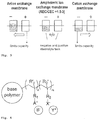
- This allows balancing of the net transport of vanadium ions between the negative and positive electrolyte by optimizing the ratio of cation- to anion exchange groups ( Figure 3 ).
- Figure 10 the capacity fading related to electrolyte imbalances is drastically improved.
- This invention discloses a method to introduce these functionalities into a pre-existing inert polymer base polymer film by means of radiation-induced grafting.
- Radiation grafting is a versatile and scalable technique to modify a polymer substrate by forming a graft copolymer to introduce desirable properties into the material.
- Irradiation of the base polymer film by ionizing radiation (gamma, electrons) introduces active sites, from which in the subsequent grafting reactions polymer chains are grown from a monomer or mixture of monomers amenable to radical induced polymerization.
- the monomer mixture may be a liquid solution or gaseous mixture of monomers and diluent(s).
- Post treatment of the grafted film may be necessary to modify the grafted moieties to obtain the final desired functionalities.
- One ionomer constituent embodies the negatively charged ionogenic constituent, for instance a sulfonic acid group, which upon swelling of the ionomer in water yields mobile protons and a fixed sulfonate anion.
- the density of negatively charged sites determines the cation exchange capacity, which itselfs determines the conductivity of the ionomer.
- Another ionomer constituent embodies a positively charged constituent, or a constituent that is turned into a positively charged moiety when exposed to the electrolyte solution, such as an amine or amidoxime that is protonated.
- the density of positively charged sites determines the anion exchange capacity, which decreases the crossover of vanadium ions, predominantly of vanadium ions with high charge states (being present in the negative electrolyte).
- the membrane may contain several types of blocking units for the different redox active species in the two electrolytes.
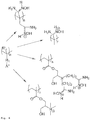
- FIG 4 shows a schematic structure of the graft copolymer consisting of the inert base polymer and grafted functional units.
- a + and X - are ionic groups fixed on the grafts (e.g., - SO 3 - ), B - and Y + the corresponding mobile ions (e.g., H + ).
- n and m are molar fractions of respective monomer units in the grafts and vary between 10 and 90%.
- the presence of the anion exchange groups significantly increases the selectivity of ion transport in the membrane by reducing the crossover of redox-active species while the total conductivity is not or only insignificantly affected.
- the parameters i x and R ⁇ are the V(IV) crossover current density measured in a diffusion cell and the ohmic resistance of the redox flow single cell containing the membrane, respectively. The latter two parameters are a function of the membrane used.
- the electrolyte membrane may contain, in addition to the cation and anion exchange groups, further constituents for specific purposes, such as crosslinker and / or antioxidants.
- these functional groups are introduced into a pre-existing yet inert polymer film by radiation induced graft copolymerzation of suitable monomers amenable to radical polymerization and, if necessary, suitable post-treatments to obtain the final functionalized and ion-conducting membrane.
- the radiation-grafted membrane may be prepared from a variety of base polymer films including fluoropolymers, such as PTFE, FEP, PFA, ETFE, PVDF, PVF, PCTFE, ECTFE, or polyolefins such as PE, PP and their copolymers, or polyamides, or polybenzimidazoles, or polyesters.
- the base polymer film is a partially fluorinated polymer, such as ETFE, PVDF, or ECTFE or copolymers derived from these.
- Figure 5 shows a schematic representation of the structure of the ionogenic groups of the preferred embodiment of this invention.
- Activation of the film is performed using ionizing radiation, such as gamma, hard x-rays, or electron beam.
- the film may be pre-irradiated or simultaneously radiated when the base polymer is exposed to the monomer mixture.
- the irradiated substrate may be stored at reduced temperature and/or under inert atmosphere if the reactive sites are unstable.
- the base polymer film is irradiated in air with a high energy (>100 keV) electron beam.
- the physical form of the monomer for grafting may be as a gas or a liquid, and the monomer may be either pure or diluted with a solvent or inert material and/or as a mixture with one or more additional monomers.
- Any radically active monomer may be used including vinyl, styrenic or acrylic monomers.
- Monomers can be selected according to the properties that are desired for the membranes. To introduce ion exchange groups, monomers having acidic, basic, salt or amphoteric functionality or their precursors may be selected.
- Non-limiting examples of monomers having acidic, basic, amphoteric, or salt functionality include ⁇ -methylstyrene sulfonic acid or a salt thereof, or 2-acrylamido-2-methyl-1-propanesulfonic acid or a salt thereof.
- Monomers that can be used as precursors for the introduction of negatively or positively charged fixed groups may also be used.
- Non-limiting examples include ⁇ -protected styrenic monomers such as ⁇ -methylstyrene, ⁇ -fluorostyrene, ⁇ -bromostyrene, ⁇ -methoxystyrene, or ⁇ , ⁇ , ⁇ -trifluorostyrene, ⁇ -fluorostyrene, 2-methyleneglutaronitrile, methacrylonitrile, glycidylmethacrylate or 1- or 2-(chloromethyl)-4-isopropenylbenzene.
- the grafted polystyrenic chains are derivatized in a subsequent step using methods known in the art to yield acidic, basic, or amphoteric functionalities in the membrane.
- anion-exchange groups can be introduced by means of subsequent amination to yield quaternary ammonium groups
- cation exchange groups can be introduced by treating with strong acids such as chlorosulfonic or sulfuric acids or sulfur trioxide dissolved in halogenated solvents or gaseous sulfur trioxide.
- the monomer is yielding the cation exchange group is ⁇ -methylstyrene, which after grafting is sulfonated in chlorosulfonic acid solution and subsequently hydrolyzed in water to obtain ( ⁇ -methyl)-styrene-sulfonic acid grafts.
- One preferred precursor yielding the anion exchange group is 2-methyleneglutaronitrile, which is functionalized with an amidoximation reaction with hydroxylamine dissolved in a polar organic solvent to yield the amidoxime, which is protonated when exposed to the acidic electrolyte solution to yield induced fixed cationic groups.
- the ratio of the monomers, the cation exchange precursor monomer and the anion exchange precursor co-monomer, in the reaction mixture is adapted to adjust the ratio of the grafted monomer units in the graft copolymer according to the specific copolymerization behavior or the two monomers, which is governed by the radical copolymerization kinetics of the two monomers chosen according to the theory of Mayo and Lewis. Therefore, the tuning of the fraction of ionogenic or precursor comonomer units in the grafts is sensitive to achieve the desired ratio of anion to cation exchange functions in the final ion exchange membrane.
- ⁇ -methylstyrene is co-grafted with 2-methyleneglutaronitrile at a molar ratio of 1.2:1, which yields a molar fraction of ⁇ -methylstyrene and 2-methyleneglutaronitrile in the grafts of around 0.5, respectively.
- the transport properties of vanadium ions can be tuned. In one extreme case, only cation exchange units are present in the grafts, thus the net vanadium transport over extended cycling periods is favored towards the positive electrolyte. In the other extreme case, the grafts contain only anion exchange monomer units.
- additional monomers may be included in the monomer mixture for specific purposes.
- crosslinking monomers such as divinyl benzene, bis(vinyl phenyl)ethane, diisopropenylbenzene, or diacrylates
- monomer units carrying antioxidants may be incorporated into the grafted chain to protect the polymer from oxidative attack.
- ETFE base polymer film (DuPont Tefzel® 100LZ, 25 ⁇ m thickness) was irradiated in air using an MeV class electron beam facility with a dose of 50 kGy and subsequently stored at -80 °C.
- the grafting reaction was performed in glass reactors under nitrogen atmosphere.
- the grafting reaction mixture was composed as follows: 65% (v/v) monomer solution ( ⁇ -methylstyrene/2-methyleneglutaronitrile at a monomer ratio of 1.2/1) + 35% (v/v) dichloromethane. Irradiated films of different sizes (7 ⁇ 7 cm, 15 x 10 cm and 30 x 70 cm) were introduced into the grafting solution.
- the glass reactor containing the grafting solution and the irradiated films was purged with N 2 for 1 h. Then, the reactor was placed in a thermostatic water bath held at 50°C for the duration of the grafting reaction. After removal of the films from the reactor, the grafted films were washed with acetone for 18 h and dried under vacuum at 50°C. The reaction time was adjusted such that a graft level, defined as the weight increase upon grafting with respect to the initial weight of the base polymer film, of around 40 % was obtained.
- Amidoximation of the nitrile groups of the grafted 2-methyleneglutaronitrile (MGN) units was performed in a small glass reactor using 2 M solution of hydroxylamine hydrochloride in 2-methylenepyrolidone/H 2 O (volumetric ratio of 9:1). The pH value of the solution was adjusted to 7 by adding KOH solution. Subsequently, the grafted films were introduced into the prepared solution and placed in a thermostatic water bath at 70°C for 4 hours. FTIR analysis of the samples indicated that, whithin the error of the measurement, the nitrile groups have completely reacted.
- the cation exchange membrane Nafion® NR212 is used as Comparative Example 2.
- the membrane was pretreated by immersion in water or electrolyte depending on the performed analysis.
- the anion exchange membrane Fumatech® FAP-450 is used as Comparative Example 3.
- the membrane was pretreated by immersion in water or electrolyte depending on the performed analysis.
- the membranes were characterized for their key properties in the context of the application in redox flow batteries.
- the ohmic resistance of a redox flow cell is largely influenced by the conductivity of the membrane in the respective electrolyte solution(s). Therefore, the ohmic resistance was measured in an assembled all-vanadium redox flow cell at room temperature comprising carbon felt electrodes (SGL SIGRACELL® GFD4.6 EA) and the respective membrane as polymer electrolyte.
- a redox flow test system (Model 857) by Scribner Associates was used to operate the cell. Both the negative and the positive electrolyte compartment were filled with an aqueous solution containing commercially available (Oxkem, Reading, UK) 1.6 M vanadium sulphate solution (average oxidation state is 3.5) in 2 M H 2 SO 4 and 0.05 M H 3 PO 4 .
- the ohmic area specific resistance R ⁇ of the cell was determined in the uncharged state at open circuit potential from the intercept of the impedance spectrum in Nyquist representation with the real axis at the high frequency end.
- the vanadium ion permeance at room temperature of prepared membranes was determined using self-made diffusion cells consisting of two round bottom flasks separated by the membrane.
- the donor compartment was filled with a 1 M solution of VOSO 4 in 2 M H 2 SO 4 while the receiving one was filled with 1 M solution of MgSO 4 in 2 M H 2 SO 4 . Solutions in both compartments were stirred in order to prevent concentration polarization at the membrane's surface. At regular time intervals the concentration of diffused VO 2+ ions in the receiving compartment was measured using UV-Vis spectroscopy.
- Table 1 shows key properties of membranes for redox flow applications, consisting of the anion and cation exchange capacity, the capacity fading rate, ohmic resistance R ⁇ in the vanadium redox flow cell, the permeance of vanadium(IV) i x (V 4+ ) across the membrane, and the selectivity parameter ⁇ , which comprises the parameters R ⁇ and i x .
- the capacity retention and selectivity parameter ⁇ of the preferred membrane embodiment showing superior characteristics compared to Nafion® NR212 and Fumatech® FAP-450 membranes (Comparative Example 2 and 3) are evident.
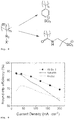
- the round-trip efficiency of the membrane Example 1 and the two comparative Examples 2 and 3 was determined from cycle experiments at different current densities ( Figure 9 ).
- the round-trip efficiency is a product of the coulombic and the voltage efficiency and thus comprises the resistance of the cell and the V-crossover at the same time.
- an improvement of round-trip efficiency of the membrane according to the present invention (Example 1) in comparison to the benchmark materials NR212 (Comparative Example 2) and FAP-450 (Comparative Example 3) is evident.
- the anion exchange membrane FAP-450 shows high efficiencies as well, which however significantly decreases for higher current densities due to the high membrane area resistance.
- the improved selectivity and amphoteric nature of the Example 1 allows high energy efficiencies in the whole range of considered current densities.
- the net volumetric flux of electrolyte across the membrane over extended cycling periods was determined from the electrolyte volume of the discharged electrolyte after each cycle.
- the volumetric flux was accompanied by a net vanadium flux in the same direction and capacity fading resulting from vanadium deficiency in one electrolyte.
- anion and cation exchange capacities in the Example 1 embodiment (with an excess of anion exchange capacity (anion to cation exchange capacity ratio of 1.5-4) the net volumetric flux was significantly decreased and capacity fading due to electrolyte imbalances mitigated (Table 1, Figure 10 ).
Landscapes
- Life Sciences & Earth Sciences (AREA)
- Engineering & Computer Science (AREA)
- Manufacturing & Machinery (AREA)
- Sustainable Development (AREA)
- Sustainable Energy (AREA)
- Chemical & Material Sciences (AREA)
- Chemical Kinetics & Catalysis (AREA)
- Electrochemistry (AREA)
- General Chemical & Material Sciences (AREA)
- Fuel Cell (AREA)
- Manufacture Of Macromolecular Shaped Articles (AREA)
Priority Applications (4)
| Application Number | Priority Date | Filing Date | Title |
|---|---|---|---|
| EP18175340.1A EP3576201A1 (fr) | 2018-05-31 | 2018-05-31 | Membrane électrolytique amphotère et batterie à flux redox comprenant une membrane électrolytique |
| US17/059,661 US11527764B2 (en) | 2018-05-31 | 2019-05-23 | Amphoteric electrolyte membrane with selective and balanced ion transport properties and a redox flow battery comprising an electrolyte membrane |
| PCT/EP2019/063362 WO2019228904A1 (fr) | 2018-05-31 | 2019-05-23 | Membrane électrolyte amphotère à propriétés de transport d'ions sélective et équilibrée et batterie à flux redox comprenant une membrane électrolyte |
| EP19729637.9A EP3804014A1 (fr) | 2018-05-31 | 2019-05-23 | Membrane électrolyte amphotère à propriétés de transport d'ions sélective et équilibrée et batterie à flux redox comprenant une membrane électrolyte |
Applications Claiming Priority (1)
| Application Number | Priority Date | Filing Date | Title |
|---|---|---|---|
| EP18175340.1A EP3576201A1 (fr) | 2018-05-31 | 2018-05-31 | Membrane électrolytique amphotère et batterie à flux redox comprenant une membrane électrolytique |
Publications (1)
| Publication Number | Publication Date |
|---|---|
| EP3576201A1 true EP3576201A1 (fr) | 2019-12-04 |
Family
ID=62495619
Family Applications (2)
| Application Number | Title | Priority Date | Filing Date |
|---|---|---|---|
| EP18175340.1A Withdrawn EP3576201A1 (fr) | 2018-05-31 | 2018-05-31 | Membrane électrolytique amphotère et batterie à flux redox comprenant une membrane électrolytique |
| EP19729637.9A Withdrawn EP3804014A1 (fr) | 2018-05-31 | 2019-05-23 | Membrane électrolyte amphotère à propriétés de transport d'ions sélective et équilibrée et batterie à flux redox comprenant une membrane électrolyte |
Family Applications After (1)
| Application Number | Title | Priority Date | Filing Date |
|---|---|---|---|
| EP19729637.9A Withdrawn EP3804014A1 (fr) | 2018-05-31 | 2019-05-23 | Membrane électrolyte amphotère à propriétés de transport d'ions sélective et équilibrée et batterie à flux redox comprenant une membrane électrolyte |
Country Status (3)
| Country | Link |
|---|---|
| US (1) | US11527764B2 (fr) |
| EP (2) | EP3576201A1 (fr) |
| WO (1) | WO2019228904A1 (fr) |
Cited By (3)
| Publication number | Priority date | Publication date | Assignee | Title |
|---|---|---|---|---|
| CN114744253A (zh) * | 2022-04-01 | 2022-07-12 | 香港科技大学 | 一种抑制全钒液流电池容量衰减及在线恢复容量的方法 |
| FR3123508A1 (fr) * | 2021-05-31 | 2022-12-02 | Arkema France | Membrane echangeuse de protons |
| FR3123507A1 (fr) * | 2021-05-31 | 2022-12-02 | Arkema France | Membrane echangeuse de protons |
Families Citing this family (2)
| Publication number | Priority date | Publication date | Assignee | Title |
|---|---|---|---|---|
| CN117659482B (zh) * | 2023-12-06 | 2024-11-08 | 江苏科润膜材料有限公司 | 一种阴阳离子辐照接枝改性全氟磺酸离子交换膜及其制备方法和应用 |
| CN120109248B (zh) * | 2025-02-25 | 2026-04-21 | 同济大学 | 一种异质聚电解质自组装膜及其制备方法和应用 |
Citations (3)
| Publication number | Priority date | Publication date | Assignee | Title |
|---|---|---|---|---|
| US20080199754A1 (en) * | 2005-02-11 | 2008-08-21 | Paul Scherrer Institut | Method for Preparing a Radiation Grafted Fuel Cell Membrane with Enhanced Chemical Stability and a Membrane Electrode Assembly |
| US20110318644A1 (en) * | 2010-06-29 | 2011-12-29 | Maolin Zhai | Amphoteric ion exchange membranes |
| EP3054518A1 (fr) * | 2015-02-06 | 2016-08-10 | Paul Scherrer Institut | Membrane électrolytique à propriétés de transport ionique sélectif et batterie à flux redox comprenant une membrane électrolytique |
-
2018
- 2018-05-31 EP EP18175340.1A patent/EP3576201A1/fr not_active Withdrawn
-
2019
- 2019-05-23 US US17/059,661 patent/US11527764B2/en active Active
- 2019-05-23 EP EP19729637.9A patent/EP3804014A1/fr not_active Withdrawn
- 2019-05-23 WO PCT/EP2019/063362 patent/WO2019228904A1/fr not_active Ceased
Patent Citations (3)
| Publication number | Priority date | Publication date | Assignee | Title |
|---|---|---|---|---|
| US20080199754A1 (en) * | 2005-02-11 | 2008-08-21 | Paul Scherrer Institut | Method for Preparing a Radiation Grafted Fuel Cell Membrane with Enhanced Chemical Stability and a Membrane Electrode Assembly |
| US20110318644A1 (en) * | 2010-06-29 | 2011-12-29 | Maolin Zhai | Amphoteric ion exchange membranes |
| EP3054518A1 (fr) * | 2015-02-06 | 2016-08-10 | Paul Scherrer Institut | Membrane électrolytique à propriétés de transport ionique sélectif et batterie à flux redox comprenant une membrane électrolytique |
Non-Patent Citations (1)
| Title |
|---|
| W. XIE ET AL., JOURNAL OF THE ELECTROCHEMICAL SOCIETY, vol. 163, no. 1, 2016, pages A5084 - A5089 |
Cited By (6)
| Publication number | Priority date | Publication date | Assignee | Title |
|---|---|---|---|---|
| FR3123508A1 (fr) * | 2021-05-31 | 2022-12-02 | Arkema France | Membrane echangeuse de protons |
| FR3123507A1 (fr) * | 2021-05-31 | 2022-12-02 | Arkema France | Membrane echangeuse de protons |
| WO2022254144A1 (fr) * | 2021-05-31 | 2022-12-08 | Arkema France | Membrane echangeuse de protons |
| WO2022254143A1 (fr) * | 2021-05-31 | 2022-12-08 | Arkema France | Membrane echangeuse de protons |
| CN114744253A (zh) * | 2022-04-01 | 2022-07-12 | 香港科技大学 | 一种抑制全钒液流电池容量衰减及在线恢复容量的方法 |
| CN114744253B (zh) * | 2022-04-01 | 2023-09-29 | 香港科技大学 | 一种抑制全钒液流电池容量衰减及在线恢复容量的方法 |
Also Published As
| Publication number | Publication date |
|---|---|
| US20210210770A1 (en) | 2021-07-08 |
| EP3804014A1 (fr) | 2021-04-14 |
| US11527764B2 (en) | 2022-12-13 |
| WO2019228904A1 (fr) | 2019-12-05 |
Similar Documents
| Publication | Publication Date | Title |
|---|---|---|
| US11527764B2 (en) | Amphoteric electrolyte membrane with selective and balanced ion transport properties and a redox flow battery comprising an electrolyte membrane | |
| US4468441A (en) | Separator membranes for redox-type electrochemical cells | |
| Gubler | Polymer design strategies for radiation‐grafted fuel cell membranes | |
| US4414090A (en) | Separator membranes for redox-type electrochemical cells | |
| JP6293822B2 (ja) | アニオン交換膜及び製造方法 | |
| Li et al. | Ion exchange membranes for vanadium redox flow battery (VRB) applications | |
| US11611084B2 (en) | Bilayer electrolyte membrane and a redox flow battery comprising a bilayer electrolyte membrane | |
| Liao et al. | Fluoro-methyl sulfonated poly (arylene ether ketone-co-benzimidazole) amphoteric ion-exchange membranes for vanadium redox flow battery | |
| WO2016124427A1 (fr) | Membrane à électrolyte ayant des propriétés de transport d'ion sélectif et batterie à flux redox comprenant une membrane à électrolyte | |
| Nibel et al. | Amphoteric ion‐exchange membranes with significantly improved vanadium barrier properties for all‐vanadium redox flow batteries | |
| Sreenath et al. | High-capacity retention thermally reinforced pore-filled anion exchange membrane for all-vanadium flow batteries | |
| Sreenath et al. | Phenolic triamine dangling poly (VDF-co-HFP) anion exchange membrane for all aqueous organic redox flow battery | |
| Kim et al. | Pore-filled anion-exchange membranes for electrochemical energy conversion applications | |
| So et al. | Hydrophilic channel alignment of perfluoronated sulfonic-acid ionomers for vanadium redox flow batteries | |
| Li et al. | Polymer electrolyte membranes prepared by pre-irradiation induced graft copolymerization on ETFE for vanadium redox flow battery applications | |
| Rajput et al. | Styrene-co-DVB grafted PVDF proton exchange membranes for vanadium redox flow battery applications | |
| US20080199754A1 (en) | Method for Preparing a Radiation Grafted Fuel Cell Membrane with Enhanced Chemical Stability and a Membrane Electrode Assembly | |
| US20060166046A1 (en) | Fuel cell incorporating a polymer electrolyte membrane grafted by irradiation | |
| Qiu et al. | Radiation grafting of styrene and maleic anhydride onto PTFE membranes and sequent sulfonation for applications of vanadium redox battery | |
| Swaby et al. | Block copolymer-based membranes for vanadium redox flow batteries: synthesis, characterization, and performance | |
| KR101794320B1 (ko) | 바나듐 레독스 플로우전지용 이온교환성 고분자용 가교제, 상기 가교제에 의해 가교된 바나듐 레독스 플로우전지용 이온전도성 가교 고분자 및 이의 용도 | |
| Wang et al. | Advanced poly (vinyl chloride)-based membranes functionalized with amino compounds for vanadium redox flow batteries | |
| Nasef | Radiation Grafted Ion Conducting Membranes for Electrochemical Energy Systems: Status of Developmental and Upscaled Membranes | |
| Suhag et al. | A new strategy for crosslinking of PVDF-co-HFP by grafting of high molality of amine groups via side carbon chain tuned AEMs for VRFB | |
| WO2013090269A2 (fr) | Rendements en courant améliorés dans des piles à combustible au bromure d'hydrogène réversibles utilisant des dispositifs de séquestration de brome en ligne |
Legal Events
| Date | Code | Title | Description |
|---|---|---|---|
| PUAI | Public reference made under article 153(3) epc to a published international application that has entered the european phase |
Free format text: ORIGINAL CODE: 0009012 |
|
| AK | Designated contracting states |
Kind code of ref document: A1 Designated state(s): AL AT BE BG CH CY CZ DE DK EE ES FI FR GB GR HR HU IE IS IT LI LT LU LV MC MK MT NL NO PL PT RO RS SE SI SK SM TR |
|
| AX | Request for extension of the european patent |
Extension state: BA ME |
|
| STAA | Information on the status of an ep patent application or granted ep patent |
Free format text: STATUS: THE APPLICATION IS DEEMED TO BE WITHDRAWN |
|
| 18D | Application deemed to be withdrawn |
Effective date: 20200605 |