EP3576211A1 - Procédé et système de gestion de bloc-batterie - Google Patents
Procédé et système de gestion de bloc-batterie Download PDFInfo
- Publication number
- EP3576211A1 EP3576211A1 EP17893591.2A EP17893591A EP3576211A1 EP 3576211 A1 EP3576211 A1 EP 3576211A1 EP 17893591 A EP17893591 A EP 17893591A EP 3576211 A1 EP3576211 A1 EP 3576211A1
- Authority
- EP
- European Patent Office
- Prior art keywords
- battery pack
- signal
- communication line
- controller
- identification number
- Prior art date
- Legal status (The legal status is an assumption and is not a legal conclusion. Google has not performed a legal analysis and makes no representation as to the accuracy of the status listed.)
- Granted
Links
Images
Classifications
-
- H—ELECTRICITY
- H01—ELECTRIC ELEMENTS
- H01M—PROCESSES OR MEANS, e.g. BATTERIES, FOR THE DIRECT CONVERSION OF CHEMICAL ENERGY INTO ELECTRICAL ENERGY
- H01M10/00—Secondary cells; Manufacture thereof
- H01M10/42—Methods or arrangements for servicing or maintenance of secondary cells or secondary half-cells
- H01M10/4207—Methods or arrangements for servicing or maintenance of secondary cells or secondary half-cells for several batteries or cells simultaneously or sequentially
-
- B—PERFORMING OPERATIONS; TRANSPORTING
- B60—VEHICLES IN GENERAL
- B60L—PROPULSION OF ELECTRICALLY-PROPELLED VEHICLES; SUPPLYING ELECTRIC POWER FOR AUXILIARY EQUIPMENT OF ELECTRICALLY-PROPELLED VEHICLES; ELECTRODYNAMIC BRAKE SYSTEMS FOR VEHICLES IN GENERAL; MAGNETIC SUSPENSION OR LEVITATION FOR VEHICLES; MONITORING OPERATING VARIABLES OF ELECTRICALLY-PROPELLED VEHICLES; ELECTRIC SAFETY DEVICES FOR ELECTRICALLY-PROPELLED VEHICLES
- B60L58/00—Methods or circuit arrangements for monitoring or controlling batteries or fuel cells, specially adapted for electric vehicles
- B60L58/10—Methods or circuit arrangements for monitoring or controlling batteries or fuel cells, specially adapted for electric vehicles for monitoring or controlling batteries
-
- H—ELECTRICITY
- H01—ELECTRIC ELEMENTS
- H01M—PROCESSES OR MEANS, e.g. BATTERIES, FOR THE DIRECT CONVERSION OF CHEMICAL ENERGY INTO ELECTRICAL ENERGY
- H01M10/00—Secondary cells; Manufacture thereof
- H01M10/42—Methods or arrangements for servicing or maintenance of secondary cells or secondary half-cells
- H01M10/425—Structural combination with electronic components, e.g. electronic circuits integrated to the outside of the casing
-
- B—PERFORMING OPERATIONS; TRANSPORTING
- B60—VEHICLES IN GENERAL
- B60L—PROPULSION OF ELECTRICALLY-PROPELLED VEHICLES; SUPPLYING ELECTRIC POWER FOR AUXILIARY EQUIPMENT OF ELECTRICALLY-PROPELLED VEHICLES; ELECTRODYNAMIC BRAKE SYSTEMS FOR VEHICLES IN GENERAL; MAGNETIC SUSPENSION OR LEVITATION FOR VEHICLES; MONITORING OPERATING VARIABLES OF ELECTRICALLY-PROPELLED VEHICLES; ELECTRIC SAFETY DEVICES FOR ELECTRICALLY-PROPELLED VEHICLES
- B60L50/00—Electric propulsion with power supplied within the vehicle
- B60L50/50—Electric propulsion with power supplied within the vehicle using propulsion power supplied by batteries or fuel cells
- B60L50/60—Electric propulsion with power supplied within the vehicle using propulsion power supplied by batteries or fuel cells using power supplied by batteries
- B60L50/64—Constructional details of batteries specially adapted for electric vehicles
-
- H—ELECTRICITY
- H01—ELECTRIC ELEMENTS
- H01M—PROCESSES OR MEANS, e.g. BATTERIES, FOR THE DIRECT CONVERSION OF CHEMICAL ENERGY INTO ELECTRICAL ENERGY
- H01M10/00—Secondary cells; Manufacture thereof
- H01M10/42—Methods or arrangements for servicing or maintenance of secondary cells or secondary half-cells
- H01M10/4221—Methods or arrangements for servicing or maintenance of secondary cells or secondary half-cells with battery type recognition
-
- H—ELECTRICITY
- H01—ELECTRIC ELEMENTS
- H01M—PROCESSES OR MEANS, e.g. BATTERIES, FOR THE DIRECT CONVERSION OF CHEMICAL ENERGY INTO ELECTRICAL ENERGY
- H01M50/00—Constructional details or processes of manufacture of the non-active parts of electrochemical cells other than fuel cells, e.g. hybrid cells
- H01M50/20—Mountings; Secondary casings or frames; Racks, modules or packs; Suspension devices; Shock absorbers; Transport or carrying devices; Holders
- H01M50/204—Racks, modules or packs for multiple batteries or multiple cells
-
- B—PERFORMING OPERATIONS; TRANSPORTING
- B60—VEHICLES IN GENERAL
- B60L—PROPULSION OF ELECTRICALLY-PROPELLED VEHICLES; SUPPLYING ELECTRIC POWER FOR AUXILIARY EQUIPMENT OF ELECTRICALLY-PROPELLED VEHICLES; ELECTRODYNAMIC BRAKE SYSTEMS FOR VEHICLES IN GENERAL; MAGNETIC SUSPENSION OR LEVITATION FOR VEHICLES; MONITORING OPERATING VARIABLES OF ELECTRICALLY-PROPELLED VEHICLES; ELECTRIC SAFETY DEVICES FOR ELECTRICALLY-PROPELLED VEHICLES
- B60L50/00—Electric propulsion with power supplied within the vehicle
- B60L50/50—Electric propulsion with power supplied within the vehicle using propulsion power supplied by batteries or fuel cells
- B60L50/60—Electric propulsion with power supplied within the vehicle using propulsion power supplied by batteries or fuel cells using power supplied by batteries
-
- B—PERFORMING OPERATIONS; TRANSPORTING
- B60—VEHICLES IN GENERAL
- B60L—PROPULSION OF ELECTRICALLY-PROPELLED VEHICLES; SUPPLYING ELECTRIC POWER FOR AUXILIARY EQUIPMENT OF ELECTRICALLY-PROPELLED VEHICLES; ELECTRODYNAMIC BRAKE SYSTEMS FOR VEHICLES IN GENERAL; MAGNETIC SUSPENSION OR LEVITATION FOR VEHICLES; MONITORING OPERATING VARIABLES OF ELECTRICALLY-PROPELLED VEHICLES; ELECTRIC SAFETY DEVICES FOR ELECTRICALLY-PROPELLED VEHICLES
- B60L58/00—Methods or circuit arrangements for monitoring or controlling batteries or fuel cells, specially adapted for electric vehicles
- B60L58/10—Methods or circuit arrangements for monitoring or controlling batteries or fuel cells, specially adapted for electric vehicles for monitoring or controlling batteries
- B60L58/18—Methods or circuit arrangements for monitoring or controlling batteries or fuel cells, specially adapted for electric vehicles for monitoring or controlling batteries of two or more battery modules
-
- B—PERFORMING OPERATIONS; TRANSPORTING
- B60—VEHICLES IN GENERAL
- B60Y—INDEXING SCHEME RELATING TO ASPECTS CROSS-CUTTING VEHICLE TECHNOLOGY
- B60Y2200/00—Type of vehicle
- B60Y2200/90—Vehicles comprising electric prime movers
- B60Y2200/91—Electric vehicles
-
- H—ELECTRICITY
- H01—ELECTRIC ELEMENTS
- H01M—PROCESSES OR MEANS, e.g. BATTERIES, FOR THE DIRECT CONVERSION OF CHEMICAL ENERGY INTO ELECTRICAL ENERGY
- H01M10/00—Secondary cells; Manufacture thereof
- H01M10/42—Methods or arrangements for servicing or maintenance of secondary cells or secondary half-cells
- H01M10/425—Structural combination with electronic components, e.g. electronic circuits integrated to the outside of the casing
- H01M2010/4271—Battery management systems including electronic circuits, e.g. control of current or voltage to keep battery in healthy state, cell balancing
-
- H—ELECTRICITY
- H01—ELECTRIC ELEMENTS
- H01M—PROCESSES OR MEANS, e.g. BATTERIES, FOR THE DIRECT CONVERSION OF CHEMICAL ENERGY INTO ELECTRICAL ENERGY
- H01M10/00—Secondary cells; Manufacture thereof
- H01M10/42—Methods or arrangements for servicing or maintenance of secondary cells or secondary half-cells
- H01M10/425—Structural combination with electronic components, e.g. electronic circuits integrated to the outside of the casing
- H01M2010/4278—Systems for data transfer from batteries, e.g. transfer of battery parameters to a controller, data transferred between battery controller and main controller
-
- H—ELECTRICITY
- H01—ELECTRIC ELEMENTS
- H01M—PROCESSES OR MEANS, e.g. BATTERIES, FOR THE DIRECT CONVERSION OF CHEMICAL ENERGY INTO ELECTRICAL ENERGY
- H01M2220/00—Batteries for particular applications
- H01M2220/20—Batteries in motive systems, e.g. vehicle, ship, plane
-
- Y—GENERAL TAGGING OF NEW TECHNOLOGICAL DEVELOPMENTS; GENERAL TAGGING OF CROSS-SECTIONAL TECHNOLOGIES SPANNING OVER SEVERAL SECTIONS OF THE IPC; TECHNICAL SUBJECTS COVERED BY FORMER USPC CROSS-REFERENCE ART COLLECTIONS [XRACs] AND DIGESTS
- Y02—TECHNOLOGIES OR APPLICATIONS FOR MITIGATION OR ADAPTATION AGAINST CLIMATE CHANGE
- Y02E—REDUCTION OF GREENHOUSE GAS [GHG] EMISSIONS, RELATED TO ENERGY GENERATION, TRANSMISSION OR DISTRIBUTION
- Y02E60/00—Enabling technologies; Technologies with a potential or indirect contribution to GHG emissions mitigation
- Y02E60/10—Energy storage using batteries
-
- Y—GENERAL TAGGING OF NEW TECHNOLOGICAL DEVELOPMENTS; GENERAL TAGGING OF CROSS-SECTIONAL TECHNOLOGIES SPANNING OVER SEVERAL SECTIONS OF THE IPC; TECHNICAL SUBJECTS COVERED BY FORMER USPC CROSS-REFERENCE ART COLLECTIONS [XRACs] AND DIGESTS
- Y02—TECHNOLOGIES OR APPLICATIONS FOR MITIGATION OR ADAPTATION AGAINST CLIMATE CHANGE
- Y02T—CLIMATE CHANGE MITIGATION TECHNOLOGIES RELATED TO TRANSPORTATION
- Y02T90/00—Enabling technologies or technologies with a potential or indirect contribution to GHG emissions mitigation
- Y02T90/10—Technologies relating to charging of electric vehicles
- Y02T90/16—Information or communication technologies improving the operation of electric vehicles
Definitions
- Embodiments of the present disclosure relate to a method and system for managing battery packs.
- High-capacity battery systems are mounted on electric transportation modes such as electric automobiles, energy storage devices, etc.
- a high-capacity battery system includes one or more battery packs, and a controller such as a BMS manages the one or more battery packs.
- the number of battery packs included in such a high-capacity battery system varies with the purposes of use and applications, and thus, it is problematic to individually set a controller according to the number of battery packs included in each system.
- the present disclosure provides a battery pack management method and system for immediately using battery packs without modifying a controller even when the number of battery packs included in a battery system varies.
- the present disclosure provides a battery pack management method and system for rapidly assigning and managing the identification numbers of battery packs included in a battery system.
- a battery pack management method for a battery management system including at least one battery pack and a controller that are sequentially connected to each other along a first communication line
- the battery pack management method including: initializing the at least one battery pack to bring the at least one battery pack into a first state in which an identification number is settable, the initializing of the at least one battery pack being performed by the controller; determining an identification number of the second battery pack, based on at least one of a first signal and a second signal, the determining of the identification number being performed by the second battery pack; and generating a third signal based on one of the first signal and the second signal and outputting the third signal via the first communication line, the generating and outputting of the third signal being performed by the second battery pack.
- the first signal may be a signal generated and output via the first communication line by the controller
- the second signal may be a signal generated and output via the first communication line by a first battery pack preceding the second battery pack.
- the first signal may include at least one reference pulse, and the generating of the third signal may be performed such that the third signal may include more pulses than one of the first signal and the second signal by a preset number.
- the determining of the identification number may be performed such that the identification number of the second battery pack may correspond to the number of reference pulses in one of the first signal and the second signal.
- the determining of the identification number may be performed based on the second signal which is generated and output via the first communication line by the first battery pack; and the generating and outputting of the third signal may be performed by generating the third signal based on the second signal and outputting the third signal via the first communication line.
- the third signal may be transmitted to the controller.
- the battery pack management method may further include performing a data transmitting/receiving operation in which the controller and the at least one battery pack transmit and receive a fourth signal through a second communication line that is different from the first communication line, based on the determined identification number of the battery pack.
- the second communication line may connect the controller to each of the at least one battery pack.
- the initializing of the at least one battery pack may include deleting an identification number of the at least one battery pack.
- a battery pack management system may include: at least one battery pack sequentially connected along a first communication line; and a controller sequentially connected to the at least one battery pack which is sequentially connected along the first communication line.
- the controller may bring the at least one battery pack into a first state in which an identification number is settable, and a second battery pack may determine an identification number of the second battery pack, based on at least one of a first signal and a second signal, generate a third signal based on one of the first signal and the second signal, and output the third signal via the first communication line, wherein the first signal may be a signal generated and output via the first communication line by the controller, the second signal may be a signal generated and output via the first communication line by a first battery pack preceding the second battery pack, and the at least one battery pack may include the first battery pack and the second battery pack.
- the first signal may include at least one reference pulse
- the second battery pack may generate the third signal in such a manner that the third signal may include more pulses than one of the first signal and the second signal by a preset number.
- the second battery pack may determine the identification number of the second battery pack in such a manner that the identification number of the second battery pack may correspond to the number of reference pulses in one of the first signal and the second signal.
- the second battery pack may determine the identification number of the second battery pack based on the first signal generated and output via the first communication line by the controller, generate the third signal based on the first signal, and output the third signal via the first communication line, and the third signal may be transmitted to a third battery pack which follows and is adjacent to the second battery pack along the first communication line.
- the second battery pack may determine the identification number of the second battery pack based on the second signal generated and output via the first communication line by the first battery pack, generate the third signal based on the second signal, and output the third signal via the first communication line.
- the third signal may be transmitted to the controller.
- the controller may bring the at least one battery pack into a second state in which identification number setting is completed.
- the controller and the at least one battery pack may transmit and receive a fourth signal through a second communication line that is different from the first communication line.
- the second communication line may connect the controller to each of the at least one battery pack.
- a battery pack management method for a battery management system including at least one battery pack and a controller that are sequentially connected to each other along a first communication line
- the battery pack management method including: initializing the at least one battery pack to bring the at least one battery pack into a first state in which an identification number is settable, the initializing of the at least one battery pack being performed by the controller; determining an identification number of the second battery pack, based on at least one of a first signal and a second signal, the determining of the identification number being performed by the second battery pack; and generating a third signal based on one of the first signal and the second signal and outputting the third signal via the first communication line, the generating and outputting of the third signal being performed by the second battery pack.
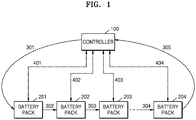
- FIG. 1 is a schematic view illustrating a battery pack management system according to an embodiment of the present disclosure.
- the battery pack management system of the embodiment of the present disclosure may include one or more battery packs 201, 202, 203, and 204, and a controller 100.
- each of the battery packs 201, 202, 203, and 204 of the embodiment of the present disclosure may include a rechargeable unit battery.
- the unit battery may include, for example, a lithium-ion battery, a lithium polymer battery, or the like, but is not limited thereto.
- Each of the battery packs 201, 202, 203, and 204 of the embodiment of the present disclosure may include one or more unit batteries.
- the unit batteries may be connected to each other in series, parallel, or series-parallel.
- the number of unit batteries included in each of the battery packs 201, 202, 203, and 204 and the connection method thereof may be adjusted according to a required output voltage and electricity storage capacity.
- Each of the battery packs 201, 202, 203, and 204 of the embodiment of the present disclosure may include a battery management module (not shown) to manage the unit batteries.
- the battery management module (not shown) may detect the state of at least one unit battery and may transmit the detected state to the controller 100.
- the battery management module (not shown) may check the state of at least one unit battery such as the current, voltage, temperature, remaining electricity, lifespan, or state of charge (SOC) of the unit battery and may transmit results thereof to the controller 100.
- the battery management module (not shown) may be, for example, a cell module controller (CMC).
- CMC cell module controller
- the battery packs 201, 202, 203, and 204 of the embodiment of the present disclosure may be sequentially connected along first communication lines 301 to 305.
- the controller 100 (described later) may also be sequentially connected together with the battery packs 201, 202, 203, and 204 along the first communication lines 301 to 305.
- the expression “sequentially connected” may mean that the battery packs 201, 202, 203, and 204, and the controller 100 are connected to each other one after another as shown in FIG. 1 .
- the first communication lines 301 to 305 may be communication lines for a daisy chain.
- this is an example, and the idea of the present disclosure is not limited thereto.
- the controller 100 of the embodiment of the present disclosure may receive, from the battery packs 201, 202, 203, and 204, information about the state of at least one unit battery of each of the battery packs 201, 202, 203, and 204, and may perform various operations based on the information. For example, the controller 100 performs a function such as overcharge protection, overdischarge protection, overcurrent protection, overvoltage protection, overheat protection, or cell balancing based on the state of at least one unit battery included in each of the battery packs 201, 202, 203, and 204.
- a function such as overcharge protection, overdischarge protection, overcurrent protection, overvoltage protection, overheat protection, or cell balancing based on the state of at least one unit battery included in each of the battery packs 201, 202, 203, and 204.
- controller 100 may check the state of the at least one unit battery such as the current, voltage, temperature, remaining electricity, lifespan, or state of charge (SOC) of the at least one unit battery to determine whether the at least one unit battery is abnormal.
- state of charge SOC
- the controller 100 may include, for example, a battery management system (BMS) or may be a BMS.
- BMS battery management system
- the idea of the present disclosure is not limited thereto, and any device capable of receiving the states of the unit batteries from the battery packs 201, 202, 203, and 204 and performing proper operations according to the states may be used as the controller 100 of the present disclosure without limitations.
- the controller 100 of the embodiment of the present disclosure may be sequentially connected together with the battery packs 201, 202, 203, and 204 along the first communication lines 301 to 305.
- the controller 100 of the embodiment of the present disclosure may be connected to the battery packs 201, 202, 203, and 204 respectively through second communication lines 401 to 404.
- the second communication lines 401 to 404 may be communication lines for controller area network (CAN) communication.
- CAN controller area network
- the controller 100 of the embodiment of the present disclosure may assign identification numbers respectively to the one or more battery packs 201, 202, 203, and 204.
- the controller 100 of the embodiment of the present disclosure may bring the battery packs 201, 202, 203, and 204 into a first state in which it is possible to set identification numbers.
- the controller 100 may transmit a signal corresponding to the change to the first state to the battery packs 201, 202, 203, and 204 through the second communication lines 401 to 404 by a broadcasting method.
- the battery packs 201, 202, 203, and 204 which have received the signal corresponding to the change to the first state from the controller 100, may change their states to the corresponding state, that is, the first state.
- the battery packs 201, 202, 203, and 204 may change to the first state by deleting their present identification numbers.
- the battery packs 201, 202, 203, and 204 may change their identification number items to null to enter into the first state in which setting of new identification numbers is possible.
- a second battery pack in the first state in which setting of identification numbers is possible, may determine its identification number based on at least one of a first signal and a second signal.
- the "second battery pack” may refer to any one of the battery packs 201, 202, 203, and 204, which is to be described.
- the second battery pack may determine a number corresponding to the number of reference pulses in any one of the first signal and the second signal as its identification number.
- the first signal is a signal generated and output via the first communication lines 301 to 305 by the controller 100
- the second signal is a signal generated and output via the first communication lines 301 to 305 by a first battery pack preceding the second battery pack.
- the second battery pack may generate a third signal based on one of the first signal and the second signal and may output the third signal via the first communication lines 301 to 305.
- the second battery pack may generate and output a third signal which has more pulses than one of the first signal and the second signal by a preset number.
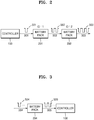
- FIG. 2 is a view illustrating a process in which a second battery pack determines its identification number based on one of a first signal and a second signal and outputs a third signal according to an embodiment of the present disclosure.
- the controller 100 outputs a first signal 501 having a single reference pulse to the first communication line 301.
- the second battery pack determines the number of reference pulses in one of a first signal and a second signal as its identification number, and generates and outputs a third signal having one more pulse than one of the first signal and the second signal.
- the second battery pack 201 may determine "1" as its identification number based on the first signal 501. That is, the second battery pack 201 may determine its identification number to be the same as the number of pulses in the first signal 501. In addition, the second battery pack 201 may generate a third signal 502 having one more reference pulse than the first signal 501 and may output the third signal 502 to the first communication line 302.
- the second battery pack 201 may determine its identification number based on the first signal 501, generate the third signal 502 based on the first signal 501, and output the third signal 502 to the first communication line 302.
- the third signal 502 may be transmitted to a third battery pack 202 which follows and is adjacent to the second battery pack 201 along the first communication line 302.
- the second battery pack 202 may determine "2" as its identification number based on a second signal 502, that is, may determine its identification number to be the same as the number of pulses in the second signal 502.
- the second battery pack 202 may generate a third signal 503 having one more reference pulse than the second signal 502 and may output the third signal 503 to the first communication line 303.
- the second battery pack 202 may determine its identification number based on the second signal 502, generate the third signal 503 based on the second signal 502, and output the third signal 503 to the first communication line 303.
- the third signal 503 may be transmitted to the next adjacent battery pack (not shown).
- a third signal generated by the second battery pack may be transmitted to the controller 100.
- a third signal generated by the last battery pack 204 of the battery packs 201, 202, 203, and 204 may be transmitted to the controller 100.
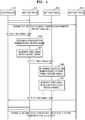
- FIG. 3 is a view illustrating a situation in which the controller 100 follows and is adjacent to a second battery pack 204 according to an embodiment of the present disclosure.
- the second battery pack 204 may determine its identification number based on a second signal 504, generate a third signal 505 based on the second signal 504, and may output the third signal 505 to the first communication line 305.
- the controller 100 since the controller 100 follows and is adjacent to the second battery pack 204, the third signal 505 generated by the second battery pack 204 may be transmitted to the controller 100.
- the controller 100 may bring the battery packs 201, 202, 203, and 204 into a second state based on the third signal 505 because setting of the identification numbers of the battery packs 201, 202, 203, and 204 has been completed.
- the controller 100 may transmit a signal corresponding to the change to the second state to the battery packs 201, 202, 203, and 204 through the second communication lines 401 to 404 by a broadcasting method and/or a unicasting method.
- the battery packs 201, 202, 203, and 204 may change their state to the second state.
- the battery pack management system of the embodiment of the present disclosure may set the identification numbers of the battery packs 201, 202, 203, and 204 in a batch, and thus, a manager of the battery pack management system may save time when setting identification numbers.
- the controller 100 may determine the number of battery packs included in the battery pack management system of the embodiment of the present disclosure by receiving the third signal from the battery pack 204. As described above, since reference pulses are in each signal including the third signal according to a preset rule, the controller 100 may determine the number of battery packs based on the number of reference pulses in the third signal. In this manner, the present disclosure may allow more active management in various system configurations.
- each of the fourth signals may be a signal corresponding to the state of at least one unit battery included in each of the battery packs 201, 202, 203, and 204 as described above, or may be a signal with which the controller 100 controls the battery packs 201, 202, 203, and 204.
- the controller 100 may communicate with a particular one and/or all of the battery packs 201, 202, 203, and 204 by transmitting and receiving signals.
- FIG. 4 is a flowchart illustrating a battery pack management method performed by the battery pack management system shown in FIG. 1 . Detailed descriptions that are the same as those given with reference to FIGS. 1 to 3 are omitted.
- the controller 100 brings the battery packs 201, 202, 203, and 204 into a first state in which identification numbers are settable (S41). At this time, the controller 100 may transmit a signal corresponding to the change to the first state to the battery packs 201, 202, 203, and 204 through the second communication lines 401 to 404 by a broadcasting method.
- the battery packs 201, 202, 203, and 204 may change their state to the first state.
- the battery packs 201, 202, 203, and 204 may change to the first state by deleting their present identification numbers.
- the battery packs 201, 202, 203, and 204 may change their identification number items to null to enter into the first state in which setting of new identification numbers is possible.
- a second battery pack in the first state in which setting of identification numbers is possible, may determine its identification number based on at least one of a first signal and a second signal.
- the "second battery pack” may refer to any one of the battery packs 201, 202, 203, and 204, which is to be described.
- the second battery pack may determine a number corresponding to the number of reference pulses in one of the first signal and the second signal as its identification number.
- the first signal is a signal generated and output via the first communication lines 301 to 305 by the controller 100
- the second signal is a signal generated and output via the first communication lines 301 to 305 by a first battery pack preceding the second battery pack.
- the second battery pack may generate a third signal based on one of the first signal and the second signal and may output the third signal via the first communication lines 301 to 305.
- the second battery pack may generate and output a third signal which has more pulses than one of the first signal and the second signal by a preset number.
- the controller 100 may output the first signal via the first communication lines 301 to 305 (S42).(S42)
- the second battery pack 201 may determine its identification number based on the first signal (S43), generate a third signal based on the first signal (S44), and output the third signal to the first communication line 302 (S45).
- the third signal may be transmitted to a third battery pack 202 which follows and is adjacent to the second battery pack 201 along the first communication line 302.
- the controller 100 outputs a first signal 501 having a single reference pulse to the first communication line 301.
- the second battery pack determines the number of reference pulses in one of a first signal and a second signal as its identification number, and generates and outputs a third signal having one more pulse than one of the first signal and the second signal.
- the second battery pack 201 may determine "1" as its identification number based on the first signal 501. That is, the second battery pack 201 may determine its identification number to be the same as the number of pulses in the first signal 501. In addition, the second battery pack 201 may generate a third signal 502 having one more reference pulse than the first signal 501 and may output the third signal 502 to the first communication line 302.
- a new second battery pack 202 that has received the third signal 502 generated by the second battery pack 201 may determine its own identification number in the same manner as the former second battery pack 201 and may output a third signal based on this.
- the second battery pack 202 may determine its identification number based on a second signal, that is, based on a third signal output by a former second battery pack 201 (S46), generate a third signal based on the second signal (S47), and output the third signal to the first communication line 303.
- the third signal may be transmitted to the next adjacent battery pack (not shown).
- the second battery pack 202 may determine "2" as its identification number based on a second signal 502, that is, may determine its identification number to be the same as the number of pulses in the second signal 502.
- the second battery pack 202 may generate a third signal 503 having one more reference pulse than the second signal 502 and may output the third signal 503 to the first communication line 303.
- a third signal generated by the second battery pack may be transmitted to the controller 100.
- the last battery pack 204 of the battery packs 201, 202, 203, and 204 may output a third signal to the controller 100 (S48).(S48)
- the second battery pack 204 may determine its identification number based on a second signal 504, generate a third signal 505 based on the second signal 504, and may output the third signal 505 to the first communication line 305.
- the controller 100 since the controller 100 follows and is adjacent to the second battery pack 204, the third signal 505 generated by the second battery pack 204 may be transmitted to the controller 100.
- the controller 100 may bring the battery packs 201, 202, 203, and 204 into a second state based on the third signal 505 because setting of the identification numbers of the battery packs 201, 202, 203, and 204 has been completed (S49). At this time, the controller 100 may transmit a signal corresponding to the change to the second state to the battery packs 201, 202, 203, and 204 through the second communication lines 401 to 404 by a broadcasting method and/or a unicasting method. In addition, when the battery packs 201, 202, 203, and 204 receive the signal corresponding to the change to the second state from the controller 100, the battery packs 201, 202, 203, and 204 may change their state to the second state.
- the battery pack management system of the embodiment of the present disclosure may set the identification numbers of the battery packs 201, 202, 203, and 204 in a batch, and thus, a manager of the battery pack management system may save time when setting identification numbers.
- the controller 100 may determine the number of battery packs included in the battery pack management system of the embodiment of the present disclosure by receiving the third signal from the battery pack 204. As described above, since reference pulses are in each signal including the third signal according to a preset rule, the controller 100 may determine the number of battery packs based on the number of reference pulses in the third signal. In this manner, the present disclosure may allow more active management in various system configurations.
- each of the fourth signals may be a signal corresponding to the state of at least one unit battery included in each of the battery packs 201, 202, 203, and 204 as described above, or may be a signal with which the controller 100 controls the battery packs 201, 202, 203, and 204.
- the controller 100 may communicate with a particular one and/or all of the battery packs 201, 202, 203, and 204 by transmitting and receiving signals.
Landscapes
- Engineering & Computer Science (AREA)
- Chemical Kinetics & Catalysis (AREA)
- Electrochemistry (AREA)
- General Chemical & Material Sciences (AREA)
- Chemical & Material Sciences (AREA)
- Manufacturing & Machinery (AREA)
- Microelectronics & Electronic Packaging (AREA)
- Power Engineering (AREA)
- Transportation (AREA)
- Mechanical Engineering (AREA)
- Sustainable Energy (AREA)
- Sustainable Development (AREA)
- Life Sciences & Earth Sciences (AREA)
- Battery Mounting, Suspending (AREA)
- Charge And Discharge Circuits For Batteries Or The Like (AREA)
- Secondary Cells (AREA)
Applications Claiming Priority (2)
| Application Number | Priority Date | Filing Date | Title |
|---|---|---|---|
| KR1020170011137A KR102273785B1 (ko) | 2017-01-24 | 2017-01-24 | 배터리 팩 관리 방법 및 시스템 |
| PCT/KR2017/011888 WO2018139734A1 (fr) | 2017-01-24 | 2017-10-26 | Procédé et système de gestion de bloc-batterie |
Publications (3)
| Publication Number | Publication Date |
|---|---|
| EP3576211A1 true EP3576211A1 (fr) | 2019-12-04 |
| EP3576211A4 EP3576211A4 (fr) | 2020-10-28 |
| EP3576211B1 EP3576211B1 (fr) | 2026-01-21 |
Family
ID=62979669
Family Applications (1)
| Application Number | Title | Priority Date | Filing Date |
|---|---|---|---|
| EP17893591.2A Active EP3576211B1 (fr) | 2017-01-24 | 2017-10-26 | Procédé et système de gestion de bloc-batterie |
Country Status (5)
| Country | Link |
|---|---|
| US (1) | US11431054B2 (fr) |
| EP (1) | EP3576211B1 (fr) |
| KR (1) | KR102273785B1 (fr) |
| CN (1) | CN110226257B (fr) |
| WO (1) | WO2018139734A1 (fr) |
Families Citing this family (2)
| Publication number | Priority date | Publication date | Assignee | Title |
|---|---|---|---|---|
| WO2021001593A1 (fr) * | 2019-07-02 | 2021-01-07 | Wärtsilä Finland Oy | Détermination d'une configuration d'un bloc-batterie |
| CN112550067B (zh) * | 2020-12-10 | 2022-10-04 | 上海金脉电子科技有限公司 | 一种车辆bdu系统 |
Family Cites Families (11)
| Publication number | Priority date | Publication date | Assignee | Title |
|---|---|---|---|---|
| KR101156342B1 (ko) | 2009-08-03 | 2012-06-13 | 삼성에스디아이 주식회사 | 배터리 id 설정 시스템 및 그 구동 방법 |
| KR101649642B1 (ko) | 2010-01-26 | 2016-08-19 | 엘지전자 주식회사 | 배터리 제어 장치 및 그 방법 |
| DE102010002758A1 (de) * | 2010-03-11 | 2011-09-15 | Tridonic Gmbh & Co Kg | Bus-Gebäudetechniksystem mit Daisy-Chain Topologie |
| EP2725715B1 (fr) | 2012-10-29 | 2018-12-12 | Optosys SA | Détecteur de proximité |
| JP5987636B2 (ja) | 2012-10-30 | 2016-09-07 | 三菱自動車エンジニアリング株式会社 | 電源管理装置 |
| JP6070093B2 (ja) * | 2012-11-13 | 2017-02-01 | 三菱自動車工業株式会社 | 電源管理装置 |
| KR101433478B1 (ko) | 2012-12-17 | 2014-09-18 | 넥스콘 테크놀러지 주식회사 | 에너지 저장 시스템용 슬레이브 배터리 관리 시스템에 대한 자동 식별자 설정 방법 |
| KR20150011426A (ko) | 2013-07-22 | 2015-02-02 | 현대모비스 주식회사 | 배터리 관리 시스템 및 그 배터리 센서 id 할당 방법 |
| KR20150033188A (ko) | 2013-09-23 | 2015-04-01 | 삼성에스디아이 주식회사 | 배터리 시스템, 배터리 시스템의 제어 방법 및 이를 포함하는 전력 저장 시스템 |
| US9973011B2 (en) | 2014-02-24 | 2018-05-15 | Lg Chem, Ltd. | Battery management unit and method for setting identifier by using frequency modulation |
| KR101754948B1 (ko) | 2014-10-07 | 2017-07-06 | 주식회사 엘지화학 | 배터리 관리 모듈의 통신 id 할당 방법 및 시스템 |
-
2017
- 2017-01-24 KR KR1020170011137A patent/KR102273785B1/ko active Active
- 2017-10-26 WO PCT/KR2017/011888 patent/WO2018139734A1/fr not_active Ceased
- 2017-10-26 EP EP17893591.2A patent/EP3576211B1/fr active Active
- 2017-10-26 CN CN201780084591.7A patent/CN110226257B/zh active Active
- 2017-10-26 US US16/480,607 patent/US11431054B2/en active Active
Also Published As
| Publication number | Publication date |
|---|---|
| US11431054B2 (en) | 2022-08-30 |
| CN110226257B (zh) | 2022-10-14 |
| KR20180086991A (ko) | 2018-08-01 |
| WO2018139734A1 (fr) | 2018-08-02 |
| CN110226257A (zh) | 2019-09-10 |
| EP3576211B1 (fr) | 2026-01-21 |
| EP3576211A4 (fr) | 2020-10-28 |
| KR102273785B1 (ko) | 2021-07-06 |
| US20190393560A1 (en) | 2019-12-26 |
Similar Documents
| Publication | Publication Date | Title |
|---|---|---|
| US9088052B2 (en) | Battery multi-series system and communication method thereof | |
| US9711977B2 (en) | Battery management system for transmitting secondary protection signal and diagnosis signal using a small number of insulation elements | |
| US11356824B2 (en) | Wireless control system, wireless control method, and battery pack | |
| CN115836425B (zh) | 充电的方法、动力电池的电池管理系统和充电桩 | |
| US9705663B2 (en) | Communication system having synchronized units and synchronization method for units | |
| US11428742B2 (en) | Wireless control system, wireless connection method, and battery pack | |
| KR101583374B1 (ko) | 주파수 변조를 이용하여 식별자를 설정하는 배터리 관리 유닛 및 방법 | |
| KR101613230B1 (ko) | 통신라인에 고장 발생 시 통신 프로토콜을 변경하는 유선통신유닛 및 이를 포함하는 유선통신시스템 | |
| US11431054B2 (en) | Method and system for managing battery pack | |
| US11880264B2 (en) | BMS recognition system and method | |
| US20240332645A1 (en) | Methods of master battery unit and module battery unit management, and battery system |
Legal Events
| Date | Code | Title | Description |
|---|---|---|---|
| STAA | Information on the status of an ep patent application or granted ep patent |
Free format text: STATUS: THE INTERNATIONAL PUBLICATION HAS BEEN MADE |
|
| PUAI | Public reference made under article 153(3) epc to a published international application that has entered the european phase |
Free format text: ORIGINAL CODE: 0009012 |
|
| STAA | Information on the status of an ep patent application or granted ep patent |
Free format text: STATUS: REQUEST FOR EXAMINATION WAS MADE |
|
| 17P | Request for examination filed |
Effective date: 20190702 |
|
| AK | Designated contracting states |
Kind code of ref document: A1 Designated state(s): AL AT BE BG CH CY CZ DE DK EE ES FI FR GB GR HR HU IE IS IT LI LT LU LV MC MK MT NL NO PL PT RO RS SE SI SK SM TR |
|
| AX | Request for extension of the european patent |
Extension state: BA ME |
|
| DAV | Request for validation of the european patent (deleted) | ||
| DAX | Request for extension of the european patent (deleted) | ||
| A4 | Supplementary search report drawn up and despatched |
Effective date: 20200929 |
|
| RIC1 | Information provided on ipc code assigned before grant |
Ipc: H01M 10/42 20060101ALI20200923BHEP Ipc: H01M 2/10 20060101ALI20200923BHEP Ipc: B60L 50/64 20190101ALI20200923BHEP Ipc: B60L 58/10 20190101AFI20200923BHEP |
|
| STAA | Information on the status of an ep patent application or granted ep patent |
Free format text: STATUS: EXAMINATION IS IN PROGRESS |
|
| 17Q | First examination report despatched |
Effective date: 20220301 |
|
| REG | Reference to a national code |
Ref legal event code: R079 Ipc: B60L0058100000 Ref country code: DE Ref document number: 602017093662 Country of ref document: DE Free format text: PREVIOUS MAIN CLASS: H01M0010420000 |
|
| RIC1 | Information provided on ipc code assigned before grant |
Ipc: B60L 58/10 20190101AFI20250711BHEP Ipc: B60L 50/64 20190101ALI20250711BHEP Ipc: H01M 50/204 20210101ALI20250711BHEP Ipc: H01M 10/42 20060101ALI20250711BHEP |
|
| GRAP | Despatch of communication of intention to grant a patent |
Free format text: ORIGINAL CODE: EPIDOSNIGR1 |
|
| STAA | Information on the status of an ep patent application or granted ep patent |
Free format text: STATUS: GRANT OF PATENT IS INTENDED |
|
| INTG | Intention to grant announced |
Effective date: 20250825 |
|
| GRAS | Grant fee paid |
Free format text: ORIGINAL CODE: EPIDOSNIGR3 |
|
| GRAA | (expected) grant |
Free format text: ORIGINAL CODE: 0009210 |
|
| STAA | Information on the status of an ep patent application or granted ep patent |
Free format text: STATUS: THE PATENT HAS BEEN GRANTED |
|
| AK | Designated contracting states |
Kind code of ref document: B1 Designated state(s): AL AT BE BG CH CY CZ DE DK EE ES FI FR GB GR HR HU IE IS IT LI LT LU LV MC MK MT NL NO PL PT RO RS SE SI SK SM TR |
|
| REG | Reference to a national code |
Ref country code: CH Ref legal event code: F10 Free format text: ST27 STATUS EVENT CODE: U-0-0-F10-F00 (AS PROVIDED BY THE NATIONAL OFFICE) Effective date: 20260121 |
|
| REG | Reference to a national code |
Ref country code: IE Ref legal event code: FG4D |
|
| REG | Reference to a national code |
Ref country code: DE Ref legal event code: R096 Ref document number: 602017093662 Country of ref document: DE |