EP3576449B1 - Système et procédé pour communiquer des informations dans un système basé sur la localisation - Google Patents
Système et procédé pour communiquer des informations dans un système basé sur la localisation Download PDFInfo
- Publication number
- EP3576449B1 EP3576449B1 EP19163409.6A EP19163409A EP3576449B1 EP 3576449 B1 EP3576449 B1 EP 3576449B1 EP 19163409 A EP19163409 A EP 19163409A EP 3576449 B1 EP3576449 B1 EP 3576449B1
- Authority
- EP
- European Patent Office
- Prior art keywords
- user
- location
- venue
- information
- venues
- Prior art date
- Legal status (The legal status is an assumption and is not a legal conclusion. Google has not performed a legal analysis and makes no representation as to the accuracy of the status listed.)
- Active
Links
Images





Classifications
-
- H—ELECTRICITY
- H04—ELECTRIC COMMUNICATION TECHNIQUE
- H04W—WIRELESS COMMUNICATION NETWORKS
- H04W4/00—Services specially adapted for wireless communication networks; Facilities therefor
- H04W4/02—Services making use of location information
- H04W4/029—Location-based management or tracking services
-
- G—PHYSICS
- G06—COMPUTING OR CALCULATING; COUNTING
- G06F—ELECTRIC DIGITAL DATA PROCESSING
- G06F3/00—Input arrangements for transferring data to be processed into a form capable of being handled by the computer; Output arrangements for transferring data from processing unit to output unit, e.g. interface arrangements
- G06F3/01—Input arrangements or combined input and output arrangements for interaction between user and computer
- G06F3/048—Interaction techniques based on graphical user interfaces [GUI]
- G06F3/0481—Interaction techniques based on graphical user interfaces [GUI] based on specific properties of the displayed interaction object or a metaphor-based environment, e.g. interaction with desktop elements like windows or icons, or assisted by a cursor's changing behaviour or appearance
-
- G—PHYSICS
- G06—COMPUTING OR CALCULATING; COUNTING
- G06F—ELECTRIC DIGITAL DATA PROCESSING
- G06F9/00—Arrangements for program control, e.g. control units
- G06F9/06—Arrangements for program control, e.g. control units using stored programs, i.e. using an internal store of processing equipment to receive or retain programs
- G06F9/44—Arrangements for executing specific programs
- G06F9/445—Program loading or initiating
- G06F9/44505—Configuring for program initiating, e.g. using registry, configuration files
-
- G—PHYSICS
- G06—COMPUTING OR CALCULATING; COUNTING
- G06F—ELECTRIC DIGITAL DATA PROCESSING
- G06F9/00—Arrangements for program control, e.g. control units
- G06F9/06—Arrangements for program control, e.g. control units using stored programs, i.e. using an internal store of processing equipment to receive or retain programs
- G06F9/44—Arrangements for executing specific programs
- G06F9/451—Execution arrangements for user interfaces
-
- H—ELECTRICITY
- H04—ELECTRIC COMMUNICATION TECHNIQUE
- H04W—WIRELESS COMMUNICATION NETWORKS
- H04W4/00—Services specially adapted for wireless communication networks; Facilities therefor
- H04W4/02—Services making use of location information
-
- G—PHYSICS
- G06—COMPUTING OR CALCULATING; COUNTING
- G06F—ELECTRIC DIGITAL DATA PROCESSING
- G06F3/00—Input arrangements for transferring data to be processed into a form capable of being handled by the computer; Output arrangements for transferring data from processing unit to output unit, e.g. interface arrangements
- G06F3/01—Input arrangements or combined input and output arrangements for interaction between user and computer
- G06F3/011—Arrangements for interaction with the human body, e.g. for user immersion in virtual reality
-
- H—ELECTRICITY
- H04—ELECTRIC COMMUNICATION TECHNIQUE
- H04W—WIRELESS COMMUNICATION NETWORKS
- H04W4/00—Services specially adapted for wireless communication networks; Facilities therefor
- H04W4/02—Services making use of location information
- H04W4/021—Services related to particular areas, e.g. point of interest [POI] services, venue services or geofences
-
- H—ELECTRICITY
- H04—ELECTRIC COMMUNICATION TECHNIQUE
- H04W—WIRELESS COMMUNICATION NETWORKS
- H04W4/00—Services specially adapted for wireless communication networks; Facilities therefor
- H04W4/20—Services signaling; Auxiliary data signalling, i.e. transmitting data via a non-traffic channel
- H04W4/21—Services signaling; Auxiliary data signalling, i.e. transmitting data via a non-traffic channel for social networking applications
Definitions
- location-based services such as the Foursquare system (available on the Internet at http://foursquare.com) permit users to verify their locations using one or more computer systems.
- Some services permit users to use their locations for the purpose of interacting within a social network.
- locations including venues such as businesses, retail locations, points of interest, or other locations.
- a check-in generally includes a process that identifies a user with a particular venue location at a given time, and such check-ins may be recorded over time (e.g. by a location-based social network).
- Such location-based social networks also permit users to interact with friends, find venues of interest, leave comments regarding particular venues, among other functions.
- US 2008/0306826 A1 relates to a system for providing a service to venues where people aggregate.
- the service includes making promoter promotions accessible by the mobile phones of members associated with an organization.
- a promotion and member are matched based on the member's geographical position, which may be reported by the member or determined automatically by a position sensor in their mobile phone, and optionally by the member's traits and behaviors.
- a member may receive reward points which can be used to obtain goods and services.
- members have mobile access to real-time information about the venues, such as the demographics of venue attendees and media posted by attendees concerning venue characteristics.
- US 2013/0080364A1 relates to systems and methods for providing recommendations based on collaborative and/or content-based nodal interrelationships.
- a recommendation generator builds a network of interrelationships between venues, reviewers and users based on their attributes and reviewer and user reviews of the venues.
- Each interrelationship or link may be positive or negative and may accumulate with other links to provide nodal links the strength of which are based on commonality of attributes among the linked nodes and/or common preferences that one node, such as a reviewer, expresses for other nodes, such as venues.
- the recommendation engine determines recommended venues based on user attributes and venue preferences by aggregating the link matrices and determining the venues which are most strongly coupled to the user.
- a system and method that preemptively searches for content on the user's behalf and presents the most interesting content to the user. For instance, it would be beneficial to provide a mobile system that presents interesting local content to users at times when the content is most actionable and engaging without the user explicitly entering a search term or expressing intent.
- aspects of the present invention relates to using contextual signals about a user to rank local content. Signals may include, for example, who they (one or more users) are, what kinds of places they like, where they are, how familiar they are with the area, the time of day, where the user's friends have been nearby, among other information related to the one or more users.
- a system may be provided that uses contextual rules and machine learning to target content to users.
- Conversions in this context may be, for example, actions performed by the user such as the user selecting a piece of content, opening a push notification, or physically going to the location mentioned in the content soon after.
- a process may be provided to pinpoint an actual moment of arrival at a specific venue. It is appreciated that determining an appropriate arrival time to a venue is an opportune moment for delivering contextual content.
- statistical models trained on actual check-in data may be used to predict when a user is actually at a particular location. Typical location-based systems rely on noisy GPS signals and/or conventional outlines of buildings to determine whether a user is located at a particular location. Rather, by using information by the users themselves of where their location is relevant to a meaningful location, a more accurate model may be developed and used by a location-based service for delivering information.
- a model that is trained on check-in data to determine the correct venue when a user has arrived at a particular venue may be used to trigger a context change.
- a change in context may trigger a delivery of information to the user (e.g., via their mobile device).
- the location-based service may determine this location change to determine the user is located at the venue, and along with the knowledge that the user has not previously been at the venue, the location-based service sends the mobile device a notification of the three most popular items on the menu.
- the location-based service sends the user a notification including the "tip" information left by the friend.
- delivery of contextual information to a user on arrival may be beneficial.
- a mobile application has a series of interfaces in which is displayed contextual content to the user. For instance, small interfaces associated with certain targeted content are shown to the user within the mobile application interface. For instance, small interfaces contacting contextual content may be displayed as "cards" within the interface. In one embodiment, such cards may be displayed under a map that shows the user's location. In another example, such contextual information may be sent to users outside of the mobile application as the user and his/her mobile device is located in different areas. Such messages may be sent to the user's mobile device as push notifications.
- a system uses advanced contextual signals such as "familiarity with the area", social signals, the user's last check-in, as well as others. Classifying a user's familiarity with the area or locale may provide a good contextual signal of what types of information should be delivered to the user (e.g., upon arrival to a venue, city, neighborhood, region or other location).
- a location-based service provides one or more contextual based content responses based on a request generated by a user (e.g., by a mobile device).
- a request primarily includes a user identification (e.g., a user ID), a location of the user (e.g., in a latitude/longitude format), and a time at which the measurement was taken (e.g., in a timestamp format).
- the location-based system accesses a variety of user-keyed and geo-keyed databases to construct contextual information based on the location that the location-based service perceives the user is located.
- such contextual information that can be generated may include the name of the city the user is in, how often the user has been there, how far would a typical user travel from their current location to go somewhere next, etc.
- the location-based system evaluates a set of modules, each designed to generate content around a specific vertical (friends, tips, sights, recommendations, trending places, etc).
- Each module has its own set of rules defining under which contexts each module should "trigger.” For example, a "new and notable module” may only be presented to users who are familiar with the region they are in.
- Each module's content output is then evaluated by a ranking algorithm, which then selects a limited number of pieces of content which are predicted to be most engaging to the user. These pieces of content are then delivered to the user as "cards" which are presented at the top of the app, or messages such as push notifications sent to the user.
- a method for periodically delivering content to the user while minimizing processing and battery life impact on a mobile device. For instance, in a device such as a mobile phone that is configured to receive notifications, processes that provide notifications commonly drain battery life during their execution.
- a process is provided that tracks user movement periodically, and delivers content when a contextual change has occurred, thus minimizing the impact on the mobile device.
- One aspect of the invention relates to pinpointing an actual moment of arrival at a specific venue. It is appreciated that there may be a high amount of "noise" as a user moves to different locations, and such noise may not necessarily result in an actual context change.
- One aspect relates to being able to accurately determine when the arrival event occurs, so that contextual content may be delivered at that time. If there is no contextual change, resources can be preserved during the period where the user is not moving, or his/her movement does not result in a context change.
- a location-based system may implement a modeling of places (e.g., venues) and users.
- a user's location may be inferred by using aggregate signals based on a collection of users' check-in data. That is, by using check-in data which ties many users' locations with semantically meaningful locations, a model can be constructed that allows a user to be "placed" in such semantically meaningful locations.
- a system may be provided that uses machine learning techniques to create a model that can map a user's location to semantically meaningful locations.
- a model may be trained using check-in data (e.g., such as check-in data maintained in one or more location-based services such as the well-known Foursquare service provided by Foursquare Labs, Inc.).
- Such training data used to train a model may include, for example, distance, time, point of interest popularity, user history, among other information maintained within a location-based service.
- the process may transition into a wait or sleep mode between periodic tracking. Length of the tracking may be determined as a function of time of day, recent movement, historical performance, or other information. Further, a geofence may be constructed when the user is stationary, and movement of the user outside of the geofence may be monitored to determine a "check-out" of a particular venue. Such processes may be combined with any of the contextual determinations herein to create an efficient system for notifying users of contextual local content.
- Another aspect of the present invention relates to identifying semantically meaningful passive triggers, such as entering neighborhoods or cities, and stopping at venues. Most existing techniques trigger notifications only on a significant location change in the GPS coordinates of a user, which can often in practice feel less tied to real-world actions.
- One aspect of the present invention relates to measuring as precisely as possible when a user has entered and stopped at a specific venue, making the contextual information the user receives seem more relevant and tied to the user's movement.
- One aspect of the invention includes a server-side and client-side component. Both the server and client maintain an exponentially smoothed estimate of the location and speed of the user as well as a history of recent locations. This data can then be used to determine if the client (e.g., a mobile phone) crosses city or neighborhood boundaries, or slows down and stops at a particular venue. When the system detects that one of these passive triggers events has occurred, the system then searches for interesting nearby content, and possibly sends a notification to the user. After the user has stopped, the system may set up a geofence around the user to allow the mobile clients to use less power while the user is stationary.
- the client e.g., a mobile phone
- systems and methods are provided that permit merchants, venue owners, and other entities defined within a location-based system to create content and communicate that content with users. For instance, within traditional location-based networks, users "check-in" to venues and are permitted to search for venues, specials, and other information. However, it would be useful to have additional communication capabilities that permit merchants and other entities to engage users in different ways.
- one or more advertisers, merchants or other entities may be able to send messages to one or more users. For instance, if a user visits a venue more than a certain number of times in total, visits or "checks-in" to that venue over a period of time, indicates that the user follows or "likes" a particular venue or merchant, or performs some other activity with the location-based network, that merchant may be provided a vehicle for sending messages to those users. For instance, it may be beneficial to offer promotions, send advertising messages, or otherwise engage users based on their activity in a location-based system.
- a system may be provided that permits advertisers and other providers to create messages that are delivered to a user based on their activity with a location-based system.
- a user may be indicated as one that receives certain types of messages when that user interacts with a particular venue location and/or merchant. For instance, if that user has checked in to a particular venue X number of times, an indication may be set in the location-based system that permits the venue location owner to target messages to that user.
- messages may be sent to a user that merely has an association with the merchant.
- a user may interact with many venues, all capable of targeting messages to the user. Therefore, according to one embodiment, it may be beneficial to enable the messages to be delivered to the user selectively based upon the user's location. So, for instance, if the user is located in San Francisco, but "likes" a coffee shop in Seattle, the user will not be targeted for any communications while the user is not located near the coffee shop in Seattle. In one example, if the user is located within a particular city, town, or other defined area (e.g., a state serviced by the merchant), then the user may be targeted for particular messages from a particular merchant if the user has made the defined activity level with that venue or merchant.
- a particular city, town, or other defined area e.g., a state serviced by the merchant
- the messaging does not require the permission to opt-in or otherwise authorize the communication of messages, but rather the user's activity with the merchant or venue within the location-based system that causes the messaging to occur. Having the capability to target users based on location (e.g., What users are located near my venue?) allows merchants to more access, in a more focused manner, the users that are capable of performing purchases.
- the user need not be located within a particular region to receive messages from a merchant. Rather, the user may be sent any message type by the merchant if that user achieved the particular status or activity level within the location-based system. For instance, if the user checks in to a particular venue location a prescribed number of times, that user can receive messages from the merchant.
- a location-based system may use one or more signals to determine the strength of a relationship between two or more entities to determine whether a communication should occur between those entities. For instance, the location-based system may observer behavior of the user (e.g., over a period of time), and when the user has achieved a certain level of contact with a venue, a communication path may be established between the user and the venue is established by the location-based system. Thus, according to one aspect, strength of location-based system signals may be used to determine the probability of a message.
- This functionality contrasts with typical opt-in users that require a single action to opt-in by the users themselves (e.g., a "Follow” on Twitter) in that the connection is performed by the location-based system, and the connection may be based on a group of activities and not a single user-defined action.
- a number of different capabilities may be provided to a merchant to selectively communicate messages. For instance, in the case of multiple stores or a chain, a capability may be provided to selectively target a group of users associated with specific stores, groups of stores with a region, or an entire chain of stores (or other venue type). For example, with a chain of venues (e.g., stores), capability may be provided to allow the merchant to send updates regarding all venues in the chain or an arbitrary subset of venues within the chain.
- a chain of venues e.g., stores
- user capability e.g., to a merchant
- delegated management capability permits a manager to delegate access to other people (e.g., submanagers) who manage individual venues (or an arbitrary set of venues). These submanagers, who only manage a subset of the National Coffee venues, are permitted only to send updates to customers near the specific venues they manage.
- capabilities are provide to engage users that are online, mobile, or in the venue location. For instance, when just online, users may be provided a control that associates them with the venue or merchant (e.g., a "like" control or other control type that associates a venue, product, manufacturer or content with the user). When mobile, certain venues or merchants may be saved for later access. When at or near the venue location, the user can "check-in" to the venue within a location-based application. Thus, conversion and/or targeting of users at different points is a useful capability to increase conversions.
- a location-based system may be provided that allows users to locate one or more venues based on location, as well as other information (e.g., recommendations by others, where people having similar tastes have been, what is popular, etc.).
- advertising and/or specials may be displayed to a user operating a mobile device, such as a cell phone.
- the mobile device may request (e.g., from a server), a list of recommendations in one or more categories based on the device's location.
- a facility may be provided for merchants, venue owners, and other entities to broadcast messages to particular users. For instance, based on a location of a user within the location-based system, the user may be sent one or more broadcast messages. For example, in one implementation, a user having a device within a certain distance radius of a venue may be targeted for a particular broadcast message. Such messages may include general communications, advertisements, specials, offers, or other information capable of being communicated through a location-based network. Such messages may be communicated in a mobile application, such as a location-based service application. In some instances, merchants may want to proactively communicate with users when the user has not opened the mobile application.
- the location-based service executes a background process that provides messaging functions when the application is not operating.
- a user may be alerted of a message in an interface (e.g., of a mobile phone) when the user enters a geographic area with which a message is associated.
- information associated with the user is used to determine whether a message is targeted to the user.
- venue locations where the user has previously visited may influence what messages may be sent to that user.
- a location-based service may store information for each particular user, including preference information identifying preferences of particular venues the user has visited (e.g., "tips"). Further, the location-based service may store preferences for venues that the user has not yet visited (e.g., "to do” information).
- information associated with other users in the location-based system may be used to determine whether a message is targeted to the user. For instance, for users that are the current users "friends," information regarding what venues those users have visited, their preferences for particular venues, and preferences for venues that they have not visited may be used to influence what messages may be displayed to the current user. Other users not in the current user's network may also be used to determine what messages are displayed. For instance, particular messages may be determined as more popular and/or have higher quality ratings as determined by other users, specific groups of users, or the entire network itself.
- tools may be provided to merchants to communicate messages to users of the location-based service.
- additional tools may be provided to promote items within the location-based service.
- Such items may be displayed more prominently within lists (e.g., of recommendations), appear within certain areas of a location-based service application interface (e.g., near a top portion of the interface), be displayed as notifications both within the application and as a notification when the application is not active, and be displayed responsive to certain user actions (e.g., after a check-in, opening the application, performing a search, etc.), among other display methods.
- Items that can be "promoted” include venues, advertisements, specials, offers, messages as discussed above, or any other item within the location-based service.
- a search engine associated with a location-based service may provide information based on one or more inputs provided by a user (e.g., via an interface of a mobile device). For instance, a user may be located at a particular location and that user decides he/she would like to purchase food. That user may also provide more specific information (e.g., the keyword "thai") although the user could be less specific and just specify a category such as "food.” In one implementation, the user may select a control on the mobile device (e.g., a button) that specifies the category "food” or lists a number of categories of interest (e.g., in a menu structure).
- a control on the mobile device e.g., a button
- the user may not want to travel past a certain distance, so the interface may permit the user to enter a distance limitation to the search along with the user's current location.
- the search engine may use any parameters provided by the user and the system (e.g., location of the user in latitude/longitude, altitude, etc.) to determine a list of venues to recommend to a user. Further, based on these user inputs, searches, venue choices or other activities within the location-based service, one or more messages may be displayed to the user.
- a location-based system may use an adjustable boundary of a geographical area in which to trigger a display of messages to a particular user responsive to an action performed by a user in a location-based service.
- the geographic area may be determined by a user (e.g., located within 1 mile of a particular venue, within the San Francisco area, within 200 feet of any store of the chain, etc.).
- the boundary of search may be adjusted based on the density of venues within a particular area. For instance, from a particular geographic point, a radius from the geographic point may be adjusted to achieve a particular venue density within a circular area.
- the boundary can be adjusted based on other criteria, such as a determination of how far other users have tended to travel from the point the current user is located when the a query was made.
- a circle may be used as a boundary, other boundary types and shapes may be used (e.g., square, rectangle, displayed map area, town, or similar boundary).
- "noisy" location signals may be used as an input to a trained model to infer when a user is located at a particular location, including a city, town, neighborhood, venue or other location of interest.
- a method for presenting information to a user in a computer system comprises acts of determining an identity of the user in the system; determining, for the user, the location of a mobile device of the user; periodically determining a context of the user, and responsive to the determination of the context, determining contextual content to display to the user; and displaying the contextual content to the user in a display of the mobile device.
- the method further comprises an act of determining movement of the mobile device of the user.
- the method further comprises an act of determining whether there is a context change of the user responsive to movement of the mobile device of the user.
- the method further comprises an act of logging a historical display of contextual information to the user in the display of the mobile device.
- the method further comprises an act of logging a historical selection of contextual information by the user in the display of the mobile device. In one embodiment, the method further comprises an act of determining, by a plurality of modules each associated with a designated content type, contextual content for display to the user. In one embodiment, the method further comprises an act of ranking the respective contextual content of the plurality of modules. In one embodiment, the method further comprises an act of displaying the highest ranked contextual content to the user in the display of the mobile device. In one embodiment, the act of displaying the highest ranked contextual content to the user in the display of the mobile device includes displaying the contextual content in at least one of a stream of content within a location-based service application and a notification pushed to the mobile device.
- the method further comprises an act of determining the context change of the user based on an arrival of the user at a venue. In one embodiment, the method further comprises an act of determining the arrival of the user at the venue by a model based on previous check-in data. In one embodiment, the method further comprises an act of determining a confidence score indicating that the user is likely located at the venue, and wherein the act of determining the context includes an act of determining that the user is located at the venue responsive to the confidence score. In one embodiment, the method further comprises an act of determining a time of delivery of contextual information coincident with a determined arrival time of the user at the venue.
- a method for presenting information to a user by a computer system comprises acts of determining, by a mobile device of the user, a change in context; requesting, by the mobile device responsive to a change in context, contextual information for display to the user; receiving the contextual information; and displaying the contextual information to the user in the display of the mobile device.
- the method further comprises an act of performing, by the mobile device, a sleep operation until a change in context of the user.
- the method further comprises an act of logging a historical display of contextual information to the user in the display of the mobile device.
- the method further comprises an act of logging a historical selection of contextual information by the user in the display of the mobile device.
- the method further comprises an act of determining a classification of a context of a user.
- the classification includes at least one of a group comprising a familiarity of the user to a locale in which the mobile device is located and an arrival classification of the mobile device to the locale.
- the method further comprises an act of ranking the contextual information.
- the act of ranking further comprises an act of determining an expected clickthrough rate for the contextual information.
- the method further comprises an act of determining a plurality of expected clickthrough rates for the contextual information based on different user contexts.
- the method further comprises an act of determining, by a mobile device of the user, whether the change in context is of a significant level to warrant a display of contextual content.
- the method further comprises an act of displaying the highest ranked contextual content to the user in the display of the mobile device.
- the act of displaying the highest ranked contextual content to the user in the display of the mobile device includes displaying the contextual content in at least one of a stream of content within a location-based service application and a notification pushed to the mobile device.
- the method further comprises an act of logging, by the computer system, impressions of the displaying the contextual information to the user on the mobile device.
- the method further comprises an act of logging, by the computer system, conversions of the contextual information to the user on the mobile device.
- the act of logging conversions includes counting selections of the displayed contextual information by the user within the interface of the mobile device.
- the locale includes at least one of a group comprising a venue, a neighborhood, a city, and area, and a location.
- the method further comprises an act of determining the context change of the user based on an arrival of the user at a venue.
- the method further comprises an act of determining the arrival of the user at the venue by a model based on previous check-in data.
- the method further comprises an act of determining a time of delivery of the contextual information coincident with a determined arrival time of the user at the venue.
- a method for determining a semantically meaningful location of a mobile device comprises acts of determining, for a plurality of mobile devices, a plurality of measured locations of the respective plurality of mobile devices; determining, based on user input, a plurality of mappings of semantically meaningful locations to respective measured locations of the plurality of mobile devices; and determining, in another measurement, a new measured location for at least one of the plurality of mobile devices; and determining a semantically meaningful location of the at least one of the plurality of mobile devices based on the new measurement and a model based on the plurality of mappings of semantically meaningful locations to respective measured locations of the plurality of mobile devices.
- the method further comprises acts of determining and communicating contextual information to a user of the at least one of the plurality of mobile devices responsive to the act of determining the semantically meaningful location of the at least one of the plurality of mobile devices.
- the act of determining, based on user input, a plurality of mappings of semantically meaningful locations to respective measured locations of the plurality of mobile devices further comprises an act of performing check-ins within a location-based service.
- the model based on the plurality of mappings of semantically meaningful locations to respective measured locations of the plurality of mobile devices includes information based on the time of the mappings, and wherein the act of determining the semantically meaningful location of the at least one of the plurality of mobile devices is responsive to a measured timestamp associated with the new measured location for the at least one of the plurality of mobile devices.
- the model based on the plurality of mappings of semantically meaningful locations to respective measured locations of the plurality of mobile devices includes information based on a plurality of user identifications associated with each of the respective mappings, and wherein the act of determining the semantically meaningful location of the at least one of the plurality of mobile devices is responsive to a user identification of a user associated with the at least one of the plurality of mobile devices.
- the method further comprises an act of determining a context change of the at least one of the plurality of mobile devices responsive to the act of determining the semantically meaningful location of the at least one of the plurality of mobile devices based on the new measurement and a model based on the plurality of mappings of semantically meaningful locations to respective measured locations of the plurality of mobile devices.
- a distributed system for presenting information to a user comprises a component configured to determine an identity of the user; a component configured to determine, for the user, the location of a mobile device of the user; a component configured to periodically determine a context of the user, and responsive to the determination of the context, determining contextual content to display to the user; and a component configured to transmit the contextual content to the user for display of the mobile device.
- the system further comprises a component configured to determine movement of the mobile device of the user.
- the system further comprises a component configured to determine whether there is a context change of the user responsive to movement of the mobile device of the user.
- the system further comprises a component configured to log a historical display of contextual information to the user in the display of the mobile device. In one embodiment, the system further comprises a component configured to log a historical selection of contextual information by the user in the display of the mobile device. In one embodiment, the system further comprises a plurality of modules each associated with a designated content type, each being configured to determine contextual content for display to the user. In one embodiment, the system further comprises a component configured to rank the respective contextual content of the plurality of modules. In one embodiment, the system further comprises a component configured to display the highest ranked contextual content to the user in the display of the mobile device.
- the system further comprises a component configured to display the contextual content in at least one of a stream of content within a location-based service application and a notification pushed to the mobile device.
- the system further comprises a component configured to determine the context change of the user based on an arrival of the user at a venue.
- the system further comprises a component configured to determine the arrival of the user at the venue by a model based on previous check-in data.
- the system further comprises a component configured to determine a confidence score indicating that the user is likely located at the venue, and a component configured to determine that the user is located at the venue responsive to the confidence score.
- the system further comprises a component configured to determine a time of delivery of contextual information coincident with a determined arrival time of the user at the venue.
- a system for presenting information to a user by a computer system comprises a component configured to determine, by a mobile device of the user, a change in context; a component configured to request, by the mobile device responsive to a change in context, contextual information for display to the user; and a component configured to transmit the contextual information to a mobile device for display of the contextual information to the user.
- the system further comprises a component configured to perform, by the mobile device, a sleep operation until a change in context of the user.
- the system further comprises a component configured to log a historical display of contextual information to the user in the display of the mobile device.
- the system further comprises a component configured to log a historical selection of contextual information by the user in the display of the mobile device.
- the system further comprises a component configured to determine a classification of a context of a user.
- the classification includes at least one of a group comprising a familiarity of the user to a locale in which the mobile device is located and an arrival classification of the mobile device to the locale.
- the system further comprises a component configured to rank the contextual information.
- the system further comprises a component configured to determine an expected clickthrough rate for the contextual information.
- the system further comprises a component configured to determine a plurality of expected clickthrough rates for the contextual information based on different user contexts.
- the system further comprises a component configured to determine, by a mobile device of the user, whether the change in context is of a significant level to warrant a display of contextual content.
- the system further comprises a component configured to display the highest ranked contextual content to the user in the display of the mobile device. In one embodiment, the system further comprises a component configured to display the contextual content in at least one of a stream of content within a location-based service application and a notification pushed to the mobile device. In one embodiment, the system further comprises a component configured to log, by the computer system, impressions of the displaying the contextual information to the user on the mobile device. In one embodiment, the system further comprises a component configured to log, by the computer system, conversions of the contextual information to the user on the mobile device. In one embodiment, the system further comprises a component configured to count selections of the displayed contextual information by the user within the interface of the mobile device.
- the locale includes at least one of a group comprising a venue, a neighborhood, a city, and area, and a location.
- the system further comprises a component configured to determine the context change of the user based on an arrival of the user at a venue.
- the system further comprises a component configured to determine the arrival of the user at the venue by a model based on previous check-in data.
- the system further comprises a component configured to determine a time of delivery of the contextual information coincident with a determined arrival time of the user at the venue.
- a system for determining a semantically meaningful location of a mobile device comprises acts of a component configured to determine, for a plurality of mobile devices, a plurality of measured locations of the respective plurality of mobile devices; a component configured to determine, based on user input, a plurality of mappings of semantically meaningful locations to respective measured locations of the plurality of mobile devices; and a component configured to determine, in another measurement, a new measured location for at least one of the plurality of mobile devices; and a component configured to determine a semantically meaningful location of the at least one of the plurality of mobile devices based on the new measurement and a model based on the plurality of mappings of semantically meaningful locations to respective measured locations of the plurality of mobile devices.
- the system further comprises a component configured to determine and communicate contextual information to a user of the at least one of the plurality of mobile devices responsive to determining the semantically meaningful location of the at least one of the plurality of mobile devices.
- the a component configured to determine, based on user input, a plurality of mappings of semantically meaningful locations to respective measured locations of the plurality of mobile devices is responsive to a component configured to record check-in information within a location-based service.
- the model based on the plurality of mappings of semantically meaningful locations to respective measured locations of the plurality of mobile devices includes information based on the time of the mappings, and wherein the component configured to determine the semantically meaningful location of the at least one of the plurality of mobile devices is responsive to a measured timestamp associated with the new measured location for the at least one of the plurality of mobile devices.
- the model based on the plurality of mappings of semantically meaningful locations to respective measured locations of the plurality of mobile devices includes information based on a plurality of user identifications associated with each of the respective mappings, and wherein the component configured to determine the semantically meaningful location of the at least one of the plurality of mobile devices is responsive to a user identification of a user associated with the at least one of the plurality of mobile devices.
- the system further comprises a component configured to determine a context change of the at least one of the plurality of mobile devices responsive to determining the semantically meaningful location of the at least one of the plurality of mobile devices based on the new measurement and a model based on the plurality of mappings of semantically meaningful locations to respective measured locations of the plurality of mobile devices.
- FIG. 1 shows a block diagram of a location-based service and system suitable for incorporating various aspects of the present invention.
- a location-based service 102 may permit one or more users (e.g., user 101) to interact with one or more other users, systems and services based on their location.
- the user's location may be determined using one or more location-aware devices (e.g., devices 104), such as, for example, a cell phone, smart phone, PDA, tablet computer, laptop or other system.
- the location-based service may provide one or more contextual-based content to the user based on their location, among other information.
- the location-based service may also provide the ability for merchants to target users based upon their activities within the location-based service and to deliver content based on their context.
- such content may be automatically delivered to the user without requiring the user provide any inputs.
- the user may be delivered contextual-based content without needing to perform a search.
- a user might typically navigate a list of venues, select venues on a map, search for venues or recommendations, etc. within a search interface.
- contextual-based content is automatically determined for the user and displayed within the interface (e.g., of a mobile device).
- service 102 may include one or more components. Such components may be implemented using one or more computer systems. In one embodiment, location based service 102 may be implemented on a distributed computer system using one or more communication networks (e.g., the Internet). In one implementation, the service is implemented in a cloud-based computing platform, such as the well-known EC2 platform available commercially from Amazon.com, Seattle, WA. Other implementations are possible and are within the scope and spirit of the invention, and it is appreciated that other platforms may be used.
- Service 102 may include a web server 106 which is capable of serving as a front end to the location-based service 102.
- Devices may communicate and display data provided by service 106 to the user (e.g., user 101).
- devices may include controls that perform various functions in a location-based application (such as one or more of application(s) 108), such as viewing venues proximate to the user's location, reviewing information regarding proximate venues left by other users, communicating with other users, among other functions.
- a location-based application such as one or more of application(s) 108
- viewing venues proximate to the user's location such as viewing venues proximate to the user's location, reviewing information regarding proximate venues left by other users, communicating with other users, among other functions.
- such devices may provide the location of the user to the location-based service 102, and this location information may be used to perform one or more functions.
- One commercially-available system that may be suitable for implementing various aspects of the present invention may include the Foursquare service, available at http://www.foursquare.com and provided by Foursquare Labs, Inc., New York. Other systems capable of providing location-based services are available and are capable of implementing various aspects of the present invention.
- Figure 2 shows a system incorporating various aspects of the present invention.
- a distributed computer system e.g., system 200
- a location-based system e.g., system 203
- Such contextual-based content may be provided to one or more users (e.g., through an interface of a user-facing application of a mobile device).
- Such contextual-based content may be provided to other systems and/or applications that work integrally with location-based service 203.
- a third party system e.g., system 205
- system 205 may be capable of receiving contextual-based content associated with the user from the location-based system.
- Such contextual-based content may be presented to users (e.g., user 201) at or near one or more venue locations (e.g., venue location 202) on one or more location-aware devices (e.g., device 204).
- location-aware devices e.g., device 204
- contextual-based content may be presented and viewed using one or more applications 206 that execute on a location-aware device.
- Device 204 may be any device, system, or item that can be used to locate a user, including a tablet computer (element 204A), smart phone (element 204B), cell phone (204C), personal computer (element 204D), or other system type.
- Location-based service 203 may include, for example, a search engine 211 that receives search information from one or more applications 206, and provides messages to a location-aware device for display to the user.
- Search engine 211 may be capable of accepting one or more parameters such as keywords, distance settings, among others, from the location-aware device and provide a list of venues that satisfy the provided parameters.
- Search engine 211 or any other separate process or element may be capable of ordering and/or ranking the search results based on one or more sets of information stored in a database of the location-based service.
- Contextual-based content may be displayed responsive to any information used in the location-based service, including activity of the user, both active and passive.
- User activity may include, for example, selecting, searching, viewing or navigating in a location-based service application, checking-in at a venue, operating a mobile device within a particular geographic location, operating a "radar" application that shows venues with a range of the user's location, etc.
- contextual-based content may be displayed to a user based on activity of other users (e.g., a friend "liked" a particular message). Also, contextual-based content may be displayed based on only location (e.g., display contextual-based content to users currently located in San Francisco). Further, users may be targeted for receiving contextual-based content based on any other information (e.g., targeting users located in particular areas, or targeting users that meet any other location-based criteria). It should be appreciated that contextual-based content may be sent responsive to any activity or information of the location-based service, either alone or in combination with any activity or information.
- Database 207 may also store one or more messages associated with the location-based service.
- the location-based system may include, a targeted message created within the system.
- the targeted message when matched to a particular query or criteria related to a location-based user, triggered as a result of the users' location or action within the location-based service application, or as a result of other display criteria, may cause the message to be displayed within the interface of the location-based service application.
- Such messages may include contextual-based information within the messages.
- the interface may display any information relating to the location-based message, including, but not limited to text-based messages, photo(s), special or other offer information, or any combination of information.
- database 207 may store popularity information (e.g., information 210) relating to venues defined in the location-based service. For instance, other users not within the current user's social network may also be used to determine what recommendations are displayed. For instance, certain venues may be determined as more popular and/or have higher quality ratings as determined by other users, specific groups of users, or the entire network itself.
- popularity information e.g., information 210
- the user "checks-in" to the location-based service using an application executing on the mobile device, and responsive to the user "checking-in," that user is permitted to receive messages (e.g., having contextual based content) within the location-based service from a particular venue.
- messages e.g., having contextual based content
- Such messages may be delivered to the user at or near a location of the venue where the user "checked in” or where the user is otherwise located.
- a user's location may be determined by a location-aware device.
- the user may be permitted to check in using a number of different applications (e.g., Check-in4Me, 4squareSMS, Foursquare, etc.) into the same location-based service or from another location-based service that shares location and check-in information regarding users.
- applications e.g., Check-in4Me, 4squareSMS, Foursquare, etc.
- application providers may be permitted to receive messages from the location-based service for display to their users. Some applications that do not provide check-in services may still be capable of receiving messaging information from the location-based service.
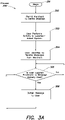
- Figure 3A shows an example process 300 for providing messaging capability to a user according to one embodiment of the present invention.
- process 300 begins.
- the system permits a merchant or other entity to define a message (e.g., including contextual based content).
- This message may have one or more parameters, including information to be communicated to a user.
- the message may also have images, text, photos, information provided by other users regarding the venue, among other information.
- the user performs an activity within the location-based system.
- the user may check in to a venue, operate a location-based application that identifies the user to be located at a particular place or within a region, "liked" or followed a particular venue or chain, operating a map window that shows venues on the map, or any combination of activity may be used to determine when a user is identified to receive messages from the merchant (or venue) at block 304.
- a location-based application that identifies the user to be located at a particular place or within a region, "liked" or followed a particular venue or chain, operating a map window that shows venues on the map, or any combination of activity may be used to determine when a user is identified to receive messages from the merchant (or venue) at block 304.
- messages may be sent responsive to any information used in the location-based service, including user activity such as, for example, selecting, searching, viewing or navigating in a location-based service application, checking-in at a venue, operating a mobile device within a particular geographic location, etc.
- the merchant may be permitted to target particular geographical areas (e.g., within a range of the venue, within a particular area, city, state, or other geographical construct, etc.) to which messages are directed.
- the location-based system delivers the message to the user at block 306.
- the message may be presented to the user within a display of the location-based service application.
- a background process e.g., executing on a mobile device
- the merchant may be permitted to send messages not based on location
- such messages may be sent at certain times or during certain periods as defined by the merchant.
- users may be targeted for messages based on their activity within the location-based network.
- Process 300 may continue indefinitely as the location-based system is executed, and the merchant(s) or other entity(ies) may be permitted to create messages and have them delivered to one or more users.
- users may be provided controls that allow them to control which merchants/venues may send messages.
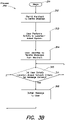
- Figure 3B shows an example process 310 for providing messaging capability to a user according to one embodiment of the present invention.
- process 310 begins.
- the system permits a merchant or other entity to define a message.
- This message may have one or more parameters, including information to be communicated to a user.
- the message may also have images, text, photos, information provided by other users regarding the venue, among other information.
- the user performs an activity within the location-based system.
- the user may check in to a venue, operate a location-based application that identifies the user to be located at a particular place or within a region, "liked" or followed a particular venue or chain, or any combination of activity may be used to determine when a user is identified to receive messages from the merchant (or venue) at block 314.
- Merchants may be permitted to send broadcasts based on one or more criteria, either alone or in combination with other criteria. For instance, a relationship between the user and the merchant or venue may determine whether a particular user receives a message from the merchant or venue (or other location-based service item). For instance, in one implementation, a user's direct engagement with received messages may determine whether that user receives additional messages. For instance, if a user "likes" or comments on a message, selects the "like" or comment, the location-based service may record that action and will show future messages from the merchant, venue, or other location-based service item because the user performed an action relative to that merchant, venue, or item.
- Merchants may also be provided a capability of targeting users, not just based on their location, but also the context. For instance, this would enable a merchant to send a message such as one that directs a message to "anyone stopped at JFK for more than 10 minutes who has a previous history with rental car companies.” In conventional systems, such messages may only be sent based on a particular location. By allowing merchants to define contextual information that leads to a triggering event, finer controls are provided to the merchant to target users more effectively.
- a user may be permitted to send a message to his/her network regarding the message.
- a venue may be having a special that the user would like to broadcast to their friends that are located in his/her neighborhood.
- a facility may be provided within the location-based service for users to communicate messages locally to other users in their social network.
- One parameter includes the user's location in relation to a defined location by the merchant.
- the merchant may define (e.g., within a management interface) a location that, when the user enters or is located within a certain distance of, triggers a condition that would cause a message to be sent or otherwise displayed to the user within a location-based service application. This capability is particular useful for merchants or venue owners that wish to create messages that are viewed by local users.
- One aspect of the present invention relates to surfacing interesting local content for location-based service users at the times when the data is most actionable and engaging. Often there is a large amount of content to choose from, and there are questions of which content should be displayed or is interesting enough to send as a notification to the user.
- the location-based service optimizes a ranking of nearby local content using click-through data.
- one possible implementation includes displaying a series of cards within a mobile interface that includes the contextual information. For instance, when the user initiates an application on his/her mobile device (e.g., a location-based service application), a determination of a user's context is made, a search for relevant content is made by each module, and each of the modules attempt to generate content based on the determined context. A list of possible modules having content is generated, and a ranking function is used to rank the content from the modules and a limited number of the content modules are chosen to display the content within the mobile device interface. In one implementation, this content is displayed within cards.
- a location-based service application e.g., a location-based service application
- a search for relevant content is made by each module, and each of the modules attempt to generate content based on the determined context.
- a list of possible modules having content is generated, and a ranking function is used to rank the content from the modules and a limited number of the content modules are chosen to display the content within the mobile device interface. In one implementation, this content
- the user's behavior related to this content is observed. For instance, if a user selects or "clicks" on the interface, that selection is recorded.
- a feedback loop may be used to determine or learn which modules are the most interesting to the user.
- a machine-learned model may be created that is optimized by user selections which can be then used by the ranking function for later displays of contextual information to the user.
- FIG. 3C shows a block diagram of a system architecture and process that may be used to perform queries in a location-based service according to one embodiment of the present invention.
- process 320 may process a query 321 including a user's location (e.g., as specified by latitude/longitude information), a timestamp, and userid.
- a retrieval is performed using a spatial index which generates a set of candidate venues in which a user may possibly be located.
- a ranking model 325 e.g., a machine learned ranker
- Data including results, features, clicks and check-ins may be logged (e.g., element 330) from the search process and used offline for modeling (e.g., element 327) and optimization (e.g., element 326).
- a user may select a check-in function, and the application may send the user's ID and current location to a location-based server.
- the user ID may be a unique identifier that is used to retrieve the user's history, friends, interests, and other personalized information used for ranking.
- the user's location is reported by the mobile device includes latitude, longitude, and a horizontal accuracy reading.
- a timestamp is generated at query time on the server (e.g., in UTC), and is used to identify historical patterns in the venue popularity for ranking.
- Interface of the location-based application may present the user with a list of nearby locations, along with a map for context.
- the location shown may be chosen based on a variety of factors including their popularity, distance from the user, and compatibility with the user's history.
- the current number of other users checked into each venue may be displayed, which can help give the user an indication of the current popularity of the venues.
- the location which the user is interested may perform an explicit textual query to find the correct venue based on a query search. If the user still cannot find the desired location after a search, they may be offered the option of creating a new venue in the database.
- the venue may be created in the database and made available to users for check-in.
- Each check-in to a venue helps define exactly where a place is on the surface of the earth. Despite each individual GPS estimate of thousands of devices of a particular location based on a check-in, an aggregate of these estimates may provide an accurate picture of the venue.
- the spatial model may be used to evaluate the probability that a set of location coordinates belongs to a specific venue.
- a confidence score (or probability) may be used to determine whether a current location of a user is located at the specific venue per the spatial model.
- a mean value may be calculated for a latitude and longitude of the venue from a set of check-in data.
- a probabilistic model may be created for the shape of a particular venue based on such check-ins.
- this temporal signal may be defined as the probability that a check-in at a venue happens at a specific hour of the week, and estimate this probability using maximum likelihood: P t
- ⁇ # of check ⁇ ins at wh t total # of check ⁇ ins , where wh( t ) is the hour of the week corresponding to time t .
- This signal is vital for distinguishing between venues which are close in distance but popular at different times, for example a bar that is next to a bakery.
- a variety of real-time signals may also be calculated about venues as well.
- An exponential moving average of check-ins/day may be used to measure the current popularity of venues. A count of the number of people who are currently checked into the venue may also be determined and may be defined as those users who have been at the venue less than several hours and have not yet checked into another place.
- FIG. 4 shows an example process 400 for processing and serving contextual based information to a mobile user according to one embodiment of the present invention.
- a server-based process of a location based service logs displays of contextual information to the user at a mobile device.
- the process or module referred to herein as a "radar" module, uses the location of the user, his/her identity along with other information to determine contextual based content to be displayed.
- the process may collect identification information for the user (e.g., a user ID), and other information based on the user's location, movement, among other information.
- the service may determine a context of the user based on the information collected.
- a log of information displayed to the user may be recorded, along with the selection of contextual information.
- a model may be periodically updated for the user based on these impressions and conversions (e.g., selections). For instance, the model may be updated daily, nightly, based on usage, or based on some other periodic manner or user criteria.
- sequence files may be stored and maintained for the user that includes these impressions and selections (e.g., in a stitched file format with impressions and clicks that are associated with each other).
- sequence information may be stored for impressions for a user (e.g., radar module impressions 402 stored as a sequence file), and/or conversions for the user (e.g., selections or clicks of contextual based content by the user stored at radar module clicks 403 as a sequence file).
- a ranking algorithm may show for a certain percentage of the time (e.g., 90%), the location-based service shows content of the modules that maximize predicted engagement. In another percentage of the time (e.g., 10%), the location-based service may perform some other prioritization of module output, such as, for example, randomly ordering module output, inserting one module at random into the list (e.g., with 1-2 others that maximize engagement).
- a mix may be created of module outputs that are predicted to perform the best, and module outputs that are "new" and the user is likely to explore.
- Example 1 Rank modules simply by their expected clickthrough rate (CTR), accounting for standard deviation in cases where there are not many examples. This model could be a single number per module.
- CTR expected clickthrough rate
- Contextual information may be used such as familiarity to improve CTR prediction and better maximize the CTR for the context the user is in.
- One first simple definition of context is a single bucket state based on the user's familiarity with the region and recency of when the user arrived. The context could grow to contain other information about the user, their interactions with past content, and basic quality scores about the content and other features describing how the content is displayed.
- An example of a model using familiarity is shown by way of example in Figure 5 . As shown, a number of contextual categories are determined for the user, and CTR is measured for each bucket based on the user's familiarity with the region and recency of when the user arrived.
- a "Tourist” category may be more interested in seeing content from a "Sights" category, and therefore, based on the location of the user, the user may be determined to be in the Tourist category, and therefore, different contextual content will be shown to this particular user based on location and/or recency of arrival.
- the location-based service logs the context and the ranking signals that went into creating an impression (e.g., a display of contextual information to the user in an interface of the mobile device).
- impressions may be cached into a database when directed message is created and "replayed" when the impression is actually displayed on the client device.
- the first request may be referred to as a "creation request” (e.g., creation within the location-based service) and the second request may be referred to as a "display request” (e.g., a display request generated by the client device for module content).
- the system is capable of logging and keeping track of every time a radar card is shown to the user, and whether or not the user selected that card. For instance, with a logged radar response, the response is uniquely identified by a request ID.
- the response may also contain the context data used to generate cards, performance characteristics, and a list of impressions.
- An impression may be uniquely identified by an impression ID which is generated every time the card is shown to the user.
- the impression data may contain module type information, position shown, and other info about the card.
- the impression data may also contain a field generatedRequestId that identifies all impressions built from the same data but potentially cached and shown multiple times.
- a conversion or "click” may be uniquely defined by a combination of impression ID and a timestamp indicating the time that the content was "converted” (e.g., selected within the interface, later acted on passively, etc.).
- the conversion may also contain more information about the location-based service item that was converted (e.g., a venue, tip, etc.).
- a method for periodically delivering content to the user while minimizing processing and battery life impact on a mobile device.
- a process is provided that tracks user movement periodically, and delivers content when a contextual change has occurred, thus minimizing the impact on the mobile device.
- Figure 6 shows an example process 600 that delivers contextual information periodically to the user.
- process 600 begins.
- the location, speed, and acceleration is determined for the user's mobile device. For instance, such information may be determined based on the change location over time of the device is determined through GPS, WiFi triangulation, and/or combinations of these and other methods.
- the change of location of them mobile devices is determined whether the change of location of them mobile devices significant. For instance, it is appreciated that if the location of the device is not changed, the users context is not changed as well, and therefore there may not be a need to deliver new content.
- a monitoring process that monitors the user's location may perform a delay or sleep operation (e.g., at block 607), and after a predefined amount of time, the process may determine whether there is any change in the user's location. If it is determined that the user's location change is significant, the process will determine content to be displayed to the user (e.g., in the display of mobile device). As discussed, content may be determined by one or more modules that determine the users locational context, and deliver content based on the context.
- the location-based service may issue a notification to the user's mobile device to display the selected content. As discussed above, such content may be displayed within an interface of a location-based application or sentence notifications directly to the user's mobile device.
- Such a process may be combined with any of the contextual determinations herein to create an efficient system for notifying users of contextual local content.
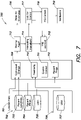
- Figure 7 shows a block diagram of another example process for delivering content to a mobile device according to one embodiment of the present invention.
- the location of the user's mobile device in association with other information may be used to determine an efficient delivery of contextual content to user's mobile device.
- a distributed process 700 uses a current location information 701 relating to the device along with historical information to determine whether a contextual change exists (e.g., at block 709).
- Other information such as the speed and acceleration of the mobile device may determine whether a context change exists for the user. For instance, at block 713 it may be determined that too fast such that a delivery of information is not likely to result in a conversion.
- a process looks for content to display the user (e.g., at block 717).
- high quality content is determined for the user based on the users context and displayed to the user on the display of mobile device or sentence and notification to the user's mobile device (e.g., at block 719).
- Information related to location changes, impressions, click-throughs, and other activity is logged to the system (e.g., stored in a database, file or other storage structure), and the process exits (at block 715).
- historical information may be stored within a database (e.g., database 702), including but not limited to, recent locations 703, recent pings (or notifications) 704 and any other information that can be stored in a database relating to a location-based user.
- database 702 e.g., database 702
- User Region Aggregation (URA) 707 may be determined for a geographical area (e.g., a city) based on public checkin counts, passive day counts, among other information for that user to determine familiarity of that user for venues, locations, and other items. Such information may be aggregated for periods of time, and updated periodically (e.g., daily, nightly, etc.).
- User Region History (URH) 705 may be stored historically for each user, and records, in real-time, the historical behavior of that user within the region over time.
- the location-based service may record over a predetermined time whether the user was in a particular region (e.g., by measuring checkins, or passive monitoring).
- Measurement of URA drives familiarity for that user e.g., whether they are classified as a tourist, local, or familiar
- URH drives arrival e.g., whether the user is classified as just-arrived, here-often. Such information may be used to rank and/or determine when particular content types are displayed to the user.
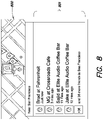
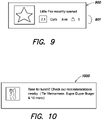
- Figure 9 shows another example interface according to various embodiments of the present invention.
- a card may be created for a "Recently Opened" item, there may be a template card in which contextual content may be inserted and displayed to the user.
- interface 900 may include one or more areas to include content (e.g., "Little Fox recently opened”).
- the card may also include a number of other information items 901 regarding the context that might be interesting to the user, such as, for example, the type of venue recently opened, how far away the venue is located, the user rating of the venue, how many people are currently checked in to the venue, among other information.
- the card may be displayed in association with a map showing the present user location.
- the cards may be arranged in a stream of display items, with most recent items displayed at or near the top of the stream.
- FIG 10 shows another example interface according to one embodiment of the present invention.
- a card may be created for a "Recently Mealtime Suggestions" item, there may be a template card in which contextual content may be inserted and displayed to the user.
- This particular card may be triggered by a module that is time dependent, and may trigger certain predefined content such as 'Time for Lunch? Check out recommendations nearby," "Time for Dinner? ", among other messages which may be keyed to the time of the day that they are triggered.
- certain venues may be suggested to the user (e.g., as determined by a ranking function that may determine the best venues by distance, rating, whether the user visited and/or commented on the venue, among other location-based service criteria.
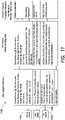
- FIG 11 shows a collection 1100 of example interfaces according to another embodiment of the present invention.
- cards and their contextual data may be aggregated into a single display of a mobile device.
- screen types that have different arrangements of cards depending on the context within the location-based service application.
- the interface may display the detailed information associated with the contextual based content. For instance, when a particular card is selected by the user, venue detail information 1101, list detail information 1102, or tip detail information 1103 may be displayed.
- a “Top Picks” interface may be shown (which may also be a default landing page for the radar process) which includes a number of cards being driven by different contextual content modules. For instance, a "Friends Nearby,” 'Trending Endpoint,” “Suggested Lists,” “Nearby Tip From a Friend” or other type of card may be arranged within the interface.
- target pages may be shown to the user that includes a full set of relevant nearby data for that particular module. For instance, full lists of relevant nearby data may be shown when the associated page is selected by the user. It should be appreciated that other arrangements of content and pages are possible that can show relevant contextual information for the user.
- Processes and methods associated with various embodiments, acts thereof and various embodiments and variations of these methods and acts, individually or in combination, may be defined by computer-readable signals tangibly embodied on a computer-readable medium, for example, a non-volatile recording medium, an integrated circuit memory element, or a combination thereof.
- the computer-readable medium may be non-transitory in that the computer-executable instructions may be stored permanently or semi-permanently on the medium.
- Such signals may define instructions, for example, as part of one or more programs, that as a result of being executed by a computer, instruct the computer to perform one or more of the methods or acts described herein, and/or various embodiments, variations and combinations thereof.
- One or more portions of the computer system may be distributed across one or more computer systems coupled to a communications network. These computer systems also may be general-purpose computer systems. For example, various aspects of the invention may be distributed among one or more computer systems configured to provide a service (e.g., servers) to one or more client computers, or to perform an overall task as part of a distributed system. For example, various aspects of the invention may be performed on a client-server system that includes components distributed among one or more server systems that perform various functions according to various embodiments of the invention. These components may be executable, intermediate (e.g., IL) or interpreted (e.g., Java) code which communicate over a communication network (e.g., the Internet) using a communication protocol (e.g., TCP/IP).
- a communication network e.g., the Internet
- a communication protocol e.g., TCP/IP
- Various embodiments of the present invention may be programmed using an object-oriented programming language, such as SmallTalk, Java, C++, Ada, or C# (C-Sharp). Other object-oriented programming languages may also be used. Alternatively, functional, scripting, and/or logical programming languages may be used.
- object-oriented programming languages such as SmallTalk, Java, C++, Ada, or C# (C-Sharp).
- Other object-oriented programming languages may also be used.
- functional, scripting, and/or logical programming languages may be used.
- Various aspects of the invention may be implemented in a non-programmed environment (e.g., documents created in HTML, XML or other format that, when viewed in a window of a browser program, render aspects of a graphical-user interface (GUI) or perform other functions).
- GUI graphical-user interface
- Various aspects of the invention may be implemented as programmed or non-programmed elements, or any combination thereof.
- each of the components may reside in one or more locations on the system. For example, different portions of the components of system 200 may reside in different areas of memory (e.g., RAM, ROM, disk, etc.) on one or more computer systems.
- Each of such one or more computer systems may include, among other components, a plurality of known components such as one or more processors, a memory system, a disk storage system, one or more network interfaces, and one or more busses or other internal communication links interconnecting the various components.
- Computer system 1200 also includes one or more input devices 1202, for example, a keyboard, mouse, trackball, microphone, touch screen, and one or more output devices 1201, for example, a printing device, display screen, and/or speaker.
- input devices 1202 for example, a keyboard, mouse, trackball, microphone, touch screen
- output devices 1201 for example, a printing device, display screen, and/or speaker.
- computer system 1200 may contain one or more interfaces (not shown) that connect computer system 1200 to a communication network (in addition or as an alternative to the interconnection mechanism 1205.
- the storage system 1206, shown in greater detail in Fig. 13 typically includes a computer readable and writeable nonvolatile recording medium 1301 in which signals are stored that define a program to be executed by the processor or information stored on or in the medium 1301 to be processed by the program.
- the medium may, for example, be a disk or flash memory.
- the processor causes data to be read from the nonvolatile recording medium 1301 into another memory 1302 that allows for faster access to the information by the processor than does the medium 1301.
- This memory 1302 is typically a volatile, random access memory such as a dynamic random access memory (DRAM) or static memory (SRAM). It may be located in storage system 1206, as shown, or in memory system 1204, not shown.
- DRAM dynamic random access memory
- SRAM static memory
- the computer system may include specially-programmed, special-purpose hardware, for example, an application-specific integrated circuit (ASIC).
- ASIC application-specific integrated circuit
- computer system 1200 is shown by way of example as one type of computer system upon which various aspects of the invention may be practiced, it should be appreciated that aspects of the invention are not limited to being implemented on the computer system as shown in Fig. 12 . Various aspects of the invention may be practiced on one or more computers having a different architecture or components that that shown in Fig. 12 .
- Such a processor usually executes an operating system which may be, for example, the Windows NT, Windows 2000 (Windows ME), Windows XP, Windows Vista or Windows 7 or 8 operating systems available from the Microsoft Corporation, MAC OS X Snow Leopard, MAC OS X Lion operating systems available from Apple Computer, the Solaris Operating System available from Sun Microsystems, iOS Blackberry OS, Windows 7 Mobile or Android OS operating system or UNIX available from various sources. Many other operating systems may be used.
- an operating system which may be, for example, the Windows NT, Windows 2000 (Windows ME), Windows XP, Windows Vista or Windows 7 or 8 operating systems available from the Microsoft Corporation, MAC OS X Snow Leopard, MAC OS X Lion operating systems available from Apple Computer, the Solaris Operating System available from Sun Microsystems, iOS Blackberry OS, Windows 7 Mobile or Android OS operating system or UNIX available from various sources. Many other operating systems may be used.
- One or more portions of the computer system may be distributed across one or more computer systems (not shown) coupled to a communications network. These computer systems also may be general-purpose computer systems. For example, various aspects of the invention may be distributed among one or more computer systems configured to provide a service (e.g., servers) to one or more client computers, or to perform an overall task as part of a distributed system. For example, various aspects of the invention may be performed on a client-server system that includes components distributed among one or more server systems that perform various functions according to various embodiments of the invention. These components may be executable, intermediate (e.g., IL) or interpreted (e.g., Java) code which communicate over a communication network (e.g., the Internet) using a communication protocol (e.g., TCP/IP),
- a communication protocol e.g., TCP/IP
Landscapes
- Engineering & Computer Science (AREA)
- Theoretical Computer Science (AREA)
- Software Systems (AREA)
- General Engineering & Computer Science (AREA)
- Physics & Mathematics (AREA)
- General Physics & Mathematics (AREA)
- Computer Networks & Wireless Communication (AREA)
- Signal Processing (AREA)
- Human Computer Interaction (AREA)
- Information Transfer Between Computers (AREA)
Claims (9)
- Procédé pour traiter des informations de lieu dans un service fondé sur la localisation (203), le procédé comprenant les actions suivantes:recevoir, par un moteur de recherche (211), un ou plusieurs paramètres pour un utilisateur (201), lesdits paramètres comprenant des mots-clés et des paramètres de distance;déterminer, par la machine de recherche (211), une pluralité de lieux sur la base d'un ou plusieurs paramètres;déterminer une liste de lieux recommandés à afficher en classant la pluralité de lieux sur la base d'informations stockées dans une base de données (207) du service fondé sur la localisation (203), lesdites informations comprenant au moins des informations de préférence d'utilisateur (208) indiquant des évaluations d'utilisateur pour des visites précédentes à la pluralité de lieux; etl'affichage de la liste de lieux recommandés et l'affichage d'un élément promu dans la liste de lieux recommandés.
- Procédé selon la revendication 1, dans lequel le ou les paramètres comprennent un emplacement déterminé de l'utilisateur (201).
- Procédé selon les revendications 1 ou 2, dans lequel les informations stockées dans la base de données (207) comprennent en outre des informations de préférence de réseau social (209) pour l'utilisateur (201).
- Procédé selon l'une quelconque des revendications 1 à 3, dans lequel l'acte d'affichage de la liste de lieux recommandés comprend l'affichage de l'élément promu en haut de la liste de lieux recommandés.
- Procédé selon l'une quelconque des revendications 1 à 3, dans lequel l'acte d'affichage de la liste de lieux recommandés comprend l'affichage de la liste de lieux recommandés dans une catégorie désignée particulière.
- Procédé selon l'une quelconque des revendications 1 à 5, dans lequel l'élément promu identifie un lieu au sein du service fondé sur la localisation (203).
- Procédé selon l'une quelconque des revendications 1 à 6, dans lequel le classement de la pluralité de lieux est en outre fondé sur une distance du dispositif mobile (204) à la pluralité de lieux.
- Procédé selon l'une quelconque des revendications 1 à 7, dans lequel l'élément promu est au moins un élément d'un groupe comprenant: un lieu; une publicité; un événement particulier; une offre; un message; et un élément de service fondé sur la localisation.
- Support lisible par ordinateur sur lequel sont stockées des instructions lisibles par machine qui, lorsqu'elles sont exécutées par un processeur, amènent le processeur à mettre en œuvre le procédé selon l'une quelconque des revendications 1 à 8.
Priority Applications (1)
| Application Number | Priority Date | Filing Date | Title |
|---|---|---|---|
| RS20220997A RS63700B1 (sr) | 2013-08-23 | 2014-08-22 | Sistem i postupak za komunikaciju informacija u sistemu za pružanje usluga zasnovanih na lokaciji korisnika |
Applications Claiming Priority (3)
| Application Number | Priority Date | Filing Date | Title |
|---|---|---|---|
| US13/974,708 US20140067901A1 (en) | 2012-07-24 | 2013-08-23 | System and method for contextual messaging in a location-based network |
| EP14838317.7A EP3036929B1 (fr) | 2013-08-23 | 2014-08-22 | Système et procédé de communication d'informations dans un système basé sur la localisation |
| PCT/US2014/052312 WO2015027165A1 (fr) | 2013-08-23 | 2014-08-22 | Système et procédé de communication d'informations dans un système basé sur la localisation |
Related Parent Applications (1)
| Application Number | Title | Priority Date | Filing Date |
|---|---|---|---|
| EP14838317.7A Division EP3036929B1 (fr) | 2013-08-23 | 2014-08-22 | Système et procédé de communication d'informations dans un système basé sur la localisation |
Publications (2)
| Publication Number | Publication Date |
|---|---|
| EP3576449A1 EP3576449A1 (fr) | 2019-12-04 |
| EP3576449B1 true EP3576449B1 (fr) | 2022-09-07 |
Family
ID=52484196
Family Applications (2)
| Application Number | Title | Priority Date | Filing Date |
|---|---|---|---|
| EP14838317.7A Active EP3036929B1 (fr) | 2013-08-23 | 2014-08-22 | Système et procédé de communication d'informations dans un système basé sur la localisation |
| EP19163409.6A Active EP3576449B1 (fr) | 2013-08-23 | 2014-08-22 | Système et procédé pour communiquer des informations dans un système basé sur la localisation |
Family Applications Before (1)
| Application Number | Title | Priority Date | Filing Date |
|---|---|---|---|
| EP14838317.7A Active EP3036929B1 (fr) | 2013-08-23 | 2014-08-22 | Système et procédé de communication d'informations dans un système basé sur la localisation |
Country Status (4)
| Country | Link |
|---|---|
| EP (2) | EP3036929B1 (fr) |
| ES (1) | ES2933179T3 (fr) |
| RS (1) | RS63700B1 (fr) |
| WO (1) | WO2015027165A1 (fr) |
Families Citing this family (4)
| Publication number | Priority date | Publication date | Assignee | Title |
|---|---|---|---|---|
| US20190130448A1 (en) * | 2017-10-27 | 2019-05-02 | Dinabite Limited | System and method for generating offer and recommendation information using machine learning |
| US11747952B1 (en) * | 2019-08-09 | 2023-09-05 | Bottomline Technologies Inc. | Specialization of a user interface using machine learning |
| JP2025528152A (ja) * | 2022-08-12 | 2025-08-26 | シグニファイ ホールディング ビー ヴィ | アンテナモジュールを備える照明器具ドライバ |
| WO2024206696A1 (fr) * | 2023-03-31 | 2024-10-03 | Snap Inc. | Recommandations temporelles basées sur l'emplacement |
Family Cites Families (10)
| Publication number | Priority date | Publication date | Assignee | Title |
|---|---|---|---|---|
| US7441203B2 (en) * | 2003-08-11 | 2008-10-21 | Core Mobility, Inc. | Interactive user interface presentation attributes for location-based content |
| US7593740B2 (en) * | 2004-05-12 | 2009-09-22 | Google, Inc. | Location-based social software for mobile devices |
| US7925995B2 (en) * | 2005-06-30 | 2011-04-12 | Microsoft Corporation | Integration of location logs, GPS signals, and spatial resources for identifying user activities, goals, and context |
| WO2007090133A2 (fr) * | 2006-01-30 | 2007-08-09 | Kramer Jame F | Systeme de prestation de service sur lieux de rencontre |
| US8571514B2 (en) * | 2009-01-28 | 2013-10-29 | Sony Corporation | Mobile device and method for providing location based content |
| US20100331016A1 (en) * | 2009-05-27 | 2010-12-30 | Geodelic, Inc. | Location-based promotion for a mobile communication network |
| US8719198B2 (en) * | 2010-05-04 | 2014-05-06 | Microsoft Corporation | Collaborative location and activity recommendations |
| US20120158472A1 (en) * | 2010-12-21 | 2012-06-21 | Research In Motion Limited | Contextual customization of content display on a communication device |
| US8170971B1 (en) * | 2011-09-28 | 2012-05-01 | Ava, Inc. | Systems and methods for providing recommendations based on collaborative and/or content-based nodal interrelationships |
| EP2771784A4 (fr) * | 2011-10-28 | 2015-06-24 | Intel Corp | Changement entre des contextes opérationnels |
-
2014
- 2014-08-22 EP EP14838317.7A patent/EP3036929B1/fr active Active
- 2014-08-22 ES ES19163409T patent/ES2933179T3/es active Active
- 2014-08-22 RS RS20220997A patent/RS63700B1/sr unknown
- 2014-08-22 WO PCT/US2014/052312 patent/WO2015027165A1/fr not_active Ceased
- 2014-08-22 EP EP19163409.6A patent/EP3576449B1/fr active Active
Also Published As
| Publication number | Publication date |
|---|---|
| EP3036929A1 (fr) | 2016-06-29 |
| EP3036929A4 (fr) | 2017-08-09 |
| EP3036929B1 (fr) | 2019-03-20 |
| ES2933179T3 (es) | 2023-02-02 |
| RS63700B1 (sr) | 2022-11-30 |
| WO2015027165A1 (fr) | 2015-02-26 |
| EP3576449A1 (fr) | 2019-12-04 |
Similar Documents
| Publication | Publication Date | Title |
|---|---|---|
| US20140067901A1 (en) | System and method for contextual messaging in a location-based network | |
| US12380175B2 (en) | Dynamic radius threshold selection | |
| US9898763B1 (en) | Delivering personalized content based on geolocation information in a social graph with sharing activity of users of the open web | |
| US8340691B1 (en) | Confirming a venue of user location | |
| US8370062B1 (en) | Switching between location contexts | |
| US20210125238A1 (en) | Systems and methods for providing content items via a push marketing auction | |
| US10185973B2 (en) | Inferring venue visits using semantic information | |
| US20140032325A1 (en) | System and method for promoting items within a location-based service | |
| US10275530B2 (en) | System and method for communal search | |
| US20170068982A1 (en) | Personalized contextual coupon engine | |
| US20180285827A1 (en) | Distinguishing events of users for efficient service content distribution | |
| US20110173198A1 (en) | Recommendations based on relevant friend behaviors | |
| US20160029368A1 (en) | System and process for location-based information retrieval | |
| US11521238B2 (en) | Method and system for determining fact of visit of user to point of interest | |
| CN106605418A (zh) | 使用基于位置的服务的移动客户端的电力管理 | |
| US20220156788A1 (en) | Method and system for determining fact of visit of user to point of interest | |
| KR20160001847A (ko) | 위치 정보에 기반한 정보 공유 방법 및 장치 | |
| US20230325947A1 (en) | Automatic analysis of digital messaging content method and apparatus | |
| US10823578B1 (en) | Geographical catchment data for electronic displays | |
| US20150142560A1 (en) | Content Delivery Based on Monitoring Mobile Device Usage | |
| EP3576449B1 (fr) | Système et procédé pour communiquer des informations dans un système basé sur la localisation | |
| US20140162694A1 (en) | System and method for communicating information in a location-based system | |
| HK40020059B (en) | System and method for communicating information in a location-based system | |
| HK40020059A (en) | System and method for communicating information in a location-based system |
Legal Events
| Date | Code | Title | Description |
|---|---|---|---|
| PUAI | Public reference made under article 153(3) epc to a published international application that has entered the european phase |
Free format text: ORIGINAL CODE: 0009012 |
|
| STAA | Information on the status of an ep patent application or granted ep patent |
Free format text: STATUS: REQUEST FOR EXAMINATION WAS MADE |
|
| 17P | Request for examination filed |
Effective date: 20190318 |
|
| AC | Divisional application: reference to earlier application |
Ref document number: 3036929 Country of ref document: EP Kind code of ref document: P |
|
| AK | Designated contracting states |
Kind code of ref document: A1 Designated state(s): AL AT BE BG CH CY CZ DE DK EE ES FI FR GB GR HR HU IE IS IT LI LT LU LV MC MK MT NL NO PL PT RO RS SE SI SK SM TR |
|
| REG | Reference to a national code |
Ref country code: HK Ref legal event code: DE Ref document number: 40020059 Country of ref document: HK |
|
| STAA | Information on the status of an ep patent application or granted ep patent |
Free format text: STATUS: EXAMINATION IS IN PROGRESS |
|
| 17Q | First examination report despatched |
Effective date: 20201111 |
|
| GRAP | Despatch of communication of intention to grant a patent |
Free format text: ORIGINAL CODE: EPIDOSNIGR1 |
|
| STAA | Information on the status of an ep patent application or granted ep patent |
Free format text: STATUS: GRANT OF PATENT IS INTENDED |
|
| RIC1 | Information provided on ipc code assigned before grant |
Ipc: H04W 4/029 20180101ALI20220330BHEP Ipc: G06F 9/451 20180101ALI20220330BHEP Ipc: G06F 3/0481 20130101ALI20220330BHEP Ipc: G06F 3/01 20060101ALI20220330BHEP Ipc: H04W 4/021 20180101ALI20220330BHEP Ipc: G06F 9/445 20180101ALI20220330BHEP Ipc: H04W 4/02 20180101ALI20220330BHEP Ipc: H04W 24/00 20090101AFI20220330BHEP |
|
| INTG | Intention to grant announced |
Effective date: 20220421 |
|
| GRAS | Grant fee paid |
Free format text: ORIGINAL CODE: EPIDOSNIGR3 |
|
| GRAA | (expected) grant |
Free format text: ORIGINAL CODE: 0009210 |
|
| STAA | Information on the status of an ep patent application or granted ep patent |
Free format text: STATUS: THE PATENT HAS BEEN GRANTED |
|
| AC | Divisional application: reference to earlier application |
Ref document number: 3036929 Country of ref document: EP Kind code of ref document: P |
|
| AK | Designated contracting states |
Kind code of ref document: B1 Designated state(s): AL AT BE BG CH CY CZ DE DK EE ES FI FR GB GR HR HU IE IS IT LI LT LU LV MC MK MT NL NO PL PT RO RS SE SI SK SM TR |
|
| REG | Reference to a national code |
Ref country code: GB Ref legal event code: FG4D |
|
| REG | Reference to a national code |
Ref country code: CH Ref legal event code: EP Ref country code: AT Ref legal event code: REF Ref document number: 1518057 Country of ref document: AT Kind code of ref document: T Effective date: 20220915 |
|
| REG | Reference to a national code |
Ref country code: IE Ref legal event code: FG4D |
|
| REG | Reference to a national code |
Ref country code: DE Ref legal event code: R096 Ref document number: 602014084908 Country of ref document: DE |
|
| REG | Reference to a national code |
Ref country code: LT Ref legal event code: MG9D |
|
| REG | Reference to a national code |
Ref country code: NL Ref legal event code: MP Effective date: 20220907 |
|
| PG25 | Lapsed in a contracting state [announced via postgrant information from national office to epo] |
Ref country code: SE Free format text: LAPSE BECAUSE OF FAILURE TO SUBMIT A TRANSLATION OF THE DESCRIPTION OR TO PAY THE FEE WITHIN THE PRESCRIBED TIME-LIMIT Effective date: 20220907 Ref country code: NO Free format text: LAPSE BECAUSE OF FAILURE TO SUBMIT A TRANSLATION OF THE DESCRIPTION OR TO PAY THE FEE WITHIN THE PRESCRIBED TIME-LIMIT Effective date: 20221207 Ref country code: LV Free format text: LAPSE BECAUSE OF FAILURE TO SUBMIT A TRANSLATION OF THE DESCRIPTION OR TO PAY THE FEE WITHIN THE PRESCRIBED TIME-LIMIT Effective date: 20220907 Ref country code: LT Free format text: LAPSE BECAUSE OF FAILURE TO SUBMIT A TRANSLATION OF THE DESCRIPTION OR TO PAY THE FEE WITHIN THE PRESCRIBED TIME-LIMIT Effective date: 20220907 Ref country code: FI Free format text: LAPSE BECAUSE OF FAILURE TO SUBMIT A TRANSLATION OF THE DESCRIPTION OR TO PAY THE FEE WITHIN THE PRESCRIBED TIME-LIMIT Effective date: 20220907 |
|
| REG | Reference to a national code |
Ref country code: ES Ref legal event code: FG2A Ref document number: 2933179 Country of ref document: ES Kind code of ref document: T3 Effective date: 20230202 |
|
| REG | Reference to a national code |
Ref country code: AT Ref legal event code: MK05 Ref document number: 1518057 Country of ref document: AT Kind code of ref document: T Effective date: 20220907 |
|
| PG25 | Lapsed in a contracting state [announced via postgrant information from national office to epo] |
Ref country code: HR Free format text: LAPSE BECAUSE OF FAILURE TO SUBMIT A TRANSLATION OF THE DESCRIPTION OR TO PAY THE FEE WITHIN THE PRESCRIBED TIME-LIMIT Effective date: 20220907 Ref country code: GR Free format text: LAPSE BECAUSE OF FAILURE TO SUBMIT A TRANSLATION OF THE DESCRIPTION OR TO PAY THE FEE WITHIN THE PRESCRIBED TIME-LIMIT Effective date: 20221208 |
|
| PG25 | Lapsed in a contracting state [announced via postgrant information from national office to epo] |
Ref country code: SM Free format text: LAPSE BECAUSE OF FAILURE TO SUBMIT A TRANSLATION OF THE DESCRIPTION OR TO PAY THE FEE WITHIN THE PRESCRIBED TIME-LIMIT Effective date: 20220907 Ref country code: RO Free format text: LAPSE BECAUSE OF FAILURE TO SUBMIT A TRANSLATION OF THE DESCRIPTION OR TO PAY THE FEE WITHIN THE PRESCRIBED TIME-LIMIT Effective date: 20220907 Ref country code: PT Free format text: LAPSE BECAUSE OF FAILURE TO SUBMIT A TRANSLATION OF THE DESCRIPTION OR TO PAY THE FEE WITHIN THE PRESCRIBED TIME-LIMIT Effective date: 20230109 Ref country code: CZ Free format text: LAPSE BECAUSE OF FAILURE TO SUBMIT A TRANSLATION OF THE DESCRIPTION OR TO PAY THE FEE WITHIN THE PRESCRIBED TIME-LIMIT Effective date: 20220907 Ref country code: AT Free format text: LAPSE BECAUSE OF FAILURE TO SUBMIT A TRANSLATION OF THE DESCRIPTION OR TO PAY THE FEE WITHIN THE PRESCRIBED TIME-LIMIT Effective date: 20220907 |
|
| PG25 | Lapsed in a contracting state [announced via postgrant information from national office to epo] |
Ref country code: SK Free format text: LAPSE BECAUSE OF FAILURE TO SUBMIT A TRANSLATION OF THE DESCRIPTION OR TO PAY THE FEE WITHIN THE PRESCRIBED TIME-LIMIT Effective date: 20220907 Ref country code: PL Free format text: LAPSE BECAUSE OF FAILURE TO SUBMIT A TRANSLATION OF THE DESCRIPTION OR TO PAY THE FEE WITHIN THE PRESCRIBED TIME-LIMIT Effective date: 20220907 Ref country code: IS Free format text: LAPSE BECAUSE OF FAILURE TO SUBMIT A TRANSLATION OF THE DESCRIPTION OR TO PAY THE FEE WITHIN THE PRESCRIBED TIME-LIMIT Effective date: 20230107 Ref country code: EE Free format text: LAPSE BECAUSE OF FAILURE TO SUBMIT A TRANSLATION OF THE DESCRIPTION OR TO PAY THE FEE WITHIN THE PRESCRIBED TIME-LIMIT Effective date: 20220907 |
|
| REG | Reference to a national code |
Ref country code: DE Ref legal event code: R097 Ref document number: 602014084908 Country of ref document: DE |
|
| PG25 | Lapsed in a contracting state [announced via postgrant information from national office to epo] |
Ref country code: NL Free format text: LAPSE BECAUSE OF FAILURE TO SUBMIT A TRANSLATION OF THE DESCRIPTION OR TO PAY THE FEE WITHIN THE PRESCRIBED TIME-LIMIT Effective date: 20220907 Ref country code: AL Free format text: LAPSE BECAUSE OF FAILURE TO SUBMIT A TRANSLATION OF THE DESCRIPTION OR TO PAY THE FEE WITHIN THE PRESCRIBED TIME-LIMIT Effective date: 20220907 |
|
| PLBE | No opposition filed within time limit |
Free format text: ORIGINAL CODE: 0009261 |
|
| STAA | Information on the status of an ep patent application or granted ep patent |
Free format text: STATUS: NO OPPOSITION FILED WITHIN TIME LIMIT |
|
| PG25 | Lapsed in a contracting state [announced via postgrant information from national office to epo] |
Ref country code: DK Free format text: LAPSE BECAUSE OF FAILURE TO SUBMIT A TRANSLATION OF THE DESCRIPTION OR TO PAY THE FEE WITHIN THE PRESCRIBED TIME-LIMIT Effective date: 20220907 |
|
| 26N | No opposition filed |
Effective date: 20230608 |
|
| PG25 | Lapsed in a contracting state [announced via postgrant information from national office to epo] |
Ref country code: SI Free format text: LAPSE BECAUSE OF FAILURE TO SUBMIT A TRANSLATION OF THE DESCRIPTION OR TO PAY THE FEE WITHIN THE PRESCRIBED TIME-LIMIT Effective date: 20220907 |
|
| PG25 | Lapsed in a contracting state [announced via postgrant information from national office to epo] |
Ref country code: MC Free format text: LAPSE BECAUSE OF FAILURE TO SUBMIT A TRANSLATION OF THE DESCRIPTION OR TO PAY THE FEE WITHIN THE PRESCRIBED TIME-LIMIT Effective date: 20220907 |
|
| REG | Reference to a national code |
Ref country code: CH Ref legal event code: PL |
|
| PG25 | Lapsed in a contracting state [announced via postgrant information from national office to epo] |
Ref country code: MC Free format text: LAPSE BECAUSE OF FAILURE TO SUBMIT A TRANSLATION OF THE DESCRIPTION OR TO PAY THE FEE WITHIN THE PRESCRIBED TIME-LIMIT Effective date: 20220907 |
|
| PG25 | Lapsed in a contracting state [announced via postgrant information from national office to epo] |
Ref country code: LU Free format text: LAPSE BECAUSE OF NON-PAYMENT OF DUE FEES Effective date: 20230822 |
|
| PG25 | Lapsed in a contracting state [announced via postgrant information from national office to epo] |
Ref country code: LU Free format text: LAPSE BECAUSE OF NON-PAYMENT OF DUE FEES Effective date: 20230822 Ref country code: CH Free format text: LAPSE BECAUSE OF NON-PAYMENT OF DUE FEES Effective date: 20230831 |
|
| REG | Reference to a national code |
Ref country code: BE Ref legal event code: MM Effective date: 20230831 |
|
| PG25 | Lapsed in a contracting state [announced via postgrant information from national office to epo] |
Ref country code: BE Free format text: LAPSE BECAUSE OF NON-PAYMENT OF DUE FEES Effective date: 20230831 |
|
| PG25 | Lapsed in a contracting state [announced via postgrant information from national office to epo] |
Ref country code: BG Free format text: LAPSE BECAUSE OF FAILURE TO SUBMIT A TRANSLATION OF THE DESCRIPTION OR TO PAY THE FEE WITHIN THE PRESCRIBED TIME-LIMIT Effective date: 20220907 |
|
| PG25 | Lapsed in a contracting state [announced via postgrant information from national office to epo] |
Ref country code: BG Free format text: LAPSE BECAUSE OF FAILURE TO SUBMIT A TRANSLATION OF THE DESCRIPTION OR TO PAY THE FEE WITHIN THE PRESCRIBED TIME-LIMIT Effective date: 20220907 |
|
| PG25 | Lapsed in a contracting state [announced via postgrant information from national office to epo] |
Ref country code: CY Free format text: LAPSE BECAUSE OF FAILURE TO SUBMIT A TRANSLATION OF THE DESCRIPTION OR TO PAY THE FEE WITHIN THE PRESCRIBED TIME-LIMIT; INVALID AB INITIO Effective date: 20140822 |
|
| PGFP | Annual fee paid to national office [announced via postgrant information from national office to epo] |
Ref country code: IE Payment date: 20250624 Year of fee payment: 12 |
|
| PG25 | Lapsed in a contracting state [announced via postgrant information from national office to epo] |
Ref country code: HU Free format text: LAPSE BECAUSE OF FAILURE TO SUBMIT A TRANSLATION OF THE DESCRIPTION OR TO PAY THE FEE WITHIN THE PRESCRIBED TIME-LIMIT; INVALID AB INITIO Effective date: 20140822 |
|
| PGFP | Annual fee paid to national office [announced via postgrant information from national office to epo] |
Ref country code: ES Payment date: 20250909 Year of fee payment: 12 |
|
| PGFP | Annual fee paid to national office [announced via postgrant information from national office to epo] |
Ref country code: DE Payment date: 20250624 Year of fee payment: 12 |
|
| PGFP | Annual fee paid to national office [announced via postgrant information from national office to epo] |
Ref country code: IT Payment date: 20250722 Year of fee payment: 12 |
|
| PGFP | Annual fee paid to national office [announced via postgrant information from national office to epo] |
Ref country code: GB Payment date: 20250703 Year of fee payment: 12 |
|
| PGFP | Annual fee paid to national office [announced via postgrant information from national office to epo] |
Ref country code: FR Payment date: 20250703 Year of fee payment: 12 |
|
| PGFP | Annual fee paid to national office [announced via postgrant information from national office to epo] |
Ref country code: RS Payment date: 20250811 Year of fee payment: 12 |
|
| PG25 | Lapsed in a contracting state [announced via postgrant information from national office to epo] |
Ref country code: TR Free format text: LAPSE BECAUSE OF FAILURE TO SUBMIT A TRANSLATION OF THE DESCRIPTION OR TO PAY THE FEE WITHIN THE PRESCRIBED TIME-LIMIT Effective date: 20220907 |