EP3577155B1 - Feuchtigkeitshärtende klebstoffzusammensetzung und verfahren zum anbringen von fliesen an wandoberflächen - Google Patents
Feuchtigkeitshärtende klebstoffzusammensetzung und verfahren zum anbringen von fliesen an wandoberflächen Download PDFInfo
- Publication number
- EP3577155B1 EP3577155B1 EP18748458.9A EP18748458A EP3577155B1 EP 3577155 B1 EP3577155 B1 EP 3577155B1 EP 18748458 A EP18748458 A EP 18748458A EP 3577155 B1 EP3577155 B1 EP 3577155B1
- Authority
- EP
- European Patent Office
- Prior art keywords
- weight
- silane
- composition
- tile
- fillers
- Prior art date
- Legal status (The legal status is an assumption and is not a legal conclusion. Google has not performed a legal analysis and makes no representation as to the accuracy of the status listed.)
- Active
Links
Images




Classifications
-
- C—CHEMISTRY; METALLURGY
- C08—ORGANIC MACROMOLECULAR COMPOUNDS; THEIR PREPARATION OR CHEMICAL WORKING-UP; COMPOSITIONS BASED THEREON
- C08G—MACROMOLECULAR COMPOUNDS OBTAINED OTHERWISE THAN BY REACTIONS ONLY INVOLVING UNSATURATED CARBON-TO-CARBON BONDS
- C08G18/00—Polymeric products of isocyanates or isothiocyanates
- C08G18/06—Polymeric products of isocyanates or isothiocyanates with compounds having active hydrogen
- C08G18/83—Chemically modified polymers
- C08G18/837—Chemically modified polymers by silicon containing compounds
-
- C—CHEMISTRY; METALLURGY
- C08—ORGANIC MACROMOLECULAR COMPOUNDS; THEIR PREPARATION OR CHEMICAL WORKING-UP; COMPOSITIONS BASED THEREON
- C08K—Use of inorganic or non-macromolecular organic substances as compounding ingredients
- C08K3/00—Use of inorganic substances as compounding ingredients
- C08K3/18—Oxygen-containing compounds, e.g. metal carbonyls
- C08K3/24—Acids; Salts thereof
- C08K3/26—Carbonates; Bicarbonates
-
- C—CHEMISTRY; METALLURGY
- C08—ORGANIC MACROMOLECULAR COMPOUNDS; THEIR PREPARATION OR CHEMICAL WORKING-UP; COMPOSITIONS BASED THEREON
- C08K—Use of inorganic or non-macromolecular organic substances as compounding ingredients
- C08K7/00—Use of ingredients characterised by shape
- C08K7/02—Fibres or whiskers
- C08K7/04—Fibres or whiskers inorganic
- C08K7/08—Oxygen-containing compounds
-
- C—CHEMISTRY; METALLURGY
- C08—ORGANIC MACROMOLECULAR COMPOUNDS; THEIR PREPARATION OR CHEMICAL WORKING-UP; COMPOSITIONS BASED THEREON
- C08K—Use of inorganic or non-macromolecular organic substances as compounding ingredients
- C08K7/00—Use of ingredients characterised by shape
- C08K7/02—Fibres or whiskers
- C08K7/04—Fibres or whiskers inorganic
- C08K7/10—Silicon-containing compounds
-
- C—CHEMISTRY; METALLURGY
- C08—ORGANIC MACROMOLECULAR COMPOUNDS; THEIR PREPARATION OR CHEMICAL WORKING-UP; COMPOSITIONS BASED THEREON
- C08K—Use of inorganic or non-macromolecular organic substances as compounding ingredients
- C08K9/00—Use of pretreated ingredients
- C08K9/02—Ingredients treated with inorganic substances
-
- C—CHEMISTRY; METALLURGY
- C08—ORGANIC MACROMOLECULAR COMPOUNDS; THEIR PREPARATION OR CHEMICAL WORKING-UP; COMPOSITIONS BASED THEREON
- C08K—Use of inorganic or non-macromolecular organic substances as compounding ingredients
- C08K9/00—Use of pretreated ingredients
- C08K9/04—Ingredients treated with organic substances
- C08K9/06—Ingredients treated with organic substances with silicon-containing compounds
-
- C—CHEMISTRY; METALLURGY
- C08—ORGANIC MACROMOLECULAR COMPOUNDS; THEIR PREPARATION OR CHEMICAL WORKING-UP; COMPOSITIONS BASED THEREON
- C08L—COMPOSITIONS OF MACROMOLECULAR COMPOUNDS
- C08L21/00—Compositions of unspecified rubbers
-
- C—CHEMISTRY; METALLURGY
- C09—DYES; PAINTS; POLISHES; NATURAL RESINS; ADHESIVES; COMPOSITIONS NOT OTHERWISE PROVIDED FOR; APPLICATIONS OF MATERIALS NOT OTHERWISE PROVIDED FOR
- C09J—ADHESIVES; NON-MECHANICAL ASPECTS OF ADHESIVE PROCESSES IN GENERAL; ADHESIVE PROCESSES NOT PROVIDED FOR ELSEWHERE; USE OF MATERIALS AS ADHESIVES
- C09J171/00—Adhesives based on polyethers obtained by reactions forming an ether link in the main chain; Adhesives based on derivatives of such polymers
-
- C—CHEMISTRY; METALLURGY
- C09—DYES; PAINTS; POLISHES; NATURAL RESINS; ADHESIVES; COMPOSITIONS NOT OTHERWISE PROVIDED FOR; APPLICATIONS OF MATERIALS NOT OTHERWISE PROVIDED FOR
- C09J—ADHESIVES; NON-MECHANICAL ASPECTS OF ADHESIVE PROCESSES IN GENERAL; ADHESIVE PROCESSES NOT PROVIDED FOR ELSEWHERE; USE OF MATERIALS AS ADHESIVES
- C09J171/00—Adhesives based on polyethers obtained by reactions forming an ether link in the main chain; Adhesives based on derivatives of such polymers
- C09J171/02—Polyalkylene oxides
-
- C—CHEMISTRY; METALLURGY
- C09—DYES; PAINTS; POLISHES; NATURAL RESINS; ADHESIVES; COMPOSITIONS NOT OTHERWISE PROVIDED FOR; APPLICATIONS OF MATERIALS NOT OTHERWISE PROVIDED FOR
- C09J—ADHESIVES; NON-MECHANICAL ASPECTS OF ADHESIVE PROCESSES IN GENERAL; ADHESIVE PROCESSES NOT PROVIDED FOR ELSEWHERE; USE OF MATERIALS AS ADHESIVES
- C09J175/00—Adhesives based on polyureas or polyurethanes; Adhesives based on derivatives of such polymers
- C09J175/04—Polyurethanes
-
- E—FIXED CONSTRUCTIONS
- E04—BUILDING
- E04F—FINISHING WORK ON BUILDINGS, e.g. STAIRS, FLOORS
- E04F21/00—Implements for finishing work on buildings
- E04F21/02—Implements for finishing work on buildings for applying plasticised masses to surfaces, e.g. plastering walls
- E04F21/023—Implements for finishing work on buildings for applying plasticised masses to surfaces, e.g. plastering walls for applying adhesive, e.g. glue or mortar, on the covering elements, in particular tiles
-
- C—CHEMISTRY; METALLURGY
- C08—ORGANIC MACROMOLECULAR COMPOUNDS; THEIR PREPARATION OR CHEMICAL WORKING-UP; COMPOSITIONS BASED THEREON
- C08G—MACROMOLECULAR COMPOUNDS OBTAINED OTHERWISE THAN BY REACTIONS ONLY INVOLVING UNSATURATED CARBON-TO-CARBON BONDS
- C08G65/00—Macromolecular compounds obtained by reactions forming an ether link in the main chain of the macromolecule
- C08G65/02—Macromolecular compounds obtained by reactions forming an ether link in the main chain of the macromolecule from cyclic ethers by opening of the heterocyclic ring
- C08G65/32—Polymers modified by chemical after-treatment
- C08G65/329—Polymers modified by chemical after-treatment with organic compounds
- C08G65/336—Polymers modified by chemical after-treatment with organic compounds containing silicon
-
- C—CHEMISTRY; METALLURGY
- C08—ORGANIC MACROMOLECULAR COMPOUNDS; THEIR PREPARATION OR CHEMICAL WORKING-UP; COMPOSITIONS BASED THEREON
- C08K—Use of inorganic or non-macromolecular organic substances as compounding ingredients
- C08K3/00—Use of inorganic substances as compounding ingredients
- C08K3/18—Oxygen-containing compounds, e.g. metal carbonyls
- C08K3/24—Acids; Salts thereof
- C08K3/26—Carbonates; Bicarbonates
- C08K2003/265—Calcium, strontium or barium carbonate
-
- C—CHEMISTRY; METALLURGY
- C08—ORGANIC MACROMOLECULAR COMPOUNDS; THEIR PREPARATION OR CHEMICAL WORKING-UP; COMPOSITIONS BASED THEREON
- C08K—Use of inorganic or non-macromolecular organic substances as compounding ingredients
- C08K2201/00—Specific properties of additives
- C08K2201/002—Physical properties
- C08K2201/004—Additives being defined by their length
-
- C—CHEMISTRY; METALLURGY
- C08—ORGANIC MACROMOLECULAR COMPOUNDS; THEIR PREPARATION OR CHEMICAL WORKING-UP; COMPOSITIONS BASED THEREON
- C08K—Use of inorganic or non-macromolecular organic substances as compounding ingredients
- C08K2201/00—Specific properties of additives
- C08K2201/016—Additives defined by their aspect ratio
-
- C—CHEMISTRY; METALLURGY
- C08—ORGANIC MACROMOLECULAR COMPOUNDS; THEIR PREPARATION OR CHEMICAL WORKING-UP; COMPOSITIONS BASED THEREON
- C08K—Use of inorganic or non-macromolecular organic substances as compounding ingredients
- C08K5/00—Use of organic ingredients
- C08K5/0008—Organic ingredients according to more than one of the "one dot" groups of C08K5/01 - C08K5/59
- C08K5/0016—Plasticisers
Definitions
- This invention relates to adhesive compositions and methods for adhering together adherends, especially for mounting tiles on wall surfaces. More particularly, the adhesive composition is suitable for mounting large format tiles including gauged porcelain panels on wall surfaces.
- a number of properties must be balanced when developing an adhesive formulation used to mount tiles to surfaces, such as flooring, sub-flooring, or wall surfaces.
- the adhesive composition must have a long enough open time so that it can be applied to the back surface of the tile and/or the mounting surface, as needed, and yet must cure relatively quickly after the tile is put in place while still allowing for some small level of adjustment by repositioning after mounting the tile on the surface.
- the uncured adhesive also should have desirable rheological properties such that it can be mixed and applied easily yet resists the shear imposed by gravity. Such considerations are especially challenging when the adhesive composition is used to mount tiles to wall surfaces and even more so when those tiles are large or have a high area density (i.e., weight of the tile per surface area of the tile).
- the adhesive must demonstrate good sag resistance (also known as green grab).
- the formulation minimizes the formation of "legs” or strings of material that come off the trowel after application and potentially drip down the wall surface.
- the adhesive formulation preferably minimizes or eliminates the formation of void spaces between the tile and the mounting surface.
- a large format tile means any tile having a surface area of at least one square meter.
- the dimensions of a large format tile may be 1x1 meters, 1x3 meters, 1.5x4.5 meters, and other dimensions.
- One type of large format tiles is gauged porcelain tiles, which are thin (e.g., about 3 - 6.5 mm thick) porcelain tiles that are at least one square meter. In view of the surface area and relative thinness of these tiles, breakage of the tiles upon installation is a concern.
- TCNA Tile Council of North America
- German Patent Publication No. DE 10 2010 002808 discloses curable compositions, in particular tile adhesives, based on silane-modified organic polymers containing a special filler mixture.
- the filler mixture comprises at least one alkaline earth metal carbonate, such as calcium carbonate, magnesium carbonate, or a mixed calcium magnesium carbonate, and at least one silicate-based filler, such as clay, mica, feldspar, pumice, perlite and glass, preferably glass.
- the Patent Publication further relates to the use of such compositions as adhesives, sealants, or coatings, in particular as adhesives for bonding tiles or natural stone slabs.
- European Patent No. 2 055 753 discloses a moisture-curable adhesive for joining wood elements together.
- the adhesive comprises a silane-modified polymer, one or more coupling agents, and additional optional additives, including treated or untreated fillers.
- the treatment may be accomplished by an amino-silane. This patent does not contemplate the use of the adhesive for mounting tiles, such as ceramic tiles, onto any surfaces, let alone wall surfaces.
- U.S. Patent Application Publication No. 2013/0065997 discloses an adhesive composition for mounting wooden floor coverings to sub-floors comprising: (a) 10 to 30 percent by mass of a moisture-reactive, silane-terminated polyalkylene oxide binding agent with an average molecular weight of 6,000 to 20,000 g/mol, the silane functions being bonded via urethane- and/or urea groups to the oligomeric skeletal structure; (b) 30 to 60 percent by mass of a surface-hydrophobized chalk powder with an average particle diameter of 0.8 to 4.0 ⁇ m; (c) 2 to 10 percent by mass of a surface-hydrophobized chalk powder with an average particle diameter of 0.2 to 0.7 ⁇ m; (d) 3 to 15 percent by mass of a surface-hydrophobized wollastonite with an average needle length of 15 to 60 ⁇ m and an average aspect ratio of 3:1 to 12:1; (e) 0.2 to 3 percent by mass of a moisture-reactive, silane-mod
- a moisture-curable adhesive composition comprises a polymer component selected from a silane-terminated polyalkylene oxide and/or a polyurethane, such as a silane-modified polyurethane; a plurality of amino-silane modified wollastonite fibers having an average aspect ratio of from about 1.5:1 to about 12:1 and an average fiber length of from about 6 ⁇ m to about 825 ⁇ m; at least two fillers, wherein one of said fillers is untreated and a second of said fillers is treated with a modifier selected from the group consisting of a fatty acid derivative, a silane, a titanate, and mixtures thereof and wherein one of said fillers has an average particle size of between about 1.5 ⁇ m and 10 ⁇ m and a second of said fillers has an average particle size of between about 0.1 ⁇ m and about 1.3 ⁇ m, wherein at least one
- a method for mounting a large format tile to a wall comprising the steps of: applying an adhesive composition to a back surface of a large format tile, wherein the tile has a surface area of at least one square meter and the adhesive composition is moisture-curable and comprises: (i) a polymer component selected from a silane-terminated polyalkylene oxide and/or a polyurethane; (ii) a plurality of amino-silane modified wollastonite fibers; (iii) a filler; and (iv) a rheology modifier; and applying the large format tile to a substantially vertically-extending wall surface by contacting the back surface of the tile with the wall surface prior to full curing of the adhesive composition.
- an alternative method of setting and adhering large format tiles (specifically gauged porcelain panels) to wall surfaces extending substantially vertically is provided.
- a moisture-curable adhesive composition comprises: (a) a polymer component selected from a silane-terminated polyalkylene oxide and/or a polyurethane, such as a silane-modified polyurethane; a plurality of amino-silane modified wollastonite fibers having an average aspect ratio of from about 1.5:1 to about 12:1 and an average fiber length of from about 6 ⁇ m to about 825 ⁇ m (as measured by the use of scanning electron microscopy "SEM" as described fully in the examples herein); at least two fillers, wherein one of said fillers is untreated and a second of said fillers is treated with a modifier selected from the group consisting of a fatty acid derivative, a silane, a titanate, and mixtures thereof and wherein one of said fillers has an average particle size of between about 1.5 ⁇ m and about 10 ⁇ m and a second of said fillers has an average particle size of between about 0.1 ⁇ m and about 1.3 ⁇ m
- the polymer component selected from a silane-terminated polyalkylene oxide and/or a polyurethane is preferably one or more of the silane-terminated polyalkylene oxide, also referred to as silyl-modified polymers or SMP polymers.
- a silane-terminated polyalkylene oxide may be any suitable silane-terminated polyalkylene oxide.
- the backbone skeleton of the silane-terminated polyalkylene oxide used in the present invention is not particularly limited and organic polymers having various backbone skeletons can be used.
- the backbone skeleton preferably contains at least one selection from a hydrogen atom, carbon atom, nitrogen atom, oxygen atom, and sulfur atom and provides excellent curability and adhesiveness to the resulting composition.
- backbone examples include polyoxyethylene, polyoxypropylene, polyoxybutylene, polyoxytetramethylene, polyoxyethylene-polyoxypropylene copolymers, and polyoxypropylene-polyoxybutylene copolymers.
- the polymer component may be a polyurethane, such as a silane-modified polyurethane.
- Silane-modified polurethane polymers known as SPURs, contain silylated polyurethane polymer chain with the bulk of the polymer containing urethane linkage.
- the polymer component may also be mixtures of a silane-terminated polyalkylene oxide and a polyurethane.
- the silane-terminated moiety of the silane-terminated polyalkylene oxide and the silane-modified moiety of the silane-modified polyurethane comprises a reactive silyl group.
- the reactive silyl group in the present invention is a group that contains a hydroxy or a hydrolyzable group bonded to a silicon atom and can undergo crosslinking through the formation of a siloxane bond by a reaction which may be accelerated by a silanol condensation catalyst.
- the reactive silyl group may be a group represented by formula (1): -SiR 1 3-a X a (1) wherein each R 1 is independently a C1 to C20 alkyl group, a C6 to C20 aryl group, a C7 to C20 aralkyl group, or a triorganosiloxy group represented by -OSi(R') 3 where each R' is independently a C1 to C20 hydrocarbon group; each X is independently a hydroxy group or a hydrolyzable group; and a is an integer of 1 to 3.
- the hydrolyzable group is not particularly limited, and may be any conventionally known hydrolyzable group. Specific examples thereof include a hydrogen atom, a halogen atom, an alkoxy group, an acyloxy group, a ketoxymate group, an amino group, an amido group, an acid amido group, an aminooxy group, a mercapto group, and an alkenyloxy group. Preferred among these are a hydrogen atom, an alkoxy group, an acyloxy group, a ketoxymate group, an amino group, an amido group, an aminooxy group, a mercapto group, and an alkenyloxy group. Particularly preferred is an alkoxy group.
- hydrolyzable or hydroxy groups can be bonded to a single silicon atom.
- these groups may be the same as or differ from one another.
- the value of 'a' in formula (1) is preferably 2 or 3 from the standpoint of curability and in particular is preferably 3 when rapid curability is required, or is preferably 2 when storage stability is required.
- R 1 in formula (1) examples include alkyl groups such as a methyl group and an ethyl group; cycloalkyl groups such as a cyclohexyl group; aryl groups such as a phenyl group; aralkyl groups such as a benzyl group; and triorganosiloxy groups represented by -Oi (R') 3 with R's each being a group such as a methyl group and a phenyl group.
- R's triorganosiloxy groups represented by -Oi (R') 3 with R's each being a group such as a methyl group and a phenyl group.
- R's triorganosiloxy groups represented by -Oi (R') 3 with R's each being a group such as a methyl group and a phenyl group.
- R's triorganosiloxy groups represented by -Oi (R') 3 with R's each being a group such as a
- the reactive silyl group examples include a trimethoxysilyl group, a triethoxysilyl group, a triisopropoxysilyl group, a dimethoxymethylsilyl group, a diethoxymethylsilyl group, and a diisopropoxymethylsilyl group.
- a trimethoxysilyl group, a triethoxysilyl group, and a dimethoxymethylsilyl group as they have high activity to achieve favorable curability.
- Particularly preferred is a trimethoxysilyl group.
- a dimethoxymethylsilyl group and a triethoxysilyl group are particularly preferred in terms of storage stability.
- a triethoxysilyl group and a diethoxymethylsilyl group are particularly preferred because they provide ethanol as the alcohol generated in connection with the hydrolysis reaction of the reactive silyl group, which means they have higher safety.
- the reactive silyl group may be introduced by any suitable method, including conventionally known methods.
- the polymer component comprises two silane-terminated polyalkylene oxides.
- the first silane-terminated polyalkylene oxide comprises a methoxysilyl chain polymer and has a branched polyether backbone and a molecular weight in the range of about 16,000 to about 18,000 g/mol.
- SAX260 is sold by Kaneka North America, LLC of Pasadena, Texas.
- the second silane-terminated polyalkylene oxide comprises a methoxysilyl chain polymer and has a linear polyether backbone and a molecular weight in the range of about 26,000 to about 28,000 g/mol.
- Such a product is commercially available under the trademark S227 and is also sold by Kaneka North America.
- the amount of the polymer component may vary over a wide range to achieve the properties of the particular adhesive application for which the composition is being used.
- the polymer component is present in an amount which achieves the properties of that application, and preferably is present, as the one or more silane-terminated polyalkylene oxides, in an amount of between about 5 to about 40% by weight, preferably between about 10 to about 30% by weight, more preferably between about 12 to about 24% by weight, and most preferably between about 15 to about 20% by weight. It is believed the polymer selected and the amount used contributes to the rheological and other properties important for this embodiment.
- compositional percentages provided herein are the percentage by weight of the constituent based on the total weight of the adhesive composition before curing, including any inherent moisture in each constituent and in the adhesive composition.
- wall surfaces herein are sometimes referred to as substantially vertically extending wall surfaces, meaning that they either extend truly vertically or at a slight offset from vertical, such as less than 5°.
- the first silane-terminated polyalkylene oxide (having the branched polyether backbone) is preferably present in an amount of between about 5 to about 30% by weight and the second silane-terminated polyalkylene oxide (having the linear polyether backbone) is preferably present in an amount of between about 0.5 to about 5% by weight.
- the moisture-curable adhesive composition of the present invention also comprises a plurality of amino-silane modified wollastonite fibers, which are acicular, have an average aspect ratio of from about 1.5:1 to about 12:1, and an average fiber length of from about 6 ⁇ m to about 825 ⁇ m.
- Wollastonite is an industrial mineral comprised chemically of calcium, silicon, and oxygen and having a molecular formula is CaSiO 3 . It may contain small amounts of iron, magnesium, and manganese substituting for calcium.
- Amino-silane treated wollastonite fibers are acicular and are well-known and commercially available.
- wollastonite fibers may be treated by mixing wollastonite fibers with an amino-silane mixed in an ethanol-water mixture and then drying.
- a particularly suitable amino-silane treated wollastonite for use in an adhesive composition used to mount tiles (especially large format tiles) to wall surfaces is sold under the trademark Nyad Wollastocoat MG 20804 by Imerys North America of Roswell, Georgia.
- Nyad Wollastocoat MG 20804 by Imerys North America of Roswell, Georgia.
- the final product may be in the form of an amino silicate bonded to wollastonite fibers, as is well-known.
- R 3 , R 4 , or R 5 can be either methoxy, ethoxy, or methyl groups; R 1 and R 2 are H; and A is a propyl chain.
- the wollastonite fibers may be purchased in an already treated state or may be purchased as untreated fibers and treated shortly before mixing with the other constituents and forming the adhesive of the present invention.
- the amount of the amino-silane modified wollastonite fibers may vary over a wide range to achieve the properties of the particular adhesive application for which the composition is being used.
- the plurality of amino-silane modified wollastonite fibers is preferably present in an amount of about 3 to about 15% by weight, with the amino-silane loading being about 1 to about 35% by weight of the fibers. More preferably, the plurality of amino-silane modified wollastonite fibers is present in an amount of about 5 to about 10% by weight, with the amino-silane loading being about 2 to about 20% by weight of the fibers.
- the plurality of amino-silane modified wollastonite fibers is present in an amount of about 6 to about 8% by weight, with the amino-silane loading being about 4 to about 10% by weight of the fibers. Most preferably, the plurality of amino-silane modified wollastonite fibers is present in an amount of about 7% by weight.
- the aspect ratio and an average fiber length of the amino-silane modified wollastonite fibers may vary over the ranges specified above to achieve the properties of the particular adhesive application for which the composition is being used.
- the aspect ratio and the average fiber length of the amino-silane modified wollastonite fibers preferably range from about 2:1 to about 8:1 and about 10 ⁇ m to about 40 ⁇ m (as measured by using SEM as described fully in the examples), respectively.
- all references herein to average fiber length and aspect ratio are determined using the scanning electron microscopy process as described fully in the examples herein (the "SEM Process").
- the aspect ratio and the average fiber length of the amino-silane modified wollastonite fibers range from about 2:1 to about 5:1 and about 12 ⁇ m to about 25 ⁇ m, respectively. Most preferably, the aspect ratio and the average fiber length of the amino-silane modified wollastonite fibers range from about 2.6:1 to about 3:1 and from about 17 ⁇ m to about 20 ⁇ m, respectively.
- the amino-silane treatment of the wollastonite affords some type of chemical interaction with the polymer component (potentially via the silyl reactive group), as formulations of the present invention lead to a smoother texture of the uncured adhesive and lead to improved rheological properties.
- the selected fibers, along with the identified aspect ratios and average fiber length contribute to the rheological and other properties of the adhesive of the present invention.
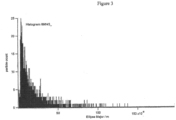
- Figs. 2 and 3 are histograms showing particle size distribution information about the fiber length of the amino-silane treated wollastonite fibers used in the examples herein.
- the x-axis is the length of a fiber from a sample batch (either 89644 or 89645) of the amino-silane treated wollastonite fibers used in the examples herein, as measured by the SEM Process below.
- the y-axis is the number of fibers having that length.
- the distribution has a fairly abrupt peak (i.e., at about one-half of the average value) and then a tail of decreasing counts as the fiber length increases above the peak value (i.e., about 20-23 microns for each sample).
- the frequency of fibers having lengths above 80 microns decreases significantly, very little fibers have lengths above 100 microns, and none have lengths above 150 microns.
- the D 90 is approximately 40 microns.
- the moisture-curable adhesive composition of the present invention also comprises at least two fillers, wherein one of the fillers is untreated and a second of said fillers is treated with a modifier selected from the group consisting of a fatty acid derivative, a silane, a titanate, and mixtures thereof and wherein one of the fillers has an average particle size of between about 1.5 ⁇ m and about 20 ⁇ m and a second of said fillers has an average particle size of between about 0.1 ⁇ m and about 1.3 ⁇ m, and wherein at least one of said fillers is irregularly shaped.
- the filler which is treated may have the larger or smaller average particle size, and the filler which is untreated may also have the larger or smaller average particle size. Either filler may be irregularly-shaped.
- filler examples include reinforcing fillers such as fumed silica, precipitated silica, crystalline silica, fused silica, dolomite, silicic anhydride, hydrous silicic acid, and carbon black; fillers such as calcium carbonate (including ground calcium carbonate, precipitated calcium carbonate, heavy calcium carbonate, and colloidal calcium carbonate), magnesium carbonate, diatomite, calcined clay, clay, talc, titanium oxide, bentonite, organobentonite, ferric oxide, fine aluminum powder, flint powder, zinc oxide, activated zinc white, shirasu balloons, glass microballoons, organic microballoons of a phenolic resin or a vinylidene chloride resin, and resin powders such as PVC powder and PMMA powder; and fibrous fillers such as glass fiber and filaments.
- fillers such as fumed silica, precipitated silica, crystalline silica, fused silica, dolomite, sili
- the amount of the at least two fillers may vary over a wide range to achieve the properties of the particular adhesive application for which the composition is being used.
- the at least two fillers are ground calcium carbonate and are preferably present in an amount of about 30 to about 70% by weight. More preferably, the at least two fillers are present in an amount of about 40 to about 60% by weight. Most preferably, the at least two fillers are present in an amount of about 42 to about 50% by weight.
- the treated filler has an average particle size of about 0.7 ⁇ m and the untreated filler has an average particle size of about 3 ⁇ m.
- the modifier is preferably the fatty acid derivative, and most preferably stearic acid.
- the manner in which a filler is treated with a modifier is well-known.
- the at least two fillers comprise a first, second, and third filler.
- the first filler comprises stearate-treated ground calcium carbonate particles having a mean particle size between about 1.5 ⁇ m and about 10 ⁇ m, preferably between about 1.5 ⁇ m and about 6 ⁇ m, and most preferably between about 2 ⁇ m and about 5 ⁇ m.
- the first filler is preferably present in the composition in an amount of about 1 to about 27% by weight, preferably between about 7 to about 19% by weight, and most preferably about 13% by weight.
- KOTAMITE is commercially available under the trademark KOTAMITE and is sold by Imerys.
- the second filler comprises untreated ground calcium carbonate particles having a mean particle size between about 1.5 ⁇ m and about 10 ⁇ m, preferably between about 1.5 ⁇ m and about 6 ⁇ m, and most preferably between about 2 ⁇ m and about 5 ⁇ m.
- the second filler is preferably present in the composition in an amount of about 1 to about 34% by weight, preferably between about 14 to about 28% by weight, and most preferably about 23% by weight.
- Such a product is commercially available under the trademark ATOMITE and is sold by Imerys.
- the third filler comprises stearate-treated ground calcium carbonate particles having a mean particle size between about 0.1 ⁇ m and about 1.3 ⁇ m, preferably between about 0.2 ⁇ m and about 1.2 ⁇ m, and most preferably between about 0.4 ⁇ m and about 1 ⁇ m.
- the third filler is present in the composition in an amount of about 1 to about 20% by weight, preferably between about 5 to about 15% by weight, and most preferably about 10% by weight.
- Such a product is commercially available under the trademark CAMEL-CAL ST and is sold by Imerys.
- the fillers is irregularly-shaped.
- “irregularly shaped” refers to fillers (or other particles) which are not spheroidal or substantially spheroidal. Examples include conical-, polygonal-(cubes, pentagons, hexagons, octagons, and the like), and polyhedral-shaped particles, as well as irregular shaped particles, as well as non-uniform particles having, for example circular, elliptical, oval, square, rectangular, triangular or polygonal cross sections found at least partially therein. "Irregularly-shaped” particles refer to three dimensional shapes wherein at least two different cross sections taken therethrough have different shapes.
- Preferred shapes include irregular random shaped ground particles. Such irregularly-shaped particles do not act like "ball bearings” but instead provide a greater resistance to flow likely due to increased frictional resistance. It should be noted that the particle size of spheroidal particles is the diameter of such particles, and the particle size of irregularly-shaped particles is the distance of its longest dimension across the particle.
- the weight ratios of the various fillers vary over particular ratios.
- the weight ratio of treated fillers to untreated fillers preferably varies over a range of from about 0.3:1 to about 0.7:1, more preferably from about 0.4:1 to about 0.6:1, and most preferably from about 0.45:1 to about 0.55: 1.
- the weight ratio of spheroidal fillers to irregularly-shaped fillers preferably varies over a range of from about 2:1 to about 6:1, more preferably from about 3:1 to about 5:1, and most preferably from about 3.4: 1 to about 4:1.
- the weight ratio of fillers having a larger particle size (i.e., most preferably between about 2 ⁇ m and about 5 ⁇ m) to fillers having a smaller particle size (i.e., most preferably between about 0.4 ⁇ m and about 1 ⁇ m) preferably varies over a range of from about 2:1 to about 6:1, more preferably from about 3:1 to about 5:1, and most preferably from about 3.4:1 to about 4:1.
- the combination of at least two fillers contributes to the rheological and other properties of the present invention.
- the adhesive can readily become too viscous and difficult to be worked.
- the sag resistance of the composition suffers.
- the use of at least some stearate-treated, irregularly-shaped filler appears to improve the green grab of the adhesive.
- the moisture-curable adhesive composition of the present invention also comprises a rheology modifier.
- a rheology modifier provides or enhances either pseudoplastic or thixotropic properties to a composition.
- the rheology modifier is used in this application to provide the rheological properties for the adhesive application.
- a wide range of rheology modifiers may be used in the present invention, including aforementioned filler fumed silica and other polyamide waxes.
- the amount of the rheology modifier may vary over a wide range to achieve the properties of the particular adhesive application for which the composition is being used.
- the rheology modifier is preferably present in an amount of about 0.5 to about 10% by weight. More preferably, the rheology modifier is present in an amount of about 1 to about 8% by weight. Most preferably, the rheology modifier is present in an amount of about 2 to about 5% by weight.
- the moisture-curable adhesive composition of the present invention may also comprise a number of additional additives.
- One such additional optional additive is a diluent used to dilute the composition, typically to reduce its viscosity and improve its workability for whatever application the adhesive is being used for.
- the diluent may be evaporative, such as a solvent, or non-evaporative, such as a plasticizer. In either case, it is preferable to use a diluent which does not contain much inherent moisture so that premature curing of the adhesive does not take place.
- Typical solvents may include odorless mineral spirits or other hydrophobic solvents. If used, the amount of the solvent may vary over a wide range to achieve the properties of the particular adhesive application for which the composition is being used.
- the diluent of the moisture-curable adhesive composition of the present invention comprises a plasticizer.
- a plasticizer allows the adjustment of the viscosity, flexibility, and sag properties of the curable composition and the mechanical properties (e.g., hardness, tensile strength and elongation) of the cured product.
- plasticizer examples include phthalic acid ester compounds such as dibutyl phthalate, diisononyl phthalate (DINP), diheptyl phthalate, di(2-ethylhexyl) phthalate, diisodecyl phthalate (DIDP), and butyl benzyl phthalate; terephthalic acid ester compounds such as bis(2-ethylhexyl)-1,4-benzenedicarboxylate; non-phthalic acid ester compounds such as diisononyl 1,2-cyclohexanedicarboxylate; aliphatic polyvalent carboxylic acid ester compounds such as dioctyl adipate, dioctyl sebacate, dibutyl sebacate, diisodecyl succinate, and tributyl acetylcitrate; unsaturated fatty acid ester compounds such as butyl oleate and methyl acetylricinoleate
- polymer plasticizers may be used.
- specific examples of the polymer plasticizers include, but not limited to, vinyl polymers obtained by polymerizing vinyl monomers by various methods; esters of polyalkylene glycols, such as diethylene glycol dibenzoate, triethylene glycol dibenzoate, and pentaerythritol esters; polyester plasticizers prepared from dibasic acids (e.g., sebacic acid, adipic acid, azelaic acid, phthalic acid) and divalent alcohols (e.g., ethylene glycol, diethylene glycol, triethylene glycol, propylene glycol, dipropylene glycol); polyethers such as polyether polyols (e.g., polyethylene glycol, polypropylene glycol, polytetramethylene glycol) which have a number average molecular weight of 500 or higher, or even a number average molecular weight of 1,000 or higher, and derivatives obtained by converting the hydroxy groups of these polyether polyols into ester
- the amount of the plasticizer may vary over a wide range to achieve the properties of the particular adhesive application for which the composition is being used.
- the plasticizer if used is preferably present in an amount of about 2 to about 40% by weight. More preferably, the plasticizer is present in an amount of about 10 to about 30% by weight. Most preferably, the plasticizer is present in an amount of about 18 to about 24% by weight.
- the plasticizer is preferably an alkylsulphonic acid ester with phenol and is phthalate-free. Such a product is sold under the trademark MESAMOLL by Lanxess of Cologne Germany.
- Another such additional optional additive is a plurality of irregularly-shaped crumb rubber particles having an average particle size of between about 0.1 mm to about 10 mm, preferably from about 0.3 mm to about 5 mm, more preferably from about 0.5 to about 1.5 mm, and most preferably about 1 mm.
- the amount of the irregularly-shaped crumb rubber particles may vary over a wide range to achieve the properties of the particular adhesive application for which the composition is being used.
- the plurality of irregularly-shaped crumb rubber particles is present in an amount of about 0.5 to about 10%, preferably from about 1 to about 5 % by weight, and most preferably from about 1.5 to about 4% by weight.
- the plurality of irregularly-shaped crumb rubber particles aid in ensuring that excessive "squeeze out" of the adhesive between the adherends does not occur upon application of the adherends to each other when the adhesive is in an uncured state.
- the irregularly-shaped crumb rubber particles serve to prevent the surfaces from touching and therefore allow for at least some adhesive to be maintained across substantially the entire mating surfaces.
- Materials that are useful as spacer particles include any that are crush-resistant and do not break or deform more than 25% from their original shape under the intended installation pressures. These could include various types of rubber, such as EPDM (ethylene propylene diene monomer) or SBR (styrene-butadiene rubber). The ability of a material to meet this requirement may be dependent on the size and shape chosen.
- the irregularly-shaped crumb rubber particles may be of any non-spherical geometric shape. Examples include conical-, polygonal-(cubes, pentagons, hexagons, octagons, and the like), and polyhedral-shaped particles, as well as irregular shaped particles, as well as non-uniform particles having, for example circular, elliptical, oval, square, rectangular, triangular or polygonal cross sections found at least partially therein. "Irregularly-shaped" particles may refer to three dimensional shapes wherein at least two different cross sections taken therethrough have different shapes. Preferred shapes include irregular random shaped ground particles.
- Further optional additives include a dehydrating agent, an adhesion promoter, and a catalyst.
- suitable dehydrating agents include but are not limited to vinyl trimethoxysilane, any vinyl alkoxysilane, inorganic and organic zeolites, and the like.
- the dehydrating agent is vinyl trimethoxysilane sold under the tradename Silquest A-171 by Momentive Performance Materials of Waterford NY.
- the amount of the dehydrating agent may vary over a wide range to achieve the properties of the particular adhesive application for which the composition is being used.
- the adhesive comprises from about 0.1 to about 10% by weight of a dehydrating agent, more preferably from about 0.5 to about 6% by weight; and most preferably from about 1 to about 4% by weight of a dehydrating agent.
- the moisture curable adhesive composition may also include an adhesion promoter.
- adhesion promoters include but are not limited to N-(beta-aminoethyl)-gamma-aminopropyltrimethoxysilane, N-(beta-aminoethyl)-gamma-aminopropyldimethoxymethylsilane, gamma-glycidoxpropltrimethoxylsilane, any substituted silane where one or more of the substitutions contains a different functional group and the like.
- the adhesion promoter is N-(beta-Aminoethyl)-gamma-aminopropyltrimethoxysilane sold under the tradename Silquest A-1120 Momentive Performance Materials of Waterford NY.
- the amount of the adhesion promoter may vary over a wide range to achieve the properties of the particular adhesive application for which the composition is being used.
- the moisture curable adhesive composition comprises from about 0.1 to about 10% by weight of an adhesion promoter, more preferably from about 0.3 to about 6% by weight; and most preferably from about 0.5 to about 3% by weight of an adhesion promoter.
- the moisture curable adhesive preferably may also include a catalyst.
- catalysts may be used including such catalysts as tertiary amine catalysts, tin catalysts, lead catalysts, bismuth catalysts and the like.
- Tertiary amine catalysts include by way of example and not limitation include compounds having one tertiary nitrogen atom including triethylamine, N,N-dimethylcyclohexylamine, N-methylomorpholine, N-ethylmorpholine, N-(2-hydroxyethyl)morpholine, N,N-dimethyl-p-toluidine, ⁇ -(dimethylamino)propionitrile, N-methylpyrrolidone, N,N-dicyclohexylmethylamine, and the like; compounds having two tertiary nitrogen atoms including N,N, N',N'-tetramethylethylenediamine, N,N,N', N'-tetramethylpropane-1,3-diamine
- Tin catalysts include by way of example but not limitation stannous octoate, dibutyltin diacetate, dibutyltin dilaurate, dibutyltin mercaptide, dibutyltin thiocaboxylate, dibutyltin dimaleate, dioctyltin mercaptide, dioctyltin thiocarboxylate, dibutyl tin oxide in diisooctyl phthalate, aliphatic organotin and the like.
- Lead, bismuth, and mercury catalysts include by way of example but not limitation lead 2-ethylhexanate, bismuth neodecanoate, phenylmercury propionate and the like.
- the preferred catalyst of the present invention is a butyltin ketonate catalyst, such as the catalyst sold under the trademark REAXIS ® C226 by Reaxis Inc. of McDonald, Pennsylvania.
- the amount of the catalyst may vary over a wide range to achieve the properties of the particular adhesive application for which the composition is being used.
- the moisture curable adhesive composition comprises from about 0.01 to about 2% by weight of catalyst, more preferably from about 0.05 to about 1% by weight; and most preferably from about 0.1 to about 0.5% by weight of a catalyst.
- Suitable additional optional additives include by way of example, but not limitation, anti-oxidants, lubricants, extenders, biocides, UV absorbers, and stabilizers. Some additives can operate to control the polymerization process, thereby affecting the physical properties (e.g., modulus, glass transition temperature) of the product formed from the composition. Others can affect the integrity of the product of the composition (e.g., protect against de-polymerization, oxidative degradation, or biological attack). The amounts of these additional additives can vary over a wide range to achieve the properties of the particular adhesive application for which the composition is being used.
- the moisture curable adhesive has one or more of the following attributes. These include but are not limited to good repositionability over time, being a one component system, rapid development of tack but sufficient open time to be able to be applied to a large format tile, good bond strength upon curing, good impact resistance upon curing, good sound abatement upon curing, minimal shrinkage upon curing, and ease of cleanability after curing preferably with only plastic tools.
- the moisture-curable adhesive composition has rheological properties such that it has a low viscosity at high shear rates and a high viscosity at low shear rates.
- the viscosity of the adhesive at the shear stress of gravity when the adhesive is used to mount a tile to a wall surface is sufficiently high to maintain the tile with no or substantially no sag.
- the viscosity under gravity is sufficient to maintain a large format tile in position with no or substantially no sag. Even more preferably, the viscosity under gravity is sufficient to maintain a tile having an area density of between about 2.4 to about 14.2 kg/m 2 (about 0.5 to about 2.9 lbs/ft 2) in position with no or substantially no sag.
- the adhesive composition preferably has a low viscosity at a shear rate typically achieved upon mixing the adhesive prior to application.
- the viscosity is sufficiently low such that an operator can easily mix and work the composition without much resistance.
- the composition of the present invention has a thixotropic index (measured as explained below in the examples) of between about 5 and 10, more preferably between 6 and 9, and most preferably between 7 and 8.
- the adhesive has a density of between about 1.2 and about 2 g/ml, preferably between about 1.4 and 1.8 g/ml, and most preferably between about 1.5 and 1.6 g/ml.
- the above components of the moisture curable adhesive composition can be mixed using conventional processing equipment and technology.
- the order of addition of the constituents is not especially critical, except for the dehydrating agent, which should be added after mechanical moisture reduction is done.
- steps are taken during the processing of the moisture curable adhesive composition to minimize the pickup of moisture by the composition, and in some instances to reduce the moisture of the composition. Generally, this involves heating the mixture and/or pulling a vacuum to remove the water, but any other method known to those skilled in the art could be used to bring the moisture content to, or maintain it at, an acceptable level.
- the mechanical steps are taken to reduce the moisture content of the adhesive composition to a moisture content of less than about 900 ppm, more preferably less than about 850 ppm, and most preferably less than about 800 ppm as measured by ASTM Test Method D 4672. Then, a dehydrating agent is added which further reduces the moisture content.
- a moisture curable adhesive of the invention is used to join at least two adherends (or at least two materials or pieces of material to be adhered).
- the adherends include but are not limited to paper, metal, ceramic (including ceramic tile), glass, textiles, cloth, plastic, rubber, foams, masonry, wood, plywood, drywall, concrete, leather, composites (including fiberglass), cement sheets, and the like. Further, the two or more adherends can be of the same or different materials.
- the moisture curable adhesive is applied to at least one adherend of the two adherends.
- the adhesive can be applied to a single side, or both or multiple sides of the adherends similar to conventional adhesives.
- the adhesive can be applied by conventional methods such as using a person's hands, spatulas, rollers, trowels or sprayers, and dispensed in conventional packaging such as tubes, cans or containers.
- the two adherends are first contacted forming a bond between the at least two adherends with the adhesive.
- the tack is sufficient to temporarily prevent the at least two adherends from pulling apart prior to the curing of the adhesive.
- the adherends can be repositioned for some period of time prior to initial cure.
- the initial cure is defined as the point at which one adherend cannot be moved relative to the other without degrading the bond. At this point, the adherends can no longer be repositioned without permanently degrading the bond strength. In the case of a bond where one substrate is immovable, i.e. a wall, it is the point at which bracing is no longer necessary to hold the substrates together.
- the at least two adherends can be repositioned with respect to each other for up to and more preferably more than about 5 minutes after they are first contacted, more preferably for up to or more than about 10 minutes, even more preferably for up to or even more than about 15 minutes.
- the bond between the at least two adherends is cured sufficiently to prevent further degradation of such bond after a reasonable period of time.
- a method for mounting a large format tile to a wall comprises the steps of: (1) applying an adhesive composition to a back surface of a large format tile, wherein the tile has a surface area of at least one square meter and the adhesive composition is moisture-curable and comprises: (i) a polymer component selected from a silane-terminated polyalkylene oxide and/or a polyurethane; (ii) a plurality of amino-silane modified wollastonite fibers; (iii) a filler; and (iv) a rheology modifier; and; and (2) applying the large format tile to a substantially vertically-extending wall surface by contacting the back surface of the tile with the wall surface prior to full curing of the adhesive composition.
- the method described herein can be used to adhere any two adherends.
- the large format tile has an area density of between about 2.4 to about 14.2 kg/m 2 (about 0.5 to about 2.9 lbs/ft 2 ), more preferably between about 4.9 to about 11.2 kg/m 2 (about 1 and about 2.3 lbs/ft 2 ), and most preferably between about 6.3 to about 9.8 kg/m 2 (about 1.3 and about 2 lbs/ft 2 ).
- Embodiments of the invention improve sag resistance of such tiles and substantially or entirely eliminate sag.
- the method further comprises the step of, after the step of applying the large format tile to a substantially vertically-extending wall surface, repositioning the large format tile by moving the tile in a direction parallel to the wall surface.
- the thickness of the adhesive layer is about one-sixteenth to one-quarter of an inch, preferably about one-eighth of an inch.
- at least 70%, more preferably at least 80%, and most preferably at least 90% of the back surface of the tile is covered with adhesive prior to mounting it to a wall surface. Most preferably, substantially all of the back surface is covered.
- a mechanical fastener is used during curing to ensure that no sagging occurs.
- a mechanical fastener such as pin or rail, supports the load of the tile while the adhesive cures.
- no mechanical fastener is used (so that the adhesive even before it is cured is sufficient to prevent sag), but only a lippage control device is used during curing.
- a lippage control device ensures alignment in the z-direction (i.e., into and out of the wall). Thus, with a lippage control device, no or only a minimal "seam" can be detected between tiles. However, the lippage control device does not prevent sag of the tile, so embodiments of the invention used with only a lippage control device have sufficient sag resistance to avoid any sag by their own properties (and not with the assistance of any mechanical fastener).
- the adhesive can be used to adhere a wide range of materials together.
- the material of the tile to be adhered is usually the fiberglass backing (but the adhesive could work directly on the ceramic tile) and the material of the wall surface may be wood, drywall, plywood, but is typically concrete.
- Embodiments of the present invention provide a number of benefits that address certain shortcomings of prior art products and methods.
- embodiments of the invention are a one-part adhesive that reacts with atmospheric moisture and moisture that is on the surface of the substrates to produce a final cured material.
- Such a one-part adhesive does not require another component to be mixed and is therefore easier to use, eliminating the need to have separate components on a job site. This leads to an easier-to-use product as well as a cleaner work area.
- Embodiments of the invention also do not require both the tile and substrate to be applied with adhesive. This removes the "back butter” step and reduces the necessary open time of the product, although embodiments of the invention have a fairly long open time of about 30 minutes.
- the open time is the time after application of an adhesive to a surface during which the adhesive will still function to adhere the surface to another substrate (i.e., before the formation of a skin which would prevent such adherence).
- the tile can be placed on a table to be coated and then placed on the wall, without having to also coat the wall.
- embodiments of the invention minimize the formation of "legs" or strings of material that come off the trowel after application. This also leads to a cleaner work area.
- embodiments of the invention also can be cleaned from the grout lines with plastic tools, even after curing. This greatly reduces the chance of a damaged tile, especially with respect to tiles which are larger in surface area and thinner, such as gauged porcelain tiles.
- Embodiments of the present invention can accommodate a larger deviation in the final substrate profile.
- the adhesive once the adhesive makes contact with the substrate, it does not rebound off the wall to as great of an extent as prior art solutions due to the rheological properties of the adhesive. This characteristic eliminates or greatly reduces the likelihood of voids between the tile and the substrate.
- embodiments of the present invention provide a small amount of workability with regard to the repositioning (i.e., by permitting movement of the tile in a direction parallel to the wall surface of the tile once it is set, namely in any direction in an x-y plane assuming that the z-axis is transverse to the substrate or wall surface).
- the tile can be moved slightly with the requisite amount force if an error was made when the tile was initially set.
- embodiments of the invention provide little or no sagging of the tile, even when used to mount large format tiles on substantially vertically extending wall surfaces and even for tiles having a high area density, such as at 14.2 kg/m 2 (2.9 lbs/ft 2 ) or above.
- embodiments of the invention show outstanding impact resistance and sound abatement (i.e., reduction in sound transmitted across an assembly and received on the opposite side).
- the experiments done to test an embodiment of the invention were largely done by testing physical properties of the resultant formula.
- the final product was tested for its rheological properties by viscometer, rheometer, sag resistance for vertical application, and ease of troweling.
- the properties were also tested by applying large format tiles of varying size as well as thickness and confirming the practical use as well as functional use of the invention.
- a formulation having the constituents of Table 1 below was made by making lab scale batches ( ⁇ 0.75 gallon) on a lab scale mixer. The percentages are given in percent by weight, including any inherent moisture in each constituent.
- the polymer component, plasticizer, and fillers were charged into the kettle and allowed to mix. After a homogenous paste was achieved, the material was subjected to heat (170°F) and vacuum. These conditions were continued until the moisture was found to be less than 800 ppm by Karl Fischer titration. Once the paste was mechanically dehydrated, the chemical dehydrating agent (a vinyl trimethoxysilane, VTMO/A171) was added. The formula was then finished by adding the adhesion promoter and catalyst. The finished formula was packaged into cartridges for testing.
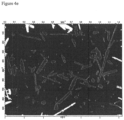
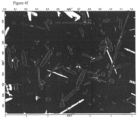
- the values obtained for the samples were an average fiber length of 18.5 microns, an average aspect ratio (length divided by width for each fiber) of 2.8:1, an average diameter of about 21.5 microns, an average circularity of 3.1, and an average eccentricity of 0.83, with over 5,500 particles analyzed. All of these results of the SEM Process are provided as mean averages.
- Testing of materials was separated into two groups of characterization. The first was done on the liquid material with the focus being application properties. The second set of tests was done on the fully cured material (in accordance with ASTM D 412, Die C, with a rate of 2"/min) with the goal to test the longer term performance of the material after installation.
- the liquid characterization was predominately done by using a Brookfield viscometer (testing at approximately 5 different RPM speeds) ASTM Method D 2556 , a Boeing sag tester ASTM D 2202-00, vertically adhering a concrete block (no test method just and internal test and a subjective trowel test.
- the Brookfield viscosity testing was done at ambient temperature and this was done to quickly compare the thixotropic index of the materials using ASTM Method D 2556. All viscosity measurements were taken shortly after opening a sealed container of an adhesive of the present invention.
- the Boeing sag tester was used to assess whether the materials propensity to sag when a thick amount of material is applied. This test is graded by the distance a material slides down a graduated surface as referenced in ASTM D 2202-00.
- the vertically installed concrete block test was done to assess whether the material could support the block without sagging. The result of this test was pass/fail.
- the final test involved the user applying the material with a 1 ⁇ 2" x 15/32" trowel to a 1'x1' area and test for difficulty of troweling. This test was also a pass/fail test.
- the second group of testing was largely focused on testing of the final cured properties of the formula. This was done through testing of tensile and elongation by following ASTM D 412 and by Lap Shear testing following ASTM D1002 - 10.
- Table 2 Pigment Volume Concentration 0.38 Density (g/ml) 1.55 Tested Trowel Pass Slump 0.1 Viscosity RPM Spindle 6 0.5 4.45E+06 cPs 1 2.38E+06 cPs 2.5 1.07E+06 cPs 5 5.78E+05 cPs 10 3.30E+05 cPs Concrete block vertical test Pass Thixotropic Index 7.43 Lapsi Tensile 132 psi Elongation 101%
- the material was applied to the large format tile, having a fiberglass mesh backing, by trowel.
- Suction cups on a tile sized frame were placed on the opposite side of the fiberglass meshing to pick up and turn the tile onto saw horses.
- the fiberglass meshing was placed facing up as this was the side to receive the adhesive.
- An excess of adhesive material was placed on the tile and slowly troweled from the edges of the tile to the center.
- the ridges of the trowel were run parallel the shortest side of the tile. This helped move the material to ensure full coverage (or substantial full coverage) of the tile as well as the least likely to contaminant the front of the tile. This was done until the full tile was covered. Once covered, the suction cups were used to place the tile on the wall.
- the tile was initially set with a few taps on the tile to contact it with the wall.
- the tile was then repositioned into place and then set into place by using a tile setting tool similar to a float. This is done to force out air as well as ensure the highest degree of coverage possible. This was done over the entire face of the tile.
- the frame was then removed. Viscosity of the samples did not change significantly for at least 30 minutes after opening
- a Thixotropic index describes a ratio comparing the adhesive composition's viscosity at a lower shear rate with its viscosity at a higher shear rate.
- the graph in Fig. 1 shows viscosity vs. rpm for an adhesive formulation of the present invention as shown in Table 1.
- the adhesive formulation of the present invention has a TI of 7.43:1 (i.e., 2,460,000/331,000).
- the shear rate provided by gravity is analogous to a value of less than 0.5 rpm, and the viscosity value there in excess of 4,610,000 cP is sufficient for purposes of the present invention.
- the absolute viscosity values at low shear rate are important.
- the viscosity of the formulation of the present invention at shear rates of less than 0.5 rpm would exceed 4,610,000 cPs.
- a certain value allows the formulation to hold a block according to the test described above. The current formulation was found to hold the block. This shows that the formula of the present invention had a viscosity that overcame the shear stress caused by the force of gravity exerted on the mass of the tile.
- the viscosity of the present invention decreases significantly after an rpm of >10 rpm, meaning that the viscosity decreases fairly quickly with increasing rpm, meaning that it is easier to work by trowel relative to other compositions which do not decrease as quickly.
- a test in accordance with ASTM E 90-09/NVLAP 08/P06 was conducted by Riverbank Acoustical Laboratories in order to assess the noise abatement of the exemplary formulation of the present invention in accordance with Table 1.
- the dimensions of the wall were 96" wide, 108" high, and 5.125" thick.
- the area of the tested surface wall was 6.7 m 2 (72 ft 2 ), with the filler being 5.0 m 2 (54.0 ft 2 ) and the comp being 11.8 m 2 (126 ft 2 ).
- the weight of the assembly was 329.1 kg (725.5 lbs) and the area weight was 49.2 kg/m 2 (10.08 lbs/ft 2 ).
- the volume of the source room was 178 m 3 (6,297.6 ft 3 ) and the area of the source room was 192 m 2 (2,066 ft 2 ).
- the volume of the receive room was 177 m 3 (6,254.5 ft 3 ) and the area of the receive room was 190 m 2 (2,042 ft 2 ).
- Six tests were run: Control runs of drywall only with and without acoustic insulation (which was batt insulation), gauged porcelain panel commercially available as Laminam from Crossville, Inc. of Tennessee with a conventional mortar sold under the trademark REFLEX thin set by Bostik, Inc. of Wisconsin (also with and without the same acoustic insulation), and gauged porcelain panel commercially available as Laminam with the formulation of the invention shown in Table 1 (also with and without the same acoustic insulation).
- the values were obtained using ASTM E413-16 and reflect improved noise abatement with increased values, on a logarithmic scale. As can be seen, the control wall had values of 40 and 50, without and with acoustic insulation, respectively. As can be shown below, with the exemplary formulation of the present invention of Table 1 above (referred to below as "Bosti Set") showed a better noise abatement than drywall with acoustic installation (values of 58 versus 50). The noise abatement of the present invention is an even greater improvement of noise abatement (58 versus 45) when comparing noise abatement with Gauged Porcelain Panel with the conventional mortar.
- the values were obtained using ASTM E413-16 and reflect improved noise abatement with increased values, on a logarithmic scale.
- the control wall had an average value of 40 and the control mortar had an average valu of 41, without acoustic insulation respectively.
- the exemplary formulation of the present invention (referred to below as "Bosti-Set") showed a markedly better noise abatement providing an average value of 49.5. With acoustic insulation, the control wall had an average value of 45 and the control mortar had an average valu of 44.5. On the other hand, the exemplary formulation of the present invention showed a markedly better noise abatement providing an average value of 54.5.
Landscapes
- Chemical & Material Sciences (AREA)
- Organic Chemistry (AREA)
- Chemical Kinetics & Catalysis (AREA)
- Health & Medical Sciences (AREA)
- Medicinal Chemistry (AREA)
- Polymers & Plastics (AREA)
- Engineering & Computer Science (AREA)
- Architecture (AREA)
- Civil Engineering (AREA)
- Structural Engineering (AREA)
- General Chemical & Material Sciences (AREA)
- Adhesives Or Adhesive Processes (AREA)
- Compositions Of Macromolecular Compounds (AREA)
- Finishing Walls (AREA)
Claims (15)
- Feuchtigkeitshärtbare Klebstoffzusammensetzung, umfassend:a) eine Polymerkomponente ausgewählt aus einem Silan-terminierten Polyalkylenoxid und/oder einem Polyurethan;b) eine Vielzahl von Aminosilan-modifizierten Wollastonitfasern mit einem mittleren Aspektverhältnis von etwa 1,5:1 bis etwa 12:1 und einer mittleren Faserlänge von etwa 6 µm bis etwa 825 µm;c) wenigstens zwei Füllstoffe, wobei einer der Füllstoffe unbehandelt ist und ein zweiter der Füllstoffe mit einem Modifikator ausgewählt aus der Gruppe bestehend aus einem Fettsäurederivat, einem Silan, einem Titanat und Gemischen davon behandelt ist und wobei einer der Füllstoffe eine mittlere Partikelgröße von zwischen etwa 1,5 µm und etwa 10 µm aufweist und ein zweiter der Füllstoffe eine mittlere Partikelgröße von zwischen etwa 0,1 µm und etwa 1,3 µm aufweist, wobei wenigstens einer der Füllstoffe nicht sphäroidisch oder im Wesentlichen sphäroidisch ist;d) einen Rheologiemodifikator.
- Zusammensetzung gemäß Anspruch 1, wobei die Polymerkomponente das Silan-terminierte Polyalkylenoxid ist und in einer Menge von etwa 5 bis etwa 40 Gew.-% vorhanden ist.
- Zusammensetzung gemäß Anspruch 2, wobei:das Silan-terminierte Polyalkylenoxid in einer Menge von etwa 10 bis etwa 30 Gew.-% vorhanden ist;die Vielzahl von Aminosilan-modifizierten Wollastonitfasern in einer Menge von etwa 3 bis etwa 15 Gew.-% vorhanden ist und die Aminosilan-Beladung etwa 1 bis etwa 35 Gew.-% der Fasern beträgt;die wenigstens zwei Füllstoffe in einer Menge von etwa 30 bis etwa 70 Gew.-% vorhanden sind; unddie Zusammensetzung ferner einen Weichmacher in einer Menge von etwa 2 bis etwa 40 Gew.-% umfasst.
- Zusammensetzung gemäß Anspruch 1, ferner umfassend eine Vielzahl von unregelmäßig geformten Gummigranulatpartikeln mit einer mittleren Partikelgröße von zwischen etwa 0,5 und 1,5 mm.
- Zusammensetzung gemäß Anspruch 1, wobei das Silan-terminierte Polyalkylenoxid umfasst:ein erstes Silan-terminiertes Polyalkylenoxid, das ein Methoxysilyl-Kettenpolymer umfasst und ein verzweigtes Polyethergerüst und ein Molekulargewicht in dem Bereich von etwa 16.000 bis etwa 18.000 g/mol aufweist; undein zweites Silan-terminiertes Polyalkylenoxid, das ein Methoxysilyl-Kettenpolymer umfasst und ein lineares Polyethergerüst und ein Molekulargewicht in dem Bereich von etwa 26.000 bis etwa 28.000 g/mol aufweist.
- Zusammensetzung gemäß Anspruch 5, wobei:das erste Silan-terminierte Polyalkylenoxid in einer Menge von zwischen etwa 5 und etwa 30 Gew.-% vorhanden ist; unddas zweite Silan-terminierte Polyalkylenoxid in einer Menge von zwischen etwa 0,5 und etwa 5 Gew.-% vorhanden ist.
- Zusammensetzung gemäß Anspruch 1, wobei die wenigstens zwei Füllstoffe umfassen:einen ersten Füllstoff, der stearatbehandelte gemahlene Calciumcarbonatpartikel umfasst und eine mittlere Partikelgröße zwischen etwa 1,5 µm und etwa 10 µm aufweist, wobei der erste Füllstoff in der Zusammensetzung einer Menge von etwa 1 bis etwa 27 Gew.-%, vorzugsweise zwischen etwa 7 und etwa 19 Gew.-% und höchst bevorzugt etwa 13 Gew.-%, vorhanden ist;einen zweiten Füllstoff, der unbehandelte gemahlene Calciumcarbonatpartikel umfasst und eine mittlere Partikelgröße zwischen etwa 1,5 µm und etwa 10 µm aufweist, wobei der zweite Füllstoff in der Zusammensetzung einer Menge von etwa 1 bis etwa 34 Gew.-%, vorzugsweise zwischen etwa 14 und etwa 28 Gew.-% und höchst bevorzugt etwa 23 Gew.-%, vorhanden ist; undeinen dritten Füllstoff, der stearatbehandelte gemahlene Calciumcarbonatpartikel umfasst und eine mittlere Partikelgröße zwischen etwa 0,1 µm und etwa 1,3 µm aufweist, wobei der dritte Füllstoff in der Zusammensetzung einer Menge von etwa 1 bis etwa 20 Gew.-%, vorzugsweise zwischen etwa 5 und etwa 15 Gew.-% und höchst bevorzugt etwa 10 Gew.-%, vorhanden ist.
- Zusammensetzung gemäß Anspruch 1, wobei das mittlere Aspektverhältnis der Vielzahl der Aminosilan-modifizierten Wollastonitfasern von etwa 2:1 bis etwa 8:1 beträgt und die mittlere Faserlänge der Aminosilan-modifizierten Wollastonitfasern von etwa 10 µm bis etwa 40 µm beträgt.
- Zusammensetzung gemäß Anspruch 1, wobei der unbehandelte Füllstoff eine mittlere Partikelgröße von etwa 3 µm aufweist und der behandelte Füllstoff eine mittlere Partikelgröße von etwa 0,7 µm aufweist.
- Zusammensetzung gemäß Anspruch 1, wobei der Modifikator ein Fettsäurederivat ist.
- Zusammensetzung gemäß Anspruch 1, wobei die Polymerkomponente das Polyurethan ist und das Polyurethan ein Silan-modifiziertes Polyurethan umfasst.
- Verfahren zum Anbringen einer großformatigen Fliese an eine Wand, umfassend die Schritte:a. Aufbringen einer Klebstoffzusammensetzung an eine rückseitige Oberfläche einer großformatigen Fliese, wobei die Fliese eine Oberfläche von wenigstens 1 Quadratmeter aufweist und die Klebstoffzusammensetzung feuchtigkeitshärtbar ist und umfasst: (i) eine Polymerkomponente ausgewählt aus einem Silan-terminierten Polyalkylenoxid und/oder einem Polyurethan; (ii) eine Vielzahl von Aminosilan-modifizierten Wollastonitfasern; (iii) einen Füllstoff; und (iv) einen Rheologiemodifikator; undb. Aufbringen der großformatigen Fliese an eine im Wesentlichen vertikal verlaufende Wandoberfläche durch Inkontaktbringen der rückseitigen Oberfläche der Fliese mit der Wandoberfläche vor vollständigem Härten der Klebstoffzusammensetzung.
- Verfahren gemäß Anspruch 12, wobei die großformatige Fliese Abmessungen von wenigstens 1x1 Meter, vorzugsweise wenigstens 1x3 Meter und höchst bevorzugt wenigstens 1,5x4,5 Meter aufweist.
- Verfahren gemäß Anspruch 12, wobei die großformatige Fliese eine Flächendichte von zwischen etwa 2,4 und etwa 14,2 kg/m2 (etwa 0,5 bis etwa 2,9 lbs/ft2), vorzugsweise zwischen etwa 4,9 und etwa 11,2 kg/m2 (etwa 1 und etwa 2,3 lbs/ft2) und höchst bevorzugt zwischen etwa 6,3 und etwa 9,8 kg/m2 (etwa 1,3 und etwa 2 lbs/ft2) aufweist.
- Verfahren gemäß Anspruch 12, ferner umfassend den Schritt von, nach Schritt b, Repositionieren der großformatigen Fliese durch Bewegen der Fliese in einer Richtung parallel zu der Wandoberfläche.
Applications Claiming Priority (3)
| Application Number | Priority Date | Filing Date | Title |
|---|---|---|---|
| US201762455142P | 2017-02-06 | 2017-02-06 | |
| US201762470524P | 2017-03-13 | 2017-03-13 | |
| PCT/US2018/016862 WO2018145002A1 (en) | 2017-02-06 | 2018-02-05 | A moisture-curable adhesive composition and a method for mounting tiles on wall surfaces |
Publications (3)
| Publication Number | Publication Date |
|---|---|
| EP3577155A1 EP3577155A1 (de) | 2019-12-11 |
| EP3577155A4 EP3577155A4 (de) | 2020-09-30 |
| EP3577155B1 true EP3577155B1 (de) | 2024-06-26 |
Family
ID=63040212
Family Applications (1)
| Application Number | Title | Priority Date | Filing Date |
|---|---|---|---|
| EP18748458.9A Active EP3577155B1 (de) | 2017-02-06 | 2018-02-05 | Feuchtigkeitshärtende klebstoffzusammensetzung und verfahren zum anbringen von fliesen an wandoberflächen |
Country Status (8)
| Country | Link |
|---|---|
| US (2) | US11624014B2 (de) |
| EP (1) | EP3577155B1 (de) |
| AU (1) | AU2018215543B2 (de) |
| CA (1) | CA3052196A1 (de) |
| MX (1) | MX2019009315A (de) |
| NZ (1) | NZ755663A (de) |
| PH (2) | PH12022553256A1 (de) |
| WO (1) | WO2018145002A1 (de) |
Families Citing this family (5)
| Publication number | Priority date | Publication date | Assignee | Title |
|---|---|---|---|---|
| CN113302254B (zh) * | 2019-01-04 | 2024-01-02 | 陶氏环球技术有限责任公司 | 湿气固化型粘合剂组合物 |
| JP6919010B1 (ja) * | 2020-03-18 | 2021-08-11 | 旭化成ワッカーシリコーン株式会社 | 湿気硬化型組成物、および該湿気硬化型組成物の製造方法 |
| CN112646395A (zh) * | 2020-12-15 | 2021-04-13 | 中国地质大学(武汉) | 改性剂和利用该改性剂改性的改性硅灰石及其制备方法和应用 |
| CN115057669A (zh) * | 2022-03-16 | 2022-09-16 | 广东省梅州市质量计量监督检测所 | 一种复合固废材料陶瓷砖胶粘剂及其制备方法 |
| CN118145937B (zh) * | 2024-03-28 | 2024-09-10 | 佛山市鲁班扣新材料科技有限公司 | 一种环保型防脱落瓷砖胶及其生产工艺 |
Family Cites Families (14)
| Publication number | Priority date | Publication date | Assignee | Title |
|---|---|---|---|---|
| NL152902C (nl) | 1970-04-16 | 1977-09-15 | Sumitomo Chemical Co | Werkwijze voor het bereiden van een vormmassa uit gewapend polypropeen alsmede gevormde voorwerpen bestaande uit of bekleed met dit polypropeen |
| US3971751A (en) | 1975-06-09 | 1976-07-27 | Kanegafuchi Kagaku Kogyo Kabushiki Kaisha | Vulcanizable silylether terminated polymer |
| US6046270A (en) | 1998-10-14 | 2000-04-04 | Bayer Corporation | Silane-modified polyurethane resins, a process for their preparation and their use as moisture-curable resins |
| US6271299B1 (en) | 1999-02-02 | 2001-08-07 | Dow Corning Corporation | Fire resistant sealant composition |
| EP1651361A1 (de) | 2003-08-08 | 2006-05-03 | Fording Inc. | Rückgewinnungsprozess für materialien mit grossem aspektverhältnis |
| DE602007004228D1 (de) | 2007-11-02 | 2010-02-25 | Drywood Coatings B V | Verfahren zum Fügen von Holzelementen unter Verwendung eines feuchtigkeitsabdichtenden Klebstoffs |
| DE102008020980A1 (de) | 2008-04-25 | 2009-10-29 | Henkel Ag & Co. Kgaa | Härtbare Zusammensetzungen enthaltend silylierte Polyurethane auf Basis von Polyetherblockpolymeren |
| US10017674B2 (en) * | 2009-12-31 | 2018-07-10 | Bostik, Inc. | Moisture curable adhesive compositions |
| DE102010002808B4 (de) | 2010-03-12 | 2019-02-21 | Henkel Ag & Co. Kgaa | Härtbare Zusammensetzungen auf Basis Silan-modifizierter Polymere und ihre Verwendung als Fliesenkleber |
| DE102010034997A1 (de) * | 2010-08-20 | 2012-02-23 | Stauf Klebstoffwerk Gmbh | Wasser-, Lösemittel-und Phthalat-freier silanmodifizierter Einkomponenten-Parkettklebstoff und dessen Verwendung zur hochgradig maßhaltigen Verklebung von Parkett, Holzbodenbelägen und Holzwerkstoffplatten im Innenausbau |
| EP2535376A1 (de) * | 2011-06-14 | 2012-12-19 | Merz+Benteli AG | Mehrkomponentige Zusammensetzung als Klebstoff für schwierig zu verklebende Materialien |
| US20130167463A1 (en) * | 2012-01-04 | 2013-07-04 | National Applied Construction Products, Inc. | Composite tile product |
| KR20150003373A (ko) * | 2012-04-26 | 2015-01-08 | 다우 글로벌 테크놀로지스 엘엘씨 | 에폭시 접착제 조성물 |
| DE202014104772U1 (de) * | 2014-10-06 | 2016-01-08 | Schlüter-Systems Kg | Fassadenkonstruktion |
-
2018
- 2018-02-05 CA CA3052196A patent/CA3052196A1/en active Pending
- 2018-02-05 PH PH1/2022/553256A patent/PH12022553256A1/en unknown
- 2018-02-05 US US16/483,196 patent/US11624014B2/en active Active
- 2018-02-05 MX MX2019009315A patent/MX2019009315A/es unknown
- 2018-02-05 AU AU2018215543A patent/AU2018215543B2/en active Active
- 2018-02-05 NZ NZ755663A patent/NZ755663A/en unknown
- 2018-02-05 EP EP18748458.9A patent/EP3577155B1/de active Active
- 2018-02-05 WO PCT/US2018/016862 patent/WO2018145002A1/en not_active Ceased
-
2019
- 2019-07-30 PH PH12019501764A patent/PH12019501764A1/en unknown
-
2023
- 2023-03-10 US US18/119,872 patent/US20240117227A1/en active Pending
Also Published As
| Publication number | Publication date |
|---|---|
| AU2018215543A1 (en) | 2019-08-08 |
| CA3052196A1 (en) | 2018-08-09 |
| EP3577155A4 (de) | 2020-09-30 |
| US20200010746A1 (en) | 2020-01-09 |
| PH12019501764A1 (en) | 2020-06-08 |
| AU2018215543B2 (en) | 2023-02-16 |
| NZ755663A (en) | 2025-11-28 |
| EP3577155A1 (de) | 2019-12-11 |
| US20240117227A1 (en) | 2024-04-11 |
| WO2018145002A1 (en) | 2018-08-09 |
| PH12022553256A1 (en) | 2024-05-20 |
| MX2019009315A (es) | 2019-11-05 |
| US11624014B2 (en) | 2023-04-11 |
Similar Documents
| Publication | Publication Date | Title |
|---|---|---|
| US20240117227A1 (en) | Method for mounting tiles on wall surfaces using a moisture-curable adhesive composition | |
| US9493689B2 (en) | Crosslinkable compositions based on organyloxysilane-terminated polymers | |
| JPH11349916A (ja) | 高揺変性変成シリコーン系接着剤 | |
| JP7231605B2 (ja) | ワーキングジョイント用1成分型硬化性組成物 | |
| KR20170097704A (ko) | 오르가닐-옥시실란-종결화된 중합체를 기반으로 하는 가교 코팅 화합물 | |
| CN103649428A (zh) | 建筑用外装材料 | |
| JP5126821B2 (ja) | 易剥離性一液湿気硬化型接着剤 | |
| KR101873610B1 (ko) | 개선된 치수 안정성을 갖는 쪽매 바닥재의 적층 방법 | |
| AU2007338453A1 (en) | Self-levelling, anhydrous coating materials for floor surfaces | |
| JP7179279B2 (ja) | 硬化性組成物 | |
| KR20210094599A (ko) | 오르가닐옥시실란 말단 중합체를 베이스로 하는 다성분 가교성 물질 | |
| JP5335507B2 (ja) | 接着方法 | |
| JP5452796B2 (ja) | 易剥離性一液湿気硬化型接着剤 | |
| JP5999463B1 (ja) | 目地構造を有する壁、目地施工方法、及び一液常温湿気硬化型シーリング材組成物 | |
| JP5999464B1 (ja) | 目地構造を有する壁、及び目地施工方法 | |
| JP3779953B2 (ja) | シリル基含有有機重合体硬化性組成物 | |
| JP2000265646A (ja) | 床構成体 | |
| JP7590749B2 (ja) | 硬化性組成物 | |
| JP2017137473A (ja) | 室温硬化性接着剤 | |
| JP2000273432A (ja) | 床構成体 | |
| JP7325077B2 (ja) | 硬化性組成物 | |
| JP7403145B2 (ja) | 湿気硬化性組成物 | |
| JP2016210839A (ja) | 室温硬化性接着剤 | |
| JP7014397B2 (ja) | 硬化性組成物 | |
| JP3916640B2 (ja) | ジアルキル酢酸錫化合物 |
Legal Events
| Date | Code | Title | Description |
|---|---|---|---|
| STAA | Information on the status of an ep patent application or granted ep patent |
Free format text: STATUS: THE INTERNATIONAL PUBLICATION HAS BEEN MADE |
|
| PUAI | Public reference made under article 153(3) epc to a published international application that has entered the european phase |
Free format text: ORIGINAL CODE: 0009012 |
|
| STAA | Information on the status of an ep patent application or granted ep patent |
Free format text: STATUS: REQUEST FOR EXAMINATION WAS MADE |
|
| 17P | Request for examination filed |
Effective date: 20190830 |
|
| AK | Designated contracting states |
Kind code of ref document: A1 Designated state(s): AL AT BE BG CH CY CZ DE DK EE ES FI FR GB GR HR HU IE IS IT LI LT LU LV MC MK MT NL NO PL PT RO RS SE SI SK SM TR |
|
| AX | Request for extension of the european patent |
Extension state: BA ME |
|
| DAV | Request for validation of the european patent (deleted) | ||
| DAX | Request for extension of the european patent (deleted) | ||
| A4 | Supplementary search report drawn up and despatched |
Effective date: 20200902 |
|
| RIC1 | Information provided on ipc code assigned before grant |
Ipc: C08K 7/10 20060101ALI20200827BHEP Ipc: C08K 9/04 20060101ALI20200827BHEP Ipc: C08K 3/26 20060101ALI20200827BHEP Ipc: C08G 18/83 20060101ALI20200827BHEP Ipc: C08K 7/08 20060101ALI20200827BHEP Ipc: C09J 171/00 20060101ALI20200827BHEP Ipc: E04F 21/02 20060101ALI20200827BHEP Ipc: C08G 65/336 20060101AFI20200827BHEP Ipc: C08K 9/06 20060101ALI20200827BHEP Ipc: C08L 51/06 20060101ALI20200827BHEP Ipc: C08L 21/00 20060101ALI20200827BHEP Ipc: C08K 7/02 20060101ALI20200827BHEP Ipc: C08K 5/00 20060101ALI20200827BHEP Ipc: C09J 11/04 20060101ALI20200827BHEP Ipc: C08K 7/04 20060101ALI20200827BHEP Ipc: C09J 175/08 20060101ALI20200827BHEP Ipc: C09J 11/02 20060101ALI20200827BHEP |
|
| STAA | Information on the status of an ep patent application or granted ep patent |
Free format text: STATUS: EXAMINATION IS IN PROGRESS |
|
| 17Q | First examination report despatched |
Effective date: 20220908 |
|
| REG | Reference to a national code |
Ref country code: DE Ipc: C09J0171020000 Ref country code: DE Ref legal event code: R079 Ref document number: 602018071011 Country of ref document: DE Free format text: PREVIOUS MAIN CLASS: C08G0065336000 Ipc: C09J0171020000 |
|
| GRAP | Despatch of communication of intention to grant a patent |
Free format text: ORIGINAL CODE: EPIDOSNIGR1 |
|
| STAA | Information on the status of an ep patent application or granted ep patent |
Free format text: STATUS: GRANT OF PATENT IS INTENDED |
|
| RIC1 | Information provided on ipc code assigned before grant |
Ipc: C08K 9/04 20060101ALI20240104BHEP Ipc: C08K 9/06 20060101ALI20240104BHEP Ipc: C08K 3/26 20060101ALI20240104BHEP Ipc: C08K 5/00 20060101ALI20240104BHEP Ipc: C08L 21/00 20060101ALI20240104BHEP Ipc: C08G 18/83 20060101ALI20240104BHEP Ipc: E04F 21/02 20060101ALI20240104BHEP Ipc: C09J 171/00 20060101ALI20240104BHEP Ipc: C09J 175/08 20060101ALI20240104BHEP Ipc: C09J 11/04 20060101ALI20240104BHEP Ipc: C09J 11/02 20060101ALI20240104BHEP Ipc: C08L 51/06 20060101ALI20240104BHEP Ipc: C08K 7/04 20060101ALI20240104BHEP Ipc: C08K 7/08 20060101ALI20240104BHEP Ipc: C08K 7/02 20060101ALI20240104BHEP Ipc: C08K 7/10 20060101ALI20240104BHEP Ipc: C08G 65/336 20060101ALI20240104BHEP Ipc: C09J 175/04 20060101ALI20240104BHEP Ipc: C09J 171/02 20060101AFI20240104BHEP |
|
| INTG | Intention to grant announced |
Effective date: 20240119 |
|
| GRAS | Grant fee paid |
Free format text: ORIGINAL CODE: EPIDOSNIGR3 |
|
| GRAA | (expected) grant |
Free format text: ORIGINAL CODE: 0009210 |
|
| STAA | Information on the status of an ep patent application or granted ep patent |
Free format text: STATUS: THE PATENT HAS BEEN GRANTED |
|
| AK | Designated contracting states |
Kind code of ref document: B1 Designated state(s): AL AT BE BG CH CY CZ DE DK EE ES FI FR GB GR HR HU IE IS IT LI LT LU LV MC MK MT NL NO PL PT RO RS SE SI SK SM TR |
|
| REG | Reference to a national code |
Ref country code: GB Ref legal event code: FG4D |
|
| REG | Reference to a national code |
Ref country code: CH Ref legal event code: EP |
|
| REG | Reference to a national code |
Ref country code: DE Ref legal event code: R096 Ref document number: 602018071011 Country of ref document: DE |
|
| PG25 | Lapsed in a contracting state [announced via postgrant information from national office to epo] |
Ref country code: BG Free format text: LAPSE BECAUSE OF FAILURE TO SUBMIT A TRANSLATION OF THE DESCRIPTION OR TO PAY THE FEE WITHIN THE PRESCRIBED TIME-LIMIT Effective date: 20240626 |
|
| PG25 | Lapsed in a contracting state [announced via postgrant information from national office to epo] |
Ref country code: FI Free format text: LAPSE BECAUSE OF FAILURE TO SUBMIT A TRANSLATION OF THE DESCRIPTION OR TO PAY THE FEE WITHIN THE PRESCRIBED TIME-LIMIT Effective date: 20240626 Ref country code: HR Free format text: LAPSE BECAUSE OF FAILURE TO SUBMIT A TRANSLATION OF THE DESCRIPTION OR TO PAY THE FEE WITHIN THE PRESCRIBED TIME-LIMIT Effective date: 20240626 |
|
| REG | Reference to a national code |
Ref country code: LT Ref legal event code: MG9D |
|
| PG25 | Lapsed in a contracting state [announced via postgrant information from national office to epo] |
Ref country code: GR Free format text: LAPSE BECAUSE OF FAILURE TO SUBMIT A TRANSLATION OF THE DESCRIPTION OR TO PAY THE FEE WITHIN THE PRESCRIBED TIME-LIMIT Effective date: 20240927 |
|
| PG25 | Lapsed in a contracting state [announced via postgrant information from national office to epo] |
Ref country code: LV Free format text: LAPSE BECAUSE OF FAILURE TO SUBMIT A TRANSLATION OF THE DESCRIPTION OR TO PAY THE FEE WITHIN THE PRESCRIBED TIME-LIMIT Effective date: 20240626 |
|
| REG | Reference to a national code |
Ref country code: NL Ref legal event code: MP Effective date: 20240626 |
|
| PG25 | Lapsed in a contracting state [announced via postgrant information from national office to epo] |
Ref country code: NO Free format text: LAPSE BECAUSE OF FAILURE TO SUBMIT A TRANSLATION OF THE DESCRIPTION OR TO PAY THE FEE WITHIN THE PRESCRIBED TIME-LIMIT Effective date: 20240926 Ref country code: LV Free format text: LAPSE BECAUSE OF FAILURE TO SUBMIT A TRANSLATION OF THE DESCRIPTION OR TO PAY THE FEE WITHIN THE PRESCRIBED TIME-LIMIT Effective date: 20240626 Ref country code: HR Free format text: LAPSE BECAUSE OF FAILURE TO SUBMIT A TRANSLATION OF THE DESCRIPTION OR TO PAY THE FEE WITHIN THE PRESCRIBED TIME-LIMIT Effective date: 20240626 Ref country code: GR Free format text: LAPSE BECAUSE OF FAILURE TO SUBMIT A TRANSLATION OF THE DESCRIPTION OR TO PAY THE FEE WITHIN THE PRESCRIBED TIME-LIMIT Effective date: 20240927 Ref country code: FI Free format text: LAPSE BECAUSE OF FAILURE TO SUBMIT A TRANSLATION OF THE DESCRIPTION OR TO PAY THE FEE WITHIN THE PRESCRIBED TIME-LIMIT Effective date: 20240626 Ref country code: BG Free format text: LAPSE BECAUSE OF FAILURE TO SUBMIT A TRANSLATION OF THE DESCRIPTION OR TO PAY THE FEE WITHIN THE PRESCRIBED TIME-LIMIT Effective date: 20240626 Ref country code: RS Free format text: LAPSE BECAUSE OF FAILURE TO SUBMIT A TRANSLATION OF THE DESCRIPTION OR TO PAY THE FEE WITHIN THE PRESCRIBED TIME-LIMIT Effective date: 20240926 |
|
| PG25 | Lapsed in a contracting state [announced via postgrant information from national office to epo] |
Ref country code: NL Free format text: LAPSE BECAUSE OF FAILURE TO SUBMIT A TRANSLATION OF THE DESCRIPTION OR TO PAY THE FEE WITHIN THE PRESCRIBED TIME-LIMIT Effective date: 20240626 |
|
| REG | Reference to a national code |
Ref country code: AT Ref legal event code: MK05 Ref document number: 1697695 Country of ref document: AT Kind code of ref document: T Effective date: 20240626 |
|
| PG25 | Lapsed in a contracting state [announced via postgrant information from national office to epo] |
Ref country code: NL Free format text: LAPSE BECAUSE OF FAILURE TO SUBMIT A TRANSLATION OF THE DESCRIPTION OR TO PAY THE FEE WITHIN THE PRESCRIBED TIME-LIMIT Effective date: 20240626 |
|
| PG25 | Lapsed in a contracting state [announced via postgrant information from national office to epo] |
Ref country code: PT Free format text: LAPSE BECAUSE OF FAILURE TO SUBMIT A TRANSLATION OF THE DESCRIPTION OR TO PAY THE FEE WITHIN THE PRESCRIBED TIME-LIMIT Effective date: 20241028 |
|
| PG25 | Lapsed in a contracting state [announced via postgrant information from national office to epo] |
Ref country code: PT Free format text: LAPSE BECAUSE OF FAILURE TO SUBMIT A TRANSLATION OF THE DESCRIPTION OR TO PAY THE FEE WITHIN THE PRESCRIBED TIME-LIMIT Effective date: 20241028 |
|
| PG25 | Lapsed in a contracting state [announced via postgrant information from national office to epo] |
Ref country code: PL Free format text: LAPSE BECAUSE OF FAILURE TO SUBMIT A TRANSLATION OF THE DESCRIPTION OR TO PAY THE FEE WITHIN THE PRESCRIBED TIME-LIMIT Effective date: 20240626 |
|
| PG25 | Lapsed in a contracting state [announced via postgrant information from national office to epo] |
Ref country code: EE Free format text: LAPSE BECAUSE OF FAILURE TO SUBMIT A TRANSLATION OF THE DESCRIPTION OR TO PAY THE FEE WITHIN THE PRESCRIBED TIME-LIMIT Effective date: 20240626 |
|
| PG25 | Lapsed in a contracting state [announced via postgrant information from national office to epo] |
Ref country code: IS Free format text: LAPSE BECAUSE OF FAILURE TO SUBMIT A TRANSLATION OF THE DESCRIPTION OR TO PAY THE FEE WITHIN THE PRESCRIBED TIME-LIMIT Effective date: 20241026 Ref country code: AT Free format text: LAPSE BECAUSE OF FAILURE TO SUBMIT A TRANSLATION OF THE DESCRIPTION OR TO PAY THE FEE WITHIN THE PRESCRIBED TIME-LIMIT Effective date: 20240626 |
|
| PG25 | Lapsed in a contracting state [announced via postgrant information from national office to epo] |
Ref country code: CZ Free format text: LAPSE BECAUSE OF FAILURE TO SUBMIT A TRANSLATION OF THE DESCRIPTION OR TO PAY THE FEE WITHIN THE PRESCRIBED TIME-LIMIT Effective date: 20240626 |
|
| PG25 | Lapsed in a contracting state [announced via postgrant information from national office to epo] |
Ref country code: RO Free format text: LAPSE BECAUSE OF FAILURE TO SUBMIT A TRANSLATION OF THE DESCRIPTION OR TO PAY THE FEE WITHIN THE PRESCRIBED TIME-LIMIT Effective date: 20240626 Ref country code: SK Free format text: LAPSE BECAUSE OF FAILURE TO SUBMIT A TRANSLATION OF THE DESCRIPTION OR TO PAY THE FEE WITHIN THE PRESCRIBED TIME-LIMIT Effective date: 20240626 |
|
| PG25 | Lapsed in a contracting state [announced via postgrant information from national office to epo] |
Ref country code: ES Free format text: LAPSE BECAUSE OF FAILURE TO SUBMIT A TRANSLATION OF THE DESCRIPTION OR TO PAY THE FEE WITHIN THE PRESCRIBED TIME-LIMIT Effective date: 20240626 Ref country code: SM Free format text: LAPSE BECAUSE OF FAILURE TO SUBMIT A TRANSLATION OF THE DESCRIPTION OR TO PAY THE FEE WITHIN THE PRESCRIBED TIME-LIMIT Effective date: 20240626 |
|
| PG25 | Lapsed in a contracting state [announced via postgrant information from national office to epo] |
Ref country code: SM Free format text: LAPSE BECAUSE OF FAILURE TO SUBMIT A TRANSLATION OF THE DESCRIPTION OR TO PAY THE FEE WITHIN THE PRESCRIBED TIME-LIMIT Effective date: 20240626 Ref country code: SK Free format text: LAPSE BECAUSE OF FAILURE TO SUBMIT A TRANSLATION OF THE DESCRIPTION OR TO PAY THE FEE WITHIN THE PRESCRIBED TIME-LIMIT Effective date: 20240626 Ref country code: RO Free format text: LAPSE BECAUSE OF FAILURE TO SUBMIT A TRANSLATION OF THE DESCRIPTION OR TO PAY THE FEE WITHIN THE PRESCRIBED TIME-LIMIT Effective date: 20240626 Ref country code: PL Free format text: LAPSE BECAUSE OF FAILURE TO SUBMIT A TRANSLATION OF THE DESCRIPTION OR TO PAY THE FEE WITHIN THE PRESCRIBED TIME-LIMIT Effective date: 20240626 Ref country code: IS Free format text: LAPSE BECAUSE OF FAILURE TO SUBMIT A TRANSLATION OF THE DESCRIPTION OR TO PAY THE FEE WITHIN THE PRESCRIBED TIME-LIMIT Effective date: 20241026 Ref country code: ES Free format text: LAPSE BECAUSE OF FAILURE TO SUBMIT A TRANSLATION OF THE DESCRIPTION OR TO PAY THE FEE WITHIN THE PRESCRIBED TIME-LIMIT Effective date: 20240626 Ref country code: EE Free format text: LAPSE BECAUSE OF FAILURE TO SUBMIT A TRANSLATION OF THE DESCRIPTION OR TO PAY THE FEE WITHIN THE PRESCRIBED TIME-LIMIT Effective date: 20240626 Ref country code: CZ Free format text: LAPSE BECAUSE OF FAILURE TO SUBMIT A TRANSLATION OF THE DESCRIPTION OR TO PAY THE FEE WITHIN THE PRESCRIBED TIME-LIMIT Effective date: 20240626 Ref country code: AT Free format text: LAPSE BECAUSE OF FAILURE TO SUBMIT A TRANSLATION OF THE DESCRIPTION OR TO PAY THE FEE WITHIN THE PRESCRIBED TIME-LIMIT Effective date: 20240626 |
|
| PG25 | Lapsed in a contracting state [announced via postgrant information from national office to epo] |
Ref country code: IT Free format text: LAPSE BECAUSE OF FAILURE TO SUBMIT A TRANSLATION OF THE DESCRIPTION OR TO PAY THE FEE WITHIN THE PRESCRIBED TIME-LIMIT Effective date: 20240626 |
|
| REG | Reference to a national code |
Ref country code: DE Ref legal event code: R097 Ref document number: 602018071011 Country of ref document: DE |
|
| PG25 | Lapsed in a contracting state [announced via postgrant information from national office to epo] |
Ref country code: DK Free format text: LAPSE BECAUSE OF FAILURE TO SUBMIT A TRANSLATION OF THE DESCRIPTION OR TO PAY THE FEE WITHIN THE PRESCRIBED TIME-LIMIT Effective date: 20240626 |
|
| PLBE | No opposition filed within time limit |
Free format text: ORIGINAL CODE: 0009261 |
|
| STAA | Information on the status of an ep patent application or granted ep patent |
Free format text: STATUS: NO OPPOSITION FILED WITHIN TIME LIMIT |
|
| 26N | No opposition filed |
Effective date: 20250327 |
|
| PG25 | Lapsed in a contracting state [announced via postgrant information from national office to epo] |
Ref country code: SE Free format text: LAPSE BECAUSE OF FAILURE TO SUBMIT A TRANSLATION OF THE DESCRIPTION OR TO PAY THE FEE WITHIN THE PRESCRIBED TIME-LIMIT Effective date: 20240626 |
|
| PG25 | Lapsed in a contracting state [announced via postgrant information from national office to epo] |
Ref country code: MC Free format text: LAPSE BECAUSE OF FAILURE TO SUBMIT A TRANSLATION OF THE DESCRIPTION OR TO PAY THE FEE WITHIN THE PRESCRIBED TIME-LIMIT Effective date: 20240626 |
|
| REG | Reference to a national code |
Ref country code: CH Ref legal event code: PL |
|
| PG25 | Lapsed in a contracting state [announced via postgrant information from national office to epo] |
Ref country code: LU Free format text: LAPSE BECAUSE OF NON-PAYMENT OF DUE FEES Effective date: 20250205 |
|
| PG25 | Lapsed in a contracting state [announced via postgrant information from national office to epo] |
Ref country code: CH Free format text: LAPSE BECAUSE OF NON-PAYMENT OF DUE FEES Effective date: 20250228 |
|
| REG | Reference to a national code |
Ref country code: BE Ref legal event code: MM Effective date: 20250228 |
|
| PGFP | Annual fee paid to national office [announced via postgrant information from national office to epo] |
Ref country code: FR Payment date: 20251231 Year of fee payment: 9 |
|
| PG25 | Lapsed in a contracting state [announced via postgrant information from national office to epo] |
Ref country code: BE Free format text: LAPSE BECAUSE OF NON-PAYMENT OF DUE FEES Effective date: 20250228 |
|
| PG25 | Lapsed in a contracting state [announced via postgrant information from national office to epo] |
Ref country code: IE Free format text: LAPSE BECAUSE OF NON-PAYMENT OF DUE FEES Effective date: 20250205 |
|
| PGFP | Annual fee paid to national office [announced via postgrant information from national office to epo] |
Ref country code: GB Payment date: 20260106 Year of fee payment: 9 |
|
| PGFP | Annual fee paid to national office [announced via postgrant information from national office to epo] |
Ref country code: DE Payment date: 20251230 Year of fee payment: 9 |