EP3578024A1 - Weeding machine and weed holder - Google Patents
Weeding machine and weed holder Download PDFInfo
- Publication number
- EP3578024A1 EP3578024A1 EP19178353.9A EP19178353A EP3578024A1 EP 3578024 A1 EP3578024 A1 EP 3578024A1 EP 19178353 A EP19178353 A EP 19178353A EP 3578024 A1 EP3578024 A1 EP 3578024A1
- Authority
- EP
- European Patent Office
- Prior art keywords
- weed
- rod
- weeding machine
- holder
- weeding
- Prior art date
- Legal status (The legal status is an assumption and is not a legal conclusion. Google has not performed a legal analysis and makes no representation as to the accuracy of the status listed.)
- Pending
Links
Images

Classifications
-
- A—HUMAN NECESSITIES
- A01—AGRICULTURE; FORESTRY; ANIMAL HUSBANDRY; HUNTING; TRAPPING; FISHING
- A01B—SOIL WORKING IN AGRICULTURE OR FORESTRY; PARTS, DETAILS, OR ACCESSORIES OF AGRICULTURAL MACHINES OR IMPLEMENTS, IN GENERAL
- A01B39/00—Machines specially adapted for working soil on which crops are growing
- A01B39/12—Machines specially adapted for working soil on which crops are growing for special purposes, e.g. for special culture
- A01B39/18—Machines specially adapted for working soil on which crops are growing for special purposes, e.g. for special culture for weeding
-
- A—HUMAN NECESSITIES
- A01—AGRICULTURE; FORESTRY; ANIMAL HUSBANDRY; HUNTING; TRAPPING; FISHING
- A01B—SOIL WORKING IN AGRICULTURE OR FORESTRY; PARTS, DETAILS, OR ACCESSORIES OF AGRICULTURAL MACHINES OR IMPLEMENTS, IN GENERAL
- A01B23/00—Elements, tools, or details of harrows
- A01B23/02—Teeth; Fixing the teeth
Definitions
- the present invention relates to a weeding machine, self-propelled or moved by an agricultural tractor, used to weed land and crops used for, inter alia, arable and horticultural purposes. More specifically, the invention relates to a holder for holding a weed tooth as part of a weeding machine.
- Well-known weeding machines include a main frame with a three-point linkage for coupling to the three-point linkage of an agricultural tractor and with a multitude of so-called weed fields.
- a weed field comprises a multitude of weed tines that are mounted in rows at right angles to the longitudinal axis of the weed machine, on the frame of the weed field.
- a weed tine is made of spring wire steel with a diameter usually of 8 +/- 3 mm.
- the first end of the weed tine is characterized by a U-shape for mounting on the frame of a weed field.
- the second end may or may not have a kink.
- One or more windings are often fitted between the ends in order to make the spring characteristic of the weed tooth more suitable for the intended application. In working mode, the second end of the weed tooth is dragged in relation to the direction of travel.
- One of the functions of the weeding machine is to crumble the top layer of the soil in order to expose germinating weed seeds to the drying effect of sun and wind, to improve the air exchange of the soil with the environment and to limit the evaporation of soil moisture.
- the practice is characterized by a wide variety of common conditions in terms of soil and vegetation. Conditional for a good functioning are 1) provisions for the adaptation to different circumstances and 2) the ease with which these provisions can be used.
- Well-known weeding machines have facilities to monitor uneven terrain and to adjust the intensity of the work according to the conditions.
- Well-known weeding machines have weed fields that are linked to the main frame with a certain degree of mobility in order to be able to better follow the surface of uneven terrain.
- a well-known technique for tracking the terrain surface the application of a gauge device in the form of, for example, a gauge slider or a gauge wheel.
- EP0407896A1 shows a soil tillage machine for weed control in row crops where a tool carrier with tillage bodies is fitted with a support or gauge device in the form of a slider.
- a drawback of this and similar devices is that the application of a gauge device is less suitable for situations in which it is to be processed (part of the)an area is covered with a cultivated crop, i.e. situations for which a weeding machine is precisely intended according to the present invention. In such situations, the cultivated crop will suffer from the gauge device and/or the operation of the gauge device is inadvertently affected by the crops.
- a well-known technique to vary the intensity of the operation of weed tines is rotating the crossbeams on which the row of weed tines are mounted, which alters the tine angle of the weed tines. For example, adjustment of the intensity is necessary in relation to the hardness of the soil and/or the development stage of the cultural crop. Techniques are known in which the adaptation by weed field can be realized from the tractor cabin.
- a disadvantage of weeding machines according to the state of the art is that the adjustment possibilities do not provide for an adjustment to the spatial variation of the working conditions resulting from crops grown in rows, whether flat fields, on ridges or on beds. This applies both to the provisions for adapting to uneven terrain and to the provisions for adjusting the intensity of the action of weed teeth in relation to the soil and crop.
- the purpose of the present invention is to provide a weeding machine which is particularly suitable for use in row crops, whether flat, on ridges or on beds.
- a weeding machine of the type described above is characterized for this purpose by the fact that the weeding machine comprises a multitude of holders for each weed tine, a holder comprising a four-rod hinge mechanism, the rods together forming a quadrangle, the first of which is equipped with means of connecting that rod to the frame and the second, opposite, rod being equipped with means of holding a weed tine.
- An advantage of a weeding machine with such weed holders is that the weed tines of the machine are better able to follow an uneven surface, for example as a result of crops grown on backs or beds, without the uneven surface having a significant effect on the intensity of a weed tine's action. This advantage is particularly evident when the four-rod hinge mechanism forms a parallelogram.
- the four-rod hinge mechanism contains a third rod, which is coupled with a spring to influence the rotation of the third rod in relation to the first rod and whose spring force is adjustable.
- the advantageous feature of this weeding machine is shown, for example, in the application in row cultures.
- the first rod is advantageous for the first rod to be identical to, and interchangeable with, the second rod.
- the invention also relates to a single holder with the above characteristics, intended in particular as an add-on to existing weeding machines.
- Figure 1 schematically shows a perspective view of a weed tine holder with a weed tine.
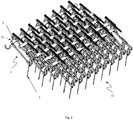
- Figure 2 shows a perspective of a multitude of weed holders with weed tines in a part of the frame of a weed machine.
- FIG. 1 shows an implementation example of a weed holder 1 with a mounted weed tine 2 according to the invention.
- the weed holder 1 comprises a four-rod hinge mechanism, i.e. a mechanism consisting of four rods that are hinged together to form a polygon in the form of a quadrangle.
- a first rod 3 is used to connect the weed holder 1 to the frame of the weeding machine (not shown).
- the first rod 3 is equipped with the means to connect weed holder 1 to the frame.
- those means consist of a recess 4 to hold a part of a tube forming part of the frame and screw 5 to secure the coupling.
- a second rod 6 located opposite the first rod 3 is equipped with means to attach a spring tooth, for example in the form of an eyebolt 7.
- the ends of the third and fourth rods 8 and 9 are equipped with forks for a stable coupling with the ends of the first and second rods 3 and 4.
- the weed holder 1 is equipped with spring means.
- these springs include a tension spring 10 which is coupled with one end to the extended end of the third bar 8. The other end is connected to the frame in an obvious way.
- the invention provides that the spring tension is centrally adjustable, for example by means of a pivoting axle with pitches, and also that the spring tension can be adjusted separately on each weed holder 1, for example by using a chain at one end of a tension spring and a hook on the frame.
- rods 3, 6, 8 and 9 of the weed holder 1 form a parallelogram.
- the advantage of a parallelogram is that the angle between the weed tine 2 and the ground, when considered in working mode, is independent of the position of the parallelogram, so that the position of the parallelogram does not affect the intensity of the operation of the weed tine 2.
- the position of the parallelogram is defined here by the angle between the first and fourth bars 3 and 9.
- the invention also covers four-rod hinge mechanisms which do not form a parallelogram but, for example, a trapezium, the characteristic of which is that, when considered in working mode, the angle between weed tine 2 and the ground depends on the position of the holder of the binder 1.
- figure 2 shows a weed field 11 with several rotatable mounted crossbeams representing the frame of the weeding machine and multipleweed holders 1, as part of a weeding machine.
- the invention relates to a weeding machine that is equipped with weed holders 1 as described above and to the weed holder 1 as an attachment for an existing weeding machine.
Landscapes
- Life Sciences & Earth Sciences (AREA)
- Engineering & Computer Science (AREA)
- Mechanical Engineering (AREA)
- Soil Sciences (AREA)
- Environmental Sciences (AREA)
- Soil Working Implements (AREA)
Abstract
Description
- The present invention relates to a weeding machine, self-propelled or moved by an agricultural tractor, used to weed land and crops used for, inter alia, arable and horticultural purposes. More specifically, the invention relates to a holder for holding a weed tooth as part of a weeding machine.
- Well-known weeding machines include a main frame with a three-point linkage for coupling to the three-point linkage of an agricultural tractor and with a multitude of so-called weed fields. A weed field comprises a multitude of weed tines that are mounted in rows at right angles to the longitudinal axis of the weed machine, on the frame of the weed field. A weed tine is made of spring wire steel with a diameter usually of 8 +/- 3 mm. There is a wide variety of tines available. In a common version, the first end of the weed tine is characterized by a U-shape for mounting on the frame of a weed field. The second end may or may not have a kink. One or more windings are often fitted between the ends in order to make the spring characteristic of the weed tooth more suitable for the intended application. In working mode, the second end of the weed tooth is dragged in relation to the direction of travel.
- One of the functions of the weeding machine is to crumble the top layer of the soil in order to expose germinating weed seeds to the drying effect of sun and wind, to improve the air exchange of the soil with the environment and to limit the evaporation of soil moisture. The practice is characterized by a wide variety of common conditions in terms of soil and vegetation. Conditional for a good functioning are 1) provisions for the adaptation to different circumstances and 2) the ease with which these provisions can be used.
- Well-known weeding machines have facilities to monitor uneven terrain and to adjust the intensity of the work according to the conditions. Well-known weeding machines have weed fields that are linked to the main frame with a certain degree of mobility in order to be able to better follow the surface of uneven terrain. A well-known technique for tracking the terrain surface, the application of a gauge device in the form of, for example, a gauge slider or a gauge wheel. Thus
EP0407896A1 shows a soil tillage machine for weed control in row crops where a tool carrier with tillage bodies is fitted with a support or gauge device in the form of a slider. - A drawback of this and similar devices is that the application of a gauge device is less suitable for situations in which it is to be processed (part of the)an area is covered with a cultivated crop, i.e. situations for which a weeding machine is precisely intended according to the present invention. In such situations, the cultivated crop will suffer from the gauge device and/or the operation of the gauge device is inadvertently affected by the crops.
- Also known are weed fields of which the frame allows a certain degree of deformation.
- A well-known technique to vary the intensity of the operation of weed tines is rotating the crossbeams on which the row of weed tines are mounted, which alters the tine angle of the weed tines. For example, adjustment of the intensity is necessary in relation to the hardness of the soil and/or the development stage of the cultural crop. Techniques are known in which the adaptation by weed field can be realized from the tractor cabin.
- A disadvantage of weeding machines according to the state of the art is that the adjustment possibilities do not provide for an adjustment to the spatial variation of the working conditions resulting from crops grown in rows, whether flat fields, on ridges or on beds. This applies both to the provisions for adapting to uneven terrain and to the provisions for adjusting the intensity of the action of weed teeth in relation to the soil and crop.
- The purpose of the present invention is to provide a weeding machine which is particularly suitable for use in row crops, whether flat, on ridges or on beds.
- According to the invention, a weeding machine of the type described above is characterized for this purpose by the fact that the weeding machine comprises a multitude of holders for each weed tine, a holder comprising a four-rod hinge mechanism, the rods together forming a quadrangle, the first of which is equipped with means of connecting that rod to the frame and the second, opposite, rod being equipped with means of holding a weed tine. An advantage of a weeding machine with such weed holders is that the weed tines of the machine are better able to follow an uneven surface, for example as a result of crops grown on backs or beds, without the uneven surface having a significant effect on the intensity of a weed tine's action. This advantage is particularly evident when the four-rod hinge mechanism forms a parallelogram.
- According to the invention, it is advantageous for the setting of the weed intensity of each weed tine that the four-rod hinge mechanism contains a third rod, which is coupled with a spring to influence the rotation of the third rod in relation to the first rod and whose spring force is adjustable. The advantageous feature of this weeding machine is shown, for example, in the application in row cultures.
- From the point of view of minimizing production costs, it is advantageous for the first rod to be identical to, and interchangeable with, the second rod.
- The invention also relates to a single holder with the above characteristics, intended in particular as an add-on to existing weeding machines.
- The invention is explained below by means of two figures.
Figure 1 schematically shows a perspective view of a weed tine holder with a weed tine.Figure 2 shows a perspective of a multitude of weed holders with weed tines in a part of the frame of a weed machine. - The invention will be explained in more detail below by way of example by means of one execution example, shown in the drawing, of a weed-
holder 1 and a multiple ofweed holders 1 in a part of a weeding-machine.Figure 1 shows an implementation example of aweed holder 1 with a mountedweed tine 2 according to the invention. Theweed holder 1 comprises a four-rod hinge mechanism, i.e. a mechanism consisting of four rods that are hinged together to form a polygon in the form of a quadrangle. Afirst rod 3 is used to connect theweed holder 1 to the frame of the weeding machine (not shown). Thefirst rod 3 is equipped with the means to connectweed holder 1 to the frame. In the present example, those means consist of arecess 4 to hold a part of a tube forming part of the frame and screw 5 to secure the coupling. Asecond rod 6 located opposite thefirst rod 3 is equipped with means to attach a spring tooth, for example in the form of aneyebolt 7. - In the present example, the ends of the third and
fourth rods second rods weed tooth 2 in the downward direction, considered in the working position, theweed holder 1 is equipped with spring means. In the present example of implementation, these springs include atension spring 10 which is coupled with one end to the extended end of thethird bar 8. The other end is connected to the frame in an obvious way. The invention provides that the spring tension is centrally adjustable, for example by means of a pivoting axle with pitches, and also that the spring tension can be adjusted separately on eachweed holder 1, for example by using a chain at one end of a tension spring and a hook on the frame. - In this example,
rods weed holder 1 form a parallelogram. The advantage of a parallelogram is that the angle between theweed tine 2 and the ground, when considered in working mode, is independent of the position of the parallelogram, so that the position of the parallelogram does not affect the intensity of the operation of theweed tine 2. The position of the parallelogram is defined here by the angle between the first andfourth bars weed tine 2 and the ground depends on the position of the holder of thebinder 1. - The advantages of the weeding machine according to the invention are explained below by means of
figure 2 , which shows aweed field 11 with several rotatable mounted crossbeams representing the frame of the weeding machine and multipleweedholders 1, as part of a weeding machine. When cultivating a crop grown in rows, in the field or on ridges or beds, it is advantageous if the processing intensity can be adapted to the cultivation method. For the professional it is immediately clear how a difference can be made in the processing intensity ofweed tines 2 working between the crop rows and weedtines 2 working on the crop rows. The same applies to weedtines 2 working on a ridge and weedtines 2 working between the ridges. - The invention relates to a weeding machine that is equipped with
weed holders 1 as described above and to theweed holder 1 as an attachment for an existing weeding machine.
Claims (5)
- Weeding machine for weeding agricultural and horticultural soils and crops, which includes a multitude of weed holders (1) for each holding a weed tine (2),
characterized in that
such a weed holder (1) includes a four-rod hinge mechanism, where the rods together form a quadrangle, where a first rod (3) is provided with means (4, 5) for connecting that rod to the frame of the weeding machine and where the opposite second rod (6) is provided with means (7) for holding a weed tooth (2). - Weeding machine according to claim 1,
characterized in that
the four-rod hinge mechanism forms a parallelogram. - Weeding machine according to claim 1 or 2,
characterized in that
the four-rod hinge mechanism includes a third rod (8), which third rod (8) is coupled with a spring to influence the twisting of the third rod (8) with respect to the first rod (3) and whose spring force is adjustable. - Weeding machine according to one of the claims 1 - 3,
characterized in that the first rod (3) is identical to the second rod (6). - A weed holder (1) for holding a weed tine (2),
characterized in that
the weed holder (1) includes a four-rod hinge mechanism, where the rods together form a quadrangle, where a first rod (3) is provided with means (4, 5) for connecting that rod to the frame (12) and where the opposite, second rod (6) is provided with means (7) for holding a weed tine (2).
Applications Claiming Priority (1)
| Application Number | Priority Date | Filing Date | Title |
|---|---|---|---|
| NL1042891A NL1042891B1 (en) | 2018-06-06 | 2018-06-06 | WIEDMACHINE AND WIEDTANDHOLDER |
Publications (1)
| Publication Number | Publication Date |
|---|---|
| EP3578024A1 true EP3578024A1 (en) | 2019-12-11 |
Family
ID=66770302
Family Applications (1)
| Application Number | Title | Priority Date | Filing Date |
|---|---|---|---|
| EP19178353.9A Pending EP3578024A1 (en) | 2018-06-06 | 2019-06-05 | Weeding machine and weed holder |
Country Status (2)
| Country | Link |
|---|---|
| EP (1) | EP3578024A1 (en) |
| NL (1) | NL1042891B1 (en) |
Cited By (1)
| Publication number | Priority date | Publication date | Assignee | Title |
|---|---|---|---|---|
| EP3903549A1 (en) * | 2020-04-27 | 2021-11-03 | Horsch Maschinen GmbH | Soil working machine, preferably agricultural harrow, and method for adjusting a tensioning force on a harrow |
Citations (9)
| Publication number | Priority date | Publication date | Assignee | Title |
|---|---|---|---|---|
| DE1813079A1 (en) * | 1968-10-01 | 1970-07-02 | Torsten Kleine | Rotary hoe |
| US3774694A (en) * | 1971-10-20 | 1973-11-27 | R Gates | Flexible harrow device |
| EP0407896A1 (en) | 1989-07-08 | 1991-01-16 | PAUL, Karl-Heinz | Groundworking machine for row cultures |
| DE4134744A1 (en) * | 1991-09-13 | 1993-03-18 | Manfred Prof Dr Hoffmann | Spike harrow - consists of tools which can be replaced and rotated within the holders and has ability to adjust set angles |
| DE19516293A1 (en) * | 1995-05-04 | 1996-11-07 | Amazonen Werke Dreyer H | Four-bar arrangement for weeder in sowing machine |
| DE29914006U1 (en) * | 1999-08-11 | 1999-12-30 | Wöllner, Hartmut, 39615 Groß Garz | Chipper combination with tine rotor |
| US20160073571A1 (en) * | 2012-12-19 | 2016-03-17 | Agriculture Concepts, Llc | Tillage device for agricultural machinery or implements to reduce compaction caused by wheels in a field |
| EP3146819A1 (en) * | 2015-09-23 | 2017-03-29 | Deere & Company | Harrow attachment and tillage implement with such an harrow attachment |
| US20180103574A1 (en) * | 2016-10-19 | 2018-04-19 | Cnh Industrial America Llc | System For Adjusting Smoothing Tools Of A Harrow Using A Linear Actuator |
-
2018
- 2018-06-06 NL NL1042891A patent/NL1042891B1/en not_active IP Right Cessation
-
2019
- 2019-06-05 EP EP19178353.9A patent/EP3578024A1/en active Pending
Patent Citations (9)
| Publication number | Priority date | Publication date | Assignee | Title |
|---|---|---|---|---|
| DE1813079A1 (en) * | 1968-10-01 | 1970-07-02 | Torsten Kleine | Rotary hoe |
| US3774694A (en) * | 1971-10-20 | 1973-11-27 | R Gates | Flexible harrow device |
| EP0407896A1 (en) | 1989-07-08 | 1991-01-16 | PAUL, Karl-Heinz | Groundworking machine for row cultures |
| DE4134744A1 (en) * | 1991-09-13 | 1993-03-18 | Manfred Prof Dr Hoffmann | Spike harrow - consists of tools which can be replaced and rotated within the holders and has ability to adjust set angles |
| DE19516293A1 (en) * | 1995-05-04 | 1996-11-07 | Amazonen Werke Dreyer H | Four-bar arrangement for weeder in sowing machine |
| DE29914006U1 (en) * | 1999-08-11 | 1999-12-30 | Wöllner, Hartmut, 39615 Groß Garz | Chipper combination with tine rotor |
| US20160073571A1 (en) * | 2012-12-19 | 2016-03-17 | Agriculture Concepts, Llc | Tillage device for agricultural machinery or implements to reduce compaction caused by wheels in a field |
| EP3146819A1 (en) * | 2015-09-23 | 2017-03-29 | Deere & Company | Harrow attachment and tillage implement with such an harrow attachment |
| US20180103574A1 (en) * | 2016-10-19 | 2018-04-19 | Cnh Industrial America Llc | System For Adjusting Smoothing Tools Of A Harrow Using A Linear Actuator |
Cited By (2)
| Publication number | Priority date | Publication date | Assignee | Title |
|---|---|---|---|---|
| EP3903549A1 (en) * | 2020-04-27 | 2021-11-03 | Horsch Maschinen GmbH | Soil working machine, preferably agricultural harrow, and method for adjusting a tensioning force on a harrow |
| EP4302582A3 (en) * | 2020-04-27 | 2024-03-13 | Horsch Maschinen GmbH | Soil working machine, preferably agricultural harrow, and method for adjusting a tensioning force on a harrow |
Also Published As
| Publication number | Publication date |
|---|---|
| NL1042891B1 (en) | 2019-12-11 |
Similar Documents
| Publication | Publication Date | Title |
|---|---|---|
| US4461355A (en) | Cultivator row unit with ridger/bedder implement | |
| US3220488A (en) | Rotary tillage tool, especially for use between plant or seed rows | |
| US20230380320A1 (en) | Soil cultivator | |
| US6935435B1 (en) | Positionable cultivating apparatus for raised bed crops | |
| US3048229A (en) | Cultivator | |
| US3203487A (en) | Rotary hoe gang assembly | |
| US3967685A (en) | Independent and biased cultivator support | |
| US4896730A (en) | Apparatus for cultivating rice and other crops | |
| US10681852B2 (en) | Hybrid tillage implement for vertical tillage and aeration of soil | |
| EA037622B1 (en) | Cultivator, especially for within-the-row cultivation | |
| US20090236108A1 (en) | Agricultural Machine | |
| EA018641B1 (en) | Rolling hoe, particularly rotary cultivator, especially for soil surface cultivation works | |
| US6293353B1 (en) | High mobility agricultural implement | |
| US4211284A (en) | Sugarcane cultivator | |
| US2612825A (en) | Cultivator with weeder attachment | |
| US3186495A (en) | Seed bed harrow | |
| EP1487249B2 (en) | A soil tillage device | |
| US5360070A (en) | Mounting bracket for implement guide system | |
| DE20115048U1 (en) | Tillage implement | |
| US3796269A (en) | Cultivator | |
| EP3578025B1 (en) | Weeding machine and weeding element | |
| NL1042891B1 (en) | WIEDMACHINE AND WIEDTANDHOLDER | |
| US11357155B2 (en) | Agricultural implement | |
| US3314486A (en) | Agricultural implements | |
| US1249008A (en) | Tillage implement. |
Legal Events
| Date | Code | Title | Description |
|---|---|---|---|
| PUAI | Public reference made under article 153(3) epc to a published international application that has entered the european phase |
Free format text: ORIGINAL CODE: 0009012 |
|
| STAA | Information on the status of an ep patent application or granted ep patent |
Free format text: STATUS: THE APPLICATION HAS BEEN PUBLISHED |
|
| AK | Designated contracting states |
Kind code of ref document: A1 Designated state(s): AL AT BE BG CH CY CZ DE DK EE ES FI FR GB GR HR HU IE IS IT LI LT LU LV MC MK MT NL NO PL PT RO RS SE SI SK SM TR |
|
| AX | Request for extension of the european patent |
Extension state: BA ME |
|
| STAA | Information on the status of an ep patent application or granted ep patent |
Free format text: STATUS: REQUEST FOR EXAMINATION WAS MADE |
|
| 17P | Request for examination filed |
Effective date: 20200612 |
|
| RBV | Designated contracting states (corrected) |
Designated state(s): AL AT BE BG CH CY CZ DE DK EE ES FI FR GB GR HR HU IE IS IT LI LT LU LV MC MK MT NL NO PL PT RO RS SE SI SK SM TR |
|
| STAA | Information on the status of an ep patent application or granted ep patent |
Free format text: STATUS: EXAMINATION IS IN PROGRESS |
|
| 17Q | First examination report despatched |
Effective date: 20220121 |
|
| STAA | Information on the status of an ep patent application or granted ep patent |
Free format text: STATUS: THE APPLICATION IS DEEMED TO BE WITHDRAWN |