EP3578329A1 - Matériau de moulage à base de résine renforcée par des fibres - Google Patents
Matériau de moulage à base de résine renforcée par des fibres Download PDFInfo
- Publication number
- EP3578329A1 EP3578329A1 EP18748379.7A EP18748379A EP3578329A1 EP 3578329 A1 EP3578329 A1 EP 3578329A1 EP 18748379 A EP18748379 A EP 18748379A EP 3578329 A1 EP3578329 A1 EP 3578329A1
- Authority
- EP
- European Patent Office
- Prior art keywords
- fiber
- forming material
- component
- reinforced resin
- resin
- Prior art date
- Legal status (The legal status is an assumption and is not a legal conclusion. Google has not performed a legal analysis and makes no representation as to the accuracy of the status listed.)
- Withdrawn
Links
- 229920005989 resin Polymers 0.000 title claims abstract description 208
- 239000011347 resin Substances 0.000 title claims abstract description 208
- 239000012778 molding material Substances 0.000 title 1
- 239000000835 fiber Substances 0.000 claims abstract description 247
- 239000000463 material Substances 0.000 claims abstract description 139
- 239000012783 reinforcing fiber Substances 0.000 claims abstract description 83
- 229920005992 thermoplastic resin Polymers 0.000 claims abstract description 7
- 229920000049 Carbon (fiber) Polymers 0.000 claims description 32
- 239000004917 carbon fiber Substances 0.000 claims description 32
- 238000005520 cutting process Methods 0.000 claims description 27
- 229920001155 polypropylene Polymers 0.000 claims description 9
- 239000004743 Polypropylene Substances 0.000 claims description 8
- -1 polypropylene Polymers 0.000 claims description 8
- 229920001721 polyimide Polymers 0.000 claims description 4
- 239000009719 polyimide resin Substances 0.000 claims description 4
- 239000004696 Poly ether ether ketone Substances 0.000 claims description 3
- 239000004962 Polyamide-imide Substances 0.000 claims description 3
- 239000004695 Polyether sulfone Substances 0.000 claims description 3
- 239000004697 Polyetherimide Substances 0.000 claims description 3
- 239000004734 Polyphenylene sulfide Substances 0.000 claims description 3
- UCKMPCXJQFINFW-UHFFFAOYSA-N Sulphide Chemical compound [S-2] UCKMPCXJQFINFW-UHFFFAOYSA-N 0.000 claims description 3
- 229920001643 poly(ether ketone) Polymers 0.000 claims description 3
- 229920001652 poly(etherketoneketone) Polymers 0.000 claims description 3
- 229920002492 poly(sulfone) Polymers 0.000 claims description 3
- 229920006122 polyamide resin Polymers 0.000 claims description 3
- 229920002312 polyamide-imide Polymers 0.000 claims description 3
- 229920000412 polyarylene Polymers 0.000 claims description 3
- 229920005668 polycarbonate resin Polymers 0.000 claims description 3
- 239000004431 polycarbonate resin Substances 0.000 claims description 3
- 229920001225 polyester resin Polymers 0.000 claims description 3
- 239000004645 polyester resin Substances 0.000 claims description 3
- 229920006393 polyether sulfone Polymers 0.000 claims description 3
- 229920002530 polyetherether ketone Polymers 0.000 claims description 3
- 229920001601 polyetherimide Polymers 0.000 claims description 3
- 229920013716 polyethylene resin Polymers 0.000 claims description 3
- 229920000069 polyphenylene sulfide Polymers 0.000 claims description 3
- 238000005452 bending Methods 0.000 abstract description 28
- VNWKTOKETHGBQD-UHFFFAOYSA-N methane Chemical group C VNWKTOKETHGBQD-UHFFFAOYSA-N 0.000 description 30
- 238000004519 manufacturing process Methods 0.000 description 23
- 239000004745 nonwoven fabric Substances 0.000 description 22
- 238000003825 pressing Methods 0.000 description 21
- 238000004513 sizing Methods 0.000 description 19
- 229920002292 Nylon 6 Polymers 0.000 description 18
- 239000003795 chemical substances by application Substances 0.000 description 12
- 230000000052 comparative effect Effects 0.000 description 9
- 238000005259 measurement Methods 0.000 description 9
- 239000011159 matrix material Substances 0.000 description 8
- QVGXLLKOCUKJST-UHFFFAOYSA-N atomic oxygen Chemical compound [O] QVGXLLKOCUKJST-UHFFFAOYSA-N 0.000 description 6
- 238000000034 method Methods 0.000 description 6
- 239000012299 nitrogen atmosphere Substances 0.000 description 6
- 239000001301 oxygen Substances 0.000 description 6
- 229910052760 oxygen Inorganic materials 0.000 description 6
- 239000000126 substance Substances 0.000 description 6
- 239000004918 carbon fiber reinforced polymer Substances 0.000 description 4
- 238000000926 separation method Methods 0.000 description 4
- 229920001187 thermosetting polymer Polymers 0.000 description 4
- 239000003822 epoxy resin Substances 0.000 description 3
- 239000003365 glass fiber Substances 0.000 description 3
- 239000010410 layer Substances 0.000 description 3
- 229920002239 polyacrylonitrile Polymers 0.000 description 3
- 229920000647 polyepoxide Polymers 0.000 description 3
- XEEYBQQBJWHFJM-UHFFFAOYSA-N Iron Chemical compound [Fe] XEEYBQQBJWHFJM-UHFFFAOYSA-N 0.000 description 2
- 239000004594 Masterbatch (MB) Substances 0.000 description 2
- 239000003677 Sheet moulding compound Substances 0.000 description 2
- 150000001875 compounds Chemical class 0.000 description 2
- 238000009730 filament winding Methods 0.000 description 2
- 238000000691 measurement method Methods 0.000 description 2
- 239000002184 metal Substances 0.000 description 2
- 229910052751 metal Inorganic materials 0.000 description 2
- 239000000203 mixture Substances 0.000 description 2
- 239000002344 surface layer Substances 0.000 description 2
- 229920001169 thermoplastic Polymers 0.000 description 2
- 239000004416 thermosoftening plastic Substances 0.000 description 2
- XQUPVDVFXZDTLT-UHFFFAOYSA-N 1-[4-[[4-(2,5-dioxopyrrol-1-yl)phenyl]methyl]phenyl]pyrrole-2,5-dione Chemical compound O=C1C=CC(=O)N1C(C=C1)=CC=C1CC1=CC=C(N2C(C=CC2=O)=O)C=C1 XQUPVDVFXZDTLT-UHFFFAOYSA-N 0.000 description 1
- KXGFMDJXCMQABM-UHFFFAOYSA-N 2-methoxy-6-methylphenol Chemical compound [CH]OC1=CC=CC([CH])=C1O KXGFMDJXCMQABM-UHFFFAOYSA-N 0.000 description 1
- 229920000877 Melamine resin Polymers 0.000 description 1
- 239000004640 Melamine resin Substances 0.000 description 1
- 239000004952 Polyamide Substances 0.000 description 1
- 229920000297 Rayon Polymers 0.000 description 1
- 229920001807 Urea-formaldehyde Polymers 0.000 description 1
- 239000000654 additive Substances 0.000 description 1
- 230000000996 additive effect Effects 0.000 description 1
- 125000003277 amino group Chemical group 0.000 description 1
- 229920006231 aramid fiber Polymers 0.000 description 1
- 238000004364 calculation method Methods 0.000 description 1
- 125000003178 carboxy group Chemical group [H]OC(*)=O 0.000 description 1
- 229920001577 copolymer Polymers 0.000 description 1
- 125000004122 cyclic group Chemical group 0.000 description 1
- 238000001035 drying Methods 0.000 description 1
- 230000000694 effects Effects 0.000 description 1
- 239000000839 emulsion Substances 0.000 description 1
- 125000003700 epoxy group Chemical group 0.000 description 1
- 125000000524 functional group Chemical group 0.000 description 1
- 239000011521 glass Substances 0.000 description 1
- 238000005470 impregnation Methods 0.000 description 1
- 229910052742 iron Inorganic materials 0.000 description 1
- 239000005011 phenolic resin Substances 0.000 description 1
- 229920001568 phenolic resin Polymers 0.000 description 1
- 229920003192 poly(bis maleimide) Polymers 0.000 description 1
- 229920002647 polyamide Polymers 0.000 description 1
- 229920000642 polymer Polymers 0.000 description 1
- 229920005749 polyurethane resin Polymers 0.000 description 1
- 239000002243 precursor Substances 0.000 description 1
- 230000002265 prevention Effects 0.000 description 1
- 239000002994 raw material Substances 0.000 description 1
- 239000002964 rayon Substances 0.000 description 1
- 230000003014 reinforcing effect Effects 0.000 description 1
- 229920002803 thermoplastic polyurethane Polymers 0.000 description 1
- 238000001721 transfer moulding Methods 0.000 description 1
- JOYRKODLDBILNP-UHFFFAOYSA-N urethane group Chemical group NC(=O)OCC JOYRKODLDBILNP-UHFFFAOYSA-N 0.000 description 1
- 229920001567 vinyl ester resin Polymers 0.000 description 1
- XLYOFNOQVPJJNP-UHFFFAOYSA-N water Substances O XLYOFNOQVPJJNP-UHFFFAOYSA-N 0.000 description 1
Images
Classifications
-
- B—PERFORMING OPERATIONS; TRANSPORTING
- B32—LAYERED PRODUCTS
- B32B—LAYERED PRODUCTS, i.e. PRODUCTS BUILT-UP OF STRATA OF FLAT OR NON-FLAT, e.g. CELLULAR OR HONEYCOMB, FORM
- B32B27/00—Layered products comprising a layer of synthetic resin
- B32B27/12—Layered products comprising a layer of synthetic resin next to a fibrous or filamentary layer
-
- B—PERFORMING OPERATIONS; TRANSPORTING
- B29—WORKING OF PLASTICS; WORKING OF SUBSTANCES IN A PLASTIC STATE IN GENERAL
- B29C—SHAPING OR JOINING OF PLASTICS; SHAPING OF MATERIAL IN A PLASTIC STATE, NOT OTHERWISE PROVIDED FOR; AFTER-TREATMENT OF THE SHAPED PRODUCTS, e.g. REPAIRING
- B29C70/00—Shaping composites, i.e. plastics material comprising reinforcements, fillers or preformed parts, e.g. inserts
- B29C70/04—Shaping composites, i.e. plastics material comprising reinforcements, fillers or preformed parts, e.g. inserts comprising reinforcements only, e.g. self-reinforcing plastics
- B29C70/06—Fibrous reinforcements only
- B29C70/10—Fibrous reinforcements only characterised by the structure of fibrous reinforcements, e.g. hollow fibres
-
- B—PERFORMING OPERATIONS; TRANSPORTING
- B29—WORKING OF PLASTICS; WORKING OF SUBSTANCES IN A PLASTIC STATE IN GENERAL
- B29C—SHAPING OR JOINING OF PLASTICS; SHAPING OF MATERIAL IN A PLASTIC STATE, NOT OTHERWISE PROVIDED FOR; AFTER-TREATMENT OF THE SHAPED PRODUCTS, e.g. REPAIRING
- B29C70/00—Shaping composites, i.e. plastics material comprising reinforcements, fillers or preformed parts, e.g. inserts
- B29C70/04—Shaping composites, i.e. plastics material comprising reinforcements, fillers or preformed parts, e.g. inserts comprising reinforcements only, e.g. self-reinforcing plastics
- B29C70/06—Fibrous reinforcements only
- B29C70/10—Fibrous reinforcements only characterised by the structure of fibrous reinforcements, e.g. hollow fibres
- B29C70/12—Fibrous reinforcements only characterised by the structure of fibrous reinforcements, e.g. hollow fibres using fibres of short length, e.g. in the form of a mat
-
- B—PERFORMING OPERATIONS; TRANSPORTING
- B29—WORKING OF PLASTICS; WORKING OF SUBSTANCES IN A PLASTIC STATE IN GENERAL
- B29C—SHAPING OR JOINING OF PLASTICS; SHAPING OF MATERIAL IN A PLASTIC STATE, NOT OTHERWISE PROVIDED FOR; AFTER-TREATMENT OF THE SHAPED PRODUCTS, e.g. REPAIRING
- B29C70/00—Shaping composites, i.e. plastics material comprising reinforcements, fillers or preformed parts, e.g. inserts
- B29C70/04—Shaping composites, i.e. plastics material comprising reinforcements, fillers or preformed parts, e.g. inserts comprising reinforcements only, e.g. self-reinforcing plastics
- B29C70/06—Fibrous reinforcements only
- B29C70/08—Fibrous reinforcements only comprising combinations of different forms of fibrous reinforcements incorporated in matrix material, forming one or more layers, and with or without non-reinforced layers
-
- B—PERFORMING OPERATIONS; TRANSPORTING
- B32—LAYERED PRODUCTS
- B32B—LAYERED PRODUCTS, i.e. PRODUCTS BUILT-UP OF STRATA OF FLAT OR NON-FLAT, e.g. CELLULAR OR HONEYCOMB, FORM
- B32B27/00—Layered products comprising a layer of synthetic resin
- B32B27/06—Layered products comprising a layer of synthetic resin as the main or only constituent of a layer, which is next to another layer of the same or of a different material
- B32B27/08—Layered products comprising a layer of synthetic resin as the main or only constituent of a layer, which is next to another layer of the same or of a different material of synthetic resin
-
- B—PERFORMING OPERATIONS; TRANSPORTING
- B32—LAYERED PRODUCTS
- B32B—LAYERED PRODUCTS, i.e. PRODUCTS BUILT-UP OF STRATA OF FLAT OR NON-FLAT, e.g. CELLULAR OR HONEYCOMB, FORM
- B32B5/00—Layered products characterised by the non- homogeneity or physical structure, i.e. comprising a fibrous, filamentary, particulate or foam layer; Layered products characterised by having a layer differing constitutionally or physically in different parts
- B32B5/22—Layered products characterised by the non- homogeneity or physical structure, i.e. comprising a fibrous, filamentary, particulate or foam layer; Layered products characterised by having a layer differing constitutionally or physically in different parts characterised by the presence of two or more layers which are next to each other and are fibrous, filamentary, formed of particles or foamed
- B32B5/24—Layered products characterised by the non- homogeneity or physical structure, i.e. comprising a fibrous, filamentary, particulate or foam layer; Layered products characterised by having a layer differing constitutionally or physically in different parts characterised by the presence of two or more layers which are next to each other and are fibrous, filamentary, formed of particles or foamed one layer being a fibrous or filamentary layer
- B32B5/26—Layered products characterised by the non- homogeneity or physical structure, i.e. comprising a fibrous, filamentary, particulate or foam layer; Layered products characterised by having a layer differing constitutionally or physically in different parts characterised by the presence of two or more layers which are next to each other and are fibrous, filamentary, formed of particles or foamed one layer being a fibrous or filamentary layer another layer next to it also being fibrous or filamentary
-
- B—PERFORMING OPERATIONS; TRANSPORTING
- B29—WORKING OF PLASTICS; WORKING OF SUBSTANCES IN A PLASTIC STATE IN GENERAL
- B29C—SHAPING OR JOINING OF PLASTICS; SHAPING OF MATERIAL IN A PLASTIC STATE, NOT OTHERWISE PROVIDED FOR; AFTER-TREATMENT OF THE SHAPED PRODUCTS, e.g. REPAIRING
- B29C70/00—Shaping composites, i.e. plastics material comprising reinforcements, fillers or preformed parts, e.g. inserts
- B29C70/04—Shaping composites, i.e. plastics material comprising reinforcements, fillers or preformed parts, e.g. inserts comprising reinforcements only, e.g. self-reinforcing plastics
- B29C70/28—Shaping operations therefor
- B29C70/40—Shaping or impregnating by compression not applied
- B29C70/42—Shaping or impregnating by compression not applied for producing articles of definite length, i.e. discrete articles
- B29C70/46—Shaping or impregnating by compression not applied for producing articles of definite length, i.e. discrete articles using matched moulds, e.g. for deforming sheet moulding compounds [SMC] or prepregs
-
- B—PERFORMING OPERATIONS; TRANSPORTING
- B29—WORKING OF PLASTICS; WORKING OF SUBSTANCES IN A PLASTIC STATE IN GENERAL
- B29K—INDEXING SCHEME ASSOCIATED WITH SUBCLASSES B29B, B29C OR B29D, RELATING TO MOULDING MATERIALS OR TO MATERIALS FOR MOULDS, REINFORCEMENTS, FILLERS OR PREFORMED PARTS, e.g. INSERTS
- B29K2101/00—Use of unspecified macromolecular compounds as moulding material
- B29K2101/12—Thermoplastic materials
-
- B—PERFORMING OPERATIONS; TRANSPORTING
- B29—WORKING OF PLASTICS; WORKING OF SUBSTANCES IN A PLASTIC STATE IN GENERAL
- B29K—INDEXING SCHEME ASSOCIATED WITH SUBCLASSES B29B, B29C OR B29D, RELATING TO MOULDING MATERIALS OR TO MATERIALS FOR MOULDS, REINFORCEMENTS, FILLERS OR PREFORMED PARTS, e.g. INSERTS
- B29K2105/00—Condition, form or state of moulded material or of the material to be shaped
- B29K2105/06—Condition, form or state of moulded material or of the material to be shaped containing reinforcements, fillers or inserts
- B29K2105/12—Condition, form or state of moulded material or of the material to be shaped containing reinforcements, fillers or inserts of short lengths, e.g. chopped filaments, staple fibres or bristles
-
- B—PERFORMING OPERATIONS; TRANSPORTING
- B29—WORKING OF PLASTICS; WORKING OF SUBSTANCES IN A PLASTIC STATE IN GENERAL
- B29K—INDEXING SCHEME ASSOCIATED WITH SUBCLASSES B29B, B29C OR B29D, RELATING TO MOULDING MATERIALS OR TO MATERIALS FOR MOULDS, REINFORCEMENTS, FILLERS OR PREFORMED PARTS, e.g. INSERTS
- B29K2307/00—Use of elements other than metals as reinforcement
- B29K2307/04—Carbon
Definitions
- Our invention relates to a fiber-reinforced resin forming material excellent in mechanical characteristics and complicated shape formability.
- Carbon fiber-reinforced plastics excellent in specific strength and specific rigidity have been developed recently for automotive members.
- thermosetting resin Automotive members of the CFRP made by prepreg, resin transfer molding (RTM) or filament winding (FW) with thermosetting resin are commercially available while such materials had been used as materials of airplanes or sports.
- the CFRP made with thermoplastic resin attracts attention because of rapid formability and recyclability suitable for mass-produced cars. It is expected that a metal forming process is replaced by a press forming process which has a high productivity and can be formed into a complicated shape or a large shape.
- Sheet-like material of discontinuous reinforcing fiber is mainstream for intermediate base material used for the press forming.
- Patent documents 1 and 2 disclose typical sheet-like materials of sheet molding compound (SMC), glass mat thermoplastic (GMT). Both intermediate materials, which can be used for a so-called flow-stamping forming process in which mold cavities are filled with flowing materials, have a form of longer reinforcing fibers are dispersed in thermoplastic resin while the reinforcing fibers make a shape of chopped strand or swirl. Because it is made of fiber bundles consisting of many single yarns, shaped products tend to have poor mechanical characteristics in spite of excellent fluidity at the time of forming.
- Patent document 3 discloses an intermediate material for press forming in which thermoplastic resin components (I) and (II) made with discontinuous reinforcing fibers dispersed like monofilament are laminated alternately.
- Patent document 4 discloses a reinforcing stampable sheet for press forming in which continuous glass fiber sheet made with thermoplastic matrix resin and short glass fiber sheet are laminated. Both of them are excellent in mechanical characteristics in spite of poor fluidity.
- Patent document 5 discloses a multilayer structure forming material comprising sheets having different fiber lengths or different concentration parameters, so that the bending properties are enhanced by longer fibers constituting the surface layer sheet while the fluidity is enhanced by shorter fibers constituting the inner layer sheet.
- the mechanical characteristics and fluidity at the time of forming have been improved in a good balance.
- tensile properties as well as the bending properties are required to be improved.
- Our invention makes it possible to provide a fiber-reinforced resin forming material excellent in mechanical characteristics and a complicated shape formability.
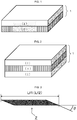
- Our fiber-reinforced resin forming material comprises a laminate of component (I) and component (II) as shown in Fig. 1 . It is possible that component (I) is integrated with component (II). Component (I) and component (II) comprise a reinforcing fiber and resin.
- a surface layer of the laminate of component (I) and component (II) consists of component (I). It is preferable that an inner layer of the laminate consists of component (II), as shown in Fig. 2 with the laminate configuration of [component (I) / component (II) / component (I)].
- the laminate comprises one or more of each component. It is preferable that proportion of components (II) in the total layers of the fiber-reinforced resin forming material is 50% or more. It is more preferably 60% or more and is further preferably 75% or more. It is preferably 95% or less. It is more preferably 90% or less and is further preferably 85% or less. The proportion in such a range can enhance mechanical characteristics and fluidity.
- fiber volume content Vf1 of component (I) is 15 vol% or more. It is more preferably 25 vol% or more and is further preferably 35 vol% or more. The content in such a range can enhance mechanical characteristics of the fiber-reinforced resin forming material. It is practical that fiber volume content Vf1 of component (I) is 70 vol% or less.
- fiber volume content Vf2 of component (II) is 30 vol% or less. It is more preferably 20 vol% or less and is further preferably 10 vol% or less. The content in such a range can enhance fluidity of the fiber-reinforced resin forming material. It is practical that fiber volume content Vf2 of component (II) is 5 vol% or more.
- the fiber-reinforced resin forming material has a thickness of 1 mm or more. It is more preferably 1.5 mm or more and is further preferably 2 mm or more. The thickness in such a range can enhance mechanical characteristics and fluidity of the fiber-reinforced resin forming material. It is practical that the fiber-reinforced resin forming material has a thickness of 10 mm or less.
- reinforcing fiber bundles constituting component (I) and component (II) are dispersed randomly.
- the forming material has a ratio of the maximum to the minimum of bending elastic modulus is 2 or less. It is more preferably 1.5 or less and is further preferably 1.2 or less.
- the fiber-reinforced resin forming material can be designed, laminated and stored, freely without concern of orientation. The bending elastic modulus can be calculated as described later.
- reinforcing fiber bundles (i) contained in component (I) have average fiber number n1 of 5,000 pieces or less. It is more preferably 1,000 pieces or less and is further preferably 500 pieces or less. Such a range of fiber number can enhance mechanical characteristics of the fiber reinforced resin forming material. It is practical that reinforcing fiber bundles (i) have average fiber number n1 of 10 pieces or more. The average fiber number can be calculated as described later. It is preferable that reinforcing fiber bundles (ii) contained in component (II) have average fiber number n2 of 500 pieces or more. It is more preferably 1,000 pieces or more and is further preferably 5,000 pieces or more. Such a range of fiber number can enhance fluidity of the fiber reinforced resin forming material.
- reinforcing fiber bundles (ii) have average fiber number n2 of 50,000 pieces or less. It is preferable that the fiber bundle is preliminarily bundled.
- the fiber bundle may be preliminarily bundled by interlacing single yarns constituting the fiber bundle, by adding sizing agent to the fiber bundle or by twisting yarns in a fiber bundle production process.
- reinforcing fiber bundles (i) and (ii) have an average fiber number per unit width of 2,000 pieces/mm or less. It is more preferably 1,500 pieces/mm or less and is further preferably 1,000 pieces/mm or less. Such a range of fiber number can improve resin impregnation into the reinforcing fiber bundle to enhance mechanical characteristics of the fiber-reinforced resin forming material. The average fiber number of more than 2,000 pieces/mm might have poor mechanical characteristics of the forming material. It is practical that the reinforcing fiber bundles have an average fiber number per unit width of 20 pieces/mm or more. The average fiber number per unit width can be calculated by dividing the average fiber number of the reinforcing fiber bundles by the average fiber bundle width. The average fiber bundle width can be calculated as described later.
- reinforcing fiber bundles (i) and (ii) have average bundle thickness t of 0.01 mm or more. It is more preferably 0.03 mm or more and is further preferably 0.05 mm or more.
- the average bundle thickness of less than 0.01 mm might have a poor fluidity of the forming material. It is preferably 0.2 mm or less, and is more preferably 0.18 mm or less and further preferably 0.16 mm or less.
- the average bundle thickness of more than 0.2 mm might have poor mechanical characteristics of the forming material.
- reinforcing fiber bundles (i) contained in component (I) have average fiber length Lf1 of 10 mm or more. It is more preferably 12 mm or more and is further preferably 15 mm or more. It is preferable that reinforcing fiber bundles (i) contained in component (I) have average fiber length Lf1 of 100 mm or less. It is more preferably 75 mm or less and is further preferably 50 mm or less. Such a range of average fiber length can enhance mechanical characteristics of the fiber-reinforced resin forming material.
- reinforcing fiber bundles (ii) contained in component (II) have average fiber length Lf2 of 3 mm or more. It is more preferably 4 mm or more and is further preferably 5 mm or more. It is preferable that reinforcing fiber bundles (ii) contained in component (II) have average fiber length Lf2 of less than 10 mm. It is more preferably less than 9 mm and is further preferably less than 8 mm. Such a range of average fiber length can enhance mechanical characteristics and fluidity of the fiber-reinforced resin forming material.
- the sizing agent may be a compound or mixture thereof having a functional group such as epoxy group, urethane group, amino group and carboxyl group although it is not limited in particular. such a compound can be used for another sizing agent added at any timing in a production process of our partially separated fiber bundle described later.
- the fiber bundle is preliminarily bundled.
- the fiber bundle may be preliminarily bundled by interlacing single yarns constituting the fiber bundle, by adding sizing agent to the fiber bundle or by twisting yarns in a fiber bundle production process.
- the reinforcing fiber is carbon fiber, glass fiber, aramid fiber or metal fiber although it is not limited in particular. Above all, the carbon fiber is preferable. From a viewpoint of weight saving of fiber-reinforced resin, a carbon fiber such as polyacrylonitrile (PAN)-based carbon fiber, pitch-based carbon fiber and rayon-based carbon fiber or a mixture thereof is preferably used although the carbon fiber is not limited in particular. Above all, it is further preferable to employ the PAN-based carbon fiber from a viewpoint of balance between strength and elastic modulus of the fiber-reinforced resin.
- PAN polyacrylonitrile
- the reinforcing fiber has a single yarn diameter of 0.5 ⁇ m or more. It is more preferably 2 ⁇ m or more and is further preferably 4 ⁇ m or more. It is preferable that the reinforcing fiber has a single yarn diameter of 20 ⁇ m or less. It is more preferably 15 ⁇ m or less and is further preferably 10 ⁇ m or less. It is preferable that the reinforcing fiber has a strand strength of 3.0 GPa or more. It is more preferably 4.0 GPa or more and is further preferably 4.5 GPa or more. It is preferable that the reinforcing fiber has a strand elastic modulus of 200 GPa or more. It is more preferably 220 GPa or more and is further preferably 240 GPa or more. Such a range of the strength and elastic modulus of the reinforcing fiber strand can enhance mechanical characteristics of the fiber-reinforced resin forming material.
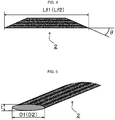
- the reinforcing fiber bundle constituting a random mat shown in Fig. 3 or 4 has cutting angle ⁇ of 3° or more. It is more preferably 4° or more and is further preferably 5° or more. Such a range of cutting angle can stably cut fiber bundles. It is preferably 30° or less. It is more preferably 25° or less and is further preferably 15° or less. Such a range of cutting angle can achieve a good fluidity at the time of forming and excellent mechanical characteristics of the shaped product. Besides, ⁇ should be expressed in absolute value.
- thermosetting resin is epoxy resin, vinyl ester resin, phenolic resin, thermosetting polyimide resin, polyurethane resin, urea resin, melamine resin or bismaleimide resin. It is possible to use a single epoxy resin, or alternatively a copolymer of epoxy resin and another thermosetting resin, a modified or blended resin thereof.
- thermoplastic resin is polypropylene resin, polyethylene resin, polycarbonate resin, polyamide resin, polyester resin, polyarylene sulfide resin, polyphenylene sulfide resin, polyether ketone, polyetheretherketone resin, polyether ketone ketone resin, polyether sulfone resin, polyimide resin, polyamide-imide resin, polyetherimide resin or polysulfone resin. It is possible to use a cyclic oligomer as a precursor of these resins. For the purpose of giving flexibility to resin, an additive may be contained.
- a fiber-reinforced resin forming material is heated for an hour in an electric furnace under nitrogen atmosphere (oxygen level of 1% or less) heated to 500°C to burn out organic substances such as matrix resin, and then the fiber mat is taken out. Forty fiber bundles are picked up from the obtained fiber mat to average the longest fiber lengths in the longitudinal direction of each fiber bundle.
- a fiber-reinforced resin forming material is heated for an hour in an electric furnace under nitrogen atmosphere (oxygen level of 1% or less) heated to 500°C to burn out organic substances such as matrix resin, and then the fiber mat is taken out. Forty fiber bundles are picked up from the obtained fiber mat to average the thickest fiber thicknesses in a direction orthogonal to the bundle width shown in Fig. 5 .
- a fiber-reinforced resin forming material is heated for an hour in an electric furnace under nitrogen atmosphere (oxygen level of 1% or less) heated to 500°C to burn out organic substances such as matrix resin, and then the fiber mat is taken out. Forty fiber bundles are picked up from the obtained fiber mat to average the widest fiber widths in a direction orthogonal to the bundle width shown in Fig. 5 .
- Reinforcing fiber bundles of approximately 2g are taken out to measure weight Wf0.
- the sample is heated for 20 minutes in an electric furnace under nitrogen atmosphere (oxygen level of 1% or less) heated to 500°C to burn out the sizing agent.
- Weight Wf1 of residual carbon fiber cooled down to room temperature is measured to calculate sizing adhesion amount X by the following formula.
- X % Wf 0 ⁇ Wf 1 / Wf 0 ⁇ 100
- Reinforcing fiber bundles of approximately 2g are taken out to measure weight Wc0.
- the sample is heated for an hour in an electric furnace under nitrogen atmosphere (oxygen level of 1% or less) heated to 500°C to burn out organic substances such as matrix resin.
- Weight Wc1 of residual carbon fiber cooled down to room temperature is measured to calculate fiber volume contents by the following formula.
- Vf 1 , Vf 2 vol % Wc 1 / ⁇ f / Wc 1 / ⁇ f + Wc 0 ⁇ Wc 1 / ⁇ r ⁇ 100
- the bending strength of the fiber-reinforced resin forming material is measured according to JIS K7074 (1988).
- the bending strength of less than 200 MPa is evaluated as C.
- That of 200 MPa and more and less than 350 MPa is evaluated as B while that of 350 MPa or more is evaluated as A.
- the tensile strength of the fiber-reinforced resin forming material is measured according to JIS K7164 (2005).
- the tensile strength of less than 150 MPa is evaluated as C.
- That of 150 MPa and more and less than 300 MPa is evaluated as B while that of 300 MPa or more is evaluated as A.
- Fluidity R of the fiber-reinforced resin forming material is measured according to the following procedure.
- Fiber-reinforced resin forming material is cut into sheets of 100mm x 100mm to be stacked so that the thickness is 4mm.
- the fiber-reinforced resin forming material preheated at a predetermined temperature with an IR heater is pressurized at 20MPa for 30sec while being placed in a pressing machine heated to a predetermined temperature.
- Surface area S2 [mm 2 ] of shaped product and surface area S1 [mm 2 ] of fiber-reinforced resin forming material before being pressed are measured to calculate fluidity [%] by the formula of S2/S1 x 100.
- the fluidity of less than 200% is evaluated as C. That of 200% or more and less than 300% is evaluated as B while that of 300% or more is evaluated as A.
- Continuous carbon fiber bundle (“PX35” (registered trademark) made by ZOLTEK Corporation) having fiber diameter of 7.2 ⁇ m, tensile elastic modulus of 240GPa and single yarns of 50,000 is used.
- Reactive urethane resin emulsion (“SUPERFLEX (registered trademark) R5000" DKS Co., Ltd.) is used.
- a sheet is prepared by using polyamide master batch made of polyamide 6 resin ("Amilan” (registered trademark) CM1001 made by Toray Industries, Inc.).
- a sheet is prepared by using polypropylene master batch consisting of 90 mass% of native polypropylene resin ("Prime Polypro” (registered trademark) J106MG made by Prime Polymer Co., Ltd.) and 10 mass% of acid-modified polypropylene resin ("ADMER” (registered trademark) QE800 made by Mitsui Chemicals, Inc.).
- Primary Polypro registered trademark
- ADMER acid-modified polypropylene resin
- the fiber bundle is wound off with a winder at constant speed of 10m/min through a vibration widening roll vibrating along the axis direction at 10Hz to be subjected to a widening process, so that a widened fiber bundle having width of 60mm is prepared through a width restriction roll of 60mm width.
- the obtained widened fiber bundle is continuously immersed in sizing solution of the sizing agent diluted with pure water to coat the widened fiber bundle with the sizing agent. Then the widened fiber bundle coated with the sizing agent is dried to remove moisture with a hot roller at 150°C and a drying furnace at 200°C. Adhesion amount of sizing agent of such obtained sizing agent-added widened fiber bundle is calculated as 3.2% according to the above-described measurement method. Besides, the sizing adhesion amount is a total adhesion amount including the sizing agent initially added to the fiber bundle.
- the widened fiber bundle is immersed in the sizing solution while the tension applied to the fiber bundle is being adjusted in case the width of widened fiber bundle is shrunk by surface tension.
- a fiber separation means is provided with fiber separation plates made of iron, having a shape of projection of 0.2mm thickness, 3mm width and 20mm height, equally-spaced by 3.5mm interval in parallel with the width direction of reinforcing fiber bundle.
- the fiber separation means is intermittently stabbed in and taken off the widened fiber bundle to prepare a partially separated fiber bundle.
- the fiber separation means is stabbed to the widened fiber bundle running at constant speed of 10m/min for 3 seconds to generate a separated fiber section and is taken off for 0.2 seconds, and then is stabbed thereto again and again.
- the obtained partially separated fiber bundle includes separated fiber sections and accumulated interlaced sections, the separated fiber section having a fiber bundle separated in the width direction to contain target average number of fibers, the accumulated interlaced section being formed at an end of at least one separated fiber section. Then the partially separated fiber bundle is continuously inserted into a rotary cutter to chop the fiber bundle into target fiber length so that a discontinuous fiber nonwoven fabric with isotropic fiber orientation is obtained by uniformly dispersing the fiber bundle.
- the discontinuous fiber nonwoven fabric is sandwiched vertically by resin sheets to impregnate the nonwoven fabric with resin by a pressing machine to prepare a sheet-like fiber-reinforced resin forming material.
- the above-described production process was performed to prepare a component (30% of fiber volume content, 1mm thickness) of fiber-reinforced resin forming material consisting of resin sheet 1 and discontinuous fiber nonwoven fabric having 98 pieces of average fiber number of reinforcing fiber bundle, 511 pieces/mm of average fiber number per unit width, 12mm of fiber length and 30° of cutting angle as shown in Table 1.
- the above-described production process was performed to prepare a component (30% of fiber volume content, 1mm thickness) of fiber-reinforced resin forming material consisting of resin sheet 1 and discontinuous fiber nonwoven fabric having 515 pieces of average fiber number of reinforcing fiber bundle, 1,030 pieces/mm of average fiber number per unit width, 12mm of fiber length and 30° of cutting angle as shown in Table 1.
- the above-described production process was performed to prepare a component (30% of fiber volume content, 1mm thickness) of fiber-reinforced resin forming material consisting of resin sheet 1 and discontinuous fiber nonwoven fabric having 4,729 pieces of average fiber number of reinforcing fiber bundle, 1,980 pieces/mm of average fiber number per unit width, 12mm of fiber length and 20° of cutting angle as shown in Table 1.
- the above-described production process was performed to prepare a component (30% of fiber volume content, 1mm thickness) of fiber-reinforced resin forming material consisting of resin sheet 1 and discontinuous fiber nonwoven fabric having 9,822 pieces of average fiber number of reinforcing fiber bundle, 4,830 pieces/mm of average fiber number per unit width, 12mm of fiber length and 90° of cutting angle as shown in Table 1.
- the above-described production process was performed to prepare a component (30% of fiber volume content, 1mm thickness) of fiber-reinforced resin forming material consisting of resin sheet 1 and discontinuous fiber nonwoven fabric having 512 pieces of average fiber number of reinforcing fiber bundle, 1,024 pieces/mm of average fiber number per unit width, 4mm of fiber length and 20° of cutting angle as shown in Table 1.
- the above-described production process was performed to prepare a component (20% of fiber volume content, 1mm thickness) of fiber-reinforced resin forming material consisting of resin sheet 1 and discontinuous fiber nonwoven fabric having 534 pieces of average fiber number of reinforcing fiber bundle, 1,068 pieces/mm of average fiber number per unit width, 4mm of fiber length and 20° of cutting angle as shown in Table 1.
- the above-described production process was performed to prepare a component (10% of fiber volume content, 1mm thickness) of fiber-reinforced resin forming material consisting of resin sheet 1 and discontinuous fiber nonwoven fabric having 4,778 pieces of average fiber number of reinforcing fiber bundle, 1,980 pieces/mm of average fiber number per unit width, 4mm of fiber length and 10° of cutting angle as shown in Table 1.
- the above-described production process was performed to prepare a component (30% of fiber volume content, 1mm thickness) of fiber-reinforced resin forming material consisting of resin sheet 1 and discontinuous fiber nonwoven fabric having 5,022 pieces of average fiber number of reinforcing fiber bundle, 3,877 pieces/mm of average fiber number per unit width, 12mm of fiber length and 10° of cutting angle as shown in Table 1.
- the above-described production process was performed to prepare a component (15% of fiber volume content, 1mm thickness) of fiber-reinforced resin forming material consisting of resin sheet 1 and discontinuous fiber nonwoven fabric having 534 pieces of average fiber number of reinforcing fiber bundle, 1,068 pieces/mm of average fiber number per unit width, 12mm of fiber length and 90° of cutting angle as shown in Table 1.
- the above-described production process was performed to prepare a component (30% of fiber volume content, 1mm thickness) of fiber-reinforced resin forming material consisting of resin sheet 1 and discontinuous fiber nonwoven fabric having 5,346 pieces of average fiber number of reinforcing fiber bundle, 1,912 pieces/mm of average fiber number per unit width, 4mm of fiber length and 30° of cutting angle as shown in Table 1.
- the above-described production process was performed to prepare a component (50% of fiber volume content, 1mm thickness) of fiber-reinforced resin forming material consisting of resin sheet 1 and discontinuous fiber nonwoven fabric having 328 pieces of average fiber number of reinforcing fiber bundle, 656 pieces/mm of average fiber number per unit width, 4mm of fiber length and 30° of cutting angle as shown in Table 1.
- the above-described production process was performed to prepare a component (30% of fiber volume content, 1mm thickness) of fiber-reinforced resin forming material consisting of resin sheet 1 and discontinuous fiber nonwoven fabric having 501 pieces of average fiber number of reinforcing fiber bundle, 1,002 pieces/mm of average fiber number per unit width, 7mm of fiber length and 90° of cutting angle as shown in Table 1.
- the above-described production process was performed to prepare a component (30% of fiber volume content, 1mm thickness) of fiber-reinforced resin forming material consisting of resin sheet 1 and discontinuous fiber nonwoven fabric having 510 pieces of average fiber number of reinforcing fiber bundle, 1,020 pieces/mm of average fiber number per unit width, 25mm of fiber length and 90° of cutting angle as shown in Table 1.
- the above-described production process was performed to prepare a component (30% of fiber volume content, 1mm thickness) of fiber-reinforced resin forming material consisting of resin sheet 1 and discontinuous fiber nonwoven fabric having 497 pieces of average fiber number of reinforcing fiber bundle, 994 pieces/mm of average fiber number per unit width, 100mm of fiber length and 20° of cutting angle as shown in Table 1.
- the above-described production process was performed to prepare a component (10% of fiber volume content, 1mm thickness) of fiber-reinforced resin forming material consisting of resin sheet 1 and discontinuous fiber nonwoven fabric having 5,012 pieces of average fiber number of reinforcing fiber bundle, 4,988 pieces/mm of average fiber number per unit width, 1mm of fiber length and 20° of cutting angle as shown in Table 1.
- the above-described production process was performed to prepare a component (10% of fiber volume content, 1mm thickness) of fiber-reinforced resin forming material consisting of resin sheet 1 and discontinuous fiber nonwoven fabric having 5,110 pieces of average fiber number of reinforcing fiber bundle, 1,899 pieces/mm of average fiber number per unit width, 9mm of fiber length and 20° of cutting angle as shown in Table 1.
- the above-described production process was performed to prepare a component (30% of fiber volume content, 1mm thickness) of fiber-reinforced resin forming material consisting of resin sheet 1 and discontinuous fiber nonwoven fabric having 5,116 pieces of average fiber number of reinforcing fiber bundle, 4,133 pieces/mm of average fiber number per unit width, 30mm of fiber length and 20° of cutting angle as shown in Table 1.
- the above-described production process was performed to prepare a component (30% of fiber volume content, 1mm thickness) of fiber-reinforced resin forming material consisting of resin sheet 1 and discontinuous fiber nonwoven fabric having 612 pieces of average fiber number of reinforcing fiber bundle, 1,224 pieces/mm of average fiber number per unit width, 12mm of fiber length and 20° of cutting angle as shown in Table 1.
- the above-described production process was performed to prepare a component (10% of fiber volume content, 1mm thickness) of fiber-reinforced resin forming material consisting of resin sheet 1 and discontinuous fiber nonwoven fabric having 4,988 pieces of average fiber number of reinforcing fiber bundle, 1,733 pieces/mm of average fiber number per unit width, 4mm of fiber length and 20° of cutting angle as shown in Table 1.
- Component (I) of Reference example 1 and component (II) of Reference example 7 were laminated to produce a fiber-reinforced resin forming material having laminate configuration of [(I)/(II)3/(I)].
- the obtained fiber-reinforced resin forming material preheated at 280°C was shaped to have 5mm of thickness with a pressing machine.
- Table 2 shows bending characteristics and fluidity of the obtained shaped product.
- Component (I) of Reference example 2 and component (II) of Reference example 6 were laminated to produce a fiber-reinforced resin forming material having laminate configuration of [(I)/(II)3/(I)].
- the obtained fiber-reinforced resin forming material preheated at 280°C was shaped to have 5mm of thickness with a pressing machine.
- Table 2 shows bending characteristics and fluidity of the obtained shaped product.
- Component (I) of Reference example 2 and component (II) of Reference example 10 were laminated to produce a fiber-reinforced resin forming material having laminate configuration of [(I)/(II)3/(I)].
- the obtained fiber-reinforced resin forming material preheated at 280°C was shaped to have 5mm of thickness with a pressing machine.
- Table 2 shows bending characteristics and fluidity of the obtained shaped product.
- Component (I) of Reference example 2 and component (II) of Reference example 16 were laminated to produce a fiber-reinforced resin forming material having laminate configuration of [(I)/(II)5/(I)].
- the obtained fiber-reinforced resin forming material preheated at 280°C was shaped to have 7mm of thickness with a pressing machine.
- Table 2 shows bending characteristics and fluidity of the obtained shaped product.
- Component (I) of Reference example 2 and component (II) of Reference example 7 were laminated to produce a fiber-reinforced resin forming material having laminate configuration of [(I)2/(II)8/(I)2].
- the obtained fiber-reinforced resin forming material preheated at 280°C was shaped to have 12mm of thickness with a pressing machine. Table 2 shows bending characteristics and fluidity of the obtained shaped product.
- Component (I) of Reference example 3 and component (II) of Reference example 7 were laminated to produce a fiber-reinforced resin forming material having laminate configuration of [(I)/(II)3/(I)].
- the obtained fiber-reinforced resin forming material preheated at 280°C was shaped to have 5mm of thickness with a pressing machine.
- Table 2 shows bending characteristics and fluidity of the obtained shaped product.
- Component (I) of Reference example 9 and component (II) of Reference example 7 were laminated to produce a fiber-reinforced resin forming material having laminate configuration of [(I)/(II)5/(I)].
- the obtained fiber-reinforced resin forming material preheated at 280°C was shaped to have 7mm of thickness with a pressing machine.
- Table 2 shows bending characteristics and fluidity of the obtained shaped product.
- Component (I) of Reference example 14 and component (II) of Reference example 7 were laminated to produce a fiber-reinforced resin forming material having laminate configuration of [(I)/(II)5/(I)].
- the obtained fiber-reinforced resin forming material preheated at 280°C was shaped to have 7mm of thickness with a pressing machine.
- Table 2 shows bending characteristics and fluidity of the obtained shaped product.
- Component (I) of Reference example 18 and component (II) of Reference example 19 were laminated to produce a fiber-reinforced resin forming material having laminate configuration of [(I)/(II)5/(I)].
- the obtained fiber-reinforced resin forming material preheated at 210°C was shaped to have 7mm of thickness with a pressing machine.
- Table 2 shows bending characteristics and fluidity of the obtained shaped product.
- Component (I) of Reference example 2 and component (II) of Reference example 5 were laminated to produce a fiber-reinforced resin forming material having laminate configuration of [(I)/(II)5/(I)].
- the obtained fiber-reinforced resin forming material preheated at 280°C was shaped to have 7mm of thickness with a pressing machine.
- Table 2 shows bending characteristics and fluidity of the obtained shaped product.
- Component (I) of Reference example 2 and component (II) of Reference example 11 were laminated to produce a fiber-reinforced resin forming material having laminate configuration of [(I)/(II)3/(I)].
- the obtained fiber-reinforced resin forming material preheated at 280°C was shaped to have 5mm of thickness with a pressing machine.
- Table 2 shows bending characteristics and fluidity of the obtained shaped product.
- Component (I) of Reference example 2 was laminated to produce a fiber-reinforced resin forming material having laminate configuration of [(I)2].
- the obtained fiber-reinforced resin forming material preheated at 280°C was shaped to have 2mm of thickness with a pressing machine. Table 2 shows bending characteristics and fluidity of the obtained shaped product.
- Component (I) of Reference example 8 and component (II) of Reference example 7 were laminated to produce a fiber-reinforced resin forming material having laminate configuration of [(I)/(II)3/(I)].
- the obtained fiber-reinforced resin forming material preheated at 280°C was shaped to have 5mm of thickness with a pressing machine.
- Table 2 shows bending characteristics and fluidity of the obtained shaped product.
- Component (II) of Reference example 7 was laminated to produce a fiber-reinforced resin forming material having laminate configuration of [(II)2].
- the obtained fiber-reinforced resin forming material preheated at 280°C was shaped to have 2mm of thickness with a pressing machine.
- Table 2 shows bending characteristics and fluidity of the obtained shaped product.
- Component (I) of Reference example 2 and component (II) of Reference example 15 were laminated to produce a fiber-reinforced resin forming material having laminate configuration of [(I)/(II)5/(I)].
- the obtained fiber-reinforced resin forming material preheated at 280°C was shaped to have 7mm of thickness with a pressing machine.
- Table 2 shows bending characteristics and fluidity of the obtained shaped product.
- Component (I) of Reference example 13 and component (II) of Reference example 15 were laminated to produce a fiber-reinforced resin forming material having laminate configuration of [(I)/(II)5/(I)].
- the obtained fiber-reinforced resin forming material preheated at 280°C was shaped to have 7mm of thickness with a pressing machine.
- Table 2 shows bending characteristics and fluidity of the obtained shaped product.
- Component (I) of Reference example 12 and component (II) of Reference example 7 were laminated to produce a fiber-reinforced resin forming material having laminate configuration of [(I)/(II)3/(I)].
- the obtained fiber-reinforced resin forming material preheated at 280°C was shaped to have 5mm of thickness with a pressing machine.
- Table 2 shows bending characteristics and fluidity of the obtained shaped product.
- Component (I) of Reference example 2 and component (II) of Reference example 17 were laminated to produce a fiber-reinforced resin forming material having laminate configuration of [(I)/(II)5/(I)].
- the obtained fiber-reinforced resin forming material preheated at 280°C was shaped to have 7mm of thickness with a pressing machine.
- Table 2 shows bending characteristics and fluidity of the obtained shaped product.
- Component (I) of Reference example 4 and component (II) of Reference example 7 were laminated to produce a fiber-reinforced resin forming material having laminate configuration of [(I)/(II)3/(I)].
- the obtained fiber-reinforced resin forming material preheated at 280°C was shaped to have 5mm of thickness with a pressing machine.
- Table 2 shows bending characteristics and fluidity of the obtained shaped product.
- Our fiber-reinforced resin forming material can be used suitably for automotive interior and exterior, electric and electronic device housing, bicycle, plane interior material, box for transportation or the like.
Landscapes
- Engineering & Computer Science (AREA)
- Chemical & Material Sciences (AREA)
- Composite Materials (AREA)
- Mechanical Engineering (AREA)
- Textile Engineering (AREA)
- Reinforced Plastic Materials (AREA)
- Laminated Bodies (AREA)
Applications Claiming Priority (2)
| Application Number | Priority Date | Filing Date | Title |
|---|---|---|---|
| JP2017017699 | 2017-02-02 | ||
| PCT/JP2018/002402 WO2018143068A1 (fr) | 2017-02-02 | 2018-01-26 | Matériau de moulage à base de résine renforcée par des fibres |
Publications (2)
| Publication Number | Publication Date |
|---|---|
| EP3578329A1 true EP3578329A1 (fr) | 2019-12-11 |
| EP3578329A4 EP3578329A4 (fr) | 2020-04-08 |
Family
ID=63040656
Family Applications (1)
| Application Number | Title | Priority Date | Filing Date |
|---|---|---|---|
| EP18748379.7A Withdrawn EP3578329A4 (fr) | 2017-02-02 | 2018-01-26 | Matériau de moulage à base de résine renforcée par des fibres |
Country Status (7)
| Country | Link |
|---|---|
| US (1) | US20200346441A1 (fr) |
| EP (1) | EP3578329A4 (fr) |
| JP (1) | JP6958541B2 (fr) |
| KR (1) | KR20190107676A (fr) |
| CN (1) | CN110234481B (fr) |
| TW (1) | TW201834837A (fr) |
| WO (1) | WO2018143068A1 (fr) |
Cited By (1)
| Publication number | Priority date | Publication date | Assignee | Title |
|---|---|---|---|---|
| US11794419B2 (en) | 2019-03-27 | 2023-10-24 | Toray Industries, Inc. | Fiber-reinforced resin molding material molded product and method of producing same |
Families Citing this family (7)
| Publication number | Priority date | Publication date | Assignee | Title |
|---|---|---|---|---|
| WO2018170084A1 (fr) | 2017-03-16 | 2018-09-20 | Guerrilla Industries LLC | Structures composites et procédés de formation de structures composites |
| CA3056458C (fr) * | 2018-09-21 | 2026-04-07 | Bauer Hockey Ltd. | Baton de hockey forme a partir d'un melange a mouler en feuille |
| US11746200B2 (en) | 2018-09-28 | 2023-09-05 | Toray Industries, Inc. | Fiber-reinforced resin molding material and molded article |
| JP7363482B2 (ja) * | 2018-10-24 | 2023-10-18 | 東レ株式会社 | 繊維強化樹脂成形材料及び成形品の製造方法 |
| JPWO2020090877A1 (ja) * | 2018-10-31 | 2021-09-16 | 東レ株式会社 | 繊維強化樹脂成形材料およびその成形品 |
| AU2021285609A1 (en) * | 2020-06-01 | 2022-12-15 | Toray Industries, Inc. | Molded article and method for producing same |
| EP4304841B1 (fr) | 2021-03-09 | 2026-04-22 | Astro Tech Co., Ltd. | Structures composites et procédés de formation de structures composites |
Family Cites Families (16)
| Publication number | Priority date | Publication date | Assignee | Title |
|---|---|---|---|---|
| NZ204415A (en) | 1982-06-02 | 1985-08-16 | Efco Mfg | Automatic door operating device with two electric motors |
| JPH059301A (ja) * | 1990-12-17 | 1993-01-19 | Nippon Steel Corp | スタンピング成形材料およびスタンピング成形品 |
| JP3273968B2 (ja) | 1992-07-29 | 2002-04-15 | ユニプレス株式会社 | 強化スタンパブルシートの製造方法 |
| JP2000141502A (ja) | 1998-09-10 | 2000-05-23 | Asahi Fiber Glass Co Ltd | 長繊維強化熱可塑性樹脂シ―トの製造方法及び長繊維強化熱可塑性樹脂シ―ト |
| JP3675380B2 (ja) | 2001-09-11 | 2005-07-27 | 日本ジーエムティー 株式会社 | ガラス繊維強化スタンパブルシート用ガラス繊維複合マット及びその製造方法、ガラス繊維強化スタンパブルシート及びその製造方法並びに成形品 |
| CN101407637B (zh) * | 2008-11-21 | 2011-07-27 | 华东理工大学 | 一类纤维增强复合材料及其制备方法 |
| JP6075094B2 (ja) * | 2012-02-07 | 2017-02-08 | 東レ株式会社 | リブ構造を有する成形品の製造方法 |
| JP5994737B2 (ja) | 2012-06-26 | 2016-09-21 | 東レ株式会社 | プレス成形用中間基材、プリフォーム、および成形品の製造方法 |
| EP2940065B1 (fr) * | 2012-12-26 | 2021-06-16 | Toray Industries, Inc. | Feuille de résine renforcée par des fibres, produit moulé unifié et procédé de production associé |
| KR101678350B1 (ko) * | 2013-12-03 | 2016-11-21 | 미쯔비시 레이온 가부시끼가이샤 | 섬유 강화 수지 적층체 |
| JP5843048B1 (ja) * | 2014-01-17 | 2016-01-13 | 東レ株式会社 | スタンパブルシート |
| JP5985085B2 (ja) | 2014-01-31 | 2016-09-06 | 帝人株式会社 | 多層構造の成形材料及び多層構造の成形体 |
| EP3112110B1 (fr) * | 2014-02-14 | 2018-04-25 | Teijin Limited | Matériau de moulage renforcé par des fibres de carbone et produit mis en forme |
| EP3263332B1 (fr) * | 2015-02-27 | 2022-06-08 | Toray Industries, Inc. | Matériau de fourniture de résine, préforme, et procédé de fabrication de résine renforcée par des fibres |
| JP6627266B2 (ja) * | 2015-06-09 | 2020-01-08 | 三菱ケミカル株式会社 | 強化繊維複合積層体 |
| JP6776735B2 (ja) * | 2016-08-31 | 2020-10-28 | 王子ホールディングス株式会社 | 繊維強化熱可塑性プラスチック作製用プレシートの製造方法 |
-
2018
- 2018-01-26 WO PCT/JP2018/002402 patent/WO2018143068A1/fr not_active Ceased
- 2018-01-26 EP EP18748379.7A patent/EP3578329A4/fr not_active Withdrawn
- 2018-01-26 US US16/479,042 patent/US20200346441A1/en not_active Abandoned
- 2018-01-26 CN CN201880009307.4A patent/CN110234481B/zh active Active
- 2018-01-26 KR KR1020197021226A patent/KR20190107676A/ko not_active Withdrawn
- 2018-01-26 JP JP2018504804A patent/JP6958541B2/ja active Active
- 2018-01-30 TW TW107103171A patent/TW201834837A/zh unknown
Cited By (1)
| Publication number | Priority date | Publication date | Assignee | Title |
|---|---|---|---|---|
| US11794419B2 (en) | 2019-03-27 | 2023-10-24 | Toray Industries, Inc. | Fiber-reinforced resin molding material molded product and method of producing same |
Also Published As
| Publication number | Publication date |
|---|---|
| CN110234481B (zh) | 2021-03-09 |
| JP6958541B2 (ja) | 2021-11-02 |
| JPWO2018143068A1 (ja) | 2019-11-21 |
| US20200346441A1 (en) | 2020-11-05 |
| KR20190107676A (ko) | 2019-09-20 |
| CN110234481A (zh) | 2019-09-13 |
| TW201834837A (zh) | 2018-10-01 |
| WO2018143068A1 (fr) | 2018-08-09 |
| EP3578329A4 (fr) | 2020-04-08 |
Similar Documents
| Publication | Publication Date | Title |
|---|---|---|
| EP3578329A1 (fr) | Matériau de moulage à base de résine renforcée par des fibres | |
| KR100944032B1 (ko) | 등방성의 섬유강화 열가소성 수지 시트와 그 제조 방법 및성형판 | |
| EP2679619B1 (fr) | Matériau composite renforcé par des fibres | |
| EP3088448A1 (fr) | Préforme, matériau en feuille et matériau en feuille intégré | |
| EP3744768B1 (fr) | Mat de fibres de renforcement, et matériau de moulage de résine renforcé par des fibres et procédé de production associé | |
| EP3513963B1 (fr) | Matériau de base stratifié, et procédé de fabrication de celui-ci | |
| JP2018507801A (ja) | 一方向繊維強化テープを作製するための方法 | |
| EP3102723B1 (fr) | Gaine et fil d'âme pour un composite thermoplastique | |
| KR102784929B1 (ko) | 불연속 섬유 강화 복합 재료 | |
| US12570809B2 (en) | Unidirectional prepreg, fiber-reinforced thermoplastic resin sheet, manufacturing methods of unidirectional prepreg and fiber-reinforced thermoplastic resin sheet, and molded body | |
| KR102784922B1 (ko) | 불연속 섬유 강화 복합 재료 | |
| TW201442862A (zh) | 碳纖維強化熱可塑性樹脂複合材料、使用其的成型體、以及電子設備框體用構件 | |
| EP3744493A1 (fr) | Matériau de base de faisceau de fibres de renforcement, son procédé de production, matériau de résine thermoplastique renforcé de fibres utilisant ledit matériau de base de faisceau de fibres de renforcement, et son procédé de production | |
| Sharba et al. | Effects of processing method, moisture content, and resin system on physical and mechanical properties of woven kenaf plant fiber composites | |
| EP3733398A1 (fr) | Matériau de moulage de résine thermoplastique renforcée par des fibres | |
| JP2018062641A5 (fr) | ||
| CN112955294A (zh) | 纤维增强树脂成型材料及其成型品 | |
| JP2022029523A (ja) | Cf-smcおよびcf-smcの製造方法 | |
| EP3252093A1 (fr) | Matériau composite à fibres de renforcement | |
| EP3597388B1 (fr) | Matériau, procédé de fabrication de matériau, matériau partiellement soudé, matériau composite et procédé de fabrication d'article moulé | |
| EP4317564A1 (fr) | Feuille de non-tissé de fibres de carbone, procédé de production de celle-ci, et corps moulé en résine renforcée de fibres de carbone utilisant celle-ci | |
| JPH02308824A (ja) | 熱可塑性コンポジット用材料 | |
| EP3744884B1 (fr) | Faisceau de fibres de renforcement | |
| EP4005788A1 (fr) | Procédé de production de produit formé et matériau composite | |
| JP6458589B2 (ja) | シート材料、一体化成形品および一体化成形品の製造方法 |
Legal Events
| Date | Code | Title | Description |
|---|---|---|---|
| PUAI | Public reference made under article 153(3) epc to a published international application that has entered the european phase |
Free format text: ORIGINAL CODE: 0009012 |
|
| 17P | Request for examination filed |
Effective date: 20190730 |
|
| AK | Designated contracting states |
Kind code of ref document: A1 Designated state(s): AL AT BE BG CH CY CZ DE DK EE ES FI FR GB GR HR HU IE IS IT LI LT LU LV MC MK MT NL NO PL PT RO RS SE SI SK SM TR |
|
| AX | Request for extension of the european patent |
Extension state: BA ME |
|
| A4 | Supplementary search report drawn up and despatched |
Effective date: 20200305 |
|
| RIC1 | Information provided on ipc code assigned before grant |
Ipc: B29B 11/16 20060101AFI20200228BHEP Ipc: B29K 101/12 20060101ALI20200228BHEP Ipc: B29C 70/08 20060101ALI20200228BHEP Ipc: B29C 70/10 20060101ALI20200228BHEP |
|
| DAV | Request for validation of the european patent (deleted) | ||
| DAX | Request for extension of the european patent (deleted) | ||
| GRAP | Despatch of communication of intention to grant a patent |
Free format text: ORIGINAL CODE: EPIDOSNIGR1 |
|
| STAA | Information on the status of an ep patent application or granted ep patent |
Free format text: STATUS: GRANT OF PATENT IS INTENDED |
|
| INTG | Intention to grant announced |
Effective date: 20200722 |
|
| 18D | Application deemed to be withdrawn |
Effective date: 20201202 |